



Abstract
While seminal work on dynamic capabilities highlights path-dependent trajectories as an important and distinguishing property, recent studies tend to marginalize this feature in favor of an ahistorical and unbound conceptualization. Following the recent “history turn” in strategy and organization research, we examine the essential yet inadequately understood role of path dependence in dynamic capability building and adaptation. Precisely, we demonstrate that dynamic capabilities, as pattern-based, learned, and context-specific entities, are prone to become path-dependent under the effect of self-reinforcing mechanisms. We further show that in the face of discontinuous environmental shifts, path-dependent dynamic capabilities can—paradoxically enough—turn dysfunctional as they perpetuate current, potentially outdated ways through which a firm reconfigures its resource base. Based on this analysis, we identify ad hoc managerial action as the basis for path transformation and path dissolution, as well as path switching and new path creation, which represent complementary ways to deal with path-dependent dynamic capabilities. Our theorizing extends a contingency perspective on dynamic capabilities by shedding light on the limits and potential alternatives of pattern-based adaptation.
Keywords
Introduction
Understanding the dynamics of organizational adaptation represents a major challenge for strategic organization scholars and practitioners alike. Over the last two decades, the dynamic capabilities perspective has emerged as the dominant approach to explain how firms can continuously adapt to changing external circumstances (e.g. Giudici and Reinmöller, 2012; Helfat and Peteraf, 2009; Hilliard and Goldstein, 2019; MacLean et al., 2015; see Schilke et al., 2018 for a comprehensive review). Dynamic capabilities are considered as learned and pattern-based organizational processes that enable firms to purposefully renew their resource base so as to achieve congruence with a dynamically evolving environment (Eisenhardt and Martin, 2000; Helfat and Peteraf, 2009; Teece, 2007; Teece et al., 1997; Winter, 2003).
Numerous studies have corroborated the strategic significance of dynamic capabilities by showing how long-established organizations develop and use specific processes, such as new product development, outlet proliferation, or alliance management (Helfat et al., 2007; Schilke, 2014a), to create, extend, or modify their resource base, and hence, successfully cope with technological and market changes (e.g. Helfat, 1997; Konlechner et al., 2018; Stadler et al., 2013; Verona and Ravasi, 2003). However, although dynamic capabilities play a major role in successful resource configuration and organizational adaptation, the success of dynamic capability-driven change endeavors cannot be taken for granted (Ambrosini and Bowman, 2009; Danneels, 2011; Zott, 2003). Time and again, formerly highly successful companies experience considerable difficulties in adapting to changing environments (Danneels et al., 2018; Rosenbloom, 2000; Tripsas and Gavetti, 2000; Vuori and Huy, 2016), often despite—or perhaps directly because of—showing a strong dynamic capability-driven change in the past. The Finnish telecommunication giant Nokia, for example—once admired for its adaptability—failed dramatically to cope with technological shifts in the cell phone business despite having widely praised R&D capabilities. Schlecker, a once-leading German drugstore chain, went bankrupt because of excessive outlet replication. Similarly, once-thriving companies such as WorldCom or Tyco used dynamic M&A capabilities to achieve rapid growth, swallowing between 60 and 200 smaller companies per year (Probst and Raisch, 2005), but nevertheless, failed in reconfiguring their resource base.
The question why some firms are able to successfully adapt while others show striking rigidity and eventually fail despite having elaborate dynamic capabilities represents an intriguing puzzle that requires refocusing on the core properties of dynamic capabilities. Notably, Teece et al. (1997) in their seminal paper conceptualize paths together with asset positions as well as organizational and managerial processes as a key property of dynamic capabilities. By “stressing organizational capacities for relentless change” (Schreyögg and Sydow, 2010: 1252), most of the dynamic capability research, however, has turned a blind eye to the fact that dynamic capabilities as routine-based resource reconfiguration patterns are prone to be subject to self-reinforcing dynamics (Sydow et al., 2009, 2020) and eventually can become path-dependent over time (Schreyögg and Kliesch-Eberl, 2007; Vergne and Durand, 2011). When confronted with discontinuous and “unfamiliar states” (Schilke, 2014a), a firm’s existing dynamic capabilities may thus not only lose their evolutionary fitness, that is, the fit to external demands (Helfat et al., 2007) but also promote maladapted resource reconfigurations. Although there is a resurgent interest in the role of history in strategic management (e.g. Argyres et al., 2020), research on how firms can cope with the dual role of dynamic capabilities as remedies, but also potential drivers of organizational rigidity remain rare (see Vergne and Durand, 2011, for a notable exception).
Against this backdrop, our conceptual article aims to contribute to a more comprehensive understanding of accomplishing organizational adaptation in discontinuous environments. We proceed in three major steps. First, we briefly summarize dynamic capabilities’ basic characteristics and elaborate on the self-reinforcing mechanisms (Dobusch and Schüssler, 2013; Sydow et al., 2009) leading to path dependence of dynamic capabilities. Second, we illustrate how discontinuous shifts in the external business environment present a significant challenge for path-dependent dynamic capabilities, turning them from a strategic asset into hard-to-reverse liabilities (Leonard-Barton, 1992). Building on this analysis, third, we elaborate on different options which firms can leverage to overcome path-dependent dynamic capabilities. Building on an analysis of ad hoc managerial action as a central means to intervene in path-dependent organizational subsystems, we illustrate two central options to address path-dependent dynamic capabilities. Path transformation involves initiatives to intervene in and thus interrupt the self-reinforcing mechanisms in such a way that the path-dependent capability can again fulfill its intended function. Path dissolution includes initiatives to retire the path-dependent dynamic capability. In addition, firms can use complementary mechanisms to bring about adaptation. These rely on other, already existing (and also potentially path-dependent) dynamic capabilities (path switching) or building new ones via directly intervening in the resource base (new path creation).
The theorizing developed in this article contributes to research on dynamic capabilities (Schilke et al., 2018) and incumbent adaptation (Eggers and Park, 2018) in three important ways. First, by addressing the striking contradiction that “dynamic capabilities are construed simultaneously as path-dependent and as a remedy to path dependence” (Vergne and Durand, 2010: 740), we follow Vergne and Durand’s (2011) call to complement “the analysis of the type of dynamic capabilities [. . .] with a careful investigation of their properties, among which path dependence plays a prominent role” (p. 376; italics in the original). Specifically, we showcase why and how dynamic capabilities such as pattern-based, learned, and context-specific organizational processes may invoke path dependence under the effect of self-reinforcing mechanisms (Sydow et al., 2009, 2020; Vergne and Durand, 2011). Second, building on research that focuses on environmental dynamism as a critical contingency factor for dynamic capabilities’ effectiveness (e.g. Schilke, 2014a), we display that in the face of discontinuous environmental shifts, dynamic capabilities’ path dependence, which creates idiosyncrasy and eases adaptation in continuously evolving environments, may ultimately turn dysfunctional. Thus, paradoxically enough, instead of bringing about successful adaptation, they generate inertia by generating maladapted resource reconfigurations under such conditions. Third, by elaborating on the distinct strategic options for breaking and eventually transforming or dissolving capability paths, we shed light on the alternative pathways of how firms can overcome the detrimental effect of path-dependent dynamic capabilities. Importantly, by emphasizing the role of ad hoc managerial action for managing dynamic capability paths within a firm, our theorizing resolves recurrent problems of dynamic capabilities’ endogenous dynamization (see, for instance, Schreyögg and Kliesch-Eberl, 2007) and the infinite regress associated solutions that focus on introducing multi-level hierarchies to revitalize a firm’s dynamic capabilities (Arend, 2015).
Why and how dynamic capabilities (can) become path-dependent
While the resource-based view mainly addresses a firm’s existing resources in more or less static business environments (Barney, 1991; Wernerfelt, 1984), the dynamic capability view—as a dynamic extension of the resource-based view (Helfat and Peteraf, 2003, 2009)—is concerned with how firms respond to changing environments by reconfiguring existing and building new resources and capabilities for sustainable competitive advantage (see, for instance, Schilke et al., 2018 for a comprehensive assessment and review). It is widely understood that dynamic capabilities—also known as second-order competencies (e.g. Danneels, 2002, 2008)—are not a generic capacity for accommodating change but involve specific and identifiable organizational processes such as new product development, chain outlet proliferation/expansion, or alliance management (e.g. Helfat et al., 2007; Helfat and Winter, 2011; Winter and Szulanski, 2001). These distinct processes allow a firm to “purposefully create, extend, or modify its resource base” (Helfat et al., 2007: 1; italics in the original) and “achieve new resource configurations as markets emerge, collide, split, evolve, and die” (Eisenhardt and Martin, 2000: 1107). Drawing upon recent clarifications of the construct (see, for instance, Peteraf et al., 2013; Vogel and Güttel, 2013; Wilden et al., 2016 for detailed bibliographic analyses), we will subsequently highlight and elucidate three key characteristics of the dynamic capabilities concept: patterned activity resulting from organizational routines, the importance of time and learning processes, and context-driven creation and use. These features make a dynamic capability, as a specific way of selecting, linking, and reconfiguring internal and external resources (see Schreyögg and Kliesch-Eberl, 2007; Teece et al., 1997), prone to be subject to self-reinforcing dynamics and eventually to become path-dependent over time.
Patterning and routines
As second- or higher-order capabilities (Helfat and Winter, 2011; Winter, 2003; Zollo and Winter, 2002), dynamic capabilities consist of and are based on organizational routines (Dosi et al., 2000; Nelson and Winter, 1982; Zollo and Winter, 2002). Routines, which are defined as habitualized, relatively stable “repetitious behavioral patterns for interdependent corporate actions” (Schilke, 2014a: 180; see also Parmigiani and Howard-Grenville, 2011), are thus generally considered as the fundamental “building blocks” of dynamic capabilities (Dosi et al., 2000; Schreyögg and Kliesch-Eberl, 2007). 1 In fact, a dynamic capability’s underlying structure resembles a set of recurring action patterns (Cohen et al., 1996) and eventually a complex bundle or cluster of interrelated routines (Kremser and Schreyögg, 2016). It is exactly this repetitive and pattern-based nature that distinguishes dynamic capabilities from one-time and ad hoc change behavior (Helfat and Peteraf, 2003; Helfat and Winter, 2011; Winter, 2003).
Temporality and learning
Conceptualized as a repeatable, patterned way of resource orchestration and collective problem-solving, it is also widely understood that dynamic capabilities are shaped by and result from organizational learning processes (e.g. Bingham et al., 2015; Zollo and Winter, 2002). Dynamic capabilities are formed through repeated use and continuous refinement (Donada et al., 2016). They are thus a time-based and historical construct by their very nature. It follows that over the course of time, a specific resource reconfiguration pattern tends to become more and more elaborated, practiced, and reliable. In fact, it is exactly this time intensive as well as complex, idiosyncratic, and causally ambiguous (Gibbons and Henderson, 2012; Konlechner and Ambrosini, 2019) accumulation process that contributes to intraindustry firm heterogeneity (Hoopes and Madsen, 2008; Noda and Collis, 2001) and eventually makes up and sustains the strategic significance of dynamic capabilities (see Dierickx and Cool, 1989; Eisenhardt and Martin, 2000; Helfat, 1994, 1997).
Commitments and context specificity
Given the fact that dynamic capabilities develop through and result from collective experience accumulation as well as deliberate learning investments (Zollo and Winter, 2002) and thus “typically involve long-term commitments to specialized resources” (Winter, 2003: 993), they are not universally applicable but context-specific (Schilke, 2014a). As such, the specific configuration of dynamic capabilities is contingent upon the particular context in which they emerged and are applied (Helfat and Winter, 2011). They build around the processing and resolution of recurring problems and thus match situations that were “previously experienced, analyzed, and understood” (Schilke, 2014a: 182). In fact, it is widely observed that the dynamic capabilities of a firm over time tend to become increasingly “tailored to the settings in which they function, including different industries, technologies, functional areas, and organizations” (Helfat et al., 2007: 7), that is, they become more and more socially embedded (Argote and Ren, 2012) and fixed to the contextual conditions in which they have proven successful.
The pattern-based nature, historicity, and mounting context specificity implies that dynamic capabilities are prone to become path-dependent over time (e.g. Bowman and Ambrosini, 2003; Helfat, 1994; Helfat and Peteraf, 2003; Schreyögg and Kliesch-Eberl, 2007; Teece et al., 1997; Vergne and Durand, 2011). Notably, Teece and colleagues (Teece and Pisano, 1994; Teece et al., 1997), who conceptualize paths alongside processes and positions as a key property of dynamic capabilities, emphasize that firms’ distinct ways of coordination and combining resources are molded by path dependencies, as a firm’s “current position is often shaped by the path it has traveled” (Teece et al., 1997: 522). At any given point in time, firms must follow a certain trajectory or path of competence development. This path not only defines what choices are open to the firm today, but it also puts boundaries around what its internal repertoire is likely to be in the future. Thus, firms, at various points in time, make long-term, quasi-irreversible commitments to certain domains of competence. (Teece et al., 1997: 515)
In addition, while Dierickx and Cool (1989) also already ascertained that firms’ choices about their domains of competence are shaped by past choices and the existing repertoire of routines, Schreyögg and Kliesch-Eberl (2007) further specified the historical nature of both operational and dynamic capabilities 2 by emphasizing that the successful combinatorial activities of (dynamic) capability building are likely to “generate positive feedback loops, thereby emergently constituting self-reinforcing processes” that ultimately “bring about path dependency in capability-based practices” (p. 916). Similarly, Vergne and Durand (2011) ascertain that dynamic capabilities “as structured patterns of routines accumulated along an organization’s unique historical trajectory” are prone to “become path-dependent under the effect of self-reinforcing mechanisms” (pp. 367–368).
Path dependence and self-reinforcing mechanisms
The notion of path dependence recognizes that “history matters” and that “[b]ygones are rarely bygones” (Teece et al., 1997: 522). In their seminal work on (technological) path dependence in economics and economic history (cf. the prominent case of the well-known QWERTY keyboard standard (Vergne, 2013)), Paul David (1985, 1994) and Brian Arthur (1989, 1994) highlight self-reinforcing feedback processes (i.e. increasing returns), such as network externalities, quasi-irreversible investments, and technical interrelatedness, as the key characteristic and main driver of path-dependent dynamics in industry and market settings (see Vergne and Durand, 2010 for conceptual clarifications, testability issues, and methodological implications of path dependence).
Sydow et al. (2009, 2020) eventually opened the black box of organizational path dependence by transferring the concept from the technical and market to the organizational sphere. The theory of organizational path dependence thereby offers a comprehensive explanation of how and why history matters in organizations. In this conception, path dependence thus means more than rigid resource allocation patterns, structural inertia, and timeworn routines (Gilbert, 2005; Hannan and Freeman, 1984); instead, it describes “processes of a diminishing scope for action that unintentionally develop their own pull and are driven by positive feedback” (Sydow et al., 2009: 698). Building on David’s and Arthur’s seminal work on technological standard setting, the authors—explicating the dynamics of how organizations and organizational action patterns can become inert—highlight four main self-reinforcing mechanisms that contribute to the development of path dependence of and in organizations: learning effects, adaptive expectation effects, coordination effects, and complementarity effects (see Dobusch and Schüssler, 2013; Schreyögg and Sydow, 2011; Sydow et al., 2009, for a comprehensive overview and discussion). Vergne and Durand (2010) furthermore describe them as a “set of mechanisms endogenous to a given path that makes it more and more dominant over time relative to alternative paths,” eventually leading to a situation “from which it is difficult to escape without the intervention of shocks exogenous to the system” (p. 755). These positive continuity-ensuring feedback mechanisms lie “at the heart of organizational path dependence” (Sydow et al., 2009: 698) and constitute “the concept’s explanatory core” (Dobusch and Schüssler, 2013: 638).
Learning effects refer to the benefits of experience accumulation that result from the repeated execution of a particular task or operation (Argote, 1999). Adaptive expectation effects, which build on the circumstance that individuals are characterized by the need to “pick the right horse” (Pierson, 2000: 254), relate to dynamic negotiation processes and the social building of preferences for certain choices. Coordination effects, which constitute the “most prominent explanation of organizational path dependence” (Sydow et al., 2020: 718), result from the advantages of rule-guided behavior. They occur “when the benefits an individual receives from a particular activity increase as others adopt the same option” (Pierson, 2000: 254). Finally, complementary effects denote synergies resulting “from the interaction of two or more separate but interrelated resources, rules, or practices” (Sydow et al., 2009: 699). In organizations, such synergies can result from the complex interplay of various interrelated elements, such as a capability’s intertwined system of activities (Porter and Siggelkow, 2008) and routines (Kremser and Schreyögg, 2016).
These self-reinforcing processes, which are partly intentionally initiated and spurred (see Garud et al., 2010; Garud and Karnøe, 2001) but to a large extent “unfold behind the backs of the actors” (Schreyögg and Sydow, 2011: 322), over time tend to stabilize a specific dynamic capability-pattern and lead to continuously refined execution and use (e.g. Helfat, 1994, 1997). Table 1 further describes the working of these mechanisms and exemplifies their potential manifestation in three well-known dynamic capabilities: new product development (resource base creation), outlet proliferation (resource base extension), and alliance management (resource base modification).
Self-reinforcing mechanisms and dynamic capabilities.
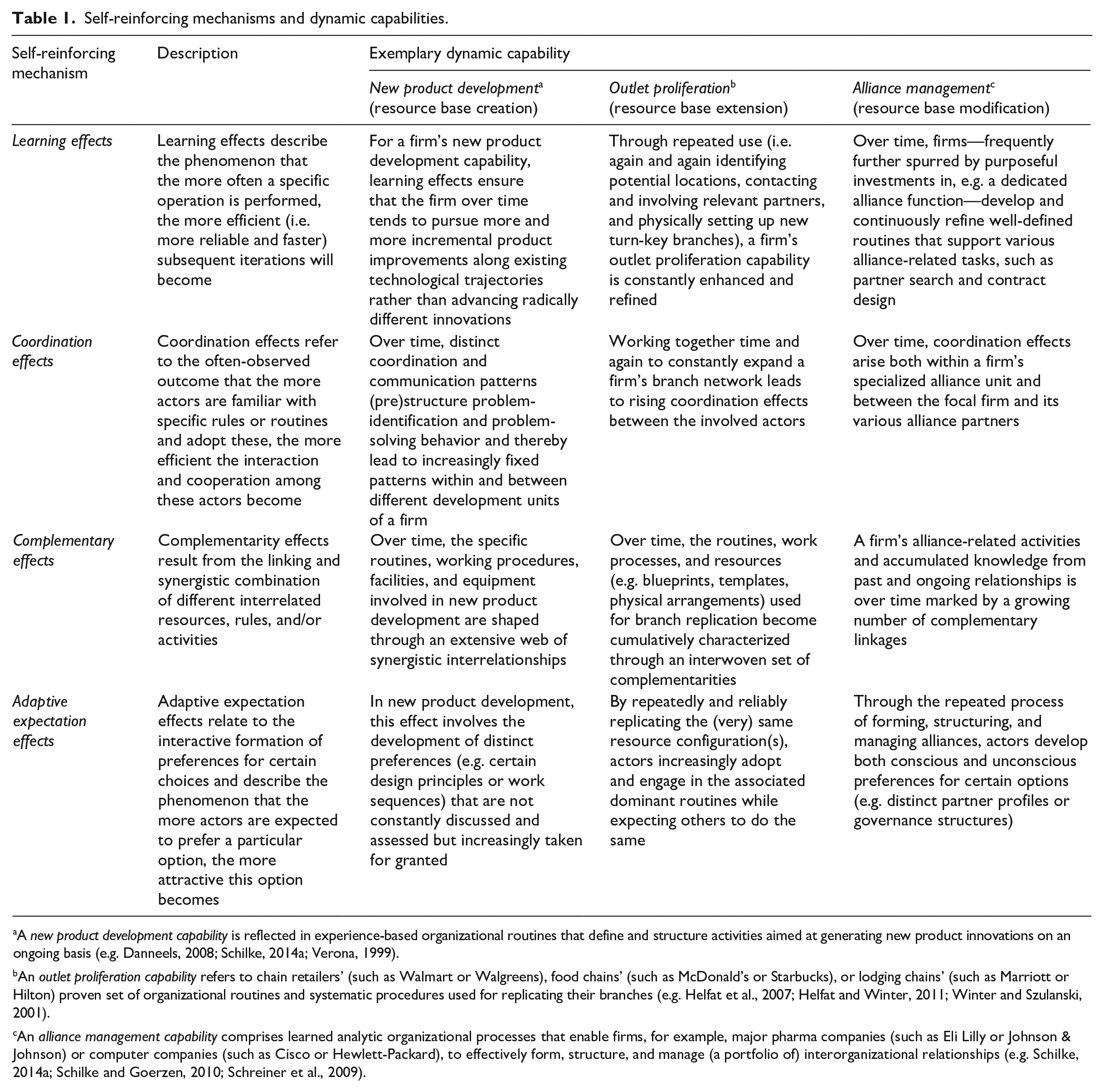
A new product development capability is reflected in experience-based organizational routines that define and structure activities aimed at generating new product innovations on an ongoing basis (e.g. Danneels, 2008; Schilke, 2014a; Verona, 1999).
An outlet proliferation capability refers to chain retailers’ (such as Walmart or Walgreens), food chains’ (such as McDonald’s or Starbucks), or lodging chains’ (such as Marriott or Hilton) proven set of organizational routines and systematic procedures used for replicating their branches (e.g. Helfat et al., 2007; Helfat and Winter, 2011; Winter and Szulanski, 2001).
An alliance management capability comprises learned analytic organizational processes that enable firms, for example, major pharma companies (such as Eli Lilly or Johnson & Johnson) or computer companies (such as Cisco or Hewlett-Packard), to effectively form, structure, and manage (a portfolio of) interorganizational relationships (e.g. Schilke, 2014a; Schilke and Goerzen, 2010; Schreiner et al., 2009).
Take, for example, a firm’s new product development capability (Danneels, 2008; Verona, 1999), which is commonly considered as one of the most important dynamic capabilities for reconfiguring a firm’s resource base (e.g. Schilke, 2014a). While there is a general tendency that firms “concentrate their R&D efforts in areas related to preexisting knowledge bases, and tend to produce new knowledge closely related to the old” (Helfat, 1994: 1722), new product development activities are also likely to be subject to self-reinforcing processes. Over the course of time, accelerated by some extraordinary (technical) achievements or accidental discovery, and the associated positive feedback, the involved actors and groups, for instance, tend to develop well-refined—frequently even formally documented—coordination procedures and interaction patterns (see Henderson and Clark, 1990; Siggelkow, 2001) and build up mutually shared and increasingly taken-for-granted beliefs and expectations about project priorities, design choices, and material preferences. Suddaby et al. (2020) thus conclude that “much of product innovation is based upon a deep knowledge of the historical grammar of the technology and extrapolating or extending that knowledge from past to future applications” (p. 546; see also Danneels, 2002; Helfat and Raubitschek, 2000).
Likewise, alliance management (Schilke and Goerzen, 2010; Schreiner et al., 2009)—another critical dynamic capability (Schilke, 2014a)—which comprises the processes how a firm forms, structures, and manages its (portfolio of) interfirm collaborations, over time frequently exhibits self-reinforcing dynamics. These, for example, include mounting complementarities between the different tasks and activities within a firm’s dedicated alliance function. Furthermore, as shown by Mayer and Argyres (2004), firms over time develop specific knowledge how to structure their interfirm relationships and thus generate learning effects, for example, in regard to partner selection and contract design (Argyres and Mayer, 2007). This line of argumentation also applies to M&A management, which represents a further important dynamic capability directed at resource base modification (e.g. Zollo and Singh, 2004).
Discontinuous shifts as a challenge for path-dependent dynamic capabilities
Recent works advancing a contingency perspective on dynamic capabilities’ effectiveness focus on the level of dynamism of the external environment, that is, different environmental states that impact the value of a firm’s extant dynamic capabilities (e.g. Schilke, 2014a) or require different kinds of (dynamic) capabilities (e.g. Ambrosini et al., 2009). In stable environments, dynamic capabilities are rarely needed, as the extant resource base matches current external demands and is hence sufficient to guarantee desired performance outcomes. Conversely, in continuously changing environments, dynamic capabilities are particularly useful and valuable. In such settings, they facilitate organizations to time and again adapt their resource base in ways that help them to meet evolving environmental demands. In discontinuously changing environments, when established firms are confronted with hitherto unfamiliar challenges, path-dependent dynamic capabilities, however, reach their limits. It follows that both the benefits and the detriments of path-dependently built resource reconfiguration patterns are contextual (Schilke, 2014a; Vergne and Durand, 2011).
In this section, we develop the argument that in the face of discontinuous environmental changes, a firm’s path-dependent dynamic capabilities not only lose their value but may even turn dysfunctional as they tend to stabilize and perpetuate the current—potentially outdated—ways through which a firm reconfigures its resources to achieve adaptation. Because of self-reinforcing processes underlying the established organizational adaptation patterns, path-dependent dynamic capabilities can become inappropriate and deleterious in the face of discontinuous environmental shifts. We elaborate on this argument in the following.
Stable environments
In stable environments, creating and sustaining dynamic capabilities is not expedient. First, building any kind of capabilities requires deliberate efforts (Zollo and Winter, 2002) as well as repeated practice and use (Helfat and Peteraf, 2003; Helfat and Winter, 2011). If there is little need for resource adaptation, firms might not get the chance to build or apply dynamic capabilities and hence sustain the ones they have already created. As Helfat and Peteraf (2009) put it, “It is true, however, that capabilities (including dynamic ones) embody past learning and therefore may depreciate if unused for a long time [. . .] if you don’t use it, you may lose it” (p. 94). Second, creating and sustaining dynamic capabilities is a costly endeavor. Undertaking this effort thus only makes sense in situations that require adaptation on a somewhat regular basis. Winter (2003), for instance, explicitly argues that “to have a dynamic capability and find no occasion for change is merely a cost burden” (p. 993).
Continuously changing environments
In dynamic, continuously changing environments, where changes happen “along roughly predictable and linear paths” (Schilke, 2014a: 181), for example, along a firm’s established technological trajectory, dynamic capabilities prove highly beneficial. Under such conditions, dynamic capabilities’ learned and routinized resource reconfiguration processes display their full-blown impact as they allow firms to constantly “refresh and renew the nature of the resource stock” (Ambrosini et al., 2009: 14) and thus repeatedly create novel sources of competitive advantages. Various empirical studies have demonstrated how firms operating in continuously changing environments develop and exercise dynamic capabilities to systematically alter their resource base in a reliable and routinized manner (e.g. Helfat, 1994, 1997; Karim and Mitchell, 2000; Stadler et al., 2013; Verona and Ravasi, 2003). A frequently cited example concerns the R&D (reserve replenishment) capabilities in the upstream oil industry (e.g. Helfat, 1994, 1997; Stadler et al., 2013). These dynamic capabilities, which constitute a “technologically difficult and organizationally complex activity involving teams of geologists, engineers, information technologists, and managers” (Helfat and Winter, 2011: 1247), allow petroleum companies to continuously update their resource base by systematically locating and exploiting new oil and gas reserves.
In a study of new product development and alliance management capabilities, Schilke (2014a) furthermore explicitly showed that when environmental dynamism is at an intermediate level, firms’ dynamic capabilities have the strongest positive effect on competitive advantage. These settings are, on the one hand, dynamic enough for dynamic capabilities to “pay off” (presenting ample opportunities for change and requiring a constant reconfiguration of the organizational resource base) but, on the other hand, stable enough to encounter recurring problem constellations and thus to “successfully leverage solutions existing in organizational memory” (Schilke, 2014a: 183).
It follows that in continuously changing environments, dynamic capabilities tend to advance economically important but gradual adaptation rather than radical change (Helfat and Winter, 2011). Self-reinforcing mechanisms, which both result from and support such continuous adaptation, over time lead to an ever-increasing efficiency of dynamic capability-based practices (Romme et al., 2010). For instance, due to mounting learning effects, firms over the course of time tend to accumulate experience and become more efficient in the distinct way of utilizing specific dynamic capabilities such as new product development, outlet proliferation, or alliance management with every successfully launched new product, every newly opened outlet, or every newly forged interfirm alliance (Zollo and Winter, 2002). This implies that firms over time not only become more efficient in utilizing a particular resource alteration mode but also—while gaining more experience with a particular mode—perform it in a specific way. In consequence, minor improvements rather than significant alterations of this dynamic capability are more and more preferred (Levinthal and March, 1993; Levitt and March, 1988). Similarly, the repeated execution of a dynamic capability also tends to yield constantly growing coordination effects between the different actors involved. For instance, a firm’s M&A activities in terms of target selection (Wu and Reuer, 2021), due diligence (Bauer and Friesl, 2022; Zollo and Singh, 2004), and post-merger integration (Szulanski, 2002) are frequently marked by well-functioning coordination procedures over time (e.g. Haleblian and Finkelstein, 1999). Self-reinforcing mechanisms thus allow and facilitate resource adaptation in continuously changing environments.
Discontinuously changing environments
In discontinuously changing environments characterized by turbulent changes that unfold in rapid and largely unpredictable ways, organizations face fundamentally novel demands, and their “resource advantages are likely to be quickly eroded” (Ambrosini et al., 2009: 13). Extant research in management and organization studies underlines that drawing on learned response patterns is often inadequate for coping with unfamiliar and unpredictable events (Weick and Sutcliffe, 2001). Empirical studies on sensemaking (Weick, 1995), for example, demonstrate that the clash of established sticky frames shaped by past experience and disparate environmental cues can lead to dysfunctional behavior and potentially fatal outcomes (see Maitlis and Christianson, 2014, for a review). Weick’s (1993) seminal analysis of the Mann Gulch disaster vividly shows how behavioral patterns based on past experience stimulated inadequate reactions to unforeseen events, eventually leading to the tragic deaths of 13 firefighters. The inadequacy of responding to novel and unfamiliar situations by drawing on past experience is also discussed in research on organizational routines. In their study on a mountaineering expedition on Mount Everest, Suarez and Montes (2019), for instance, demonstrate how the breaking down of established routines in the face of unexpected challenges required team members to abandon their learned response patterns (see also Obstfeld, 2012) and to improvise (Moorman and Miner, 1998).
In the context of dynamic capabilities, by raising the question of “how dynamic can organizational capabilities be?,” Schreyögg and Kliesch-Eberl (2007) have notably challenged the suitability of history-dependent dynamic capabilities to cope with new, hitherto unknown demands. Relatedly, Ambrosini et al. (2009) suggest that firm failure in the face of discontinuous change can be attributed to the fact that firms are “using the extant set of dynamic capabilities when these are not appropriate for the new environment” (p. 16). In an in-depth historical case study on the attempt of the rubber industry leader Firestone to respond to new technology, Sull (1999) coined the term active inertia, showing that the firm failed not because of doing nothing but by sticking to and further accelerating proven processes and learned activities that had contributed to its past success (see also Danneels (2011) for a detailed empirical study of the mechanical typewriter manufacturer Smith Corona and its failed attempt to exercise dynamic capability in the face of the dissipation of its main product category). 3 It follows when discontinuous change forces a firm to substantially alter its basis of success, path-dependent resource reconfiguration patterns not only can prove less beneficial than before but, paradoxically enough, may even turn dysfunctional (see Leonard-Barton, 1992 on the inertial flipside and paradoxical qualities of operational (core) capabilities). As such, these changes constitute a rationality shift that is “turn[ing] an efficient strategic pattern into an inefficient one” (Koch, 2011: 347).
Specifically, there are two main theoretical reasons why routine-based dynamic capabilities turn ineffective and can even become deleterious in the face of discontinuous environmental changes. 4 First, Schilke (2014a) highlights that dynamic capabilities, which build through and are “based on interpretations and outcomes of past actions” (p. 181), follow a patterned stimulus-response logic and thus only tend to match familiar situations that have been encountered and handled before. As a consequence, radical and discontinuous environmental shifts, which usually entail a variety of new and unfamiliar cues and organizational challenges, thus requiring long-jump reorientations (Levinthal, 1997), pose a problem to dynamic capabilities’ experience-based matching process “in that they do not trigger a programmed reactivation of matching organizational change” (Schilke, 2014a: 182). Second, and even more problematic, given existing path dependencies in a firm’s dynamic capabilities, they show difficulties to simply endogenously change and transform themselves (i.e. adapt and renovate themselves by their own efforts) to match the new situation so as to achieve congruence between the organizational resource base and the changed business environment (Schreyögg and Kliesch-Eberl, 2007). Most notably this even holds true in cases of significant misalignment with external conditions in which the (dynamic capability) pattern that has proved so successful since its inception has turned suboptimal and potentially inefficient. Vergne and Durand (2011), for instance, highlight that “[p]ath dependence can thus represent a threat if it incapacitates a capability’s dynamic potential” (p. 366). The working of self-reinforcing mechanisms not only ensures that a specific way of resource creation, extension, or modification (Helfat et al., 2007) becomes increasingly dominant over time but it also tends to generate and perpetuate persistence (e.g. Koch, 2011; Wenzel, 2015), to blight deviant change attempts and eventually to rule out the transformation of existing and emergence of alternative resource reconfiguration patterns (Sydow et al., 2009, 2020).
To sum up, while dynamic capabilities’ inherent path dependence is likely to promote a firm’s resource reconfiguration processes and to guarantee steadily rising efficiency benefits—thus leading to and preserving competitive advantage in dynamically changing environments—the potential inertial downside of path-dependently built dynamic capabilities has so far received relatively little scholarly attention (for a notable exception, see Vergne and Durand, 2011). For this reason, we next outline and discuss how firms can overcome the detrimental effects of path-dependent dynamic capabilities.
Overcoming dynamic capabilities’ path dependence
So far, we showed that dynamic capabilities may turn problematic in discontinuous environments. As a consequence, in the face of discontinuous environmental shifts, path-dependent dynamic capabilities prove “insufficient to impact appropriately upon a firm’s resource base” (Ambrosini et al., 2009: 15) and may even turn dysfunctional and detrimental by holding an organization on a maladapted (strategic) trajectory. This raises the important question how firms can overcome path-dependent dynamic capabilities and thus change the way of reconfiguring its resource base.
We outline how firms can tackle this challenge below. In a first step, we discuss the role of managerial action in overcoming path-dependent dynamic capabilities. In particular, we draw on the idea of ad hoc managerial (or entrepreneurial) action of strategic leaders which was identified as a key concept to better understand organizational adaptation behavior (Teece, 2012, 2014). In a second step, we argue for two main options for addressing path-dependent dynamic capabilities directly. Path transformation is based on an intervention in the path-dependent dynamic capability. The focus of this intervention lies on interrupting the self-reinforcing mechanisms that cause the path dependence and thus realigning the dynamic capability. Path dissolution follows the idea of taking measures to retire the dynamic capability affected by path dependence (see Helfat and Peteraf, 2003). In a third step, we illustrate complementary mechanisms, such as relying on other, already existing (and also potentially path-dependent) dynamic capabilities (path switching) or building new ones (new path creation). These mechanisms accompany those approaches that aim to intervene directly in the dynamic capabilities concerned, since without such intervention, the self-reinforcing mechanisms embedded in the dynamic capability would continue to operate and consume those resources needed for adaptation. Figure 1 illustrates the fundamental idea behind the basic options for overcoming path-dependent dynamic capabilities.
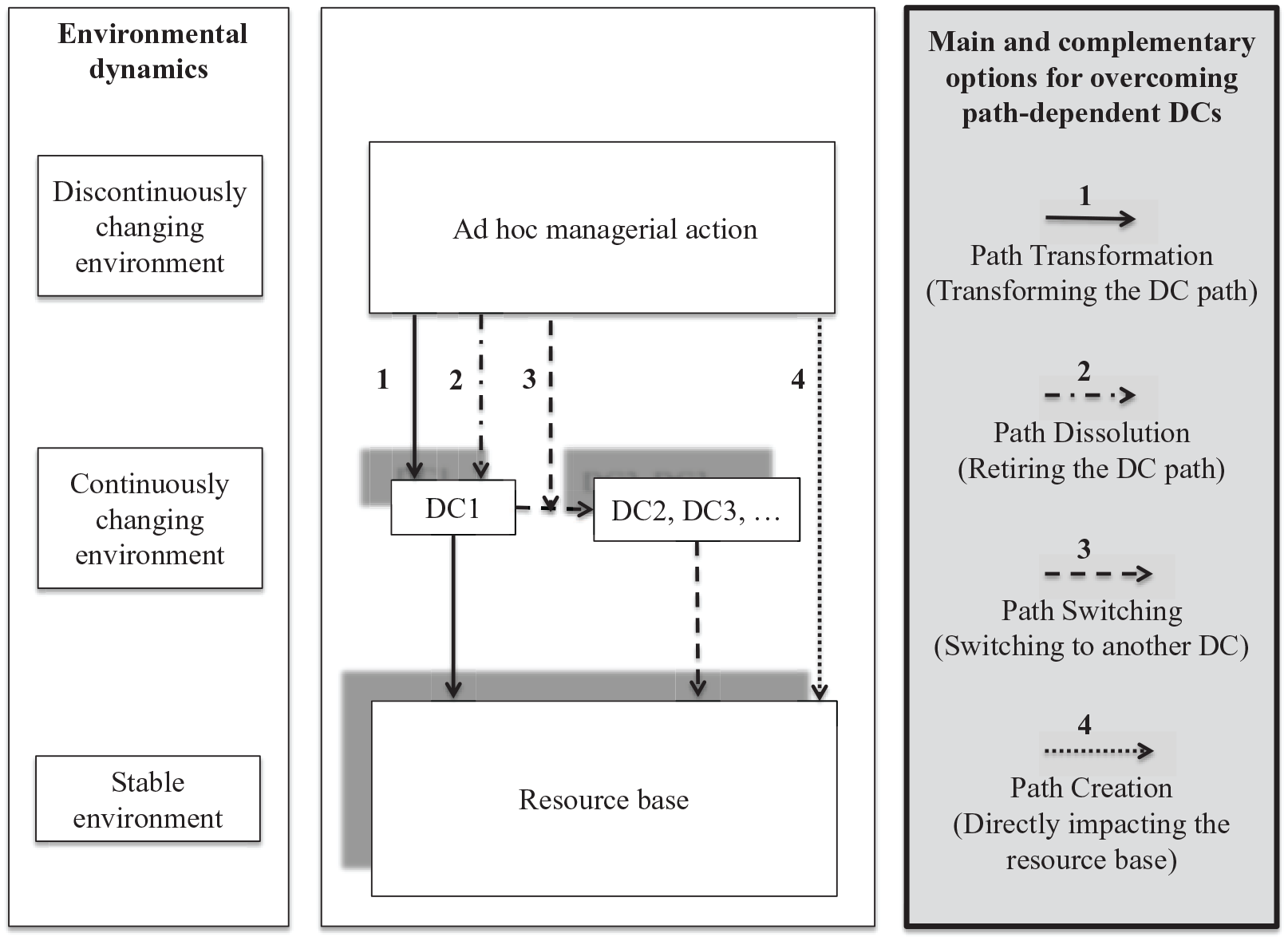
How to overcome path-dependent dynamic capabilities.
Ad hoc managerial action as a starting point for overcoming path-dependent dynamic capabilities
Our analysis of ad hoc managerial action as a starting point for overcoming dynamic capabilities proceeds in three steps. First, we argue that overcoming path dependence requires an exogenous intervention in which a higher-level entity, unaffected by the mechanisms, acts upon the path-constituting, self-reinforcing mechanisms. Second, we identify ad hoc managerial action as a feasible approach to explain the adaptation of dynamic capabilities without encountering those conceptual difficulties that underlie routine-based solutions to this phenomenon. Third, building on the distinction between reflective and reflexive systems of managers, we illustrate how decision makers detect that ad hoc action becomes necessary to address path dependence.
Exogenous intervention versus endogenous change
The idea that some kind of strategic, higher-order entity, that is, an “external lens” (Sydow et al., 2009), is needed to impact a path-dependent capability builds on the insight that a “path-dependent dynamic capability cannot monitor itself reflexively to avoid lock-in” (Vergne and Durand, 2011: 375). Path-breaking change is unlikely to emerge endogenously within a system (Schreyögg and Kliesch-Eberl, 2007) since the actors involved in the operational execution of the capability benefit from the self-reinforcing mechanisms in place. By analogy with Sydow et al. (2020: 722) who argued with respect to organizational path dependence that actors “who are not affected by a path and who are endowed with the necessary material and immaterial resources may intervene in a path-dependent organization from outside it,” we assume that the impetus for change must come from outside the path-dependent (sub-)system (cf. Vergne and Durand (2010) who define lock in as “a state of the system that cannot be escaped endogenously” (p. 743)). Overcoming path-dependent dynamic capabilities hence require an exogenous intervention (see Lambert et al., 2022) from a higher-order entity that aims at disrupting the working of self-reinforcing mechanisms.
Ad hoc managerial action versus capability hierarchies
Previous research has intensively addressed the question of what this higher-order entity is, enabling organizations to adapt their existing dynamic capabilities. One approach toward answering this question draws on the notion of a multi-level hierarchy of (dynamic) capabilities. Specifically, it is proposed that “meta capabilities” (Collis, 1994), “regenerative dynamic capabilities” (Ambrosini et al., 2009), or “second order dynamic capabilities” (Schilke, 2014b)—that impact not on the resource base but on a firm’s current set of dynamic capabilities—are suited to overcome and thus redynamize rigidities and break potential path dependencies at lower-level dynamic capabilities. However, since its inception, this idea has been criticized as leading to an infinite regress (Arend, 2015; Arend and Bromiley, 2009; Hallberg and Felin, 2020) which constitutes a problem that is “very important but yet is often overlooked” (Arend, 2015: 76). This is because path dependencies at lower-order organizational processes are likely to diffuse upward in the “dynamic capability hierarchy” over time and thus require yet another level to reshuffle (Collis, 1994).
To avoid an infinite regress when engaging in resource reconfiguration, it is increasingly understood that a firm’s top management plays a key role in evaluating, prescribing, and eventually implementing changes to a firm’s path-dependent dynamic capabilities (Teece, 2012, 2014; see also Zahra et al., 2006). In this perspective, overcoming path dependence in a firm’s dynamic capabilities and realigning the firm to fundamentally novel circumstances is not and cannot be rooted in routine (Obstfeld, 2012), that is, experience-based and patterned organizational processes (Vergne and Durand, 2011). Winter (2003), for instance, explicitly highlights the decisive role of ad hoc, that is, non-routine and “in particular, not highly patterned and not repetitious” problem solving as an important complement to dynamic capability-based organizational adaptation, especially “as a response to novel challenges from the environment or other relatively unpredictable events” (pp. 992–993). More recently, Teece (2012, 2014) also revised his initial dynamic capability conception by stressing the role of managerial action in triggering and successfully executing major organizational change. Referring, for example, to Steve Jobs’ involvement in Apple’s corporate history and remarkable transformation, he eventually posed the question “whether higher-level dynamic capabilities can usefully be thought of as being rooted in routines” (Teece, 2012: 1398). Instead of drawing on the idea of routinized capability adaptation, he emphasizes that “radical change is possible, but it requires organizational mutation. Such mutation must be engineered and driven by entrepreneurial managers/leaders” (Teece, 2014: 336).
Reflective and reflexive systems of managers
The question of what managers or leaders base their actions on has received increased attention in the recent past (Helfat and Martin, 2015; Helfat and Peteraf, 2015; Hodgkinson and Healey, 2011). Studies on the psychological underpinnings of managerial action in the context of organizational adaptation provide valuable insights into the cognitive, affective, and behavioral microfoundations of the concept. They suggest that ad hoc managerial action builds on the interplay of two complementary aspects: reflection and reflexion. An individual’s reflective system “underpins higher forms of cognition, such as logical reasoning, planning, and hypothetical thinking” (Hodgkinson and Healey, 2011: 1503). Hence, the reflective system is connected to the analytical and effortful aspects of organizational adaptation. It helps managers to engage in deliberate problem-solving (Vince, 2002) and avoid bias in decision-making (Liedtka, 2015; Toplak et al., 2011). Insights into the functioning of (dynamic) capabilities that serve as a basis for reflection and bring about a “thorough understanding of the social mechanisms driving the path process” (Sydow et al., 2009: 705) require some kind of capability monitoring which “looks at the practice of capabilities from a non-practicing point of view” and is therefore “primarily designed as a modus of reflection (and not direct acting)” (Schreyögg and Kliesch-Eberl, 2007: 926–927). A reflexive (dynamic) capability monitoring allows for a timely sense of critical signals and gives early indication of change necessities for a firm’s current dynamic capabilities (i.e. continuously checking their evolutionary fitness). In contrast to the reflective system, the reflexive system “underpins more automatic and basic affective forms of social cognition such as implicit stereotyping, automatic categorization, and empathizing with others” (Hodgkinson and Healey, 2011: 1503). The reflexive system works in a non-conscious manner (Epstein, 2010) and is strongly connected to intuition and emotion. However, these aspects have so far received scant scholarly attention in the management field (Hodgkinson et al., 2008), particularly with regard to the dynamic capability debate. Exceptions can be found in works that focus on the role of agency and the enactment of practices leading to strategic change (Regnér, 2008) as well as works that emphasize the role of creative action in the context of dynamic capabilities (MacLean et al., 2015).
Although research increasingly emphasizes the critical role of non-routine ad hoc managerial action in radical organizational change processes (e.g. Kaplan, 2015), little is known exactly about how these “sui generis strategic acts” (Teece, 2012: 1395; italics in the original) actually facilitate a fundamental renewal of the organizational resource base. We argue in the following how these managerial actions contribute to path transformation and path dissolution as strategies for overcoming path-dependent dynamic capabilities.
Addressing path-dependent dynamic capabilities
In the case of path dependencies in an organization’s dynamic capabilities, ad hoc managerial interventions, to be effective, need to address the “very logic and the specific energy” (Sydow et al., 2009: 702) of the self-reinforcing mechanisms that lead to and subsequently stabilize a dynamic capability. These interventions can thus be understood as an efficacious gearwheel to gradually rewind and reshuffle an established, usually deeply ingrained resource reconfiguration pattern (Koch, 2011) by addressing the existing continuity-ensuring (self-reinforcing) forces (Fortwengel and Keller, 2020), which represent the “theoretical cogs” of organizational path dependence (Anderson et al., 2006). While prior research has highlighted the necessity to intervene in a non-routine manner in maladapted capability trajectories, we zoom into the microlevel activities and thus clarify how these interventions in the functioning of resource reconfiguration patterns and the underlying self-reinforcing mechanisms exactly (need to) look like (Sydow et al., 2020: 729). Importantly, while we fully acknowledge the intricacy of path-breaking interventions, which typically require to simultaneously address the logic of different and oftentimes deeply intertwined persistency-sustaining mechanisms (Koch, 2011), for the sake of better comprehensibility, we first discuss each mechanism and the respective counteractions separately. However, we also explain how the different coping activities may work in conjunction to penetrate the mechanisms’ interwoven modes of action and to eventually overcome the path-dependent resource reconfiguration pattern.
There are two main options how firms can overcome the detriments of path-dependent dynamic capabilities. Path transformation refers to the breakup and subsequent readjustment of an existing path-dependent dynamic capability; path dissolution concerns the process of gradually dismantling a rigidified resource reconfiguration pattern.
Path transformation
To unlock and eventually transform a path-dependent pattern, strategic actors must engage in activities that interrupt and redirect the self-reinforcing mechanisms underlying a path-dependent dynamic capability (Sydow et al., 2009; Vergne and Durand, 2011). This (1) requires redirecting resource allocation and to readjust a firm’s deliberate learning efforts within a particular dynamic capability (Zollo and Winter, 2002). Overcoming detrimental dynamics of existing learning effects thus involves accepting a loss of (short-term) efficiency benefits. Redirecting (2) adaptive expectation effects involves influencing the organization members’ taken-for-granted beliefs and views on how adaptation and resource alteration is achieved (Danneels, 2011). Changing expectations requires initiating processes of cognitive reframing regarding a (dynamic) capability’s function or outcomes. In the case of new product development (Verona, 1999), this, for instance, can concern established beliefs about product design and use, material preferences, as well as targeted innovation goals. Because it involves changing organization members’ mindsets, deliberately adjusting the expectations of organizational members lies at the very heart of classic change management and organizational development approaches (e.g. Stadler and Hinterhuber, 2005; Stouten et al., 2018). Breaking up (3) the working of organizational coordination effects through reorganizing established work sequences and interaction processes is particularly important when it comes to transforming path-dependent dynamic capabilities. Adapting organizational rules, roles, and routines are all potential levers to transform the dominant coordination patterns underlying a firm’s dynamic capabilities (Okhuysen and Bechky, 2009). Reshuffling organizational interaction and communication processes, restructuring R&D or M&A teams, or simply replacing specific individual actors or groups can help to interrupt existing coordination effects and thereby bring about change in a particular dynamic capability. Finally, overcoming (4) complementary effects also often requires opening up the dense cluster of a dynamic capability’s interlocking routines and activities (Kremser and Schreyögg, 2016). In the face of discontinuous developments, long-established complementarities between firm assets but also within the structure of a firm’s proven dynamic capabilities that constituted an imitation barrier, and therefore, a source of competitive advantage in the past can turn into a hard-to-reverse liability (Wu et al., 2014). The key to abandoning the intricate power of organizational complementarities is to accept misfit costs by deliberately chopping existing synergistic interrelationships.
We next discuss path dissolution as an alternative approach that does not involve activities to transform but to retire the path-dependent resource reconfiguration pattern.
Path dissolution
Valuable insights about how firms can discard path-dependent dynamic capabilities come from research on how firms abandon no longer useful and maladapted organizational capabilities (e.g. Danneels et al., 2018; Rahmandad and Repenning, 2016). Dissolving a path-dependent dynamic capability is, however, typically not simply a matter of not using the particular resource alteration mode anymore or “cutting” the capability out of the organization, for instance, by closing the responsible department or group (see Helfat and Peteraf, 2003: 1005 on capability retirement). Instead—given that self-reinforcing processes are usually hidden dynamics that can spread from the level of a particular (dynamic) capability and thus over time become embedded and eventually inscribed into the wider organization (see also Koch, 2011 on the distinction between mechanism inscription and pattern inscription)—it typically requires a more complex response. Lavie (2006) thus notes that it is particularly difficult to abandon socially embedded capabilities that require “the employment of multiple organizational processes involving numerous employees across different divisions” (p. 165). Path dissolution, for instance, hence, often demands interventions in a firm’s social hierarchy (see Magee and Galinsky, 2008 on the self-reinforcing nature of power and status) to work against resistance from the carriers but also beneficiaries of the particular resource reconfiguration pattern (Boeker, 1989). Most notably, it (1) requires engaging in deliberate attempts of unlearning (Huber, 1991; Nystrom and Starbuck, 1984) and organizational forgetting (De Holan and Phillips, 2004) to spur erosion dynamics of outdated dynamic capabilities (see Rahmandad and Repenning, 2016). De Holan and Philips (2004), for instance, explicitly note that “competitiveness is not just about learning; it is also about forgetting the right things at the right times” (p. 423). Furthermore, despite pulling back the deliberate learning investments and resource flows into a specific dynamic capability (Zollo and Winter, 2002), firms must (2) also engage in activities of deinstitutionalizing (Dacin and Dacin, 2008; Dacin et al., 2002; Oliver, 1992; for an empirical study on deinstitutionalization of firm capabilities see Danneels et al., 2018) and deframing of the ingrained expectations associated with a specific dynamic capability. Deframing refers to the process of purging existing frames and the expectations embedded in them. In one of the few works addressing the topic, Dunbar et al. (1996) argue that deframing does “not imply that we must obliterate all previous ways of thinking. That is not possible. What it does imply is the need for an ability to step back from reliance on the particular frames we currently rely on” (p. 26). They understand frames-in-use as “metaphors anchored in the past” (Dunbar et al., 1996: 29) and argue that deframing requires moving from a fixed frame perspective to a multi-frame perspective through which the shifting of expectations becomes possible. Deframing, hence, is closely connected to sense-breaking which “involves the destruction or breaking down of meaning” (Pratt, 2000: 464) and is initiated by managers challenging the status quo (Maitlis and Christianson, 2014). In addition, given the fact that (3) a dynamic capability typically involves a variety of activities by actors from different organizational groups and is thus marked by strong coordination effects that pervade not only a single department but multiple groups or even the (entire) organization (Siggelkow, 2001), path dissolution typically requires cutting existing patterns of interaction and well-refined inter-departmental coordination activities (Henderson and Clark, 1990). For instance, when a firm decided to no longer engage in M&A activities and to dismantle the related capability, established coordination practices with involved internal (e.g. the firm’s finance department) and external actors (e.g. specialist consultancies) need to be addressed. Finally (4), firms must untangle and work against existing complementarity effects, for instance, within the embedded network of interconnected knowledge-sharing practices between a firm’s central R&D and other divisions (Collinson and Wilson, 2006), stemming from the long-term use of the specific dynamic capability.
Complementary mechanisms
Directly addressing a dynamic capability that has become dysfunctional by changing it or (at least temporarily) retiring it is a necessary first step in overcoming path-dependent dynamic capabilities. However, especially capability path dissolution requires recourse to a complementary mechanism to further ensure organizational adaptability. In this section, we differentiate between switching to another, already existing dynamic capability pattern (path switching) and directly intervening in the organizational resource base (new path creation) as central complementary mechanisms.
Path switching
Switching to an alternative resource alteration mode is a mechanism that can be used in conjunction with addressing a path-dependent dynamic capability. This option is open to organizations that have several, distinct dynamic capabilities, such as new product development and M&A capabilities. We refer to this mechanism as path switching because it allows firms to switch from one dynamic capability to another one. Path switching is useful when (1) not all dynamic capabilities are equally affected by the negative effects of path dependence and (2) decision makers understand and can influence the interaction effects between the firm’s different dynamic capabilities.
(1) Path dependence is a property of all capabilities (Ray et al., 2004), albeit to a different degree. This is also especially true for dynamic capabilities (Teece et al., 1997; Vergne and Durand, 2011). The self-reinforcing mechanisms that lead to path dependence increase the overall reliability of dynamic capabilities but also make it difficult to adapt them as soon as adaptation becomes necessary. Distinct dynamic capabilities, however, may have different susceptibilities to becoming dysfunctional. Some types of resource alterations modes may still be suitable while others may no longer meet the environmental demands, that is, favored by the external selection environment (Vergne and Durand, 2011). Helfat et al (2007), for instance, note that “many dynamic capabilities retain their value in turbulent environments as well. For example, capabilities for environmental scanning retain or even gain value when the environment changes” (p. 15). Under such conditions, path switching becomes a valuable alternative.
(2) Separate dynamic capabilities can be tightly or loosely coupled (Sanchez and Mahoney, 1996). The degree of coupling depends on the extent to which they are linked with each other. In the case of tight coupling, several dynamic capabilities may have to be adapted in parallel because of coordination and complementary effects between the separate capabilities. In the case of loose coupling, it is easier to switch to an existing dynamic capability while the dysfunctional one is attended to.
The story of Pfizer’s R&D turnaround is a prime example of how organizations can shift emphasis between dynamic capabilities as a result of ad hoc managerial actions (Wu et al., 2021). Until 2009, Pfizer had achieved a reputation of achieving growth through acquisitions, and it had developed capabilities for supporting this strategy (illustrated, e.g., by Vermeulen, 2005). Meanwhile, Pfizer’s own R&D capabilities dwindled (Cressey, 2011). Over time, however, leaving the firm’s internal R&D capabilities dormant became severely threatening. Mikael Dolsten, the company’s chief scientific officer, stated that Pfizer lost its confidence “in developing new drugs via our internal R&D capabilities,” which also led to a “follower mentality” (Wright, 2019). To tackle this problem, Pfizer switched from mainly relying on M&A toward revamping their own R&D capabilities (Wu et al., 2021). It created a new R&D structure and narrowed the therapeutic areas it wanted to compete in from 14 down to 5. Within these areas, Pfizer is striving for market leadership. Adapting the strategy also involved reallocating resources and breaking established expectations. As Dolsten puts it, “A lot of work was done to counter the mindset of just doing more of the same because that’s where you started.” Restructuring its own R&D has helped Pfizer to gain greater control over drug development. As Dolsten concludes: [O]ur R&D turnaround gave us an alternative and less-turbulent path to innovation and growth than large M&As” (Wright, 2019).
New dynamic capability path creation
Directly intervening in the resource base is a further mechanism that can be used in conjunction with addressing a path-dependent dynamic capability. Directly intervening in the resource base is useful when there are no alternative dynamic capabilities that enable an organization to develop its resource base in the desired direction (Winter, 2003) or when the existing alternatives appear equally unsuitable to driving this development. We refer to this mechanism as new path creation (see Garud et al., 2010; Garud and Karnøe, 2001), since the direct intervention in the resource base is a potential starting point for the development of new organizational (dynamic) capabilities, which then evolve along their own—however, in advance only partly foreseeable—evolutionary paths (Helfat and Peteraf, 2003; Vergne and Durand, 2011). This idea follows the work of Zollo and Winter (2002), who describe how direct, more or less intentional intervention in the resource base drives organizational learning mechanisms that help decision makers understand causal relationships between actions and outcomes and thus drive the evolution and path-building process of new (dynamic) capabilities.
Acquisitions represent an illustrative example of direct intervention in the organizational resource base. Many large technology companies, such as Amazon, Apple, or Microsoft, have developed elaborate M&A dynamic capabilities in recent decades. However, these firms all had to develop their M&A dynamic capabilities in a first step and refine them later (Barkema and Schijven, 2008); mostly as an alternative to an already existing new product development dynamic capability. Acquisitions are then used to close perceived resource gaps (Helfat and Lieberman, 2002) better or more efficiently than existing resource alteration modes. The main purpose is to gain access to technologies that would be difficult or costly to develop internally or that are already embedded in existing economic ecosystems. Microsoft’s first acquisition target was, for example, the US software producer Forethought, which had developed a presentation program that would later become known as MS PowerPoint. Since its first acquisition in 1987, Microsoft has continuously swallowed other firms, over 100 in the last 10 years alone, thus giving rise to an increasingly sustained dynamic M&A capability (see Akhigbe and Martin, 2002, for an analysis of the firm’s acquisition behavior during the 1990s and their official investor relations reports for current numbers).
An afterthought: multi-business unit management as a means for governing multiple dynamic capability paths
Observing Fortune 500 companies including long-standing corporations such as GE, IBM, and Siemens, Birkinshaw (2020) recently argued that many of them survived even major changes such as the Second World War, global financial crises, and the emergence of revolutionary technologies. Today, these corporations are an assembly of decentrally organized, often loosely related business units, that is, various product-market combinations that have also adopted quite different business models (e.g. Karim, 2006; Karim and Mitchell, 2000; Tushman and O’Reilly, 1996). This organizational design allows an organization to undergo changes within any of its subsystems without creating a ripple effect that hazards other subsystems (see Baden-Fuller and Haefliger, 2013; Sanchez and Mahoney, 1996). Moreover, loosely coupled business units allow the reconfiguration of a unit’s resource base faster and more easily compared to a firm with strongly integrated units (Sanchez and Mahoney, 2013; Volberda et al., 2001). This observation underpins the argument—also suggested by Helfat and Peteraf (2003)—that decentralized structures and multi-business unit management not only allows firms to engage in different market/industry settings but also to create and maintain multiple independent dynamic capability paths, thus making them less vulnerable to the path dependence of one particular dynamic capability in one specific business unit.
Decentralized organizational structures permit autonomy for the respective business units. As such, these organizational designs counterbalances and thus reduces the susceptibility to negative effects of path dependence by setting up various dynamic capabilities in different fields. Operating multiple business units hence reduces dependence on (1) learning effects in regard to resource reconfiguration in one particular unit. This is because business units enable the acquisition and transfer of knowledge in different learning contexts and with distinct learning logics (O’Reilly and Tushman, 2013); therefore, they facilitate a different pacing of learning dynamics of firms’ resource alteration modes. The establishment of independent business units further allows firms to cope with (2) adaptive expectations embedded in the diverse dynamic capabilities that are present in the different units. Especially newly generated corporate units may develop new mindsets that frequently compete with established ones (Gilbert, 2006), thereby also allowing the establishment of new and alternative resource reconfiguration patterns within the new unit. In addition, large conglomerates such as General Electric have business units that operate in very different market environments, such as Aviation, Healthcare, and Transportation Systems, each of which also requires quite different dynamic product innovation capabilities that develop along idiosyncratic paths. The creation of structurally distinct business units also reduces a firm’s vulnerability to (3) coordination effects. This is because the structural separation between units presents a “natural boundary” for social interactions (Joseph and Ocasio, 2012). Although firms might set up initiatives or structures that facilitate cross-business-unit coordination (see, for instance, Martin and Eisenhardt, 2010) and keeping an overview of the separate developments represents a major senior management challenge, the business unit-specific dynamic capabilities, such as new product development or alliance management (Schilke, 2014a) rely on clearly definable, structurally differentiated coordination patterns. Business units, finally, also make organizations less vulnerable to (4) complementary effects that surround separate dynamic capabilities. This is because webs of complementarities between respective activities and routines as well as their synergies are mainly leveraged within a unit (Pil and Cohen, 2006) and not across units (Baldwin and Clark, 2000).
Discussion and conclusion
The dynamic capability view has become “one of the most influential theoretical lenses in contemporary management scholarship” (Schilke et al., 2018: 390), and insights have been successfully transferred to management practice (e.g. Harreld et al., 2007). However, we still see incumbents that showed strong dynamic capability-driven adaptation in the past struggling to adapt to discontinuous change (see Eggers and Park, 2018, for a recent review). Although dynamic capabilities of incumbent firms might still be “technically fit” to reliably perform their intended functions, these functions lack “evolutionary fitness” as they are no longer suited to achieving organizational adaptation (Helfat et al., 2007). Trends such as the digital transformation or global crises such as the financial crisis of 2008 or the COVID-19 pandemic dramatically demonstrate the limitations of reacting to radical discontinuities by drawing on long-established dynamic capabilities. To address this lacuna why established firms fail to transform despite being armed with strong dynamic capabilities, we elaborated on the critical yet so far insufficiently theorized role of path dependence in dynamic capability building and adaptation as suggested in the seminal work of Teece et al. (1997). Specifically, we argue that the same self-reinforcing mechanisms that make dynamic capabilities a valuable source of competitive advantage cause their path dependence, which eventually turns dysfunctional in the face of discontinuous environmental shifts. To interrupt the working of self-reinforcing mechanisms and therefore help incumbents to overcome path-dependent dynamic capabilities, we outlined different options that all hinge upon a firm’s top management.
Our theorizing provides three contributions. First, we reconnect the important notion of “history matters for strategy” to the dynamic capabilities debate (e.g. Suddaby et al., 2020; see also Argyres et al., 2020; MacLean et al., 2016). Although historical aspects, specifically paths, played a crucial role in the initial conceptualization of dynamic capabilities (Teece et al., 1997), historicity has long been neglected in the debate. Specifically, our elaboration of path dependence in dynamic capability reasoning links to sparse but insightful works addressing the dilemma that “dynamic capabilities are construed simultaneously as path-dependent and as a remedy to path dependence” (Vergne and Durand, 2010: 740) and the problem that “positive feedback-processes are likely to bring about path dependency in capability-based practices” (Schreyögg and Kliesch-Eberl, 2007: 916). Interestingly, prior research has tended to either emphasize history as “a valuable but underexploited organizational resource” (Suddaby and Foster, 2017: 35) that acts as “an enabler rather than an impediment to change” (Suddaby et al., 2020: 531) or as a constraining factor leading to problems when “initial choices or capabilities undergo self-reinforcing development and may end up in a lock-in, which is deemed potentially inefficient” (Sydow et al., 2020: 720). In this study, we analyze the dual role of path dependence as stabilizing factor and as an inertial force by elaborating on when and how dynamic capabilities become path-dependent under the effect of self-reinforcing mechanisms, that is, learning effects, adaptive expectations, coordination effects, and complementary effects (Sydow et al., 2009). While a series of learning experiences and positive feedback cycles over time bring about path dependence in capability-based practices, some dynamic capabilities show more persistence and a lower potential for endogenous change than others (Vergne and Durand, 2011; Zott, 2003). Future work might thus explore the role of time, timing, pace, and intensity of self-reinforcement (Sydow et al., 2020, see also Cloutier and Langley, 2020), evaluating possibilities and conditions under which actors “on the path” can—against the odds—retain or, if necessary, regain room for maneuver. Research on path dependence suggests that this also depends upon the extent to which the capability pattern and the underlying self-reinforcing mechanisms are inscribed into the organizational “deep structure” (see Koch, 2011) and relatedly how much a specific dynamic capability path and the underlying routine bundle had expanded or disseminated from the particular subsystem or “feature” (Vergne and Durand, 2011) into the entire organization. In turn, this implies that in some cases when path dependence has fully intruded the strategic sphere (Burgelman, 2002), the exogenous impetus must come from a truly external actor, such as via changes in leadership or company ownership (Keller, 2018), or through the intervention of other external changes agents (Ambrosini et al., 2009). Overall, we believe that our theorizing enables developing a more granular perspective on how dynamic capabilities impact organizational development and helps to extend the growing body of research on the historicity and the (internal) dynamics of dynamic capabilities (Salvato and Vassolo, 2018; Schreyögg and Kliesch-Eberl, 2007; Wenzel et al., 2021).
Second, our in-depth analysis of when and how dynamic capabilities become path-dependent highlights the conditions under which the path dependence of dynamic capabilities eventually becomes problematic. While the core features of dynamic capabilities as “learned and stable pattern of collective activity” (Schreyögg and Kliesch-Eberl, 2007: 923) “oriented to relatively specific objectives” (Winter, 2003: 992) ensure adaptability in predictable environments, path dependence becomes particularly salient and potentially troublesome under the condition of discontinuous change, that is, when there is an evolutionary “misfit” between a firm’s dynamic capabilities and environmental demands. Prior studies developing a contingency perspective on dynamic capabilities (e.g. Ambrosini et al., 2009; Eisenhardt and Martin, 2000; Schilke, 2014a) have mainly emphasized their limited value in discontinuous environments. We develop the argument that they even become dysfunctional by perpetuating potentially outdated ways of resource reconfiguration. With this insight, we contribute to a better understanding of the paradox nature of dynamic capabilities: their path-dependent nature creates idiosyncrasy and eases adaptation in continuously evolving environments and hampers firm adaptability in discontinuously changing environments at the same time.
Third, we elaborate and outline a holistic framework of how to overcome path-dependent dynamic capabilities. We identified ad hoc managerial action as the foundation for intervening in path-dependent dynamic capabilities. The idea of ad hoc managerial action builds on established works that have identified ad hoc problem-solving as a valuable alternative to (dynamic) capability-based adaptation (Teece, 2012, 2014; Winter, 2003) and emphasizes decision-making as an essential managerial function embedded in the dynamic capability framework (e.g. Augier and Teece, 2009). The top management of a firm plays a particularly important role here since it can initiate exogenous interventions in a path-dependent system (i.e. the dynamic capability) from outside the system. Drawing on insights into the psychological foundations of dynamic capabilities (Helfat and Peteraf, 2015; Hodgkinson and Healey, 2011), we argue that reflective and reflexive systems of managers interact in sensing critical signals in the environment and hence recognizing those situations in which ad hoc managerial action becomes necessary to overcome the path dependence of inappropriate dynamic capabilities (Ambrosini et al., 2009). Ad hoc managerial problem-solving has to be conceptually separated from dynamic managerial capabilities. The latter concept represents a further, useful lens for analyzing the impact of individual managers on strategic change. However, dynamic managerial capabilities “have important attributes that characterize capabilities more generally” (Helfat and Martin, 2015: 1285). They are “fundamentally grounded in the experiences and innate abilities of the managers within their respective organizational contexts” (Martin and Bachrach, 2018: 30) and are “supported by patterns of behavior and activities” (Huy and Zott, 2019: 32). By building on behavioral patterns, they may become subject to the similar self-reinforcing effects that restrict the value of organizational dynamic capabilities in the context of discontinuous change. As Helfat and Peteraf (2015) put it, “the fact that knowledge gained from prior experience shapes the perception of new experiences suggests path dependency: prior experiences shape new perceptions, which then become part of the experience base for subsequent perceptual activity” (p. 838). Ad hoc managerial action, however, requires “non-routine strategizing and entrepreneurial activity” (Teece, 2012: 1399).
Ad hoc managerial action can be used to intervene in path-dependent dynamic capabilities. We theorize path transformation and path dissolution as alternative approaches. Both approaches aim at interrupting the self-reinforcing mechanisms embedded in the dynamic capability and ultimately either adapting or retiring the capability. In addition to these alternative approaches, we identify the complementary mechanisms of path switching and new path creation as further measures to support organizational adaptability in turbulent environments.
Our analysis primarily shows how organizations at the business unit level can deal with path-dependent dynamic capabilities. At the corporate level, organizations have the option of adapting their design by setting up multi-business unit management to become less vulnerable to path dependencies at the overall organizational level (Eisenhardt and Brown, 1999; Tushman and O’Reilly, 1996). Multiple business units, designed to excel in heterogeneous environments, provide diverse experience accumulation opportunities for shaping different kinds of dynamic capabilities. As a result, firms allow for the development and coexistence of multiple sets of dynamic capabilities. All of these dynamic capabilities might be path-dependent, but the firm will be able to create multiple paths (in different organizational subsystems) in parallel (Bergek and Onufrey, 2014; see also Sydow et al., 2020: 719). The multi-business unit approach also connects to research on organizational ambidexterity, which—under the header of structural ambidexterity—elaborates on the “how” and “why” behind setting up multiple business units for serving established versus emerging markets (O’Reilly and Tushman, 2013). Studies in this stream of research have denoted ambidexterity as a major dynamic capability of organizations (Birkinshaw et al., 2016; O’Reilly and Tushman, 2008) and often implicitly viewed the implementation of dual structures as a proactive step to ensure long-term survival. Access to existing, additional business units reduces the dependence on path-dependent dynamic capabilities in the individual business units.
We believe that our theorizing enriches and extends the dynamic capabilities perspective and encourages other scholars to follow us on our path. Likewise, we hope that it helps incumbents to better cope with and successfully adapt to rapid and discontinuous environmental changes.
Footnotes
Acknowledgements
The authors are grateful for the helpful comments on earlier versions of this article from Veronique Ambrosini, Johann Fortwengel, Martin Friesl, Lucas Müller, Christian Stadler, Gianmario Verona, and Matthias Wenzel. We also want to thank senior editor Ann Langley for her thoughtful advice as well as two anonymous reviewers for their valuable input and suggestions.
Funding
The author(s) disclosed receipt of the following financial support for the research, authorship, and/or publication of this article: The authors gratefully acknowledge financial support from the Anniversary Fund of the Oesterreichische National Bank (OeNB); grant number 18133.
