



Abstract
Strategy scholars are increasingly attempting to tackle complex global social and environmental issues (i.e. wicked problems); yet, many strategy scholars approach these wicked problems in the same way they approach business problems—by building causal models that seek to optimize some form of organizational success. Strategy scholars seek to reduce complexity, focusing on the significant variables that explain the salient outcomes. This approach to wicked problems, ironically, divorces firms from the very social-ecological context that makes the problem “wicked.” In this essay, we argue that strategy research into wicked problems can benefit from systems thinking, which deviates radically from the reductionist approach to analysis taken by many strategy scholars. We review some of the basic tenets of systems thinking and describe their differences from reductionist thinking. Furthermore, we ask strategy scholars to widen their theoretical lens by (1) investigating co-evolutionary dynamics rather than focusing primarily on static models, (2) advancing processual insights rather than favoring causal identification, and (3) recognizing tipping points and transformative change rather than assuming linear monotonic changes.
Introduction
Current global social and environmental challenges, such as climate change, biodiversity loss, and wealth inequality, will shape the future of societies and businesses alike. Failing to address these complex societal challenges could be catastrophic to economic and human prosperity (Steffen et al., 2015). These challenges are often called wicked problems (Rittel and Webber, 1973), because the elements are so interconnected that it is impossible to identify a single cause or solution.
The frequency and intensity of wicked problems are rising, as digital technologies and the mobility of people and things make the world increasingly interconnected and complex. Furthermore, some wicked problems, such as inequality, resource scarcity, and waste accumulation, put further pressures on the system, which catalyzes further wicked problems in an endless cycle that is disrupting both business and society.
Although contemporary strategy research builds on diverse literatures, much of it is grounded in economics, which seeks to develop parsimonious models of organizational actions (Barney, 1991; Williamson, 1991). Strategy scholars assume that an organization’s actions can be isolated from the highly dynamic, uncontrollable social-ecological systems in which the organization is embedded. They adopt deterministic thinking, rather than the probabilistic inferences characteristic of dynamic environments.
To their credit, some strategy scholars have started to recognize the importance of the macro environment in their scholarship (e.g. DesJardine and Durand, 2020; Flammer et al., 2021). However, much of this research remains embedded in traditional reductionist thinking and masks the complexities and dynamics of wicked problems. These strategy scholars still model the context through regression analysis, and often depict their models through boxes and arrows. Strategy’s holy grail is a well-identified model to offer causal inferences.
Such thinking is flawed not only because the macro context is dynamic, but also because firm growth is assumed to be unlimited in a world in which resources are constrained. For example, a strategy scholar may seek to address the climate crisis by seeking to reduce firm-level carbon emissions (e.g. Lewandowski, 2017). Yet, even if all organizations reduced their emissions, the aggregated emissions could still exceed the targeted well below 2°degrees Celsius of pre-industrial levels.
We suggest that systems thinking will help strategy scholars more fully recognize and embrace the complexity involved in tackling wicked problems within the limits of planetary boundaries (Whiteman et al., 2013). This requires strategy scholars to recognize that wicked problems have no clear boundaries, exhibit non-linear dynamics, and require new ways of thinking.
In recent years, systems thinking has experienced a resurgence in the wider community of organizational scholars. We join a growing chorus of scholars that are asking for new tools and approaches to analyze wicked problems and grand challenges (Howard-Grenville and Lahneman, 2021; Jarzabkowski et al., 2016; Wasieleski et al., 2021). These calls challenge the cherished ideals of strategy, including capitalism, growth, and consumption, in order to inspire new ways of doing business that are more sensitive to and compatible with the natural environment and society.
We add to this growing dissent with strategy scholarship by advocating for systems thinking to supplement the reductionist approach to theorizing, traditionally applied by strategy scholars. In this essay, we begin by providing a short overview of the history of systems thinking and its core principles. Then, we discuss the value of systems thinking to strategy scholars who study wicked problems, using climate change as an illustration.
The evolution of systems thinking in strategy and organization studies
Systems thinking emerged in modern science in the 1920s (Capra, 1996). Organizational scholars such as Forrester (1961; system dynamics), Churchman (1968; systems approach), Ackoff (1971; purposeful systems), Jackson (1992; critical systems thinking), and Checkland (2000; soft systems methodology) were central to its development. Systems thinking was a natural fit for studying organizational strategy and change (Ackoff, 1971), as scholars viewed organizations as “organisms” that both shape and are shaped by their environments (Dooley, 1997).
Despite heavy early engagement, systems thinking did not take root in mainstream management studies, particularly strategic management research. Instead, systems thinking appeared in a domain seemingly independent of strategic management. Over time, it has been viewed as a theory, a paradigm, belief system, perspective, and a method (see Table 1).
Different understandings of systems thinking.
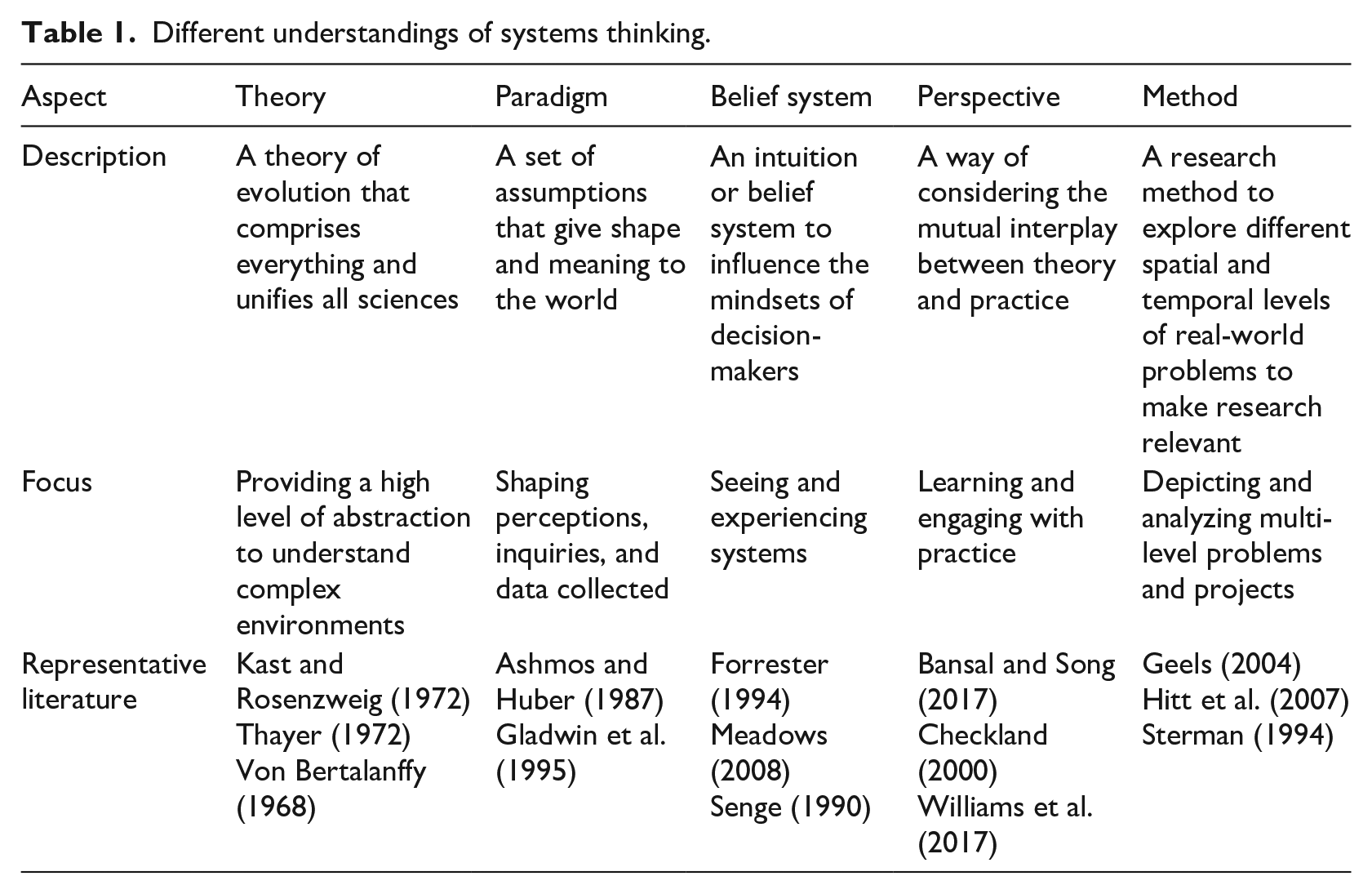
As a theory, systems thinking applies the ideas of General Systems theory, which seeks to unify all natural and social sciences in one grand conceptual model to replace the classical mechanical worldview in organization studies (Kast and Rosenzweig, 1972; Thayer, 1972; Von Bertalanffy, 1968). It aims to explain unrelated findings by exploring the interrelationships between organizations and the external environment. This approach peaked in the 1970s, but was not widely adopted, because it did not offer precise causal explanations with refutable hypotheses (Ashmos and Huber, 1987), making it empirically intractable in social sciences (Peery, 1972).
The early failure of systems thinking to establish itself as a theory opened opportunities for other understandings of systems thinking, including as a new paradigm which is a set of assumptions that give shape and meaning to the world and influence how issues are studied and interpreted (Gladwin et al., 1995). As a paradigm, systems thinking is broader in scope than a theory and aims at developing knowledge and coordinating actions across organizational disciplines (Pfeffer, 1993).
Another interpretation of systems thinking is as a belief system which speaks to intentions and changes in behavior and mental models. This approach interprets problems as ways of seeing, thinking, and acting differently (Senge, 1990). To solve wicked problems, corporate and political decision-makers need to be influenced toward systematic changes. Specific tools, techniques, and principles, such as Senge’s (1990) 11 laws of systems thinking reveal interdependencies and connections among subsystems across space and time.
A similar interpretation is systems thinking as a perspective, which describes the mutual engagement between theory and practice to address situations of interest or areas of concern (Checkland, 2000). Such areas of concern can be problems in a particular discipline or broader real-world problems, where systems thinking practices can preserve key elements of holistic thinking. Instead of simply describing the world as a system, systems thinking as a perspective examines how to deal with the world and how to define desirable and feasible actions (Checkland and Scholes, 1990).
Finally, systems thinking is also perceived as a method for conducting multi-level studies to better capture large-scale and complex problems. A wide variety of systems thinking methods exists, including system dynamics approaches (Forrester, 1994; Sterman, 1994), multi-level analysis (Hitt et al., 2007), and historical socio-technical studies (Geels, 2004). What unites them is the aim to develop explicit and complete models instead of providing guidance and solutions.
These different understandings have hampered systems thinking from reaching across disciplines, especially those disciplines predisposed to elegant solutions. Therefore, mainstream strategy scholars have resisted embracing the breadth of systems thinking, even though some of its elements have informed strategy-specific studies, such as contingency theory (Kast and Rosenzweig, 1972), paradox theory (Bansal and Song, 2017; Jarzabkowski et al., 2019), dynamic capabilities (Teece, 2018), process studies (Langley et al., 2013), strategy as practice (Jarzabkowski et al., 2016), organizational adaptation (Howard-Grenville and Lahneman, 2021), and leadership (Uhl-Bien and Arena, 2018). However, these approaches cherry-pick systems thinking concepts so that the power of systems thinking is not fully harnessed. Strategy scholarship has an opportunity to develop more relational and holistic understandings of wicked problems as we describe below.
Systems thinking principles
Despite different interpretations of systems thinking, some core principles ground scholars who take this approach. Most of these are reflected in a complex adaptive systems perspective (Levin, 1998). Systems thinking adopts a relational view of the living world as a network of interconnected and interdependent relationships among elements that produce patterns of dynamic stability across temporal and spatial scales (Capra, 1996; Meadows, 2008). One’s observational perspective is central to understanding the system (Capra, 1996). For instance, a car is a system comprising interactions among various parts, such as the engine and wheels, which in turn have their own internal relationships. By only examining the individual parts, the observer may have difficulty identifying whether the larger system is a car, truck, or bus. Only by understanding the nature of such relationships can observers appreciate network boundaries and may identify it as a car (Capra, 1996).
Yet, most systems are open and interact with other systems, making the boundaries subject to interpretation (Von Bertalanffy, 1968). Open systems maintain structures but exchange materials, such as matter and energy, with other systems (Von Bertalanffy, 1968). For instance, the earth continually receives shortwave radiation from the sun that can be absorbed to maintain stability in living systems and avoid a state of high entropy (Clayton and Radcliffe, 1996; Kast and Rosenzweig, 1972). Systems thinking recognizes that systems involving diverse yet inseparable elements, including humans, non-humans, and the material world, co-create structured patterns of behavior and opportunities for system change (Whiteman and Kennedy, 2016). So, although systems boundaries are porous, they can exhibit patterns that can be understood and influenced.
Systems thinking seeks to understand reality by studying interactions and related properties—that is, how parts become an “integrated whole” (Capra, 1996: 36). Through synthesis, reality is understood by examining how components fit and work together (Ackoff, 1974), thereby revealing the emergent properties that are born through dynamic interaction. Thus, systems may appear to be greater than the sum of their parts, as properties may not be readily explainable by examining components in isolation (Clayton and Radcliffe, 1996). Likewise, the performance of any component (e.g. a car engine) can only be explained in relation to the entire system (i.e. the car; Ackoff, 1974).
Systems thinking frames the world as a set of feedback loops or control mechanisms (Meadows, 2008). Through circular arrangements of casual connections, actions elicit responses that “feed back” to influence the original propagator (Capra, 1996; Meadows, 2008). Organizational actions stimulate counteracting forces within a system which influence capabilities and shape understandings of which actions to take next.
In this way, systems thinking frames the world as a hierarchy of nested systems (Simon, 1974). Organizations are understood as embedded within society which in turn is situated within an ecology with biophysical limits, but without top-down control (Simon, 1974). Higher order systems (e.g. laws or social conventions) are large, slow to change, and may constrain the behavior of lower order systems (e.g. a firm’s behavior; Holling, 2001). Lower order systems change quickly and enable higher order systems to emerge (i.e. individuals are necessary components of teams). Sub-systems are semi-autonomous, and their interactions and relationships between components are denser than those between hierarchical levels (Meadows, 2008).
Systems thinking calls for examining dynamic movements to understand system-level behavior over time (Meadows, 2008). Complex adaptive systems are continually changing, as variation and novelty are constantly emerging through autonomous self-organization (Levin, 1998). System dynamics are not stable, and behavior can be hard to predict due to changes in flows of materials and information, non-linear interactions, and components responding to stimulation in different ways at different times. Behavior is emergent as components constantly adapt and learn from experience.
Systems change within domains of stability representing the range of possible states with the same basic structure, feedback loops, and functioning (Walker and Salt, 2012). Systems thinking calls us to recognize that systems may exist in alternate forms. When a system changes too much, it may enter a new domain with a different structure and new feedback loops between its components (Walker and Salt, 2012). Such transformations, termed regime shifts, may be desirable or undesirable for system actors (Gunderson, 2000). For instance, increases in cattle grazing and low rainfall may cause a grass-dominant savanna to become shrub-dominant because fire, which restricts woody vegetation, cannot spread when grass levels are low (Walker and Salt, 2012). Systems thinking calls us to consider how a system adapts in the face of change and unexpected disturbances to maintain its current state, and when it may transform to an alternate state in a new regime (Walker and Salt, 2012).
Differences between reductionist thinking and systems thinking
Whereas reductionist thinking examines parts to understand the whole, systems thinking considers the context in which parts are embedded. The following examples illustrate the differences between reductionist thinking favored by strategy scholars and systems thinking.
Simplicity versus complexity
Reductionist thinking tends to seek static and narrow conceptions of causality to develop a model that parsimoniously reflects reality. To do so, strategy scholars often seek firm-level outcomes (e.g. firm performance) and causal explanations, which are modeled through archival data, experiments, or surveys. Consequently, strategy scholars focus on proximate causal connections, which are easier to identify, measure, and predict than more distal connections (Bansal and DesJardine, 2014). Moreover, scholars who adopt methods that apply reductionist thinking stop searching for explanations once a cause with sufficient explanatory power is uncovered (Sterman, 2001). Due to an incomplete understanding of causal mechanisms, strategy scholars may fail to consider how multiple causal factors—and most importantly, their interaction effects—influence outcomes. Systems thinking, instead, invites strategy scholars to explore dynamic interpretations of causal connections that may be distant in time and space (Senge, 1990), and to consider how delays may create (in)stability within a system and how reactions may differ in the short and long terms.
Independence versus interconnectedness
Reductionist thinking methods tend to divorce problems from their contexts by studying them in isolation, thereby excluding potential synergies and tradeoffs. Reductionist thinking may make it difficult to consider interaction effects and important contextual factors when attempting to build valid and reliable causal models that predict single outcomes. For instance, “sustainable” products, services, and business models are perceived as innately desirable outcomes instead of understanding whether and how they may stimulate evolutionary dynamics at the industry level. Little attention is paid to systemic issues of interconnectivity, such as rebound effects (e.g. more greenhouse gases are emitted elsewhere in the system), dependence on a problem’s continued existence (e.g. selling medication for obesity), and how systems may become overly reliant on a single firm (e.g. depending on one provider of low-cost water filters to ensure safe drinking water).
Firm level versus system level
The scale of wicked problems and their dynamics are difficult to translate to the organizational context (Bansal, 2019). A reductionist approach devotes much attention to solving wicked problems based on firm-level performance variables, assuming that improvements to individual firm performance will innately create the change needed to tackle wicked problems. Yet, such performance indicators are disconnected from macro-level indicators of social-ecological system functioning (Whiteman et al., 2013) and ignore that seemingly progressive actions at the firm level may be insufficient. Systems thinking calls scholars to adopt multi-level understandings of reality based on different hierarchies (Peery, 1972) and scales (Bansal et al., 2018). Rather than merely examining direct dependent variables at the firm level, considering hierarchies reveals a fuller understanding of how different subsystems contribute to the whole, and to shaping new conditions for environmental and social problems.
Implications of systems thinking to strategy scholarship
We propose that systems thinking can help strategy scholars investigate co-evolutionary dynamics, advance processural insights, and recognize tipping points and transformative change of wicked problems. We illustrate our arguments using the wicked problem of climate change and associated extreme weather events, with tragic effects for businesses and society. Current strategy approaches to climate change typically focus on economic considerations, such as product-market competition (Busch and Hoffmann, 2011), process and innovation improvements (Kolk and Pinkse, 2005), or strategic responses (Slawinski and Bansal, 2012). These approaches to climate change ironically ignore the natural systems in which the firm is embedded. For instance, it is easy for reductionist approaches to strategy to overlook the interaction between organizational outcomes and weather events, which is contributing to the greater frequency and intensity of these weather events. The following three suggestions should help to address these shortcomings.
Investigate co-evolutionary dynamics
Systems thinking invites strategic management research to widen their focus from the organization to accommodate a more macro perspective. Systems thinkers consider very deliberately the appropriate boundaries for their research. So, in the study of climate change, systems thinkers would recognize the importance of capturing the dynamic interplay among firms, societal actors, and carbon accumulation in the atmosphere. By embracing these dynamics and the interconnectivity between the social and biophysical environments, strategy scholars can develop broader understandings of not only how individual firms’ actions affect climate change, but also how individual firms interact with others to shape what is to come. In other words, firms and the broader context in which they are embedded are interacting in a process of forever becoming (Ingold, 2011; Whiteman and Kennedy, 2016). Strategic management research would then ask how corporate actions on climate change may stimulate or inhibit carbon transitions beyond the firm, and to link firm actions to change dynamics in industries and wider social-ecological systems (Waddock, 2020; Williams et al., 2021).
By widening the focal lens from the organization to a system of organizations, new solutions come into view. Strategy research would investigate the solutions that lie between firms or within the larger industry or field. For instance, York et al. (2016) examined how the wind energy field in Colorado changed due to clashes between incompatible logics. Their findings reveal logic hybridization within a field as an emergent process as actors trigger and respond to actions and generate outcomes that are difficult to predict.
By re-drawing the boundaries of analysis, strategy studies can develop “ecologies” of solutions. These ecologies are nudges that are consistent and coordinated to move the system, rather than focusing on single levers of change or silver bullets. A systems thinking approach recognizes that industries change through co-evolutionary dynamics and multiple corporate actions. Examining potential synergies and tradeoffs in regard to collective action may unlock strategic opportunities that are obscured by reductionist thinking. For instance, advancing hydrogen energy storage may not improve a firm’s own carbon footprint, yet may facilitate a surge in solar energy production. Organizations, then, look to the future of where the industry is going, rather than remain locked into routines and path dependencies (Gümüsay and Reinecke, 2021). This orientation facilitates new understandings of firm performance based on future long-term scenarios and collective outcomes.
Important questions that systems thinkers could investigate that recognize the dynamics that yield such ecologies of solutions include how is the firm’s strategy impacting the climate system’s ability to self-organize? Moreover, how is the firm’s strategy impacting other actor’s capacity to reduce carbon emissions?
Advancing processual insights
Strategy scholars commonly measure short-term effects between a firm’s carbon emissions and financial performance, which are easy to identify, measure, and predict (Bansal and DesJardine, 2014). Scholars such as Damert et al. (2017) have considered 5-year periods to examine “long-term effects” of strategies on firm-level financial performance and carbon emissions. Yet, climate change unfolds over a much longer time horizon (Bansal et al., 2018), as may large investments for decarbonization (e.g. bio-based chemicals). Systems thinking encourages scholars studying climate change to analyze the unfolding of organizational- and individual-level behavior over longer time horizons, as well as their feedback effects and delayed outcomes.
Systems thinking warns that focusing solely on firm actions and outcomes in the short term may neglect feedback effects in the longer term (Senge, 1990). For instance, corporate and industry-wide inactivity on climate change may seem profitable in the short term, but likely will have negative effects in the long term. Wright and Nyberg (2017) effectively captured feedback effects in a process study of Australian corporations over a 10-year period. They showed how firms failed to embed climate strategy into organizational processes and thus were susceptible to investors’ calls to scale back efforts in order to maximize short-term profitability during an economic downturn.
By unlocking process characteristics instead of measuring outcomes, strategic management research could provide insights on the underlying actions of corporate responses to climate change. This requires considering a broader range of variables, including values, identity, and beliefs, which are often neglected in strategic models (Meadows, 2008). Such “soft” variables may inform the multiple root causes and patterns of firms resisting decarbonization, and reveal how firms can improve carbon emissions and their capacity to decarbonize in the future.
Important questions to investigate with processual accounts of climate change include how did a firm achieve its emission reduction targets? How can firms develop new, low-carbon operational routines and practices? How can firms form new identities to enable transformation?
Recognizing tipping points and transformative change
Strategy scholars who study climate change typically conduct quantitative analyses of historical data and static parameters to develop explanations. Yet, the value of these studies is limited when the organizational environment is dynamic and the past is an unreliable predictor of the future (Bansal, 2019). The climate does not remain in a fixed state. It undergoes constant, dynamic change associated with natural fluctuations and now unprecedented changes driven by anthropogenic contributions to greenhouse gases. Firm activities contribute to climate change and associated changes in the operating environment. Changes to physical risks (e.g. extreme weather events) and societal pressure for decarbonization may alter industry dynamics, stimulating self-organization and the emergence of new behavior in ways that are hard to foresee (Waddock, 2020). Systems thinking asks strategy scholars to recognize slowly unfolding patterns of change within the climatic system, industry, and society to recommend responses for business action (Williams et al., 2021).
It is critical for strategic management research to analyze how information and materials flow and accumulate within and across subsystems to reveal previously hidden, non-linear spatial patterns and changes in system behavior. For instance, a coal company that is not investing in so-called “clean coal” solutions may be viewed as performing poorly on carbon reduction. Yet, this may mask its growing potential for transformative action through accumulating the capabilities to switch to renewable energy that will enable it to completely forego coal as an energy source.
In particular, strategy scholars need to generate understandings that firms, industries, and the climate system may operate in radically altered states once constraint limits and tipping points are transgressed (Lenton et al., 2009). Beyond such points, explanations of behavior based on historical data have a little use as systems transform. Presently, few strategy studies connect firm behavior to thresholds of climatic systems, implicitly assuming that current equilibriums within systems will be maintained. Furthermore, it is important for strategy scholars to adopt a future orientation in order to predict and imagine corporate behavior within alternate regimes (Gümüsay and Reinecke, 2021). Such work may encourage innovation and proactive transformations of firms and industries to avoid catastrophic climate change (Whiteman and Kennedy, 2016).
Important questions to study are how do corporate strategies on climate change help avoid climatic tipping points? How will corporate behavior change as threshold limits are encroached? How will business conditions and activities change in a new climatic regime?
Why strategy scholars need systems thinking now more than ever
We believe that the willingness of strategy scholars to study wicked problems provides an opportunity for systems thinking principles to become firmly established within strategy studies. Thus far, strategy scholars have resisted systems thinking, perhaps because of the power that comes with the elegance and parsimony of the economic assumptions on which strategy has been built. Systems thinking, however, comes in many flavors, ideas, and methods (Williams et al., 2017). It challenges the notion that researchers can only investigate the parts of the system (i.e. organizations) in order to understand the whole (i.e. wicked problems). It also questions some basic strategy assumptions, such as unlimited growth and endless resources.
As well, the publication process that shapes success for strategy scholars belies the approaches taken by systems thinkers (Kanashiro et al., 2020). Systems thinkers hesitate to describe simplified problems and solutions, yet editors and reviewers of strategy journals are often looking for simplicity. Systems thinkers recognize that most outcomes, especially at more macro level of analysis are unpredictable in the short term. Yet, most strategy journals seek significant solutions.
Despite these challenges and hesitations, we believe that the current approach taken by strategic management in researching wicked problems may not only be incomplete, but potentially misleading. We argue that it is time for strategy scholars to foreground systems thinking as a key approach to studying wicked problems. Systems thinking is not a panacea for solving wicked problems, but it offers a different way of thinking and new insights to some of the most challenging issues that will shape business and human prosperity.
Organizational and societal actions in this decade will conclusively determine whether oceans continue to rise, hundreds of species perish, and natural resources are depleted, or whether this planet remains livable for future generations. Significant, high-leverage actions must be taken now to reach the UN Sustainable Development Goals by 2030. The stakes are simply too high to continue with strategy management research as usual.
Footnotes
Acknowledgements
The authors would like to thank Paula Jarzabkowski in her clear and supportive editorial guidance and the two anonymous reviewers for their thoughtful comments. In addition, they thank the writing club at the Department of Business-Society Management, Erasmus University, for their feedback on earlier drafts of the essay.
Funding
The author(s) received no financial support for the research, authorship, and/or publication of this article.
Author biographies
 ), a growing network of over 35,000 followers from management research and practice, and the Ivey Innovation Learning Lab, which helps businesses create value for themselves and society simultaneously over the long term. Address: Ivey Business School, Western University, London, ON N6A 3K7, Canada. [email: