




Abstract
Although organizational routines have attracted increasing attention in strategy and organization research, they have received surprisingly limited attention in competitive dynamics scholarship. Our essay seeks to advance a routine-based view of interfirm rivalry by bridging the competitive dynamics and routine literatures. We put forward a conceptual model of the routine-based view of interfirm rivalry that is centered on “competitive action routines.” The model clarifies the roles that managers play in driving a firm’s competitive behavior, challenges the assumption of routine-based rigidity in competitive behavior, and adds nuance to our understanding of managerial cognition in competitive dynamics. Moreover, the routine-based view offers new insights regarding the awareness-motivation-capability framework, and amplifies previous calls to broaden the methodological repertoire of competitive dynamics research.
Keywords
Introduction
Imagine entering an organization to observe the activities that are connected with competitive behavior. Take, as an example, the opening of a new route by an airline, a canonical move in the competitive dynamics literature (e.g. Chen et al., 2007; Ethiraj and Zhou, 2019). Establishing a new route involves a broad range of activities, such as gauging demand, mapping competition, calculating a business case for the new route, negotiating service deals with airports, adjusting fleet management routines and pricing algorithms, updating information on the firm’s network structure in relevant marketing channels, launching a marketing campaign for the new route, and monitoring the performance of the new route (e.g. Schosser, 2019). These activities are performed more or less every time a new route is established, allowing a great deal of knowledge to accumulate in the firm over time on how to effectively open a new route. Much of this knowledge is embedded in what we call competitive action routines, that is, organizational routines that are invoked in the course of performing competitive moves (e.g. price changes, advertising campaigns, product launches). Consistent with prior literature, we view organizational routines as “repetitive, recognizable patterns of interdependent actions, carried out by multiple actors” (Feldman and Pentland, 2003: 95).
Although opening a new route is specific to competition among airlines, competitive action routines also play a central role more generally in multiple kinds of competitive actions. Routines play an important role in new product development, as managers seek to replicate past successes (Salvato, 2009) and speed up innovation (Helfat and Winter, 2011). Dutta et al. (2003) show how price changes, a seemingly simple competitive move, depends on a complex bundle of organizational routines ranging from tracking competitors’ prices to preparation of presentations for price negotiations with customers. While competitive dynamics literature acknowledges the role of routines in tactical moves such as price changes (e.g. Hambrick et al., 1996: 681), they are central in more strategic competitive moves as well. For example, Cisco, a famous serial acquirer, claims that their “standard set of principles and processes” for integrating information technology systems of acquired companies has led to several business benefits, including “shorter time to gain the value expected from each deal” and “ability to pursue more deals, more quickly and at lower risk.” 1 In line with Cisco’s experience, empirical studies support the claim that routines are central to effective execution of competitive strategies through mergers and acquisitions (Laamanen and Keil, 2008; Shi and Prescott, 2012).
Against this backdrop, it is surprising that competitive action routines have not become a more central theoretical element in our understanding of interfirm rivalry. One of the reasons for this is that the study of competitive dynamics is rooted in industrial organization (IO) economics (e.g. Bain, 1959; see for example, Chen et al., 1992; Porter, 1980) and Austrian economics (see for example, Ferrier, 2001). The messy details of organizing are not the focus of economics-based theorizing (Kay, 2018). Although theorizing of competition has, over the years, borrowed ideas from fields such as cognitive psychology as well as from institutional theory, the resource-based view, and network theory (see for example, Chen and Miller, 2012), organizational routines have received limited attention.
Even when organizational routines have been mentioned in connection with competitive behavior (e.g. Chen and Hambrick, 1995: 461; Derfus et al., 2008: 67; Kilduff et al., 2010: 946; Marcel et al., 2010: 118; Pazzaglia et al., 2012: 691), they have usually not taken center stage. The concept of routine has predominantly been invoked as a latent mediating construct to explain the relationship between observable variables, for example, past performance and characteristics of competitive attack (e.g. Ferrier, 2001: 862–863), organizational age and change in competitive behavior (e.g. Miller and Chen, 1994: 7), and characteristics of competitive behavior and organizational performance (e.g. Laamanen and Keil, 2008: 665). However, in particular for “large and complex organizations” (Nelson and Winter, 1982: 97), competitive action routines are at the core of how firms compete, and how they are able to efficiently perform a specific competition action. Hence, we argue that competitive dynamics research should develop a deeper understanding of the role of competitive action routines in interfirm rivalry.
We bring the organizational routines literature (e.g. D’Adderio, 2011; Feldman et al., 2016; Glaser, 2017) into a dialogue with competitive dynamics. Our essay is also inspired by recent research in the strategy-as-practice (SAP) literature that has enhanced our understanding of the intra-organizational dynamics of competing (Jarzabkowski and Bednarek, 2018). We draw attention to how competition is routine-based to a significant degree. In terms of the awareness-motivation-capability (AMC) framework (Chen et al., 2007), competitive action routines influence how managers pay attention to competitors and competitive moves, how motives for competitive action develop, and which competitive actions firms are able to initiate and counter. We hope to inspire competitive dynamics theorizing and empirical work that acknowledges this.
From automata to routines as “effortful accomplishments”
Systematic research into organizational routines can be traced back to the Carnegie school and the subsequent emergence of the evolutionary theory of the firm. Originally published in 1958, March and Simon (1993) were interested in “programs,” defined as “a highly complex and organized set of responses,” (p. 162) to specific environmental stimuli, “developed and learned at some previous time as an appropriate response for a stimulus of this class” (p. 160). Nelson and Winter (1982) put forward the concept of routines as a central object in the evolutionary theory of the growth of the firm. For Nelson and Winter, organizational routines were key to understanding how micro-level adaptation (i.e. changes in routines) by individual firms gives rise to industry-level changes in output, productivity, and profits (see also Aldrich, 1999). At the same time, they emphasized the emergent nature of firm-level evolution driven by a host of routines not fully manageable by the top management (Winter, 2006).
The strategy literature has often viewed routines relatively mechanistically, as building blocks or “programs” (March and Simon, 1993) that constitute organizational capabilities (D’Adderio, 2001; Madhok, 1996). Although routines are seen to offer efficiency gains, they also engender organizational inertia (e.g. Johnson, 1988; Leonard-Barton, 1992). Individuals are assumed to follow the routine, and any change in routines must come from the outside. The implication of this way of viewing routines is that organizations should develop “meta-routines” (Adler et al., 1999) or dynamic capabilities (Winter, 2003) to keep their routines up to date. Moreover, managers should be vigilant about the potentially dysfunctional effects of organizational routines and, when needed, change or bypass them (e.g. Jacobides, 2007). Kay (2018) argues that this understanding of organizational routines does not do proper justice to the original sources, and that Nelson and Winter, for example, did not conceptualize “routines as stable and unchanging and just associated with organizational stability and inertia” (p. 948).
This way of viewing routines is, nevertheless, visible in the present competitive dynamics literature when scholars make references to the concept. For example, Chen (1996: 115) argues that firms are “more capable of reacting easily to those kinds of situations that evoke routine responses by drawing from the preprogrammed and preestablished routines that exist inside the firm” (p. 115). Such routines emerge from “a rich history of prior activity” (Young et al., 1996: 247), which is why firms with more experience can have “more efficient search and action routines” (Derfus et al., 2008: 67). In the competitive dynamics literature, routines are also seen to increase the predictability and decrease the flexibility of the firm’s competitive actions. As articulated by Smith et al. (2001), “‘routinization’ of action is based on the idea that firms seek to reduce search costs associated with environmental scanning. As such, older firms become less aware of the competitive environment and more predictable in action” (p. 328).
Our goal in this essay is to introduce a more nuanced understanding of organizational routines into the competitive dynamics literature. In so doing, we leverage the extensive and growing literature on the sociology of routines (Feldman et al., 2016). Overall, this literature emphasizes the variability and ongoing potential for change in organizational routines by the individuals performing them. We see this literature as a fruitful starting point for the routine-based view for two main reasons. First, the literature helps broaden the scope of inquiry in competitive dynamics research to consider how a broad range of actors—other than top managers—might be relevant for understanding a firm’s competitive behavior. Second, the routine literature has developed rich insights about how organizational routines can serve as the engine of flexibility and change (Feldman and Pentland, 2003). This shift in thinking is important because the competitive dynamics literature often sees routines and the dynamism associated with competition as polar opposites (e.g. D’Aveni et al., 2010; Hughes-Morgan et al., 2018). In general, the sociological routine literature can be seen as a reaction to the tendency in the strategy literature to “black-box” routine performances for the sake of explaining some higher level outcomes (Parmigiani and Howard-Grenville, 2011). We see that black-boxing is not without merits, considering the insights that this approach has given to our understanding of strategy and economics (e.g. Chandler, 1992; Hodgson and Lamberg, 2018). However, further consideration of this perspective is outside the scope of this essay.
As space restrictions do not permit us to provide a comprehensive review of this literature (e.g. Dionysiou and Tsoukas, 2013; Feldman, 2000, 2003; Feldman and Pentland, 2003; Ortmann and Sydow, 2018; Pentland et al., 2012; Spee et al., 2016), we settle for summarizing our main take-away. In our view, competitive action routines can be usefully defined as endogenously and exogenously changing patterns of action underlying competitive moves which involve human actors and non-human artifacts and that display regularity and repetitiveness.
Feldman’s (2000) and Feldman and Pentland’s (2003) seminal re-conceptualization of organizational routines highlight that organizational routines have an inherent ability to change endogenously over time. According to this view, organizational routines are not just social structures that exist above humans and regulate their behaviors independent of their interpretations and judgments. While organizational members act on what they perceive to be the routine from their own point of view (ostensive aspects of the routine), each performance of a routine contains small variations and constitutes a moment when the routine may change, due to circumstances, due to what the actors bring to the situation, or simply due to the natural variability of human behavior (performative aspects of the routine).
Thus, although the notion of an algorithm, or program, would appear to be a useful metaphor for understanding organizational routines, the routines are performed by mindful humans. With each performance of the routine, organizational members can change the routine, abandon it, or choose a different routine to perform. Accordingly, any apparent regularity and repetitiveness of organizational routines is an “effortful accomplishment” (Pentland and Rueter, 1994: 488), rather than automatic. Moreover, regularity and repetitiveness depend on the point of view taken, as “routines might be perceived as stable or changing depending on the perspective of routine participants” (Danner-Schröder and Geiger, 2016: 634).
Despite the continuously evolving nature of routines, there are also a number of mechanisms that contribute to their stability. For example, individuals develop and adopt habits and cognitive representations that contribute to the continuity of organizational behavior (Brauer and Laamanen, 2014; D’Adderio, 2011; Winter, 2013). Moreover, even if some organizational members would have a desire to alter the routine, this might be difficult in practice, because it would risk the “truces” (Nelson and Winter, 1982) constituted by the routines, challenging the established “understanding of the way work is done in the organization” (Feldman, 2003: 746). Finally, artifacts such as formal decision rules and process manuals can help maintain stability in organizational routines (D’Adderio, 2008, 2011). They achieve this, for instance, by embodying expectations about behavior in a particular task (D’Adderio, 2014; Jarzabkowski et al., 2016), which can be cited to foster alignment.
Competitive action routine-based view of interfirm rivalry
We conceptualize competitive behavior in terms of competitive action routines, competitive actions, non-routine behaviors, and artifacts and organizational context (see Figure 1). At the core of the model are the competitive action routines, which shape the firm’s competitive actions. Competitive action routines evolve endogenously through the performative–ostensive cycle, where routine participants’ view of the competitive action routine (ostensive aspects) informs—but does not determine—how they perform the routine (performative aspect). Performances of competitive action routines are shaped by actors’ interpretations of the competitive situation and by the organizational context that affects how participants in the routine make sense of the appropriateness of different courses of action (Howard-Grenville, 2005).
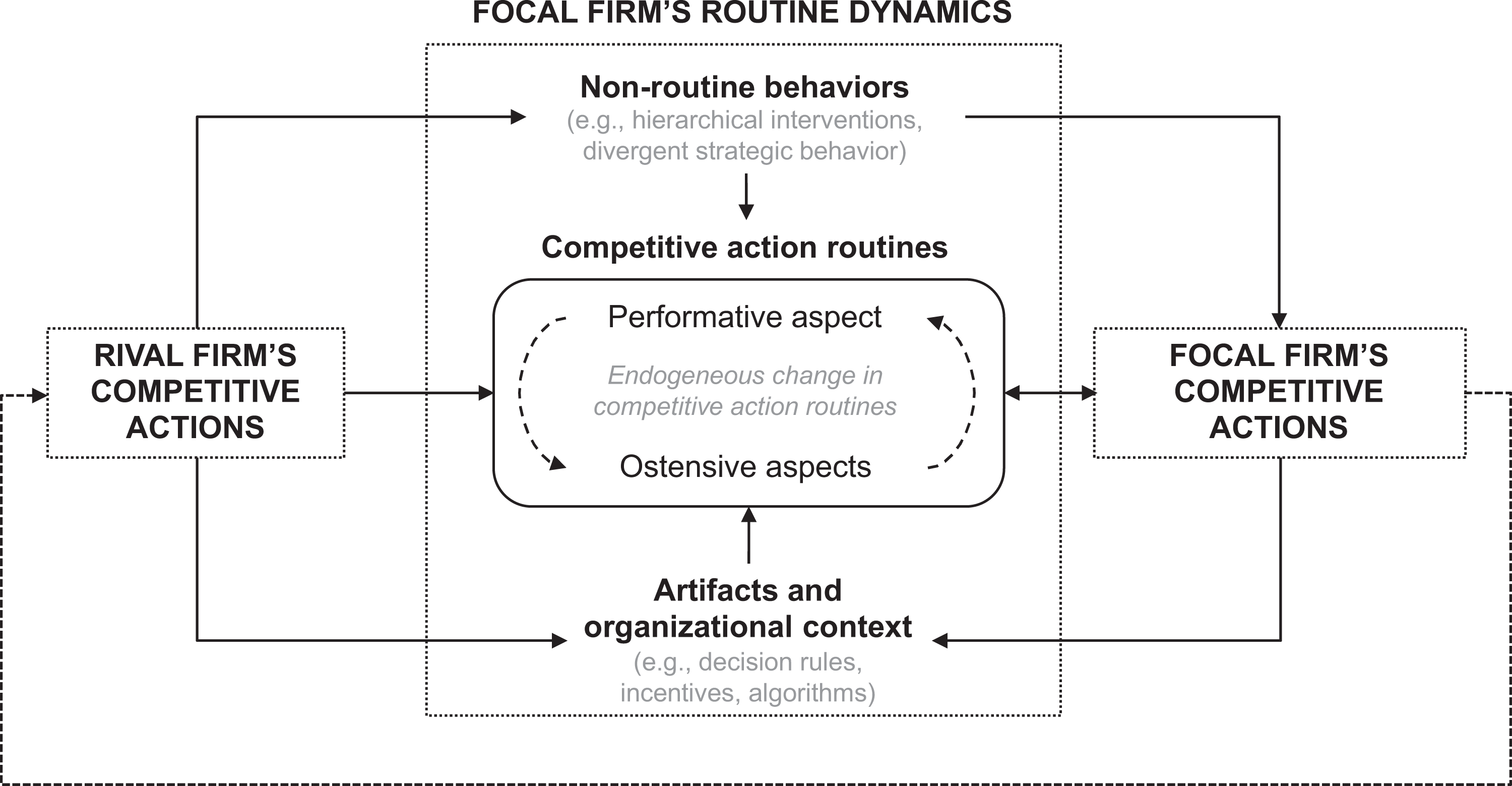
Competitive action routine-based view of interfirm rivalry.
Managers can seek to intentionally induce patterns of competitive behavior in the organization by creating and modifying artifacts and the organizational context of competitive action routines. Such actions may be motivated by feedback from earlier moves (e.g. Salvato, 2009) as well as by observations concerning rival behavior (e.g. a rival’s increasing competitive activity, knowledge of a rival’s competitive action routines). Artifacts include standard operating procedures, formal decision rules and policies, as well as temporal structuring devices such as annual clocks (Orlikowski and Yates, 2002). Artifacts articulate particular viewpoints on what routines ought to be performed as well as how, when, and with what consequences (D’Adderio, 2008, 2011; Glaser, 2017). Moreover, computer software and (artificial intelligence) algorithms are increasingly incorporated within competitive action routines. Examples include pricing algorithms used by hotels and airlines, as well as algorithms related to selecting, targeting, and displaying digital advertisements (e.g. search engine ads). Beyond the trivial role of non-human agents as performers of specific tasks within a routine, information technology also shapes how human actors perceive and perform their role in competitive action routines (Jarzabkowski et al., 2016), and how routines change over time (Murray et al., in press).
The organizational context refers to formal and informal features of the organization where the competitive action routine is embedded. The organizational context includes espoused strategic goals, communication channels, role definitions, incentive schemes, key performance indicators, and administrative processes. Managers may try to influence the organizational context with the intention of affecting competitive action routines. For example, by incorporating specific key performance indicators (e.g. customer satisfaction or loyalty, market share) into employees’ bonus schemes, managers can indirectly influence what competitive moves are performed and how, which will subsequently influence how and what kinds of competitive action routines develop. Rules pertaining to appropriate use of communication channels, or to the amount of discretion that can be exercised in certain decisions, can have similar effects.
The distinction between routine behaviors and non-routine behaviors is primarily a conceptual one, rather than a stable ontological divider, since in our view context- and perspective-free demarcation criteria for “routineness” cannot be unequivocally established. Non-routine behaviors include “hierarchical interventions” (Jacobides, 2007) by senior managers and potentially “divergent strategic behaviors” (Tarakci et al., 2018) by middle managers. They may trigger the performance of specific competitive action routines or affect competitive actions directly. Consider, for example, a chief executive officer (CEO) who becomes concerned about an acquisition by a rival. In an effort to nullify the potential competitive threat, the CEO can direct the mergers and acquisitions department to begin the search and screening for similar acquisition targets. Also, other top management team (TMT) members, or middle managers that know about the acquired company’s technology or markets may be involved in championing (Mantere, 2005) the possibility of a counter-move. An emerging commitment to a competitive response may subsequently cause several competitive action routines to be performed (e.g. target identification, target prioritization, due diligence), and ultimately lead to the focal firm performing a counter-acquisition (Keil et al., 2013).
Implications
Our conceptual model of the routine-based view of interfirm rivalry has important implications for competitive dynamics scholarship. First, the routine-based view of interfirm rivalry expands the range of actors that should be considered in competitive dynamics research. Scholars have traditionally conceptualized competitive dynamics as a form of interaction between company CEOs or between TMTs. It is the CEO “who is most directly responsible for orchestrating firm action” (Marcel et al., 2010: 123). As a consequence, psychology has played an important role in competitive dynamics research alongside with the classical economics focus. In existing research, the rest of the organization enters the competitive arena almost as an afterthought, once top managers have decided what moves they wish the company to make. This kind of thinking is evident, for example, in the AMC framework (Chen et al., 2007).
Inspired by Feldman (2015: 317) and Jarzabkowski and Bednarek (2018), we maintain that it is potentially misleading to make a priori claims about the most important actors in competitive maneuvering. Instead, the routine-based view instructs us to investigate the role of different organizational members in the context of specific competitive moves. Individuals’ participation in competitive conduct occurs through (a) their participation in the performance of competitive action routines, (b) their actions that create or modify the artifacts and the organizational context of competitive action routines, and (c) their non-routine behaviors. This conceptualization points to a more inclusive view of who is driving the firm’s competitive behavior, and limits the amount of agency we can assume any individual or group of individuals to have. In many cases, the role of senior managers is to engage in creating and modifying artifacts and the organizational context of competitive action routines, rather than to be directly responsible for the firm’s moves. In other words, senior managers engage in “design performances” (Glaser, 2017) and exercise “architectural leadership” (Kollenscher et al., 2017) to drive change in competitive action routines. However, even the creation and modification of artifacts and the organizational context of competitive action routines will often involve middle managers and specialists who have a better grasp of the specifics of the competitive landscape and of the requirements of certain competitive moves (Winter, 2006).
Second, the routine-based view of interfirm rivalry challenges the traditional conceptions of routine-based rigidity and predictability related to competitive behavior. At the level of individual competitive action routines, the possibility of improvisation and endogenous change is ever-present. Indeed, creative and mindful contributions to specific routine performances are often not only possible but also necessary because managers’ articulations concerning what ought to be the routine are always incomplete (D’Adderio, 2011). Top managers might view and describe competitive action routines as repetitive and predictable, but from the point of view of the organizational members performing them, the situation may look different. It is also possible that individuals performing specific competitive action routines might be describing their work as standardized and repetitive, even if their actual performances are highly varied and tuned to the situation at hand (Danner-Schröder and Geiger, 2016). Different views of repetitiveness or sameness relate in part to differences in the temporal granularity of attention (Bansal et al., 2018). Finally, the outputs of competitive action routines can be highly innovative and novel from the point of view of outside observers (e.g. customers or competitors), despite their apparent sameness to some inside observers.
At a higher level of aggregation, competitive action routines constitute a complex, multi-layered constellation. The way in which collections of competitive action routines come together in specific competitive situations is not automatic, but also an effortful accomplishment (Kremser et al., 2019). “Managerial enactment” (Grand and Bartl, 2019) of routine configurations in specific contexts (D’Adderio, 2014) explains why any apparent stability or predictability at the routine-level need not manifest as rigidity or predictability at the firm-level competitive actions or action patterns. For example, consider that a firm makes a non-routine decision to acquire a company in order to attack a competitor’s business. Such a move may come as a total surprise to the market. Even in such cases, however, the firm may be able to rely on the routines that it has developed for acquisitions based on its prior acquisition experience. A firm may routinize specific phases or aspects of the competitive action process, which can be deployed in various ways that allow for significant competitive flexibility and surprise (cf Ferrier, 2001: 865).
Third, the routine-based view of interfirm rivalry adds nuance to our understanding of managerial cognition in competitive action. The existing literature tends to frame competition as a conscious and deliberate cognitive process. Although competitive dynamics scholars also point to the existence of cognitive biases (Zajac and Bazerman, 1991), different levels of strategic intelligence in competitive action (Levine et al., 2017), and that perceptions of rivalry may differ from “‘objective’ market conditions” (e.g. Kilduff et al., 2010), competitive moves are assumed to be the result of conscious reasoning (Tsai et al., 2011) by senior managers.
The routine-based view affords two important extensions to our understanding of the role of managerial cognitions in interfirm rivalry. The first extension is that the strength and temporal distance of the association between managerial cognition and competitive moves can vary quite dramatically, depending on the role of the focal manager in the process of performing a competitive action. For instance, if a manager is a participant in a pricing routine that involves monitoring and responding to changes in competitors’ prices, their cognitions about competition are rather directly reflected in the firm’s pricing behavior. If, however, a (senior) manager is in a role of designing competitive action routines, their cognitions may have a large impact on the firm’s competitive behavior but it will take some time for the cognitions to produce observable effects on competitive behavior. There are also many situations where management’s deliberations and cognitions pertaining to competition do not play a central role in explaining competitive actions. For example, a hotel’s yield management routine can produce a reduction in room pricing simply because there is a change in the demand data which is fed into a yield management algorithm that supports pricing decisions (see for example, Metters et al., 2008). Causally, the pricing move may be a response to a rival’s marketing campaign, which produces a change in the demand signal, but the price change is not necessarily cognized as a competitive response by the involved managers.
The second extension is that competitive action routines also shape cognitions about competition. The existing literature suggests that organizational resources are a key factor that affect which rivals managers pay attention to and whose actions they are motivated to counter (e.g. Gómez et al., 2017; Porac et al., 1989; Uhlenbruck et al., 2017). We argue that managerial judgments about resource similarity and strategic groupings of firms are in part shaped by the firm’s competitive action routines. In general, performances of organizational routines shape organizational members’ understandings of “how the organization operates” (Feldman, 2003: 748). Competitive action routines, then, may affect understandings of how the organization competes, which in turn shapes the relative salience of different competitors in the market. The landmark study by Porac et al. (1989) shows how Scottish knitwear manufacturers’ routines of market information acquisition, as well as their production techniques (routines), shaped whom the managers saw as their rivals. In our parlance, competitive action routines were a key factor shaping how the knitwear manufacturers conceptualized their competitive landscape.
Fourth, the routine-based view of interfirm rivalry offers new insights on how firms become aware, motivated, and capable of making competitive moves. Few would probably question that competitive action routines contribute to a firm’s capability to take action (e.g. Chen, 1996). Competitive action routines can be said to afford managers options to execute specific moves (Winter, 2003). However, the literature does not give clear indication of how competitive action routines shape awareness and motivation. Some scholars argue that routines reduce awareness of the competitive environment (Miller and Chen, 1996; Smith et al., 2001), while others argue the opposite (see also Chi et al., 2010; Smith et al., 1991). The literature does not directly address the role of routines in shaping motivation, but the general ethos is that routines reduce firm-level motivation to act (e.g. Ferrier, 2001; Hughes-Morgan et al., 2018; Miller and Chen, 1994).
The routine-based view suggests that blanket statements about the directional impact of competitive action routines on any of the AMC components are hard to defend. A more granular analysis is required. For instance, market research, competitor analysis, and other (routinized) forms of competitive intelligence are related to organizational attention to specific competitive opportunities or threats (Chi et al., 2010; Smith et al., 1991). Whether those routines increase or decrease awareness in particular circumstances depends on the specifics of the routines. Performance monitoring and appraisal routines affect motivation to take action by influencing what lessons managers draw regarding past moves (e.g. Luoma et al., 2017). Again, the directional impact on motivation depends on past performance, not only on whether such routines are in place or not.
Moreover, the routine-based view highlights the distributed nature of competitive cognitions (awareness) and motivational heterogeneity within the firm. Competitive action routines shape how individual cognitions and motivations aggregate to firm-level awareness and motivation by affecting the degree and mechanisms of organizational members’ participation in the firm’s competitive decision-making. Furthermore, as noted earlier, competitive action routines reflect “truces” between the differentially motivated actors who are involved in competitive decision-making. Accordingly, while certain competitive moves (e.g. small price changes) may be performed without much negotiation, others (e.g. large price changes) may be more difficult to perform, because the implied departures from the routine pattern of behavior may jeopardize tacit truces among organizational actors (Zbaracki and Bergen, 2010), thus reducing the motivation of the organization to perform a competitive move.
Finally, the routine-based view of interfirm rivalry invites broadening the methodological repertoire of competitive dynamics research. Most theorizing about competitive interaction is based on analyses of secondary data regarding competitive behavior and performance. A typical methodological approach is to examine panels of firm-years or firm-quarters and test hypotheses based on such data. However, throughout this essay we have highlighted the various routine-related processes, some of which unfold gradually over time, which may undermine correlation-based research designs that implicitly assume rapid organizational dynamics.
While calls to expand the methodological repertoire of competitive dynamics have been made before, the routine-based view amplifies them. Routine scholars building on practice theories tend to advocate participant and non-participant observations, because retrospective analyses tend to lose the idiosyncrasy and dynamism associated with routines. Such studies of competition remain rare (Jarzabkowski and Bednarek, 2018) and would represent an important direction for future research. Vaara and Lamberg (2016) suggest that historical methods might also complement ethnographic methods in the study of social practices. This could be a suitable methodological approach for competitive dynamics scholars as well (e.g. Lamberg et al., 2009). Computational methods (e.g. Sharapov and Ross, 2019) could be applied to study the evolution of competitive action routines over time. For students of the (social) psychology of competition, experiments (e.g. Luoma et al., 2018) might prove useful because experimental designs allow manipulating away the confounding effect of competitive action routines. Finally, to the extent that competition is the product of relatively enduring competitive action routines, one might also be able to apply machine-learning algorithms to predict competitive moves, even when the routines themselves cannot be observed.
Conclusion
We have sought to advance the conversation in the competitive dynamics scholarship through the rich literature on organizational routines. In addition to routine scholarship enriching competitive dynamics research, competitive dynamics research may offer a context to enhance our understanding of routine dynamics and a lens to examine how routine dynamics shape strategic outcomes. We argue that competitive action routines are central to our understanding of how firms compete. Yet, the existing competitive dynamics literature has given organizational routines only limited attention. To the extent that routines are discussed in competitive dynamics research, scholars tend to rely on simplistic conceptualizations that ignore the major advances made in routine scholarship over the past two decades. This body of literature shows that the evolution and impact of organizational routines can only be understood by examining the situated actions of organizational members designing and performing routines as well as the artifacts and organizational context that influence the design and performance of organizational routines. Building on these insights, we elaborate on the routine-based view of interfirm rivalry. Our conceptualization of competition has a strong affinity with the emerging, practice-based view of competing. Approaches such as the routine-based view and the SAP literature can help us deepen our understanding of how competing is accomplished within organizations in terms of situated sayings and doings. We hope that the routine-based view of interfirm rivalry that we propose here helps in advancing these efforts.
Footnotes
Acknowledgements
The authors would like to thank the editor, Paula Jarzabkowski, and two anonymous reviewers for helpful feedback during the review process.
Declaration of conflicting interests
The author(s) declared no potential conflicts of interest with respect to the research, authorship, and/or publication of this article.
Funding
The author(s) received no financial support for the research, authorship, and/or publication of this article.
