



Abstract
This study integrates the attention-based view with Edith Penrose’s theory of growth to examine how the interplay between managerial attention and newly created technological resources influences firm growth. I draw upon research showing that combining broad types of knowledge during R&D creates new technological resources that are potentially valuable, and also relatively complex and ambiguous, making them challenging to utilize effectively. I theorize that attention’s temporal orientation shapes how managers understand complex technologies and construe opportunities for their use. I hypothesize that a shorter-term attentional focus is incongruent with broad knowledge combination, resulting in a less effective and more incremental use of newly created, complex technologies and lower levels of growth. Conversely, a longer-term attentional focus helps managers understand and identify novel, strategic opportunities for such complex technologies, leading to comparatively higher levels of growth. Analysis supports these predictions using a panel data set of 327 firms between 2003 and 2017.
Keywords
Introduction
The attention-based view (ABV) articulates how attention influences firms’ adaptation to changing competitive environments (Nadkarni and Barr, 2008; Ocasio, 1997) and specifies how an organization’s structure and processes channel attention and shape a firm’s strategic agenda and emergent strategy (Ocasio, 2011). Despite its significant contribution to strategy research, however, there exists only a relatively small and recent body of work explicitly connecting the ABV to the growth of the firm (Joseph and Wilson, 2018). This is somewhat surprising, given that growth is a core strategic question to both academics and executives 1 (Ahlstrom, 2010; Davidsson and Wiklund, 2017; Porter and Kramer, 2011). Although research has established that attention influences a variety of organizational processes that may contribute to multiple dimensions of firm growth, including the identification of strategic opportunities (Shepherd et al., 2017), the development of new products (Chen and Nadkarni, 2017; Li et al., 2013), and the creation and subsequent deployment of resources (Eggers and Kaplan, 2013; Helfat and Martin, 2015), there have been limited efforts to directly connect attention and growth.
This study addresses this gap by exploring the relationship between attention and organizational resources in the context of firm growth. Specifically, it draws on a relatively underexplored aspect of the ABV that emphasizes the effects of the relationship between attention and internal resources on a firm’s value creation efforts. As Ocasio (1997) concluded in the initial articulation of the ABV, “a full understanding of competitive advantage and firm heterogeneity requires that we integrate an attention-based view of the firm with resource and industry perspectives to develop a dynamic theory of business strategy and value creation” (p. 205). This study builds on this argument by connecting the ABV with aspects of Edith Penrose’s seminal theory of the growth of the firm (Penrose, 1959). Although Penrose is influential for her conception of the firm as a “bundle of resources” (Rugman and Verbeke, 2002), her theory of firm growth placed emphasis on the joint importance of management and resources (Foss, 1999; Mahoney, 1995). At the core of her theory is the assertion that growth is driven by a dynamic interplay between available “non-managerial” resources within the firm and management’s subjective interpretation of how such resources should best be used in the pursuit of growth (Penrose, 1959).
I use the ABV as a rich theoretical foundation to expand our understanding of management’s interplay with firm resources as described by Penrose. A basic proposition underpinning my study is that the relative congruence between characteristics of managerial attention and an organization’s resources within this interplay drives growth. To explore this proposition, I integrate two bodies of research and identify particular firm resources and characteristics of managerial attention that may work together to influence growth. The first body of research that I draw upon suggests that knowledge combination during R&D influences important qualities and characteristics of a firm’s newly created technological resources, 2 including their potential scientific and competitive value. The second body of research is related to attention’s temporal orientation and the strategic implications for how managers understand the uses of available resources and identify opportunities in their environment depending on whether they focus attention on the shorter versus longer term.
Substantial theory and research suggest that a central driver of economic growth is the creation of new technological resources that contribute to new products and services and facilitate greater productivity (Bottazzi et al., 2011; Guarascio and Tamagni, 2019; Romer, 1990; Schumpeter, 1942). Similarly, the strategic management literature recognizes that R&D efforts and the subsequent creation of new technological resources have substantial implication for a firm’s competitive performance (He and Wong, 2004; Jansen et al., 2006; Teece, 2016). To examine the effect that a firm’s new technological resources have on its growth, this study considers knowledge combination within a firm’s R&D efforts. Innovation is often described as a process of combination (Arthur, 2009; Hargadon and Sutton, 1997; Romer, 1990) and research suggests that the manner in which different domains of knowledge are combined affects the characteristics of an organization’s newly created technological resources (Fleming, 2001; Katila and Ahuja, 2002; Yayavaram and Ahuja, 2008).
Specifically, I focus on important characteristics of a firm’s new technological resources influenced by the breadth of distinct knowledge domains combined during a firm’s R&D efforts. Breadth is an important dimension of knowledge combination that impacts the characteristics of a firm’s new technological resources. Technological resources that are created by combining greater numbers of different knowledge domains are more likely to be applicable across a broad range of issues and opportunities (Trajtenberg et al., 1997), more distinctive in nature (Miller et al., 2007; Schoenmakers and Duysters, 2010), and more radical in their departure from the status quo of existing solutions (Kneeland et al., 2020; Xiao et al., 2022). Moreover, combination of a broad range of knowledge domains is associated with more commercially valuable technological resources (Kaplan and Vakili, 2015), and firms that create new technological resources by combining wider ranges of knowledge have persistently higher levels of profitability (Hirshleifer et al., 2018).
Despite considerable evidence of numerous potential benefits of new technological resources that result from broad knowledge combination, the connection between such resources and firm growth is less clear, and research indicates that the relationship between new technological resources and firm growth may be contingent on organizational and managerial factors (Coad, 2009; Knott, 2008). One such managerial factor, in which attention plays a critical role, is how effectively managers understand the potential uses for available resources within the firm and identify suitable opportunities to match them with perceived opportunities in the market (Chen and Nadkarni, 2017; Eggers and Kaplan, 2013; Kaplan, 2008). The ability of managers to understand specific resources and identify the right opportunities for their use may be particularly crucial in the case of newly created technological resources derived from broad knowledge combination. Although such resources are potentially valuable to the firm, they are also relatively complex and their applications are not immediately understood at the outset (i.e. ambiguous) (Dougherty and Dunne, 2011; Grandori, 2010; Snowden and Boone, 2007). Under conditions of broad knowledge combination, the heightened complexity and ambiguity of such new technological resources requires more managerial effort and understanding to use effectively (Dahlander et al., 2016; Teodoridis et al., 2019; Xiao et al., 2022), and variation in the focus and distribution of attention may be particularly important in determining the extent to which new technological resources are effectively used to achieve growth.
Temporal orientation of top management’s attention is a salient aspect of attention that is likely to influence the manner in which new technological resources are used for growth. In this article, temporal orientation is defined as the extent to which attention is focused on shorter- versus longer-term goals, opportunities, issues, and priorities (Bluedorn, 2002). Temporal distance from the future is a fundamental dimension of how individuals construe their environment and weigh the benefits and costs of actions (Trope et al., 2007). The importance of the temporal aspect of attention is further reflected in its centrality to a firm’s strategy, where managers seek to prioritize and sequence their activities to achieve their goals (Ancona et al., 2001; Hambrick and Fredrickson, 2005), and the extent to which managers are focused on the shorter versus longer term is a critical element of how they identify opportunities and weigh the potential value of investments (Souder and Bromiley, 2012; Venkatraman, 1989). Management’s temporal orientation is particularly important in the context of innovation, which is characterized by higher degrees of uncertainty and fewer immediate results (Flammer and Bansal, 2017), suggesting that temporal orientation may play a significant role in how effectively firms utilize their newly created technological resources for growth.
Building on Penrose’s theory emphasizing interplay between managerial and firm resources, I theorize that the temporal orientation of top management’s attention is particularly relevant to understanding how new technological resources derived from broad combinations are used, making attention effectively act as a brake or accelerant to growth (Starbuck, 1965). Because broad knowledge combination is associated with more complex, less easily understood, but potentially valuable technological resources, I posit that a shorter-term attentional orientation will be associated with lower levels of growth relative to a longer-term attentional orientation. A relatively shorter-term orientation leads to more specific and complex understanding of new technological resources (Liberman et al., 2002) and prioritization of more incremental opportunities (Knudsen and Levinthal, 2007), where managers have less tolerance for the lack of definable, immediate returns (Laverty, 1996; Lee et al., 2023; Marginson and McAulay, 2008). Such a shorter-term temporal orientation is incongruent with effectively using the complex and ambiguous technological resources created through broad combination. Conversely, a longer-term attentional orientation is comparatively congruent with these technological resources. Managers who are more focused on the longer term have a greater appetite for risk, may understand a wider range of uses for these new technological resources, and may identify more novel and distant opportunities, allowing them to match new technological resources to those opportunities in a way that generates significant value (Gavetti and Levinthal, 2000; Sagristano et al., 2002; Sull and Eisenhardt, 2015). I hypothesize that this congruence between a longer-term attentional orientation and using technological resources created by broad knowledge combination, relative to incongruence between using similar technological resources and attention having a shorter-term orientation, is associated with comparatively higher rates of growth.
This study tests and finds support for my prediction using ordinary least squares regression. To assess the relative temporal orientation of managerial attention, measures are constructed based on quarterly earnings call transcripts between 2003 and 2017, and utilize an established dictionary of temporal vocabulary to calculate the extent to which attention is distributed along the shorter- versus longer-term continuum. To measure the breadth of knowledge combination utilized in the creation of new technological resources I use a data set connecting patents granted by the United States Patent and Trademark Office (USPTO) to specific firms. This sample consists of 327 public firms in the United States that actively invested in R&D and patenting activities between 2003 and 2017, for a total of 3403 firm-year observations. The measure of breadth reflects the unique number of knowledge classes that are combined when generating new patents (technological resources). Growth measures as well as additional firm- and industry-level control variables are derived from data from COMPUSTAT. Results are robust to several alternative specifications.
This article makes several contributions. First, it links the joint role of attention and resources in the process of firm growth. Specifically, it seeks to further integrate the ABV with Penrose’s theory of growth. Building on recent work by Joseph and Wilson (2018), who explicitly connected the ABV with Penrose, this article expands the role of attention in the growth process further to include its relationship with resources, which are a core component of Penrose’s theory. In doing so, it also contributes to the long noted theoretical importance of the relationship between attention and resources in the ABV (Ocasio, 1997), which is a topic that has received limited empirical investigation and explicit theorizing. Second, this article highlights the importance of the temporal focus of attention in the ABV. Temporality is a fundamental, albeit understudied, dimension of attention (Brielmaier and Friesl, 2022; Lee et al., 2023) and the results of this article suggest that a major aspect of temporality—the extent to which managers focus on shorter- or longer-term time horizons—plays an important role in influencing how managers interpret uses and opportunities for resources. Finally, by highlighting new technological resources, this research also informs our understanding of the impact of managers’ attention and temporal orientation on innovation and new technological resources (Cooper et al., 2022; Flammer and Bansal, 2017), particularly with respect to the strategic value of broad combination.
Literature and theory review
Although firm growth is a major concern for executives and a core question in strategic management (Coad, 2009; Nason and Wiklund, 2018; Penrose, 1959), there has been limited research on the effects of attention on the growth of the firm. Scholars have documented the relationship between attention and a number of strategic processes and outcomes for firms that may ultimately lead to growth, such as efforts to adapt to environmental change (Cho and Hambrick, 2006; Joseph and Ocasio, 2012; Nadkarni and Barr, 2008; Vergne and Depeyre, 2016), a firm’s competitive aggressiveness (Nadkarni et al., 2016), and the development of new products and capabilities (Eggers and Kaplan, 2013; Helfat and Peteraf, 2015; Li et al., 2013). Yet, the question of how the distribution and focus of managerial attention influences growth has rarely been the subject of explicit study. A notable exception to this—which makes the most direct connection between the ABV and growth—was the investigation by Joseph and Wilson (2018) of how levels of attentional specialization and integration affect both the way in which new issues are processed and how firms grow their organizational structure. In linking the information-processing dimension of attention with this process of architectural elaboration, Joseph and Wilson make an important connection between the ABV and Edith Penrose’s theory of firm growth.
In her seminal Theory of the Growth of the Firm (1959), Penrose (1959) posits that management plays a critical role as growth is the result of “a truly ‘dynamic’ interacting process” (p. 5) between managers’ perceptions both of new opportunities in the market and of the firm’s capacity to configure and deploy existing resources toward those opportunities. Drawing from the ABV, Joseph and Wilson (2018) argue that attention, having an essential role in managerial information-processing, contributes to the subjective managerial “image” of the world that drives choices associated with the use of available resources and ultimately growth in Penrose’s theory.
It is important to note that the role of managerial interpretation has received less scrutiny than several other components of Penrose’s theory of growth (Foss, 1999). Most notably, Penrose’s conceptualization of a firm as a bundle of resources has justifiably been closely associated with the resource-based view of the firm (Barney, 1991; Rugman and Verbeke, 2002). However, in Penrose’s original work, the discussion of resources is consistently theorized in the context of the services such resources could render based on the experience and perceptions of managers (Kor et al., 2016). The role of management is recognized directly in the literature on the “Penrose effect,” where firms grow rapidly in one period and then are constrained by limited managerial and organizational resources in the next (Shen, 1970; Tan and Mahoney, 2005; Uzawa, 1969). However, her pointed emphasis on the formation and influence of managers’ subjective interpretation remains less examined. This emphasis on the strategic consequences of heterogeneity in how managers process information is similar to a central argument in the ABV, which is that the differences in the focus of managerial attention are a crucial determinant of differences in firm behavior (Ocasio, 1997). Consequently, both Penrose and the ABV share a common theoretical perspective stressing the importance of managerial cognition and the importance of variation in how managers interpret their worlds. By incorporating attention into Penrose’s theory, I seek to contribute to a better understanding of the basic dynamic between management and resources in the broader process of firm growth.
Specifically, this article extends the theoretical connections between the ABV and Penrose by considering how an organization’s technological resources—which are central to Penrose’s argument (Cantwell, 2000)—work in concert with management’s temporal orientation to impact firm growth. The interest in developing a deeper theoretical understanding of the relationship between management and resources is reflected in several bodies of work in strategic management. Research in dynamic capabilities (Helfat and Peteraf, 2015; Teece, 2007), resource orchestration (Sirmon et al., 2011), and managerial cognition (Eggers and Kaplan, 2013) all emphasize that performance outcomes depend on the joint effect of managerial judgment and the nature of a firm’s underlying resources and capabilities. However, the role of attention is often only implicit in these theories, and the outcome of interest is not necessarily growth. It is notable that the original articulation of the ABV ends with an explicit call to better integrate attention with theory regarding firm resources (Ocasio, 1997: 205), but to date, there has been limited empirical or theoretical work on the ABV that considered such integration. Although studies, such as Vergne and Depeyre’s (2016) analysis of how aspects of attention and capabilities work together to facilitate adaptation, research has provided surprisingly few insights into how attention and resources combine to inform strategic outcomes, including growth.
A detailed example that provides a particularly helpful illustration of the strategic importance of the relationship between attention and resources is Ocasio and Joseph’s (2018) qualitative case study of Apple’s and Motorola’s simultaneous competitive efforts to successfully innovate in the digital mobile phone space. Their comparative analysis found that at the outset, both Apple and Motorola possessed similar prerequisite technological resources to successfully create a highly competitive mobile phone; however, the two firms had different distributions and focuses of attention. Apple’s structure of executive attention was distributed broadly across functions and key activities, which facilitated their holistic understanding of how their existing technological resources should work together, allowing them to coordinate and integrate these resources to successfully launch the iPhone in 2007. In contrast, Motorola’s top management had a much more fragmented and narrow attentional focus and they ultimately failed to deploy their technological resources in their mobile phone development efforts as successfully as Apple. Ocasio and Joseph’s study illustrates how attention and resources work in concert to drive strategic outcomes, highlighting core arguments that I make in this article. Apple’s attention proved congruent with its technological resources, resulting in substantial firm growth, while at Motorola, incongruence between attention and technological resources hindered efforts to grow and compete successfully in the mobile space.
Broad knowledge combination and the creation of complex technological resources
Considerable research has established that technological innovation is often a fundamental driver of economic growth (Coad, 2009; Landes, 2003; Romer, 1990; Schumpeter, 1942). The crucial role of innovation extends to the strategic management literature, where findings suggest that an organization’s innovative efforts have substantial influence on performance, strategic position, and competitive advantage (Jansen et al., 2006; Raisch et al., 2009; Teece, 2007). Innovation has been characterized as a process of combining existing knowledge to create something novel (Arthur, 2009; Hargadon and Sutton, 1997; Schumpeter, 1942). At the level of the firm, this has led to long-standing interest in the differences in how elements of technological knowledge are combined during an organization’s R&D efforts (Fleming, 2001; Grant, 1996; Henderson, 1992), with research suggesting that differences in how knowledge is combined are associated with systematic variation in the nature and characteristics of the firm’s newly created technological resources (Argyres and Silverman, 2004; Carnabuci and Operti, 2013; Savino et al., 2017; Yayavaram and Ahuja, 2008).
This article focuses on knowledge breadth, or the number of different domains of knowledge that firms combine during their innovation efforts when creating patents as a new technological resource (Xiao et al., 2022). Broad knowledge combination reflects a firm’s capacity to combine a large and potentially diverse number of different ideas and types of knowledge during R&D, forming connections between domains of knowledge that are not typically brought together (Leiponen and Helfat, 2010) and increasing the likelihood of generating novel and valuable inventions (Hirshleifer et al., 2018). A wide breadth of knowledge combination results in the creation of a greater variety of new technological resources (Rosenkopf and Almeida, 2003), which have a greater likelihood of radically departing from existing technological paradigms and being particularly distinctive in nature (Schoenmakers and Duysters, 2010; Xiao et al., 2022). Scientifically, a firm’s new technological resources are more likely to have a larger impact, garnering more successful patents and higher rates of citation (Almeida and Phene, 2004; Kneeland et al., 2020; Miller et al., 2007) and beyond the scientific value broad knowledge combination creates new technological resources with strategic implications for firms. When a larger number of knowledge domains are combined, inventions are also more likely to be generally applied across numerous scientific fields, increasing their complexity and influence (Trajtenberg et al., 1997). Patents characterized by broader combinations of knowledge have also been associated with greater commercial value (Kaplan and Vakili, 2015), and firms that combine larger numbers of distinct knowledge domains in their patents have been associated with higher value and more persistent levels of profitability (Hirshleifer et al., 2018).
Despite this extensive body of research documenting consequences and benefits of new technological resources derived from broad knowledge combination, scholars have found an inconsistent empirical relationship between innovation and growth at the firm level (Coad, 2009). These findings are somewhat surprising, given the strong theoretical connections between innovation and economic growth (Romer, 1990; Schumpeter, 1942). Although several explanations are possible for such inconsistent findings, other research has suggested that this tenuous connection between innovation and firm growth can be explained by variation in the capacity of individual firms to utilize their new technological resources effectively (Cooper et al., 2022), and that managerial and organizational factors weigh heavily on the extent to which firms can capitalize on innovative outcomes in their efforts to grow (Knott, 2008).
Penrose’s theory points to the importance of managerial interpretation of resources and opportunities in determining the extent of firm growth. While this process of interpretation is particularly salient in the case of new technological resources (Teece, 2016), where variation in what managers focus their attention on can lead to substantial differences in how firms respond to, adapt, and employ new technologies (Eggers and Kaplan, 2013; Kaplan, 2008; Tripsas and Gavetti, 2000), managerial interpretation may be especially significant under conditions of broad knowledge combination. Technological resources created through broad combination incorporate multiple different domains of knowledge, making them more complex (Simon, 1962) and posing distinct challenges for managers (Dougherty and Dunne, 2012). Complex technological resources are often associated with a wide range of plausible uses (Snowden and Boone, 2007; Trajtenberg et al., 1997) and the conditions under which they are successful can be fragile (Pisano, 2006). This makes identifying suitable opportunities difficult. Predicting the economic outcomes of complex technologies is challenging (Grandori, 2010), as their best use may not be immediately obvious (i.e. ambiguous) and it may take longer to determine whether the resource was successfully utilized (Dougherty and Dunne, 2011). This suggests that the ways in which firms deploy new technological resources may be particularly sensitive to variations in managerial attention and may subsequently lead to variations in levels of organizational growth.
Congruence between temporal attention and new technological resources: a theoretical connection with firm growth
In Penrose’s theory, the range of services
3
derived from even the same resource is a result of subjective interpretations on the part of management (Foss, 1999; Mahoney, 1995). Thus, for Penrose, as management’s attentional orientation varies, the same resources can be used in different ways and to different effect. As she explains, This kind of heterogeneity in the services available from the material resources with which a firm works permits the same resources to be used in different ways and for different purposes if the people who work with them get different ideas about how they can be used (Penrose, 1959: 76).
As theory in strategic management has developed considerably since Penrose, there has been increasing focus on the importance of how variation in managers’ subjective interpretation of their resources and environment is an important driver of heterogeneity in the identification of plausible sets of strategic actions (Csaszar and Levinthal, 2016; Gavetti and Levinthal, 2000; Walsh, 1995). The ABV emphasizes the role of attention in how managerial schema and interpretations are formed and their implications for firm strategy, highlighting the importance of variation in the focus of attention in explaining variation in strategic behavior.
More recently, research has emphasized the importance of subjective managerial interpretation in the process of how managers match available resources with opportunities in their environment (Eggers and Kaplan, 2013). This process has two related components. The first is how managers understand potential uses for their available resources, as different managers may look at the same technological resource and envision its use in different products or services (Danneels, 2011; Eggers and Kaplan, 2013; Taylor and Helfat, 2009). The second is the number and nature of opportunities in the environment managers can identify, where differences in managerial focus and perceptions can lead to recognition of different sets of opportunities, which may vary in quality (Barr, 1998; Kaplan et al., 2003). Managers who form more effective understanding of their resources and identify a more suitable range of potential opportunities with which to match these resources are better positioned to find success and drive growth via the delivery of new goods and services to customers and markets (Ahlstrom, 2010; Baumol, 2014; Cantwell, 2000).
Given the complexity and ambiguity of new technological resources created through broad combination, the process of understanding potential uses and identifying opportunities may be particularly difficult (Dougherty and Dunne, 2011; Grandori, 2010; Snowden and Boone, 2007). Broadly, I posit that attention plays an important role in the process of how managers interpret resources and opportunities in pursuit of growth. First, attention influences how managers learn and understand effective uses of their available resources, particularly with respect to new technological resources created through the R&D process (Greve, 2017; Ocasio et al., 2020). Second, attention also influences where to apply new technological resources, as attention contributes to the different types of opportunities managers are likely to recognize and pursue (Joseph and Wilson, 2018; Shepherd et al., 2017).
Beyond the general relationship between attention and the characteristics of new technological resources, I theorize that the temporal orientation of top management is a particularly salient dimension of managerial attention in the context of growth. The question of temporality has been the subject of considerable research in strategic management, where time is viewed as a central construct in the study of how organizations function and a basic driver of how firms and managers understand their world (Ancona et al., 2001; Bansal et al., 2022; Chen et al., 2021; Orlikowski and Yates, 2002). Although the concept of time has implications for many dimensions of organizations, it is particularly relevant to core strategic questions of the pacing of decisions, actions, and deployment of resources that a firm pursues to realize its goals and pursue opportunities (Hambrick and Fredrickson, 2005; Penrose, 1959; Porter, 1996).
Temporality is therefore especially important for key decision makers, whose perception of time influences how they interpret strategic choices and weigh the value of potential investments (Wiesenfeld et al., 2017). Variation in managerial perceptions of time has significant implications for a range of key strategic activities, such as planning (Das, 1987), change efforts (Kunisch et al., 2017), and risk-taking (Nadkarni et al., 2016). Although the importance of how managers allocate their attention to different time periods has been noted in the literature (Shipp et al., 2009), scholars have only recently begun explicitly addressing questions of temporality in the ABV (Brielmaier and Friesl, 2022; Lee et al., 2023).
For the purposes of this article, temporal orientation refers to the extent to which managers allocate their attention across shorter- and longer-term horizons. Questions of the antecedents and consequences of shorter- and longer-term focus for organizations and managers have been a subject of sustained scholarly attention (Bluedorn, 2002; Chen et al., 2021; Laverty, 1996; Lee et al., 2023). Research has previously noted the persistent short-termism of managers (Laverty, 1996), which leads to the prioritization of more immediate goals and opportunities and underinvestment in projects that may not see quick returns but may be valuable in the longer term (Bushee, 1998). Indeed, there is good reason to think that managers default to a shorter-term attentional orientation given that they face numerous immediate demands from organizational channels and processes, including formal yearly planning requirements (Hayes and Abernathy, 1980), the day-to-day pressures of the stock market (Bushee, 2001), and cost–benefit analyses biased toward the near-term cost of capital (Jacobs, 1991). The tendency toward shorter-term focus is particularly problematic with respect to investments in innovation, which are characterized by higher up-front costs and uncertain payoffs (Jalonen, 2012; Miller, 2002; Zahra and Nielsen, 2002).
Building on this line of argument, I posit that in the case of new technological resources derived from broad combination, a shorter-term attentional orientation will lead to less growth than a longer-term attentional orientation when knowledge combination is broader. This comparative congruence between a longer-term orientation and these new technological resources is driven by temporal attention’s influence on both how managers understand uses for their available resources and how managers identify opportunities in the environment.
Research suggests that variation in temporal orientation is likely to lead managers to develop different understandings of the same new technological resources. A shorter-term orientation often prompts individuals to focus more on concrete aspects of a situation (Nussbaum et al., 2006), which may be poorly suited for understanding the ambiguous, novel, and complex technological resources derived from broad combination. Specifically, when individuals are faced with numerous possibilities, such as those offered by new technological resources generated by broad combinations of knowledge, they are often more constrained in their decision-making (Iyengar and Lepper, 2000), and detailed mental representations can exacerbate this tendency (Sull and Eisenhardt, 2015). Shorter-term focus creates a relative myopia (Lee et al., 2023), generating a more restricted and potentially conservative set of uses for these new technological resources, which may mitigate their potential value to the firm.
Conversely, longer-term attentional orientation is likely to be more congruent with using technologies stemming from broad combination, where a longer-term attentional perspective may encourage deeper managerial understanding and ultimately more effective use of complex, ambiguous, but potentially valuable technological resources for growth. Specifically, a greater focus on the long term facilitates the development of simpler mental schema of the world (Nussbaum et al., 2006). Research suggests that simplicity of a manager’s mental schema is effective to an extent that is contingent on the complexity of the situation, where simple schema are more effective under conditions of complexity and higher levels of novelty (Csaszar and Ostler, 2020), such as those characterized by technological resources created through broad combination.
Moreover, there is evidence that a longer-term orientation will also help make managers more effective at learning about new technological resources. A longer-term orientation increases individuals’ willingness to learn about unfamiliar subjects (Reyt and Wiesenfeld, 2015), think more broadly and flexibly about possible solutions (Sull and Eisenhardt, 2015), and increase creative problem-solving (Liberman and Trope, 1998; Polman and Emich, 2011). Extending this theory and research to predict how managers will understand their available resources based on the focus of their temporal attention suggests that a longer-term focus will facilitate a broader range of possible uses, increasing the likelihood these new, complex technological resources will be effectively utilized for growth.
There is also reason to predict that the manager’s temporal orientation may influence their tendency and ability to identify and understand market opportunities to match with new technological resources. Shorter-term time horizons often lead managers to identify more myopic or familiar opportunities and solutions, which may result in more incremental movement from a current strategic position (Knudsen and Levinthal, 2007; Levinthal and March, 1993). This incrementalism is further reinforced by a shorter-term focus contributing to a preference for lower risk (Sagristano et al., 2002) and a tendency toward hyperbolic discounting, where managers prioritize known and immediate rewards even if their potential value is lower than more distant alternatives (Ainslie, 1975; O’Donoghue and Rabin, 1999; Thaler and Shefrin, 1981) Therefore, while shorter-term orientation creates conditions that may be incongruent with the lengthy and time-consuming process of developing and deploying new technological resources in general (Flammer and Bansal, 2017), these conditions may be exacerbated when a focus on the shorter-term confronts the more ambiguous, complex technological resources that stem from broad combination.
Conversely, a longer-term focus facilitates the identification of distant opportunities from a firm’s current position and product offerings (Augustine et al., 2019; Gavetti and Levinthal, 2000; Logue and Grimes, 2022). Executives with greater focus on the future are more cognizant of new trends and customer needs (Chandy and Tellis, 1998), which may provide a greater range of possible opportunities for new technological resources that have multiple potential uses (Brown and Eisenhardt, 1997). The fact that greater focus on the distant future also facilitates an increased appetite for risk is particularly important (Sagristano et al., 2002), as the complexity of these new technological resources often means that it takes a longer time to understand and realize their value (Dougherty and Dunne, 2012; Schilling and Shankar, 2019). All of this taken together implies that a longer-term orientation may lead to identifying a wider range of opportunities in the environment for new technological resources created from broad combination, increasing the likelihood of effectively using such resources to find new sources of revenue and growth (Ahlstrom, 2010).
This collective body of theory and evidence suggests that the allocation of managerial attention’s orientation across the shorter and longer terms has significant implications for how managers understand resources and identify potential opportunities for their use. Variations in temporal orientation will have implications for both the understanding managers form of plausible uses for new technological resources as well as the nature of opportunities that managers may identify in the environment for those resources to be matched to. I hypothesize that a shorter-term attentional orientation is less beneficial for growth efforts than an attentional focus on the longer term when either temporal condition is accompanied by new technological resources resulting from broad combination.
H1: When new technological resources are created through a process of broader knowledge combination, such resources will be incongruent with a shorter-term attentional orientation, resulting in comparatively lower levels of growth relative to those same technological resources and their congruence with longer-term temporal orientation.
Empirical approach
Data and sample selection
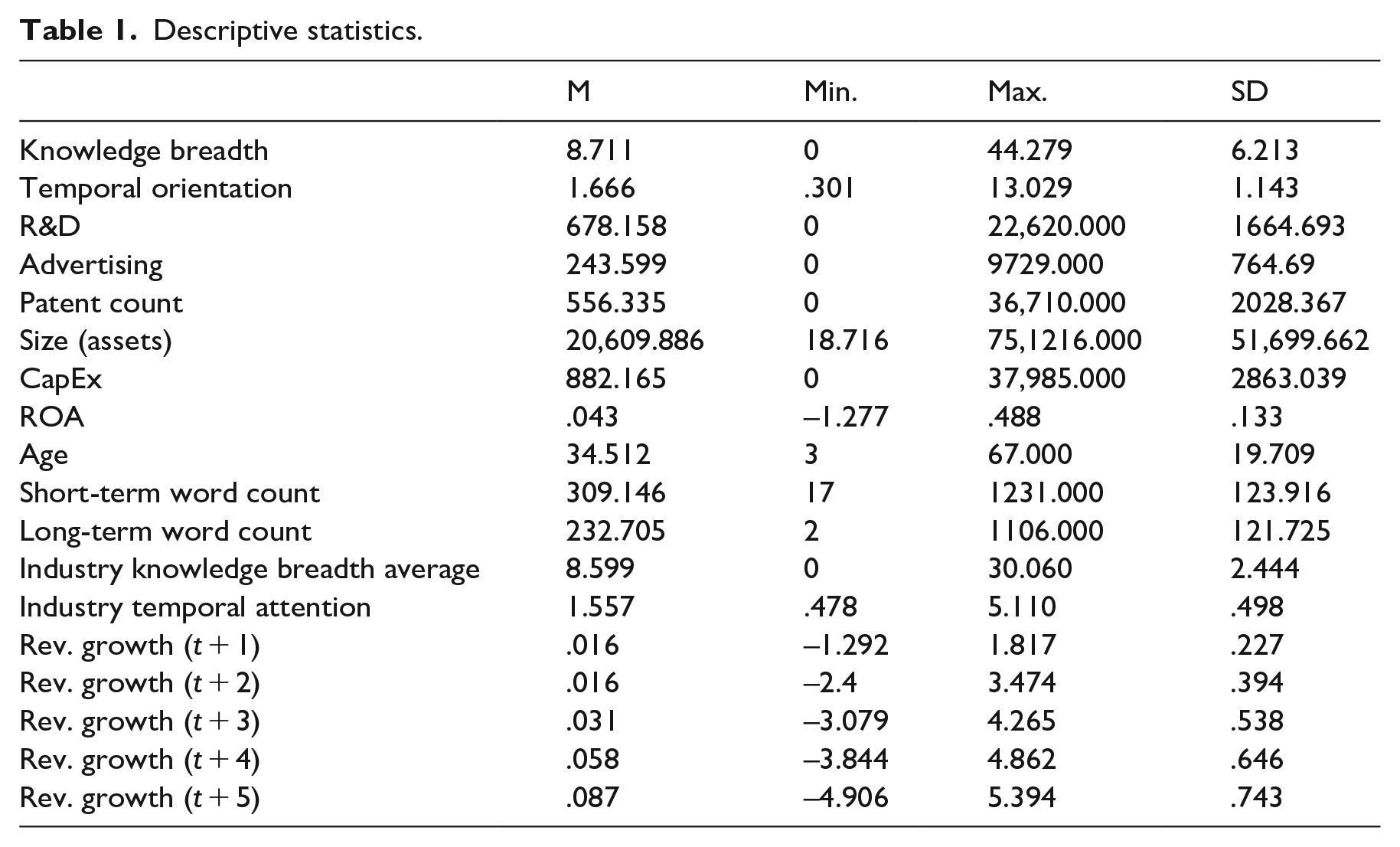
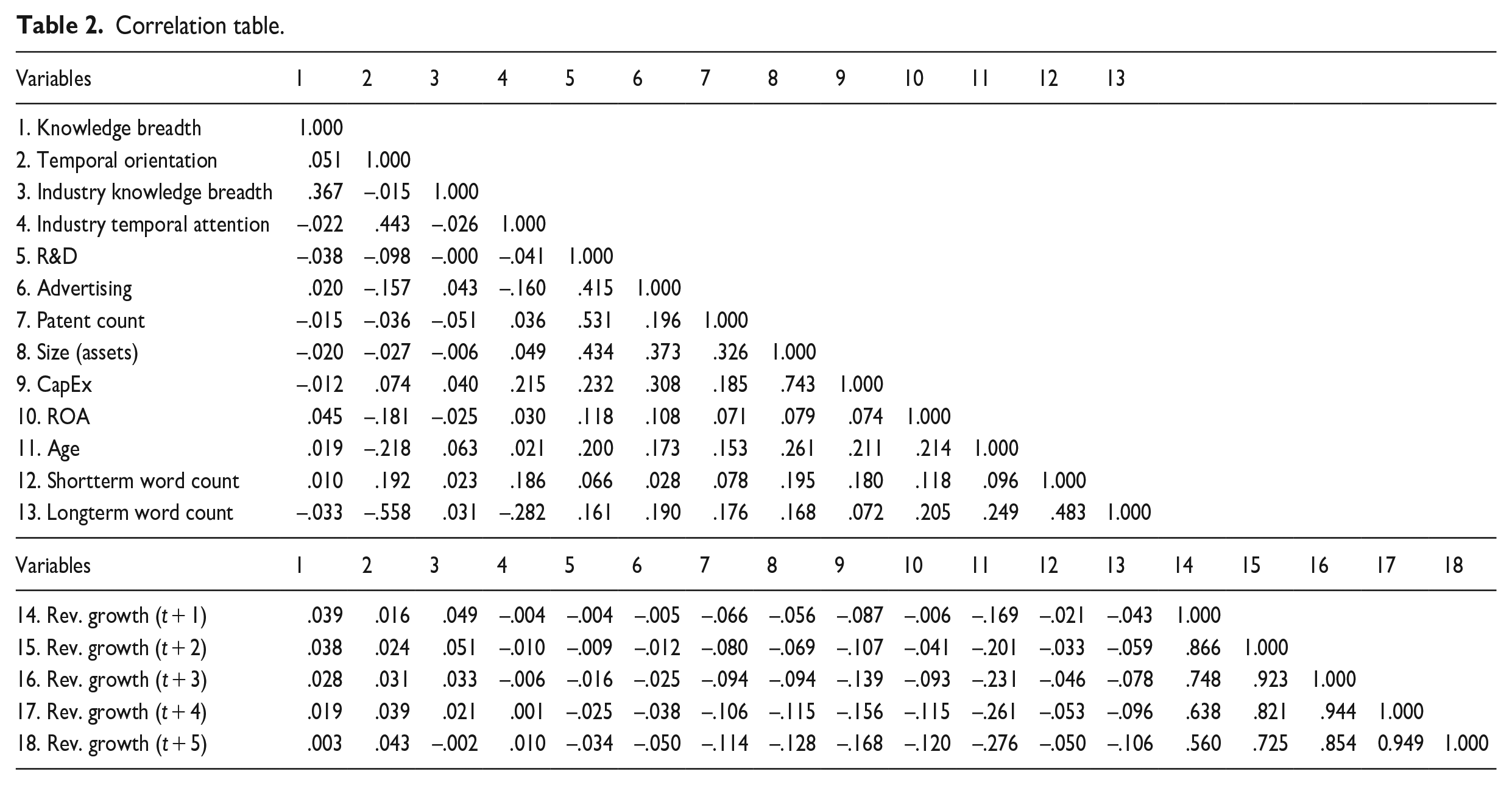
I use multiple data sources to construct the sample: COMPUSTAT, the patent database from the USPTO, and Investext. The COMPUSTAT variables provide data on revenue growth as well as firm and industry control variables. The USPTO patent data provide the basis for measurement of firm knowledge combination by connecting firms to the patents granted to them, as well as information on the number of different technological classes cited by a given granted patent. Finally, I collect transcripts of quarterly earnings calls from Thomson Investext to measure the short- and long-term focus of managerial attention. The final sample consists of 327 firms between 2003 and 2017, for a total of 3403 firm-year observations. These are publicly traded firms with either recorded R&D spend or at least a single patent. Tables 1 and 2 show descriptive statistics and correlations for independent, dependent, and control variables. Distributions for variables can be found in Appendix Item 1 (Supplemental material).
Descriptive statistics.
Correlation table.
Measures—dependent variables
Growth
To measure firm growth, I focus on revenue growth. Revenue is a standard measurement in the growth literature (Weinzimmer et al., 1998). It is particularly related to the launch of new products and services that are facilitated by new technological resources and which may expand or deepen the customer base and create new sales (Ahlstrom, 2010). In robustness tests, I consider alternative forms of growth, such as employment and asset growth. I calculate the raw percentage change in revenue growth by subtracting the log transformation of revenue in year t from the log transformation of a smoothed average of revenue from years t, t–1, and t–2 (Lee and Kang, 2007), which helps account for sudden changes in revenue due to M&A activity or one-time events. In addition, because the sample consists of multiple industries and extends across 14 years, I utilize an established measure of revenue adjusted growth (Bottazzi et al., 2011; Capasso et al., 2014) that helps address industry-related size differences, sectoral growth rates, and the possibility of common shocks and general economic factors, such as business cycles and inflation (Higson et al., 2004). This measure is constructed by subtracting the industry log revenue from the logarithm of each firm’s revenue

where S is the size of the firm (measured in revenue), and N is the number of firms in industry J to which firm i belongs in time t. This means that

Measures—independent variables
Attentional temporal orientation
Attentional temporal orientation is the extent to which top management teams in firms focus on shorter- versus longer-term issues and objectives. The measure for temporal orientation is derived from transcripts of quarterly earnings calls. These calls are increasingly used as a source of insight into firm behavior in both the management literature (Nadkarni et al., 2016) and the finance and accounting literature (Chen et al., 2018), including for research on managerial temporal focus (DesJardine and Bansal, 2019). Moreover, the National Investor Relations Institute’s best practices instruct companies to contextualize a given quarter’s results with both near- and long-term goals.
At times, a firm may explicitly discuss their immediate temporal priorities. An example of this is Boston Scientific reassuring investors that “these litigation settlements do not change our short-term strategy” or Walmart communicating that “we increased our short-term borrowing of commercial paper to ensure we had a buildup of cash in place for accounts payables due to the system’s transition to SAP.” Similarly, longer-term attentional focus is often reflected in explicit discussion of more distant issues. For example, Amazon stated, “We haven’t changed our long-term view about what the model can be” or “with a $10 billion business . . . it’s going to take some number of years before they [new businesses] become meaningful.” At other times, firms discuss both immediate and longer-term issues, as Cisco did when they laid out what we believe is driving our current growth, as well as what we think will be the key factors that we expect should allow us to continue to maintain a solid long-term growth rate over the next three to five years.
The measure for attentional temporal orientation is based on a dictionary developed by Brochet et al. (2015). The dictionary was created through manually reading and coding transcripts of earnings calls, and it has the benefit of being derived from the particular vocabulary and norms of those calls. See Appendix Item 2.1 for a full list of the words for the shorter- and longer-term categories (Supplemental material). The measure relies on a simple word count, where the total word count for shorter-term vocabulary is divided by the total word count for longer-term vocabulary. The words are counted at the quarterly level for each transcript

where f is a given firm in year t, and the ShortTerm and LongTerm word counts for firm f are summed across the previous six quarters. Therefore, if a firm’s attentional patterns are equally focused on shorter- and longer-term issues, goals, and priorities, then there will be a score of 1. Higher numbers indicate more of a short-term focus; lower numbers indicate more of a long-term focus. As a ratio, the variable captures the relative distribution of attention across the temporal horizons in the same time period. This reflects the limited nature of attention and the need for managers to attend to both shorter- and longer-term issues simultaneously. The ratio allows for testing the comparative hypothesis in a single interaction, where a higher score for attentional temporal orientation and knowledge breadth is predicted to be associated with lower revenue growth.
This measure of attention is created using the trailing six quarters of year t, which captures the patterns of managerial attention leading up to the final firm performance for the fiscal year. Table 1 shows the mean score for temporal orientation is 1.66, or a ratio of 1.66 shorter-term words for every longer-term word. The maximum score is 13. It is notable that there is a significant amount of within-firm variation (0.68 SD) and between-firm variation (0.9 SD) in the data set, indicating that temporal orientation is redistributed by the same firms. I winsorize the data at the 1st and 99th percentiles, and standardize the variable. As with the combinatory variables, I standardize variables for the purpose of the regression.
Knowledge breadth
Knowledge breadth captures the extent to which firms can integrate and combine distinct domains of technological knowledge when generating new products and services. I use the method of counting distinct technological classes used by Hirshleifer et al. (2018). Knowledge breadth measures the average number of classes a firm combines per patent. Knowledge breadth is calculated using USPTO data on patents that firms were granted. When patents are submitted to the USPTO for review, they cite previous patents, which have been assigned primary and secondary technological classes by patent examiners. These technological classes form the basis for the knowledge breadth variable. Consistent with prior work, I utilize three-digit technology classes (Li et al., 2014).
To generate the score of knowledge breadth at the firm level, the first step is calculating ClassCount, the total number of unique technological classes per patent that a firm is granted in a given year (see Appendix Item 2.2 for a more detailed explanation of the variable, Supplemental material)

where i is a patent issued to firm f in year t.

By basing the calculation for knowledge breadth at the level of granted patents, the measure reflects the ability of a firm to combine and integrate knowledge within a single new technological resource (i.e. the patent). Looking at the average number of unique classes per patent helps control for outliers with higher numbers of technological citations as well as for the tendency of some firms to produce a large number of patents. The mean knowledge breadth score is 8.71, with a standard deviation of 6.2. In addition, because the sample includes knowledge breadth scores of 0, I transform this variable with a square root transformation. The variable is standardized for the purpose of regression.
Controls
I include a variety of controls at the firm, industry, and year levels that may influence revenue growth. Dummy variables are included for each year to account for annual effects. At the firm level, I control for size (total assets) as well as capital expenditure, advertising spend, and R&D budget (all logged-transformed). I also control for firm age, as that is a particularly important variable in predicting firm growth (Coad, 2009). In addition, I include a control for the number of patents a firm is granted in the previous 5 years, which matches the window of time used to calculate knowledge variables. The measurement of temporal orientation is a ratio between longer- and shorter-term word counts. To capture the extent of attention dedicated to the issue of time, and to address concerns about ratio variables in regressions, I control for the word count for both the shorter- and longer-term vocabulary used to calculate the overall temporal orientation score (Certo et al., 2020). I also include firm fixed effects to account for time-invariant firm features that may influence growth. Furthermore, to account for industry variation in attention and knowledge, I control for industry averages of temporal orientation and knowledge use at the level of two-digit SIC codes.
Research design
My main outcome variable of interest is the rate of firm revenue growth. I test the effects of interaction between temporal orientation and knowledge breadth using a panel ordinary least squares (OLS) regression model

where
Results
My hypothesis predicted that growth would be relatively lower when knowledge breadth was higher and temporal orientation was focused more on the shorter term. To test this hypothesis, I ran regressions on revenue growth for each year from t + 1 through t + 5. First, I ran the regression on raw change in revenue for the purpose of interpretability. However, for a more stringent measure and for use in subsequent marginal effects, I used the industry-adjusted revenue growth that presents a more conservative estimate of firm growth relative to a given firm’s percentage change in revenue. 4 Table 3 shows the raw change in revenue and confirms H1, which is that shorter-term attention and higher levels of knowledge breadth are associated with lower growth than longer-term attention and higher levels of knowledge breadth. In year t + 1, there is a 3% (p = .040) penalty to revenue growth; by year 5, it is 4.3% (p = .031). This means that over a 5-year period, standard deviation increases in both knowledge breadth and shorter-term attention are associated with a 4.4 percentage point decrease in revenue growth, relative to higher knowledge breadth and longer-term attention. Table 4 shows the same regression using industry-adjusted growth. In year t + 1, the coefficient is negative at −0.014 (p = .081), and in year +5, the coefficient is negative at −0.069 (p = .017).
Raw revenue growth (DV)—knowledge breadth and temporal orientation.
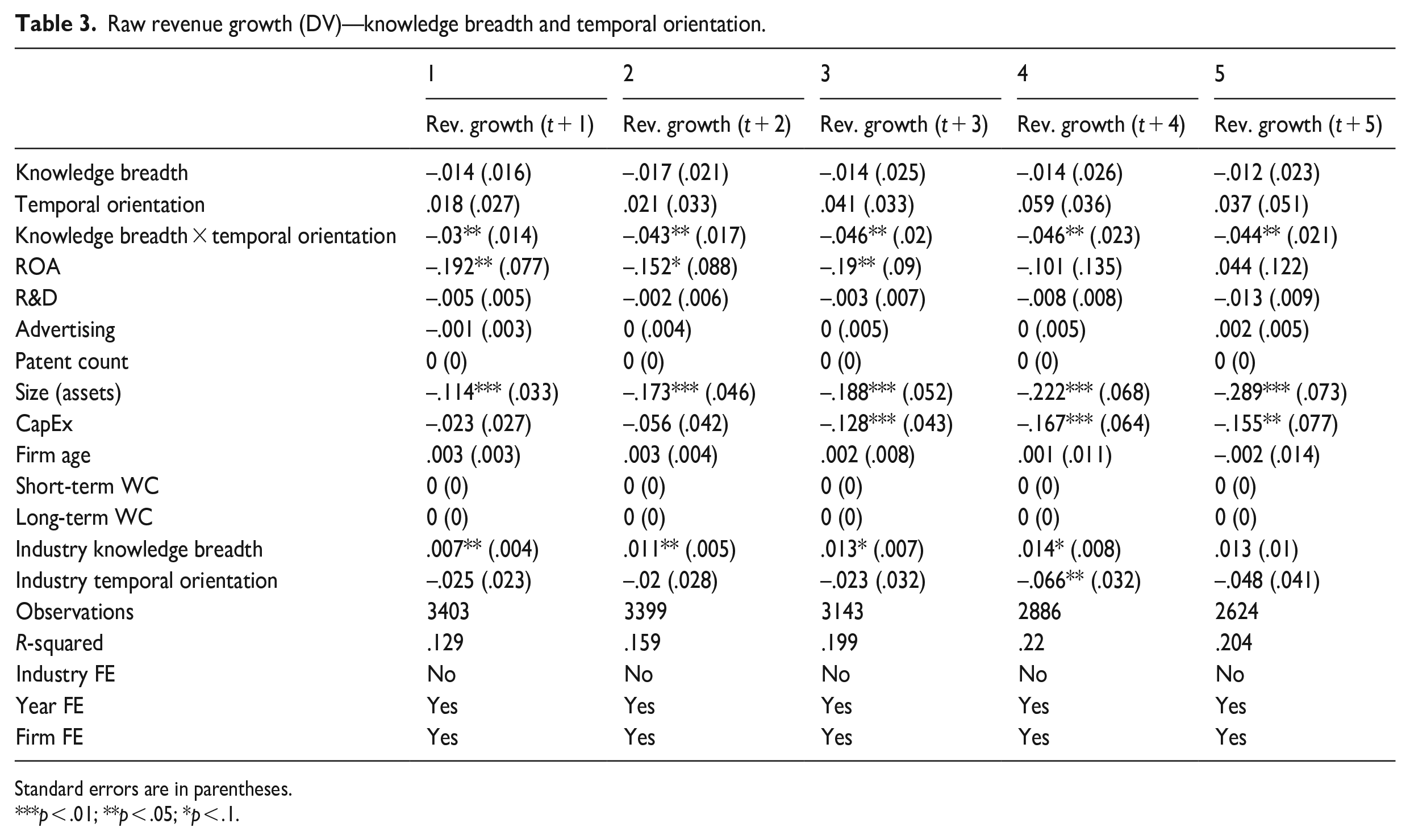
Standard errors are in parentheses.
p < .01; **p < .05; *p < .1.
Regression results: industry-adjusted revenue growth (DV)—knowledge breadth and temporal attention.
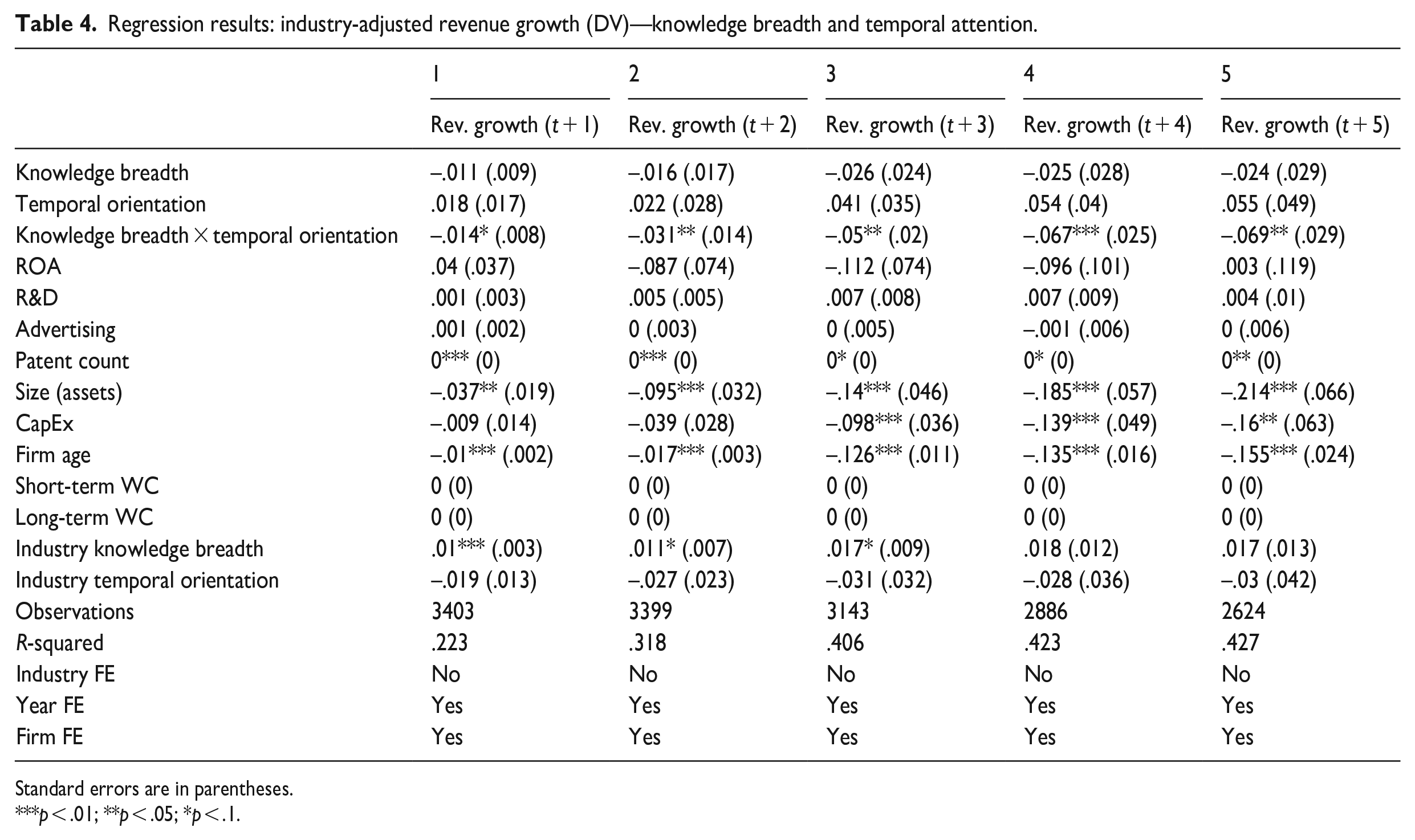
Standard errors are in parentheses.
p < .01; **p < .05; *p < .1.
Figure 1 shows the marginal effects of the interaction documented in Table 4, and more specifically the trend of the relationship between broad combination and different temporal orientations. This marginal effect graph demonstrates further support for H1 in that at higher levels of knowledge combination, shorter-term orientation is associated with lower levels of growth relative to longer-term orientation. In the graph, the trend for short-term attention (1 SD above the average of temporal orientation) decreases as knowledge breadth increases. This suggests potential congruence between narrow combination and shorter-term focus, where technology may be less ambiguous and complex, and is better suited to more familiar and immediate opportunities. Conversely, the trend for longer-term orientation (1 SD below the average of temporal orientation) has an increasingly positive relationship with growth as knowledge breadth increases, supporting the main hypothesis.
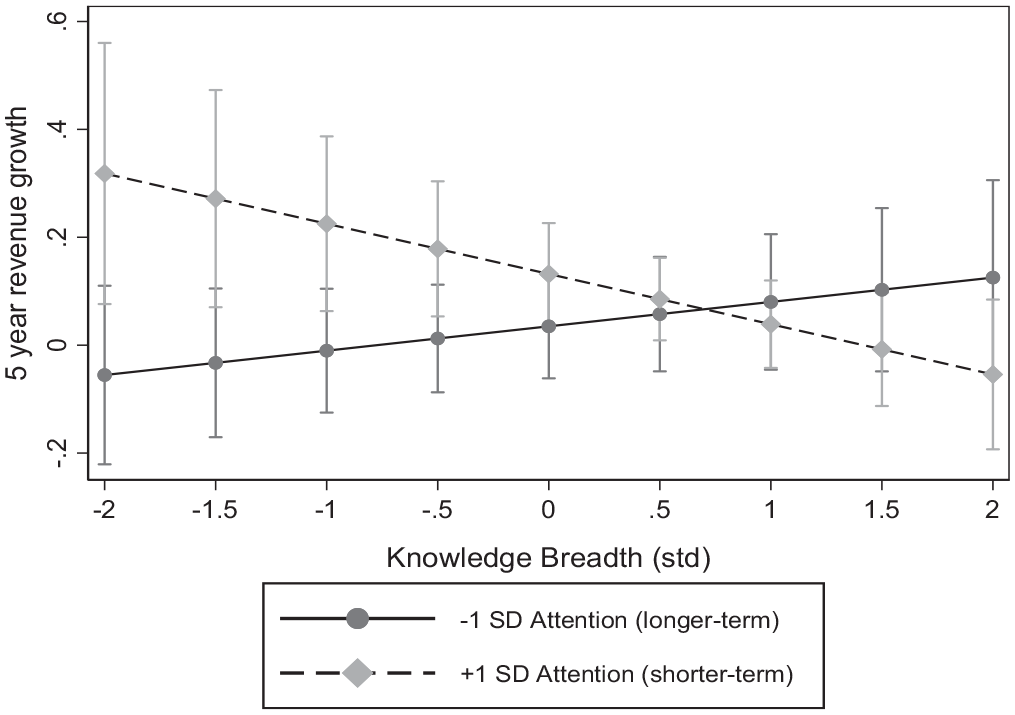
Marginal effects of knowledge breadth and temporal attention on revenue growth.
Robustness and supplementary analysis
I performed several robustness tests and alternate specifications. Results are robust to using industry fixed effects instead of firm fixed effects, indicating that the variation both within and between firms is significant. I also tested the models using alternative windows of time to calculate the attention score. The results are robust to calculating attention at four quarters as well as two quarters and when removing assets and using revenue as a control for size. I ran models of the main effects of attention and knowledge breadth on revenue growth, and as expected there is no main effect for either. To allay additional concerns of autocorrelation, I also ran models controlling for the previous years’ revenue growth, and the results were substantially the same.
As an additional test to isolate the benefits of the breadth of knowledge combination on new products and services and subsequent revenue growth, I constructed measures of both asset and employee growth (Weinzimmer et al., 1998). The interaction between attention and combination variables is not significant for either asset or employee growth, which is not unexpected given the intangible nature of knowledge, and which provides further support for the theorized effects of combination, in particular on enhanced revenue opportunities through new products and services. To test the robustness of my measure of temporal orientation, I logged the main attention variable and results were consistent. I also rearranged the variable to reflect the proportion of words dedicated to the longer term out of all temporal words (e.g. what total share of temporal words were longer-term focus) and again found similar results, where the interaction between a greater share of longer-term attention and higher knowledge breadth is positively associated with revenue growth.
To test the importance of the congruence between longer-term focus and broad combination I employed a second dictionary from DesJardine and Bansal (2019), which captures the extent to which management is focused on the longer term. These results were consistent with the main findings (longer-term focus and higher knowledge breadth is associated with higher growth) and can be found in Appendix Item 3 (Supplemental material). Finally, to better isolate the role of knowledge breadth, I constructed measures for both search depth (exploitation) and search novelty (exploration) (Katila and Ahuja, 2002). These are conceptually distinct from measures of knowledge breadth, which reflects the average breadth of a firm’s set of inventions and does not measure a firm’s search activity relative to its previous efforts, or the extent to which a body of knowledge is familiar or novel for a given firm. Results are robust to the inclusion of depth and novelty as control variables, and results can be found in Appendix Items 4.1 and 4.2 (Supplemental material).
Discussion and conclusion
This article makes several contributions. First, it connects attention more fully to the process of growth. Growth, as a key element of a firm’s value creation efforts, is a central concern in strategic management and to executives, yet it is a topic that the ABV has rarely addressed directly. Recent work by Joseph and Wilson (2018) makes important progress in this regard, linking the ABV to Penrose and highlighting the crucial role of attention in information processing and in the identification of problems and opportunities that spurs important aspects of structural growth. Building on this line of argument, I further integrate the ABV and Penrose by highlighting the core interplay between managerial and firm resources in Penrose’s theory and suggest that attention is a central component of the managerial limit. As a finite cognitive property of managers that influences information processing, attention provides a theoretical perspective that helps us understand the role of subjective managerial interpretation in Penrose’s theory of growth (Kor et al., 2016), and more fully exploring the commonalities and connections between the ABV and Penrose is a promising avenue for future research.
This focus on resources also contributes to work in the ABV. Although the interaction between management and resources is central in Penrose’s theory, research on the ABV has spent little time examining the relationship between attention and resources (Vergne and Depeyre, 2016). Building on arguments in the initial articulation of the ABV (Ocasio, 1997), the findings in this article suggest that we gain a fuller understanding of the relationship between attention and performance outcomes, such as growth when considering dimensions of both attention and the particular resources a firm possesses. These results indicate attention is an important lens through which we can understand the role of management in the utilization of resources, and that the ABV is an important perspective in the burgeoning interest in systematically exploring the connection between managers and resources (Eggers and Kaplan, 2013; Helfat and Peteraf, 2015; Teece, 2016).
A second contribution of this article to the ABV is in highlighting the issue of temporality. Given the centrality of time to strategy (Ancona et al., 2001; Bansal et al., 2022) and given the importance of temporality in the process of how individuals construe their world (Liberman et al., 2002), it is perhaps surprising that the ABV has not thought more explicitly about time. Scholars have called for a concerted effort to better understand the relationship between temporality and attention (Brielmaier and Friesl, 2022), and this article contributes empirical findings that support recent theoretical efforts to do just that (Lee et al., 2023). Moreover, this article extends the theoretical connection between temporality and the ABV by arguing that the distribution of managerial attention across temporal horizons in particular has implications for how managers understand resources and opportunities. It is also important to note that temporal horizons are only one aspect of temporality, and that time is a rich subject with multiple potential avenues for dialogue with the ABV. Other dimensions of temporality—such as urgency and the pacing of decisions (Gevers et al., 2006; Landy et al., 1991)—are important topics where managerial attention may play a significant role. More broadly, the ABV emphasizes the distributed nature of attention beyond top management and across the entire organization. Questions of timing and temporal focus in organization-wide attentional dynamics—such as bottoms up and top down attentional processing (Ocasio, 2011)—provide further opportunity to understand the relationship between attention and firm behavior (Brielmaier and Friesl, 2022; Ocasio et al., 2023; Orlikowski and Yates, 2002).
Finally, this article contributes to the literature on temporal orientation and innovation. Broadly speaking, the empirical results are consistent with recent evidence that longer-term perspectives are associated with more effective investment in R&D and higher rates of growth (Flammer and Bansal, 2017). However, long-term focus by itself is not enough to spur growth. The results support theoretical predictions of Penrose and the ABV, which suggest that management’s information processing and the nature of their resources are important factors to jointly consider. More generally, this article adds to our understanding of managerial and organizational features that influence how innovation and newly created technological resources are strategically used by firms (Cooper et al., 2022). That attention works in concert with new technological resources to spur growth is particularly notable, as innovation and growth are strongly theoretically linked (Landes, 2003; Romer, 1990), but inconsistently empirically observed at the organizational level (Coad, 2009; Knott, 2003). The findings build on the literature connecting attention and the development and utilization of technology (Kaplan, 2008; Ocasio and Joseph, 2018; Tripsas and Gavetti, 2000), but follow Penrose’s core argument of a dynamic interplay between management and resources to focus on the joint effects of both the focus of attention (temporal) and the nature of technology (broad combination) on growth.
This article also has several limitations, which are important to recognize. In this article, I theorize about particular dimensions of both attention and technology, and this limits our understanding of the broader relationship between the two. As mentioned above, there are many other aspects of temporality, which may be relevant to how attention interacts with technology. Similarly, it is important to note that breadth is only one aspect of how knowledge is utilized to create new technological resources, and innovation is only one set of activities a firm performs. An opportunity for future research might be to explore the relationship between temporal attention and alternative dimensions of innovation (beyond knowledge breadth) as well as alternative bundles of firm resources (beyond new technological resources). Likewise, growth is a multidimensional construct, and revenue growth is only one aspect to consider. Future research could examine how the interplay between attention and resources drives other forms of growth. Finally, on an empirical note, it is important to reiterate that this is a causal study. The research design attempts to mitigate some concerns about endogeneity, but this study should conservatively be interpreted as correlational.
Ultimately, this article aims to more firmly bridge the research on the ABV and on firm growth. Growth is a crucial organizational outcome to practitioners, capital markets, and strategic management research. Understanding how technological resources work in concert with attention to drive growth both builds on ideas in the ABV (Ocasio, 1997) and connects the ABV to Penrose’s foundation theory of firm growth (1959). The application of this theoretical integration to particular questions of an attentional temporal orientation, innovation, and newly created technological resources further informs our understanding of these phenomena. All of this suggests multiple avenues for future research about the role that the interplay between attention and firm resources plays in the process of firm growth.
Supplemental Material
sj-docx-1-soq-10.1177_14761270231196213 – Supplemental material for Temporal attention, knowledge breadth, and firm growth
Supplemental material, sj-docx-1-soq-10.1177_14761270231196213 for Temporal attention, knowledge breadth, and firm growth by Dylan Boynton in Strategic Organization
Footnotes
Funding
The author(s) disclosed receipt of the following financial support for the research, authorship, and/or publication of this article: The author received funding from the SRF Dissertation Research Grant.
Author’s note
This research has benefited from the comments of William Ocasio, Edward Zajac, Jillian Chown, JP Eggers, and my editor John Joseph; seminar participants at the Kellogg School of Management, the Ross School of Business, and the Organizational Intelligence and Attention lab at UIUC; and participants at the Strategic Management Society and Academy of Management.

Supplemental material
Supplemental material for this article is available online.
Notes
Author biography
References
Supplementary Material
Please find the following supplemental material available below.
For Open Access articles published under a Creative Commons License, all supplemental material carries the same license as the article it is associated with.
For non-Open Access articles published, all supplemental material carries a non-exclusive license, and permission requests for re-use of supplemental material or any part of supplemental material shall be sent directly to the copyright owner as specified in the copyright notice associated with the article.
