




Abstract
Intercultural competence development has been integrated in the last couple of years in the curricula of many higher education institutions. Recent studies indicate that especially the use of 360-degree videos can help to better comprehend course materials. However, little is known about the psychological processes involved when using this technology for more psychological learning outcomes especially in the field of intercultural competence. Our report aims at better understanding student reactions to a novel use of virtual reality for teaching intercultural competence to international bachelor students at a German university and to shed more light on the role of perceived immersiveness in the student experience. Based on an online survey (n = 77 participants) our results suggest that students found the VR videos engaging with relatively high levels of spatial perception and attentional awareness. Self-reported learning was positively related to both components of immersiveness. Open-ended comments indicated the students appreciated the unique experience of using VR in the classroom despite the VR sickness but some participants desired more active control over the VR experience.
Keywords
Virtual reality (VR) technology is increasingly being used in educational settings, with demonstrated potential for the use of VR in teaching skills and concepts related to history, medicine, social work, foreign language, science, and more (Averbeck et al., 2023; Pirker & Dengel, 2021). The use of VR could revolutionize teaching all around the world and it is therefore important to understand the usefulness of this technology for fostering competence development in students. Therefore, the purpose of the present paper is to examine psychological features of intercultural VR experiences (360-degree videos), namely immersion, spatial presence, and attentional allocation, and assess the role of these features in the learner experience. We also discuss lessons learned from initial application of our teaching method and offer recommendations for improvement and extensions.
Intercultural Competence
Intercultural competence (ICC) is the “ability to communicate effectively and appropriately in intercultural situations based on one's intercultural knowledge, skills, and attitudes” (Deardorff, 2006, p. 194). There are many models of ICC that impact how the construct is addressed in learning situations and how it is measured (Leung et al., 2014; Rokos et al., 2023). We use the cultural intelligence model of ICC (Van Dyne et al., 2015) that has four key components: (a) metacognitive cultural intelligence, (b) cognitive cultural intelligence, (c) motivational cultural intelligence, and (d) behavioral cultural intelligence. Leung et al. (2014) note that cultural intelligence is associated with many important psychological outcomes such as adjustment, well-being, satisfaction, and emotional exhaustion. ICC has become particularly important in higher education recently as work organizations of all kinds have become more internationalized (Akdere et al., 2021; Rokos et al., 2023) and the International Union of Psychological Science includes cultural competence as one of the core competencies in professional psychology (Wei et al., 2021).
We follow Deardorff's process model (2008) of ICC development where all four dimensions of ICC development are connected. Hence, the motivational and cognitive dimensions of ICC can be seen as building blocks toward behavioral learning and initiating another cycle of the ICC Learning Spiral. Diverse experiences and the processing of experiences over time have shown ICC development to be cyclical rather than linear (Moeller & Nugent, 2014; Tennekoon, 2015). The development of ICC can therefore be seen as a life-long endeavor. This process may start in a university classroom where the focus may be on laying the foundation of awareness of cultural differences, building to relevant behavioral change and meta-cognitive strategies for managing responses and behaviors.
Much of the research literature on ICC development in higher education is indeed focused on the foundational and internal elements of ICC. A thorough literature review about ICC assessment between 2000 and 2022 (Rokos et al., 2023) identified four categories of intercultural competencies assessed most frequently (based on the model by Deardorff, 2006) in higher education research on ICC: (a) attitudes such as openness, (b) culture-specific knowledge, (c) internal outcomes such as alteration of perspectives, and (d) external outcomes such as cultivating new relationships. External outcomes were assessed in only three studies in the review (Rokos et al., 2023).
Summing up, ICC can be considered one of the key competencies of the 21st century and is an important learning outcome in higher education all around the world. The most important observable behavioral outcomes of ICC development seem to be underrepresented in research and practice (Rokos et al., 2023). Nonetheless, cognitive and attitudinal outcomes are important as building blocks for more behaviorally-oriented ICC.
VR in Education
VR helps create psychological conditions that are well suited to instructional settings, most notably immersion and attentional control (Averbeck et al., 2023; van Zelderen et al., 2024). The immersiveness of VR technology, defined as “the psychological experience of being ‘present’ in a virtual environment” (van Zelderen et al., 2024, p. 4) helps learners focus on cues of the learning environment that they may not detect if their attention is divided elsewhere. Further, use of VR may enhance learner motivation through novelty and increased interest, leading to more effective learning (Bell et al., 2017; Rosendahl & Wagner, 2024). VR also permits creation of high fidelity environments (van Zelderen et al., 2024) for learning, such that participants feel more like they are truly in the specified location or interacting with individuals depicted in a video rather than only reading about an event or viewing it in two-dimensional video. High levels of psychological fidelity can be achieved in a more cost-effective way when using virtual environments (e.g., Champney et al., 2017) and with reduction of risk to both the learner and other actors in a situation.
Types of VR
There are multiple types of VR stimuli that can be used for educational purposes. 360-degree videos are video recordings of real environments made with special cameras that allow capture of the full 360-degree field of vision, thus allowing viewers to interact with the video and determine their field of view (Rosendahl & Wagner, 2024). These videos can be viewed on a range of hardware resulting in different levels of immersion for the user, with viewing on a head-mounted display providing higher levels of immersiveness than viewing on a mobile phone or computer. 360-degree videos can also result in perceptions of social presence, depending on how the scenarios are filmed (Han et al., 2022). Unfortunately, VR sickness (Biswas et al., 2024) can result from the use of 360-degree videos among a fraction of the population and could result in reduced effectiveness for those users.
Programmed VR applications, such as games and simulations, involve creation of an entirely new environment and are considered by some to be the “true” VR (Pirker & Dengel, 2021; Rosendahl & Wagner, 2024). These programmed applications enable a higher degree of interaction than 360-degree videos, although have been critiqued as having an “unrealistic, cartoonish style” (Shadiev, Yu & Sintawati, 2021). Programmed applications are often more difficult and time consuming to develop, requiring more expertise than recording and editing 360-degree video.
For purposes of this study, we refer to VR as 360-degree videos that are viewed using head-mounted displays. Rosendahl and Wagner (2024) found in their systematic literature review that there are three main purposes for using 360-degree videos in teaching: (1) engaging and motivating presentation of learning content, (2) immersive and interactive theory–practice illustration, and (3) facilitating external and self-reflection (e.g., watching a 360-degree video of one's own performance and reflecting on it). We focus on the first purpose, using 360-degree video for a more engaging and motivating presentation of ICC learning content. We also include some elements of the second purpose, as we help students connect theory and practice through group discussion of video content.
VR and ICC
Features of VR that are useful for education in general can be especially relevant in the context of ICC. VR can help create a more experiential type of learning (Pirker & Dengel, 2021), critical to the development of ICC, while allowing students to learn without traveling to the country of interest. This helps reduce financial resources needed and time required for travel (Akdere et al., 2021; Shadiev, Yu & Sintawati, 2021) and allows students to develop ICC in a safe environment before needing the skills while actually abroad.
Evidence suggests that VR environments can foster the development of ICC, especially at the cognitive level (Akdere et al., 2021; Shadiev et al., 2020). The understanding of foreign cultures and therefore the knowledge dimension of ICC can be improved as participants learn from their observations of the virtual environment (Shadiev, Wang & Huang, 2021). Other research has demonstrated positive impact on participants’ attitudes, skills of discovery and interaction, skills of interpreting and relating to the foreign culture, and intercultural awareness (Shadiev et al., 2024; Shadiev, Yu & Sintawati, 2021; Song, 2019). In a study with 21 students from China and Uzbekistan using student generated 360-degree videos as learning content (Shadiev, Wang & Huang, 2021) most participants perceived VR to be useful for intercultural learning. Another study showed a significant improvement in a behavioral ICC outcome, intercultural conflict mediation skills, after having used 360-degree VR videos (Taguchi, 2023). Furthermore, participants in one study showed a more realistic self-assessment of their ICC (Akdere et al., 2021).
In summary, the current literature has examined the use of 360-degree videos in various formats to teach ICC with some promising results in what are usually small studies. The focus of these studies is clearly on the cognitive and attitudinal dimensions of ICC. However, there is a research gap regarding details of the psychological processes involved when using 360-degree videos. This is important to be able to understand how this technology might be used to foster the development of the other dimensions of ICC (metacognitive and behavioral) in the longer term.
We contribute to this literature by focusing on the psychological immersiveness of 360-degree videos and how perceptions of immersiveness might inform development of more impactful methods for teaching ICC. The following research questions guide our study:
How is immersiveness (spatial presence and attention allocation) in the VR experience perceived by students? How is self-reported learning related to both components of immersiveness? To what extent is VR sickness a concern when using 360-degree videos for ICC instruction?
Method
Research Design
Class Context and Study Participants
The study was conducted in a bachelor-level course on ICC that is part of an international double-degree management program at a German University of Applied Sciences. While this study was conducted in a management course, there are similar courses offered in psychology programs (Wei et al., 2021). Students participate in a series of interactive lectures about culture, ICC, cultural differences in the workplace, intercultural communication, and working in intercultural teams. The study was conducted across two consecutive semesters. In the first semester there were 75 students enrolled in the class representing seven different countries with a gender distribution of 55% male and 45% female. In the second semester there were 26 students enrolled, also representing seven different countries. The gender distribution was 50% male and 50% female.
VR-Based Session
The VR sessions were held in October 2024 and March 2025 with 14–24 students in each session as part of an intensive block week in the module Intercultural Management at a German university. In the 90-min sessions, students engaged in two short VR experiences in the form of two 360-degree videos using Meta Quest 3 headsets. They were first given an introduction to the experience and a short tutorial on using the headsets and controllers. They were then instructed to watch two 360-degree videos: (1) a video created by one of the instructors that included five short scenes depicting a university in India and the city of Bengaluru, and (2) a tour of a European city (Valencia or Dublin) that was produced by a commercial firm and made available for free on YouTube. Students worked in pairs so they could assist one another with the hardware and help prevent each other from colliding with furniture in the classroom or other students. After viewing the videos, students were asked to identify features of the viewed environments and relate them to cultural differences that had been previously discussed in lecture-oriented class sessions. The debriefing and discussion took place in an international group of students. The experiences were discussed first in student pairs, and then with the full group. It was a structured dialogue where the instructors acted as moderators to foster awareness of cultural differences and better illustrate the link between theory and practice.
Procedure and Measures
At the conclusion of each VR session, students were asked to complete an online evaluation in Google Forms. They were informed that completion of the form was voluntary and their responses would be anonymous. No identifying or demographic data were collected. The study followed ethical guidelines and did not require formal review by the Ethics Committee at our institution. The instructional materials and data collected were part of regular course offerings involving normal educational practices. The response rate in the first semester was 70.7% (53/73) and 85.7% (24/28) in the second semester, for a total of 77 responses (overall response rate 76.2%). Because the data were anonymous, we could not test for overall representativeness of the sample but the response rate was high. In order to ensure consistency between semesters, the course content in both groups was identical, the level of student diversity within the groups was similar, the instructors were the same, and the presentation of the VR activity was at the same point in the course.
In the feedback survey, we focused on two key aspects of immersiveness, spatial presence, and attention allocation (Averbeck et al., 2023). Spatial presence was measured with five items from Averbeck et al. (2023). A sample item is “I felt like I was part of the environments shown.” The coefficient alpha reliability was .78. Attention allocation was measured with three items and had a coefficient alpha reliability of .68. A sample item for the attention scale is “I was very focused on the VR content.” We also asked single item questions about student experiences with VR sickness (defined as nausea or headaches), enjoyment, effort required, and learning perceptions. All items were used with a five-point Likert scale (1 = Strongly Disagree, 5 = Strongly Agree). Finally, we included one question requesting open-ended feedback about the session.
Data Analysis
To analyze the data, we first examined potential differences between the two subsamples (semester 1 and semester 2) to determine the appropriateness of combining the two groups. T-tests indicated there were no significant differences between participants in the two different semesters and therefore we combined the two groups into one dataset. We next created scale scores for the multi-item measures (spatial presence and attention allocation), calculated coefficient reliabilities, and calculated descriptives and correlations for all measures (see Table 1). We then conducted hierarchical multiple regression using each learning measure as a separate outcome. Data were analyzed in SPSS version 29.
Means, Standard Deviations, and Correlations.
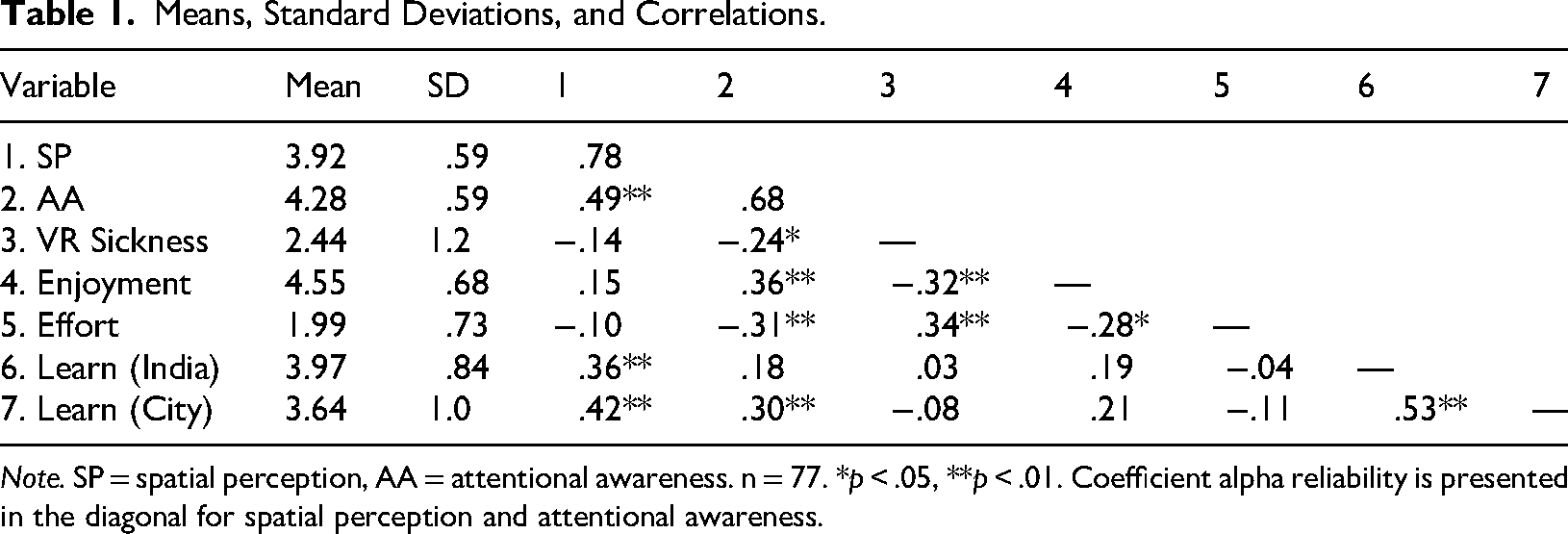
Note. SP = spatial perception, AA = attentional awareness. n = 77. *p < .05, **p < .01. Coefficient alpha reliability is presented in the diagonal for spatial perception and attentional awareness.
Results
Results (see Table 1) suggest that students found the VR videos engaging with relatively high levels of spatial perception (mean = 3.92) and attentional awareness (mean = 4.28), moderate perceived VR sickness (mean = 2.44) and low level of effort required (mean = 1.99). Attentional awareness was positively related to enjoyment (r = .36, p < .01). Self-reported learning was positively related to spatial perception (r = .36 and .42 for India and the chosen city, Valencia/Dublin, respectively, p < .01). Attentional awareness was significantly correlated with self-reported learning for the chosen city (r = .30, p < .01) but not for India, and was negatively related to perceived sickness (r = −.24, p < .05). This suggests that when students felt symptoms of VR sickness they were not able to pay attention as closely. Regression results (see Table 2) suggested that for both learning outcomes, spatial perception was the primary predictor. Enjoyment had the second-largest regression weight but was not statistically significant in either analysis. Open-ended comments and the verbal debriefing at the end of the sessions indicated the students appreciated the unique experience of using VR in the classroom despite the VR sickness but some participants desired more active control over the VR experience.
Regression Results.
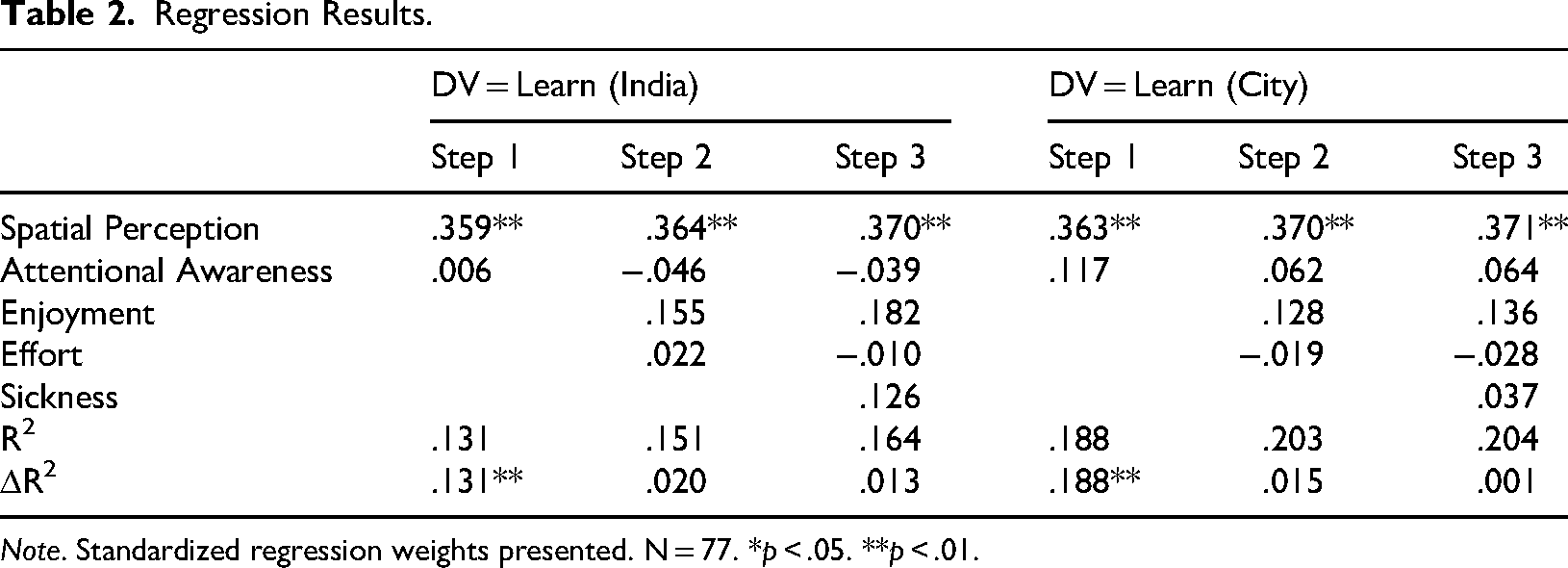
Note. Standardized regression weights presented. N = 77. *p < .05. **p < .01.
Discussion
This research demonstrates one path for better understanding the psychological foundations of using VR technologies to teach ICC. Aspects of immersiveness (spatial perception and attentional awareness) appear to be important constructs for facilitating positive student outcomes from a 360-degree video learning experience about two different cultures, with regression results suggesting that spatial perception was more important than attentional awareness. Immersiveness ratings were relatively high for these videos (3.92 for spatial perception and 4.28 for attentional awareness on a five-point scale) even with the 360-degree video technology chosen rather than the potentially more immersive programmed VR applications. Attentional awareness was positively related to enjoyment reactions, and both aspects of immersiveness were related to self-reported learning. This suggests that VR media and the student viewing experience should be designed with particularly spatial perception but also attentional awareness in mind to maximize learning potential.
Some research has shown that VR does not have an advantage over face-to-face methods in teaching knowledge-oriented outcomes in psychology (e.g., Vincent & Frewen, 2024). The method used in the present example includes aspects of both VR and face-to-face learning, as the sessions were conducted in small in-person groups. This helped provide additional support to the students as many of them were using VR for the first time but may have also created some distractions through the noise generated by other students. Headphones were available to plug into the VR headsets to reduce ambient noise but few students chose to use the headphones. More extensive testing of ICC learning outcomes associated with our 360-degree video instructional format should be conducted.
The relatively high levels of reported VR sickness in this sample are a concern. The causes of such VR sickness are complex and multi-faceted (Biswas et al., 2024), including individual differences, hardware issues, and software issues. We took many of the steps suggested by Biswas et al. to reduce VR sickness, such as reducing active motion in the videos and minimizing exposure time, but participant experience of such VR sickness is not uncommon (Shadiev et al., 2024), even as the quality of the head-mounted displays continues to improve. From our direct observations, some of the adverse reactions could be attributed to insufficient instruction about making sure that the headsets fit properly or the fact that many participants were using VR devices for the first time. More time and instruction should be provided in the sessions for properly fitting the headsets.
Further, a few students were limited in their ability to engage with the VR material because they could not comfortably wear the headsets along with their corrective eyeglasses and could not see clearly without their eyeglasses. We did not have any students with visual disabilities (e.g., blindness), but students with such disabilities would likely be unable to engage in the experience. An alternative activity, such as 2D video on a computer screen, would need to be provided to students unable to participate but the immersiveness would be lower outside of the head-mounted display.
As already noted, most of the students in the sample were using VR for the first time and the novelty was made clear through observing and listening to their reactions. Therefore, the novelty of the experience may have at least partially led to the high enjoyment scores (Bell et al., 2017). If VR technologies become more broadly adopted in daily life, the novelty effect could disappear. This could have advantages for education as more students would already know how to use the technology, but the positive effects of novelty may be lost. Another interesting question for the use of VR in classes like this is about the extent to which the technology should be integrated into the course. Should it be used on a regular basis or on a limited basis? Alternatively, VR could be made available for self-directed learning at each learner's own pace (Rosendahl & Wagner, 2024). In the ICC context, once a broad library of content is available students could be encouraged to use the VR independently to learn more about particular cultures and countries in which they have higher levels of interest. In our context, that could be the country to which students will be going for the study abroad portion of the double-degree program.
Limitations
This research does have some limitations that require caution in interpreting and generalizing the results. The reliability of the attention allocation measure was relatively low at .68. This measure should be improved for future data collections. Further, we used a self-report measure of learning. We considered this appropriate for a preliminary study as we were focused on the student reactions. We also did not include a control group in the study. It would have been interesting to compare results with a group of students who watched a regular two-dimensional video of the same intercultural situation.
Perhaps the most significant limitation is that we were unable to measure the higher-level dimensions of ICC to determine impact of our intervention of learning of intercultural communication and other behaviors. We also do not know if the changes in knowledge or attitude that our learners experienced will transfer to other situations. Future research should include direct measurement of both cognitive and especially behavioral ICC learning outcomes to test the effectiveness of the learning method.
Future Developments
For further developments of the instructional method, the VR technology could be used to improve the assessment of ICC. As an example, Borgnis et al. (2023) used 360-degree videos to assess basic executive functioning (e.g., planning, decision making, dealing with divided attention). Participants had to choose among several options available to them in the VR environment. A similar assessment strategy could be used in the ICC education context. Cognitive assessments could be embedded directly into 360-degree videos, with students demonstrating knowledge of specific cultural cues and appropriate behaviors to apply (e.g., how to appropriately greet someone in a different culture).
Reflective assessments tapping into meta-cognitive elements of ICC could be conducted by recording learners in 360-degrees in an interaction with someone from another culture and having them use VR to view the video, reflecting on what they could have done more effectively. This technique is currently used in education for teachers (Pirker & Dengel, 2021; Rosendahl & Wagner, 2024). Shadiev et al. (2025) used a variation of reflection-based assessment in a 360-degree video project with Chinese and Indonesian students in which students first wrote self-reflections of their learnings and then recorded a 360-degree video in which they discussed their reflection. True behavioral assessments of ICC may require other technologies, such as integration of realistic virtual beings (So et al., 2023) into simulated VR environments. Alternatively, students could watch 360-degree videos about intercultural incidents from both cultural perspectives and then initiate a problem-solving task in a diverse student group. Extending Shadiev et al.'s technique, student groups could then record a solution to the intercultural incident, role-playing the situation. This would focus more on the observable behavioral dimension of ICC that is infrequently assessed (Rokos et al., 2023).
We also see potential for applying VR to teaching other learning outcomes related to psychology that require substantial situational awareness, such as clinical interactions or research techniques such as participant observation. This could be done with both 360-degree video and VR simulations. For example, students could view 360-degree videos of patient–clinician interactions or experimental procedures and be asked to identify correct or incorrect behaviors by the clinician or researcher. Alternatively, in a simulation, students could pose questions to avatars representing patients or research participants. As these simulations develop to integrate artificial intelligence (AI) and realistic virtual beings (So et al., 2023), AI-driven avatars could react in real time to simulate patient behaviors and responses to clinician inquiries. This method could further enhance existing non-VR simulation approaches already used in psychology programs to teach counseling and communication skills (Herrmann & Drechsel, 2024; Hulsbergen et al., 2023).
Conclusion
This research report shares results from the introduction of 360-degree videos shown in VR to enhance ICC education among bachelor level students. The psychological immersiveness of the experience, as measured through spatial perception and attentional awareness, was high and students enjoyed the experience in spite of some reported VR sickness. Thus, the technique appears promising as a supplemental method for teaching ICC and more traditional psychology course material. However, the use of the technology needs to be integrated into an overall course concept that allows for the discussion of different cultural-diverse perspectives after the VR experience. Hence, the 360-degree videos should be seen as one building block of ICC in order to initiate a new cycle of ICC development (Deardorff, 2008), as pure exposure to foreign environments does not automatically produce ICC.
Footnotes

Ethical Considerations and Informed Consent
Our institution does not require ethical approval for studies in which participation is voluntary and all data are anonymised. All research activities complied with ethical regulations.
Funding
The authors disclosed receipt of the following financial support for the research, authorship, and/or publication of this article: This work was supported by two internal University grants.
Declaration of Conflicting Interests
The authors declared no potential conflicts of interest with respect to the research, authorship, and/or publication of this article.
Data Availability
The data generated during the current study are available from the corresponding author on reasonable request.