




Abstract
In recent years, immersive technology has become increasingly popular in educational settings. Its immersive characteristics enhance learning achievement, boost motivation, promote skills, and foster students’ creativity. This meta-analysis synthesizes 19 researches published between 2012 and 2023 that examined the influence of immersive technology on students’ creativity. The findings indicate that immersive technology interventions significantly and positively affect students’ creativity, with a substantial effect size of 0.82. Given the high heterogeneity among the reviewed studies, factors such as country, educational level, treatment duration, type of immersive technology, and teaching activities were identified as moderating variables. The results suggest that immersive technologies can significantly enhance students’ creativity by transforming the educational experience. However, it is also important to recognize the temporal impact of these technologies, as excessive use may lead to physical discomforts that could impede the creative process. Studies demonstrate that in educational experiments aimed at enhancing student creativity through immersive technology, student-centered pedagogical approaches are essential. Nevertheless, the guidance of teachers remains indispensable to maximize the positive effects of immersive technologies on student’s creativity. This Meta-analysis is registered as INPLASY202210108.
Plain Language Summary
1. Immersive technologies hold the potential to significantly enhance creative thinking and innovative capabilities across all educational levels, from primary through to tertiary education. 2. While immersive technologies confer benefits, their extended use may result in dizziness and fatigue, thereby potentially diminishing creativity through reduced student engagement with educational materials. 3. Inspiring creativity is contingent upon the integration of immersive technologies with student-centered pedagogical methods to forge an interactive and personalized learning environment. 4. Teacher guidance is indispensable for optimizing the positive effects of immersive technologies on fostering student creativity.
Introduction
The effectiveness of immersive technologies is extensive and growing, impacting sectors such as healthcare, education, collaboration, and productivity, thus providing significant value (World Economic Forum, 2023). Immersive technologies, comprising Mixed Reality (MR), Virtual Reality (VR), Extended Reality (XR), and Augmented Reality (AR), enhance students’ learning experiences (T.-C. Huang et al., 2016), provide opportunities for immersive learning using visual, audio, olfactory, and haptic (Baxter & Hainey, 2024), facilitate participation in collaborative activities (Fonseca et al., 2014), motivate trainers (Tang et al., 2022), and increase creativity and engagement (H.-M. Huang et al., 2010), and increase the academic performance and motivation (Turan & Karabey, 2023).
Creativity is recognized as an essential 21st-century skill (Rayna & Striukova, 2021). In a knowledge-driven, creative economy that shapes globalization and the digital landscape, nurturing creativity is crucial to counteract contention (European Commission, 2019; The White House, 2019). Studies indicate that VR can enhance individual creativity in immersive, interactive environments (Jou & Wang, 2013; Wei et al., 2015).
Related Concepts of Immersive Technology and Students’ Creativity
Immersive Technology in Education
The definition of immersive technology originated 50 years ago with the creation of the earliest immersive human-computer interaction model, the Man-Machine Graphical Communication System (Sutherland, 1964). In recent years, the application of immersive technology has seen a significant increase. Researchers have explored the concept of immersive technology from multiple dimensions (H.-G. Lee et al., 2013; Slater, 2009; Suh & Prophet, 2018; Tang et al., 2022). Milgram and Kishino (1994) have put forward concepts related to the Reality-Virtuality Continuum (Figure 1), as well as the conceptual elaboration of immersive technology by Suh and Prophet (2018). This meta-analysis adopts a broad definition: immersive technology encompasses VR, AR, MR, and XR. Immersive technologies blur the boundaries between the physical and virtual worlds, providing deeply immersive real-life experiences.

Reality-virtuality continuum (Milgram & Kishino, 1994).
Immersive technology is widely applied across various domains such as education (Mohsen & Alangari, 2023), medicine (Morimoto et al., 2022), and tourism (Talwar et al., 2023). Since 2000, the volume of studies on immersive technology in education has grown significantly, promoting learning in a variety of subjects, including Science (Cheng & Tsai, 2013), Technology (H. Lee & Hwang, 2022), Engineering (P. Wang et al., 2018), Arts (Kim et al., 2022), and Mathematics (Çakıroğlu et al., 2024). Several studies have reported constructive effects of immersive technology on learning achievement (Fidan & Tuncel, 2019), learning motivation (C. H. Chen et al., 2020), students’ skills (Yilmaz & Goktas, 2017), and students’ creativity (Yousef, 2021).
Students’ Creativity
Creativity is recognized as a crucial 21st-century skill, The World Economic Forum identifies creativity as the third significant skill for success in the fourth industrial revolution (Gray, 2016). In today’s dynamic and complex world, creativity is essential for success (Rahimi & Shute, 2021). It is defined as the capacity to transcend existing paradigms and to conceive and execute novel ideas (Ward, 2004). Creativity encompasses sensitivity, fluency, flexibility, originality, and elaboration (Guilford, 1985), and involves problem-solving abilities (Jang, 2009). Benefits of student creativity include enhanced solution-finding skills and critical thinking (Karpova et al., 2011), and it has a beneficial effect on student performance (Bicer et al., 2021). Furthermore, creativity contributes significantly to the emotional and social well-being of college students, educators, and the broader community, particularly in collaborative efforts to address diverse challenges (Gilbert, 2014).
In education, creativity is placed at the peak of Bloom’s taxonomy, surpassing other aspects such as memorizing, understanding, applying, examining, and evaluating (Krathwohl, 2002). Despite its importance, students’ creativity is often neglected. In 1950, scholars highlighted the neglect of creativity in vocational and educational contexts. An examination of around 121,000 titles published over the preceding 23 years revealed that only 186 were explicitly indexed as pertaining to creativity (Guilford, 1950). During the teaching process, students’ creativity is often suppressed rather than encouraged (Kaufman & Sternberg, 2007).
As technology develops rapidly, researchers are increasingly exploring the significance of various instructional technologies for students’ creativity. For instance, web-based technology integrated with real-life scientific materials stimulates creativity in secondary school students (Jang, 2009). Educational robotics has been applied in classrooms to foster creativity among elementary school students (Y. Q. Yang et al., 2020). Online learning has enhanced college students’ creativity during the COVID-19 pandemic (Niu & Wu, 2022). Researchers are also examining the relationship between digital games and students’ creativity (Gao & Izadpanah, 2023). Among emerging technologies, immersive technology is frequently discussed and utilized to enhance students’ creativity.
Immersive Technology for Students’ Creativity
Immersive technology, encompassing AR, VR, and MR, has recently shown significant improvements in students’ creativity, particularly in VR-based educational technology. In design education, VR-based teaching activities have been found to enhance creativity more effectively than traditional paper-and-pencil methods. For instance, a study revealed that students engaged in VR-based design challenges exhibited higher creativity compared to those using conventional methods (X. Yang et al., 2018). Virtual reality (VR) can also improve the creative performance of participants at both the personal and collaborative levels, and simultaneously increase the enjoyment and fun of participants (Bourgeois-Bougrine et al., 2022). Similarly, immersive VR design environments boost freshman design creativity more than non-interactive ones (Obeid & Demirkan, 2023).
Numerous studies exhibit that VR improves students’ creativity by providing engaging, interactive, collaborative, and problem-solving opportunities (H. Chang et al., 2024; López Ríos et al., 2020). For example, Web-based VR tools improve computer science students’ creativity by enabling them to develop and implement immersive and VR programs with classroom support (Nguyen et al., 2018). Additionally, the platform Second Life enhances the educational experience by offering immersive, interactive environments that foster creativity, especially in collaborative and experiential learning settings (Pezzutti et al., 2020). The use of BIM-enabled VR in architectural design studios also significantly enhances students’ creativity by creating a more engaging and collaborative learning settings (Hajirasouli et al., 2024). VR and interactive experience on the flexibility of students’ mathematical ideas enhance students’ mathematical creativity (Hidajat, 2024).
While VR has garnered considerable attention, AR has also emerged as a crucial educational tool. AR enhances students’ storytelling abilities and fosters creativity (Yilmaz & Goktas, 2017). Virtual worlds based on immersive technologies, including AR, VR, and MR, significantly improve students’ creativity, technical skills, and innovative capacities by enabling interactive and collaborative learning experiences (Damaševičius & Sidekerskienė, 2024).
Beyond AR and VR, other immersive tools also promote students’ creativity. Platforms like Minecraft Education (Slattery et al., 2023) and the Marie Curie Lab STEAM Room (Calderón et al., 2024) encourage imagination and experimentation by providing flexible and open immersive learning environments. Overall, the use of various types of immersive technology significantly enhances students’ creativity.
Study Purpose
This meta-analysis is to investigate the impact of immersive technology on students’ creativity, aiming to advance research and practice in this area. Based on a review of relevant literature and research frameworks, we propose two research questions (RQs):
RQ1. Does immersive technology benefit students’ creativity?
RQ2. Does the effect of immersive technology on students’ creativity vary depending on contextual variables (country, educational level), technological characteristics (type of immersive technology, treatment duration), and teaching elements (student-centered pedagogies, learning activities)?
Method
Study Search
This meta-analysis follows the Preferred Reporting Items for Systematic Reviews and Meta-Analyses (PRISMA) standards (Page et al., 2021). We searched for English-language articles on immersive technology and creativity, published up to December 2023, across four databases: Web of Science, EBSCO Host, IEEE Xplore, and ACM Digital Library.
We used the following keyword groups: (“Virtual Reality” OR VR OR “Augmented Reality” OR AR OR “Mixed Reality” OR MR OR “Extended Reality” OR XR OR “Virtual Environments” OR “Immersive Technology”) AND (“Creativity” OR “Creative” OR “Creative Potential” OR “Creative Processes” OR “Creative Performance” OR “Creative Outcome” OR “Innovativeness” OR “Originality” OR “Imagination” OR “Inventiveness”).
We included articles from journals such as “Review of Educational Research,”“Educational Psychologist,”“Computers & Education,”“Educational Research Review,”“Internet and Higher Education,”“Review of Research in Education,”“Computers in Human Behavior,”“Virtual Reality,”“Advanced Engineering Informatics,”“Journal of Creative Behavior,”“Psychology of Aesthetics,” and “Creativity, and the Arts.” Additionally, we used reference chasing and previous meta-analyses research.
Initially, we identified 1,047 research items. After removing duplicates and implementing 5 eligibility criteria, 19 papers were selected for the meta-analysis (Figure 2). This Meta-analysis is registered as INPLASY202210108.

Flowchart of study selection process.
Study Selection Criteria
To minimize researcher subjectivity, two trained coders independently coded each phase of the meta-analysis. Given the critical importance of data selection in conducting a meta-analysis, this study followed a systematic process (Figure 2). The inclusion criteria were as follows: (1) articles examining the impact of immersive technology on students’ creativity, (2) studies employing experimental (comprising quasi-experimental) designs, (3) use data with the assessment of students’ creativity, (4) focus specifically on students, rather than the general population or adult learners, (5) provision of statistical measures such as correlations or indicators convertible into effect sizes.
Data Extraction
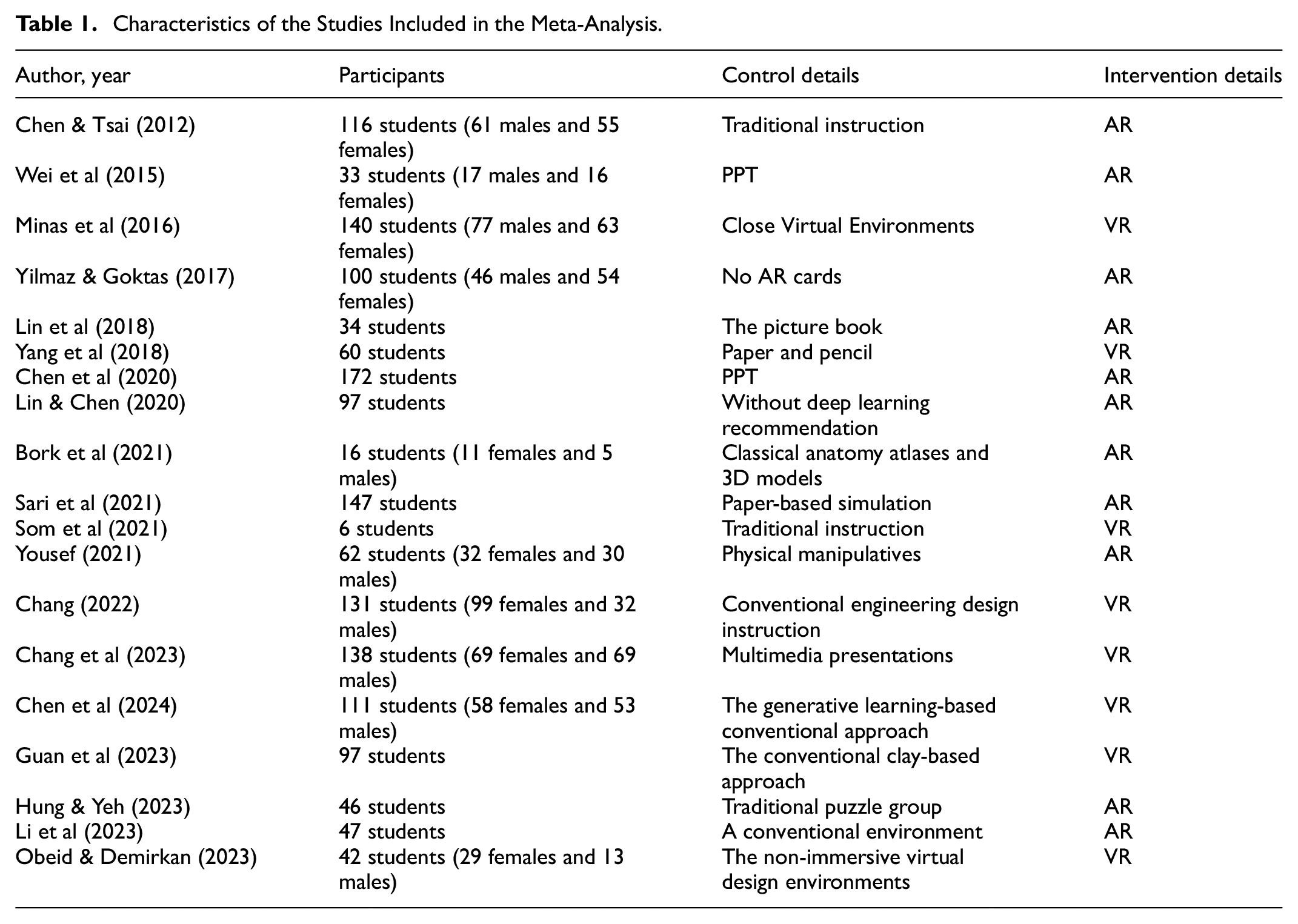
The features of 19 researches included in the meta-analysis are detailed in Table 1. X.J. and W.J.L. rigorously screened the headings, abstracts, and full texts of the papers to identify and assess the quality of the literature. The tools used to measure creativity varied across studies, with the Torrance Tests of Creative Thinking (TTCT), Wallach–Kogan Creativity Tests (WKCT), and Test of Creative Thinking–Drawing Production (TCT-DP) being commonly utilized (Gralewski & Karwowski, 2019). In this meta-analysis, creativity was primarily quantified through creativity scales, diagnostic interviews, and self-report questionnaires.
Characteristics of the Studies Included in the Meta-Analysis.
Quality Assessment of Studies
Meta-analysis is a research methodology that synthesizes existing studies. The reliability of the final data and results depends on the standard of the included primary literatures. Original literature quality assessment was conducted following the literature quality evaluation method proposed by Valentine and Cooper (2008). Each study’s evidence quality was evaluated based on five main aspects: interventions, research designs, sample characteristics, assessment tools, and measurement procedures. Scores ranging from 1 to 3 were assigned to each aspect based on clarity level. This evaluation form was reviewed by T.Z and X.H., and checked by X.J. After extensive discussions and revisions, W.J.L. served as the arbitrator. As indicated in Table 2, the quality of the included literature satisfied the research requirements.
Quality Assessment of Studies.

Coding Scheme and Procedures
This study will categorize and code the data based on several variables to ensure a comprehensive analysis. These variables include country, educational level, treatment duration, type of immersive technology, learning activities, and student-centered pedagogies. By examining these factors, we aim to better understand how different contexts and approaches influence the significance of immersive technology for students’ creativity. This detailed coding process will allow for a nuanced analysis and provide valuable insights into the conditions under which immersive technology most effectively enhances creativity.
Effect Size Calculation
To assess the effectiveness of immersive technology on students’ creativity, we computed Hedges’s g (Hedges, 1981) with 95% confidence intervals (CIs) for robust statistical analysis. When original studies lacked mean and standard deviation data, we derived effect sizes from F-test values (Darch et al., 2006), ensuring consistency and comparability across studies. Statistical analyses were conducted using Comprehensive Meta-Analysis (CMA 3) and Review Manager (RevMan 5.4), both reliable and freely available online tools. These programs enabled detailed data examination and advanced meta-analytic procedures, ensuring our analysis was thorough and adhered to high standards of statistical rigor.
Moderator Coding
The coding results for each source and effect are detailed in Table 3.
Moderator Coding.

Country
This perspective was coded according to the countries or regions where the selected studies were conducted. Twenty-three studies were typically categorized into two groups: those conducted in China and those conducted outside of China.
Educational Level
The selected studies were categorized based on the educational levels of the participants, including elementary school, middle school, high school, and university.
Treatment Duration
The duration and scheduling of each study varied. For statistical analysis, this variable was divided into five categories: up to 2 weeks, up to 4 weeks, up to 6 weeks, up to 8 weeks, and up to 10 weeks.
Type of Immersive Technology
Based on the type of immersive technology, this code was categorized as AR and VR.
Learning Activities
Based on the different learning activities, this code was categorized into cooperative learning, teacher instruction, and personal learning.
Student-Centered Pedagogies
In contrast to teacher-centered approaches, student-centered pedagogies provide an inquiry-based learning environment. Three student-centered pedagogies (i.e., team-based learning TBL, problem-based learning PBL, and project-based learning PjBL) that focus on real-world problems were summarized. This code was categorized into TBL, PBL, and PjBL.
Results
Publication Bias
We began by investigating indices of publication bias using a funnel plot, where the X-axis represents the effect size (ES) of each sample, and the Y-axis represents the standard error. The overall fail-safe N was 1,105, indicating that detecting 1,105 unreported null effects would be necessary to render the overall result insignificant. According to Rosenthal (1995), the quantity of null or additional researches required to nullify the comprehensive effect sizes in this meta-analysis must exceed the value of 5k + 10. The K mean represents the current number of studies in the meta-analysis. This threshold suggests that the observed significant effects are robust. Figure 3 illustrates the effect sizes. As shown in the Figure 3, multiple studies with positive and large effects also had small sample sizes, suggesting that some reported results may have been selectively reported. This analysis provides a comprehensive overview of the potential publication bias and the trustworthiness of the findings, ensuring the reliability of the conclusions drawn from this meta-analysis.

Funnel plot of precision by Hedges’s g.
Studies Included in the Review
To obtain the 19 articles included in this meta-analysis, we screened 1,047 abstracts and titles and then assessed 695 full-text articles for eligibility. The selection process is illustrated in the PRISMA flowchart. Four of the 19 primary studies contributed multiple samples, resulting in a total sample size of k = 23. Table 4 lists the JCR-SSCI indexed journals that published these articles, all of which examine the effectiveness of immersive technology on students’ creativity. This rigorous selection process ensures that the included studies meet high standards of quality and relevance, providing a robust foundation for our meta-analysis.
Number of Immersive Technology and Creativity Studies Published in International Journals.

Meta-Analysis
We calculated Hedges’g values and their 95% confidence intervals (CIs) for the 23 studies included in the meta-analysis. The effects were weighted by the inverse of their variance (Borenstein et al., 2009), and we employed random effects models. Pooled effect sizes were categorized as small (Hedges’g 0.2), moderate (Hedges’g 0.5), large (Hedges’g 0.8), very large (Hedges’g 1.2), and huge (Hedges’g 2.0; Cohen, 1992). Figure 4 illustrates the influence of immersive technology on students’ creativity. The Hedges’g effect size was 0.82 (95% CI [0.55, 1.10]; p < .001), indicating a substantial positive effect. This finding addresses the primary research question: “Does immersive technology-based instruction significantly enhance students’ creativity compared to non-immersive methods?” Heterogeneity in the meta-analysis was classified as low (0%–30%), moderate (40%–60%), and high (75%–100%; Deeks, 2019). Our meta-analysis revealed a primary heterogeneity of 85%. Further analysis, conducted by using exclusion methods to identify sources of heterogeneity, showed that removing the study by Lin and Chen reduced the heterogeneity from 85% to 75%. Specifically, the high heterogeneity was primarily attributed to the control group in Lin and Chen’s study employing an AR system not recommended for deep learning. To understand this heterogeneity, we conducted a moderator analyses, which explained the underlying causes.

Pooled analyses of the impact of immersive technology on students’ creativity.
Moderator Analyses
The results of the moderator analyses are presented in Table 5. These results provide further insights into the variables influencing the effect of immersive technology on students’ creativity, highlighting the conditions under which these technologies are most effective.
Moderator Analyses.

Note. k = number of independent studies; g = Hedges’g; SE = standard error; CI = confidence interval; Q = between-group homogeneity.
Country
The Q-statistics revealed variance in Hedges’g according to the participants’ country as a moderator variable. Significant differences in effect sizes between countries were observed based on the 95% CIs. China (g = 0.95, 95% CI [0.58, 1.33], k = 15) showed very large effects. Non-China (g = 0.52, 95% CI [0.19, 0.85], k = 8) had a moderate effect.
Treatment Duration
For the treatment duration moderator, the Q-statistics revealed significant heterogeneity in effect sizes (Q = 14.43, p < .05). This indicates that the effects of immersive technology on students’ creativity vary significantly across different treatment durations, as shown by the 95% CI. Experimental groups with treatment durations of up to and including 2 weeks (g = 0.85, 95% CI [0.45, 1.25], k = 14), 4 weeks (g = 0.95, 95% CI [0.31, 1.59], k = 5), and 8 weeks (g = 0.92, 95% CI [−0.09, 1.93], k = 2) exhibited very large effects. The group with a treatment duration of up to and including 6 weeks (g = 0.61, 95% CI [−0.78, 2.01], k = 1) demonstrated a large effect size. The group with a treatment duration of up to and including 10 weeks (g = 0.16, 95% CI [−1.22, 1.55], k = 1) had a small effect.
Type of Immersive Technology
The Q-statistics for the immersive technology moderator showed significant heterogeneity in effect sizes (Q = 6.58, p < .05). AR (g = 0.85, 95% CI [0.49, 1.21], k = 14) had a very large effect. VR (g = 0.79, 95% CI [0.35, 1.23], k = 9) demonstrated a large effect size.
Student-Centered Pedagogies
The Q-statistics for the student-centered pedagogies moderator revealed significant heterogeneity in effect sizes (Q = 32.01, p < .05). Project-based learning (PjBL) had a very large effect (g = 1.16, 95% CI [0.80, 1.52], k = 13). Team-based learning (TBL; g = 0.43, 95% CI [−0.16, 1.02], k = 4) and problem-based learning (PBL; g = 0.42, 95% CI [−0.09, 0.94], k = 6) showed moderate effects.
Educational Level
The Q-statistics revealed variance in Hedges’g according to the educational level of the participants as a moderator variable. Significant differences between educational levels were observed based on the 95% CIs. Middle school (g = 0.87, 95% CI [0.24, 1.31], k = 5), high school (g = 0.86, 95% CI [−0.17, 1.89], k = 2), and university (g = 0.85, 95% CI [0.33, 1.36], k = 8) showed very large effects. Elementary school (g = 0.79, 95% CI [0.25, 1.32], k = 8) showed a large effect.
Learning Activities
For the learning activities moderator, the Q-statistics revealed significant heterogeneity in effect sizes (Q = 14.88, p < .05). Teacher instruction had a remarkable effect (g = 1.04, 95% CI [0.66, 1.43], k = 12). Personal learning (g = 0.62, 95% CI [0.01, 1.23], k = 5) and cooperative learning (g = 0.57, 95% CI [0.04, 1.10], k = 6) had large effects.
Discussion
Discussion of Overall Effect Sizes
Many educational initiatives leverage technology to make learning more motivating and effective, and the use of VR/AR in education is well-established (Scavarelli et al., 2021). The instructional potential of immersive technology is significant, offering benefits such as cognitive acceleration, increased self-management, and enhanced creativity (Pellas et al., 2019). The forest plot (Figure 4) indicates that most studies yielded a positive Hedges’g, with a total effect size of 0.82. The confidence intervals of many studies do not encompass zero, and their p-values are below .01. These findings suggest that immersive technology has a statistically significant positive impact on students’ creativity. The forest plot addresses RQ1 in this meta-analysis: Does immersive technology benefit students’ creativity? This finding underscores the substantial benefits of incorporating immersive technology in educational settings.
Discussion of Moderating Variables
To answer RQ2, we analysis of the moderator variables.
Country
This meta-analysis examined the geographic distribution of studies. The Q-test showed significant differences (p < .01) among regions. In this meta-analysis, 65% of the samples were from China, while those from non-China regions made up 35%. China (g = 0.95) had very large effects, non-China (g = 0.52) had a moderate effect.
Some scholars have found that Chinese students generally consider their creativity inferior to that of Western students (B. Wang & Greenwood, 2013). Some studies discovered that Confucian cultural beliefs among students in China shape the development of creativity (Tam et al., 2023). Prior studies have shown that culture and region impact student creativity. Based on 23 samples, the meta-analysis divides participants into China and non-China groups for research. The meta-analysis showed that immersive technology affects China students’ creativity more effectively than that of non-China students.
Treatment Duration
In teaching that enhances students’ creativity using immersive technology, time is crucial. It significantly influences every stage of the creative process, from problem formulation to idea incubation and validation (Andrews & Smith, 1996; Baer & Oldham, 2006). In this study, durations of up to 2 weeks (g = 0.85), 4 weeks (g = 0.95), 6 weeks (g = 0.61), and 8 weeks (g = 0.92) had large effect sizes. The experimental group with a duration of up to 10 weeks (g = 0.16) had a small effect.
Most researchers set shorter durations to stimulate creativity. For example, participants were asked to write a creative continuation of a text in 140 s (Shah et al., 2013), engage in a solitary divergent thinking exercise for 2 to 5 min (Fink & Benedek, 2014), or design a wearable device with smartphone capabilities within 5 min while wearing EEG equipment (X. Yang et al., 2018). Additionally, our study confirmed that prolonged use of technologies like VR can lead to dizziness, fatigue, and discomfort, reducing the experiment’s effectiveness (X. Chen et al., 2019; Van Kerrebroeck et al., 2017).
Type of Immersive Technology
Research indicates that immersive technology can enhance learners’ experiences, foster cooperation, and creativity in classrooms (Tang et al., 2022). However, the specific type of intervention has seldom been considered when exploring factors influencing the influence of immersive technology on students’ creativity. Most research has focused on the effects of immersive technologies in a single modality (VR or AR), with little attention to comprehensive types (Saliba et al., 2022; Yenioglu et al., 2021). Different types of immersive technology positively affect cultivating students’ creativity. AR (g = 0.85) had a very large effect, while VR (g = 0.79) demonstrated a large effect size. This suggests that incorporating AR into educational interventions may be more beneficial for enhancing students’ creative thinking.
In the field of education, Clark (1983, 1994) argued that media are more vehicles delivering instruction, while Kozma (1991, 1994) argued that specific media has unique attributes affecting learning. This discussion is known as the Clark-Kozma Debate or the Great Media Debate. Both Clark and Kozma agreed that learning and instruction processes are intricate and require the strategic alignment of media with pedagogical approaches to achieve intended educational outcomes (Hastings & Tracey, 2005; Surry & Ensminger, 2001). In summary, exploring the impact of various immersive technologies on students’ creative thinking is valuable, as different modalities may offer unique benefits and enhance the overall educational experience.
Student-Centered Pedagogies
The interdependence between educational technology and student-centered pedagogies is well-documented (Koh et al., 2020). Student-centered pedagogies help mitigate the fading novelty effect of technology in education (Tsay et al., 2020). Enhancing students’ creativity in education also boosts critical thinking and problem-solving skills (Karpova et al., 2011). Research shows that Project-Based Learning (PjBL) has a very large impact on students’ creativity, with an effect size of 1.16. In contrast, TBL and PBL show moderate effects, with effect sizes of 0.43 and 0.42, respectively. PjBL emphasizes hands-on activities and the creation of authentic products (Adriyawati et al., 2020), enabling students to develop solutions that align more closely with real-world needs (Kuo et al., 2021).
Educational Level
Previous meta-analyses have identified educational level as a potential moderator. For instance, university students have been found to collaborate more effectively with researchers in experiments on the effect of VR on learning English as a Foreign Language (Bin Qiu et al., 2024). However, another study found no significant differences in AR effect sizes across different educational levels (F. Li et al., 2023).
In our meta-analysis, participants spanned four educational levels: elementary school (35%), secondary school (21%), high school (9%), and university (35%). The results indicated very large effects for secondary school (g = 0.87), senior high school (g = 0.86), and university (g = 0.85), while elementary school exhibited a large effect (g = 0.79). These findings suggest that immersive technology has consistently positive effects across various educational levels, aligning with the outcomes of previous studies (H.-Y. Chang et al., 2022).
Learning Activities
This study, incorporating insights from the moderating variables of previous meta-analyses (Bin Qiu et al., 2024), categorized the sample into three instructional types: teacher instruction (52%), cooperative learning (26%), and personal learning (22%). Teacher instruction showed a very large effect (g = 1.04), while personal learning (g = 0.62) and cooperative learning (g = 0.57) demonstrated large effects. These findings support the notion that individual engagement is more effective than collaborative efforts in educational environments (Merchant et al., 2014).
Teachers are a crucial element in every educational system, playing a key role in integrating and accepting technology in education (Tzima et al., 2019). Research indicates that teachers are indispensable in learning activities facilitated by immersive technologies to enhance students’ creativity. Some scholars have also highlighted the importance of teacher guidance, especially for young children who may struggle with independent learning (Vitta & Al-Hoorie, 2023). This underscores the significant role of teachers in academic activities and the effective use of immersive technology.
Conclusion and Future Work
Implications and Contributions
Firstly, our research provides valuable insights and new findings that enhance the understanding of immersive technologies and their impact on students’ creativity. Immersive technology proves to be a powerful tool in educational settings, offering significant potential to transform the learning experience. Integrating immersive technologies into teaching methodologies has been shown to substantially boost students’ creative thinking and innovative capacities across all educational levels, from primary to tertiary education.
Secondly, it is crucial to acknowledge the temporal dimension of immersive technology use. While these technologies can be highly beneficial, prolonged exposure may lead to adverse effects such as dizziness and fatigue. These physical discomforts could impede the creative process by reducing students’ ability to thoroughly connect with the learning process.
Thirdly, inspiring creativity in students is a multifaceted and intricate process. It requires a holistic approach that extends beyond the mere application of immersive technologies. Effective strategies must integrate these technologies with pedagogical methods centered on the student’s learning experience and learning needs, creating an interactive and personalized learning environment.
Lastly, the role of educators is paramount, especially in an age of swift technological progress and an overwhelming influx of information. Teachers are essential in guiding students through this complex landscape, ensuring that the application of immersive technology is purposeful, balanced, and conducive to nurturing creativity. Their expertise in facilitating meaningful interactions with technology is crucial for maximizing its potential as a catalyst for creative learning.
Our study underscores the importance of immersive technologies in education while highlighting the importance of careful implementation and the pivotal role of educators in guiding this technology toward positive educational outcomes. By providing this evidence, we aim to inform future practices and policies that leverage the strengths of immersive technologies to inspire and develop students’ creative potential.
Limitations and Recommendations
Despite meaningful findings, this study has two limitations. To ensure rigor, we included only empirical studies from academic journals cataloged in scholarly databases. This approach may have excluded relevant papers from other databases and grey literature, such as government reports, theses, dissertations, technical reports, and other unpublished works, or papers missed due to search string limitations.
Future research should broaden study selection criteria to include diverse literature, enhancing the scope and representativeness of meta-analyses. This expansion will make conclusions about the function of immersive technology in enhancing students’ creativity more reliable and impactful.
This study focused solely on immersive technology interventions. Future researchers should explore a broader spectrum of technological fields to enhance students’ creativity. While this meta-analysis compared the effects of immersive and non-immersive technology, some empirical studies have examined various technologies’ impact on creativity. For example, integrated media technology fosters learning agility and creativity among university students (Alhulail & Singh, 2023), and online books enhance creativity and self-regulation abilities (Hidajat, 2023).
Future research could more comprehensively investigate several critical areas. Firstly, studies could examine how the duration of immersive technology intervention shapes student creativity. Secondly, researchers could assess whether the effectiveness of immersive tools in fostering creativity varies among students with different learning levels and whether this effectiveness is constrained by students’ prior knowledge. Finally, investigations could explore whether pedagogical approaches play a pivotal role in mediating how immersive technology impacts student creativity.
Footnotes
Acknowledgements
Valuable comments from anonymous reviewers and editors are sincerely appreciated.

Ethical Considerations
This meta-analysis is a secondary data analysis of published studies. All 19 original studies included adhered to ethical guidelines for human research and complied with the principles of the American Psychological Association (APA) Ethical Principles of Psychologists and Code of Conduct. As this meta-analysis did not directly involve human participants and utilized data from publicly available literature, no additional ethical approval was required.
Consent to Participate
This meta-analysis utilized original data from 19 published studies. Informed consent had been obtained from participants in all included studies; therefore, no additional informed consent was required.
Author Contributions
Juan Xiong: Conceptualization, Methodology, Formal analysis, Data coding, Data analysis, Writing – method and results sections, Writing – original draft, Visualization, Supervision. JianLin Wen: Conceptualization, Methodology, Formal analysis, Data coding, Data analysis, Visualization, Funding acquisition. Xu Han: Data coding, Data analysis. Zi Tao: Data coding, Data analysis, Participation in discussion and writing. GuangShu Pei: Data coding, Data analysis, Participation in results. Wei Cui: Participation in discussion.
Funding
The author(s) disclosed receipt of the following financial support for the research, authorship, and/or publication of this article: This meta-analysis received partial financial support from the National Social Science fund, under Grant [21BKS160], and General Project of the 2024 Special Research Program for Teachers of Ideological and Political Theory Courses in Higher Education Institutions, Ministry of Education of China, under Grant [24JDSZK185].
Declaration of Conflicting Interests
The author(s) declared no potential conflicts of interest with respect to the research, authorship, and/or publication of this article.