



Abstract
Keywords
In tandem with the rapid proliferation of the internet and personal computing, online learning has increasingly become part of course offerings for universities and higher education institutions (Allen & Seaman, 2007; Nguyen, 2015; Sun & Chen, 2016), offering advantages to distance education and student flexibility. Building on this continued expansion across the 21st century, online learning experienced a sudden and massive growth in March of 2020, as many universities and higher education institutions transitioned to online learning in response to the coronavirus disease 2019 (COVID-19) global pandemic (UNESCO, 2020). In most cases, this transition to online learning happened within days, leaving students and educators with little time to adjust to this change in learning modality (Sandars et al., 2020). Yet, while this relative boom in online learning occurred over a remarkably short time, many educators and scholars argue that changes in learning and teaching and student expectations favoring increased online learning opportunities within higher education are here to stay (Rapanta et al., 2020; Wieland & Kollias, 2020). Such a shift in academic delivery prompts the need for additional research, as despite the newfound popularity of online learning, little is known about the correlates of engaging and succeeding in online courses—inhibiting the development of evidence-based programs to improve student performance. Thus, the current research aims to investigate the predictors of online course behavioral engagement using an integrated model of the theory of planned behavior (TPB—attitudes, subjective norms, perceived behavioral control, intentions), health action process approach (action planned and self-monitoring), and habit theory.
Online Learning Since the Onset of the COVID-19 Pandemic
While online learning in universities and higher education became commonplace during and in the wake of the COVID-19 pandemic, the transition to online learning placed additional demands on many students. For example, many undergraduate psychology students reported increased procrastination, disengagement, and stress after moving to online education (Usher et al., 2024). This is reflected in the wider online higher education literature: A significant challenge that educators faced during the pandemic and in general online education was ensuring that students were adequately engaging in their online courses (Kurt et al., 2021). For instance, to get the most out of their learning experience students had to ensure that they had suitable access to technologies that facilitated their online learning (Kelebogile Mudau et al., 2022). Students also reported a decrease in engagement due to other factors such as stress, distractions during at-home learning, and limited access to technology (Pennino et al., 2022; Qutishat et al., 2022).
Student engagement, both in-person and online, has a significant impact on student performance (Chen et al., 2010; Northey et al., 2017) and can be defined as the extent to which a student is willing to invest time and physical energy into their academic experience (Robinson & Hullinger, 2008). While engagement also has affective and cognitive components (Appleton et al., 2006; Fredricks et al., 2004), the behavioral component of academic engagement reflects the specific academic behaviors that students might engage in with regard to their learning (Northey et al., 2015). Academic behaviors, such as participation in learning activities and class attendance, are important predictors of students’ subsequent academic success (Nieuwoudt, 2020; Northey et al., 2015). As such, the investigation of student experiences engaging in online content for higher education represents an interesting and important topic not only for reflecting on the COVID-19 pandemic and future emergency preparedness in education, but for investigating the general best practices in online higher education.
Using Social-Cognition Models to Understand Academic Behaviors
A key theoretical perspective that has assisted in understanding what motivates academic behaviors is the application of social cognition models, such as the TPB (Ajzen, 1991; Burns et al., 2017). As outlined in the TPB, behavior is best predicted by an individual's intention, which in turn is predicted by attitudes (i.e., beliefs regarding possible outcomes of performing a behavior), subjective norms (i.e., beliefs regarding whether one's important others would approve or disapprove of them engaging in a behavior, as well as their motivation to attain that approval), and perceived behavioral control (i.e., beliefs regarding one's ability to perform the behavior). The ability of the TPB to predict a range of behaviors has received meta-analytic support (e.g., McEachan et al., 2011) and findings typically suggest that the more positive an individual's attitudes toward a behavior, the stronger the social norms to complete it, and the greater belief in their ability, the stronger their intention to enact the target behavior is said to be. Yet, although there is substantial support for the use of single-phase models of motivation, like the TPB, in predicting subsequent behavior, there is growing consensus among researchers that much of the variance in behavior remains unexplained when measuring the intention construct alone (McEachan et al., 2011; Ouellette & Wood, 1998). That is, in many cases, intentions do not always translate into actual behavior, necessitating further investigation as to why this may be the case.
Consequently, an increasing number of researchers have adapted the TPB to integrate constructs outlined in other models of human behavior to provide a more comprehensive perspective on how and why intentions do or do not translate into behavior, and other determinants which may influence behavior beyond intentional decision making (Hagger & Hamilton, 2020). One common example in this field is the health action process approach (HAPA; Schwarzer, 2008). As outlined in the HAPA, the process of enacting or changing behavior can be broadly delineated into two distinct phases (Schwarzer, 2008; Schwarzer & Hamilton, 2020). First, similar to the TPB, the HAPA outlines a motivational phase through which an individual develops intentions to perform an action based largely on consciously held beliefs about the behavior (i.e., expected outcomes, perceived risks, self-efficacy beliefs). However, the HAPA extends this further by identifying a volitional phase through which an individual utilizes self-regulatory processes to facilitate the translation of intention into action. For example, action plans are one self-regulatory process which involve formulating plans which specify when, where, and how an intended behavior is to be performed. Similarly, self-monitoring is a self-regulatory process that involves an individual reflecting on their behavior and how it aligns with their goals or standards. When examined alongside intention, self-regulatory processes such as planning and self-monitoring have been proposed to facilitate the enactment of intentions such that they mediate the intention-behavior relationship (Schwarzer, 2008; Zhang et al., 2019).
In the context of learning and teaching, prior research supports the use of constructs outlined in the TPB and the HAPA to explain students’ motivation and behavior For instance, empirical studies have supported the core propositions of the TPB, demonstrating that positive attitudes toward learning and academic effort, subjective norms reflecting the approval of important others, and perceived behavioral control with the specific the belief that academic goals are within students control, are all associated with both self-reported intentions for academic success and objective indicators such as course grades and program completion (Kovac et al., 2016; Kyle et al., 2014; Pitas et al., 2023; Roland et al., 2018). Studies have also shown the TPB to successfully predict other academic outcomes including intentions to graduate (Davis et al., 2002) or apply for graduate school (Ingram et al., 2000), academic dishonesty (Alleyne & Phillips, 2011; Stone et al., 2010), and student retention (Dewberry & Jackson, 2018; Sutter & Paulson, 2017).
However, it is important to note that most of the aforementioned evidence stems from in-person or mixed delivery courses, rather than online learning, and direct tests of the TPB for predicting academic engagement and performance in online undergraduate cohorts are scarce. It thus remains possible that, while the TPB has in general shown efficacy in predicting general study behaviors, its effectiveness or the relative contribution of its composite constructs in predicting online academic behavior may vary. Self-regulatory processes like planning and self-monitoring have also been identified as important skills involved in promoting student engagement and learning (e.g., Ghanizadeh, 2016), particularly within online learning environments (Abd-El-Fattah, 2010; Kizilcec et al., 2017; Pellas, 2014). For students to make the most of flexible online learning environments, it is important that they have the self-regulatory abilities to be self-directed learners (Melissa Ng Lee Yen, 2018). For instance, research has shown that self-monitoring can positively predict academic achievement (Abd-El-Fattah, 2010; Chang, 2010) and is important for self-management behaviors (e.g., time-management) in undergraduate students (Zhu & Doo, 2022).
However, while the HAPA offers a theoretical framework for understanding how intentions may translate into behavior, primarily through mechanisms such as action planning and self-monitoring, other factors may explain why intentions are not always reflected in actual behavior. Specifically, researchers adopting integrated models of behavior are also increasingly acknowledging the idea that much of human behavior is regulated by cognitive processes which operate automatically and outside of conscious awareness (Deutsch et al., 2016; Hagger et al., 2023). That is, while traditional social cognition models like the TPB and HAPA suggest that behavior is largely the result of consciously controlled and deliberate thought processes (e.g., beliefs influence the formation of intentions, which in turn determine behavior), more contemporary models of behavior (e.g., Deutsch et al., 2016; Gardner, 2015; Hagger, 2016; Phipps et al., 2021, 2023) aim to identify both “controlled” (i.e., conscious, reflective) and “automatic” (i.e., nonconscious, impulsive) predictors of behavior.
For instance, the habit construct is considered an automatic cognitive process in that a habit is an automatic impulse to perform an action in response to contextual cues (Orbell & Verplanken, 2010). Habits result from the nonconscious activation of cue-behavior associations stored in long-term memory (Wood & Rünger, 2016). Over time, the successful performance of an action in the context of stable cues may result in the mere presence of those cues prompting a behavioral impulse to perform the associated behavior (Lally et al., 2010; Orbell & Verplanken, 2010; Phipps et al., 2024; Simpson-Rojas et al., 2024). Thus, when integrated with social cognition models like theTPB, habit represents efficient and automatic behavioral enaction due to past behavior becoming routinized, as compared to behavioral enactment due to an active consideration of one's beliefs as modeled via intentions. For example, a student who studies in a consistent environment and surrounded by stable contextual cues may, over time, develop an automatic and nonconscious impulse to engage in study-related behavior in response to those associated cues, and may thus engage in academic behavior without undergoing a considered decision-making process. Although there is a large body of literature supporting the role of habit in nonconsciously regulating a wide range of behaviors (e.g., Gardner et al., 2011; Hagger et al., 2023), to the authors’ knowledge the habit construct (as conceptualized in contemporary models of behavior) has not yet been investigated in the context of online academic behavior. Thus, by incorporating the habit construct into the current model, a greater understanding can be gained as to the extent to which both controlled and automatic cognitive processes contribute to student engagement and academic achievement.
Integrated Models of Behavior
While the above research supports the utility of the TPB, HAPA, and habit constructs to independently predict academic behaviors and achievement, to the authors’ knowledge, research to date is primarily grounded in traditional, in-person learning, and is overall yet to test an integrated model based in the prediction of online academic behaviors. Utilizing integrated models has the benefit of providing the opportunity to identify and synthesize previously identified constructs, with the aim being to develop an optimally effective predictive model of behavior (Hagger & Hamilton, 2020). For example, in other areas of research, the extant literature is increasingly utilizing integrated models to better identify the variables that predict a wide range of behaviors including physical activity and exercise (More & Phillips, 2022), sugar consumption (Phipps et al., 2020), alcohol consumption (Caudwell et al., 2019), and social distancing behavior (Hagger et al., 2020). That is, by testing an integrated model as compared to a limited subset of constructs, the current research aims to provide a more holistic interpretation of the predictors of academic engagement and success, allowing for more targeted and informed educational interventions to promote positive outcomes for online learners.
The Present Study
In summary, the current study used an integrated model based on the TPB, HAPA, and habit theory to predict undergraduate psychology students’ online academic behavior and academic achievement during the COVID-19 pandemic. Academic behavior was measured objectively by electronically recording: (a) Attendance during online lectures, (b) attendance during online tutorials, and (c) completion of weekly worksheets. Each student's overall grade for the course was recorded at the end of the trimester as an objective measure of overall academic performance. The tested integrated model is displayed in Figure 1.
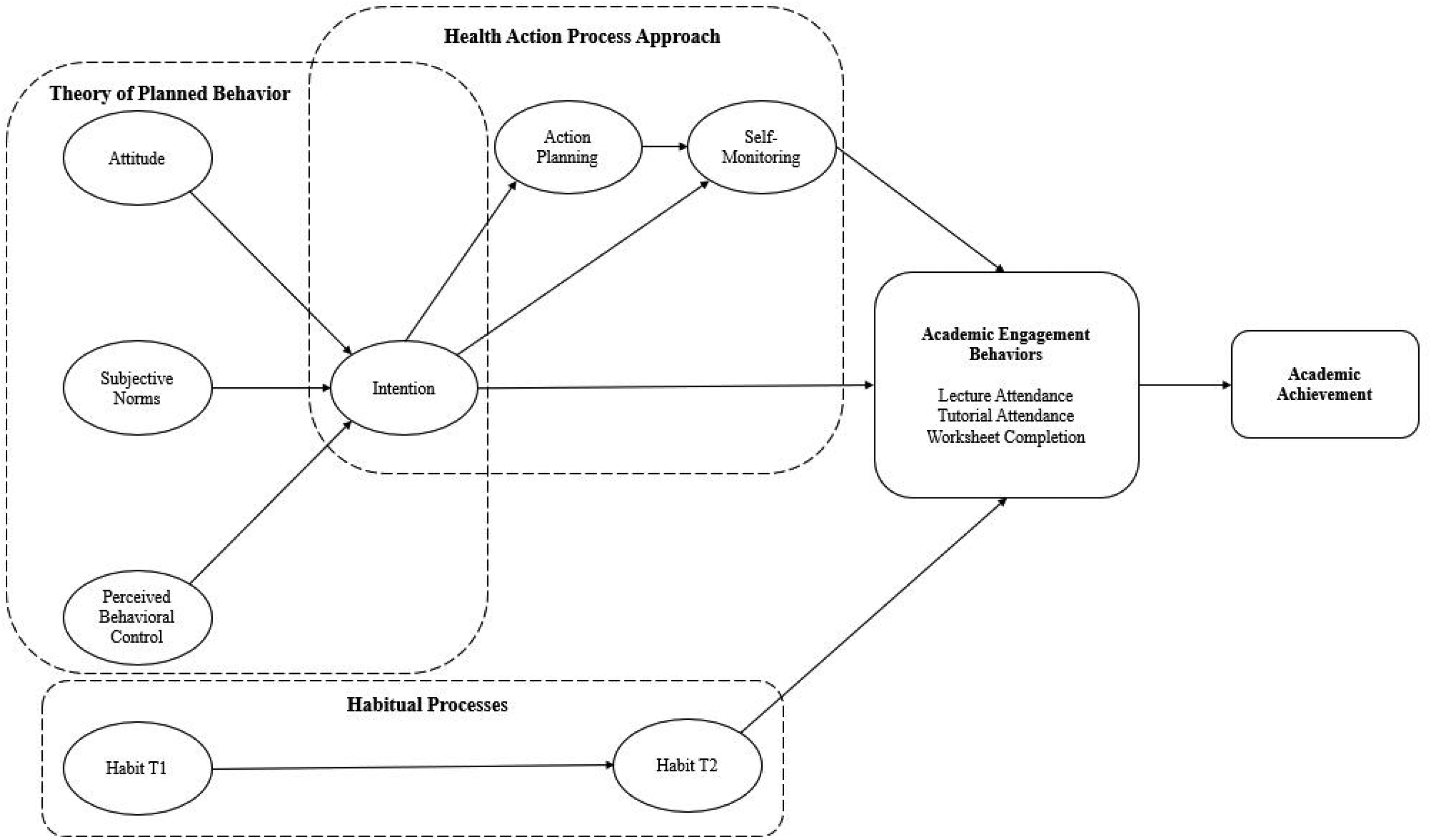
The hypothesized dual-phase dual-process model predicting online engagement and grades.
First, consistent with previous research employing the TPB in the context of student behavior (e.g., Dewberry & Jackson, 2018; Sutter & Paulson, 2017) it was predicted that the TPB constructs (attitude, subjective norms, and perceived behavioral control) would predict students’ intention to engage in the course content, which in turn would predict students’ academic engagement (i.e., online lecture attendance, online tutorial attendance, worksheet completion). Second, it was predicted that action planning and self-monitoring would mediate the relationship between intention and academic behaviors. Support for this prediction would be consistent with prior research highlighting the importance of self-regulatory strategies in promoting academic behaviors in the online learning environment (e.g., Abd-El-Fattah, 2010; Kizilcec et al., 2017; Pellas, 2014). Third, it was predicted that student academic behaviors would mediate the effects of the TPB and HAPA constructs on overall course grade. Finally, reflecting the growing support that nonconscious, automatic processes are important in regulating behavior (Hagger et al., 2023), it was predicted that students who reported strong study habits going into the trimester would continue to report stronger habits at the trimester midpoint, which in turn would predict student academic behaviors and overall course grade.
Methods
Participants and Procedure
A sample of 279 undergraduate psychology students enrolled in first year courses were recruited from an Australian university (65 male, 211 female, 3 other; 203 Australian, 5 Australian Aboriginal, 71 other ethnicities) 1 . While all students within the course were eligible to participate in the research, participation in the study was voluntary, with course credit offered as an incentive. All students provided informed consent and were aware that their attendance and final course grades would be recorded for analysis. The current study adopted an intervention-controlled prospective correlational design. At the beginning of the 12-week academic term (referred to as a trimester at the university where students were recruited), participants completed an online survey of their study social cognitions, habits, and plans for the upcoming trimester (T1). Mid-way through the academic term (i.e., weeks 6–7) participants were re-contacted via email to complete a follow-up measure of habit and self-monitoring (T2). Students’ weekly online lecture and tutorial attendance, weekly worksheet completion, and final grade were extracted via the course website at the completion of the trimester. All lectures and tutorials were synchronous and delivered online using a course learning management system. Data were collected as part of an intervention study in which students were randomly allocated to a control or intervention group. Participants allocated to the intervention group received a one-off planning activity at T1 that involved the formulation of action and coping plans aimed to enhance course engagement through identifying when, where, and how they will engage in the course content and how they might overcome possible barriers. The intervention was delivered electronically, and students were provided guidance on how to best formulate their action and coping plans. The full protocol for the intervention is available in the intervention registration protocol on the Open Science Framework: https://osf.io/g4w26/?view_only = 3589daeae5704d5197d8eedec4440ef2. While participants differed across conditions based on whether they were instructed to complete planning exercises, no significant intervention effects were found in the data. However, for completeness, intervention effects were controlled for on all study variables to negate any possible intervention effects. This approach is consistent with prior research testing social cognition mechanisms following an intervention that yielded no effects (Hattar et al., 2016). Ethical approval for the study was provided by the University Human Research Ethics Committee (2020/541).
Measures
Academic Behaviors and Course Grade
Students’ attendance at weekly online synchronous lectures and tutorials across the trimester was automatically recorded via the course learning management system, with a maximum of 11 lectures and 11 tutorials. Students were also asked to complete a worksheet each week, with the submission of up to 11 possible worksheets recorded via the course website. The provided worksheets contained activities aimed at facilitating the student's learning of the course content for that week—for example, responding to multiple-choice questions or exploring practical examples of applied content. Students’ attendance at lectures and tutorials, as well as their submission of the weekly worksheets, were not mandatory components of the course and did not contribute to their final course grade. At the end of the academic term, participants’ final course grade was extracted from the course learning management system.
Social Cognition Constructs
Measures of the social cognition constructs were adapted to reference the online academic engagement context based on established guidelines (Ajzen, 1991).
Attitude. Students’ attitude towards engaging in course content was assessed using four semantic differential items with the common stem “My engaging in course content across the Trimester would be”, each scored on a 7-point scale (e.g., [1] Bad to [7] Good).
Subjective Norms. Participants’ subjective norms towards engaging in course content were assessed via a three-item measure (e.g., “Most people who are important to me would approve of me engaging in course content across the Trimester”), scored on a 7-point Likert scale from [1] Strongly disagree to [7] Strongly agree.
Perceived Behavioral Control. Participants’ perceived behavioral control over engaging in course content was assessed using four items (e.g., “It is mostly up to me whether I engage in course content across the Trimester”), each scored on a 7-point Likert scale from [1] Strongly disagree to [7] Strongly agree.
Intention. Students’ intention to engage with course content across the academic term was assessed using three items (e.g., “I intend to engage in course content across the Trimester”), scored on a 7-point Likert scale anchored [1] Strongly disagree to [7] Strongly agree.
Volitional Constructs
Measures of the social cognition constructs were adapted to reference the online academic engagement context based on established guidelines (Schwarzer, 2008).
Planning. Participants’ plan to engage in the course content was assessed with four items (e.g., “I have made a plan regarding how to engage in the course content”), each scored on a 7-point Likert scale from [1] Strongly disagree to [7] Strongly agree.
Self-Monitoring. Mid-way through the trimester (i.e., weeks 6-7) participants reported the extent to which they monitor their own behavior on four items (e.g., “I have consistently monitored if I engage in the course content”), each scored on a 7-point Likert scale from [1] Strongly disagree to [7] Strongly agree.
Habit. Participants’ study habits, reflecting the automatic and nonconscious cognitive processes, were assessed using the behavioral automaticity subscale of the Self-Report Habit Index (Gardner et al., 2012; Verplanken & Orbell, 2003), with responses collected on a 7-point Likert scale (e.g., “Engaging in course content is something I do automatically”, [1] Strongly disagree to [7] Strongly agree).
Data Analysis
Data were analyzed using the lavaan package in R (R Core Team, 2013; Rosseel, 2012). Where missing data were observed, Little's missing completely at random test was used to evaluate randomness of missing data, and data were imputed using full information maximum likelihood analysis. The model fit-to-data was assessed using χ2, CFI, TLI, and RMSEA, where nonsignificant χ2 values, CFI and TLI values above .90, and an RMSEA value less than .08 were considered indicative of acceptable fit. Given an intervention was also being conducted during the trimester, intervention group, dummy coded as 1 = intervention group and 0 = control group, was also included as a covariate for all time 2 and time 3 variables. For completeness, we also present invariance testing between intervention and control groups in Appendix A.
Results
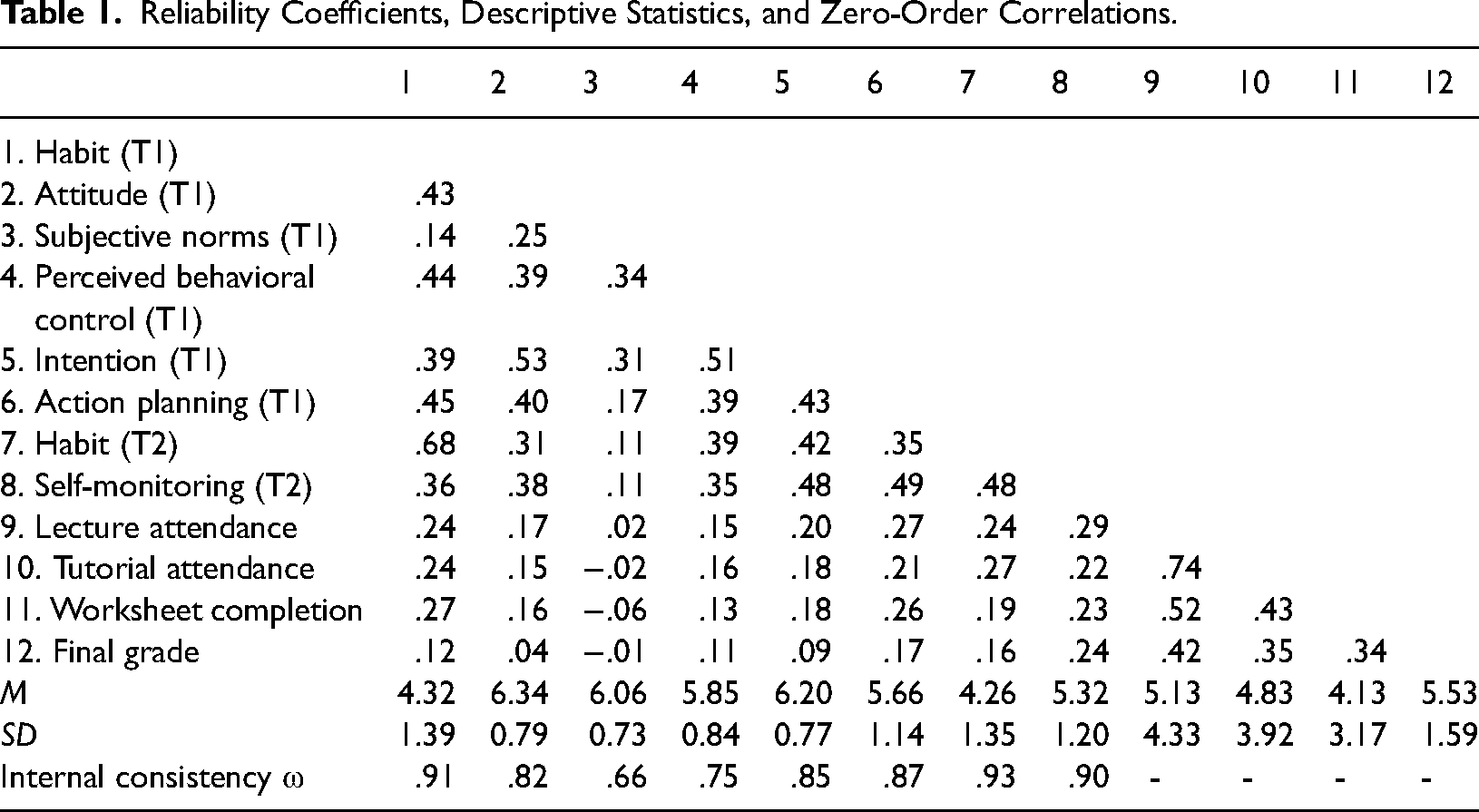
Reliability coefficients, descriptive statistics, and zero-order correlations between each of the model variables are presented in Table 1. We observed some missing data, potentially due to either noncompliance or course dropout. Specifically, 79 participants did not complete the mid-course measures of self-monitoring and habit, and data were not available for the grades, lecture attendance, and worksheet completion of 5 students, and the tutorial attendance of 56 students. However, Little's test indicated the data to be missing completely at random (χ2(44) = 55.83, p = .103). Thus, full information maximum likelihood was used, making use of all available data.
Reliability Coefficients, Descriptive Statistics, and Zero-Order Correlations.
Model Effects Predicting Behavioral Engagement and Student Grades in an Online Undergraduate Course.
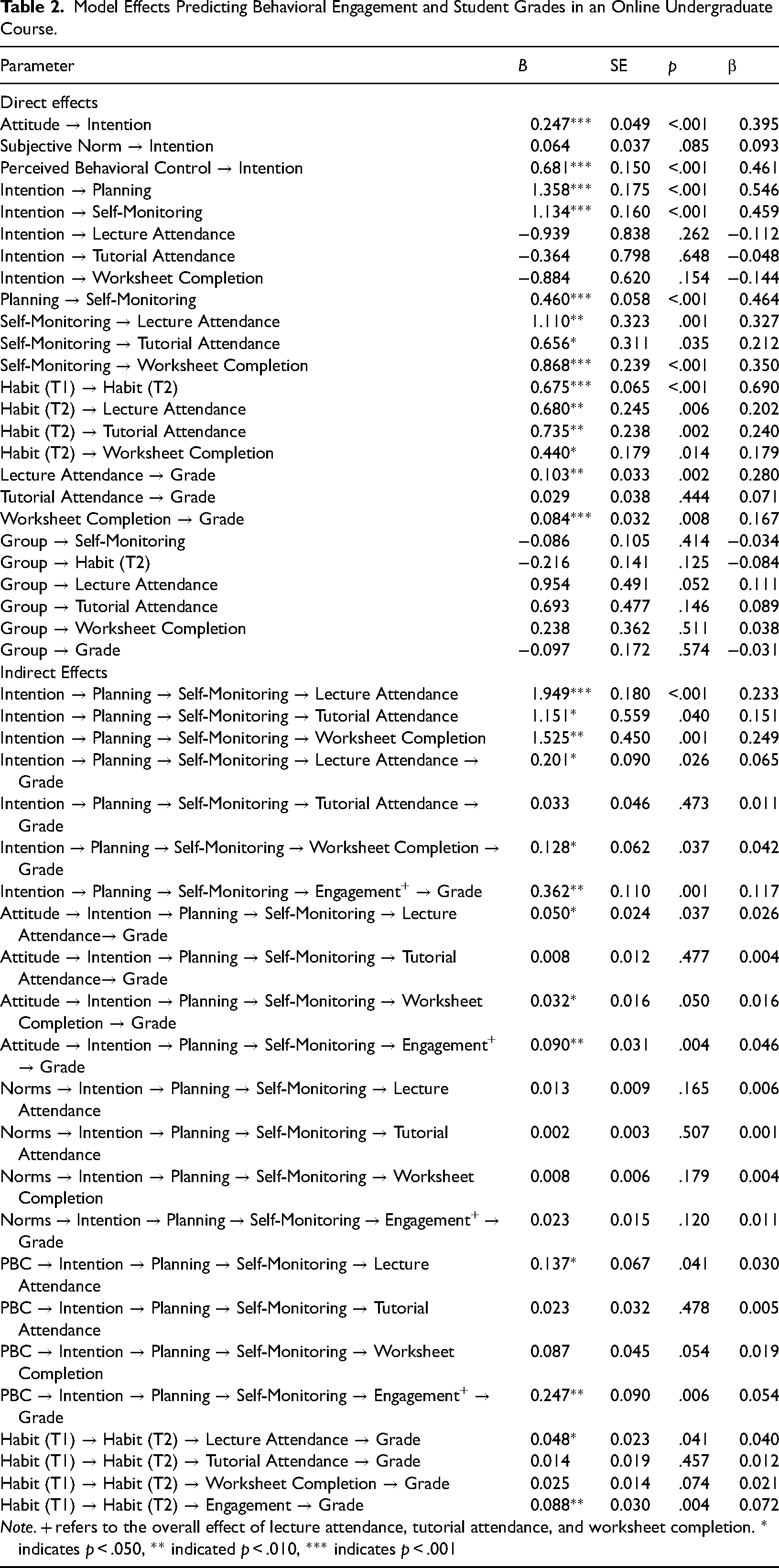
Moving to our core model test, an integrated model of the TPB, HAPA, and habit theory (see Figure 1) was tested. We expected the constructs of the TPB to predict intention, while action planning and self-monitoring from the HAPA would mediate the effects of intention on behavioral engagement, and habit would predict behavioral engagement directly, representing the effect of nonconscious or automatic processes on study behavior. The model demonstrated acceptable fit-to-data (χ2(528) = 1018.85, p < .001, CFI = 0.916, TLI = 0.905, RMSEA = 0.058). The model is presented in Figure 2, and all parameter estimates are available in Table 2. Overall, the model predicted a small-moderate-sized portion of variance in each behavioral outcome: 13.4% of the variance in lecture attendance, 11.3% of the variance in tutorial attendance, and 11.7% of the variance in worksheet completion. Further, the model predicted a moderate size portion of variance in students’ final grade (19.7%).
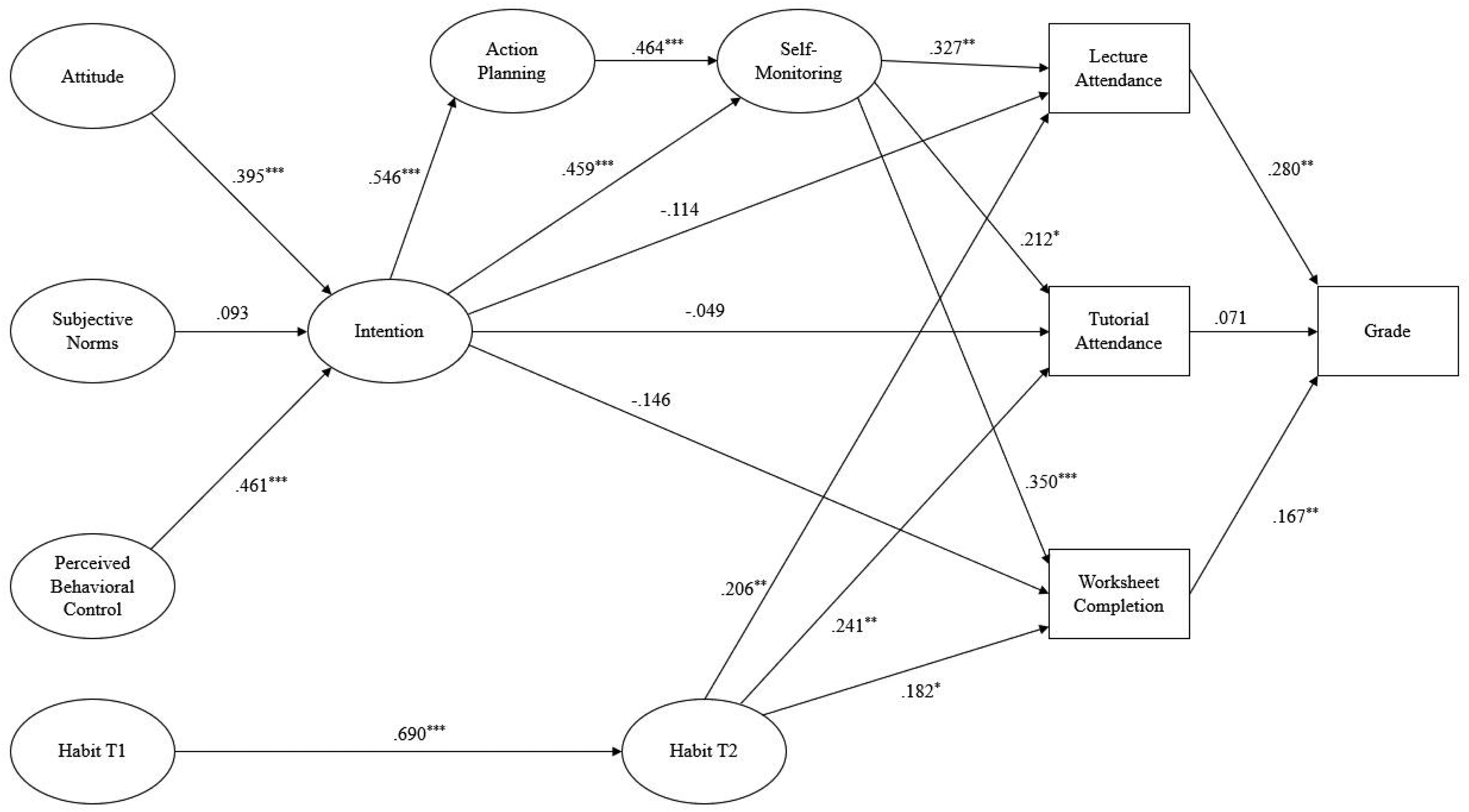
Results of a dual-phase dual-process model predicting online course engagement and grades. Note. * indicates p < .050, ** indicates p < .010, *** indicates p < .001. T1 = Time 1, T2 = Time 2.
Students’ final course grades were predicted by their lecture attendance and completion of weekly worksheets, but tutorial attendance was not associated with final grades. With regards to consciously controlled cognitive processes, attitude and perceived behavioral control both predicted intentions, and in turn had significant indirect effects on students’ final grade via intention, planning, self-monitoring, and the total effect of course engagement. In contrast, subjective norms were not associated with study intentions or behaviors. The effect of attitude on grade had significant effects mediated via both lecture attendance and worksheet completion, but not tutorial attendance, while the indirect effect of perceived behavioral control only had significant effects via lecture attendance. Intention also significantly predicted lecture attendance, tutorial attendance, and worksheet completion with an indirect effect via self-monitoring and planning, but no direct effects of intention were observed. Further, intention was found to significantly predict final course grade via lecture attendance and worksheet completion, but not tutorial attendance. Regarding the automatic and nonconscious processes, strength of study habits at the commencement of the trimester predicted study habits measured mid-way through the academic term, which in turn predicted lecture attendance, tutorial attendance, and weekly worksheet completion. Baseline habit also had a total indirect effect via all three forms of course engagement, but only the indirect path via lecture attendance had a significant unique effect.
Discussion
Using an integrated theoretical model, the current study aimed to identify the determinants of Australian undergraduate psychology students’ online course engagement and academic achievement during the COVID-19 global pandemic, while undergoing a planning intervention. The integrated model included constructs outlined in the TPB (Ajzen, 1991) and the health action process approach (Schwarzer, 2008), and included habit as a measure of the nonconscious processes that regulate behavior (Wood & Rünger, 2016). Results indicated significant effects of motivational factors on university students’ course engagement and final grades. Specifically, results showed significant direct effects of the TPB constructs of attitudes and perceived behavioral control on intentions, and indirect effects on final course grade via planning, self-monitoring, and overall course engagement. Intention in turn had indirect effects on all three forms of course engagement mediated via planning and self-monitoring. Intention also had a significant direct effect on overall engagement (encompassing lecture attendance, tutorial attendance, and worksheet completion), which subsequently predicted overall course grades. Results also revealed that habit was predictive of student engagement but that only lecture attendance had a unique mediating effect on final course grades.
These findings support prior literature using the TPB and HAPA models in the context of higher education (e.g., Ghanizadeh, 2016; Sutter & Paulson, 2017). For instance, the current findings suggest that holding more favorable attitudes toward course engagement and having stronger beliefs in one's ability to engage with course material positively predicted course engagement intentions. Prior research has similarly shown that students are more motivated to engage in online learning and demonstrate greater academic success when they hold positive beliefs toward learning (Ferrer et al., 2020). Fostering motivation to engage students in learning can be a challenging endeavor, particularly within online learning environments (Barak et al., 2016). Developing more effective and engaging online learning environments may be an important process within higher-education settings to help improve students’ attitudes toward online learning (Aixia, 2011). For instance, strategies targeting attitude could involve information provision (e.g., providing information about consequences of lack of engagement with course activities and its impact on grades; explaining the benefits of attending course lectures and tutorials) and communication—persuasion (e.g., using credible sources to deliver messages; using framing/reframing methods) about course activities (Hamilton & Johnson, 2020).
An important finding of the current research is that planning and self-monitoring were found to mediate the relationships between the TPB constructs and students’ behavioral engagement. This is consistent with a growing body of literature identifying planning and self-monitoring strategies as important mediators of the intention-behavior relationship (Zhang et al., 2019), and research demonstrating the important influence that self-regulatory strategies have on student engagement (e.g., Abd-El-Fattah, 2010; Kizilcec et al., 2017). The present findings suggest that individuals with positive beliefs about the study are not only likely to hold stronger study intentions, but are also likely to engage in self-regulation strategies, such as planning and self-monitoring, to help them translate this motivation into action. Importantly, these findings identify planning and self-monitoring as viable targets for behavioral interventions which are aimed at improving student engagement in online courses (Weijers et al., 2022). While some participants in the current study did participate in a planning intervention, the null effects of the intervention are likely best explained by the brief nature of the intervention. That is, the single session planning intervention was likely not enough to adequately increase the salience of participants’ study plans and influence their study behavior. Moreover, students in the intervention group were not provided any guidance or feedback while they were formulating their plans. Prior planning interventions have shown effectiveness when careful monitoring and individualized feedback on formulated plans is provided (e.g., Ranjbaran et al., 2022).
In line with previous habit theory and research (Hagger et al., 2023), habit also significantly predicted each engagement behavior independently of the effects of volitional constructs. Such consistent effects of habit may be expected, given that habits are considered most likely to influence stable and consistent behaviors (Gardner, 2009; Orbell & Verplanken, 2010), and suggests that educators may wish to promote the formation of strong study habits as a way of promoting online course engagement. Although research examining the habit construct in the context of higher education remains in its infancy, strategies identified within the field of health psychology and behavior change may prove to be a useful starting point (e.g., Gardner et al., 2021). For instance, students might be encouraged to design a study environment whereby they are surrounded by stable cues during their study periods that may, over time, assist to nonconsciously elicit helpful study behaviors.
While all three forms of course engagement were positively associated with final course grades based on bivariate correlations, the effect of tutorial attendance on grade was attenuated by the effect of lecture attendance (which also had a stronger bivariate association with grade) in the full model. This is likely due to lecture content being more closely aligned to exam content in the course that participants were enrolled in. The two exams accounted for the largest proportion of the overall grade. Tutorial content on the other hand was more closely aligned with the written assignment, which was a single task with a smaller weighting.
Practical Implications for Online Learning
The current study has several potential implications for online teaching practice. From an interventionist perspective, the current results indicate attitude and perceived behavioral control may be the most viable constructs for interventions aiming to improve intentions, while interventions aiming to teach action planning and monitoring may be most effective for those already reporting strong intentions but still failing to satisfactorily engage with course content. Finally, given the small but consistent effects of habit on engagement, it may be important to consider that educators may be able to improve academic engagement by promoting the formation of helpful habits (e.g., by keeping the cues or environments for course requirements stable), but may also need to contend with unhelpful study habits which may make entrenched unwanted behavior resistant to intervention even in the face of changing beliefs and intentions.
Further, current results may also highlight the value of considering online learning separately from in-person engagement. That is, results showed that both intentional and automatic processes were implicated in encouraging behavioral engagement for online learning, a result overall similar to those found in predicting in-person academic engagement (Kovac et al., 2016). However, of the social-cognitive constructs, attitude and perceived behavioral control were the most impactful, while subjective norms did not show a significant effect. This lack of effect of subjective norms on academic intentions and performance may be of interest, given it contrasts with evidence predicting academic behaviors from in-person cohorts where norms have been a significant predictor of academic effort and persistence (Kovac et al., 2016; Pitas et al., 2023; Roland et al., 2018). Although speculative, this may suggest that while normative influences play an important role in engaging in-person students, their impact may be diminished in an online learning environment. This attenuation could be due, for instance, to online students experiencing fewer meaningful interactions with both peers and instructors compared to their in-person counterparts (Salta et al., 2022), potentially reducing the motivational salience of group norms. Nonetheless, future research is necessary to enhance current understandings of the comparative drivers of engagement in face-to-face versus online learning contexts
Limitations and Future Directions
While the current study had several strengths, including the collection of observational behavioral data and the prospective theory-based design, there are limitations to this research which warrant discussion. First, the correlational design of this study precludes any causal inferences from being made. However, the findings of this research do provide valuable preliminary insight as to how this integrated model could be further applied and used within the context of higher-education settings. Future research may also wish to consider extending the findings of the current research using more rigid experimental or quasi-experimental designs. For instance, embedding planning-based intervention material into course-related activities (e.g., Hammill et al., 2020) and measuring dispositional characteristics (e.g., personality traits) may help identify those individuals who are more or less likely to engage in planning-related behaviors. This may then allow for the design of a planning-intervention that is more targeted toward a specific student population group.
A second limitation is that while the current study was conducted longitudinally over the course of a 12-week academic term, further longitudinal research may provide additional insight into how the constructs measured here fluctuate over time to influence behavior. For instance, cross-lagged designs may help to identify the bi-directional relationships between the motivational, volitional, and nonconscious processes that underpin behaviors (e.g., Hamilton et al., 2023; Phipps et al., 2022). Thirdly, it is also important to consider that the current data were collected in the relatively early stages of the COVID-19 pandemic. Thus, while the presented findings have clear implications for reflecting on the COVID-19 pandemic and emergency preparedness for education, we are not able to make any assertions of whether or not the observed effects will replicate in online learning in a post-COVID setting. Given online learning remains popular even after the close of the COVID-19 pandemic, future research should seek to consider the determinants of online learning engagement in a broader range of contexts and time settings.
Finally, it is important to note that the model tested predicted only a modest portion of variance in both course engagement and final grades. While modest effect sizes in psychological research are commonplace, they likely indicate that at least to some extent other factors, like students’ underlying personality and abilities (Farsides & Woodfield, 2003), competing commitments with education (Jach & Trolian, 2022), or student wellbeing (El Barusi & Kurniawati, 2024), may also impact grades and may be worthwhile additions to models investigating holistic predictors of student success.
Conclusion
In summary, present findings provide preliminary support for the use of an integrated theoretical model to better understand undergraduate psychology students’ engagement with online course material and academic achievement. Results provide valuable insight into the motivational, volitional, and nonconscious processes that underpin students’ engagement and performance. The current findings suggest that promoting positive beliefs toward online learning may have an important influence on encouraging students to engage with their course material, and that self-regulatory strategies like planning and self-monitoring may be viable targets for intervention. Future research should seek to further test this model with more longitudinal or cross-lagged panel designs, to investigate the stability and reciprocal nature of the constructs outlined in the present model.
Footnotes
Data Availability Statement

Declaration of Conflicting Interests
The authors declared no potential conflicts of interest with respect to the research, authorship, and/or publication of this article.
Ethical Approval
Ethical approval for the study was provided by the University Human Research Ethics Committee (2020/541).
Funding
The authors received no financial support for the research, authorship, and/or publication of this article.