




Abstract
Enterprise challenges are teaching activities that allow students to develop and pitch a creative idea in response to a real-life challenge, usually posed by a charitable organisation. Students work in teams to develop their ideas and draw on their subject knowledge, as well as entrepreneurial processes, to articulate their product or service that addresses the challenge. These activities have the potential to enhance psychological literacy as they provide an opportunity to utilise psychological knowledge and skills in novel and unfamiliar ways and urges students to find creative solutions to societal problems. This article presents the rationale and structure to design an enterprise challenge in psychology teaching and uses two case studies to show diverse ways of delivering these teaching events. Evaluation data from six previous challenges show that students self-rate their perceived psychological literacy and entrepreneurial orientation higher after having participated in an enterprise challenge. These teaching activities present a propitious way of enhancing psychological literacy in the curriculum and supporting students on their journey to develop as global citizens.
1 An undergraduate degree in psychology equips graduates with a wide range of transferrable skills that are applicable in a broad range of careers and professions (Lantz, 2014; O’Hare & McGuinness, 2005; Quality Assurance Agency (QAA), 2023). In the UK (United Kingdom), a third of psychology graduates go on to careers in professional psychology (QAA, 2023), while the majority use their knowledge and skills in a diversity of different careers (Prospects, 2023). Indeed, psychology is seen as providing excellent preparation for these careers, due to the diversity of skills developed in the degree (Mair et al., 2014; QAA, 2023). However, the relevance of a psychology education goes beyond a narrow focus on employability and can include development and growth in personal, social and cultural dimensions.
The aspiration to make a psychology degree relevant to all aspects of a graduate's life is often described as the development of psychological literacy or "the general capacity to adaptively and intentionally apply psychology to meet personal, professional and societal needs" (Cranney et al., 2012, p.iv). This means, psychologically literate graduates are not only able to use their psychology to further their own employability, but also to apply their subject knowledge and associated skills to all aspect of their life. Furthermore, our education should develop "global citizenship" which includes an awareness of the issues facing global society today, taking responsibility for addressing these and the ability to work towards solving them (Cranney et al., 2011; Cranney et al., 2022; Newell et al., 2022; Trapp & Akhurst, 2011). In other words, the development of psychologically literate citizens entails not only the educational outcomes usually associated with undergraduate degrees, such as subject-specific knowledge and skills development, but also entails developing as responsible and ethically minded participants in local and global communities and societies.
The term "psychological literacy" therefore subsumes quite a variety of aspects and dimensions. Newstead (2015) categorises these broadly as knowledge literacy (i.e. the theories, frameworks and findings of the different psychological fields, often defined by appropriate subject bodies such as the British Psychological Society (BPS) or the American Psychological Association (APA), skills literacy (e.g. reading and writing skills, critical and scientific thinking, as well as interpersonal skills) and cultural literacy (e.g. the application of aforementioned skill and knowledge literacies to one's personal and social life, as well as the orientation towards global citizenship). While the employability and professional aspect of psychological literacy appear uncontroversial (Lantz, 2014), it appears questionable whether psychology graduates really do employ their degree experience to better their social and personal lives and these aspects may be seen as more aspirational in developing psychological literacy rather than a universal outcome (Newstead, 2015). Nevertheless, focussing education on addressing global and societal problems and incorporating opportunities to provide discipline-specific solutions is a worthwhile aspiration (Cranney et al., 2022; Trapp & Akhurst, 2011). The challenges facing global society today are many (United Nations Educational, Scientific and Cultural Organization (UNESCO), 2017) and psychology as a discipline is perfectly placed to contribute to solutions (Cranney et al., 2022; Abraham Maslow articulated the importance of psychologists in contributing to global change by stating: ‘I believe that the world will either be saved by the psychologists, or it won't be saved at all’. 1956, p. 10).
One way to engender the development of cultural literacy to provide solutions to societal problems is through entrepreneurial learning (Norton, 2019; Mwasalwiba, 2010): in fact, entrepreneurship is an important but neglected, aspect of the development of psychological literacy. Psychology is not usually associated with the development of new business ventures, and indeed this is not what is meant here. Rather, entrepreneurship here entails a mindset (Holmström et al., 2015; Lindberg, Bohman and Hultén, 2017; Lindberg et al., 2017) that will allow a graduate to use their resources (knowledge, skills) in psychology to articulate and realise their ideas in the real world. While this usually refers to economical ideas, i.e. developing innovative products, services and businesses, we argue that an entrepreneurial mindset is also a necessary precondition for realising and applying psychological ideas to one's own life, community and society.
Recent reviews of research on the entrepreneurial mindset have attempted to find clarity in the multitude of conceptualisations (see for instance, Kuratko et al., 2021 Daspit et al., 2023). At the heart of these definitions of the entrepreneurial mindset lies the ability to recognise opportunities and to use resources innovatively to solve problems or address needs under conditions of uncertainty or material and temporal constraints (Daspit et al., 2023). In the UK, enterprise education is more and more embedded within institutional and subject-specific initiatives and curricula (see Norton, 2019; Norton & Sear, 2022), usually with a focus on developing learners' employability and graduate outcomes.
Psychology students possess, or are in the process of developing, a broad variety of intellectual resources (the knowledge and skills literacies discussed above). Entrepreneurial learning can provide a context in which students are encouraged to seek out novel opportunities to serve the needs of specific populations using their psychological literacies and thereby develop insight into how these intellectual resources can be used to address challenges in their communities and society.
To go back to Newstead's (2015) cultural literacy, we would argue that to fully become a global citizen through using psychology to meet societal needs, an entrepreneurial mindset is pivotal.
How can psychology education then engender an entrepreneurial mindset and provide opportunities to students to apply their psychological resources to a real-life situation? The aim of this article is to present a teaching intervention that we have been running at Newcastle University, UK, as part of the psychology degree since 2015 that provides such an opportunity. These events, termed "enterprise challenges" have been used across many disciplines at the University, but with a predominant focus of business development and creating new startup companies. In 2015, we adopted this model to integrate it into psychology education and the development of psychology literacy. In this article, we describe the structure of the enterprise challenges and provide a template that can be adapted. We describe two case studies of enterprise challenges, first our initial challenge from 2015, then a challenge from 2020 held online during the Covid19 lockdown, to demonstrate the versatility of the delivery of these events. We present data on students’ ratings of their own psychological literacy before and after attending an event and use this to evaluate the value of the enterprise challenges. We endeavour to present an adaptable and versatile educational event that may help educators enhance psychological literacy.
What is an Enterprise Challenge?
At Newcastle University, enterprise challenges are defined as teaching interventions involving student teams tackling a real-life issue, provocation or call to action. These events are not restricted to programmes of study and have been delivered in a variety of schools, across all faculties of the university. Enterprise challenges aim to provide a practical application to the learning experience and create maximum alignment with the curriculum. As activities, they are very flexible; either bringing together students across different disciplines, consequently harnessing different knowledge and skill sets around an issue with multi-faceted demands or can be delivered around a single subject area. The distinguishing or rather unifying feature of these challenges is the requirement of a business mindset; in the development of ideas, a commercial approach is undertaken with the intention of producing a product, idea or service that could be taken to market. Contrary to the perception that a focus on businesses would compromise learning, one of the focuses of the challenges is the process of understanding the needs of potential beneficiaries, which forces students to draw upon their subject knowledge to ensure that their ideas accurately reflect their understanding of the field. A typical format is as follows: students are put into teams, presented with the "challenge" usually set by an industry professional, then trained and supported in using idea generation and development tools with a focus on aligning subject knowledge in a creative way. This usually culminates into a pitch, which is presented to a panel.
To make this model relevant to psychology students and the development of psychological literacy, the collaboration with the "industry partner" is a vital ingredient, as this sets the real-life context of the challenge, providing the urgency and experience of the potential beneficiaries that allows students to start applying their theoretical knowledge into real-life scenarios. Instead of looking for business ventures and industrial organisations, propitious partners for psychology challenges are charitable organisations. Not only do charities often deal in areas that overlap with the interests of psychology, such as mental health or social interactions, but these organisations also fulfil important community roles and can therefore provide the context by which psychology students can develop their ideas alongside their citizenship (Trapp & Akhurst, 2011). It is of of course concievable that psychology challenges could be organised with for-profit organisations, say from the pharmacological or marketing industries. However, the distinct pedagogical (and arguably, moral) advantage of working with charities is the shared endeavour to utilise resources for the betterment of society, rather than for profit. Table 1 shows the enterprise challenges that we have run at Newcastle since 2015, together with the charitable organisations and hyperlinks to their websites. (Note: Challenge 6 was a researcher from Newcastle University, the theme in Challenge 9 was on autism, and the context was set outside of the challenge event through guest speakers).
Summary of Enterprise Challenges run at Newcastle University.
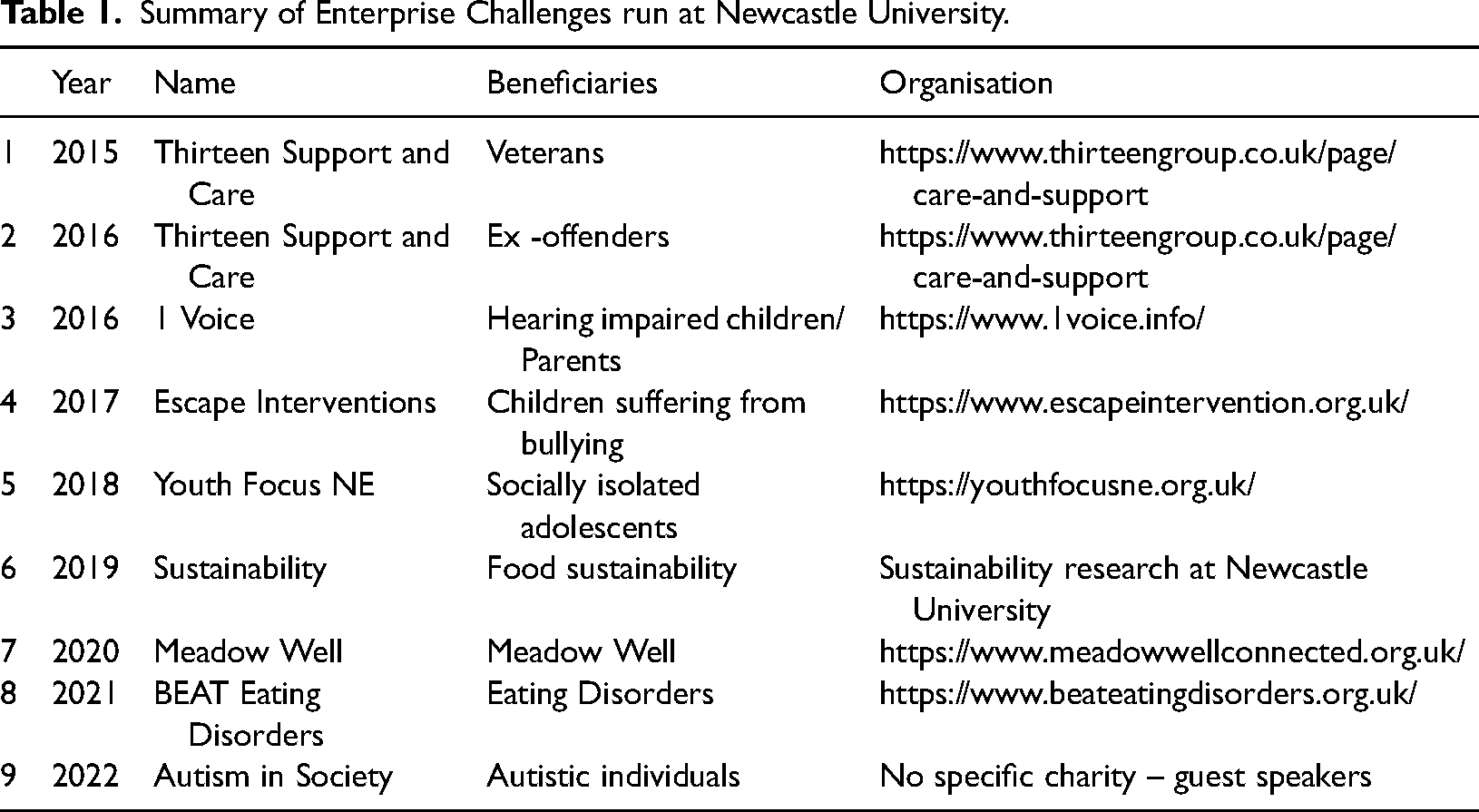
As teaching events, enterprise challenges are inherently flexible: they can be scaled from shorter events that take a few hours to full days or even a week. Moreover, they can be either embedded within specific modules or courses (which may create a thematic context for example social psychology or health psychology) or remain extra-curricular, freestanding events. At Newcastle, most of our challenges were embedded within our first-year modules termed "Psychological Enquiry" (an introductory module focussing on academic skills and psychological literacy, see also Rosenkranz, 2012) and "Introduction to Psychology" (the equivalent for Joint Honour students) and ran for a full day. All but one of our challenges (Challenge 2020, see also Case study 2) were held in person. Ideally, the rooms allow for effective group work, but even in classic tiered lecture theatres, this is achievable.
Anatomy of an Enterprise Challenge
In this section, we describe the basic structure of our enterprise challenges. While this is based on our own experience, these segments can be varied when adapting challenges to different contexts. Figure 1 summarises the core processes of the challenge, from both a learner as well as staff perspective.
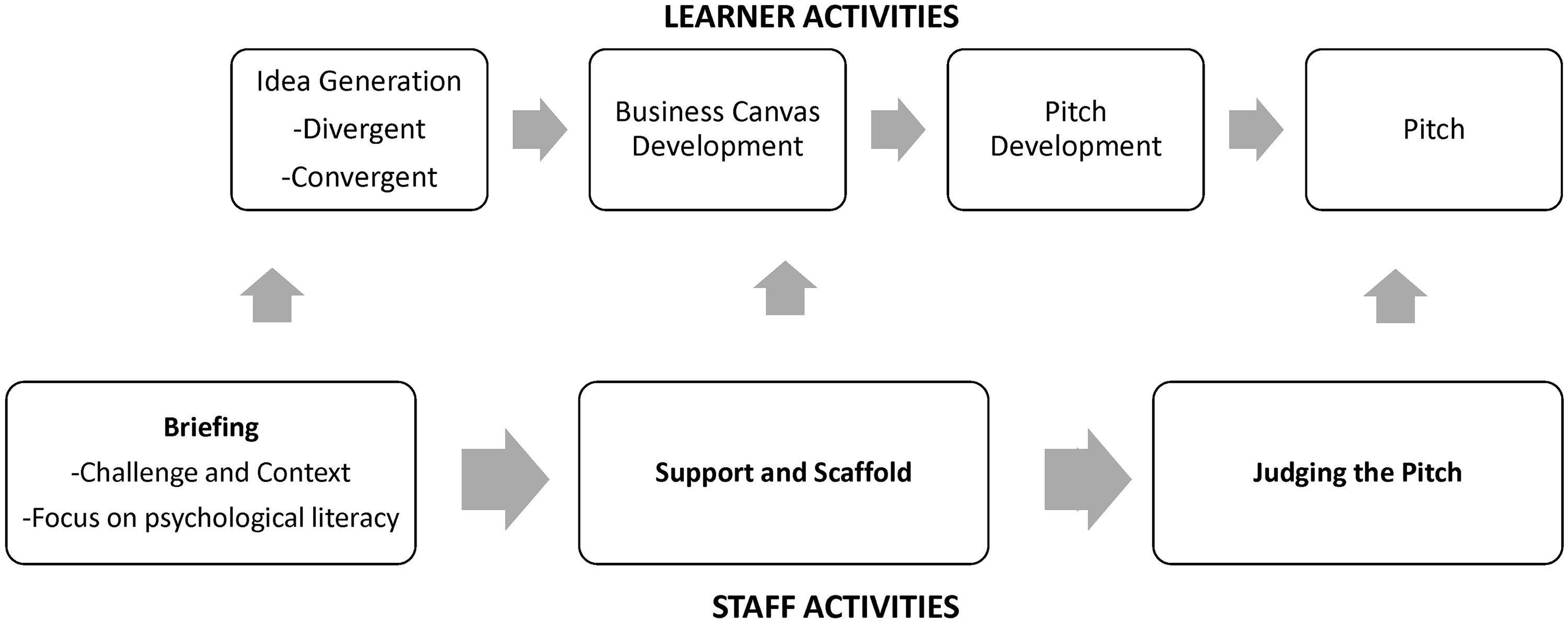
Anatomy of an enterprise challenge.
Pre-Challenge Preparations
Prior to the event itself, the staff team and the external contributors should meet and discuss logistics and expectations. This is especially important if the challenge includes a presentation by members of the organisation that may be vulnerable. Students should also be briefed prior to the challenge about expectations for the day. We have found that it builds up excitement not to reveal the actual wording of the challenge until the event itself, but to provide general information about the external organisation to generate interest. Even though our events were embedded in the curriculum, we asked students to register their attendance. Registration also asked for a commitment to attend due to the logistics and planning involved (especially when catering). Moreover, this also allowed us to pre-assign attendees to groups. The staff team consisted of academic staff from psychology (including authors 1, 3, 5 and 6), the external contributors, and colleagues from the enterprise teams (authors 2 and 4) from the Newcastle Careers service.
Introduction to the Challenge and Briefing
Students arrive at the venue and find their group. The event starts with the various appropriate briefings building up towards the challenge itself. Here the contribution of the external organisation can be pivotal to build up the context and real-life setting for the challenge, especially if potential beneficiaries of the challenge can talk about their experiences. However, video, or online contributions can also work well in this context. The aim of the introductory briefing is to set the stage and context for the challenge itself. Students are encouraged to consider their intellectual resources and that these can help provide an original solution to the challenge. Psychology staff contribute at this stage to frame the challenge around the use of psychological literacy. Explicit instructions to reflect on and implement potential ideas from students' current learning and the psychological literature are given in the briefings. These instructions are depend on the context of the challenge. To give an example, the challenge in 2018 focussed on supporting young people in the North East who are affected by loneliness and social isolation. The brief here included the call to think about students' knowledge about the causes and consequences of loneliness and the literature around possible ways of ameliorating these. Care must be given to not prime students too far down a certain way of thinking. After all, the opportunity of the challenge lies in finding novel and innovative ways of implementing and combining psychological ideas. One way of doing this is to provide general outlines of how the teaching from specific psychological subfields may be applied, without being too specific. For example, the challenge in 2017 focussed on supporting children who suffered from bullying. In the briefing and instructions, students were reminded that they can use any relevant theory or research for their studies. To scaffold this further, they were given examples of relevance, by pointing out their teaching in social psychology, in particular social identity theory, altruism, self -affirmation and the self. Moreover, a further link was also made to evolutionary modules and research on cooperation and reputational effects. All this served as a primer for students to creatively seek solutions using their insight from their learning.
After the call to use psychological literacy, the structure of the day, i.e. the stages for working through the challenge are explained. Finally, the challenge is set to the students, usually in the form of ‘Design an idea for a service, initiative or product that addresses …).
Idea Generation Phase – Divergent and Convergent Thinking
Students get to work in their groups. This segment of the event prompts them to generate initial ideas for their solution, first in an open divergent way, then by staring to focus in on their final idea. The segments are timed so that students remain focused on the challenge itself, and the event staff prompt them on moving on to the next part. Moreover, staff act as "critical friends" to each group by supporting, scaffolding and questioning the ideas being developed. In the divergent phase, they are prompted to think of as many ideas as possible, anything goes, and record these. Here the focus is on quantity not quality of ideas. The suggestions need not be fully worked out, rather sketches or vague outlines; the emphasis is on generation and creativity. Staff move from group to group and advise on the various ideas being discussed. These interactions are important as therein lies further opportunity for scaffolding the creative use of the psychological literature.
In the convergent phase, they are prompted to hone on their best idea, the one they wish to further develop and work on. Here the focus is on choosing the idea that has the best chance of being realised and offering a solution to the challenge. Again, staff can sense check and advise on the ideas.
Business Development Canvas Phase
In this phase, the teams work on the specifics of the idea, supported by the events team. The Business Development Canvas (see for instance https://en.wikipedia.org/wiki/Business_Model_Canvas for a creative commons version) is an effective tool that allows students to focus their ideas on specific and pragmatic areas to realise it. Broadly separated into internal (infrastructure) and external (customer facing) areas, student articulate and develop their ideas regarding key partners, key activities, costs, funding and revenues and customer groups. The canvas provides a scaffold for teams to work out the external and internal constraints on realising their idea. At the heart of the canvas is the value proposition, an expression of what the students’ idea contributes to the solution of the challenge and what make it unique and creative.
Students spend sufficient time on this phase to work out these details.
Pitch Development and Pitch
In the final stage of the challenge, students are prompted to develop their pitch. Each group has a restricted time to pitch their idea to a panel of judges. When developing their pitch, students are prompted to focus on the key value gain that lies in their idea, but also include the constraints and pragmatic revenue streams. They are encouraged to collaborate on distinct aspects of the pitch and practice their presentation before going ahead.
The pitch itself can take on different forms: a live pitch in front of a panel of judges has a sense of immediacy and excitement that can make these events incredibly exhilarating. However, they also can put a lot of pressure on the students, especially if they are still developing their confidence in public speaking. Moreover, time and resource constraints can make live pitching impractical or prohibitive. An alternative is to ask student teams to video record their pitches and then upload these to either to a VLE (Virtual Learning Environment) or private video-sharing account, so that the judging panel can view the video. Usually, pitches are restricted to 3-5 mins. In later enterprise challenges, the pitches have been framed as “elevator” pitches, highlighting the idea that complex information must be distilled within a brief period, focusing on the key take home message.
Judging the Pitches
A panel of experts, whether presented live or via video recording, judges the pitches. This usually includes psychology academic staff, careers service staff and, importantly, staff from the organisation that pose the challenge. Where possible, if client groups can be part of the judging panel, then this enhances the authenticity and relevance of the judging. Evaluating the pitches can occur through pre-set categories, such as feasibility, cost-effectiveness, appropriateness of psychological theorising and effective use of psychological literacy. A wining pitch should be an idea that poses a workable solution to the challenge, has the potential to be implemented and bring value and impact to the organisation and beneficiaries.
Post -Challenge
The winning pitches should be announced soon after the event (as soon as the judging allows). Ideally, representatives of the organisation should announce the winners and runners up and explain the reasons for the success of the pitch. If the winning team and the organisation wishes to implement the idea, then next steps to doing so can be discussed. Moreover, if the organisation is recruiting for work placements, or internships, the students now have a first impression of the organisation and an insight into what the work may involve. Finally, a debrief from the psychology staff on the different ideas that were pitched can help make the most out of the challenge experiences.
Case Studies of Challenges
In this section, we describe two case studies to exemplify the above structure.
Case Study 1: Veterans
Our very first challenge in 2015 was created in collaboration with the charity "Thirteen Care and Support", which is the charitable arm of the social housing organisation "Thirteen Group" (https://www.thirteengroup.co.uk/page/care-and-support). In collaboration with the charity, we designed a challenge around creating practical solutions to challenges faced by veterans in the North East of England. Veterans can face a diverse set of complicated support needs, ranging from mental health issues, such as post-traumatic stress, to drug addiction. The challenge for the psychology student was to ‘develop an idea for a service, initiative or product that addresses challenges faced by veterans in the North East’.
Eighty-five first-year psychology students took part in the challenge, working together in 17 teams. In this challenge, the teams knew each other as they had worked together previously in mentor groups (Rosenkranz, 2012). Final-year peer mentors, as well as psychology staff, careers service staff and staff from Thirteen group facilitated the teamwork throughout the event. The event itself was held in a classic tiered lecture theatre that was large enough that teams could spread out and work independently, while staff could facilitate their working.
The event began with a presentation by Thirteen Group about the work of the charity and the specific needs and challenges faced by veterans within the North East. The presenter, Phil Thompson, a veteran himself, and now a representative of the Charity, explained the complex challenges facing veterans within the North East and presented the above challenge. The presentation also included videos to illustrate the work of the charity. The presentation ended with the challenge itself and a timetable overview of the rest of the day.
The student teams started work on their ideas, working through the phases outlined above. For this challenge, we allocated approximately 60 min to initial idea generation (subdivided into divergent and convergent phases), 30 min to developing specifics of the business canvas and 30 min to prepare the pitch. Once teams had prepared everything and discussed their idea and final pitch with a member of the event team, they were free to go and record their pitch elsewhere on campus. Teams had a deadline that evening to submit their video pitch and the team briefed them on how to record their pitch using their mobile phones. Of the 17 teams, 15 submitted pitches by the deadline and these were viewed by the judging panel that evening. The panel was comprised of psychology and careers service staff, but also had four members of the charity as well as veterans to judge the pitches. Each pitch was viewed collectively and then marked on four criteria: Understanding the challenges faced by veterans, creativity, pitch and practical considerations (finance etc.).
Many of the pitches were deemed outstanding, but the winning pitch was called Puppies to Save the Day (PTSD): the idea was to pair dog walking services from dog shelters in a structured way with veteran shelters, to improve well-being and loneliness, based on psychological research that interaction with animals, such as dogs can improve well-being. The group suggesting this intervention had found research that shows that interaction with pets can have beneficial effects on the recovery of mental illness (e.g. Wisdom et al., 2009) and then further found evidence that veterans suffering from PTSD benefitted in their recovery from interactions with pets (e.g. Taylor et al., 2015). Their proposed service included a way to pair veterans with dog shelters for structured walks and interactions, allowing them to build relationships, without having the full responsibility of dog ownership. The idea was seen as both psychologically valid and pragmatically implementable, with the added advantage of benefitting both the veterans and the dogs. This idea was seen as outstanding by Thirteen Group and the organisation was intent on implementing it as a service. They invited the winning group for lunch in one of their housing centres, which happened approximately 3 months after the challenge where their idea was further discussed, and the students got a chance to meet some of the veteran living there.
Back to the challenge, the module leader announced the winning team and runners up in a subsequent lecture. When asked after the challenge, most students were broadly satisfied with the day (n = 28, 61% agreed). We also asked students if they felt they had developed their psychological literacy (n = 28, 53% agreed). When asked if they felt that they had an increased capacity to understand the needs of Veterans, all students agreed (n = 28, 100% agreed). (Note: All case-specific evaluation questions were phrased as statements and responses measured on a 5-point Likert scale. Responses on points 4 (agree) or 5 (strongly agree) were seen as agreement).
Case Study 2: Meadow Well
In 2020, the global pandemic meant we had to flip our enterprise challenge model online. In 2020, we worked with "Meadow Well Connected", a local community hub, situated in North Shields to the east of Newcastle. Meadow Well Connected has been serving the local community in Meadow Well through a variety of initiatives for over 30 years. The hub aims to work positively with local people to achieve its objectives around community involvement, skill development and well-being. The vision of the hub is to create a thriving community that is a beautiful place to live, work and play. During the pandemic, the hub faced the challenges of delivering on its services while adhering to social distancing regulations that were in place at the time. This became the focus of the enterprise challenge in 2020: students were tasked to "Develop an idea for a service, initiative or product that addresses challenges faced by Meadow Well Connected in light of the Covid-19 pandemic – how they can still deliver their services, and ensure vulnerable members of the community do not become isolated?"
This challenge was open to students across all years of our UG programmes. Over 50 students signed up but 15 turned up on the first day. Unlike the previous challenges, we spread the activities for this challenge out over 3 days – mindful of the online environment and the necessity for students to take breaks. The students worked in three groups to develop their ideas. The day started with a pitch from Meadow Well Connected, outlining their vision, mission and objectives and a summary of their key activities. The presentation emphasised that many users of the hub were vulnerable and/or lived alone and one of their concerns was loneliness during the pandemic. They also highlighted that the area of Meadow Well is one of the most deprived in the North East and thus some more obvious solutions such as online activities may not work when access to devices and the internet could be limited – in fact many users of the hub accessed the internet and devices at the hub and were thus prevented from doing so due to lockdown. Academic staff encouraged students to reflect on the information they were given about the users of Meadow Well connected and to consider how this related to aspect of their psychological learning, for example their understanding of loneliness and isolation (covered in our modules "Social psychology" and "Personality and mental health") as well as the possibility that users might already be experiencing deprivation (social psychology). It was highlighted to them that the hub's focus was to provide a space for connection and supported access to services and resources and encouraged students to consider how any idea they develop would need to be communicated to both to users of the hub as well as those managing the hub, thereby highlighting the opportunity to communicate and present ideas in different context to different audiences.
Having heard about Meadow Well Connected, students were then guided on the principles of divergent and convergent thinking and set up with their first task of idea generation. Students used breakout rooms on Zoom to work in their groups with staff staying online and able to drop into groups to support them during the initial phases. Once students had used the allocated time to form their initial ideas, they were tasked with planning their activities over the next 3 days and were encouraged to develop their own timetables, agreeing when to meet and which tasks each of them would lead on. They were told about academic and career staff availability and advised of drop-in sessions with guidance about submitting their pitches. Students presented their pitches live; these were then judged in the same way as previous challenges. The judges (including staff and users from Meadow Well) deemed that aspects from all pitches were implementable and therefore no winning team was determined. Due to the pandemic, this challenge had only three groups, and all met the challenge.
Evaluation: Do Enterprise Challenges Enhance Psychological Literacy?
To evaluate the way that enterprise challenges affect the development and perception of psychological literacy in our students, we asked them to rate their perceived level of psychological literacy before and after each enterprise event. The rationale underlying this approach was to understand if students perceived their literacy to be enhanced after the event. The challenges described above explicitly ask students to make use of their psychological knowledge and skills in new circumstances, think critically and consider different interpersonal, social, financial and ethical constraints. Moreover, during the challenges, staff supporting the groups in their idea generation encourage the use of their psychological learning. Each challenge and even each idea within a challenge may involve a complex combination of distinct aspects of psychological literacy, so it was important to evaluate if and how students perceived a gain in their own understanding of their psychological literacy. Student perceptions are a limited way of objectively assessing actual gain in psychological literacy, but as the challenges were not compulsory (but greatly encouraged as part of the module), they were not tied to any formal summative assessment. Moreover, the main aim of the challenges as a pedagogical event was to provide a learning opportunity to apply knowledge and skill in a novel context and are therefore an aspect of experiential learning. Gaining insight on how students experience these events and their own potential awareness of the applicability of psychological literacy, can give some insight into how effective the challenges are.
Method
On the day of each challenge, we sent students an online survey using Qualtrics (Qualtrics, Provo UT) that contained the pre-event measures and allowed time before each challenge for students to complete this on their devices. After each event, i.e. after the submission deadline for each pitch, students were sent the second part of the survey, i.e. post-test measures. The time between completion of the pre- and post-test measures was comparable across the challenges, as each challenge lasted one day and the submission of the final pitch and the opening of the post-test measure happened at the end of the day. (The one exception is challenge 7, which due to the online format lasted three days. However, the timing of the post-test also occurred at the final submission of the pitch). Data was collected from six challenges between 2017 and 2022, as we only introduced the below method of evaluation in 2017. Only data from completed pre- and post-tests were included in the analysis. As the sample sizes of completed pre- and post-test were small, the data were pooled across the challenges. This may introduce additional confounds, such as timing, however we felt justified in pooling the data, given that the timings across the challenges were comparable, and the aim of the analyses was to investigate the pedagogical method, rather than the individual challenges.
All data collection was annually approved by the Newcastle University Ethics Committee. The most recent ethics reference is 26607/2022.
Materials
We collected demographic (gender, age) information. The measure of psychological literacy followed Chester et al. (2013) and Burton et al. (2013) who in turn based their measures on McGovern's nine capabilities of psychological literacy (McGovern et al., 2010). These nine capabilities (e.g. “thinking critically” or “understanding scientific research practices”) were presented to students who were asked to rate their ability in each area, from "non-existent" to "excellent" on a 7-point scale (for all dimensions see Table 3). A second set of measures were included that represented a selection of entrepreneurial attitudes or mindset: The items measured these aspects of entrepreneurial orientation, such as (a) jumping on unexpected opportunities, (b) applying knowledge in novel areas, (c) team working, (d) communication and (e) thinking of new ways of doing things. Items 1 and 2 were adapted from Holmström et al. (2015) and Lindberg et al. (2017). The authors generated the other three items. These items were measured on a 5-point Likert scale from Strongly Disagree to Strongly Agree. As multiple pairwise comparisons were made, significant levels were adjusted by the number of tests in that comparison group (Psychological literacy p < .05/9 = p < .005; Enterprise orientation p < .05/5 = p < .01).
Participants
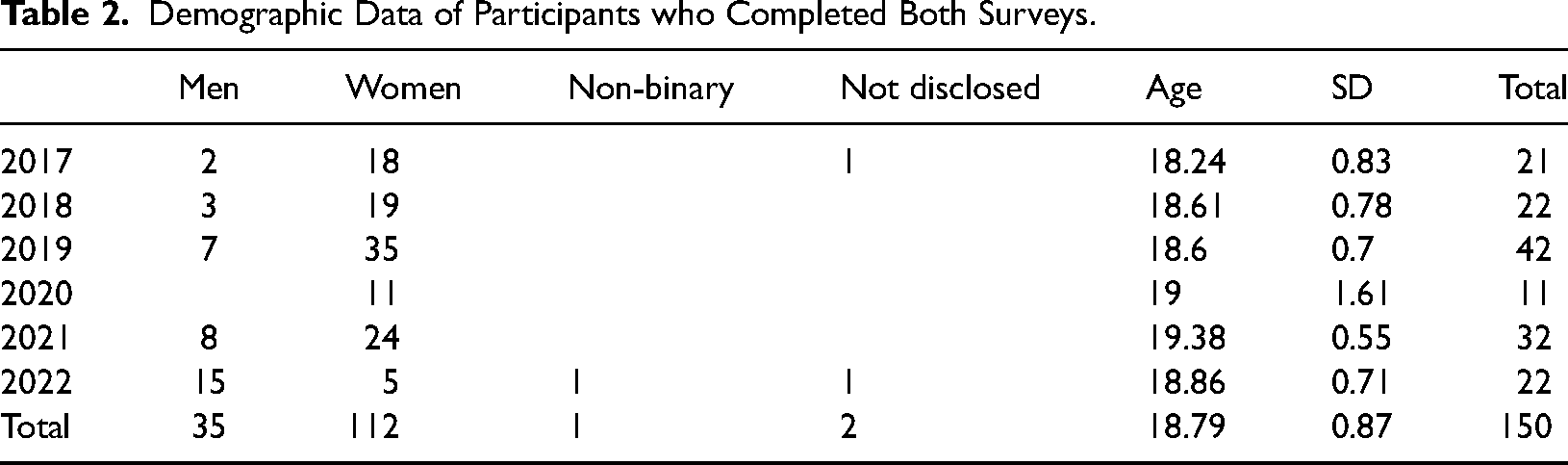
Table 2 shows the demographic data of all students who participated in the challenges and who completed both the pre- and post-test.
Demographic Data of Participants who Completed Both Surveys.
Results
Table 3 shows the mean values and standard deviations for all measures before and after the challenge. Student self-ratings of psychological literacy increased after participating in a challenge. On all dimensions, mean values were higher after the event. In the pooled data, these differences were significant for all dimensions apart from "understanding basic concepts in psychology" (t (149) = -1.95, p = .053) and "having cultural competence" (t (149) = -0.65, p = .546). "Acting ethically" was significant at p < .05 (t (149) = -2.04, p = .044) but, taking adjustments for multiple testing into account, can be treated as a not-significant. The two dimension that showed the strongest effect were "communicating well in many different circumstances" (t (149) = -5.77, p < .001, d = 1.27) and "applying psychological principles to personal, social or organisational problems" (t (149) = -7.16, p < .001, d = 1.19).
Mean (M) and Standard Deviation (SD) of Pre- and Post-event Ratings for Psychological Literacy and Enterprise Orientation. Asterisk (*) Denotes Significant Mean Differences at the Adjusted Significant Level (Psychological Literacy = p < .005; Enterprise Orientation = p < .01) (Note: Due to Three Missing Cases for Enterprise Orientation, the N = 147).
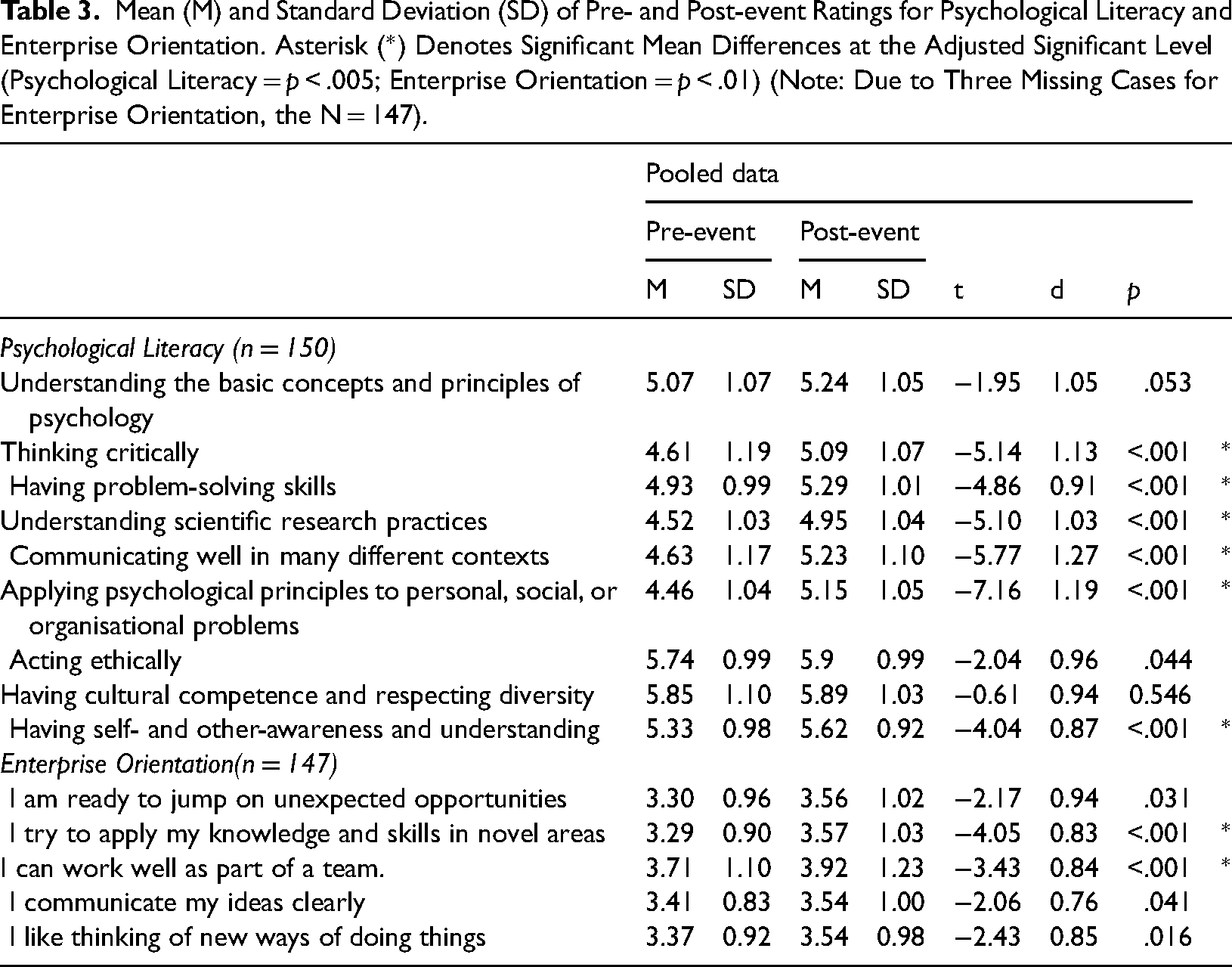
The five items of enterprise orientation also showed a mean increase after the event. These differences were significant at p < .5 but when adjustment for multiple testing was considered, only the dimensions "I try to apply my knowledge and skills in novel areas" (t(146) = –4.05, p < .001, d = 0.83) and "I can work well as part of a team’ showed a significant difference" (t(146) = -3.43, p = .001, d = 84).
Discussion
Do enterprise challenges enhance the psychological literacy of students participating in them? Self-ratings indicate that students perceive their own psychological literacy and entrepreneurial orientation to be increased after taking part in an enterprise challenge. Within psychological literacy, the two dimensions with the strongest significant effect, "Communicating across many different circumstances" and "Applying psychological principles to personal, social and organisational problems" are consistently rated higher after the event. Both dimensions tap directly into the core aim of enterprise challenges: students are encouraged to make use of their psychological education as a resource and apply this to the challenge brief, as well as communicating their rationale succinctly and clearly in a pitch to a general audience.
In a similar vein, students rate aspects of their own entrepreneurial orientation, in particular "team working" and "applying knowledge and skill in novel areas" as enhanced by the event. It is heartening to see that the ratings of the students in terms of perceived increase in psychological literacy and entrepreneurial orientation is in the expected direction. However, any interpretation of these findings must acknowledge the limited measurement of psychological literacy. Our evaluation did not objectively measure students’ ability in these areas, but rather asked them to self-rate. While there was sufficient time between pre- and post-measures for it to be unlikely that students remember their actual rating on each dimension, there may be bias due to implied demand characteristics and expectation effects. Moreover, the sample was limited by completion of both pre- and post-surveys. While most participants in the events completed the pre-survey, only a fraction returned for the post-survey, limiting the power of the analysis, but also opening the potential for self-selection effects on the measurement. The interpretation of the result needs to be suitably cautious.
The enhancement to psychological literacy that enterprise challenges as a teaching intervention can facilitate is not one of substantive gain, e.g. the development of new knowledge and skills, but rather an opportunity to gain experience in using psychological learning in a novel context. The challenge briefs and the real-life problem posed by the organisation allow students to apply, rehearse and employ their psychological knowledge and skill in novel or unfamiliar situation. Rather than developing and learning new knowledge, this activity can contextualise and frame the intellectual resources that students have gained so far. The value of enterprise challenges in psychology lies in this process of using intellectual psychological resources and utilising them in novel ways and for the benefit of society. Understanding the needs of a particular client group, working in teams to critically examine and solve problems, and manoeuvring external constraints draw together to provide a broader context for psychological knowledge and an arena, in which it can be applied. Thus, enterprise challenges have the potential to engender the development of "global citizens" as they give students the opportunity to take their learning out of the lecture theatre and to aim them at societal problems. This presents opportunities for the development of "cultural literacy" (Newstead, 2015) as undergraduate education cannot only process modules that develop knowledge and skill but should also provide opportunities to practise this knowledge and aim it societal and global problems. The challenges enhance psychological literacy by providing an experience and opportunity to apply psychological knowledge and skills in novel contexts and to the benefit of others. The experience of thinking with an enterprise mindset about their own resources and skills is also an important aspect of professional development (Norton & Sear, 2022) and may begin preparing students for an increasingly capricious and fast-changing career environment where traditional careers are rapidly changing and new opportunities can be sought out (for instance in interaction with artificial intelligence).
However, there are ways in which the enterprise challenges can be adapted and assessed summatively. This would also allow for a more objective way to assess their effectiveness and the gain in psychological literacy. Module/ course leaders may decide to use an adapted version of the presented model to assess their learning outcomes. This would entail constraining the brief considerably to focus students on the intended theories and content. Moreover, the challenge itself would need to be run over a longer period culminating in a more extensive and worked out pitch, possibly in written form and including a portfolio of business canvas and cost calculations etc. An assessment like this, especially put into the context of a real-life challenge, would be a truly authentic assessment (see for instance, McArthur, 2023) as the outcomes may be fully applicable and implementable, develop a student's entrepreneurial mindset and, of course, their psychological literacy.
At Newcastle University, we have opted for a model in which enterprise events are embedded in the first-year curriculum, and mostly take place face to face over an extended afternoon. However, the template described above is versatile and can easily be easily stretched to large and longer projects. A propitious way of utilising the enterprise challenges for more advanced students would be to pair with so-called COIL (Collaborative Online International Learning) methodology (Hackett et al., 2023). Working across nations and cultures and solving collective challenges related to global issues as articulated, for instance, through the UNESCO (2017) sustainable development goals are a promising way to further develop enterprise challenges and thereby creating educational opportunities that can cultivate global citizenship. We intend to adapt the model in this way for a final-year course on "Professional Skills and Psychological Literacy". Final-year students, looking toward the transition into work or further study, may be very receptive to challenges like this, as their professional and social development is on the forefront of their minds. Moreover, final-year students have a greater range of psychological literacies to draw upon, at least compared to first-year students. Our current module is assessed through a reflective log, where some students look back to the challenges they participated in as first years. Reflective practice (Moon, 2004) in general is propitiously paired with enterprise challenges, as the experience of working through a challenge and ongoing and subsequent reflections on this may lead to deeper insights by the students on the value of their own knowledge and skills, and how they may be employed for the betterment of their own and others development. Future developments of our module will incorporate reflective learning into the process.
A key insight into how to make the enterprise challenges successful is the interaction with the organisation. The pragmatic nature of the pedagogical model, including cost constraints, ethical considerations, time and marketing, makes it appealing for those organisations seeking novel and psychologically sound solutions for the problems they and their clients are facing. A good rapport between the educator and the liaison at the charity, as well as an understanding of how the interaction may be mutually beneficial is a good foundation to build on: Charities will get exposure of the work they are doing and the potential to network with students who may subsequently seek internships, placement or may even fund-raise for their organisation; educators on the other hand will find a context for their teaching and their students’ development.
Ultimately, enterprise challenges, as an adaptable and versatile teaching model, are one way, in which psychology students can develop and practice their learning in the context of societal challenges, and, going back to Maslow (1956), make a start on finding ways of contributing to saving the world.
Footnotes
Acknowledgments
We would like to thank all members of the charitable organisations who have worked with us over the years to create and design enterprise challenges. Similarly, thank you to all the staff of the Careers Service and School of Psychology at Newcastle Univerity, who supported us and helped us deliver these activities. We would also like to thank Professor Susan Nolan and the two anonymous reviewers for their constructive comments on the manuscript. Patrick Rosenkranz would like to dedicate this work to the memory of Leon Mexter, CEO of Youth Focus NE and friend, who sadly passed away in 2019 and is greatly missed.
Funding
The authors received no financial support for the research, authorship, and/or publication of this article.
