




Abstract
Psychological literacy is an approach to teaching which encourages students to consider their subject knowledge in ‘real world’ applied contexts (i.e. in student’s lives beyond university), which may be professional, personal, or societal. ‘Real world’ here refers to the application of psychological knowledge and skills to students’ personal, student-role, work, and community contexts. Psychological literacy is typically integrated into psychology programmes through classroom activities, extra-curricular activities, and opportunities outside of the core curriculum. However, for the goals of psychological literacy to be fully realised, it should be intentionally and thoughtfully embedded at the module and programme level. One way to achieve this is to develop and evaluate modules (i.e. standalone units or courses) that embed psychological literacy explicitly by design. In this paper, we provide overviews, brief evaluations, and reflections on four undergraduate modules within a UK Psychology (BSc) degree that integrate the principles of psychological literacy. These include a first-year compulsory module (‘Biological Approaches to Human and Non-Human Behaviour’), a second-year compulsory module (‘Neuroscience’) and two final-year elective optional modules (‘Face Perception’ and ‘Feminist Social Psychology’). We offer reflections on the process of designing these modules as educators who are interested in developing students’ psychological literacy and also provide student evaluations.
Psychological literacy is broadly defined as ‘the intentional values-driven application of psychology to achieve personal, professional, and community goals’ (Cranney et al., 2022, p. 3). Psychological literacy constitutes both a pedagogical philosophy (i.e. an approach to the teaching and learning of psychology) and a set of unique graduate attributes (i.e. a set of measurable capabilities; Cranney et al., 2022; Pownall, Harris, et al., 2022). Psychological literacy is an approach to teaching that encourages educators to develop students’ personal, societal, and cultural awareness, while also supporting them to become responsible, ethical, and global citizens (Mair et al., 2013). Psychological literacy has thus been thought to promote skills such as effective communication, reflection, and problem-solving (Mair et al., 2013), and now features explicitly in accreditation standards and programme specifications for psychology in the UK (BPS, 2019; QAA, 2019). Therefore, according to the British Psychological Society, all UK psychology graduates should develop psychological literacies to fulfil the requirements of a psychology degree. As such, it is important to critically consider how psychological literacy can be effectively integrated into psychology curricula in the UK.
Research has made progress in addressing perceptions of psychological literacy (including staff, Newell et al., 2022; and students, Harris et al., 2021; Morris et al., 2013; Pownall, Harris, et al., 2022), and broadly concludes that psychological literacy is viewed positively. However, there now remains a need to not only explore perspectives of psychological literacy as a construct (e.g. Newell et al., 2021) but also to address how psychological literacy can be embedded in teaching (e.g. Heritage et al., 2016; Mair et al., 2013; Newstead, 2015). Some work has begun in this area. For example, Taylor and Hulme (2015) compiled case studies of psychological literacy practices, highlighting the ways in which psychological literacy may be added to existing curricula through interventions including seminar activities, innovative assessments, peer mentoring, research apprenticeship schemes, and peer-assisted learning schemes. Similarly, there have been other useful examples of how psychological literacy can be integrated within teaching; for example, through authentic approaches to assessment (Pownall et al., 2023), active learning, and promoting co-creation with students (Hulme & Cranney, 2021).
Case studies of small-scale psychological literacy activities are a useful place to start (Taylor & Hulme, 2015). However, it is more challenging to implement a psychological literacy education across larger-scale units of teaching, for example, whole undergraduate modules (i.e. standalone units taught within a degree programme) and programmes (i.e. degree courses, such as BSc Psychology). Challenges include the constructive alignment of psychological literacy with the module- and programme-level learning outcomes, the assessment design, and quality assurance processes. To date, there have been relatively few 1 reports of modules or programmes that intentionally centre psychological literacy as a pedagogical approach in their development, design, and subject content. Therefore, we designed, implemented, and evaluated four undergraduate modules in a BSc Psychology undergraduate programme in a large research-intensive university in the North of England. Each module aimed to explicitly centre the pedagogical principles of psychological literacy. These modules were selected to broadly represent the subdisciplines within psychology (i.e. social, cognitive, and biological) according to the British Psychological Society (2019) and were considered pathfinder modules to determine how best to integrate psychological literacy across the psychology programme in our institution. While the definition of psychological literacy is not fixed (see Newell et al., 2021), we take the view that developing psychological literacy refers broadly to the process of supporting students to consider how the content that they learn can be applied to their own personal and professional lives, as well as more generally to society, in a way that is meaningful, critical, and thoughtful (see Cranney et al., 2022). In other words, psychological literacy, to us, is about moving beyond teaching standalone psychological content (e.g. theories about human behaviour) as detached from human experience but instead helping theories to be clearer to students by realising the ‘real world’ implications of psychological knowledge, in a way that encourages students to be responsible, ethical, and compassionate thinkers. ‘Real world’ implications here refer to the application of psychology knowledge and skills to ‘real world’ applied contexts within and beyond university, for example, in student's personal, work, and community contexts (an extension of Hulme, 2014). We were informed by the notion that psychological literacy encompasses both skills (e.g. communication, critical thinking, scientific thinking, and team working; McGovern et al., 2010) as well as principles or values (e.g. global citizenship, ethics, a concern for equality, real-world application of content), and thus, we aimed to integrate both into our modules.
Module design, development, and evaluation
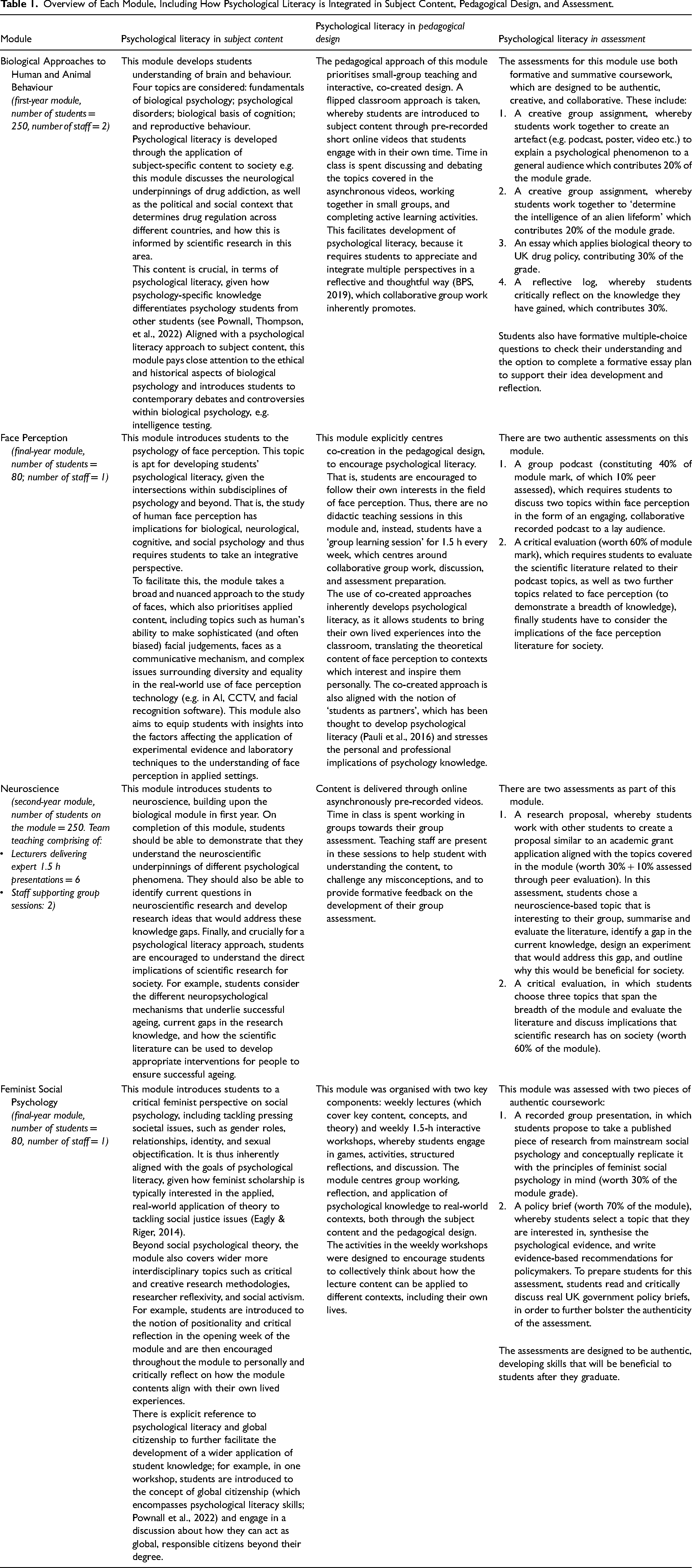
We designed four new modules: a large first-year 2 compulsory module (‘Biological Approaches to Human and Animal Behaviour’, N students = 250), a second-year compulsory module (‘Neuroscience’, N students = 250) and two final-year elective optional modules (‘Face Perception’ and ‘Feminist Social Psychology’, N students each = 80). Throughout these modules, we aimed to support students to develop psychological literacy skills and realise the ‘real world’ practical, personal, and professional implications of psychological knowledge (see Cranney & Morris, 2021; Hulme, 2014). To achieve this, we designed modules with subject content that explicitly tackles pressing ‘real world’ issues, including racial/gender bias in face recognition research, ethical dimensions of neuroscience, and social justice policy work. Indeed, these principles of psychological literacy (application to real-world issues and development of skills) are reflected in the module learning outcomes. For example, ‘identify and appropriately deploy neuroscientific research to address real-world problems’ and ‘develop communication and team workings skills, and critically reflect on the development of these and other transferable skills’. All module overviews, which detail learning outcomes exhaustively, can be openly accessed here (Harris et al., 2023, https://osf.io/k7gdb/). Throughout the modules, we co-created module content with students, adopted innovative and authentic assessments, and prioritised active, small-group learning. In Table 1, we describe the process of designing these modules and articulate how psychological literacy informed our pedagogical decision-making.
Overview of Each Module, Including How Psychological Literacy is Integrated in Subject Content, Pedagogical Design, and Assessment.
Student evaluation
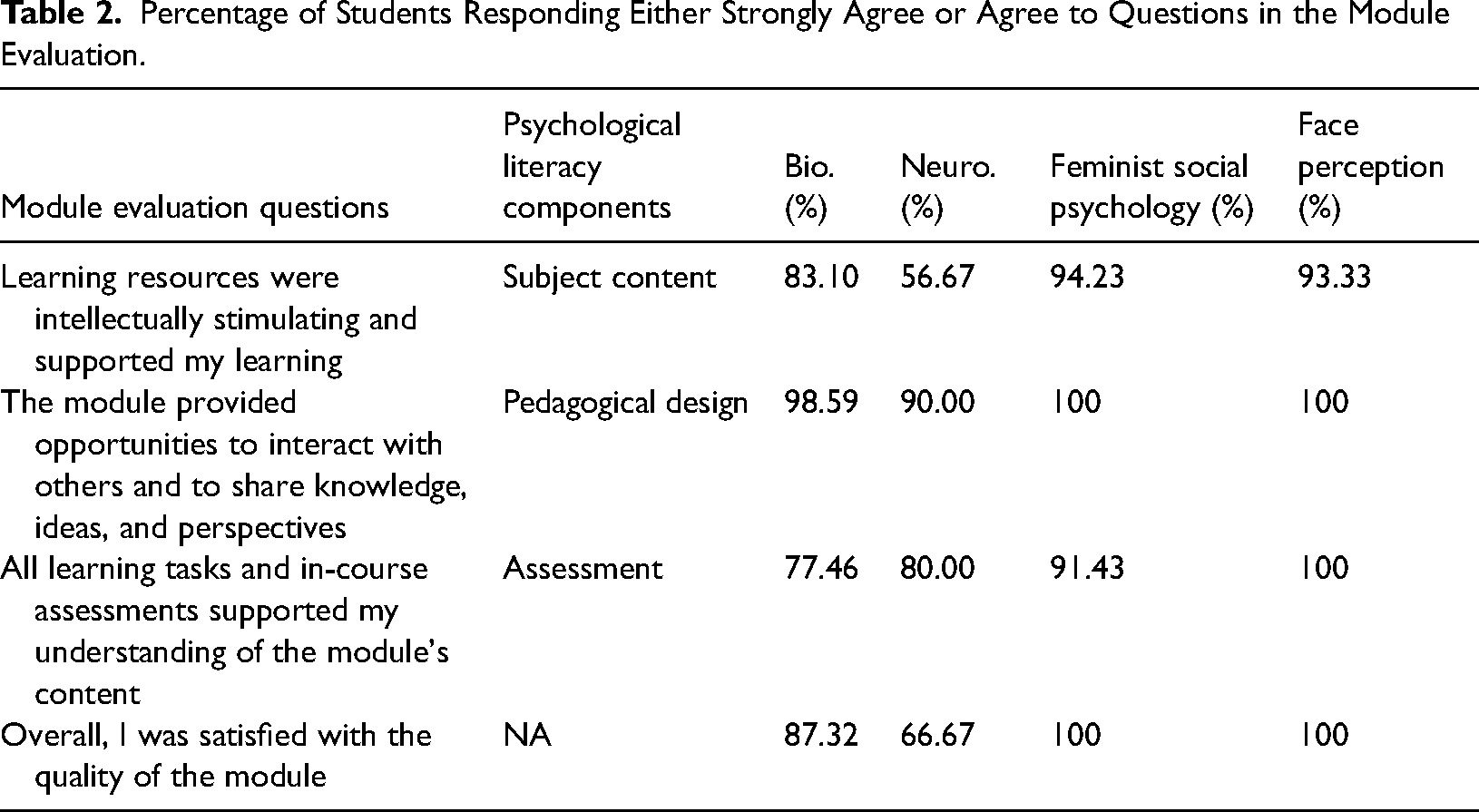
Overall, these four modules aimed to centre psychological literacy skills including collaboration, co-creation, the application of specialist psychology knowledge to real-world settings (Pownall, Harris, et al., 2022), effective science communication and outreach (Hulme & Cranney, 2021), reflection and reflexivity (Coulson & Homewood, 2016), and respect for diversity (McGovern et al., 2010), among others. To evaluate the success of these modules, we considered the student module evaluations for each module. Given the novelty of these modules, in our evaluation, we were interested in the holistic student experience of completing these modules rather than examining other outcomes (e.g. attainment or retention). Module evaluations are anonymous surveys that are sent to students at the end of the module. The module evaluation includes quantitative questions such as ‘overall, I was satisfied with the quality of this module’ which students answer on a 5-point Likert scale from strongly agree to strongly disagree. Additionally, there are two open-ended questions with free-text responses: (1) what aspect of the module did you enjoy? and (2) what aspects of the module could be improved? Students are actively encouraged to complete the module evaluations, although completion is not compulsory. Table 2 provides students responses to questions aligned with the three psychological literacy components detailed above: (1) subject content, (2) pedagogical design, and (3) assessment.
Percentage of Students Responding Either Strongly Agree or Agree to Questions in the Module Evaluation.
Furthermore, we conducted a deductive qualitative content analysis of responses to module evaluations (as per Pandey, 2019). We analysed the free-text responses to both questions for each of the four module evaluations using a deductive content analysis (i.e. positive comments and negative comments) with codes pertaining to the three psychological literacy components detailed above: (1) subject content, (2) pedagogical design, and (3) assessment. Table 3 shows the results of this coding. The coding of the four modules was split between two authors and coding was then checked and any issues were iteratively discussed and resolved.
Content Analysis of Positive and Negative Student Comments for Each Module, Broken Down by Component of Psychological Literacy. Numbers Indicate the Frequency of Responses that Contained Each Component.
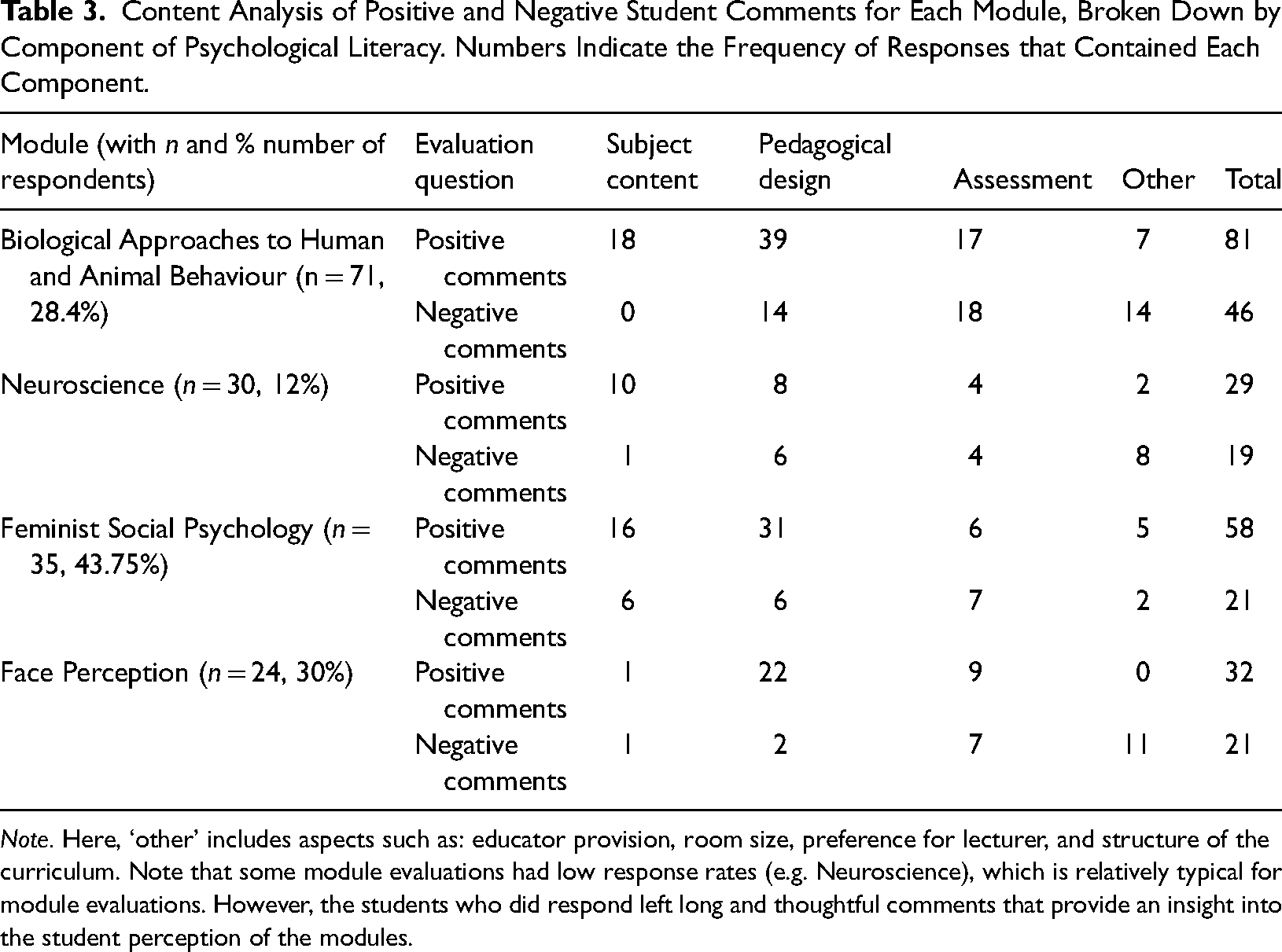
Note. Here, ‘other’ includes aspects such as: educator provision, room size, preference for lecturer, and structure of the curriculum. Note that some module evaluations had low response rates (e.g. Neuroscience), which is relatively typical for module evaluations. However, the students who did respond left long and thoughtful comments that provide an insight into the student perception of the modules.
Psychological literacy in subject content
Across the modules, students provided 45 positive comments about the subject content and only 8 negative comments. Students highlighted the value of specifically applying their psychology subject knowledge to social issues, beyond the context of their assessment (e.g. ‘making us do things that we will need to be doing in a real life scenario is great’ [Neuroscience] and ‘seeing how Feminist Social Psychology is applied in the real world’ [Feminist Social Psychology]). Students particularly enjoyed when content was delivered in a way that emphasised the societal, professional, or personal implications (e.g. ‘loved how this module related back to society as a whole’ [Biological Approaches]).
In terms of negative and constructive comments (n = 8), some students mentioned generic comments about the content, such as ‘content was not very engaging’ [Neuroscience] and ‘I didn’t see the relevance of some content’ [Face Perception]. Some students also expressed a preference for broader content that covers more areas of psychology and different theories (e.g. ‘The only thing I could suggest to “improve” the module is to have a wider range of lecture content’ [Feminist Social Psychology]). Beyond this, other students generally did not like the module content and had specific constructive feedback for how lecture content was prepared (e.g. ‘in some lectures given, the claims given were merely explained with minimum references and inadequate future direction for that topics’ [Biological Approaches]).
Psychological literacy in pedagogical design
The analysis showed that most of the positive comments were related to pedagogical design (n = 100). For example, students reported particularly enjoying the active and interactive learning approaches that were adopted in these modules (e.g. ‘I liked that as well as lectures we were provided with interactive opportunities such as workshops’ [Biological Approaches] and ‘I appreciated the interactive take on this module’ [Face Perception]). In particular, the opportunity to work collaboratively with other students and sharing their knowledge and experiences with each other was particularly well received (e.g. ‘I really enjoyed the collaborative part of this module’ [Face Perception], ‘I liked doing group work … it was great to share ideas and learn from each other’ [Biological Approaches], and ‘it was stimulating working in collaboration with peers across the module’ [Feminist Social Psychology]). Students’ appreciation of collaborative working was particularly prominent in assessment contexts (‘I liked working on the podcast as it was something I had not done before and it allowed me to work with a group of people on something fun’ [Face Perception]).
Further, students in the evaluation reported enjoying the opportunity to engage in co-creation with staff. Co-creation means that students can follow their own interests, in terms of what they learn and also how they demonstrate meeting learning outcomes in assessments, and this flexibility was well-received (e.g. ‘I love the whole idea of the module, such as choosing topics that we are interested in … which is very inspiring and fun to work on with’ [Neuroscience] and ‘I appreciated being able to guide ourselves in the direction we wanted to’ [Face Perception]). Students’ enjoyment of co-created learning also extended to assessment contexts; for example, some students commented specifically on appreciating the ability to follow their interests in coursework (e.g. ‘I found the freedom to choose the topic we wrote it on nice as it allowed me to pick something that I'm passionate about’ [Feminist Social Psychology]).
In the negative comments about pedagogical design (n = 28), some students across the modules did not appreciate some of the teaching modalities adopted in the module; for example, in the modules with pre-recorded content, students expressed a preference for ‘live’ or in-person content instead (e.g. ‘online lectures were disappointing. I would much prefer having in person lectures’ [Neuroscience]). Similarly, while some students mentioned group working as a positive aspect of the modules, other students did not enjoy this and found it difficult to engage with (‘I don’t really like working in a group’ [Neuroscience]). However, in contrast, other students commented that they would have preferred more discussion and peer-to-peer working (e.g. ‘I think more opportunities for in-class discussion would be beneficial, I don't think the amount we had was problematic, but I think the more the better’ [Feminist Social Psychology]).
Psychological literacy in assessment
There were an equal number of positive and negative comments about assessment design across the module evaluations (n = 34 each). Students commented on assessments frequently in the module evaluation; for example, students praised the authentic assessment and could identify ‘real life’ applicability. The applied nature of these assessments’ contrasts with many of the assessments that students complete during their degree which are designed to assess subject knowledge and examine students’ ability to critically evaluate psychological theories, without necessarily considering the meaningful application of this knowledge. Students also appreciated the creativity that this assessment approach required and enjoyed the shift away from high-stakes summative exams to more creative, collaborative, supported approaches to assessment (e.g. ‘I like the different kinds of assessments! Gets you thinking in a different and more creative way’ [Neuroscience]). For example, one student reflected that: ‘I am in full support of reducing the emphasis on knowledge as something you need to pass exams, and instead prompting students to flexibly apply our knowledge in different more “life-like” contexts’ [Biological Approaches]). This notion of the application of subject knowledge to solving ‘real’ problems lies at the heart of psychological literacy, and thus demonstrates the promise of this approach.
In terms of the constructive comments on assessment design, some were related to the logistics of the assessments in the modules (e.g. ‘the word count for the policy brief needs to be higher’ [Feminist Social Psychology]). Other comments referred to the unfamiliar nature of the authentic assessments; for example, ‘providing an example of the expectation would have more clearly provided a perspective as to what we needed to do’ [Feminist Social Psychology]. Further, echoing the feedback on the pedagogical design, some students also mentioned that working in a group in an assessment context was challenging (e.g. ‘I felt nervous working with others towards my grade’ [Face Perception).
Staff evaluation
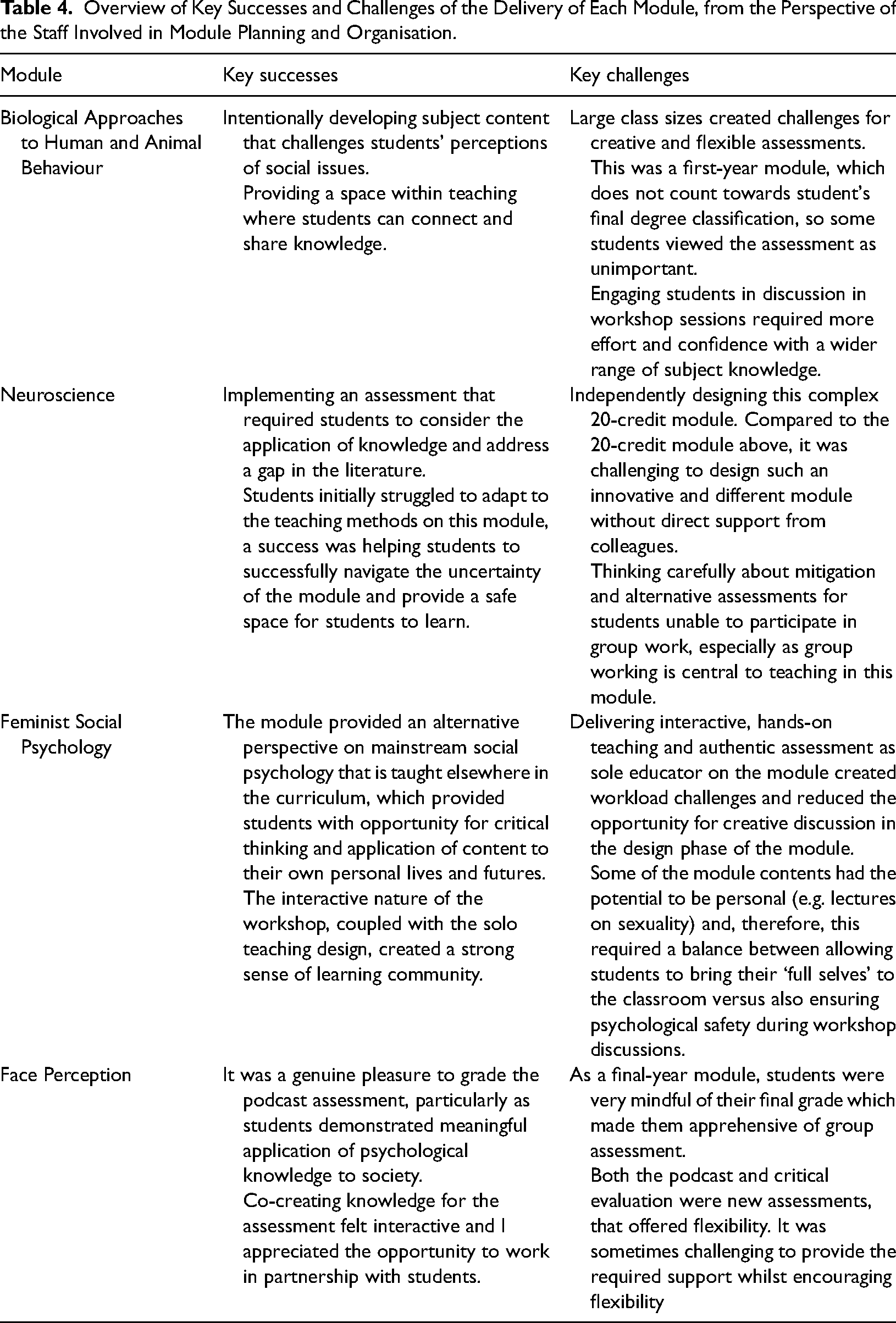
Although it is important to understand student perspectives of the implementation of psychological literacy in undergraduate modules, it is also necessary to understand the perceived benefits and challenges of teaching in this way from a staff perspective. The staff who designed these modules were the main deliverers of the module contents (and, indeed, the authors of this paper). Therefore, to add more nuance to the student evaluation, we share here key successes and challenges from the module leads of the four modules (Table 4). We then use these insights to shape recommendations for other educators in the Discussion.
Overview of Key Successes and Challenges of the Delivery of Each Module, from the Perspective of the Staff Involved in Module Planning and Organisation.
Discussion
Taken together, our four case studies demonstrate the pedagogical potential of psychological literacy and demonstrate how the principles of psychological literacy can be integrated across large-scale undergraduate curricula. Our modules were well received by students, as evidenced in the module evaluation content analysis which suggested that students seemed to particularly appreciate the ‘real life’ applicability of subject content, the opportunity to work collaboratively with other students, and the authentic approaches to assessment design. However, while student feedback was generally positive, in that student's evaluation was coded to be more positive (n = 200) compared with negative or constructive (n = 107), our experiences of creating and delivering these modules was not without challenge, particularly in the context of facilitating group work and allowing a high level of student choice and flexibility. Thus, we have four key recommendations for educators who wish to explicitly adopt a psychological literacy approach to their module or programme design. These recommendations respond to key challenges that we experienced throughout the course of the module development.
Challenges and recommendations
Interactive teaching requires more resources.
We found that while students appreciated the interactive small-group sessions and activities, this approach inherently requires more staff time and energy to deliver. Beyond workload constraints (i.e. the notion that smaller-group sessions require more staff hours to deliver), the sessions themselves were also more labour-intensive and required a higher-level of engagement from us as educators. For example, engaging students in discussion, activities, and debates required more cognitive effort in the sessions. There are ways to maximise the efficiency of time spent in class to compensate for this. For example, there is value in considering how students can be afforded the opportunity to work collaboratively on interactive tasks, in a way that makes the most out of timetabled class sessions and minimises staff input in these classes, through, for example, more self-directed study and peer-facilitated group-work sessions. The issue of resource requirements and workload was challenging, particularly in modules that were not team taught, i.e. modules with one educator delivering all teaching.
Furthermore, outside of time spent in class, an added workload challenge is the time, attention, and care needed to create modules that centre the principles of psychological literacy. Designing these modules required us to think differently about our approach to content, assessment, and pedagogical design, which created more work than a traditional didactic module would require. To overcome this challenge, in the Biological Approaches module, two academics co-designed and delivered this module. We found that having two academics working together inspired creativity and spread the workload.
Recommendation: Carefully consider staff workload when designing modules with interactive elements and build in opportunity for peer-to-peer discussion among teaching staff. Team teaching may help to alleviate workload pressures.
Increased flexibility needs careful management.
Similarly, we also noted how efforts to maximise flexibility, particularly in the context of assessment, created challenges such as calibrating standards, ensuring learning outcomes were met, and prioritising consistency across markers. For example, the flexibility in assessment meant that student work was varied. While this is not necessarily problematic, it does require careful management to ensure equity in the student experience, and to make sure that all students are demonstrating the relevant learning outcomes. In our experience, we ensured equity through regular discussion within module teams to allow calibration across markers, clear and detailed assessment briefs with marking rubrics that afforded flexibility, and a keen eye to learning outcomes throughout the delivery of the module and assessment. However, this too created an additional workload pressure and required iterative, thoughtful reflection upon learning outcomes.
Recommendation: Embrace flexibility and creativity into teaching and assessment but ensure that learning outcomes are at the centre of module and assessment design to ensure equity in the student experience.
Authentic assessment can lead to authentic challenges.
Further, we experienced challenges related specifically to group work. For example, some students expressed difficulties with ensuring that all group members contributed equally. Other students experienced challenges in group dynamics and felt that creativity was sometimes stifled to prioritise group cohesion. While we tried to mitigate against this by, for example, providing teaching on group dynamics and encouraging groups to create a ‘group working contract’, this remained a challenge. Additionally, some students struggled to engage with group activities due to disability, including social anxiety and autism. Challenges associated with group working and assessment are not unique to modules that centre psychological literacy (Hassanien, 2006); however, these issues become more problematic when the module uses group working as the main pedagogical approach to teaching. All the modules we outline here involved in-person group work, which was often aligned with group-based assessment.
Furthermore, some students also found the freedom within the more flexible assessments daunting. However, developing ideas, thinking creatively, and working collaboratively are skills that students will require in many job contexts, and thus they have value beyond university. In many cases, the challenges associated with authentic assessments that aimed to emulate ‘real’ tasks were largely aligned with the nature of the task itself. In this sense, authentic assessments bring with them their own set of authentic challenges. Thus, while these are valid concerns that have been noted across the authentic assessment literature (Murphy et al., 2017), they largely replicate the experiences of working collaboratively in employment settings. Therefore, authentic assessments can enable students to deal with authentic challenges they will encounter in working life, ensuring they are prepared for post-graduate employment.
Recommendation: Educators who wish to integrate more innovative and authentic assessments to elicit psychological literacy skills should consider what kinds of support students need to overcome the challenges associated with the assessment. Educators should be mindful that authentic assessments are often new to students, and therefore require adequate scaffolding. Discussing potential challenges around group work and authentic assessments with students may be a useful mechanism to calibrate expectations and manage frustration too. Educators must also anticipate reasonable adjustments to support students with disabilities in their group work.
The need for a unified psychological literacy approach across the curriculum.
Finally, it is worth noting that while student feedback on the psychological literacy approaches were positive, this may be partly due to our positions as educators in this context. Given our collective scholarship about psychological literacy (Harris et al., 2021; Pownall, 2023), we have an appreciation of pedagogical approaches that can facilitate psychological literacy and were motivated to centre psychological literacy in our module designs. As such, we were well prepared to integrate psychological literacy into our module design. We recognise that it may be considerably more challenging, however, if the importance of embedding psychological literacy is not shared across teaching teams.
Therefore, it is perhaps unsurprising that most existing psychological literacy case studies to date involve smaller-scale teaching activities that typically require one-two members of staff to implement (Taylor & Hulme, 2015), as this does not typically require wider staff buy-in to the concept. Starting with a shared articulation of how psychological literacy is viewed, including perceived value and desired learning outcomes (or, indeed, graduate attributes), could facilitate more effective integration. Ideally, to successfully embed a psychological literacy approach to the curriculum, psychological literacy should be incorporated within programme-level outcomes, curriculum content, and assessment, which all should be constructively aligned (Biggs, 1996). Ultimately, this allows psychological literacy to move from being a retrospective add-on to core module content and assessment, to being a key graduate competency that is integrated throughout the programme. Recommendation: Before integrating psychological literacy as a pedagogical principle in whole modules or programmes, ensure that a unified approach to the importance of psychological literacy exists among teaching staff.
Conclusion
Overall, our work here provides case studies of modules that intentionally embed the principles of psychological literacy by design into the curriculum rather than integrate it through smaller-scale activities. The modules discussed here echo previous research which speaks to the importance of co-creation, peer-learning, and authentic assessment (e.g. Bovill et al., 2016; Cook-Sather et al., 2014) and demonstrate the value of this kind of approach. Throughout the modules, we championed authentic approaches to assessment, the explicit application of psychology content to applied settings, and prioritised flexibility, creativity, and collaboration. We also encouraged students to think about how to effectively communicate their psychology knowledge, in a way aligned with the notion of ‘giving psychology away’ through psychological literacy skills (Banyard & Hulme, 2015). In our evaluation, we focused predominately on the broad student experience in an open-ended way. It may now be useful to further this work by examining how psychological literacy approaches in module design may impact other student outcomes, including attainment, retention, and wider indicators of student success.
A further important point to consider pertains to whether students are, or indeed should be, explicitly aware that they are developing psychological literacies while studying these modules (e.g. see Harris et al., 2021). Our pedagogical approach and assessment design were intended to develop psychological literacies, however, whether students explicitly recognise these skills as constituting psychological literacy is a separate, albeit important, point for future research. There are current debates in the literature (Newell et al., 2022) surrounding the extent to which psychological literacy should be explicitly articulated to students or whether is constitutes a pedagogical philosophy that simply guides educational practice. Future research should strive to empirically investigate whether students are aware of psychologically literacy, not just as a concept (as per Harris et al., 2021), but as explicit learning outcomes in their studying. In conclusion, the approach that we adapted in these four modules was largely successful and speaks to the pedagogical potential of integrating psychological literacy more extensively and explicitly throughout psychology curricula. Therefore, we now encourage educators to consider how psychological literacy can be actively integrated into their own pedagogical contexts.
Footnotes
Declaration of Conflicting Interests
The authors declared no potential conflicts of interest with respect to the research, authorship, and/or publication of this article.
Funding
The authors received no financial support for the research, authorship, and/or publication of this article.
