




Abstract
The Complete State model of mental health differentiates between the dimensions of psychiatric disorders and wellbeing. The latter dimension is consistent with educators proactively creating learning-supportive curricular environments by, for example, translating the Basic Needs Satisfaction (BNS) theory into practical curricular strategies. One gap in the literature on curricular approaches to supporting student wellbeing is descriptions of innovations in the design of specific units focusing entirely on the psychological science of student self-management, success and wellbeing. The aim of this report was to address this gap by describing the nature and student evaluations of two such units. The curricula of these units, whose design and delivery were guided by BNS theory, are described. Institutional unit evaluation surveys over four years and eight unit deliveries revealed that the units were well received by students, regardless of variations in internal (e.g., online vs. flipped classroom mode of delivery) and external (e.g., presence of COVID-19 pandemic) factors. Moreover, students agreed with the statement that the unit “provided me with knowledge and skills I can apply”. By considering BNS theory during curriculum design and delivery, the success and wellbeing of students were supported while they learned about the science of wellbeing.
Keywords
In the past decade there has been increasing concern regarding student distress in the higher education sector (e.g., Orygen, 2017), and this has been exacerbated by the stressors associated with the COVID-19 pandemic (e.g., Kumar et al., 2021; Ye et al., 2020). Both before and after the onset of the pandemic, institutions have attempted to assist distressed students through extracurricular strategies such as Counselling Services and website resources. These efforts have been primarily reactive and focused on the ‘treatment’ end of the assumed unidimensional mental health/ill-health spectrum (where the latter reflects the presence of psychiatric disorders). In contrast, the theoretical framework for the work described in this paper draws on Keyes’s (2007) Complete State Model of Mental Health which asserts that mental health is influenced by two correlated but distinct dimensions: psychological wellbeing and psychiatric disorders. In this model, poor wellbeing may exist even in the absence of diagnosed psychiatric disorders. This model is empirically supported, despite the complexity of each dimension (e.g., Keyes, 2007; Routledge et al., 2018). Keyes (2007) defines wellbeing as positive emotions and positive functioning. Many have argued that educators should draw on evidence-based principles from psychological research regarding wellbeing, to design and deliver curricular environments that support student academic success, and thus enhanced wellbeing (e.g., Baik et al., 2017a; Baik et al., 2017b). Such curricular approaches should facilitate early intervention and prevention regarding the psychiatric disorders dimension, as well as promote student success and thus wellbeing. Moreover, it can be argued that all students must engage with the curriculum, whereas the most vulnerable students may be least likely to engage with extracurricular services (Baik et al., 2017a; Baik et al., 2017b).
Self-determination Theory (Ryan & Deci, 2000), particularly the sub-theory of Basic Needs Satisfaction (BNS; e.g., Johnston & Finney, 2010), has been successfully implemented and supported in multiple contexts including education (e.g., Niemiec & Ryan, 2009). A key premise is that the satisfaction of three basic psychological needs leads to increased psychological wellbeing (Sheldon & Elliot, 1999): competence, the feeling of being effective in accomplishing valued tasks (such as learning; this has been the traditional focus for educators); autonomy, the feeling of being ‘in control’ of one's own behaviour (often identified as key to student engagement, e.g., Carroll et al., 2018; Lee, n.d.); and relatedness, the feeling of being understood and cared for by others, which in tertiary contexts, includes relatedness with student peers, teaching staff, and the institution (i.e., belonging; Ng et al., 2012; van Gijn-Grosvenor & Huisman, 2020). The creation of curricular environments that allow students to effectively strive toward achieving realistic academic goals leads to goal achievement, the satisfaction of psychological needs, and thus increased wellbeing, which then fuels further engagement (Bahrami & Cranney, 2017; Baik et al., 2017b; Sheldon & Elliot, 1999).
Transdisciplinary practical resources are available to guide educators in providing students with opportunities to succeed academically and thus experience wellbeing (e.g., Enhancing Student Wellbeing, 2016; Field et al., 2014). Educators often focus on discipline-specific competencies, however there are also generic self-management competencies that facilitate both academic and career success. Self-management is the capacity to effectively strive toward valued goals, and to be flexible in the face of setbacks (Cranney et al., 2016). For students, key self-management skills include goal-setting, time-management, study skills, and emotional regulation (e.g., knowing how to reduce procrastination). Educators in any discipline can be supported to integrate self-management skills in their curriculum, and there has been some work in this broad area (e.g., Teaching at UNSW, 2021).
One gap in the literature on curricular approaches to supporting student wellbeing, however, is descriptions of innovations in the design, implementation and evaluation of specific units focusing entirely on the psychological science of student self-management, success and wellbeing. The aim of this report was to address this gap by describing the nature and student evaluations of two units on the science of wellbeing. The curricula of both a flipped classroom and an online unit, whose design and delivery were guided by BNS theory, are described. To guide the structure of this descriptive report in addressing the knowledge gap, three exploratory research questions were posed: (1) What are the intended learning outcomes and teaching and assessment strategies in science of wellbeing units framed by BNS theory; (2) Are students generally satisfied with the delivery of such units; and (3) Are such units consistently evaluated by students, regardless of internal factors such as mode of delivery, and external factors such as pandemic conditions?
Method
Science of Wellbeing Units
This section addresses Question 1, by describing the design and implementation of two units on the science of wellbeing. One of the internal factors relevant to Question 3 is mode of delivery, which was different across the two units (flipped-classroom vs. totally online), and there were some minor differences in content (see https://www.psy.unsw.edu.au/current-students/undergraduate/course-outlines/course-outlines-2019 for sample unit outlines of PSYC1031 [Flipped] and PSYC1062 [Online]).
The content of the
The main expected learning outcomes were to articulate and apply diverse theoretical and experimental approaches to major psychological issues relating to: wellbeing, resilience, and student success, including self-knowledge; motivation; emotional regulation; academic competencies and metacognition; positive psychology; connectedness & communication. Students were also expected to individually and collaboratively apply key research methodology skills, communication skills, and reflective, analytical, critical and creative thinking skills. As such, the unit was designed specifically to focus on general and student-specific theory, research, and skills necessary to support psychological wellbeing, with emphasis on sequenced topics: (1) introduction/resilience/wellbeing/research; (2) stress; (3) positive psychology; (4) motivation, goal attainment, competence, and study strategies; (5) communication and relatedness; and (6) emotional regulation (Morris et al., 2018b). Prior to each weekly 2-h face-to-face tutorial, students were expected to have undertaken homework tasks which then became the focus of highly interactive in-class activities (relevant to competence and relatedness).
Unit assessment consisted of (a) weekly scaffolded homework tasks designed to meet the need for competence; (b) a report on a structured goal-pursuit project (relevant to autonomy and competence); (c) a group assignment whereby a video demonstrating a chosen topic/skill (featured in the unit) was created to meet marking rubric criteria (relevant to autonomy
A book was written by Morris et al. (2018a) which, from mid-2018, served as the text for both units.
The
As part of this online unit, four modules were designed, focusing on: (1) Imperfect Mind (e.g., dysfunctional thinking, research methods), Know Thyself (e.g., strengths, beliefs); (2) Getting Motivated (e.g., study strategies, time-management); (3) Flexible Mind (e.g., emotional regulation strategies) and Stress (prevention/reduction strategies); (4) Positivity (e.g., growth mindset), Connecting (e.g., active listening), and Moral Mind (e.g., moral foundations). Unit assessment consisted of (a) the submission of homework tasks for each 2-week module (designed to scaffold development of competence, facilitated by rapid feedback); (b) a video assignment similar to the flipped classroom unit, except that it was individual (it involved choosing one self-management tool from the textbook, and making a short, engaging video designed to illustrate this strategy for other students, including the evidence-base for the strategy, and examples of how to use it); and (c) a final exam (all multiple-choice questions, with at least half of an applied nature). Autonomy was emphasised throughout, with students encouraged to approach each module in whatever manner suited them, and the assignment allowed choice in topic and approach taken. After the first offering, increased emphasis was placed on building a sense of a learning community (relatedness), for example by (a) icebreaker activities (e.g., forum posts in which they wrote 5 things about themselves, and found something in common and commented on 3 other students’ posts), and (b) asking students to comment on each other's posts (e.g., finding common study strategies; critiquing each other's research designs). Note that throughout these units, the instructor set expectations for student-instructor interactions, for example constructive feedback and respectful interactions.
As an example of the kind of teaching and assessment activities in this unit, in Module 2 on Getting Motivated, students did activities pertaining to goal setting (setting a SMART goal), time management (planning a weekly schedule, and reflecting subsequently on the extent to which they adhered to this), identifying study strategies and whether they aligned with a given research paper into effective study strategies, designing a study to evaluate one of their peer's study strategies, critiquing a peer's research design, and summarising research that evaluates one self-management strategy from the assigned textbook chapter.
Student Evaluations and Campus/Curriculum Context
This section is relevant to Questions 2 and 3. From the start of the second-last class contact week until the beginning of examinations (approx. 17 days), students could choose to anonymously evaluate their units through a survey which has standard university-wide items, sometimes Faculty-specific items, and sometimes a unit-specific item (see footnote to Table 1 in the Appendix). Students chose from one of 6 rating options: strongly disagree (1); disagree (2); moderately disagree (3); moderately agree (4); agree (5); strongly agree (6). In order to answer Questions 2 and 3, we report in the Results section only the Overall Satisfaction ratings as well as ratings regarding a specific ‘application’ statement. The results of other unit evaluation items that may be of interest to the reader, but are not central to answering the three research questions, are presented in the Appendix. Nevertheless, for simplicity and completeness, the methodology for all ratings is presented here.
Unit evaluation reports contain comparisons with the average University ratings across all units (which in the evaluations are referred to as “courses”), which we report here, unless the statements are Faculty-specific, whereby we report comparisons with average Faculty (of Science) unit ratings (see Appendix Table 1). There are five statements which have remained relatively constant, in particular “Overall I was satisfied with the quality of the course” (this is the only item with variability statistics provided), and statements about learning community, feedback, course resources, and assessment (see Appendix Table 1). During the first two terms of the pandemic (T1-T2 2020), there were university-wide statements about online learning experience, and Faculty-specific statements about unit structure and whether the teaching was inclusive (see Appendix Table 1). Institutional ethical approval was acquired (UNSW HREAP C #3398).
Relevant to Question 3 and the potential negative influence of external factors on student satisfaction ratings, it should be noted that prior to the COVID-19 pandemic, delivery of units was primarily in blended mode (i.e., mostly face-to-face lectures and tutorials/practicals/labs), with each unit having an LMS site with variable resource offerings. Between 2019 and 2020, the academic calendar changed from two semesters (S) with 4 units per semester full-time load, to three terms (T) with three units per term full-time load. T1 2020 involved a whole-of-university mid-term ‘pivot’ to online learning, and from that point onwards, only the online unit has been offered. T2 and T3 2020 university units were all online; T1 2021 involved some on-campus units/classes; T2 2021 involved a whole-of-university ‘pivot’ to online in the middle of term. With the impact of the pandemic on face-to-face learning, it was fortuitous that this unit was available online because learning these self-management tools was likely very useful.
Results
Figure 1 presents the mean Overall Satisfaction rating for the Flipped and Online units from S2, 2018 until T2, 2021, as well as the average for all University units for each relevant time-point. Firstly, ratings for these units all appear to be above the University average, which answers Question 2 in the affirmative; that is, students were highly satisfied with their experience of this kind of unit. Secondly, there was not a significant difference between satisfaction with the S2 2018 Flipped unit and that of the T1 2019 Online unit (t[47] = 1.80, p = .08), suggesting no adverse effect given change of mode of delivery. There was also no difference between S2 2018 Flipped and T2 2019 Flipped Unit evaluations (t[37] = −8.12, p = .422), suggesting no effect of change from Semester to Term in academic calendar. Moreover, there was no difference between the T1 2019 pre-pandemic and T1 2020 post-pandemic Online Unit ratings (t[37] = −0.616, p = .542), suggesting no effect of the pandemic on student ratings. Thus, it appears that students were satisfied with their experience in these online units, regardless of changes in internal factors (e.g., mode of delivery, including minor differences in content and teaching/assessment strategies), and in academic calendar and pandemic conditions.
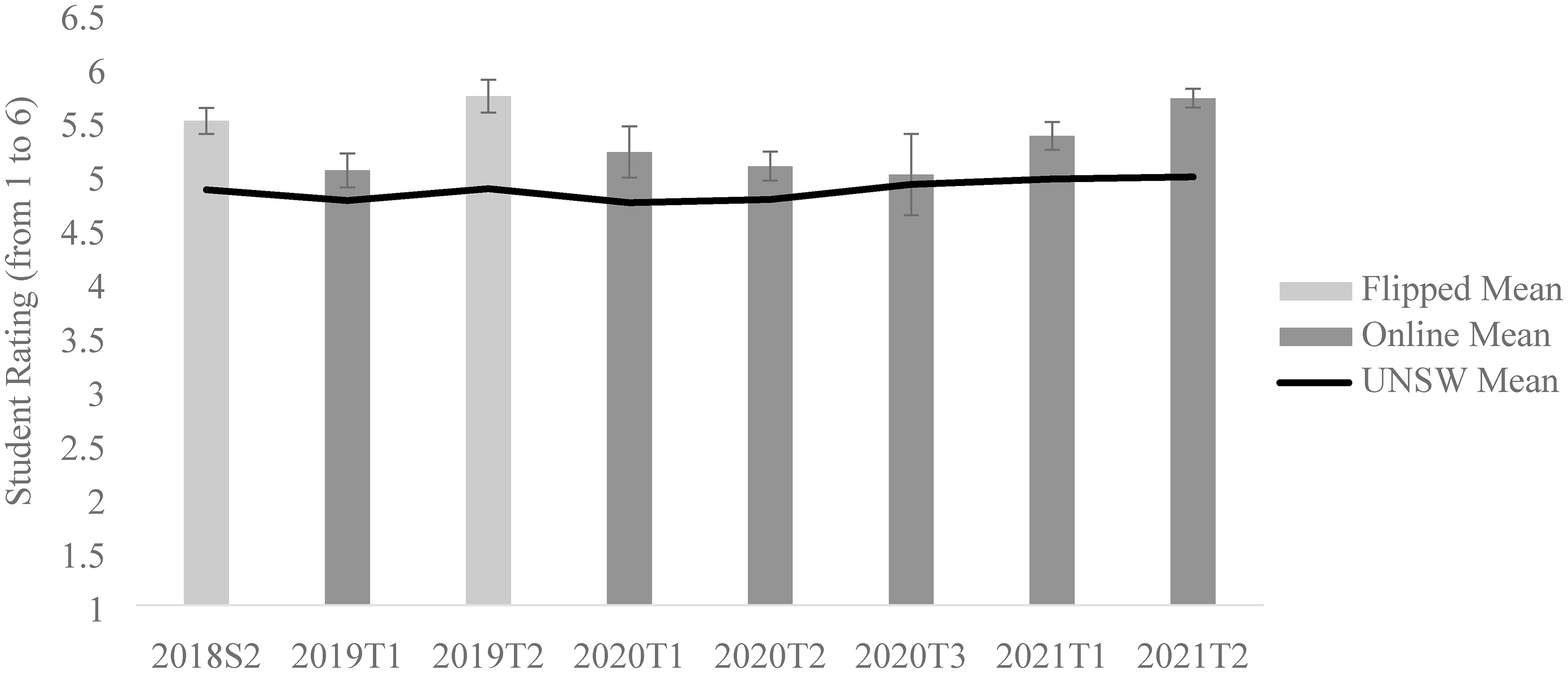
Mean (overall satisfaction) agreement rating of the university-wide statement “overall I was satisfied with the quality of the course” as a function of when the unit was offered (S = semester; T = term), and whether flipped classroom (flipped) or online mode of delivery. Error bars = SEM.
Relevant to Question 2 are the ratings, on three occasions, to the author-selected Unit-specific statement “This course provided me with knowledge and skills I can apply”. There was 100% agreement (means: S2 2018 = 5.88; T3 2020 = 4.29; T1 2021 = 5.72), thus providing further support for an affirmative answer to Question 2. Again relevant to Question 2 are example open responses from the Online Unit students to the question “What were the best things about the course?” (see also Appendix): “Being able to learn very practical things that can be used to maintain a healthy and functional mindset in all stages of life: study, work, family life.”
“This course explored various methods of challenging thinking, new ways to approach tasks and look at problems. More than one method is explored and the homework tasks that involved application of this method to own problems were very useful. In particular, I liked the use of ACT–related techniques in re–framing thinking, as these are less popularly explored in other courses, and I found those very helpful.”
“As for the content of the course I found it really relevant to students’ lives and found many of the tips applicable for managing stress, enhancing study techniques and time management.”
“I loved that the learning in this course was easily applicable to real–world/beyond uni life. Too often you hear about people learning things which they find pointless (because it really is only useful for the exam and nothing beyond that). However, this course was useful, real–world knowledge and I enjoyed studying it for the sake of my own being rather than studying it for the sake of my degree. It was great that this course helped me to work on my person outside of academics. I feel so much more in–tune with who I am, who I want to be and how to get there which is really invaluable education.”
“I am not a psychology student and I chose this course as a general education course and it is so well structured and the book is so well written that anyone can read and understand it as well as enjoy it.”
Discussion
In summary, this study addressed three questions. The answer to Question 1, “What are the intended learning outcomes and teaching and assessment strategies in science of wellbeing units that are framed by BNS theory?”, is provided in the Method section. Learning outcomes of both units focused on articulating and applying diverse theoretical and experimental approaches to major psychological issues relating to self-management, academic success, and wellbeing. A major teaching strategy for both units was scaffolding a sense of competence through regular assessable homework (including quizzes); this was supplemented and build upon in-class in the Flipped Unit, whereas in the Online Unit, this was supported by having the activities closely follow the Textbook. In terms of teaching strategies to satisfy a sense of relatedness, this was clearly achieved in the Flipped Unit through the weekly classes and the group assignment; in the Online Unit, specific strategies were put in place to foster student-student and student-instructor interaction. A sense of
The answer to Question 2, “Are students generally satisfied with the delivery of such units”, is affirmative, as indicated in Figure 1, and particularly, as compared to the University average. The answer to Question 3, “Are such units robustly evaluated by students, regardless of internal factors such as mode of delivery, and external factors such as pandemic conditions?”, is again affirmative, as there were no differences in Overall Satisfaction ratings across these different kinds of conditions. The lack of a clear negative pandemic impact may be due to (a) the increased relevance of the unit material given the greater number of stressors in students’ lives, and (b) the purposeful increased relevance of teacher ‘presence’, that is, student-instructor relatedness (Stone, 2017; Rapanta et al., 2020; this was indicated by many survey comments, e.g., “…helpful that Sue made herself available for a Live question and answer session each week”; “Sue is one of very few teachers that I felt like actually cared about my mental health and wellbeing and was considerate of the effects of lockdown and other stresses affecting young people”; “…she replies to all my questions quickly”).
There was high agreement with the statement “This course provided me with knowledge and skills I can apply”. This finding is congruent with (a) Miller’s (1969) call to “give psychology away” (p. 1071), and (b) Halpern’s (2010) call for increased psychological literacy ( = the capacity to intentionally apply psychological knowledge to achieve personal, professional, and societal goals; Morris et al., 2021) in the general population. Other Australian universities have created units modelled on ours and international colleagues have created somewhat similar units on the ‘psychology of adaptation’(e.g., Dunn et al., 2015; see also Choi & Chung, 2012; Stallman, 2011); however, this is the first study to describe science of wellbeing units framed by BNS theory, and to provide student evaluation data for those units over several years, thus demonstrating their sustained perceived value. These kinds of units provide one strategy in a whole-of-university approach to supporting student success and wellbeing (Baik et al., 2017a; Baik et al., 2017b). We argue that all students should be offered this kind of unit in the first year of university/college, particularly as it should increase the self-management capacity, and thus academic success and wellbeing, of students in disadvantaged groups (e.g., ‘first-in-family’).
Finally, in terms of psychology education, it has recently been proposed (Cranney et al., in press) that one of the graduate capabilities of the undergraduate psychology programme should be to “apply psychology Knowledge to the Personal Domain, in order to achieve valued personal goals” (see also Wilson, 2009). These science of wellbeing units are designed to support the development of that capability. The associated transdisciplinary pedagogical approach could be described as ‘Self-reflective learning’, whereby the educator values the development of increased student knowledge of self-context relationships, and so explicitly encourages students, often through authentic assessments, experiential learning exercises and reflective practice (Coulson & Homewood, 2016) to apply empirically supported theory and evidence-based practice to themselves. Discipline-specific aspects (including a set of professional values) relevant to ‘Self-reflective learning’ are described by Hulme and Kitching (2017) in their argument that psychological literacy provides the motivation for educators to deliver ‘sensitive topics’ such as aspects of psychological health/illness. As with the two units described in this paper, a safe learning environment must be constructed using a variety of strategies (e.g., confidentiality in tasks that require application to self; scaffolding students’ professionalism in peer interactions; choice in tasks; explicit reminders regarding student support services; compassionate proactive communication with at-risk students). The student comments in the Results section, and in Appendix Table 2, reflect the success of this pedagogical approach.
In conclusion, this study has filled a gap in the psychology literature by describing science of wellbeing units, framed by BNS theory, that consistently receive high overall satisfaction ratings by students, regardless of internal factors such as mode of delivery, and external factors such as pandemic conditions. Recent higher education literature has increasingly focused on student wellbeing issues, and the value of curricular approaches to increasing student success and wellbeing is afforded by consideration of the wellbeing dimension in the Complete State Model of Mental Health (Keyes, 2007). The availability of these science of wellbeing units provides psychology and other students with the opportunity to gain knowledge and skills from psychological science that should promote their academic as well as graduate success. We encourage psychology educators to adapt these units for implementation in their own institutions, as part of their institution-wide strategy to support student academic success and wellbeing.
Footnotes
Acknowledgements
We acknowledge funding from (a) the Australian Federal Government Office for Learning and Teaching that supported the creation of the flipped classroom unit, and (b) the UNSW Pro-Vice-Chancellor Education Portfolio that supported the creation of the online unit. We acknowledge the contributions of colleagues and co-authors over several years who have contributed to the thinking behind this paper, including Dana Dunn, Peter Baldwin, Leigh Mellish, and Annette Krochmalik/Olschewski. We especially thank all of our students for helping us to continue to learn.
Declaration of Conflicting Interests
The author(s) declared no potential conflicts of interest with respect to the research, authorship, and/or publication of this article.
Funding
The author(s) disclosed receipt of the following financial support for the research, authorship, and/or publication of this article: This work was supported by the Australian Government Office for Teaching and Learning, (grant number ID12-2381).

Author Biographies
Appendix
This additional Results and Discussion section relates to the ratings of additional items in the formal student evaluation of the units. See the Method section for more detail regarding procedure and materials.
Appendix Table 1 presents the mean agreement ratings from Semester 2 2018 until Term 2 2021 (no variance statistics were available). In
In
In
In
It should be acknowledged that a major limitation of this study is the occasionally low number of student respondents and response percentages, possibly associated with the timing of the evaluation (during the high-stress final weeks) and the expectation of students to complete evaluations for all units each term. Term 2 2021 is a positive exception.
As expected, the learning community rating appears to be less for the initial offerings of online compared to flipped, with this difference reducing over time, and for the most recent offering (T2 2021) the online ratings appear to be substantially higher than the University average. This is likely due to several factors, including increased effective effort to build student-to-student and student-to-educator relatedness (Ryan & Deci, 2000), particularly after the pandemic onset (Kumar et al., 2021), for example, asking students to respond to one another's posts (thus creating a sense of ‘getting to know’ one another), and emphasising the value of peer feedback on learning (i.e., relatedness).
There was high agreement with the statement “The teaching in this course was inclusive of students of diverse backgrounds”. Inclusivity is emphasised in unit ‘announcements that are designed to acknowledge diversity (thus likely increasing student-instructor relatedness), as well as in the autonomy provided in the course (thus reducing any sense of ‘one size fits all’).
There are many limitations to the conclusions that can be drawn from this study, given the non-experimental design. Nevertheless, it is clear from the ratings that students appreciate and value what they learn in these units. The comments in Appendix Table 2 illustrate that appreciation, and are congruent with the theoretical underpinnings and practical intent of these units on the psychological science of student self-management, academic success and wellbeing.