



Abstract
The goal of this work was to determine whether contextualized prompting can promote student engagement with resources designed to develop self-management skills. In a second-year social and developmental psychology unit, a special section of the learning management system (LMS) contained multiple self-management tools/resources which covered topics such as time-management, study strategies, and emotional regulation. “Just-in-time” (JIT) prompts regarding selected self-management tools were delivered through LMS reminders (e.g., time-management tools early in the term). The primary measures were the number of hits on each resource and the percentage of students who accessed each resource, which allowed comparison between those resources selected for JIT LMS prompts, and those that were not. Across two studies (whereby in the second study, the LMS section was simplified, and the frequency of JIT prompts was increased), it was found that there were more hits on the JIT-prompted resources than those resources that were not prompted, and that the percentage of students accessing the JIT resources generally dropped off across the term. In addition, Study 2 suggested that increasing the frequency of JIT prompts did not increase student engagement. Limitations, implications, and future directions for this initiative are discussed.
The goal of the work described in this paper was to determine whether contextualized in-curricular just-in-time (JIT) prompting can promote student engagement with selected tools in a repository of generic self-management resources designed to support academic success and thus wellbeing. We first outline conceptual approaches that provide the rationale for this study: the Complete State Model of Mental Health, self-determination theory, and self-management.
Higher education researchers and policy leaders have adopted Keye's (2007) Complete State Model of Mental Health which argues for two correlated but distinct dimensions of mental health, namely psychiatric disorders and psychological wellbeing. Educators can play a role in promoting the latter dimension by providing curricular environments that support student success (e.g., Cranney et al., 2016a; Orygen, 2020). Under this broad theoretical umbrella, Self-Determination Theory (SDT; e.g., Ryan & Deci, 2000) provides an empirically-supported framework for educators to identify, implement, evaluate and improve curricular strategies to support student academic success and wellbeing (e.g., Baik et al., 2017a, 2017b; Cranney & Morris, 2021; Teaching at UNSW Sydney, 2021).
For example, the Enhancing Student Wellbeing (2016) website provides examples of how educators, within their curriculum, can either promote or thwart the satisfaction of the three psychological needs outlined in SDT. These needs are relatedness (feeling cared for by others), autonomy (a sense of choice and control in pursuing one's interests), and competence (a sense of possessing valued capabilities). In the context of higher education, relatedness is about building constructive and professional student-to-educator, student-to-student, and student-to-institution relationships, which build a sense of belonging. Strategies like supported group classroom activities, ‘check-in’ tools, and program-level social and career activities that give students opportunities to develop networks can foster relatedness. Autonomy can be promoted by building choice and meaningfulness into the curriculum. Educators can allow students to choose topics in learning and assessment activities and draw links between unit material and ‘big ideas’ and/or future careers paths. Finally competence, the sense students have that they are capable of accomplishing the academic tasks, can be fostered by scaffolding unit content and assessment, and providing feedback that can be acted on (Enhancing Student Wellbeing, 2016; Ng et al., 2012; Niemiec & Ryan, 2009).
Satisfying the need for competence is the ‘core business’ of educators. We write a list of learning outcomes for each unit of study, teach to those learning outcomes, and assess whether students have achieved them. Educators, however, may not include in such a list, a number of generic capabilities that often enable the acquisition of the explicit learning outcomes. Educators may assume that students already know how to manage their time, study effectively, and regulate their emotions during learning (e.g., managing procrastination or exam anxiety tendencies). These generic skills are incorporated in the concept of self-management, which is the capacity to effectively pursue valued goals, and to be flexible in the face of setbacks (Cranney et al., 2016b). One challenge is that educators are subject-matter experts, and not experts in supporting students to develop the generic skills that enable them to manage their learning. At our institution, independent faculty identified and refined, via literature searches and iterative in-class piloting, evidence-informed self-management tools which were then placed in a repository section entitled “Self-management for effective learning”, that coordinators can import to the learning management system (LMS) for their unit (Teaching at UNSW Sydney, 2021). This self-management section provides evidence-informed tools/resources in several categories, including time-management, study strategies, and stress management (see also Morris et al., 2018). As such, educators can, at a minimum, import the section into their course and announce its presence in the outline/syllabus.
In the current paper, we investigate whether explicit and frequent prompting, in a contextualized manner (e.g., reminders regarding effective study skills in the lead up to an examination), may promote student engagement with these self-management resources. Given that students enter university with varying strengths and weakness across the different categories of self-management skills (Cranney, 2015), we made engagement with the resources an optional activity. Across two deliveries of a second-year psychology unit, the self-management section was imported to the unit LMS, and prompts regarding selected resources were provided in a contextualized—just-in-time (JIT)—manner through LMS links. It was expected that the number of hits for the selected JIT-prompted resources would be greater than that for resources that were not chosen for JIT prompting. Other variables, such as resource category and time period during the term were of interest. Given the pilot nature of this work, descriptive results only are presented.
Study 1
In Study 1 (Term 1, 2019), we sought to improve student engagement with self-management resources by prompting students to engage with relevant resources at key points during the term. The self-management section included 62 resources related to goal setting, scheduling time, study strategies, procrastination and motivation, assessment feedback and reflection, stressors versus distress, balancing life, mindfulness, emotional management, and exam preparation (see “Self-management for Effective Learning section” videos at https://www.teaching.unsw.edu.au/healthyuni-main/moodle-resources for brief description). The self-management section was located at the bottom of the unit LMS page. In the first lecture of the term, the unit coordinator showed students that it was available in the LMS and explained the kinds of resources that they may choose to explore.
To design the “just in time” (JIT) intervention, the unit coordinator identified 5 points during the term in which students may benefit from a particular resource (see Supplementary Materials for more detail). At the beginning of term, students may need resources related to goal setting (Orientation Week) and time management (Week 1). In the middle of the term (Week 7), when assessment burden is significant, students could benefit from resources related to managing stress. After receiving feedback, students may need resources that scaffold how to reflect on performance and use feedback productively (Week 8). Prior to exams, students may benefit from resources about evidence-based study strategies (Week 10).
To address student needs at each of these periods during the term, the coordinator chose an activity/resource from the self-management section and linked to the resource within the week-by-week LMS sections (which listed lecture, tutorial, assessment and other activities for that week) under a “Check this out” subheading—thus delivering the JIT prompt.
Institutional ethical approval (HREAP C #3398) provided permission to utilise LMS engagement reports as the index of how many hits each resource received and how many students had engaged with each resource in the self-management section. Figure 1 shows hits for each of the 62 resources in the section, as a function of whether they were prompted within weekly LMS sections (JIT resources) or were just available within the self-management section.
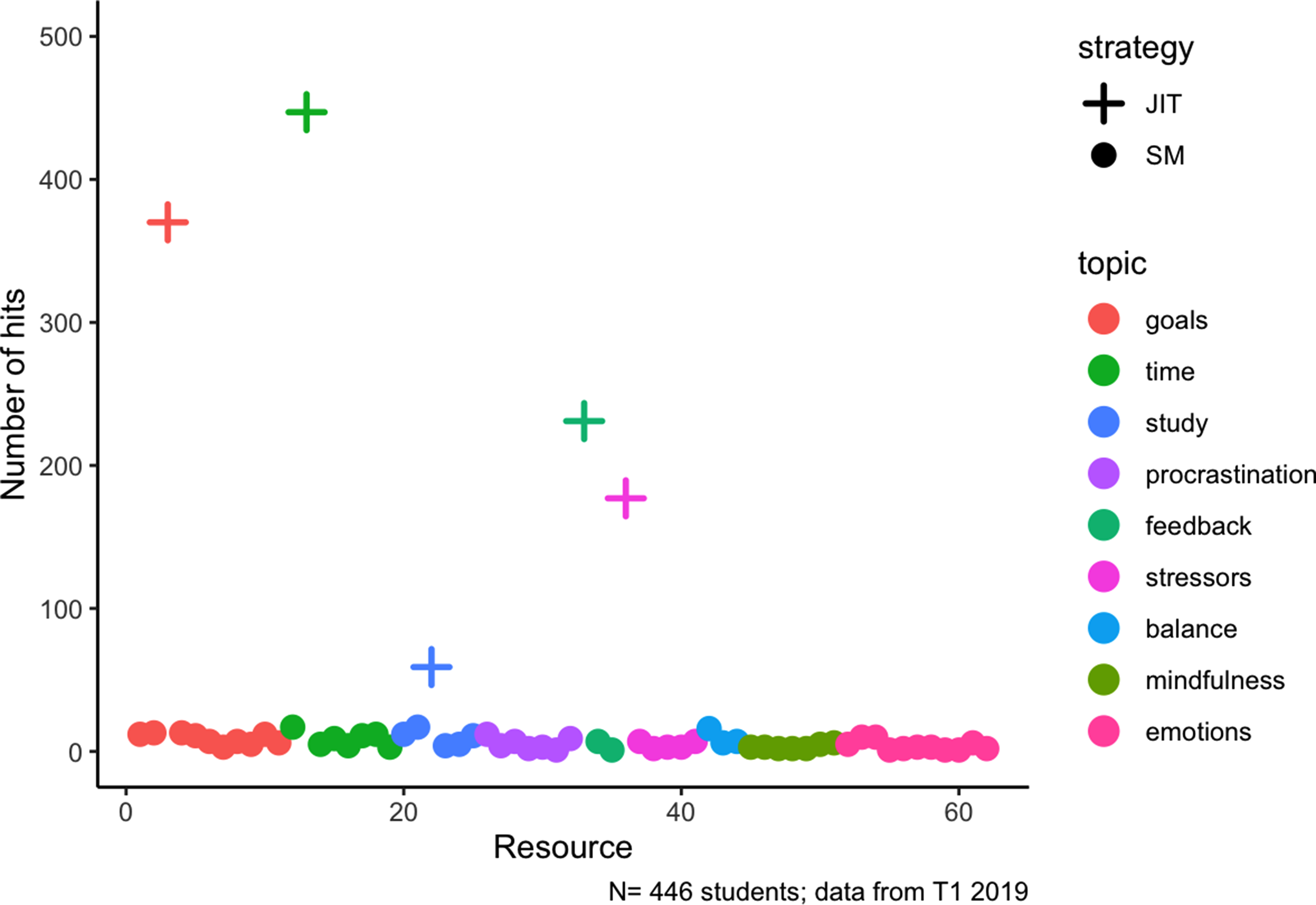
Number of hits that each self-management resource received as a function of whether it was highlighted/prompted weekly (JIT = stars) or non-prompted but still available in the LMS section (SM = dots). The ordering of the resources along the Y-axis represents their ordering under each category in the LMS section.
Figure 1 illustrates that JIT-prompted resources attracted more engagement than SM resources, particularly early in the term, when resources about goal setting and time management were prompted. Most students in the cohort clicked on goal-setting and time-management JIT resources that were linked in Week 0 and 1, and reasonable numbers of students clicked on the stress management and feedback resources in Weeks 7 and 8; however, by Week 10, only 10% of students engaged with JIT resources related to study strategies (see Figure 2).
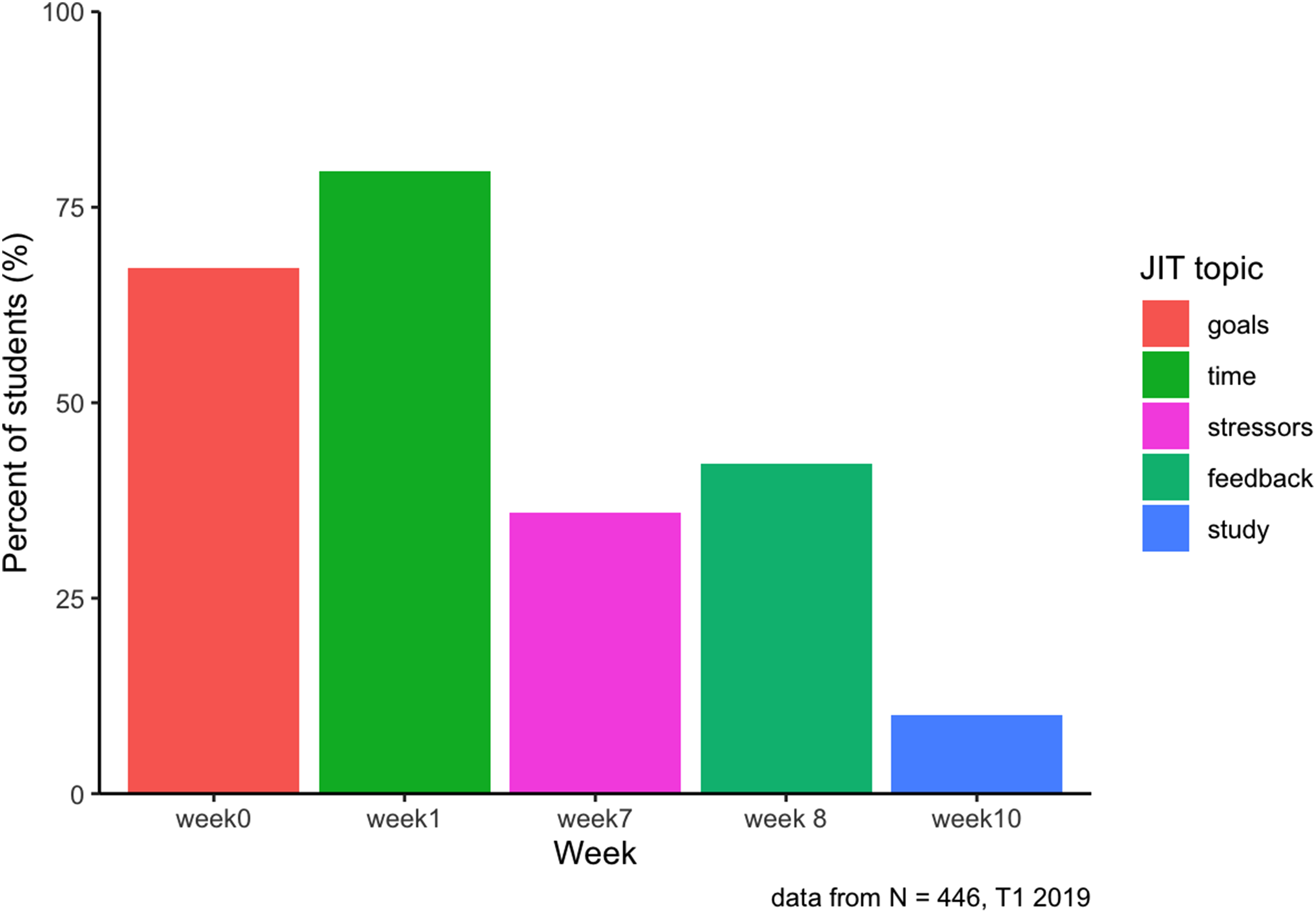
Percent of students who engaged with JIT resources across the term. Week 0 (Orientation) = goal-setting; Week 1 = time-management; Week 7 = stress management; Week 8 = feedback; Week 10 = study strategies.
Here we showed that granting students access to self-management resources that are designed to promote success and wellbeing is not sufficient to drive student engagement. We found that students only engaged with these optional resources when they were curated, that is, prompted by the weekly ‘check this out’ labels within the LMS. Providing a link within a weekly LMS section that prompted students to look at a relevant resource increased student engagement with that resource, particularly early in the term. The low hit rate on the study strategies resource in Week 10 suggested it was ‘too late’ in the term for students to have time,given other demands, to engage with such strategies. Given the importance of study strategies (and indeed, their productive use well before assessment due dates; Dunlosky et al., 2013), it was clear that a modified approach was needed.
Study 2
In Study 2 (Term 1, 2020), we sought to determine whether similar engagement could be gained by promoting two relevant links per week throughout the term, with early exposure to different categories of resources designed in anticipation of the likely drop-off in engagement during the demanding end-of-term period. Before the term began, we revised the self-management section, reducing repetition and paring down the resources to 37. The resources were reorganized into 5 categories: time management & goal setting, study skills, paralysing p's (i.e., procrastination/perfectionism), feedback and stressors. We chose a total of 20 JIT resources and added two links within each weekly LMS section under a “Check this out” heading. JIT prompts for resources from each category were spread across the term (i.e., time management & goal setting—Weeks 0, 1, 2 & 4; study skills—Weeks 0, 1, 5, 7, 8, & 10; paralysing p's– Weeks 2, 3, & 9; feedback—Week 4 & 7, and stressors—Weeks 3, 5, 6, & 8 (see Supplementary Materials for more detail).
As in Study 1, we exported the LMS student engagement report and plotted how many hits each resource had received, as a function of whether they were prompted in weekly JIT links or not, as well as, the proportion of students who accessed the self-management resources. (Figure 3)
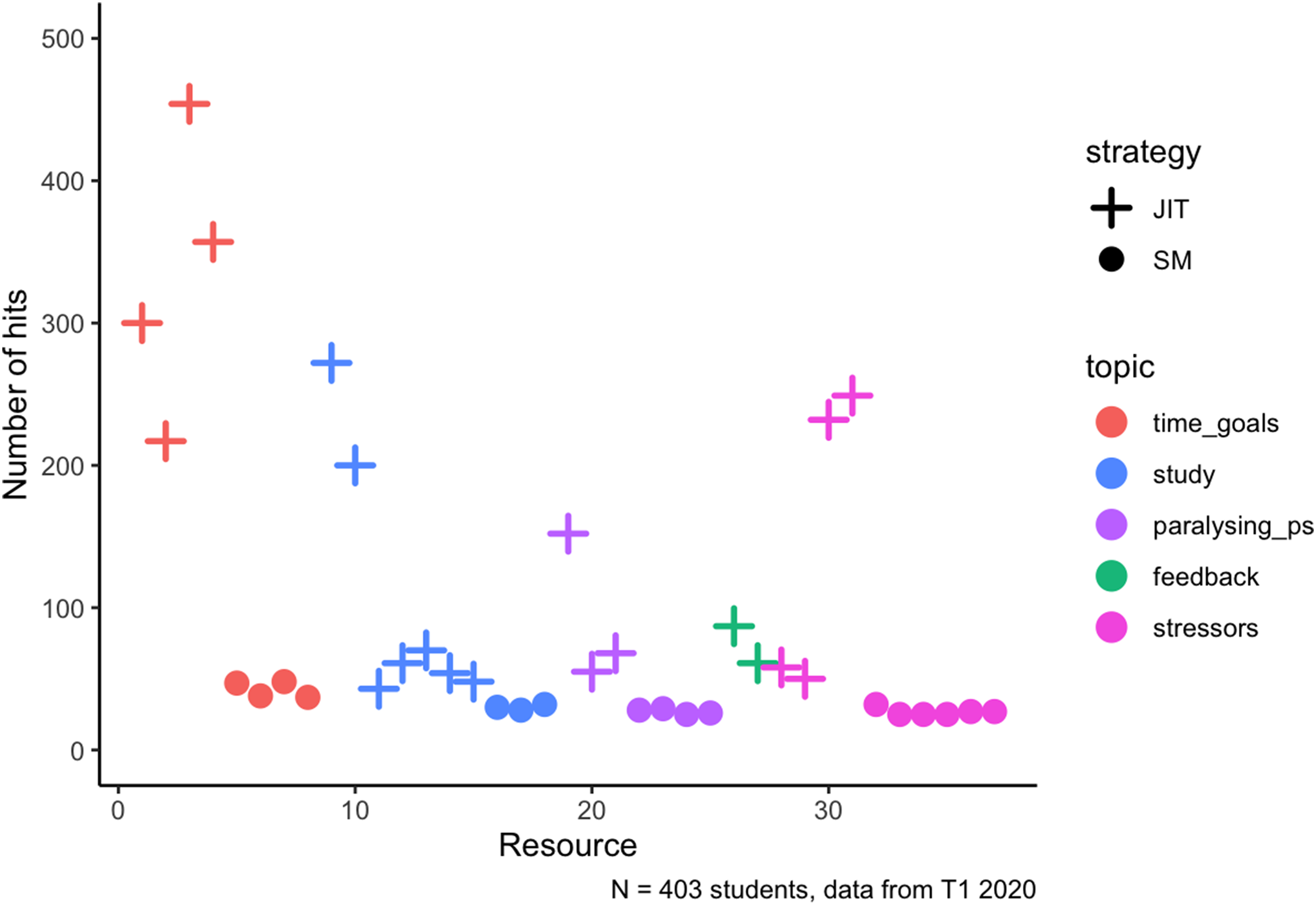
Number of hits that each self-management resource received as a function of whether it was prompted (JIT = stars) or non-prompted but still available in the LMS section (SM = dots). The ordering of the resources along the Y-axis represents their ordering under each category in the LMS section.
As in Study 1, students were more likely to engage with resources that were prompted in the weekly LMS sections than were those that were not, however, the number of students that engaged with JIT resources differed by resource category and across the term. Resources related to goal setting and time management were the only JIT resources where engagement was uniformly high, but it should be noted that these resources were concentrated in the first few weeks of term. For all other categories, some JIT resources resulted in high engagement and others were no more popular than resources that were not prompted.
Although it seems that engagement with JIT resources was generally lower in T1 2020 than in T1 2019, we saw a similar pattern of decline across the term. While on average more than 50% of the cohort accessed resources in Week 0 (orientation week), by Week 10 engagement had dropped to 10% of the cohort. That is, across both studies, we found that as assessment demands increase, students are less likely to seek out optional resources to support their study (see Figure 4).
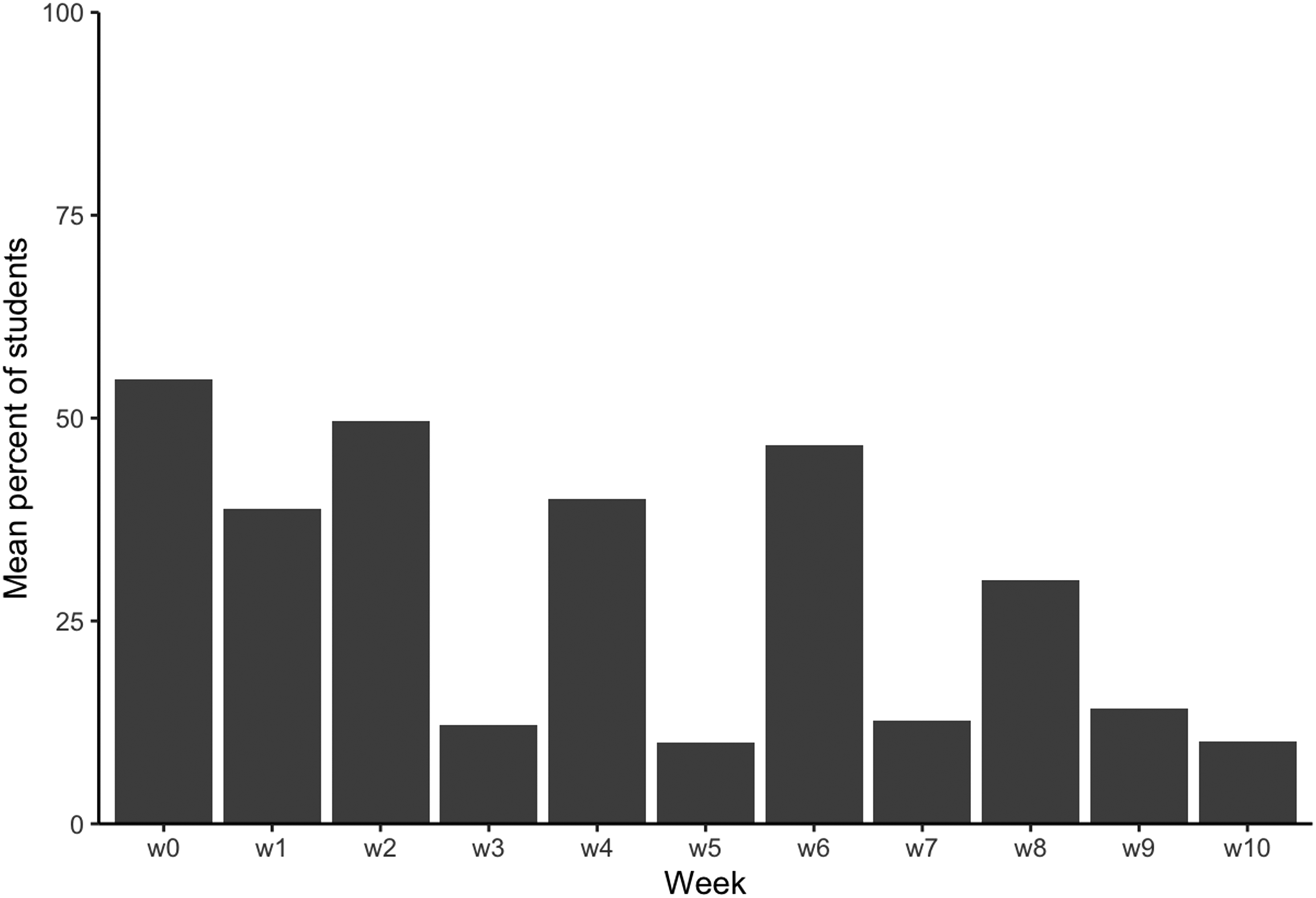
Mean percent (across the two resources prompted) of students who engaged with JIT resources each week across the term. Note that because two resources of different categories were prompted each week, different resource categories are not represented in this figure.
General Discussion
Across two studies, we found that there were more hits on the JIT-prompted self-management resources than those resources that were not prompted, however, the percentage of students accessing the JIT resources dropped off across the term. In Study 2, increasing the frequency of JIT prompts did not appear to increase student engagement; indeed, the engagement appeared to be lower in Study 2 (T1 2020) than that in Study 1 (T1 2019). Nevertheless, prompting students to engage with resources from more than one category each week throughout the term led to more even patterns of engagement across categories, particularly for those that attracted low hit rates in Study 1 (e.g., study skills). There are two possible explanations for the apparently lower overall engagement in Study 2. First, the frequency of the reminders may have been overwhelming for students. By providing two prompts per week, it is possible that we diluted the effect of curating resources that were well tailored to student need at that point in the course. Second, lower engagement in Study 2 may reflect the impact of the pandemic, and in particular, the greater number of stressors students were experiencing. COVID-19 has been challenging for students, given loss of income, needing to adapt to a fully online mode of delivery, and social isolation (Kumar et al., 2021). Given these other life demands, it is not necessarily surprising that students were less able to engage with optional resources in T1 2020.
The clear finding of this research is that educators can play a key role in facilitating student engagement with self-management resources by alerting students to these resources in a just-in-time manner. Our research showed that weekly prompts embedded within the LMS were most effective early in the term. For this reason, we recommend that educators prompt students to resources from different self-management categories early, before students become overwhelmed with the compulsory assessment tasks. Most recently, we have begun to integrate some of these resources into brief in-class activities (i.e., assessment time management planning) and to attach a nominal grade to task completion. Note that where feasible, student choice in self-management tool engagement should be afforded. By allowing students to choose which resources are most relevant to their learning goals, educators are both promoting a sense of autonomy, and acknowledging that students vary in the proficiency of their self-management skills, and thus may have different development needs (Cranney et al., 2016b). In future research, we plan to assess the impact of in-class activities versus just-in-time prompting and to seek ethical approval to correlate resource engagement, unit grade, independent pre-post measures of key self-management knowledge and skills, and individual difference factors such as prior academic performance. Note that the institutional ethical approval for the research reported in this paper did not include permission for such analyses.
Including in-class and/or assessable self-management activities address two of the major limitations of this study. Firstly, number of hits and proportion of students clicking on a link are crude measures and tell us little about whether students subsequently engage meaningfully with a resource. That is, it is not possible to distinguish between those students who click on the link, download the worksheet, complete it, and gain useful insights, and those students who click on the link and do not engage further. Secondly, we do not know whether students who really need these resources are the ones who are engaging with them. Students who are struggling may not have the insight (i.e., lack of knowledge that they need to improve certain self-management skills such as study strategies) or the time to utilize these resources (e.g., because they are working full-time to pay their living expenses). Educators should look to combine careful curricular design and delivery, with technological innovation, such as artificial intelligence, which allows for early detection of students at risk. Early identification of specific areas of need in terms of bolstering self-management skills may also allow educators to tailor co-curricular support programs.
Although traditionally-oriented subject specialist educators may prefer to refer students to extracurricular student support services that offer opportunities to improve self-management skills, such skill building is most relevant within the curriculum context and in relation to learning and assessment activities. In addition, students in most need of such development, may not have the capacity to engage with extracurricular student support services, whereas they must engage with the curriculum to gain/maintain their identity as a successful student. We acknowledge that educators require some training and support to design and deliver curricular environments that support students in this way, and guidance for educational leaders is available (e.g., Enhancing Student Wellbeing, 2016). For example, in our training sessions with educators from all disciplines, it is clear that educators find SDT a useful framework to identify which curricular strategies are supporting, or not supporting the psychological needs of students. The SDT framework helps educators to isolate components of their practice for improvement.
The self-management section used in the current studies was developed so that educators did not themselves need to identify evidence-informed tools/resources that are relevant to students in the various self-management resource categories. At different institutions, there are likely to be resources available in both the extracurricular space (e.g., student support units specializing in learning skills and student wellbeing), and in external sites, however, educators should be careful to check the evidence base of such resources.
Within psychology, educators should be knowledgeable about the psychological principles and the evidence-informed strategies that support student learning and be able to identify opportunities to embed the development of self-management skills in the curriculum. In doing so, such psychologically-literate educators are answering George Miller's (1969) call to “give psychology away” so as to improve human welfare, and in this case, student academic success and wellbeing (Morris et al., 2021).
Supplemental Material
sj-docx-1-plj-10.1177_14757257221098763 - Supplemental material for Curricular Approaches to Supporting University Student Academic Success and Wellbeing
Supplemental material, sj-docx-1-plj-10.1177_14757257221098763 for Curricular Approaches to Supporting University Student Academic Success and Wellbeing by Jenny L. Richmond and Jacquelyn Cranney in Psychology Learning & Teaching
Footnotes
Declaration of Conflicting Interests
The author(s) declared no potential conflicts of interest with respect to the research, authorship, and/or publication of this article.
Funding
The author(s) received no financial support for the research, authorship, and/or publication of this article.

Supplemental material
Supplemental material for this article is available online.
Author Biographies
References
Supplementary Material
Please find the following supplemental material available below.
For Open Access articles published under a Creative Commons License, all supplemental material carries the same license as the article it is associated with.
For non-Open Access articles published, all supplemental material carries a non-exclusive license, and permission requests for re-use of supplemental material or any part of supplemental material shall be sent directly to the copyright owner as specified in the copyright notice associated with the article.
