




Abstract
Fostering metacognitive awareness of misconceptions should enhance deep processing of scientifically correct explanations and thereby decrease misconceptions. To explore these potentially beneficial effects, we conducted a field study implemented in a regular educational psychology course in an Australian teacher education program. In a two-by-two within-subject experimental design, student teachers (n = 119) answered misconception questionnaires, made metacognitive judgments, and participated in awareness activities at the start (T1) and the end (T2) of the semester (within-subject factor: time). Half of the misconception items focused on educational psychology course content, while the other half focused on related topics that were not covered in the course (non-course content). Awareness activities (AA) consisted of providing feedback regarding all misconception items. During the lectures, we provided additional scientifically correct refutational explanations (RE) regarding course content. Thus, we compared the combined AA+RE treatment for course content with the AA treatment for non-course content (within-subject factor: treatment). Our findings confirm that student teachers harbor numerous high-confidence educational psychological misconceptions. Furthermore, awareness activities plus refutational explanations resulted in significant increases in metacognitive awareness and in performance. Additionally, initial metacognitive overconfidence was related to persistent misconceptions, indicating that overconfidence may hinder correction of course content misconceptions.
Introduction
Students harbor incorrect beliefs about almost all disciplines at the start of their formal education. Thus, misconceptions are domain-general challenges for learning and teaching in general, but they are particularly challenging when instructing student teachers in educational psychology. Psychological knowledge is often considered “common sense” and psychological evidence is disregarded in favor of relying on personal experiences, beliefs, or intuition. In addition, student teachers have to overcome their lack of scientific psychology training to understand educational psychological evidence necessary for correcting misconceptions. Underscoring these arguments, educational psychology misconceptions are exceptionally prevalent and persistent among student teachers. To address this practical problem, we explore the effects of theory-based metacognitive awareness treatments to correct misconceptions. Research has repeatedly shown that people often endorse misconceptions with high confidence in their false beliefs. Thus, accurate metacognitive awareness about one’s own misconceptions could be an important mechanism for the correction of misconceptions.
Misconceptions as Domain-General Challenge for Learning and Teaching
Misconceptions are beliefs inconsistent with the consensus of core concepts and research findings in a discipline (Bensley & Lilienfeld, 2015, 2017; Hughes et al., 2013b). Terms such as “alternative frameworks” (Hughes et al., 2013b), “myths” (De Bruyckere et al., 2015; Macdonald et al., 2017), and “questionable beliefs” (Asberger et al., 2019) have been used almost synonymously. However, some of these terms may rather have connotations of subjective folk theories (Keil, 2010) that may contain more than just a grain of truth. As such, in contrast to the term misconception, these terms seem to allude to the inherently tentative, provisional, contradictory, and fallible nature of scientific knowledge (Bromme & Goldman, 2014). We acknowledge this constructed and uncertain nature of scientific knowledge, but posit that science is more than opinion, and that the validity of knowledge claims can be evaluated against cumulative scientific evidence (an “evaluativist” epistemic perspective according to Barzilai & Weinstock, 2015; also see Bensley & Lilienfeld, 2015). Therefore, we will use the term “misconceptions” throughout this contribution to emphasize that these beliefs contradict the current consensus of science. In subsequent sections we will address misconceptions about specific topics. Consistent with previous research, we will use the term “psychological misconceptions” to refer to misconceptions “inconsistent with the consensus of research in psychology” (Bensley & Lilienfeld, 2015, p. 283) and “educational psychological misconceptions” to refer to similar “myths about topics from educational psychology” (Menz et al., 2020, p. 3).
Misconceptions are inevitable and ubiquitous (Amsel et al., 2011; Carey, 2000). Humans explain their world using intuitive theories about physical, biological, and psychological phenomena (Wellman & Gelman, 1992), mostly derived from nonscientific information such as personal experience, everyday conversations, or popular media (Bensley et al., 2014; Bensley & Lilienfeld, 2015, 2017; Lewandowsky et al., 2012). Intuitive theories consist of complex networks of ontological assumptions, explanatory concepts, and causal mechanisms (Amsel et al., 2011; Carey, 2000). Learners rarely start with blank slates. However, in contrast to rigorously developed scientific theories, intuitive theories can be superficial, fragmented, and may contain misconceptions (Keil, 2010).
General cognitive biases and heuristics also contribute to misconceptions. We may acquire misconceptions via heuristics such as anchoring (undue influence of initial information), judging validity based on emotional reaction, or perceiving illusory correlations/causations (Lilienfeld et al., 2012; Pasquinelli, 2012). Our existing beliefs may then be reinforced by seeking out evidence consistent with our beliefs while denying belief-discrepant information (confirmation bias; Lilienfeld et al., 2012; Nickerson, 1998; Pasquinelli, 2012) and by overestimating our knowledge and understanding (Dunning et al., 2003; Pieschl, 2009). As a result, beliefs—including misconceptions—are persistent (Lewandowsky et al., 2012), because we ignore, reject, or exclude information that conflicts with our prior assumptions; alternatively, we might hold in abeyance or reinterpret this information (Chinn & Brewer, 1993).
Rational conceptual change is slow and effortful (Bensley et al., 2014, 2015; Bensley & Lilienfeld, 2017; Chinn & Brewer, 1993; Hughes et al., 2013b; Kowalski & Taylor, 2009, 2017). Misconceptions need to be made explicit to shake learners’ commitment to their intuitive theories. The belief-discrepant information has to be presented as credible, unambiguous, and coming from multiple sources to induce strong cognitive conflict. Scientifically correct frameworks that account for the discrepancy have to be presented as plausible, intelligible, and fruitful. Conceptual change is also more likely if learners understand the epistemic status of knowledge claims and process information deeply. Similar refutational approaches have been suggested for debunking misconceptions (Bensley & Lilienfeld, 2017; Butler et al., 2011; Hughes et al., 2013b; Kowalski & Taylor, 2009; Menz et al., 2020).
Particular Challenges of Misconception Correction Related to the Domain of Psychology
Having correct knowledge and valuing the scientific approach are key components of psychological literacy (Roberts et al., 2017). However, individuals perceive knowledge construction and justification differently in different domains (Kienhues et al., 2018). Knowledge in social sciences, such as psychology, is often considered less certain and more subjective than knowledge in, for example, the natural sciences (Barzilai & Weinstock, 2015). First, similar to many social sciences, psychological empirical evidence allows for probabilistic conclusions only and may not predict individual behaviour in specific situations. This presents challenges to non-experts and may lead them to perceive psychological evidence to be uncertain, fragile, and subject to opinion rather than to scientific evidence and theory (Bromme & Goldman, 2014). Second, people may feel capable of explaining psychological phenomena directly through their own everyday experiences and observations (Keil et al., 2010). Such feelings of immediacy would imply that personal beliefs need no external validation because they have been “verified” by one’s own insights (Asberger et al., 2019). The public image of psychology as a pseudoscience may be further reinforced by scientific controversies spilling over to the general public (Ferguson, 2015) and sham psychologists or dubious self-help books (Amsel et al., 2014). Individuals may judge psychological phenomena to be issues of “common sense” rather than scientific inquiry (Amsel et al., 2014; Keil et al., 2010; Langfeldt, 1989).
Research in this field (recent reviews: Bensley & Lilienfeld, 2017; Hughes et al., 2013b) seems to confirm this picture. Endorsement of psychological misconceptions is positively related to faith in intuition and negatively related to critical thinking and information literacy (Bensley et al., 2014; Hughes et al., 2013b, 2015; Kowalski & Taylor, 2017). Psychological misconceptions decrease—but do not cease to exist—with more psychology training and education (Amsel et al., 2011, 2014; Bensley et al., 2015; Gaze, 2014; Hughes et al., 2013a, 2013b, 2015; McCarthy & Frantz, 2016; Taylor & Kowalski, 2004). Misconceptions about psychological contents are prevalent even among psychology students (Bensley et al., 2014; Bensley & Lilienfeld, 2015; Gardner & Brown, 2013; Gaze, 2014; Hughes et al., 2013a, 2013b, 2015; Kowalski & Taylor, 2009, 2017; LaCaille, 2015; Lassonde et al., 2017; McCarthy & Frantz, 2016; Roberts et al., 2017; Taylor & Kowalski, 2004, 2012), doctoral students (Hughes et al., 2015), and faculty (Gardner & Hund, 1983). Moreover, even psychology students often do not fully accept psychology as a scientific discipline (Amsel et al., 2011, 2014; Holmes, 2014).
These results underscore the fact that people often misinterpret the epistemic status of psychological knowledge, discounting scientific psychological evidence in favour of their own opinions and beliefs. This process contributes to exceptionally prevalent and persistent psychological misconceptions.
Particular Challenges of Misconception Correction Related to the Population of Student Teachers
Educational psychological misconceptions are of practical relevance for teachers. Having correct general pedagogical/psychological knowledge is an important part of teacher competence (Asberger et al., 2019; Heyder et al., 2018; Voss et al., 2011). It can be defined as declarative and procedural knowledge about classroom management, teaching methods, classroom assessment, learning processes, and students’ individual characteristics (Voss et al., 2011). However, teachers may believe incorrect educational knowledge claims (Fives & Buehl, 2012). Teacher beliefs filter information, frame situations, and guide action (Fives & Buehl, 2012). As such, teacher beliefs are relevant for teaching practice and student outcomes (Asberger et al., 2019; Dekker et al., 2012; Eitel et al., 2019; Heyder et al., 2018; Macdonald et al., 2017). If teachers harbor misconceptions, they might teach less effectively than they would with evidence-based knowledge (Bensley et al., 2014; Menz et al., 2020; Pasquinelli, 2012). General pedagogical/psychological knowledge is compulsory for teacher education programs in most countries (Heyder et al., 2018; Lohse-Bossenz et al., 2013). For example, the Australian Institute for Teaching and School Leadership (AITSL, 2011) has professional knowledge about “students and how they learn” as the first of seven teaching standards and this is predominantly taught in educational psychology courses within teacher training programs.
Despite the importance of such knowledge, debunking (student) teachers’ educational psychological misconceptions is challenging because teachers receive little scientific training in general and little psychology training in particular. This complicates presenting intelligible and scientifically correct information necessary for conceptual change (Chinn & Brewer, 1993). That is, (student) teachers may lack the knowledge, skill, and/or motivation to evaluate the epistemic status of complex, tentative, and often contradictory educational psychological evidence (Bauer et al., 2017; Brown, 1984; Dekker et al., 2012). This may make them vulnerable to falling prey to distorted, misinterpreted, or outdated scientific information (Lilienfeld et al., 2012; Pasquinelli, 2012). Instead, they may rely on their personal experience, intuition, or “common sense” while being susceptible to cognitive biases due to their desire for quick fixes for their practical teaching problems (Lilienfeld et al., 2012; Pasquinelli, 2012).
In line with these arguments, research on teacher misconceptions has shown that teachers frequently harbor educational psychological misconceptions (Asberger et al., 2019; Dekker et al., 2012; Eitel et al., 2019; Heyder et al., 2018; Menz et al., 2020) or neuromyths (Dekker et al., 2012; Macdonald et al., 2017; Simmonds, 2014) and cannot distinguish between correct and incorrect research reports (Langfeldt, 1989). For example, 76% of educators agreed that “individuals learn better when they receive information in their preferred learning style” (Macdonald et al., 2017, p. 16), even though no scientific evidence substantiates this claim (Willingham et al., 2015). There is mixed evidence about teachers’ susceptibility to misconceptions: teachers appear to harbor fewer educational misconceptions than the general population (Asberger et al., 2019; Macdonald et al., 2017), but their “neurophilia” may drive an easy acceptance of neuromyths specifically (Dekker et al., 2012; Pasquinelli, 2012; Simmonds, 2014). Teachers also do not seem to consult evidence-based information sources productively (Heyder et al., 2018; Simmonds, 2014), although research training or reading peer-reviewed journals predicts less endorsement of neuromyths (Macdonald et al., 2017).
These results underscore the importance of addressing educational psychological misconceptions in student teachers. Though conceptual change generally poses a major challenge to learners, this may be particularly true for student teachers who lack psychology training.
Metacognitive Awareness as a Pivotal Mechanism for Misconception Correction
Generally, refutational approaches have been recommended to correct misconceptions (Bensley & Lilienfeld, 2017; Hughes et al., 2013b). Such approaches proved moderately successful in debunking psychological misconceptions in psychology students (Kowalski & Tayler, 2009, 2017; LaCaille, 2015; Lassonde et al., 2017) but Menz et al. (2020) found that only a few preservice teachers shifted their false beliefs substantially after reading refutational texts. One factor contributing to the limited success of refutational approaches might be that learners have an “insight gap” (Chaplin & Shaw, 2016). Even though such “metacognitive deficit” has been rarely explored in misconception research (Bensley et al., 2015), the importance of this factor is underlined by the fact that learners often endorse misconceptions with high-confidence (Bensley et al., 2015; Bensley & Lilienfeld, 2015; Gaze, 2014; Langfeldt, 1989; Taylor & Kowalski, 2004). Metacognitive confidence judgments are based on metacognitive awareness. Thus, we propose metacognitive awareness as a pivotal mechanism for correcting misconceptions.
Metacognition is defined as cognition about cognition (Flavell, 1979). Classic metacognition models posit that learners constantly monitor their progress and regulate or control their learning to reduce discrepancies between their goals and the status quo (Nelson & Narens, 1994). Accurate metacognitive monitoring or awareness should be pivotal for learning. If learners overestimate their competence, they might stop studying prematurely and thereby learn less than they could. However, learners do not have privileged access to their own cognitions. Rather, they base their metacognitive judgments on cues (Koriat & Levy-Sadot, 1999). During default intuitive information-processing, learners rely on experience-based cues such as ease, fluency, familiarity, or accessibility (Alter et al., 2007; Koriat & Levy-Sadot, 1999) and are prone to cognitive biases (Amsel et al., 2014). During analytic information-processing, learners rely on information-based cues such as their (metacognitive) knowledge (Alter et al., 2007; Koriat & Levy-Sadot, 1999). Such deep processing can be activated, for example, by difficulties (Alter et al., 2007) or feedback (Bensley & Lilienfeld, 2017).
Metacognition research has shown that people are generally overconfident in their knowledge (Dunning et al., 2003; Pieschl, 2009). However, direct feedback can significantly enhance the accuracy of metacognitive monitoring (Händel et al., 2020; Huff & Nietfeld, 2009; Miller & Geraci, 2011; O’Leary & Sloutsky, 2019; Vauras et al., 1999). In general, more accurate metacognitive monitoring results in better regulation of studying and performance (Dunlosky & Rawson, 2012; Händel et al., 2020; Metcalfe & Finn, 2013). Furthermore, meta-analyses confirm the benefits of metacognitive training for strategy use, motivation, and learning outcomes (Donker et al., 2014). However, not all learners seem to be equally responsive to metacognitive training (Vauras et al., 1999), accurate metacognitive monitoring does not automatically result in better regulation of studying or performance (Miller & Geraci, 2011; O’Leary & Sloutsky, 2019), and the monitoring-control relationship seems more complex than a simple feed-forward mechanism (O’Leary & Sloutsky, 2019). Thus, accurate metacognitive awareness does not guarantee conversion into strategy application or outcomes.
Nonetheless, such metacognitive perspective suggests a promising path for the correction of misconceptions. People might be highly confident about misconceptions that come to mind quickly or seem familiar. Without difficulties or feedback, they may remain in a default superficial mode of information-processing, prone to cognitive biases, and are likely to overlook scientifically correct information. Thus, without metacognitive awareness, people’s misconceptions might be continuously reinforced. This might be the case with some refutational approaches that make misconceptions explicit in an effort to induce cognitive conflict (Chinn & Brewer, 1993), but do not necessarily make people aware of their own misconceptions. In contrast, metacognitive awareness should foster deep analytical processing of presented scientifically correct information necessary for conceptual change and reduction of cognitive biases (Bensley & Lilienfeld, 2017; Chinn & Brewer, 1993). Promising research has shown that misconceptions held with high confidence can be corrected via feedback (Butler et al., 2011). Nonetheless, promoting metacognitive awareness is not a sufficient condition for misconception revision. Misconception correction is more likely if scientifically correct explanations are provided in addition—and if learners possess the skill (e.g., cognitive strategies) and willingness (e.g., motivation) to understand and integrate this information into their knowledge bases. Therefore, we explore the effectiveness of adding refutational explanations to promoting metacognitive awareness. Specifically, we compare promoting metacognitive awareness only with the more promising path of promoting metacognitive awareness in combination with refutational explanations.
Purpose of the Present Study
Due to their prevalence and possible negative impact, it is desirable to correct educational psychological misconceptions held by student teachers. In this study, we explore the potential of the theoretically grounded but novel idea of increasing metacognitive awareness to correct false beliefs. Specifically, we examined whether providing awareness activities plus scientifically correct refutational explanations was more effective than awareness activities only in decreasing student teachers’ misconceptions (and thereby increasing their performance; Hypothesis 1) and in increasing student teachers’ metacognitive awareness of their own misconceptions (Hypothesis 2). We expected significant time-by-treatment interactions for both hypotheses. The effects of awareness activities plus refutational explanations should be more pronounced than effects of awareness activities only. Refutational explanations should remind students of their own initial misconceptions and thus contribute to their metacognitive awareness. Providing scientifically correct explanations should facilitate conceptual change and misconception correction. We also expected main effects of time for both hypotheses, even in the awareness activities only condition. Awareness activities should promote metacognitive awareness and might lead to performance improvement for students who might remember feedback or might look up information in their spare time. Additionally, we explored which factors are most strongly related to performance and correction of misconceptions (Research Question 1). We were mainly interested in metacognitive awareness and judgements, but also considered variables such as lecture attendance or student teachers’ age.
Method
Design
We conducted an exploratory field study with a two-by-two within-subject experimental design 1 embedded in a regular 13-week undergraduate educational psychology course in an Australian teacher education program. This is the only mandatory psychology course in this teacher education program. All students attended the same weekly one-hour lecture taught by two lecturers and were split into 11 weekly two-hour tutorials led by one of six tutors. Students answered misconception questionnaires, made metacognitive judgments, and participated in awareness activities at the start (T1) and the end (T2) of the semester (within-subject factor: time). Awareness activities consisted of providing immediate feedback regarding all misconception items and discussions about the nature of misconceptions and conditions of conceptual change. Half of the misconception items focused on educational psychology content explicitly covered during the course. Only these misconceptions were explicitly addressed via refutational explanations during the lectures that included scientifically correct explanations. The other half of the misconception items also focused on psychology topics related to learning and instruction, but these topics were not covered during the course. Thus, we compared two within-subject treatment conditions with different doses and active ingredients (for similar designs see, Kowalski & Taylor, 2009, 2017; LaCaille, 2015): course content misconceptions were treated by awareness activities plus refutational explanations (AA+RE; experimental condition), non-course content misconceptions were treated by awareness activities only (AA; quasi-control condition). This research project as well as all measures and materials were approved by the Human Research Ethics Committee of The University of Newcastle, Australia.
Sample
A total of N = 256 students finished the course, n = 221 (86%) volunteered their data with informed consent at the start of the semester (T1), n = 136 (53%) at the end of the semester (T2), and n = 119 (46%) provided data at both times and constitute the final sample. Students in the final sample did not differ significantly from those only providing their data at T1 regarding their demographics or questionnaire answers. All students in the final sample were pursuing Bachelors of Education (n = 98 Secondary, n = 18 Primary, and n = 3 Early Childhood & Primary), were on average M = 21.92 years old (SD = 4.56) and predominantly female (69 females, 49 males, 1 no information). By Week 12, they reported having attended M = 8.41 lectures (SD = 3.86) and M = 9.87 tutorials (SD = 2.16).
Measures
Student teachers completed the same questionnaire about misconceptions and metacognitive judgments at T1 and T2. In both questionnaires, they also indicated their age and sex, and, at T2, they reported how many lectures and tutorials they had attended during the semester and whether or not they considered the misconception awareness activities helpful for their awareness and learning.
Misconception Questionnaire
We adapted proven and tested psychological misconceptions questionnaires with forced-choice formats for the present study (Bensley et al., 2014; Bensley & Lilienfeld, 2015; Kowalski & Taylor, 2017; Taylor & Kowalski, 2012). In such questionnaires, respondents have to decide which of two response options is “most true”, one option reflecting accurate psychological knowledge or another option reflecting a misconception about the same topic. This format prevents answer tendencies, tests misconception endorsement with a better alternative available, and the instruction to look for the “most true” answers accounts for the tentative and provisional nature of psychological knowledge. Previous research shows good reliability and validity for these questionnaires. We retained original items that were related to educational psychology (Bensley et al., 2014; Bensley & Lilienfeld, 2015; Kowalski & Taylor, 2017; Taylor & Kowalski, 2012), but added items in the same format based on recent research about educational psychological misconceptions (De Bruyckere et al., 2015; Dekker et al., 2012; Gardner & Brown, 2013; Gaze, 2014; Taylor & Kowalski, 2012). All items are included in Appendix A (supplemental material). Ten items focused on content explicitly covered in the course. For example, students had to decide between “Students learn best when they are taught in their preferred visual, auditory, or kinaesthetic learning style.” (misconception) and “Teaching students in their preferred visual, auditory, or kinaesthetic learning styles does not improve students’ learning.” (scientifically correct answer; Willingham et al., 2015). Ten items focused on content not covered in the course. For example, students had to decide between “Grouping students in classes by their ability levels has little or no effect on how much students learn.” (scientifically correct answer; Steenbergen-Hu et al., 2016) and “Grouping students in classes by their ability levels increases how much students learn.” (misconception). For each pair of contrasting statements, students decided which option was “most true according to up-to-date research evidence”. The presentation order of misconceptions and scientifically correct statements varied. Performance for each condition was computed as the number of correct answers out of ten; performance gain was computed as T2 performance minus T1 performance.
Metacognitive Judgments
To investigate the extent to which some students guess the answer, misconception questionnaires sometimes include separate judgments about answer certainty (e.g., Bensley et al., 2014; Bensley & Lilienfeld, 2015). Because metacognitive awareness is one of the main variables of the present study, we asked student teachers to make two metacognitive judgments for each pair of contrasting statements. First, they rated their confidence in the correctness of their response on a scale from 1 (50%, I guessed) to 6 (100% certain) which is a validated metacognitive retrospective confidence judgment scale with explicit anchoring of “guessing” (Koriat, 2018). Second, they rated the extent of their knowledge of each topic on a scale from 1 (shallow) to 7 (deep) which is a validated metacognitive knowledge judgment scale (Rozenblit & Keil, 2002). We computed relative accuracy as intra-individual point-biserial correlations between metacognitive judgments and performance (Pieschl, 2009). Because correlation coefficients are not on an interval level of measurement, we used Fisher z-transformed values for further analyses. High positive values indicate high metacognitive awareness. For example, students would be more confident for items they answered correctly than for items they answered incorrectly. Negative values indicate the reverse, namely, more confidence or estimated knowledge for incorrectly answered items. Values near zero indicate no relationship between metacognitive judgments and performance. We computed mean raw metacognitive judgments and mean relative accuracy of metacognitive judgments per condition.
Treatment: Awareness Activities and Refutational Explanations
In conjunction with each data collection during the tutorials, we conducted awareness activities regarding all misconception items (AA+RE experimental condition, AA quasi-control condition). At T1, we provided immediate feedback by showing correct answers to elicit metacognitive awareness and trigger cognitive conflict. Additionally, we discussed the ubiquitous nature of misconceptions, highlighting that misconceptions can seem convincing and are hard to debunk. At T2, we provided the same immediate feedback. Furthermore, we discussed potential ways to address misconceptions both in the course as well as in student teachers’ own future teaching. This immediate feedback procedure is in line with procedures that foster accuracy of metacognitive monitoring (Händel et al., 2020; Huff & Nietfeld, 2009; Miller & Geraci, 2011; O’Leary & Sloutsky, 2019; Vauras et al., 1999).
All course content misconceptions in the AA+RE experimental condition were explicitly refuted during educational psychology lectures. In contrast to regular lectures, the lecturers explicitly pointed out misconceptions within the general public and, as soon as T1 results were available, showed answer distributions from T1 regarding course content topics to remind students of their own initial misconceptions. Subsequently, in a similar manner to regular lectures, lecturers provided comprehensive explanations and scientific evidence regarding the scientifically correct perspective. For example, in Week 10, the lecturer presented online news articles seemingly describing a “cyberbullying pandemic.” This was followed by the T1 answer distribution of student teachers indicating that the majority (90%) also considered that cyberbullying occurred more frequently than bullying. The lecturer then presented scientific studies and representative surveys with compelling evidence that face-to-face bullying is more prevalent than cyberbullying. This procedure is in line with refutational approaches that “activate a misconception and then immediately counter it with correct information” (Kowalsky & Taylor, 2009, p. 153; also see Bensley & Lilienfeld, 2017; Kowalski & Taylor, 2017) and it follows guidelines for conceptual change that recommend making false beliefs explicit, inducing cognitive conflict, and then providing plausible and scientifically correct frameworks (Chinn & Brewer, 1993).
Results
Descriptive Results
Means and standard deviations of the main variables by within-subject conditions are displayed in Table 1. We note the number of misconceptions endorsed by more than 50% of student teachers, that is, above chance level (Bensley & Lilienfeld, 2015). Among the ten course content misconceptions, seven were endorsed by the majority of student teachers at T1 (see Appendix A in the supplemental material, Table 1), namely, misconceptions about the coherence principle (Rey, 2012), VAK learning styles (Willingham et al., 2015), (cyber-)bullying (Modecki et al., 2014), the big-fish-little-pond effect (Marsh et al., 2008), effects of external rewards on intrinsic motivation (Deci et al., 1999), short-term versus long-term memory (Atkinson & Shiffrin, 1968), and the benefits of raising self-esteem (Baumeister et al., 2003). At T2, none of the course content misconceptions was endorsed by the majority of student teachers anymore. Among the ten non-course content misconceptions, four were endorsed by the majority of student teachers at T1 (see Appendix A in the supplemental material, Table 2), namely, misconceptions about group brainstorming (Paulus et al., 1993), catharsis of aggression (Bushman, 2002), ability grouping (Steenbergen-Hu et al., 2016), and learning while sleeping (Züst et al., 2019). At T2, only one non-course content misconception about group brainstorming was still endorsed by the majority of student teachers.
Means and standard deviations (in brackets) of main variables by conditions.
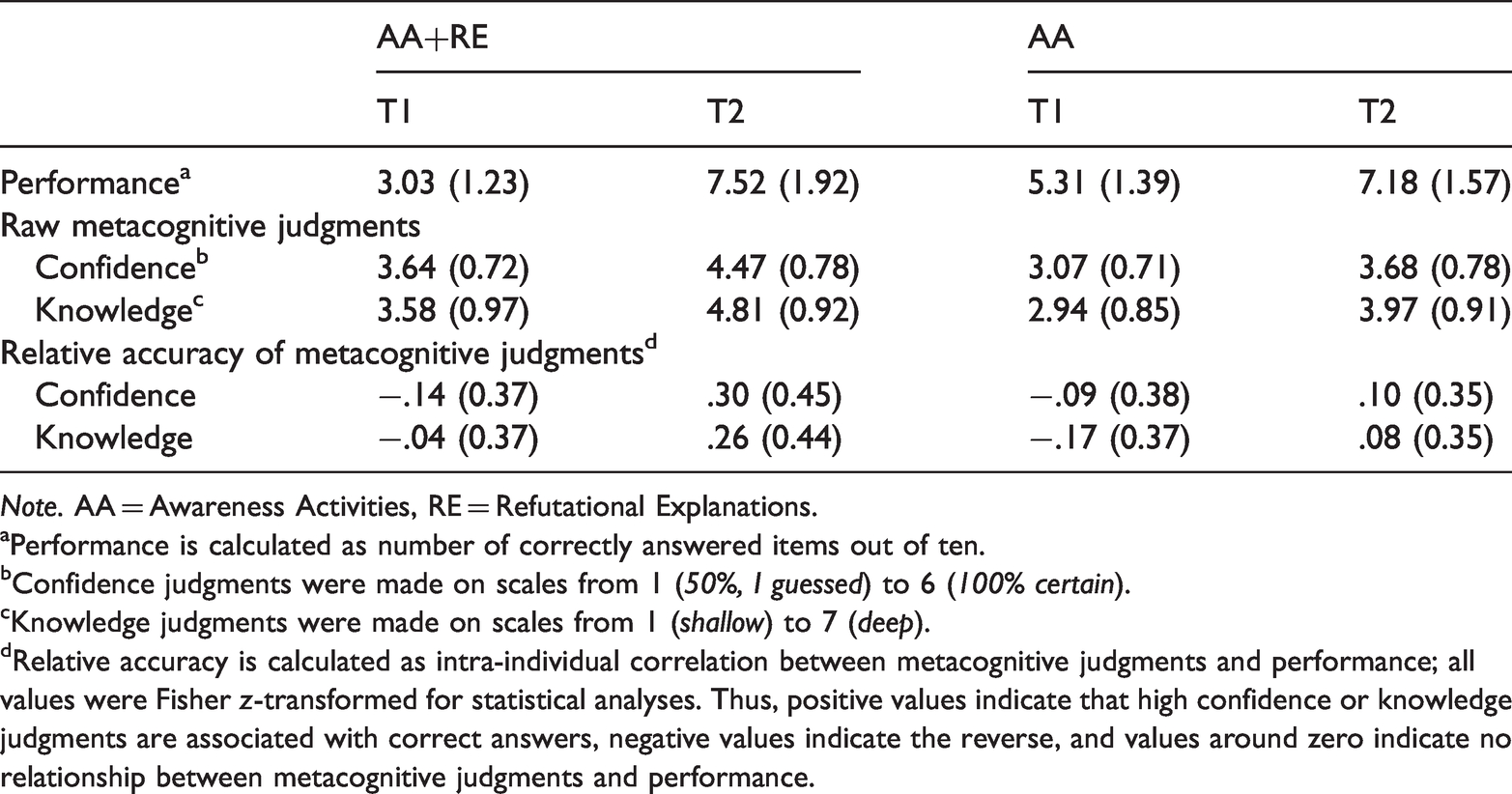
Note. AA = Awareness Activities, RE = Refutational Explanations.
aPerformance is calculated as number of correctly answered items out of ten.
bConfidence judgments were made on scales from 1 (50%, I guessed) to 6 (100% certain).
cKnowledge judgments were made on scales from 1 (shallow) to 7 (deep).
dRelative accuracy is calculated as intra-individual correlation between metacognitive judgments and performance; all values were Fisher z-transformed for statistical analyses. Thus, positive values indicate that high confidence or knowledge judgments are associated with correct answers, negative values indicate the reverse, and values around zero indicate no relationship between metacognitive judgments and performance.
Correlations between performance indicators and potentially relevant variables per condition.
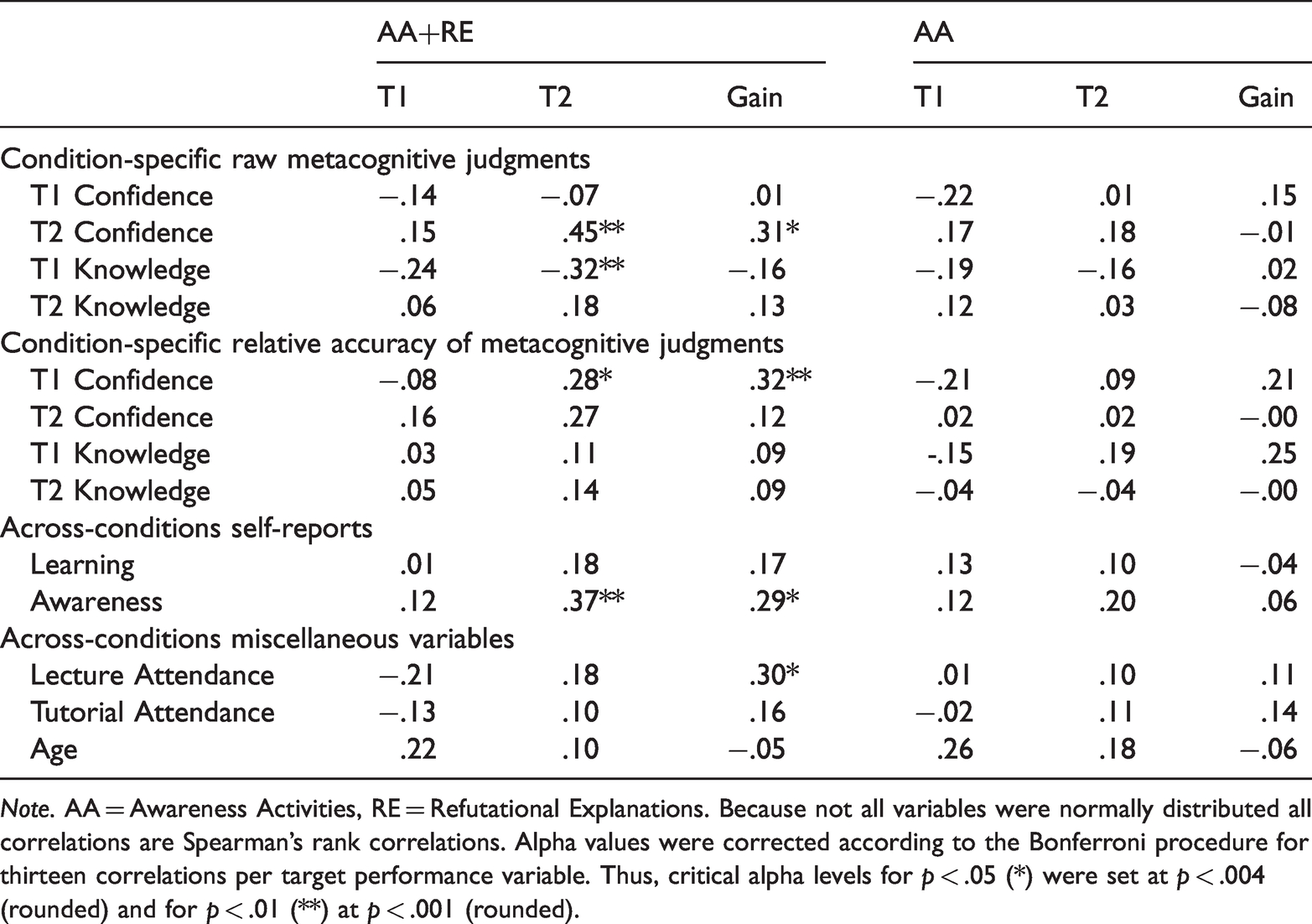
Note. AA = Awareness Activities, RE = Refutational Explanations. Because not all variables were normally distributed all correlations are Spearman’s rank correlations. Alpha values were corrected according to the Bonferroni procedure for thirteen correlations per target performance variable. Thus, critical alpha levels for p < .05 (*) were set at p < .004 (rounded) and for p < .01 (**) at p < .001 (rounded).
Hypothesis 1: Treatment Effects on Performance
We computed a repeated-measure ANOVA 2 to test the effects of time (T1 vs. T2) and treatment (AA+RE vs. AA) on performance (Hypothesis 1). Results show significant main effects of time, F(1,118) = 494.02, p < .001, ηp2 = .81, and treatment, F(1,118) = 62.34, p <.001, ηp2 = .35, and a significant time-by-treatment interaction, F(1,118) = 159.82, p < .001, ηp2 = .58 (see Table 1 and Figure 1). Post hoc paired-samples t-tests with Bonferroni corrections show significant increases in performance both in AA+RE, t(118) = −24.18, p < .001, and AA conditions, t(118) = −11.17, p < .001, and a significant difference between AA+RE and AA conditions at T1 with better performance in the AA condition, t(118) = −14.60, p < .001, but not at T2. A paired samples t-test comparing student teachers’ performance gain between treatment conditions indicates significantly more performance gain, t(118) = 12.64, p < .001, d = 1.16, in the AA+RE condition, Mgain = 4.48, SDgain = 2.02, 95% CI [4.11, 4.85], than in the AA condition, Mgain = 1.87, SDgain = 1.82, 95% CI [1.53, 2.20].
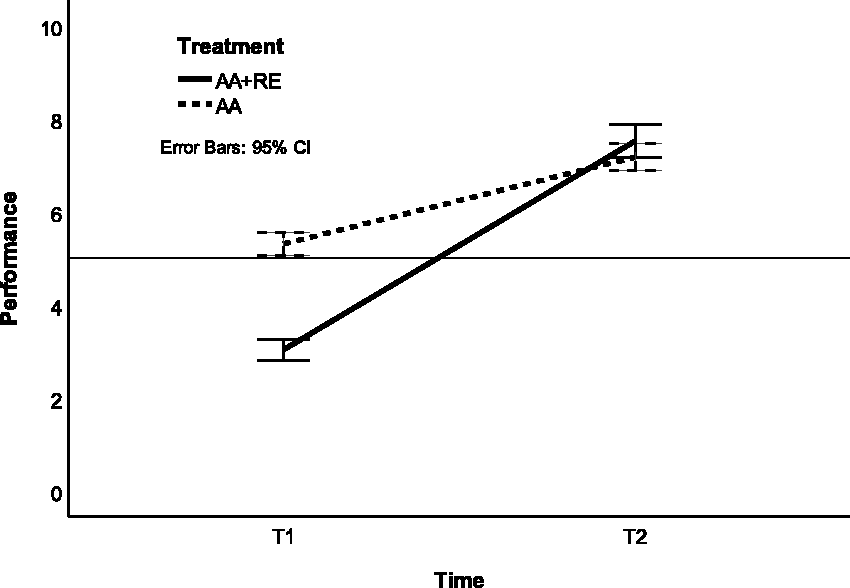
Performance by time and content conditions.
Student teachers’ own perspective at T2 confirms these results. On average, they self-reported that the awareness activities increased their learning (M = 5.18, SD = 1.06, on a scale from 1 [reduced learning] to 7 [increased learning]).
Hypothesis 2: Treatment Effects on Metacognitive Awareness
Student teachers’ metacognitive judgments regarding their confidence and knowledge are significantly correlated in all conditions (rs = .68 to rs = .72, all p < .001) but are not equivalent. Therefore, we analysed relative confidence accuracy and relative knowledge accuracy separately. We computed repeated-measures ANOVAs2 to test the effects of time (T1 vs. T2) and treatment (AA+RE vs. AA) on relative confidence accuracy and on relative knowledge accuracy (Hypothesis 2).
For relative confidence accuracy, results show a significant main effect of time, F(1,88) = 63.82, p < .001, ηp2 = .42, and a significant time-by-treatment interaction, F(1,88) = 10.64, p = .002, ηp2 = .11, but no main effect of treatment, F(1,88) = 2.68, p = .105, ηp2 = .03 (see Table 1 and Figure 2a). Post hoc paired-samples t-tests with Bonferroni corrections show significant increases in relative confidence accuracy for AA+RE, t(92) = −8.22, p < .001, and AA conditions, t(112) = −4.01, p < .001, and a significant difference between AA+RE and AA conditions at T2 with better relative confidence accuracy in the AA+RE condition, t(92) = 3.54, p = .001, but not at T1.
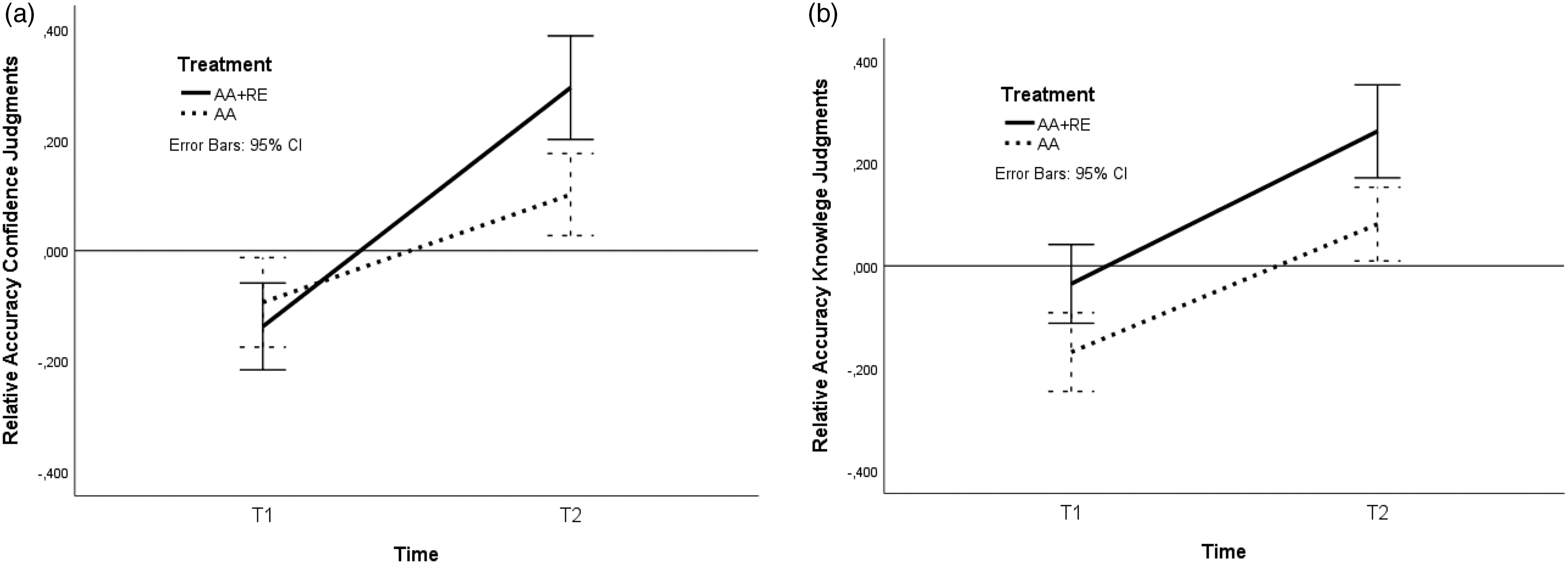
Relative accuracy of metacognitive confidence (a, left) and knowledge judgments (b, right) by time and content conditions.
For relative knowledge accuracy, results show significant main effects of time, F(1,90) = 55.02, p < .001, ηp2 = .38, and treatment, F(1,90) = 12.19, p = .001, ηp2 = .12, but no time-by-treatment interaction, F(1,90) = 0.42, p = .521, ηp2 = .01 (see Table 1 and Figure 2b). Relative knowledge accuracy increased from T1 to T2 and was consistently better in the AA+RE than in the AA condition.
Student teachers’ own perspective at T2 confirms these results. On average, they self-reported that the awareness activities increased their awareness of their own misconceptions (M = 5.65, SD = 1.02, on a scale from 1 [reduced awareness] to 7 [increased awareness]).
Research Question 1: Factors Related to Performance and Misconception Correction
To explore factors that might be related to T2 performance and correction of misconceptions (Research Question 1), we correlated all potentially relevant variables, namely, the (accuracy of) metacognitive judgments, student teachers’ self-reports regarding their learning and awareness, their lecture and tutorial attendance, and their age, with condition-specific performance indicators, namely, T1 and T2 performance and performance gain.
Correlations (see Table 2) show significant relationships with performance only in the AA+RE treatment condition. Better AA+RE performance at T2 correlated significantly with lower knowledge judgments at T1, higher relative confidence accuracy at T1, higher confidence judgments at T2, and self-reported increase in awareness of misconceptions. Higher AA+RE performance gain correlated significantly with more accurate confidence judgments at T1, higher confidence judgments at T2, self-reported increase in misconception awareness, and more frequent lecture attendance. For example, the results regarding relative confidence accuracy indicate that students who were initially overconfident in their answers showed lower performance at the end of the course and corrected fewer misconceptions than students who were better aware of their misconceptions at the start of the semester.
Discussion
This study corroborates and extends prior research in three ways. First, descriptive results confirm that our convenience sample of Australian student teachers harbored numerous educational psychological misconceptions and had high confidence in their misconceptions. Second, tests of Hypothesis 1 and Hypothesis 2 show that awareness activities—especially in combination with refutational explanations—resulted in significant increases in metacognitive awareness and significant increases in performance in this sample. Third, correlations (cf. Research Question 1) tentatively suggest that an initial metacognitive deficit of being overconfident may hinder correction of misconceptions.
More specifically, descriptive results highlight that more than 50% of student teachers endorsed seven out of ten course content and four out of ten non-course content misconceptions at T1. This prevalence is consistent with previous research on teacher misconceptions about similar and/or different psychological or educational phenomena (Asberger et al., 2019; Dekker et al., 2012; Eitel et al., 2019; Heyder et al., 2018; Langfeldt, 1989; Macdonald et al., 2017; Menz et al., 2020; Simmonds, 2014). Student teachers’ below-chance performance on course content might be explained by high interest coupled with a reliance on dubious information sources, experience, or intuition (Heyder et al., 2018; Lilienfeld et al., 2012; Simmonds, 2014). Some of these common misconceptions are shared by educators around the world, for example, the belief in the benefits of catering to students’ visual, auditory, and kinaesthetic learning styles (Macdonald et al., 2017). Other misconceptions might result from misunderstanding technical terms (“short-term” vs. “long-term” memory) or from frequent media reports (for example, about the prevalence of cyberbullying). It would be an interesting question for future research to address whether other populations than student teachers endorse these misconceptions at similar rates and with similar confidence, and whether other populations would be more or less likely to correct their misconceptions in response to similar interventions.
Hypothesis 1 was confirmed, namely, that providing awareness activities plus scientifically correct refutational explanations (AA+RE) was more effective than awareness activities only (AA) in decreasing student teachers’ misconceptions (thereby increasing their performance). Student teachers’ performance increased significantly from T1 to T2, and significantly more so in the AA+RE condition than in the quasi-control AA condition. This performance gain as well as the persistence of some misconceptions at T2 is consistent with prior research on misconceptions (e.g., Bensley & Lilienfeld, 2017; Hughes et al., 2013b; Kowalski & Taylor, 2009, 2017; Lassonde et al., 2017; Menz et al., 2020). Student teachers might have failed to correct all of their misconceptions because they did not correct deeply-entrenched “ontological” misconceptions (Hughes et al., 2013b), because of seemingly ambiguous evidence or unintelligible explanations (Chinn & Brewer, 1993), or because they did not consider educational psychology to be a scientific discipline (Amsel et al., 2014). Nonetheless, our results suggest that that metacognitive awareness activities combined with scientifically correct refutational explanations can be beneficial for correcting misconceptions held by student teachers.
Hypothesis 2 was mostly confirmed, namely, that providing awareness activities plus scientifically correct refutational explanations (AA+RE) was more effective than awareness activities only (AA) in increasing student teachers’ metacognitive awareness of their own misconceptions. The relative accuracy of student teachers’ metacognitive judgments about their confidence and knowledge increased significantly from T1 to T2. For confidence judgments, but not for knowledge judgments, metacognitive awareness increased significantly more in the experimental AA+RE condition than in the quasi-control AA condition. Consistent with previous research (Bensley & Lilienfeld, 2015; Gaze, 2014; Taylor & Kowalski, 2004), student teachers displayed negative relative accuracy at T1. That is, they were more confident and judged themselves to have more knowledge regarding their misconceptions than their correct answers. This provides strong support for high-confidence educational psychology misconceptions. At T2, all relative accuracy values were positive, pointing to some metacognitive awareness, especially in the AA+RE condition (Fisher z-transformed rpb = .26 to rpb = .30). However, compared with metacognition research in other areas, these values are moderate at best. For example, for delayed judgments of learning, values of up to G = .93 (Dunlosky & Nelson, 1992) have been found. This indicates that student teachers were not fully aware of their misconceptions, even at the end of the semester. This is consistent with metacognition research demonstrating general overconfidence especially in unskilled populations (Dunning et al., 2003) and for difficult tasks (Pieschl, 2009). Nonetheless, our results suggest that metacognitive awareness activities combined with scientifically correct refutational explanations can be beneficial for promoting metacognitive awareness in student teachers.
In Research Question 1 we explored which factors were most strongly related to performance and correction of misconceptions in student teachers. Results indicate that (the accuracy of) metacognitive judgments are significantly related to performance and performance gain. Most importantly, high knowledge judgments and low relative accuracy of confidence judgments at T1 are consistently related to low performance at T2 and small performance gains. Thus, initial metacognitive awareness deficits of overconfidence seem to hinder correction of educational psychological misconceptions. Blinded by overconfidence in their false beliefs, student teachers may have ignored our misconception feedback and the scientifically correct explanations provided by the lecturers (Chinn & Brewer, 1993; Lilienfeld et al., 2012). Interestingly, relationships between (the accuracy of) metacognitive judgments and performance were more consistent and stronger than, for example, those between lecture or tutorial attendance and performance. This may also underscore the importance of metacognitive awareness for educational psychological misconceptions and their correction. Future research needs to explore further the nature of this relationship. For example, it is unclear whether and how metacognitive awareness—alone or in combination with refutational explanations—mediates or moderates the relationship between (awareness) interventions and correction of misconceptions.
Limitations
The present study is not a well-controlled laboratory experiment but an exploratory field study. For ethical reasons, potentially beneficial treatments had to be offered to all students regarding course content and students had to receive immediate feedback about all of their misconceptions. We could only compare the potentially most beneficial awareness activities plus refutational explanation (AA+RE) treatment condition with a quasi-control awareness activities only (AA) condition. Similar conditions have been used in other misconception intervention studies (Kowalski & Taylor, 2009, 2017; LaCaille, 2015), but our results have to be interpreted with due caution. Without a no-treatment control group, main effects of time in the AA group are only a rough approximation of the unique effects of awareness activities. Additionally, even though our design allows for comparisons between AA+RE and AA conditions, not all differences can be clearly attributed to the refutational explanations. The within-subject conditions might have differed in T1 difficulty; non-course content items seem less difficult than course content items (see above). Furthermore, we had no control over the content of other courses or about what student teachers read or heard in their spare time. Even in the AA condition, curious student teachers might have sought out scientifically correct (refutational) explanations. Furthermore, selective dropouts might have skewed our final sample towards the best and most motivated students—even though at T1 the final sample did not show better performance on the misconception questionnaire than their peers who dropped out at T2.
Moreover, from a philosophy of science perspective, the feasibility of determining “misconceptions” might be questioned. On the one hand, experts often debate what to consider a “misconception” (for psychological debates see, Bensley & Lilienfeld, 2017; Brown, 1984; Gardner & Brown, 2013; Hughes et al., 2013b). On the other hand, people’s intuitive theories are often mixtures of correct assumptions and misconceptions based on kernels of truth (Amsel et al., 2011; Carey, 2000; Keil, 2010). People’s beliefs are rarely “completely wrong” and there is no unanimous “consensus of core concepts and research findings in a discipline” for all topics. Consequently, our diagnosis of educational psychological misconceptions itself is tentatively based on the current state of cumulative scientific evidence—which we emphasize in our misconception questionnaire. The general format and content of misconception questionnaires can also influence responses (Hughes et al., 2013a; Taylor & Kowalski, 2012). We cannot exclude the possibility that this was also the case in this study. Further, student teachers might have been affected by the demand characteristics of the misconception questionnaire. For example, one of the educational psychology lectures dealt with the topics of self-regulated learning, metacognition, and epistemic beliefs. Students might have seen the use of awareness activities and refutational lectures as a means of raising metacognitive awareness and then might have responded to the perceived expectations. However, anecdotal evidence points in the other direction: quite a few student teachers vocally defended their misconceptions and insisted that their personal experience was just as valid a justification for their convictions as scientific evidence. Besides, misconception questionnaires in general are skewed toward eliciting false responses. Yet metacognitive judgments seem to be more accurate for easier items with better-than-chance performance (Koriat, 2018). This might have artificially increased metacognitive overestimation in this study. We cannot guarantee that our student teachers’ self-reports reflected their true beliefs, an issue with all self-reports. We also cannot guarantee that the treatments resulted in permanent correction of misconceptions (Butler et al., 2011). Some authors point to the danger of “rebound effects” (Hughes et al., 2013b) while others found significant long-term effects (Kowalski & Taylor, 2017; McCarthy & Frantz, 2016).
Nonetheless, we argue that the benefits of an ecologically valid field study that shows what can be implemented in a real educational psychology courses outweigh these concerns. Even so, our findings should be interpreted carefully and should be replicated in more controlled settings.
Conclusions and Implications
Notwithstanding these limitations, our results have relevant implications. First, this study identifies highly prevalent educational psychological misconceptions among our convenience sample and this might inform lecturers of similar educational psychology courses which topics should be addressed with priority. Second, this study shows the benefits of easy-to-implement awareness activities combined with refutational explanations that seemed to increase metacognitive awareness and correction of misconceptions in student teachers. Similar interventions might be effective in other teaching contexts not only in teacher education programs. Third, the results for metacognitive judgments show that many educational psychological misconceptions seem to be deeply entrenched and many student teachers have a pronounced metacognitive deficit. They are unaware of their misconceptions and overconfident in their false beliefs. To conclude, metacognitive awareness seems to be an important variable to include in future research about psychological misconceptions and conceptual change. It is a promising target for future interventions to reduce misconceptions.
Supplemental Material
sj-pdf-1-plj-10.1177_1475725721996223 - Supplemental material for Effects of Raising Student Teachers’ Metacognitive Awareness of Their Educational Psychological Misconceptions
Supplemental material, sj-pdf-1-plj-10.1177_1475725721996223 for Effects of Raising Student Teachers’ Metacognitive Awareness of Their Educational Psychological Misconceptions by Stephanie Pieschl Janene Budd Eva Thomm Jennifer Archer in Psychology Learning & Teaching
Footnotes
Declaration of Conflicting Interests
The author(s) declared no potential conflicts of interest with respect to the research, authorship, and/or publication of this article.
Funding
The author(s) disclosed receipt of the following financial support for the research, authorship, and/or publication of this article: Our work was funded by the Strategic Networks and Pilot Projects (SNaPP) scheme of the Faculty of Education and Arts (FEDUA) of the University of Newcastle, Australia.

Supplemental material
Supplemental material for this article is available online.
Notes
Author Biographies
References
Supplementary Material
Please find the following supplemental material available below.
For Open Access articles published under a Creative Commons License, all supplemental material carries the same license as the article it is associated with.
For non-Open Access articles published, all supplemental material carries a non-exclusive license, and permission requests for re-use of supplemental material or any part of supplemental material shall be sent directly to the copyright owner as specified in the copyright notice associated with the article.
