




Abstract
The use of effective study strategies is important for academic achievement, yet research indicates that students often use relatively ineffective learning strategies. Though potent strategies to promote durable learning exist, there is a lack of theoretical and empirical work on how to train students to self-regulate use of these strategies successfully. We summarize a novel framework to do so: the knowledge, belief, commitment, and planning (KBCP) framework. The assumptions are that learners must develop knowledge about a strategy and how to use it, believe that the strategy is effective for the individual learner, commit to the strategy, and create an action plan for carrying it out. We then describe an example of the KBCP framework as applied to a college course on teaching students effective learning strategies and self-regulation of these strategies in their college coursework. Lectures on specific learning strategies conveyed knowledge about the strategies, in-class demonstrations illustrated their efficacy (to support belief), and assignments required students to develop a plan for applying them to their courses and to implement the plan (to ensure commitment). Discussion focuses on the implications of including training in how to use learning strategies in psychology courses and curricula, and on the possible extension of such training to the teaching of other psychology content.
Introduction
In recent years, cognitive and educational psychologists have developed a clear understanding of fundamental learning strategies that have considerable effects on learning and memory (e.g., Brown et al., 2014; Dunlosky et al., 2013; Fiorella & Mayer, 2015, 2016; Pashler et al., 2007). Although these strategies have been shown to be highly effective among individuals and across academic domains (Dunlosky et al., 2013), at present they are rarely taught in school (Dunlosky et al., 2013; Pomerance et al., 2016). In this article, we build the case for why training in how to use learning strategies should be a core component of the school curriculum, we review a recently proposed theoretical framework to guide the teaching of learning strategies so that students develop agency over their learning (McDaniel & Einstein, 2020), and we illustrate how this framework was translated into a new college-level course devoted to helping students acquire sophisticated and effective learning strategies to meet their educational challenges.
The Need for Training in How to Use Learning Strategies
Successful students have agency or self-regulation over their own learning (Hacker et al., 2009; Pintrich, 2000). Effective agency requires that students learn powerful strategies for producing good learning and memory and that they understand how and when to use them. Yet, research shows that students do not have a particularly good understanding of how their learning and memory work. That is, they tend to have less than optimal metacognition (Schwartz et al., 1997), and they frequently use ineffective strategies at all levels of education—in middle school and high school (Agarwal et al., 2014), and in college (Dunlosky et al., 2013; Karpicke et al., 2009; Putnam et al., 2016). Thus, the troubling upshot is that students’ general reliance on ineffective strategies limits their academic achievement, undermines their enjoyment of learning, and likely dampens their commitment to lifelong learning.
The use of less than optimal strategies is in large measure due to basic limitations associated with using personal experience to judge their effectiveness. As proposed by Koriat (1997) and others (Kirk-Johnson et al., 2019; Schwartz et al., 1997), we do not have direct access to the strength or quality of our memories and instead we use a variety of cues and heuristics to infer how well we are learning. In addition, many studies have shown that our inferences are often misguided and lead to incorrect judgments when assessing the effectiveness of learning strategies (e.g., Karpicke & Roediger, 2008; Kirk-Johnson et al., 2019; Kornell, 2009; Shaughnessy, 1981).
One factor that undermines our ability to identify successful study strategies is that people tend to use immediate access to judge the effectiveness of strategies, and nearly all strategies (including relatively ineffective ones like rote rehearsal; Miyatsu et al., 2018) yield good immediate access. As many studies have shown, immediate judgments of learning are relatively poor predictors of long-term learning (Dunlosky & Nelson, 1994; Dunlosky & Tauber, 2016). Our biases also limit our ability to judge the effectiveness of strategies. For example, as Kirk-Johnson et al. (2019) recently showed, learners tend to assume that high effort during learning is associated with poor learning. Specifically, after studying instances of bird categories using interleaved study (more effective but more effortful) and blocked study (less effective and less effortful), learners correctly rated the interleaved strategy as more effortful but incorrectly indicated that it was the less effective learning strategy. Importantly, they also indicated that they would be less likely to use the more effective interleaved strategy in the future on similar tasks.
Still another factor that challenges our ability to rely on personal experience to evaluate the effectiveness of strategies is that we are unable to control all of the relevant variables affecting performance under everyday learning situations. The result is that ineffective strategies, under certain conditions, can seem quite powerful. For example, a relatively ineffective strategy such as rote repetition will sometimes lead to good performance (e.g., in an immediate test or an easy test), even though it is a strategy that does little for long-term retention. Given the problems associated with using personal experience to judge the effectiveness of strategies, and as noted by Pressley et al. (1989, p. 302; see also Dunlosky et al., 2013), it is not surprising that “many students are committed to ineffective strategies.”
In light of the inherent difficulties associated with discovering effective learning strategies on one’s own, it seems particularly important to teach students powerful learning strategies and how to use them. Yet, as noted earlier, students currently receive little or no comprehensive instruction in learning strategies. Teachers tend to emphasize the acquisition of content and the development of critical thinking abilities and not learning strategies (Dunlosky et al., 2013). Moreover, teacher training rarely includes extensive instruction in learning techniques (Dunlosky et al., 2013; Pomerance et al., 2016). Even if teachers had a deep understanding of effective study strategies, there is at present a major gap in our understanding of how to teach students these strategies such that they will self-regulate their learning and spontaneously engage powerful learning strategies in appropriate situations (Manalo et al., 2018; see also Kubik et al., 2020).
Knowledge, Belief, Commitment, and Planning Framework for Training the Use of Learning Strategies
In a previous article, we presented our framework for training the use of learning strategies and detailed the theoretical and empirical work that motivated the components and assumptions of the framework (McDaniel & Einstein, 2020). Accordingly, here we simply provide a summary of the framework. The main purpose of the present report is to then describe a college training course on learning strategies that embeds each of the framework’s components. The framework proposes four critical components for training students in the use and transfer of learning strategies.
First, students need to be taught about the strategies and how to use them (e.g., Borkowski et al., 1987; Cook & Mayer, 1988; Dansereau et al., 1979; see Donker et al., 2014, for a meta-analytic review). The importance of this knowledge component is self-evident. We emphasize that the knowledge component includes three aspects: (a) knowledge about the strategy (what the strategy is); (b) evidence the strategy is effective; and (c) knowledge about how the strategy is implemented for authentic learning tasks (how to apply it). When general study strategies (as reviewed in Dunlosky et al., 2013) are taught (the literature on training self-regulated learning strategies has mostly focused on strategies for particular subject matter domains, most often reading or math; Donker et al., 2014), the training tends to rely exclusively on this knowledge component, typically with a focus on what the strategy is. As common examples, at our institutions (Furman University and Washington University), introductory psychology students are taught about effective strategies through brief classroom lectures or assigned readings.
In other words, the standard assumption has been that the main obstacle preventing students from applying and transferring effective strategies to their coursework is a lack of knowledge about them. Unfortunately, as reviewed in McDaniel and Einstein (2020), training that focuses on the knowledge component (knowledge about the strategy and how to use it) generally supports learners’ self-regulated use of the strategy only within a brief time frame after training and within the context of participating in the experimental study. The existing findings, therefore, do not inspire confidence that knowledge-focused training will support sustained self-regulated use of strategies outside of the training context and for a range of learning challenges. Our view is that students armed with knowledge about strategies alone will generally not apply them under appropriate circumstances (see Borkowski et al., 1987, for a similar view).
Second, students also need to develop belief that the strategies are effective for them (e.g., Brigham & Pressley, 1988; Garner, 1990). Our framework assumes that students are more likely to transfer strategies to their own learning objectives when they directly experience the benefits of using them. The idea here is that the direct experience has a powerful influence on their belief in the strategy’s effectiveness. Pressley et al. (1989) proposed that students are more likely to deploy strategies when they fully appreciate their effectiveness. Along these lines, a handful of studies suggest that students are more likely to transfer a strategy to their studying when they have directly experienced its benefits (Brigham & Pressley, 1988; Bjork et al., 2011; deWinstanley & Bjork, 2004; Einstein et al., 2012). Consequently, we advocate including participatory demonstrations to help students realize there is a connection between their study strategies and their learning outcomes (Bugg et al., 2008; Einstein et al., 2012). Demonstrations have the potential to serve a powerful function in illuminating the benefits of the strategy for oneself, thereby creating belief. Our experience, as well as that of our colleagues (who convey learning strategies to students), is that students tend to think they are unique and that learning strategies that work for others may not work for them. Research evidence suggests this is the case (Yan et al., 2016). Our theoretical assumption is that demonstrations encourage students to use the strategy, because they gain firsthand experience that the strategy works for them. We provide some initial observational support for this assumption in the following section.
Third, students need to develop a commitment to implementing the strategies (i.e., a commitment to action), which involves recognizing the value to their lives (e.g., academic performance) (e.g., Harackiewicz et al., 2016). Students may know an effective strategy and believe that it works for them but fail to exert the effort required to implement it. One potential reason is that their commitment level to use the strategy may be insufficient (e.g., in clinical settings, lower commitment to a cognitive/behavioral strategy is associated with reduced use of the strategy in appropriate situations; Amrhein et al., 2003). Therefore, our knowledge, belief, commitment, and planning (KBCP) theory assumes that a third training component is necessary, one focusing on a commitment to action (i.e., motivation). One promising approach to compelling commitment involves generating utility value, which can be accomplished by encouraging students to reflect on the inherently positive outcomes associated with effective strategy use (Harackiewicz et al., 2016). In educational settings, increasing the perceived value of a task (e.g., learning math) increases interest, motivation, and persistence in activities related to that task (e.g., Hulleman et al., 2017). McDaniel and Einstein (2020) review other approaches, such as self-attribution, which might also be used to increase commitment.
Fourth, a large social/motivational literature (e.g., Gollwitzer, 1999) has established that commitment is not sufficient for effective “follow-through” of intentions. In the case of applying learning strategies, students may intend to implement strategies such as spacing their studying over several days before an exam, but the demands of daily life and school can derail this commitment (Susser & McCabe, 2013). Accordingly, students need to formulate an action plan for implementing effective strategies in their school learning (Duckworth et al., 2013). Such planning has been shown to be effective even with fifth graders in educational contexts (Duckworth et al., 2013).
A KBCP-Inspired Learning Strategy Course
We now present an overview of a college-level learning strategy course that was recently developed by one of the co-authors (MM) based on the KBCP framework. We describe how each component was implemented and conclude with a discussion on the implications of including training in the use of learning strategies in psychology courses and curricula, the extension of such training to the teaching of other psychology content, and enhancement of equity. Table 1 provides a schematic of the four components, the theoretical justification for each component, the implementation of each component in the course, and the outcomes of the course tied to each implementation.
Overview of the KBCP-Inspired Learning Strategy Training Course
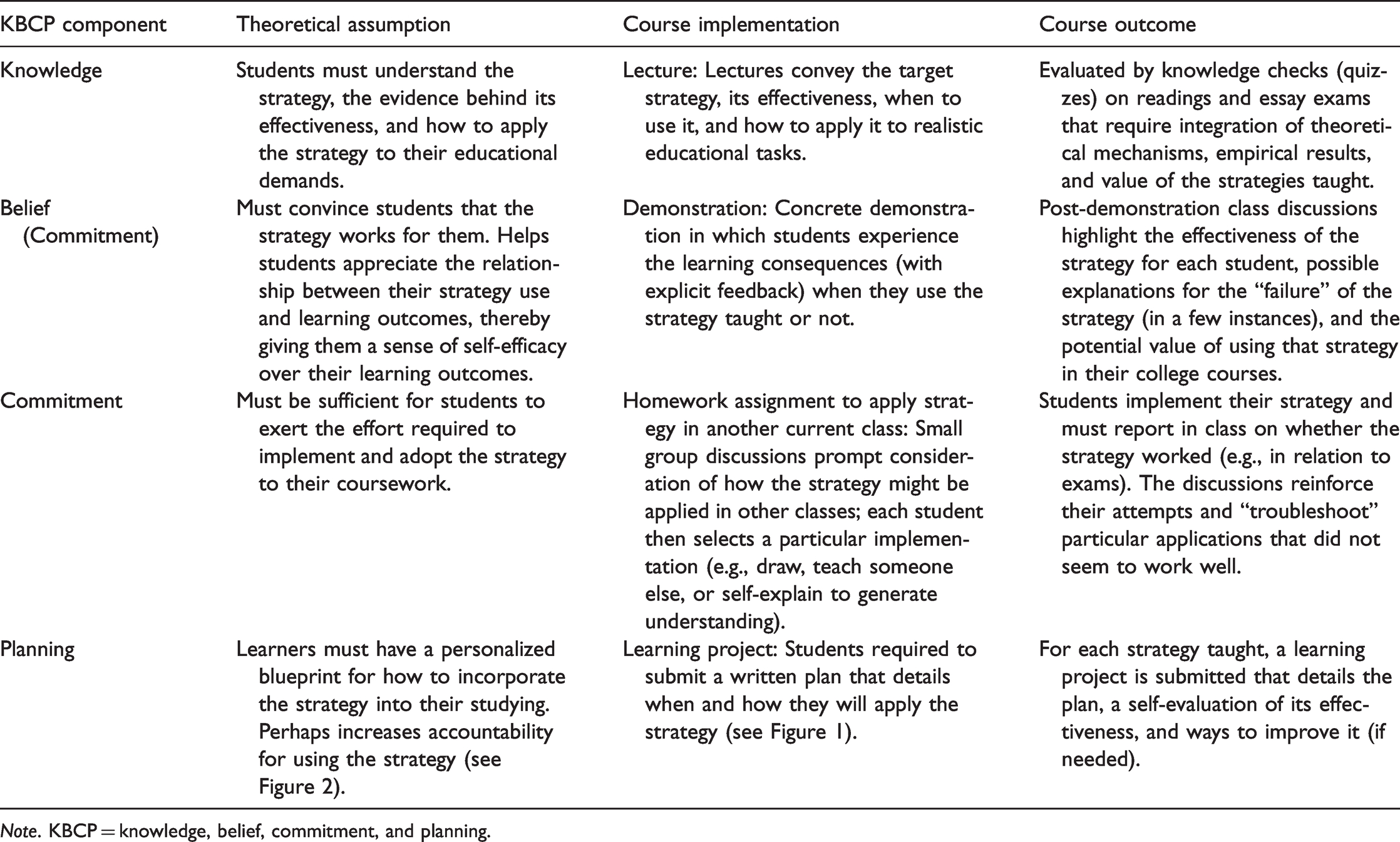
Note. KBCP = knowledge, belief, commitment, and planning.
Method
Students
The course was listed as a freshman/sophomore-level psychology course, with introductory psychology as a prerequisite. For this first offering of the course, the class size was restricted to facilitate small group and classroom discussions; demand turned out to be limited, and 10 students enrolled in and finished the course.
Knowledge
We implemented this component with standard pedagogical tools. Lectures and readings targeted effective learning strategies, as informed by the cognitive science literature. Make It Stick: The Science of Successful Learning (Brown et al., 2014) was assigned to give a nontechnical and engaging overview of the learning strategies. More emphasis was placed on required readings from the primary research literature and, generally, one article was selected for each of the learning strategies taught. These readings were selected to be accessible and not overly long (e.g., from Current Directions in Psychological Science or Psychological Science) or to counter nonevidence-based claims made by some educators (e.g., the use of mnemonics leads to rote learning, and “inert knowledge;” the Levin & Levin, 1990, paper was assigned to provide evidence countering this stance—more on this below). A “knowledge check” (an in-class quiz of 4–5 short-answer questions) to encourage completion of the reading assignment was conducted for each assigned article; students were forewarned about these knowledge checks. The knowledge checks were straightforward questions about the main findings of the research. Two in-class essay examinations were given (each covered approximately half of the semester) to further reinforce the importance of understanding the learning strategies taught and the evidence supporting their effectiveness.
Selection of the particular strategies to target was informed by the following considerations. Much of the existing research concerning classroom training in the use of learning strategies has focused on domain-specific strategies, especially strategies for reading (and writing) and math (Donker et al., 2014). By contrast, the objective of the course was to teach strategies that students could apply to their learning challenges across a broad range of courses. Furthermore, we favored strategies for which experimental evidence supported their utility with authentic educational materials, which by necessity includes laboratory experiments given the present limited availability of classroom-based studies for many learning strategies. Based on our own reading of the literature and several excellent reviews (Dunlosky et al., 2013; Fiorella & Mayer, 2015, Pashler et al., 2007), the course focused on the following strategies: retrieval practice, building understanding (including self-explanation), organization, mnemonics, generation, spacing, and interleaving.
The selection of mnemonics merits comment because some educators have suggested that its utility is limited in terms of the degree to which it can be applied in some content areas (Dunlosky et al., 2013). Educators in the academy also disfavor mnemonics because the “rote learning” it supports is antithetical to prescriptive-based educational objectives that foster understanding, inferencing, problem-solving, and critical thinking (but see discussion by Kubik et al., 2020). However, the educational objectives that students have to meet in their courses do not necessarily align with these prescriptions. Instead, as we found from teaching the learning strategies course, students do not have to struggle to find applications for mnemonics in their courses. In many cases, course objectives (as evidenced by the summative exams) require the learning of arbitrary associations (e.g., between a scientist’s name and their contribution, a prominent requirement in some students’ courses), precisely the learning challenge for which mnemonics is designed. Furthermore, as noted above, the evidence indicates that mnemonic strategies can lead to better inference and problem-solving performance than does standard instruction (e.g., when learning and generating inferences from botanical taxonomies; Levin & Levin, 1990). As another example, mnemonics using the method of loci has been applied with great success to British students’ course preparation for their A-level exams in psychology (see Brown et al., 2014, pp. 190–197; also see Miyatsu & McDaniel, 2019, for the catalytic benefits of mnemonics for retrieval practice).
Belief
To promote students’ belief that the strategies worked, we prepared in-class demonstrations in which students implemented each strategy using a set of items. Experimental evidence shows that students’ experiences with different strategies are much more convincing when the strategies are clearly separated, so they can more easily appreciate their differential effects (Yan et al., 2016). Accordingly, the demonstrations included learning a set of target material with a standard study strategy (e.g., reading, massing study, or rereading) and then learning a comparable set of items with the more effective strategy (e.g., generating understanding, spacing study, retrieval practice).
An important and perhaps obvious feature worth highlighting is that for each demonstration, care was taken to control study time (pacing of items by the instructor), material difficulty, test delay, and test difficulty, thereby isolating the study strategy as the cause of the difference in performance between a typical strategy and the evidence-based strategy. This allowed students to compare (e.g., rote rehearsal vs. self-explanation) strategies under relatively controlled conditions. To encourage this comparison, immediately following each demonstration, we initiated a classroom discussion in which students shared their “results,” their experiences in using the target strategy, and their reflections on the demonstration. The self-reflection prompted by such discussion indicated that the demonstrations did indeed foster students’ belief that the strategy worked for them. For example, in the discussion following the retrieval practice demonstration (modeled on Einstein et al., 2012) one student remarked “I wouldn’t have appreciated the power of recall for learning—my experience convinced me how much more I could remember after attempting recall (retrieval practice) than after rereading” (a close paraphrase).
Another positive (and unexpected) outcome of the discussion on self-reflection was that in some cases students articulated their impressions of why the strategy worked. Following the retrieval practice demonstration, one student noted that they elaborated the connections among the concepts in the passage as they were generating their recall. Another student remarked, “on the final test, I found myself thinking back to recalling the first day, and recalled the same way.” These reflections aligned nicely with theoretical explanations for why retrieval promotes learning—retrieval stimulates elaboration of content (McDaniel & Masson, 1985) and recall strengthens retrieval routes (Bjork, 1975)—and, thus, could be used to reinforce the theoretical underpinnings of the strategy’s effectiveness. Another observation is that students enjoyed the demonstrations; several students indicated on the course evaluation form that it was a favorite part of the course.
The potential impact of the demonstration component is vividly conveyed by an anecdote from a high school teacher with whom we collaborated. After a limited learning strategy intervention we undertook in a high school math class consisting of two sessions that included demonstrations, the teacher related to us the following dramatic outcome, suggesting that demonstrations may be a key mechanism (for some students) for stimulating the self-regulated use of learning strategies. I have a student who got a D first semester and was relatively unengaged: school was difficult and he didn’t feel like he could do well in it, so the level of caring was pretty low. This semester, he has been a completely different person. I sat down with him and asked him some questions about what made this semester different. Without hesitation, he said that Emily [co-author EE] coming in and doing the activities was a game changer for him. He specifically referenced the “connecting to understanding” activity involving the man doing different activities [based on materials from Pressley et al., 1987]. He said he now listens closer to explanations and connects the concepts to things that make sense in his world. He is now making a B in the class and I believe that his math and school trajectory have been altered in such a positive direction (Dr. Drew Crismon, personal communication, March 20, 2020).
Commitment
The commitment component was implemented as a homework activity. After a particular strategy had been taught and demonstrated, students were required to apply the strategy to at least one other course. To reinforce the commitment and prepare students for applying the strategy, two techniques were adopted. First, during class time, students were divided into small groups and instructed to help each other identify a particular course(s) to which the strategy might be applied to help crystalize how it might be operationalized. For example, for a strategy concerned with retrieval practice, reading and reciting might be preferred for some content (e.g., learning about different philosophical viewpoints), whereas using flashcards might be preferred for other types of content (e.g., learning about the conceptual contributions made by different anthropologists). The instructor circulated among the groups to listen to the ideas and provide feedback. Second, students were then given a planning assignment in which they had to describe in detail how they were going to apply the strategy and to which course(s) (described below).
With a shortened strategy training intervention (rather than a semester-long course) situated in a content course (e.g., the two-session intervention in a high school math class mentioned above), we have attempted to increase commitment with a utility value intervention. Following previous literature (Harackiewicz et al., 2016; Hulleman et al., 2017), we asked students to write a couple of paragraphs in which they reflected on the importance of the content (to their short- and/or long-term goals) to try to increase their perceived value of the course and, thereby, generate motivation (or commitment) to apply the strategies for which they had been trained (see McDaniel & Einstein, 2020).
Planning
Students were required to complete a two-part learning project for each strategy. In the first part they were instructed to develop a fairly detailed action plan for implementing the strategy. Students were provided (on a PowerPoint slide in class) a set of questions to support their plan: In what course will you use the strategy? What is your objective in implementing the strategy? How frequently throughout the week will you use the strategy? Describe in detail exactly when and how you will implement the strategy each day. Students were given 3–5 days to write their plan and hand it in. Feedback on the plan was directed at whether the student provided answers to the questions. Nearly always, the plans included all of the requisite information. There were seven learning projects for the semester.
Figure 1 shows part of the plan developed by one of the students to apply retrieval practice to studying for summative assessments for several courses (cognitive neuroscience and Spanish courses are displayed in the figure, but other courses were included as well). Note that the plan was well specified and relatively sophisticated. As far as the cognitive neuroscience course is concerned, two kinds of retrieval practice were planned (flashcards and free recall): a 5-day plan was specified with different temporal delays on various days between studying and practicing retrieval, different mixes of flashcard use and free recall were specified, and even a target amount of time was allocated for flashcard practice. With regard to Spanish, the plan allowed for 2 days of retrieval practice, with generous spacing of flashcard use throughout each day. Of course not all students generated such a detailed plan, but the advice we gave students about what elements to include in the plan seemed to promote “actionable” plans.
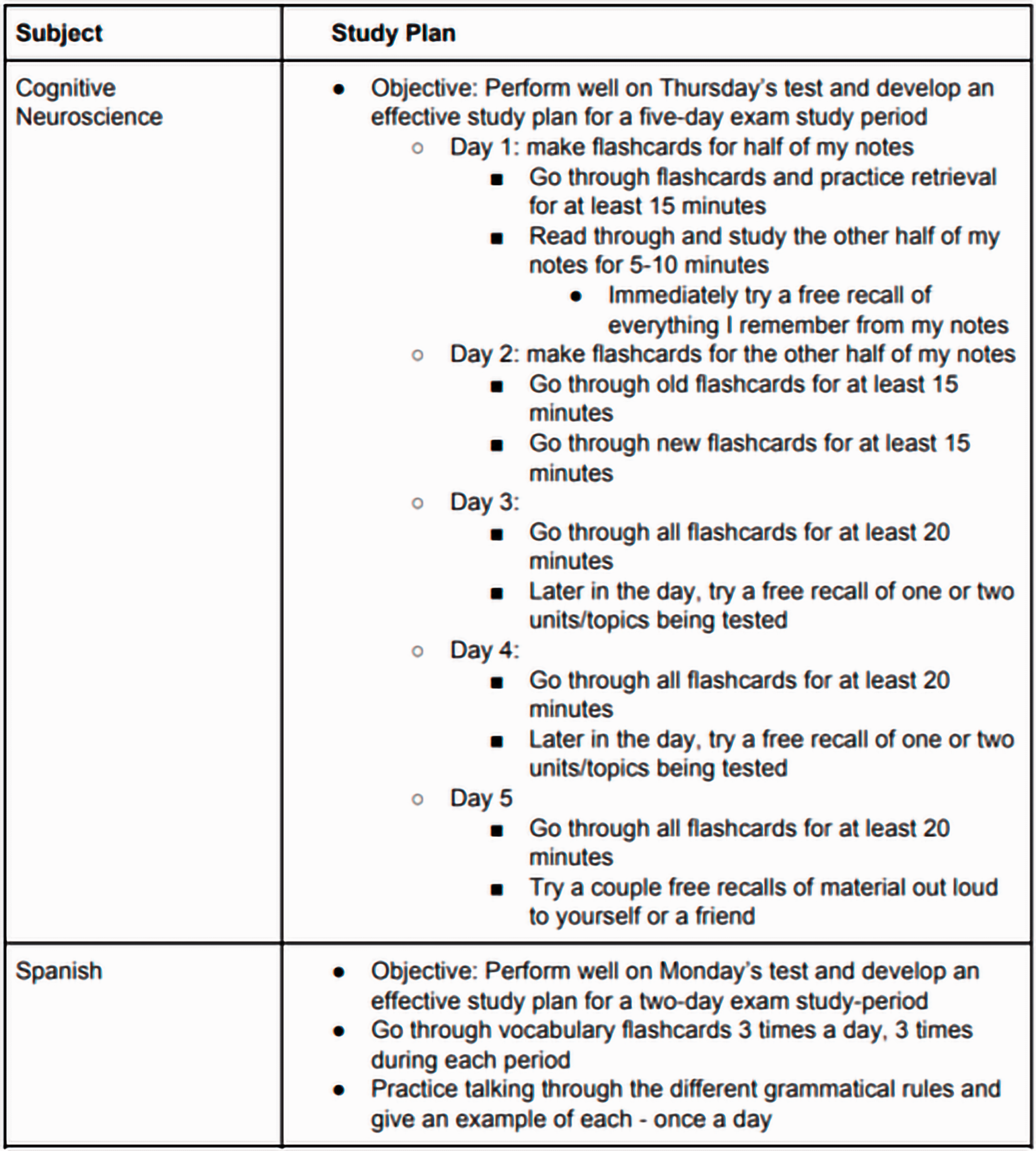
A Student’s Action Plan for Implementing Retrieval Practice
The second part of the learning project, which students completed a week or two after formulating their strategy plan, required them to reflect on and evaluate their plan: Did it seem to work? Why or why not? Could they modify their plan to improve it? The rationale for this part of the project was based on theoretical views that self-reflection plays a key role in helping students evaluate whether their strategies are successful in achieving their academic goals (e.g., Efklides, 2008; Pintrich, 2000; Zimmerman, 2008), which in turn, stimulates students to distinguish between effective and ineffective approaches to learning and to adjust their behavior accordingly. As with the first part of the learning project, we provided feedback as to whether the reflection and evaluation addressed the questions provided as scaffolding.
Figure 2 shows one student’s reflection and evaluation of her retrieval practice plan for her cognitive neuroscience course. A number of interesting and positive aspects emerge from this reflection. One is that even though retrieval practice was the assigned focus of this learning project, the student spontaneously (i.e., not an assigned strategy) integrated spacing (another evidence-based strategy covered in the course) into the study strategy. Moreover, the planning (for the assigned learning project) did support the student’s follow-through in the implementation of the study strategy, and it also supported her self-regulation of the spacing component of the study strategy. She mentions that “making the plan held her accountable” so she started studying earlier than she would have otherwise. In addition, even when she could not adhere to her plan perfectly (likely because of how ambitious it was), she discerned clear benefits from retrieval practice in that by the time of the exam she could think about and consider the most challenging material without referring to her notes. Another point of self-reflection highlights a realization of the indirect benefits of her retrieval practice strategy, which replaced her tendency to spend time on presumably less effective strategies such as rewriting notes and reading back over notes and slides (from the lecture).

The Student’s Reflection and Evaluation of Her Plan for Using Retrieval Practice in Her Cognitive Neuroscience Course (As Shown in Figure 1)
An Example of One Learning Strategy Unit
Although the description above may imply a strict temporal ordering of the presentation of the KBCP components, the flow of these components in the course did not necessarily follow a precise sequence. To illustrate, we describe the implementation of each component for the unit on generating understanding, which took approximately a week of class time (3 in-class hours). It started with a demonstration in which students learned a set of 12 sentences (presented at a speed of about 5 s per sentence) using their own strategy. Each sentence described a particular person performing a seemingly arbitrary action (e.g., “The short man bought the broom”; materials adapted from Pressley et al., 1987; Stein et al, 1982). A cued recall test followed (“Which man bought the broom?”) and students then scored their answers. Next, we emphasized the importance of generating understanding during learning by trying to explain why certain events might occur (to reduce the apparent arbitrary nature of new to-be-learned information). Then, with several demonstration sentences, students were encouraged to generate meaningful explanations for why a person was performing a particular action (e.g., for the sentence, “The brave man ran into the house,” a reasonable explanation would be “to rescue the child from the fire.”) Next, we presented students with a new set of 12 sentences, and they were instructed to learn them by generating understanding (an explanation) for each sentence. After a cued recall test on this material (and self-scoring), students indicated with a show of hands whether they recalled more on the first or second set. The demonstration produced an overwhelming advantage for the second set (some students scored perfectly on the second set), and this served as the foundation for a short discussion on the benefits of generating understanding.
After the demonstration, we described and discussed several possible techniques that students could use to generate understanding (the particular techniques selected were judged to be those that would be the most straightforward for students to apply to their course material): explaining why, teaching to learn, writing to learn, and drawing to learn. Each was presented in turn, along with research findings from the laboratory, classroom, or both that established the effectiveness of the technique for improving learning of authentic educational content relative to other common study activities.
This unit concluded with small in-class group discussions focused on identifying a strategy(ies) to apply to a particular course in which a student was presently enrolled. In the discussion groups, each student was encouraged to propose which strategy(ies) (of those presented in class) they would try to use, for what course, and for what material in the course. The instructor circulated around the room and encouraged students’ ideas or assisted when students were stuck. At the end of this class, students were given until the next class day to formulate a written action plan detailing how they planned to use the strategy, and they were again encouraged to implement the plan in the course(s) of their choice.
Discussion
Although researchers have identified learning strategies that are highly effective in many educational contexts (e.g., Dunlosky et al., 2013), most students continue to use relatively ineffective strategies (e.g., Karpicke et al., 2009). Consequently, in postsecondary education, there is a growing commitment to enhance students’ learning strategies. As Winne and Marzouk noted (2019, p. 698), “Every postsecondary institution that we know of offers some” degree of support (workshops, coaching, online materials) to help students develop effective learning strategies. We suspect that this support focuses primarily on providing students with knowledge about learning strategies (e.g., based on the proliferation of books on the topic; e.g., Agarwal & Bain, 2019; Brown et al., 2014; McGuire, 2018; Rhodes et al., 2019) (but see Biwer et al., 2020, and Endres et al., 2020 for recent notable exceptions). By contrast, the KBCP framework outlined herein (see also McDaniel & Einstein, 2020) proposes that the key components of knowledge, belief, commitment, and planning are needed to maximize training in the use and transfer of effective learning strategies. As a first attempt to implement this type of training, we designed a college course to include the core components (KBCP). Students were taught about strategies and provided with empirical evidence for their effectiveness (knowledge), participated in classroom demonstrations to experience the power of the strategies firsthand (belief), and developed concrete plans to use the strategies when studying for other college courses (commitment and planning).
The initial student feedback from this college course indicated that students learned about effective learning strategies and used them to study a variety of other college courses, even continuing to do so in the following school year. From a survey conducted on the last day of class, students reported using passive strategies (e.g., rereading) less, and generative strategies (e.g., retrieval practice) more, compared with the beginning of the semester (the same survey was conducted on the first day of class). We also conducted the survey at the end of the semester following the completion of the course (about 7 months later). Although only about 50% of the students responded, the responses, nevertheless, were encouraging. For at least one generative strategy (covered in the course), students reported more frequent use of that strategy in their current courses than they had a year before at the outset of the learning strategies training course. Indeed, all but one of these students reported using a generative strategy (e.g., “quiz yourself”, “try to explain concepts to yourself”) “very often.” We readily acknowledge that these “results” are preliminary and informal. More controlled research is needed to illuminate the effectiveness of the KBCP training format for supporting students’ self-regulation of effective learning strategies and subsequent achievement outcomes in their courses. Initial studies along these lines have recently been reported by Biwer et al. (2020) and Endres et al. (2020) for learning strategy training programs that include elements aligning with the KBCP framework.
We believe that the KBCP framework and the college psychology course based on its components help advance understanding of how to train students to use learning strategies so that they embrace and self-regulate the use of those that are most effective. Based on our observation of several introductory psychology courses, when study strategies are taught, the instruction tends to rely almost exclusively on the knowledge component—what the strategy is and evidence that the strategy promotes learning. For example, as noted earlier, in some introductory psychology classes at the authors’ institutions, students are taught about effective strategies through classroom lectures or assigned readings. In a preliminary study conducted by instructors of one of those classes, surveys on study strategies indicated that there were few, if any, changes in students’ self-reported strategy use for the exam that followed the strategy lecture as opposed to the one prior to it (Rowell et al., 2020). Recent approaches to training students how to use learning strategies reinforce the idea that acquiring knowledge about effective learning strategies is valuable but not sufficient (Biwer et al., 2020; Endres et al., 2020). For example, Biwer et al.’s (2020) “study smart” approach incorporates features concerning study motivation and assignments for applying the strategy to students’ courses. We suggest that if training in the use of learning strategies is to be embedded into a psychology course, it would also be beneficial to include demonstrations that would allow students to experience the positive effects of the strategy for themselves (e.g., see Bugg et al., 2008; Einstein et al., 2012; cf. Biwer et al., 2020 for demonstrations designed to illuminate differences in effort required for retrieval practice but not its benefits). These demonstrations could be followed with techniques (e.g., assignments) for fostering students’ commitment to using the strategies in the course (e.g., Hulleman et al., 2017; see Biwer et al., 2020 for hurdles students face in committing to the strategies) and for supporting explicit planning (e.g., Duckworth et al., 2013; Gollwitzer, 1999). Along these lines, Endres et al. (2020) have implemented a learning strategies training program for students in the psychology program at the University of Freiburg that includes techniques for increasing motivation to use the strategies and for supporting planning (forming the intent to carry out implementation; Gollwitzer, 1999).
The KBCP framework may also have more general implications for psychology instruction. Many topics in psychology have potentially important applications for changing one’s behavior (e.g., an understanding of reinforcement principles can lead people to modify their behaviors as well as the behavior of others, and understanding that engaging in regular physical exercise has positive effects on one’s physical and cognitive health can help people develop healthier lifestyles). As with the teaching of learning strategies, we suspect that the major focus of lessons on these topics is the knowledge component, and professors tend to assume that students will then spontaneously change their behaviors in the light of these principles. According to the KBCP framework, students will be more likely to apply these principles to their lives if the lessons, when applicable, also address the belief, commitment, and planning components directly. In turn, engaging these additional components (e.g., encouraging students to think about how applying the principle would positively affect their lives and then developing an action plan for implementing the principle) involves generative processing that is likely to deepen understanding of the concept and help students remember it (Fiorella & Mayer, 2016).
At present, it is not certain which kinds of course platforms are effective for integrating instruction on learning strategies into the curriculum. The example described in this article was a full 3-hour credit course with relatively extensive coverage of the empirical support for the target learning strategies. However, only the most motivated or interested students may want to commit time in their course schedule to a full course on this topic. Further, finding an instructor in the psychology department willing to prepare such a course may be challenging. The 3-hour course (as described herein) could be stripped down to a 1-hour psychology course, for example, by reducing coverage of the empirical support for the strategies, by covering a more select subset of strategies, or both (for other less extensive approaches see Biwer et al., 2020 and Endres et al., 2020). Another possibility is to incorporate a learning strategies unit into courses in the psychology department; courses such as introductory psychology or cognitive psychology could be good candidates. Another issue that warrants consideration is whether the current example could be scaled up for courses with a large number of students. Some of the core components could be taught to large classes as demonstrations, whereas other components might be more challenging, for example, providing feedback and holding in-class discussions on action plans. Adaptations seem possible, however. For example, the planning component could focus on getting students to develop their intention to implement a strategy (i.e., associating a trigger situation the student anticipates encountering with applying a particular learning strategy), as incorporated into Endres et al.’s (2020) learning strategies training protocol (see also Duckworth et al., 2013).
We close by pointing out that a central issue in education today is how to provide equitable learning experiences to all students. We believe that training students to use learning strategies effectively could be an important step toward that goal. Students who have been less able to develop effective strategies (e.g., because of lower cognitive ability, Jonsson et al., 2014; because of an absence of effective instruction in primary grades, Ornstein & Coffman, 2020; or because of challenging cultural–social–economic contexts) face the prospect of performing relatively poorly throughout their education, which, in turn, likely affects their lifelong learning. Importantly, evidence suggests that at least some of the learning strategies identified above (see Knowledge in the course description) are beneficial irrespective of cognitive ability. For instance, retrieval practice shows benefits for low-, medium-, and high-cognitive ability students (as assessed by a comprehensive composite of fluid intelligence, working memory, short-term memory, and episodic memory scores, among others; Jonsson et al., 2020; see also Bertilsson et al., 2020), and mnemonics provides comparable benefits for students with low-, medium-, and high-learning ability levels (for vocabulary learning; Pressley et al., 1980). Armed with effective learning strategies and the commitment to use them, students who face inequities in instructional, environmental, or personal contexts—or those at lower cognitive ability levels—could plausibly show significant gains in achievement (e.g., see Fink et al., 2018). We offer the present framework and the example of its application to a college course as a concrete roadmap for successfully training all students to use effective learning strategies.
Footnotes
Declaration of Conflicting Interests
The authors declared no potential conflicts of interest with respect to the research, authorship, and/or publication of this article.
Funding
The authors received no financial support for the research, authorship, and/or publication of this article.
