




Abstract
Formative assessment and feedback strategies play a core role in effective learning and instruction. Thus, teachers should be able to effectively apply the theoretical and empirical insights on formative assessment and feedback strategies in their classrooms. However, designing and implementing formative feedback strategies are complex tasks. Based on the Interactive Tutoring Feedback Model we developed a seminar concept combining case-based reflections of empirically based principles for the design of formative feedback strategies; planning and designing formative feedback strategies for a typical oral or written student assignment; and implementing, evaluating, and iteratively adapting this feedback strategy using on-campus micro-teaching sessions. The benefits and constraints of this seminar concept were explored in an evaluation study with teacher students (N = 87). Students participating in the treatment seminars had higher gains in knowledge and competencies compared to students of control groups that had either a short theoretical input or no input on feedback. Furthermore, they appreciated the mix of instructional and micro-teaching components, and rated the transferability of the knowledge and competencies they had acquired as high.
Keywords
Introduction
Formative feedback strategies are considered a core factor for effective learning and instruction (e.g., Hattie, 2012; Shute, 2008). However, designing and implementing formative feedback strategies is challenging and requires combining content knowledge with psychological and pedagogical knowledge on the conditions and effects of formative feedback strategies (e.g., Schütze et al., 2017). To promote the acquisition of the knowledge and competencies necessary for accomplishing these challenging tasks, teacher education programs should include courses or training components explicitly addressing issues of how to combine content knowledge with psychological and pedagogical knowledge on formative assessment and feedback strategies. We used the Interactive Tutoring Feedback Model (ITF-Model; e.g., Narciss, 2017), and approaches to teacher training (e.g., Desimone, 2009), case-based learning (e.g., Mostert, 2007; Orr & Weekley, 2019), and on-campus micro-teaching (e.g., Amobi & Irwin, 2009; Ostrosky et al., 2013) as frameworks for developing such a course concept.
The purposes of the project presented in this paper were threefold. First, we aimed at developing a comprehensive syllabus that targets the acquisition of knowledge and competencies with regard to designing and implementing formative feedback strategies in instructional contexts. Second, we implemented this syllabus in several preservice teacher courses in order to explore its benefits and constraints, and to iteratively optimize it. Third, the effects of the training were evaluated in an exploratory field study in order to contribute findings to the following research questions:
What are the effects of the seminar on students’ knowledge gains regarding the conditions and effects of formative assessment and feedback strategies? What are the effects of the seminar on students’ competencies in applying formative assessment and feedback strategies? Which constraints have to be taken into account when investigating the seminar concept within a regular preservice teacher course program at the university?
Interactive Tutoring Feedback Strategies
The ITF-Model views feedback as a multi-dimensional instructional activity that aims at empowering students to become self-regulated learners by providing them with formative or tutoring information on their current state of learning. Its first version was developed in the late 1990s, inspired by seminal reviews and meta-analyses of feedback research (most importantly, Butler & Winne, 1995; Kluger & DeNisi, 1996), as well as insights from systems theory (for further details, see Narciss, 2013, 2017). Rooted in these lines of research, the ITF-Model suggests that the mixed findings on the effects and conditions of feedback in instructional contexts can be explained by: (a) situating feedback as a core component of two interacting feedback loops (see Figure 1); and (b) considering not only the factors and processes related to providing feedback from an external source (e.g., a teacher, parent, peer or computer-based learning environment), but also the factors and processes related to generating internal feedback (i.e., self-assessing one’s current state of learning; see also Butler & Winne, 1995), and uptaking the externally provided feedback.
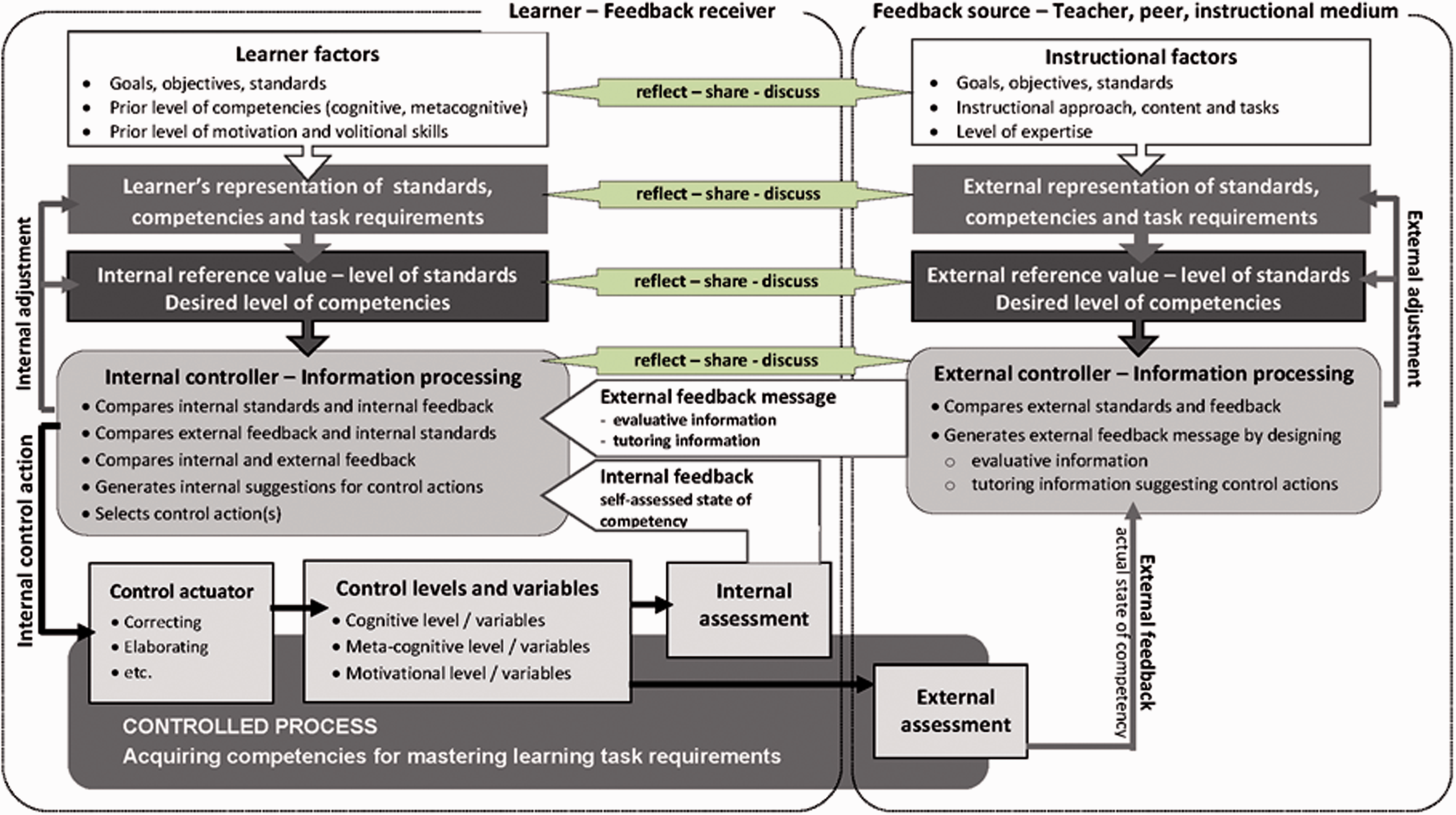
Interactive Tutoring Feedback-Model (cf. Narciss, 2017, p. 177).
These theoretical considerations led to the assumption that researchers and teachers have to take into account at least three sets of conditions for the design and evaluation of feedback strategies: firstly, the quality of the feedback strategy (e.g., scope, nature, and structure of the information provided and form of presentation); secondly, individual learning conditions (e.g., prior knowledge or level of competencies, meta-cognitive strategies, motivational dispositions and strategies), and thirdly, situational conditions of the instructional setting (e.g., instructional goals, educational standards and competencies, learning content and tasks).
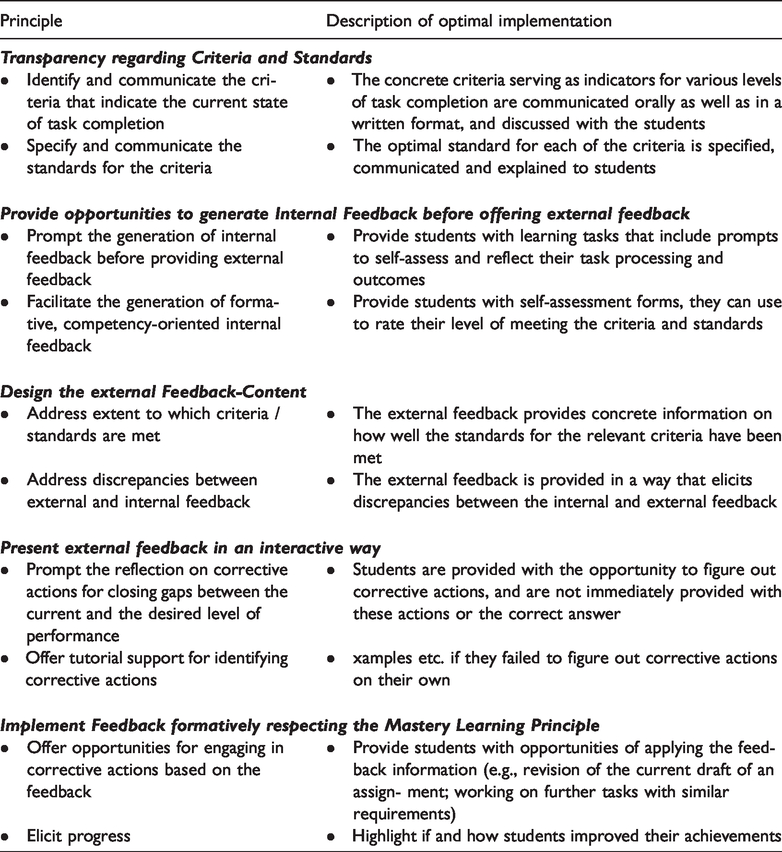
According to the ITF-Model, good feedback strategies should empower students to become self-regulated and productive lifelong learners. In order to do so, they should be interactive rather than just transmitting some kind of evaluative external feedback. Furthermore, they need to be designed according to the principles described in Table 1.
Principles for Designing Feedback Strategies Derived from the ITF-Model (Narciss, 2017).
Design of the Seminar Concept and Material
The instructional design of the treatment course was inspired by several lines of teacher education research including: (a) frameworks on effective professional development of (prospective) teachers (Desimone, 2009); (b) work on case-based learning with text or video material (e.g., Kramer et al., 2020); (c) work on case-based learning with own versus external (video) cases (e.g. Seidel et al., 2011); (d) work on using video for pre-service teacher education (Blomberg, Renkl, Gamoran, Borko, & Seidel, 2013); and (e) work on on-campus micro-teaching (e.g., Amobi & Irwin, 2009). Table 1 provides an overview of how we combined components targeting the acquisition and elaboration of pedagogical content knowledge with components targeting reflective competencies, and the integration and transfer of the pedagogical content knowledge.
Goals and Study Objectives
Developing professional expertise as a teacher requires, on the one hand, acquiring conceptual knowledge that is grounded in theoretical as well as empirical evidence. On the other hand, it requires gaining experiences in applying this knowledge to instructional contexts (Elvira et al., 2017). Thus, the main goals of the seminar were to foster the acquisition and elaboration of: (a) knowledge on formative assessment and feedback strategies; and (b) competencies in designing, implementing, and reflecting formative feedback strategies. More specifically, and in terms of the European Qualification Framework for the Higher Education Area, the seminar should qualify students: (a) to demonstrate knowledge and conceptual understanding on current theoretical frameworks of formative assessment and feedback; (b) to apply their knowledge and understanding on formative assessment and feedback to a reflected analysis of typical feedback scenarios in school contexts; (c) to communicate clearly the reflections and conclusions concerning the feedback scenarios, the knowledge and a scientifically grounded rationale underpinning these; and (d) to integrate and apply their knowledge on formative assessment and feedback when designing, implementing, and reflecting feedback strategies for instructional contexts.
Content, Instructional Material, and Structure
The seminar was conceptualized for a regular semester with 12–14 weeks. It included a knowledge acquisition and elaboration phase (5 units of 90 min.), and 2 knowledge integration and transfer phases (7 units of 90 min.). Table 2 provides an overview with further details.
Overview of Course Structure, Goals, Content, Material, and Activities.
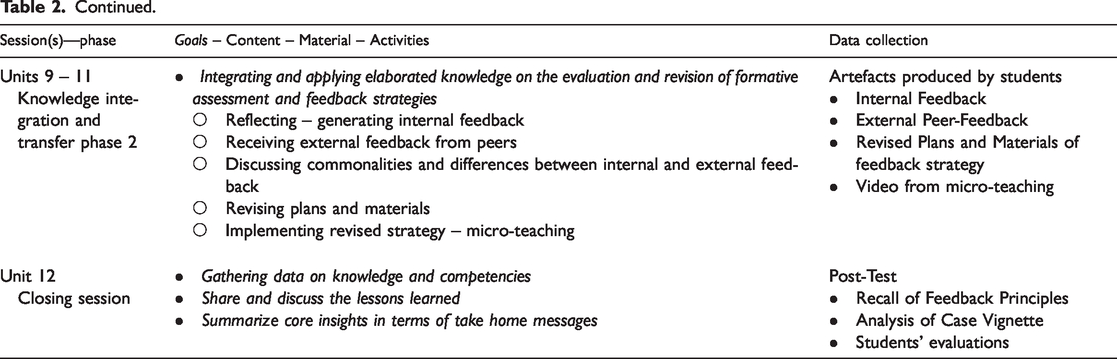
In the knowledge acquisition phase, students studied and discussed core scientific texts on formative assessment and feedback. Furthermore, they were asked to compare and contrast selected typical to best-practice examples of: (a) formative feedback and assessment instruments; and (b) competency evaluation rating forms. Additionally, to offer students opportunities to reflect on and elaborate their knowledge on the ITF principles, we developed vignettes describing typical instructional scenarios in which a teacher is providing feedback on (either) an oral or a written student assignment. The teachers’ behaviors in these vignettes met some of the feedback principles derived from the ITF-Model but not others. The vignettes served as material for case-based reflections and elaboration of empirically based principles for the design of formative feedback strategies.
The first knowledge integration and transfer phase (4 units of 90 min.) consisted of planning and designing a formative feedback strategy for a typical oral or written student assignment in a self-selected classroom scenario. Furthermore, students were required to implement the strategy within a micro-teaching section, in which their peer students played the roles of the learners. The second knowledge integration and transfer phase (3 units of 90 min.) comprised the reflection of the micro-teaching experience, based on internal (i.e., self-assessment) and external feedback (peer and teacher feedback), the revision of the feedback strategy, as well as the implementation of the revised strategy within a second micro-teaching section.
The opening and closing sessions started with a period for collecting the pre- and post-test data. Furthermore, they served for providing an organizational frame for sharing goals, and reflecting on the current level of knowledge and competencies concerning the core principles of formative assessment and feedback.
Evaluation of the Seminar
The benefits and constraints of this course concept have been piloted with several groups of teacher students (e.g., Höppner et al., 2019). The findings of these pilots have been used to iteratively optimize the seminar components and structure. The final version of the seminar is described in Table 2.
Participants
The effects of the optimized version of the seminar on students’ knowledge and competency gains have been explored with a pre-test–post-test design within several seminar groups of the teacher education program at a large German university. Over all groups, 87 teacher education students participated in the pre- and post-tests of the study. They were all participants of the advanced psychology module, which can only be attended after successful participation in two introductory lectures for the basic psychology module. Since the study was run in the field (that is, in regular seminar groups), we had to respect that students did not want to provide demographic data that would potentially allow identification of individual cases. Thus, we can provide only approximate demographic information. In each group there were more females (ca. 80%), and the students’ ages ranged from 22 to 26.
Design and Procedure
Data were collected in five seminar groups. The first group was provided with the program described in Table 2 over a semester with 12 sessions of 90 minutes each (formative assessment and feedback with micro-teaching—semester; n = 13; treatment time 15 h). The second group was provided with the program described in Table 1, but due to organizational constraints the 12 sessions were provided block-wise over an intensive course lasting 3 days with 6 hours per day (formative assessment and feedback with micro-teaching—block; n = 25; treatment time 15 h). These two groups are referred to as the ITF-treatment groups hereafter. Students of the third group were participants in a regular seminar on formative assessment and feedback that included most parts of the knowledge and acquisition phase described in Table 2, but not the parts of the two knowledge integration and transfer phases (seminar on formative assessment and feedback; n = 11; 9 h). Students of the fourth group were participants in a seminar on motivation that included one session on formative feedback (seminar on motivation; n = 18; 90 min.). In order to reduce potential teacher effects, this session on formative feedback was taught by the same teacher as in the third group. Finally, a course focusing on psychological issues related to students with special needs served as the control condition, because this course did not include any instructional input on formative feedback (control, n = 20). In all non-treatment groups, the pre-test data were gathered in the first sessions of the courses and the post-test data six weeks later. In the ITF-treatment groups, the pre-test data were gathered before the opening session, and the post-test data in the closing session. In the blocked treatment version this meant that the post-test data were collected at the end of the third day, while there was a week in between the last session and the post-test for the semester-wise treatment group.
Measures and Data Analyses
Students’ perceptions of the seminars including the micro-teaching-components were gathered through a questionnaire addressing: (a) satisfaction with the content, organization, and methods of the training (12 items; e.g., “the seminar was interesting for me”; “the course material supported my understanding”; Cronbach’s alpha .78); (b) the perceived utility of the acquired knowledge and competencies for teachers (3 items; e.g., “I will be able to apply the knowledge I have acquired in this seminar to my future work as a teacher”; Cronbach’s alpha .72); and (c) the perceived knowledge and competency gain (13 items; e.g., “I can describe core principles of designing formative feedback”; “I can plan a feedback strategy for an instructional context”; Cronbach’s alpha .81). Students had to provide their responses to the questionnaire items on a rating scale ranging from 1 (do not agree) to 5 (totally agree). Furthermore, they were asked to state briefly which of the seminar components they considered beneficial for their professional development.
Students’ knowledge and competencies on formative feedback strategies were assessed in the pre- and post-test. The knowledge test consisted of a free recall task (i.e., describe the six most important formative feedback principles that can be derived from the ITF-Model; note that these principles have been explained and illustrated in the educational psychology lecture that is a mandatory prerequisite for joining the seminars). The competency test assessed students’ reflective and argumentative competencies. It provided a vignette that was designed in a similar way to the vignettes that served in the knowledge elaboration phase as a basis for reflecting and discussing issues on how to apply formative assessment and feedback principles. The pre-test vignette included a feedback scenario in which a teacher is providing feedback on an oral presentation in a geography lesson. Her feedback strategy includes communicating and discussing the standards for the oral presentation, a self-assessment phase, and an external oral feedback phase, in which she provides external oral feedback in a bilateral conversation with a student. The post-test vignette included a feedback scenario in which a teacher provides feedback on a written language assignment (writing a fairy-tale). His feedback strategy includes an individual feedback phase (providing written feedback with the help of rubrics), and an open plenary feedback phase in which he provides oral feedback to selected students. In both vignettes, half of the ITF principles were respected and half of them were ignored. Students had to answer seven case-based reflection and argumentation items (e.g., which feedback principle is not respected by the teacher in this phase of the scenario? Explain why it is not respected and what it would mean for the present phase to respect it). To analyze students’ responses to the pre- and post-test items we developed a coding scheme based on the formative feedback principles derived from the ITF-Model (Kleineberg, 2017; see also Table 1). Two independent raters coded the student responses with this scheme (interrater reliability κ = .95).
Results
Students’ Perceptions of the Formative Feedback Seminars with Micro-Teaching Phases
The questionnaire data of the two ITF-treatment groups show that students of both groups were highly satisfied with the content, organization, and methods of the seminars (meanblock = 4.49; SD =.35; meanweekly = 4.57; SD =.35). Furthermore, they considered the knowledge and competencies they had acquired through the seminar as highly relevant for their future professional life as a teacher (meanblock = 4.71; SD =.43; meanweekly= 4.79; SD =.26). Moreover, they had very positive perceptions of their knowledge and competency gains (meanblock = 4.27; SD =.53; meanweekly = 4.43; SD =.34).
The analyses of the open statements revealed that the students valued both the knowledge acquisition and elaboration components, as well as the knowledge integration and transfer phases. They particularly emphasized that they appreciated having the opportunity to apply the knowledge they have acquired in the first phase when planning, implementing, reflecting, and revising a concrete feedback strategy, as well as receiving and generating formative feedback on the micro-teaching units.
Students’ Gains in Knowledge and Competencies on Formative Assessment and Feedback
The analyses of the knowledge and case-based competency test responses revealed that students had a very low level of knowledge and competencies on formative feedback strategies in the pre-test even though they had attended an introductory lecture on educational psychology that included two sessions on concepts, models, and principles of formative feedback (see Table 3 for descriptive data).
Means and Standard Deviations of the Knowledge and Competence Scores from Pre-test (t1) and Post-test (t2) Obtained within the Five Study Conditions.
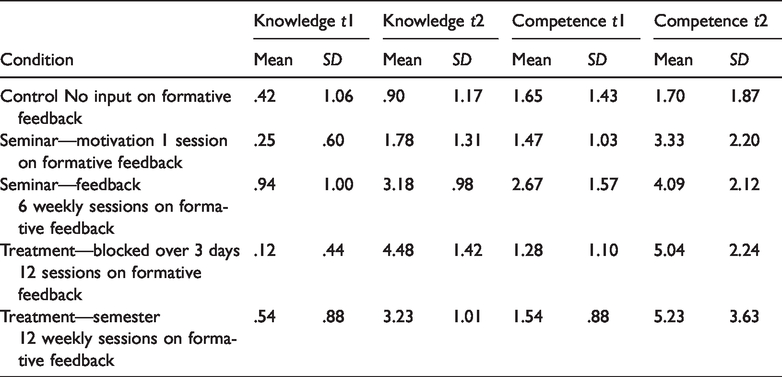
Yet the analyses also revealed a significant gain in knowledge and competencies from pre- to post-test (Wilks’ Lambda .25, F(2,81) = 123.94, p < .0001, eta2 = .75), and a significant multivariate interaction among condition and measurement time (Wilks’ Lambda .38, F(8,162) = 12.34, p < .0001, eta2 = .38).
Follow-up univariate tests and Dunnett’s post-hoc tests indicate that the increase in knowledge and competency vary significantly among the groups. Compared to the participants in the control group, the participants in the ITF-treatment groups, and the participants in the seminars including some instructional input on formative feedback, obtained significantly higher knowledge and competency scores in the post-test compared to the pre-test (Figure 2).
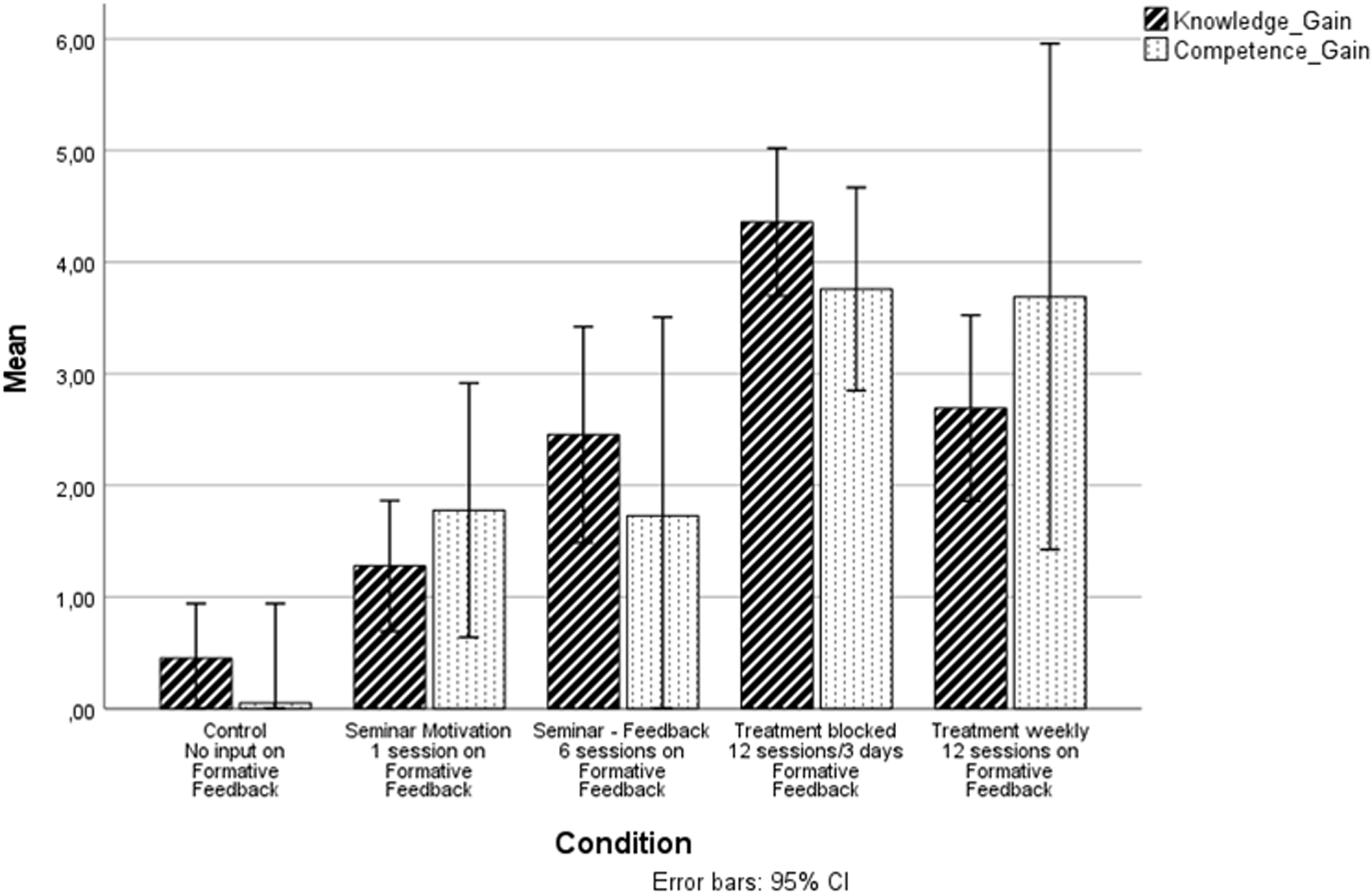
Mean knowledge and competence gains from pre- to post-test by study conditions.
The knowledge gain is significantly highest in the ITF-treatment group with the blocked condition, followed by the ITF-treatment group with the semester-wise condition, and the group attending the regular seminar on formative assessment and feedback. The motivation group, which had only one session on formative feedback, had a smaller knowledge gain than the treatment groups with 12 sessions on feedback (see also Table 4).
Post-hoc Comparisons and Effects Sizes for the Mean Differences of Knowledge and Competence Gains.

Regarding the differences in the competency gains, the post-hoc tests revealed that compared to the control group the two treatment groups achieved a significantly higher level of post-test competency, while the differences among the competency levels of the motivation as well as the feedback group and the control group was not statistically significant (Table 4).
Finally, it is worth noting that we found significantly positive correlations among the knowledge and competency scores of the pre- (r = .272) and post-test (r = .498), indicating that higher levels of declarative knowledge are associated with higher levels of (reflective, argumentative) competencies.
Discussion
Current insights on the role of formative assessment and feedback strategies for effective learning and instruction (e.g., Hattie, 2012; Narciss, 2017; Shute 2008) imply that future teachers should be able to effectively apply the theoretical and empirical insights on formative assessment and feedback strategies. To do so, they need to be provided with seminars or courses offering scientifically sound material to gain knowledge on these theoretical and empirical insights on the one hand and on the other hand opportunities to exercise the application of this knowledge. The major goals of the project presented in this paper were to develop, implement, evaluate, and iteratively optimize a seminar concept meeting the two requirements. This paper presents the final version of the seminar, and the findings of an exploratory evaluation study. As outlined in Table 2, the seminar included: (a) a knowledge acquisition and elaboration phase; and (b) two knowledge integration and application phases that required students to plan, design, and implement a formative feedback strategy for a typical oral or written student assignment, as well as to reflect and revise this feedback strategy using micro-teaching sessions. The evaluation study reveals the following findings concerning our research questions:
Knowledge: students who studied and discussed the core assumptions, insights and implications of the ITF-Model were significantly more able to recall and describe the ITF principles in the post-test than the students of the control group who were not provided with any input on formative assessment and feedback strategies. Yet the achieved level of knowledge differs among the groups: the motivation group, which had been working only one session with the ITF-model, had lower knowledge gains than the treatment groups and the regular formative assessment and feedback seminar group. The latter three groups had several sessions (5–6) to study and discuss in-depth scientific work on formative assessment and feedback, and elaborate on it with the help of case-based examples. However, the higher level of post-test knowledge of the treatment group which attended the block-wise seminar version might be explained by the timing of the post-test for this group: while all other groups had a week’s delay before the closing session with the post-test, there was no delay for the block-wise group (students had to complete the post-test in the last session of the third day).
Competency: the pattern of result for the competency gains elicits the benefits of providing students not only with a knowledge acquisition and elaboration phase, but also with knowledge integration and transfer phases which include instructional design tasks that require the reflected application of psychological knowledge to the analysis of external text-cases, and the creation, reflection and revision of own video-cases. The treatment groups achieved the highest scores in the competency test of the closing session.
Our findings are consistent with the findings of the training study of Schütze et al. (2017) who also found that participants of their formative feedback training did not only acquire declarative knowledge on formative feedback, but were also able to apply this knowledge in a feedback generation task, and in a case-based reflection task. Furthermore, they are in line with prior work that revealed that both text-based and video-based material are beneficial for fostering the acquisition of pedagogical content knowledge (e.g., Kramer et al., 2020). Moreover, our findings indicate that there can be an added value of developing and using own cases generated through micro-teaching experiences which confirms partly findings from studies on case-based learning with own versus external (video) cases (e.g., Seidel et al., 2011).
Limitations and Implications
The evaluation study was conducted in regular seminars in a preservice teacher education program at a large German university. This field context imposed several challenging constraints that led to several limitations which qualify the findings of the study. First, the treatment seminars were provided within a non-mandatory module, while all other seminar groups were part of a mandatory module within the psychology program for the teacher students. Despite the mandatory nature of the non-treatment seminars, the attendance policy that has been implemented after the Bologna Reforms allows students to be absent from sessions. This happens in particular at the end of the semester, and partly explains the low number of participants in each condition. Thus, we do not know to what extent selection biases and/or selective drop-out biases have contributed to the findings. The latter issue is particularly critical in the groups that ended up with small numbers of participants. Second, students of the control group were participants in seminars that had their focus on different psychological concepts and topics. Thus, they struggled with being asked to work on the pre-test-, and questioned in particular their participation in the post-test assignments. This may have influenced their motivation in responding mindfully to the post-test assignments. To disentangle potential motivation effects from the treatment effects, further studies should collect control variables on students’ motivation and commitment in responding mindfully. Third, the study included two ITF-treatment and three comparison groups, and the treatments of these groups varied in various aspects (e.g., blocked vs. distributed scheduling for the treatment groups; number of sessions related to formative feedback (0 – 1 – 6 – 12); timing of post-test for the blocked ITF-group). The various treatment differences and the small sample size make it very difficult to disentangle treatment effects from confounding effects resulting from the treatment variations, and/or inconsistent mortality effects. They have thus to be kept in mind when interpreting the data. Fourth, for organizational reasons, we used on-campus micro-teaching with peer students instead of micro-teaching with school students. Thus, it is an open issue for further research if and how actively participating in a seminar like the treatment seminars contributes to the acquisition and application of feedback competencies for more authentic school contexts.
Despite these limitations we consider that the findings of our study are promising enough to encourage further work on seminar concepts including theoretical and empirical insights on formative assessment and feedback, as well as training tasks requiring students to apply the knowledge to analyzing and discussing typical external text-cases, and/or creating, reflecting and revising own video-cases.
Footnotes
Acknowledgement
We would like to express our sincere gratitude to the editor Professor Joerg Zumbach as well as the anonymous reviewers for their critical reading of former versions of the manuscript and for providing us with valuable critiques and suggestions.
Declaration of conflicting interests
The author(s) declared no potential conflicts of interest with respect to the research, authorship, and/or publication of this article.
Funding
The author(s) disclosed receipt of the following financial support for the research, authorship, and/or publication of this article: The work in this paper has been partly supported by the “Qualitätsoffensive Lehrerbildung”, a joint initiative of the Federal Government and the Länder which aims to improve the quality of teacher training. The program is funded by the Federal Ministry of Education and Research (BMBF  ). The authors are responsible for the content of the publication.