




Abstract
This paper describes a model for the articulation and assessment of goals in the development and use of a general psychology custom textbook. A description of custom textbooks is presented, and the specific textbook that our Psychology Department has developed is discussed. Two studies present data on student and faculty perceptions of the effectiveness of the textbook. Study 1 involved faculty members who used the custom textbook, and Study 2 included students who were enrolled in General Psychology. For both studies, perceived benefits and drawbacks of the custom textbook were surveyed, as well as the helpfulness of its various components. Results revealed higher satisfaction with the custom textbook as compared to a traditional text, as well as consistency between faculty and students in the perceived helpfulness of different components of the text. Results also indicated that the original goals of the project were met. The benefits and drawbacks of using a custom text and the importance of having clear goals before beginning a customization project were discussed.
Introduction
Although traditional textbooks are heavily utilized in introductory courses in some countries such as the United States and Canada, these textbooks have several disadvantages such as a lack of flexibility of coverage, a fixed publication schedule, and cost. A custom textbook—an innovative product used to create specialized materials for a specific course—addresses these limitations (Romine & Banerjee, 2012). For the six largest publishers, custom textbooks made up 25% of the textbook market in 2014, and up to 40% of textbooks sold by some major publishers (Benson-Armer, Sarakatsannis, & Wee, 2014). Although custom textbooks are becoming more common, not all faculty are familiar with the product. The purpose of this report is to describe the concept of custom books, discuss the specific textbook that our Psychology Department has developed and used over the last 13 years, present data on student and faculty perceptions of the effectiveness of the textbook, and discuss advantages and disadvantages of a custom textbook.
What is a Custom Textbook?
A custom textbook is created by a publisher in coordination with a university department or faculty member(s) and includes information such as publisher-owned materials, original department or faculty content, and third-party resources (Higher Education and Opportunity Act, 2008). To begin the process, a standard textbook can be selected and then modified, or parts of several textbooks and/or readings can be combined to create a text. Chapters (or parts of chapters) can be deleted, allowing students to purchase only needed materials. Additional publisher-owned materials (e.g. statistics appendix), and department/faculty generated materials (i.e. experiential learning activities) can be added. Material from third-party sources such as articles from professional journals also can be included, and it is the publisher’s responsibility to obtain permission to use the third-party material. The cost of the permission to use third-party material, if any, varies and would be built into the price of the textbook. Faculty then make decisions about the format of the textbook such as loose leaf, soft cover, color or black/white print, and cover design. Pricing and access to online activities and e-books can be negotiated. Lastly, if desired, a royalty can be generated.
The Customization Process: Meeting Goals
The most important factor in determining the need for a custom textbook is to determine which goals (if any) the current teaching materials are not meeting. These goals are then crucial in assessing the success of a project (Chen, 2005) and in guiding the customization process. The goals articulate the reasons for customizing, identify the outcomes that should be achieved, set priorities (e.g. price), dictate what types of materials should be included, and determine the degree of customization that is necessary. Clearly articulated goals at the beginning of the project enable better communication of the project’s needs, help faculty and administrators understand the benefits of the project, and help publishers provide the desired product.
Our department has 13 years of experience customizing our General Psychology textbook. For many years we worked with one publisher. We have recently switched to a different textbook and, thus, have been working with a different publisher. In designing our custom textbook, the following goals were identified and guided our decisions: provide a more stimulating and engaging course experience for students (student enrichment), lower cost of the textbook, provide revenue for student enhancement outside of the classroom, and meet university requirements for General Education designation. First, a comprehensive textbook at the desired reading level with appropriate coverage of the topics was selected. The textbook was then edited as described below to achieve our four goals.
Student enrichment goal
Common student complaints are that textbooks are not helpful for the course (Marek & Christopher, 2011), and money is spent on materials that are not used (Martin, Belikov, Hilton, Wiley, & Fischer, 2017). Thus, based on faculty consensus and American Psychological Association (APA) guidelines for undergraduate programs (American Psychological Association, 2013), content not covered in the course was removed in the early editions of the custom text (in the current edition, all content is included). Additionally, publisher-owned material was added (i.e. appendices on study skills and statistics). The following course-specific information was included: (a) information about the research requirement, (b) descriptions of faculty research, (c) a list of psychology faculty and their research interests, and (d) information about the General Education requirement. To create a more engaging course experience and increase active learning and critical thinking, a handout section, which now consists of 53 pages of activities and exercises, was developed by the faculty and incorporated into the text. The handouts were developed specifically to target concepts our students have traditionally found difficult, as well as topics important for General Education designation (e.g. ethics, critical thinking). Included were activities such as identifying problems in a poorly designed study and suggesting improvements, deciding whether a study is ethical or not, identifying elements of classical and operant conditioning, and determining if a study is a correlational or experimental design. These handouts are used as graded and non-graded in-class assignments and/or for graded homework. The extra materials also benefited faculty by providing easy access to the supplements and enabling all students to have copies of the required information.
Cost reduction goal
New textbook prices have gone up 88% from 2006 to 2016 (Bureau of Labor Statistics, 2016). Therefore, cost was a major concern in the development of the custom textbook. Further, even with new digital offerings, research indicates that, when costs across media are equivalent, students prefer reading in-print (Baron, Calixte, & Havewala, 2017). The format of our custom textbook is print and loose leaf to facilitate the use of the handouts incorporated into the text. Because of the loose-leaf format, students cannot sell the textbook back and buying it used can cause difficulties if materials are missing. Thus, a cost analysis was performed to determine the price level that would keep the cost of the custom text at or below the cost of a printed traditional textbook over a typical 3-year publication cycle. In this calculation, it was assumed that, in the first semester the book was published, the cost to the student would be the cost of the new textbook minus the money the student would receive if the book was sold back (sell back). After the first semester, we calculated cost to student as the difference between buying a used book and the sell-back price of the used text. The last semester before a new edition, the cost to student would be the cost of a used book with no sell back (our bookstore would not buy back a used book if a new edition would be used the next semester). The costs to students were then averaged over the 3-year publication cycle. This price level and any potential price increases were then part of the negotiation process with the textbook publisher. As an additional part of the negotiation process, online axillaries that generally would involve an extra fee were provided free to the students.
Our current custom textbook is a full color, illustrated text, which includes all of the chapters in the traditional textbook, plus a chapter on study skills and a chapter on industrial/organizational psychology. Because of the high level of enrollment in our General Psychology courses, the cost of the custom bundle (which includes a print custom textbook, the e-book, and online study resources) is equivalent to the cost of the digital version of the traditional textbook and online resources.
Revenue for enhancement goal
The development of the textbook required large amounts of department resources including faculty and student time. In addition, due to the need to update information, the customization process is not a one-time event. To off-set these costs, a royalty was paid to our department. Royalties on custom textbooks typically range from $1.00 to $2.00 per book depending on the level of customization (S. Bunton, personal communication, January 11, 2019). There have been criticisms regarding the payment of royalties from the sale of custom textbooks (Hechinger, 2008); therefore, it was important to explore the use of royalties in this project. A goal—that our department had previously been unable to meet due to budget constraints—was to provide outside class opportunities for our students. Thus, all royalties that have been generated by the custom textbook have been used to provide experiences such as General Psychology peer tutors, students’ travel to conferences, support of undergraduate student research, and support of student-oriented on-campus conferences.
General education goal
As at many colleges and universities in the United States, our General Psychology course helps fulfill a General Education requirement. Because it is important for the department that General Psychology continues to qualify for this designation, the General Education requirements were incorporated into the textbook.
Research on Effectiveness
The few published studies addressing the effectiveness of custom textbooks generally suggest positive effects (e.g. Baker-Eveleth, Miller, & Tucker, 2011; Massey & Van Hise, 2003; Speckler, 2008), but not in all cases (see Brown & Simpson, 2012). The two studies reported below utilized a novel goal-based model to determine the effectiveness of our custom textbook. The redesign of the custom textbook (which the current studies are based upon) occurred in 2013 and utilized the Bernstein textbook (2014).
Study 1: Faculty Perceptions
Method
Participants
The participants were eight General Psychology instructors at a midsize public university in the United States. Faculty who used the textbook over several semesters, but who were not heavily involved in the creation of the custom textbook, were surveyed. All faculty were experienced instructors of General Psychology and had used both traditional textbooks and the custom textbook in teaching the course. Class size was between 50 to 150 students for 75% of the faculty. Because of the small number of participants, informed consent was indicated by checking a box on the informed consent document and returning the form.
Measures and procedure
As part of a larger survey, questions were included to determine instructors’ perceptions of the custom textbook. In part 1, instructors rank ordered seven potential benefits of the custom textbook from 1 (most beneficial) to 7 (least beneficial). In part 2, using Likert-scale ratings from 1 (strongly disagree) to 5 (strongly agree), faculty rated the perceived benefits to the
Results and Discussion
Rank ordering of benefits
Mean rank orders were calculated for the seven items with 1 being most beneficial and 7 being least beneficial. The reduced cost to the student was perceived as the biggest benefit (M = 1.38, SD = 0.52) followed by the handouts (critical thinking activities), (M = 3.25, SD = 1.58). The deletion of information not covered in the course (M = 3.38, SD = 1.77) and the description of the research participation requirement (M = 3.75, SD = 1.49) also were rated as important. Rated as somewhat less beneficial were the description of the General Education requirement (M = 5.25, SD = 2.12) and the descriptions of department faculty research (M = 5.38, SD = 1.69). The list of faculty interests was viewed as the least beneficial (M = 5.88, SD = 1.25).
Perceived benefits for the students
Most faculty agreed or strongly agreed that the custom textbook benefited the students’ course experience (75%), improved understanding of information (88%), and importantly, benefited student performance (75%) when compared to a traditional textbook. Most faculty also believed the custom text was reasonably priced compared to a traditional text (63%).
Perceived satisfaction and benefits for faculty
Satisfaction with the custom textbook was high (100%). Most faculty indicated that they found the custom textbook to be more useful (88%) and preferred a custom textbook (75%) compared to a standard version. Half (50%) of the faculty believed the handouts and extra customized information enhanced instruction, and most believed that the accessibility of the handouts made it more likely they would use the activities (88%).
Use of royalties
The seven participants who answered the question about satisfaction with the use of the royalties (to support student enrichment opportunities) were satisfied.
Study 2: Student Perceptions
Method
Participants
Recruited from a psychology research pool at the same university as Study 1, participants were 105 undergraduate students (50 men and 55 women), all of whom were enrolled in a General Psychology class. Additionally, 60% self-identified as Caucasian, 29% as African American, and 11% as being of other ethnic backgrounds. Participants received either course or research credit for their participation. Written consent for participation was obtained.
Measures and procedure
As part of a larger survey, students used a Likert scale with ratings from 1 (strongly disagree) to 5 (strongly agree) to answer questions about the following: (a) students’ satisfaction with the custom textbook, (b) students’ perceptions of the custom textbook compared to a traditional textbook (students were asked to compare the custom textbook to standard textbooks used in their other classes), (c) students’ perceptions of the specific customized parts of the textbook, and (d) how well the course meets the General Education requirements. The Likert-scale items included the option (6) of Not Applicable (did not use the textbook/was not assigned/did not read). As with Study 1, the 5-point Likert scales described above were collapsed into three categories (strongly agree/agree, neutral, and disagree/strongly disagree). Reponses of “6” were not included in the analyses. Students also were asked open-ended questions about the benefits and drawbacks of the custom textbook and a forced-choice question asking students their preference for a custom textbook with no sell back (listing the price) or a soft-bound traditional textbook with a sell back (both price and sell back amount listed). In small groups, participants completed the anonymous surveys individually.
Results and Discussion
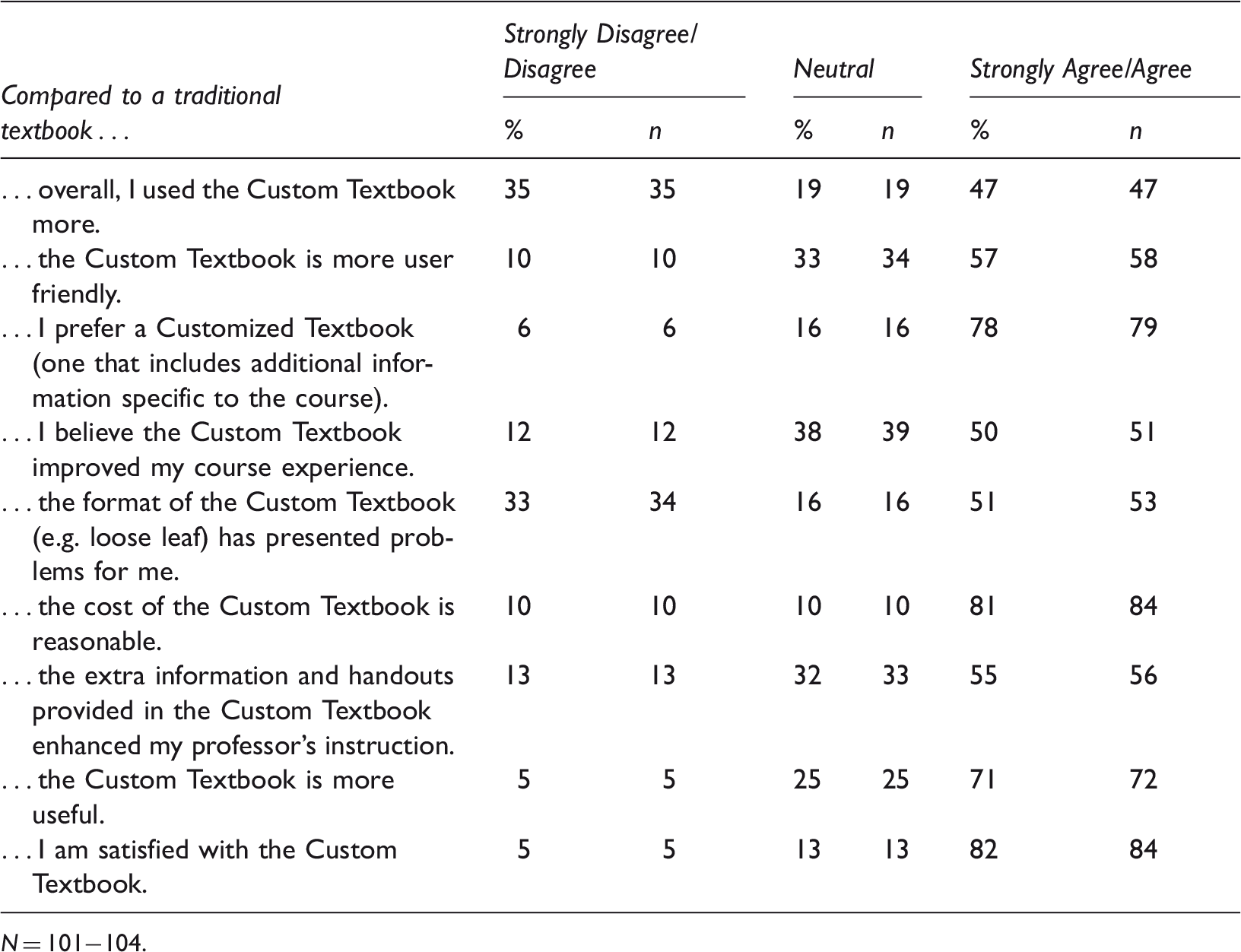
Students’ satisfaction with the custom textbook and comparisons to a traditional textbook
Comparison of Custom to Traditional Textbook: Students’ Perceptions
N = 101−104.
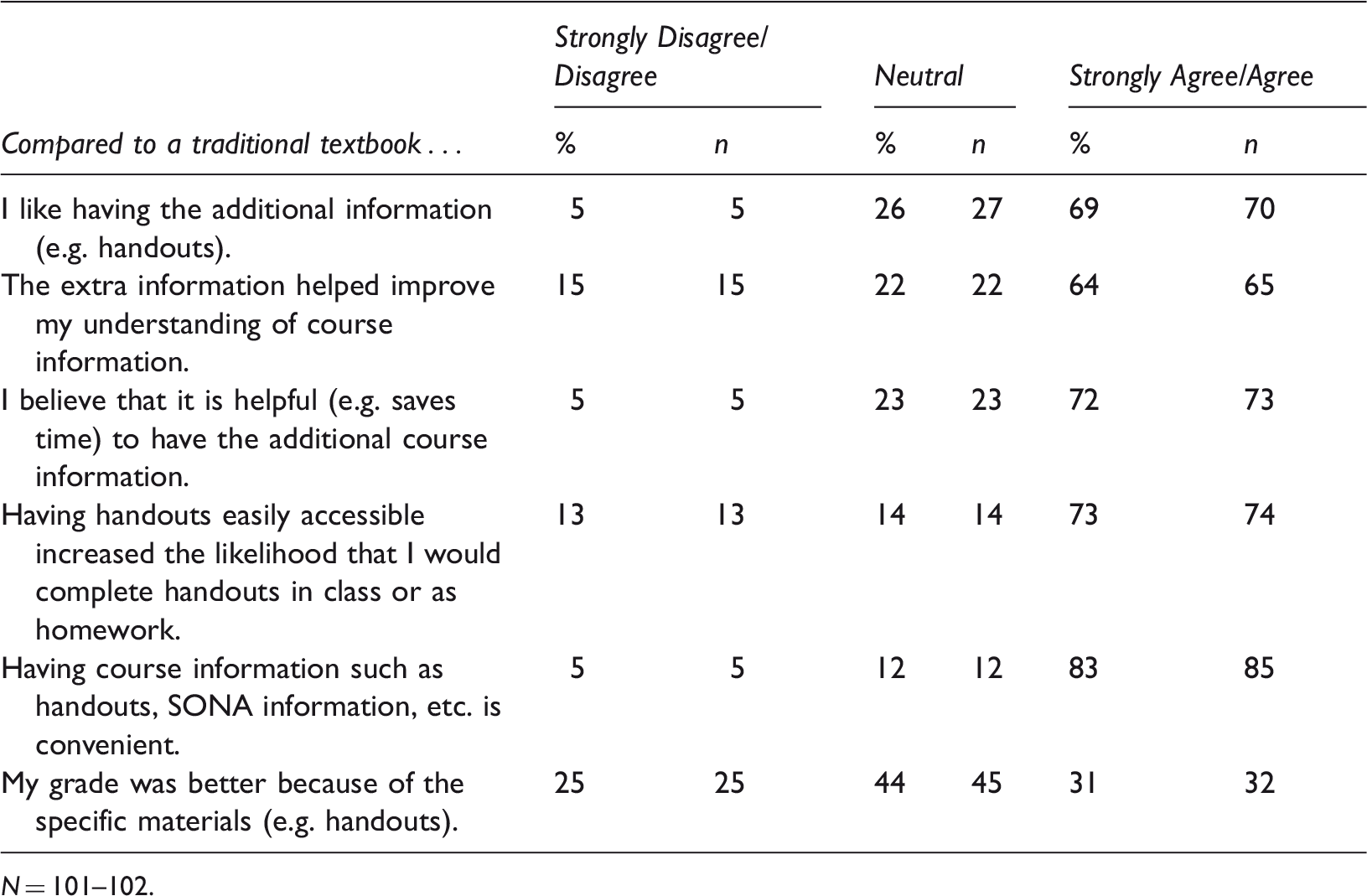
Students’ perceptions of specific additional materials
Students Perception of Additional Material
N = 101–102.
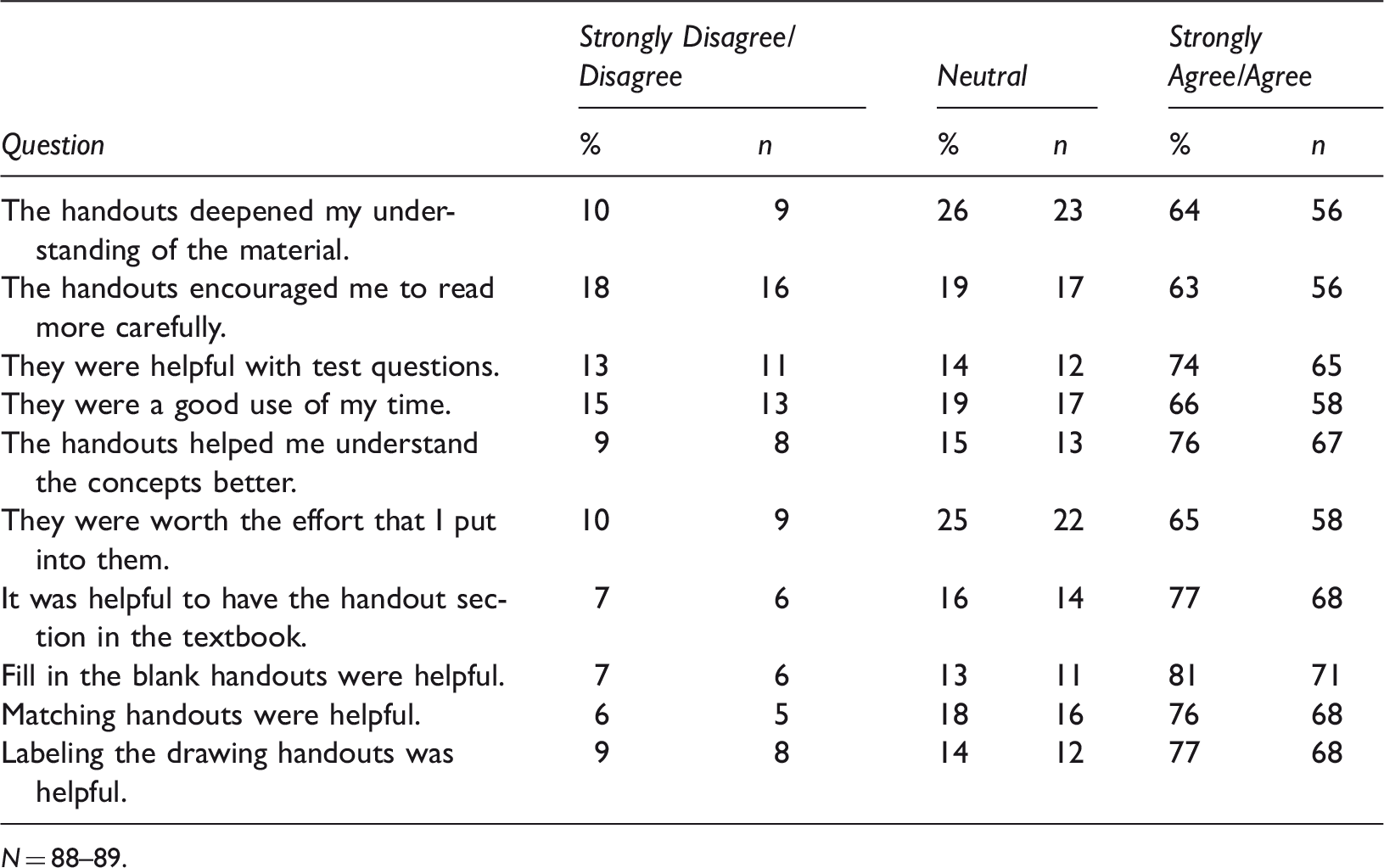
Students’ Perception of Handouts
N = 88–89.
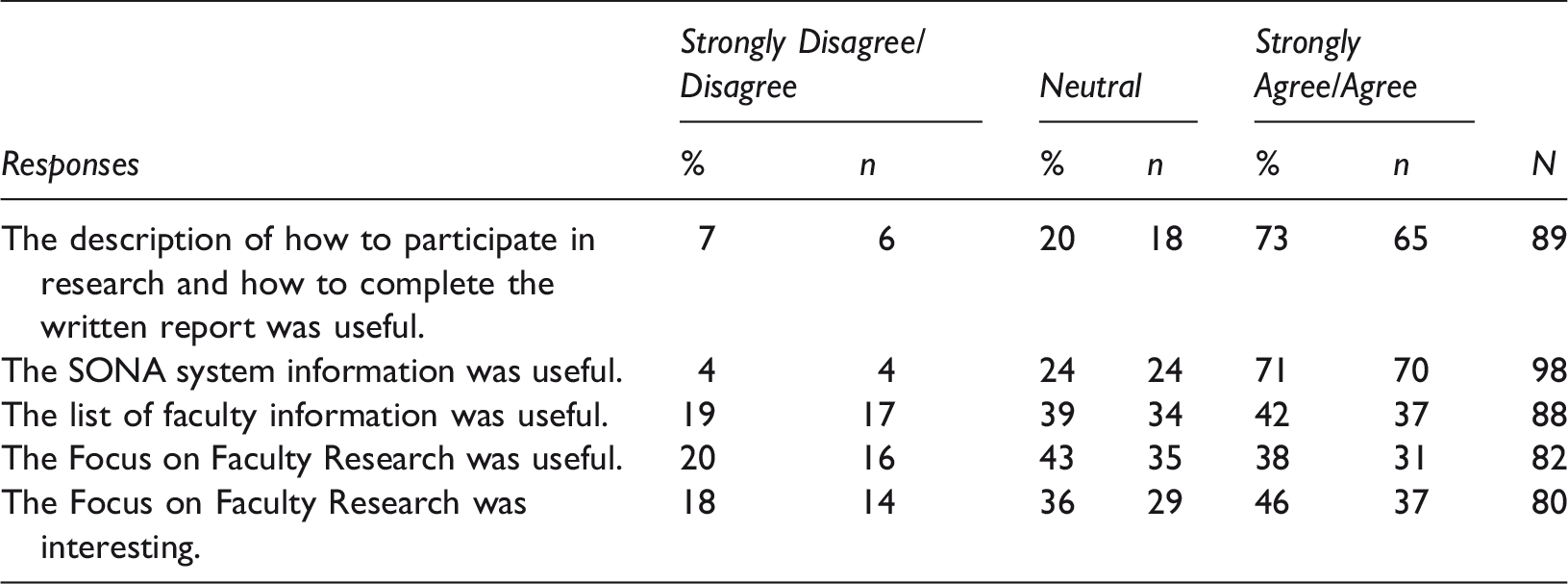
Students’ Perceptions of Specific Additional Information
Meeting General Education requirements
Most students (between 63% and 83%) agreed/strongly agreed that the course was meeting the seven General Education requirements.
Open-ended questions: Benefits and drawbacks
Categories were developed based on the student written responses. Two undergraduate students (who were not involved in the development of the categories) placed the responses into the categories. Discrepancies were resolved by a team discussion. The participants believed that having the handouts in the textbook was the biggest benefit of the custom textbook (28% of the 121 responses) followed by the customized material included in the text (16%), and then lower cost (13%). The students viewed the biggest drawback of the custom textbook to be the loose-leaf format (42% of the 99 comments). The inability to sell the textbook back was mentioned in 10% of comments, and 3% mentioned the cost of the textbook.
Purchase preference
Students’ responses to the forced-choice question comparing their preference for purchasing a custom textbook or a soft-bound traditional textbook indicated that 75% would prefer to buy the custom textbook.
Discussion
Meeting Goals
Evidence from both studies indicates that the goal of student enrichment was achieved. Both students and faculty believed that the custom textbook enhanced learning with almost 1/3 of students believing the custom textbook improved their grades. From both a faculty and student perspective, the additional material that directly addressed the course (e.g. handouts) was perceived as the most beneficial. Because of the addition of the handouts section, our course has become more interactive and more focused on critical thinking.
The goal to reduce cost also was achieved. Faculty viewed the reduction in cost as the number one benefit of the custom book. Importantly, the majority of students also viewed the book as reasonably priced. Further, in a forced-choice format, students indicated that they preferred to buy loose-leaf custom texts over soft-cover traditional textbooks.
All of the royalty from the custom textbook was used to enrich student learning outside of the classroom. The revenue being used in this manner reduced ethical concerns (Hechinger, 2008) about the generation of royalties. It also provided a method for the department to justify the use of student assistant and faculty time to develop this project. Additionally, faculty were satisfied with how the royalty was spent.
Lastly, the customization of the textbook was a crucial factor in successfully recertifying the course as a General Education requirement. Importantly, most students agreed that the course met the seven requirements for General Education designation.
Drawbacks of a Custom Textbook
As shown in the research above, some students found the loose-leaf format problematic (possibly because pages get lost or out of order, or students may view the loose-leaf format as an impediment to reselling the text). Additionally, since the start of this customization process, more options (e.g. e-books, rentals) have emerged in the textbook market (Senack, 2014). The use of a custom textbook may preclude some of those options and, thus, result in higher cost to students who prefer these alternatives. In our experience, placing a custom textbook on reserve in the library allows students who choose other options to still have access to the custom materials. For example, a student may rent a traditional textbook and then copy the custom materials, such as the handouts from the library copy. Further, as mentioned earlier, we have been able to negotiate bundle pricing comparable to the e-book alone.
A recent development in the textbook market has been the emergence of Open Educational Resources (OER), which are free online to the student. There is research supporting the use of OER textbooks (Clinton, 2018; Hilton, 2016); however, the findings of studies focused specifically on General Psychology OER products compared to traditional textbooks have been mixed regarding student outcomes (Clinton, in press) and quality (Clinton, in press; Griggs & Jackson, 2017). In our most recent customization cycle, we considered the OER option. After reviewing the products, our faculty believed that, for our purposes, the custom textbook option offered a more comprehensive product, allowed a more seamless integration of our department designed materials, and offered superior online support ancillaries for faculty and students. In addition, it was important for us to consider the electronic nature of the OER product and how our students would be utilizing the textbook in our course. Thus, one of the most important benefits of the custom text compared to the OER product was that the hard copy format of the custom text facilitated the in-class active learning components (students needed printed copies of the handouts and, in some cases, the chapters to complete the in-class assignments). Also, we teach at a large diverse university and many of our students do not have consistent access to computers and the internet when they are off campus or lap top computers when they are in class. Those who prefer or need a print version of OER textbooks would incur an additional printing cost. As OER resources evolve, we will be reassessing this product.
One of the major drawbacks of producing a custom textbook is the time and commitment from faculty needed to develop the course-specific materials. Although some custom textbooks have been criticized because they do not vary much from the original/standard text (Hechinger, 2008), we believe that to justify the use of a custom textbook, it should be designed to genuinely enhance the student’s classroom experience.
Benefits of a Custom Textbook
The biggest advantage of a custom textbook is that it can be designed to meet specific goals not being met by current teaching methods. As described above, students and faculty preferred the custom textbook to a standard version and believed that the custom materials improved class performance and instruction. The ability to add our own critical thinking activities and the fact that every student has copies of the handouts as part of the textbook has been very beneficial and has allowed the course to become more interactive. Unfortunately, we were unable to investigate the impact on actual student grades because at the time the custom textbook was adopted, there were university changes that confounded any grade and retention comparisons between pre- and post-customization.
Negotiating a lower cost of the package and much lower price increases over time is another benefit. Many students prefer to read print (Baron et al., 2017), and a print version also helps those students without consistent internet access. Customizing is a cost-efficient way to allow students access to both the print and e-book versions.
The custom textbook option also is very flexible. As mentioned previously, in the United States, introductory courses often rely heavily on textbook material. With a custom product, however, faculty can adjust the content to any teaching approach. For example, a custom product could contain research or theoretical articles, the professor’s notes, publisher or faculty generated homework/activities—in other words, any materials that would facilitate learning. A custom product also could be used to enhance other offerings such as OER. Lastly, the custom textbook does not need to be on the adoption schedule of a standard textbook and can be revised only when needed.
Conclusion
If designed properly, a custom textbook can be an innovative and beneficial addition to a course. Although custom textbooks can vary greatly, their content can be guided by formal guidelines, such as those from APA (2013), to maintain consistency. The key component of the customization process is the use of a goal-based approach to determine if customization of the textbook will benefit the course, to then drive the customization process, and to guide the evaluation of the custom textbook product.
Footnotes
Declaration of Conflicting Interests
The author(s) declared no potential conflicts of interest with respect to the research, authorship, and/or publication of this article.
Funding
The author(s) received no financial support for the research, authorship, and/or publication of this article.