



Abstract
The concept of “non-disposable assignments” (NDAs), including those referred to as “renewable assignments,” has grown in popularity in recent years in select education circles, particularly alongside an enthusiastic push toward open pedagogy. Unfortunately, little organized literature exists to effectively define, implement, and empirically evaluate what is ultimately an age-old though infrequently applied practice of assigning students a learning activity that provides impact or value outside the traditional student–teacher dyad. In contrast to the often-detested “disposable assignment,” NDAs can be defined by their openness and, accordingly, their ability to reach others, even beyond classroom boundaries. It is this very characteristic that likely underlies anecdotal reports of NDAs’ success at promoting student excitement, engagement, productivity, and achievement. In this report, we briefly review supporting rationale and guides for the implementation and innovative applications of these utilities of open pedagogical practice. Further, we provide a framework for conceptualizing NDAs wherein the openness of assignments can be viewed to influence others across three key dimensions: time, space, and impact/value, or “gravity.” This model is further exemplified through a succinct review of representative NDAs applied at our own institution. Based on this framework, we endeavor to promote a launching ground for empirical research focused on effective practices and learning outcomes for NDAs and, accordingly, support for open pedagogy. Together, the current model and research strategy presents a path for future integration of NDAs in the individual instructor’s open-education toolkit to benefit innovation in the classroom for students and humankind.
Keywords
Introduction
Practical application and subsequent evaluation of “non-disposable assignments” (NDAs) has grown in popularity in recent years, predominantly via shared anecdotes and pedagogy blog posts (For example, Jhangiani, 2015). Discussion of NDAs has coincided with the surge of open pedagogy and the often-synonymous, though at times, distinct (Cronin, 2017; Wiley and Hilton, 2018) open educational practices (OEPs), as well as the production of open educational resources (OER). Although frequently considered to be a concept inclusive of or at least relevant to open pedagogy, little organized literature exists to effectively define, implement, and, accordingly, empirically evaluate the use of NDAs (Cronin, 2017).
NDAs are best conceptualized in their juxtaposition to “disposable assignments,” which constitute the vast majority of student work prescribed in contemporary instructional settings and are typically the result of a student’s work being submitted to and thus shared with only the instructor for evaluation purposes (Jhangiani, 2015; Jhangiani, 2017). Despite their conventional popularity, disposable assignments “add no value to the world” and are complained about widely by both students and faculty (Wiley, 2013, para 4). For example, after a student spends hours of cognitive effort, a teacher may spend minutes grading an assignment that is eventually discarded. This loss, which could otherwise be utilized outside of the student–teacher dyad, has been estimated to exceed two billion hours of student work per semester (Wiley et al., 2017; Wiley & Hilton, 2018).
What: Defining and Situating NDAs in an Open Pedagogy Movement
What if we changed these ‘disposable assignments’ into activities which actually added value to the world? Then students and faculty might feel different about the time and effort they invested in them (Wiley, 2013, para 4).
Since Wiley’s call for such assignments in today’s movement toward a more open pedagogical environment, many definitions for NDAs (as well as alternative terms) have been provided or implied. At its most basic level, an NDA could be considered any assigned task that adds value to the world. More restrictive definitions hold that an NDA ought to produce a resource that is openly published so that others can find, use, and if desired, repurpose or update the work (Jhangiani, 2015; Wiley, 2013; Wiley et al., 2017; Wiley & Hilton, 2018). Influence for these definitions, especially the latter, is no doubt a product of today’s open pedagogy movement, which, at its heart, promotes the use and creation of OER. In fact, the term “open pedagogy” itself is sometimes used synonymously with what could otherwise could be called “NDAs.” For instance, a recent report repeatedly referred to “Open Pedagogy assignments” before later calling them “NDAs” (Bonica et al., 2018). It is noteworthy that recently, Wiley and Hilton (2018) differentiated “disposable assignments” from three other categories that arguably progress in their degrees of value and openness, including “authentic,” “constructionist,” and “renewable.” These latter three could conceivably be combined into one category (i.e., “NDAs”).
For our purposes, NDAs will henceforth be defined as any activity that: (a) students are asked to engage in as part of an organized course; (b) promotes student learning through the completion of the assignment; (c) affords assessment of students’ learning of course objectives; and (d) provides impact or value outside of the traditional student–teacher dyad. Further, in the context of this discussion, we conceptualize this final component as being fundamentally open, and thus as a type of OEP. According to Conole (2013), the Five Principles of OEP include information collaboration and exchange, communication throughout the education process, the communal assembly of information resources, scholarly advancement through cooperative critique, and chance innovation (Ehlers, 2011; Hegarty, 2015).
We view NDAs as adhering to most, if not all, of these Five Principles:
NDAs fundamentally involve information collaboration and exchange. As forms of responsive and responsible pedagogy, NDAs involve communication throughout the education process, that is, opportunities for revision, creativity, modifying key terms and objectives, etc. While the communal assembly of information resources is an OEP principle, we suggest that although NDAs might not necessarily involve communal assembly, the resulting product or practice must always be shared outside the teacher–student dyad, creating opportunities for communal access of the NDA as an information resource. Further, we have trouble envisioning how a good NDA would be produced in isolation; in other words, communality is a quality of good NDAs, if not a fundamental characteristic. As with Principle 2, NDAs produce learning through cooperative critique. Because they are not exams or isolated writing assignments, NDAs fore-ground chance innovation. Indeed, innovation is hard-wired into the concept of NDAs, which is to produce something novel, not replicate something within an existing framework.
We propose this broad definition of NDAs as the foundation of a provisional framework with which to think through the practical, conceptual, and empirical study and implementation of NDAs as OEPs. Accordingly, the categorization of “NDA” may include assignments ranging from a brief, in-class, discussion between two students to the creation and global sharing of new OER. Below, we offer a tripartite framework that involves the dimensions of gravity, time, and space as a normative typology with which to not only differentiate NDAs but to generate research questions about student learning, pedagogy effectiveness, and the development of new ways to engage non-disposability as a tool for open, critical, and inclusive learning. With this, we provide examples of NDAs used by the authors in undergraduate psychology classes taught at a large research institution, including our retrospective appraisals of where they might be situated within our proposed framework. By reviewing the application of these exemplars, we also aim to provide a launching pad for future empirical evaluation of NDAs.
Why: Defining the Need for NDA Course Implementation
While students often struggle to find the value in traditional disposable assignments (Jhangiani, 2015; Jhangiani, 2017), NDAs inject the elements of value, meaning, purpose, identity, competence, and autonomy into course activities (Wiley, 2013). Indeed, research conducted on NDA-like assignments demonstrates that these build intrinsic motivation and consistently promote self-directed productivity (Ariely, Kamenica, & Prelec, 2008; Chalofsky & Krishna, 2009; Pink, 2011). Cultivating intrinsic drives (Pink, 2011) through the production of work that is perceived to be meaningful and valuable may yield greater classroom achievement and learning productivity as well as enhanced well-being, among other self-reflective evaluations (Allan, Duffy, & Collisson, 2018; Ryan & Deci, 2000; Vansteenkiste, Simons, Lens, Sheldon, & Deci, 2004).
NDAs may also effectively build other valuable meta-skills, such as self-efficacy and self-regulated learning. Self-efficacy (Bandura, 1986) refers to beliefs in one’s ability to successfully complete a task. Van Dinther, Dochy, & Segers’ (2011) extensive meta-analysis of various assignments types, including NDAs, demonstrates that self-efficacy can be fostered in the classroom through the application of social cognitive theory. This promotes transactional and reciprocal interactions, as well as performance-based self-evaluation alongside so-called “social models” (e.g., vicarious experiences) and social persuasion (e.g., effective communication). The openness of NDAs, particularly when shared among peers and others (e.g., community stakeholders), likely promotes self-efficacy by fostering positive evaluation of students’ own experiences through the give-and-take of reciprocal evaluative feedback (Schunk, 1987, 1989).
Intrinsic motivation and self-efficacy are also closely tied to self-regulated learning (Bandura, 2002; Pintrich, 1999, 2000). Defined as the ability to assume responsibility for one’s development by self-directing one’s personal learning needs, self-regulated learning is critical for success in the classroom as well as in transitioning to the work force (Fontana, Milligan, Littlejohn, & Margaryan, 2015). NDAs can therefore stimulate and enhance self-regulated learning by simulating the processes by which students and future workers gain and manifest expertise, particularly with the benefit of instructional scaffolding.
Together, intrinsic motivation, self-regulated learning, and self-efficacy promote cognitive engagement and academic performance (Pintrich & de Groot, 1990). Furthermore, assignments promoting these aspects of agency not only support students’ potential for success and feelings of well-being in a variety of life situations but also impact the development of media literacy skills, where academic achievement and digital competency are becoming increasingly linked (Bandura, 1986; Terras, Ramsay, & Boyle, 2013). NDAs can therefore strengthen higher-order media literacy skills needed to push student learning horizons beyond the old limitations of time and space. Coupled with this is the documented, invaluable potential for NDAs to foster creativity (e.g., Jhangiani, 2015). Accordingly, creativity can be considered as an important component to produce diverse and heterogeneous learning/teaching activities. Undoubtedly, promoting and supporting diversity and inclusion fosters creativity, innovation, and success across innumerable mediums of time and space (Martins & Terblanche, 2003; McLeod, Lobel, & Cox Jr, 1996).
Even more generally, and perhaps more importantly, NDAs may level the playing field for students from systematically disadvantaged or socially marginalized groups. For instance, media-based NDAs may help instructors cultivate highly demanded skills (e.g., media literacy) that are often limited by relatively immutable characteristics, such as socioeconomic status (Hargittai & Walejko, 2008) and age (Terras et al., 2013). Further, NDAs can address these barriers in classrooms where media or digital technology is not the explicit focus. Moreover, some NDAs involve community interaction, encouraging students (and instructors) to share their work. Finally, NDAs have the capacity to fulfill the aims of critical pedagogical approaches, including critical race pedagogy (Lynn, 1999) and intersectional pedagogy (Case, 2017), by conceptualizing issues of human cultural differences and social inequalities in more radical terms than existing diversity paradigms typically accommodate (Ahmed, 2012; Grzanka, 2017). Critical pedagogical approaches involve interrogating and dismantling systems that perpetuate oppression and centering the experiences of those with historically marginalized identities. For example, rather than learning about members of marginalized groups by looking at others’ experiences, community-based, collaborative NDAs encourage students and faculty to examine their own identities and social locations to learn with and for members of multiply marginalized groups. Rather than simply diversify content or representation, critical NDAs potentially destabilize the foundational grammar and logic of normative pedagogies. Non-disposability lends itself especially well to community engagement that resists these transactional dynamics in which students simply “take” from community members without acting as partners in a mutually beneficial relationship. “Cultural tourism” models of service learning, for example, take presumably naive undergraduate students into the community and implicitly reinforce the town/gown binary by suggesting that (a) students (and faculty) should not actually conceptualize themselves as community members; and (b) students possess no knowledge, skills, or resources that could be brought to bear on problems facing communities. The opposing concern, that students may bring their “knowledge” without regard for the actual needs of the community, may also pose barriers to community engagement. NDAs—and thus OEP adoption—encourage instructors to consider how non-disposability may function as an ethics for community-engaged teaching by foregrounding the questions: How can my students’ learning meaningfully contribute to the community? How can learning experiences function as partnerships that last beyond the boundaries of a semester? Thus, behaviors contributing to positive citizenship or community engagement can be reinforced by providing students with a consistent civic context that includes support from one’s primary social system as well as values from one’s cultural background (Zaff, Malanchuk, & Eccles, 2008). As socializing agents that can advance civic identity development, NDAs may be usefully deployed as part of the consistent civic context provided by academic institutions.
How: Guidelines for Effective Implementation
Instructors seeking to adopt NDAs can facilitate the development of quality student-created learning objects by following conventional principles for enhanced student learning (e.g., backward course design; Wiggins & McTighe, 1998). For example, in his initial attempts to incorporate NDAs in undergraduate courses, Jhangiani (2015) began by encouraging projects aligned with program and course learning objectives. Instructors should also recognize needs for: extensive scaffolding (support) throughout the creation/execution of the NDA-derived product; developing a means for the internal vetting (i.e., quality control); and adopting grade-based incentives to facilitate the production of quality materials where applicable. By scaffolding stages of completion in NDAs, we train students’ metacognitive ability through approximating the three critical phases of self-regulation (Zimmerman, 1990; Zimmerman, 2002): forethought, performance, and self-reflection. For example, in addition to providing examples of NDAs that have been achieved through best practices, the instructor should scaffold skills needed in the assignment by requiring multiple drafts separated by peer-assessment and revision. This modeling allows students to exercise self-regulated learning as they work to keep pace with the course while being continually shaped by positive feedback from a community of knowledge creators.
Effective implementation of NDAs requires that instructors are also aware of the approach’s potential shortfalls. Some challenges and risks of NDAs include exposure, vulnerability, community resentment, and lack of student preparedness. To further facilitate the production of quality learning objects, the instructor must also consider factors influencing students’ self-motivation (e.g., intrinsic motivation, self-regulated learning, self-efficacy, creativity). Indeed, students (and instructors) can be resistant to the adoption of NDAs. For some of us, deeply held suspicions and fear surround the prospect of sharing information beyond intimate connections (Adams, Liyanagunawardena, Rassool, & Williams, 2013). In these instances, instructors must seek to counterbalance or neutralize these potential risks so the net-value of an NDA is uncompromised. Ethically, instructors must give full advanced disclosure of ultimate uses for student work with the option to contribute shared work anonymously or refrain altogether (i.e., to opt-out of public exposure). When appropriate, instructors may instead consider offering “disposable” alternatives (e.g., essays) of equivalent weight for students who are averse to this experimental/innovative pedagogy. However, in the spirit of open pedagogy, students completing such substitutes could nevertheless investigate ways by which they could disseminate their final product openly, whether this opportunity be undesired, infeasible, or limited by a particular instructor’s scenario.
Seeking disposable alternatives should not necessarily be the first line of defense against such student discomfort. That students are often ultimately inspired to do work that benefits others suggest these risks can be outweighed by highlighting a “higher purpose.” By helping students negotiate professional interactions with community members and stakeholders—including potential employers—NDAs can transform a situation that may be intimidating, particularly for students with less cultural or social capital, into one that tangibly increases self-efficacy. For example, a student who learned about a regional social justice agency, through an NDA created by one of this article’s co-authors, later contacted the agency to learn about potential summer internship opportunities and was ultimately hired. In another co-author’s course, initial reticence among students assigned a within-class peer-review of term papers is often later reneged with reports such as, “It wasn’t as bad as I’d thought it would be” and “I really feel like reading and responding to others’ papers, as well as seeing those responses to mine, helped me grow as a writer. I hadn’t expected that.”
The evaluation and recommendation of learning objects created by students through NDAs requires future development of objective standards for providing metadata to be used in the classification of learning objects. Presently, one can develop personalized methods for rating (external quality control) student-sourced materials, keeping in mind that consistency in student outcomes and convergent solutions will emerge from empirically-grounded work (Jhangiani, 2015).
Time, Space, and Gravity: A Framework for Evaluating NDAs
Generally, we can situate NDAs along three dimensions: time, space, and gravity (see Figure 1).
A Time–Space–Gravity model for examining utility of NDAs.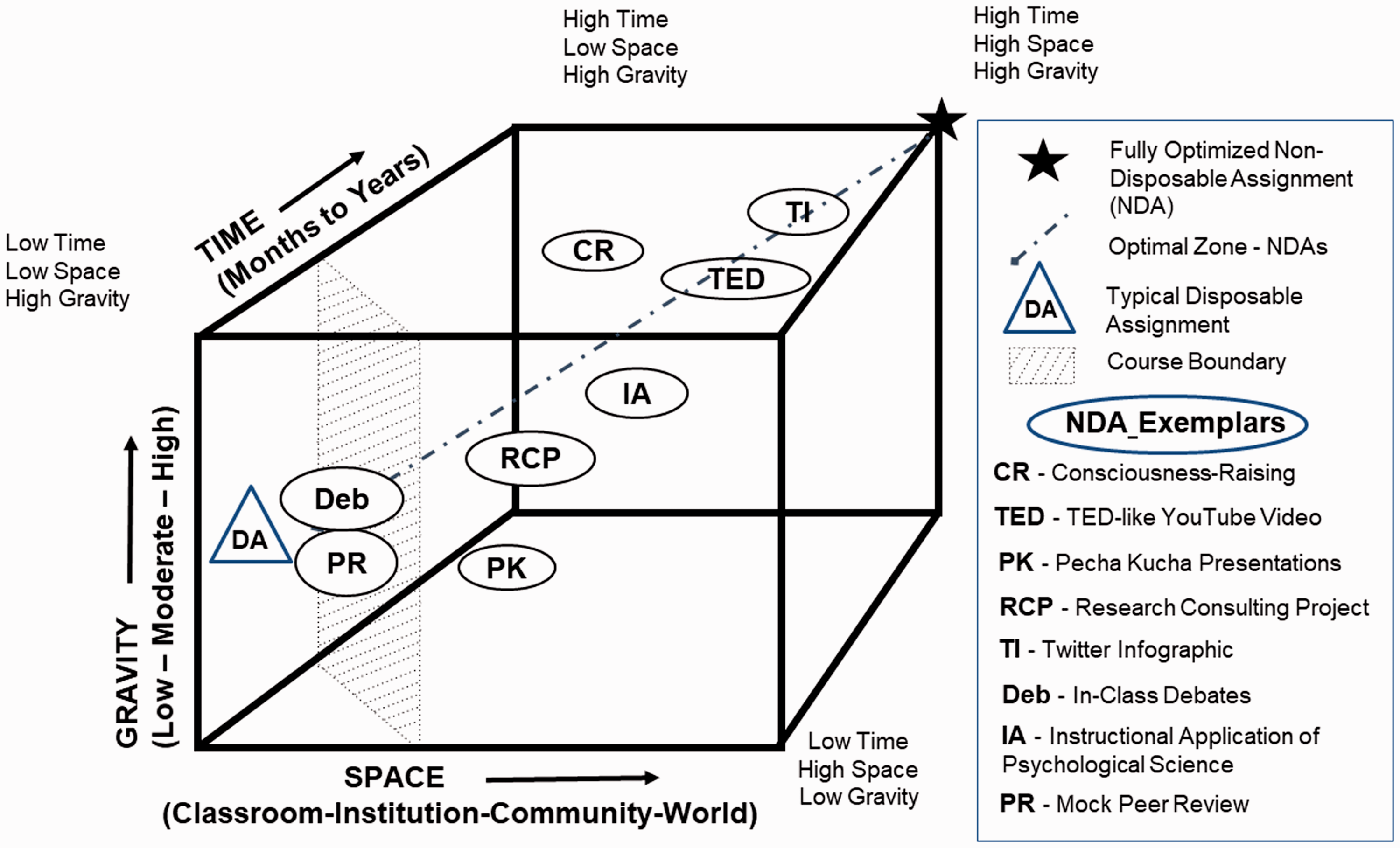
In the realm of disposable assignments, the impact of a student’s work is fleeting, but NDAs provide an opportunity for longer-lasting influence. Time refers to a potential for the product (and associated learning) to persist and can range from a few hours or days (e.g. in-class activity) to a theoretically infinite period, surpassing a semester (e.g., creation of web-based resources). In some scenarios, the products of NDAs may extend their influence along the time dimension as globally shared learning objects (i.e., OER). NDAs therefore not only shape learning within the cohort of student creators; their openness can further impact innumerable future learners.
Spaces Defining the Geographic Reach of NDAs.
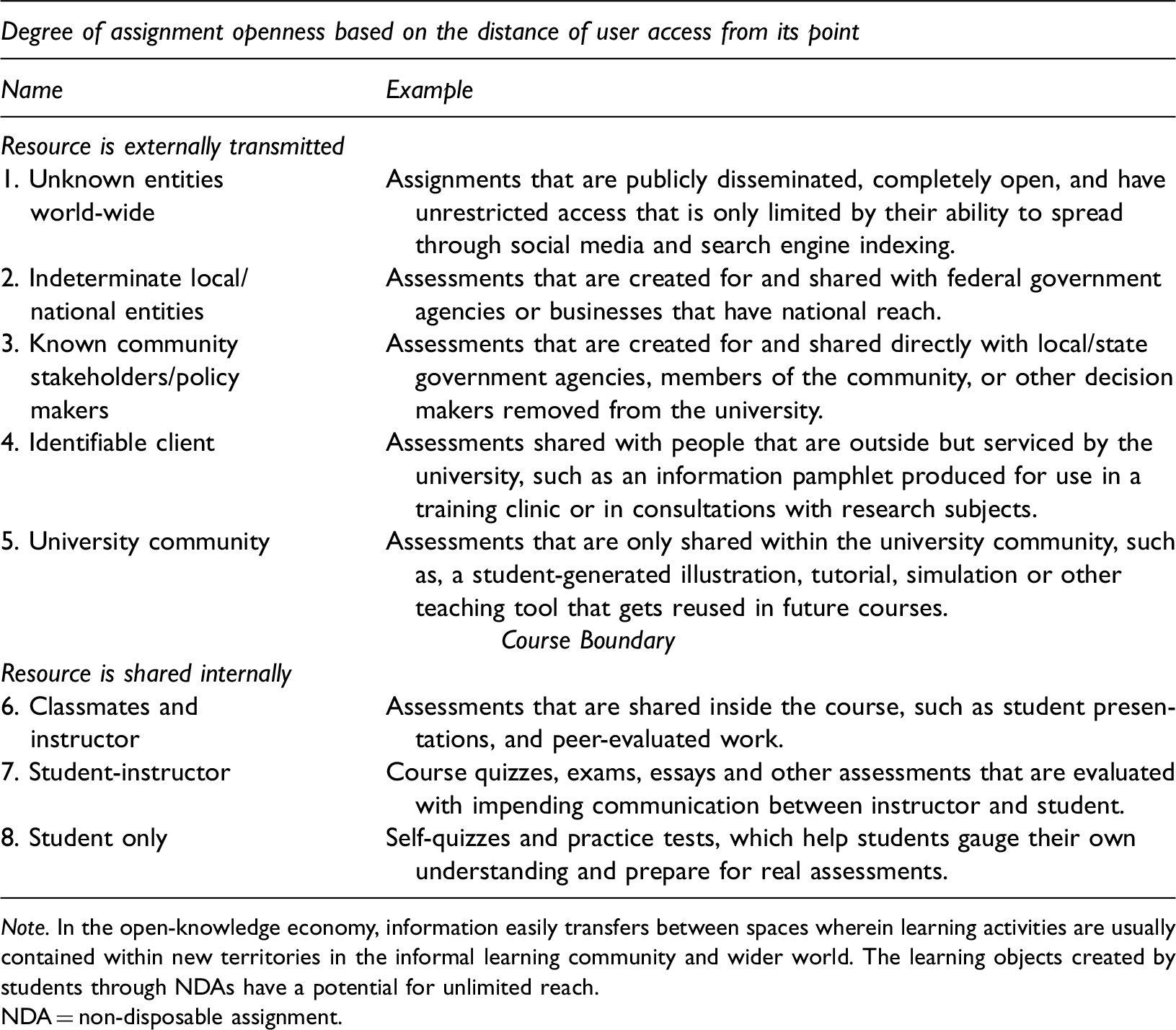
Note. In the open-knowledge economy, information easily transfers between spaces wherein learning activities are usually contained within new territories in the informal learning community and wider world. The learning objects created by students through NDAs have a potential for unlimited reach.
NDA = non-disposable assignment.
Finally, NDAs can vary in their Gravity or extent of value/impact. Like the space continuum(a), gravity can consist of multiple components and, accordingly, be differentially situated in the three-dimensional framework. For instance, gravity may refer to the learning impact for student creator (internal gravity) and/or fellow student/public consumers (external gravity) of the final learning product. While the learning benefit to the community or society corresponds to external gravity, the fulfillment of learning objectives through experiential learning, and the development of soft skills and media literacy, are aspects of internal gravity. Furthermore, we might assess gravity in terms of the degree to which the students perceive meaningfulness (internal gravity) in their own learning, experience, creation, delivery, and/or public contribution of the final product. We might also measure gravity in terms of the classmate/peer-teaching benefit or impact on the larger community (external gravity). Gravity is not necessarily independent of the other dimensions—one might expect that as time and space increase, so too might the inherent gravity for the learning object creator and/or consumer. Gravity also includes multiple layers of abstraction, which may be parsed out upon the further development of standardized NDA practices and subsequent empirical evaluation in open pedagogy. Finally, the aggregate or net gravity (internal + external) of a particular NDA can be viewed as the comparative measure of total learning and/or experiential benefits to the student–creator(s) and outside recipients. Thus, the notion of net gravity can help the instructor to ascertain whether to adopt an NDA without obvious personal benefit/interest to students that may yet have meaningful societal benefits. Our proposed framework includes elements that may be systematically assessed quantitatively and/or qualitatively.
Application of Time, Space, and Gravity to Representative NDAs
Examples of Psychology NDAs.
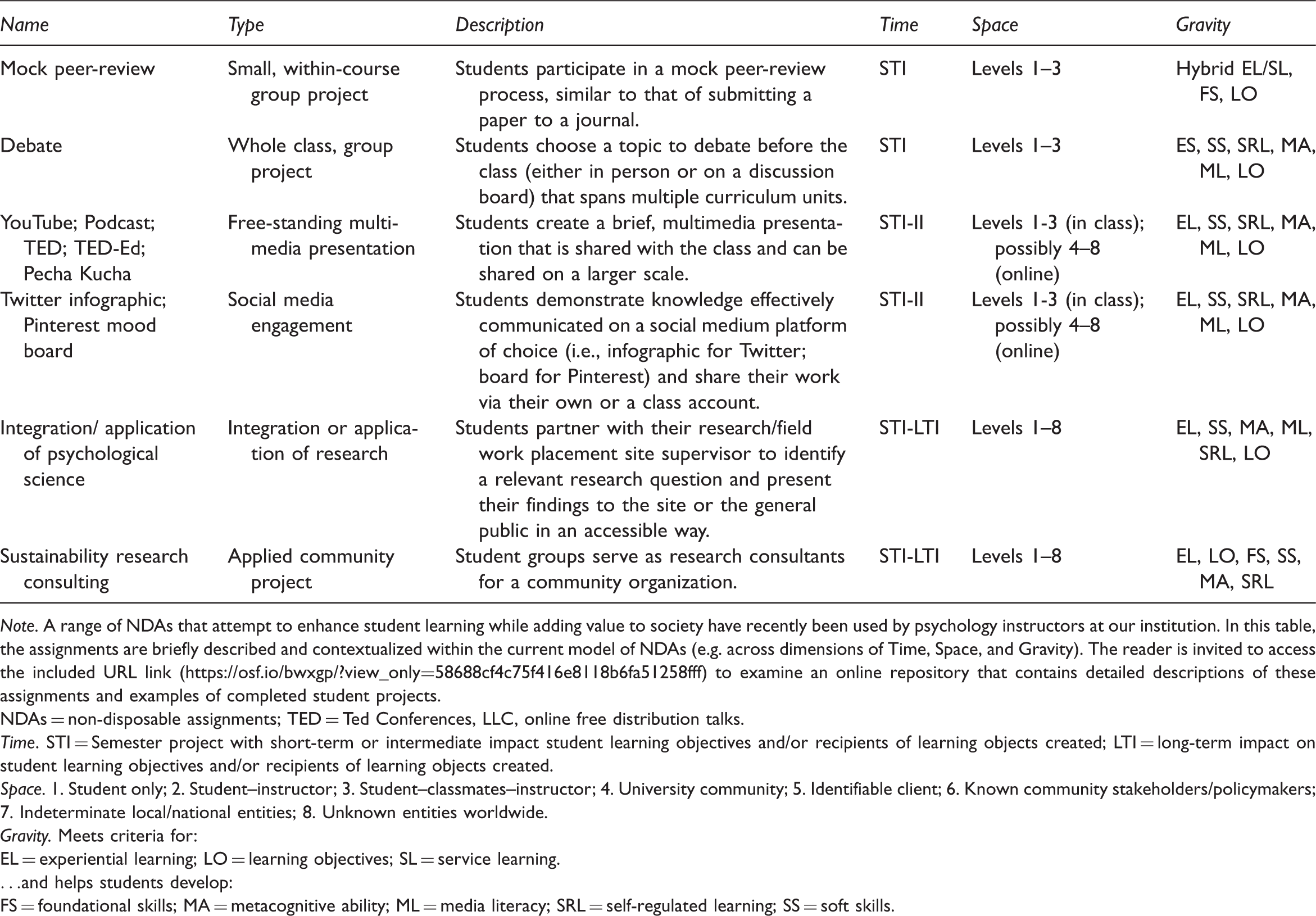
Note. A range of NDAs that attempt to enhance student learning while adding value to society have recently been used by psychology instructors at our institution. In this table, the assignments are briefly described and contextualized within the current model of NDAs (e.g. across dimensions of Time, Space, and Gravity). The reader is invited to access the included URL link (https://osf.io/bwxgp/?view_only=58688cf4c75f416e8118b6fa51258fff) to examine an online repository that contains detailed descriptions of these assignments and examples of completed student projects.
NDAs = non-disposable assignments; TED = Ted Conferences, LLC, online free distribution talks.
Time. STI = Semester project with short-term or intermediate impact student learning objectives and/or recipients of learning objects created; LTI = long-term impact on student learning objectives and/or recipients of learning objects created.
Space. 1. Student only; 2. Student–instructor; 3. Student–classmates–instructor; 4. University community; 5. Identifiable client; 6. Known community stakeholders/policymakers; 7. Indeterminate local/national entities; 8. Unknown entities worldwide.
Gravity. Meets criteria for:
EL = experiential learning; LO = learning objectives; SL = service learning.
and helps students develop:
FS = foundational skills; MA = metacognitive ability; ML = media literacy; SRL = self-regulated learning; SS = soft skills.
Per our definition of NDAs (see above), an assignment may stay within the course boundaries and still qualify as an NDA if it is shared in some manner with others outside the traditional student–teacher dyad. Although disposable assignments are potentially valuable learning exercises, they do not generate learning objects to be employed as teaching tools. Thus, a traditional “quiz” or “lab-report” could only qualify as an NDA (and even then, likely only a “Low Net Gravity” NDA) if it were to culminate in some shared learning object that could be used to further understanding among learners beyond those preparing the NDA.
Many examples of Moderate–High gravity NDAs exist, despite their varied locations in space and time. For instance, Mock Peer-Review and Debate NDAs have considerable gravity, but their products predominantly remain in the classroom (Low Geographical Space, Low Time). In Mock Peer-Review, students experience a simulated scientific publication process wherein they (as “field experts”) are required to prepare draft publications while also critically evaluating the work of their peers. Contrastingly, Freestanding Multi- and Social-Media NDA products are widely disseminated to be accessed by anyone on the Internet, and thus potentially have great geographic and sociocultural range (High Space) and shelf lives (High Time). Their gravity also has high potential, though may differ across students or assignments, because features of gravity depend on consideration of both internal and external impacts of knowledge. For example, in a Psychology of Motivation course, students created “TED”-like videos to inform others on a range of self-selected topics such as “The motivation to eat” (probable Low Net Gravity) and “Confronting suicidal ideation” (probable High Net Gravity).
Alternatively, although also rooted in a single semester’s work (Low–Medium Time), the learning objects generated by our Integration/Application of Psychological Science and Community Consultation NDAs had tremendous reach (High Space) and value (High Net Gravity) for students and community members. For example, in an upper-level internship course, students partnered with placement sites to assist in conducting research or field work on bullying prevention efforts (High Net Gravity) and shared their research findings both at their placements (Medium Space) and with the public (High Space).
Although NDAs conferring higher levels of Net Gravity, Space and Time have maximal potential for producing valuable learning objects, instructors should not seek to situate their assignments only at the “High” dimensional levels within this framework, but instead utilize that approach most applicable to course- and instructor-specific learning objectives.
When: The Future of NDAs in Open Pedagogy and Empirical Study
Although NDAs are theoretically backed and anecdotally supported, empirically derived questions abound regarding their effectiveness in advancing learning goals, fostering student agency and self-motivation, and creating competent global citizens. Accordingly, the scholarship of teaching and learning begs further investigation of these assumed benefits of NDAs and other aspects of open pedagogy.
As a unique tool for assessing courses and curricula, as well as for facilitating research, the heuristic value of our framework lays in its ability to help instructors and administrators consider assessments and other learning tools. At the course level, instructors can use the framework to situate assessments, determine the extent to which those assessments capture intended learning outcomes, and identify dimensions on which the assessments might be modified to extend their reach. At the curriculum level, courses and assignments can be mapped onto the framework to identify areas that are under- or over-assessed, with considerations of ways to scaffold the curriculum so students move to assignments with greater gravity or broader space as they progress through the curriculum. To the extent that the framework can be reliably operationalized, it can also facilitate research by allowing for the conceptualization of questions about the impact of assignments that differ along the identified dimensions. For example, do assignments that move from narrower/shallower to broader/deeper produce different learning outcomes? Is one dimension (e.g., gravity) more conducive to learning than others (e.g., time and space)? Do specific abstractions of the space dimension more significantly determine the internal gravity of NDAs for students?
Conclusion
The future vigor of OEP may be secured through widespread use of NDAs (Littlejohn, 2003), with a potential serve to enhance student learning, agency, and sociocultural competency (Littlejohn & Pegler, 2014). NDAs may also produce tools that can enhance the learning of others, truly providing “value” for the hours of invested cognitive effort. We highlighted the usefulness of NDAs as facilitating education through the innovation of learning objects that foster student-centered motivation and self-efficacy while promoting community engagement. Our framework can be of use to those recognizing the potential benefits (enhanced student learning, public service, etc.), grappling with drawbacks, or endeavoring to support the characterization and evaluation of NDAs from an empirically based approach. Student-generated instructional materials represent some of the best examples of culturally rich and effective learning objects (Alvarez, 2013; Falconer & Littlejohn, 2007). In other words, the future of NDAs and open pedagogy may involve promoting and then following our students’ lead.
Footnotes
Declaration of Conflicting Interests
The author(s) declared no potential conflicts of interest with respect to the research, authorship, and/or publication of this article.
Funding
The author(s) received no financial support for the research, authorship, and/or publication of this article.