




Abstract
Open Educational Resources (OER) remove barriers to access instructional material. In light of their increased availability and use, a body of research has emerged to examine the impact of OER on college student success. While many of these studies have broadly examined efficacy across a variety of disciplines, the current study specifically examined the impact of the type of textbook (commercial vs. OER) on course content mastery within an undergraduate sample of introductory psychology students (N = 63) while controlling for instructor and student differences. Results indicated that there were no significant differences in content mastery between those students in introductory psychology courses who were assigned a traditional commercial textbook and those who were assigned an OER textbook. These results support that OER can be equally effective as traditional, commercial textbooks and have implications for course material selections that help ensure access for all students.
The first textbook with the term psychology in the title appeared in the 1840s and since then the psychology textbook industry has expanded and evolved, often in concert with various sociopolitical influences (Weiten & Wight, 1992) and in response to professional recommendations (Weiten & Houska, 2015). One of the meaningful changes that Weiten and Wight (1992) have noted is an increased focus on student-oriented texts beginning around the time of the Great Depression. This emphasis on student focus included an increased inclusion of pedagogical aids within the texts (e.g. chapter summaries, bolded terminology), along with increased solicitation of students’ feedback on chapter critiques. Although these efforts to increase textbook appeal within the marketplace may have boosted sales for some authors, whether such changes impacted student learning outcomes in a meaningful way is still in question.
Despite the pervasive use and customization of textbooks, little empirical research is available to support a positive relation with student comprehension and learning (Durwin & Sherman, 2008; Landrum, Gurung, & Spann, 2012). Neither the use of pedagogical aids within the textbook (Gurung, 2004) nor the students’ perceptions of such aids (Gurung, 2003) predict performance. In addition, despite the textbook industry’s interest in meeting the desires of the student consumers (e.g. visual appeal, featured content boxes, introduction vignettes), students’ reasons for purchasing or using the textbook and their ratings of the textbook are also unrelated to performance (Landrum et al., 2012).
One true need among an increasing number of students is affordable access to educational materials (Bliss & Smith, 2017). Average cost for books and supplies currently approaches $1300 (College Board, 2017) and as reported by Senack (2014), 65% of students have reported not buying or renting course textbooks because of cost. To continue to remain student-oriented and reduce the financial constraints of the modern student, the textbook industry has approached the problem through two predominant strategies: offering existing printed commercial textbooks through electronic versions at a reduced cost and developing open-source materials at no cost.
Electronic Textbooks
Although electronic versions of existing commercial textbooks have provided cheaper options for students, students’ interest in such electronic textbooks has been varied, with many still preferring traditional print textbooks over electronic versions (Shepperd, Grace, & Koch, 2008; Woody, Daniel, & Baker, 2010). Beyond student preference, many researchers have found that electronic textbooks do not compromise student learning outcomes (Rockinson-Szapikiw, Courduff, Carter, & Bennett, 2013) and that the outcomes are consistent with those achieved by students using hardcopy texts (Chulkov & VanAlstine, 2013; Shepperd et al., 2008; Terpend, Gattiker, & Lowe, 2014). However, other researchers (e.g. Gurung, 2017b) have reported that the format of the book (print vs. electronic) can contribute to significant differences in quiz performance on specific topics of psychology. These findings suggest that despite offering an alternative and often cheaper means to access course content, electronic textbooks may not be equally effective for all students or all content areas.
Open Educational Resources
Just as electronic textbooks, in part, aimed to improve access to course content, the Open Educational Resources (OER) movement has introduced an even greater number of options for higher education textbooks. The Hewlett Foundation (2018) defines Open Educational Resources as “teaching, learning and research materials in any medium – digital or otherwise – that reside in the public domain or have been released under an open license that permits no-cost access, use, adaptation and redistribution by others with no or limited restrictions” (“OER Defined”). Such OER options allow free access to courses and educational materials to all individuals, including those with limited finances who might not otherwise have access (Bliss, Hilton, Wiley, & Thanos, 2013; Bliss & Smith, 2017). This access has the potential to significantly impact student engagement in course materials, as well as subsequent performance – 82% of students reported that they believed they would perform better in a course if the textbook was available free online, with an option to purchase a hard copy (Senack, 2014). Despite these potential perceived benefits, some researchers (e.g. Griggs & Jackson, 2017a) have expressed concern over the quality and coverage of OER. It is not surprising, then, that as an increasing number of institutions begins to consider the adoption of an OER textbook, empirical investigations have examined their relative effectiveness on student learning outcomes.
Although some initial work supported OER as equal to or better than traditional textbooks with regard to student outcomes (Allen, Guzman-Alvarez, Molinaro, & Larsen, 2015; Bowen, Chingos, Lack, & Nygren, 2014; Hilton, Gaudet, Clark, Robinson, & Wiley, 2013; Hilton & Laman, 2012; Pawlyshyn, Braddlee, Casper, & Miller, 2013), some authors (e.g. Gurung, 2017a; Hilton, 2016) have cautioned that design factors within individual studies may limit the generalizability of their results. For example, some studies could not control for teacher or student differences (Hilton et al., 2013; Pawlyshyn et al., 2013; Robinson, 2015) while others utilized different outcome measures when comparing groups (Hilton & Laman, 2012). More recent work has attempted to address many of these original confounds. While some researchers have found that the use of OER is associated with improved (Bliss, Robinson, Hilton, & Wiley, 2013; Colvard, Watson, & Park, 2018) or worsened (Gurung, 2017b) outcomes, most research has found OER to be equivalent to traditional textbooks (e.g. Hendricks, Reinsberg, & Rieger, 2017; Jhangiani, Dastur, Le Grand, & Penner, 2018; Watson, Domizi, & Clouser, 2017). Although most findings seem to support that using an OER is not associated with poorer outcomes (Hendricks et al., 2017), inconclusive findings regarding the comparative effectiveness of OER (Griggs & Jackson, 2017b) support the ongoing need to examine the impact of textbook type on performance while controlling other potential sources of variability.
Some of these sources of variability that may mediate the effectiveness of textbooks include student demographics and course content. For example, among continuing students, no differences emerged in terms of student success for those using traditional versus OER texts; there was, however, some evidence that OER was related to better grades for new students (Winitzky-Stephens & Pickavance, 2017). In addition, the positive impact of OER has been particularly notable among part-time students, students from ethnically diverse backgrounds, and those students who are Pell grant eligible (Colvard et al., 2018). In terms of course content, student success in math courses was lower when students had OER textbooks relative to those using traditional texts, particularly at the onset of adoption; this was not the case for other content courses, highlighting the importance of controlling for subject matter in analyses (Winitzky-Stephens & Pickavance, 2017).
In terms of discipline, few studies of OER effectiveness have looked specifically at psychology textbooks. Those that have (e.g. Fischer, Hilton, Robinson, & Wiley, 2015; Hilton & Laman, 2012; Robinson, 2015) have typically included confounds or have only examined specific topic areas of psychology (Gurung, 2017b). Most recently, Jhangiani and colleagues (2018) compared psychology student performance using traditional or OER textbooks, but acknowledged that the two textbooks differed in content, structure, and style. The current limited insight into the impact of OER textbooks in psychology courses is unfortunate, given the popularity of introductory psychology at the college level (American Psychological Association, 2014) and the potential that a significant number of students from a variety of disciplines will take this, and perhaps only this, psychology course (Weiten & Houska, 2015). Examining the effectiveness of an open textbook for introductory content in psychology, therefore, seems imperative to better meet the needs of such a broad audience of students. Following from that need, the purpose of the current study was to examine the impact of the type of textbook (commercial vs. OER) on students’ content mastery, as measured by performance on selected exam items for students in an introductory psychology course. This study adds to the current body of literature that has examined potential effectiveness of OER textbooks relative to commercial textbooks by controlling for a variety of factors, including instructor and student differences and course instruction modality, and by utilizing identical outcomes measures.
Method
Participants
Participants were 63 students who completed introductory psychology in Fall 2016 (n = 33; before adoption of open-source text) and Fall 2017 (n = 30; after adoption of the open-source text); five of these students were retaking the course and were excluded from the analyses given their previous exposure to the content. The large majority of students in the course for both semesters were non-psychology majors (Fall 2016: 28 out of 33; Fall 2017: 27 out of 30). The non-psychology majors commonly came from biology (14%), business (8%), criminal justice (10%), education (10%), and nursing (14%), as well as undeclared students (16%); representation of these majors were fairly similar in both conditions. In both semesters, the large majority of students identified as white (Fall 2016: 76%; Fall 2017: 70%). Whereas two-thirds of the students in the Fall 2016 section identified as female, this was more evenly split in the Fall 2017 section (males: 43%; females: 57%). Across both groups, most students were 17–22 years of age, with very few non-traditional students in either section (n = 3). The institution where we collected this data is a private liberal arts college that enrolls fewer than 6000 students. This study was approved by the institutional review board.
Design, Materials, and Measures
The current study examined archival data to compare student performance on a selection of exam questions using a quasi-experimental between-subjects design; students who took the course in Fall 2016 before the adoption of the open-source text were the control group and students who took the course in Fall 2017 after the adoption of the open-source text were the experimental group. The commercial textbook used was Real World Psychology (Huffman & Sanderson, 2014), and the OER was OpenStax – Psychology (OpenStax College, 2014). According to R. A. Griggs (personal communication, July 20, 2018), both of these textbooks would be considered lower-level texts. Students had access to both printed and electronic versions of both textbooks during their respective semesters and could choose which modality they preferred; as this was an archival study that relied on existing data, we did not have the ability to retrospectively determine whether students used the printed or electronic version.
Both sections of the course came from fall semesters and were taught by the same instructor at the same time to reduce confounds related to instructor, student, and timing. By the start of the Fall 2016 term, the instructor had five years of experience teaching the introductory psychology course at the current institution. In both semesters, the classes met three days a week for a 50-minute period class. Each exam counted for 10% of the course grade, included 50 items, and was taken in class through the college’s online learning management system. Exams were closed-book/closed-note. Students were permitted to take the entire 50-minute class period to complete each exam.
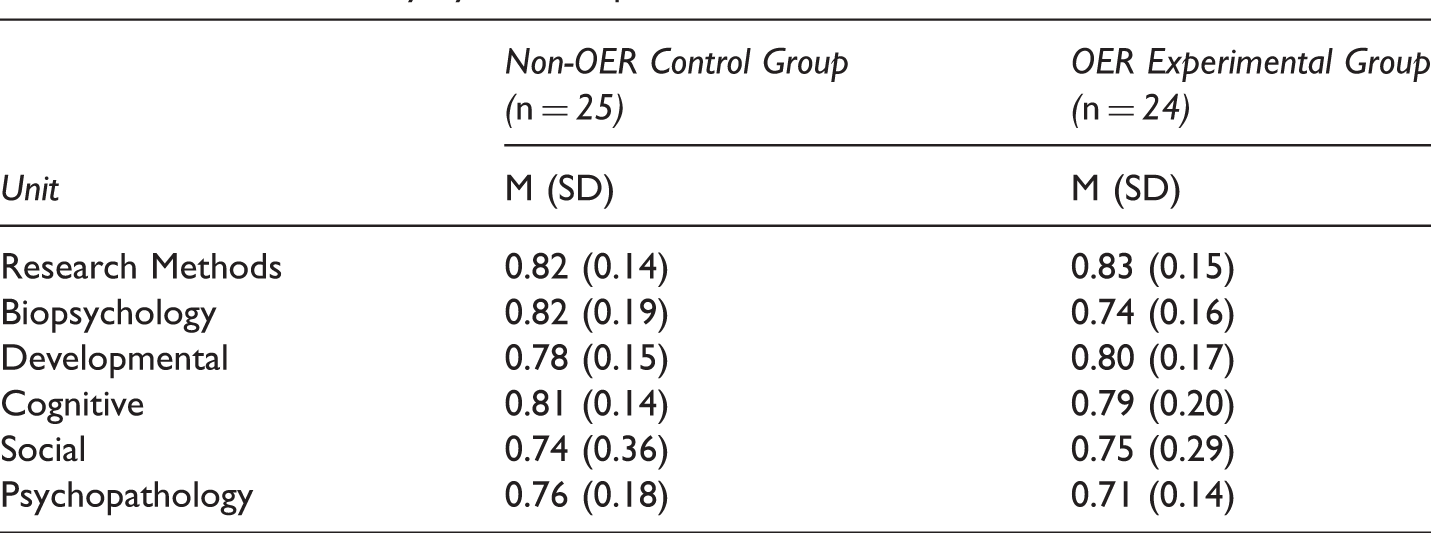
Course content mastery was assessed by a performance score that was calculated as a percentage of correct exam responses out of total responses. If a student failed to respond to an item (e.g. skipped the item, missed the exam), this was not included in their performance score. Across six exams, 46 questions were identified that were identical during both semesters. Two of the items were revised slightly to account for terminology differences between the two textbooks; both were included in the developmental psychology unit and the correct answer was the same language for both groups. All of the selected questions focused on material covered in both textbooks, so students could reasonably answer the questions based on readings alone; all of the content was addressed in class lectures, as well, with minimal differences in presentation between the two groups. The questions represented research methods (n = 10), biopsychology (n = 10), developmental psychology (n = 10), cognitive psychology (n = 9), social psychology (n = 2), and psychological well-being/psychopathology (n = 5). We calculated performance scores for each student representing their overall performance, as well as their performance within each of the six units.
In addition to course performance data, the following data were collected from institutional records for each participant to use as covariates: SAT scores, term GPA, cumulative GPA, term credits attempted, term credits earned, total credits attempted, and total credits earned.
Results
Descriptive Statistics
Student demographics for non-OER and OER groups.
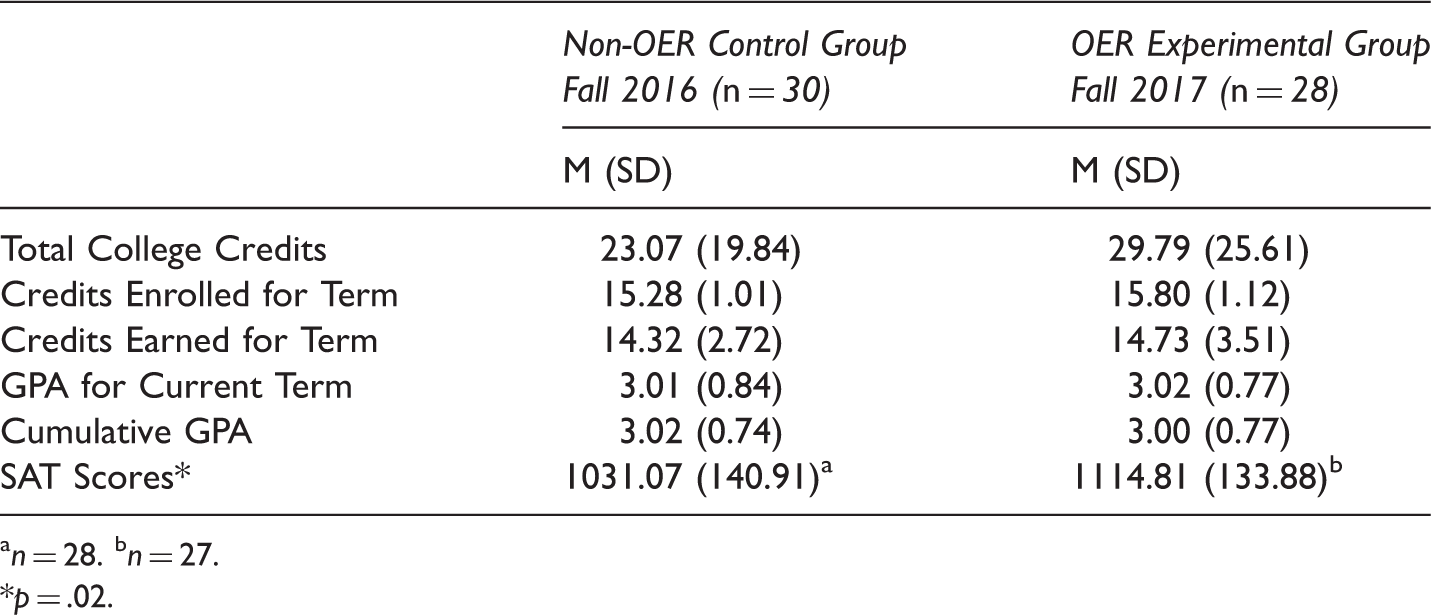
n = 28. bn = 27.
p = .02.
Differences in Students’ Content Mastery
As participants were not truly randomly assigned to either condition, and thus, factors related to the students themselves were not controlled for a priori in the design of the study, we chose to conduct a one-way between-subjects analysis of covariance (ANCOVA) to examine the effect of the textbook on course mastery, while allowing for a post-hoc, statistical control over any effects of current course load, total earned credits, and overall academic performance (term GPA and SAT scores). SAT score was the only statistically significant predictor of overall content mastery (F (1,49) = 21.48, p < .001, partial η2 = .31). 1 The main effect for textbook failed to reach statistical significance (F (1, 49) = 3.53, p = .07), with performance of the OER experimental group (M = 0.78, SD = 0.11) appearing the same as that of the non-OER control (M = 0.78, SD = 0.11), even after covarying out the effects of potential student differences. 2
Content mastery by sub-discipline.
Discussion
Results from the current study indicate that there are no significant differences in student content mastery between those students in introductory psychology courses who are assigned traditional commercial textbooks and those who are assigned open educational resources. Students in the section of introductory psychology who were assigned an OER textbook had comparable content mastery scores to the students who were assigned a traditional textbook.
The current study adds to the existing body of literature that supports OER as equally effective to traditional, commercial textbooks (Hilton, 2016; Hilton et al., 2013). In comparing across the two textbooks, we examined students’ mastery of course material, as measured by select exam items, rather than using the broader outcome of course grades. The potential advantage of using performance on the specific exam items as compared to course grade is that the exam-based performance measure focused on what content students learned. Although course grades, in part, measure content mastery, they may also reflect student behaviors that are less directly relevant to content mastery itself, such as earning credit for completing low-risk assignments or attending/participating in class. Thus, some aspects of a course grade would not necessarily speak directly to impact of the textbook on a student’s learning. Another concern relevant to the present study was that the weighting of specific assignments were not held consistent between the control and the experimental group, so any observed difference in course grades could not be linked back to the difference in textbook itself.
Consistent with the recommendation by Grewe and Davis (2017) that GPA should be controlled for in any investigations that attempt to assess the impact of instructional modifications on student learning, we controlled for potential influence of GPA. Our study also accounted and controlled for other student differences, including total college credits completed and SAT performance, the potential influences of course, type of instruction, teacher differences, and outcome measures. In light of these controls, these findings are particularly compelling; they yield well-founded support for the use of OER in introductory psychology courses to improve access to course materials without compromising student learning outcomes.
Limitations and Future Directions
Although our sample size yielded sufficient power to detect significant findings, it is important to acknowledge that our sample size is fairly small compared to other larger-scale investigations that have examined similar questions (e.g. Fischer et al., 2015; Hilton, Fischer, Wiley, & Williams, 2016; Winitzky-Stephens & Pickavance, 2017). The smaller sample in the current study afforded us greater control over various confounds, but it does create some potential limitations in generalizability. Future research should attempt to replicate these findings in larger samples, while also controlling for other potential confounds (i.e. different instructors, outcome measures) that might result. It is also important to note that these results may not generalize to other situations where instructors might customize the book to suit the specific needs of their courses or students or to other instruction modalities (e.g. online or hybrid/blended courses), although previous studies (Hilton et al., 2016) have indicated that the impact of OER generally extends to both face-to-face and online/hybrid courses.
Additionally, as is often the case for many instructors, the current instructor’s lectures largely aligned with content coverage in the book. Thus, for the current study, although the selected items could reasonably be answered by reading either of the textbooks, students could have been potentially able to answer based on knowledge gained from class. It would be valuable in future studies to identify questions that relied solely on reading the textbook, to provide a clearer comparison between what can be learned from reading either commercial or OER textbooks. From a practical standpoint in terms of textbook selection, if instructors use class lectures largely to supplement and expand upon the textbook content, rather than leaving students to be accountable for any portion of those readings solely on their own, instructors could be facilitating success of all students by selecting the OER and removing a potential and unnecessary financial burden.
It is important to acknowledge that this archival study did not have access to data regarding the mode or degree to which students utilized either of the types of textbooks. Both books were available as printed or electronic versions; with the OER textbook, the electronic version was available online at no cost, whereas the printed copy was associated with a cost to students. In contrast, there was a cost associated with both the printed and the electronic version of the non-OER text. It is unclear whether students had a preference for a certain modality with the OER as compared to the non-OER textbook. If students were more likely to use the electronic version of the OER, based on previous research, it may be the case that students were not using the OER as frequently or effectively (Daniel & Woody, 2013; Shepperd et al., 2008) as the printed version of the non-OER. Considering that previous research links the degree to which students use the textbook (Gurung, 2004; Landrum et al., 2012) to course performance, that would suggest that the students could have more room to benefit from the OER and, in fact, could have experienced higher performance than with the previous non-OER textbook. This possibility highlights the need to determine if there are ways to most effectively utilize these resources to further strengthen student performance (Croteau, 2017).
Finally, as students commonly face financial obstacles, including being able to afford traditional textbooks, it may have been the case that fewer students had access to the non-OER textbook, whereas students in the OER group had increased access. As Fischer et al. (2015) noted, the benefit of OER textbooks perhaps has most to do with providing an avenue for affordable access to course materials that can facilitate students’ learning opportunities. It was the case that the non-OER textbook was available for students to use through the library, which aimed to improve access for students who could not purchase or rent the textbook. However, students may not have always been aware of or able to make use of the library-copy as a resource. This obstacle would not have been present for the OER text. Future research initiatives that more directly assess whether students purchase or access the assigned text for their introductory psychology course can better elucidate the interaction of the textbook modality and student usage on learning outcomes. Additionally, it may be valuable to remove cost as a potential confound by developing a study that provides access to either book at no expense to students.
Conclusion
Despite potential limitations of the current study, it expands on a growing body of research that suggests that commercial texts may be no more effective than no-cost alternatives and that adopting OER does not compromise learning opportunities for students (Croteau, 2017). In contrast, these options may enhance student success by facilitating access to materials (Fischer et al., 2015) while helping students save a significant amount of money. Of particular import is the finding that the relative benefits of OER texts emerge specifically in introductory psychology courses. In light of the high enrollments that are characteristic of this course, the decision to adopt OER textbooks in introductory psychology courses has potential for significant financial impact (Watson et al., 2017). Prior to abandoning all traditional commercial textbooks, however, it is important to note that students make decisions about which form of the textbook they select based on a variety of factors, including cost, the ability to keep it, and their preferred method of reading (online vs. print) (Chulkov & VanAlstine, 2013). Until a clearer understanding of how these various factors interact to influence student success, it seems prudent to ensure that students have a variety of options, including OER, available to them when selecting their course materials.
Footnotes
Declaration of Conflicting Interests
The author(s) declared no potential conflicts of interest with respect to the research, authorship, and/or publication of this article.
Funding
The author(s) received no financial support for the research, authorship, and/or publication of this article.