



Abstract
Student success is of the upmost importance across the global higher education sector with a wealth of rich scholarship demonstrating the complexity of influences and factors that shape success. This article acknowledges that complexity and focuses on how students perceive, and partner in, shaping notions of their learning success through an analysis of two in-depth case studies. I draw on the theoretical framework of students as partners in learning and teaching. Broader implications are articulated followed by a specific focus on cross-cultural partnership from the perspective of a Chinese student partner. I argue that higher education scholars researching student success and learning outcomes should take seriously the perceptions of students to inform practice and policy, while also partnering with students in our own research to more genuinely comprehend the complexities of student success.
Keywords
Introduction
In this article I will argue that if the higher education research community is genuinely serious about student success in higher education, then we—scholars dedicated to advancing learning—must reflect upon our own beliefs about the role of students in our research and practice. We must be open to learning ourselves. Transformative learning that changes how we see, experience, and engage in the world. 1 I am asking us to engage in the type of learning we often espouse as the purpose of a quality university education that informs our aspirations for student success.
Affirming conceptions of engagement and success that give primacy to fostering learner agency and nurturing meaningful learning relationships between students and academics, I offer a radical and disruptive idea that we should be working in partnership with students on research and practice that is intended to promote, advance, and deepen understanding of engagement and success for students. Drawing on theorisations in the emerging field referred to as students as partners, I present two in-depth case studies from my own research practice to demonstrate both the practicalities and outcomes afforded by working in partnership with students as co-researchers. Finally, I abstract broader implications that are applicable in different contexts, including cross-cultural partnerships, and end with a call to action that provokes our research community to re-think how we position students in our research on student success.
Learning is Central to the Concepts of Student Success and Student Engagement
Universities across the globe aspire to engage students in a higher education experience that leads to their success. 2 Increasingly, research and practice are focused on achieving “student success” often through “student engagement” efforts. 3 Scholars of student engagement argue that students’ involvement in high quality learning activities that nurture positive interactions between students and students, and students with staff, foster belonging and contribute to student success. 4 Conceptions of student success tend to be broad and holistic to signal the complexities of understanding, theorising, supporting, assessing, and researching in this field where overlapping dimensions—active involvement (engagement), self-efficacy, finding meaning (purpose), personal validation, reflection, self-awareness, and social integration—influence student learning success. 5
These terms—engagement, involvement, success—and the practices they evoke are highly contested, even though research has proliferated. We can agree there is a consensus view that student engagement is related to student success, and learning is central to both these concepts. Carey 6 summarised these overlaps and relationships with an expansive conception of engagement predicated on student identity shaped by their involvement in higher education in ways that enable agency in learning within and beyond the confines of formal university structures. Enabling student agency is recognised in relational models for student engagement that privilege the values of learning partnerships. 7 Research also highlights the centrality of high quality interactions between students and staff to increased student engagement outcomes. 8
Related to student learning success is a focus on “learning outcomes.” This is a large, complex field of inquiry with an emphasis on practical applications as quality assurance in higher education necessitates a focus on learning—and what is learned—whereby universities seek to name outcomes, teach them, and demonstrate student attainment of them. 9 The focus on pre-described, narrowly articulated, “one-size-fits all” learning outcomes of a higher education that give primacy to knowledge and skills gained for individual economic gain have been critiqued and criticised, typically through a juxtaposition of neoliberal and social justice arguments, 10 for which I have also argued. 11 In this article I adopt a pragmatic point of view in terms of learning outcomes research to emphasise the role of students in such work.
More Active Roles for Students in Student Success Research
Students can play more active roles in our scholarly understanding of learning success in relationship to curriculum development. I argue this from a democratic ideological lens that privileges participatory approaches, which translates into a conception of students as equally important members of the university community who work alongside staff to share the responsibility for learning and teaching. 12 This is an ideological stance with historical and scholarly threads in the student voice movement. 13 To demonstrate how students can be engaged in differing ways in student learning outcomes research, I draw on two examples from my own applied research work. Both of the examples had a direct influenced on large-scale curriculum policy and planning across a science degree program, although in differing ways.
My intention is to expand traditional notions of how we imagine student involvement in university quality assurance processes because involving students as both participants in research and research partners can offer “rich insights into the world and lives of our students,” 14 which is essential in conceptualising student success and aligns with future oriented visions emerging in universities in the UK, North America, and Australia that imagine students as partners in teaching and learning. 15 Thus, before presenting two case studies from my own research practice, I articulate the theoretical framework underpinning my argument.
Working in Partnership with Students: Students as Partners
Engaging with students as partners is ultimately about the quality of relationships between students and staff (using “staff” broadly to encompass academics or faculty along with librarians, learning support, and administrative staff roles that support the student experience). I have argued that student-staff partnership is a metaphor intended to challenge traditional assumptions about what it means to be a student and an educator: “Through the surprising (to some) juxtaposition of “student” and “partner”, this metaphor imagines and makes way for respectful, mutually beneficial learning partnerships where students and staff work together on all aspects of educational endeavours.” 16 Relationships are guided by values of partnership that Cook-Sather, Bovill, and Felten 17 describe as respect, reciprocity, and shared responsibility: “These qualities of relationship emerge when we are able to bring students’ insights into discussions about learning and teaching practice in meaningful ways—ways that make learning and teaching more engaging for students and ourselves.”
Strict definitions of students as partners are difficult to articulate because the concept is grounded in principles and values intended to guide practice. Thus, the idea of students as partners is not a recipe to be followed 18 with each partnership looking different because the people involved are different. 19 The principles of partnership give primacy to quality relationships, emphasise the learning process as it unfolds, and the enactment of partnership values. As Healey, Flint, and Harrington 20 argue: “Partnership is framed as a process of student engagement, understood as staff and students learning and working together to foster engaged student learning and engaging learning and teaching enhancement … It is a way of doing things, rather than an outcome in itself.” Thus, partnership is commonly presented as a mindset or an ethos that translates into an array of practices; a way of thinking where students are respected and trusted adults with active responsibility for their learning that challenges notions of students as passive educational consumers and evaluators of teaching and teachers. 21
The outcomes of student-staff partnership were recently explored in a systematic literature review of 65 empirical works conducted over a five-year period and published in English, and found that: 22
56% of papers reported increased student engagement, motivation, and ownership for learning
45% reported gains in confidence or self-efficacy
39% cited an increased student understanding of the staff experience
37% identified that students reported enhanced relationships with staff
Because student-staff partnership is a reciprocal process, the review also reported outcomes for staff, although these were less likely to be reported in comparison to student outcomes:
43% of papers identified that staff reported enhanced relationships with students
31% cited the development of new or better teaching practices or curricular materials
28% indicated an increased staff understanding of the student experience
Many more outcomes were reported in that review along with challenges, which signals that adopting students as partners practices are risky and time consuming. Nonetheless, the outcomes associated with the process of student-staff partnership are gaining traction internationally with more and more universities evoking the language of students as partner in strategic planning documents. 23
The most widely cited model to guide the implementation of students as partners is from Healey, Flint, and Harrington, 24 which proposes partnerships in (1) teaching and learning (teaching, learning, and assessment activities; and subject-based research and inquiry approaches), and in (2) educational quality enhancement (curriculum development and pedagogical consultants; and institutional research). Thus, students as partners practices encompass many existing pedagogical approaches while pushing the boundaries into places not typically imagined as learning spaces. For the purposes of this article, I am drawing on student-partnership in quality enhancement activities associated with curriculum development and institutional research.
Importantly, the concept of students as partners is presented in juxtaposition to students as evaluators, as a source of data for institutions or individual teachers, or as representatives of other students. For example, Wenstone 25 argues that students in the UK have numerous opportunities to offer views through surveys, focus groups, and student representatives. Ongoing student involvement in the process of conceptualisation, design, implementation and evaluation related to teaching and learning activities 26 are not spaces typically occupied by students—spaces Wenstone 27 argues, are in need of student partners. This signals that partnership is not the same as inviting students to complete a survey or give feedback. Thus, partnership in research on student success creates a learning space for both students and researchers, where one had not previously existed, that enables student agency in shaping policy and practice.
Case Study 1: Students as Participants in Research on Learning Outcomes to Inform Curriculum Development
In 2008 I developed a survey tool, the Science Students Skills Inventory (
provide a foundation for articulating and developing the higher education science curriculum, and for improving learning and teaching in science at the university level.
In other words, the university staff in the sciences and the national scientific community were developing statements of learning outcomes expected of students graduating with a bachelor’s degree in science that ultimately emphasised disciplinary content knowledge (and applying that knowledge) along with several skills (e.g. teamwork, oral communication, written communication, ethical thinking, and quantitative). The rationale for developing the
Since its development, the
The
SSSI quantitative survey questions and alpha-numeric scale responses for each indicator

SSSI quantitative survey questions and alpha-numeric scale responses for each indicator
These data were discussed with 40-45 academics and senior administrators in the Faculty of Science through a series of workshops unfolding over six months with the intention to inform recommendations for the formal BSc Review Submission. As the BSc at UQ is a large, generalist degree program with students enrolled in over 40 majors (fields of studies), we aggregated the results into broad disciplinary bands for comparative purposes with the hope such a level of analysis would resonate with staff who tend to identify with their disciplines. A typical response to the broad program-level results included questions about, “how that reflects in my area of teaching?” Thus, I wanted to be able to address that question in the UQ BSc review (level of analysis that had not been published previously in the scholarly literature). For this example, I worked with some science staff and we grouped students’ responses by disciplines as outlined in Table 2.
BSc majors organised into broader disciplinary categories

Percentage agreement for aspects of scientific content knowledge, split by science discipline.

Analysis was not complex for our review purposes (compared to analysis conducted for publication in academic journals). Descriptive statistics for each indicator were examined for all learning outcomes by discipline area. “Percentage agreement” was calculated based on the two highest points of a four-point scale for all indicators. Then visuals were created—graphs—that became talking points in the workshops. Although we discussed all the six learning outcomes explored in the
Scientific Content Knowledge is central to a science degree program and the graph in Figure 1 displays a consistency and clustering of students’ perceptions across discipline areas. The story this graph tells is one of success from the view of the vast majority of students, regardless of discipline area, where the espoused academic outcome is being achieved, as perceived by the students who responded to the
The story of “scientific content knowledge” was the real success story. None of the other outcomes, from the perception of students, meet the high level of agreement or clustering by discipline. In contrast, the story of “ethical thinking” as a graduate learning outcome is far from a success story, according to students. Figure 2 is visually striking, to the extent that more complex statistical analysis was not requested during the workshops because the results were clear and staff recognised the experience students were having when they began discussing when and how ethical thinking was being taught and assessed. In this case, the students’ perspectives were loud, clear, and undeniable—even where a discipline area (in this case the biomedical science as BioSc) was “on top,” they were still low levels of agreement. While the views were not clustered per se, all discipline areas could clearly see that their students perceived ethical thinking as important but that the curriculum was not including opportunities for them to learn or demonstrate their learning of ethics thinking via assessment, and so it follows that students perceived limited gain in their improvement of ethical thinking as a result of undertaking a UQ BSc.
Percentage agreement for aspects of ethical thinking, split by science discipline.
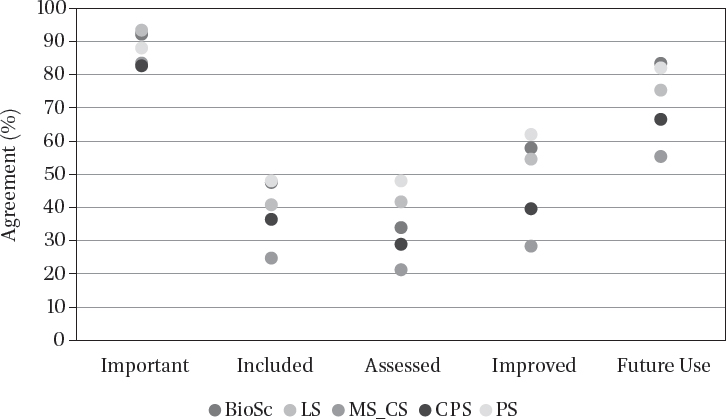
The conversation this graph sparked was introspection at a personal level (typical comments from staff outlining how they were teaching ethics) followed by some undermining of students’ understanding (views about students not “seeing” the ethics being taught to them or understanding what ethics actually is) that triggered some broader reflection (included discussions about, “well, are we teaching ethics enough? do we know how to teach ethics? whose fault is it if students don’t understand ethics?”) that led to a consensus view that the BSc at the time needed to do more to enhance the teaching and assessment of ethics (followed from a discussion of how vital ethical thinking is in science), which informed recommendations in the formal BSc Curriculum Review Submission. 40
In this example of drawing on the
In 2015 I was awarded an Australian Learning and Teaching Fellowship on “engaging students as partners in curriculum development.” Building on my applied research that captured students’ perspectives as a source of data to inform academic curricular decision-making, the Fellowship allowed me to think of students as more active, ongoing contributors and collaborators in my research that acknowledged the unique expertise that students could bring to bear on understanding how students experience learning. The key here is that I was working with students in a shared learning process that allowed students to gain research and analytic skills while learning about how the university makes sense of student generated data, and offered me fresh insights into the experiences of students to better inform research conclusions and draw more grounded implications for curriculum development in practice. In other words, working in partnership was a reciprocal learning process of mutual benefit for students and me. 42
During the analysis phase of the BSc Review, I partnered with a BSc honours student to make sense of the
In the meantime, I partnered with another undergraduate student in the BSc. As a dual or double degree student, she felt her science degree and her arts degree were not well aligned and she wanted to explore the extent of this issue with other dual degree students. While this was not a topic of particular interest to me, I appreciated her concern. Following a literature review, she found similar issues raised in differing contexts but little about the experience of students that drew on student-sourced research. We drew on the BSc review
Similar to any research process, there are ethical considerations and implications in working with students 46 along with particular issues related to the inherent power dynamics between an academic and a student. 47 By more explicitly discussing the research process, making space to discuss forms of expertise that both myself and students could contribute, a mutually agreed upon plan for collaborating and ongoing communications about the collaborative relationships, the power was never balanced or equal but was accepted and navigated in ways that worked for all involved.
Taking Seriously What Students Think While Fostering Student Agency Through Partnership in Our Work
Student engagement and success are complex ideas that are highly contested and situated within a broader political landscape that shapes how researchers and practitioners position students and imagine what success means for them. A broader view of engagement and success that give primacy to fostering student agency that translates beyond formal learning resonates with me, such as Carey’s
48
work. By bringing students’ views into the thinking and planning stages of curriculum review and development through the
Although there are many ways that academics and staff are engaging with students as partners 49 that go beyond my example presented above (see 50 for a range of approaches being implemented across Australian universities), I wanted to focus on how we—researchers of student success and learning in higher education in Australia, China, and elsewhere—can partner with students in our work. Because partnership is based on the values of mutual respect and reciprocity, evoking the broader idea of students as partners not only imagines how we engage students, but also requires us to consider our own engagement with students in learning and teaching.
Broader Implications That Translate Across Contexts
While involving students as participants in research to inform practice is commonplace, the aim of such research should always be to harness, translate, and then communicate students’ perceptions to inform tangible action through curriculum and/or policy development. Inviting students to participate in such research and then not using the data to inform practice or policy are unethical. Thus, a key implication from the first case study is how researchers must go beyond collecting and reporting data from students to a process of translation for action, which is also an ongoing conversation in the learning outcomes assessment community. 51
Partnering with students in higher education research starts a new conversation. There are several broader implications from the second case study presented above that can guide researchers to engage with student partners. Interacting with students in partnership calls into questions taken-for-granted assumptions about expertise and power hierarchies that can fundamentally upend culturally accepted norms for both students and staff. 52 Thus, engaging with students as partners in our research is far more complicated than creating a role for a student research assistant who simply follows our directions to complete specific tasks, yet the principles of effective research collaboration still apply. Partnering with students transforms research collaborations into pedagogical spaces in an explicit way. This transformation toward learning collaborations is where broader implications emerge from the single case study presented above to guide the practices of others.
Start on a small scale by working with two or three students where there is a specific yet meaningful contribution for students to make to the research endeavour. (A small group of students might build student confidence to contribute more actively)
Start the partnership by explicitly discussing the idea of working in partnership and the values underpinning how the collaboration will work, while establishing through dialogue appropriate boundaries and expectations.
Decide on personal learning goals, ways of working, and timelines together at the beginning of the partnership, and revisit and revise together as needed.
Discuss the idea of expertise and acknowledge the expertise students possess by nature of being a student in contrast to the different yet equally valuable expertise that researchers possess—emphasise the mutual learning process.
Listen more than talk. Pose open questions often and invite questions. Establish earlier on that dialogue is essential. Be okay with silence.
Create time to nurture the learning relationship that pays attention to the process of collaborating.
Be flexible to change focus or outcomes based on student contributions so the collaborative process can become co-owned as a powerful way to build student agency.
Celebrate effective processes of working together along with achievement of research outcomes or outputs.
Take seriously what students say through ongoing negotiation and dialogue while also sharing your thinking based on your expertise.
Create space for reflection about the partnership as a learning process for yourself and students.
Our beliefs about what an academic does and what a student does in the game of education are well entrenched and culturally formulated. Thus, working in partnership with students should be viewed as a long-term practice with an understanding that developing genuine partnerships take time. In my experience partnering in research with students from Australia and overseas, students receive the idea of working in partnership in differing ways with variation by cultural backgrounds.
Implication for Cross-Cultural Partnerships: Chinese Student Experience
I recently partnered with an international student from China. She contributed a blog post reflecting on students as partners and questioned how the idea would be received by Chinese students in general: 53
Throughout my schooling in China, I was rarely given opportunities to have a say on what I wanted and should learn. I never thought about it because our educational system is not designed to question the authorities. It did not seem to foster critical thinking. Most importantly, it was: “Pass the exam!” … As I see it, students as partners is an extension of the freedom that students are given in Australian universities to be heard and respected.
Because of the differences she identified about active learning in China versus Australia, she concluded that Chinese students would initially be “reluctant to ‘buy’” the idea of students as partners, but then goes on to question her own belief that Chinese students are, in fact, passive learners. She indicates that active learning looks different in different contexts and is perhaps less recognisable in Chinese universities, yet her attraction to the idea of being an active student partner actually started in her Chinese educational experiences.
While sharing the experience of a Chinese student is relevant for an article in a journal dedicated to Chinese Education, additional implications are illuminated. First, the role of reflection about partnership, learning, context and culture, and the purpose of higher education are affirmed. Second, cross- cultural partnerships are important yet challenging because our beliefs about education and how we act in educational systems are cultural dependent. Finally, the importance of context and culture when engaging in partnership warrants deeper consideration.
Conclusion
If we are truly serious about student success in higher education, then we—scholars of higher education dedicated to advancing learning—must reflect upon our own beliefs about the role of students in our research and practice. My intention with this article is to illuminate how students can have a powerful influence in shaping ideas of their own success, advocating for Cook-Sather’s 54 call that challenges us in higher education to create opportunities for students to share responsibility and ownership for their own success. As I have argued that engaging with students as partners is the future direction for the student engagement movement, 55 I am arguing here that our future approach as academics researching in the field of student success has to engage with students in ways that move them from being more than a source of data by creating a process for dialogue with students about their learning success in ways that foster student agency in their own learning. I am not suggesting we end data collection from students. Rather, I propose we involve students as participants and partners in, and across, our research endeavours, which is essential given the complexity of student success research in an increasingly complex global higher education system. In other words, we cannot truly comprehend the complexities of student success without engaging with students in our research and practices.
Footnotes
1
John Dewey. Experience and Education (New York: Simon and Schuster, 1938).
2
Hamish Coates and Kelly E Matthews. “Frontier Perspectives and Insights into Higher Education Student Success.” Higher Education Research and Development 37, no. 5 (2018): 1-5.
3
Ella R. Kahu, and Karen Nelson. “Student Engagement in the Educational Interface: Understanding the Mechanisms of Student Success.” Higher Education Research & Development 37, no. 1 (2018): 58-71.
4
Alexander W. Astin. What Matters in College?: Four Critical Years Revisited (San Francisco: Jossey-Bass, 1993); Hamish Coates, Paula Kelly, Ryan Naylor, and Victor Borden. “Innovative Approaches for Enhancing the 21st Century Student Experience.” Can Policy Learn from Practice? 23, no. 1 (2016): 62-89; George D. Kuh, Jillian Kinzie, John H. Schuh, and Elizabeth J. Whitt, Student Success in College: Creating Conditions that Matter (New York: John Wiley & Sons, 2005); Kerri‐Lee Krause, and Hamish Coates. “Students’ Engagement in First‐Year University.” Assessment & Evaluation in Higher Education 33, no. 5 (2008): 493-505.
5
Joe Cuseo. “Student Success: Definition, Outcomes, Principles and Practices.” Esource for College Transitions (2007): 1-16.
6
Philip Carey, “Student Engagement in University Decision-Making: Policies, Processes and the Student Voice.” PhD diss., Lancaster University, 2013.
7
Colin Bryson, “Clarifying the Concept of Student Engagement.” In Understanding and Developing Student Engagement, 21-42. London: Routledge, 2014.
8
Hamish Coates. “The Value of Student Engagement for Higher Education Quality Assurance.” Quality in Higher Education 11, no. 1 (2005): 25-36; Coates, Hamish. “Development of the Australasian Survey of Student Engagement (AUSSE).” Higher Education 60, no. 1 (2010): 1-17; Kuh, George D. “What We’re Learning about Student Engagement from NSSE: Benchmarks for Effective Educational Practices.” Change: The Magazine of Higher Learning 35, no. 2 (2003): 24-32.
9
Melguizo, Tatiana, and Hamish Coates. “The Value of Assessing Higher Education Student Learning Outcomes.”
10
Barnacle, Robyn, and Gloria Dall’Alba. “Committed to Learn: Student Engagement and Care in Higher Education.” Higher Education Research & Development 36, no. 7 (2017): 1326-1338.
11
Kelly E. Matthews. “Students as Partners as the Future of Student Engagement.” Student Engagement in Higher Education Journal 1, no. 1 (2016a): 1-9.
12
Kelly E. Matthews, Alison Cook-Sather, and Mick Healey. “Connecting Learning, Teaching, and Research through Student-Staff Partnerships: Toward Universities as Egalitarian Learning Communities.” In Research Equals Teaching: Inspiring Research-based Education through Student-Staff Partnerships, 23-29 (London: University College of London Press, 2018).
13
Alison Cook-Sather. “Tracing the Evolution of Student Voice in Educational Research.” In Radical Collegiality through Student Voice (New York: Springer Publishers, Forthcoming).
14
Suanne Gibson, Delia Baskerville, Ann Berry, Alison Black, Kathleen Norris, and Simoni Symeonidou. “Including Students as Co-Enquirers: Matters of Identity, Agency, Language, and Labelling in an International Participatory Research Study.” International Journal of Educational Research 81 (2017): 117.
15
Alison Cook-Sather, Catherine Bovill, and Peter Felten. Engaging Students as Partners in Learning and Teaching: A Guide for Faculty (San Francisco: John Wiley & Sons, 2014); M. Healey, A. Flint, and K. Harrington. Students as Partners in Learning and Teaching in Higher Education (York: Higher Education Academy, 2014); Kelly E. Matthews, “Five Propositions for Genuine Students as Partners Practice.” International Journal for Students as Partners 1, no. 2 (2017a): 1-9.
16
Matthews, Kelly E. “Five Propositions for Genuine Students as Partners Practice.” International Journal for Students as Partners 1, no. 2 (2017a): 1.
17
Alison Cook-Sather, Catherine Bovill, and Peter Felten. Engaging Students as Partners in Learning and Teaching: A Guide for Faculty (San Francisco: John Wiley & Sons, 2014).
18
Kelly E. Matthews, “Five Propositions for Genuine Students as Partners Practice.” International Journal for Students as Partners 1, no. 2 (2017a): 1-9.
19
Catherine Bovill. “A Framework to Explore Roles within Student-Staff Partnerships in Higher Education: Which Students are Partners, When, and in What Ways?” International Journal for Students as Partners 1, no. 1 (2017): 1-5.
20
M. Healey, A. Flint, and K. Harrington. Students as Partners in Learning and Teaching in Higher Education (York: Higher Education Academy, 2014): 7.
21
Colin Bryson, Ruth Furlonger, and Fae Rinaldo-Langridge. “A Critical Consideration of, and Research Agenda for, the Approach of ‘Students as Partners.’” In International Conference on Improving University Teaching, Ljubljana, Slovenia. 2015; Alison Cook-Sather, Catherine Bovill, and Peter Felten. Engaging Students as Partners in Learning and Teaching: A Guide for Faculty (San Francisco: John Wiley & Sons, 2014); Kelly E. Matthews, “Five Propositions for Genuine Students as Partners Practice.” International Journal for Students as Partners 1, no. 2 (2017a): 1-9; Matthews, Kelly E., Alexander Dwyer, Lorelei Hine, and Jarred Turner. “Conceptions of Students as Partners.” Higher Education (2018): 1-15.
22
Lucy Mercer-Mapstone, Sam Lucie Dvorakova, Kelly E. Matthews, Sophia Abbot, Breagh Cheng, Peter Felten, Kris Knorr, Elizabeth Marquis, Rafaella Shammas, and Kelly Swaim. “A Systematic Literature Review of Students as Partners in Higher Education.” International Journal for Students as Partners 1, no. 1 (2017): 1-23.
23
Kelly E. Matthews, Alison Cook-Sather, and Mick Healey. “Connecting Learning, Teaching, and Research through Student-Staff Partnerships: Toward Universities as Egalitarian Learning Communities.” In Research Equals Teaching: Inspiring research-based education through student-staff partnerships, 23-29 (London: University College of London Press, 2018).
24
M. Healey, A. Flint, and K. Harrington. Students as Partners in Learning and Teaching in Higher Education (York: Higher Education Academy, 2014).
25
Rachel Wenstone, “A Manifesto for Partnership. National Union of Students.”
26
Cook-Sather, Alison, Catherine Bovill, and Peter Felten. Engaging Students as Partners in Learning and Teaching: A Guide for Faculty (San Francisco: John Wiley & Sons, 2014).
27
Wenstone, Rachel. “A Manifesto for Partnership. National Union of Students.”
28
Brian Yates, Sue Jones, and Jo Kelder. “Learning and Teaching Academic Standards Project: Science.” Sydney: Office for Learning and Teaching.
29
Kelly E. Matthews, and Yvonne Hodgson. “The Science Students Skills Inventory: Capturing Graduate Perceptions of their Learning Outcomes.” International Journal of Innovation in Science and Mathematics Education 20, no. 1 (2012).
30
Faculty of Science. “Bachelor of Science Curriculum Review Submission.” Brisbane: The University of Queensland.
31
Kelly E. Matthews, Jennifer Firn, Susanne Schmidt, and Karen Whelan. “A Comparative Study on Student Perceptions of their Learning Outcomes in Undergraduate Science Degree Programmes with Differing Cirriculum Models.” International Journal of Science Education 39, no. 6 (2017): 742-760.
32
Kelly E. Matthews and Lucy D. Mercer-Mapstone. “Toward Curriculum Convergence for Graduate Learning Outcomes: Academic Intentions and Student Experiences.” Studies in Higher Education 43, no. 4 (2018): 644-659.
33
Lucie S. Dvorakova, and Kelly E. Matthews. “Graduate Learning Outcomes in Science: Variation in Perceptions of Single-and-Dual-Degree Students.” Assessment & Evaluation in Higher Education 42, no. 6 (2017): 900-913.
34
Kelly E. Matthews, Peter Adams, and Merrilyn Goos. “The Influence of Undergraduate Science Curriculum Reform on Students’ Perceptions of their Quantitative Skills.” International Journal of Science Education 37, no. 16 (2015): 2619-2636; Lucy D. Mercer-Mapstone, and Kelly E. Matthews. “Student Perceptions of Communication Skills in Undergraduate Science at an Australian Research-Intensive University.” Assessment & Evaluation in Higher Education 42, no. 1 (2017): 98-114.
35
Kelly E. Matthews, Peter Adams, and Merrilyn Goos. “Quantitative Skills as a Graduate Learning Outcome: Exploring Students’ Evaluative Expertise.” Assessment & Evaluation in Higher Education 42, no. 4 (2017): 564-579.
36
Kelly E. Matthews, Yvonne Hodgson, and Cristina Varsavsky. “Factors Influencing Students’ Perceptions of their Quantitative Skills.” International Journal of Mathematical Education in Science and Technology 44, no. 6 (2013): 782-795; Cristina Varsavsky, Kelly E. Matthews, and Yvonne Hodgson. “Perceptions of Science Graduating Students on their Learning Gains.” International Journal of Science Education 36, no. 6 (2014): 929-951.
37
Deborah King, Cristina Varsavsky, Shaun Belward, and Kelly E Matthews. “Investigating students’ Perceptions of Graduate Learning Outcomes in Mathematics.” International Journal of Mathematical Education in Science and Technology 48, no. 1 (2017): S67–S80.
38
Faculty of Science. “Bachelor of Science Curriculum Review Submission.” Brisbane: The University of Queensland.
39
Michael J. Drinkwater, Kelly E. Matthews, and Jacob Seiler. “How Is Science Being Taught? Measuring Evidence-Based Teaching Practices across Undergraduate Science Departments.” CBE -Life Sciences Education 16, no. 1 (2017): ar18.
40
Faculty of Science. “Bachelor of Science Curriculum Review Submission.” Brisbane: The University of Queensland.
41
Kelly E. Matthews. “Student Voice in Curriculum Review: Students as Partners.” In Australian Council of Deans of Science Education Conference, 2016b.
42
Alison Cook-Sather, Catherine Bovill, and Peter Felten. Engaging Students as Partners in Learning and Teaching: A Guide for Faculty (San Francisco: John Wiley & Sons, 2014); M. Healey, A. Flint, and K. Harrington. Students as Partners in Learning and Teaching in Higher Education (York: Higher Education Academy, 2014).
43
Lucy D. Mercer-Mapstone and Kelly E. Matthews. “Student Perceptions of Communication Skills in Undergraduate Science at an Australian Research-Intensive University.” Assessment & Evaluation in Higher Education 42, no. 1 (2017): 98-114.
44
Kelly E. Matthews, and Lucy D. Mercer-Mapstone. “Toward Curriculum Convergence for Graduate Learning Outcomes: Academic Intentions and Student Experiences.” Studies in Higher Education 43, no. 4 (2018): 644-659.
45
Lucie S. Dvorakova, and Kelly E. Matthews. “Graduate Learning Outcomes in Science: Variation in Perceptions of Single-and-Dual-Degree Students.” Assessment & Evaluation in Higher Education 42, no. 6 (2017): 900-913.
46
Alison Cook-Sather. “Tracing the Evolution of Student Voice in Educational Research.” In Radical Collegiality through Student Voice (New York: Springer Publishers, Forthcoming).
47
Kelly E. Matthews. “Students as Partners as the Future of Student Engagement.” Student Engagement in Higher Education Journal 1, no. 1 (2016a): 1-9.
48
Philip Carey. “Student Engagement in University Decision-making: Policies, Processes and the Student Voice.” PhD diss., Lancaster University, 2013.
49
Alison Cook-Sather, Catherine Bovill, and Peter Felten. Engaging Students as Partners in Learning and Teaching: A Guide for Faculty (San Francisco: John Wiley & Sons, 2014); M. Healey, A. Flint, and K. Harrington. Students as Partners in Learning and Teaching in Higher Education (York: Higher Education Academy, 2014).
50
Kelly E. Matthews. “Students and Staff as Partners in Australian Higher Education: Introducing our Stories of Partnership.” Teaching and Learning Together in Higher Education 1, no. 21 (2017b): 1-4.
51
Hamish Coates. “The Value of Student Engagement for Higher Education Quality Assurance.” Quality in Higher Education 11, no. 1 (2005): 25-36; Hamish Coates, “Development of the Australasian Survey of Student Assessment (AUSSE).” Higher Education 60, no. 1 (2010): 1-17.
52
Kelly E. Matthews. “Five Propositions for Genuine Students as Partners Practice.” International Journal for Students as Partners 1, no. 2 (2017a): 1-9.
53
Yitong Bu. “Do International Students Buy the Idea of ‘Students as Partners?’ Will SaP be beneficial for them?” Students as Partners in Global Learning (2017).
54
Alison Cook-Sather, “Listening to Equity-seeking Perspectives: How Students’ Experiences of Pedagogical Partnership Can Inform Wider Discussions of Student Success.” Higher Education Research and Development (in press).
55
Kelly E. Matthews, “Students as Partners as the Future of Student Engagement.” Student Engagement in Higher Education Journal 1, no. 1 (2016a): 1-9.