




Abstract
Open educational resources (OER) have been developed to free students from the expense and instructors from the restrictions of commercial materials. There has been a wealth of empirical examination on numerous aspects of OER. The purpose of this narrative review is to synthesize and integrate the findings on OER in psychology to assist instructors in making informed decisions about course materials. Topics in this review were organized according to the Cost, Outcomes, Usage, and Perceptions framework. Results indicated that OER adoption yielded cost savings while generally having similar or better outcomes in terms of grades. Students typically reported similar use and perceptions of OER compared to commercial course materials. Resources for instructors interested in OER are described. Criticisms of OER, such as concerns about quality, are addressed as well as limitations of reviewed research and future directions for research and development of OER.
Introduction
The cost of materials for postsecondary courses, especially textbooks, has increased dramatically in the past few decades (Perry, 2015). This high cost of course materials often results in students making decisions that are not advantageous to their educational goals, such as enrolling in fewer courses per semester (Florida Virtual Campus, 2016). Also, students often go without their required materials or opt to use less expensive, even outdated materials, even though they know having the current versions of their required course materials would be academically beneficial (Florida Virtual Campus, 2016; U.S. Public Interest Research Group Education Fund and Student Public Interest Research Groups (USPIRG), 2014). This limits faculty in their design of course activities because their students could have different versions of course materials, be waiting to have the financial aid to obtain their materials, or opt to not obtain materials to avoid the cost entirely (Diener, Diener, & Biswas-Diener, 2017; Watson, Domizi, & Clouser, 2017). In addition, faculty members are constrained in how they can use commercial course materials with copyrights that prohibit adaptations and sharing of resources (Bissell, 2009; Hilton, Wiley, Stein, & Johnson, 2010).
In response to these issues, Open Educational Resources (OER), which are defined as “digitized materials offered freely and openly for educators, students, and self-learners to use and reuse for teaching, learning, and research,” have been developed (Bissell, 2009, p. 97). OER include textbooks, short readings, modules, lesson plans, artwork, videos, music, or podcasts (Butcher, 2015). OER are free in terms of being available for use by educators and students, without license fees (Smith, 2009). OER are free to be adapted and mixed by faculty (although the extent to which they can be changed varies by the license; see Green, 2017; Hilton et al., 2010) and can be shared on course learning management sites (Feldstein, Martin, Hudson, Warren, Hilton, & Wiley, 2012).
In this narrative review, the empirical findings on studies of the use of OER in postsecondary college courses are presented. The focus was on teaching psychology; however, studies of multiple disciplines that had separate findings for psychology courses were included. The purpose is to provide an overview of the empirical findings so that instructors of postsecondary psychology may make informed decisions regarding OER adoption for their courses. Such a review is necessary because one of the barriers to OER adoption by faculty is concerns about the quality and efficacy of OER (Allen & Seaman, 2014; Belikov & Bodily, 2016; Hassall & Lewis, 2017). To organize this review, the Cost, Outcomes, Use, and Perceptions (COUP) framework was used. The COUP framework emphasizes the four areas considered most important in OER research, those being cost (e.g., financial for students and institutions), outcomes (e.g., course grades), use (how much the book is read and reading strategies used by students), and perceptions (of the book quality by students and faculty; Bliss, Robinson, Hilton, & Wiley, 2013). Following the descriptions of the studies, there is a section on resources for instructors interested in using OER. Finally, there is a section with limitations and future directions in OER research.
Methods
Summary of findings on OER specific to psychology.
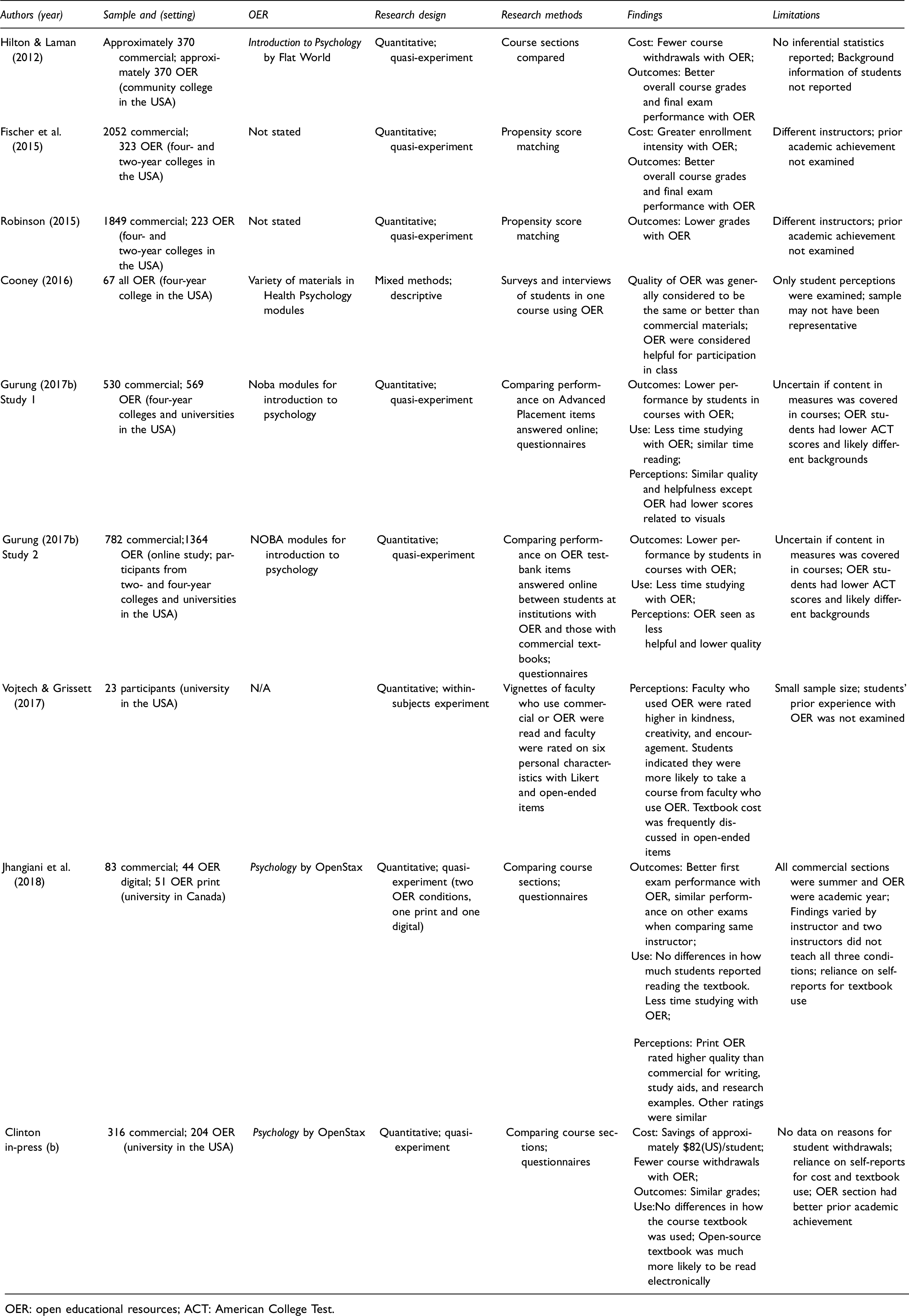
OER: open educational resources; ACT: American College Test.
As can be seen in Table 1, one type of OER that has received a great deal of attention and scholarship in psychology is open textbooks, which is typical of OER research in general (Weller, de los Arcus, Farrow, Pitt, & McAndrew, 2017). Open textbooks are similar in organization and content to commercial textbooks, but their licensing allows them to be available to access electronically without cost and be adapted by users (Weller et al., 2017). The growth of open textbooks is likely related to the ubiquity of textbooks as required course materials (Illowsky, Hilton, Whiting, & Ackerman, 2016), coupled with high costs of commercial textbooks (USPIRG, 2014). Open textbooks are particularly appealing to faculty because they can be edited and adapted (Griggs & Jackson, 2017a). In contrast, faculty members may be frustrated with outdated or inaccurate information presented in a commercial textbook, which cannot be changed under the copyright (Bliss & Smith, 2017). Therefore, it is not surprising that many of the studies on OER have focused on open textbooks (see Hilton, 2016, for a review). For these reasons, this review covers issues related to OER in general, but much of the empirical work presented is specific to open textbooks.
Results
Cost
The issue of cost in OER adoption in psychology involves a variety of metrics, such as student financial savings on textbook costs as well as costs in terms of changes in course withdrawal. Textbook cost is often stated by faculty as the primary motivation to adopt OER in order to reduce financial barriers to their courses (Ozdemir & Hendricks, 2017). Indeed, students often emphasize how much they appreciate the cost savings of OER when discussing their experiences with the materials (Cooney, 2016). Furthermore, the cost savings of OER addresses broader goals of more equitable access to education (Biswas-Diener & Jhangiani, 2017). Frequently, cost-savings are considered in terms of potential savings based on the price of a new textbook for a course (Hilton, Robinson, Wiley, & Ackerman, 2014). However, students often obtain access to textbooks through less expensive means than purchasing a new copy, such as sharing textbooks, downloading pirated copies, or using an outdated edition (which is generally much less expensive than the current edition; Christie, Politz, & Middleton, 2009; Jhangiani & Jhangiani, 2017; Moxley, 2013). Moreover, students report not purchasing the textbook at all if the cost is prohibitive (Florida Virtual Campus, 2016). One study reviewed compared the financial costs of an open and commercial textbook (Clinton, in-press (b)). Using student self-reports of textbook cost (including estimations of paper and ink for self-printing), Clinton (in-press (b)) found that students spent on average approximately $84 on the commercial textbook and $2 on the open textbook. This indicates that despite the resourcefulness of students in saving money on textbooks, there were financial savings in open textbook adoption. However, this finding was based on self-reports, so students may have misestimated or incorrectly recalled their actual textbook costs.
Course withdrawals are expensive to both the student and the institution. Withdrawing from a course financially affects students in terms of tuition loss and delays in graduation (Moore & Shulock, 2009). Due to issues related to accountability and time-to-degree completion rates, institutions incur negative consequences when students withdraw from courses (Hall, Smith, Boeckman, Ramachandran, & Jasin, 2003). Although students withdraw from classes for many reasons, such as dislike of the instructor or materials (Hall et al., 2003), a common reason for withdrawing from a course is financial problems (Michalski, 2014). Approximately one-fifth of postsecondary students reported that they have withdrawn from a course because of the cost of the textbook (Florida Virtual Campus, 2016). In other words, even though students have long-term financial costs associated with course withdrawal, they may be more likely to drop a course if they do not have the funds immediately available to purchase the textbook. Findings from two studies show course withdrawal rates for introduction to psychology were lower when an open textbook was adopted (Clinton, in-press (b); Hilton & Laman, 2012). In one of the studies, the reduction in withdrawal rates with an open textbook adoption was found even though the students who withdrew had similar levels of prior academic achievement (as indicated by high school grade point average; Clinton, in-press (b)). In these studies, the instructor and the course material (two common reasons for withdrawal; Hall et al., 2003) were held constant, so it is possible that the open textbook was a factor in the change in withdrawal rate. However, neither study included data to assess the role of the textbook on the decision from those students who withdrew, and one did not include tests of statistical significance (Hilton & Laman, 2012).
Outcomes
Student outcomes in OER research has typically focused on performance measures in their courses, such as overall grade, passing rates, and exam grades. However, there was one study in which performance on a standardized assessment chosen by a researcher was compared between students enrolled in courses with OER and those using commercial textbooks (Gurung, 2017b). In terms of results, two studies on performance favor OER (although they may be limited to certain measures), two studies found no differences between OER and commercial materials, and two studies favored commercial materials.
In one of the first empirical examinations on OER adoption, Hilton and Laman (2012) compared course grades and final examination performance between a semester taught using a commercial textbook and a semester taught using an open textbook published by Flat World Knowledge (Stangor, 2011), for “Introduction to Psychology” courses taught by the same instructors. The averages for student overall course grades and final examination performance were higher for the open source textbook compared to the commercial textbook; however, inferential tests of statistical significance were not conducted (Hilton & Laman, 2012) so the generalizability of this finding is quite limited. It should be noted that Hilton and Laman (2012) did not have data on student characteristics (e.g., high school grade point average, standardized test scores, prior psychology knowledge) that would be helpful for comparisons between semesters with different course materials. In addition, the open textbook adoption involved faculty development of supplementary materials to accompany the adoption, which could have affected student performance (Hilton & Laman, 2012).
When comparing performance on the same exams in courses taught by the same instructor using different textbooks, students performed better on the first exam of the semester if they had an open textbook (Psychology by OpenStax, 2014) rather than a commercial textbook, despite similar scores on a pretest of psychology knowledge (Jhangiani, Dastur, LeGrand, & Penner, 2018). Jhangiani et al. (2018) speculate that this could be because some students may have waited to see how they performed on the first exam before purchasing the commercial textbook. This speculation is supported by the similar grades on subsequent exams (Jhangiani et al., 2018). However, different academic terms were compared, which could contribute to differing student characteristics.
Similar to Jhangiani et al.’s (2018) design, Clinton (in-press (b)) compared student grades in an Introduction to Psychology course in a semester using a commercial textbook with a semester using an open textbook (OpenStax). Clinton (in-press (b)) found that grades were similar, after students’ prior academic achievement was considered. Like Jhangiani et al. (2018), different terms were compared so there are similar issues of different student characteristics. Another study found that there were generally no differences between grades in psychology courses using OER and those using commercial textbooks at several community and four-year colleges (Fischer, Hilton, Robinson & Wiley 2015). However, the sample size was not adequate to conduct propensity score matching with outcomes for grades in specific courses. Without control of the influences of demographics, prior academic achievement, and instructor, it is difficult to discern what the specific role of OER was on grades.
The results from two studies show worse student outcomes with OER. In one, Robinson (2015), propensity scores were used to match students based on demographics in an approach similar to Fischer et al. (2015). Unlike Fischer et al. (2015), Robinson (2015) found that students in psychology courses with OER had lower grades than did students in courses with commercial materials. Similar to the limitations of Fischer et al. (2015), Robinson’s (2015) findings should be interpreted cautiously as students’ prior academic achievement was not considered and different instructors were compared. In addition, the type of OER and/or commercial textbooks used may explain the conflicting findings between Robinson (2015) and Fischer et al. (2015), but details about the materials were not provided in either report.
Gurung (2017b) conducted a multi-institution study comparing Introduction to Psychology students enrolled in courses using an open textbook (Noba; Biswas-Diener & Diener, 2014) to those in courses with commercial textbooks. Instead of examining learning outcomes based on course grades, Gurung (2017b) used researcher-chosen measures in two separate studies, one based on the Psychology Advanced Placement exam and the second on the Noba testbank, both of which students completed online. This allowed for objective comparisons using the same measures thereby controlling for fluctuations in grades due to instructor, which is a clear strength of the study. Students enrolled in courses using OER scored lower on the learning measures than did students enrolled in courses using a commercial textbook even with controlling for American College Test (ACT) scores, reported time studied, and ratings of both the instructor and textbook in the analyses (Gurung, 2017b). However, it was uncertain if the courses covered the content in the assessments used in these studies. Furthermore, Gurung (2017b) noted a limitation that students in OER courses reported lower ACT scores than students in courses with commercial textbooks. Although Gurung included a control for ACT scores in outcome analyses, it is possible that differences in ACT scores could be indicative of other issues that could affect performance on learning measures that were not controlled, such as native language or socioeconomic status (Gaertner & McClarty, 2015). Despite these limitations, the lower performance on objective measures by students in courses with OER is concerning and prompts a need for scrutiny of OER.
Use
Research on OER has included examinations of how much students use their textbooks, the strategies involved when reading their textbooks, and methods of accessing their textbooks (e.g., Hendricks, Reinsberg, & Rieger, 2017; Jung, Bauer, & Heaps, 2017; Medley-Rath, in-press). Three studies that specifically examined the use of psychology OER were reviewed.
In terms of reading the course material, two studies found no differences between courses with OER compared to commercial textbooks (Gurung, 2017b, Study 1; Jhangiani et al., 2018). In addition, another study found that students reported using their course textbook to prepare for classes and exams similarly for an open textbook and a commercial textbook (e.g., exam preparation, reading to prepare for class; Clinton, in-press (b))
. However, differences in the time spent studying for courses with OER or commercial materials have been found. A multi-institution study found students in courses with open textbooks through the Noba project reported spending less time studying than students in courses with commercial textbooks (Gurung, 2017b). This includes both study behaviors that use the book (e.g., reading, highlighting) and behaviors that do not use the book (e.g., making flashcards, reviewing lecture notes). Moreover, Jhangiani et al. (2018) found that students reported spending less time studying for their courses with OER than commercial materials.
OER are typically freely available for students to access electronically; however, paper materials would involve costs with either printing or ordering a hard copy (Hilton & Wiley, 2011). Students generally read their psychology OER on a laptop or other electronic device rather than printing materials or ordering paper copies (Clinton, in-press (b); Cooney, 2016; Gurung, 2017b), likely to avoid the costs involved with reading from paper. This is despite college students indicating an overwhelming preference for reading from paper over electronic text (Aharony & Bar-Ilan, 2018; Mizrachi, 2015). For this reason, there may be concerns that students would be less willing to read electronic materials than paper or read these materials less well. Indeed, two recent meta-analyses comparing experimental findings on reading from paper and electronic sources noted a small benefit of reading from paper for performance on assessments (Clinton, in-press (a); Kong, Seo, & Zhai, 2018), although learning outcomes from reading textbooks specifically have been found to be equivalent between paper and electronic media (Taylor, 2011). To test the possibility that medium may relate to use of OER and learning in psychology, Jhangiani et al. (2018) conducted a quasi-experiment in which classes were assigned to one of three conditions: commercial textbook, open textbook with free print copies provided, and open textbook with free electronic access (with the option to print at one’s own cost). The purpose of the free print copy condition was to compare the same textbook in print or electronic medium while keeping the cost constant. Jhangiani et al. (2018) found that students reported reading from their textbook similarly between medium conditions and that learning outcomes were comparable. In other words, using an electronic textbook for a course did not lead to negative effects on learning, unlike what was found in the meta-analysis (Clinton, in-press (a)).
Perceptions
Perceptions in the COUP framework involve student and faculty opinions of OER in multiple manners. In four of the five studies on perception reviewed (Clinton, in-press (b); Cooney, 2016; Gurung, 2017b; Jhangiani et al., 2018), researchers have examined how students perceive the quality of OER, whether OER are considered useful, and how effective OER are considered to be as learning tools. Another area of perceptions that has been examined is student opinions of faculty who adopt OER.
In broad examination of OER quality, almost all of the students in a health psychology course indicated the quality of the OER (modules with a variety of media) was the same or better than that of commercial materials and that they would register for another course using similar OER (Cooney, 2016). Another broad metric of quality is how much students think a textbook is worth. When asked what a fair price would be for the textbook, students estimated similar values for commercial and open textbooks (Jhangiani et al., 2018).
More fine-grained examinations of student perceptions of quality that directly compare students using an open textbook with students using a commercial textbook have been conducted in three studies (Clinton, in-press (b); Gurung, 2017b; Jhangiani et al., 2018). Findings from these studies indicate generally similar ratings for textbook characteristics, such as helpfulness and quality of examples (Jhangiani et al., 2018), questions to test understanding (Clinton, in-press (b)), and helpfulness of research studies described (Gurung, 2017b; Jhangiani et al., 2018). One area of examinations in which there are differences in findings has been the visuals. In one study, students with an open textbook (Noba) indicated lower perceptions of quality for the figures and photographs than did students with a commercial textbook (Gurung, 2017b). In contrast, the quality and appeal of the visuals in OpenStax’s textbook was considered similar to the commercial textbook in a separate study using the same measures (Jhangiani et al., 2018). In addition, another study found that students liked the visuals (diagrams, tables, photographs, and illustrations) similarly for the open and commercial textbook (Clinton, in-press (b)). The difference in findings may be due to the type of open textbook examined because the Noba textbook does not have many visuals compared to the OpenStax textbook.
Student perceptions of their textbook’s writing is of particular importance, as it is positively correlated both with how much they read and performance on course exams (Gurung & Martin, 2011). In two studies comparing the OpenStax textbook to a commercial textbook, students indicated that the writing was more understandable in the OpenStax textbook (Clinton, in-press (b); only for comparisons of a print open textbook in Jhangiani et al., 2018). This finding is somewhat surprising given that computerized analyses of the two textbooks indicated that the writing in the OpenStax textbook was at a higher-grade level and subsequently would be considered more difficult than the writing in the commercial textbook (Jhangiani et al., 2018). In addition, a critical analysis by two psychology professors concluded that this textbook had a low level of writing quality, noting a lack of consistency in the writing style throughout the chapters (Griggs & Jackson, 2017a). One reason could be how the examples are presented, as students indicated the examples were more effective in the open textbook than the commercial textbook (Jhangiani et al, 2018). In this way, the writing that described examples well may have been more understandable despite the lower readability metrics and issues with consistency.
In terms of perceived helpfulness, the majority of students indicated the OER were helpful in that they improved their grade and assisted with class participation (Cooney, 2016). Moreover, students indicated that there were more study aids and that the study aids were more helpful with the OpenStax textbook than the commercial textbook (Jhangiani et al., 2018). In contrast, in the first of Gurung’s (2017b) studies, students in courses using a Noba textbook indicated their course textbook was similar in helpfulness to students in courses using commercial textbooks. However, in Gurung’s (2017b) second study, students with commercial textbooks rated their materials as more helpful than students with OER (also a Noba textbook). One of the commercial textbooks differed between Study 1 and Study 2, which could explain the disconnect in findings.
In addition to student viewpoints on the quality of OER themselves, there is also the issue of how students perceive instructors who use OER. Vojtech and Grissett (2017) examined this by having students read vignettes in which faculty who use OER or commercial textbooks were described. Faculty who were described as using OER were rated as more kind, more creative, and more encouraging than faculty described as using a commercial textbook. In open-ended responses, students frequently commented on textbook cost to be a factor in their ratings. In addition, a faculty member’s ability to make changes to OER appeared to be a justification for creativity ratings.
When discussing perceptions of OER, it is important to note the debate over issues related to quality with OER (see Gurung, 2017a). As presented in this review, much of the research on perceptions of OER has indicated that students view the quality as comparable to commercial materials (see Hilton, 2016, for a broader review). However, a critical analysis was conducted on three open Introduction to Psychology textbooks and the conclusion was that the quality was lower than that of commercial textbooks (Griggs & Jackson, 2017a). This assessment was based on the amount of coverage of topics typically covered in Introduction to Psychology courses, writing style, and updating of content. Griggs and Jackson (2017a) criticized the use of teams of writers for the Noba and OpenStax textbooks for causing a lack of continuity of writing style across chapters. One positive feature noted by Griggs and Jackson (2017a) was that most of the OER they reviewed were at an appropriate level of difficulty.
One reason for the disconnect between the findings on perception covered in this review and the critical analysis by Griggs and Jackson (2017a) could be due to how quality is operationalized. For example, students often comment on the ease of online access of OER as an aspect of their quality, as they appreciate the convenience (Bliss et al., 2013; Clinton, in-press (b)). Faculty who use the resources may see one element of quality as the flexibility and adaptability of materials for their courses (Jhangiani et al., 2018; Jhangiani, Pitt, Hendricks, Key, & Lalonde, 2016). Moreover, the immediate and online accessibility of OER provides faculty members more freedom with course design because a barrier to students being prepared for class is removed (Bliss et al., 2013). Although not specifically tested, it is possible that if faculty have positive attitudes towards OER for these reasons, their students may embrace similar perceptions of quality. These characteristics (accessibility, adaptability, flexibility) were not incorporated into the metrics used by Griggs and Jackson (2017a) for their critical analysis. Conversely, the measures that Griggs and Jackson used (2017a; e.g., content coverage, writing consistency, and updated content) were not specifically examined in the studies covered in this review.
Instructor Resources for OER
Instructors interested in finding OER may find the University of Minnesota’s open textbook library helpful (Center for Open Education, 2018). This library contains textbooks that have either been used at multiple institutions or are affiliated with a reputable organization, as well as instructor reviews. One of the library’s requirements is that the OER be downloadable for offline access, which is important given that students in one study reported insufficient internet access was a difficulty in accessing their OER modules (Cooney, 2016). Downloading also allows for printing, which may also be helpful given college students’ overwhelming preference for reading from paper compared to screens (Aharony & Bar-Ilan, 2018; Mizrachi, 2015).
The OER movement has been criticized for focusing on content over pedagogy (Knox, 2013). Indeed, much of the discourse related to OER has centered on freely accessible resources rather than teaching and learning (Paskevicius, Veletsianos, & Kimmons, 2018). It is true that some open textbooks often have less in terms of instructor resources than what is provided by commercial textbook companies (Gurung, 2017a). However, there are other sources for instructor resources outside of those developed by commercial publishers. The Multimedia Educational Repository for Learning and Online Teaching (MERLOT) may be particularly helpful for instructors using OER in their courses. MERLOT is a helpful catalog of teaching resources that instructors can access for free (Cafolla, 2006). MERLOT’s psychology instructor resources include videos, animations, games, activities, and lesson plans (Brinthaupt, Pilati, & King, 2008; Hartnett, 2017). A collection of open resources (with Creative Commons Licensing) specific to teaching research, statistics, and writing in psychology is TeachPsychScience.Org (Strohmetz, Ciarocco, & Lewandowski, 2017). Furthermore, it should be noted that OpenStax and Noba introduction to psychology textbooks include test banks and other resources (e.g., OpenStax has embedded video links in its psychology textbook; Baraniuk, Finkbeiner, Harris, Nichoson, & Williamson, 2017; Diener et al., 2017).
Limitations and Future Research
Across the studies, the findings on cost, use, and perceptions were based on self-reports. Self-reports are limited in that they are subject to both the awareness of the participant (e.g., memory for how much was spent on a textbook) and the willingness for the participant to disclose information. It is challenging to obtain self-reports of cost or perceptions without self-reports, but use of digital OER could be examined through online access and viewing data (see Gyllen, Stahovich, & Mayer, in-press, for an example of such a study with a commercial textbook and Giannakos, Chorianopoulos, & Chrisochoides, 2015, for an example of learning analytics with open videos). In addition, students may appreciate the cost savings of OER and have a positive bias in their responses (Jhangiani et al., 2018). To address this potential bias, it would be helpful to conduct an experiment in which college students read an excerpt from an open or commercial textbook then provide perception ratings while blind to the textbook’s funding source.
The research reviewed was quantitative with the exception of one study with interviews (Cooney, 2016) and two studies with open-ended item analyses (Clinton, in-press (b); Voitech & Grissett, 2017). This is typical of research in OER (see Hilton, 2016), which indicates that future research with qualitative methods would be informative. Such work would provide insight into the lived experiences of faculty and students who have used OER as well as assist with understanding conflicts in some findings (e.g., Robinson, 2015 and Fischer et al., 2015).
Because of the adaptable nature of OER, Griggs and Jackson (2017b) commented that it is difficult to empirically compare OER with commercial resources that have restricted use. It is true that the use of an open textbook varies much more by instructor, given the flexibility of its licensing, compared to a commercial textbook with a traditional copyright (Weller et al., 2017). That said, a key feature of OER is that they can be adapted. The OER movement is about much more than free books, it is about freeing faculty to customize materials in a way that would best promote student learning (Jhangiani, 2017). Therefore, there are calls to emphasize the opportunities for customized course design afforded by OER in addition to their cost savings (Blick & Marcus, 2017; Jhangiani, 2017; Wiley, 2017). For example, if faculty are more invested in their courses because of designs afforded by OER, it is possible that students would benefit from this. However empirical findings on this issue were not found in this review, indicating that this would be a potential avenue for future research.
The research covered in this review was all conducted in North America, although the use of OER is global (Bliss & Smith, 2017). Given that textbook availability and use varies by country (Krämer, Neugebauer, Magenheim, & Huppertz, 2015; Milligan, Tikly, Williams, Vianney, & Uworwabayeho, 2017; Pangeni, 2016), future research should examine OER experiences outside of North America. One issue that may be particularly important to consider is whether the ease of access and cost savings of OER for students in locations where internet and computer access is common carries over for students in locations in which access to technological resources is limited (Butcher, 2015).
Conclusions
OER provide opportunities for both free materials to improve student access to education and freedom for instructors to adapt materials to suit their needs (Jhangiani, 2017). In this narrative review, the empirical evidence on psychology OER is presented through the guidance of the COUP framework (Bliss et al., 2013). The findings indicate that there is a cost savings both in terms of student finances and in course withdrawal (which can be expensive to both the students and the institution). However, it is unclear what role OER had in course withdrawal. In terms of outcomes, grades tended to be similar in psychology courses with OER and commercial materials (Clinton, in-press (b); Fischer et al., 2015; Hilton & Laman, 2012; Jhangiani et al., 2018; with Robinson, 2015 as an exception with lower grades in OER courses). Students in courses with OER performed less well on objective measures than did students in courses with commercial materials (Gurung, 2017b), which, although a number of possible factors were likely involved, indicates a need for more research with objective measures on OER. The use of objective measures could also address issues with instructor subjectivity with grades in studies comparing course performance.
Students reported using and reading OER and commercial materials similarly (Clinton, in-press (b); Gurung, 2017b; Jhangiani et al., 2018); however, students appeared to study more in courses with commercial materials than OER (Gurung, 2017b; Jhangiani et al., 2018). This potential confound of study time should be considered when interpreting findings from OER studies. Student perceptions of quality were generally similar with some minor variations, such as the writing quality was considered better for the open textbook than the commercial textbook in two studies (Clinton, in-press (b); Jhangiani et al., 2018) whereas the visuals were perceived as better for the commercial textbook than the open textbook in a different study (Gurung, 2017b). Therefore, fine-grained measures may be more appropriate than broad measures of quality to illuminate specific issues in quality perceptions. Outside of the materials themselves, students may perceive faculty who adopt OER more positively (Vojtech & Grissett, 2017) perhaps because students appreciate it when faculty consider the financial burdens of postsecondary education. In summary, the bulk of the empirical research in this narrative review indicates that OER offer comparable quality and learning opportunities at a much lower financial cost than commercial materials. Psychology instructors can use the findings presented in this review to make informed choices about course materials in their courses.
Footnotes
Declaration of Conflicting Interests
The author(s) declared no potential conflicts of interest with respect to the research, authorship, and/or publication of this article.
Funding
The author(s) received no financial support for the research, authorship, and/or publication of this article.