



Abstract
Mindfulness practices improve cognition, emotional balance, and well-being in clinical and non-clinical populations. The bulk of mindfulness research in higher education has focused on improving psychological and cognitive variables, leaving academic performance largely unexplored. We investigated the effects of a brief mindfulness intervention on quiz performance in two sections of an undergraduate upper-level human development class (N = 67). We used a between-group experimental design (waiting control group) and compared student quiz scores. Students assigned to practice mindfulness performed better on the first two quizzes than the control group. When the control group received the mindfulness intervention, there was no significant difference on quiz performance between the two groups. Mindfulness training did not impact state mindfulness or exam scores. Taken together, our results suggest that small doses of mindfulness training can briefly enhance students' knowledge retention of lecture content.
Introduction
Over a hundred years ago, educators recognized that a crucial cognitive capacity related to academic achievement is knowing how to direct and sustain focused attention on relevant stimuli. For example, William James famously said, “the faculty of voluntarily bringing back a wandering attention, over and over again, is the very root of judgment, character, and will … An education which should improve this faculty would be the education par excellence” (James, 1890, p. 424). However, he went further on to say that this was “easier to define this idea than to give practical directions for bringing it about.” Today, researchers in psychology and neuroscience are beginning to reveal that training in mindfulness is rooted in what James regarded as, ‘bringing back a wandering attention over and over again’ (e.g., see Slagter, Davidson, & Lutz, 2011).
Practicing mindfulness involves moment-to-moment monitoring of attention with an emphasis placed on sustaining focus on the present (Gallant, 2016). When the mind wanders or distraction arises, individuals are taught to acknowledge these internal or external distractors (e.g., thoughts or sounds) and shift attention back to the present without judgment. Mindfulness is most commonly defined as, “the awareness that arises from paying attention on purpose, in the present moment, nonjudgmentally” (Kabat-Zinn, 2003, p. 145). Within the literature, mindfulness is conceptualized as both a distinct form of attention and awareness (i.e., a mental state) and as a dispositional trait that is cultivated through regular mindfulness practice (Brown & Ryan, 2003).
Mindfulness-based interventions are increasing in popularity as empirical research continues to reveal the beneficial effects associated with formal mindfulness practice (mindfulness meditation). Randomized controlled studies consistently show that mindfulness interventions have a therapeutic effect on a broad range of medical conditions and psychological disorders (e.g., chronic pain, chronic stress, depression, anxiety, and addiction) and a performance enhancing effect on cognitive and affective variables such as attentional skills, metacognitive awareness, and emotional stability in healthy populations (for a review, see Creswell, 2016). Overall, cultivating mindfulness has been shown to facilitate adaptive psychological functioning that results in positive psychological effects (e.g., increased subjective well-being, reduced psychological distress, and improved behavioral regulation) in both clinical and nonclinical populations (Keng, Smoski, & Robins, 2011). Past research indicates that the involvement of executive functions may help explain the beneficial effects of mindfulness-based practices on psychological health and well-being (Short, Mazmanian, Oinonen, & Mushquash, 2015). This is consistent with recent neuroscientific findings that show mindfulness training is associated with enhanced functioning in brain regions related to attentional control, emotion regulation, and self-awareness (Tang, Hölzel, & Posner, 2015). Taken together, the empirical literature suggests that mindfulness training may enhance important cognitive abilities and psychological mechanisms that facilitate academic achievement.
In a recent systematic review of mindfulness-based interventions in schools, Waters, Barsky, Ridd and Allen (2015) report that various countries across the world have developed mindfulness-based programs, such as England (Mindfulness in Schools Project, DotB), the United States (Mindful School and MindUp), Canada (Mindful Education), Israel (The Mindfulness Language), and India (The Alice Project). This international educational interest in the utility of mindfulness programs reflects the growing amount of empirical studies investigating the effects of mindfulness-based interventions in school settings. In a recent meta-analysis, Zenner, Hernleben-Kurz, and Walach (2014) found that in grades K-12, mindfulness training had the largest effect on students’ cognitive performance, resilience, stress, and emotional problems, respectively. Furthermore, preliminary evidence suggests that mindfulness interventions improve children’s academic performance (e.g., Bakosh, Snow, Tobias, Houlihan, & Barbosa-Leiker, 2016; Beauchemin, Hutchins, & Patterson, 2008; Thierry, Bryant, Speegle Nobles, & Noris, 2016).
In higher education, mindfulness-based interventions are also found to benefit students. For example, in college student populations, mindfulness training has been shown to reduce stress and anxiety (Bamber & Kraenzle Schneider, 2016), improve psychological well-being (de Vibe et al., 2013), sleep quality and mood (Caldwell, Harrison, Adams, Quin, & Greeson, 2010), and enhance various cognitive abilities such as executive attention, working-memory, cognitive inhibition, and cognitive flexibility (Moore, Gruber, Derose, & Malinowski, 2012; Moore & Malinowski, 2009; Morrison, Goolsarran, Rogers, & Jha, 2014; Tang et al., 2007; Zeidan, Johnson, Diamond, David, & Goolkasian, 2010). These enhancing effects on cognitive functions are particularly important as previous research indicates that deficits in executive functioning is a predictor of impaired academic performance in college students (Knouse, Feldman, & Blevins, 2014). Researchers suggest that mindfulness interventions may be one promising avenue to facilitate academic achievement in college student populations (e.g., Shapiro, Brown, & Astin, 2011). However, empirical studies examining the effect of mindfulness training on academic performance remains sparse. The purpose of this study is to add to the wanting literature by exploring how a brief mindfulness intervention may enhance college student learning.
To our knowledge, there are only two studies that examined the impact of brief mindfulness training on college students’ academic performance. In one study, researchers investigated if 10-minutes of mindfulness practice bi-weekly would enhance psychological well-being and student learning (Yamada & Victor, 2012). College students participating in this research enrolled in one of two sections of a psychology course with identical content and learning material. At the end of 15 weeks, students in the mindfulness condition reported greater self-compassion, decreased perceived levels of stress, trait and state anxiety, and less ruminative thinking in comparison to the control condition. However, there were no significant differences in learning outcomes (i.e., class exam scores and total points for the class) between the mindfulness and control condition. The authors suggest that the learning outcomes were not an accurate or appropriate measure to capture the effect 10-minutes of mindfulness practice can have on student learning (Yamada & Victor, 2012).
In another study, Ramsburg and Youmans (2014) conducted a series of randomized controlled experiments in three different college classrooms and investigated if a brief mindfulness practice impacted students’ post-lecture quiz performance. Students participated in a six-minute mindfulness training or rest condition, listened to a class lecture, then completed a post-lecture quiz that assessed students’ knowledge of the lecture material. Students who received the mindfulness training scored better on the post-lecture quiz compared to students who rested. Taken together, these two studies point towards the possibility of using small doses of mindfulness practice to enhance students’ short-term learning. However, it is empirically unclear if enhancements in short-term knowledge retention will lead to improvements in students’ long-term learning (Ramsburg & Youmans, 2014).
The goal of the current study is to integrate and bridge the gap between the two previous studies (i.e., Ramsburg & Youmans, 2014; Yamada & Victor, 2012) examining the impact of brief mindfulness training on college student learning. In this study, we created a very brief mindfulness intervention to investigate if five minutes of mindfulness practice would benefit students’ course learning. We set up a between-group experimental design that compared students’ quiz and exam scores. We hypothesized that students in the mindfulness group would perform better on quizzes than the comparison group. We also tested if students practicing mindfulness would perform better on exams and show higher levels of state mindfulness compared to the control group.
Method
Participants
Students enrolled in two sections of an upper elective human development course at a midsized four-year university in Wisconsin, U.S.A. participated in this study (N = 67; 9 males and 58 females). We used a between-group quasi-experimental design. The first group of participants consisted of 28 students. The second group of participants consisted of 39 students. Both groups met every Tuesday and Thursday for an hour and twenty minutes. The course instructor (not either author) granted access to the student population.
Materials
Meditation Style
Participants were taught how to practice focused-attention meditation. The basic instructions that were given to students are summarized in four steps: (1) voluntarily direct and sustain attention on a chosen object (e.g., the breath); (2) recognize when the mind wanders and becomes distracted (e.g., thoughts or sounds); (3) reorient attention away from distractors and shift attention back to the breath; and (4) cognitive reappraise distractor (e.g., “just a thought”, and “it is okay to be distracted”) (Lutz, Slagter, Dunne, & Davidson, 2008). Focused-attention meditation was taught to students through a brief, six-minute video-clip by Dr. Jeffrey M. Schwartz (https://www.youtube.com/watch?v=oH1H3eC_KFE), a research psychiatrist at the School of Medicine at the University of California at Los Angeles.
Mindfulness
We used the State Mindfulness Scale (SMS: Tanay & Bernstein, 2013) to assess mindfulness defined as a state-like mental behavior in the present moment. The SMS consists of 21 statements in which students used a 5-point scale ranging from 1 (not at all) to 5 (very well) relating to objects of which one is mindful (e.g., I was aware of different emotions that arose in me) and the quality of how one is mindful of those objects (e.g., It was interesting to see the patterns of my thinking). Reliability for the scale was α = 0.94.
Quiz
We used three quizzes to test knowledge retained from lectures. The first author, who served as a teaching assistant for the course, developed the quizzes. The quiz tested content from the lecture that was given the same day. For Quiz 1 and Quiz 3, students were told at the beginning of each lecture that a quiz would be administered during the last five minutes of class. For Quiz 2, students were not informed that they would be administered a quiz during the last five minutes of class. All quizzes consisted of 10 multiple choice questions.
Exam
The course consisted of three exams, designed independent of the intervention and tested knowledge about lecture material. Prior to the intervention, students had already completed Exam 1. Students completed Exams 2 and 3 during the intervention period. The course instructor developed all three exams. Exams consisted of multiple choice questions, short answer questions, and essays.
Procedure
The Institutional Review Board approved this study. The intervention took place the tenth week of the semester. Group 1 began class by watching an 18-minute video on racial discrimination in everyday life. The video represented a no-treatment control. Following the video, the instructor distributed consent forms while informing students that at the start of every class, they will spend the first five minutes reviewing course notes (except for exam dates and special occasions; see Figure 1). At this time, the professor also announced to students that a quiz would be administered during the last five minutes of class relating to the content covered in the next 60 minutes. Then, the instructor proceeded as normal with the lecture on the topic of cross-cultural human development.
This figure displays a schematic process of the entire procedure.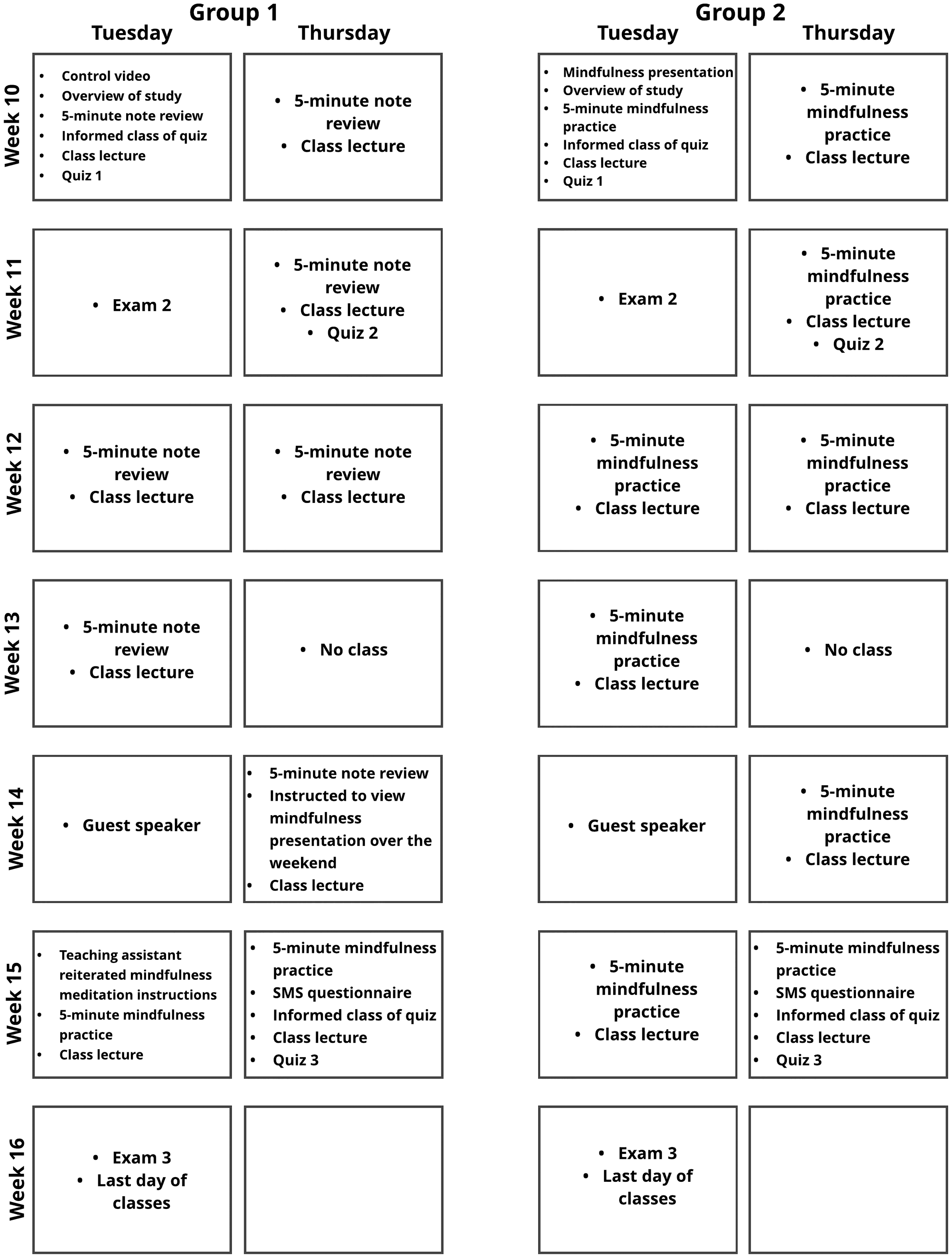
Group 2 began class by listening to a 12-minute PowerPoint presentation on mindfulness relative to education delivered by the first author. Following the presentation, students watched the six-minute video on focused-attention meditation described above and were invited to engage in a five-minute mindfulness practice. In addition, students were told that the first five minutes of every class would be dedicated to practicing mindfulness till the end of the semester (except for exam dates and special occasions; see Figure 1). Then, the course instructor distributed consent forms to students. After consent forms had been collected, the mindfulness practice began. Once five minutes passed, the teaching assistant asked the participants to stop. The professor informed the class she would administer a quiz during the last five minutes of class relating to the content covered in the next 60 minutes. The second group’s lecture and quiz was identical to the first group’s lecture and quiz.
The following week, students in both classes took a quiz on the lecture content of that day. However, for this quiz (Quiz 2), the professor did not inform students in either class about the quiz being administered during the last five minutes of class. Both the control group (i.e., the class who were instructed to review their notes) and the mindfulness group received identical lecture content and quiz.
During class on the day preceding the last week of classes (i.e., the week before finals), students in the control group (Group 1) were instructed by the professor to view the mindfulness presentation available on the course management system (Desire2Learn) over the weekend. By utilizing Kaltura software, the mindfulness presentation was made identical to the content presented to Group 2 earlier in the semester. The mindfulness PowerPoint was transformed into a 12-minute live presentation, which included narration over the slides and Dr. Schwartz’s mindful breathing instructions. Both the online and in-class presentations were the same in length and had identical content.
During the next class, the teaching assistant greeted Group 1, briefly reiterated the directions of Dr. Schwartz’s mindfulness breathing instructions, and invited the students to participate in mindfulness meditation for the first five minutes of class. Group 2 practiced mindfulness meditation for the first five minutes of class. The next class, both groups practiced mindfulness for the first five minutes of class. Following the mindfulness meditation, the students completed the SMS (only once). The professor collected the SMS and informed both classes that during the last five minutes of class, a quiz would be administered on the class content that is covered in the lecture. The lecture and quiz were identical in both classes. At this time, Group 1 practiced mindfulness a total of two times and Group 2 practiced mindfulness a total of nine times. Figure 1 provides a schematic of the entire procedure.
Results
Before testing our main hypothesis, we tested for any pre-existing differences between our experimental group and the control group. We conducted a one-way analysis of variance on Exam 1 scores. There were no significant differences between groups, F(1,65) = 0.005, p = 0.943,
Means (M) and Standard Deviations (SD) for Major Dependent Measures.
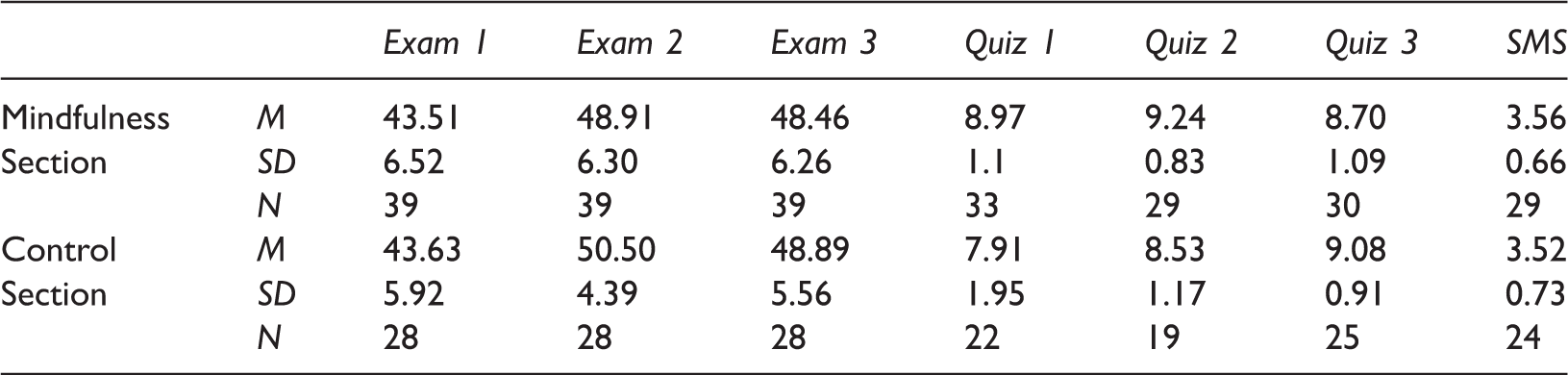
Note: SMS = State Mindfulness Scale.
Correlations Among Exams, Quizzes and State Mindfulness Scale (SMS).
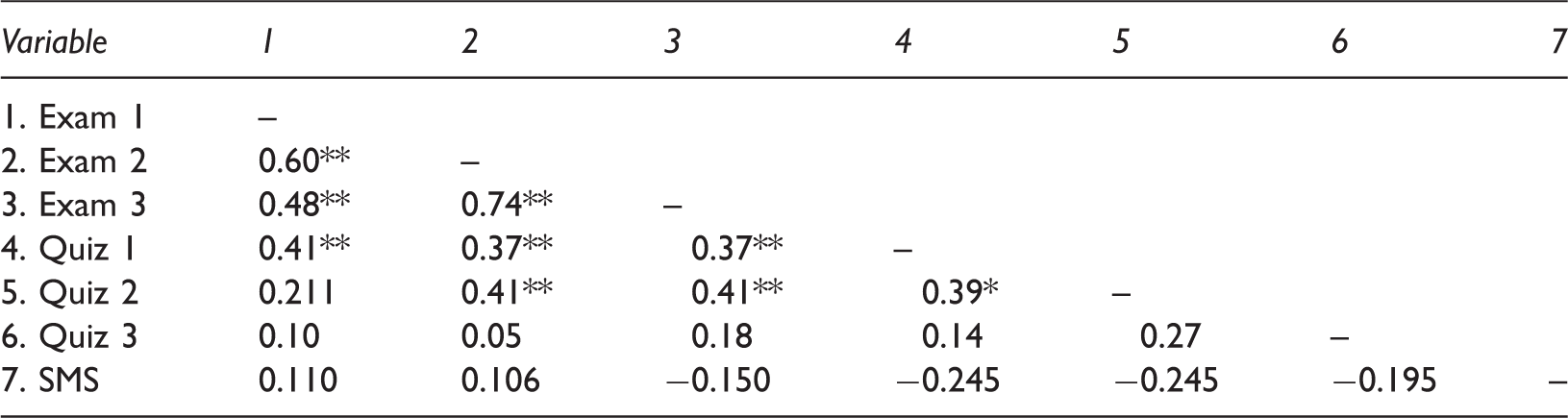
Note: *p < 0.05; **p < 0.01.
To test our main hypothesis, we conducted a repeated-measures analysis of variance (ANOVA) with quiz as the within-subjects factor and class section as the between-subject variable. We found a significant main effect of quiz, F(2,36) = 12.29, p < 0.001,
In order to test whether the mindfulness meditation had any effect beyond the quizzes on the three course exam scores, we conducted a repeated measures ANOVA with exam as the within-subjects factor and class section as the between-subject variable. We found a significant main effect of exam, F(2,64) = 42.61, p <0.001,
Discussion
The beneficial effects of mindfulness may be evident after a single practice session. Students who engaged in a five-minute mindfulness practice performed significantly better on two post-lecture quizzes compared to students in the control group. When both groups practiced mindfulness, there was no significant difference in quiz score between groups. Consistent with previous research (Ramsburg &Youmans, 2014), our findings suggest that a brief mindfulness practice enhances students’ knowledge retention.
By examining the effectiveness of a brief mindfulness intervention on both quiz and exam performance, we found that practicing mindfulness for five minutes bi-weekly had no significant effect on exam scores. This finding is important as it fills a gap in the mindfulness and academic performance literature on whether the improvements in students’ knowledge retention carry over to exam performance (Ramsburg & Youmans, 2014). Our results show that five minutes of mindfulness practice does not lead to improvements in exam scores, suggesting that the enhancements in students' knowledge retention are transitory.
One possible explanation for the lack of significant findings in exam scores may be due to the low dose of mindfulness practice students received. This interpretation is consistent with past research which shows that depending on the methods, quality, and dosage of mindfulness interventions, mindfulness training can have both short-term and long-term effects (Davidson & Kaszniak, 2015). For example, in Creswell’s (2016) review on mindfulness interventions, the author notes that brief mindfulness intervention studies such as five- to ten-minute mindfulness trainings immediately buffer affective reactivity to pain and cravings and reduce impulsive behaviors. However, these effects were small in magnitude. On the other hand, larger dosages of mindfulness interventions, such as the eight-week Mindfulness-Based Stress Reduction program demonstrate moderate-to-large overall effects pre-post training with maintained effects at follow-up (Khoury, Sharma, Rush, & Fournier, 2015). As such, we suspect that the dosage of mindfulness in this present study was insufficient for long-term enhancements in knowledge retention, which is consistent with the Yamada and Victor (2012) findings.
One novel contribution of this study was the use of a waiting-control group. By having our control group also receive the intervention, we were able to examine if the frequency of mindfulness practice would affect students’ quiz performance. We hypothesized that there would be no significant differences in Quiz 3 score between groups. However, we also held some degree of uncertainty as students in the mindfulness group engaged in mindfulness practice seven times more than students in the control group. Therefore, on the day participants completed Quiz 3, we administered the SMS once to both groups directly after the five-minute mindfulness practice. The SMS measures mindfulness as a mental state and thus, we suspected that if significant differences in Quiz 3 scores emerged it could potentially be explained by the differences in students’ SMS scores. Our findings support our hypothesis as we found no significant difference in Quiz 3 scores or SMS scores between groups. This is particularly interesting because it suggests that five minutes of mindfulness practice closed the performance gap between the two groups’ post-lecture quiz scores. Moreover, the nonsignificant findings in SMS scores may further explain why there were no significant differences in Quiz 3 scores between groups.
One explanation for why the mindfulness group (i.e., Group 2) did not show increased SMS scores compared to the control group (i.e., Group 1) is that the dosage of mindfulness practice was not strong enough to facilitate improvements in state mindfulness. Researchers suggest that mindfulness training may follow the same general rules of aerobic exercise; that is, larger doses and frequent practices are more likely to produce larger effects associated with measurable gains (Creswell, 2016). An additional explanation is that the quality of the intervention was not designed in a way that fostered increases in state mindfulness as the purpose of this study was to create a very brief, economical, and feasible mindfulness intervention to enhance student learning in the college classroom.
In this present study, students were taught by an online source and were not informed on how to apply formal mindfulness training skills to stressful or emotionally aversive situations in daily life. Without the proper knowledge about how to use mindfulness in informal situations (e.g., interpersonal conflicts, and busy schedules), it is possible that the only time students activated a state of mindfulness was during the five-minute mindfulness practice and subsequent lecture. Therefore, it would be fruitful for future research to explore if enhancing the quality of the mindfulness intervention (e.g., incorporate journal article or chapter readings on mindfulness and show brief online teachings from world renowned researchers in the field) and increasing the dosage of the mindfulness practice would increase students’ mindfulness. For example, one study found that by only teaching undergraduate students about the origins and the applications of mindfulness, students trait mindfulness significantly increased pre-course to post-course (de Bruin, Meppelink, & Bögels, 2015).
Lastly, a strength of this study was the use of an active control group. In mindfulness-based research, one methodological issue that commonly arises is expectancy effects (Shapiro et al., 2011). Using an active control group reduces the likelihood that results of the study are influenced by an expectation of improvement in the mindfulness intervention group. Researchers underscore the importance of treating the active control intervention as a comparison control group in all of the basic nonspecific factors such as group format, time allocated to intervention and the expectation that the intervention is beneficial and can promote similar enhancements in outcome measures (Davidson & Kaszniak, 2015). In this study, participants in both groups were enrolled in an identical upper-level human development course and showed no significant differences on Exam 1 scores, suggesting groups did not differ between previous knowledge about lecture content. More importantly, our control group engaged in a study technique that is related to student learning; rereading lecture notes has been found to be positively associated with exam performance (Carrie, 2003) and self-reported Grade Point Average (Hartwig & Dunlosky, 2012). Furthermore, both groups were blinded to our target intervention as we informed participants that the purpose of this study was to assess learning techniques.
No study is without limitation, and the limitations presented here are largely a result of undertaking research in a real-world setting (i.e., the college classroom) as opposed to a controlled laboratory setting. Because our experiment took place in a higher educational classroom, it was our ethical responsibility to respect the course instructor’s time constraints. In other words, we did not want to interfere with the instructor’s class syllabus and therefore compromised controlling for third variables. Ultimately, we felt that the benefit of utilizing measures related to course content (e.g., quizzes, and exams) was an appropriate starting point for teachers and educators who look to enhance student learning, and for future research to follow-up on.
The lack of measurement of third variables leaves us wondering what factors may have contributed to the mindfulness group scoring significantly better on Quiz 1 and Quiz 2 compared to the control group. For instance, we cannot be certain that the differences found in post-lecture quizzes are a definite result of the intervention due to having no pre-measure of previous knowledge and familiarity with the lecture content. However, since we found no significant differences on Exam 1 between groups, we can speculate that there were no significant pre-existing differences in knowledge about lecture content between the two classes. Moreover, further support that groups did not differ in knowledge or familiarity with lecture content is provided by the finding that both groups performed similarly on Exam 2 and Exam 3.
One possible interpretation for the immediate enhancements of students’ knowledge retention may be related to decreases in mind wandering. According to Creswell (2016), mindfulness-based practices focus on training multiple features of attention, such as noticing when the mind wanders, repeatedly shifting attention back to the object of focus, developing sustained attention, and learning how to cultivate an open accepting form of attention in order to not let thoughts, emotions, or body sensations take over one’s present-moment awareness. In educational settings, attention regulation is necessary when a student is in lecture and becomes distracted by an external stimulus or internal stimuli (e.g., an incoming text message, and mind wandering). There is a growing body of research indicating that attention is a limited resource that is needed to maximize learning (see Pachai, Acai, LoGiudice, & Kim, 2016). For example, one study showed that attention decreases as a function of time in a lecture setting (Risko, Anderson, Sarwal, Engelhardt, & Kingstone, 2012). Risko et al. (2012) administered a comprehension test following the lecture and found that students were less likely to correctly answer questions from content in the second half of the lecture compared to the first. Thus, it appears that as attention starts to wane, mind wandering grows stronger, leading to poor comprehension and retention of lecture material.
To reduce students’ mind wandering, researchers have suggested training in mindfulness-based practices (Pachai et al., 2016; Smallwood & Schooler, 2015). Recent studies reveal that mindfulness training increases sustained attention on task performance and decreases self-reported mind wandering in college students (Morrison et al., 2014). In addition, students who engaged in a 2-week mindfulness training demonstrated enhanced improvements in working memory capacity and Graduate Record Examinations’ reading comprehension scores that were mediated by reduced mind wandering (Mrazek, Franklin, Phillips, Baird, & Schooler, 2013). Furthermore, Mrazek, Smallwood, and Schooler (2012) found that eight minutes of mindful breathing reduced behavioral indicators of mind wandering during a Sustained Attention Response Task. Taken together, these studies indicate that small doses of mindfulness training may reduce mind wandering during lecture. Future studies are needed to examine the impact of mindfulness training on students’ mind wandering in a college classroom setting.
In conclusion, mindfulness-based research is still in its earlier years, especially in regards to academic performance in higher education. Our findings presented here suggest that five minutes of mindfulness practice is a sufficient general learning technique that can facilitate immediate improvements in students' knowledge retention. Future research should begin to examine potential underlying mechanisms that may engender the enhancements in knowledge retention associated with brief mindfulness practice. As meditation experiences can be subtle and complex, more studies that demonstrate a systematic and dynamic approach to understanding the impact of mindfulness practice on attentional and cognitive variables related to academic achievement are needed.
Footnotes
Acknowledgements
We would like to thank the course lecturer, Sawa Senzaki and her students for their participation in this study.
Declaration of Conflicting Interests
The author(s) declared no potential conflicts of interest with respect to the research, authorship, and/or publication of this article.
Funding
The author(s) received no financial support for the research, authorship, and/or publication of this article.