




Abstract
This paper provides five clear, relatable examples that can help students understand the distinction between the term “factors” and “mechanisms” in Developmental Psychology. The examples emphasize the idea that factors are related to changes in ways that moderate development, but are not causal. On the other hand, the term mechanism refers to processes that produce change. These examples can be embedded in lectures individually or shared as a whole to support student learning. A precise understanding of the distinction between factors and mechanisms can help students better understand development, parse research findings, and consider policy and practical implications.
Terminology is more than jargon; it communicates important concepts in a field. In Developmental Psychology, explaining change over time is essential to explaining development (Siegler, 2000). Thus, the terms “factors” and “mechanisms,” which are used to describe what influences change, are central to the field. This paper offers examples and analogies to help students better understand of these concepts.
Importance of Understanding Factors and Mechanisms
Factors and mechanisms are central to the study of child development because they help explain how development unfolds. Child development refers to children’s acquisition of more complex skills or knowledge over the course of time. This development is marked by accomplishments at different periods of childhood, also referred to as milestones. Developmental milestones are behaviors or skills that children demonstrate at a given time point in development. Milestones vary across age ranges. For example, a key milestone, or accomplishment, in the first year of life is crawling, while a key milestone of the second year is walking. Factors and mechanisms are used to explain how children achieve these milestones.
The two differ in the extent to which they explain change in development. A factor is an environmental or individual characteristic that influences change, either accelerating or impeding it, but alone is not sufficient to cause change (e.g., Evans, Li, & Whipple, 2013). Examples of factors include socioeconomic status, vocabulary exposure, gender, and temperament. Take access to books, for example. A child who has 10 dinosaur books may be more likely than a child with only one to know information about dinosaurs, but just owning the books (and never reading them) does not guarantee it. Books make it easier to acquire information, but do not cause you to. On the other hand, a mechanism is a cognitive or biological process that causes change. Examples of mechanisms include encoding, strategy choice, synaptic pruning, and neurogenesis (Siegler, 1989). A mechanism causes change in the sense that it is viewed as directly responsible for the effect observed – some new knowledge or skill can only be acquired because of the mechanism. In the example above, reading the dinosaur books would be the direct cause of knowing information about dinosaurs. Whether you only have one book or ten would not matter unless you read them, but if you read them than having ten is better than having one. In this way, factors influence the extent of change while mechanisms cause it and explain how factors (e.g., risks or resources) affect development (Roisman & Fraley, 2013).
The distinction between factors and mechanisms is closely related to other methodological concepts in psychology, such as correlation versus causation and moderation versus mediation. A correlation indicates that a relation between two things exists (e.g., number of dinosaur books owned and amount of dinosaur knowledge), but not that one causes the other. Factors are correlational; whereas, mechanisms are causal. Similarly, moderators generally increase the strength of a relationship (e.g., more books is better), while mediators are generally causal, explaining the relation between two things. In this way, factors tend to be moderators, while mechanisms are causal like mediators. Thus, helping students to use the terms factors and mechanisms with precision can also help them better understand other key distinctions in the debate about causal inference.
A precise understanding of the distinction between factors and mechanisms has additional benefits. One, it can help students consider the complexity of development. Factors and mechanisms often interact such that factors affect development through mechanisms (e.g., the number of books and reading example). Being able to identify and explain these relations is central to understanding the complexity of development. Second, it can help students parse and interpret research findings. Studies often include several variables that influence development at different levels (e.g., temperament, socioeconomic status, and parent–child relationships) and increasingly include complex path analysis models. Being able to distinguish between factors and mechanisms provides students with a way to label and categorize the variables, which, in turn, can simplify the task of understanding a complex study. Third, it can help students consider policy and practical implications. By understanding the distinction in the extent to which factors and mechanisms influence change, students can think more deeply about why and how policies may affect development. Thus, instruction about the distinction between factors and mechanisms in Developmental Psychology courses could be a useful approach for helping students to develop a more nuanced view of development and critical stance toward research and policy.
Benefit of Examples for Instruction
Example-based instruction is an effective strategy for teaching new concepts and reasoning skills to novice learners (Atkinson, Derry, Renkl, & Wortham, 2000). Examples illustrate a principle. They can also provide an expert analysis and mapping of the similarity between a familiar and unfamiliar topic for the learner to study. In this way, examples serve as models or analogies for new concepts (Gentner, Lowenstein, & Thompson, 2003). Indeed, there is considerable evidence that understanding gained through studying specific examples can be transferred to novel situations (e.g., Dunbar, 2000; Renkl, 2010).
Two kinds of examples that have been shown to be particularly effective are analogies and worked-examples. Analogies make new and unfamiliar concepts more meaningful to students by connecting what they already know to what they are learning. They are particularly effective when elements of the analogy can be mapped easily onto the concepts being learned (Gentner, Lowenstein, & Thompson, 2003). For example, when the milestone, factor, and mechanism in a familiar context are easily perceived and/or explicitly denoted. Worked-examples support learning by providing a model and directing students’ cognitive resources to the principle features of a problem (Atkinson et al., 2000). They are most effective when the students have the opportunity to study the example before being asked to solve a similar problem and to explain the examples to themselves or another (Renkl, 2010); for example, when students have the opportunity to discuss the factors and mechanisms within an example before being asked to identify the constructs in another developmental context. Both analogies and worked-examples are most useful when multiple ones are used to allow for comparison among them and when they are sequenced to increase in complexity (Atkinson, et al., 2000; Braithwaite & Goldstone, 2015).
Examples of Distinction
Below are five examples of the distinction between factors and mechanisms that could be integrated in a Developmental Psychology course. The first three examples are meant to be easily relatable to students, thereby serving as analogies. These three build in complexity and specificity. The last two are worked-examples that demonstrate the distinction between factors and mechanisms in relation to actual developmental phenomena and are grounded in research findings: language acquisition; and fetal alcohol syndrome.
Example 1: Traveling to New Orleans
You are driving to New Orleans for Mardi Gras. The trip, getting from your university to New Orleans, is a development. On Monday you are at your university and on Wednesday you are in New Orleans. These are the milestones. How did you get to New Orleans? You could just say “driving,” but that doesn’t really explain how your car (and you in it) was able to travel from your university to New Orleans. Driving is a mechanism of sorts here, but it is much too vague. It is like saying children develop by growing and thinking. Sure, but you still have to figure out how they think and grow, right? So, what is the process that caused your car engine to work and, therefore, caused you to get from one destination to the other? The process is combustion. The engine burned the fuel providing power to the engine, turning the wheels and causing you to move. Because combustion is a process that causes change it is the mechanism. The more gas you have and maybe the better grade of gas you use (supreme vs. regular) the more efficient the combustion and the quicker and more smoothly you get to the next destination. Because gas accelerates or impedes combustion, but alone is not sufficient to move the car, it is a factor. Now, what if you ran out of gas? Well, then combustion would not be possible at all and you would stop in your tracks. So, in this case, the lack of a key factor needed could stop all development. Combustion, the mechanism, explains how gas influences development. Figure 1 presents the model of development.
Developmental model of traveling to New Orleans.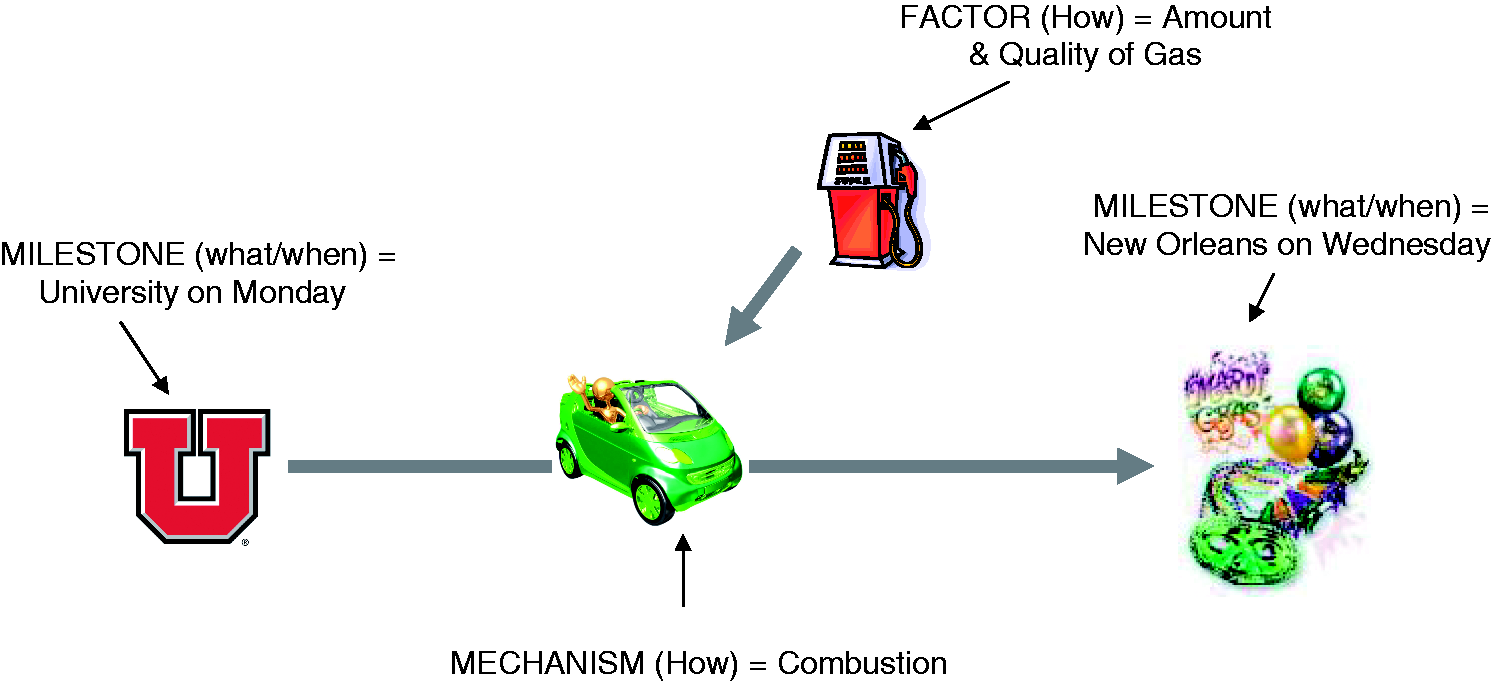
Example 2: Learning Buildings on Campus
Your first day at college, you probably did not know which building your lecture was in or how to get to the building. Now, you know the names of the buildings and can get to them no matter from where you start on campus. These are the milestones – a description of what you knew or were able to do at different points in time. How did you learn the names of the buildings and how to get there? You could just say “because I had to go there for class,” but that does not really explain how you figured out how to get there. So, what are the processes that caused you to acquire the knowledge about how to get to various buildings on campus? One of them could be encoding (representing the features of objects and events in memory). You probably looked at a map, produced a mental image of where the building was in relation to a building you knew, like your dorm, and then used this representation to find your way there. Because encoding is a process that caused a change in your memory representations of the building locations it is the mechanism. Now, what if you have had lots of classes in the same building? Having to locate a building a greater number of times would definitely help you learn how to get there sooner, but it still does not explain how you learned to get there. So, the number of classes in a particular building is a factor; it influences the rate of change, but it is not the process underlying it. Figure 2 presents what this looks like in a developmental model.
Developmental Model of Learning Buildings on Campus.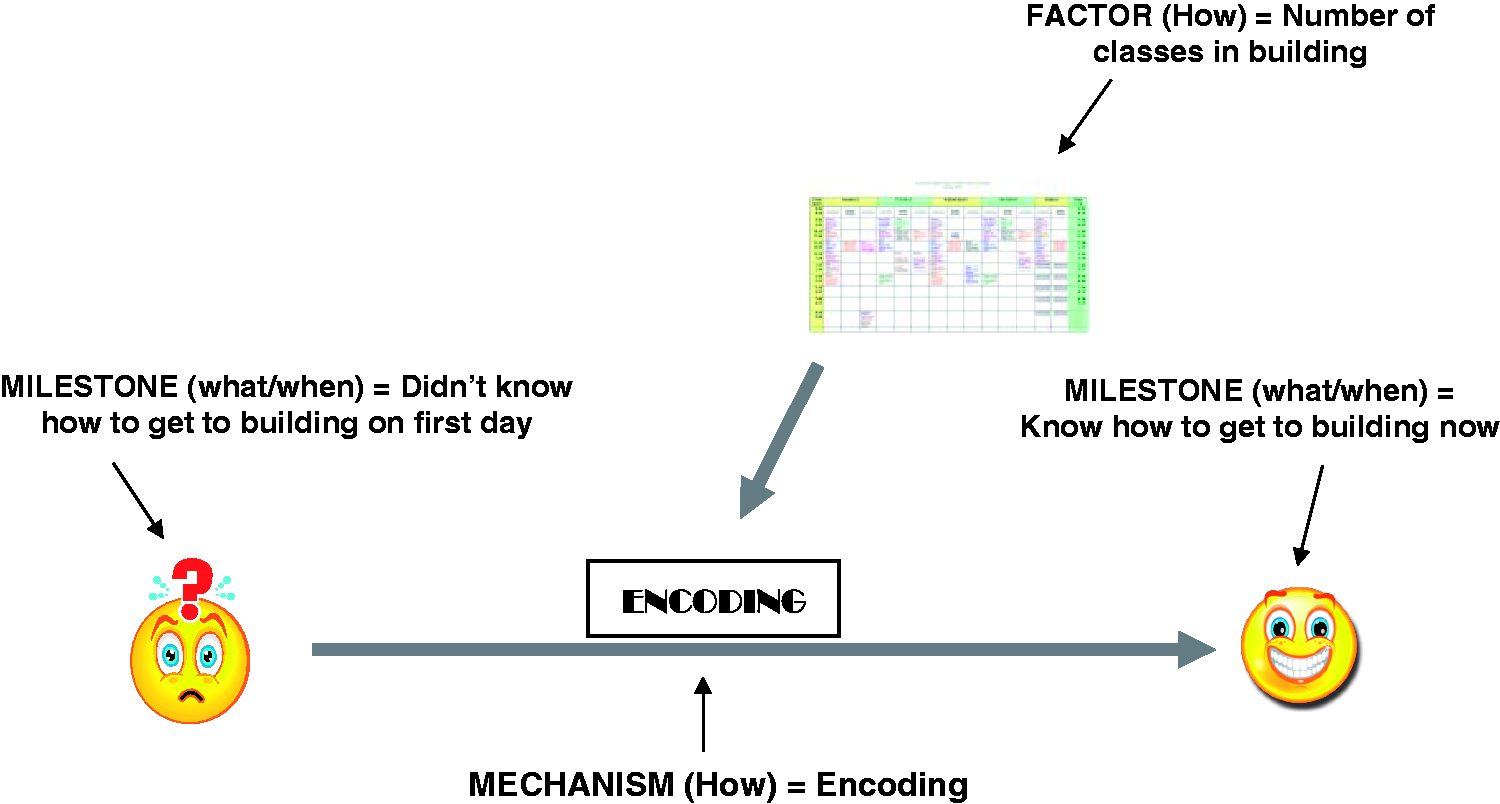
Example 3: Improving at Football
In this example, you will see how more than one mechanism can explain the same aspect of development and get a better sense of the complexity of explaining a developmental phenomenon. Various mechanisms and factors contribute to any given development. The various branches of psychology (e.g., cognitive psychology, evolutionary psychology, educational psychology, community psychology, and neuroscience) and theoretical perspectives (e.g., bioecological, and information processing) posit and investigate different mechanisms. In most cases, the complete picture of development probably involves an integration of the various viewpoints.
Consider how someone, in this case we can imagine Tom Brady, improves at throwing a football over time. By the age of 39-years, Brady was considered one of the best US National Football League quarterbacks of all time. He won four Super Bowl championships and was ranked fifth, among all quarterbacks, in terms of touchdown passes. When Brady played on a football team as a kid, he probably threw short when he passed to the receiver. By the time he was 24-years-old and led the Patriots to a Super Bowl win as their quarterback, he completed most his passes, getting the ball right in the receiver’s hands. These are the milestones that describe what he could do at different points in development. What explains Brady’s improvement? You could just say “practice,” but that’s too vague. Developmental psychologists aim to explain development as precisely as possible. So, what are the processes that caused Brady to throw better? One mechanism could be automatization (a cognitive process by which skills become executed with little to no conscious attention). Automatization might have caused him to release the ball sooner and, therefore, made his throws more accurate. The more balls Brady practiced throwing, the faster the aspects of a good throw (e.g., grip, arm position, and body position) probably became automatized. If he had never practiced, the skill would not have become automatized. In this case, then, the amount of practice is a factor that contributed to the mechanism – automatization. These factors and mechanisms are illustrated in Figure 3(a).
Learning to complete a pass in football: (a) DEVELOPMENT = Learning to complete a pass in football; (b) DEVELOPMENT = Learning to complete a pass in football.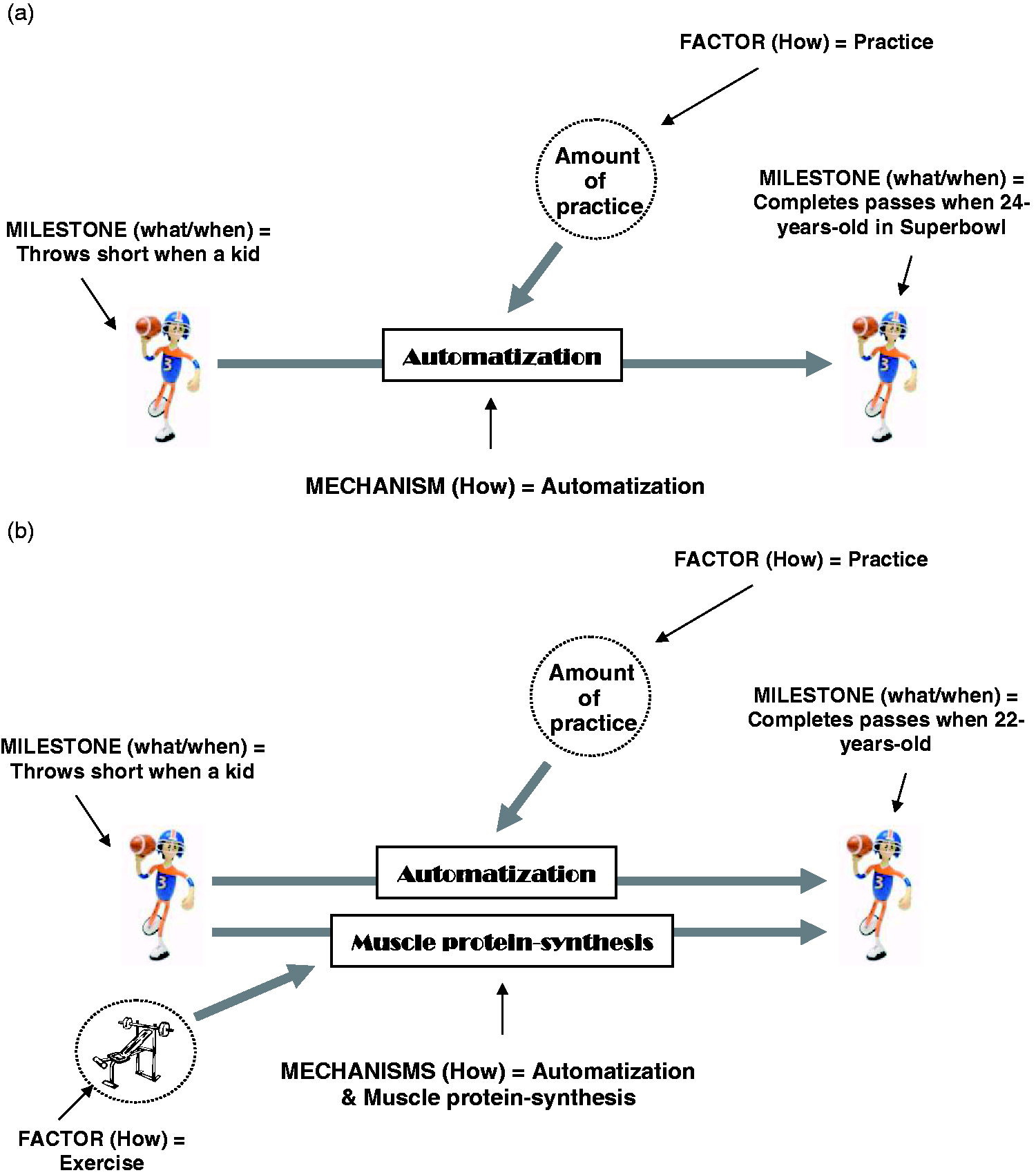
Some of you may have had a different idea. Maybe you were thinking that he could complete his passes because he could throw farther. That makes sense, but “throws farther” is actually just another milestone, it is not a process; it is something he could do at 24 that he could not do when he was a kid. You have to ask yourself, “How did he become able to throw farther?” Perhaps you are thinking, “Because his arm got stronger?” Again, that makes sense, but then you have still have to explain how his arm got stronger. Exercise, right? Nope; it is not that easy. Exercise is a factor. It is related to getting stronger – the more you exercise, the stronger you get – but it is not the process by which your muscles get stronger. Exercise initiates a process called muscle protein-synthesis, a process in which amino-acids are released and repair and reinforce muscle fibers. This biological process could be another explanatory mechanism for Brady’s improvement. The more complex model of development in this case is presented in Figure 3(b).
As shown in the complex model, both mechanisms – automatization and muscle protein-synthesis – occur simultaneously to support development. In fact, it is common for several mechanisms to influence the same developmental outcome. The reason for this complexity is that mechanisms can occur at different levels. Some mechanisms are genetic (e.g., gene variations), others neural (e.g., the creation of new neurons), others social or behavioral (e.g., modeling and imitation), and others cognitive (e.g., automatization). In the example of learning to pass a football described here, the mechanisms work simultaneously, but independent of each other. In other cases in development, two simultaneous mechanisms at the same or different levels might work in concert, such as those described in the multiple deficits model explanation of developmental disorders (Pennington, 2006). Thus, it is always important to consider that development may be more complex than what is communicated by a single theoretical position or research study.
Example 4: Language Acquisition
Now consider a more central and universal development – the acquisition of language in the first two years of a child’s life, specifically the ability to produce words. An infant typically starts to babble, producing repetitive syllables such as “ba, ba, ba”, by six-months of age. In just a little over a year and a half, most 24-month old toddlers can use an average of 50 words to communicate. Developmental research attempts to explain how children move from the first milestone to the second by identifying the factors and mechanisms.
There is substantial evidence that children from lower socioeconomic backgrounds have a slower rate of language acquisition and know fewer words by 24-months than their peers from middle- to higher- income families (Fernald, Marchman, & Weisleder, 2013; Hurt & Betancourt, 2016). Is socioeconomic status a factor or mechanism? You should be asking yourself: “Can being poorer or wealthier cause a child to learn language more rapidly?” Because in and of itself socioeconomic level does not produce development it is a factor not a mechanism. Remember, a factor helps explain the extent or rate of development because it influences the underlying mechanism. So, how does knowing socioeconomic background is related to differences in children’s language development help explain how language develops? For this, research has to uncover other factors associated with socioeconomic background that can impact children’s ability to use developmental learning mechanisms.
One key difference that has been found between families of different socioeconomic backgrounds is the extent to which children are exposed to language. In fact, a seminal study by Hart and Risley (2003) identified what has come to be known as the 30-million word gap in the number of words children in the wealthiest versus poorest families have heard by the age of three years. Their observational data indicated that toddlers from families on welfare heard only about 616 words per hour, while those from middle class families heard around 1,251 words per hour, and those from professional higher-income families heard roughly 2,153 words per hour. Thus, children being raised in middle to high income class homes had far more language input to process and learn from.
Knowing that amount of language input is related to differences in language development pointed to the processes and mechanisms underlying children’s acquisition of language. For one, it helped research establish that language involves experience-expectant plasticity, whereby neural connections relating to universal skills are stabilized through experiences in the environment (Greenough, Black, & Wallace, 1987). It also propagated research establishing statistical learning as a key mechanism in language development (Romberg & Saffran, 2010). Statistical learning is a process whereby humans extract regular patterns in input from the environment. For example, infants are able to notice the regularity in which phonemes are paired with each other in order to establish word boundaries in running speech (Saffran, Aslin, & Newport, 1996). The more data available to process, the easier it is to notice and extract the patterns. Thus, statistical learning is the process (mechanism) that explains how amount of language heard (a factor) contributes to language development. A developmental model of language development including this mechanism and factor is shown in Figure 4.
Developmental model of language acquisition.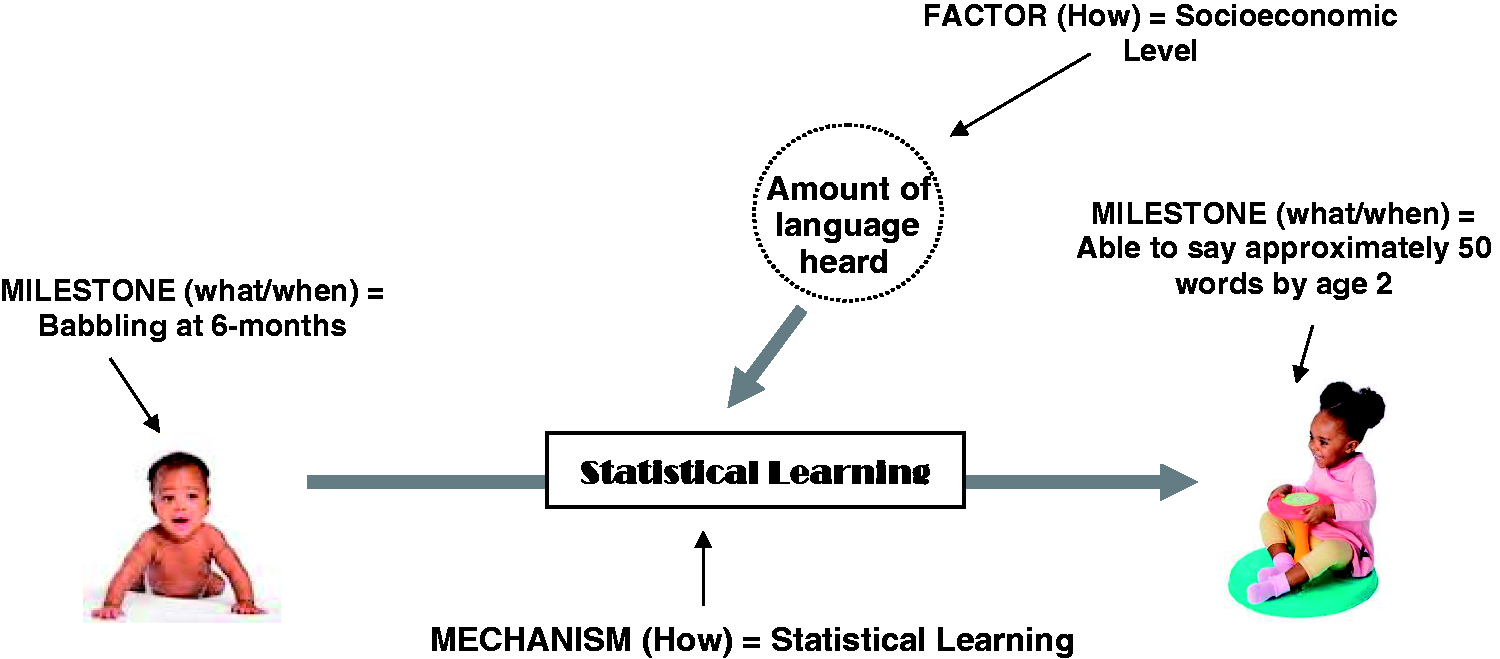
It should be noted that a full description of how children learn language is far more complex. The model presented above only incorporates one factor and mechanism and shows the relation between them. Many other mechanisms and factors have been posited to be important to language development (Saxton, 2010). Each theoretical perspective places emphasis on different kinds of mechanisms. For instance, information processing theory focuses on cognitive mechanisms, such as working memory (e.g., Marchman & Fernald, 2008). On the other hand, social theorists tend to focus on variations in the environmental contexts and social interactions (e.g., Hoff, 2006). Unfortunately, research on the various mechanisms and factors tends to occur in isolation. An integrative over-arching model of language development has not yet been developed.
Example 5: Fetal Alcohol Spectrum Disorders
This final example demonstrates that the same distinction between factors and mechanisms applies when explaining atypical development. Fetal alcohol spectrum disorders are a group of conditions related to atypical development in the physical (e.g., abnormal appearance, low body weight, and small head size) and cognitive (e.g., lower intelligence, and behavioral inhibition problems) domains of development. Obviously, prenatal exposure to alcohol plays a role in these disorders, but is it a factor or mechanism? Just as with the examples above, because it is not a process, but rather something that influences a process it is a factor. The severity of fetal alcohol spectrum disorders depends on the amount, frequency and timing of alcohol consumption during pregnancy. Numerous mechanisms are thought to explain the damaging effects of prenatal alcohol exposure on the developing fetus (Goodlett & Horn, 2001; Memo, Gnoato, Caminiti, Pichini, & Tarani, 2013). Generally, alcohol interferes with the delivery of oxygen to a fetus’ developing tissues and organs, resulting in neural apoptosis (cell death) (Ikonomidou et al., 2000). A better understanding of how alcohol affects development (i.e., via which mechanism) is important for generating prevention and treatment programs.
Integration into Developmental Psychology Course
The analogies and examples provided here can be integrated in numerous ways into a developmental psychology course. In an introductory course, the instructor might guide students through them and take time to discuss as a class. In an upper level course, they might be assigned as readings for the students to process independently. They can also be supplemented with other exercises, such as small group discussions and writing assignments. The best approach will depend on the students’ level and instructor’s goals.
In my introductory Child Development course, I emphasize the distinction between factors and mechanisms over the course of the semester. I assign the first three examples as reading before an overview lecture about key themes in the field at the beginning of the semester. During this lecture, students are given the opportunity to discuss the examples and apply what they learned to construct a new example in small groups. To reinforce the learning, the language example is provided as a handout during the language lecture and the fetal alcohol spectrum disorders example in the prenatal development lecture. In addition, in various lectures over the semester, students are asked to identify the factors and mechanisms discussed in video clips. Further, for some topics, such as physical development, students work in small groups to organize their knowledge about the topic by listing key milestones, factors, and mechanisms in a worksheet provided. Students’ understanding of the distinction is formally assessed through exam items, such as being asked to identify the factors and mechanisms in a research article abstract (see Appendix A).
Conclusion
Psychologists have identified and proposed numerous developmental factors and mechanisms. The various branches of psychology (e.g., cognitive psychology, evolutionary psychology, educational psychology, community psychology, and neuroscience) and theoretical perspectives (e.g., bioecological and information processing) posit different kinds of mechanisms and examine different factors. For example, information processing theory focuses on cognitive mechanisms, such as statistical learning, while sociocultural theory focuses on social processes in development. Yet, all perspectives similarly try to describe the relation between factors and mechanisms.
It is important to understanding the distinction between factors and mechanisms and the relation between them. It allows for more critical reading and interpretation of research, particularly in relation to claims about causality. It also informs the application of research to policy and practice. Identifying factors involved in development points to levers that can be used to support or enhance it. Yet, selecting which factor is most worth investing resources into often requires understanding its relation to the underlying mechanisms. For example, knowing that encoding is a key mechanism by which children learn about numbers from playing number board games, akin to chutes-and-ladders, was fundamental to identifying ways to enhance that learning (Laski & Siegler, 2014). Children who play by saying the names of numbers in the squares as they move their token, which promotes their encoding of the position of the numbers on the game board, learn twice as much as those who count the number of spaces moved. Without considering the relation between the mechanisms (encoding) and factors (instructional design features), this substantial impact on learning of this subtle difference in game procedure might not have been discovered. Thus, understanding the distinction between “factors” and “mechanisms” is far more meaningful than simply leading to an accurate use of terminology; it has important implications for advancing developmental psychology and the continued support and enhancement of children’s development.
Footnotes
Declaration of Conflicting Interests
The author(s) declared no potential conflicts of interest with respect to the research, authorship, and/or publication of this article.
Funding
The author(s) received no financial support for the research, authorship, and/or publication of this article.