




Abstract
To improve teaching in higher education, teachers in psychology are encouraged to use evidence-based teaching, that is, to apply empirical findings regarding learning and teaching, when designing learning opportunities. This report illustrates the combination of evidence-based teaching and the Scholarship of Teaching and Learning in teaching psychology and describes the implementation of an innovative module for first-year students in the undergraduate psychology program at Goethe University Frankfurt, Germany, as an example. A detailed description of the teaching formats is provided with a focus on evidence-based teaching techniques, which were implemented in the first semester of the module, specifically feedback, testing effects, and spaced learning. Furthermore, evaluation data concerning the students’ perceptions and objective assessments are presented as an example of the Scholarship of Teaching and Learning. For example, students significantly acquired knowledge during web-based training, but the learning outcomes are independent of their pretest knowledge, suggesting that this teaching format may contribute to the reduction of heterogeneity among first-year students. Possible implications for future modifications of the module are discussed and general recommendations are offered to teachers of psychology regarding the implementation of a combination of evidence-based teaching and the Scholarship of Teaching and Learning to promote empirically founded teaching.
Keywords
In the context of current challenges in higher education, such as the growing heterogeneity among students, good teaching should support all students in achieving intended learning outcomes (Biggs & Tang, 2011). Students’ learning approaches were found to be related to teachers’ teaching approaches (Trigwell, Prosser, & Waterhouse, 1999), which leaves teachers (partly) in charge of their students’ learning outcomes. Since most academics are well trained in their area of expertise but not always in teaching, lecturers often have to rely on their intuitive knowledge of teaching, personal experience, and traditions (Buskist & Groccia, 2011; Halpern & Hakel, 2003).
Advanced training and professional development for teachers in higher education aim at professionalizing this knowledge and have been shown to promote teaching skills and student-centered teaching among university teachers (e.g., Gibbs & Coffey, 2004; Postareff, Lindblom-Ylänne, & Nevgi, 2007). This training provides teachers with findings from the fields of cognitive and educational psychology and supports them in planning and implementing their own lectures and courses based on those findings, that is, in performing evidence-based teaching (EBT). This refers to the implementation of teaching techniques that are known to promote student learning in controlled settings (e.g., Saville, 2010). Particularly in psychology, teachers often have theoretical knowledge of the principles of learning and teaching, which facilitates the implementation of EBT (Dunn, Saville, Baker, & Marek, 2013).
Boyer (1990) defined the Scholarship of Teaching as one of four important areas of responsibility in academic work. One of its most important aspects is the implementation of classroom research (Cross, 1996). Therefore, teaching methods and techniques are to be selected carefully depending on intended learning outcomes and their impact on student learning, and “teaching becomes a subject of scholarly inquiry” (Daniel & Chew, 2013, p. 363). Consequently, in the Scholarship of Teaching and Learning (SoTL), teachers investigate their own courses to provide information on scholarly teaching in higher education (cf., Spinath, Seifried, & Eckert, 2014). In empirically founded teaching, the ideas of EBT and the SoTL can be regarded as complementary. This report describes an example for the combination of both ideas. A module in educational psychology was developed based on the principles of EBT. Evaluation data are reported to optimize the module in accordance with the SoTL, and possible implications for the module and teaching in psychology in general are discussed.
Designing a Module for First-year Psychology Students
The module, which was implemented for first-year students in the undergraduate psychology program at the Goethe University Frankfurt (Germany), was developed based on the principles of social constructivism (Palincsar, 1998) and problem-based learning (Dochy, Segers, van den Bossche, & Gijbels, 2003). According to social constructivism, knowledge is (co-)constructed in an interaction between social and individual processes. This idea is supported by the student-centered approach of problem-based learning, which provides situations and learning opportunities whereby transferable knowledge can be constructed and applied during the interaction and cooperation with fellow students. Following these ideas, the module in educational psychology includes various teaching formats and extends over three semesters. The module particularly aims at bringing the increasingly heterogeneous qualification levels of first-year psychology students in line with basic requirements in academic studies to create the best possible conditions for all students from the outset. This goal involves not only basic knowledge and understanding of learning and teaching but also practical and social skills, such as presentation techniques and cooperation and communication skills. Furthermore, the module strives for academic and social integration of all students. Therefore, during the three semesters, the focus of the module shifts from learning to peer teaching and finally to mentoring.
Overview of the goals of the module, semesters, teaching formats, and corresponding learning activities.

Goal exceeds the scope of the module.
Teaching formats throughout the first semester include a lecture, web-based trainings (WBTs), a practical workshop, and mentoring workshops offered by third-semester students. In the lecture, students gain basic knowledge of educational psychology and academic practice. Students have the opportunity to take a test on the topics discussed in the lecture. Students receive feedback on their knowledge of educational psychology and on possible misconceptions or illusions of knowledge (see Rozenblit & Keil, 2002). In the WBTs, students learn basic presentation techniques and skills, are quizzed on their learning outcomes, and receive direct feedback (cf., Narciss & Huth, 2004). Specifically, these tutorials offer practice-based advice on the preparation, realization, and web-based documentation of interactive presentations. The WBTs are designed as adaptive learning opportunities that take into account the heterogeneous prior knowledge of first-semester students. Furthermore, knowledge of both theoretical background and practical presentation tools is extended in a practical workshop by means of peer presentations involving topics, such as memory functioning, learning strategies, and e-learning principles, and methodological topics, such as interactive teaching techniques, moderating discussions in presentations, and working in groups effectively. In the presentations, students are directed to apply the skills introduced in the WBTs. Therefore, both presenters and receivers apply theoretical knowledge in that presenters attempt to teach their peers to use high-engagement learning activities (see Biggs & Tang, 2011).
Techniques of Evidence-based Teaching Implemented in the Module
With all these teaching formats, various learning opportunities are provided, which allows students to construct and apply knowledge and skills based on the ideas of social constructivism and the approach of problem-based learning. For this purpose, the learning opportunities were designed to include techniques of EBT with regard to the intended learning outcomes, specifically feedback, testing effects, and spaced learning. These techniques will be described in the following section.
Firstly, feedback is implemented based on widespread evidence of its beneficial effects in various learning settings (e.g., Downs, 2015; Hattie & Timperly, 2007). During the first semester, students receive mostly formative feedback on their presentation skills and learning outcomes. Feedback is an important element of the module, and it occurs in the various teaching formats: in the test of knowledge gained from the lecture, in every WBT session, in preparation for the practical workshop (concerning presentation schedule drafts), and most intensively during the practical workshop (concerning the actual presentation). In the latter case, students receive and learn how to handle feedback and learn how to structure and articulate constructive feedback that they give to their peers (cf., Gielen & de Wever, 2015; Nicol, Thomson, & Breslin, 2014).
Secondly, the so-called testing effect is regarded as an EBT technique in which tests are used to improve students’ learning outcomes (Dunn et al., 2013). The benefits of this effect are based on findings showing that taking tests is useful for not only assessing learning but also enhancing memory (e.g., Carpenter, 2012). The module takes advantage of this effect insofar as learning outcomes are tested repeatedly in quizzes during the WBTs and in the test of knowledge of educational psychology and of possible student misconceptions during the lecture. The disclosure of misconceptions is highlighted here because the potential influence of prior knowledge has been observed to be especially important in psychology classes due to “widespread interest in psychological concepts and their applications to everyday life” (Thompson & Zamboanga, 2004, p. 778).
Thirdly, spaced learning is incorporated in the module insofar as key topics and skills recur in the various teaching formats with varying foci. Abundant research on the advantages of spaced learning suggests that multiple learning sessions yield better long-term outcomes (e.g., Carpenter, Cepeda, Rohrer, Kang, & Pashler, 2012). The relationship between these learning conditions and task performance was found to be moderated by the complexity of the task inter alia, but overall performance is significantly higher in spaced learning than in massed learning (Donovan & Radosevich, 1999). This advantage of spaced learning over massed learning applies to both conceptual knowledge (e.g., Wahlheim, Dunlosky, & Jacoby, 2011) and practical skills (e.g., Dunlosky & Rawson, 2015; Simon, 2012). In the first semester of the module, students acquire theoretical knowledge and practical skills (e.g., presentation skills) as they make use of a variety of learning opportunities. These learning opportunities are offered during various teaching formats at various times throughout the semester. According to the classification by Dunlosky and Rawson (2015), this technique may be classified as “spaced practice,” which is regarded as one of the most effective learning strategies.
As explained above, the module was designed and implemented to include EBT techniques, which have been shown to positively affect student learning. Nevertheless, students’ learning outcomes associated with the teaching formats of this module implemented in the curriculum remain unclear and need to be investigated in an empirical inquiry. Furthermore, with the goal of continuously improving the module and its implementation, based on an evaluation of students’ learning outcomes, possible future modifications can be developed, and the effects of these modifications can be investigated (SoTL). In this context, the evaluation needs to consider students’ perceptions of their own learning outcomes and the components of the module. In addition to this subjective information, actual objective assessments of students’ learning outcomes need to be considered. For this purpose, adequate instruments need to be developed and tested for several teaching formats of the module.
Method
There were 148 student participants (21.62% male; 78.38% female) in the first semester of the module in educational psychology. Because the module involves diverse teaching formats, the evaluation is designed to match the complex structure. Therefore, to determine possible biases generated by self-evaluation (e.g., Falchikov & Boud, 1989; Ross, 2006), both subjective and objective measures were included. These measures were used in various empirical inquiries among the participants at various times during the first semester of the module. The inquiries did not include any control conditions: participation in the module was mandatory for all the students.
In addition to the students’ self-evaluations of their skills and knowledge acquisition, they were asked to evaluate the quality of the courses using both quantitative and qualitative instruments. Furthermore, objective assessments of the students’ knowledge and understanding were developed for both the lecture and a WBT. In the following section, the inquiries are described with regard to the participants, measures, and analytic strategy.
Students’ perceptions: Self-evaluation and course evaluation
To investigate the students’ perceptions, an online survey was sent to all the students after the first semester of the module. One hundred and thirty students participated in the survey (20.00% male, 79.23% female). Their ages ranged from 18 to 51 years (M = 23.36; SD = 6.28).
Categories for students’ self-evaluation and course evaluation and representative survey items.
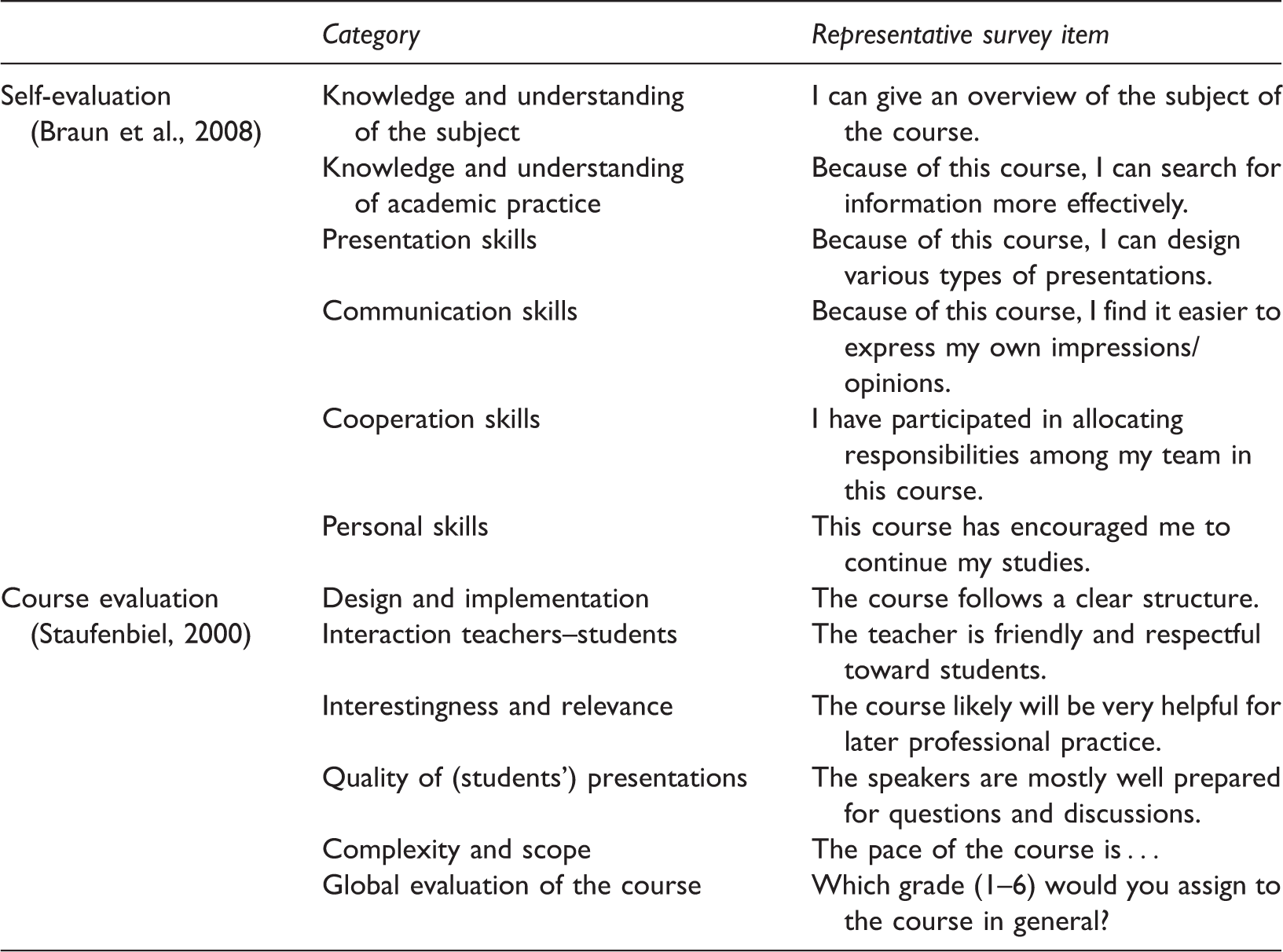
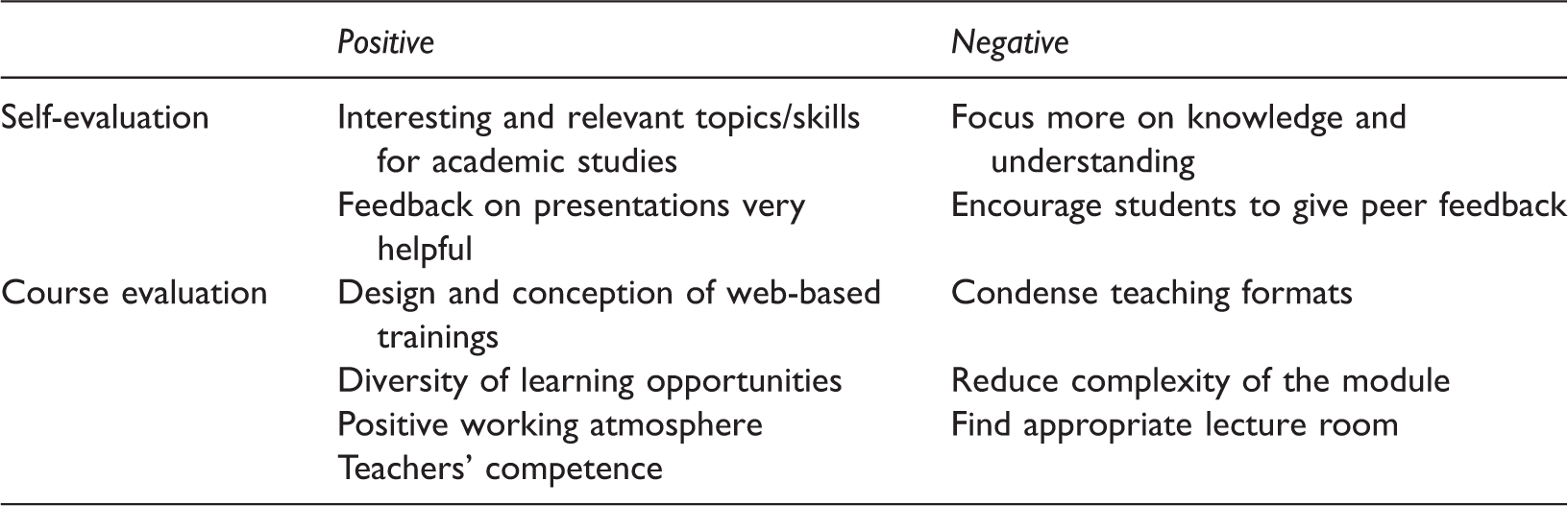
At the end of the survey, the participants were encouraged to comment on the teaching formats and their learning outcomes. The results were analyzed using the inductive development of categories in content analysis (e.g., Mayring, 2010). Therefore, to aggregate the information obtained from the students, the statements were paraphrased and assigned to appropriate categories during a multi-stage process.
Objective Assessment: Knowledge and Understanding
Since students’ self-evaluations and objective evaluation of their learning outcomes may diverge (cf., Dunlosky & Rawson, 2015), objective assessments of the students’ increase in knowledge and understanding of educational psychology and academic practice were designed to complement the investigation of the students’ perceptions. These assessments focused on the learning outcomes of the students following their participation in a WBT respectively their participation in the lecture.
To measure the students’ learning outcomes from their participation in the first WBT during the first semester of the module, single- and multiple-choice items regarding the content of the WBT were developed and randomly assigned to either a pretest or the post-training test. Thirty-seven first-semester students (18.92% male, 81.08% female; age from 18 to 51; M = 22.62; SD = 6.82) were asked to complete the pretest and respond to items measuring their motivation for learning (18 items selected from IMI; Deci & Ryan, n.d.; Cronbach’s α = .91). Then, the participants attended the WBT and answered the post-test questions. The results of the pre- and post-test were compared using a paired t-test, and predictors of the results of the post-test were examined using regression analysis.
With the goal of developing another assessment regarding the subjects discussed during the lecture, existing self-developed tried and tested items regarding the students’ knowledge of educational psychology were analyzed using item response theory (IRT) models (e.g., van der Linden & Hambleton, 1997). Thus, the instrument will allow for the identification of changes in the students’ knowledge during the module and differences in knowledge levels between cohorts. To calibrate the existing 53 items, they were assigned to a sample of 84 psychology students attending the lecture using a balanced incomplete block design (e.g., Frey, Hartig, & Rupp, 2009). The collected responses were scaled using a one-parameter logistic IRT model. The ability of the students was estimated based on a maximum likelihood, and the mean of the latent ability distribution was set to 0.00.
Results
Students’ Perceptions: Self-evaluation and Course Evaluation
The self-evaluations indicate that the students on average perceived moderate increases in knowledge and understanding of educational psychology and academic practice during the first semester of the module (M = 3.26, SD = .76; M = 3.18, SD = .97; Figure 1 shows the descriptive analysis). The improvement in their presentation skills was rated highest by the students’ among the learning outcomes that were assessed (M = 3.71, SD = 1.01). Improvements in communication (M = 2.67, SD = .95), cooperation (M = 2.92, SD = .91), and personal skills (M = 2.87, SD = 1.00) received lower ratings (Figure 1).
Descriptive analysis of self-evaluation scores (mean; standard deviation; five-point Likert scale).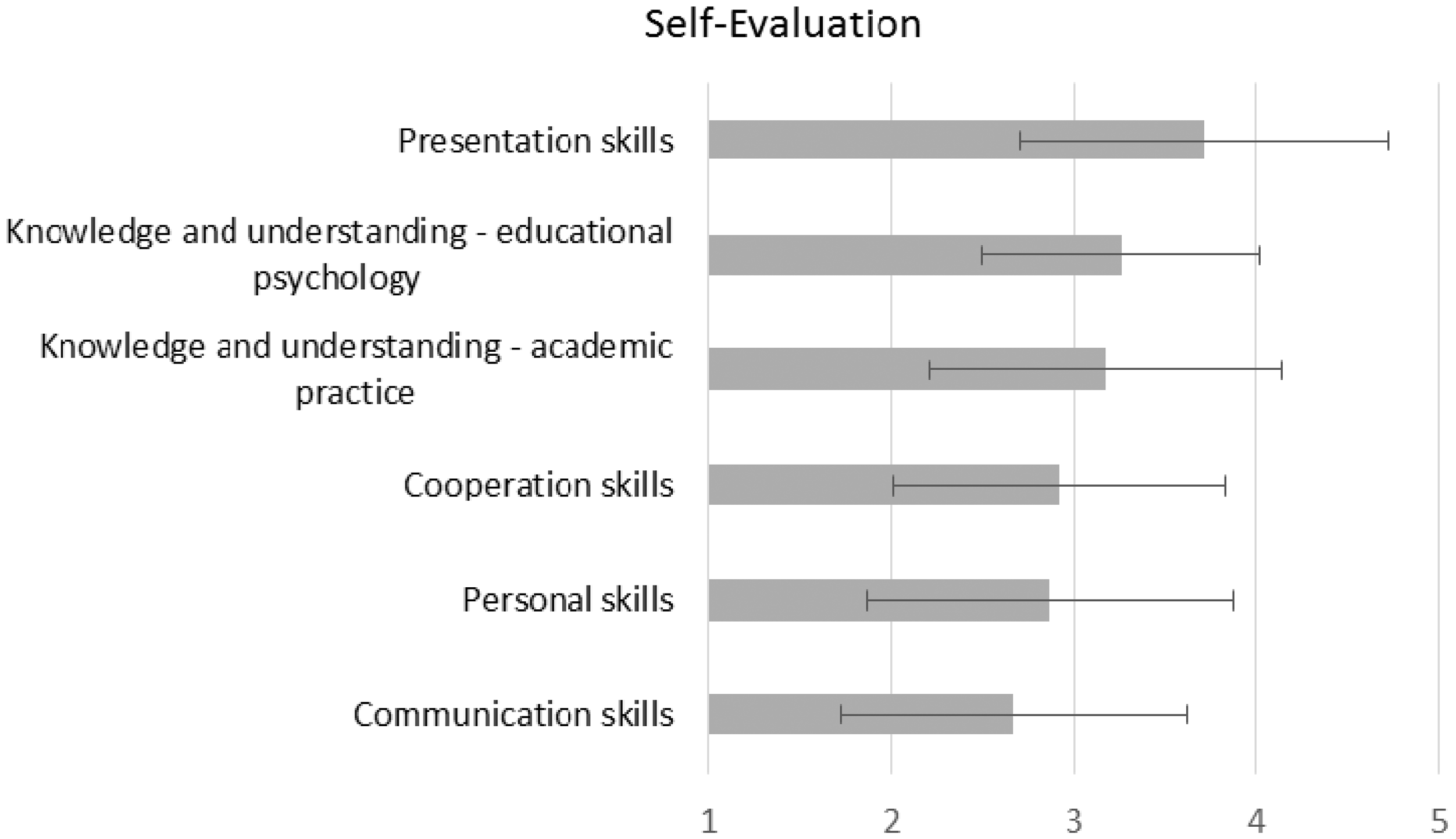
Based on the course evaluations, the students gave very positive ratings to the teaching formats in the first semester. In particular, the interaction between students and teachers was rated very high (M = 4.31, SD = .75; Figure 2). In comparison, the participants rated the complexity and scope of the module as average (M = 3.09, SD = .50).
Descriptive analysis of course evaluation scores (mean value; standard deviation; five-point Likert scale).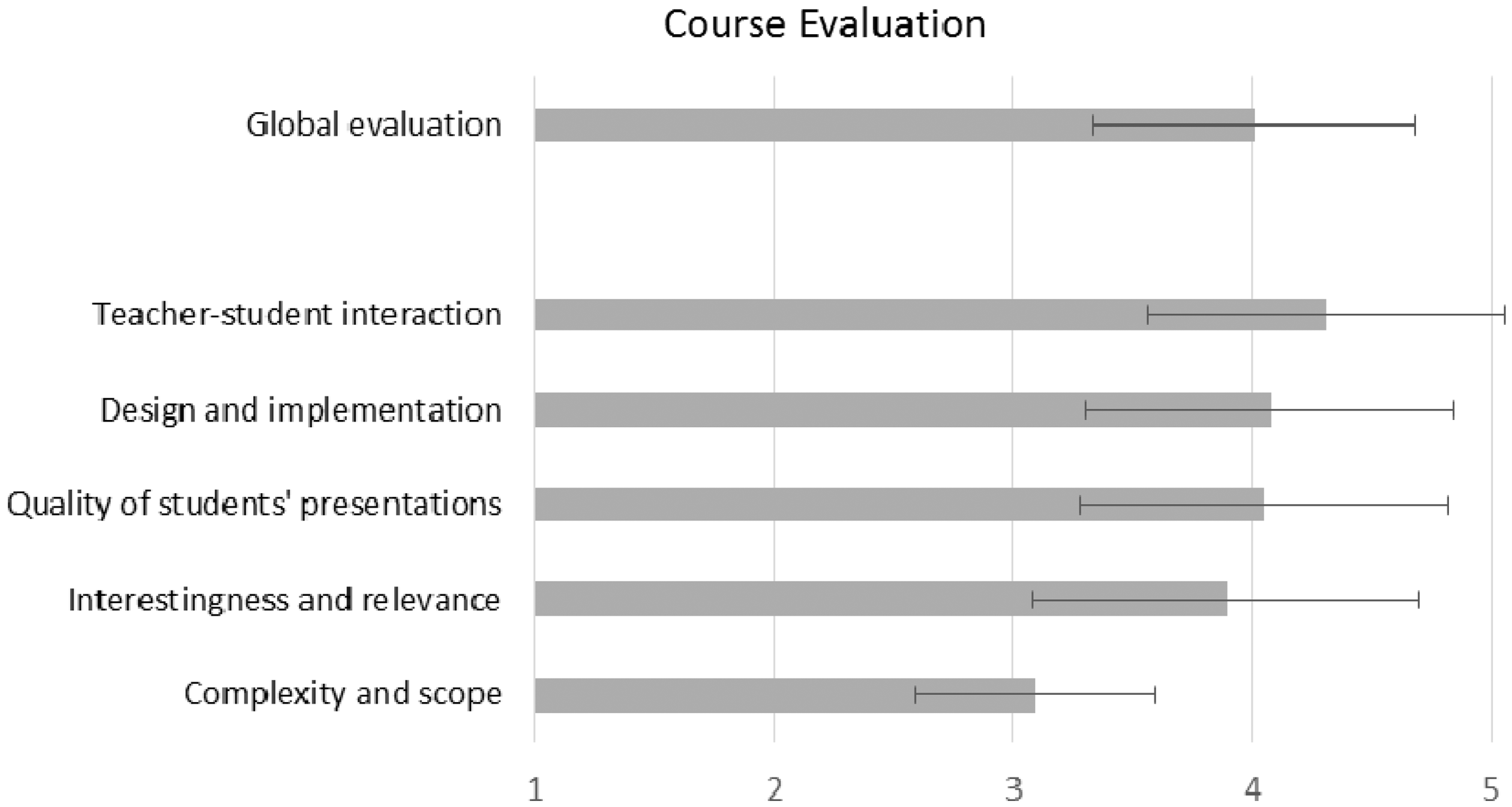
Categories of students’ comments that were mentioned frequently.
Objective Assessment: Knowledge and Understanding
The students’ learning outcomes from the web-based tutorial were assessed objectively. Their knowledge improved significantly based on an increase from a mean of 34.36% correct answers (M = .34, SD = .22) on the pretest to 64.26% (M = .64, SD = .16) on the post-test (t(36) = 6.83, p < .01). No significant Pearson’s correlation was found between the students’ results on the pretest and post-test (r = .072, p > .05, two-tailed). However, the students’ motivation significantly predicted their learning outcomes (b = .37, t(35) = 2.32, p < .05) and explained a significant proportion of the variance in the students’ learning outcomes (R2 = .13, F(1,35) = 5.40, p < .03).
While developing the assessment of learning outcomes of the students who attended the lecture, it was noted that no items showed significant misfit, but 22 items showed low discrimination, that is, less than .2. Thus, 31 items were retained in the test. The following analyses involve these selected test items. The difficulty distribution had a mean of –.19 with a standard deviation of 1.19. The point–biserial correlation between a single item and the sum of solved items, which is comparable to the item discrimination from classical test theory, had a mean of .36 with a range of .20–.65. The reliability of the ability estimates was .57.
Discussion
The module described above provides an example for empirically founded teaching in psychology, since several techniques of EBT were implemented within a variety of learning opportunities. Furthermore, based on the idea of the SoTL, the various teaching formats and learning opportunities offered during the first semester of the module are considered in an evaluation. The evaluation includes the students’ perceptions of their learning outcomes (self-evaluation) and the learning process in terms of course evaluation. Objective assessments were developed with regard to the students’ knowledge and understanding of the subjects addressed.
Students’ Perceptions: Self-evaluation and Course Evaluation
The students’ perceptions presented in both the self-evaluation and course evaluation provide interesting information regarding the intended learning outcomes achieved during the first semester of the module. The students’ improvements in personal, cooperation, and communication skills were not rated very high, although the students were expected to develop and apply these skills during the first semester as well. As described below, possible modifications of the module for the following cohorts can be derived from this information. However, possible bias in the self-evaluation data needs to be acknowledged, and there is a need for objective assessments of one of the main intended learning outcomes: knowledge and understanding of educational psychology and academic practice. In addition, for future cohorts, the correlation between subjective and objective assessments of students’ learning outcomes needs further investigation.
The module was designed and implemented simultaneously. Therefore, the findings cannot be compared with those of a previous cohort or a matching control group. Furthermore, students’ perceptions are reported for all the teaching formats offered during the first semester of the module. This lack of a control and specificity of the data imposes a limitation on the results of the self-evaluation and course evaluation because no conclusion can be drawn regarding the effects of individual teaching techniques and teaching formats. Thus, the objective assessment of the students’ knowledge and understanding involves only individual teaching formats of the module. Nevertheless, for future cohorts, possible modifications of the module will not be implemented for all students simultaneously so that comparisons with a control group or waiting group can be made.
Objective Assessment: Knowledge and Understanding
The results concerning the objective assessment of students’ learning outcomes from participation in the first WBT are very interesting with regard to the idea of reducing heterogeneity among first-year students. Based on the data, it can be assumed that the students acquired knowledge during the training. Moreover, their learning outcomes are independent of their pretest knowledge, which may be explained by the individual pace of learning during the WBT. Nevertheless, these results pertain to only the first WBT in the first semester of the module. Therefore, similar pre- and post-tests need to be designed for the remaining WBTs. In addition, it remains unclear which factors (beside student motivation) are useful for predicting students’ learning outcomes, since there is no control condition.
To develop a test to assess students’ learning outcomes from attending the lecture, items measuring their knowledge and understanding were analyzed using IRT models. However, these items still need to be tested with regard to their usefulness for measuring changes in students’ knowledge over time, and eliminated items need to be revised and recalibrated in future assessments to enhance the reliability and validity in terms of the interpretation of the test scores. The test will be administered to different cohorts, which can be connected using appropriate linking or equating methods (e.g., Kolen & Brennan, 2014), thereby facilitating an objective comparison of student achievement across several cohorts. In addition, students can be provided with individual feedback on their current level of knowledge compared to their peers to identify possible misconceptions and illusions of knowledge. Furthermore, the application of these models allows for retracing students’ learning processes during the lecture using repeated measures without using the exact same test items. Therefore, the development of this assessment will be an important step toward implementing a high-quality evaluation of the effects of future modifications on specific teaching formats of the module.
Conclusions and Implications
With the goal of providing an example of empirically founded teaching in psychology by combining EBT and the SoTL, two aspects of practical implications are discussed. Firstly, further steps for improving the module are derived based on the results reported above. Secondly, implications for teaching in psychology in general are suggested.
Implications for the module
The results reported above provide valuable information about the students’ perceptions of their learning outcomes and the courses during the first semester of this module and about the students’ actual learning outcomes, that is, knowledge and understanding. In conclusion, three possible modifications and their implementation consistent with the goals and intended learning outcomes are introduced. In accordance with the idea of the SoTL, the intention is to implement these modifications and evaluate their effects on future student learning outcomes.
Firstly, the students suggested that they should be more involved in providing feedback on their peers’ presentations during the workshop. Since this request is consistent with the goals of the module, it is important to include student feedback in both oral and written forms (cf., van den Berg, Admiraal, & Pilot, 2006). To encourage students to provide feedback, the workshop design needs to be adapted with regard to the form of feedback and its scheduling (see Nicol et al., 2014).
Secondly, another suggestion mentioned more than once was to condense the teaching formats, which particularly applies to the workshop’s duration of two days. Because it will not be possible to shorten the total duration of the workshop, one modification might be to divide the workshop into several sessions in accordance with the idea of spaced learning (see Carpenter et al., 2012).
Thirdly, according to the self-evaluations, the students did not rate their improvements in communication, cooperation, and personal skills as high as they did their improvements in the other skills (Figure 1). These results are not surprising, since the module is designed such that the former skills are developed primarily in the second and third semester (see Table 1). Nevertheless, the students also need to develop their communication and cooperation skills when working in groups during the first semester. Supplementary WBTs in those subjects could prepare students for these tasks during the first semester.
For the future, it might be interesting to consider the development of students’ skills over the course of their studies by interviewing other psychology teachers with regard to the students’ skills and performance. The goals of the module include not only the acquisition of knowledge and skills, but also students’ social integration (cf., Bers & Smith, 1991). This aspect of the intended outcomes has not yet been addressed in the evaluation and should be taken into account in future investigations.
Further implications for teaching in psychology
Sharing experiences and examples of good teaching practice in higher education is considered helpful for teachers to learn from one another and to find inspiration for their own teaching. EBT in planning and designing learning opportunities based on theoretical and empirical evidence goes beyond this unsystematic observation (Saville, 2010). Psychology teachers in particular can benefit from EBT, since psychologists already have crucial knowledge regarding students’ cognitive processes and their behavior in groups (see Dunn et al., 2013).
However, applying this knowledge and empirically proven concepts to a specific teaching context may pose specific challenges depending on the context, the target group, and the topic (Felten, 2013). The practice of examining one’s teaching (SoTL) may aid in overcoming these challenges. In applying the SoTL, psychology teachers find themselves in a unique position (Gurung, Ansburg, Alexander, Lawrence, & Johnson, 2008). Psychologists understand diagnostic methods, designing subjective and objective assessments, and the appropriate use of qualitative and quantitative research methods in the SoTL. Thus, psychologists can benefit from their broad knowledge of empirically based teaching techniques, state-of-the-art psychometric evaluation techniques, and technological improvements (e.g., e-assessments) when implementing and evaluating innovative teaching concepts.
This report provides a novel example for the combination of EBT and the SoTL in psychology. Techniques of EBT were considered during the planning stage of the module and the learning opportunities offered were inquired with regard to students’ learning outcomes. Teachers in psychology are invited to follow this example and make use of this combination of the complementary concepts of EBT and the SoTL to promote empirically founded teaching in psychology and thereby come one step closer to meeting the current challenges that teachers in higher education encounter.
Footnotes
Declaration of Conflicting Interests
The author(s) declared no potential conflicts of interest with respect to the research, authorship, and/or publication of this article.
Funding
The author(s) received no financial support for the research, authorship, and/or publication of this article.