




Abstract
Previous research has found that the flipped classroom (i.e., learning prior to the lecture, and using the lecture time for consolidating knowledge) increases students’ deep learning, and has an association with improved grades. However, not all students benefit equally from flipping the classroom, and there may be important individual differences that influence preference for different teaching styles. In the present study, undergraduate Psychology students (n = 200) answered questions about exam preparedness, learning goals, preference for the traditional or flipped classroom, and the Big Five of personality. We found that preference for the flipped classroom had a significant, positive association with agreeableness and the mastery goal. Preference for the traditional lecture was predicted by beliefs about exam preparedness. The results are discussed with a reference to the Big Five paradigm in the context of learning and teaching.
Keywords
Introduction
In recent years, the flipped classroom approach has gained increased pedagogical interest across different disciplines in higher education (Danker, 2015; Eichler & Peeples, 2016; Khanova, McLaughlin, Rhoney, Roth, & Harris, 2015; Peterson, 2016; Sharma, Lau, Doherty, & Harbutt, 2015). Although this line of teaching is one of many types of blended learning (McLaughlin & Rhoney, 2015), there is no single agreed definition of the flipped classroom approach. There are a number of alternative understandings of what this pedagogical innovation represents and the types of activities which can support it (O’Flaherty & Phillips, 2015; Pierce & Fox, 2012). However, there is one commonality in all published studies: students are encouraged to follow set activities outside the classroom, prior to and after the lectures. The teaching sessions are devised to support activities which are intended to assist students to consolidate their knowledge through discussion and collaboration (mainly problem-solving activities), based on students’ pre-lecture activities and teachers’ guidance. Teaching sessions are then followed by post-class activities, such as on-line discussions and further reading, based on the in-class discussions. Thus, in a flipped classroom, the intention is that students become engaged with the learning process, “as the teacher stops lecturing and students work on a question or task designed to help them understand a concept” (Andrews, Leonard, Colgrove, & Kalinowski, 2011, p. 394).
Although there have been few theoretical developments highlighting the mechanisms and educational outcomes of the flipped classroom approach (Abeysekera & Dawson, 2015), it is generally thought to be beneficial in: stimulating deep learning (Danker, 2015); increasing motivation (Abeysekera & Dawson, 2015); engagement (Gilboy, Heinerichs, & Pazzaglia, 2015); satisfaction (Chen, Wang, Kinshuk, & Chen, 2014); and independent learning (Wilson, 2014). Many studies have found that students can improve their grades by following a flipped classroom approach (Eichler & Peeples, 2016; Moraros, Islam, Yu, Banow, & Schindelka, 2015; Peterson, 2016). It is possible that this is a result of active engagement in learning, where instructors have a lesser role in transmitting knowledge, and students take charge of their own learning (Freeman et al., 2014). However, the question still remains as to whether all students have positive experiences of the flipped classroom approach and what factors may influence their experiences. With this in mind, in the present paper, we explore the possibility that personality, goal orientation, and exam preparedness influence students’ preference for the flipped classroom approach compared to the traditional lectures.
The Big Five dimensions of personality (i.e., Openness, Conscientiousness, Agreeableness, Extraversion, and Neuroticism) have been identified as a potentially important individual difference influencing preference for different learning and teaching approaches (Komarraju, Karau, Schmeck, & Avdic, 2011). Openness is characterized by imagination and curiosity; Conscientiousness by self-discipline and sense of duty; Agreeableness by kindness, altruism, and cooperativeness; Extraversion by energetic engagement with the external world, assertiveness and talkativeness; and Neuroticism by negative emotionality, instability and anxiety (John & Srivastava, 1999). Although the role of the Big Five has not previously been investigated in relation to a preference for the flipped classroom, there are other related studies that can shed light on the putative relationship (Vasileva-Stojanovska, Malinovski, Vasileva, Jovevski, & Trajkovik, 2015).
Firstly, ‘deep learning’ has been previously associated with the flipped classroom approach (Danker, 2015), and also with all of the Big Five traits (Baeten, Kyndt, Struyven, & Dochy, 2010), especially Openness to experience (Chamorro-Premuzic & Furnham, 2009). Second, preference for interactive teaching has a link with deep learning, high Agreeableness, and low Neuroticism (Chamorro-Premuzic, Furnham, & Lewis, 2007). Third, reflective learning styles, which are characterized by applying new ideas to already existing knowledge, have been related to Conscientiousness and Openness to experience (Komarraju et al., 2011). Thus, we would expect that high Openness, Conscientiousness and Agreeableness, and low Neuroticism have an association with a preference for a flipped classroom approach.
Another potentially relevant factor in the preference for different types of teaching approaches is whether the student’s main goal is to perform well in the exam (i.e., performance approach goal), or whether their aim is to fully understand the learning materials (i.e., mastery approach goal). The performance approach goal has been associated with surface learning, and increased vigilance around materials that may be relevant for the exam (Senko, Hama, & Belmonte, 2013). In contrast, the mastery approach goal, where the key learning goal is to understand the materials, has a relationship with deep learning (Diseth, 2011). As previous research has indicated links between deep learning and flipped classroom (Danke, 2015), we would expect that the mastery approach goal is related to a preference for the flipped classroom style. Further, perceptions of the association between the teaching style and exam preparedness could affect the preference for flipped classroom vs traditional lectures. Thus, we also expect that student preference for each teaching style is related to how effective they evaluate the teaching process to be in order to prepare them for the exam.
In summary, the present research investigates the roles of the Big Five of personality, goal orientation, and perceptions of exam preparedness in the preference for traditional vs flipped classroom teaching in a large cohort of Psychology undergraduate students. Based on previous literature, we expect that personality, exam preparedness, and learning goals have an influence on students’ preference for different teaching approaches. Students’ performance in relation to their teaching preferences on different approaches was not examined in this study.
Methods
Participants and Module Description
Participants were 200 (24 male, mean age = 18.61, standard deviation = 1.14) first year undergraduate students, enrolled on a large (n = 482) introductory module on Social and Clinical Psychology at a University in the North-West of England. Students who participated in the research were those who attended the final lecture of the lecture series. The majority of the students were British (98%).
The students were taught by two different instructors, one specializing on Social, and the other on Clinical Psychology. Both lecturers delivered two of their sessions following the traditional way of teaching, and three sessions following a flipped classroom approach. Thus, the first year students had the opportunity to compare the two approaches delivered by the same teachers. In a traditional learning environment, the teachers expected students to attend their lectures and to ask questions, if they had any, at the end of the session. The learning material was uploaded on a Virtual Learning Environment (VLE) to the students 48 hours before the lecture session. In a flipped classroom learning environment, the teachers encouraged students to study learning material and both students and staff posted their comments on the online discussion forums based on a case study scenario before each lecture session. In the lecture theatre the teachers and the first year psychology students discussed further and in-depth the relevant topic and the teachers used Poll Everywhere to receive from students their responses on different case scenarios. Finally, the teachers uploaded on the VLE module space additional material and activities based on the discussions that they had in the lecture theatre in order to support the post lecture activities. Overall, the activities that supported the flipped classroom approach gave the first year psychology students the opportunity to work independently and in groups and to review a case study in class and online.
The lecture series consisted of 10 × 2 hour sessions over the course of one semester; assessment was a multiple choice test consisting of 100 questions (50 on each topic). Although there were two teaching approaches used in this module (traditional and flipped classroom), a multiple choice test at the end of the semester was designed to assess students’ performance on this this module (Scouller, 1998). However, the questions that were included in the final multiple choice test were designed to follow Bloom taxonomy (Bloom, 1956). For example, there were questions which assess students’: (1) knowledge by recalling certain facts and/or information; (2) comprehension on use of facts and principles; (3) ability to apply concepts, facts or principles on different situations; (4) ability to analysis by separating of a whole into component parts; (5) ability to synthesize by combining ideas to form a new whole; and (6) ability to evaluate by developing judgments or decisions.
Materials and Procedure
At the last session of the lecture series, students were given module evaluation forms, containing the questionnaires associated with the present study. In order to reduce respondent fatigue, we requested them to evaluate either the Social (n = 81) or the Clinical (n = 119) part of the module. At the beginning of the evaluation form was a number of statements related to personality traits and later questions to support the comparison between the traditional and flipped classroom approach. The lecturer handed out the anonymous questionnaire by alternating the questionnaire types given to each row, and the students filled them in during the break time of their final 2-hour lecture session.
All the predictor and outcome variables in the study were measured on a 5-point Likert scale (1 = Strongly Disagree; 5 = Strongly Agree). The outcome variables in the present study were the reported preference for traditional and flipped classroom approaches, which each was measured with a single question (i.e., I prefer the flipped/traditional lecture). We also collected individual student’s open responses in a “comment box” at the end of the questionnaire, but these will not be reported in this paper.
Exam preparedness was measured with questions such as: “Overall, I believe that I could improve my own exam performance by following (i) traditional way of teaching, (ii) flipped classroom approach.” The mastery goal was measured with questions such as “My aim for the module is to understand the content as thoroughly as possible”, and the performance goal was measured with questions such as “My aim for the module is to get a good mark”.
The Big Five of personality was measured with 42 items from the Big Five Inventory (BFI) (John & Srivastava, 1999), on a five-point Likert scale (1 = Strongly Disagree; 5 = Strongly Agree). Nine items were averaged to form an index of Conscientiousness (e.g., I see myself as someone who makes plans and follows through with them, Cronbach’s α = 0.66), and Agreeableness (e.g., “I see myself as someone who likes to cooperate with others; Cronbach’s α = 0.58). Dropping one question (i.e., “I have a few artistic interests”) from the Openness scale improved the alpha (from α = 0.42 to 0.64), and this subscale was constructed with the eight remaining questions (e.g., “I see myself as someone who has an active imagination”). Due to an error when constructing the questionnaires, fewer items were used for the remaining two traits. Eight items were measuring Extraversion (e.g., I see myself as someone who is talkative; Cronbach’s α = 0.77), and seven items were measuring Neuroticism (e.g., I see myself as someone who gets nervous easily; Cronbach’s α = 0.74). Due to the poor Cronbach’s alphas for some of the sub-scales, the results concerning these traits should be treated with caution.
Results
Descriptive Statistics and Correlations for the Big Five, Preference for Flipped and Traditional Teaching, Preparedness for Exams after Flipped and Traditional Teaching, and Mastery and Performance Approach
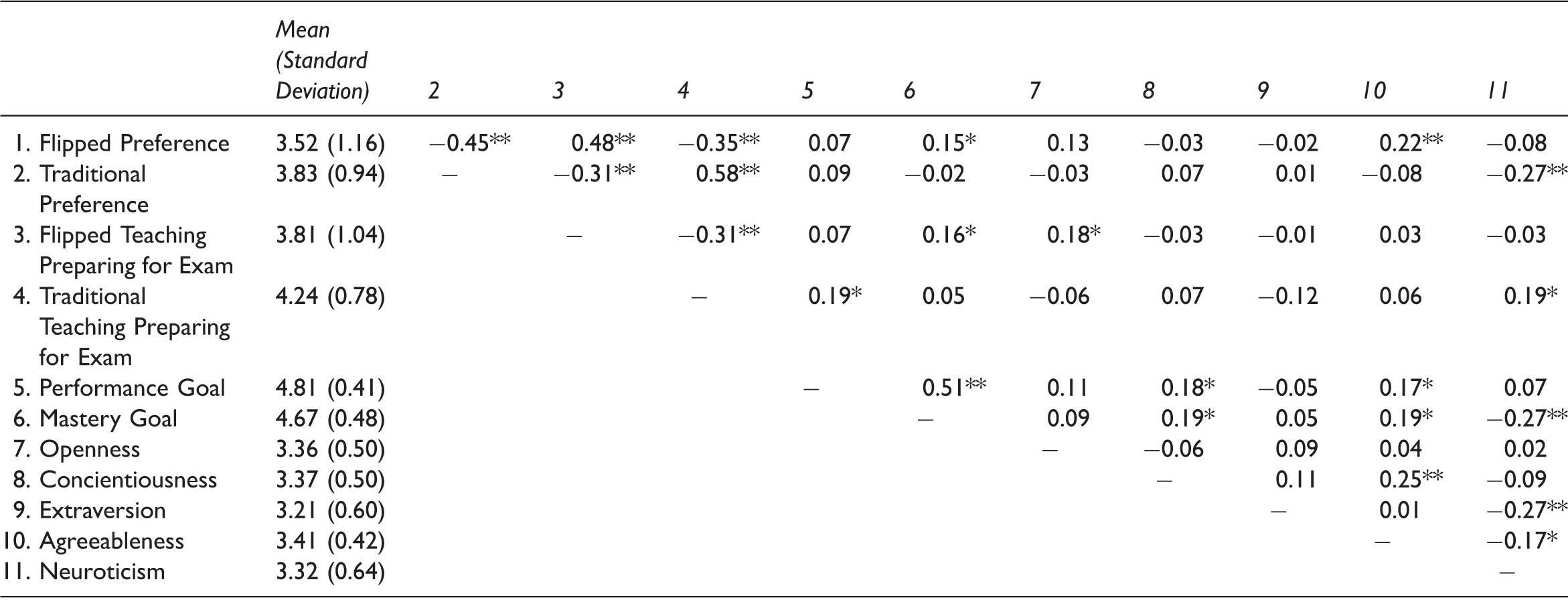
p < 0.001; *p < 0.01.
In order to tease out the relative contribution of personality, preparedness for exam, and the mastery and performance goals, we conducted two simultaneous multiple regressions with preference for the flipped and traditional teaching approaches as the outcome variables, and the teaching group (clinical/social; Step 1), exam preparedness (preparedness after flipped/ traditional teaching; Step 2), learning goals (mastery/performance goal, Step 3), and personality (openness, conscientiousness, extraversion, agreeableness, neuroticism; Step 4) as the predictor variables.
For the preference for traditional teaching, the teaching group was not a significant predictor (F(1, 191) = 1.02, p = 0.32) at Step 1, and adding preparedness for exam at Step 2 improved the model (Fchange(2, 187) = 51.29, p = 0.001). The belief that traditional lecture methods improve exam performance was a significant positive predictor of the traditional teaching approach (β = 0.54, t = 8.72, p = 0.001), and the belief that flipped classroom teaching improves exam performance was a significant negative predictor of preference for the traditional teaching approach (β = -0.13, t = 2.09, p = 0.05). At Step 3, the performance and mastery goals did not improve the model (Fchange(2, 185) = 0.11, p = 0.90), and at Step 4, personality did not improve the model either (Fchange(5, 180) = 0.56, p = 0.70). The results indicate that preference for traditional teaching has a positive relationship with beliefs about exam performance, but not with learning goals or personality.
For the flipped classroom preference, the teaching group was not a significant predictor (F(1, 190) = 0.80, p = 0.37) at Step 1, and adding preparedness for exam at Step 2 improved the model (Fchange(2, 188) = 36.39, p = 0.001). The belief that flipped lecture methods improve exam performance was a significant positive predictor of the flipped classroom approach (β = 0.42, t = 6.40, p < 0.001), and the belief that traditional classroom teaching improves exam performance was a significant negative predictor of preference for the flipped classroom approach (β = -0.22, t = -3.39, p < 0.01). At Step 3, adding the learning goals did not improve the model (Fchange(2, 186) = 1.85, p = 0.16), Adding the Big Five traits at Step 4 improved the model (Fchange(5, 181) = 2.84, p = 0.02), and agreeableness emerged as the only significant predictor, indicating that higher agreeableness had an association with a higher preference for the flipped classroom (β = 0.21, t = 3.30, p < 0.001).
Discussion
In the present study, we provided an insight into the role of personality, goal performance, and exam preparedness in the preference for two different teaching approaches. Interestingly, only Agreeableness and the mastery goal approach emerged as significant positive predictors for flipped classroom preference. For both flipped and traditional teaching, perceptions of the effectiveness of the teaching approach were significant predictors for the preference for that teaching process.
The finding that Agreeableness predicted a preference for the flipped classroom is not surprising, as this teaching approach contains a collaborative, in-class discussion group element. Trait Agreeableness is characterized by enjoyment in cooperative activities and in interactive learning (Chamorro-Premuzic et al., 2007). Individuals high in Agreeableness have reported having more pleasant interactions with others (Tov, Nai, & Lee, 2016), and it is possible that students high in this trait may find it easier to learn by discussing ideas with others in the classroom. Additionally, based on students’ open responses, some of them had difficulties in following the flipped classroom approach, as they did not feel confident to discuss with people whom they did not know (i.e., “I prefer the traditional approach especially as I do not know a lot of people. So did not really get the chance to discuss”). It is possible that those students who struggled with the flipped classroom had difficulties that are due to the interaction between agreeableness and enjoyment in communicating with others. The links between class-discussions and agreeableness should be investigated further in future studies.
The other significant factor in the flipped classroom preference was the learning goal of the student. Those students who had the goal of understanding the content of the module as thoroughly as possible also enjoyed the flipped classroom teaching more. According to the open comments, some students showed a preference for the flipped classroom approach due to their enhanced enjoyment, engagement and understanding (e.g., “I increasingly enjoyed the flipped classroom approach. It gave me an understanding of the topic before the lecture and aroused my interest”, and “I think the discussions in the flipped classroom force people to actually think about the topic which is good. It is more stimulating than the traditional method. If the topics of the traditional were not as interesting as they were, it would not have interested or stimulated me”). It is possible that there is a feedback loop between the flipped classroom and learning goal. Perhaps the flipped teaching style alters the existing learning goals of the students, making them strive for the mastery approach goal, which could lead to the improved grades reported in other studies (Eichler & Peeples, 2016; Peterson, 2016).
It seems that the flipped classroom approach could lead students to follow a deep learning approach, as it involves activities not based on memorizing knowledge and/or a list of facts. Such activities tend to be encouraged by a traditional way of teaching in which a surface learning approach is promoted (Entwistle, 2009). This surface approach to learning can often be a strategic decision on the part of students – seeking to do the minimum possible to pass their exams. This may help explain why students’ desire to pass the exam is more highly correlated with traditional methods while students’ seeking to understand the material is more highly correlated with the flipped model. The flipped classroom offers a more active environment, which encourages students to actively form new connections between the materials and collaborate in their learning. This connection between preference for understanding over merely passing the exam is supported by Danker (2015) who suggested that the flipped approach allowed students to connect the topics taught to knowledge previously gained thus deepening the learning of the material. A flipped approach also supports prior planning and preparation for the class, meaning students need to take time prior to class, to visit the material supporting distributed practice. Finally, an added benefit to the flipped approach is that any confusions or misconceptions which may arise in students’ notes from the lecture/materials can be addressed in class and are less likely to be perpetuated.
Our study is not without limitations. Firstly, the assessment (i.e., Multiple Choice Exam) did not follow the idea of constructive alignment, where learning outcomes, learning and teaching activities, and assessments are developed to strategically support each other (Biggs, 1996). The reason for not choosing any other assessment method was mainly because the introduction of the flipped classroom approach was a pilot teaching process for this module. The main aim of introducing the flipped classroom approach was to study how this process could support a large cohort of students and what students believe about this teaching approach. However, the multiple choice test at the end of the semester was designed to cover many elements from the Bloom taxonomy. Rather than testing higher order thinking skills, Multiple Choice Exams often test the ability to recognize patterns and recall information, or as Biggs notes: “the contents of knowledge are treated as having been learned in binary units (correct/incorrect), which are then summed, each unit being seen as equivalent to any other unit. Not only does this reflect a bizarre epistemology, it nudges the student to focus on details” (Biggs, 1996, p. 357). The flipped classroom approach aims to encourage students to apply, criticize, synthesize, and evaluate theories through discussions or other activities from the real world examples. A Multiple Choice Exam is not an ideal way to test the higher order thinking skills based on Bloom’s taxonomy (Krathwohl, 2002), but this might not affect the results of this study, as students participated in this research over the teaching week 12, before they took their final exam. The other reason for not changing the final exams was in terms of staff workload, often the multiple choice test at the end of the semester is a feasible way of examining students in large cohorts. However, after the encouraging results of the initial introduction of the flipped classroom approach in this module, the change of the assessment methods will be a subject for future studies.
Second, we did not look at the students’ exam performance, nor did we collect detailed demographic information, such as their socio-economic status (SES). A study by Smeding, Darnon, Souchal, Toczek-Capelle and Butera (2013) suggested that emphasizing mastery goals in teaching may be beneficial for students who are from lower SES backgrounds. It would be interesting to see if SES moderates the relationship between exam performance, goal orientation, Agreeableness, and preference for the flipped classroom. Third, due to time constraints, we could not use longer measures to investigate the variables of interest. Future research should consider using more comprehensive, validated measures for goal approach orientation, for example.
In conclusion, the current study provides first steps in investigating individual differences in who prefers, and/or benefits from the flipped classroom. The flipped classroom has created much enthusiasm among educators, but there is still much work to do in evaluating this approach in pedagogical action research. Although personality clearly matters, our study would benefit from replication and expansion to include other important variables, such as exam performance. However, a flipped classroom approach could allow teachers an alternative approach when they are seeking to increase levels of collaboration and deeper learning even within a large cohort of students.
Footnotes
Declaration of conflicting interests
The author(s) declared no potential conflicts of interest with respect to the research, authorship, and/or publication of this article.
Funding
The author(s) received no financial support for the research, authorship, and/or publication of this article.