




Abstract
Problem-based learning (PBL) courses have historically been situated in physical classrooms involving in-person interactions. As online learning is embraced in higher education, programs that use PBL can integrate online platforms to support curriculum delivery and facilitate student engagement. This report describes student perspectives of the online PBL experience, interpreted through the lens of Cognitive Load Theory. Fifty-two undergraduate health professional students participated in this descriptive survey. The responses revealed that, overall, learners perceived the platform to be suitable for conducting online PBL, that distractions in the online environment were no greater than those experienced in physical classroom, and that online PBL was as effective as in-class PBL for learning. In online PBL, the technological capabilities and limitations of the online platform were identified by students as the key sources of hindrances and facilitators to learning. Suggestions for implementing online PBL using instructional principles from Cognitive Load Theory and multimedia learning are offered.
Background
Problem-based learning (PBL) has been used in higher education for several decades (Barrows, 1996), but delivery of PBL has historically been situated in physical classrooms involving in-person, face-to-face interactions. Increasingly, online learning is being embraced in higher education and psychology instructors are exploring the implementation of both PBL and online learning in their courses. Programs that offer PBL have an opportunity to integrate online platforms to support curriculum delivery.
There is a wide range of course delivery models for online learning. Online courses can be delivered in a synchronous format, where students and the instructor interact in the virtual environment with video and/or audio connectivity; and there are also asynchronous online delivery models, where the instructor and students are not required to be online concurrently. Posts to discussion threads on the learning management system happen at any time. Another asynchronous delivery approach involves incorporating online learning modules into a course: pre-recorded videos that cover course content and provide a springboard for further discussion either within a virtual or in-class environment.
In our undergraduate nursing program, we have adopted synchronous, online PBL for our final two semester required courses. The first term course is 3.5 hours per week for the entire 12-week term; the second term course runs for 6 hours a week for six weeks. Our online PBL format follows the traditional practices of PBL that have been implemented in health professional programs for decades (Albanese, 2010). We have, however, made some modifications to the traditional PBL model worth noting. First, we have 20 students per online PBL class as compared with the group sizes of typically 6–8 discussed in the literature. Second, all core nursing theory courses are delivered in a PBL format starting from the first semester of entry into the undergraduate program, so students in our program are familiar with the PBL process by the time they reach their final year. The online PBL course option is offered alongside the in-class option only in the final two semesters of the program and students can choose to take either the in-class or the online course. Both in-class and online PBL delivery formats have identical course evaluation measures. While all students had experience with PBL in the classroom, they were new to online PBL.
During the online PBL classes, students are introduced to a professional practice scenario or problem through a video, text-based, or slideshow format. Students then identify their learning goals, research learning questions, discuss their learning, and then apply their research to the scenario initially presented. Additionally, instructors allocate time during online PBL to include both large (entire class of 20 students) and small breakout group (3–5 students) discussions.
Attempts to translate an in-class PBL experience to an online setting, however, requires that the instructor also understands how the online environment introduces additional or different cognitive load burdens on learners. While concurrently facilitating the PBL process for the class, the instructor must also navigate the technology and multimedia aspects of the online PBL environment. This presents additional challenges for which an instructor must be prepared. This includes educators teaching in psychology courses, as is the focus of this special issue. Cognitive Load Theory (CLT), therefore, becomes a useful framework within which to consider instructional design and course delivery approaches in the online PBL context.
Cognitive Load Theory is based on the premise that learning results from information being processed within a constrained and limited working memory prior to being integrated into long-term memory through schema construction and automation (Artino, 2008; Sweller, 1988). Information will not be retained if it exceeds the learner’s working memory capacity (Sweller, 1994). The triarchic theory of cognitive load describes three types of cognitive load imposed on a learner’s working memory: intrinsic, extraneous, and germane (Sweller, Van Merrienboer, & Paas, 1998). Intrinsic cognitive load describes information processed specifically as part of the learning task and is influenced by factors such as the learner’s level of expertise and the inherent difficulty of the learning goal. Extraneous cognitive load describes the irrelevant or unnecessary features of instruction that impose an additional burden on working memory and are hindrances to learning (Sweller et al., 1998). Germane load contributes additional cognitive burden to working memory processes as well but is considered useful for learning (Paas & Van Merriënboer, 1994) by assisting the learner with schema construction and automation. Collectively, these three components of CLT provide a framework for instructional design that encourages instructors to maintain intrinsic cognitive load within the limits of a learner’s working memory capacity, decrease extraneous load, and promote germane cognitive processing.
Purpose
The purpose of this report is to summarize student perceptions of their online PBL experiences and to use the Cognitive Load Theory framework to interpret student feedback and suggest applications for educators who wish to implement online PBL in their courses. At our institution, the Blackboard Collaborate™ platform (referred to hereinafter as Blackboard) is used for all synchronous, online PBL courses. Blackboard features include audio, text chat, emoticons, shared whiteboards, and breakout rooms for small group discussion. However, other learning platforms are available to conduct online PBL. Therefore, the teaching applications provided in this report are not limited to the online platform our institution currently uses, and the insights gleaned from this study can be applied to other online learning and web-conferencing platforms available for use in higher education as well.
Approach
Senior-level, final year undergraduate nursing students (n = 52) contributed to this descriptive survey. At the end of the term, students provided feedback regarding their online PBL experience by completing a survey that students could access through a web link. This survey contained both Likert scale and open-ended questions. IBM SPSS Statistics version 22.0 was used to analyze the Likert scale responses. The qualitative feedback provided by students to the open-ended questions were analyzed for recurring themes.
Because this was not a research study that attempted to measure cognitive load variables in the online PBL environment, the survey questions were not labeled to represent particular cognitive load variables. The aim of this report was to gather student feedback and then interpret the student feedback based on what is known in the literature about managing cognitive load during instruction. Survey questions were loosely based on previous CLT research questions described in the literature (Cierniak, Scheiter, & Gerjets, 2009; DeLeeuw & Mayer, 2008; Kalyuga, Chandler, & Sweller, 1998). Furthermore, student responses were not linked to course evaluation measures or learning outcomes given the many confounding variables within this in vivo (Dunbar & Blanchette, 2001) online PBL environment.
Ethics
The joint Research Ethics Board approved the implementation of this survey. Students consented to participate when they provided feedback to the survey.
Findings
Online PBL Student Survey
Online PBL Platform
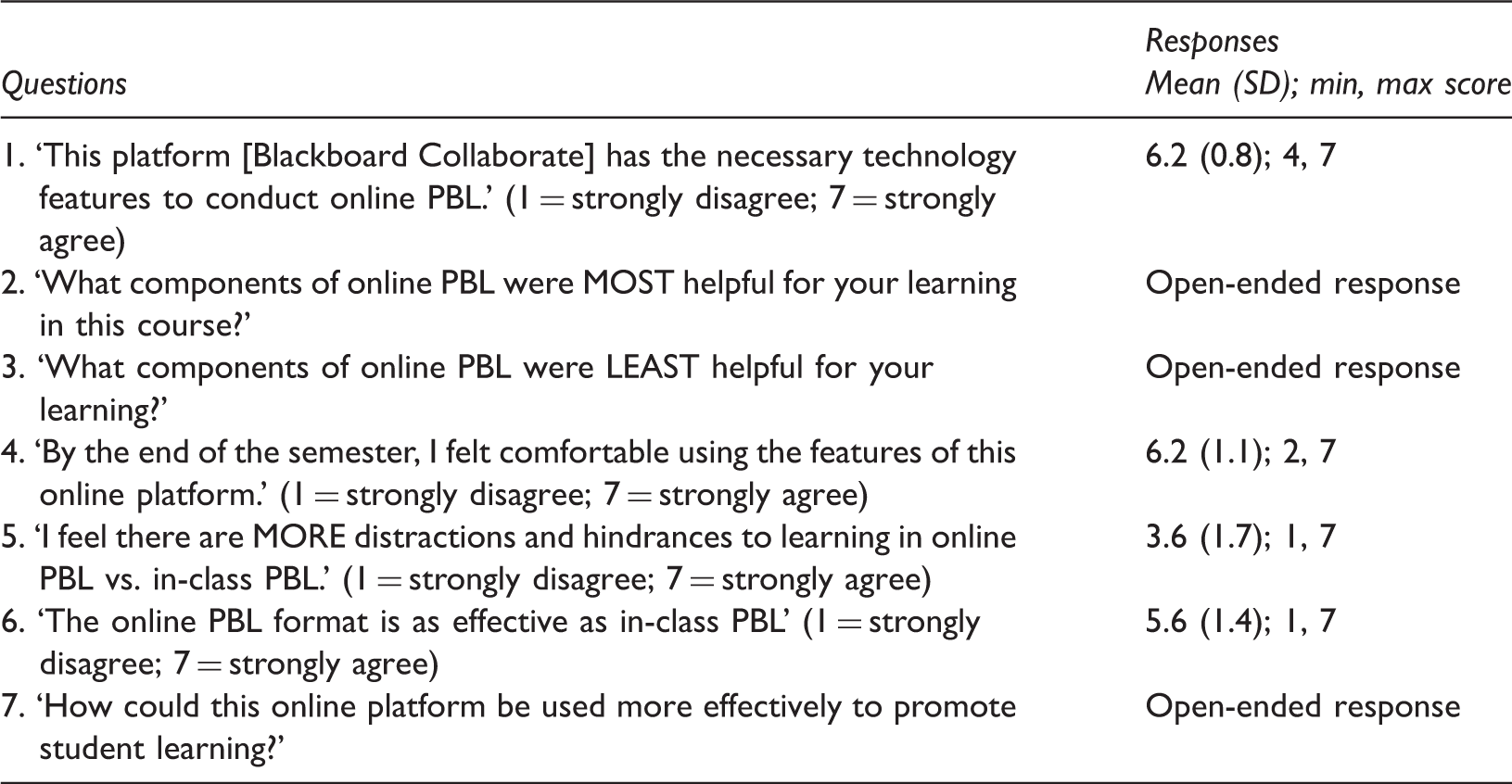
Feedback revealed that, overall, students perceived the online platform to be suitable for conducting online PBL. Students indicated that the Blackboard platform had the necessary technology features for online PBL (Question 1). Furthermore, students felt comfortable using the Blackboard features for online PBL communication by the end of the semester (Question 4). Consistently, in the qualitative feedback provided in Questions 2, 3, and 7, students cited that a having the instructor provide a detailed orientation to the online platform at the start of the term was necessary for developing comfort with platform for online PBL as students ‘needed guidance from [their instructor] and [the platform] was not self-explanatory’ (Student 8).
Hindrances and Facilitators to Learning
There was a broad distribution in responses to the question, ‘I feel that there are more distractions and hindrances to learning in online PBL vs. in-class PBL’ (Question 5). Exploring the qualitative feedback (Question 3) to understand better why there was such a wide range of student responses, several themes emerged. While the online platform was felt to be adequate to conduct online PBL, the distractions participants experienced in the online environment were different from the distractions experienced in class in their previous PBL courses.
The most common hindrance theme expressed by participants were the ‘technology difficulties’. A frequent distraction during an online PBL session, given its highly interactive and discussion-focused pedagogical approach, were the audio delays when some students spoke, and particularly, when multiple students spoke simultaneously. This, compounded by the ‘lack of non-verbal communication’ because video chat was not employed during the class, was a distraction for some. Students had to adjust to other forms of communication in online PBL. Examples include the use of emoticons to show approval for a comment made, typing in the chat box to pose a question, and using the ‘raised hand’ feature to request to speak rather than speaking spontaneously during discussion. Others felt that it was ‘harder for people to engage in critical discussion … [for students] to act as gatekeepers or encourage participation of others’ (Student 24).
However, students also identified facilitators to learning in online PBL (Question 2). Many students stated the ‘polling function, whiteboard use, and breakout rooms’ were features that enhanced their discussions and helped them stay engaged in discussion. One student’s comment summarized what others also expressed: ‘ [these aspects] required that I be engaged in the process of class activities which I appreciated’ (Student 11).
Comparison to In-Class PBL
The survey also revealed that students felt online PBL was as effective as their previous in-class PBL classes for meeting course learning goals (Question 6). Students felt that the in-class PBL environment had its own distractions, with a common theme being that there were ‘many side conversations [in class] that were distracting’, whereas online PBL was ‘much more focused’. An additional theme that many students expressed was that online PBL helped quieter or shy members contribute to discussions more freely. The combination of emoticons, chat, and whiteboard features helped students stay engaged in the discussion when they were not speaking, and the breakout rooms helped quieter members feel more comfortable in sharing their research findings with a smaller group of peers.
Interpretation
Feedback from the student survey provides insight into the student experience of online PBL. When this feedback is interpreted through the lens of the CLT literature, we can identify a few practical strategies to assist psychology course instructors with online PBL course design and implementation, particularly with respect to application of Cognitive Load Theory and multimedia learning principles.
Instructors should view the online technology platform as an integral course component and central to effective facilitation of the PBL process. As Savin-Baden and Wilkie (2006) state, ‘[there is a] need for strong and effective interaction between pedagogy and technology to ensure that both are used to best effect’, and this is particularly true for online PBL course delivery and design. One consistent feedback from students was that they required, and benefitted from, a clear orientation to the online platform at the beginning of the term. Students reported that the learning platform had the potential to ‘feel overwhelming and confusing … too many things to pay attention to’ (Student 32).
This aspect of managing the intrinsic cognitive load of students is an example of the pretraining principle in multimedia learning (Mayer & Moreno, 2003) whereby providing students with this early, foundational instruction helps prepare them for more effective subsequent learning. Another way to interpret the students’ feedback is that the online platform can hinder learning when the distractions of navigating the online technology, the increased extraneous cognitive load, prevent students from focusing on PBL discussion. Therefore, any steps that an instructor could take to reduce online distractions, including providing an initial orientation to the online PBL platform, would be helpful for students.
One word of caution, however, is that the orientation should introduce learners to the central features of the online platform required for engagement in class rather than to an overly detailed explanation of all possible features available in the online platform. For example, learners should know how to turn on/off their microphones, understand how the chat function will be used during class, how to use the emoticons in response to their peers’ comments, and how to post comments and information to the whiteboard. The online platform should serve as a support to student learning and technological features should not be the central focus of online PBL.
Another theme expressed by students was that they experienced different distractions in online PBL vs. in-class PBL, with the source of online PBL distractions being primarily related to connectivity issues and managing the information retrieval and discussion process (e.g. searching for research on one computer screen window while simultaneously having to engage in class discussion in a different window). This feedback is consistent with research by others that describe the increased, extraneous cognitive load experienced when processing information on two separate computer screens (Van Cauwenberge, Schaap, & van Roy, 2014). Instructors can mistakenly assume that the current generation of students are far abler in managing multiple technology inputs than previous generations. However, instructors should approach students as ‘digital natives’ who are not necessarily more capable of dealing with technology than previous generations of students (Kirschner & van Merriënboer, 2013).
Instructors, therefore, can help students manage the additional cognitive demands imposed by the online platform by taking active steps to minimize distractions in the online PBL environment. Strategies include ensuring that, in addition to the pretraining orientation to the learning platform, all students have an adequate Wi-Fi or Ethernet connection prior to the start of term (which helps to mitigate the audio delays), and an appropriate audio and speaker set-up (which prevents speaker feedback and audio reverberation).
Furthermore, in addition to managing the distractions imposed by the technology, the instructor must continue to guide students through the PBL process within the online environment. The instructor must be explicit with respect to what stage in the PBL process the class is currently engaged with, the time allocated for each learning activity or discussion topic, and the goals to achieve within the allotted timeframe. Because the research that students conduct to answer learning questions is usually on the same computer as their online PBL class, but in different browser windows, it is important to allow students time for information retrieval and critical appraisal of research and to ensure that the research time is clearly differentiated from the group information sharing and discussion time.
Students also expressed concern about the lack of non-verbal communication during online PBL, because video chats were not used. Using video chat on Blackboard resulted in significant audio/visual delays and were hindrances to class discussion. As an aside, other online platforms are known to be more effective for facilitating video chats (e.g. Adobe Connect web conferencing). The lack of visual feedback from peers and the inability to pick up non-verbal cues from classmates and the instructor was disconcerting for many students, and this was frequently mentioned in the survey responses. Therefore, it was important for the instructor to encourage and remind students to use other avenues for communication (e.g. emoticons, text chat comments/questions, writing notes on the whiteboard in addition to using their microphones to speak) to compensate for the lack of visual cues.
One strategy that instructors could use in online PBL is an application of the modality principle (Neto, Huang, & Melli, 2015). This principle describes how cognitive load is decreased when both audio and visual channels are used during instruction, with the intent to provide complementary information sources to students rather than information through a single channel alone. For example, having students share information verbally while the group is able to see a key word or image on the whiteboard can decrease extraneous cognitive load when compared with using the audio alone (i.e. without any visual cues). The instructor can help the group manage this process by providing explicit guidance for how to optimize both auditory and visual input for learners. For example, an instructor could recommend to students that they post their theoretical framework on the whiteboard, verbally explain the framework to the class, and use the pointer to identify the part of the framework being discussed.
Recent multimedia learning and cognitive load literature has discussed the role of motivation in facilitating germane cognitive processing. Cognitive engagement can be mediated by motivational factors (Moreno & Mayer, 2007), and this can be applied to psychology teaching in an online PBL format as well. Learner motivation is connected to learner engagement which can promote generative, or germane, cognitive processing. As Mayer (2014) suggests, instructors should ‘ [u]se design features that motivate learners to engage in generative processing while also providing enough guidance to mitigate excessive extraneous processing [i.e. extraneous cognitive load]’.
Feedback from students in online PBL identified several features that facilitated engagement during class. Polling features and emoticons were quick ‘instant feedback’ strategies used by the instructor to maintain attention and to provide encouragement for classmates who were speaking or sharing information. The text chat box and whiteboard writing allowed students to offer more thoughtful comments or questions during the discussion. This served to facilitate interaction between group members yet not interrupt individuals who were speaking. However, in implementing these strategies, the instructor should establish clear guidelines for how the chat and whiteboard writing will be used. Written comments or questions should be connected to the current topic being discussed. Furthermore, it is helpful to stop the audio conversation briefly to allow the group to review comments posted in the chat box so that attention is not diverted from the speaker using the microphone.
Lastly, a common theme students expressed was how the small group breakout sessions supported learning by facilitating engagement and active discussion. When students are in a breakout room, everyone is able to turn on their microphones, write on the whiteboard, post their research findings, and freely critique the research or discuss their key learning. One benefit of online PBL is that multiple breakout group conversations could occur simultaneously. Students in one breakout group were not able to hear students in another breakout group and distractions were minimized. Students noted that, in previous in-class PBL courses, they were frequently distracted by other breakout groups’ conversations and activities.
Students consistently expressed that online PBL breakout groups enhanced their motivation to engage in critical thought around the topics explored during a PBL class. This feedback is consistent with the findings of others who identified that germane processing is facilitated when students are able to be involved in creating their own learning goals (Grunwald & Corsbie-Massay, 2006) and manipulate their learning materials (Van Merrienboer & Ayres, 2005). To provide one further application for psychology teaching in the online PBL format, the judicious intermingling of breakout discussion time within the large group online PBL session is perhaps an example of the segmentation effect where learners’ cognitive load is optimized by breaking a learning session into smaller sections with discrete learning goals (Mayer & Moreno, 2003).
Conclusions
This report describes student experiences of online PBL and discusses potential applications of cognitive load theory within the online PBL context for psychology educators interested in implementing online PBL in their courses. In online PBL, the technology capabilities and limitations of the online platform were identified by students as the key sources of hindrances and facilitators to learning. Students benefit from a clear orientation to the online PBL platform. Instructors must help students minimize distractions in the online environment; this includes not only managing the multiple sensory inputs encountered during class but also the different communication strategies required in online PBL that are different from in-class PBL. Lastly, instructors can promote student motivation and engagement in online PBL through effective incorporation of online technology features into class discussion.
Footnotes
Declaration of Conflicting Interests
The author(s) declared no potential conflicts of interest with respect to the research, authorship, and/or publication of this article.
Funding
The author(s) received no financial support for the research, authorship, and/or publication of this article.