



Abstract
Interdisciplinary complex problem-solving relies on psychologically safe teamwork where individuals feel confident to speak up with unique knowledge, or voice dissent. Existing studies on psychological safety (PS) have mainly concentrated on developing diagnostic tools and categorising the antecedents to psychologically safe interactions in face-to-face teams. Few focus on the establishment and maintenance of psychological safety in online teamwork, let alone in the context of now-prevalent online learning in higher education. Leveraging the natural experiment in online teaching and learning brought about by COVID-19 lockdowns, we conducted a preliminary study that combines quantitative and qualitative methods to examine the extent to which, and how, undergraduates experience psychological safety in virtual teams. Students reported experiencing relatively high psychological safety in their collaborations, yet the results also suggest that specific elements of instructional design were needed to support the establishment and maintenance of psychological safety in the online environment. These measures include extra provision for timetabled group work, demonstrating openness and curiosity, designing assessment tasks that necessitate diverse contributions and normalising constructive failure through iterative feedback. Pedagogical tools and practices related to these measures can help online student teams build and sustain psychologically safe collaboration to optimise problem-solving and innovation.
Keywords
Introduction
The interconnected and complex nature of 21st century political, economic, social and environmental challenges (Dorst, 2015; Holley, 2017; Organisation for Economic Co-operation and Development, 2018) is fuelling escalating demand for competence in teamwork, critical thinking, open-mindedness and creativity in problem-solving contexts (Edmondson & Harvey, 2018; Edmondson & Roloff, 2009; Roepen et al., 2010). In response, the idea of interdisciplinary effectiveness, defined as the ‘integration and synthesis of multiple viewpoints and practices [and] working effectively across disciplinary boundaries’ (University of Sydney, 2019), has emerged as a highly desirable attribute for university graduates (Brassler & Dettmers, 2017; Budwig & Alexander, 2020; Goltz et al., 2007).
As documented extensively by leadership and management scholar Edmondson and Harvey (2018), a climate of psychological safety is a necessary precondition for effective interdisciplinary teamwork, especially when such collaborations aim for the creation of novel solutions to problems that cannot be resolved using a singular disciplinary lens. Psychological safety (PS) is defined as a team-level belief that members will not be punished or humiliated for speaking up with new ideas, questions, concerns or mistakes when working in a collaborative context, thus destigmatising failure and supporting a team-wide learning mindset (Edmondson, 1999, 2004; Edmondson & Harvey, 2018; Edmondson & Roloff, 2009).
Unsurprisingly, PS is recognised as a characteristic of effective student teams as well (Ashauer & Macan, 2013; Cave et al., 2016; Roh et al., 2018; Zarraga-Rodriguez et al., 2015). PS enables students to engage in learning by facilitating cognitive (inquiry-based) rather than affective (emotional) conflict, providing individual participants with the confidence to share unique knowledge, challenge team assumptions and experiment with new ways to integrate diverse perspectives (Amason et al., 1995).
Interdisciplinary problem-centred curricula and the construct of PS are both well-documented and overlap in the educational and organisational learning literature. Yet, relevant research into the function of teams in establishing trust, sharing knowledge and engaging in brave and innovative problem-solving often rests on the implicit assumption that such collaboration occurs face-to-face (in-person). After the disruption of workplace and education practices during the Covid-19 pandemic, this assumption can no longer be taken for granted.
While distance learning in the higher education sector is not new (Shankar et al., 2023), emerging research is highlighting the variety of ongoing challenges and mixed implications of the scramble to transition campus-based programs into an online learning environment (Arday, 2022; Mayfield & Valenti, 2022). Furthermore, studies into the relationship between PS and online teamwork environments is nascent and mainly concentrates on professional rather than educational settings (see, e.g. Tkalich et al., 2022). In the higher education context, Glikson and Erez (2020) have explored early-stage online interactions between international MBA students on the establishment of a psychologically safe communication climate. Recent research by Rødsjø et al. (2024) has directly examined PS in interdisciplinary postgraduate student project teams online, but their principal goal was to validate the use of Edmondson’s 1999 Team Psychological Safety Scale for online teamwork, rather than interrogate how PS can be promoted in virtual interdisciplinary collaborations.
The research presented here contributes to this new branch of PS literature by seeking to explore both the dynamics of team PS in online problem-based collaborative learning in interdisciplinary student groups, and the specific affordances of this mode of communication to support the development of PS. Our findings suggest that positive experiences of PS are attainable for online student teams, but that deep cross-boundary knowledge sharing is contingent on instructional design that responds to the distinctive impact of the online environment on interpersonal engagement. The results of this study will be significant not only for interdisciplinary problem-based and work-integrated learning in higher education, but also in the wider context of professional teams collaborating in exclusively online environments.
Literature review and research aims
Psychological safety and interdisciplinary learning
For interdisciplinary teams working on complex problems, PS is vital to the productive exchange of knowledge across disciplinary boundaries. The establishment of PS helps sustain communication and trust, enabling teams to adopt a collective task-oriented mindset rather than defaulting to impression management or individual performance goals (Ashauer & Macan, 2013). Put simply, a psychologically safe team climate acts as a catalyst for open inquiry and experimentation, both of which are essential building blocks of innovation.
In the context of experiential learning, PS creates a ‘safe environment for failure’ (Kolb & Kolb, 2018, p. 10) where individuals can interact in good faith to explore and expand their understanding of complex, novel challenges (Edmondson, 1999). PS facilitates a team learning orientation that rewards the risky process of applying and adapting disciplinary skills in new ways, incrementally building collective intelligence of different dimensions and factors contributing to a problem. This is especially important when students are novice interdisciplinarians, not only working for the first time on complex problems, but new to the process of disciplinary integration itself.
Barriers to psychological safety
While PS represents a crucial dimension of effective interdisciplinary collaboration, this does not mean it is routinely or easily achieved. Edmondson (1999, 2004) details several common structural factors that can hinder the formation of PS, including the absence of a clear and motivating team goal, lack of necessary information and resources for members of the team to carry out their individual tasks, the need for regular face-to-face interaction, poor team leadership and the relative difficulty of establishing PS in larger teams (>20 members). At the intra-team level, PS is predicated on the behaviour of individual team members, including allowing equal airtime for each member to contribute, respectful and active listening, timeliness and overall engagement (Cave et al., 2016; Duhigg, 2016). In other words, emergence of PS depends on a range of factors, from the appropriate high-level teamwork setting to ground-level team interactions.
PS can also be hampered by specific challenges that are endemic to interdisciplinary practice. Scholars of investigating processes of interdisciplinarity frequently refer to the difficulty of initiating boundary-crossing collaboration due to its potential to destabilise discipline-based academic identity (Bamber, 2012). Likewise, insecurity can arise when team members have low tolerance for uncertainty and ambiguity, especially if they experience cognitive dissonance (psychological discomfort) when confronted by different epistemic positions (Boon & van Baalen, 2019; Repko et al., 2017). Avoidance of this type of ‘mental pain’ can cause individuals to prematurely dismiss new or unfamiliar ideas (Welch, 2017). Teams comprising individuals from diverse disciplines therefore require additional set-up time to build metacognitive awareness of, and common ground between, academic fields. Ongoing effort is subsequently required to sustain disciplinary awareness as a basis for open discussion (Winowiecki et al., 2011). This shortlist of challenges provides some indication of the trip hazards for establishing and maintaining a safe climate for interpersonal risk-taking in an interdisciplinary problem-solving context.
Psychological safety and online collaboration
For interdisciplinary complex problem-solving curricula in higher education, the sudden switch to digitally mediated learning at the beginning of the Covid-19 pandemic in 2020 raised additional questions: when instructor-student and peer-to-peer interactions are entirely virtual, to what extent can PS emerge in student teams and what additional measures are required to sustain it?
Edmondson (2004) suggests that repeated in-person interactions are necessary for PS to arise. However, it is not clear whether virtual collaboration that entails, for example, synchronous (live) visual and audio contact via a videoconferencing platform represents a sufficient proxy to physical face-to-face engagement. Researchers investigating effective methods for interdisciplinary collaboration have developed communication strategies for boundary-crossing (e.g. Repko et al., 2017; Winowiecki et al., 2011), but these also take for granted the ability of teams to meet face-to-face.
With a focus on remote (distance) education, Mayfield and Valenti (2022) note that collaborative learning opportunities can provide online students with an increased sense of being part of a learning community, presumably galvanising a positive and proactive attitude towards teamwork. However, this benefit can be offset by negative experiences including the additional strain of managing technology and accessing resources, establishing rapport among remote team members, coordinating meeting times and achieving equitable contributions across the team. Experiencing any of these countervailing factors may stymie the establishment and maintenance of team PS by reducing individual member’s self-efficacy and trust in their teammates.
While the development of PS in student groups can be encouraged and supported by teaching staff in face-to-face learning environments, it is potentially more difficult to scaffold and monitor in an online learning context. Mayfield and Valenti’s 2022 comparative study of the level of team trust, satisfaction and identity experienced by in-person and online postgraduate teams found that participants rated all three dimensions higher in face-to-face contact, which enabled teams to establish themselves more quickly and build a more durable sense of interpersonal cohesion. A preliminary survey conducted by Shankar et al. (2023) across a variety of online courses, ranging from large introductory subjects (>100 students) to more intimate postgraduate research seminars, indicated that students in smaller online classes expressed low satisfaction with the quality of discussion. Singh (2021) also examined knowledge sharing in online student teams, finding that educational, cultural, communication and knowledge barriers were more pronounced in online teamwork. Given that overcoming such barriers is critical to the development of team PS, their potential amplification in interdisciplinary collaboration – where students may not even share a common epistemic foundation for their respective research approaches – could become a significant threat to effective problem-solving.
This sample of recent research underscores the widespread recognition that online student teams encounter a range of potential difficulties in establishing a safe climate for interpersonal risk-taking, knowledge sharing and willingness to traverse disciplinary boundaries. Common structural barriers to PS, specific cognitive and emotional challenges associated with interdisciplinary collaboration and the added complications of online teamwork all play a role. However, there is limited understanding of the strategies instructors can use to assist student teams to build PS when working in an exclusively online environment. The aim of the present research is, therefore, to develop preliminary insights into the emergence of PS in online collaborative learning environments and identify teaching strategies that support it. Given the persistence of online learning in higher education following the radical transition to this form of delivery in early 2020 (Rapanta et al., 2021), this study will assist in the formulation of practical, research-led pedagogies for interdisciplinary online collaborative learning.
Methodology
Context of the study
Our research examined PS in the interdisciplinary online collaborative learning context of the University of Sydney’s Industry and Community Project Unit (ICPU) program. ICPUs are available to undergraduate students in their final year of study as a form of experiential work-integrated learning. The ICPU cohort comprises students from the natural sciences, social sciences and humanities disciplines, who collaborate on a complex societal problem in partnership with an external industry stakeholder. The purpose of ICPUs is to sharpen students’ awareness of diverse disciplinary capabilities, assist them in learning to combine academic knowledge with insights provided by diverse stakeholders and develop integrative collaboration and problem-solving strategies.
Students in ICPU are typically allocated into groups of four to six members in the initial phase of the subject, with instructors acting as specialist advisors rather than experts in the project topic. Class size is capped at around 50 students (i.e. 9–10 project groups) and delivered either as a weekly 3-h block across a 13-week semester, or in intensive ‘block’ mode during the winter and summer breaks.
ICPUs were developed for face-to-face delivery but made an emergency shift online in March 2020 (Valiente-Riedl et al., 2022). Across 2020 and into 2021, classes were conducted entirely online via Zoom, including extensive use of breakout rooms for group work, instructor consultations and industry partner feedback sessions. Students accessed multi-media learning resources using the Canvas learning management system, while also making use of email, Microsoft Teams, Google docs, online whiteboard tools and various instant messaging apps to support communication and collaboration.
Research design
The study used a two-stage mixed methods approach to integrate and associate data from both quantitative and qualitative instruments (Cresswell, 2009). Both stages were carried out between July 2020 and February 2021, corresponding to fully online ICPU delivery. Approval for the study was granted by the University of Sydney’s Human Research Ethics Committee on 2 July 2020 under project number 2020/395.
Stage 1: Quantitative survey
The initial stage of the research involved administering a survey to yield quantitative data about the extent to which the ICPU cohort experienced PS in their online teams.
The survey was based on Edmondson’s (1999) Team Psychological Safety Scale, which comprises seven questions for assessing the extent of PS perceived by individuals working in teams. We also included additional questions based on Mu and Gnyawali’s (2003) exploration of synergistic knowledge development processes in student group work. These included three items on task conflict (TC), exploring the degree to which conflicting viewpoints pertaining to the group task were identified and expressed in the collaboration process, and two items regarding procedural elements of social interaction (PSA), including extensive collaboration and structured feedback processes.
The survey was administered using REDCap in the two weeks following the completion of projects within the research period. Data were processed using R (R Core Team, 2022). We tested for differences in respondents' demographics using chi-square tests for proportions and reported results using descriptive statistics and analysis of variance. Furthermore, we analysed the covariance of survey items through confirmatory factor analysis using the library lavaan (Rosseel, 2012), using maximum likelihood (ML) estimation and fixed variances for latent variables. For this analysis negatively worded items were reverse-coded and a plausible model was identified using the model chi-square test (p > .05), Tucker Lewis Index (TLI) values greater than 0.90 and root mean square error of approximation (RMSEA) below 0.08 (Kline, 2023).
Stage 2: Student interviews
As quantitative methods are not sufficient to explain causal factors behind the level of PS experienced in online student teams, we conducted extended semi-structured group interviews to uncover PS-enabling conditions and team dynamics that emerged during ICPU project work. The design of the interview questionnaire was informed by the concept of teaching as service design (Carvalho & Goodyear, 2018; Goodyear, 2015), which proposes that learning experiences emerge at the intersection of set design (the physical environment or structural supports for learning), social design (the social environment and types of interpersonal interactions that occur) and epistemic design (the informational environment, including the curriculum and learning resources). We organised the interview questions to probe these factors across the sequential phases of student work in ICPU.
Three small group interviews were conducted online (via Zoom) in August, September and December of 2020 with seven of the survey respondents who volunteered to participate in an interview round. The duration of the interviews was between 60 and 90 min. Three participants had completed a semester-length online ICPU and four the online intensive. We applied the principle of ‘homogenous strangers’ to the target sample (Morgan, 2011) by bringing together ICPU students who had just completed an ICPU but had not been in the same project group. Conducting the interviews in groups of two to three students offered the potential for discussion between participants, allowing them to enhance their recall of events and explore their experiences openly in a more participant-led mode (Kumar, 2011; Morgan, 2011).
Interview transcript analysis
Thematic content analysis was used to identify common themes across the transcribed interviewee responses (Braun & Clarke, 2006; Charmaz, 2006; Merriam, 2009; Seidman, 2006). We conducted three coding cycles using whole sentences as the unit of analysis (Elo & Kyngäs, 2008; Kyngäs, 2020). After an initial round of open coding (Saldana, 2009), codes were grouped thematically to an initial set of sub-categories describing notable behaviours, attitudes, beliefs, assumptions, techniques, actions and experiences that students described in relation to their group work. These sub-categories were aggregated and refined to eliminate overlap and repetition, allowing for the development of generic categories that were further refined into main themes (Elo & Kyngäs, 2008; Saldana, 2009). At this stage our aim was to create as comprehensive as possible a picture of online teamwork characteristics and features that either contribute to, or detract from, the development and maintenance of PS. To ensure the findings were translatable into teaching practice, the teaching as service design model was used to cluster the instructor-led interventions that helped support student team PS.
To established reliability in the coding process, both authors coded the first transcript and compared our interpretations, resolving any discrepancies. Robinson then continued coding the remaining two transcripts, adding new sub-categories as necessary.
Limitations
This study took advantage of the temporary pivot to online higher education delivery during the COVID-19 period to understand students’ online learning experiences in a curriculum that was not ordinarily delivered remotely. As such, the time window for gathering data was limited, affecting the numbers of respondents for both the quantitative and qualitative components. The survey was conducted on a small sample and the CFA had to be amended post-hoc to summarise the observed co-variation structure and achieve a satisfactory fit. Desirability bias may also have affected the students’ responses in our group interviews. Without claiming to be conclusive, our findings offer important insights and suggestions for future research, especially regarding the role and encouragement for TC in interdisciplinary undergraduate cohorts and their understanding of effective collaboration practices.
Results
Quantitative survey
The survey was completed by 67/1203 students (6%). About 42 respondents identified female, 22 as male and 3 preferred not to say, which is not statistically different from the distribution in the population of students enrolled in ICPUs during these semesters. Similarly, there was no significant difference regarding the respondents’ faculty affiliations.
Survey respondents generally reported high levels of elements of PS (Figure 1). The share of positive responses ranged from 44% to 83%, with a median of 65% (IQR 58%, 73%).
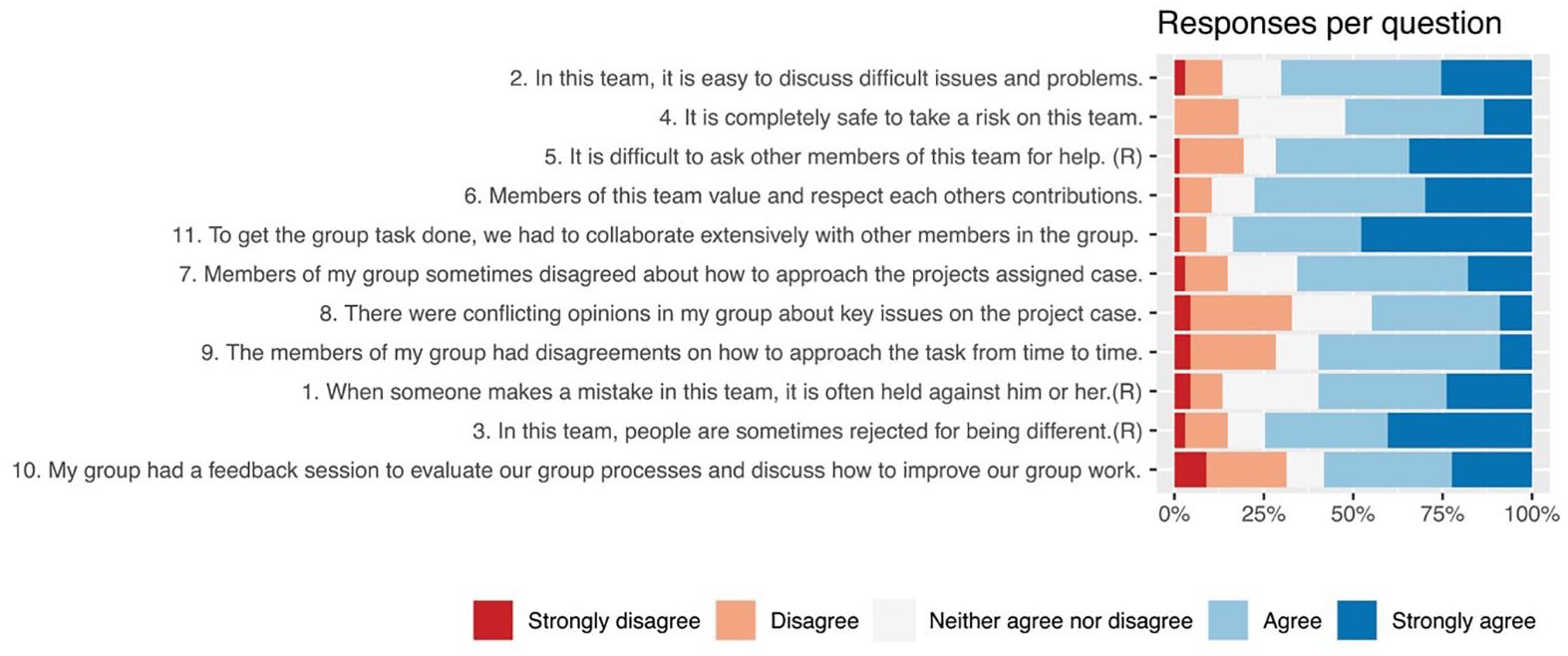
Distribution of responses for each survey question.
An initial Confirmatory Factor Analysis (CFA) on the factors PS, PSA and TC suggested a poor fit. The covariance matrix indicated that item 10 on PSA had low covariance with the other items while items 1 and 3 on PS showed high correlation with each other, but not with the remaining items. Consequently, we removed item 10 from the model, adding the remaining item on PSA as an indicator for PS and treated items 1 and 3 as indicators for a distinct latent factor. Moving forward, we will refer to these two items as inclusive practices (IP), a common aspect of psychologically safe environments.
The adjusted CFA model (Table 1) represented a plausible model of the observed covariance and achieved an acceptable fit with TLI = 0.903 and RMSEA = 0.074. All individual factor loadings were statistically significant (p < .05). There was a significant negative covariance between PS and TC (-.315, p < .05) and a positive covariance between PS and IP (.550, p < 0.05). The covariance between TC and IP was negative, but not significant.
Adjusted CFA model.
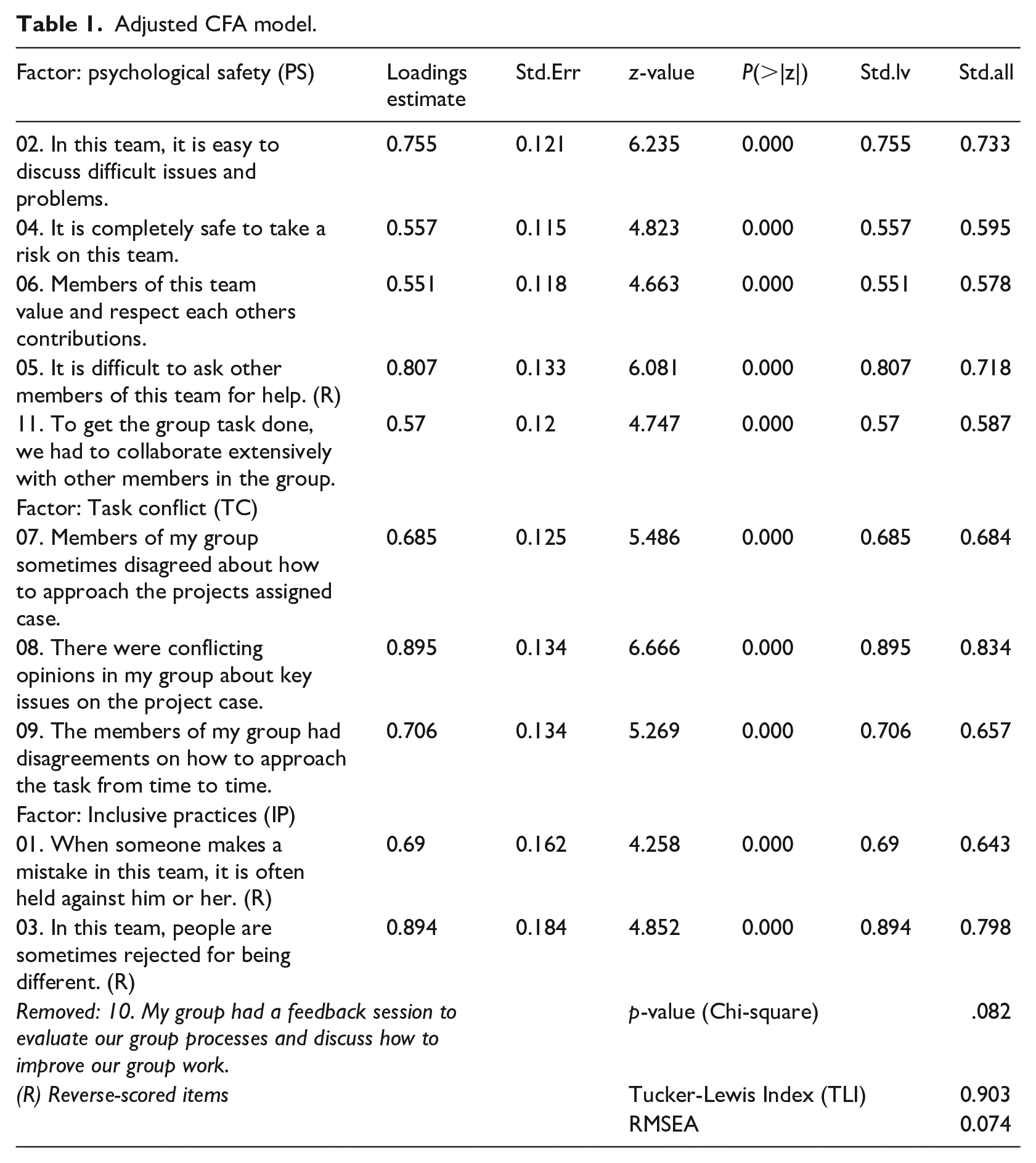
In summary, the survey cohort results indicated that participants had experienced high levels of PS in their collaborations, where mutual help and open discussion of problems characterised the interactions in many groups. Participants identified inclusive practices (IP) at both the interpersonal and the task level as contributors to PS. However, where there was expressed conflict about the team's tasks (TC), the experience of PS was reduced.
Student interviews
Overview
Our thematic analysis of the interviews yielded a total of 76 sub-categories, 28 categories and 10 main themes from approximately 28,500 words of transcribed dialogue. Those relating specifically to the three dimensions of teaching as service design included 10 categories and 25 sub-categories. In the final round of coding, 1 category and 9 sub-categories were added overall, suggesting that saturation – the point at which no new open codes are being generated (Kyngäs, 2020) – was not fully attained in this study. This outcome is not inconsistent with a preliminary study and points to the potential for further research to build on our findings.
Social design
In a context where the majority of survey respondents reported relatively high levels of PS, the interview analysis revealed the crucial initialising role that instructors play in helping teams establish the interpersonal conditions necessary for PS to emerge. An important motivating factor mentioned across the interviews was group composition, with participants citing satisfaction with diversity in their team – including member personalities and the prospect of interacting with a range of disciplinary perspectives – as a catalyst for effective interpersonal relationships and general comfort with the project. While disciplinary diversity also meant that students encountered diverging opinions about their project topics, students perceived this as an opportunity to broaden their disciplinary awareness, enabling them to practise critical thinking and intellectual humility:
I think because we had such diverse group members, I could take their comments and say ‘okay, this is not something I've had thought about before. I'll find out more and I'll get back to you’.
Students described ‘functional fun’ activities orchestrated by instructors as important to building rapport online within such a diverse class. Icebreakers such as online dress-ups and family pet show-and-tell sparked conversations and diminished hierarchical barriers between students and the instructor, establishing a relaxed atmosphere and giving students the confidence to be themselves:
In the very first week [the instructor] did some very funny things for zoom activity, like pyjama scene and hat scene. . . it just makes you get to know each other and then you feel it's easy and relaxed to do things.
Alongside these light-hearted activities, there was a clear role for instructors in establishing formal ground rules for effective online team collaboration, including setting unambiguous expectations for interacting on Zoom and providing tools for effective teamwork. Participants acknowledged the utility of ‘good team norms’, set up early in the project by collective agreement, reified in a team charter and revisited during times of stress or friction. Students also relied on deliberate instruction around conflict types and resolution strategies, subsequently feeling more confident to deal with inevitable disagreements and capable of distinguishing between productive disagreements and interpersonal conflict:
[learning about teamwork] really helped because it made us realise that yes, we are going to go through conflicts, but this is how we can handle it – so we could anticipate these issues occurring, but we had strategies to overcome potential issues.
One student emphasised that mandating visual contact online removed the burden on individual students to request that team members turn their webcams on, also helping establish a wider sense of solidarity across the class:
One thing that was really, really, good was when our ICPU supervisor made us all turn on our cameras, because it helped create community across not just our group, but also within everyone who’s doing that course.
Conversely, in the absence of explicit instructions about online engagement, students felt vulnerable. One student observed ‘I’m not going to want to be that one person who’s showing their face to everyone else’, indicating that, for some people, insecurity and self-consciousness may be elevated in virtual settings, setting a higher bar for the establishment of PS.
Once a solid foundation for interpersonal relations was created, iterative communication with a responsive instructor facilitated team discussions and routinised the process of regular problem identification and troubleshooting – a feature of a psychologically safe team climate. Through just-in-time ‘light touch’ guidance, instructor mentoring acted as a safety net and overall corrective, without dictating the direction of student projects:
[The instructor] was great, because she let us do what we wanted to do, and just tried to facilitate it, she was really good at giving us confidence.
Participant comments indicate that it was important for these instructor check-ins to take place frequently. The immediacy of online communication enabled this:
Fortunately, [our instructor] was always available, because it’s online, and then, you know, you left a message in Teams, he replied. . . and then you move on, have a difficulty again, and you discuss [again].
Epistemic design
Epistemic design encompasses how the curriculum is structured to promote acquisition of knowledge, including types of assessments and provision of information resources. When considering elements of epistemic design that influence PS in online ICPU teams, participant responses clustered prominently around assessment design and the framing of the project, with in-class activities and support of student autonomy also playing important roles.
Participants highlighted the significance of assessments in providing sufficient incentive for interdisciplinary collaboration online. The first structural element mentioned was the weighting of tasks, with group assignments that comprise the majority of a student’s final grade (as they do in ICPU) being conducive to students investing in the effortful work of establishing an effective collaboration climate.
Another basic ingredient in promoting a team orientation towards interdisciplinary knowledge-sharing and interdependence online was to present the class with a project brief intrinsically outside the auspices of any specific field; that is, with a real-world complex problem where ‘it wasn't feasible to just have one person doing everything’. While this type of challenge could prove confronting, it also presented a clear opportunity for collaboration.
Students were seemingly using the complexity and novelty of the problem brief as a convenient pretext for engaging with each other in non-hierarchical and experimental ways. As one student put it:
Because everyone was so unfamiliar with both the processes and the topic, and the approach that we did, we were all sort of chucked into it together - and it meant that no particular person emerged as a dominant leader or dominant view of ‘this is how we do it’.
This shared unfamiliarity with the task supported a sense of common purpose, with teams deliberately seeking to frame their projects in ways that could accommodate ongoing diverse contributions.
Team-level instructor mentoring proved instrumental in sustaining group-level motivation and overall project coherence despite the novelty of the problem space. By setting bite-sized milestones, followed up with regular progress checks, the instructor modelled effective project management and reinforced the importance of consistent group effort, especially during periods where teams experienced high stress or doubts about their ability to perform:
I'm really grateful for [our instructor] keeping everyone on task, like group weekly plans, because we might have just like lost the thread completely and gone in so many different directions.
Students highlighted the iterative cycles of divergent and convergent thinking that they used to facilitate development of collective knowledge and ensure that team members remained accountable and engaged, despite all their interactions being online:
I think we prioritised looking at the members’ disciplinary backgrounds and allocating little research aims, and then coming back and having a full-on discussion of everything we found and telling everyone else why it's important and how it can be used.
By actively designing their team projects to maximise joint ownership and non-hierarchical involvement, students were practicing epistemic humility, negotiating their evolving understanding of the project topic and developing confidence as active decision-makers. These factors suggest ways that students can overcome the distancing aspects of online interaction to produce high levels of team PS.
Set design
The online setting featured prominently in the ways in which students discussed the structural environment of their ICPU experience. Digital media determined the manner of teacher-student and peer-to-peer communications. Additionally, the intensive subject schedule that some of the students experienced interacted with the digital medium to produce teamwork conditions that influenced team PS in both positive and negative ways.
Participants recognised the advantages of easily accessible, ‘24/7’ digital communication tools for facilitating group collaboration. The Zoom video-conferencing platform was integrated with Canvas, providing students with unlimited and instantaneous access to a communication channel from the same online location as all their course information and materials. Zoom was perceived as highly intuitive, with features allowing for proximity to a face-to-face experience.
Teams were encouraged to set up their own group chats using their preferred instant messaging platform (mainly Facebook messenger, WhatsApp or WeChat), which they used to organise impromptu Zoom meetings and continue conversations between Zoom sessions. Questions, newly discovered information or fresh ideas could be shared quickly, allowing teams to move more efficiently through the iterative cycles of project development: ‘it meant that we were always getting that feedback loop of what everyone else was doing’. This seamless interaction environment supported team-level PS and overall group efficacy, as individuals could regularly test their developing understanding of the subject matter and exchange information that was crucial to the progress of the project. Those participants who had done the block mode version of the subject also identified the compressed schedule as a contributing factor to positive online teamwork experiences. The fast turnaround for projects created a sense of urgency and intensity that ‘made the online environment more stimulating and exciting and dynamic’, enhancing the level of engagement with group work.
At the same time, the logistic benefits of online interaction also produced behaviours that worked against the formation of trust, which is necessary to establish PS. For example, one participant noted that it was difficult to negotiate group member availabilities, as members took advantage of their ability to join calls from anywhere by continuing to work their regular casual jobs across the duration of the subject. This diminished the group’s productivity during collaboration sessions, creating an impression that some members did not contribute equally.
The geographic distribution of students in the course also meant that some group members were logging in from different time zones. As a result, the group risked defaulting to atomised work patterns rather than synchronous discussions and ideation: ‘we just worked on our parts separately’. This effect, combined with the already condensed timeframe for the subject and pressure for teams to meet their assessment deadlines, may have suppressed genuine divergent thinking, constructive approaches to task conflict and project innovation, as groups ‘didn’t have the time to investigate different methods or approaches’ and could avoid expressing disagreement if it might extend the length of online collaboration sessions.
Discussion
In combination, the quantitative and qualitative insights gained through our preliminary study suggest that PS can, and does, emerge in online student teams, even when such teams comprise of individuals whose disciplinary knowledge and skills differ widely. We can infer that synchronous online interactions, mediated through appropriate videoconferencing platforms and complementary digital channels, do have the potential to serve as a sufficient proxy for physical in-person collaboration (previously considered a precondition to the establishment of PS – see Edmondson 2004). This finding is likely connected to the specific learning context of ICPUs, where students form teams early and, as Mayfield and Valenti (2022) noted, are more likely to feel part of a learning community despite the remote setting.
The interview participants, who generally experienced high PS in their teams, reported what De Dreu (2007) refers to as ‘cooperative outcome interdependence’: a synergistic approach to project work that recognises the necessity of collaboration to complete tasks. This translated most prominently into curiosity about and willingness to explore divergent viewpoints (and adjust their own perspective accordingly), a proactive approach to task delegation, integrating different perspectives and engaging in cooperative decision-making. The presence of these inclusionary practices (IP) mirrors the survey results.
At the same time, removing the necessity of physical co-presence also creates opportunities for disengagement and erosion of PS. As Tkalich et al. (2022) have noted, virtual teamwork is less conducive to spontaneous interaction, which is one important building block of PS. Conflicting commitments, team members in different time zones and multitasking can lead to atomised work patterns, as well as the perception of unequal contributions and absence of genuine team discussion. Additionally, the interviews suggests that even students who experienced relatively high PS in their online teams were still prone to greater self-consciousness online, manifesting as feelings of vulnerability and reluctance to ‘expose’ themselves, even via the simple act of switching on their webcam. Such inhibitions may emerge more readily in online settings, where taken-for-granted communication factors – such as direct eye-contact– are not guaranteed.
An underlying deficit of trust in team members’ reliability and project commitment, combined with a heightened sense of personal vulnerability online and inexperience in constructive task-oriented debate, could explain why our survey revealed a lower incidence of task-conflict (TC). High levels of PS have been found to moderate the effects of TC with regards to group performance (Mu & Gnyawali, 2003), and low levels of reported TC may suggest that in some teams, the desire to maintain superficial harmony in the group may override the willingness to engage in robust debates or point out errors in thinking. This phenomenon, widely known as ‘groupthink’, is antithetical to the courageous exchange of different viewpoints associated with increased performance in psychologically safe teams.
Our research shows that students rely on deliberate and tailored instructional design and mentoring to scaffold their intra-team communication, knowledge sharing and the constructive negotiation of diverging perspectives (Edmondson & Lei, 2014; Singh, 2021). The following sub-sections outline practical strategies that teachers can use to build student capacity in establishing and maintaining the components of PS in interdisciplinary online teams.
Making time for students to get to know each other and stay connected
As highlighted by Mayfield and Valenti (2022), intra-team rapport is critical for the success of online teams. Our research found that students require sufficient time and opportunity to establish interpersonal relationships online, especially during the critical phases of project commencement and team formation (see also Glikson & Erez, 2020). Making provision for fun, informal activities is integral to the establishment of supportive team bonds. Ice-breakers and other rapport-building activities should be complemented by explicit instructions and tools for establishing online team norms, such as a team charter, expectations around webcam use and activities that allow students to practice giving and receiving constructive feedback.
To routinise the idea that successful teams need regular, synchronous collaboration sessions (Edmondson & Harvey, 2018), instructors can schedule frequent group work as part of timetabled classes. This is especially important when subjects are taught intensively in block mode, where tight deadlines can lead teams towards premature consensus on key task-related issues (i.e. conflict avoidance) if they perceive there is insufficient time to engage in genuine deliberation (Mu & Gnyawali, 2003).
Establishing the technological foundations for students’ ongoing maintenance of informal communication through channels outside of the class environment should be considered part of the formal curriculum.
Teaching and modelling openness
Instructors can also help normalise behaviours that are conducive to PS through their own interactions with students. Edmondson and Harvey (2018, p. 354) observe that ‘team members tend to notice the behavior of the leader. . . such that his or her responses to team members speaking up either help create an atmosphere of psychological safety or damage it’ and, further, that ‘people are more likely to take interpersonal risks within their team if they see the leader as someone who is available and approachable. . . and models openness and fallibility’. By being present to the class and individual teams, instructors can demonstrate how to ask questions and practice active listening, promote equal opportunities for participants to speak and model accountability (Cave et al., 2016; Duhigg, 2016).
As part of this modelling process, the instructor should emphasise the students’ agency and autonomy regarding the direction of their projects and the contributions made by individual members. Explicit instruction about the purpose and impact of effective team norms and process may raise awareness of interpersonal dynamics and motivate the negotiation and refinement of these standards over the course of a project.
Task conflict is an inevitable feature of interdisciplinarity, which requires the negotiation of different and sometimes opposing perspectives. Our interview participants noted that information resources and class activities that introduced them to the benefits of task-related cognitive conflict (and provided strategies for dealing with less productive conflict types) helped them anticipate friction and cooperate more smoothly. Such resources may help counteract the conflict avoidance detected in the PS survey component of this research.
Designing project tasks that invite and require diverse contributions
Students taking part in collaborative complex problem-solving online require strong incentives to overcome a range of interaction challenges, including the difficulties associated with interdisciplinary teamwork, greater reluctance to engage openly and spontaneously online and the logistics of coordinating a virtual team. Project and assessment design is crucial in providing sufficient extrinsic motivation for students to persevere through these challenges.
In their review of PS-related research, Edmondson and Harvey (2018) observe that team members tend to sidestep interpersonal interactions if faced with simplistic tasks that can easily be broken down into disconnected parts for individual completion. For online interdisciplinary problem-solving – where the aim is specifically to encourage students to experience boundary-crossing collaboration – it follows that the overall project task must be challenging enough to make genuine cooperation a precondition to success.
In our research, participants noted that ICPU assessments required sustained labour and multiple inputs. The inherent ambiguity that characterises complex real-world problems also acted as an integration device, with students using the problem brief as tacit permission to explore new and diverse perspectives and venture outside of their methodological comfort zones. This indicates that ICPU students were able to overcome the more pronounced educational, cultural, communication and knowledge barriers associated with online collaboration (Singh, 2021).
To build students’ resilience to epistemic uncertainty (especially in an online environment where they may feel more vulnerable), instructors can provide task descriptions and success criteria (marking rubrics) that clearly articulate the necessity of interdisciplinary cooperation and reward evidence of it. In our experience, providing exemplars of high-quality submissions from previous cohorts can also help students envisage the variety of ways in which the outcomes of interdisciplinary inquiry can be organised and presented.
Using feedback cycles to normalise constructive failure and revision of ideas
To counteract the compounded challenges of boundary-crossing collaboration, complex problem-solving and online interaction, instructors should prioritise giving frequent, responsive feedback and guidance aligned with the specific issues or project stage of the group. Participants in the research highlighted how sustained mentoring by their instructor created a safety net that gave them confidence to exercise project autonomy in an open and psychologicaly safe way, including jointly exploring an unfamiliar topic.
Iterative cycles of instructor feedback and course correction can also normalise the process of identifying errors and developing openness to change, both of which are key features of PS. In turn, students may become more resilient to uncertainty and ambiguity, which supports the process of complex problem-solving (Boon & van Baalen, 2019; Repko et al., 2017; Welch, 2017). However, maintaining a supportive but unintrusive presence is quite a delicate task, especially in a high-pressure online context. To sustain and grow students’ sense of competence, the instructor needs to avoid the development of student dependence on their advice and direction. Instructors may need to shift their mindset from the traditional academic role of ‘teacher’ to one of ‘coach’ or ‘facilitator’ and make this position clear to students. Likewise, emphasising team self-governance by incorporating opportunities for students to conduct periodic reviews of team performance and act on the outcomes (the lowest scoring question in our survey) could further enhance the level of PS.
Conclusion
Psychologically safe collaboration environments are characterised by a team-level learning mindset and interpersonal trust, where individuals readily step up to provide new information, challenge assumptions or identify errors in the interests of helping the team accomplish its collective goals. Existing research on PS prioritises diagnostic studies (whether PS exists in specific teamwork situations) or understanding the typology of PS characteristics, such as a team’s ability to engage in robust and dynamic task-related debates or experiment with new concepts. Fewer studies document practical strategies for achieving PS, especially in the context of online teaching and learning.
This research is significant in pinpointing aspects of instructional design that support the establishment and of maintenance of PS in online interdisciplinary problem-based learning. Our study indicates that the interaction of specific elements of teaching as service design, including epistemic, social and set design considerations, can move students towards realising PS in their teams, and thus experience deeper interdisciplinary collaboration. Instructional design and practices that assist students to overcome some of the challenges of achieving PS in an online environment include:
Making time for students to get to know each other and stay connected;
Teaching and modelling openness;
Designing project tasks that invite and require diverse contributions; and
Using regular cycles of feedback to normalise constructive failure and revision of ideas.
Since the Covid-19 pandemic, online learning has cemented itself as a commonplace mode of higher education delivery. The findings of our preliminary study will be of value in distinguishing practical aspects of instructional design that can build students’ collaboration capability and support complex problem-solving in a remote learning context. More broadly, if the actions of instructors are paralleled with those of team coordinators in the professional sphere, the strategies outlined in this article may also assist organisational leaders to promote effective boundary-crossing collaborations in virtual work teams.
Footnotes
Data availability statement
Quantitative survey results and interview transcripts are available from the authors on request.
Declaration of conflicting interests
The author(s) declared no potential conflicts of interest with respect to the research, authorship, and/or publication of this article.
Funding
The author(s) received no financial support for the research, authorship, and/or publication of this article.

Research data availability
Digital assets (survey data and focus group transcripts) are stored on the University of Sydney’s Research Data Store (RDS). Other researchers may request access to the data collections from Dr Fabian Held.