




Abstract
The aim of this study was to investigate how first-year students view the purpose of tutorial groups in problem-based learning. In all, 147 students from 24 groups participated, providing 399 statements. Data were analysed using thematic analysis. The results showed a focus on both learning and social influence. Learning involved the tutorial as both an objective and as a means. Social influence is important for a tutorial to become a well-functioning group, together with opportunities to use the group as an objective in and of itself to learn to work in a group, cooperate, solve problems and communicate. Social support and feelings of togetherness create conditions for intrinsic motivation, as well as stronger identification with the group. A tutorial group as a well-functioning learning environment requires both the group as an objective and as a means.
Introduction
As a new student beginning at a university course applying problem-based learning (PBL), one gets introduced to the tutorial group rather quickly. Even if the tutorials, with their intensive work and processes, are regarded as the core feature and major incitement for learning in PBL, the student might have a different experience regarding the purpose of the tutorial group. How new students are introduced to PBL and how their expectations are received can affect the way they approach the subject matter and how they relate to the tutorial (Azer, 2005, 2009). Experiences of uncertainty, anxiety and strain are common among students new to PBL (Habjanic, Daouas, & Dahmane, 2014). Even though studies on PBL and different aspects of the tutorial have been in focus over the years, studies on students’ views on tutorial groups are sparse. One example is Hendry, Lyon, Prosser, and Sze’s (2006) study of first-year students’ perceptions of PBL. The results showed an emphasis on collaborative learning as a way to develop understanding and rather than learning independently. The aim of this study was to investigate how first-year students view the purpose of tutorial groups in PBL.
PBL is an educational approach where the learning is student propelled. The learning is self-directed, inquiry based and occurs in a social context (see, e.g., Barrett, 2005; Dolmans & Schmidt, 2010; Hammar Chiriac, 2008; Savin-Baden & Howell Major, 2004). The student is in the centre of his/her own learning process and the context in which the learning takes place is acknowledged. The starting point for learning involves real-life situations presented as vignettes. The students work in small tutorial groups, guided by a tutor, to confront, problematise and ultimately try to develop viable solutions to the allotted problem. The purpose is not to “solve” the problem, but rather to use it as a trigger for continuous learning (Barrows, 1986; Cockrell, Caplow, & Donaldson, 2000; Habjanic et al., 2014; Loyens, Gijbels, Coertjens, & Coté, 2013). There are three comprehensive processes in PBL: the problem-solving process, self-directed learning and group processes (Barrows, 1986). The three processes, each one individually, but also together, facilitate learning in the tutorial. From a review of research on PBL, Hmelo-Silver (2004) concluded that most studies have focused on how knowledge is constructed, on the problem-solving process or on self-directed learning. Research on collaborative skills in tutorial groups has gained considerably less attention.
The tutorial group is the core in PBL, the platform for learning (Cockrell et al., 2000; Dolmans, Wolfhagen, & van der Vleuten, 1998; Hmelo-Silver, 2004). The purpose of the tutorial is to serve as support, as well as a challenge, for individual students’ knowledge acquisition, but it can also be used for training collaboration abilities (Azer 2009; Hmelo-Silver, 2004). A tutorial group normally consists of between five and 10 students and a tutor (Barrett, 2005; Cockrell et al., 2000) meeting regularly (e.g., once a week) over a limited period of time. The tutorial often employs a structured problem-solving process to organise the group’s work and process. However, research in PBL has begun to question the use of a structured problem-solving model in exchange for a more open and inquiring approach (Moust & Roebertsen, 2010; Silén & Uhlin, 2008). The tutor’s role is to facilitate and guide the students’ learning process, preferably on a metacognitive level, by encouraging the students to be reflective and critical learners (Silén, 2006; van Berkel, Scherpbier, Hillen, & van der Vleuten, 2010). In addition, the tutor should help the tutorial group to stay focused on the task in order to reach the course objectives (Azer, 2005, 2009); in other words a mix between being supportive and directive (Abrandt Dahlgen, Castensson, & Dahlgren, 1998). The tutors are not expected to give lessons or pass on their expert knowledge, but instead, to “hold on to the philosophy of PBL” (Dolmans, Wolfhagen, van der Vleuten, & Wijnen, 2001, p. 1), that is, let the students control their own learning process, giving them the opportunity to acquire knowledge in a social context (Azer, 2009; Barrett, 2005; Habjanic et al., 2014; Silén & Uhlin, 2008).
Social Influence
In tutorial groups, the dynamic interplay is considered a part of the task and is an incitement for learning (Azer, 2009; Cockrell et al., 2000). As in any group important for its members, a tutorial has the potential for both a strong positive and negative social influence (Hammar Chiriac, 2014; Postmes, Haslam, & Swaab, 2005). A tutorial group can provide a learning environment in which interest in the subject matter and intrinsic motivation are more probable (Schmidt & Moust, 2000), but it could also involve extrinsic motivation in which social pressures are the main motivator to study (Sobral, 2004). An ideal would be students that are intrinsically motivated to study, but most likely, some level of extrinsic motivation is at play for most of them (Ryan & Deci, 2000). In terms of the self-determination theory, feelings of autonomy, relatedness and competence are important for internalisation and intrinsic motivation (Ryan & Deci, 2000). PBL may create feelings of autonomy, as students must formulate their own learning objectives and are relatively free to choose sources of information. It stimulates relatedness, as groups of students must collaboratively work on problems. It may create, at times, a satisfactory feeling of competence, when mastered content is explained to peers. (Ten Cate, Kusurkar, & Williams, 2012, p. 967)
Each group member’s identification with the group determines how the membership influences their actions and thoughts (Leach et al., 2008). A positive influence can lead to helping behaviour (Levine & Cassidy, 2010). Social influence can also result in a more uniform group with potential positive effects, such as stronger cohesion, but also group members less likely to express their own ideas and beliefs (Kraut, 2003). Conformity to group norms as a powerful influence exerted by groups in general, and especially by groups important to the members, has been in focus for a long time (see, e.g., Cialdini & Goldstein, 2004). The probability for conformity is higher in cohesive groups, more so if the cohesion is based on socio-emotional aspects (Dion, 2000). Cohesion involves both a task and a social dimension in which group members can stick together in pursuit of a common task and/or to get social needs fulfilled (Carron & Brawley, 2012). Agreeing to and following group norms can increase identification with a particular group (Livingstone, Haslam, Postmes, & Jetten, 2011). However, knowing about the norms of a group, especially a group where membership is assigned, such as a tutorial group, only leads to acceptance if the level of identification with the group is high.
Research on social influence in tutorial groups has focused on, for example, motivation, interaction, cohesion and social aspects (De Grave, Dolmans, & van der Vleuten, 2001, 2002; Dolmans et al., 1998; Garí & Iputo, 2015; Hommes et al., 2014; Schmidt & Moust, 2000, Ten Cate et al., 2012). Based on focus group discussions of facilitating and inhibiting factors in tutorial groups, Garí and Iputo (2015) found four dimensions of learning: motivation, social, cognitive and self-directed learning. The motivational dimension was, however, related to the content and not to social influence in the group. The social dimension involved equal participation, whereas the self-directed learning involved aspects of group interaction outside the tutorial. The cognitive aspects covered understanding of academic knowledge. Dolmans et al. (1998) found that cohesion had an influence on motivation in tutorial groups, and that interaction and motivation had a direct effect on the groups’ productivity. De Grave et al. (2001, 2002) studied critical incidents in tutorials, focusing on lack of elaboration, interaction, cohesion and motivation, as well as on unequal participation and difficult personalities. Lack of cohesion and motivation was not as pronounced in the first year compared to later years, although it was regarded as inhibiting the learning process (De Grave et al., 2002). They argued that this could be because first-year students are more dependent on the tutorial compared to students in later years. First-year students describe both social and task cohesion as being important for the tutorial (Hommes et al., 2014). Social cohesion involved showing respect and having an open climate in the group. Also, activities outside the scheduled tutorials influenced feelings of relatedness and attraction to the group. Social cohesion was also related to feelings of psychological safety in the tutorial group. Task cohesion was important for collaborative learning, and was related to motivation to study. Individual motivation could be expressed in the group by being prepared and involved in the tutorial.
Learning as Objective and Means
From a learning perspective, group work might function as both an objective (i.e., learning collaborative abilities) and as the means (i.e., a base for academic achievement) or both (Baines, Blatchford, & Chowne, 2007; Gillies & Boyle 2010; Johnson & Johnson, 2004). The purpose of the tutorial group is two-fold: to promote students’ development of group work abilities, such as social training and interpersonal skills (i.e., as an objective), and as a means to acquire academic knowledge (Azer, 2009, Hmelo-Silver, 2004). While Azer (2009) emphasised the acquisition of both cognitive and non-cognitive skills, where the latter refers to group work skills, other researchers have highlighted the acquisition of (a) knowledge, (b) problem-solving skills, (c) self-directed learning and (d) collaborative abilities (Barrett, 2005; Hmelo-Silver, 2004; Lam, 2009). Group knowledge is often referred to as skills regarding collaboration or being a part of a group, such as communication, managing group dynamics, problem-solving or interpersonal skills (Azer, 2009; Habjanic et al., 2014; Hmelo-Silver, 2004). Even if there are differences in which concepts are used, the significance is that the tutorial group can be considered a learning environment where group work is used both as an objective and as a means. Both functions are important and might serve as an incentive for learning, emphasising different aspects of knowledge and learning in a group within an educational setting (Hammar Chiriac, 2014).
Method
Participants
The participants of this study were first-year students in the Psychologist programme 1 at Linköping University, Sweden. They had started to practice PBL in tutorial groups, but were relatively new to the concept. The participants were students from five different cohorts in 24 tutorial groups, providing 139 different data sets, with a total of 399 statements. There were 147 individuals that took part in the study (50 men and 97 women). This means that eight students did not provide individual data (written accounts); however, they were part of the process of creating data.
Each tutorial group in this study consisted of six to seven students. The total number of students in the 24 groups was 161 (14 were absent the day of the data collection). All but two groups were mixed. These two were all-female groups. In all but four groups, the majority of participants were women. In each of the four groups with male predominance, there were four to five men. In the groups with a female majority, there were one to three men in each group. Overall, in the cohorts of this study, there were 34% men and 66% women. The participants of the study accurately reflected this distribution.
Procedure
Data were collected in connection with a scheduled part of the introductory course held by one of the authors. In this, the tutorial groups were instructed to, first, jointly in the tutorial, reflect on the question: “What is the purpose of tutorial groups?”. After that, each individual was instructed to write down her or his own answers to the question on the provided small plastic film. The author collected all slides.
Data Analysis
The data were analysed using thematic analysis (Braun & Clarke, 2006). The raw data included text on plastic films, as written by individual students. For clarity, all statements, indicated by a bullet or similar sign, were transcribed in an Excel document by one of the authors. In a few instances where the handwriting was particularly hard to interpret, both authors were involved. Both authors then coded all 399 statements individually. The second step involved both authors in a common analysis process of collating codes into themes and refining the specifics of each theme. This resulted in 407 codes, from which two main themes – social influence and learning – were constructed, together with a number of sub-categories for each. Eight statements had content that was double coded and ended up under both main themes.
Ethics and Quality
The ethical principles provided by the British Psychological Society guidelines (BPS, 2014), which emphasise concern for participants’ interest, have been applied throughout the study. All participating students gave their consent to be involved in the study (12 oral and 135 written consent). To facilitate trustworthiness, a thorough description of the analysis process was presented (Braun & Clarke, 2006).
Results
The reasons for having tutorial groups were expressed both in terms of social influence and as a platform for learning. In Figure 1, a map of the main and sub-categories is presented.
Thematic map of main and sub-categories (final analysis).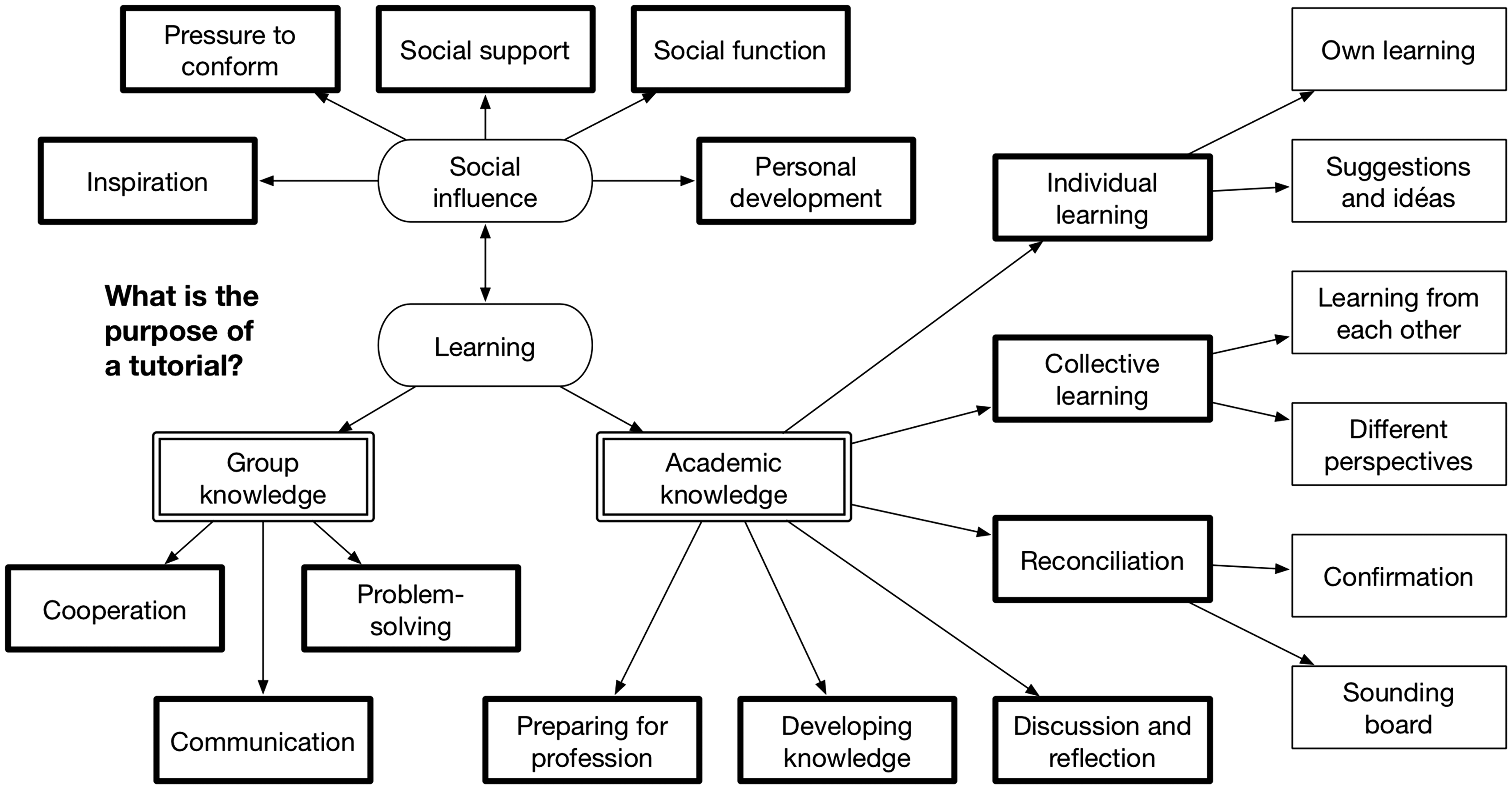
A total of 407 codes were constructed. Most statements were about aspects of learning (67.2%), and just over a quarter were about social influence (26.9%). A few of the statements could not be categorised (5.9%). The statements that were not categorised were often more general, such as that the tutorial was central to the education, that it is “an educational context” that it is “flexible” or “a recourse”.
Social Influence
Social influence in this context involved any statements that indicated being influenced by the group as a prerequisite for learning in the form of inspiration, a pressure to conform, social support, as personal development or as a social function.
Inspiration
The tutorial can provide inspiration or motivation to do the work needed to be able to participate in the group work. It could also mean being inspired or feeling creative as part of the group.
Pressure to conform
The other end of the social influence scale compared to inspiration is the pressure to conform. It was expressed in terms of being on the receiving end of a “blowtorch” or “whip”, or to feel the pressure to work hard to not sabotage the group. To ensure this was met, there were expressions of being controlled by other group members to make sure one did what one should. The pressure was also framed in a more positive way, focusing on a climate in the group that encourages group members to study and to “make sure you read regularly”.
Social support
Most statements regarding social influence were about getting social support from the group and a sense of security from being in the group. It also involved having a fixed point in life with people one can depend on and get help from when needed. The students expressed that the group could provide emotional, practical and moral support.
Social function
The function of the tutorial was also described in terms of social function. The group was described as a place for friendship and fun in which togetherness and team spirit are important. As one student put it, “the work will be more fun if you are in a group of people”. It was also expressed as being a place for social exchange.
Personal development
Being part of a group was also described as being a place for personal development. Being responsive to the social influence of a group can help one develop as an individual, learning about oneself through others.
Learning
The purpose of being part of a tutorial in terms of learning was expressed both as a means and an objective.
Group knowledge
Using the group as an objective involved striving to understand and learn about the group itself and the group processes that influence activities in the group, learn to work in a group, cooperate, solve problems and communicate.
The knowledge required to cooperate involves learning about the group and group processes, as well as how to use this knowledge to be able to work in a group in the best possible way. The tutorial also provides opportunities to train and try out the acquired group knowledge and to learn how to be tolerant towards the other group members. Problem-solving can be about the particular tasks allotted to the group, and in the tutorial, the group members can learn how to tackle and solve different kinds of problems together as a group. It can also be about learning to cope with conflicts in a group and learn about conflict management first-hand. The tutorial group is also a place to practice communication, expressing thoughts and knowledge. It could also involve learning to be responsive and to show respect towards other group members, as well as to learn how to interact. In a more general sense, the tutorial could serve as a place for developing conversation abilities – “it is conversation practice”.
Academic knowledge
The most common type of statement involved using the tutorial primarily as a means to an end, that is, the tutorial group as a base for acquiring academic knowledge. It involves individual and collective learning, reconciliation, discussion and reflection, developing knowledge and preparing for the coming profession.
Being part of a tutorial could, in some cases, be expressed solely as individual learning – as a place to support and stimulate one's own academic learning. Ask and “get answers about things you wonder about”. One can also get suggestions on literature and find out what others are reading. The group can provide new ideas and suggestions for the individual member’s knowledge acquisition. The most frequent type of statement was about how to use the tutorial as a place for collective learning – a place where one can share knowledge and experiences and learn from each other. There were statements about acquiring knowledge “eight times faster than as an individual” that can then be shared in the group, and that “eight brains are better than one”. In the tutorial group, the students can complement each other. An important aspect of collective learning was getting new perspectives and exploring problems from different angles, to take advantage of different opinions in the group – “an exchange through our differences”, and the students learn to “see things from different perspectives”.
In PBL, there is often an uncertainty regarding if one read enough and if one read the right things. The tutorial was described as a place for reconciliation, where the students can check if one is at a reasonable level of knowledge compared to the other students. The tutorial group “serves as my safety where I can check what and how much the others read”. Getting feedback from the group is valued. The tutorial was also described as a sounding board from which one can try out new ideas and get some type of validation back. Furthermore, the tutorial group can serve as a discussion forum where students can express thoughts and questions, in addition to being a place for reflection. There were expressions about learning better if one is allowed to express thoughts and knowledge in words, a development of both the individual and the topic in question through discussion. Some statements focused more on the outcome of the tutorial in terms of developing deeper or broader knowledge through the group. The tutorial can provide a better understanding of what the individual students have read, while also providing opportunities to learn to apply theory.
There were statements describing the tutorial as preparation for the coming profession and working life. One aspect of this was the opportunities to interact with different people in different contexts, as it is something the students will face when they start to work. Other statements involved creating or learning a methodology for knowledge acquisition that is suitable for their coming profession.
The Purposes of a Tutorial Group
Frequencies of Main and Sub-categories (A Total of 407 Codes), and Percentages in Total and Within Main and Sub-categories
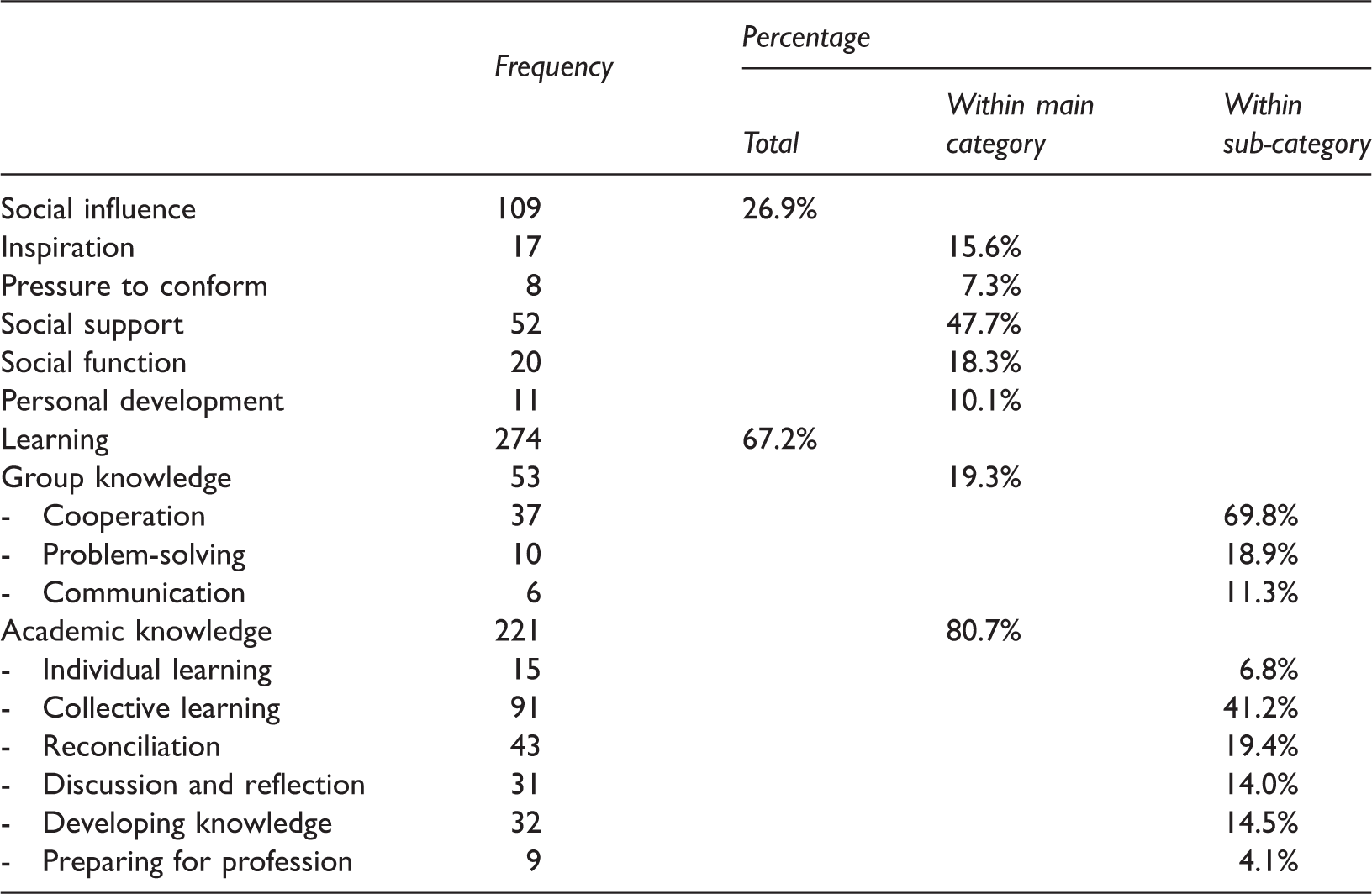
Statements about learning are more common than are statements of social influence. Statements of academic knowledge are more common than are statements of group knowledge. The most frequent statement involving social influence was about using the tutorial group as a source of social support. Using the tutorial for learning group knowledge focused mainly on cooperation and using it for learning academic knowledge – collective learning was the dominant theme.
An individual or collective purpose
About one quarter of all statements clearly expressed either an individual or a collective purpose of the tutorial. These statements cut through most of the above-mentioned categories. Individual purposes (49 statements) involved describing the tutorial in terms of “I” (e.g., “I learn better using the group”). Other examples of expressions of individual purposes of the tutorial include getting self-awareness through the group and stimulating one's own thoughts. The purposes are framed in terms of what one, as an individual, can get out of the experience. There were also expressions of purposes in clear collective terms (39 statements) formulated as something “we” do in the tutorial group. “We” can learn together, stimulate, inspire and help each other.
Discussion
The results showed a focus on both learning and social influence. In the eyes of the first-year students, the purpose of tutorial groups is, first and foremost, a place for obtaining academic knowledge, that is, using the tutorial as a means. They also described the tutorial as an objective in and of itself, increasing group knowledge and how group processes affect the individual member and the tutorial group as a whole. This aspect of learning also includes using the tutorial as a training ground for, for example for communication and cooperation skills. The first-year students also described the tutorial as a place for social influence.
Social Influence in Tutorial Groups
Social influence in this study involved feeling inspired, motivated, supported and safe, but also feeling a pressure to conform to the group standards so as to not sabotage the group.
Motivation
Getting motivation from a tutorial group is an aspect many studies have emphasised as being important in PBL. Motivation in a tutorial group can positively influence group performance (Dolmans et al., 1998; Gari & Iputo, 2015), and lack of motivation can be a hindrance for learning (de Grave et al., 2001, 2002). The origin of motivation has been described, both on an individual and a group level. Gari and Iputo (2015) took an individual stance, describing motivation based on the individual liking of the tutorial and the feeling that topics covered were interesting. Lack of motivation, according to de Grave et al. (2001, 2002), relates to the effects a number of individuals can have on the group if less motivation is shown. Motivation in the current study involved social influence on a group level in which the tutorial provided a context for contributing to inspiration and creativity. This can be understood in terms of intrinsic motivation (Schmidt & Moust, 2000) – the tutorial in and of itself provides a foundation for motivation. A tutorial can also involve extrinsic motivation and, in this study, it was expressed as a social pressure to conform to the norms of the group – to study hard so as to not sabotage the group. In terms of the self-determination theory (Ryan & Deci, 2000), this kind of pressure reduces autonomy and possibly relatedness, which inhibits internalisation and intrinsic motivation.
Cohesion and identification with the group
An important purpose of a tutorial group, according to the first-year students, was to provide social support and serve as a social function from which feelings of togetherness can come. Socio-emotional aspects influence cohesion (Dion, 2000). Getting support and help from the tutorial group can create feelings of safety in the often unclear situation, especially for first-year students (Habjanic et al., 2014). It could also involve more task-related support, fostering task cohesion in the group. Hommes et al. (2014) found task cohesion to be important for collaborative learning, and described preparation and involvement in the tutorial as expressions of motivation that the students relied on.
Feelings of togetherness can be described in terms of how strongly the students identify with the group and probably also in terms of how strongly they identify as psychologist students (Leach et al., 2008). The students expressed feelings of affinity with the tutorial group, both in terms of the social function of the group, as well as social support, creating feelings of security. Strong identification with a group leads to acceptance and internalisation of group norms (Livingstone et al., 2011). This could increase the possibility for intrinsic motivation as the otherwise external pressure becomes internalised.
The Individual and The Group
The level of identification with the group and the consequences of being part of a tutorial varied among the students. Some expressed the purpose of a tutorial purely in individual terms (12% of the students). This involved using the tutorial group for personal development or individual learning goals. Pressure to conform to group norms will, in this case, more likely lead to externally regulated and controlled motivation (Ryan & Deci, 2000). On the other hand, almost as many expressed the purpose in clear collective terms, indicating that the group is extra important for learning, creating a basis for intrinsic motivation.
The Group as Objective and Means
It is obvious that the students acknowledged the tutorial group as an incentive for learning, both as objective and as means, even though there was a main emphasis on learning as means (cf. Hammar Chiriac, 2014). The students used strategies to handle experiences of anxiety (Habjanic et al., 2014) by using the tutorial as a place for reconciliation and as a safety net, regarding academic learning, group working skills and preparing for their coming profession on an individual and collective level. The students described the tutorials as a sounding board where they can get confirmation and validation regarding their achievement and skills (Cockrell et al., 2000). Accordingly, the tutorial served as a platform for checking and training one’s cooperation skills, such as communication and problem-solving. Well-functioning interaction and communication are essential for a successful tutorial group (Azer, 2009; Cockrell et al., 2000). Strategies for validation of cognitive skills used by the students were also distinguished, such as active participation in discussions. By verbalising one’s own perspectives and ideas, it is possible to check one’s own standards and learn from others in a group environment. To belong and feel secure in the tutorial, one strategy used was to support and contribute to the development of collective leaning. The results showed that all three main processes of PBL – problem-solving, self-directed learning and group processes (Barrows, 1986) – were included in the students’ descriptions of the purposes of PBL.
Limitations
One limitation of this study involves an uncertainty about the level of data, whether on the individual or group level. The groups discussed the question prior to the individuals writing their answers. This could have influenced the data, as dominant or compromised views in these discussions could have resulted in some individual voices getting lost in the process.
Conclusions
To be able to use a tutorial group as a means to achieve academic knowledge, social influence, in terms of social support, togetherness and inspiration, is important. The nature of PBL creates conditions for autonomy; a well-functioning tutorial group fosters feelings of relatedness and using the group as a place for discussion, reflection, and expression of one’s thoughts and knowledge in words contributes to feelings of competence. All three aspects are important for creating motivation to learn in terms of intrinsic self-regulated motivation. By creating conditions for group identification, local norms are more easily internalised, which also helps motivation to become intrinsic. To be able to achieve all of this, there is a need to focus on more things other than just academic knowledge – the group as an objective in and of itself is equally important. A tutorial group as a well-functioning learning environment requires both the group as an objective and as a means.
Footnotes
Declaration of Conflicting Interests
The author(s) declared no potential conflicts of interest with respect to the research, authorship, and/or publication of this article.
Funding
The author(s) received no financial support for the research, authorship, and/or publication of this article.