



Abstract
At a German university of technology, a large-scale project was funded as a part of the ‘Quality Pact for Teaching’, a programme launched by the German Federal Ministry of Education and Research to improve the quality of university teaching and study conditions. The project aims at intensifying interdisciplinary networking in teaching, promoting student engagement and motivating students to take a degree in science, technology, engineering and mathematics. We describe the new teaching projects psychology students were admitted to and how many psychology students were reached. We discuss the results and outline limitations concerning evaluation in a practical setting.
Keywords
A main goal of higher education is the development of knowledge, skills, abilities and other characteristics such as values. Therefore, keeping up the quality of university teaching is an important task. However, at universities attention is often centred more on research and the acquisition of funding than on teaching. Such trends have been reported for countries in Europe; for example, Germany and the United Kingdom (Esdar, Gorges, Kloke, Krücken, & Wild, 2011; Harley, Muller-Camen, & Collin, 2004) as well as for North America (Vannini, 2006). In recent years attempts have been made to put forward quality of teaching. In particular, educational investments for science, technology, engineering and mathematics (STEM) have been called for and implemented; for example, in the United States (Callahan, Pyke, Shadle, & Landrum, 2014; Chen, 2009) and Europe (Roberts, 2002).
A large-scale project was initiated at a German university of technology, the Technische Universität (TU) Darmstadt, to improve quality of teaching and study conditions (i.e. conditions that influence learning at institutions for higher education). The project is called “competence development through interdisciplinary cooperation from the very outset” (in German abbreviated KIVA). It is part of the ‘Quality Pact for Teaching’, a joint programme of the federal and the state governments funded by the German Federal Ministry of Education and Research (German acronym BMBF).
The project focuses on three goals: promoting student engagement, intensifying interdisciplinary networking in teaching and motivating students to take a degree in STEM fields. High school graduates and first-year students are specifically targeted groups for the project in order to reduce withdrawal rates in STEM programmes.
Despite this focus on STEM subjects, the project goals are also highly relevant to psychology students. Positive links between student engagement (i.e. time and energy that are devoted to educationally purposeful activities by students and the institutional actions to motivate them (Kuh, 2003)) and college success have been found not only for students in general (Miller & Butler, 2011) but also for students taking part in psychology courses in particular (Svanum & Bigatti, 2009).
Our society is faced with complex problems such as climate change that call for interdisciplinary solutions (Boix Mansilla, 2006) and psychologists certainly can make important contributions to them (Swim et al., 2011). However, higher education usually does not prepare them well enough, as psychology students, just like most other students, are usually educated to become specialists in their discipline (Waldman, 2013). Therefore, intensified interdisciplinary networking is needed for teaching in general and for psychology teaching in particular.
Across different nations, a need for well-educated STEM specialists has been announced (Anger, Koppel, & Plünnecke, 2014; President’s Council of Advisors on Science and Technology, 2012). Investment in STEM subjects can positively influence education, amongst others by promoting cross-faculty relationships and boosting pedagogical development (Callahan et al., 2014). Thus, corresponding measures can be relevant for psychology education as well. Moreover, a focus of the current project was quality of teaching in mathematics. Psychology students have been found to have difficulties with statistics (Guàrdia et al., 2006), which, at our university, are taught initially at the Faculty of Mathematics. Thus, a high-quality mathematics education is relevant not only for students in STEM fields, but also for psychology students.
As described, the project (as defined by its goals) was relevant to and addressed important needs of psychology students. Accordingly, project implementations addressed psychology students to a varying extent. In turn, psychology students also contributed to the project. For example, psychology students are trained to become team advisors in interdisciplinary first-year study projects, where they supervise groups concerning team processes. This is only one example for psychology students’ roles in the project. Both, the interventions and how they addressed psychology students will be described in more detail below.
The project in practice
To achieve the projects’ goals, different measures were taken within six subprojects. In subproject I, at the Faculty of Mathematics, one professorship with two assistants was additionally implemented. Accordingly, teaching capacities increased and additional learning opportunities could be offered, especially for engineering students. To invigorate students’ motivation for mathematics, demonstrating the relevance of abstract mathematic concepts for engineers is brought into focus. Providing engineering applications for mathematical course contents has been recommended as a suitable measure to improve mathematical teaching for engineers by engineering students (Güner, 2013). Moreover, the professorship was denominated with a special focus on the development and use of innovative forms of teaching and learning. Innovative teaching concepts (e.g. for differential equations) have been developed. Extensive evaluation will assess the effectiveness of these concepts.
In subproject II, temporary visiting professorships are funded. Visiting professorships are an established concept in higher education that are often implemented to support internationalisation of teaching (Deutscher Akademischer Austauschdienst, 2014) or to test innovative approaches in science and teaching before establishing them permanently. The visiting professorships funded in subproject II are supposed to enrich teaching and promote innovations by: a) pointing out gender issues related to STEM subjects and developing concepts on how to raise the percentage of women at every level of the university; b) enhancing awareness for gender issues among students studying for a teaching profession and showing them opportunities to integrate gender issues in their work; or c) supporting international and/or intercultural rich teaching.
In subproject III, additional staffing for the faculties’ student offices was provided. The new employees counsel students regarding all questions related to new teaching formats, such as approval when transitioning from a Bachelor to a Master degree programme or in connection with stays abroad. High-quality advising has been linked to student success (Kuh, Kinzie, Buckley, Bridges, & Hayek, 2006). Extended services offer students more possibilities to become engaged in their academic studies. Especially, the new employees support faculties concerning administrative tasks such as the implementation of interdisciplinary courses.
In subproject IV, training concepts for tutors were developed (further) at different faculties, keeping in mind specific departmental needs. All trainings include a basic module, in which didactical principles (e.g. feedback rules, behaviour in critical situations etc.) are taught using various techniques (e.g. role-playing). Having completed the trainings, students can put into practice the training contents when working as a tutor. In many departments, students are guided through this process. Offers include, for example, observations of tutorials and subsequent feedback by the trainer, accompanying seminars or a consultation hour, where problems can be discussed with the trainer (for a detailed description of the different training concepts, see also Frey, Herbst, Kühner-Stier, & Trebing, 2014; Freyn, 2014; Rößling, 2014; Stefanovska & Meuer, 2014; Trebing, 2014). Trainings are now held on a regular basis. Tutorials are educationally purposeful activities which offer students the opportunity to receive feedback. Feedback is important for student learning and achievement (Hattie & Timperley, 2007) and considered good practice in education (Chickering & Gamson, 1987). Therefore, improving the qualification of tutors can promote student engagement and certainly is generally beneficial for students.
In subproject V, interdisciplinary first-year study projects are organised. Students from different disciplines work together for one week or semester to solve a given task. The task requires an integration of knowledge and methods from the different disciplines. Teams receive advice concerning technical questions from technical advisors (mostly scientific assistants) and have the opportunity to discuss their solution to the task with a professor. Furthermore, they receive feedback from team advisors (students trained by the Centre for Educational Development) concerning cooperative behaviour and the use of working and creativity techniques. Thus, the projects facilitate several of Chickering and Gamsons (1987) principles for good practice in undergraduate education, namely student–faculty contact, reciprocity and cooperation among students, active learning, (prompt) feedback, time on task and high expectations. The use of active and collaborative learning techniques has been linked to student engagement as well as to gains in personal and social development, general education knowledge and practical competencies (Umbach & Wawrzynski, 2005). Moreover, organising interdisciplinary projects offers faculty from different disciplines the opportunity to network within the university. Thus, the subproject enhances interdisciplinary networking in teaching, promotes student engagement and improves quality of teaching.
Subproject VI is concerned with the development of interdisciplinary teaching concepts and their administration. For example, it was proposed to align the numbers of credit points assigned to interdisciplinary courses by different departments to make them compatible for all degree programmes. Therefore, the subproject responds to the problem of coordinating administrative details of interdisciplinary courses (Golding, 2009). In improving interdisciplinary education in general, subproject VI contributes to enhancing interdisciplinary networking in teaching, promoting student engagement and organisational development.
Impact of the project
Evaluation of the project.
Relevance of the project for psychology students.

Subproject I provided additional resources to the Faculty of Mathematics, where psychology students take part in a lecture on statistics. Since many psychology students have difficulties with this subject (Guàrdia et al., 2006), even subtle improvements of teaching achieved due to an improved overall situation are valuable.
Two out of three lines of funding for visiting professorships in subproject II focus on STEM subjects. However, the subproject was also relevant for psychology students. Most visiting professors open their lectures for students from other disciplines, including psychology students. For example, psychology students were invited to participate in a lecture about usable security at the Faculty of Computer Science. A visiting professorship for the Department of Psychology was granted for spring 2016.
In subproject III, two additional academic jobs were created in the student office responsible for psychology students. They advise psychology students, for example, with respect to interdisciplinary teaching projects and studying abroad; thus, they conduct many administrative tasks that formerly were in the hands of teaching staff. Therefore, lecturers have more resources for their core task, the preparation and conduct of courses, which in turn is a benefit for students.
Subproject IV’s relevance for psychology students was twofold. Psychology students have the opportunity to participate in the trainings for tutors developed in this subproject when choosing the team development and supervision module. Furthermore, they are supervised by trained tutors in their statistics tutorial.
Subproject V probably had the highest relevance for psychology students. First-year psychology students now take part in a project with students from the Faculty of Civil and Environmental Engineering, the Faculty of Law and Economics and the Department of Pedagogy. Participation was obligatory in the winter term 2012/2013, but also when the course was optional in 2013/2014, nearly all psychology students participated. Furthermore, thanks to subproject V, the first-year project of the Faculty of Electrical Engineering and Information Technology was opened for Master students of psychology. It now also involves students from the Faculty of Law and Economics and the Department of Sociology.
Subproject VI made general contributions to an improved interdisciplinary education that potentially benefitted psychology students more than other students (e.g. development of concepts to facilitate administration of interdisciplinary courses). Furthermore, subproject VI supported on a developmental level interdisciplinary courses in which Master psychology students are involved.
Conclusions
Psychology at a technical university is special as it has to provide networking with science and engineering faculties, developing the necessary knowledge, skill, ability and other characteristics to successfully cooperate in interdisciplinary teams. Our analysis showed that the majority of psychology students at our university of technology got in touch with the measures of KIVA in some way.
Interventions targeted at promoting student engagement and intensifying interdisciplinary networking in teaching benefitted psychology students directly and improved psychology teaching. Course offerings will be extended due to the upcoming visiting professor in psychology and the faculty receives more administrative support and thus has more resources to invest in teaching. Furthermore, the trainings developed in subproject IV and the interdisciplinary study projects in subproject V that admit psychology students can be considered improvements of psychology teaching as well (although not directly situated in the Department of Psychology). Certainly, more in-depth analyses will be needed to substantiate these effects.
Measures focusing primarily on motivating students to take a degree in STEM subjects were necessarily not tailor made for psychology students. However, even though this investment in STEM subjects did not directly benefit psychology students or teaching, indirect benefits could be identified for the respective measures as well (such as an improved education in statistics).
This report is limited, as it does not directly assess effects on students’ learning or other outcomes for the interventions described. It was beyond the scope of this report, which is confined to describing the subprojects psychology students came in touch with. Furthermore, numbers of psychology students admitted to the measures could not be quantified more exactly than by estimation. Given the great variability of the measures adopted, this is the best accuracy we could provide at this stage. To ensure that the benefits claimed for psychology students and teaching are supported, further analyses are needed.
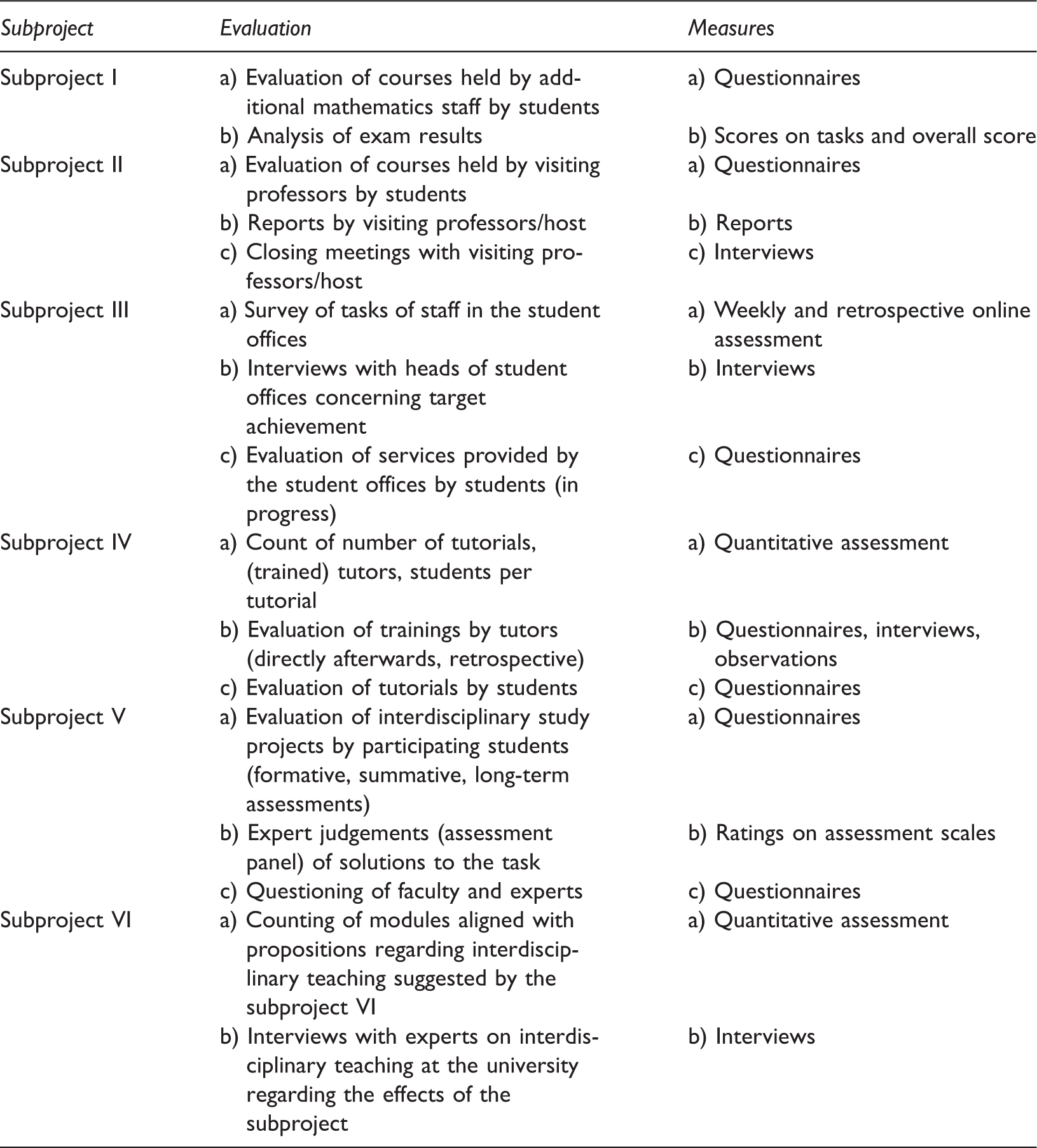
However, since evaluation methods vary across the different subprojects (see Table 1), analysing students’ satisfaction with the project as a whole is difficult. The variability concerning evaluative methods is due to specific requirements of the faculties, which are the process owners, and to the great variability of the subprojects themselves. It thus reflects the problem of adapting scientific rigour to practical requirements. However, we work hard on overcoming these limitations. A strong basis for this ambition is that project evaluation was started already with the project while usually it is begun close to or after the end of a project. Furthermore, although project evaluation is not reviewed by an ethics board, it is externally supervised and coordinated with the directors of the different subprojects and of the project as a whole.
Analyses of the effects of specific interventions, such as the interdisciplinary study projects in subproject V (Awolin, Koch & Sommerfeld, 2015), have already been conducted. Future research will continue to explore general as well as differential effects of interventions on student outcomes or teaching (e.g. specifically for psychology students and psychology teaching).
Outlook
An unresolved challenge is the question of how long lasting the benefits will be. In September 2016 the project ends. The university has to start developing follow-up funding. Based on evaluation results, sustainability initiatives have been triggered. We currently work on extending the evaluation from student ‘temporary impression’ to a retrospective assessment of the project’s relevance after graduation. The routine post-graduate survey is considered to assess whether students with project experiences retrospectively attribute relevance to interdisciplinary teaching in their jobs. Tracking project participants during their further course of study and professional career requires large resources and is critical with respect to data privacy issues. However, to ensure that students profit as much as intended from the project, an evaluation of its long-term effects is of utmost importance. A lesson learned is that although there are substantial evaluation resources planned in the project, they still are not sufficient to follow-up long-term effects and thus had to be complemented by university resources.
To conclude, it could be shown that KIVA was successful in networking psychology students with fellows of other disciplines and thus made a fruitful contribution to a corporate interdisciplinary education of all students. However, our analysis also showed limitations of a) influence of psychology at a large university of technology and b) applying strict scientific evaluation principles within a large-scale, ‘real-world’ project. We believe that our lessons learned are useful for other universities in general and those with departments of psychology in particular.
Footnotes
Funding
This research was supported by grants from the German Federal Ministry of Education and Research (BMBF), which is financing the KIVA project from October 2011 to September 2016 (01PL11048). The authors are responsible for the contents of the publication.