




Abstract
Despite the large number of new international schools opening each year, very little innovation is evident in the market. DiMaggio and Powell (1983) use institutional isomorphism to explain the phenomenon of organisations in a field being similar and this paper investigates the extent to which accreditation contributes to that phenomenon. By reviewing the handbook, standards, and lesson observation tool of one large, global accreditor, a picture is built in this paper of the ‘ideal school’ that would perform well in an accreditation review. Accreditation was found to restrict how the school is managed, narrow the learning philosophy of the school, and prescribe the practices that take place in the classroom. Opportunities for limited creativity were found in teachers’ design of learning activities, with the caveat that those activities must be aligned to prescribed curriculum standards.
Introduction
The international schools market has experienced significant growth over the past two decades, rising from 2,584 schools with 988,600 students in 2000 to 10,400 schools with 5.8 million students in 2019 (ISC Research, 2019). Countries that have experienced the most growth are China, the United Arab Emirates (UAE), the Kingdom of Saudi Arabia (KSA), and India (ISC Research, 2019). This growth has accelerated in recent years as the number of schools in June 2021 reached 12,281, albeit with a reduced student enrolment of 5.66 million; the Middle East region is the dominant area with 1.72 million international school students (Stokes, 2021). Although initially established to serve expatriates living in the host country, international schools are becoming increasingly populated by local students whose parents are dissatisfied with the quality of their local education systems and seek the best chances for their children to enter elite universities (Hayden and Thompson, 2013). The ability of schools to attract local students has allowed them to maintain their enrolment during crises which cause the expatriate community to return to their home countries (ISC Research, 2020).
Despite such a large competitive market, these schools exhibit many similarities. Reviewing the websites of international schools globally reveals students engaged in similar activities, sitting in similarly arranged classrooms, in schools that have similar vision and mission statements. Due to the size of its international schools market and the author’s familiarity with it, this paper will draw on some practical examples from KSA. In KSA, where an international school cannot operate without accreditation, this paper hypothesises that accreditation is a strong force homogenising the practice of international schools. This effect is one form of the isomorphisms described by DiMaggio and Powell (1983) and can restrict the competitive opportunity to innovate. Although the attraction of the International Baccalaureate (IB) Diploma Programme (DP) as a gold standard has been given as a reason for the growth of international education (Lauder, 2007), in KSA (which only has 12 schools offering the IB Diploma) and the United Arab Emirates (UAE) which has 45 (IB, 2021) that impact is far less significant. Rather, in choosing an international school for their child, parents are seeking a more traditional curriculum, often American or British. Due to the proliferation of American-style international education in the large markets of these Arabian Gulf states, this paper focusses on one popular American accreditation organisation.
After defining the concept of an international school, this paper will expand on the importance of accreditation, explaining why it is considered so influential. Isomorphism will then be introduced and some of the types of isomorphisms affecting international schools discussed, of which accreditation is only one. The paper will then seek to explain the relationship between what schools collectively practice and the origins of that practice in the accreditation documents of one of the largest accreditors, Cognia, by conducting a deconstructive policy analysis using the theoretical framework of Codd (1988). Non-negotiable requirements and opportunities for creativity in those documents will be investigated. The paper should be of interest to researchers seeking to explain the reasons for isomorphism in international schools, as well as to school leaders who are going through the accreditation process, aiming to meet the accreditor’s requirements whilst finding opportunities to creatively obtain a competitive advantage.
International Schools
International schools have been defined in different ways. One difficulty in defining them is that most international schools are new (Machin, 2019), so that as the field grows, new definitions are required. Hayden and Thompson (2013) note one of the characteristics of international schools as being that they offer a curriculum not of their host country, though they may offer a national curriculum as well; for example, in KSA international schools must teach parts of the national curriculum, namely Arabic, Islamic studies and local social studies. This can reach up to a quarter of instructional time in some grade levels. Hayden and Thompson (2013) also mention that as the sector has grown, it is no longer the case that international schools are largely staffed by expatriate teachers. In addition to 39% of KSA’s teachers being Saudi (Ministry of Education, 2021), there has been a growing trend in lower-priced international schools not to hire expatriate teachers from the country of origin of the school’s curriculum. Rather, schools are hiring from countries where teachers can be recruited for lower salaries than their Western peers. Due to such diversity, it is not possible for this paper to undertake an analysis of all international schools. Instead it focuses on a specific type of international school whose definition will be discussed below.
Hayden and Thompson (2013) identify three different types of international school. Type A are the ‘traditional’ schools that largely cater for expatriates. These make up a significant minority in KSA and such schools are normally affiliated to a foreign embassy. Type B are the ‘ideological’ schools which aim to bring together students from different backgrounds with a view to promoting peace and understanding. Type C are the ‘non-traditional’ international schools which are increasingly attended by host country elites who are seeking out a higher quality of education than is provided by the host country’s educational system. This paper will consider Type C international schools, although Hayden and Thompson’s categorisation does not take into account countries such as KSA whose families do not fit the economically advantaged description to which they refer. Not only does KSA have many working-class families attending affordable international schools, but also the Saudi families are from a wide range of socio-economic backgrounds (Alfaraidy, 2020). This paper considers Type C international schools, but based on a wider view of the economic status of the families enrolled.
External governance of international schools
There are many factors external to international schools that impact on how the schools operate. Whether the school offers a truly international curriculum (such as the programmes of the IB) or as is found in some cases, a national curriculum transposed to another location (for instance A levels) (Hayden and Thompson, 1995), the curriculum is an important external factor driving what happens within the school. Although in 1995, Hayden and Thompson suggested that only some schools offer a national curriculum exported to a another context, in some markets the authenticity of the exported curriculum can be a strong selling point. This can be seen from the websites of international schools, to the signs above their physical doors which almost always mention the curriculum they offer.
Some governments have concerns about the fact that international schools may operate outside their control (Bunnell et al, 2016). Such concerns are addressed in different ways. Some have their own accreditation process which all schools must complete as in Indonesia (Haryati, 2014) and the United Arab Emirates (Blaik Hourani and Litz, 2016). In KSA, all schools are assigned a supervisor from the Ministry of Education (MOE) who makes regular visits to the school, ensuring that they adhere to the MOE’s policies. Schools must also be accredited by an external accreditation agency if their students’ school certificates are to be authenticated by the Ministry of Education. Adherence to accreditation protocols will have an impact on how a school is managed.
Accreditation of international schools
School inspections have been conducted since the nineteenth century but have recently experienced growth as governments see education as key to their countries’ economic development (Brown et al, 2016). Accreditation is a specific form of inspection which includes some form of self-evaluation (Bernasconi, 2006). Due to the number of shared processes between accreditation and inspection, this paper will include evidence from research on inspection where the process is shared (such as a visit from external evaluators and adhering to a defined set of standards). In a study of 35 accreditors, Fertig (2015) found that whilst all protocols involved self-evaluation there are some differences in implementation. Some protocols allow schools to use their own evaluation criteria, while others have criteria set by the accreditor. Some protocols put an emphasis on student performance or rely completely upon it (Bernasconi, 2006). Different accreditors differ in what evidence they require prior to the external visit but generally the same procedure appears to be followed by all major accreditors (Cognia, CIS, NEASC, MSACS) which is that the school: completes a self-study, submits evidence, receives the external review team, receives an exit report, and finally shares recommendations with stakeholders. A google search for accreditation reports returns so few results that it is evident that reports are rarely shared publicly, although recommendations may be shared privately to stakeholders. Brown et al (2016) mentioned that since many countries do not mandate publishing of inspection reports, the inspection process does not promote competition. The same appears to be true for accreditation.
Literature on accreditation mentions reasons for and impacts of accreditation that give insight into not only why some educational authorities require accreditation but also why schools may attain accreditation voluntarily. As Type C international schools are fee-collecting institutions, it would be reasonable to assume that parent perception and satisfaction is an important factor driving schools to seek accreditation. The benefits of government compliance and school improvement can be achieved by gaining accreditation from just one accreditation organisation, so the tendency for some schools to have multiple accreditations could indicate that there is some prestige attached to the accreditation badge. Fertig (2007) identified a number of concerns that accreditation addresses which might also be common concerns of parents, namely that accreditation shows parents that the school can provide a consistent quality such that if their children were to move schools they could expect to experience the same quality as in their previous school. Also, accreditation guarantees that the standards of the school are high enough to support the students in gaining college admission. In Alfaraidy’s (2020) study of Saudi parents, school quality – of which accreditation was an element – was found to be one of the most motivating factors for selecting an international school. Chedrawi, Howayeck and Tarhini (2019) mention the competitive advantage arising from accreditation for Lebanese business schools, and it stands to reason that the same advantage should be experienced by international schools. That advantage would not be experienced where the accreditation is mandated by law, but could explain the motivation for gaining multiple accreditations or accreditation by more prestigious institutions. Accreditation from the country from which the school’s curriculum originates is likely to hold more credibility than accreditation from a different country. This point ties into what some researchers have noted about accreditation contributing to the legitimacy of the school identifying as an international school (Bunnell et al, 2016; Chedrawi et al, 2019) and the symbolic value of accreditation (Steiner-Khamsi and Dugonjić-Rodwin, 2018).
A review of the websites of some of the larger accreditors shows a consistent message that accreditation not only confirms the school’s adherence to standards of quality at present but also that they have made a commitment to continuous improvement (ASIC, 2021; Cognia, 2021; CIS, 2021). Accreditation has been recognised as a system to help schools improve (Mo and Ulmet, 2019) and the school self-evaluation in particular has been identified as key to that process (Meuret and Morlaix, 2003). This is because as schools go through self-evaluation, they not only evaluate the various aspects of the school as it is but also identify areas where they can improve and generate evidence of that prior to the accreditation team’s arrival. However, it is in relation to this stage of evidence generation that the validity of self-evaluation may be called into question. As Ball (2003) argues, technologies (such as accreditation) which are designed to make organisations more transparent can have the opposite effect if organisations fabricate the image they wish to portray and exclude documents that contradict that image. Other research has identified the risk of schools acting the role of the ‘good school’ to meet accreditors’ and inspectors’ expectations (Haryati, 2014; Perryman et al, 2018). The risk of fabrication is even greater when the consequences of failure are higher. In some jurisdictions, lack of accreditation means that the school will not be able to provide students with graduating certificates and may be forced to close. The impetus to fabricate could then be linked to school leaders’ perception of the possibility of failure. Oldham (2018) found that only two per cent of schools were estimated to have had accreditation revoked by Cognia; she had interviewed one accreditor who in visiting a school had observed students sleeping in class, but the school still achieved accreditation. Furthermore, a growing number of accreditors are adopting a risk-sensitive approach to re-accreditation (Fertig, 2015) such that, before making their evaluations, accreditors consider the impact on schools of losing their accreditation and possibly closing. Leaders familiar with this approach would not be so motivated to fabricate evidence.
Even if the concerns of fabrication are disregarded, school improvement cannot be considered as a guaranteed outcome of engaging in the accreditation process. Whilst Blaik Hourani and Litz (2016) concluded that accreditation is an effective means of governments implementing change programs, and Enomoto and Conley (2014) found it useful for principals leading school reform, Ehren and Visscher (2008) rightly highlight that improvement suggestions may only be implemented successfully if the accreditors follow up on them – as evidenced by the fact that some schools are given lower ratings on re-accreditation visits. There are also concerns that accreditation does not have an impact on student performance outcomes (Rosenthal, 2004; Winterbottom and Piasta, 2014). If school improvement is not affecting student performance, then this raises the question of what exactly is being improved? Does the improvement relate to the school becoming more like the blueprint of what the accreditor stipulates is a good school? Fertig’s (2007) study of CIS protocols found that there is a value system underlying the process such that one could use their protocols to construct an image of what a school that passes the process would look like. Brown et al (2016) concluded that inspection policy documents have an underlying tendency towards New Public Management (NPM) philosophies. NPM is the application of business management practices to public administration which focusses attention on accountability, performance management and managerialism (Tolofari, 2005). Clarke et al (2014) identified the language of NPM being common in documents used by Ofsted inspectors. As Ofsted requirements have a strong influence on the crafting of policy within English schools (Perryman et al, 2018), and policies define how all aspects of the school should operate, the link between inspector protocols and the institutionalisation of the school is a strong one. In education, NPM has been observed as driving the adoption of measurables that can be used to compare the effectiveness, efficiency and continuous improvement of schools (Wilkins et al, 2019). Accreditation, similarly, is one of the tools that embed that measurement process in the school as accreditation organisations have been noted as encouraging implementation of data-driven decision-making, professional development and strategic planning (Bernasconi, 2006; Ehren et al, 2015). Fertig (2007) argues that the accreditation process has a restraining effect as schools are forced to adapt to a particular organisational mould. It is this isomorphism that Fertig argues needs further research attention and is the motivation for the focus of this paper.
Isomorphism
As international schools compete for students in order to stay financially viable, a common assumption would be that schools should be constantly striving to have something unique to offer that distinguishes them from their competitors. However, globalisation has seen many school systems around the world converge to a common model of policies and practices (Shields, 2013). DiMaggio and Powell (1983) explain this unexpected phenomenon as institutional isomorphism: the process of organisations becoming increasingly similar to each other as they become organised into a field. Education is such a field where isomorphism could occur and Machin (2019) offers it as an explanation for the fact that international schools develop in similar ways even when there is no economic advantage to doing so. DiMaggio and Powell (1983) describe three types of isomorphism which cause organisations to become more similar:
Although the focus of this paper is the extent to which accreditation contributes to isomorphism, accreditation is not the only factor. Some other factors contributing to isomorphism will be highlighted below before proceeding to discussion of the isomorphic effects of accreditation in more detail.
Market Growth
The rapid growth of the international school market has made it highly attractive for newcomers, of which there are two types: the educator and the investor. Educators familiar with their home country education system may move to work abroad in international schools for (often) attractive salary packages, and be completely unfamiliar with both the host country context and international education in general. Meanwhile, investors who previously owned businesses in other industries may see international schools as a lucrative opportunity and open schools without having any experience in the education field. Uncertainty and ambiguities of the international schools market is a driver for mimetic isomorphism (Machin, 2019). New entrants to the market will look to already established schools for guidance, thus minimising the risk of trying something new in an unfamiliar field. Likewise, teachers new to the context will look to their more experienced colleagues for guidance on dealing with the new context. The act of gaining accreditation in countries where it is not a legal requirement can also be a mimetic response as new schools see other organisations in the field being accredited and copy them, fearing a competitive disadvantage if they do not gain the same accreditation.
Parental Expectations
Parents of students in international schools have certain expectations of an international school, which may be based on their experience with other international schools, discussions with friends and colleagues, or influence of the media. The picture presented by other schools on the internet can give parents a distorted view of international schools in general, as schools will show the customer only what they want them to see. Expectations set by other non-international private schools may also have an influence. An example in KSA is parents’ expectations of lower class sizes or, as is sometimes the case, guaranteed high marks on yearly report cards. This coercive isomorphism can be the reason for international schools adopting localised practices which may not be found in similar curriculum schools in other countries. In countries such as KSA, where students in public schools follow a textbook from cover to cover, and the curriculum is understood to be synonymous with the textbook, international school parents familiar with public school practices may express dissatisfaction when they discover that a page from the book has not been covered. The fear of upsetting fee-paying parents can cause schools to follow the same textbook-bound method rather than a more standards-based approach.
Governmental Pressure
Any external body that has control over the school can contribute to coercive isomorphism (Machin, 2019). One of the more powerful coercive isomorphisms is the influence of governmental agencies such as the Ministry of Education (MOE). This can vary according to country. In some countries, international schools operate outside governmental control (Bunnell et al, 2016), while some governments have broad policies for international schools to adhere to, and others have direct influence. For example, in KSA each school has assigned by the MOE a number of supervisors who visit the school on a regular basis. The supervisors visit classes, check the qualifications of staff, authorise assessment schedules, check that MOE policies have been implemented, and follow up on parental complaints. Their reports can affect the rating of the school and support the enforcement of parental expectations. Even without having such detailed influence, the authority to be able to close the school is a significant coercive force.
Teacher Recruitment
The practices for recruiting teachers have both normative and mimetic isomorphic effects. It is also here where most stratification can be found within the same country. At the basic level, the formal training that teachers must complete in some countries to gain employment will result in a common model of good practice being adopted in the classroom. However, different countries’ education systems follow varying philosophies (Hudson, 2009) and so practice will vary. In international schools in KSA, higher fee schools will employ teachers trained in the West where differentiated, student-centred instruction dominates. Lower fee international schools must employ lower cost teachers from countries that tend to have a more direct instructional approach. This has the effect of normalising practice within each fee band.
The nature of the recruitment pool contributes to mimetic isomorphism. Teachers in international schools are often globally mobile teachers who have chosen to work in the field of international education (Hayden and Thompson, 2011). The global pool of teachers is not completely accessible by international schools as most teachers worldwide do not move from their home country. Those who are teaching internationally have often chosen the location where they prefer to teach (Chandler, 2010) and so international schools frequently recruit teachers who have experience of teaching in other schools in the same country. Depending on the type of international schools, these factors can lead to international schools mimicking each other across borders or within the country itself. All of this happens within the local constraints of government and parental expectation noted above.
The process of leadership selection also has a normative effect. In some schools where leaders are (as sometimes happens) promoted from within, there is a high possibility of new leaders following the model set by their former leaders. Some schools will stipulate that school leaders have a formal leadership qualification which also can have a normative effect.
Accreditation
Chedrawi, Howayeck and Tarhini (2019) found that all three isomorphic pressures were present in the accreditation process in their study of Lebanese business schools. They referred to accreditation ‘trapping’ schools in institutional isomorphism, and the same may be witnessed in K-12 international schools. As accreditation organisations are external to the school they exert pressure in the coercive domain (Machin, 2019). DiMaggio and Powell (1983) explain that the more an organisation depends on another, the more similar it will become to the organisation that it depends on. If the school depends on accreditation for its very survival, then accreditors have one of the strongest coercive isomorphic influences over the school.
Accreditation reviews normally involve visits from a team of peers (Fertig, 2015), resulting in leaders from other schools advising the visited school on changes and improvements to make: another form of mimetic isomorphism. The selection of these peers, which may arise through prospective candidates applying directly to the accreditation body, but could also arise through a current accreditor recommending a known associate, may have a normative effect, as may the process of an individual becoming certified as an accreditation team member. Fertig (2015) identified a growing trend of observers in classrooms reaching consensus causing standardisation of what best practice in the classroom should be. This is further formalised in the accreditation organisations’ observation rubrics. As schools aim to perform well during accreditation visits, teachers and leaders may be trained on how to use the same rubrics as the accreditor, and perform to those standards. Any school that is part of the Cognia network, for instance, may obtain free certification for their staff on the Cognia classroom observation tool. Such training is normalising and results in a type of Foucauldian governmentality which is control of the self, where actors fit into the system even when not being directly observed (Perryman et al, 2018). This begins with training to meet certain expectations for planned observations, and develops into the teacher self-regulating to be ready for any unexpected visit from supervisors or inspectors. What began as being necessary in case of being observed becomes an embedded practice even without the threat of observation. In the context of England, Peal (2014) identified the homogenising effect of Ofsted inspections, describing what he refers to as an Ofsted teaching style which consists of student-centred, active, independent learning, as well as group work and reduced teacher talk time. Whether this teaching style is exclusive to Ofsted is unclear, but it seems likely that inspection by other accreditation and inspection organisations would lead to members adopting their respective accepted teaching styles.
Accreditation involves assessing the practices of the institution against a set of standards. These standards can drive what schools understand are practices of value (Fertig, 2007) and this will in turn determine what schools adopt in their own policies (Perryman et al, 2018). This can all occur before the inspection has even taken place, especially as accreditation involves self-evaluation, and changes in policy may be triggered by the self-evaluation process. After the accreditation visit, the final reports of the inspectors make explicit what practices the school cannot ignore (London, 2004). Often, schools will have to submit an ‘update report’ within a pre-determined time to confirm that they have applied any requirements from the accreditation visit.
With all three types of isomorphic pressure coming from the accreditation process, Machin (2019) claims that there is still room for entrepreneurial leaders to effect change. The purpose of this paper is to explore to what extent accreditation has trapped international schools in isomorphism and where that room for entrepreneurship might be. There is a growing trend for US accreditation agencies to accredit institutions worldwide (Bose et al, 2017), and the isomorphic force of accreditation is a global one.
Methodology
This study has applied documentary analysis to some of the documents used by schools participating in the accreditation process. The same documents are also used by the accreditation review team. Documentary analysis is advantageous because these documents are readily available free of charge. The documents being analysed were not produced for the purpose of the study and so it is an unobtrusive study unaffected by the researcher’s presence (Cardno, 2018). As the documents are public, there are no ethical issues arising from their use. However, the author’s prior experience with those documents in a limited number of contexts may impact the framing of their analysis. Codd’s (1988) method of textual deconstruction has been adopted to analyse the documents. This approach looks at the underlying values, assumptions and ideologies that guide the policy creation process. It is also concerned with the effect that the document has on the different members of its audience. It is not concerned with what effect the authors intended to have, but rather with the actual or expected effects on the reader. As a school leader who has prepared a small number of schools for accreditation, this paper’s author can offer that perspective, albeit from a very personal point of view. This is an appropriate way of considering the isomorphic forces in accreditation documents since those effects are usually not intended by the documents’ authors. In order to deduce some of the more important themes in the documents, content analysis has been used which is primarily concerned with word frequencies (Cardno, 2018). NVivo (2018) was used to support this analysis by calculating word frequency statistics and for the selection and tallying of themes. The deductive approach has been used to identify occurrences of key themes of mandatory vs flexible processes. An inductive approach has also been used whilst reading the text to identify themes which have not previously been anticipated. Frequency of themes has not been used alone, but rather in conjunction with the Codd method.
Fertig’s (2007) study considered the CIS accreditation process as an illustration of accreditation processes more widely – though it would not necessarily represent the standards of all the different accrediting bodies. The present study focuses on the accreditation process of Cognia. Firstly, Cognia claim to be the largest accreditation body in the world (Cognia, 2021) and so this study could generate findings relevant to a wider global context. More specifically in KSA, Cognia accredit 233 schools: a large proportion of KSA’s 1238 schools. As Cognia often treat the boys’ and girls’ sections as one school (almost all schools in KSA are divided into boys’ and girls’ sections: there are no mixed classes), whilst the MOE considers them separately, the actual number of accredited schools is much higher than 233. Lastly, having served as an external review team member, I am familiar with Cognia’s accreditation process, thus addressing the concern of Cardno (2018) about documentary analyses using freely available open documents online which may be from unreliable sources or placing too much emphasis on insignificant documents due to not knowing the currency of the documents analysed.
Three documents are the focus of this study:
The Accreditation Handbook (Cognia, 2020a): Selected because it outlines the entire process that the institution must follow from preliminary steps to the accreditation review itself, as well as which ongoing processes should continue after the evaluation report is received.
The Performance Standards (Cognia, 2020c): The standards form the basis of both the self-evaluation and the evaluation by the external review team. The Cognia-provided stakeholder perception surveys and each indicator of the lesson observation are all aligned to one or more of these standards.
The Effective Learning Environments Tool (eleot) (AdvancED, 2017a): Classroom observations make up a considerable amount of the time spent by the external review team during an accreditation visit. The Effective Learning Environments Observation Tool (stylised as: eleot 2.0) along with its associated guide and flashcards is what is used by the team to quantitatively evaluate the learning environment. It is also made available for schools in the Cognia network to continuously assess their own learning environments, and so its effects may stretch beyond the immediate period surrounding accreditation as schools use it as part of their own teacher evaluation procedures (Coutet, 2021).
What follows is the analysis of these documents.
Analysis
The Accreditation Handbook
As the document outlining the entire accreditation process, the accreditation handbook is one of the most important documents with which an institution must be familiar. The language used within it makes clear what cannot be ignored by the institution. A word frequency analysis (see Table 1) shows the ten most frequently mentioned issues in the document. Whilst the count in relation to any word refers to the total number of times that the word and its similar words appear in the document, the weighted percentage distributes the words occurrence over the groups of similar words it occurs in, such that all the percentages together (not only for the ten most frequently cited) total 100%.
Accreditation Handbook Word Frequency (Top 10).
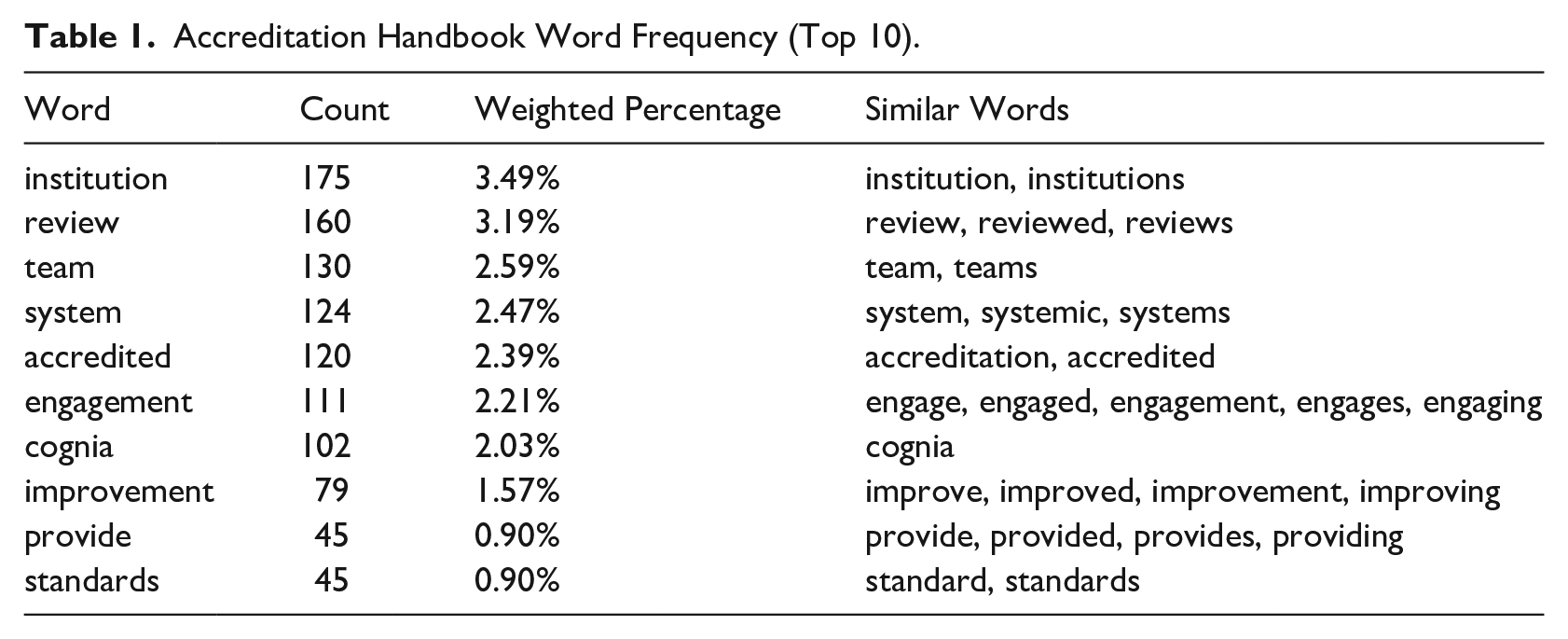
Other than the words relating to the process itself (such as engagement review team, accreditation, institution), the most frequently cited words reveal the objectives of the process, which are to adhere to performance standards, show improvement, and have systemic processes. The institution needs to provide evidence of these to gain accreditation.
Documentary analysis of the handbook compared language of a commanding nature with language which allows a flexible approach. Nothing in the handbook indicated a mandatory way of presenting data. All references to mandatory documents were about the accreditation process itself and not about the running of the institution. The handbook states that all institutions must ‘adhere to the Cognia policies, standards and requirements’ (Cognia, 2020a: 7). Also, after accreditation the institution must implement all findings of the team. So, although there may be flexibility in how the institution documents its running and what type of documents facilitate the institution’s work, the essential functions must be included in some way. The handbook claims that ‘Cognia accreditation is responsive to variations in the purposes (ie, missions and visions)’ (Cognia, 2020a: 4) of the institutions it accredits, although analysis of the standards later in this study suggested that the validity of that statement may be questionable.
Figure 1 shows the most often mentioned themes identified during the content analysis, with improvement, data use and performance most frequently occurring. Schools are expected to be highly data-driven and performance-focussed, with the evidence for that performance being in the form of reliable data and the performance being seen as measurably improving over time.
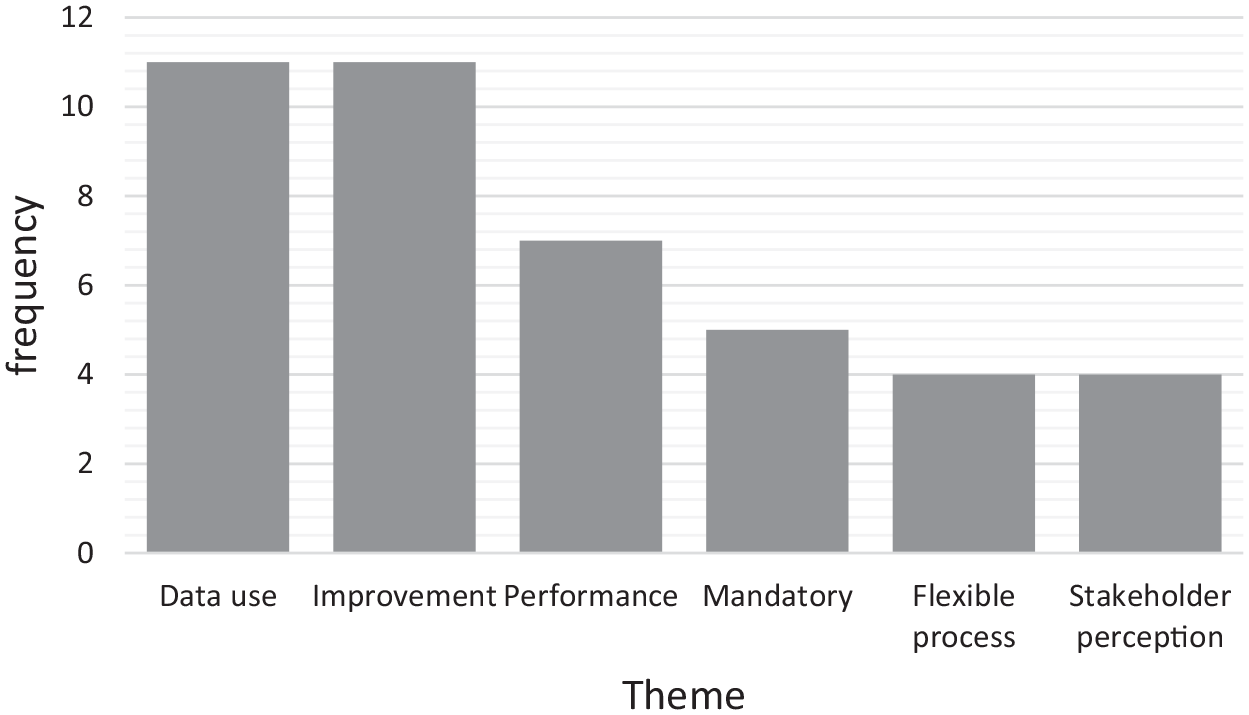
Accreditation Handbook Themes.
The handbook includes a visit schedule, where much of the visiting team’s time is spent in classroom observations. Since a major source of evidence for the accreditation is observations, schools are likely to react by preparing well to ensure that the review team observe the style of teaching and the type of learning environment expected (to be considered in review of the eleot document).
Another major source of evidence is stakeholder feedback, which might lead to structures being put in place by a school to encourage stakeholders to have a favourable perception that matches the image the school wishes to present to the review team. This might include establishing parent and student councils as well as some form of regular written communication. The handbook mentions in more than one place the need for schools to share the results of their accreditation visit with all stakeholders. Brown et al (2016) suggest that this theme of a transparent organisation should result in increased competition which improves performance. However, whilst a google search for accreditation reports did reveal many schools announcing to stakeholders that they had achieved accreditation, very few schools posted any summary of the accreditors’ recommendations. There is therefore little evidence that the desired level of transparency is being achieved. If reports are not visible to competitors, or customers of competitors, then the increased competition is arguably minimal.
The Performance Standards
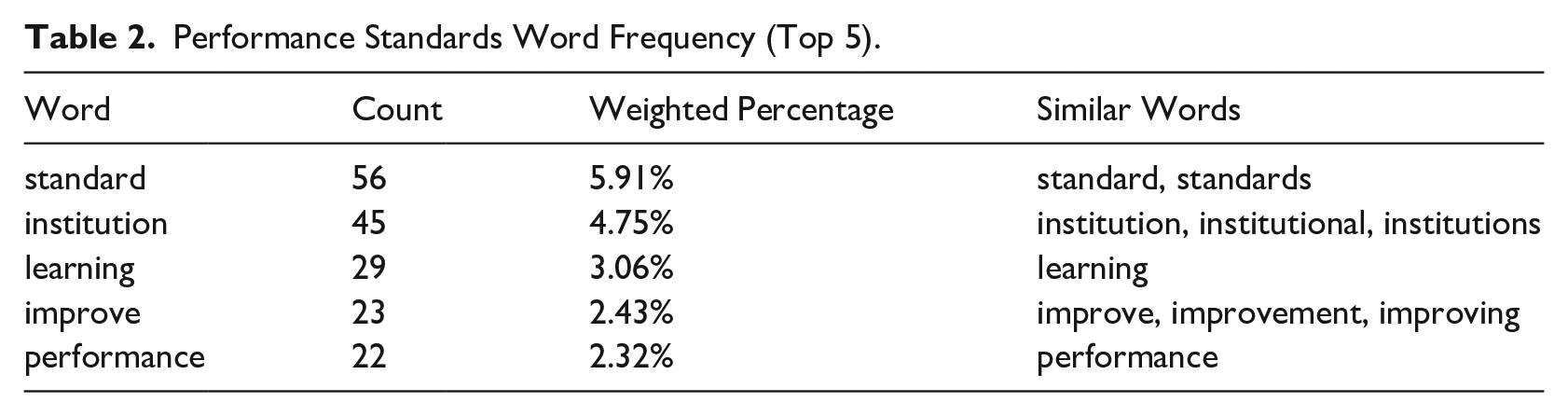
The performance standards are rated with the aid of a rubric called the ‘i3 Rubric’ (Cognia, 2020b). The rubric is used to rate how embedded practices are in the culture of the organisation, and is applicable to every standard. For the standard to be rated highly there must be a process in place to collect data, analyse it and modify programmes based on that data. The data must show sustained improvement over time. The word frequency analysis (Table 2) shows that learning, improvement, and performance are concepts that are found throughout the entire document. Therefore, an underlying value of the importance of Data Driven Decision Making (DDDM) is present in all standards. With accreditation visits taking place every five years and schools normally conducting their self-evaluation within a year prior to the review visit, there may have been a significant amount of time when the school was not focussed on maintaining this data. Consequently, there could be a temptation to fabricate data to show a history of improvement. Schools are also likely to only volunteer data that is favourable and not represent a completely true image of the school, as noted by Ball (2003).
Performance Standards Word Frequency (Top 5).
Dividing the standards into three domains outlines Cognia’s vision of the key pillars expected for a good school: leadership capacity, learning capacity and resource capacity (Cognia, 2020c). There are slightly more standards in the learning domain compared to the leadership domain (12 as opposed to 10), which suggests that being responsible for student learning is the main purpose of the school, but that structured leadership processes must support that purpose. The eight standards in the resource domain show the importance of efficient and effective use of resources, which is a feature of new public management (NPM) that was also identified as being present in the language of Ofsted inspection reports (Clarke and Baxter, 2014).
Three of the leadership domain standards mention the organisation’s purpose statement (Cognia, 2020c: 3). Cognia expects that schools will have a purpose statement and leaders must ensure that all stakeholders are engaged in supporting it. With respect to the i3 Rubric, there should be evidence that the purpose statement has been achieved. Although it is expected that schools should develop their own purpose statement, Standard 1.1 does allude to a specific framework that cannot be ignored in the statement ‘defines beliefs about teaching and learning, including the expectations for learning’ (Cognia, 2020c: 3). As will be discussed in the next section, Cognia favours a social constructivist approach, with which the purpose statement should therefore be aligned. However, the purpose statement is not limited to that approach and there is room for schools to include other aspects of student development.
Standard 1.6 requires the school to have an established process for evaluating staff. Although not specifically stated in the standards, the i3 Rubric implies that this process should be quantitative in order to show measurable and sustainable improvement. The school is free to determine which evaluation criteria are appropriate for their organisation so long as they fit within the approach of quantifiable performance management. This approach has been argued to erode the space for teachers’ judgement on what good practice to implement (Ball, 2006). Standard 1.3 requires that the improvement process produces ‘measurable results of improving student learning’ (Cognia, 2020c: 3). This can cause leaders to encourage performance that can be measured quantitatively and to focus efforts where the greatest impact can be quantified easily, such as with respect to lower achieving students, at the expense of high ability students. The Learning Domain makes clear the interaction that teachers should have with data: ‘Educators gather, analyse, and use formative and summative data’ (Cognia, 2020c: 4). This standard should have an impact on the way professional learning is planned in the school in order to train teachers in designing assessments that can generate such data. It also has an impact on the way in which learning time is planned for students to allocate time for assessments. Standard 2.4 requires that the school has a formal structure of adults supporting the learners and developing relationships with them, implying that the school must have some form of homeroom teacher and student counselling system.
Standard 2.8 defines a value system of the very purpose of students being in school. The school should support ‘learners’ educational futures and career planning’ (Cognia, 2020c: 4). There is also a requirement for the curriculum to prepare ‘learners for their next levels’ (Cognia, 2020c: 4). Next levels can be interpreted as relating to progression from grade to grade and/or gaining university admission after leaving school. This makes clear the role of the school as preparing students for the job market or for higher education (which in most cases will also lead to the job market), which is consistent with the neoliberal view that educational institutions are responsible for maximising human capital (Spohrer et al, 2018). This does not mean that the school cannot work on using education for other purposes, but without other purposes being included in the standards it seems unlikely that schools will exert a comparable amount of effort on those purposes.
Throughout the standards in the Learning Domain, it is clear what type of learning should be found in a Cognia-accredited school. Learners should ‘develop skills and achieve the content’ in a curriculum that is ‘aligned to standards’ (Cognia, 2020c: 4). These requirements also make clear to schools what their curriculum planning should include. Standard 2.2 says that the culture of the school should promote ‘creativity, innovation and collaborative problem-solving’ (Cognia, 2020c: 4). This means that memorising the content is insufficient; rather learners should apply their knowledge in creative ways. There appears to be an underlying belief in the value of project-based learning and that students learn best through working in groups. The standards implicitly discourage a classroom of individuals passively absorbing content; they also make clear that the learning should be differentiated according to learners’ needs.
Whilst many of the standards referred to above have implications for the content of professional learning to be provided by the school, the necessity for the school to provide professional learning is emphasised in the first three standards of the Resource Capacity Domain. Standard 3.3 explicitly mentions three forms of training that must exist: induction, mentoring and coaching. The terminology used in standard 3.2: ‘professional learning structure’ and ‘promote collaboration and collegiality’ (Cognia, 2020c: 5) appears to be based on the notion that there should be professional learning communities (DuFour et al, 2016) organised in the school, though it is not certain that school leaders would understand that from the standards as it is not made explicit.
Standard 3.6 assigns responsibility for providing resources for teachers to the school. This could be problematic in high-poverty areas, but should be less of an issue in private schools. Standard 3.5 places importance on the use of technology in all parts of the school, with digital resources available for teachers. A classroom following this standard would likely involve the teacher using a digital copy of the book, Powerpoint presentations or some form of computerised activity. Digital tools should also be used in the processes of running the school. Strategic resource management is mentioned such that all schools, private or public, should have systems in place for sustainable financial management.
The Effective Learning Environments Observation Tool (eleot)
Cognia claim that eleot is not a teacher evaluation tool but rather an assessment of the school’s impact on student learning and of the implementation of school plans (Cognia, 2020a). However, the need for the teacher to facilitate this learning environment means that the implications of each indicator for teachers’ practice cannot be ignored. As it is provided for use by all Cognia network schools, schools do use it as part of their own teacher evaluations (Coutet, 2021). The eleot assesses the presence of seven learning environments: equitable, high expectations, supportive, active, progress monitoring and feedback, well-managed, and digital. Throughout many of these environments, there is the underlying notion that learning is a social process (Vygotsky, 1978). All learners must be observed having ‘equal access to classroom discussion’ (AdvancED, 2017b: 1), they should be ‘asking questions to clarify assignments’ (AdvancED, 2017b: 2) and ‘showing peers how to apply specific steps or processes’ (AdvancED, 2017b: 2). The supportive learning environment describes learners as ‘peers’ (AdvancED, 2017b: 3) who help and encourage each other. The digital learning environment requires digital tools to be used to ‘communicate and/or work collaboratively for learning’ (AdvancED, 2017b: 7). The observation would not score highly if the teacher was adopting a teacher-led direct teaching approach, and so any decision the teacher makes in the classroom must fit into the social constructivist philosophy.
The learner-centric approach is further expounded in Environment D: Active Learning. Learners are expected to talk with each other, working together on activities that are connected to their prior learning. The implication here is that the teacher should design student-led activities and should not spend much of the lesson time explaining concepts. Environment A: Equitable Learning requires work to be differentiated according to the students’ needs and interests. As the guidance specifies that the activities themselves should be varied, it may be understood by a teacher that other methods of differentiation such as differentiating by support are not acceptable. Whilst some flexibility seems to be apparent in students ‘working in small groups, whole groups, or individually’(AdvancED, 2017b: 1), the requirement for peer discussion suggests that some form of grouping is preferred. The last indicator in Environment A relates to whether learners have opportunities to develop respect and empathy for people of different backgrounds, cultures, and characteristics. This could be interpreted by the teacher to mean that mixed-ability grouping is favoured over grouping students by ability. It could also lead the teacher to make a conscious decision to mix students according to their ethnicity or background rather than on the basis of academic performance.
Rubrics are mentioned in several indicators and environments. In the high expectations environment, students should refer to rubrics to meet the expectations set by the teacher. In the progress monitoring environment, students should use rubrics both to assess their own learning and to know how their work will be assessed. The inference is that the teacher should have a highly objective, quantifiable way of determining student progress and a focus on student performance. This echoes the focus on measurable student performance in other parts of the accreditation process as noted earlier. The eleot also encourages teachers to direct the students to be measurable performance-orientated. Students should be observed ‘referring to their syllabus’ (AdvancED, 2017b: 2) and ‘referring to course syllabus for grading information’ (AdvancED, 2017b: 5).
The Well-Managed Learning Environment defines what student behaviour should be observed. There is a requirement for students to be aware of classroom rules, and so teachers or the administration must set the rules. Some rules are explicitly mentioned, including ‘raising hand’, ‘not . . . criticising others’, ‘staying in learning space’, ‘staying focussed’ (AdvancED, 2017b: 6). However, the procedure to determine these rules and procedures is not prescribed. There is also no mention of students being required to know the consequences of following or breaking the rules. This leaves considerable flexibility for schools to adopt a behaviour policy suitable for their context. It also allows for teachers having an autonomous behaviour management system which is not connected to the school’s policies.
Allocating digital learning its own individual learning environment sends a message to observers, teachers, and administrators that the use of digital tools in education is important. It indicates an underlying assumption that learners can benefit from using technology in education. Although the digital learning flashcard mentions that even the use of a calculator can be considered digital learning (Advanc-Ed, 2017c), it is clear that more is needed as the indicators require students to be using digital tools to engage in research, communicate and work collaboratively. It could be assumed that school administrations wishing to score adequately in this area would need to invest in smartboards, high-speed internet connections and computers.
Conclusion
This study analysed the three most important documents used in the accreditation process of Cognia. The aim of the study was to determine to what extent isomorphism, as witnessed in the context of international schools, can be attributed to or reinforced by the need for schools to gain accreditation either for market or legislative reasons. As the study was concerned with the effects of these accreditation documents, a policy deconstruction approach (Codd, 1988) was utilised that analysed the effects policies have upon different readers (in this case school leaders and teachers) regardless of the writers’ intentions, whilst considering the underlying values upon which the policy appears to be founded.
The study suggests that accreditation is likely to have an isomorphic effect on the school management practices, teacher practices, and the organisation of the learning environment. The whole school is expected to collect, analyse, and use data in almost all its practices. Management should measure and evaluate all staff using data which could have the consequence of inhibiting creativity in areas which will not be measured in the already established performance measurement rubrics. All members of the school should be focussed on a mission to prepare students for the job market or entry into higher education. The school should be strategic in its planning and use resources efficiently and effectively. Teachers should be organised into collaborative professional learning communities and there must be a comprehensive professional development plan in place for all staff.
The standards and eleot observation tool make it possible to draw a picture of the classroom that would successfully pass accreditation. This classroom is connected to the internet with a smartboard. All students have access to these digital tools in order to conduct research and collaborate. Student desks are flexibly arranged, so long as they are not arranged individually. The room is not silent, with students talking to each other about tasks, and students of mixed abilities and backgrounds are evidently seated next to each other. The teacher has planned the lesson according to standards, determining both the skills and content that the students should learn. The philosophy adopted is social constructivism where students build on their prior knowledge and learn from each other. The teacher does not directly teach, and learners are working on tasks which are differentiated according to their ability and interest. They are frequently assessed, both formatively and summatively, and know in detail how their tasks will be assessed.
As more schools globally seek accreditation by agencies outside their own country (Bose et al, 2017), this raises questions as to applicability of the framework for teaching and learning described above for the cultural contexts to which it is being exported. It assumedly puts great pressure on schools to provide extensive professional development for a faculty that has been trained on the basis of different philosophies. This is particularly pertinent in countries like KSA where many international schools adopt western (particularly US) curricula but do not hire many western-trained teachers due to low salary budgets.
Whilst the accreditation process does not appear to allow much room for flexibility in school leadership style, nor in organisation of the learning environment, there is still opportunity for teachers to exercise some creativity by modifying or creating resources suitable for differentiated learning – provided the learning is aligned to standards that lead to college-readiness.
The documentary analysis approach used in this study suggests the effects that documents may have on the reader. Further study is needed to explore the actual effects on school leaders and teachers who have gone through the accreditation process. This study considered just one accreditation organisation, which although large is not necessarily representative of all accreditation organisations. In particular, not all accreditors have a set rubric for classroom observations and so the isomorphic effects it is suggested may be found on teaching practice are not generalisable. Further study incorporating standards of other accreditors would enable a broader analysis to be undertaken of the isomorphic effects of accreditation more generally.
Footnotes
Acknowledgements
I would like to thank Professor Hugh Lauder, Dr Brendan Higgins and Michael Fertig for their support in the generation of this paper.
Funding
The author received no financial support for the research, authorship, and/or publication of this article.
