



Abstract
Research into what is effective leadership in different cultures provides guidance for leaders moving from one culture to another (House et al, 2014). There is a paucity of empirical research into how culture impacts effective educational leadership in culturally diverse communities, which provides the direction and focus for this study. The cultural backgrounds of staff can impact what they expect about i) how leaders communicate, ii) what actions help build trust and collaboration and iii) how decisions can or should be made (Hofstede, 1991; Meyer, 2014). This study analyses the extent to which school leaders adapt their behaviours in response to the cultures of their staff. Findings suggest that leaders in schools do adapt their actions, most often using different communication styles but also methods of building collaboration and trust, and decision-making structures. Culture impacts what are effective leadership practices (Dorfman et al, 2012) and educational leaders need to understand these potential impacts if they work in culturally diverse communities. This is important to consider for school leaders and leadership preparation programmes.
Introduction
It is a truism to say that school communities are becoming more diverse, with immigration and refugees impacting national systems globally (Brooks and Jean-Marie, 2015). In addition, there has been increasing interest in and continuous global growth of international schools, which now number over 11,000 worldwide (ISC Research, 2021). And while the nature of the international school sector is changing, with increasing numbers of such schools now catering principally for local affluent families rather than for the globally-mobile expatriate students traditionally found in such schools, there continue to be thousands of school leaders working within culturally diverse communities of both students and staff. Motivated by a wish to understand the complexities of this situation, research into school leadership and culture became a focus for the larger piece of research upon which this article is based (Fisher, 2019).
Much of the current research on culture and leadership in schools is comparative, comparing concepts, structures or behaviours between nations or cultures. It has most often focused on western influenced cultures, with other cultures receiving less attention. Research on leadership in multicultural communities is extremely limited. The present study explores leadership behaviours in culturally diverse school communities whose stakeholders include a mixture of western and non-western backgrounds and cultures, and analyses the extent to which school leaders’ behaviours respond to the cultures of the staff with whom they work. School leaders in different contexts use a variety of titles, including Head, Director, Headteacher, Superintendent, Principal, and others. Throughout this article, the term ‘leader’ will be used to describe any individual with one of these titles who participated in this study. Additionally, school communities include various stakeholder groups including students, teachers, administrators, other staff, parents and the wider community. In investigating leadership of these schools, the group collectively known as ‘staff’ was the focus, which includes teachers and non-teaching staff and administrators. The research explores what the leaders did and why, when relating to their staff, in order to better understand what effective leadership means in these school communities. It is hoped that the findings will help to increase understanding of leadership, both for school leaders currently in place and for future leaders’ training and development. The conclusions may be of value to leaders in other groups, who have similar dynamics at play in their communities.
This article begins with a literature review, followed by consideration of the research design, data collection and findings. It concludes with implications for further research and potential impact on leadership practice and development.
Literature Review
The aim of the research was to investigate the impact of culture on the behaviours of current school leaders in multicultural communities. ‘Culture’ – which can describe organisations as well as societies – may be defined as ‘a system of shared assumptions and beliefs, values and behaviours in a given group, community or nation’ (Cheong, 2000: 209). ‘Multicultural communities’ are social groupings in a particular geographic region which include groups from different cultural backgrounds. Many schools proudly provide information on the number of different nationalities or cultures represented within their communities. It is these types of multicultural school communities and the staff within them that are the focus of this research. The first section of the literature review will focus on the aspects of culture relevant to leadership in the wider community, while the next section will address school leadership.
Aspects of Culture Relevant to Effective Leadership
Interest in social culture and how it impacts behaviours has been in evidence for many years, but was given new emphasis by the work of Hofstede (1980, 1991), Hofstede and Hofstede (2005) and Hofstede and Minkov (2012). Hofstede’s initial research, conducted with more than 70,000 employees of the multinational technology company IBM, identified four (later extended to six) cultural dimensions by which one can compare social cultures. Three are of particular interest to those in leadership positions: power distance, individuality, and uncertainty avoidance (Hofstede and Hofstede, 2005).
Power distance refers to the way in which members of society approach authority or leadership. Those countries with low power distance feature a more horizontal, egalitarian approach to authority; leaders in countries with high power distance are more authoritarian and vertical in structure. Hofstede was careful to emphasise that no right or wrong approach to authority was suggested in his work – power distance is merely a cultural dimension and both high and low power distance can be found in economically and socially cohesive, successful countries. Individuality is related to the level of independent thinking and action encouraged or discouraged in a society, while uncertainty avoidance is related to how comfortable the society is with ambiguity and the unknown (Hofstede and Hofstede, 2005). Hofstede’s work suggests that if a leader from a low power distance, egalitarian society takes a position in a more authoritarian culture without being aware of or attempting to understand the difference between the two contexts, the likelihood of a clash of expectations is high. The same outcome – a potential professional conflict between those from different cultural orientations– can occur in all Hofstede’s dimensions, a point reinforced by the findings of the current study.
While Hofstede’s research has been criticised by some for its methodology and sweeping conclusions, his work has frequently been cited and applied by many in the fields of comparative leadership research. An example is the Global Leadership and Organisational Behaviour Effectiveness (GLOBE) study. GLOBE expanded on Hofstede’s work by analysing the relationship of culture to effective leadership behaviours in different regions (Dorfman et al, 2012; House et al, 2004: House et al, 2014). GLOBE concluded that in order for leaders to be effective they must adapt to the expectations of those they lead (Dorfman et al, 2012). This does not mean that leaders must abandon their own identity and values, but rather that they need to understand that their effectiveness depends upon addressing local values and cultural orientations in order to avoid frustrating outcomes.
Based on the work of Hofstede, Dorfman et al (2012), Nisbett (2005), Hall and Hall (1990), Lewis (2006), and her own investigations, Meyer (2014) proposed eight culturally-influenced areas of leadership. Seeking to sustain and advance businesses with diverse staff, she explored the relationship of culture to expectations, behaviours and the effectiveness of particular actions. Meyer describes the way in which her research highlights culturally-influenced differences in orientation toward all aspects of work and leadership. She provides examples of how a lack of awareness can cause individuals or even businesses to fail. Aligned with findings in the GLOBE study (Dorfman et al, 2012; House et al, 2014), Meyer confirms the value of ‘authentic flexibility’ in which leaders do not lose sight of essential goals and their own values while adapting to different staff behaviours and orientation. Three of her eight areas are central to leadership, and influenced the present study: communication, building trust and decision-making.
School Leadership and Culture
Societal culture is important for leaders to consider when identifying effective organisational structures and leadership actions, including those in education (Bryant, Walker and Lee, 2018; Gronn, 2001; Lumby, 2012; Romanowski, 2013; Tang, Yin and Min, 2011; Walker and Riordan, 2010). Like all other social and government institutions, schools need effective leadership. However, the definition and characteristics of effective leadership behaviours and styles have been contested (Daniels et al, 2019; Day et al, 2010; Day and Sammons, 2016; Gumus, 2018; Johnson et al, 2008; Lee et al, 2018; Ross and Cozzens, 2016). A resolution providing clear guidance for school leaders does not appear imminent, as the analysis continues to evolve.
It is therefore important to relate school context to effective leadership behaviours. In general, researchers have examined the impact of societal culture (including race, ethnicity, gender, age and religion) on leadership (Hammad and Shah, 2018; Poore, 2005; Quantz et al, 2017; Shah, 2010; Walker and Riordan, 2010). In addition, a great deal of research supports the assertion that environment is a critical influence on effective leadership (Bush, 2018; Day and Sammons, 2016; Hallinger, 2018; Hallinger and Leithwood, 1996; Lee, Hallinger and Walker 2012; Truong and Hallinger, 2017; Walker and Hallinger, 2015). However, the nature of the contextual circumstances that relate to leadership have not been clearly defined. Further, there has been a limited number of investigations into the relationship between culture, context and leadership, as noted by various researchers (Bunnell, 2018; Cravens, 2018; Hirsch, 2017; Lee, Hallinger and Walker, 2012; Lee, Walker and Bryant, 2018; Quantz et al, 2017).
A positive development has been the increase in the numbers of studies of educational leadership in non-Western cultures, though many of the analyses have been conducted by either Western investigators or those trained in the developed world. Educational research on leadership and culture has been recently published about Africa (Hallinger, 2018), Latin America (Castillo and Hallinger, 2018; Flessa et al, 2018), Cuba (Sando et al, 2018) Vietnam (Truong and Hallinger, 2018), Hong Kong (Szeto, Lee, and Hallinger, 2015), Arabic societies (Hallinger and Hammad, 2019) and Spain (Gomez-Hurtado et al, 2018). These studies facilitate a better understanding of educational leadership styles and behaviours in different countries and cultures, but do not necessarily help leaders who seek guidance related to culturally diverse school communities, and in particular culturally diverse staff.
Culture and Leadership in International Schools
Thus, the limited empirical research does not clearly identify specific challenges of leading international schools and multi-cultural communities. There have been studies on leadership of culturally diverse student bodies (Billot, Goddard and Cranston, 2007) but an inadequate number of investigations relating to culturally diverse staff communities. Blandford and Shaw (2001) published their initial studies into leadership in international schools. While later research explores some of the issues faced by leaders who manage culturally diverse communities (Bryant et al, 2018; Bunnell, 2018; Cravens, 2018; Lee et al, 2018; Hammad and Shah, 2018; Walker and Riordan, 2010), it is limited in its relevance as a guide for new leaders. Tarc (2018) and Barakat and Brooks (2016) explore the challenges that new, inexperienced leaders confront when they lack skills in intercultural understanding. Their research suggests that leaders are not receiving the preparation needed for effectively supervising culturally diverse communities.
Summary
By definition, culture impacts people’s values, attitudes and behaviours in a range of areas. The GLOBE research indicates that there are some leadership behaviours which are more effective than others in some cultures (Dorfman et al, 2012). Interest in cross-cultural research in educational leadership is growing. However, there is a need for investigations that guide educational leaders in managing culturally diverse communities. While the comparative studies cited above highlight the possible cultural differences between leaders and their staff, they do not clearly identify effective leadership behaviours.
Research Design
The following research questions were used to guide the study:
In what ways, if any, do international school leaders adapt their communication styles to fit the expectations of the cultural groups within their staff?
To what extent do international school leaders adapt their methods of building trust and collaboration in their staff, to fit the expectations of the various cultural groups within the community?
To what extent do international school leaders adapt their decision-making procedures to fit the expectations of the cultural groups within their staff?
To what extent have leaders been given any training or support in understanding leadership in a culturally diverse community?
To what extent do international school leaders believe that training in understanding how effective leadership is impacted by culture would help them be more effective?
Methodology
The study’s unit of analysis was individual leaders’ interpretations of their context and behaviours. A qualitative paradigm provided the philosophical basis, with case study used as the methodological structure. The case protocol maintains the connection between the individual, their context and personal interpretations (Atkinson and Silverman, 1997 in Rapley 2010: 15; Yin, 2012; Yin, 2014). Each case focused on a leader in the relevant school context and each was conducted in a different geographic area from any other. A compilation and analysis of all cases revealed themes that addressed the research questions.
Data Collection and Participants
Relevant contextual factors of each school and leaders (including senior leadership team, SLT).
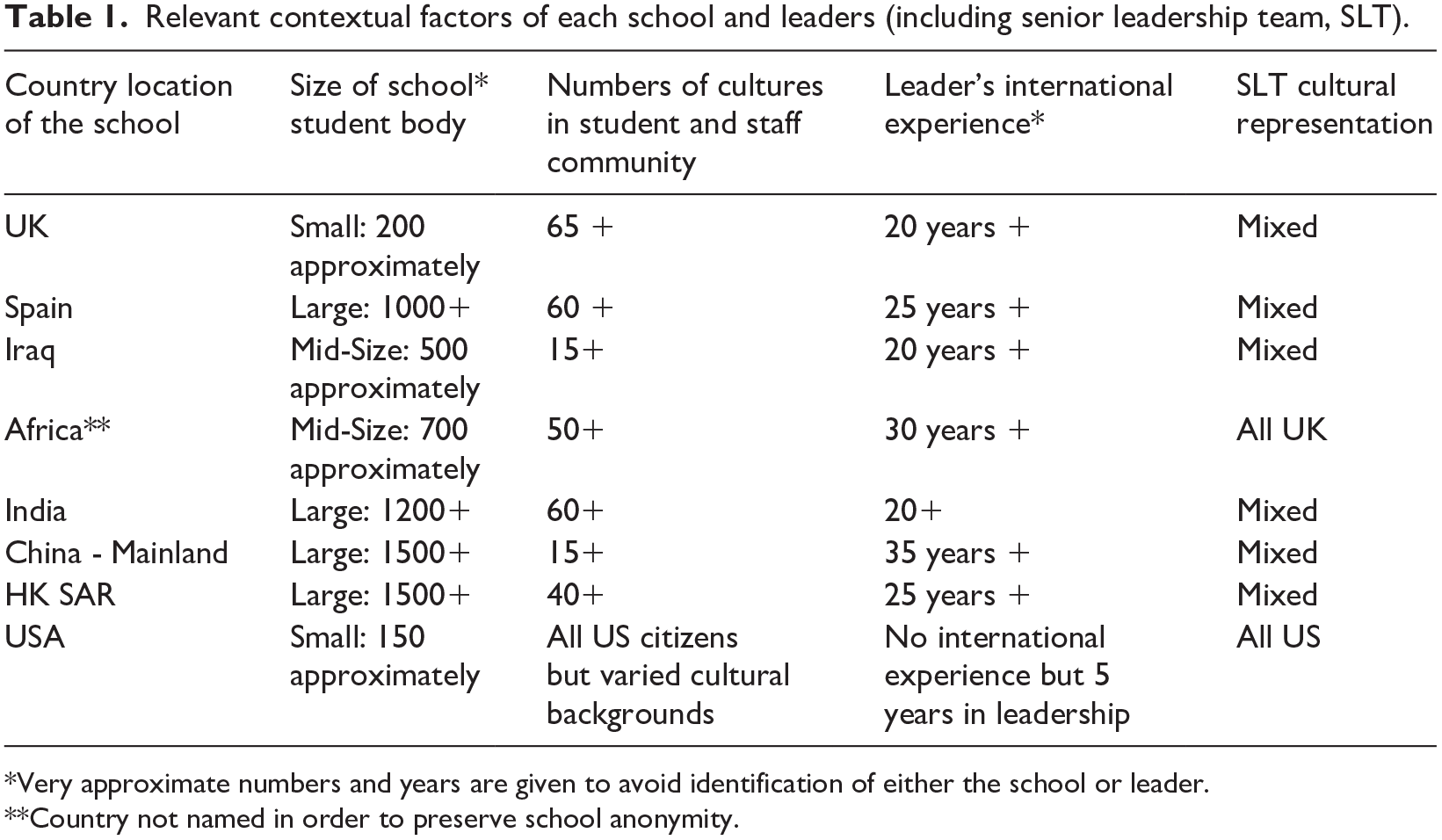
Very approximate numbers and years are given to avoid identification of either the school or leader.
Country not named in order to preserve school anonymity.
All leaders indicated interest in the research area and agreed to be interviewed. Each was asked to suggest two members of their leadership team who could be invited for interview. All individuals were then invited and all except two (one in Iraq, one in Spain) agreed. Ethical considerations were followed in line with the BERA (2017, 2018) guidelines, with all interviewees being assured of confidentiality and all agreeing to quotations being included, in anonymised form, in the subsequent research report.
The majority of the 21 interviews were conducted face to face (prior to Covid-19), with the remainder conducted via Skype due to challenges of visiting some areas. Documents were provided by all except one school. All interviews were individually transcribed and initially manually coded then uploaded into NVivo with the associated documents. Re-reading and refining of codes followed, providing 472 data points from 284 files, aligned under 8 major nodes tied to the research questions and 29 ‘child’ (or minor) nodes which provided further detail found in the major nodes’ themes.
Data Analysis
The interview transcripts provided a rich source of data arising from leaders’ perceptions and behaviours. Each leader and leadership team member’s interviews and school documents were firstly analysed as one case. Leaders’ claims were reviewed in terms of the research questions – communication (RQ1), collaboration and building trust (RQ2), and decision-making (RQ3) – and their views on leadership preparation and development (RQ4). Comments were then collated under the major and child nodes. Leadership team members’ responses were compared with the leader’s claims to check for consistency or disagreement within each node. School documents were analysed in terms of the leader’s claims, again checking for consistency. A report was written for each case which included an analysis of the findings according to the research questions: communication (RQ1), building trust and collaboration (RQ2), decision making (RQ3), and leader’s preparation and development (RQ4). Each case concluded with preliminary findings. The comparison of emerging themes across all cases concluded the final analysis.
Findings
Each school differed in geographic and cultural context and leader experience level, thus facilitating a variety of perspectives for exploration. Each case reflects its physical location, since each included some local individuals as well as those from other cultures. As will be discussed below, seven of the eight leaders adapted their behaviours to the cultures found in their community, albeit with differing levels of complexity. The final school leader acknowledged that their cross cultural skills needed to be developed further, and had plans in process. The following excerpts provide some examples of leaders’ reflections on their actions; all quotations are from leaders unless otherwise indicated.
Individual Cases
Case 1 UK
The leader in this school believed she did not need to adapt her behaviours to the cultures of her staff. She felt that, as they were all working in an International Baccalaureate (IB) school, she could assume they accepted the IB’s Western philosophies and leadership expectations of collaboration and shared decision-making. This was a recurring theme among the leaders in this study. However this leader did adapt her communication style to individuals she was working with where she believed it helpful in achieving her leadership goals. Thus she adapted some behaviours but not all: ‘I’m thinking about a number of staff where I would be probably a little more formal than I would be with other staff and that seems appropriate . . . So yes, I do watch my Ps and Qs but I’m not nuancing the centrality of any message.’
In an effort to build trust and develop collaboration, she was clear in her expectations of new staff providing feedback and being engaged in collaborative activities regardless of their personalities or whether they came from a ‘high power distance’ culture that does not encourage speaking up. She deployed communication styles specific for the individual as required, in order to achieve her leadership goals of collaboration and shared decision making:
‘So this is in our DNA – that we are collaborative . . . because we have so many collaborative opportunities very few of them are massive groups of people – so I think even the shyest or most timid or someone from a school which didn’t have these opportunities or culture to voice their opinions . . . they would feel comfortable’
This expectation of collaboration is confirmed by the senior leadership team members in interviews, and also in this statement found in the staff handbook:
‘The [school] senior leadership team believes that as a staff, our strength lies in our collective ability to work together in a way that requires each of us to be inclusive, compassionate and inspiring to our students along their path to becoming world citizens.’
This leader was aware that some cultures might encourage less overt engagement in team work and decision-making, and worked hard to make collaboration and the provision of feedback a clear expectation of all staff. Toward this end she followed structures that were supportive of staff who were less inclined to speak up:
‘I am adamant when I meet any of the new staff that they are here to make a difference and give us feedback – gives us a wealth of feedback.’
In summary, this leader did not believe she needed to adapt her leadership expectations of collaboration or shared decision-making. While she would communicate with her staff as one large group, she would interact with individuals in culturally appropriate ways.
Case 2 Spain
This leader adapts his communication styles to both the individual and the culture of the groups he is working with. He spoke of the differences in how he worked in India in contrast to his work in Spain. His perspective on the differences in communication expectations between staff cultures was supported by a senior leadership team member when they said:
‘and those who work in a Spanish context . . . they don’t need very detailed information, whereas the North Americans really want to know how things work – and they need things to be explicitly explained and to know the background story – everything. They need detail.’
[Senior Leadership Team-(SLT)1]
According to this leader and his team, achieving trust and strong relationships depended upon context.
‘So, if you want to build trust you need to do it differently’ [Leader]
‘In Spain and India it’s more relationship-based rather than task-based – so it’s about chatting with them, getting to know them.’ [SLT]
The leader believed that building trust and collaboration was achieved in India through social opportunities whereas social activities were not well attended in his current school, since staff preferred to spend free time with their family. With reference to decision-making, he spoke of following the Western philosophical tradition of collaboration where possible. He understood that those from some cultures accepted more direction and less involvement in decision-making, while others expected to participate. In summary, this leader referred to the different ways of communicating and building trust and collaboration in his current school, in contrast to his previous experience. He adapted to where he was while always encouraging engagement.
Case 3 Iraq
This leader had served internationally with staff from many cultures prior to coming to Iraq. He often described his other experiences and how they differed from his current post. He explained that he adopted relevant communication styles with different colleagues, and even went so far as changing his dress according to the context:
‘I was always very friendly. But at no point did the staff see me as equal. I was always standing – and they were able to address me directly – but I was always standing, always wearing a suit.’
When building relationships to encourage collaboration and shared decision-making he recognised that he had to take time and engage in socialising before getting to business:
‘I knew that Arabic culture was all about relationships and taking time. Not talking about business right away but . . . giving them a taste of my family background before anything – wish their family well – talk about the weather – etc. There was a whole preamble you had to do before you got to the business at hand.’
The leader understood that his Senior Leadership Team was not used to being encouraged to provide input into decision-making or to take responsibility for outcomes. He was determined to have them engaged and to contribute so that the context could be more inclusive. Ironically, he used authoritarian-style demands to encourage his team to become more egalitarian. This Leader was therefore adapting his leadership behaviours in ways that were understood by his staff, in order to achieve his aims. Similar to Leader 1 he wanted collaboration and shared decision-making but, unlike Leader 1, he changed his leadership style to be more authoritarian in order to achieve his aims. In addition, he communicated differently with his whole-staff groups, acknowledging the different styles of communication needed for different cultures.
Case 4 Africa
The leader in this school was very cognisant of changing his communication style with individuals on his staff so that he met their expectations and could be more clearly understood:
‘[Y]ou’ve always got the problem [that] what I think I said and what they think they heard are not always the same.’
His experience in other contexts provided him with an understanding of differences between cultures, including communication styles and approach to business. For example, he said:
‘China was unique, and trying to interface with the officials there [was frustrating] . . . how you get involved with conversations and pleasantries. I’m not saying I like the Dutch way, which is just say it to your face and get on with it! But . . . you don’t need half an hour of chit chat before asking them to sign the paper – I need to get on with things – so cultural aspects do impact you as a leader.’
He had to work hard to ensure that his staff engaged in collaboration, and he frequently employed quasi-authoritarian methods to achieve their engagement:
‘So I’ve had to really think about leadership when it comes to the cultural interface with them [non-teaching staff]
. . . [I]t took at least a whole year for people seeing how I work to really encourage that frank discussion and know it is OK to be robust – in these four walls it’s OK to have a robust discussion and sort the problems and then go out.’
This leader was similar to leader 1, in that they both treated their expatriate teachers – in this case 95% of the teaching faculty – as a unified Western cultural group. He assumed they would work collaboratively and participate in decision-making and did not change his leadership behaviours for the teaching staff. However, working effectively with his non-teaching staff presented other challenges, and he had to adapt his leadership behaviours and in particular his communication styles in order to achieve his aims.
Case 5 India
The leader in this school was an Indian national, and was very aware of the different expectations between her expatriate staff and her Indian staff in terms of communication, collaboration and decision-making. In India, expatriate teachers could comprise no more than 10% of teaching staff, a rule that created a small but vocal minority. She said: ‘A culturally diverse community has to have culturally diverse expectations of how you communicate, when you communicate, what you communicate about’
‘One on one they (expatriates) were the nicest people, but in staff meetings they wanted to question everything, and it seemed to everyone else that – goodness these people are so rude! Your (Indian) idea of respect is that you don’t question your leader in a meeting.’
She provided a number of examples of incidents in which she explained to the different factions the communication preferences of their counterparts. Her hope was that after this mini-professional development the staff could more easily collaborate and relate to the whole school community. In order to enable greater collaboration, a main focus for this leader was the development of empathy by her and her leadership team.
‘[I]f you want to be a team you cannot make lip service to the word collaboration. It has to be cooperation and collaboration. So how do you get that? So empathy becomes a very key skill and that is something I work a lot with my staff to engender.’
When making decisions, she was also very aware of different expectations from the different cultural groups and worked to ensure that while she might not be fully democratic she did engage everyone where possible:
‘There are times when you make executive decisions and you need to – you cannot be consultative all the time. Because culturally . . . a lot of my staff [Indians] would
This leader demonstrated an understanding of the different communication styles, levels of cooperation, and expectations of engagement in decision-making favoured by the expatriates as compared to the non-expatriates within her staff. She clarified which behaviours were acceptable while simultaneously working to build familiarity between cultures that had previously not related well. Within this framework she expected empathy and respect for and from all. She understood the different expectations of communication styles, levels of collaboration and styles of decision-making held by different cultural groups in her staff, and engaged in different behaviours accordingly.
Case 6 China (Mainland)
The leader in China provided a very clear example of how she adapted her communication style to each staff group she worked with. Similar to some of the previous leaders, she treated her expatriates as one group regardless of how many cultures were included. However, she communicated with that group quite differently than how she related to her local staff members, as she explains below:
‘I do tend to treat the foreigners as a group – not that I don’t understand or appreciate differences, but basically my approach and my planning for them is as a group for the foreigners – and that would mean that I would engage them, and I would have them active . . .. And if it’s a mixed group of Chinese and foreign – then I’m much more cautious. I’m clearer – less ironic – much clearer in sense of language and structure sometimes, but also verbally I would put it in context much more often . . . And then if it’s just Chinese then I’m very careful because they do perceive and take messages from the boss differently. So, I’m very cautious, very diplomatic etc and equally straightforward, but I would do more overt explanation.’
Her SLT members also described different behaviours and expectations according to the cultural context. When the leader tried to encourage all staff to participate and provide input in meetings, one SLT member said:
‘The question is that Chinese sometimes feel that saying something in a meeting is showing disrespect, and for example [if you don’t talk in a meeting] in an international school some people will think you are not interested’ [SLT 1]
The leader employed different strategies to build trust. She offered examples in which she regularly encouraged local members to speak up, participate in collaborative groups, and/or take on responsibility and initiatives. She frequently had to overcome resistance caused by the different cultural orientations of these colleagues. She required all her teaching staff to become part of decision-making committees. As with the leader in Iraq, this leader used an authoritarian style to engage local staff in activities that were democratically oriented. In effect, both leaders employed leadership skills to effectively relate to colleagues from high-power and low-power distance backgrounds.
Case 7 Hong Kong Special Administrative Region
The leader in Hong Kong confirmed a strong belief in the need to communicate differently with different cultural groups, and the importance of leaders being aware of cultural variations in expectations of behaviour. He was clear that his values remained constant while the way he communicated might change:
‘You certainly espouse your values consistently across both cultures and values . . . Although the manifestation of that [value] in different cultural groups may be different.’
He provided examples of challenges in developing collaboration and obtaining feedback:
‘Working with a group of English-speaking teachers there may be an expectation of a certain level of egalitarian equality, respect where you will kick around an idea and there will be some sense of consensus and collaboration at the end. Taking a similar approach with a group of Chinese teachers would tend to result in stony silence and not getting much back. The process of sharing is fine – you communicate – you need to have packaged things in such a way that the Chinese teachers can see and understand the reason for doing something. You can then advise them of what you intend to do and objection will usually come to you through back channels and through indirect ways. So if you made a mess of something – suggested something that is inappropriate – then they’ll let you know [indirectly]’
The SLT members also identified different cultural expectations as part of the knowledge requirement for their work. They understood the need to be aware of the cultural expectations of both local and expatriate staff when dealing with issues:
‘For us (Chinese) it is very hard to separate personal and professional – these things really blur – within the Chinese community – you are building the relationship as you move forward. So people can have a different sense of what professionalism is.’ [SLT2]
In summary, the leader adapts his communication style and expectations of collaboration and feedback to the different cultural groups. Developing a more shared structure for decision-making was a focus for development in this school community, reflecting his desire for a more egalitarian culture within the school. He helped his leadership team and all staff to understand the origin and manifestation of different values and to demonstrate respect for all.
Case study 8 USA
The leader in the American school was the only leader who lacked international school experience, although he had served in previous leadership positions. He was also in a school where, as required by the state licensing authorities, all the teaching staff were American, though they came from different ethnic and racial backgrounds (European, African and Asian). The school was in its early stages of development and the leader and his leadership colleague had been working to support students from diverse cultures but had not yet included staff in this endeavour. After reviewing the interview questions, they both indicated this would change:
‘Only . . . I realised that on reading these [interview] questions, oh! . . . we haven’t done anything of these . . . and that is part of our struggle now as we come to think what is the culture of the building in terms of culture and international mindedness . . . This is where we are huge believers in communication and transparency.’
The leader confirmed that he would work to raise his awareness of the different cultural backgrounds of the staff. He acknowledged that his own professional development in intercultural understanding might support or challenge teachers in their work, and how it correspondingly might be redirected towards supporting their students. At the time of the interviews and visit, the leader did not adapt his communication style, collaboration or decision-making structures according to the staff in his school.
Findings and Emerging Themes
After collating and analysing the data from each of the cases the following findings and themes emerged. They are presented according to the research questions, numbered 1 to 5, as follows:
1. In what ways, if any, do international school leaders adapt their communication styles to fit the expectations of the cultural groups within their staff?
Seven of the eight school leaders adapted their communication styles to the cultures of the individuals with whom they interacted. Five of the eight school leaders also indicated that they adapted their communication to the large cultural groups in their local and expatriate staff. This was found in schools whose staff included many locals as well as a large group of expatriates. One leader indicated he did not adapt his communication style for the teaching staff because they were nearly all expatriates, but did so for the non-teaching staff. Three of the leaders stated that they treated the expatriates as one cultural group in spite of it including many cultures. This might appear as contrary to the goal of exhibiting intercultural understanding, except that all three also adapted their communication with individuals in context. A claim that communication styles are often adapted by leaders to the culture of the individuals or staff groups is therefore strongly supported across the cases.
2. To what extent do international school leaders adapt their methods of building trust and collaboration in their staff, to fit the expectations of the various cultural groups within the community?
All leaders worked to build trust and collaboration. They sometimes did so in ways that reflected local expectations. One example described a leader who tried to follow the local norms by developing relationships through socialising opportunities prior to focusing on work matters. Alternative ways of building trust and collaboration were used, including the attempt to create visibly equal status or encouraging collaboration through different strategies to obtain feedback. Through using different leadership behaviours with each cultural group, leaders believed they were being more effective. These behaviours demonstrate a willingness to do or model what is required within the cultural contexts in order to achieve leadership aims. The claim that leaders adapt their behaviour related to building trust and collaboration, and in relation to the cultures of their staff, is thus tentatively supported.
3. To what extent do international school leaders adapt their decision-making procedures to fit the expectations of the cultural groups within their staff?
It was more difficult to determine whether leaders adapted their decision-making framework and behaviour according to the culture of the teams. Reviewing all of the cases it is clear that sometimes different behaviours were employed, but this might be due less to the culture of the staff than to the context of the school. The leader’s decision-making actions might also have reflected the preferences of the owner or owning organisation. When the leaders indicated a preference for staff involvement in the decision-making process, they made every effort to encourage it. Towards that end they would use culturally appropriate communication styles to engage and encourage staff members in feedback for decision-making. Four of the eight leaders stated that they wanted to encourage staff participation, and personally interacted with individuals from cultures that would not normally engage in this way. Two leaders indicated they were comfortable with the decision-making structures in place, with one style more collaborative and the other more top-down. One leader in particular was sensitive to both local comfort levels and organisational goals. He employed an authoritative manner (preferred locally) to change the decision-making framework to a more collaborative orientation. Overall, these diverse outcomes suggest that adaptation of decision-making occurs within specific contexts, including local conditions, and is not simply a function of the leader’s aims or staff culture.
4. To what extent have leaders been given any training or support in understanding leadership in a culturally diverse community?
5. To what extent do international school leaders believe that training in understanding how effective leadership is impacted by culture would help them be more effective?
None of the leaders or leadership team members had received any training that may have helped them to lead a culturally diverse staff. In addition, none had deeply reflected about when and how they might adapt their behaviours to be most effective, simply using their experience of the past to guide their actions. All eight leaders and their teams stated that professional development in this area would be beneficial, though there were various opinions about how it might be conducted.
Discussion
Leadership
The quality and quantity of behaviour adaptation by leaders depended on the cultural backgrounds and nature of their staff. One important variable was the proportions of local and expatriate teachers. While some leaders recognised the need to adapt their leadership style, they nonetheless insisted on maintaining their core cultural values while doing so. As one stated: ‘You certainly espouse your values consistently across both cultures and values – so that when I communicate and the way I express that . . . I would hope that it is reasonably consistent.’ [Leader – HK]
Another participant suggested similar flexibility but cited the importance of aligning the school and the leader’s core values:
‘Those [leadership] values have to be aligned with your school in order to be appropriate – but the clothes you wear to the meeting – you can choose to wear a suit and tie or a polo shirt, and you can choose a certain set of behaviours with one set and another set of behaviours with other parents – but our values – they have to be aligned otherwise you shouldn’t be in that school’ [Leader – Africa]
Meyer calls this concept ‘authentic flexibility’, and suggests that being adaptable does not require a change in one’s basic values (2014: 104). Leaders who practise this strategy can simultaneously maintain their own values while recognising that others might interpret the same value differently. For example using Hofstede’s paradigm, a leader with an individualistic orientation might be seen as self-centered by a collectivistic staff. Maintaining one’s integrity is a highly prized trait in leadership, as was confirmed by the GLOBE studies (Dorfman, 2012). Thus, it is advisable for leaders to develop flexibility in their actions while maintaining their core values, as evidenced by a number of the leaders in this study.
Communication
The findings indicate that seven of the eight leaders adapt their communication styles in relation to the culture of their colleagues. Demonstrating expertise in employing various communication styles is a crucial skill for all educators, but especially for school leaders with diverse staff. Once again, this outcome aligns with the findings of the GLOBE research, which suggested that business leaders were more effective when their actions aligned with their followers’ expectations (Dorfman, 2012; House, 2014). Novice leaders might study Lewis’ model of communication (2006) to help them understand the complex mix of expectations and appropriate behavioural adjustments. Culturally responsive communication skills is not an optional skill set, if school leaders wish to be effective.
Building trust and collaboration
All leaders interviewed were working to build collaboration and trust among staff. Collaboration was developed through a variety of methods, and depended on the expectations of the different groups as noted above. In addition, in order to create a trusting environment leaders sometimes had to assure each cultural group that it would be treated equally and with respect. This empathetic approach was a significant strategy, and it took different forms in practice. In support of this method Meyer provides examples of how trust and relationships are fostered in different cultures (2014: 163-193). The results of the study indicate that leaders need to recognise contextual clues and consider possible relevant culturally responsive strategies before acting.
Decision-making
Leaders have less control over applying flexible strategies within the decision-making structure than was apparent in areas reported above. This is often due to ownership preferences, governance structures, and the cultural and geographical expectations of locale. The three variables reported by Hofstede and Hofstede (2005) – Power Distance, Individualism/Collectivism, and Approach to Uncertainty – as well as Meyer’s (2014) model, confirm the importance of understanding different expectations of leadership behaviours. Participating leaders were patently aware of the different expectations of staff and the correlation between culture and assumptions about leadership. Five of the leaders specifically spoke of how they worked to engage all in decision-making, but the processes varied greatly. In addition, two acknowledged that they used high power distance behaviours to encourage specific cultural groups to engage in low power distance collaboration on decision-making. This in itself could be the basis for future research. Overall it is clear that leaders need to understand different cultural expectations of leadership behaviours before deciding how to work with their teams.
Preparation of leaders
That none of the leaders were trained to work in culturally diverse communities, and that they had learned through experience, suggests that in the past there has been little or no relevant training for these skills. While there are now available some leadership courses that include cultural awareness, none has been found that focus – even in a limited manner – on the leadership of multicultural teams (Quantz et al, 2017). Research in the business world has strongly identified the importance of leaders’ skills in developing and employing cross-cultural understanding (Chhokar et al, 2007; Dorfman, 2012; House et al, 2014). Research by Taras et al (2011: 196) equates intercultural training with a 10-20% enhancement in productivity, and research by McKinsey supports the value of culturally diverse teams (Hunt et al, 2018). These reports confirm the need for the institutions that prepare educational leaders to provide more of a focus on developing cross-cultural leadership competencies.
Implications
Two implications for international school leaders and leadership preparation programmes emerge from this study:
Little preparation or professional development on this topic has been available to current leaders. Leaders of diverse staff might already be adapting their behaviours to the cultures of their colleagues, using their experience to guide them. However, the opposite could also be true: some might not be aware of the benefits of such understanding and adaptation. Professional development opportunities with a focus on relevant content and skills should be made available to support their effectiveness, regardless of personal experience.
The preparation and development of future middle level, whole school or district leaders should include courses which focus on the skills, tools and understanding required to lead culturally diverse communities of the future. This is pertinent for both national and international schools, given the increasingly multicultural nature of schools worldwide.
Limitations
Though the study has led to a number of interesting conclusions, a number of limitations need to be acknowledged. The study employed a convenience sample, in that participants had been known to the researcher in different professional capacities over a period of years. The findings are therefore not necessarily reflective of the general leadership community, and need to be read as potential examples of reality in other contexts rather than being claimed to be generalisable. Furthermore, the ability of veteran leaders to reflect upon and explain their own behaviours when so much had become intuitive made the connection between action and rationale sometimes difficult to ascertain. A further limitation is that while leaders may be cognisant of what they intend their behaviours to be, or what they believe are their actions in practice, this may not necessarily be entirely consistent with what their actions are perceived to be by others. This is an area which would benefit from further research.
An additional limitation inherent to global research was the inability of the researcher to visit each school leader in situ. A combination of financial limitations as well as physical distance or dangers prevented some visits. While this did not affect the length or content of interviews, it would have been preferable to interact with all participants in their own context in order to more fully understand their responses. Future research would ideally gather additional in-depth, on-site data.
Future Research
A number of areas for future research arise from this study.
Individual leaders often connected their personal background and experience to their leadership behaviours. This would suggest that some individual case studies could investigate the links between particular experiences which support the development of cultural awareness and skills in working with multicultural staff.
The treatment of expatriate teachers as one cultural community expected to have Western-style assumptions about leadership was widespread among leaders. The rationale, methods and effectiveness of this approach needs further research to be fully understood and evaluated.
Government expectations and professional development programmes relating to the preparation of school leaders should be carefully analysed to ensure the most effective leadership skills are being developed.
Similar research could be undertaken in national schools with culturally diverse internal and external communities such as the case study in the US school. This could focus on the extent to which leaders perceive the value of intercultural understanding and appropriate effective leadership behaviours. The consequences this might have for national school leadership preparation would be an important consideration for the future.
Conclusion
Without an understanding of or at least a curiosity about intercultural understanding and cross-cultural competence, leaders in many contexts will be without full capacity to understand, influence and lead their staff effectively. Increased attention to the skills, knowledge and understanding necessary to successfully lead a multicultural staff should be an immediate priority, not only in schools, but also in wider communities around the globe. With such knowledge in place, school leaders could become a significant model of effective multicultural leadership.
Footnotes
Declaration of Conflicting Interests
The author declared no potential conflicts of interest with respect to the research, authorship, and/or publication of this article.
Funding
This research received no specific grant from any funding agency in the public, commercial, or not-for-profit sectors.
