




Abstract
The number of international schools is growing rapidly and existing data points to great diversity of their governance structure. The nature of hybrid governance, in which a board comprises both elected and appointed governors, was investigated through a case study of an international school in western Europe and triangulated with interviews with nine experts in international schooling. Hybrid governance was found to offer the advantages of both elected and appointed boards: elections foster transparency and representation of stakeholders, while appointments allow the board to be populated with particular skills. A model for governance was presented in which the hybrid structure is underpinned by recruitment and training practices that ensure governors complement the existing skillset of the board, have desirable motivations for serving, and understand their role. This model may be useful for informing international school improvement efforts, although its compatibility with the diverse landscape of international schools remains to be determined.
Introduction
The number of international schools globally is growing at an unprecedented rate (ISC Research, 2018) and the landscape has shifted from mainly not-for-profit institutions to a patchwork of for-profit and not-for-profit schools, differing in terms of their culture, language, composition of nationalities, curriculum, accreditation and governance (Hayden & Thompson, 2013; James & Sheppard, 2014). Governance is known to impact the educational outcomes of students (Connolly & James, 2011), yet little research has been undertaken into international school boards. Given that 5 million students are estimated to attend international schools (ISC Research, 2018), it is vital that schools are provided with guidance to optimise their governance. James and Sheppard (2014) provide the only comprehensive overview of governance structures within the international school context. Their research suggests it may be advantageous to combine elected and self-perpetuating models into a hybrid structure. This article reports on a study which sought to further explore this idea through investigating the nature of hybrid governance in an international school.
Following this introduction, I will consider what constitutes an international school, the governance of international schools, and how we can define good governance. The methodology of the study and its findings will then be explained. The penultimate section will discuss how the findings relate to existing literature, and will present a model for the hybrid governance of international schools. The final section offers the conclusions of the study.
International schools
The term ‘international education’ can encompass higher education institutions and education in global citizenship (Bunnell, 2019), as well as other interpretations. This study will avoid the term ‘international education’ and will refer only to ‘international schools’, defined broadly by Bunnell (2019:1) as ‘schools with a global outlook located mainly outside an English speaking country delivering a non-national curriculum at least partly in English’. Historically, international schools have been regarded as not-for-profit institutions, founded to provide an education for globally mobile families or to promote a particular philosophy (Hayden & Thompson, 2013). Hayden & Thompson (2013) categorise these as Type A and Type B international schools respectively. Common features include accreditation by international bodies, delivery of an international curriculum by multinational teachers, a multilingual and multinational student body, and an English or bilingual language of instruction (Hayden & Thompson, 2013).
According to ISC Research (2018), the number of international schools grew by 335% between 2000 and 2018. Many of these new schools do not fit into the Type A or Type B categories. Instead, they tend to fall within Hayden & Thompson’s (2013) third group, Type C. Such international schools are usually operated for profit under private ownership and serve the wealthy local population. In fact, approximately 80% of international school students attend Type C schools (ISC Research, 2018). The increase in commercialisation of the international school sector is exemplified by the growth of corporate brands of schools (Hayden & Thompson, 2013). More recently, subdivisions have emerged within the Type C category: some school conglomerates are ‘satellites’ of elite private schools such as England’s Dulwich College and Marlborough College, while others such as Nord Anglia, Cognita and GEMS are partly or wholly owned by private equity firms (Bunnell, 2019).
Bunnell (2019:44) suggests that 2014 was the beginning of a ‘new era’ of international schooling, in which the ‘nature, character, purpose and clientele’ of schools began to shift dramatically, impacting the institutional legitimacy of international schools. In this new era, Type A and B schools are in the minority. Type C schools dominate the market, with China and the United Arab Emirates at the epicentre of growth (Bunnell, 2019). Further, a potential fourth category of international school (tentatively labelled Type D) is emerging: often bilingual and predominantly in China, these schools offer national students an international curriculum alongside the national education framework (Bunnell, 2019).
Governance of international schools
School governance has been a significant topic of research over the last 20 years. Governing bodies have been found to safeguard the quality of institutional leadership through providing strategy, scrutiny and support (Ranson, 2011). They can also directly impact upon student attainment by improving the working structures of the organisation, leading an improved learning environment (Ranson, 2011). MacKenzie (2012) places these ideas within the international school context, describing how governing bodies are crucial to the success of international schools because they are responsible for selecting the head of school, safeguarding the school’s finances, and creating and enacting a strategic vision (MacKenzie, 2012).
The board model for school governance is prevalent in international schools (James & Sheppard, 2014) in which long- and medium-term strategic planning tends to be separated from the day-to-day operations of the school (Connolly et al., 2017). However, there exists diversity in terms of how the boards are constituted (James & Sheppard, 2014), with many following a variation of either stakeholder or skills-based models of governance. In the stakeholder model of governance, groups within a school such as parents and teachers may be directly represented in the governance structure (Connolly et al., 2017). While the stakeholder model can promote transparency and democratic participation (James & Sheppard, 2014), engaging parents in governance is a well-documented challenge (Connolly & James, 2011), limited by a lack of competence and a lack of desire to participate (Heystek, 2011). Furthermore, boards consisting of elected parents are associated with a number of issues, including lack of strategic oversight and long-term planning, and high turnover of board members (James & Sheppard, 2014).
Juxtaposed is the skills-based model, which emphasises skills over representation, and constitutes boards based on expertise (Connolly et al., 2017). Such boards tend to be self-perpetuating, where the board itself appoints new members (James & Sheppard, 2014). Self-perpetuating boards have an increased potential to become set in their ways, reluctant to take risks, yet become involved in the micromanagement of the school (James & Sheppard, 2014). Self-perpetuating boards are also viewed by heads of school as lacking both stakeholder voice and transparency (James & Sheppard, 2014). An advantage of the self-perpetuating model, however, is that governors often have a personal interest in the school’s financial stability and long-term sustainability (James and Sheppard, 2014). There exists a tension, therefore, between the individual capabilities of governors and the participation of stakeholders in governance (Connolly & James, 2011). Haikio (2012) describes this in terms of legitimacy versus accountability: legitimacy is conferred through governors having the skills to be able to effectively lead the school, while accountability is promoted by governors being stakeholders.
Defining ‘good’ governance
Although it is known that governing bodies play a role in the nature and quality of education (Connolly & James, 2011), it is difficult to define ‘effective’ or ‘high quality’ governance (Forrest, Goodall, Hill & James, 2016). Forrest et al. (2016) suggest governance is evaluated through the concept of its legitimacy, defined as conforming ‘to a socially constructed set of norms, definitions, beliefs and values and . . . therefore proper and desirable’ (Suchman, 1995, in Forrest et al., 2016:6). Scott (2014, in Forrest et al., 2016) outlines three pillars underpinning the legitimacy of an institution: regulatory, normative and cultural-cognitive. The regulatory pillar refers to legal regulations pertaining to the host country of the institution. The normative pillar is the norms and values of the institution itself. Finally, the cultural-cognitive pillar is the shared understanding of the community of stakeholders.
Training can promote the legitimacy of governance through the normative and cultural-cognitive pillars, for example through developing a sense of shared responsibility for the whole school, rather than for narrower stakeholder groups (MacKenzie, 2012). Literature on school governance stretching back as far as Kerr (1964) stresses the importance of board training, with Everett and Sloan in 1984 concluding that both well-planned orientation and ongoing comprehensive board education are critical. Gawlik and Allen (2019) suggest that these earlier ideas still hold true for the US charter school context, and recommend that board training should address the substance of what it means to be a steward of the school, as well as skills related to financial oversight and recruitment.
Recent years have seen an increase in guidance and training opportunities regarding international school governance. Dubai’s Knowledge and Human Development Authority (KHDA), for example, released a document aimed at promoting good governance across schools in Dubai (KHDA, 2018). The Educational Collaborative for International Schools (ECIS, 2018) offers an 8-hour online governor training course aimed at international school governors. Many experts offer consultancy and training regarding the governance of international schools, while the Council of International Schools (CIS, 2018) provides a list of consultants who specialise in improving school leadership and governance.
The normative and cultural-cognitive pillars of the institution both support and are underpinned by the relationship between the board and the head of school. This is identified as key to successful governance (Connolly & James, 2011). Clear delineation between school management and governance is central to this relationship (Connolly & James, 2011), as micromanagement by board members has been found to negatively impact governance (James and Sheppard, 2014). The relationship between the head and the board chair is particularly important: the chair must be a sounding board, an advisor and also a performance manager for the head of school, but may have a high level of dependency on the head of school regarding pedagogical matters (Hill and James, 2017). These conflicting sub-roles have the potential to bolster or damage the legitimacy of the institution. The question of legitimacy is particularly relevant for the international school context. Due to the rapid growth and diversification of international schools, Bunnell (2016) warns that the legitimacy of international schooling is at risk. As the way in which a school is governed impacts its legitimacy as an educational institution (James and Sheppard, 2014), it is vital that international schools are provided with guidance for strengthening their regulatory, normative and cultural-cognitive pillars.
Research methodology
The aim of the research was to investigate the nature of hybrid governance in one international school, supplemented by interviews with experts in international schooling on their experiences of international school governance more generally. To this end, an exploratory case study (Yin, 1994) was undertaken of an established international school in western Europe, referred to hereafter as the Case Study International School (CSIS). CSIS is a Type A school (Hayden and Thompson, 2013), a not-for-profit school predominantly serving globally mobile families based in its local area. The CSIS board comprises six elected and five appointed board members. An additional seat is reserved for a faculty member, elected by employees of the school. Two methods of data collection were undertaken at CSIS: in-person individual interviews with board members and school leaders, and observations of board and committee meetings. Nine further interviews were carried out via Skype with experts in international schooling, identified because of their longstanding participation in governance and leadership in the international school sector, with a view to supplementing the case study with broader perspectives of international school governance.
Interviews explored the perceived advantages and disadvantages of having elected and appointed board members, and sought to identify other factors that participants believed contribute to successful governance of their Type A school. A semi-structured interview approach afforded flexibility in terms of the order and follow-up of questions, whilst providing a clear framework for the interview. The inclusion of expert interviews enhanced the validity of the study because the experts had experience of working with a range of Type A, B and C schools, as defined by Hayden and Thompson (2013), including satellite schools of elite British private schools, and large corporate groups. Nevertheless, it is recognised that making generalisations across the international school sector is challenging due to its wide diversity (Connolly & James, 2011) and, being a Type A school, CSIS now represents only a minority of international schools (Bunnell, 2019).
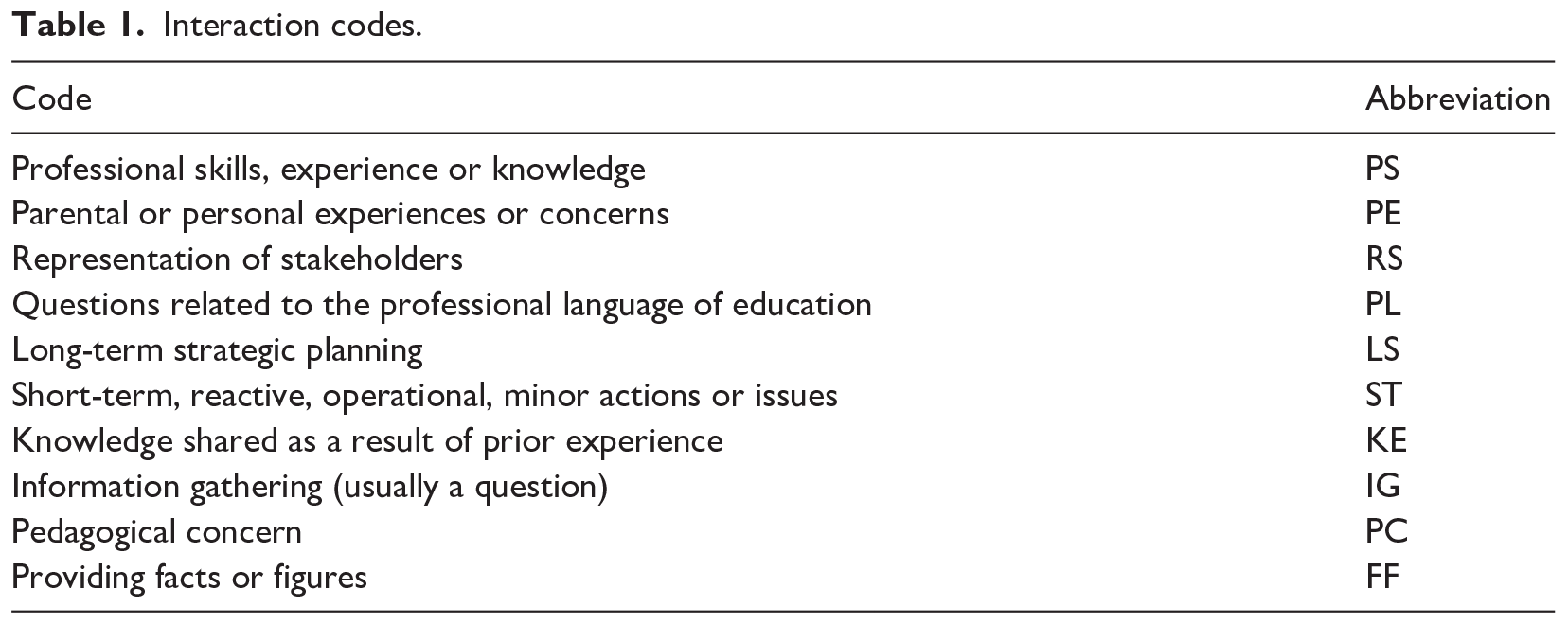
Interview responses were transcribed and categorised in order to identify similarities, differences and other significant aspects of the data through a deductive approach. Five themes emerged, and these organise the reporting of the interview data in the next section. Two board meetings and seven committee meetings at CSIS were observed over a period of seven months. Interactions between attendees were recorded and coded. Interactions were defined as spontaneous comments, questions, responses or feedback that are incidental to the agenda or are prompted by an agenda item. Observations were categorised using codes derived from the literature and listed in Table 1. In cases where an interaction fitted multiple codes, a best-fit approach was taken. Each interaction was assigned a maximum of two codes.
Interaction codes.
In undertaking this study, the protocol relating to ethical issues – including assuring participants of anonymity, confidentiality and the right to withdraw at any time – was developed in accordance with standards set by the British Educational Research Association (2018).
Findings
In this section, I will first describe the themes that arose from the interviews, before presenting the observation data. Experts are identified by a number preceded by the letter E, and CSIS participants are identified by their role: EBM (elected board member), ABM (appointed board member), FBM (faculty board member) and SL (school leader). The identity of all contributors has thus been entirely anonymised.
Interviews with experts and CSIS participants
Board structure
The experts describe a wide range of approaches to the governance of international schools, including those that are self-perpetuating, elected and hybrid. There is no consensus among experts about which model dominates in the international school community, and none stated that structure was the most important factor in good governance. Nevertheless, most experts and CSIS participants demonstrate strong feelings one way or another about efficacy of the different models. E2, E4 and E5 favour elected boards and value the explicit representation of stakeholders in governance. As E4 explains, ‘The greater degree of election the better; [boards] should be transparent.’ At CSIS, elections are viewed as a way of avoiding the board becoming too insular (SL3), as well as providing a ‘check and balance system’ (SL2).
E9 favours self-perpetuating boards as a way to co-opt individuals with the right skill-set: “Securing the financial wellbeing of the school; is the school operating within its legal remit? Schools need people familiar with both these.”
Likewise, at CSIS, the appointed seats are highly valued by both school leaders and board members as an opportunity to strategically populate the board with particular skills and to add diversity.
“[The appointee could be] appointed on the basis of a skills set . . . we need someone who is a lawyer, or familiar with [country name] law” (FBM) “We wanted more female representation and someone [from a scientific background], and this is where [an ABM] comes from. She probably wouldn't have run otherwise.” (SL2)
SL2 also appreciates the role appointed board members play in providing institutional knowledge over time, as their term-length is determined by the board rather than by the election cycle: “In the transient nature of the community, appointed board members provide continuity.”
Most experts considered a hybrid model to be an effective compromise between the two models, as E5 explains, “Self-perpetuating members give continuity, understanding and history . . . elected members [help the board] to keep current, representing the stakeholders - a good balance.” This aligned with the view from CSIS that the hybrid model is a good compromise between a fully elected and fully appointed board: “We don't really have a concern of having a board that isn't continuous, and we also don't have a concern of a board that lacks new blood . . . so I think it actually works quite well.” (ABM3)
Experts identify as commonplace in international schools an organisational structure in which several committees feed into the board. Experts consider this model to be beneficial in terms of division of responsibility, although E8 cautions that committees are “potentially an issue because it encourages crossing over the fine line between management and governance.” This view is echoed at CSIS where committees are described as the primary area of governance in which the strategic and operational aspects of school leadership overlap: “Sometimes I think the board is too much into the daily life . . . in [some committees] you have a lot of really tiny tactical issues, whether you build the fence 1m 50 or 2m is probably not what should be discussed.” (ABM3)
At CSIS, the board committees can include non-board member parents, school leaders and faculty members invited to the committee due to their relevant expertise or expressed interest. The presence of non-board member parents was notable, as it was these participants who “tend to be a little bit more about 'my kid' [than board members]” (SL3). Nevertheless, committees are viewed as autonomous and trusted in terms of the recommendations they make to the board (SL1, SL2).
Representation of stakeholders
At CSIS, elections are valued as a way of connecting the governance of the school to the parent community (EBM1): “It is really important [parents] have confidence in the governance, confidence in the direction, confidence in the stability of the institution. They are the stakeholders and the fact that they can elect gives them a sense of ownership.” (SL4)
Despite this, parental participation at CSIS is low in open board meetings and elections. This is expressed as a concern by most board members. School leaders, however, recognise that this low participation could be interpreted as a sign the school governance is going well: “It is hard for [the board] to get the recognition they deserve because people see things work, and when things work, people . . . don't see the need to be such active participants.” (SL4)
At CSIS, the presence of the faculty board member is considered a positive addition by board members and school leaders alike as a way of giving “the board an additional perspective on issues” (ABM3) and of the board hearing about issues “from a teacher's perspective . . . providing an authenticity that is very valuable” (SL2).
E3 and E5 support the direct representation of stakeholders on the board, advocating for “properly balanced representation” (E4). As E3 explains: “It is important the governing body is representative of everybody who contributes to the school . . . by doing that, the students are well-represented and so are their parents.”
Similarly, E5 considers it to be “key to have a faculty member elected from their bodies” (E5). Other experts express concern about direct representation by parents and faculty; they worry that this leads to the needs or concerns of that particular group taking precedence, as opposed to safeguarding the institution as a whole. E2, E4 and E6 all speak out against having a faculty board member on the board for this reason, while E6 describes a personal experience at a school they previously worked at where a small group of dissatisfied parents successfully waged a campaign to get on the board and remove the school head. As E1 summarises, “It is not really about representation on the board, it is about ensuring the board's success as an institution.”
An area of more consensus for the experts involves the direct inclusion of students within governance: most participants express a desire to capture more student voice, but agree that it is challenging to meaningfully include students (particularly young students) in school governance. Relatedly, at CSIS, SL3 outlines how student councils have previously been trialled but “never really gained any traction”.
The personal disposition, capabilities and motivations of governors
Experts describe how the transient nature of the international school community can result in a lack of suitable community members to draw from (E4, E7) and a high turnover of governors (E7). Nevertheless, recruiting governors with the right personal disposition, capabilities and motivation emerges as an important theme.
At CSIS, a nominations/headhunting process is used to draw interest and to attract the right people, both for elections and appointments. This is followed by screening of potential board members as a way to “avoid someone coming in with a single issue, even if it is a good issue” (SL2) and to “get people with the right competence and the right desire . . . to work on the board” (EBM1). The nominations/head hunting process is supported through a capability audit, as described by EBM1: “We look at every year . . . what competences do we think we need . . . if we don't have it on the elected side . . . we can then bring it in the appointed [side].”
Experts describe positive motivations for governing, such as a desire to be of service to the community (E3), “enriching your own experiences [through being] exposed to people who have different capabilities in terms of leadership” (E6) and “expanding their mind and discovering what it takes to run a top-quality school” (E5). E6 and E2 caution against governors who serve primarily to gain “financial remuneration” (E6) or “status within the community” (E2). At CSIS, all current board members are parents of students in the school, and this is expressed as a key motivation for serving by EBM4, FBM and ABM2. FBM and ABM2 both note that board members are not compensated for their time, yet are “highly engaged and believe in the cause” (ABM2) due to their “direct and personal investment in what goes on here” (FBM).
EBM4 and ABM1 describe how being a board member has allowed them to better connect with their own children because “you know what they are talking about” (ABM1) and “can experience . . . what they are experiencing, and share some things in common that we didn't before” (EBM4). Others speak of professional benefits of serving: “Sometimes the more personal touch of the school has helped me make sure we don't lose the personal touch in the business setting.” (ABM2) “It’s an exciting growth opportunity for me to learn about governance of a non-profit.” (EBM4)
Understanding and fulfilling the governor role
Five experts emphasise the importance of “understanding the differences between governance and management” (E1) and the board “limiting its involvement to providing direction to what is being accomplished by the school” (E6). Seven participants highlight governor training as a way of promoting this understanding. As E6 explains: “In-service training is important - you have to learn to govern. Many board members are managers . . . so naturally drift towards areas of management.”
Induction and board training are cited by all CSIS participants as key factors in promoting good governance, during which board members “set up mutual agreements, our goals for every year . . . that helps to emphasise what is important for us” (EBM2). Board members describe having clear protocols in place for guiding their actions, particularly when approached by parents with an issue (EBM1, EBM4): “Policy does certainly help to set out the framework as to what the board should do and what the administration does.” (ABM3)
This is supported by school leaders, for example: “They will check themselves and say, ‘This isn't really for us; it is for the head of school or the teachers to decide’. They really have a clear understanding of what their role is and what it isn't.” (SL1)
Nevertheless, there remain some questions about the role of the board (EBM4, ABM3), as ABM3 articulates:
“It’s not always black and white, some of it is grey . . . To what extent do we tackle particular issues, or do we rather leave those up to the administration?”
The relationship between the board and school leadership
A positive relationship between the board and head of school is considered vital to good governance by five experts, in particular a high level of trust between the head of school and the board chair (E1, E8). This can be promoted through “clear roles, sound decision-making policies and procedures, aligned beliefs and values, shared goals, working interdependently to achieve them” (E9) and “[a policy of] no surprises . . . effective structure and management of meetings” (E1). Conversely, the head of school being asked to leave meetings corrodes trust (E1). Other reasons noted by experts for a breakdown in relationship include: a disconnect between expectations, promises and reality (E8, E9); cultural differences (E8); and broken trust due to poor communication (E9).
A positive relationship between school leaders and the board is cited by some board members, and all school leaders at CSIS, as key to ensuring the good governance of the school. EBM2 describes an atmosphere of “mutual respect” in which the board works “hand in hand” with school leaders. SL4 describes the relationship as “reciprocal” in which “[board members are] respectful of the expertise that we bring and have about pedagogy . . . I trust their financial guidance of the school.” SL3 and SL4 value in particular the outside perspective that board members can provide, especially through the asking of challenging questions.
Observation data from board and committee meetings at CSIS
Two board meetings and seven committee meetings at CSIS were attended by me as a researcher over a period of seven months. 364 interactions between meeting attendees (at both board meeting and committee meetings) were recorded, and 454 codes were assigned in total. 90 interactions were assigned two codes, in cases where it was determined that one interaction corresponded equally to both. Figure 1 shows the total number of interactions recorded by role. Parent committee members (PM) and school leaders (SL) made the most contributions, followed closely by elected board members (EBM) and then appointed board members (ABM). The faculty board member (FBM) and other faculty/staff (FS) of the school made the fewest contributions.
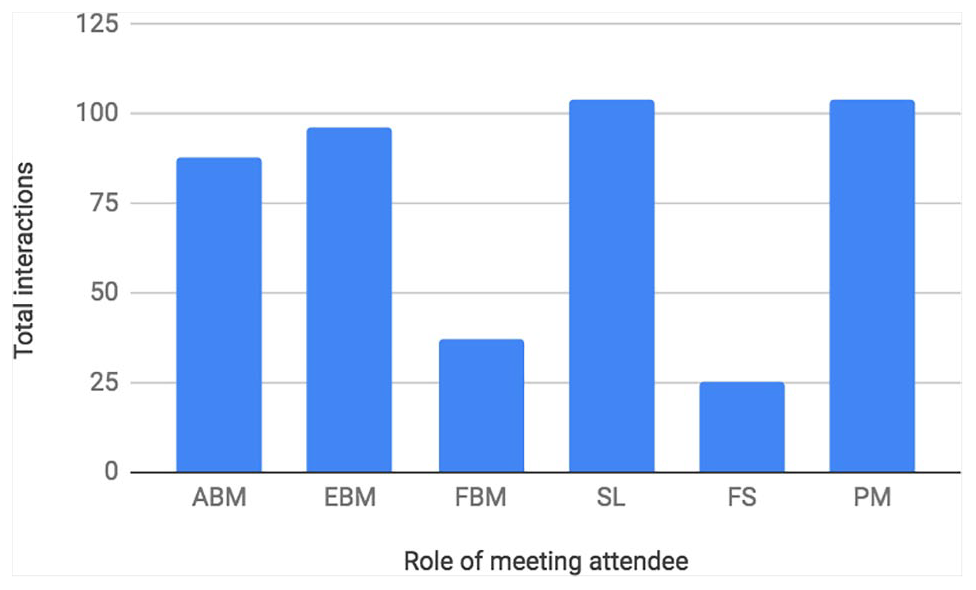
Total number of interactions made by meeting attendees, shown by role.
Faculty/staff present in the meetings tended to be invited in for a particular purpose, such as making a presentation, and they often left after their segment was complete. The low number of contributions by the faculty board member may be partly reflective of the fact that there is only one faculty board member, although the parent committee members did not usually number more than one per committee and these individuals contributed frequently. The number of SL, ABM and EBM participants present in the meetings were evenly balanced on average.
Figure 2 shows that the two largest groups of interactions were those relating to information gathering (IG) and long-term strategic planning (LS). Together these comprise nearly half the total interactions. Interactions related to the provision of information (FF), representation of stakeholders (RS), and the sharing of personal experience (PE) or professional skills (PS) also ranked highly. There were comparatively few interactions relating to short-term, operational issues (ST). Likewise, interactions which shared prior knowledge from being present on the board or committee in previous years (KE) were in the minority. The lowest number of interactions related to the clarification of technical or professional language of education (PL). The complete list of interaction codes is included in Table 1.
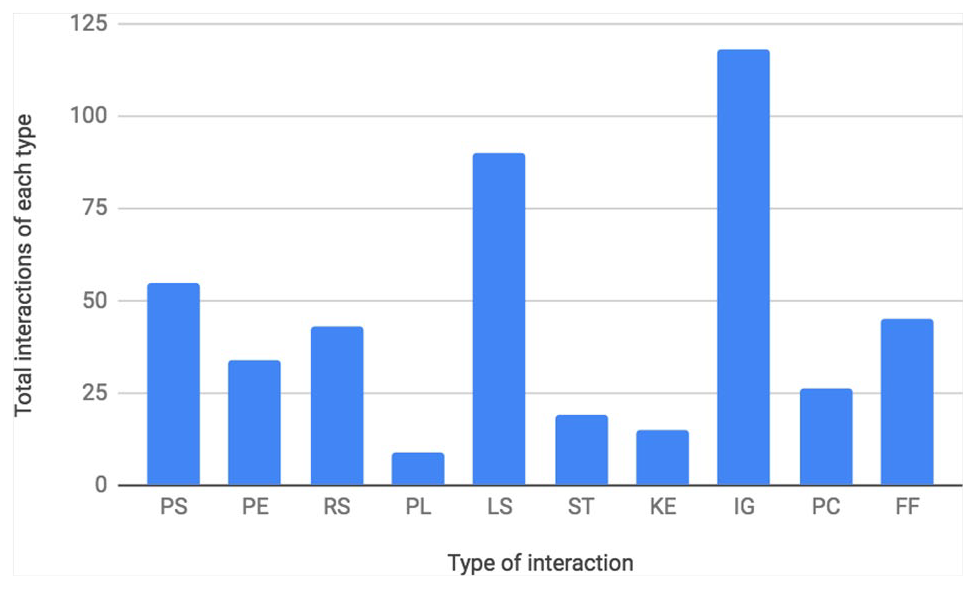
Total interactions of each type recorded in committee meetings and board meetings at CSIS.
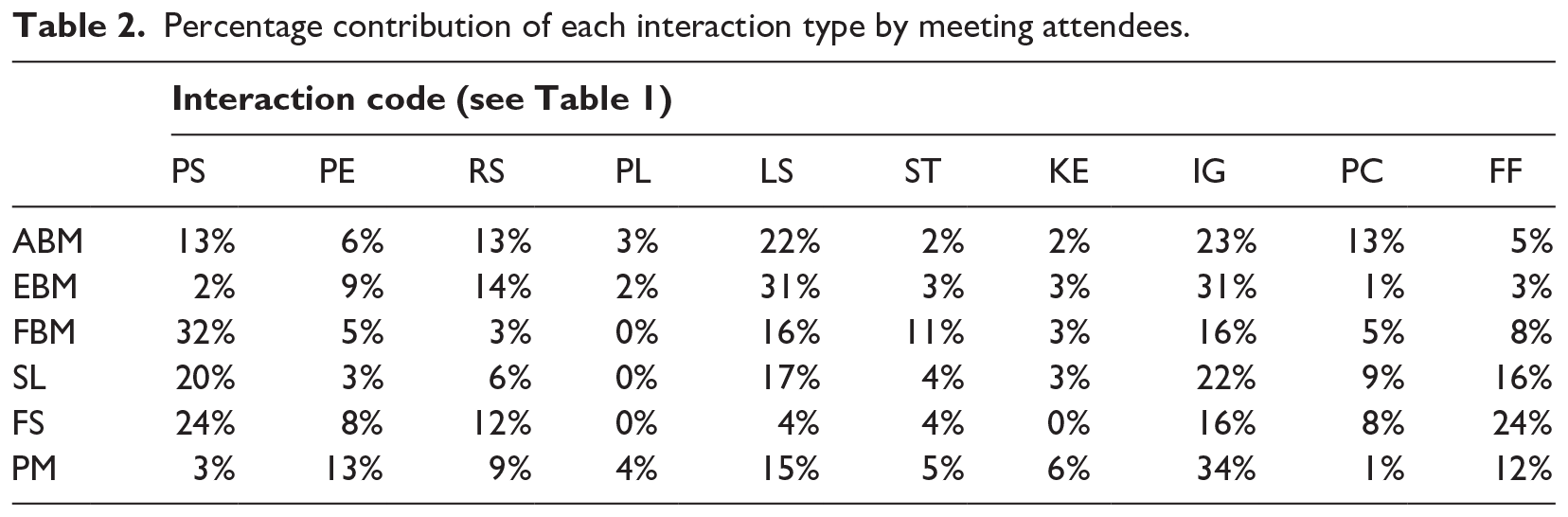
Table 2 shows the interaction data by the relative contribution of each role. Faculty and staff (FS) provided the fewest interactions in total and usually provided information which related to their professional experience or their role in school (FF, PS). This was usually in response to a specific inquiry from another member of the committee, such as for instance: “Non-native speakers are performing higher in pre-primary.” (FF)
The majority of interactions by the FBM related to the sharing of knowledge based on their professional experiences (PS), and the FBM was the largest contributor of this type of knowledge. The FBM also provided more interactions related to short term issues than other participants, such as: “[There is] water damage in the basement.” (ST)
The most interactions recorded in total came from school leaders and parent committee members who are not board members, with each group providing 104 interactions. The spread of interactions was different, however, between these two groups. For school leaders, the majority of interactions were fairly evenly spread between the provision of information (FF), information gathering (IG), long-term strategy (LS) and input related to their professional skills and experience (PS). For example: “Under-14s cannot be indirectly supervised - they must be directly supervised.” (FF) “Students find it interesting to verbalise and articulate their soft skills.” (PS) “How do we measure sustainability regarding our buildings?” (LS)
In contrast, parent committee members tended strongly towards interactions that related to information gathering (IG). This group also had the highest number of interactions that related to their personal experiences (PE), and asked more questions about the professional language of education (PL), such as: “Can a regular IB Diploma student take a career-related study?” (IG) “I have never been told about any of this.” (PE) “What is PD?” (PL)
After parent committee members, EBMs provided the most interactions related to personal experiences (PE); however, these were comparatively small.
“What about students watching sports matches? My son and his friends . . .” (PE)
Both EBMs and ABMs focused their interactions on gathering information (IG) and long-term strategic planning (LS): “How are we currently measuring transdisciplinary skills?” (IG by EBM) “What does the Global Politics course entail? Is there overlap with other subjects?” (IG by ABM) “The board's role here is to sign up and agree to policies which are practical and work, and to look at the liability of the school.” (LS by EBM) “What can we do to increase our political capital before we use goodwill with [more] construction projects?” (LS by ABM)
These two groups also provided the highest numbers of interactions related to the representation of stakeholders (RS): “Do you collect evidence of teacher feedback from students [to guide professional development decisions]?” (RS by EBM) “How are we standardising the way people are nominated and suggested [to join] the committee?” (RS by ABM)
A notable difference between the ABM and EBM groups was the number of interactions specifically related to pedagogical concerns (PC). ABMs provided the largest number of interactions for this category and EBMs (together with PMs) provided the fewest: “Once they have learnt [how to play the coding game], to what extent can the kids extract that information and explain what they are doing?” (PC by ABM)
Furthermore, aside from school employees (FBM, SL and FS), the ABMs provided the most interactions specifically related to their professional skills or experience (PS), particularly related to finance, such as: “A useful efficiency ratio for this would be . . .” (PS)
In contrast, the other non-school employee groups, the EBMs and PMs, provided few interactions related to their own professional skills or experience (PS).
Percentage contribution of each interaction type by meeting attendees.
Discussion
At the heart of this study was an exploration of the nature of hybrid governance in one Type A international school. It began by considering the findings of James and Sheppard (2014) on the advantages and disadvantages of elected and fully self-perpetuating boards, and has revealed other factors that are perceived as contributing to good governance. The expert data on board structure strongly align with the findings of James and Sheppard (2014). Data from CSIS are in places inconsistent with the views of the experts, and with James and Sheppard (2014), reflective perhaps of the organisational structure of CSIS, its cultural context and its categorisation as a Type A school. The findings suggest that the emerging factors of recruitment, induction and training of governors may play an important role in promoting good governance. These ideas will be explored next.
Elected and self-perpetuating boards: is the hybrid model a happy medium?
There was no consensus from the experts on a preferred board structure. Some experts valued elections as a way of promoting direct participation and representation of parents in governance. They raised concerns that self-perpetuating boards lack transparency (James & Sheppard, 2014) and can lead to conflicts of interest. Other experts favoured the self-perpetuating model because appointments allow the board to be populated with governors with a particular skills-set. They worried that elections can result in board members lacking competence (Heystek, 2011) and that elected boards have a higher turnover and lack strategic oversight (James & Sheppard, 2014).
The above concerns are not apparent in the data from CSIS. However, the advantages of each structure are visible. CSIS board members and school leaders believe elections foster transparency, representation of stakeholders and interest from the school community, yet they highly value the opportunity to populate the board with particular skills through appointment. Their comments echo the assertion of Haikio (2012) that appointments confer legitimacy while elections promote accountability.
The CSIS data therefore provide support for the suggestion by James and Sheppard (2014) that a hybrid model may be a way to benefit from the advantages and offset the disadvantages of a fully elected or fully self-perpetuating board. Although these findings do point to a positive effect of the hybrid model on governance, they could also result from the school’s nominations and screening processes, as well as the governor training programme, as explored later in this section.
Stakeholder versus skills-based governance: how important is direct representation?
The literature describes two opposing approaches to the representation of stakeholders in governance: direct and indirect representation. Direct representation is achieved in a stakeholder-based system, whereby elected representatives govern the school (Connolly et al., 2017). Indirect representation occurs via a skills-based approach, in which governors are selected based on their attributes and not on their role in the community (Connolly et al., 2017). All groups in this study consider the representation of stakeholders to be important for promoting good governance; however, evidence from the case study school supports both direct and indirect representation, whereas interviews with experts lean towards indirect representation.
Some experts consider parental representation via elections to be vital, while others believe indirect representation of stakeholders is sufficient, provided governors have a thorough understanding of their role and the necessary skills. Data from CSIS indicate that direct representation of parents via elections does not necessarily equate to greater representation, as both elected and appointed board members have a high number of interactions relating to the representation of stakeholders. Furthermore, low participation by parents in elections further calls into question the value of direct representation, aligning with the findings of Heystek (2011) and Connolly and James (2011) that parents may lack desire to participate in school governance.
Nevertheless, interview data from CSIS reveals that direct stakeholder representation is considered important for promoting transparency and accountability, and connecting the governance of the school to the community. Board members feel that being parents themselves is beneficial as it gives them a personal interest in the success of the school (MacKenzie, 2012). Whether faculty should be directly represented on the board also received mixed responses from experts. Data from CSIS, however, comes down strongly in favour of a faculty seat. Interview and observation data both support the view of MacKenzie (2012) that the faculty board member role is important for providing the perspective of someone currently working in the school, providing the board with information which they would otherwise not receive.
Direct student involvement in governance is not considered vital by any group. Experts and school leaders share a desire to engage students within the governance structure of a school, yet both concede that it is challenging to achieve this in a meaningful way.
Governor recruitment: how nominations, capability audits and screening can facilitate good governance
Experts and CSIS participants emphasise how important it is that governors have desirable personal disposition, capabilities and motivation. It was a shared concern across all groups and in the literature (e.g. James & Sheppard, 2014) that fully elected boards can result in gaps in the skills and capabilities of governors. All groups valued appointments as a means to recruit individuals with specific skills and competencies. Experts also note that international school communities may have only a small pool of potential governors. They also caution against governors who take on the role for financial remuneration or as a way of gaining status within the community.
Three recruitment processes of value emerge from the data that may avert these potential issues: nominations/headhunting, capability audits, and screening. Nominations enable CSIS to actively recruit individuals for election or appointment with particular skillsets, thus widening the pool of potential board members and boosting the recruitment potential of both the elected and self-perpetuating models. Capability audits can be used to highlight competency gaps and enhance the overall skillset of a board (Connolly et al., 2017), as demonstrated in the observation data from CSIS: one notable difference in the contributions of appointed and elected board members is that appointed board members made more interactions related to their professional skills or experience and raised more pedagogical concerns.
Finally, screening is used at CSIS in conjunction with capability audit data. While experts caution against undesirable motivations of governors, such as gaining status within the community, evidence from CSIS suggests screening can be effective in avoiding the appointment of governors with questionable motives. No concerns were raised by school leaders about the personal motivations of board members, and the observation data shows that board members demonstrate a good understanding of their role. Furthermore, while numerous personal and professional benefits of serving on the board emerge from their experiences, all board members interviewed valued the altruistic nature of their work.
Induction and training: developing a shared understanding of the governor role and promoting positive relationships
Gawlik and Allen (2019) outline a body of predominantly US-based research stretching back nearly 60 years that points towards the importance of induction and ongoing board training in helping governors to fully understand and fulfil their responsibilities. MacKenzie (2012) supports this view in the international school context, emphasising that board members must develop a shared sense of responsibility, and make decisions in the best interests of the school as a whole. Hill and James (2017) suggest that a training and induction programme supports international school governors in achieving this through the establishment of protocols and norms to guide their actions. In this study, experts are also strongly in favour of governor training.
Data from CSIS support this view: board members express confidence when articulating their role and cite induction, training and experience as the processes through which they developed their ability to effectively fulfil the board member role. They also describe following policy and protocols to guide them through challenging situations, and school leaders give examples of self-policing actions by board members.
Governor induction and training at CSIS not only provides clear delineation of the roles of governors and school leaders but also promotes positive relationships between the school leadership and the board by establishing a framework for their interactions. The positive relationship between governors and school leadership was highly valued by school leaders at CSIS and was identified as a key element of good governance by the experts. This supports the findings of Connolly and James (2011) regarding the importance of a positive relationship between the head of school and the board chair.
Observation data provides further support for a comprehensive governor training programme. Non-board member parents attending committee meetings, who are not trained, offered more contributions related to their personal experiences than board members. Meanwhile, the vast majority of interactions by both appointed and elected board members related to information gathering and long-term strategy. Board members rarely raised short-term, operational issues or their own personal experiences. The lowest number of interactions related to the clarification of technical or professional language of education. This again may be an outcome of training, the mode and impact of which is an area for potential further exploration.
Committees: where governance meets management
Experts and CSIS participants identify division of responsibilities as a benefit of a committee structure that sits below, and feeds into, the board, and the autonomy of committees is generally viewed positively at CSIS. Committee members are trusted and their recommendations tend to be accepted, although a lack of ownership may be felt by non-members whose jobs are impacted by committee decisions. There is interview evidence from all groups that committees pose an area of challenge for international school governance: it is in committees that governance and management appear most likely to overlap. Observation evidence, however, suggests this is not a major issue at CSIS. Comparatively few interactions related to short-term, operational issues. Personal experiences were utilised at times by board members, but most interactions were focused on information gathering, long-term strategy and input related to their professional skills and experience. This may again be attributed to governor training.
Board members and expert interviews suggest a committee structure has the potential to become unwieldy, with too many meetings and too many people involved. Observation data from CSIS raise a question about the value of including in the committees parents who are not on the board. Their presence increases the number of participants in the meeting, yet their interactions were predominantly information gathering and they gave the most input related to their own personal experience. The contradictory nature of the data regarding board committees and the complexities of the committees themselves means that a conclusion cannot be reached regarding their impact on governance. This is another area for potential study.
A model for the hybrid governance of Type A international schools
The key findings from this study are summarised below. Figure 3 takes the form of a flow chart that brings together key findings 1-4 in a proposed model for governance in the Type A international school setting.
A hybrid board structure captures the advantages of both election and appointment. Elections facilitate transparency, stakeholder representation and community engagement; appointments allow for targeted recruitment and maintenance of institutional memory.
A hybrid structure may buffer against the disadvantages of fully elected and fully appointed boards, although its relative impact as compared to governor training and recruitment processes is unclear.
A hybrid structure allows direct representation of parents and faculty on the board, and this promotes democratic participation; stakeholders can, however, be successfully advocated for through indirect representation by appointed board members.
Recruitment and training processes ensure governors have desirable skills and motivations, understand their role, and use protocols and policies to guide their actions; this promotes positive relationships and a focus on long-term strategic planning.
Committees can be used as an interface between governors and school leadership within the hybrid model as a way of dividing responsibilities; but this is also an area of risk for governors engaging in micromanagement and short-term, reactive actions.
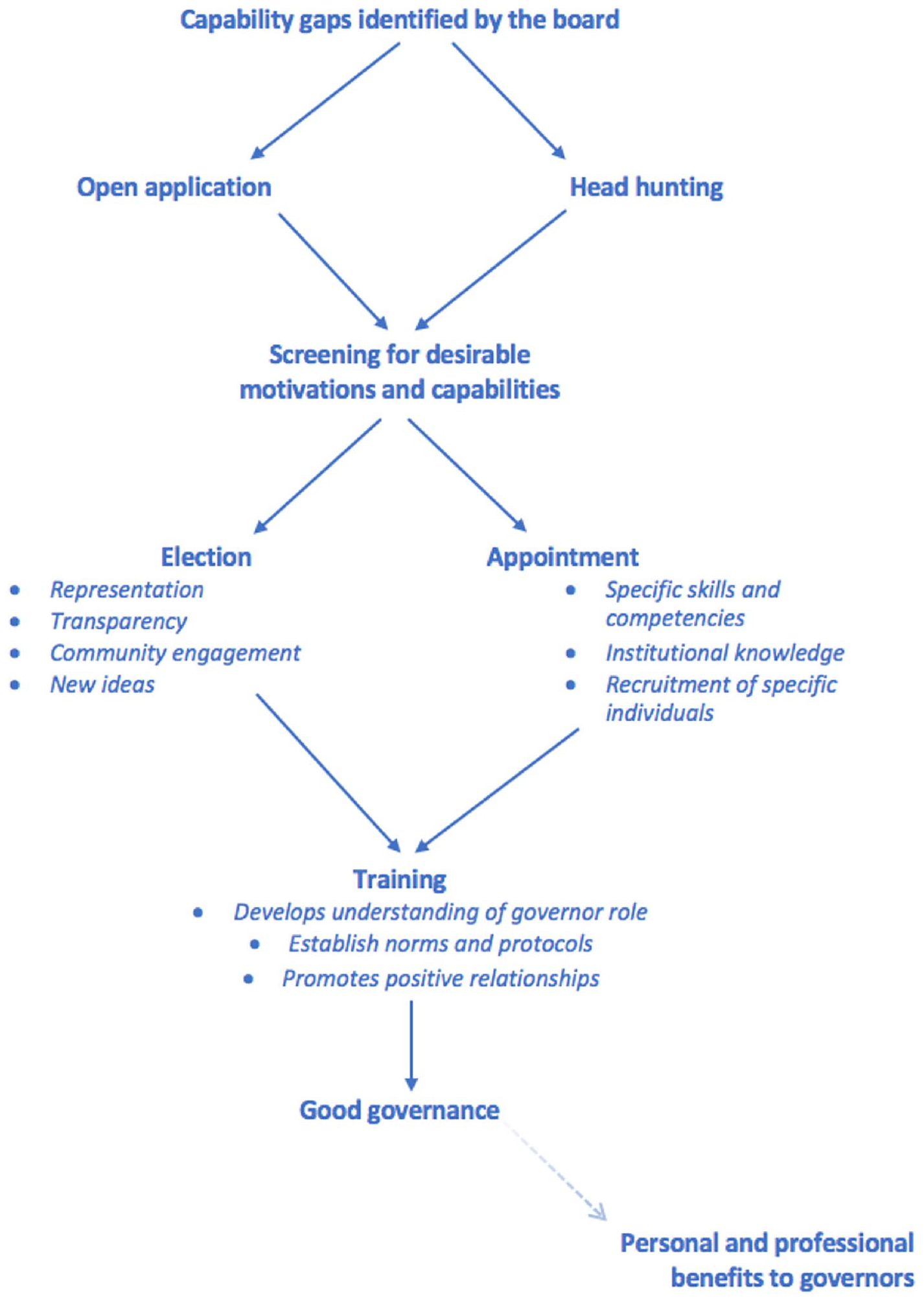
A proposed model for the hybrid governance of international schools.
As the model in Figure 3 outlines, an audit first identifies capability gaps in the existing board. Open application and head-hunting/nominations can be used simultaneously to attract potential governors from the local community. The model does not preclude the direct representation of any stakeholder group, such as a faculty or alumni seat, provided the capability audit identifies a need. During screening, the attributes, skills and motivations of individuals are evaluated against the capability audit data. It could be argued that the screening process prior to elections impedes democratic participation; however, the strength of the data in favour of ensuring that only those with desirable skills and motivations join the board supports the inclusion of screening as a safeguard.
Candidates who pass the screening are then appointed to the board or run for election. New governors participate in an induction and training process to develop their understanding of the role, and establish protocols and norms that promote positive relationships with one another and the school leadership. A consequence of this approach, shown as an offshoot, are the personal and professional benefits of being on a school board. Personal or professional gain is an undesirable motivation for governors taking on a role on the board, but is a welcome outcome.
Although the primary purpose of this model is to allow us to visualise how a hybrid approach may be successfully utilised, fully elected and fully appointed models are visible as alternative routes to the same endpoint. As the advantages of election versus appointment are noted within the model, schools have the opportunity to mitigate against the disadvantages of their chosen structure. For example, if a board is wholly elected, as is the case with many Type A and Type B schools (James & Sheppard, 2014), the voting community could be informed about capability gaps to guide meaningful voting decisions.
Likewise, a fully appointed board could make the appointment process more transparent through sharing how new appointments fill a gap in their collective capabilities. This suggests some potential transferability to the expanding group of Type C international schools, which often have appointed boards (James & Sheppard, 2014), although this is likely to be limited to standalone schools. Bunnell (2019) notes that since 2014 there has been a shift towards discreet and even secretive ownership of international school groups as the sector is increasingly attracting the attention of private equity firms and sovereign wealth funds; the governance of these school conglomerates is more complex than this model allows for. Similarly, transferability to the governance structure of emerging bilingual schools offering a fusion of national and international curricula (tentatively labelled Type D) remains unclear. This area is underexplored and likely to involve complexities related to the national context. A further limitation of the model is that it does not include committees (key finding 5), despite them being commonplace in international board structures. While the data indicate committees may have a role in supporting governance, the mixed feedback suggests further research is needed to be able to articulate an optimum approach to their use.
Finally, there is more work to be done in defining ‘good governance’ in international schooling and how this might be viewed differently in Type A, B, C and D schools. Type A and B schools have many common features including their not-for-profit status (Hayden & Thompson, 2013). The focus on profitability of Type C schools and accountability to shareholders and investors outlined by Bunnell (2019) suggests financial evaluation of governance may be more prominent in Type C than in Types A or B. Through better defining ‘good governance’ it may also be possible to determine the relative impact of training, recruitment and board structure on indicators of successful governance, such as a sense of shared responsibility for the whole school (MacKenzie, 2012), clear delineation of responsibilities of school management and governance (Connolly & James, 2011) and a positive relationship between the school head and the board chair (James & Sheppard, 2014).
Concluding comments
This article has explored the nature of hybrid governance in one Type A international school, supplemented by interviews with experts on their experiences of international school governance more generally. At CSIS, the benefits of both elected and self-perpetuating boards are visible within the hybrid structure. Elections foster transparency, representation of stakeholders and interest from the school community, while appointments allow the board to be populated with particular skills. These findings from CSIS align strongly with the literature and the expert views. In contrast, the disadvantages of elected and self-perpetuating boards described in the literature and by experts are not apparent in the data from CSIS. This disconnect suggests the hybrid structure of the Type A case study school may buffer against the disadvantages of fully elected and fully appointed boards, although the extent to which this may also be attributed to recruitment, screening and training needs further exploration.
These emergent factors of recruitment, screening and training may have policy and process implications for both Type A and Type B international schools, given their many common features (Hayden & Thompson, 2013). It remains unclear if the findings of this study are relevant for Type C schools, which now comprise the majority of international schools, and the emerging group of Type D schools. Nevertheless, given that the importance of board training is visible in the literature from as far back as Kerr (1964), and continues to emerge as important in both the international and US contexts (Hill and James, 2017; Gawlik and Allen, 2019), this appears to be an avenue through which international schools regardless of classification may be able to enhance their legitimacy.
Footnotes
Authors’ Note
Leila Holmyard is now an Independent Education Consultant.
Funding
The author received no financial support for the research, authorship, and/or publication of this article.
