




Abstract
This article reports on a small-scale study which explored the perceptions of learning support assistants (LSAs) about how they facilitate learner agency and wellbeing, two key facets of the capability approach. Interviews were conducted with ten LSAs working in an international school to investigate whether LSAs support aspects of this theoretical framework within their role, where their efficacy is often valued by the quantity of time they spend with the child rather than the quality of the support provided. The capability approach was utilised as an analytic framework by using the four capability approach categories which Sen (1999) argues can evaluate human life: wellbeing achievements, agency achievements, wellbeing freedoms, and agency freedoms. The findings from the study indicate that whilst LSAs did support key aspects of the capability approach, they felt unsure if every part of their role could be based on it due to a range of factors beyond their control, such as parental expectations and the school’s deployment of the LSAs. Possibilities for future research, such as the impact of higher-education on LSAs’ ability to further the capability approach, are discussed briefly.
Introduction
This small-scale study of Learning Support Assistants (LSAs) in one international school sought to examine whether their perceptions of their role in including students with individual needs within mainstream classes supported aspects of the capability approach (CA) such as setting goals, making choices, and recognising students’ individual needs (Felder, 2018). The LSAs’ personal understandings, meanings and daily practices were the focus of the research. Two of the main categories within the CA are ‘capability’ and ‘functioning’; a capability is the approach or action which the individual chooses to value, whereas the function is what the individual is able to be or to do (Sen, 1999: 7). Resources, such as LSAs, are valued insofar as they support or improve an individual’s functionings towards their capabilities. This study examined the experiences of LSAs within the four categories of Sen’s (1999) CA framework: wellbeing achievements, wellbeing freedoms, agency achievements, agency freedoms. The rationale for this study lay in the international importance of the work of LSAs (Tarry and Cox, 2014), the questions raised by research into this field in a number of countries (Arduin, 2015), and the emergence of the CA as a development in disability studies (Dalkilic and Vadeboncoeur, 2016).
A detailed analysis by Webster and Blatchford (2015) of students’ experiences with LSAs suggested that there was a strong correlation between a child receiving support from an LSA and that child being observed to experience explicit and subtle separation from their peers and teachers. This analysis highlighted, in line with the influential findings of the Deployment and Impact of Support Staff (DISS) project reported by Blatchford et al. (2009), that LSAs actually reduce agency and wellbeing for the students they support, which cannot be explained by the actions of the LSAs due to managerial decisions about how institutions deploy those in this role. This is in line with the outcomes of research which laments the ‘velcro’ effect of LSA support, where the LSA may become a barrier to a child enacting their own freedom and capabilities, due in part to ineffectual pedagogical training and a misconception by institutional management as to their role (Radford et al., 2014; Blatchford et al., 2011). Based on this previous research, it seems unlikely that those deploying the LSA role would support the CA, as the role seems to undermine two key facets: the agency and the wellbeing of the child (Terzi, 2007). The participants in this study, however, were found to be in a complex situation navigating between their beliefs about inclusion, which supported aspects of the CA, and their daily experiences performing their LSA role.
International importance of the LSA role
The DISS project claims to be the largest study of teaching assistants and other school support staff in the world, and was the first longitudinal study to analyse the impact of support staff for academic outcomes (Blatchford et al., 2009). It collected questionnaire data from 6076 schools, and 7667 support staff, making it one of the widest-ranging studies into the effect of support staff to date. The influential DISS project concluded that the impact of support staff on student outcomes was negligible (Blatchford et al., 2009). These negative findings were supported by a separate review of thirteen papers which focussed on the impact of support staff, although this was more critical of support staff when engaged with general classroom support in comparison to delivering specific interventions (Farrell et al., 2010). It may not be the position of LSAs that is problematic; rather it may be how schools and the educational system perceive and deploy these professionals in their role.
The DISS project drew heavily on quantitative data, and has been criticised for not incorporating qualitative data that could demonstrate the potentially positive role of LSAs for the facilitating of social inclusion (Saddler, 2014). In a follow-up project to the DISS project, which utilised observations instead of questionnaires, it was found that LSAs could theoretically promote independence by utilising certain verbal strategies and avoiding others such as ‘stereo teaching’, where the LSA repeats verbatim the words of the teacher (Webster et al., 2014: 90), although use of the strategies had to be taught by the researchers and was not common practice beforehand. In a series of 48 detailed case studies, students who were assigned an LSA to work with them inside the classroom experienced a subtle form of separation from the class, including fewer teacher interactions and fewer peer interactions (Webster and Blatchford, 2015). Such findings highlight concerns about whether LSAs are currently beneficial in terms of social inclusion, or have any positive outcomes for students, despite being a near constant presence in some children’s lives (Webster and Blatchford, 2013; Blatchford et al., 2011).
Recent research into the role of the LSA, however, has identified the value of the role in a range of ways, such as the positive learning outcomes that may be associated with a focus on scaffolding and independence (Radford et al., 2014; Webster et al., 2013) or if the support is measured in terms of fostering a positive approach to the learning experience (Radford et al., 2016). This highlights the potential for LSAs to adopt a positive pedagogical role in the classroom, if appropriately trained, although the views of the LSAs in adopting this pedagogical role are noticeably absent from previous research (Cockroft and Atkinson, 2015).
The mode of LSA deployment may have significant consequences in terms of the LSA and the supported students feeling marginalised and at ‘the bottom of the ladder’, as one participant described the role in Lehane’s (2016: 18) small-scale study of experienced LSAs. The mode of deployment which caused the most negative feelings for LSAs was that of being a general therapeutic support within the mainstream class (Lehane, 2016; Roffey-Barentsen and Watt, 2014), the model that is utilised most often by assistants in the mainstream (Webster and Blatchford, 2015). This is a mode of support which reduces agency and wellbeing by creating an ‘island’ which has only the LSA and student on it (Slater and Gazeley, 2018: 6), with neither receiving support from the teacher. This can result in the LSA feeling that the teachers are in a higher position than themselves, and that the LSA role is a low status one (Watson, Bayliss and Pratchett, 2013). Given the mounting evidence that interactions are the key to successful inclusion (Radford et al., 2016; Keating and O’Connor, 2012), it does not seem surprising that when the LSA role is deployed in such a way that a student’s main source of interaction is with the LSA rather than with their peers or teachers, the wellbeing and agency of both LSA and student are reduced (Blatchford et al., 2009).
Whilst many Special Educational Needs Coordinators, in a study by Maher and Vickerman (2018), valued the role for its potential to improve academic attainment, the perceptions of the twelve LSAs towards their work were more focused on remuneration and based on personal circumstances than on a love of the job. This study was based only in the UK, and serves to highlight the need for more research into the LSA role in international settings. In a follow-up piece of research to the DISS project, a systematic literature review of 39 publications from five countries concluded that students’ attainment improved with targeted interventions from LSAs (Farrell et al., 2010). This suggests that, internationally, LSAs may have an impact on student outcomes, though whether the LSAs who were delivering these interventions internationally were less motivated by money and more by support for the CA, for example, is not clear.
Inclusion and the Capability Approach
The debate relating to inclusion focuses on a range of areas, including the need to promote social freedom for children and increase recognition of the individual’s needs (Felder, 2018). This has led to optimism that the CA may provide educational justice for all (Toson et al., 2013). Discussion relating to the CA was initiated by Sen, for whom difference is not an additional need to be cured, or a complication that can be ignored or alleviated through a reworking of the environment; it is the fundamental reality upon which everything else must be based (Sen, 1992: xi). This focus on what an individual is able to do, and what the individual wishes to do, puts the individual and their differences at the centre of the debate. The capabilities of the individual are directly related to the freedom the individual has to live a certain kind of life, so that the CA opens up inclusive education to becoming a question of social justice (Sen, 2005). For Sen, education is a basic capability as it is noted that it enhances other capabilities and therefore improves people’s opportunities for wellbeing and freedoms (Sen, 1992). An equal education which includes everyone then becomes a fundamental egalitarian principle, with the need to embrace difference at its heart. In an alternative approach such as the medical approach, disability is seen as a biophysical impairment where the individual’s biological characteristics are deficient and need to be normalised, while in the social approach it is how the social context is structured that disables the individual (Dalkilic and Vadeboncoeur, 2016). The medical approach creates an overly simplistic conflation of SEN and disability, and fails to recognise that a child may have an SEN and not a disability, or have a disability without an SEN, whereas the social approach has been criticised for being utopian; awareness of these various limitations has led to growing disappointment with the approaches (Norwich, 2014). Terzi’s version of the CA, based on the work of Sen, focuses highly on resource distribution, even arguing that for some individuals who will never reach certain goals, the resources put in place to support them in the medical and social approaches could be prioritised to help them participate in the wider society, with the additional resources being redirected elsewhere (Terzi, 2007).
Terzi (2007) does not, however, provide an explanation of how to overcome resourcing conflicts, such as how to allocate resources to support an individual’s goals if the resources are limited or the goals contradictory (Hedge and MacKenzie, 2012). Terzi also views every child’s right to be supported with their capabilities as equal, ignoring the utopian nature of this ideal or the structure of the school. Finally Terzi ignores the views of the resources, such as the LSAs, as it posits them as means rather than ends. By taking the individual child rather than the community as the unit of evaluation, the views of the LSA become secondary to the goals of the child, which establishes a hierarchy whereby the child’s perspective of their capability is above the LSA’s view. The question of whether LSAs support aspects of the CA is then an important question for evaluating its practicality.
The CA has also attracted criticism for appearing to claim agency takes precedence over functioning by presuming that all individuals can have agency, which is not the case for some, such as young children (Terzi, 2007). This critique argues that some individuals are incapable of making their own choices, and therefore the function which enables the individual to have agency over their choices and goals should be focussed on. Terzi does not go into depth about who has the right to control agency for these individuals, or how it is not deemed as hindering wellbeing, although subsequent work by Biggeri (2011) has sought to operationalise the CA in relation to child development. Crocker and Robeyns (2009) also explored this issue of agency, arguing that an action by another in support of an individual’s goals does not become the agentic action of the individual who could not complete the action themself, which was Sen’s argument for those incapable of having agency. As LSAs spend a considerable amount of time with certain children, their perspectives on agency and wellbeing become important for understanding how the CA relates to additional adult support, which is viewed by some as reducing both agency and wellbeing (Webster and Blatchford, 2013).
Another critique argues that some individuals make systematic poor choices, and therefore some may need to be protected from their own agency (Robeyns, 2016: 401). Within the inclusive education field, this may mean that some students may routinely choose negative agentic actions, or be incapable of enacting personal agency due to a lack of function. The role of the LSA then becomes important, as they could be the scaffold between how the child currently functions, and what they are capable of achieving, if their role supports the CA (Radford et al., 2014).
LSAs and the Capability Approach
Since the voice of LSAs is absent from many discussions of the LSA role (Lehane, 2016; Radford et al., 2014), the research described in this article contributes to enabling LSAs to have their voices heard. It has been found previously that LSAs in the UK are concerned about being seen as offering good value for money, although to achieve this would require institutional leaders to rethink the role (Roffey-Barentsen and Watt, 2014). If the role were to include promoting facets of the CA such as agency and wellbeing, LSAs would require support from institutional leaders in enabling them to learn these new techniques (Kudliskis, 2014). Despite LSAs themselves valuing training and continuing professional development opportunities (Webster et al., 2013; Abbott et al., 2011), there is often a lack of training available for LSAs (McLachlan and Davis, 2013). Even if LSAs adhere to a perspective of their role which supports the CA, therefore, they may require training in order to put this perspective into practice.
LSAs would also require the support of parents, and there is a concern that many parents seek a label for their child in order to secure a certain number of LSA hours for them (Webster, 2014). This results in the value of LSA support being located in the amount of time that is spent with the child, rather than in the quality of the support provided. LSAs promoting the CA as part of their role would therefore require parents to accept the value of the support provided by LSAs in terms of how much they can promote agency and wellbeing for the child, using whatever pedagogy best facilitates this, rather than being attached to the child’s side for a certain number of hours (Radford et al., 2014; Blatchford et al., 2011).
In a recent review of the values that underpin the approaches of four different countries to inclusion, namely England, Ireland, Finland and Norway, Arduin (2015) argues that whilst many national education programmes claim to be inclusive, approaches to inclusion may be based on different underlying philosophies. The focus of the approach of England and Ireland to inclusion is on ‘where’ the child is to be educated, and on supporting the individual to become a successful worker (Arduin, 2015: 116). However, the approach of Norway and Finland aims to adapt education so that all children accept differences as part of being successful citizens, in a sense focusing on ‘how’ education should be provided within the community (Arduin, 2015: 115). This approach is also evident in the Canadian education system, although when Canadian LSAs’ views were explored by Bennett and Gallagher (2013), it was found that all 67 of the randomly selected LSAs viewed inclusion (and by extension, LSA support) as limiting social relationships, despite all 21 of the students interviewed disagreeing with that view, thus strongly suggesting a disconnect between the views of LSAs and students when it comes to the ability of LSAs to improve students’ inclusion. The current research will be limited to the views of LSAs.
The contrast between an individualist view of SEN and a communitarian approach is largely based on national discourses on inclusion (Arduin, 2015: 107). For the current study, an international school in Jordan was selected as the location. It was hoped that, being free from the constraints of a medical or social approach required by any particular national policy, the view of inclusion held by LSAs might be based less on a national policy and more on the LSAs’ experiences with the children. LSAs in international settings tend to have higher levels of qualification than do those in a UK mainstream school (Cockroft and Atkinson, 2015), so that concerns raised by the DISS project about LSAs’ ability to support the delivery of academic content at a suitable level (Blatchford et al., 2009) would also be mitigated.
The Capability Approach as a Framework
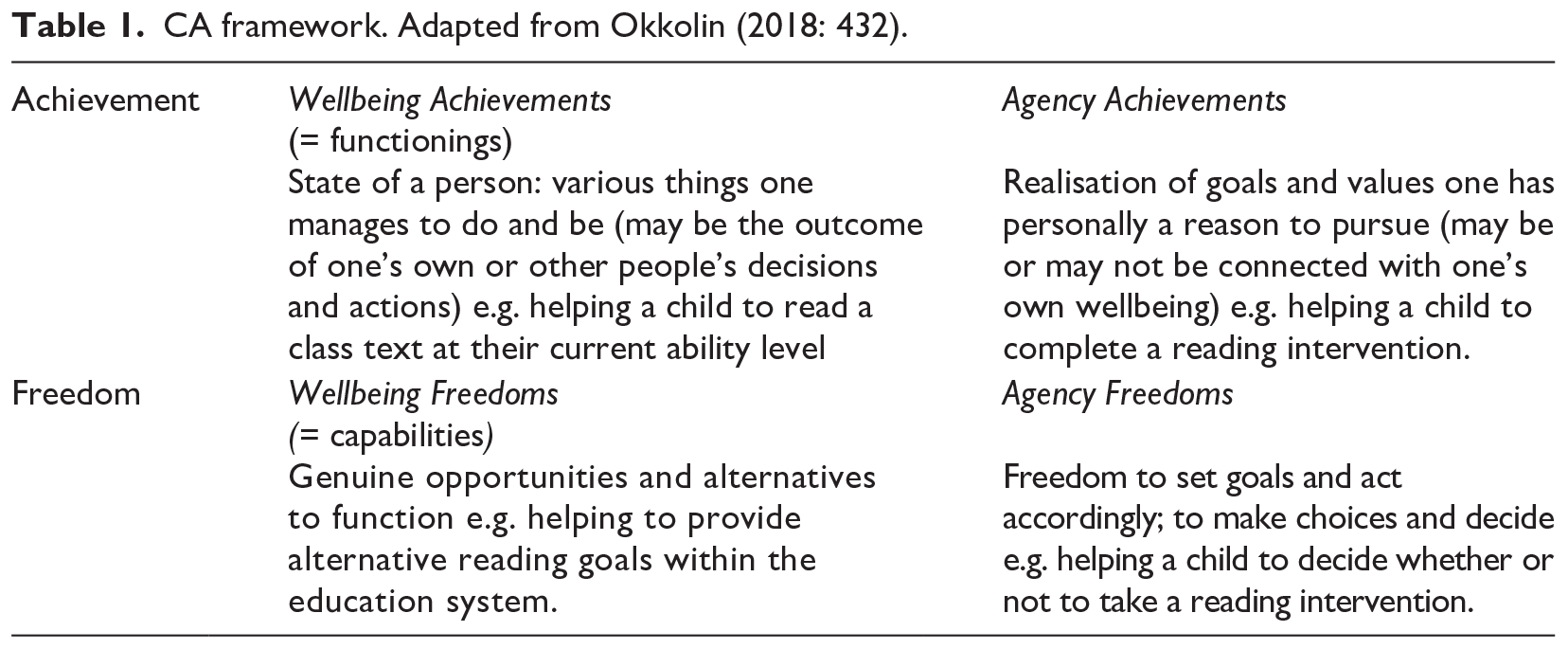
Sen defined the CA as falling into four categories in which to evaluate human life, namely: wellbeing achievements (also referred to as functionings) which concern the agency of students to function, and therefore includes issues of reliance on additional adults and their ability to make judgements on children’s functions; wellbeing freedoms (also referred to as capabilities) which concern the actual opportunity to accomplish what is valued, and thus how the LSAs enable and constrain these opportunities such as through the suitability of the curriculum delivered; agency achievements which concern the realisation of personal goals, including how and why LSAs facilitate and advocate for these personal goals; agency freedoms which refer to whether the child’s environment gives them freedom to do whatever they value (Sen, 1999: 36-38). Okkolin et al. (2018) argue that Sen’s four categories (1999) constitute a CA framework which can be used to analyse data. In the current study, this framework was used to explore whether the LSAs’ perceptions supported these four categories of the CA. This framework was selected as the categories proposed by Sen have been utilised across different applications of the CA (Okkolin et al., 2018; Okkolin, 2016; Crocker and Robeyns, 2009; Terzi, 2007; Sen, 1999; Sen, 1992), so that conclusions could be drawn relating to the CA generally.
The framework was originally initiated by Nussbaum and Sen (1993), on the basis of the inability of other approaches to measure wellbeing and make interpersonal comparisons between groups within policy research, and was then explored theoretically by Crocker and Robeyns (2009). Okkolin et al. (2018) and Okkolin (2016) utilised this framework to evaluate the discourses of Finnish and Tanzanian students. With Okkolin’s approach in Tanzania (2016), the policy-research perspectives are complemented by a hermeneutic approach that focuses on the voices of the participants concerning their capabilities, which results in the stronger person-centred approach adopted for the analysis. The present research, however, conceives of the data slightly differently, as it does not require a belief in the ‘interconnection between structure and agency’ (Okkolin, 2016: 104), and the voices of the participants are not held to speak concerning wider social structures. Although the framework as utilised by Okkolin et al. (2018) and Okkolin (2016) was designed for data from Finnish students and Tanzanian female students, as it was based on research from a number of countries, including India and the global South, it seemed particularly suited to be used in an international school context.
Methodology
Participants
The ten LSAs who participated in this study were selected through convenience sampling from an overall team of twenty-five who worked in the international school in Jordan in which I held a leadership position. The team is directly line-managed by one of my deputies, and a current and past relationship therefore existed between the participants and myself. The ten participants were selected as each of them had at least three years’ experience as an LSA, and had worked in both primary and secondary schools. At the time of the study five were working in the primary school section, and five in the secondary school section, all with specific students identified as experiencing learning difficulties. The ten participants were selected as they were likely to have formed views surrounding student agency and wellbeing from working with multiple children. The pre-existing relationship between the participants and myself was based on trust and familiarity. Nine of the participants were women and one was a man, which reflected the ratio of men to women in the team and the prevalence of women in the para-professional workforce more widely (Watson, Bayliss, and Pratchett, 2013).
There were a number of limitations with this sample. Despite coming from six different countries, they were all of Arab ethnicity, and all had higher education degrees: a requirement for the LSA role in Jordanian international schools. Six of the degrees specialised in English and four in management, and all participants were required, before taking up the LSA role, to complete both an advanced level course in supporting students with additional needs and an in-house training programme. This sample of LSAs may not be representative of the para-professional workforce in all international schools, and indeed they were notably different from the LSAs involved in the DISS project due to the higher education degree requirement and their Arab ethnicity (Blatchford et al., 2009). There were some similarities with the Blatchford et al. (2009) participants, in that all but one participant was female. The purpose of this study was, however, to explore the perspectives of this small number of LSAs in one international school rather than to seek generalisations.
The study also only reflects the practices of one particular international school in Jordan, which is characterised as a private, fee-paying institution under the Ministry of Education. The student population was made up of 33% from Jordanian families and 66% from expatriate communities, with the largest proportions from the United States of America and the United Kingdom. It was also a design limitation that, as noted above, the study was planned only to involve LSAs, due to the disconnect between the views of LSAs and students with respect to the ability of LSAs to improve students’ inclusion. For a full discussion of children’s capabilities, children themselves would need to be included, both expatriate and local (Bailey, 2015).
Interviews
The views of the ten LSAs were sought through individual semi-structured interviews, based on ten questions designed around the CA. Semi-structured interviews allowed participants to express themselves in their own words, and the data obtained were relevant to the purpose of the study (Okkolin, 2016). Interviews were scheduled at a time convenient for participants, during the working day so that they would not have to sacrifice their personal time, and in each case lasted around an hour, with the length depending on the participants’ responses. The interview location was decided by the participants, to give them greater control, and to mitigate some of the power dynamics of conducting the interviews in the office of, say, a senior leader. Interviews were recorded on a private device, before being transcribing and analysed.
Ethics
Participants were guaranteed anonymity throughout, and after a general email invitation was sent to all potential participants by an independent third party, only participants who responded were contacted. All participants knew the purpose of the study, and were offered opportunities throughout to withdraw their consent. Names of participants were coded throughout the analysis, and all data were stored on secure drives. BERA (2018) ethical guidelines were followed throughout the research.
Given my role in the school, this research was an example of ‘insider research’, with which is associated a host of strengths and weaknesses (Mercer, 2007: 1). In particular, as the participants were from a team loosely affiliated with my position in the school (although hired and managed by other people), I felt it necessary to assure participants that their data would be drawn on only outside of the school’s systems. Following Mercer’s example (2007), participants were assured that I was not intending to share my findings with members of the senior leadership team, an undertaking I reiterated in the consent form. Finally, in order to reduce the possibility of informant bias, I did not talk about the topic or share my personal views with anyone connected with the workplace, so participants were not ‘aware of my own perspective’ (Mercer, 2007: 8).
Utilising the Capability Approach Framework
My purpose in this study was to examine how LSAs’ perceptions of their role relate to supporting aspects of the CA. This therefore required an interpretivist epistemology - a view of knowledge where knowledge is created by the participant’s perceptions – in order to understand the subjective interpretations of the LSAs. To analyse these subjective interpretations, a voice-centred relational method adapted from Okkolin (2016) was utilised due to similarities in the amount of data generated and the application of the CA framework. This involved three separate readings of the interview transcripts, with each reading designed to achieve a different purpose. The first identified the overall theme of the interview and involved a reflection on the ‘intellectual and emotional response’ (Okkolin, 2016: 893) of myself as researcher. The second focussed on the LSA’s agency and environment. The third focused on the LSA’s perception of their relationships and the consequences.
After completing the readings, the complex task began of separating relevant data into the four categories of Sen’s (1999) CA framework: wellbeing achievements, wellbeing freedoms, agency achievements, and agency freedoms. The transcripts were reviewed by both myself and the respondent, in order to ensure that the transcript represented what the respondent had both said and felt. Some parts of the data were difficult to place in just one category, and so in order to ensure rigour, further clarification was sought from the respondent which helped to generate more depth and discussion. For example, when deciding whether the data represented a wellbeing achievement or wellbeing freedom, the focus was on whether the data referred to what the child can currently achieve, or if the child was free to choose an alternative. Similarly, when deciding whether the data represented an agency achievement, or an agency freedom, the focus was on whether the data referred to helping the child achieve their personal goals, or on helping the child to set their goals. The categories and definitions used for these decisions is summarised within Table 1.
CA framework. Adapted from Okkolin (2018: 432).
None of the participants withdrew consent or asked to amend any of the data, which suggests it is an accurate representation of LSAs’ perspectives.
Findings
The findings will be discussed here according to the four categories of the CA framework, bearing in mind that the aim of the study was to answer the following research questions:
1) How do LSAs in an international school perceive their role?
2) What do LSAs do to support the capabilities of children?
The ten LSAs are referred to in the discussion as LSA1, LSA2 and so on, to protect their anonymity. Any students referred to by LSAs have been given pseudonyms, again to protect their anonymity.
Wellbeing Achievements
Participants were asked to reflect on how much power the students had to do things, and the role of the LSA in relation to this power. Despite LSA10’s insistence that ‘the child is always in control’, the more common view shared was a fear that different stakeholders, including the child and the school, could become over-reliant on the LSA in order to function. LSA2’s words resonate here when referring to Jason: ‘I haven’t taken a sick day in three years as I worry that Jason wouldn’t cope without me’. A similar view was shared by LSA8 and LSA9, and LSA6 described this negative aspect of wellbeing achievements when a child with autism: ‘wouldn’t talk to others, only to me. As he would only communicate with me, if I was absent, they would have to contact the parents and ask him not to be brought in. His parents ended up taking him back to the States’.
LSA6 is alluding to her role as being necessary for the child to attain a level of functioning, which presents a clear difficulty if she is temporarily unavailable. A difficulty with respect to wellbeing achievements is the question of who judges how the child is able to function. It was clear from the data that some LSAs (such as LSA5 or LSA7) believed they were the best judge of a child’s ability. There was wider agreement, however, that different people, whether LSAs, parents, teachers, or the children themselves, would all ascribe different functions to the child. For this reason wellbeing achievements, or functions, became quite problematised within the transcripts. This phenomenon is best summarised by LSA8, who maintained that: ‘Working with a child for so long, you know what the child can or cannot do. Such as LSA10, she has worked with Jackson for so long, she knows what he can or cannot do. As what she sees is everything she sees, maybe as children respond differently to different adults, they would all see what the child can do differently’.
Whilst the LSAs agreed in the importance of wellbeing achievements and were supportive of this aspect of the capability approach, their transcripts reveal the difficulties in making judgements about what a child can currently do, and the difficulties that can arise for the LSA role if different people (including the child) believe the child is able to perform different functionings.
Wellbeing Freedoms
Reflecting on whether children had a real opportunity to accomplish what they value if it is different to their peers, a view articulated by LSA1 and LSA4 was that the personality of the LSA was important in creating more opportunities for the child. As LSA4 recounted: ‘There was a child in Foundation Stage who had an LSA who was very cuddly, and the child became very clingy and dependent. When she moved up to Year 1, every time she cried, she was ignored. This resulted in a drastic decrease in the frequency of the number of times [she cried]. This is my personality more than a technique’.
Whilst LSA4 believes this reflects her personality, she actually describes an operational technique; this could still suggest that the genuine opportunities a child has are constrained by the techniques employed by the LSA. If the goal is to support children’s capabilities, there could arise a question of training LSAs to be less dependent on what they perceive as their own personality, and to focus on developing a range of skills so that children have support to accomplish what they value.
Another mode of expanding wellbeing freedoms for children explored by LSAs was their role in delivering alternative curriculums as spaces where children are free to accomplish what they value. These were sometimes designed to enable children to reach their peers’ academic abilities, such as when LSA3 worked in Year 1 with a boy outside of the classroom ‘for 90% of the day, but he [the supported child] caught up after a year. He kept moving up the ladder, rather than drowning in the class’ (LSA3). In order for the child to achieve what they were capable of, LSA3 thought they had to be educated outside of the mainstream class, which problematises the place of mainstream education within a CA if it is too inflexible to provide an opportunity for children to accomplish what they value.
Agency Achievements
In a reflection about whether LSAs enable students to realise goals, the LSAs were unanimous that the LSAs’ role was to advocate for children’s goals and to foster independent agency achievements. LSA4 said ‘I do everything to make him independent’, while LSA2 commented that ‘All I want is for him to achieve, whatever it is he wants to’. LSA6 discussed how she was an advocate for an older child’s goals, in order for the school system to adapt so he could take exams sequentially: ‘I insisted the child take exams in different exam series, to reduce the load. He passed every exam and his GCSEs, then he went on to work in his father’s factory’.
The LSAs’ perceptions of their role support a student’s agency achievements, whether this requires advocating with the management for the child, or advocating with peers to make friends. LSA2 reported that a Year Four girl: ‘always complained about having no friends, which was due to a lack of social skills, so we included her in social skills interventions. Now she has a group of five friends. They sit together and go around each other’s house - the parents had to get on board’.
The advocacy of the child’s goals here is with the parents as well. The LSA role has become more than facilitating learning within the mainstream classroom, and instead has taken on a social dimension to further the child’s agency achievement which is independent of the LSA’s actions.
Agency Freedoms
Out of the four CA areas analysed, the LSAs positioned themselves furthest away from supporting agency freedoms. There was doubt as to whether students had the freedom to set and pursue personal goals, which was attributed to a number of factors. One factor identified by the LSAs was a perceived inability within the child with additional needs: ‘Our kids are so far behind - not behind, but so different - that they cannot realise they have personal goals. Goals are beyond their understanding, even if you make them child-friendly’ (LSA8).
Another factor was the school itself, and by extension the deployment of the LSAs, as the mainstream school was not set up to help children to achieve personal goals. This was reflected by LSA4 in saying that ‘the school doesn’t care what the child wants’, or when LSA9 said ‘The school isn’t set up to help children achieve their goals, much of what we do is set up our children to do their best in exams.’ The school as hindering agency freedoms was also seen in the transcript of LSA7, where she saw the role of the LSA being hindered by how it is deployed by the school: ‘The role of the LSA isn’t to help the child achieve what they love; say in their extra-curricular time if they love to code, their ability to become a coder is outside of the role’.
Despite the desire to enable acts of agentic freedom by the child, the LSA positions themself away from enabling this due to their deployment by the school, suggesting institutional limitations to an LSA’s ability to further the CA.
Discussion
LSAs perceived their role positively and positioned themselves as advocates for the individual child and their capabilities, even when another stakeholder was of a different view. The LSA’s ability to further wellbeing freedoms may be the result of an individual’s personality, which Mackenzie (2011) suggests could be the most important factor in understanding the LSA role. The findings, however, suggest that what LSAs perceive as personality can be identified as operational techniques. This could then suggest that an LSA’s ability to further capabilities can be improved through training, and the individual personality is less important than previously thought.
The relationship between LSAs and other stakeholders in international schools needs further research, as do the differences between LSAs operating in different international schools, and between LSAs operating in international schools and those based in national schools. The findings here stand in contrast to the findings of Maher and Vickerman’s (2018) study of LSAs in the UK, as the LSAs in the present study were driven less by economic factors and more by a desire to enable agency achievements for the children. This could reflect a different status of the LSA role in international schools, the higher level of qualifications required, or the comparatively high salary of an LSA compared to average salaries for staff within the local area. Further research is required on the differences between international school and national school LSAs; there is already a significant body of research within national schools in countries including the UK on which to base comparisons (Blatchford et al., 2009). This could include potentially important factors highlighted by these findings, including comparing the LSAs’ perceptions of children’s agency achievements with their higher-education backgrounds, prior experience, or their participation in on-going training. It is intended that this study will open up such further dialogue.
The social dimension was mentioned by LSA4 and LSA6, and their understanding supports Saddler’s (2014) view that LSAs have an important part to play in teaching students how to socialise as an agency achievement. This was outside of the classroom, however, so Bennett and Gallagher (2013) could still be correct in asserting that inside the classroom LSA interactions may actually restrict social relationships with peers and the class teacher due to their deployment, supporting a finding of the DISS project (Blatchford et al., 2009), and despite the LSAs’ perceptions their actions in furthering social agentic achievements may be detrimental. This highlights the importance of further research involving children’s perceptions, which can be cross-referenced to the LSAs who work with them.
Valuing the role of LSAs insofar as they support the four categories of the CA framework may, however, be too simplistic, as the role involves other factors that go beyond facilitating the CA. The LSAs, however, perceived their role closely in relation to advocating for the individual capabilities of the child and their personal goals, which indicates Sen’s (1999) four CA categories are a better framework for understanding how LSAs perceive their role than are the medical or social approaches. Sen’s CA categories are not without their difficulties; the nuance between an agency freedom to set goals and an agency achievement of goals was difficult to judge as it was so subjective, yet these nuances were very important for the analysis. There was also strong support for Crocker and Robeyn’s (2009) view of agency where they argue against Sen that an action by one person to further the agency achievement of another does not become an agentic act of the supported person. This was because the LSAs perceived their actions in supporting the child to achieve agency achievements as separate from the child’s achievement due to employing strategies which focus on the children’s independence, such as focussing on independent social skills for outside the classroom.
Perhaps surprisingly, given the negative findings of Blatchford et al. (2009) towards LSAs’ effects on agency and wellbeing, the LSAs perceived themselves as supporting children’s wellbeing freedoms, although they were not always in a position to enable agency freedoms. The LSAs believed their role should enhance wellbeing and agency, although in practice this was limited by the individual techniques of the LSA, and how they were deployed by the school, echoing the findings of Blatchford et al. (2009) and Lehane’s (2016) study. School leaders need to focus on how they are deploying LSAs if they are to fully support the four categories of the CA. LSAs support agency achievements, although they were found to be in a complex situation where it was not always practical to focus on these achievements and to set the required goals, as students are not provided with the space to exercise their agency freedom in mainstream education. This differs from the findings of Okkolin’s (2018) research into the CA using teachers, which was positive as to its practicality within inclusive mainstream schools, highlighting the need for more cross-sectional research comparing perspectives of the CA from different stakeholders.
The LSAs displayed a view of agency and wellbeing which problematised the field, and were aware of the practical difficulties within a school of making the CA possible, which means they may be the best placed to advocate for the CA within school inclusion. Terzi’s (2007) view of the CA looked quite idealistic, and the LSAs offer a more practical interpretation which schools can utilise. The LSAs’ potential to support students to excel across the four categories of the CA framework is likely still understated and under-researched, and there is likely much to be gained by listening to the voices of LSAs and letting them champion the CA within international schools.
Footnotes
Funding
The author received no financial support for the research, authorship, and/or publication of this article.
