




Abstract
Educational aspirations and expectations are important indicators of individuals’ educational and occupational trajectories. While existing research highlights the role of social background and migration-related factors, less is known about how these processes operate among refugees and the extent to which refugee-specific conditions matter. This study contributes to closing these gaps by drawing on data from the ReGES study (N = 2300), which surveyed refugee adolescents who arrived in Germany between 2014 and 2018. The findings showed that a substantial share of refugee adolescents reported high, academic aspirations and expectations. Several refugee-specific conditions, particularly insecure residence status, limited German language proficiency, attendance in newcomer classes and age-inappropriate school placement, were negatively associated with both outcomes, whereas risk of posttraumatic stress disorder showed no significant association. Contrary to theoretical expectations, these factors were not consistently more strongly related to educational expectations than to aspirations. Most associations were attenuated once parental educational aspirations, pre-migration social status, and migration-related mechanisms were considered. Parental aspirations emerged as the strongest positive predictor. Overall, the study highlights the importance of refugee-specific conditions within a broader framework of social inequality and migration research and discusses their implications for educational practice and future research.
Keywords
Introduction
Globally, the number of refugees has been rising, with most displaced within their own countries or neighbouring states. Since the mid-2010s, increasing numbers have also been arriving in the European Union, particularly in Germany, and a substantial share of them are of school age (Destatis, 2025). The integration of young refugees into the education system plays a crucial role in supporting social participation and promoting long-term educational success and subsequent participation in the labour market. 1 However, integrating substantial numbers of newly arrived refugees poses major challenges for both the education system and the young immigrants themselves.
Refugee adolescents face conditions that differ from those of both other immigrant groups and majority families. Their migration biographies frequently involve forced displacement, exposure to violence and prolonged uncertainty, often accompanied by interruptions in schooling and psychological strain. Upon arrival, many face insecure residence prospects, which generate additional uncertainty regarding their future in the host country. These individual circumstances intersect with institutional arrangements that structure educational opportunities.
Understanding how refugee adolescents navigate the education system and form their educational goals requires considering both their specific migration experiences and living conditions, and the institutional environment in which they are integrated. Although high educational ambitions can foster academic success (Dollmann and Weißmann, 2020; Neumeyer et al., 2022), misaligned expectations may contribute to school dropout rates (Tjaden and Hunkler, 2017) or disillusionment and depression (Chen and Hesketh, 2021; Greenaway et al., 2015; Reynolds and Baird, 2010). Germany constitutes a particularly informative case because its federal education system generates substantial variation in initial access to schooling and in the organisation of newcomer classes, while its highly stratified structure with early tracking and limited permeability creates strong constraints for newcomers, particularly those who arrive at later stages of their educational careers, so-called “late arrivals.” Examining how refugee adolescents calibrate their aspirations and expectations in this context provides insights into their prospects for appropriate school placement and longer-term educational progression, and also offers implications for comparative research but also educational practice in other resettlement contexts such as Canada, Australia and most countries in the European Union.
Our first research question (RQ1) asks therefore to what extent refugee-specific conditions (i.e. security of residence status, risk of post-traumatic stress disorder, host-country language proficiency, and type of schooling for newly arrived immigrants) are associated with educational ambitions among refugee youth.
Previous research on ethnic educational inequality has consistently shown that immigrant students, on average, perform worse than their majority peers in both achievement and educational attainment (Alba et al., 2011; Alieva et al., 2024; Olczyk et al., 2016; Porcu et al., 2023). A substantial proportion of these inequalities can be traced back to differences in family social background, including socioeconomic status and parental education (Diehl et al., 2016; Heath and Rothon, 2014; Hillmert, 2013; OECD, 2023). Yet despite these disadvantages, many immigrant students maintain comparatively high educational ambitions (Ferrara and Salikutluk, 2025; Hadjar and Scharf, 2019; Hao and Bonstead-Bruns, 1998; Salikutluk, 2016) and make ambitious educational choices (Busse and Scharenberg, 2022; Dollmann, 2017, 2021; Heath and Brinbaum, 2007; Jackson, 2012). This pattern suggests that educational ambitions are shaped not solely by social background and performance, but also by migration-related factors, such as immigrant optimism, supportive co-ethnic networks and experiences of discrimination (Kao and Tienda, 1995; Ogbu, 1987; Salikutluk, 2016).
However, whether these mechanisms also apply in a similar way to young refugees has not yet been systematically investigated. Forced migration entails limited transferability of pre-migration resources and structural constraints on agency during and after displacement – factors that may modify the associations observed among non-immigrant or other immigrant groups.
In this context, we address a second research question (RQ2) concerning the role of more general mechanisms: to what extent do established factors related to social background and migration-related processes shape educational ambitions among refugee youth?
Specifically, we distinguish between educational aspirations (i.e. desired educational outcomes) and educational expectations (i.e. assessments of what is attainable under given constraints, including academic performance, institutional placement and legal prospects). Refugee adolescents may sustain high aspirations despite barriers, whereas expectations are likely to adjust as students encounter placement mechanisms, understand opportunities and constraints of the German school system and evaluate their future prospects in light of their legal situation.
Theoretically, our study is grounded in decision-theoretical models of educational choices and the Wisconsin model, which emphasises the role of significant others in shaping adolescents’ educational aspirations. Within these frameworks, we explicitly position refugee-specific conditions, such as legal insecurity, proficiency in the language of the host country, institutional placement, and disrupted educational biographies, as factors that are expected to directly influence both educational aspirations and expectations. Furthermore, we discuss to what extent mechanisms established in research on social background and migration-related characteristics remain valid for refugee youth under the specific conditions of forced migration. Our analyses draw on data from the Refugees in the German Educational System (ReGES) study (Will et al., 2021), which surveys refugees who arrived in Germany between 2014 and early 2018 and applied for, or intended to apply for, asylum. Most respondents originated from Syria, Iraq and Afghanistan.
By focusing on refugee adolescents in a highly stratified education system, this study makes three contributions. First, it systematically distinguishes between educational aspirations and expectations, thereby capturing theoretically distinct dimensions of educational ambition as conceptualised in the Wisconsin status-attainment tradition and in decision-theoretical models of educational choice. Second, it extends these models by incorporating refugee-specific conditions that have so far received limited attention in quantitative research on educational inequality. Third, it empirically assesses the extent to which theoretical mechanisms established in research on social and migration background apply under the particular constraints of forced migration.
Institutional context: Germany in European comparison
The German education system is characterised by early differentiation into distinct educational tracks, usually beginning after Grade 4 (at around age 9–10, or after Grade 6 in some federal states). The main tracks, namely the academic, the intermediate and the lower track, lead to different qualifications: the latter two typically prepare students for vocational education and training, while only the academic track provides direct access to tertiary education (Eckhardt, 2017; Helbig and Nikolai, 2015). Although reforms and more flexible school types have increased formal permeability, transitions between tracks remain limited and initial track placement continues to strongly structure later educational opportunities (Winkler, 2020). This applies particularly to the group of young refugees (Schouwink and Mundt, 2025). Comprehensive schools combining different tracks have become more widespread but operate within a stratified system (Maaz and Kühne, 2020).
Across Europe, countries differ widely in the timing and structure of school tracking (Blossfeld et al., 2016). Some countries, such as Austria and Switzerland, similarly divide students according to ability into distinct tracks at an early age, typically around 10 years old. This can limit upwards mobility and hinder participation in higher-level tracks for students with fewer socioeconomic and cultural resources. In Southern European countries like Italy and Spain, tracking is delayed until about age 14, following a longer phase of comprehensive schooling. By contrast, systems in Sweden and Norway postpone tracking until age 15–16, allowing students to remain in a comprehensive setting for an even longer period. Comparative studies link these institutional differences to cross-country variation in social segregation and educational inequality (e.g. Brinkmann et al., 2024; Strello et al., 2022).
These structural differences can have important implications for how aspirations and expectations are formed (Buchmann and Dalton, 2002; Dollmann, 2021; Griga and Hadjar, 2014), also for refugee youth. In late-tracking systems, educational ambitions can remain high for longer, as students are not required to make binding educational decisions while still acquiring language proficiency and adjusting to a new school system. This extended period of comprehensive schooling may provide late-arriving students with more time to demonstrate their academic potential. In contrast, in early-tracking systems such as Germany, students may adjust their expectations at a much earlier stage (Bittmann and Schindler, 2021; Geven and Forster, 2021), as initial track placement strongly shapes subsequent educational opportunities and upwards mobility is limited once students are assigned to lower tracks.
Education policy for refugees adds another layer of complexity (Crul et al., 2018). Across host countries, different strategies have been developed to facilitate the educational incorporation of late arrivals with limited proficiency in the language of instruction. While some aim for immediate placement in regular classes, others provide initial newcomer or reception classes. In Germany, most federal states place new arrivals in separate newcomer classes before transferring them into regular classrooms, although some states pursue direct placement (Will et al., 2022). Thus, the German case is typical in that it mirrors reception structures found in other countries, but distinctive in how these arrangements intersect with a highly stratified, early-tracking system.
Theoretical framework and state of the art
General conceptual and theoretical considerations
While the explanation of educational aspirations (or idealistic aspirations) emphasises the importance of significant others and their desires and expectations (Wisconsin model; Sewell et al., 1969, 1970), educational expectations (or realistic aspirations) can be understood as anticipated educational decisions (Kleine et al., 2009). In this context, decision-theoretical models (Breen and Goldthorpe, 1997; Erikson and Jonsson, 1996) suggest that expectations result from evaluating the costs and benefits of educational alternatives. The perception of costs may depend on factors like school availability near the place of residence, whereas benefits relate to occupational positions obtainable through different school types. Crucially, benefits hinge on the perceived probability of success, typically based on academic performance and proficiency in the language of instruction. Unlike aspirations, expectations incorporate external constraints such as academic achievement and financial limitations.
Although theoretically distinct, aspirations and expectations are closely intertwined in family realities and empirically difficult to separate. Both constructs are highly correlated (Haller, 1968) and are sometimes even summarised in one scale (see Haller, 1968; Spencer, 1976). As many factors are assumed to shape both aspirations and expectations, the following sections consider their determinants jointly, highlighting distinctions where mechanisms are more clearly linked to one dimension.
Building on this general framework, we proceed in two steps. First, we outline how refugee-specific factors relate to educational aspirations and expectations. Second, we examine whether mechanisms established in research on social background and migration-related factors are applicable to refugee adolescents and formulates corresponding hypotheses.
Refugee-specific factors and educational aspirations and expectations
One refugee-specific factor relates to experiences of trauma. Many refugees have had traumatic experiences in their country of origin or while fleeing, and it can be assumed that post-traumatic stress disorders (PTSD) among refugees are relatively prevalent. Mental stress, in turn, could hamper learning and thus lower the probability of success in obtaining a qualification allowing access to university. Lower perceived probabilities should primarily reduce expectations, though severe psychological strain may also undermine the formation of long-term goals and reduce aspirations. Existing research has largely focused on the effects of trauma on immediate achievement or language acquisition (e.g. Seuring and Will, 2022; Will and Homuth, 2020), whereas the consequences for educational ambitions in general remain understudied.
Another central condition concerns residence status. A considerable share of refugees lacks secure residence rights. Uncertain legal status may make completion of schooling in Germany appear unrealistic, thereby lowering educational expectations. Moreover, the perceived value of German qualifications varies: the general higher education entrance qualification is more transferable across countries than a vocational qualification tied to the German labour market – an aspect that is considered particularly significant from a transnational perspective. Conversely, because of the shortage of skilled workers in Germany, efforts are being made to attract refugees for vocational training (Braun and Lex, 2016). Refugees without secure residence status have the option of so-called Ausbildungsduldung, meaning that migrants receive the right to remain in Germany for the duration of their vocational training and a certain amount of time to look for a job thereafter (Junggeburth, 2017). This could increase the incentive to pursue vocational training, for which lower school qualifications are sufficient, instead of striving to go to university. Again, this mechanism may primarily affect expectations, by shaping what is realistically feasible and with regard to the assessment of the medium- and long-term benefits of different educational qualifications. However, if insecurity becomes highly salient, it may also inhibit long-term planning and thus reduce aspirations (Johansson, 2016; van Heelsum, 2017). Qualitative studies suggest that prolonged waiting for residence decisions may distract students from initial educational motivations (Grüttner et al., 2018) and lead to choices that prioritise convenience over aspirations (Wehking, 2020). Overall, theoretical perspectives yield divergent predictions regarding the effects of insecure residence status on educational ambitions, although assumptions of a negative association tend to predominate.
Proficiency in the language of instruction and everyday school life is another key factor. Lower proficiency in the school language is an issue that also affects other migrant groups in principle. However, as most of them are second or even third generation immigrants living in Germany, they generally have significantly better German language skills than newly arrived refugees, so that we treat this as a refugee-specific factor. Language proficiency is essential for full classroom participation and affects performance across subjects, including non-language domains such as mathematics (Glinka and Winkler, 2024). Low proficiency is therefore expected to reduce educational expectations. However, limited language proficiency may also affect educational aspirations indirectly, as language barriers can restrict meaningful interaction with teachers, career advisors, and peers who serve as sources of encouragement and information. Reduced exposure to such role models may weaken students’ confidence in pursuing ambitious long-term educational goals.
Attendance in newcomer classes could introduce additional challenges. In many host countries and also in most German states, newly arrived students with limited proficiency in German as the language of instruction are initially placed in separate newcomer classes (Massumi et al., 2015). While these classes are designed to support entry into mainstream schooling, their segregated nature may foster social exclusion (Miller et al., 2005) and reflect deficit-oriented perspectives (Panagiotopoulou and Rosen, 2018). Both factors can contribute to a reduction in aspirations, as on the one hand there is a lack of positive role models, and on the other hand, responsible professionals at school, who are certainly perceived as significant others, appear to have little confidence in the new immigrants. High heterogeneity in age and prior education (Gamper et al., 2020; Karakayali et al., 2017) complicates individualised support, and grading is often suspended. These conditions may make it difficult for students to assess their academic standing, likely reducing especially expectations.
Finally, due to interrupted educational biographies, language barriers, or administrative hurdles, refugee students are often not placed in age-appropriate grade levels upon entering the German school system (Will et al., 2022). Such mismatch between age and grade can contribute to experiences of stigmatisation, reduced self-efficacy and social isolation. These experiences may lower aspirations but also expectations, as students perceive limited prospects for catching up.
Based on these refugee-specific conditions, we expect that high levels of post-traumatic distress, insecure residence status, limited host-country language proficiency, participation in newcomer classes and age-inadequate class placement are negatively associated with both educational aspirations and expectations (Hypothesis 1a), with stronger associations anticipated for expectations than for aspirations (Hypothesis 1b).
Established mechanisms from social inequality and migration research and their relevance for refugee youth
Beyond refugee-specific circumstances, research on social background and migration-related factors highlights additional mechanisms that shape educational ambitions (Boudon, 1974; Breen and Goldthorpe, 1997; Erikson and Jonsson, 1996). In the following, we consider how these mechanisms might operate within the refugee youth population and synthesise their potential relevance for aspirations and expectations.
A first set of mechanisms highlighted in research on social inequalities comprises three interrelated pathways through which family background shapes adolescents’ educational ambitions. First, research shows that parents in higher-status families often act as role models or convey explicit expectations, thereby raising educational aspirations (Wisconsin Model; Sewell et al., 1969; Woelfel and Haller, 1971). These mechanisms likely apply to refugee families as well. We therefore expect variation in aspirations among refugee youth to partly reflect differences in the prevailing educational aspirations within families. Second, status-maintenance motives, highlight families’ desire to avoid downward social mobility (Boudon, 1974; Breen and Goldthorpe, 1997), which should also be reflected in increased parental educational aspirations. This mechanism should also be relevant for refugee families. However, since many refugees initially struggle to find employment in the host country that corresponds to their social status before flight, the reference point for status maintenance may be their origin-country status rather than their current status in Germany (see also section on relative status maintenance). Third, resource-based mechanisms highlight that socioeconomic and cultural capital mitigate the perceived risks of pursuing ambitious educational trajectories, or, in other words, increase subjectively assessed success probabilities (Gil-Flores et al., 2011; Kienast, 2021; Tramonte and Willms, 2010). Refugee families often face depleted resources, unrecognised qualifications and weakened social networks, which may limit the extent to which resources support their expectations, even if aspirations are relatively high.
Based on this reasoning, we hypothesise that parents’ educational ambitions – arguably those of the most significant others – together with their pre-migration status, interpreted as reflecting status-maintenance motives, are positively associated with both the educational aspirations and expectations of refugee adolescents (Hypothesis 2a). In addition, pre-migration social status is expected to be positively associated with adolescents’ aspirations and expectations beyond parental aspirations, due to the availability of resources that guide adolescents’ assessments of realistic educational prospects, particularly for expectations (Hypothesis 2b). However, because many pre-migration resources associated with social status cannot be (fully) transferred to the host country, the association between pre-migration social status and adolescents’ educational ambitions is expected to be weaker than the association between parental aspirations and adolescents’ ambitions (Hypothesis 2c).
Beyond families’ social background, migration-related mechanisms offer additional insights into how educational ambitions are shaped among adolescents, and their relevance for refugee youth is considered below. Immigrant optimism refers to the belief of migrants, especially in the context of economic migration, that migration opens up new opportunity structures and improves socioeconoomic status (Kao and Tienda, 1995). Migrant parents often have not been able to achieve their own ambitions and transmit these goals to their children, along with the belief that education is the key to accessing available opportunities (for evidence on intergenerational transmissions in immigrant families, see, e.g. Kamm et al., 2023; Kirui and Kao, 2018; more generally, see, e.g. Schmaus et al., 2024; Schörner and Bittmann, 2024). These parental aspirations are thought to motivate children’s educational aspirations and, indirectly, their expectations by shaping perceived social norms and well-being (Stavrova, 2014). Since immigrant parents tend to have higher educational aspirations than majority families (Feliciano and Lanuza, 2016), this mechanism contributes to elevated ambitions among immigrant students as well. Although this argument was developed for economic migrants, who represent a selective group that has consciously decided to migrate, it may also apply to refugees, especially those who have made it to Germany, given the country’s presumed strong education system and the associated opportunities for upwards mobility. Initial findings also point in this direction (Spörlein et al., 2020; Welker, 2022) and show, for example, that refugees in Germany tend to be positively selected with regard to (parental) education. Furthermore, according to the data from the IAB-BAMF-SOEP refugee survey, 43% of refugees stated that the education system was one reason for moving to Germany (Brücker et al., 2016). Descriptive findings further suggest that many refugee parents maintain high educational aspirations and expectations for their children (Will et al., 2018). Ethnic and co-ethnic networks may provide normative support, information and social control that reinforce high educational ambitions (Hao and Bonstead-Bruns, 1998; Portes and Zhou, 1993). Evidence is mixed, with positive, negative, and null effects depending on context, network composition and available resources (Frost, 2007; Johnson et al., 2001; Kroneberg, 2008; Roth, 2014; Van Houtte and Stevens, 2010; Wicht, 2016). For refugees in Germany, state-directed regional allocation often limits access to established ethnic communities. From a conditional perspective, while high educational aspirations may be present, the resources necessary to sustain and translate them into realistic expectations may be lacking. Therefore, close contact with other refugees could be detrimental, particularly in terms of maintaining high educational expectations. Relative status maintenance highlights that expectations reflect efforts to preserve pre-migration social status if the relative position of migrants in the country of origin was higher than their current status in the receiving country (Engzell, 2019; Feliciano and Lanuza, 2016; Ichou, 2014; Nygård, 2022). The argument of relative status maintenance should also apply to refugees. Given the unplanned nature of forced migration and the limited opportunity for preparation, such as securing employment or initiating recognition procedures for foreign qualifications, the gap between refugees’ pre-migration status and their position in the host society should be particularly pronounced, especially in the early stages after arrival. Perceived or anticipated discrimination can exert dual effects on educational ambitions. On one hand, the expectation of discrimination may motivate students to acquire protective credentials, such as pursuing academic tracks perceived as more meritocratic (Busse and Winkler, 2024; Dollmann, 2017; Heath and Brinbaum, 2007; Jackson, 2012; Jonsson and Rudolphi, 2011; Pearce, 2006; Salikutluk, 2016; Tjaden and Hunkler, 2017). On the other hand, actual or anticipated barriers may lower expectations and reduce engagement if opportunities appear blocked (Ogbu, 1987; Schafer, 2023; Skrobanek, 2007). Refugees’ exposure is heterogeneous, influenced both by negative attitudes towards visible or culturally distinct groups (Steinbach, 2004) and by supportive initiatives, such as “welcome culture” programmes, integration mentoring and vocational training incentives (Glasl, 2017).
Taken together, these migration-related mechanisms offer important explanatory insights, but their applicability to refugee youth cannot be assumed in general. Forced migration, legal vulnerability and legal restriction, for example, with regard to the free choice of place of residence may substantially modify how these well-established mechanisms operate. From this reasoning, the following hypothesis can be derived:
Immigrant optimism and relative status maintenance are positively related to both educational aspirations and expectations, whereas co-ethnic networks are not expected to confer advantages among refugees (Hypothesis 3); perceived or anticipated discrimination may have ambivalent effects, potentially reducing motivation or triggering compensatory effort.
Data and operationalisations
Data
Data for our analyses come from the first wave of the longitudinal panel study ReGES (see Will et al., 2021, for detailed information). 2 ReGES was designed to investigate the conditions for successful educational incorporation of refugee minors into the German education system, examining how refugee-specific factors (e.g. migration history, traumatic experiences) interact with more general socioeconomic and institutional conditions. The study followed two cohorts of refugee children and adolescents across seven survey waves, providing insights into both initial educational transitions and mid-term trajectories. Germany’s federal structure and substantial variation in school and integration policies across its federal states enabled comparative analyses. Five federal states (i.e. Bavaria, Hamburg, North Rhine-Westphalia, Rhineland-Palatinate, and Saxony) were selected based on macro-indicators such as number of refugees hosted, labour-market opportunities, population density, and models for entry into regular schooling. Participants were randomly sampled from registration office records across 120 municipalities in the five selected states. The adolescent cohort included 14- to 16-year-olds attending lower-secondary school in spring 2018 (N = 2415). While the panel primarily surveyed adolescents, parents were also interviewed in detail at the first wave, providing retrospective information on education and occupational status prior to flight. To ensure accessibility and comparability across linguistic groups, survey instruments were translated into eight languages.
The analyses below drew on data from the first wave. We excluded 115 adolescents whose responses regarding their aspired and expected school-leaving qualifications could not be clearly classified as either academic or non-academic (i.e. those who indicated “no qualification”), resulting in a final analytical sample of N = 2300.
Measures
Adolescents’ educational aspirations and expectations
Adolescents’ aspirations were assessed by asking: “Regardless of your current school and your marks, which school qualification would you like to achieve?” Their educational expectations were measured with the question: “Considering everything you know now: with which qualification will you probably leave school in Germany?” For both questions, adolescents could choose between three options, namely without a school qualification, a school qualification that allows me to have access to vocational training in Germany, and a school qualification that allows me to attend university. 3 We recoded the responses into dummy variables for each construct: Responses indicating a qualification that allows university attendance were coded as 1 (academic aspirations/expectations), and those indicating a qualification that grants access to vocational training were coded as 0 (non-academic aspirations/expectations). Adolescents who reported that they do not aim for any qualification were excluded from the analysis (see Data section).
Refugee-specific conditions
Post-traumatic stress disorder
Adolescents were asked whether they had symptoms of PTSD such as problems falling asleep, nightmares, headaches or physical pain. Overall 10 symptoms were asked about using the PROTECT scale (Boillat and Chamouton, 2013). We generated a sum score, which we dichotomised with the value 1 indicating a medium to high risk of PTSD (i.e. four or more symptoms named) and 0 indicating a low risk of PTSD (i.e. zero to three symptoms). In addition, adolescents were also assigned a value of 1 if the interviewed parent reported a formal PTSD diagnosis, regardless of the adolescent’s symptom score.
Residence status
The residence status of the adolescents was considered using a dummy variable distinguishing between adolescents with secure status, that is, recognised as refugee or with an accepted asylum application (= 1), versus adolescents with a more insecure status (= 0).
German language proficiency
To assess the German language proficiency of the young refugees, standardised competence tests were conducted. For the present analyses, we draw on the results of a vocabulary test based on the German adaptation (Lenhard et al., 2015) of the Peabody Picture Vocabulary Test, fourth edition (PPVT-4). The PPVT-4 is an internationally well-established instrument developed by Dunn and Dunn (2007) for individuals between three and 17 years.
Newcomer class attendance
Based on parents’ responses, we distinguished whether the adolescent was currently attending or had previously attended a newcomer class (1 = newcomer class attended) or not (= 0).
Age-inadequate schooling
Age-adequate schooling was determined by comparing the adolescent’s age in years with the grade level they were attending at the time of the interview. A value of 1 indicated that the student was placed below the expected grade level for their age, whereas a value of 0 denoted age-appropriate placement.
Social background and migration-related conditions
Social background
To capture families’ social background, we used the International Economic Index of Occupational Status (ISEI; Ganzeboom et al., 1992), referring to the occupational status in the country of origin prior to migration. For our analysis, we used the highest ISEI score (HISEI) across both parents. This indicator also relates to the concept of relative status maintenance. In addition, we considered the highest level of parental education, measured in years of schooling. For both measures, we used information provided by the interviewed parent.
Significant others, status maintenance motive and immigrant optimism
The influence of significant others, status maintenance motive and the optimism of immigrants were operationalised based on parents’ idealistic educational aspirations. Specifically, parents were asked which school-leaving qualification they would wish for their child to obtain. Response options included: no particular qualification; a qualification enabling vocational training in Germany; or a qualification allowing access to university. For the analyses, we distinguished between aspirations for a university-qualifying school-leaving certificate (= 1) and all other aspirations, including vocational qualifications or no specific qualification (= 0).
Social networks
Adolescents were asked how often they spend time with people from their country of origin (outside of the family), from another country (not country of origin or Germany), as well as with people from Germany. Answer options ranged from 1 = daily to 6 = never. We reversed the items so that higher values indicate higher frequency of contact.
Perceived and anticipated discrimination
We measured two types of discrimination: perceived and anticipated discrimination (Horr et al., 2020). Perceived discrimination refers to past experiences, while anticipated discrimination captures expected future disadvantages. Both types were further differentiated by whether the discrimination was directed at the individual or at their ethnic group (Horr et al., 2020). Perceived personal discrimination was assessed with: “Are you treated worse at school than others just because of your background?” (5-point scale: 1 = no, never to 5 = all the time). Anticipated personal discrimination was measured with “What impact do you think your origin has on your chances of being accepted for a vocational training position?” (1 = a very negative impact to 5 = a very positive impact; recoded so higher values indicated greater anticipated discrimination). Group-related discrimination was assessed via agreement with two statements: “Refugees receive more rejections for job applications, even if their qualifications are just as good” and “Refugees can only succeed if they try harder than others.” Responses were given on a 4-point scale (1 = not true at all to 4 = completely true).
Controls
Given that objective conditions may shape the educational aspirations and particularly educational expectations of refugee adolescents, we considered the attended school type, class level and the achieved Grade Point Average (GPA) based on marks in German and mathematics at the time of the interview. We reversed the GPA, so that higher values indicated better average grades. We further considered the gender of the student (1 = female; 0 = male), the age at arrival in Germany, the country of origin, as well as the German state where adolescents lived. Information on marks was provided by the adolescents themselves. Data on the country of origin was primarily gathered from parents, and only in cases of missing information, we supplemented it with data from the adolescents. The remaining variables were collected by the survey institute from the parents during the screening process.
Descriptive statistics of the study variables are displayed in Table 1. A correlation matrix is provided in the Supplemental Material (Table S1).
Descriptive statistics.
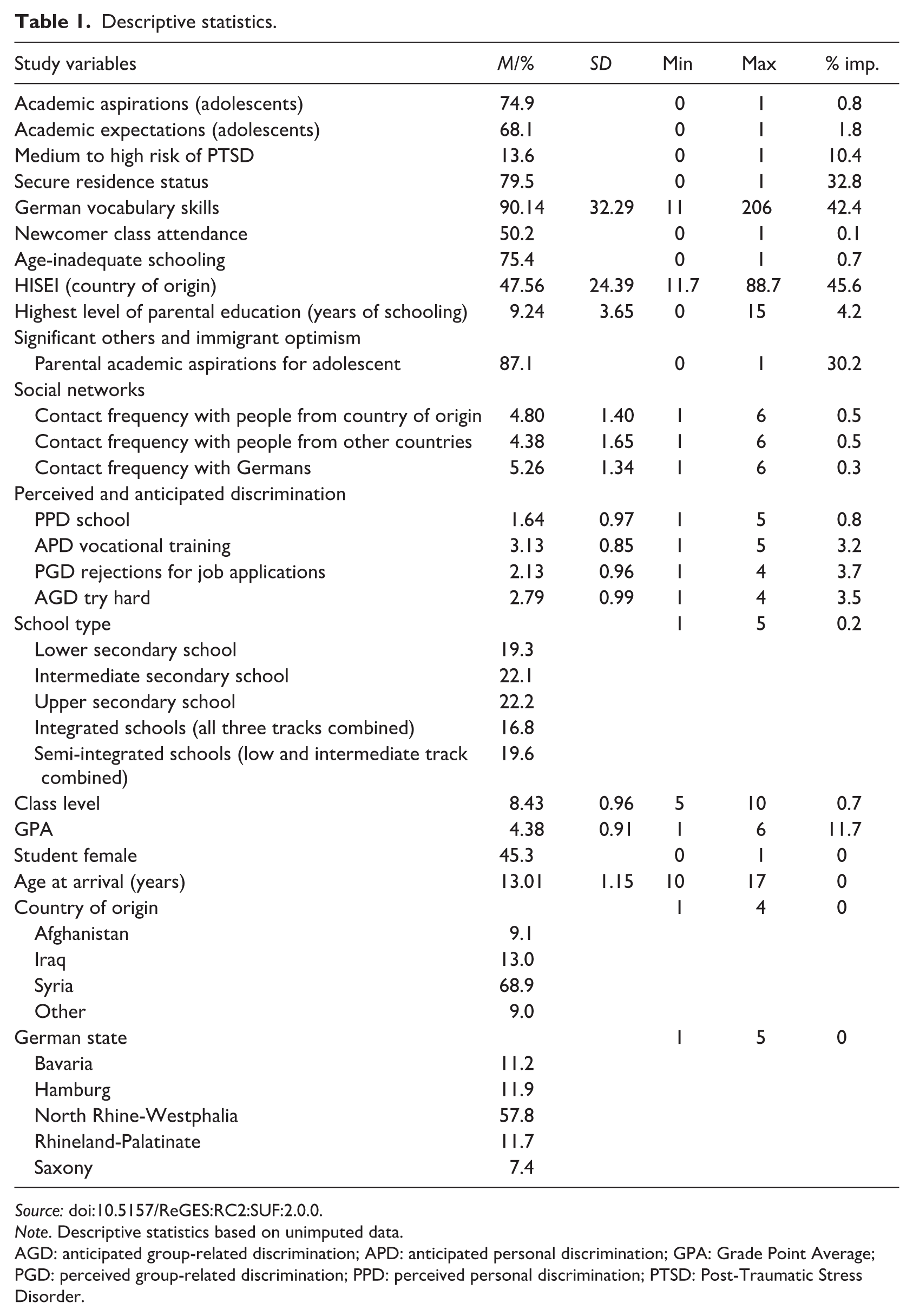
Source: doi:10.5157/ReGES:RC2:SUF:2.0.0.
Note. Descriptive statistics based on unimputed data.
AGD: anticipated group-related discrimination; APD: anticipated personal discrimination; GPA: Grade Point Average; PGD: perceived group-related discrimination; PPD: perceived personal discrimination; PTSD: Post-Traumatic Stress Disorder.
All metric indicators were z-standardised to allow comparisons of regression coefficients.
Analytic approach
We followed a stepwise modelling approach to explore the relative explanatory contribution of different sets of factors to young refugees’ educational aspirations and expectations. All analyses were conducted separately for the two outcome dimensions. Model 1 (M1) included the institutional setting, academic performance and additional student-level characteristics. In the next step, Model 2 (M2) incorporated refugee-specific conditions and addresses RQ1 by examining how refugee-specific circumstances are associated with educational ambitions among refugee youth. Model 3 (M3) subsequently added indicators of the family’s social background and migration-related characteristics in order to address RQ2, namely to what extent mechanisms established in research on social and migration background also operate within this group. Finally, Model 4 (M4) estimated a fully specified model including all explanatory variables simultaneously. This model allows us to assess whether associations between refugee-specific conditions and educational aspirations and expectations persist once social background and migration-related mechanisms are taken into account, and vice versa.
We conducted linear probability models (LPM) with robust standard errors to facilitate the interpretation of coefficients and avoid shortcomings related to logit models (e.g. Allison et al., 2020).
Missing data were multiply imputed using iterated chained equations (White et al., 2011), resulting in 70 complete datasets (see Table 1, for the proportion of imputed cases). In addition to the survey variables, the imputation model included auxiliary variables such as grammar test scores and parental educational expectations to support the assumption of a missing at random mechanism (c.f. Collins et al., 2001).
All analyses were conducted using Stata/SE 17.0 (StataCorp, 2021).
Results
The refugee adolescents in our sample represent a highly ambitious group: 75% reported academic aspirations, and 68% expressed academic expectations – that is, they aspire or expect to attain a school-leaving qualification that would enable university entry (Table 1). These figures are notably higher than those observed among other immigrant groups and the majority population in Germany (e.g. Ferrara and Salikutluk, 2025, 1278; Neumeyer et al. 2022, 271).
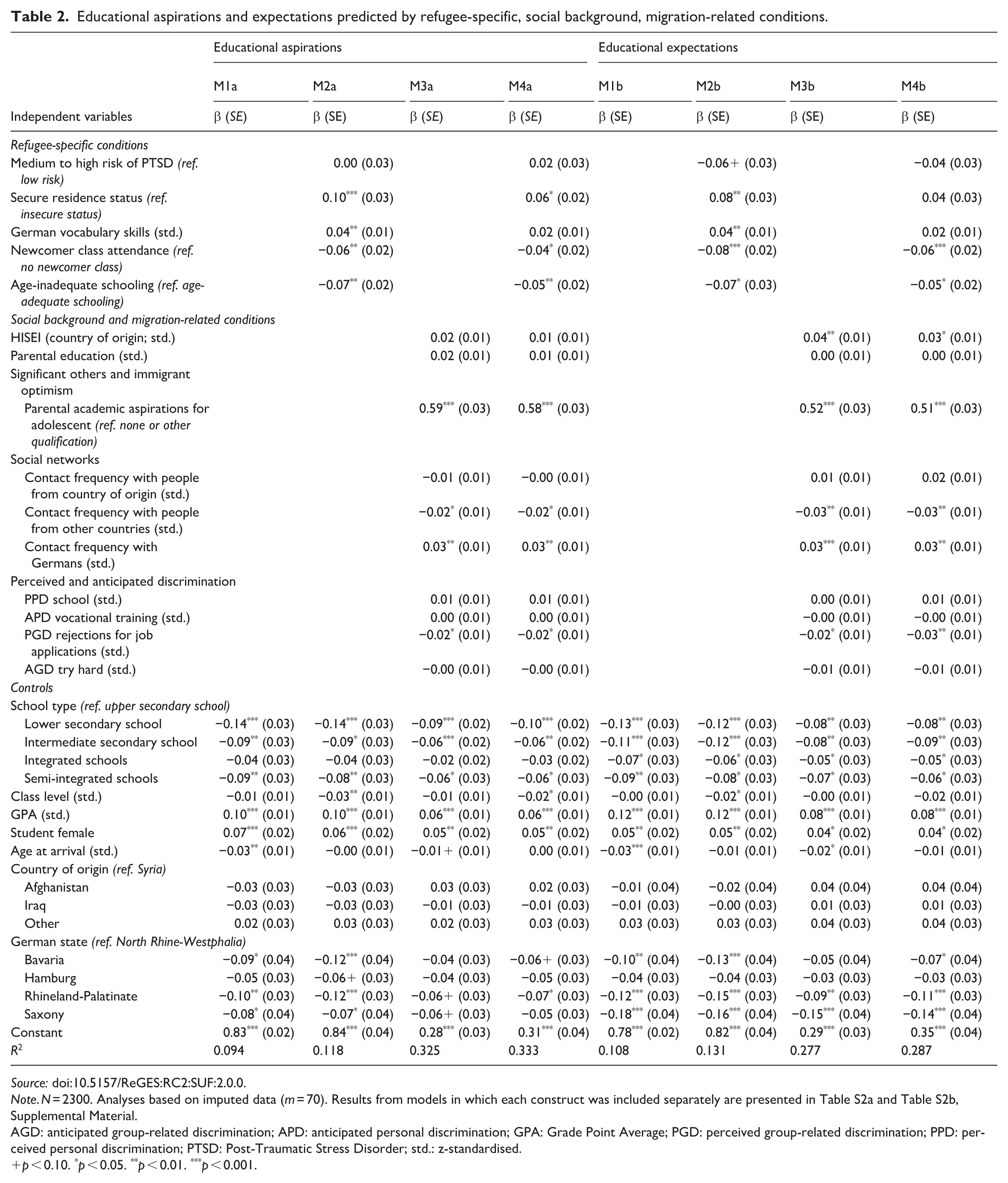
Our baseline regression models (Table 2), which included (institutional) indicators such as school type and academic performance, accounted only for approximately 9% of the variance in aspirations and 11% in expectations (M1a, M1b). The slightly higher explanatory power for expectations is plausible, as expectations explicitly refer to current circumstances (e.g. school type, grades), whereas aspirations are intended to be largely independent of such constraints. Nonetheless, the difference between the models was not substantial. The association patterns were broadly similar for both outcomes: attending an upper secondary school track, better grades and being female were positively associated with both academic aspirations and expectations. Age at arrival was negatively associated with both outcomes, suggesting that adolescents who arrived in Germany at an older age were less likely to report academic ambitions. Furthermore, notable differences emerged across German states: adolescents in Bavaria, Rhineland-Palatinate, and Saxony were less likely to report academic aspirations and expectations than those in North Rhine-Westphalia, even after accounting for school-related characteristics. No systematic differences were found by country of origin or class level.
Educational aspirations and expectations predicted by refugee-specific, social background, migration-related conditions.
Source: doi:10.5157/ReGES:RC2:SUF:2.0.0.
Note. N = 2300. Analyses based on imputed data (m = 70). Results from models in which each construct was included separately are presented in Table S2a and Table S2b, Supplemental Material.
AGD: anticipated group-related discrimination; APD: anticipated personal discrimination; GPA: Grade Point Average; PGD: perceived group-related discrimination; PPD: perceived personal discrimination; PTSD: Post-Traumatic Stress Disorder; std.: z-standardised.
p < 0.10. *p < 0.05. **p < 0.01. ***p < 0.001.
Refugee-specific conditions
In the next step, we added refugee-specific conditions while continuing to control for the baseline characteristics, but without yet accounting for social background or migration-related factors (M2a, M2b, Table 2). As expected, having a secure residence status and increasing German vocabulary skills were positively associated with both aspirations and expectations. Also, as expected, attending a newcomer class or being placed below the age-appropriate grade level showed negative associations. PTSD risk showed no significant association with either aspirations or expectations. With the exception of PTSD risk, all refugee-specific conditions exhibited the expected associations, underscoring the relevance of considering refugee–specific circumstances when analysing educational ambitions. Including these factors led to an improvement in model fit compared to the baseline models (M1a and M1b; Table 2), although the increase was modest, with explained variance rising to 12% for aspirations and 13% for expectations.
Social background and migration-related conditions
We now turn to social background and migration-related conditions, which capture a set of well-established mechanisms from social inequality and migration research. The overall pattern of associations was largely similar for aspirations and expectations, consistent with the idea that these mechanisms shape educational ambition in comparable ways, albeit with different emphases. Parental aspirations were the strongest predictor. Adolescents whose parents wished for them to obtain a university-qualifying certificate were much more likely to hold such ambitions themselves. This finding aligns with mechanisms emphasising the role of significant others, intergenerational transmission of educational norms and status-maintenance motives, as well as with arguments related to immigrant optimism. Supplementary analyses using a step-by-step model structure (M3, Tables S2a and S2b, Supplemental Material) further showed that parental aspirations accounted for a considerable share of the variance, with a somewhat stronger association for adolescents’ aspirations than for expectations. Beyond parental aspirations, indicators of family social status showed differentiated associations with the two outcomes. Parental socioeconomic status was positively associated with adolescents’ expectations, but not aspirations, even when parental aspirations were held constant. This suggests that expectations are more closely aligned with resource-related dimensions of social status, such as cultural or symbolic capital, which are not fully captured by parental aspirations and may play a greater role in shaping more realistic assessments of educational prospects. Parental education itself showed no significant association with either outcome.
Migration-related mechanisms related to social networks also revealed distinct patterns. Contact with native-born Germans was positively linked to both outcomes, while contact with other migrant groups (not co-ethnics) was negatively associated. Co-ethnic contact showed no effect. These findings are in line with conditional perspectives on ethnic embeddedness, suggesting that access to resource-rich networks, rather than ethnic proximity per se, is more relevant for sustaining educational ambition, particularly in terms of expectations. Experiences of discrimination were mostly unrelated to educational ambitions. One exception was perceived group-based labour market discrimination, which was negatively associated with both aspirations and expectations. This pattern does not support assumptions of compensatory motivation and instead points towards demotivating effects when future opportunities are perceived as structurally constrained. Taken together, incorporating social background and migration-related conditions substantially improved model fit, increasing the explained variance to 33% for aspirations and 28% for expectations (M3a, M3b; Table 2).
Finally, the fully adjusted models including all explanatory variables simultaneously (M4a, M4b) allow us to assess the relative contribution of refugee-specific conditions once established mechanisms related to social background and migration are taken into account. Overall, the inclusion of refugee-specific factors added only limited explanatory value beyond social and migration-related factors. Importantly, associations linked to social background and migration-related mechanisms remained largely stable in the full models, underscoring their central role in shaping both educational aspirations and expectations among refugee youth. By contrast, several refugee-specific indicators showed attenuation once these mechanisms were controlled for. In particular, the association with residence status lost statistical significance in the fully adjusted models for expectations (M4b), but not for aspirations (M4a). In addition, the positive associations of German vocabulary skills with both aspirations and expectations were no longer statistically significant once social background and migration-related conditions were taken into account. In contrast, indicators capturing educational placement within the school system, namely attending a newcomer class and being placed below the age-appropriate grade level, remained significantly associated with both outcomes, albeit with reduced effect sizes.
Discussion
This study set out to examine how educational aspirations and expectations are shaped among refugee adolescents under the specific conditions of forced migration and participation in a highly stratified education system. Across all analyses, one central finding stands out: refugee adolescents in Germany constitute an overall highly ambitious group, with a substantial share reporting academic educational aspirations and expectations. This pattern mirrors findings from research on other immigrant groups, yet unfolds under markedly different structural and biographical conditions. Understanding how such ambitions are shaped under conditions of forced migration and within a stratified education system is therefore central to assessing refugee adolescents’ educational orientations.
Addressing our first research question, the results demonstrated that educational ambitions among refugee adolescents were linked to refugee-specific conditions. While general school-related conditions, such as school type or grades, were associated with aspirations and expectations, they accounted for only a small part of the variance, indicating that other (including refugee-specific) conditions may contribute to educational ambitions. Most refugee-specific circumstances, namely insecure residence status, limited host-country language proficiency, participation in newcomer classes and age-inadequate class placement, were significantly associated with lower educational aspirations and expectations. By contrast, the risk of post-traumatic stress disorder showed no statistically significant association, suggesting that structural and institutional constraints may be more salient for educational goal formation than psychological distress alone. With this exception, Hypothesis 1a was therefore broadly supported. The expectation that refugee-specific conditions would be more strongly associated with educational expectations than with aspirations (Hypothesis 1b) was not supported by the results: For some factors, such as German language proficiency and age-appropriate schooling, the correlations with aspirations and expectations were of similar magnitude. Other conditions displayed differentiated and partly opposing patterns: insecure residence status was more strongly linked to reduced aspirations, whereas placement in newcomer classes was more strongly associated with lower expectations, presumably particularly with regard to the perceived attainability of academic qualifications. Taken together, these findings indicate that refugee-specific constraints do not uniformly operate through a single mechanism, but affect both the formation of educational goals and assessments of their attainability. In particular, legal insecurity appears to undermine not only realistic educational planning but also the development of longer-term educational aspirations. Conversely, placement in newcomer classes seems to primarily shape perceptions of attainability, potentially signalling limited access to academic pathways. This raises the question of the extent to which these separate classes, which are designed to prepare newly arrived young people as well as possible for participation in the education system, can fulfil their purpose in their current form.
Turning to our second research question, the analyses showed that established mechanisms from research on social background and migration also operate within this group. Consistent with Hypothesis 2a, parents’ educational aspirations were positively associated with both adolescents’ educational aspirations and expectations. In line with Hypotheses 2b and 2c, pre-migration social status (also under control of parental aspirations) was significantly linked to educational expectations, but not to aspirations and these associations were weaker than those for parental aspirations. This pattern is consistent with the idea that pre-migration resources are more influential for shaping realistic assessments of attainable educational outcomes than for the formation of aspirations.
Migration-related mechanisms provided additional nuance to our understanding of refugee adolescents’ educational ambitions. As hypothesised (Hypothesis 3), indicators of immigrant optimism and relative status maintenance, proxied through parents’ educational aspirations, were positively correlated with educational aspirations and expectations. In line with our expectations, co-ethnic networks showed no significant effect, suggesting that proximity to peers from the same origin country does not necessarily support ambitious educational goals in this context. At the same time, adolescents’ perceptions of group-related discrimination were significantly negatively associated with both aspirations and expectations. Rather than triggering compensatory motivation, these experiences appear to act as demotivating factors, indicating that structural barriers and anticipated disadvantages can constrain the pursuit of educational goals. Altogether, these findings underline the relevance of migration-related factors even within the relatively specific group of refugee youth. Some aspects, such as perceived discrimination, could even be particularly relevant for the group of refugees.
In the fully specified models, the associations between refugee-specific conditions and educational aspirations and expectations were generally attenuated once social background and migration-related mechanisms were accounted for. German vocabulary skills no longer showed significant links to either outcome, and residence status was no longer significantly associated with expectations, indicating that part of their influence overlapped with broader social and migration-related conditions. These results underscore the importance of situating refugee-specific experiences within the wider contextual framework. While refugee-specific conditions contribute to the overall picture, their impact seems at least partially mediated or confounded by more general mechanisms. Nevertheless, correlations between structural characteristics of refugee schooling, namely newcomer class attendance and age-inappropriate grade placement, and educational ambitions remained statistically significant even in the full models. This highlights the need to carefully assess schooling strategies for newly arrived students and to determine whether current measures adequately support them in achieving their educational goals.
Despite these findings, unexplained variance remained. It is therefore important to further explore the causes of high aspirations and expectations, which remain only partially understood. Such knowledge is necessary to optimally support young refugees in realising their goals. In cases of unrealistically high ambitions, students and their parents may need help adjusting their expectations to avoid disappointment and disengagement. Moreover, more research is needed on why objective conditions such as grades or the attended school type have limited explanatory power. Is this due to information deficits? For example, it remains unclear how teachers shape and manage educational ambitions (e.g. Emery et al., 2023), and how well they are prepared for this task. Teachers should be aware of the potential mismatch between students’ educational aspirations and expectations and the educational realities they face. Depending on feasibility, teachers need to either support students in pursuing their ambitions or help them recalibrate overly optimistic expectations. The role of teachers may also differ across education systems: while late-tracking contexts allow teachers to sustain high aspirations for longer, early-tracking systems often confront them with the need to recalibrate expectations at an earlier stage.
Our results also revealed significant variation across German states, even after controlling for general institutional characteristics and refugee-specific aspects such as attending a newcomer class or age-appropriate schooling. The state in which students live may shape not only the type of school attended by refugee students (Will et al., 2022), but also further conditions influencing their attitudes and wishes. These findings point to potentially context-specific dynamics within the German education system. These contextual conditions do not have to be specific to refugees, but may also reflect general structural characteristics of the education system. For example, differences in educational ambitions between federal states may mirror variation in the general likelihood of obtaining a university entrance qualification (i.e. Abitur), which differs substantially across states even in the overall student population. In the 2014/15 school year, for example, the Abitur graduation rate was 55% in Hamburg, followed by North Rhine-Westphalia (38%) and Rhineland-Palatinate (31%), while rates in Saxony and Bavaria were below 30% (Destatis, 2015). Importantly, intra-German differences can also be interpreted as a microcosm of international variation, mirroring the diversity of institutional arrangements and integration policies across European countries. Future research should explore how structural, institutional, or discursive differences between regions, such as the organisation of newcomer education, the availability of transition pathways, counselling infrastructure, local cultures of reception or the broader climate of inclusion, may shape young refugees’ educational outlooks.
Although this study drew on German data, the findings may be relevant across Europe. Many countries face similar challenges in integrating newly arrived students, particularly those with limited proficiency in the language of instruction. Several systems have introduced reception or newcomer classes similar to Germany. Shared barriers such as delayed placement, language acquisition and unfamiliarity with the school system are common. Refugees in Europe may also be positively selected in terms of educational motivation compared with those remaining in conflict-adjacent regions. However, realisation of ambitions depends on national education systems. Our findings are especially relevant for countries with early tracking, where institutional limitations may hinder ambitions, while later-tracking systems offer more flexibility and time to catch up. Comparative research should further explore how system design affects the realisation of refugee students’ goals and whether ambitions become a resource for successful participation in education or a cause for frustration.
Regarding research on educational ambitions more generally, our findings demonstrated that considering aspirations and expectations simultaneously yielded fewer differences in their associations with explanatory variables than theory suggests. While there were some indications that objective circumstances exerted a greater influence on educational expectations, and that parental aspirations were more strongly associated with educational aspirations, the observed correlations were largely similar.
The present study also had limitations. First, it should be noted that Syrian refugees are overrepresented in the sample (69%). However, our analyses did not reveal systematic differences in educational aspirations or expectations across countries of origin once baseline characteristics were controlled for. Therefore, while general caution is warranted when generalising to other refugee populations, the overrepresentation of Syrian youth is unlikely to have substantially biased the observed patterns. Second, the operationalisation of some migration-related constructs was not optimal, particularly immigrant optimism, which was approximated through parental aspirations. This indicator may be confounded with other factors, such as parental personality traits or cultural characteristics. Without comparable data from individuals who remained in the country of origin, these interrelations cannot be fully disentangled. For example, PISA data show that students in emerging economies such as Mexico or Turkey often reported highly ambitious occupational goals despite not being migrants (OECD, 2013, 182f.). Cultural or other contextual factors may therefore also drive elevated aspirations or expectations. While the main countries of origin in the ReGES study are not represented in PISA, cultural explanations should nonetheless be considered as alternative interpretations. Furthermore, our measure of social networks only captured frequency of contact, not quality or embedded resources. Another relevant factor, namely parents’ occupational status in the host country, could not be assessed, as very few parents in the sample were employed in Germany (n = 155). Third, the study relied on cross-sectional data, limiting conclusions about causality or long-term effects. While initial school placement may not be strongly family-driven (Will et al., 2022), other interdependencies may have gone undetected. Future research could use longitudinal analyses to examine selected associations more closely with regard to their causal relationships. In addition to investigating initial levels of aspirations and expectations and their potential determinants, such studies could also explore the dynamic development of educational ambitions over the course of students’ educational trajectories.
In sum, enabling refugee adolescents to pursue their ambitions while supporting them in navigating structural barriers, particularly those arising from early tracking and limited permeability between school types, remains a key challenge for research, policy, and educational practice alike. Beyond Germany, our findings suggest a broader European challenge: whether refugee adolescents’ high aspirations and expectations act as a resource for educational attainment or become a source of frustration when they are misaligned with institutional opportunities may depend on how national education systems structure educational pathways. The observed variation across school types and federal states points to the relevance of institutional arrangements, which future comparative research should examine in greater depth.
Supplemental Material
sj-docx-1-eer-10.1177_14749041261442928 – Supplemental material for Understanding educational aspirations and expectations among refugee adolescents in Germany: Beyond social and migration-related explanations
Supplemental material, sj-docx-1-eer-10.1177_14749041261442928 for Understanding educational aspirations and expectations among refugee adolescents in Germany: Beyond social and migration-related explanations by Gisela Will, Melanie Olczyk, Hannah Glinka and Ebru Balaban-Feldens in European Educational Research Journal
Footnotes
Acknowledgements
We would like to thank the staff of Reinhold Sackmann’s Chair of Social Structure Analysis as well as the participants of the colloquium of Department 2 of the LIfBi for providing helpful advice on an earlier version of this paper.

Ethical considerations
All adolescents and parents involved in the ReGES projects gave their written consent to participate in the respective study. They were informed about the purpose of the projects and the content of the surveys, and that they have the right to revoke their consent at any time. For underage students, additional parental consent was obtained for their children’s participation.
Funding
The authors disclosed receipt of the following financial support for the research, authorship, and/or publication of this article: The present work took place partly within the framework of the project “Educational Trajectories of Refugee Children and Adolescents” (funded by the BMBF and, since summer 2025, by the BMBFSFJ, grant number FLUCHT2021) and of the “Educational Integration of Refugee Children and Youth” project (funded by the BMBF and, since summer 2025, by the BMBFSFJ, grant number 01JG2107). The content of this publication is solely the responsibility of the authors.
Declaration of conflicting interests
The authors declared no potential conflicts of interest with respect to the research, authorship, and/or publication of this article.
Data availability statement
The data are accessible for scientific use via the LIfBi Research Data Centre in Bamberg, Germany. The codes for the analysis will be made available to the scientific community.
Supplemental material
Supplemental material for this article is available online.
Notes
Author biographies
References
Supplementary Material
Please find the following supplemental material available below.
For Open Access articles published under a Creative Commons License, all supplemental material carries the same license as the article it is associated with.
For non-Open Access articles published, all supplemental material carries a non-exclusive license, and permission requests for re-use of supplemental material or any part of supplemental material shall be sent directly to the copyright owner as specified in the copyright notice associated with the article.
