




Abstract
While the integration of digital technologies in European schools often promises pedagogical and technological innovation, efficiency, and equality, we know that in practice regularly the opposite plays out: social inequalities are reproduced or even exacerbated in EdTech implementation. This study shows how these processes can even unfold in the most mundane and unexpected ways – particularly through practices of waiting. Based on a 1-year ethnographic study in German and Swedish schools, we analyse how EdTech makes certain students, teachers, families and schools wait more often, for longer periods, and under more precarious conditions than others. Bringing together critical research on temporalities in education and migration studies’ conceptualisations of temporal bordering, we show how waiting as social practice reconfigures life in schools by evaluating the time of certain actors as more valuable than that of others. We identify three key waiting practices – waiting for connexion, waiting for repair, and waiting for help – and illustrate how EdTech shapes classrooms in ways that reproduce structural disadvantages. Our study contributes to the critical literature on EdTech not only by showing how power, technology and time interplay in European classrooms, but also by teasing out the seemingly unspectacular moments in everyday practice in which inequality materialises.
Introduction
In Mr Marbach’s office reigns organised chaos. From a humming box on the ceiling hang colourful cables, wildly entwined, some of which find their way into a green flashing box at the other end of the room or into outlets embedded in the wall. On the shelves against the wall lay heavy folders, a few piles of broken tablet computers and electrical spare parts in torn plastic bags and cardboard boxes. Mr Marbach sits behind his desk, wearing a fleece vest over a chequered shirt and lurking from between his two large computer screens. He is the school’s IT administrator and has been for many years. Even before the school was renovated 8 years ago, he was in charge of the 5 computer rooms and 16 laptops owned by the school at the time. ‘Back then it was still easy with the digitalisation’, he reports drily. Now his school is connected to the city’s internet network, the majority of the 1300 students are taught using tablet computers and in all 100 or so classrooms exist smartboards, computers and projectors. This has also changed his work – the internet connexion and mobile device management (MDM) are no longer managed by him but by the school authority, and the repair and maintenance of the tablets is carried out by an external provider instead of him. He therefore believes now the processes for almost everything simply take too long. ‘The students come here when something doesn’t work, which I then have to take care of. And now I can only ever write to the school authority. And then we have to wait for it to work again at some point’. As if on cue, a student knocks on the door and enters the office with their tablet computer to ask Mr Marbach for help with a technical problem. He turns his attention to the device and tries to take care of it. He mumbles in the students’ direction: ‘Oh, so, just wait. Let’s have a look. Wait a second’. or ‘That looks good, that looks good. . . that doesn’t look good at all. So, wait another moment’ and finally ‘Wait, I have to make a quick adjustment. Again. Again. Wow. Done. There you go, one just has to wait long enough and everything will work out fine’.
This brief insight into the everyday working life of IT administrator Mr Marbach at a secondary school in Germany shows, on the one hand, how school digitalisation processes are redefining areas of responsibility and the actors involved in what is considered schooling. On the other hand, waiting – a seemingly unspectacular and mundane event – turns out to be a central practice of this digitalised everyday school life. It is not only Mr Marbach who waits for a response from the school authorities when technical issues arise and it is not only the students who wait for Mr Marbach to fix technical problems. Our ethnographic study in German and Swedish classrooms rather shows that waiting practices are deeply inscribed in the sociotechnical infrastructure of contemporary schools. However, our observations indicate that not all actors wait equally. Instead, waiting captures a particular moment in time in which power materialises – assembling actors and their relations in a specific way. Accordingly, we consider waiting a rich framework to access the everyday realisation of social inequality in European classrooms and ask: Which practices of waiting can be observed in the sociotechnical infrastructure of German and Swedish schools and to what extent are social inequalities negotiated in these practices?
To answer this question, this study takes up two lines of contemporary critical research on EdTech: on the one hand, the connexion between EdTech and temporality – digital technologies co-produce new temporal conditions in education – and on the other hand, the connexion between EdTech and inequality – access to and use of digital technologies varies between actors in education along different lines of dis/advantage. The aim of the study is to interweave both lines to reconstruct the day-to-day realisations of inequality in schools by using waiting as a concrete temporal practice. In doing so, we aim to understand the particularities and situatedness of inequality by attending to the very practical encounters through which it materialises.
Although waiting was not a phenomenon that we were interested in at the beginning of our fieldwork – after all, almost all actors in education at some point wait for something – it became clear over time that waiting goes beyond temporal aspects and the mere passing of time. In waiting practices, social orders are revealed and actors who wait become just as visible as actors who make others wait. We realised how waiting as a social practice is deeply intertwined with aspects of control, agency and domination. It affects individuals in how they want to live their lives and threatens their capability to ‘function’ as a human being (Sen, 1992). In other words: waiting situated in the normative setting of the school often plays out as a disadvantage, therefore it should be critically examined.
The basis for this article is a 1-year ethnography carried out in the context of the international research project Reconfigurations of Educational In/Equality in a Digital World (RED). Detailed descriptions from German and Swedish schools are presented and brought into dialogue with each other in order to draw an insightful picture of European digital education. First, however, the study will be situated in current discussions of critical EdTech studies on the temporality of digital education as well as in different disciplinary considerations on waiting.
Situating the study: Critical perspectives on EdTech and temporalities
Educational Technologies (EdTech) increasingly enter European classrooms and become an integral part of the sociotechnical infrastructure of schools, often accompanied by the promise of enhancing efficiency, effectiveness, and overall educational quality. However, digital infrastructures and EdTech in schools also take part in renegotiating the social fabric of schools as they differentiate, categorise and hierarchise (Rafalow and Puckett, 2022) actors participating in digital education practices. One dimension of this relationship between EdTech and inequalities is the way in which digital education practices create temporal borders between actors – thus making some actors wait.
This article adds to critical perspectives on EdTech that have been increasingly articulated in the last 10–15 years (Costa et al., 2019; Decuypere et al., 2021; Selwyn, 2010; Williamson, 2019). Recently Macgilchrist reflected on the implications of the ‘critical’ in Critical EdTech Studies and identifies, among others, two relevant approaches: (1) the focus on transformations – EdTech is a fast-moving and constantly changing field in which new technologies, new policies, new processes and new practices emerge – and at the same time (2) the focus on stabilities – despite the fast-moving nature of EdTech, certain phenomena, such as social inequality and injustices, remain stable (Macgilchrist, 2021). This article is located precisely in this tension between transformation and stability and takes a closer look at the complex interrelationships between the application of EdTech in European schools and the related re/configurations of social inequality.
Transformations and stabilities also hint at relatively recent interest in critical EdTech discourse: the temporalities of digital education. As ‘[t]ime is at the core of any form of education’, Decuypere and Vanden Broeck (2020, pp. 603–604) note, ‘the temporal dimension of present-day education and its policy needs to be unpacked by being attentive to specificities and particularities’. This discourse has increasingly challenged a traditional view of time as being purely linear or sequential ‘clock time’ (Munn, 1992), as numerous special issues and studies have instead emphasised the complexities of time through temporalities, focussing on fluidity and multifacetness (Alirezabeigi and Decuypere, 2025; Decuypere and Vanden Broeck, 2020; Madsen et al., 2025). In particular, with the growing influence of digital technologies and platforms in educational practices, these studies have unpacked how time and temporalities organise what becomes in/visible and how they function as a tool for certain visions and governance (Bodén, 2016; Lunde and Piattoeva, 2025). Previous research has primarily focused on methodological and theoretical explorations of temporalities in digital education (Decuypere et al., 2022) while the empirical work has focused on for instance policy analysis (Tierens et al., 2024) or digital data and platforms (van de Oudeweetering and Decuypere, 2021). Building on this existing work, this article extends the discussion by ethnographically turning to the day-to-day, mundane aspects of ‘digital’ schooling while using a temporal lens to explore different actors’ actual experience of time (Rabenstein et al., 2025). Ethnography and extensive time spent in the field make it possible to uncover constants, variances and particularities in seemingly inconspicuous practical realisations (Bandak and Janeja, 2018).
Conceptualising the study: Inequality, waiting, bordering
Our study focusses on the ways in which the specific temporality of EdTech shapes interactions, pedagogical practice and the social fabric of schools and classrooms. Following Dussel’s (2023: 30) call for an ‘analysis of contemporary classrooms [that takes] into account the complex and hybrid temporalities involved in and by media’, our article brings into play a specific temporal practice co-produced with EdTech: waiting. We consider waiting as a rich and complex temporal mode in which previously discussed phenomena, such as policy, platforms or digital data condense in social practice in the classroom. In this sense, waiting can be a framework for making time and temporalities visible as social ordering mechanisms – or as Bandak and Janeja put it their Ethnographies of Waiting: ‘waiting as a concept enables us to explore ethnographically what forms action, thought and social relationships acquire in diverse engagements in, and with, time’ (Bandak and Janeja, 2018: 2). While waiting as a social practice has not yet been focused on in critical EdTech studies, it has been a much-discussed phenomenon in migration studies in recent years. This discourse will be discussed accordingly in the next section after a brief conceptualisation of the interrelations between inequalities and waiting.
Inequalities and waiting
To link inequalities to waiting we firstly have to ask: what is inequality? Inequality can be understood as a ‘macro-social phenomenon’ that describes the ‘unequal distribution of resources in the population’ (Riedel, 2001: 221; transl.) as well as the ‘access of different population groups to socially scarce goods and services’ (Olk, 2009: 127; transl.) that is commonly ‘mapped at the structural level of society’ (Diehm et al., 2013: 32; transl.). Inequalities – while being enacted and actualised interactively (Garfinkel, 2018) – are historically grown and relatively stable, though not unchangeable (Hirschauer, 2021; West and Fenstermaker, 1995). If ‘[i]nequality always means excluding some people from something’ (Therborn, 2013: 21), then people who wait are excluded from control over their own time, as ‘[c]ontrol over time is [. . .] a medium of hierarchic power and governance’ (Munn, 1992: 109), and from the possible effects and advantages of a self-determined use of their own time. Their disadvantage consists of exclusion from access to possible social resources and the experience of negative affects and emotions while waiting. This links to what some scholars have called ‘temporal capital’: the time one has under control to engage in what one wants to pursue (Paust et al., 2023; Wang, 2023). In this sense, inequality is the result of unaligned times between actors (e.g. between students and teachers, teachers and schools or schools and policy), with practices of waiting being a symptom of such unaligned time. A connexion between social inequality and waiting can therefore be drawn, albeit not causally, as we will explain in a later section.
Secondly, we ask: what is waiting? At first glance, waiting seems to be an unspectacular event. It is an integral part of everyday life: we wait in offices, in traffic, at railway stations. We wait for feedback, right of way and trains. We wait in anticipation, nervously and desperately. Waiting is a social, embodied and deeply affective experience. Nevertheless, waiting often goes unnoticed (Schabacher, 2020) and is a ‘temporal region hardly mapped and badly documented’ (Schweizer, 2008: 1). Khosravi describes waiting as a ‘particular experience of time’ (Khosravi, 2021: 14), one in which – as Schweizer notes – ‘time is slow and thick’ (Schweizer, 2008: 2). This makes waiting ‘more than merely an inconvenient delay’ and ‘more than a matter of time’ (ibid). Rather, waiting is ‘a feature of human relationships’ (Khosravi, 2014: 66) and ‘a powerful technique for the regulation of social interactions between individuals, as well as between individuals and the authorities’ (Khosravi, 2021: 14). Due to this close connexion between waiting, social experience and power, in practices of waiting social structures, hierarchies and ordering mechanisms can be surmised. As Bourdieu states, ‘[w]aiting is one of the privileged ways of experiencing the effect of power, and the link between time and power’ (Bourdieu, 2000: 228). Seen in this light, it is not surprising that waiting is not evenly distributed across society, as ‘[w]e all wait, but the experience of waiting is different for different people’ (Khosravi, 2021: 13). Auyero emphasises how ‘waiting is stratified, and there are variations in waiting time that are socially patterned and responsive to power differentials’ (Auyero, 2012: 27) which makes waiting ‘pre-eminently a political issue’ (Khosravi, 2021: 13). After developing this social and political understanding of waiting and its relation to inequality we turn to migrations studies’ understanding of this interrelation.
Waiting as temporal bordering
In the previous section we could see how through waiting practices hierarchical borders are drawn between different social actors. These types of border practices have been discussed in migration studies in recent years with the concept of ‘everyday bordering’. Borders in this sense are not understood as ‘stable and fixed objects, but as practices [. . .] that shape and enact the border in the everyday’ (Papoutsi, 2021: 2). These practices ‘are situated and constituted in the specificity of political negotiations as well as the everyday life performance of them, being shifting and contested between individuals, groupings and states as well as in the constructions of individual subjectivities’ (Yuval-Davis et al., 2018: 230). In addition, there is the idea that the everyday experience of borders is often not a spatial experience, but a temporal one: ‘[b]orders function through the imposition of waiting and through appropriating migrant time’ (Papoutsi, 2021: 2). These temporal bordering practices mean that ‘marginalised groups often find themselves caught in [. . .] the “paralytic” time of waiting’ (Andersson, 2014: 802). The connections between temporal bordering practices, the experience of waiting and inequalities have thus been extensively reflected upon in migration studies, particularly in ethnographic studies in migration camps.
This article joins few selected attempts to make these concepts fruitful for analysing digital educational contexts. But while van de Oudeweetering and Decyupere rather apply the concept of bordering practices to analyse spatiotemporal phenomena in online education settings (2023) and Shaheen is committed to the experience of blind and low-vision students idle time as ‘access lag’ (2025), this study is particularly interested in the reconfiguration of inequality within everyday school practices, as we argue that to understand the particularities and situatedness of inequality we have to analyse the very practical encounters through which it materialises. And we believe these practical encounters can be accessed through the phenomenon of temporal bordering. Since waiting practices have been frequent in our observations of schools and classrooms, the aim of this study is to borrow the concept of everyday temporal bordering from migration studies and to interrogate our observations of waiting for their connections with instances of social inequality. 1
Re-evaluating waiting
Finally, it should be pointed out that – although waiting symbolises ‘waste, emptiness and uselessness’ (Khosravi, 2014: 66) – there can also be generative, creative and subversive potential in waiting. Etymologically, the English word waiting is derived from the words ‘to watch’ and ‘to be awake’, which is inscribed in today’s linguistic usage, for example in the profession of ‘waiters’ (Schabacher, 2020). Accordingly, waiting is also a state of consciousness: ‘[t]he person in a state of waiting constantly thinks about her or his waiting’ (Khosravi, 2021: 17), which makes waiting a highly self-reflective and potentially transformative practice. The French word ‘attendre’ also has the meaning of directing one’s mind towards something (similar to the English ‘to attend to sth’.). In this sense, waiting is also a focused, directed practice. Similarly, the German word ‘Warten’ has a double meaning, which, in addition to the passing of time, also includes attending to things with care (Schabacher, 2021). In the following analysis of schools and classrooms, waiting is therefore not only interrogated in relation to dis/advantage, but also in relation to its potential for maintenance, attention and generative reflexivity. In this sense, waiting can be an act of ‘being-with’ rather than ‘being-against’ time (Anderson, 2023) or a ‘practice of response’ (Farman, 2018) – representing temporal ethics that value presence and relation.
Waiting should also be considered in the context of a critique of a neoliberal understanding of time, in which time must be used as ‘productively’ as possible in order not to ‘fall behind’ or not to organise one’s life ‘effectively’ enough. Digital technologies in schools and society often adhere to this logic when their manufacturers promise increased productivity and optimisation of the individual’s everyday life through their use. However pausing, holding out and patience – as Dussel reminds us – are critical for a functioning democracy, as for a holistic understanding of education: ‘without having the patience, affording the time “to listen to others [or] to wait one’s turn to speak” (Crary, 2013: 124), public life will be severely curtailed’ (Dussel, 2023: 30).
We argue that waiting practices elude a clear normative evaluation – they are neither inherently negative or positive – and must be viewed in a differentiated manner. Waiting is a ubiquitous human experience that acquires meaning depending on contexts, purposes, and distributions of control involved. What matters in our cases in not waiting per se, but the unequal distribution of temporal agency: While some actors can flexibly navigate delays or shift tasks, others are held in suspensions with little control over the conditions of waiting (Bandak and Janeja, 2018). We therefore argue that waiting becomes problematic in education precisely when it reinforces existing asymmetries of power and access, depriving some students, teachers or schools of temporal agency, while privileging others. And when waiting takes place in the school context where actors are asked to be as fast, efficient, and productive as possible (Tyack and Tobin, 1994), it often materialises as disadvantage.
Based on the previous theoretical and conceptual considerations, we operationalise ‘waiting practices’ for this study as a multi-layered and ambivalent but revealing social practice. Waiting serves as a heuristic tool for the analysis to make visible the everyday realisation of inequality through and with EdTech. The framework of waiting is used to capture a specific moment in day-to-day school life in which the sociotechnical infrastructure of the school – people, technologies, policies, discourses, etc. – is assembled and materialised in a particular, situated but concrete way. Since waiting – when played out as temporal bordering – functions as an ordering mechanism that reconfigures the relationship between social actors (Khosravi, 2014), a detailed description of waiting practices promises to reveal insights about the social fabric of classrooms and the role of digital technologies within. In this sense, we consider a ‘waiting practice’ as more than the singular practice of passing time, but as a multiple ensemble of actions, objects, actors and affects (Bielo, 2018). Pausing and persevering is often part of what we frame as ‘waiting practices’, but we also look at what is, can be, or cannot be done while waiting or what is done instead of waiting.
Data collection and analysis
This study is based on research of the international research project titled Reconfigurations of Educational In/Equality in a Digital World (RED), which includes research teams from Argentina, Mexico, Germany, Sweden and South Africa. Carried out between 2020 and 2024, the project aims to study the reconfigurations of schooling through the processes of digitalisation of education in different regions of the world and the ways in which these reconfigurations reproduce inequalities or improve conditions of equality. This article particularly draws on 1 year of ethnographic research in two different schools in both Germany and Sweden, each selected to represent different positions on the opportunity structure of the respective educational context (see table). Data collection included participant observation of a total of 128 lessons, formal semi-structured interviews with various actors (teachers, principals, IT staff, school social workers) and non-structured ethnographic interviews. Before conducting field research in the schools, the research teams also analysed the national and local policy discourses on ‘digital education’, considering the problematisation of social inequalities (Büchner et al., 2023; Dussel and Williams, 2023; Ferrante et al., 2024). Those policy discourses were considered as a framing of the field research and also inform the study presented here.
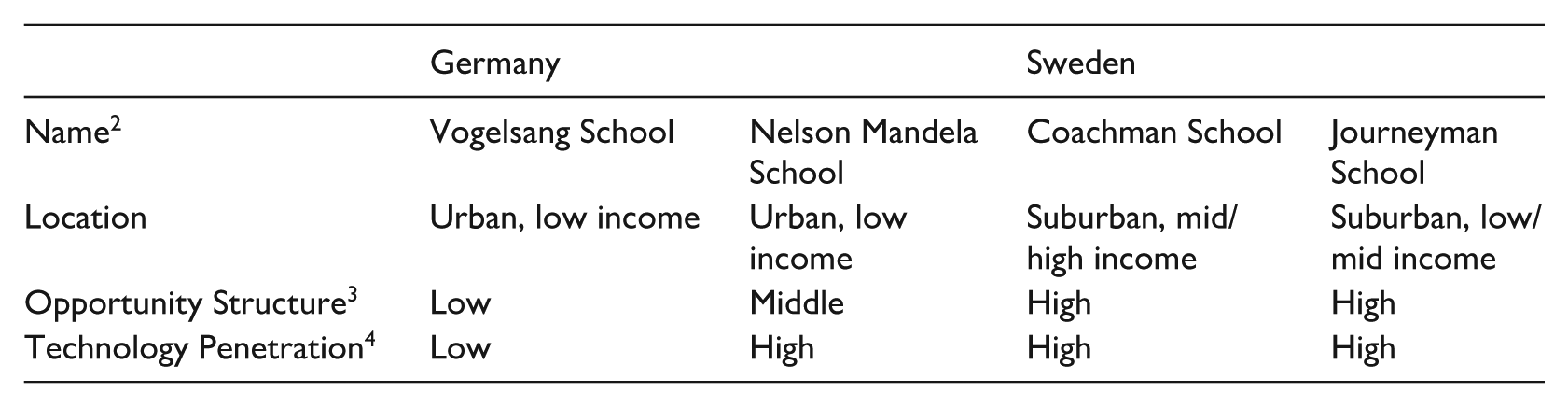
Classroom observations were recorded as field notes and later expanded into detailed descriptions of ‘scenes’ (Emerson et al., 2011) to capture the complexity of narratives we encountered in our schools. An extensive analysis of the material was dialogically conducted by the two authors to identify local specificities as well as European similarities – therefore lines of difference and resemblance between the four schools included in this analysis were drawn. The goal was not to compare ‘German classrooms’ and ‘Swedish classrooms’, but to find ‘rich points’ (Agar, 2006) in each of the local material that connect to broader continental phenomena. The extensive time in the field allowed us to identify patterns and particularities of seemingly mundane activities such as day-to-day acts of waiting – which we later reconstructed as three ‘waiting practices’. The ethnographic descriptions given in each case serve to illustrate the analysis and are intended to provide as deep an insight as possible into everyday school practice in digital European classrooms. However, while aiming at ‘saturation rather than representation’ (Small, 2009), they are of course only examples of a broader repertoire of practices and do not represent any kind of modelling.
This paper focusses on German and Swedish classrooms, as both countries position themselves as digital ‘pioneers’ in Europe while considering digitalisation as positive and a way to address inequalities (Ferrante et al., 2024). However, local practice manifests differently as, as the schooling landscapes vary greatly: In Sweden school digitalisation has unfolded as part of a marketisation that includes free school choice and for-profit schools funded by the state, existing alongside municipally run schools (Svallfors and Tyllström, 2018). Educational technologies, platforms and software are generally procured but provided by commercial actors. Overall, this has led to increasing concerns about segregation and inequality despite generally well-resourced schools (Ljungqvist and Sonesson, 2022). In Germany on the other hand, digitalisation has traditionally been focused on privacy concerns and an orientation to open-source solutions, that are built rather than bought (Macgilchrist, 2019). Even after schools started inviting more commercial actors and their EdTech products during the COVID-19 pandemic, the digitalisation of schooling is still perceived as a lagging process by public and commercial actors (Cone et al., 2022). Structurally, Germany has been criticised as having one of the most unequal education systems in Europe, due to its tripartite school system that can block social mobility (Georg, 2006).
Therefore, Sweden and Germany are rich contexts for this study to unpack the local and nuanced unfoldings of digital classrooms in relation to inequalities. Building on recent work that has demonstrated how EU programmes materialise contrasting temporalities (van de Oudeweetering, 2023; van de Oudeweetering and Decuypere, 2023) we see waiting as one of the downstream effects of such European time-making: our German and Swedish ethnographies illustrate how sociotechnical infrastructures – from funding cycles and connectivity to identification and platform systems – configure classroom temporalities as uneven regimes of acceleration and delay. In this sense, the significance of our study reaches beyond national cases, providing empirical insights in how European temporal politics are translated and materialised in everyday school life.
Practices of waiting
In the following, we present three waiting practices and reflect upon their connexion to social inequality. This empirical part follows the following structure: Firstly, we introduce short, detailed descriptions of everyday school life in German and/or Swedish schools. Secondly, we identify a waiting practice, reconstruct it and discuss it in relation to how it is reconfiguring social inequality in the classroom. We discuss the following three waiting practices: waiting for connexion, waiting for repair and waiting for help.
Waiting for connexion. . .
The ‘digitalisation’ of European schools and classrooms is taking place on many different levels. The call for ‘digitalisation’ is often associated with the acquisition of digital software for administration and teaching as well as digital hardware for teachers, students and classrooms or the transfer of certain teaching and learning practices to the digital space. A basic prerequisite for many of these transformations is the fundamental connexion of various actors to the internet. Although it is generally assumed that an Internet connexion and the access to a wide range of digital processes is assured across large parts of Europe, we have found that in relation to schools and education some actors are still waiting for connexion. This waiting sometimes affects certain schools, but also certain individuals or groups such as students or their families.
. . .at Vogelsang School
In order to meet the demand for school digitalisation, Vogelsang Schools’ local school authority carried out a pilot project between 2016 and 2018 in which six schools were ‘digitalised’ on a trial basis and the experiences of these processes were evaluated. These pilot schools were selected following their proactive applications and in particular on the basis of ‘technical and structural requirements’ (Local School Website, 2017).
5
Vogelsang School did not apply to the pilot programme, as digital education was not considered a pressing issue at the time, as the headteacher Mr Fleischer explains: There wasn’t necessarily a push to become such a pilot school at the time. With our student clientele, I think these are also special requirements. Because digital education can provide support, but for us it’s actually partly about basic skills such as learning to write, learning to read, learning to swim, learning to ride a bike. We don’t necessarily have that.
After the pilot project, the school authority planned a gradual digitalisation of the other around 100 schools under its administration. The funding provided by the federal government as part of the so called ‘DigitalPakt Schule’ (BMBF, 2019) policy had to be implemented between 2019 and 2024, which is why the school authority decided to ‘use the DigitalPakt funds economically’ (Local School Authority, 2020: 3). 6 However, following feedback from school leaders and school administrators, it was decided that ‘schools with special social challenges should also be considered’ (ibid.). An evaluation matrix was created to determine the order of digitisation measures for the remaining schools, in which an already in-place technological infrastructure was prioritised as primary criterion. However, if several schools achieved the same score, social aspects were used as secondary criteria, such as the presence of a language learning class for migrants or a high ratio of students with special educational needs.
The Vogelsang School performed poorly in the school authority’s matrix, as the school is neither connected to the municipal Wi-Fi network nor does it have an internal network and therefore scored low in the primary criteria. As a result, the school authority’s digitalisation measures bypassed the Vogelsang School. And although it scored high in the secondary social criteria, it was not prioritised but condemned to wait. Mr Fleischer comments on this situation: I have the feeling [the school authority] also often slows itself down. Because projects don’t run smoothly or because there are difficulties or complaints are filed. And so everything is delayed. We were supposed to have an emergency WLAN here at the school by the end of the year. But it looks (with a slight laugh) as if that won’t work either.
In its digitalisation plans, the school authority warned that the ‘gap between well-equipped and poorly equipped schools [. . .] will widen even further’ in the context of digitalisation (Local School Authority, 2020: 6). But due to the limited period of the funding guideline, social criteria were given low priority over the ‘economic’ criteria. As a result, schools that were already well-positioned in terms of infrastructure received additional funding and already disadvantaged schools were additionally neglected and condemned to wait for connexion. The funding structure and logic of the nationwide digitalisation measures through the ‘DigitalPakt Schule’ and the economic pressure of local school authorities create a practice of waiting that further neglects schools with a particularly disadvantaged infrastructure and exacerbates social inequalities that are structurally inscribed in the education system. This act of policy enactment echoes what Tierens and colleagues frame as ‘temporal governance’ – the ‘the intricate ways in which time [. . .] shapes social life and governs education’ (Tierens et al., 2024: 612).
. . . at Coachman School
For a long time, Swedish educational policy has aimed to establish leadership in the digital world, and given that nearly 96% of the population regularly uses the internet (The Swedish Internet Foundation, 2023), the integration of these technologies into educational settings has been seen as an essential part. This ‘digital-by-default’ approach is evident at Coachman School, where schoolwork and administration are conducted primarily on digital platforms. One of these platforms is Vklass, a Swedish platform for planning and communication between students, teachers, and the school. To use Vklass, parents must identify themselves electronically, which is predominantly done via the online service BankID, used by over 92% of smartphone users in Sweden. However, obtaining electronic identification requires a Swedish bank account and a personal identification number issued by the Swedish Tax Agency (Trumpp, 2022). This process can be challenging for foreign-born individuals who face language barriers, insecurity, and difficulties in navigating the Swedish digital landscape, as ‘the websites of any Swedish bank doesn’t cater to [foreign] people’ and ‘[g]etting your ID card can take a couple of months due to waiting times’ [ibid.]. The headmaster of Coachman School is aware of the issue, as she states how without the personal identification number: ‘It is not possible to get into the municipal system’.
Parents without a BankID at Coachman School must find their own way to participate in communication about schoolwork and their children. Often the only other way to communicate is by phone with the school administrator. Although organisational practices such as reporting students sick or obtaining information can be realised this way, such workarounds push certain families into a different temporality: one in which, due to their exclusion from digital processes, their own time is taken up more extensively while they, for example, have to wait for a personal identification number or a telephone call with the school administrator. In this case, waiting for connexion is an experience of exclusion of certain families whose citizenship or residence status prevents them from participating in the school’s digital administrative processes. While Swedish schools such as the Coachman School are comprehensively connected to the internet in the context of Sweden’s ‘digital-by-default’ approach, the waiting for connexion shifts to individual parents, students and families. Digital platforms like BankID then serve as infrastructures of everyday temporal bordering (Yuval-Davis et al., 2018), asymmetrically ordering access to connexion an thereby creating punctuated temporalities (Maury, 2022) in the day-to-day school experience of some actors.
Similarly, while schools like Coachman School are connected to the internet by default, a few students are not connected at home. Because it is impossible to take part in digitally-orientated teaching processes without internet at home, students without an internet connexion will physically travel to school outside of class time to use the school network. The ICT pedagogue at Coachman School recalls: ‘I heard of stories where students and whole families sat outside the school, sometimes in a car, to access the schools WiFi’. Also, the school’s ground keeper reports: ‘A student liked to come up and sit in the parking lot because he knew that the school’s WiFi is covered even there, there he could sit’. When schools are digital-by-default and participation in class is tied to connexion to the internet, students without a home internet connexion are pressured to invest personal time. Their time is rendered as less valuable and temporal borders are created between them and their connected classmates who do not have to spend that time to wait for connexion. This example also demonstrates how in waiting practices, space and time often fold into each other, creating asymmetrical educational space-times (Decuypere et al., 2022) for different actors.
Waiting for repair. . .
Everyday school life using digital educational technologies is characterised by digital infrastructure breakdowns of varying intensity. These breakdowns – as we understand them – ‘do not only imply the mundane breakage of an element or object, human or non-human, but also a disruption in a system’ (González López and Büchner, 2024: 13). The teachers who orchestrate these digital teaching arrangements are on the one hand dependent on the smooth functioning of the digital technologies, but at the same time anticipate the frequent breakdowns and have either alternative teaching practices or workarounds up their sleeves. They also act as repairers and maintainers of a fragile digital infrastructure. In moments of breakdown, the planned teaching process is interrupted and practices of waiting emerge.
. . . at Nelson Mandela School
At the Nelson Mandela School in Germany, for example, the internet connexion regularly breaks down. This is also the case in the following two scenes. In the first, Mr Gonzales wants to show his class their current grades. He tries to retrieve the relevant information from his digital classroom app and show it on the classroom’s smartboard, but he can’t seem to make it work today. He taps around on his tablet in frustration and finally addresses his class: ‘Give me a second, the internet is down again’. The lesson is interrupted for the time being, Mr Gonzales devotes all his attention to his tablet while his class waits patiently and routinely. ‘Oh, I’ll just make a hotspot’, Mr Gonzales finally announces, taking his mobile phone out of his trouser pocket and typing on it for a moment. ‘Is it working now?’ he asks more to himself than to his students. In the meantime, they start whispering quietly to each other. One student opens her selfie camera and checks her hairstyle. Another student opens a video game on her tablet and starts playing. Finally, Mr Gonzales is able to retrieve the information from his phone and writes the grades on the blackboard with a felt-tip pen instead, which takes a few minutes. The second scene plays out in the class next door where Ms Winter gives her class the task of finding out what the word ‘revolution’ means by doing a short internet search. Almost immediately, a few students shout in frustration: ‘The internet isn’t working’ or ‘the website isn’t loading’. Ms Winter, like her colleague, then tries to resolve the problem with a mobile hotspot from her phone. However, her actions and the navigation on her phone are cumbersome and slow, so that there is also a pause in the course of the lesson, forcing the students to wait. After Ms Winter failed to set up the hotspot even after several attempts, she gives up and subsequently only discusses the solution to the task with those students who were previously able to connect to the internet.
Breakdowns in the digital infrastructure create situations of waiting in the course of the lesson. This waiting is a tense situation in the classroom, as many students can only ‘endure’ it to a certain extent before moving on to other activities. Teachers are well aware of this fact, which is why Mr Gonzales loudly comments on his repair process in real-time and, in anticipation of losing his audience, asks for just ‘one second’. In the same way, Ms Winter finally decides to give up her repair of the breakdown in order to continue her planned lesson with at least some of her students – we see how both teachers are involved in active educational time-making (Decuypere and Vanden Broeck, 2020) that is characterised by constant work (Rabenstein et al., 2025) and also interwoven with the affective traces (Cone, 2024) of frustration and failure. As students endure waiting through breakdowns to varying degrees, some maintain their attention and patiently sit out the breakdown, while others drift away with their attention and occupy themselves with other activities. Differences arise between the students in how they deal with waiting, which result in differently ‘risky’ practices: While one student has only briefly checked her hairstyle, the other is potentially excluded from the rest of the lesson by starting the video game. Differences also arise between the teachers and their navigation of the breakdowns and the situation of waiting. While an anticipated breakdown can lead to a quick regaining of control over the lesson through routine workarounds, too much trust in the digital infrastructure leads to an escalation of waiting as a destructive teaching practice.
. . . at Journeyman School
At Journeyman School, the internet connexion is fairly reliable, so breakdowns happen – or are anticipated as such by teachers – at other levels of the sociotechnical infrastructure. Specifically, Ms Lopez is currently contemplating switching from one digital platform to another – from the Learning Management System (LMS) PingPong to Unikum. The Journeyman School has decided to make this switch in recent months after many discussions within the teaching staff and the school management. Ms Lopez remembers: When we talked about the platform change, Unikum was supposed to be so good, and we sat in groups discussing what features we wanted. Then when it’s actually in place, it’s not like that. We have to adapt to the system instead—according to how the platform wants us to work. Now it’s like the learning platform is steering us towards something we don’t want, and everyone I talk to finds ways to bypass it. I have to spend a lot of lesson time guiding students on what to do with different platforms—my teaching time is taken up by this.
The switch of the LMS and the related changes in technical and pedagogical possibilities are perceived by Ms Lopez as breakdowns in the sociotechnical infrastructure. She and her colleagues have to find ‘ways to bypass it’ and repair the infrastructure accordingly. However, these processes take time, both in the preparation and implementation of her lessons. Her students need to be ‘guided’ in their use of the platforms, which takes up valuable ‘teaching time’. While Ms Lopez actively tries to repair the infrastructure through ‘workarounds’ and ‘bypasses’, her students are put in a state of waiting. Before their lessons can continue as usual, they have to wait for their teacher’s repair work and invest time themselves to practise operating the new platforms.
Some of Ms Lopez’s colleagues, however, are so frustrated by the new platform and the prospect of the necessary repair work that they refuse to use it and prefer to wait for another change of platform, which they believe will come sooner or later due to the current platform’s lack of functions. In one of the discussions about the platform in a staff meeting, Mr Nyesto expresses his resentment: ‘Soon they’ll change the learning platform again and then I’ll have to change again. . .I don’t care.. . .’ Whereas Ms Lopez does care and carries out repair work, Mr Nyesto does not care and waits for repair. Again, we see active time-making (Decuypere and Vanden Broeck, 2020) by different teachers to different degrees. In both cases, the students are affected by waiting, whereby it can be assumed that Ms Lopez’s students have to wait less or have more agency in their waiting due to their teacher’s repair work than Mr Nyesto’s students, whose waiting is one without agency (Khosravi, 2017). At the expense of Ms Lopez’s invested time and a corresponding intensification of her already immense teacher’s work (Bergviken-Rensfeldt and Hillman, 2023) her students (and she herself) are exposed to a less perceptible waiting for repair.
Waiting for help. . .
Digital devices such as mobile phones, computers or platforms make up significant parts of the sociotechnical infrastructure in everyday school life. They bring with them affordances for their users: certain logics of design and functionality, expectations of use as well as inscribed subject positions. The competent operation of these devices is often assumed in the classroom or dismissed as an easy problem to solve. It is for example expected that students have at least a basic understanding of how these technologies work, as they have grown up with them and have been confronted with them on a daily basis. At the same time, teachers – especially in digital-by-default settings – are expected to have at least basic skills in handling and integrating these technologies as part of their teaching profession. When individuals in digital classrooms settings do not fulfil these expectations, ‘digital education’ turns out to be a multidimensional puzzle that seems unsolvable for some. Accordingly, they evade these practices and wait for help.
. . . at Vogelsang School
At Vogelsang School, media lessons take place in a computer lab, where students sit at one desktop computer each and are given tasks by their teacher, which they then have to solve individually. Today, Mr Bär asks his class to create a CV for the upcoming internship application. Mr Bär first demonstrates the various work steps on his teacher’s computer and then asks his students to complete them independently. A handful of them get to work, but the majority remain motionless in front of their keyboards. Mr Bär then moves from student to student to offer individual help. He joins Ahmat, who after trying briefly, has been sitting motionless for some time without completing the first step of the task – typing in the heading ‘Lebenslauf’ (CV) in his document. Ahmat is still learning the German language, so a first hurdle is already understanding the word ‘Lebenslauf’ and writing it correctly. A second hurdle, however, seems to be operating the computer, navigating the mouse and typing on the keyboard. Ahmat pushes the computer mouse around with stiff movements and without aim. Before he uses the keyboard, he intently stares at the keys to identify letter after letter. He quickly loses his ambition to complete the task and falls into a state of waiting. When Mr Bär arrives at Ahmat’s place, he sits down on the edge of the table behind Ahmat, reaches around and to take his student’s hand off the mouse and place it carefully in Ahmat’s lap. He then takes control of the mouse and keyboard himself, typing the word into the document and then sets off to help the next waiting student. Ahmat stares at the screen, his hands still in his lap, and resumes to wait until his teacher returns again. The lesson progresses and after a while a few students have finished the task. Miriam is one of them. After finalising her document, Miriam naturally turns to two of her classmates, who – like Ahmat – are waiting for their teacher to return and help them. Miriam starts talking to both and routinely supports them with the task for the rest of the lesson.
This scene shows how seemingly basic operations of digital tasks in the classroom can pose great challenges for individual students. The unexpectedly complex demands of operating digital technologies are revealed in Ahmat’s feeling of helplessness. Technologies such as the keyboard, the computer mouse or the digital text programme have certain subject positions (Weich, 2023) inscribed into them – in this case a user with sufficient knowledge of German language and previous experience in operating a desktop computer. Ahmat does not fulfil this expected subject position and is accordingly rendered as different and incapable by the technology and subsequently also by his teacher. The seemingly simple work task produces an intersectionally potentiated problem for him, to which he (and others) can apparently only react with paralysis and waiting for help. This waiting for help is a waiting based on helplessness and lack of agency (Khosravi, 2021). It particularly affects vulnerable and intersectionally disadvantaged students and through everyday temporal bordering (Yuval-Davis et al., 2018) deepens their experience of marginalisation and incompetence in the classroom. At the same time, the example also shows the potential for careful social interaction between students and their peers in waiting for help. Miriam selflessly turns to her classmates for help without any noticeable appreciation from her teacher. In this case, waiting for help leads to community building and solidary (Khosravi, 2017) among students.
. . . at Coachman School
In Ms Rahm’s maths lesson at Coachman School today, the students are asked to solve exercises in the learning app Nomp. While Ms Rahm is still explaining the task, there is a commotion in the classroom: some students were not present last week and apparently does not know how to log into the platform. Ms Rahm pauses and thinks, she obviously hadn’t anticipated this problem. After a short while, Ms Rahm tells her students that she cannot remember how to log in and asks if anyone in the class can remember. One of her students, Thomas, then raises his hand and explains that the user name is the first name, underscore, and then the first initials of the last name. However, he adds that Ms Rahm had changed the password in the platform and she has to retrieve the information there. Ms Rahm seems confused as to what she can do with this information. The lesson is currently interrupted, a few students with a login are already working on the tasks on the platform, but most of them are waiting for Ms Rahm and the solution to the problem. Thomas realises that Ms Rahm needs more help and gets up, takes his laptop and sits next to his teacher to go through the solution with her step by step.
This insight into the Coachman School shows that students are not the only actors in the sociotechnical system of the classroom who are waiting for help due to the use of digital technologies. For teachers too, digital devices or platforms are complex challenges whose affordances can be overwhelming. At the same time, when teachers are waiting for help, traditional roles in the classroom can be reversed. Students are often the ones who are available to solve problems and help their teachers. However, when teachers are waiting for help, students are also waiting. The course of the lesson is interrupted and – similar to waiting for repair – put into a state of limbo. Students are thrown back on themselves and occupy themselves while they wait for their teacher. If teachers are waiting for help, this can indicate ruptures in other parts of the sociotechnical infrastructure: for example, if the policy discourse or the school itself advocates a digital-by-default approach, but the teachers are not (yet) adequately prepared for this change in their work. The degree of professionalisation of teachers with regard to the integration of digital elements in lessons varies within the teaching staff but also between different schools, which means that some teachers wait for help more regularly than others and therefore being more effected by temporal asymmetries (Papoutsi, 2021).
Discussion
Through a comparative ethnographic analysis in Germany and Sweden, this study revealed how social inequalities are not only reproduced but also intensified by digital technologies in schools. Adding on other recent critical studies on EdTech problematising digital education from a temporal perspective, this study linked waiting as a social practice with concepts of temporal bordering. On the basis of three identified waiting practices – waiting for connexion, waiting for repair and waiting for help – the study showed that not all actors in digital school life are affected equally:
Firstly, we could see how certain actors in the sociotechnical system are waiting for connexion. In the case of the Vogelsang School, systematic inequalities in the national education system and economic pressure inscribed in the local policy discourse lead to schools that are already structurally disadvantaged continuing to wait for connexion, while schools that are already better equipped infrastructurally receive additional funding. We see this temporal governance (Tierens et al., 2024) and educational time-making (Decuypere and Vanden Broeck, 2020) also in the Coachman School, where waiting for connexion is deflected from the school itself to individual students and their families due to the digital-by-default approach inscribed in the national policy discourse. As connexion is considered the norm, non-connected individuals fall out of sight and their waiting becomes an everyday practice. Here, too, actors are affected who are already structurally disadvantaged, for example due to their residence status or financial means. In both cases, characteristics that lead to structural social disadvantage are activated in the context of digital education and their precariousness is exacerbated.
Secondly, by attending to breakdowns, repair became visible as a complex practice in which components of the sociotechnical infrastructure of the classroom were replaced, supplemented or reassembled to varying degrees (González López and Büchner, 2024). The time spent waiting for repair changed depending on the extent to which teachers understand the breakdown as an everyday occurrence, anticipate it and are willing to invest personal time, resources and care in its repair. Students are affected differently in the classroom by long waits for repair – for example, due to teachers being overwhelmed by breakdowns (as in the case of Ms Winter at Vogelsang School) or the emotionally loaded refusal of repair work (as in the case of Mr Nyesto at Journeyman School). Without claiming that teaching and learning should not also be characterised by phases of temporal calmness and deceleration, our observations show that waiting for repair can result in disadvantage. For example, when during phases of waiting students turn to activities that sabotage their learning success or their social involvement, or when access to learning or social resources is prevented while waiting for repair. At the same time, there is a danger of glorifying the repair work of teachers – because although it seemingly leads to a shortening of waiting time, it also intensifies the already immense workload of teachers and can thus lead to a disadvantage due to stress, mental load and overwork (Bergviken-Rensfeldt and Hillman, 2023).
Thirdly, we laid out how waiting for help as a practice of waiting arises due to the multiple challenges that individuals face in digital classroom settings. Certain students and teachers lack the necessary experience, knowledge or skills to operate digital devices, to meet their techno-material requirements or to take on an expected subject position and instead wait. In waiting for help, these actors are characterised as helpless, vulnerable and norm-deviating. Accordingly, their waiting is affectively charged as it reproduces harmful emotions and behaviours from other social contexts (Khosravi, 2021). As our observations show, waiting for help (re)activates the experience of non-belonging for example due to language, migration background, economic disadvantage or professional skills. At the same time, we were able to identify opportunities for community building and peer solidarity in practices of waiting for help on the one hand and transformations of traditional power dynamics in the classroom on the other. In this sense, waiting for help addresses those aspects of waiting that are aimed at attentiveness and care (Schabacher, 2020, 2021).
This study showed how different actors – students, teachers, school administrators, and external IT service providers – experience and cope with waiting differently. It demonstrated that waiting practices are infrastructurally embedded (Karasti and Blomberg, 2018) phenomena that often systematically produce disadvantage or barriers (Star, 1999) for certain groups, particularly by rendering certain schools as low-status, certain teachers and students as unqualified or incompetent, or certain families as socio-economically suspended. While previous critical temporal analyses have often used wider-angled approaches like education governance (Tierens et al., 2024) or specific online education settings (van de Oudeweetering and Decuypere, 2023), we examined the subjective day-to-day experiences of waiting and how they reinforce social inequalities. By analysing waiting as a component of social inequality, our research aligns with other contemporary studies that add a critical temporal dimension to existing debates on the digitalisation of education. Our ethnographic insights show not only who waits in digital education systems, but also how exactly these waiting practices are produced by political and technological conditions as part of everyday sociotechnical infrastructuring in schools.
Although waiting was a common practice in schools and classrooms even before the intensive penetration of educational processes with digital technologies (Akar, 2020; Sánchez-Rojo, 2022), this study took temporal bordering as an opportunity to reflect on the connexion between digital technologies and social inequality in classrooms. While social inequality is generally an ‘invisible’ object of observation for ethnography, as it requires theoretical assumptions about societal structures that cannot themselves be gained from empirical research (Emmerich and Hormel, 2017), we saw the observation of waiting practices and the associated temporal borders between actors as a window through which to look at the situated materialisation of social inequalities in classrooms.
Our analysis specifies a European contribution: it renders how EU digitisation agendas and transnational governance frameworks are translated into school time as regimes of waiting and acceleration. In doing so, we extend existing accounts of European time- and space-making (Decuypere and Vanden Broeck, 2020; van de Oudeweetering, 2023; van de Oudeweetering and Decuypere, 2023) by providing ethnographic insights on how sociotechnical infrastructures become tangible in classrooms – where they appear as waiting for connexion, for repair, for help. In this sense, our study empirically grounds the notion that European education is not merely governed through top-down discourses but is materialised through mundane infrastructural practices that distribute temporal agency unevenly across classrooms and populations.
Conclusion
This article began with the observation that transformations are taking place in digital European classrooms with regard to the actors involved in educational processes. With the increasing penetration of digital technologies into classrooms, the sociotechnical infrastructure necessary for the enactment of teaching and learning, but also of social processes in schools, is changing. One practice that particularly caught our attention in the context of our ethnographic studies in German and Swedish classrooms is that of waiting. We found that different actors wait in different ways when engaging with digital technologies. Our analysis of classrooms in two schools each in Germany and Sweden allowed us to identify three different practices of waiting: waiting for connexion, waiting for repair and waiting for help. We argued how in almost all cases, waiting practices created temporal borders that disadvantage those actors who are already disadvantaged in other social contexts due to ascribed social characteristics. Accordingly, our study joins a strand of contemporary analyses that recognise a reproduction and intensification of social inequalities in the increasing digitalisation of society and its institutions. However, this is particularly noteworthy in the context of schools and education, as EdTech is largely seen as a solution to educational, administrative or social problems (Cone et al., 2022; Ferrante et al., 2024). It raises expectations of particularly efficient, smooth and fair education processes. In contrast, our study shows that EdTech leads to ruptures in the sociotechnical infrastructure of classrooms and schools as practices of waiting arise in which social power relations are exacerbated.
At the same time, in our analysis we identified an ‘other’ side of waiting in which potential for subversion of power relations and solidarity among marginalised actors can take place. This confirmed an assumption from certain works within migration studies, in which waiting is not only a state of precarity and disadvantage, but also of attentiveness, care and hope (Khosravi, 2021). In this sense, the results of our study should not be interpreted to mean that waiting in classrooms should be avoided in principle. Waiting is and remains an integral and indispensable part of educational processes. Instead our analysis raises awareness to the explicit connections between EdTech and waiting, the fundamental fragility of sociotechnical infrastructures and the possible disadvantage of marginalised perspectives through temporal bordering in the classroom.
The dialogue-based interplay of ethnographic observations from German and Swedish classrooms enabled a complementary picture of contemporary European digital education to be drawn. Although the two national educational contexts differ, particularly in terms of their approach to EdTech, it was possible to identify similarities in practices of waiting that point to overarching phenomena of reproduction and exacerbation of social inequality in European classrooms.
Footnotes
Acknowledgements
We are grateful to our colleagues for the continuous conversations and discussions on digital media, schools and inequalities. We would also like to extend our special thanks to the reviewers for their meticulous reading of our manuscript, and to Prof. Dr. Felicitas Macgilchrist for her invaluable insights and guidance.
Declaration of conflicting interests
The authors declared no potential conflicts of interest with respect to the research, authorship, and/or publication of this article.
Funding
The authors disclosed receipt of the following financial support for the research, authorship, and/or publication of this article: This research was possible thanks to the generous support of Riksbankens Jubileumsfond, which funds the RED project (Reconfigurations of Educational In/Equalities in a Digital World; GI19-1500).
