




Abstract
The use of educational technology and digital learning environments in secondary education can offer multiple opportunities to go beyond the traditional approach frequently used in history education. This paper provides the result of a three-week intervention in two Spanish public schools with 86 fourth-year compulsory secondary education history students. The study examined the results of the implementation of a digital learning environment about the Spanish transition to democracy, and analyzed the effects of an intervention focused on the development of historical understanding and the use of digitized historical sources in student engagement and knowledge acquisition. Data obtained through the use of questionnaires were examined quantitatively and qualitatively using a mixed methods approach and different categories. Participants reported a positive perception of the methodological approach used during the sessions and high student engagement levels were detected after the intervention, which was supplemented by improvement in knowledge acquisition after the intervention. It is concluded that the intervention allowed students to become more engaged in a traditional discipline such as history by using a disciplinary approach, and that the use of the digital learning environment was useful in promoting historical understanding about the period under examination.
Keywords
Introduction
Students’ access to information and communication technologies (ICTs), both at home and at school, has gradually but steadily improved over the last decades. According to the most recent data, 80% of secondary education students in the OECD area have access to computers at their school, on average (Vincent-Lancrin et al., 2019). While this trend is encouraging and has allowed students and educators to gain access to digital media and the Internet, the implementation of educational technology can still be hampered by a mentality that frequently focuses on the effectiveness of technology as a complementary resource, instead of taking into account new approaches to improve educational practices (Sigalés et al., 2008). At the same time, it is also possible to detect a stagnation in the transformation of teaching methodologies (Phillips, 2016), which otherwise should be able to leverage those opportunities afforded by digital tools and resources by combining both technological and content knowledge together with pedagogical expertise, in line with the TPACK framework developed by Mishra and Koehler (2006).
From an educational and domain-specific point of view, these challenges can also influence social studies education, which encompasses disciplines such as history, usually more traditional in nature and less susceptible to the inclusion of technology in teaching practices. For history education, this implies making use of digital resources and primary sources to help foster historical understanding or historical reasoning, which has been defined as a “blend of subskills that are each complex, such as explaining, asking historical questions, historical contextualization, and the ability to investigate historical sources” (van Boxtel and van Drie, 2018: 167). It is because of this that in order to promote inquiry-based learning and use historical sources, a methodology that relies on students directly contrasting historical data using a disciplinary approach (Wineburg et al., 2013), it might be key to encourage a new approach capable of transforming traditional teaching methods by using technology (Voet and De Wever, 2017).
This task can be addressed with the help of digital learning environments and open resources, something that also has the potential to foster student engagement in history and in other disciplines due to the use of diverse strategies such as gamification (Malahito and Quimbo, 2020). Gamification, which can be defined as the use of game-design elements in educational contexts (Welbers et al., 2019), can also be supplemented by a course design that can rely on offering personalized and flexible content for students due to the possibility of adapting the degree of difficulty of the material due to the information and feedback provided by online platforms (Barata et al., 2015).
Educational technology and new opportunities for history education
From the point of view of social studies and history education, the emergence of educational technology in the last decades has clearly influenced teaching practices and curriculum development, although the particular nature of history education requires tailoring the use of digital tools to the specificities of this discipline. Despite the opportunities and resources available, educators do not always show a predisposition to integrate technology in the classroom due to lack of knowledge or because attitudes towards technologies are not always as favorable as expected (Gutiérrez et al., 2010; McGarr and Gavaldon, 2018).
In particular, social studies and history education are still sometimes characterized by the use of technology as a mere supplement for traditional teaching practices, without any change in pedagogical models (DeWitt, 2007; Swan and Hicks, 2006). Not all educators have embraced the new possibilities offered by technology, and while a gap can still be detected between early adopters and laggards even today (Bolick, 2017), social studies teachers are not only expected to introduce technology in educational contexts, but also to use it to promote effective student learning and to foster civic practices (Hicks et al., 2014). Like in other domains, teachers do not always seem aware of the potential offered by educational technology to provide scaffolding tools that can guide and provide assistance to students, even if they believe that using digital resources can be valuable for them (Voet and De Wever, 2017).
Regardless of these challenges, using digital media and educational resources could be a way to develop teacher competences and to promote students’ learning and their level of engagement, as well as their confidence in their own abilities, fueling students’ interest in both contents and technology itself (Chipangura and Aldridge, 2017; Liu et al., 2011). With this in mind, digital learning environments can provide opportunities for educators to engage with students in diverse and personalized ways (McPherson, 2016), allowing teachers to decide whether it is better to adopt an unguided instructional methodology or a guided approach to learning with a systematic implementation of scaffolding to assist students with their tasks (Veletsianos, 2016).
Specifically, learning management systems such as Moodle are not only widely available at educational institutions (Costello, 2013), but can also be easily supplemented by resource repositories with reusable, exchange-ready open resources and learning objects (McGreal, 2013). Such practices can bring about the effective integration of newly-available resources into the educational process, promoting the exchange of information and resources between educators in order to provide students with new opportunities (Orr et al., 2015), something that can also be specifically applied to history education.
Digitized resources, engagement, and the promotion of historical understanding
While teaching history through digital media has been the main focus of several research studies for more than a decade, there are still challenges to be considered (Green et al., 2014). These include the creation, design and scaffolding of online operational settings in order to encourage a teaching approach based on problem-oriented guided inquiries (Callahan et al., 2014), and also issues linked to motivation, attitudes towards technology, and the methodological transformation in this field. Regarding student engagement, it should be noted that previous studies that have focused on history education with digital learning environments have shown that the use of digitized resources and scaffolding strategies can help secondary education students address inquiry problems in history, and that specific interventions can positively affect their level of engagement (Brush and Saye, 2008; Saye and Brush, 2007). In any case, the novelty factor should always be taken into account in these sorts of interventions, especially when students are not used to innovative teaching methodologies (Hanus and Fox, 2015).
Similar results could be found in previous systematic studies that have also focused on social studies and history education, where students showed higher motivational levels after the interventions (Heafner, 2004). Participants also highlighted the availability of multiple resources, a direct approach to digitized historical sources, or the change from traditional teaching practices as something positive (Friedman and Heafner, 2007; Tally and Goldenberg, 2005). Recent interventions have gone beyond the use of traditional digital learning environments and have begun using historical videogames (Anderson, 2019), technologies such as geocaching (Alexandre-Cunha and Solé, 2018) or even virtual reality in history education (Egea-Vivancos et al., 2017). In this regard, the use of historical sources emerges as essential for history education, not simply because of their value when examining the past, but also due to their educational potential (Fox and Maggioni, 2018; van Hover et al., 2016). Using and adapting digitized sources can, in fact, provide students and educators with the opportunity to foster their digital competence (Miguel-Revilla et al., 2020), and to also develop competences linked to historical thinking and understanding, especially by conducting structured or teacher-guided inquiries with the assistance of a learning environment (Haydn, 2011).
Additionally, the use of historical sources can provide opportunities to integrate digital media in teaching practices in new and more sophisticated ways, which is a well-founded pedagogical approach in social studies and history education (Stoddard and Marcus, 2017). Embedding media in a learning environment can allow students to work with primary or secondary historical sources, and to foster historical thinking and understanding competences, such as contextualization or corroboration (Oliver and Purichia, 2018). From this point of view, the use of digitized historical sources can also encourage students to critically reflect about the past in an era where knowledge about how to process and contrast online information is key (Wineburg, 2018).
From this point of view, the use of digitized sources allows for the opportunity to implement teaching practices that are better suited to specifically target the development of critical and analytical skills, rather than to make students simply memorize historical facts. While first-order or substantive knowledge—usually related to factual knowledge—is one important element of historical understanding (Thorp and Persson, 2020), its relation with the development of other historical reasoning skills is still being examined (van Boxtel and van Drie, 2018), one of the reasons why it may be interesting to analyze whether fostering historical understanding explicitly in the classroom can facilitate substantive knowledge acquisition. Taking this into account, using educational technologies to foster historical understanding and the development of key historical thinking competences (Seixas, 2017) can provide opportunities to improve learning, to change teaching practices and to encourage engagement among students.
Aim and research questions
The main purpose of this study is to analyze the effects of an educational intervention about the Spanish transition to democracy with Spanish students using a digital learning environment in secondary education. This digital learning environment, created using Moodle as a platform, incorporated a series of interactive historical resources about this period, and allowed researchers to design a series of activities adopting a disciplinary approach to history education, going beyond the implementation of a traditional teaching methodology. This research intends to examine whether the use of a digital learning environment and the implementation of teaching practices focused on the development of historical understanding with digitized sources can positively influence participants’ engagement. Additionally, the present study also intends to analyze whether the intervention was also able to facilitate knowledge acquisition in secondary education students after the intervention. Therefore, this study seeks to answer the following research questions: In which ways can a digital learning environment specifically designed for history education, and the use of digitized historical sources foster secondary education students’ engagement? How was students’ historical knowledge acquisition affected after an intervention focused on the development of historical understanding using the digital learning environment?
Method
This study is based on a mixed methods approach that combines quantitative and qualitative procedures in order to strengthen the understanding of the mechanisms of this intervention and its resulting outcomes (Gay et al., 2018). On the one hand, participants’ level of engagement and their opinions regarding several aspects related to the use of the digital environment have been quantitatively assessed. On the other hand, this information was supplemented by a qualitative analysis of the responses reported by the students after the intervention. Additionally, a quantitative analysis of students’ historical knowledge about the period before the intervention and the level of knowledge acquisition after the experience was also carried out. A convergent design was used: qualitative and quantitative data were collected concurrently (Creswell, 2018).
Context and participants
The digital learning environment was implemented with three different experimental groups, all composed of fourth-year secondary education students. The intervention took place during five sessions (for a total of three weeks) during the time-slot allotted for the subject “Geography and history”. All secondary education students were enrolled in two secondary public schools located in the city of Burgos and in Laguna de Duero, near the city of Valladolid (Spain). A total of 86 participants (46 male and 40 female) aged 15–16 took part in the intervention: the first group was composed of 31 students, while the second and third groups (both belonging to the second school) were composed of 23 and 28 students, respectively.
Those groups of students that took part in the intervention were chosen due to the availability and collaboration of the teachers in charge of them. As a result, a non-probabilistic sampling strategy was used, and participant selection can be described as intentional (Wellington, 2015) given the difficulties involved in conducting research inside compulsory education schools. The researchers were in charge of the supervision of the complete process, and were also the ones to put the intervention into practice with the help of the educators in charge of the three groups. All information was obtained with teachers, institutions and participants’ informed consent.
Description of the intervention
The three-week intervention was designed with the intention of covering the Spanish period going from 1975 to 1982 using a digital learning environment. Although the Spanish transition to democracy is usually addressed in textbooks and the curriculum by focusing on political aspects of the process, in this occasion, cultural and economic elements were also thoroughly covered in order to allow students to obtain a comprehensive view of the period. The topics included a description of the people’s mentality, society, culture and daily life in Spain during the last years of Franco’s dictatorship, the problem of terrorism and repression during the 70 s and 80 s, the search for a political consensus and the return of democracy after 1975, and the revision and reinterpretation of this period in the present.
Additionally, the five sessions were designed to allow students to establish a connection between the present and the recent past, something that could help them understand the current social and political landscape, as well as the influence of many significant decisions that helped shape the future of the country. While this is a period that is not always addressed by teachers in secondary education due to a variety of reasons, such as its controversial nature (Martínez-Rodríguez, 2014), the Spanish transition to democracy also has the potential to allow for an in-depth reflection about historical consciousness and the public dimension of history (Miguel-Revilla and Sánchez-Agustí, 2018), which might help students understand this discipline in a more profound way and at the same time, foster their engagement.
Memory and its transmission can play a very important part when addressing a topic such as the Spanish transition to democracy, especially bearing in mind the way recent historical accounts are shared among family members (Pagès, 2008). Previous studies with large representative samples that have examined some of the preconceptions of Spanish secondary education students regarding this period indicate that, while there are some small regional differences, perceptions are very similar all over the nation (Sánchez-Agustí et al., 2019). In any case, while students might share a similar insight, it is always important to take into account how historical (the impact of factors such as terrorist attacks or the outcome of episodes such as the 1981 Spanish coup d'état) and current events (like the surge in nationalist movements in Spain) might have shaped ideas regarding the recent past, and how oral history can influence newer generations.
After considering different alternatives, Moodle was selected as the best option to create the digital learning environment for this particular context with secondary education students. Moodle is an open-source learning management system that is usually familiar for the teaching staff, given its degree of implementation in educational institutions (Costello, 2013). Moodle can easily be used by researchers and educators to monitor how each student use the learning environment, allowing for more personalized teaching strategies (Lu and Law, 2012). Furthermore, its flexibility also allowed the researchers to customize many of its features (both from the point of view of contents and in terms of functionality and aesthetic design), and to also modify, integrate and share resources and digital media.
All activities integrated in the learning environment were designed in order to focus on key historical thinking concepts like historical significance, cause and consequence, use of evidence, or change and continuity, all of them based on a comprehensive theoretical framework and essential part in the development of historical understanding (Monte-Sano and Reisman, 2016; Seixas, 2017). Students were asked to ask questions and discuss about topics such as reconciliation after the dictatorship period and the role of the Spanish society in the process. They also took part in interactive activities where they had to watch annotated video fragments (historical sources such as political discourses, music videos, and TV advertisements from that era), or where they had to look for information online and write a summary after consulting a selection of historical sources (official economic data, newspaper articles, and photographs, among other resources).
One of the key aspects of the intervention was the implementation of a methodological orientation that prioritized the use of historical sources. By providing the participants with textual and audiovisual resources annotated using H5P, it was possible to guide students and allow them to work by themselves, independently, searching for and contrasting historical information using a disciplinary approach (Wineburg et al., 2013). The creation of a repository using Omeka, a free and open-source platform supported by an important development community (Marsh, 2013), made it possible to host all the resources that were embedded in the learning environment. Omeka was selected due to its adoption of the Dublin Core Metadata Initiative (DCMI) specification, which permitted the use of standardized metadata for all resources, allowing this information to potentially be exchanged with other platforms.
Finally, the intervention also tried to incorporate innovative practices with the aim of taking advantage of the potential of educational technology, something that could also affect student engagement. A series of tools were used in order to successfully increase motivational incentives (De-Marcos et al., 2016; Walsh, 2013), including forums, interactive timelines produced with TimelineJS, an initial assessment system built around a Kahoot-based gamified contest, or a series of videos annotated with EDpuzzle. Bearing in mind the importance of feedback and scaffolding strategies for history education (Lee and Molebash, 2014), all activities incorporated a support system that guided and provided students with additional information. The responsive design made it possible to work on mobile devices such as smartphones, even though the existing equipment in schools involved limiting the implementation to the use of the IT classroom.
Research instruments
An 8-item questionnaire concerning student engagement and the experience of working in the newly-created environment was handed out to study participants after the intervention. This instrument combined open and closed questions using a 5-point Likert scale. Anonymous responses were processed with both SPSS and ATLAS.ti in order to facilitate a detailed analysis of the participants’ answers to open-ended questions, which were transcribed and inductively codified using four categories: the teaching methodology that was employed and the novelty of the intervention, the use of historical resources and the kind of activities proposed, the usability of the environment, and the usefulness of the intervention for learning history.
A 12-item questionnaire about different aspects of the Spanish transition to democracy was used to assess knowledge acquisition, and questions of a factual nature were designed to incorporate overarching notions that were addressed explicitly during the three weeks of the intervention, including key historical thinking and understanding concepts such as historical significance, change and continuity or cause and consequence (Seixas, 2017). The questionnaire was embedded in the digital environment itself and information was obtained during the first session of the intervention. The instrument enabled the storage of custom information, including the answers provided by the participants and the time required for the students to respond to each of the questions. After three weeks, the same questionnaire was completed by participants once again in order to establish a comparison. The results, presented as the percentage of correct answers, were processed using the SPSS software. Both instruments were analyzed by a series of experts during the development phase, focusing both on internal and external validity, as well as the adequacy of the questions for secondary education students.
Results
Assessment of student engagement and use of the learning environment
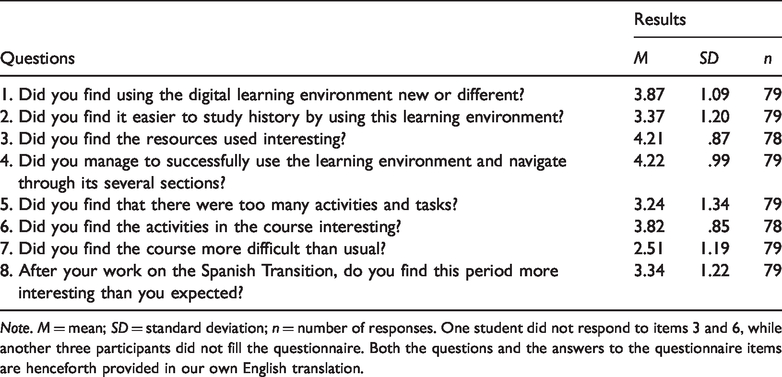
In the first place, and in order to assess students’ perception of the intervention with the digital learning environment, a post-intervention satisfaction questionnaire was filled by participants in written form, which allowed the researchers to obtain open-ended qualitative responses. Students’ qualitative opinions were supplemented by their quantitative responses to the 8-item questionnaire using a Likert scale. The data, which have been summarized in Table 1, indicates the mean values found after analyzing the answers to all questions provided by all three target groups. Results are presented using a 1–5 value range, according to the Likert scale that was applied.
Results of the satisfaction questionnaire concerning the environment.
Note. M = mean; SD = standard deviation; n = number of responses. One student did not respond to items 3 and 6, while another three participants did not fill the questionnaire. Both the questions and the answers to the questionnaire items are henceforth provided in our own English translation.
The first category that was analyzed had to do with students’ perception of how the implementation of the digital learning environment might have affected the
The analysis of the responses indicated that the perceived novelty of the intervention might be related to the use of technology in history education, which was considered something unusual by most participants. In this regard, one student pointed out how “this is something that we very seldom do in other subjects; it is a more dynamic, entertaining way of learning new stuff” (8, group 1). On the other hand, students in one of the groups claimed that they had worked with digital technologies before in social sciences as a result of the innovative teaching practices applied by their teacher. This might explain a lower degree of novelty perception in the answers to the first item of the questionnaire for this particular group (M = 3.44 in group 1, as against M = 4.18 and M = 4.16 in groups 2 and 3, respectively).
Regarding the transformation of teaching methodology, it should be noted that students perceived that they took on a different role from that of passive recipients during the intervention, becoming active participants in the learning process. This was detected by several participants who expressed their satisfaction: “never before had we learnt by doing research ourselves” (59, group 3); “I am grateful for the possibility of putting books aside and studying a subject in a different way” (43, group 2); “it seems to me a better way of teaching and more fun; we work in a more autonomous way” (42, group 2). Conversely, the design of the digital environment was structured so that the teacher gave up their traditional role as transmitter of knowledge and rather acted like a counsellor or guide for students, thus facilitating student learning. This was pointed out by one of the students, for whom the new method was “all-new and different: it’s not just the teacher who teaches the lesson; instead, you do it yourself” (7, group 1).
Regarding the second category that was analyzed, together with the methodological changes, another perceived innovation brought about by the use of a digital learning environment had to do with the
Similarly, their opinions underscored their satisfaction, not just with the resources themselves, but also with the way they were used. 67.9% of the students signaled that they quite or very much agreed that the activities were of interest (M = 3.82), although 41.8% quite or very much agreed that they were too many of them (M = 3.24). The integration of historical sources and resources in the activities was highly valued. For instance, one participant indicated “they are different, original ways of seeing what society was like in former times” (43, group 2), while another one highlighted how “we generally don’t work with videos, cartoons or songs from the period: we always work with the illustrations in our textbook” (68, group 3). A majority of students mentioned the use of songs as their favorite resource because, as one participant puts it, “it was interesting, because you can stop and think about the meaning of those songs” (6, group 1); or, in the words of another, “you realize the connection that exists between those well-known songs and the Transition period” (8, group 1).
In a more limited way, the third category focused on the
Finally, the fourth category was concerned with the perceived
Participants also expressed a positive judgement on other related aspects, including one participant for whom the new environment “looks better than regular textbooks, because everything is more visual and clear” (71, group 3). This very same idea was also detected in the remarks made by a participant in another group, who argued that working by themselves was “more effective than constantly taking notes in the classroom” (51, group 2). In a much smaller proportion, there are skeptical responses about the use of digital resources. For instance, one of the participants described the experience as being “not bad, but I believe that you learn better without technology, because using technology always takes longer” (82, group 2), probably referring to the amount of time required for participants to familiarize with the digital learning environment.
Assessment of knowledge acquisition
Secondly, and given the interest in learning about the impact of using a digital environment on the degree of knowledge acquisition by history students, an initial evaluation of the level of student expertise regarding the Spanish transition to democracy was performed. The initial test mainly focused on factual aspects about the period under consideration, although the questions took into account historical thinking and understanding categories (Seixas, 2017; van Boxtel and van Drie, 2018). The results were compared with a second test conducted during an additional session after finishing with the intervention, once the students had spent three weeks working with historical sources and had been given the opportunity to know more about the period.
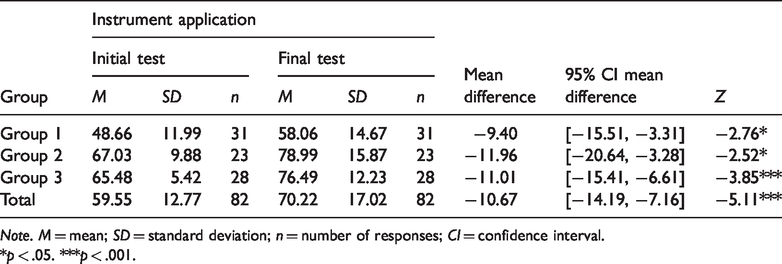
The aim of this analysis was to understand whether the new approach that was implemented during the intervention, making use of historical sources and a new methodology, was useful not only to foster engagement, but also in order for student to learn more about the historical period. The statistical comparison of the results obtained in both tests is shown in Table 2.
Results of the Wilcoxon Test and descriptive statistics for the knowledge acquisition test.
Note. M = mean; SD = standard deviation; n = number of responses; CI = confidence interval.
*p < .05. ***p < .001.
Several Wilcoxon signed-rank tests were used in order to compare the results of the instrument application (for each of the groups and for the total sample), signaling progression towards competence. Regarding the total data set, the Wilcoxon Test evidenced a significant difference between the results obtained before and after the intervention (Z = −5.11, p < .001), which indicated an increase in the average score of the participants after using the digital learning environment (M = 59.55 as against M = 70.22).
This improvement could be perceived in all groups in which the instrument was applied. In the first case, the difference obtained (M = 48.66 as against M = 58.06) also qualified as significant in the Wilcoxon Test (Z = −2.76, p = .006), in line with the results obtained in the second group (M = 67.03 as against M = 78.99) (Z = −2.52, p = .012), and also in the third group (M = 65.48 as against M = 76.49) (Z = −3.85, p < .001). The overall results, which will be discussed later on, indicated an improvement for those participants who joined the intervention with a lower level of previous historical knowledge —particularly noticeable in the first group of students— and for those others who showed a higher level of knowledge about the topic under consideration before the intervention.
Discussion and conclusions
The use of the digital learning environment described in this paper, designed with the purpose of teaching secondary education students about recent history—and more specifically about the Spanish transition to democracy—has provided an opportunity to analyze the effects on an intervention, both in relation to student engagement and to knowledge acquisition. It is important to remember that history education is a field with specific characteristics and with a high potential for interventions supported by educational technology, although some of these possibilities have not fully been explored in history education for quite some time (Green et al., 2014; Swan and Hofer, 2008). From this point of view, empirical studies that try to put into practice new approaches to history education in different contexts with the help of technology can provide useful information.
First of all, the analysis of the methodological implementation in this intervention suggests that participants were able to detect a shift in their ordinary learning routine: one that entailed a higher level of autonomy. At the same time, educators assumed a different role by guiding the learning process of the students and by focusing on how to foster historical thinking competences rather than on how to simply transmit factual information. The implementation of gamified elements was also very well received, allowing students to become more engaged in the intervention, like in other studies that have also applied similar principles (Welbers et al., 2019). The perceived contrast between traditional methods (e.g. mere textbook reading) and a teaching approach more closely focused on the work of historians—and therefore keener on developing analytical and research skills (Reisman, 2012; Wineburg et al., 2013)—were some of the elements that, together with the novelty involved in employing digital tools, seem to have influenced students’ engagement and satisfaction with the intervention.
These results regarding the level of satisfaction shown by students were similar to the ones found in other history education interventions with digital learning environments (Brush and Saye, 2008; Heafner, 2004). In this occasion, just like in the empirical study conducted by Friedman and Heafner (2007), the perceived novelty in the methodology and teaching practices that were used encouraged participants to regard the intervention in a positive light, whereas some of the negative comments generally pointed to an increased workload as a result of the presence of multiple activities. This seems to confirm the conclusions reached by Harris and Haydn (2006), who argued that, in order for students to become invested in the discipline, the learning methodology in history education might even play a larger role than the selection of contents.
The use of platforms like Moodle and Omeka was perceived as particularly useful, and allowed to make the most of the historical resources available in the repository and to embed them into the learning environment. The use of digital media was highly valued by participants and has been acknowledged as one of the key elements for the positive reception of the intervention. Being in contact with digitized historical sources made possible a much more direct and visual exposure to the fragmentary past, corroborating similar interventions where participants highlighted the novelty of the use of these resources (Tally and Goldenberg, 2005). Similarly, the integration of digital media in the learning environment itself did not involve an additional complication for students, either in terms of navigation or in terms of the usability of the digital learning environment, which underscores the potential of the connection between Moodle and the Omeka repository as complementary platforms.
Secondly, the comparison between learning outcomes before and after the intervention points towards a general improvement in all three target groups. The main goal of using a digital environment was to implement learning practices based on the use of digitized historical resources and autonomous research, and to also promote historical understanding during the three-week intervention. As previously indicated, and for the last decades, history education has highlighted the necessity to address historical thinking and understanding concepts with students in order for them to fully appreciate the complexity of history as a discipline.
It is not possible to simply consider first-order or substantive knowledge as the basis of historical understanding, but examining the connection between its different components or factors is a relevant line of research in history education (Ercikan and Seixas, 2015). From this point of view, the results of this study indicate that the focus on the development of historical understanding and the use of digitized historical sources during the intervention might have facilitated substantive knowledge acquisition. This research has consciously avoided a clear opposition between first-order substantive learning and the development of second-order concepts, as both aspects should supplement each other and are non-exclusive (van Boxtel and van Drie, 2018). For this reason, although results are tentative and should be expanded in the future, it should be noted that this three-week intervention might have proved useful in promoting the acquisition of knowledge and a more comprehensive historical understanding about the period under examination.
Limitations and future directions
Among the limitations detected in this study, it should be noted that this particular intervention took place with a total of 86 secondary education students in two different cities. This sample size can be considered relatively small, although the main aim of this study was to analyze the effects of the use of a particular digital learning environment for history education in very specific contexts. Future research might try to replicate this intervention with additional participants in order to establish potential contrasts and analyze how changes in the learning environment may affect students’ perception of the use of the platform and the implementation of a different teaching methodology in history education.
Due to practical limitations, the intervention took place for three weeks. The difficulties for gaining access and conducting research in compulsory education schools made it necessary to establish contact with specific educators that could allow researchers to organize the intervention with the informed consent of the participants. In fact, the Spanish transition to democracy is a historical period that is usually only addressed at the end of the academic year, and Spanish teachers do not always cover this and other recent history periods (Martínez-Rodríguez, 2014). Future research might also consider adapting the learning environment to address additional historical periods and topics to allow for a more comprehensive assessment of learning outcomes and student engagement which might take into account the novelty factor when using educational technologies and innovative teaching practices (Hanus and Fox, 2015).
It should also be mentioned that interventions such as the one described in this research are usually limited when trying to discern some of the outcomes in detail. As previously indicated, student engagement can be influenced by a multitude of factors, including the use of technologies in particular contexts, but also the implementation of new teaching methodologies or the introduction of new historical topics. A series of categories have been used in this contextualized study in order to delve into participants’ ideas, but future research might try to establish a further controls or differentiations with a larger sample. Additionally, this notion could also be applied to the debate regarding the balance between first-order and second-order knowledge and the discussions regarding assessment of historical understanding (Ercikan and Seixas, 2015). In this regard, a series of more refined instruments and questionnaire might be able to go beyond a specific context in order to improve the reliability and validity of future studies.
Despite the limitations, such as the use of self-report instruments used in this particular study, it is expected that future educational technology research will shed further light on how technology and digital media can contribute to improve history education. This might include focusing on how technology can transform the way teachers and students approach history, but also on how to go beyond traditional teaching practices in order to foster students’ historical understanding, motivation and engagement. It is important to remember that making use of educational technology cannot be an end in itself, and that is why a domain-specific approach can provide particular tools and resources that can be valuable to bring history closer to students.
Finally, sharing both the course and the specific activities created around this historical period and designed for the digital environment could encourage the dissemination of the materials designed for this intervention. The open character of the platforms supports the potential transformation and further adaptation of educational resources (Orr et al., 2015), but also their quick implementation in pre-installed digital environments commonly used by compulsory education schools, where Moodle or similar platforms are employed on a regular basis. Due to all these possibilities, encouraging further transformations in history education is possible, and can be achieved by establishing a transformation in teaching practices. The implementation of educational technology can have an important role in this process, allowing students to become more engaged and to develop a more nuanced historical understanding, something that can be further examined in the future.
Compliance with ethical standards
All of the authors have substantially contributed to the research, and confirm that this manuscript has not been previously published and is not under consideration for publication elsewhere. All authors state that they have approved the final version of this article. All information has been collected with the informed consent of the participants and all parties involved in the research.
Footnotes
Declaration of Conflicting Interests
The author(s) declared no potential conflicts of interest with respect to the research, authorship, and/or publication of this article.
Funding
The author(s) disclosed receipt of the following financial support for the research, authorship, and/or publication of this article: This work was supported by the Spanish Government’s Ministry of Economy, Industry and Competitiveness (MINECO), and co-financed by the European Regional Development Fund (ERDF), under Grant EDU2013-43782-P.
