




Abstract
Different educational systems, especially in highly accountable and so-called soft accountability systems place varying expectations on teachers. This study examines how different approaches to school accountability shape perceived roles and responsibilities by teachers. The study was conducted using the discursive dislocation method whereby four English and four Finnish teachers observed each other’s work in authentic situations. Data included observation sheets, daily journals and focus group interviews. The main results reveal that the English teachers have multiple roles in their professional work. The main categories are labelled as how the English teachers described them: ‘hats’, which are Compliance, Teaching, Safeguarding and pastoral care. By immersing participants in unfamiliar environments, the discursive dislocation method made visible the different ‘textures’ of teachers’ roles between the English and Finnish education systems. The textures of English teachers’ roles were not only noticed by Finnish teachers navigating English schools, but also by the English teachers themselves as they observed the Finnish school life. These textures are underlain by different societal expectations on teachers, schools and the education system between the two countries, and the findings of this paper suggest that the English system places a great amount of emphasis on structure, safety and performance.
Introduction
Societal expectations, along with contextual factors and local structures, contribute to teachers’ ability to work and regulate their professional actions (Toom and Husu, 2016). As Juvonen et al. (2024: 410) state: ‘educators are obligated to fulfil societal expectations, and implicit normative expectations and societal discourses on education are always reflected in pedagogical interactions in one way or another’. In this paper, we examine how different approaches to school accountability shape the perceived roles and responsibilities of teachers. Drawing on Högberg and Lindgren’s (2020) categorisation of ‘thick’ and ‘thin’ accountability, we selected Finland and England as educational contexts with divergent levels of monitoring and control. The study uses an innovative research method, discursive dislocation (Santori et al., 2024) where four English and four Finnish teachers were immersed within each others’ work environments to experience authentic, alternative teaching conditions. In doing so, the teachers were able to not only observe, but also experience how different accountability approaches created different types of expectations for teachers. This enabled the research team to compare the two environments along new lines of inquiry, inspired by the participants’ own curiosities, rather than being pre-determined by the researchers. The method is used to explore prevailing beliefs, tacit norms, assumptions and expectations about teachers’ own experiences, practices and broader conditions that shape what is (un)thinkable and (un)imaginable (Santori et al., under review). In this paper, we use these experiences to explore questions of autonomy and accountability, with a particular focus on how societal conditions affect the embodiment of roles and responsibilities for the English and Finnish teachers of this study.
As Wermke et al. (2023: 362) argue, the significance of comparative research is that it allows us to see what is familiar through new perspectives, thus making it interesting and even problematic. According to Salokangas and Wermke (2020), comparative research can show ‘how nation-specific and local (i.e. municipal) steering traditions shape teachers’ autonomy and pinpoint the interrelatedness of various actors at various levels in a school system as a condition for understanding teacher autonomy’ (565). Finland and England with highly contrasting approaches to education and accountability facilitated a more pronounced comparison and, in turn, a more disruptive experience. The teachers were immersed in each other’s school contexts for 3 days. By following the teachers’ curiosities, we became interested in how teachers perceive and embody varied expectations, especially above and beyond those related to ‘typical’ teaching and pedagogical work. As a starting point, we borrow from Wermke and Salokangas (2021) distinction between a ‘true profession’ and an occupation. According to them, the state is important in determining the professionalism for teachers, both in terms of what it means in a particular society and the degree to which teachers can exercise it. Finland represents what is typically considered a very autonomous educational system, where the National core curriculum provides guidelines, values, contents, and objectives for teaching and learning, while pedagogical decisions, or how these are taught, are up to the teacher (e.g. Sahlberg, 2014; Toom and Husu, 2016). This aligns with Finland being a Nordic welfare state with central values such as universal social rights, equality, and commitment to democratic governance (see more Pedersen and Kuhnle, 2017). These principles translate to an educational system that is based on equal, free for all comprehensive school (ages 7–16), and free secondary education (ages 16–18) with a choice of academic or vocational track, continuing to free higher education. Similarly, the Finnish approach to accountability and quality assurance is based on trust, rather than strict methods of measuring (Wallenius, 2020). There are no standardised tests, benchmarks, or measuring of students or teachers. ‘Interestingly, the term accountability cannot be found in Finnish educational policy discourse’. (Sahlberg, 2010: 55).
The professional context of the English teachers is significantly different, often considered a more hierarchical system that values high standards, rigorous accountability and decentralised control. Accountability has a powerful effect on teaching and pedagogy, and according to Hall et al. (2015) the New Public Management ‘reform process in England has largely positioned teachers as the implementers of externally determined changes’ (494). As noted in our previous work (Santori, 2020: 3) the English educational system rests on test-based accountability: the tying of school performance -especially raising student achievement- to processes of accrediting, promoting, inspecting, and, ultimately, rewarding or disciplining schools, heads, and teachers. Although England has tried to reform public education, Clarke and Mills (2022) argue that schooling in England has never been public in a deeply meaningful sense. Thompson et al. (2022), state that ‘[u]nderstanding teachers’ work as a characteristic of the publicness of education systems requires seeing the dynamic work of teachers, the conditions under which they conduct their work and the various mechanisms to support their work as characteristics of a system rather than matters for individuals’ (85). In the following section, we provide the theoretical framework that informed how we made sense of the different contexts described here.
Theoretical framework
Teacher autonomy and accountability
Teacher autonomy has been extensively researched (e.g. Erss et al., 2016; Frostenson, 2015; Haapaniemi et al., 2021; Helgøy and Homme, 2007; Parker, 2015; Usma Wilches, 2007), alongside accountability (e.g. Cribb and Gewirtz, 2007; Ingersoll, 2009). Cribb and Gewirtz (2007) raise a caution against labelling autonomy as good and control as bad. According to them the issue is much more nuanced and requires ‘richer debates about the value of different forms of and balances between autonomy and control’. (Cribb and Gewirtz, 2007: 203). In addition, they state that a model of autonomy control that suits one educational system may not suit another system (Cribb and Gewirtz, 2007: 211). Wermke and Forsberg (2017) have constructed an analytical distinction of service autonomy and institutional autonomy. By service autonomy they refer to teacher’s practice in the classroom as well as the practice of the school. By institutional autonomy they mean professional body of teachers that have legal rights and duties (Wermke and Forsberg, 2017). A comparative study by Erss (2018) shows that ‘teacher autonomy is a concept that depends highly on the institutional, cultural and historical context of the education system in which teachers work. Teachers’ sense of autonomy within the curriculum and institutional context varies from country to country’ (252–253). According to Erss et al. (2016: 591) ‘[t]eacher autonomy is a complex phenomenon that contains philosophical, psychological, sociological and historical-political aspects’. Salokangas and Wermke (2020) define teacher autonomy ‘as something that is actively exercised, rather than passively received’. (566). Based on an extensive four country comparative research project, they have constructed a multidimensional model for examining autonomy (Salokangas et al., 2020; Salokangas and Wermke, 2020; Wermke and Salokangas, 2021), consisting of horizontal domains and vertical levels. The domains are educational, social, developmental, and administrative. The educational domain refers to activities and responsibilities related to teaching and learning, including but not limited to planning, instruction/deliver and assessment/evaluation. The social domain includes the grouping of students, disciplining and special needs. The developmental domain refers to the degree of involvement in the professional development of the staff and school. The administrative domain refers to decision-making concerning timetabling, use of resources or other functions the teachers can be involved in (Salokangas and Wermke, 2020: 569-570). The levels are classroom, school, and professional. The classroom dimension refers to, for example, teacher’s choice of taught content and methods. The school level contains cooperation, collegiality, relations with parents and other actors in the school. The professional level refers to teachers’ academic knowledge base, status, education and so on. (Salokangas and Wermke, 2020: 569). In addition, Wermke and Salokangas (2021) consider that autonomy in education is dynamic, as well as that autonomy and control can be high and low at the same time, thus they are not opposites. Wermke and Salokangas (2021) have extended their definition of teacher autonomy by constructing a model, which they call the autonomy mindset model. It illustrates limited and extended control continuum and limited and extended decision-making continuum. This model can be used to examine or compare different aspects of the teaching profession, but also the teaching profession holistically. The mindset model demonstrates complexity of teaching, along with the degree of risk involved. The less risk teachers are willing to take, the less autonomy they have, and someone else takes the responsibility of making decisions (Wermke and Salokangas, 2021: 79). These differing governance arrangements have been called input and outcome regimes (e.g. Hopmann, 2003; Wermke et al., 2019), with outcome regimes controlling teachers through outside agencies are often coupled with high-stakes national exams and other forms of accountability (Salokangas et al., 2020: 331). These have been found to have negative effects on teachers (Ingersoll et al., 2016; Kaynak, 2020).
Finnish teachers have had a great degree of pedagogical autonomy and freedom in their work for decades (see e.g. Chung, 2023; Tirri, 2014). It is widely accepted that Finnish teachers are trusted as professionals, have pedagogical autonomy, and exercise a high degree of freedom to realise their work (see, e.g. Niemi, 2016; Sahlberg, 2014; Toom and Husu, 2016). In Finland the national curriculum gives very broad guidelines and does not restrict the pedagogical autonomy of the teachers (e.g. Simola, 2015). Furthermore, the teaching profession is highly appreciated in Finland (Juvonen and Toom, 2023) and valued by the greater society (OECD, 2020). In Finland, the pupils’ national testing is conducted on a sample-based method and no school performance results are publicised at the school level (e.g. Wallenius, 2020). Standardised tests and measuring are almost non-existent in the Finnish education system, neither are the teachers evaluated or inspected. In a study by Maaranen and Afdal (2020), it is shown that Finnish teachers do experience a lot of professional space and trust. Maaranen and Afdal (2024) conclude that great degree of autonomy is integral in the Didaktik tradition, thus Finland can be characterised as an input control governance (e.g. Wermke and Salokangas, 2021).
England, on the other hand, can be considered more of an output control governance, where the high-stakes accountability system is based on standardised assessments, end of secondary examination (GCSEs), and a consequential inspection system (e.g. Skerritt, 2019). Students navigate multiple assessment points throughout their schooling. Alongside testing, Ofsted inspections play a central role in the accountability system, producing reports and classifications to inform school choice. These judgements carry high stakes, influencing reputation, enrolment, and in some cases triggering mandatory academy conversion for low-performing schools (Perryman et al., 2023). The current Education Inspection Framework (EIF) introduced a focus on curriculum intent, implementation, and impact (Tian, 2024), but the system remains widely criticised for its punitive nature, which has been associated with teacher de-professionalisation and high turnover (Bousted, 2020; Perryman, 2006). Additionally, the emphasis on performance data and inspection outcomes has narrowed curricula, with schools focussing disproportionately on test preparation (‘teaching to the test’) (Bradbury and Roberts-Holmes, 2017). It has also intensified the datafication of education, with teachers required to continuously collect and report pupil progress data, thereby increasing workload and surveillance pressures (Roberts-Holmes, 2015). Teacher stress and burnout have received mounting attention over the past two decades, with headlines warning of an ‘epidemic of stress’ in England (see Asthana and Boycott-Owen, 2018). As noted by Allen et al. (2020), workload—such as overly-bureaucratic requirements for planning, marking, and data entry—are driving teachers out of the profession (DfE [Department for Education], 2018; Gibson et al., 2015).
As shown, the English accountability system sets clear requirements for teachers’ work and the degree of autonomy they have, which significantly differs from that of the Finnish teachers. However, as Erss (2018) states ‘[l]imitless autonomy is not an ideal for teachers’. (253). Furthermore, Cribb and Gewirtz (2007) list four arguments for state control of teachers, which are: Firstly, protecting learners from harm. Secondly, ensuring equal access to education. Thirdly, teachers not needing to make too many decisions. And fourthly commonality and cohesion, which means commitment to a common educational experience (Cribb and Gewirtz, 2007). Also Wermke and Salokangas (2021) conclude that increasing teachers’ professional autonomy might not lead to desired outcomes, because it increases complexity and risk in their work. Thus, there are also arguments that, to some degree, control and limitations to work can be helpful for teachers.
Research methods
Discursive dislocation
This study draws upon an emerging qualitative method called discursive dislocation (Santori et al., 2024). Discursive dislocation draws across methodological traditions of methodological reflexivity (Pillow, 2015), embodied research methods (Liu, 2023; Thanem and Knights, 2019), participatory research (Anderson et al., 2015; Kemmis, 2006), and critical policy studies (Bacchi, 2012; Ball, 2003). A distinctive feature of discursive dislocation is the immersion of participants within contrasting environments as a way of provoking new forms of reflexivity (for the researchers and participants). We contend that being exposed to professional practices in a contrasting regulatory environment could enable participants to identify and critically examine normalised aspects of their own beliefs and practices, making explicit their unspoken certainties, and even question the material and discursive conditions that shape their own practice and sense of self. In line with embodied research methodologies, the immersive experience, which we detail below, attempts to produce knowledge through the body, rather than of the body, bringing the physical, material, sentient, feeling and emotional body into the research and knowledge production process (Liu, 2023). What we argue is that, by physically experiencing an alternative version of a given context (i.e. in this case, a school in a foreign system), the subjects become better able to understand how the conditions of their ‘home’ environment have shaped their views, identities, and trajectories. While observing ‘others’ is an important part of the immersion process, it is the felt and embodied experience that is meant to provoke new insights for the participant (and thus the researcher). Discursive dislocation builds upon co-investigative practices and participatory methods that move primary data collection directly into the hands of research participants themselves (Porter and Dungey, 2021), enabling the direct integration of participants’ perceptions, interests, and viewpoints into the research focus and data collection process. So, in the Discursive dislocation method, it is the participants themselves who collect and produce data as they are interpellated by the foreign system. Data collection then becomes a means for their exposure to a different discursive environment that will bring their own certainties, assumptions, and expectations into question. What sets this method apart from existing participatory methods is that, rather than examining participants’ interpretations of their own context (something that has already been done in participatory research), it immerses them in a contrasting context to elicit self-reflection and self-questioning.
Data collection
Four English and four Finnish teachers participated in this study. Participating schools and teachers were recruited via existing connections of the researchers. Participation was voluntary and required permissions were obtained from individuals, schools, and governing bodies. First, the English teachers visited the Finnish teachers’ schools and classrooms for three full days; afterwards, the Finnish teachers visited the English teachers’ schools and classrooms, also for 3 days. The visits that were organised by the researchers were funded by research grants from the researchers’ universities. The participants observed classroom teaching, conducted peer interviews with their partner teachers, and met with other school personnel (e.g. headteachers), essentially shadowing their counterparts. Participants had a schedule designed by the host institution, but could request specific areas they would like to observe. For data collection, the teacher-participants used observation sheets, wrote daily online journals, designed and recorded individual interviews with their exchange partners, and participated in a culminating focus group interview with the research team (English and Finnish teachers attended separate focus groups). The observation sheets included a column for detailed descriptions and another for participants to record subjective impressions, questions and reflections. Daily journals were reflections after each day, in which the teacher-participants could complement their daily notions more thoroughly. The focus group then added to that by summarising the experiences, sharing thoughts and reflecting. For this study, we have analysed observation sheets (OS), daily journals (DJ), and focus group interviews (FGI).
Methodological limitations
It is worth noting that immersing practitioners in contrasting environments presents some challenges that have budgetary and logistical implications. In our study, it required liaising with Local Authorities and School Senior Leadership for approval, as well as teacher replacement arrangements for the duration of the immersion. Participating teachers also had to do some training on qualitative data collection techniques (observation, interviewing). Moreover, for our use of discursive dislocation, institutional ethics requirements also created unforeseen challenges, ranging from questions about the participant-researcher role (e.g. how will anonymity work if those doing the interviews are participants?), as well as travel concerns, like insurance coverage for non-university travellers. In our case, we worked closely with King’s College Ethics Department to navigate these challenges. Thus, these factors should be considered when designing a project of this nature, and the team should remain flexible as they navigate various constraints (e.g. minimising geographical distance). As methodological limitation we must recognise that the teacher-participants form subjective conclusions based on a very short visit to another context. Thus, their conceptualisation of the contrasting educational system was based on a snapshot and can also be formed based on a misinterpretation of a situation. In addition to that, due to practicalities, discursive dislocation is limited to a restricted number of participants, thus large samples and generalisable findings are not reachable. Despite its limitations, this project generated rich and nuanced data that provides new ways to think about the relationship between teachers, their practice, and the societal expectations that shape their roles and responsibilities.
Analysis
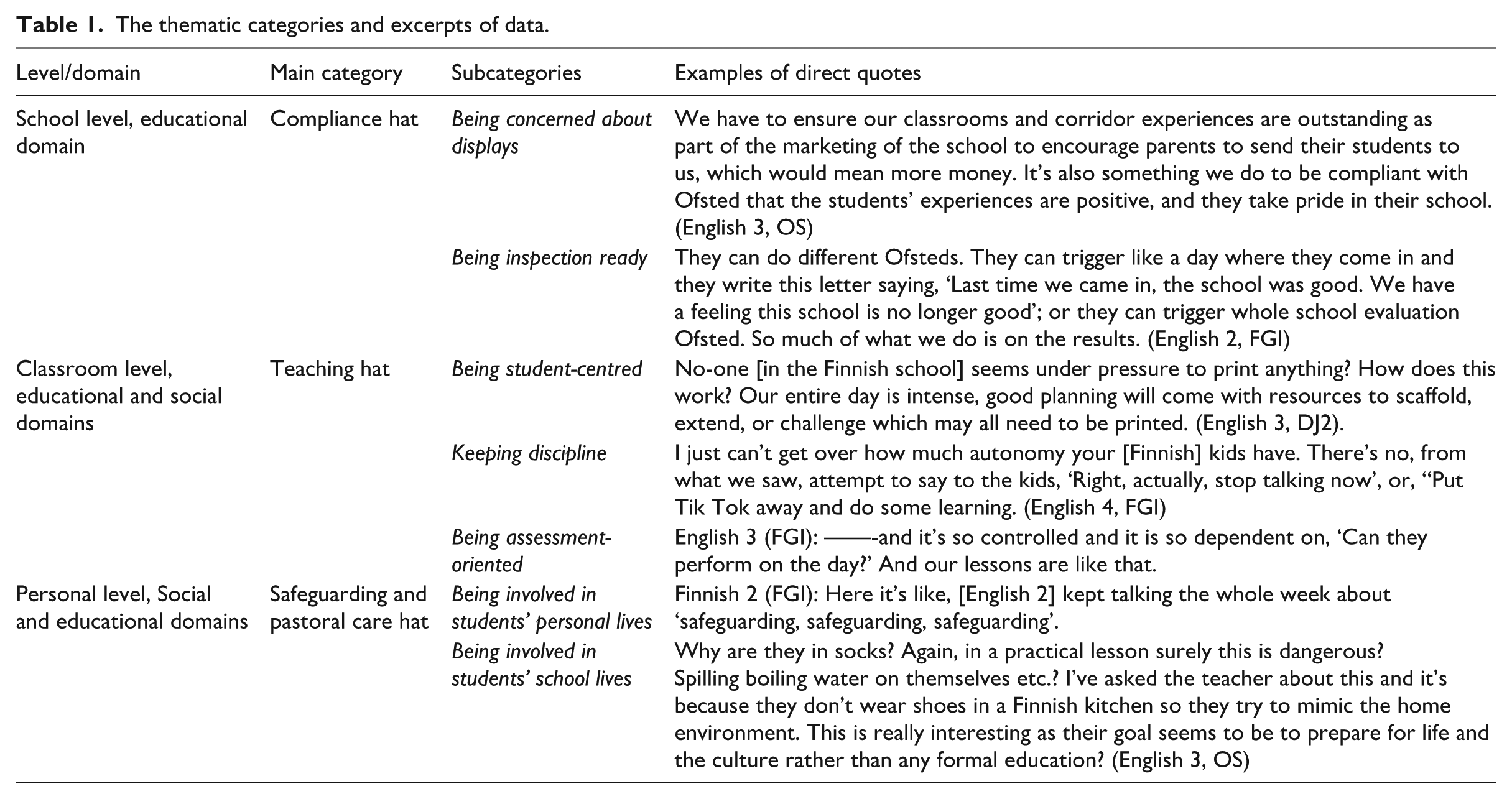
By facilitating a space to interrogate unspoken certainties and normalised aspects of teachers’ beliefs and practices, our analysis attempts to bring texture and nuance to otherwise artificial compartmentalisation of professional practice. In order to identify the roles and societal expectations of English teachers, as perceived by the English and Finnish teachers respectively, the data were analysed using NVivo via an inductive thematic approach. To analyse the various forms of data, we began by open coding to understand the scope and substance of the corpus. We also used analytic memoing to track our ongoing thinking and theorisation, while meeting regularly to discuss what we were finding. A combination of hand-coding and NVivo has been used to chart regularities in the data in relation to particular themes and identifying both prevailing tendencies and discrepant cases (LeCompte and Preissle, 1993). After several rounds of close reading, lower-level codes pertaining to teachers’ perceived and expected roles were identified, producing a total of 135 references. These codes were then organised into categories and subcategories, with the categorisation being negotiated among the authors multiple times in order to produce a set of findings that best addressed the research question while ‘staying true’ to the participants’ experiences and the empirical materials they helped produce. The final categories, explored in detail below, are: Compliance, Teaching and Safeguarding and Pastoral Care. We label the main categories as ‘hats’, based on how one English teacher (1) described them: ‘The job role looked different [in Finland]. Whereas we wear so many hats; we are not just teachers’. Although the analysis was inductive, we have abductively related the emerging categories to metalevels, modifying the levels by Salokangas et al. (2020) in their matrix of Teacher autonomy as multidimensional construct, consisting of aspects related to decision-making and control. Table 1 shows the levels the teachers operate on, the three main categories (hats) and associated subcategories, and examples of teachers’ expressions to illustrate the categorisation rationale.
The thematic categories and excerpts of data.
Results
The compliance hat
The compliance hat consists of two subcategories, which deal with issues related to how the schooling should look to outsiders. The compliance hat can be understood as a school’s adherence to and conformity with external laws, regulations, standards, and internal policies. In Salokangas et al. (2020) model of control, this corresponds to the school level, and educational domain. We have identified the subcategories of Being concerned about displays and Being inspection ready illustrating the dimensions of this hat.
Being concerned about displays
This subcategory contains notions and thoughts about how the school buildings and classrooms are arranged and presented. While visiting the Finnish schools, the English teachers noticed that the classrooms were ‘not engaging, bright or even uniform’ (English 3, OS). They brought up issues related to educational material on the walls (present in English schools, missing from the Finnish), tidiness, and cleanliness. For example, in the following extract the English teacher brings up how much work the decorating is: I’ve realised today that every display on the wall [in Finland] is pupil work. It looks tatty. Is it above Finnish teachers to expect them to improve the environment of their classrooms? Is this a difference in teacher compliance, English teachers spend hours preparing, printing, laminating, and putting displays up. We care so much more about the environment and aesthetics. (English 3, DJ2)
The English teachers also brought up the school identity and marketing of the school to prospective parents. The schools and classrooms need to look good to attract future students and thus secure funding and maintain reputation (cf. Clarke and Mills, 2022). Ofsted inspections also affect how the school’s physical surroundings and appearances should look (cf. Perryman, 2009), with reports usually noting how spaces should be kept and used for a positive learning environment. In Finland the schools automatically enrol students from the neighbourhood, and it is unusual for a student to choose (and apply) to a different school, rather than attending the one closest to their home. The schools are not inspected by any external agency. The students’ artwork or educational poster presentations are the most common decorations in the Finnish schools.
Being inspection-ready
In this subcategory, the significance of inspections in the English teachers’ work becomes evident. The English teachers are both prepared to act as inspectors, but also take future inspections into account in everything they do (cf. Perryman, 2009). The Finnish teachers were surprised to see how dominant the inspection element is in their work, which is non-existent in Finnish schools.
I thought I was getting used to this system of constant testing and inspection, but it managed to surprise me again. The teachers sit and assess each other’s lessons (every second week!!!). And for A-level practice books, everything needs to be scanned and marked FOR INSPECTION, not for student, not for teacher, not for teaching. Solely for the inspection. (Finnish 3, DJ3)
On the other hand, for the English teachers the inspection ‘mode’ comes naturally, and is a part of their daily work, as well as being aware of possible unannounced inspections, as is visible in the next extract: I wonder will the Finnish teachers write or record as much as we do throughout the day? We are so used to observing lessons, being observed, performing to criteria, it’s second nature to me to watch a colleague teach and spot trends, moments, areas of success and [areas] to improve. I wonder will they feel uncomfortable in the process as they really comment that they do not get observed nor do they observe anyone else. (English 3, DJ2)
In Finland, as there are no inspections, the teachers are not used to being observed or their work being analysed. Neither is there a description or definition of a ‘good teacher’ or a ‘good lesson’, nor are the Finnish teachers trained for this (e.g. Maaranen and Stenberg, 2021). For the Finnish teachers, the inspection system seemed controlling, and diminished the English teachers’ autonomy, as is visible in the following extract: — you said the keyword in my mind, which is “autonomy”, which we actually have, and are confident in our teaching; and we can really kind of take the role of a teacher; instead of being continuously monitored or inspected or watched over; and we can actually decide what to teach instead of being told. Of course, we have the curriculum. Maybe the biggest thing is this autonomy of the teacher which stands out; which we have and they don’t. (Finnish 3, FGI)
Teaching hat
The teaching hat consists of issues dealing with pedagogy and schooling. The teaching hat can be understood as belonging to the classroom level and educational and social domains as in the Salokangas et al. (2020) matrix. Three subcategories formed, comprising: Being student-centred, Keeping discipline, Being assessment-oriented.
Being student-centred
The student-centred teaching ideology was defined very differently by the English and the Finnish teachers. The Finnish teachers considered student-centred teaching such where the students are active participants and responsible for their own work, whereas the English teachers felt that they needed to be on top of the students’ learning, and ultimately being responsible for their students’ experience and performance. The Finnish teachers found the English ability grouping stressful, whereas the English teachers thought that the Finnish school was not challenging enough: ‘The higher ability students in this school seemed bored. They’re not challenged and they’ve been let down’. (English 4, DJ3).
Finnish 3 (FGI): Well, I can start. Before kids come to secondary school, they have a nation-wide exam. . .. Finnish 4: SATs. Finnish 3: . . .which puts them into these level groups; and they teach either foundation, which is the lower level, or the higher paper which is the higher level. The kids are always pushed forward. So they can never reach a level where they would be good enough. They could never reach that. So if they are very capable, if they are kind of—if they are doing really, really well, they are still pushed. “You can go further”. So kind of having this mentality that “you are never, ever good enough”, of course, it creates mental health problems for kids that are in puberty and struggling with other stuff, too. And maybe the school results are not the most important stuff.
The differences in the atmosphere of the schools in the two countries was also visible to the teachers. The Finnish school seemed very relaxed, and even lax in the eyes of the English teachers, whereas the English school was perceived as more formal and faster paced, as can be seen in this observation: It seems like what we are seeing is classrooms built on respect and relationship building. The students call teachers by their first names, ask for help when they need it, and the teacher circulates and provides 1-1 support more than what we would see. In comparison of teaching styles, I think we teach at a faster, more intense pace with a lot more direct instruction because in our eyes they need to know the content and we need to fit it all in before the exam! (English 3, OS)
The English teachers drew a clear distinction in how much they had to invest into their work compared to the Finnish teachers. According to them, they simply work much harder than the Finnish teachers do (cf. e.g. Arthur and Bradley, 2023), which could also be described as work intensification (e.g. Thompson et al., 2022). The English teachers saw differences in the lesson planning, using teaching materials, engaging students, ‘selling’ the lesson to the students, and in general being responsible for the students’ success. For the English teachers, the Finnish teachers seemed lazy, stating that in England that teaching would not be considered ‘good’, but instead would result in consequences. However, at the same time they were able to consider the cultural difference as an explanatory factor for what was viewed as ‘lazy’, as can be seen from the following extract: English 3 (FGI): I am totally conscious that we are totally conditioned to expect what a standard teacher looks like. So what I saw was as “lazy” was a lack of planning, no differentiation, no real engagement, nothing stimulating. The teachers that I spoke to were under pressure; their timetables were heavy, heavier than what we would teach. But I think they were capable of teaching it. Because for me, they didn’t put any effort into it. There was no real forward planning. . . opening a textbook and just getting on with it. And that must be how they survive. So it looked lazy to me but I understand that if that happened in an English school, if I saw that in an English school, that person would be cause for concern; work plan, still on probation, fingers crossed they are, and get rid of them quickly. . .. English 2: Yeah, and that actually would be - and if the teachers were put into our primary school, we would call it “lazy” in our setting. But here, to me, it seemed a bit more relaxed and that they were more autonomous and they had this trust; “you know what’s right”.
Keeping discipline
The English teachers were overwhelmed by what they considered a lack of discipline and manners in the Finnish schools. They considered the behaviour of the Finnish students rude, and were amazed at how the teaching staff did not address the behavioural issues in any way, as can be seen from the following extract: I am a teacher who likes to control the room and has very high expectations for behaviour. I witnessed a student banging his chair throughout a video, one who drew all over his book, and one who wrote an insult on the wall. Each of these would have been challenged and sanctioned in my classroom and by letting it go I would be concerned that the behaviour would gradually deteriorate and the level of respect would decrease. The level of respect in the room is much lower than I would expect. At one point a student poked a teacher with a pen to get his attention, another called, ‘teacher, help me.’ For me, behaviour like this would be rude in the adult world so it should be challenged by a responsible adult. (English 4, DJ1)
The quote above shows very concretely the differences in the societal and the school cultures between these two countries. Finnish society and its education system has adopted informal and equal manners, which seem in stark contrast to English culture. However, during the observation visits, the English teachers began to question the rules of the English system, and reflected on the reasons for the strict manners, as is visible in the next quote: Why do we care so much? I’m reflecting that we are so uptight on classroom behaviour, students here are literally brushing hair, applying lip gloss, on their phones, listening to music during actual teaching time. They are not looking at the teacher when they are speaking. Where is the respect? Do we demand respect from the students and measure it based on their behaviour because society in England does not respect teachers as much as here does? (English 3, DJ2)
The Finnish teachers could not understand the strict classroom rules, such as not allowing a student to go to a bathroom in the middle of the lesson. For the Finnish teachers, this seemed to reflect strict behavioural norms and obeying the teachers’ authority. Contrary to that, in the Finnish context they would have considered the individual students’ basic needs as a priority, as well as not causing problems for anyone else in the classroom. The English teachers noted that their controlling environment caused situations where they themselves see that it is not necessarily the best way to act, but they are forced to do so because of the monitoring structures of the education system. The pressure of covering contents on a specific and tight timeline seemed to cause the teachers pressure to keep discipline in situations where they evidently realised that it would not lead to the preferable result, just as Biesta (2015) describes as assessing becoming an end in itself (see also Skerritt, 2019).
Being assessment-oriented
The English system relies on standardised testing and consequential inspection to monitor progress and performance. For instance, the Ofsted inspections require the English teachers to be prepared, and they need to rehearse for the Ofsted interviews (cf. Santori and Holloway, 2023). For the Finnish teachers, the fact that testing and measuring played such a controlling role in schooling felt overwhelming, and their observations resembled Ball’s (2003) notions of fabrications and performativity.
Finnish 4 (FGI): And most of the secondary school classes were going through GCSE markings schemes only; to memorise what they want, specific words in physics and chemistry. A good example was that a question required the student to define “current” and the correct word was “flow of charge” but “flow of electricity” was a loss of two points. They had to memorise because they used this test battery as their basis of grading, that grades the school; that the students have to know things by heart; because someone might inspect them; and someone will take a look at some headline figures; and the headline figures that they publish each year are the rates at which students pass their Maths and English. 40 per cent of students don’t pass Maths and English. How is that possible? And then they say the system is so great; but still they don’t have passes.
To the Finnish teachers, it did not seem to make much sense to practice exact wordings instead of gaining a more comprehensive understanding of a phenomenon. Furthermore, the Finnish teachers were shocked by the rehearsing for the upcoming standardised assessment which seemed like ‘teaching for the test’ to them, as is visible in the next quote: Finnish 3 (FGI): In the English exam yesterday, when I sat in the English lesson, they were doing this text analysis. And they were to give an opinion. And then one guy put his hand up, “If we get a text like this, we should always agree.” And the teacher said, “No, that is question 4. In question 4, you always agree. But this is question 5 and there you can give your own opinion”. So the exam is always having the same question; the only thing that changes is the text. “In text 4 you have to agree”——- Finnish 1: Oh, my gosh.
This extract shows the focus of the English school on specific details that might be tested in the upcoming external exam. This further confirms the differences between the systems regarding the purpose and meaning of education: the details and specifics of a phenomenon that will be tested and assessed, or a more comprehensive knowledge, which the Finnish teachers consider to be the core of the Finnish education system. Moreover, the clear difference between the two educational systems is the grading of the students. In Finland, the teacher gives the grades based on their own assessment. There are no standardised tests in the Finnish comprehensive school (grades 1–9).
Finnish 4 (FGI): Yes, “if the student is underperforming [in the English school], it’s always the teacher’s fault; because they haven’t taught them this and this marking scheme”. [English 3 and English 4] told us that if they taught in our system, where they had to decide the final grades, they couldn’t bear with the guilt, they said.
However, through observing Finnish schools, the English teachers also began to critically question the testing culture of their own system, and how it shapes their planning and teaching: I’m wondering if the British system is so pressed to teach content for the exams that we overlook the fact that most students completely forget the majority of the knowledge once they finish the GCSEs. If this is the fact, then why do we spend so long fighting to get students to remember content for an arbitrary amount of time? Here [in Finland], they learn it, assess it, move on. Why do students need to remember the 8 energy stores for exactly 3 years? Just because someone at AQA decided it. Yes, there are skills and processes that students need to keep on top of but is the knowledge as important. What use is there in society for every 16-year-old to know the function of mitochondria? (English 4, DJ2)
The English teachers questioned their own controlled environment and assessment-focussed schooling when comparing it to the Finnish education. They were able to pinpoint the challenges that testing and measuring causes for the students, but also the pressure and demands it places on the teachers.
Safeguarding and pastoral care hat
The safeguarding and pastoral care hat is divided into two subcategories associated with how the teachers are involved in the students’ lives. We view this hat belonging to the personal level, which does not belong to the Salokangas et al. (2020) model but is our expansion of the model. This hat also belongs to the education and social domains. Firstly, we explain Being involved in students’ personal lives and secondly, Being involved in students’ school lives.
Being involved in students’ personal lives
Based on the data, a teacher’s role in England contains a significant responsibility of being explicitly involved in the students’ personal lives. This falls under the notion of safeguarding, which is a legal duty of the school (e.g. Baginsky et al., 2019). The teachers noticed a stark contrast with Finland in this matter, because in Finland the concrete task, for instance getting involved in the family life, belongs to the social workers.
English 1 (FGI): The job role looked different [in Finland]. Whereas we wear so many hats; we are not just teachers. You are there through the nurturing side, the safeguarding/protection side. You have got so many hats to wear. Whereas it just doesn’t feel like that here. And I think about, it’s more relaxed. When we are observing primary school [in Finland], that person’s only job there is literally what the teacher - get them to do the work, that she wants them to do in that lesson.
While both Finnish and English teachers recognised the need to act if concern over a child’s welfare is raised as part of their responsibilities, the English teachers claimed to be responsible for student behaviour outside school, as is clearly visible in the next extract from the focus group interview: English 3 (FGI): And regardless of the absolute work that we put into children and they might take four hours of that day, just trying to get them to “sit down, be quiet, do this”, they might still go out, meet a drug dealer, carry a knife and sell drugs. So much of it is on home, but the blame is always on schools.
Safeguarding and pastoral care for the English teachers extend beyond the school day and the school premises (cf. Baginsky et al., 2019). It extends to the teachers’ feelings of guilt and receiving blame if a child’s personal life goes off track, such as getting involved with illegal substances or crime. In the English teachers’ opinions, this seems to be different in Finland. To them it seemed like the Finnish teachers do not need to get so deeply involved with the students’ personal lives.
Being involved in students’ school lives
While observing the Finnish schools and the Finnish teachers’ work, the English teachers noticed many safety, security, and safeguarding issues being very different from England. They were very concerned about safety issues in the Finnish school, such as the Finnish students not wearing shoes in the school building, and potentially harming themselves with hot water, knives (home economics classroom), or chemicals in the laboratory experiments. They also noticed that the Finnish schools do not have fences, and students can quite freely walk around or even in and out of the school building. Furthermore, they noticed that the Finnish teachers could have been by themselves in the classroom with the students, without windows to the corridor or a door open, or someone else checking on them. This illustrates the ethos of trust in the Finnish society (e.g. Tirri, 2014; Toom and Husu, 2016), whereas it was a potential security issue in the English teachers’ minds, such that could happen when provided with too much autonomy (e.g. Cribb and Gewirtz, 2007), as is visible in the following quote: We are literally ten minutes into the lesson directly after break, why is this child going to the toilet? Their idea of lessons in so informal they do not seem bothered to miss any learning. The child isn’t questioned, just leaves and comes back. Where is the safeguarding that this child could just walk off site? (English 3, OS)
Moreover, the English teachers concluded, that the Finnish teachers seem not to fear consequences: ‘From what I see, these teachers do not fear being sued or being [held] negligent as we do’. (English 3, OS). This reflects how broader social imaginaries shape institutional frameworks and professional practice. In the English context regulatory frameworks are the cornerstone of professional practice, with very little room for interpretations. The liability culture referred to by English 3 evidences how teachers’ actions (in accordance with school policies) are designed to pre-empt risk (cf. Wermke and Salokangas, 2021).
Discussion
In this study, the teachers’ experiences with discursive dislocation helped expose how teachers internalise society’s expectations of them, to the extent to which it was difficult for them see different conditions as having much value. Juvonen and Toom (2023) highlight the implicit and explicit expectations that the society sets for teachers. In Finland there seems to be less explicit expectations compared to England, as there are no testing, inspections or even similar safeguarding requirements. Implicit expectations, however entail what a ‘good’ teacher and school should be like in both education systems. As the analysis illustrated, teachers from both countries struggled to see the ‘other’ group as following good teaching practice. Extending previous literature that has looked at teaching practices, roles and responsibilities, (e.g. Chatelier and Rudolph, 2018; Eacute and Esteve, 2000; Lauermann, 2014) this paper adds another dimension to our understanding of how teachers embody these expectations and how such expectations become internalised and normalised. In doing so, teachers’ capacity to see otherwise becomes quite limited, and being immersed within other environments can help break down these ontological boundaries.
Despite the significant differences in how the Finnish and English teachers experience the expectations placed upon them, they both work in the best interest of the children and students. Nonetheless, they are constrained by two very different societies, cultures, and education systems that set the conditions for the teachers’ professional work. The ‘hats’ clearly show the constraints the accountability regime (i.e. Biesta, 2010) places on the English teachers. The ‘hats’ are clearly identifiable for the English teachers, but unfamiliar to the Finnish. The Finnish teachers do not identify with the Compliance hat or the Safeguarding and pastoral care hat, as they are understood in the English teachers’ context. While previous comparative studies have drawn attention to different ways accountability and autonomy operate in places like England (e.g. Perryman and Calvert, 2019) and Finland (e.g. Sahlberg, 2014) the teachers’ immersive experiences from this study allowed for a deeper understanding of how such systems produce particular types of norms and embodied expectations for teachers. Similarly to our case, the findings by Skerritt (2019) show, that being exposed to a contrasting educational system makes it possible to compare them. The Irish teachers in Skerritt’s (2019) study experienced the English high-stakes accountability as overwhelmingly negative. In our study, the teachers’ encounters with difference helped highlight the ways such norms shape what they view as good or bad teaching practice and disposition. This also helped them, and therefore us (the research team), surface some of the normalised means for accountability and autonomy, particularly as they are often conceptualised as external forces that teachers resent or even try to resist (e.g. Hall et al., 2015; Ingersoll et al., 2016). This study shows just how deeply internalised and naturalised these logics have become in everyday practice, as well as how teachers view their own professional responsibilities and autonomy.
Viewing the multidimensional model of teacher autonomy by Wermke and Salokangas (2021), the heavy accountability and monitoring infrastructure of the English system places stronger emphasis on social and administrative dimensions, while the Finnish system seems more focussed on the education dimension. As to control and decision-making power (i.e. Salokangas et al., 2020), English teachers are often seen to be controlled on all levels of school, classroom and personal. They are bound by the excessive testing and inspection systems in the school as well as in the classroom, when having lessons. Our findings translate to the mindset model by Wermke and Salokangas (2021): holistically viewed, the English teachers’ profession allows them to take very little risk in their work, and thus their decision-making possibilities are limited. Due to the marketisation, but also Ofsted inspections, they must be business-minded regarding their school, as the school’s future funding and even the teacher’s own future can depend on the success of the school (e.g. Bradbury and Roberts-Holmes, 2017; Clarke and Mills, 2022; Perryman, 2009). Rather than using a normative view of what accountability or autonomy should look like from a research perspective, this study illustrates how the teachers themselves have internalised views about their responsibilities.
The Finnish society operates with a soft accountability tradition (see e.g. Afdal and Maaranen, 2023; Maaranen and Afdal, 2024), and can be called input control governance (e.g. Wermke and Salokangas, 2021), whereas England as an outcome regime (e.g. Wermke et al., 2019), operates on the other end of the continuum with heavy accountability (e.g. Santori, 2020), or what Clarke and Mills (2022: 23) describe as a: ‘neoliberal education project with its toxic mix of deregulation, competition and performativity-driven accountability’. As Cribb and Gewirtz (2007: 211) have stated, one kind of autonomy control model may suit one educational system would not suit another, thus the local context frames the amount of professional space the teachers have (see also Maaranen and Afdal, 2020). In England, teachers’ perceptions of societal expectations seem to revolve around accountability, such as assuming responsibility for the students’ academic success, as well as meeting requirements for external inspections for quality assurance. Studies by Skerritt (2019) and Miller (2018) have found similar results when examining foreign teachers in England. In Skerritt’s (2019) study of Irish teachers in England, the teachers experienced the English system as highly stressful due to the high-stakes accountability. Furthermore, the teachers in Skerritt’s (2019) study found that some accountability measures, such as markings, were taken because of the requirement and inspection, not for the students’ benefit. In addition, our findings show that the perceived expectations for the teachers extended beyond the pedagogical, and into the realm of the overall school appearances and premises. For example, safeguarding played a significant role in the observations and reflections of the participants of this study. On the contrary, Finnish teachers’ work seemed much more relaxed to the English teachers, who went as far as describing the Finnish teachers as ‘lazy’. The teachers’ projections of their own experiences and understandings onto the ‘other’ system created these sorts of categorisations of what they interpreted as ‘different’ behaviours. What this study shows is that teachers’ own experiences and understandings of ‘norms’ shapes how they perceive different environments. This is particularly important when thinking about the effects of societal conditions and how these shape the expectations for and responsibilities of teachers (cf. Juvonen et al., 2024).
Conclusion
By immersing participants in unfamiliar environments, the discursive dislocation method made visible the different ‘textures’ of teachers’ roles between the English and Finnish education systems. These textures are underlain by different societal expectations between the two countries for teachers, schools, and the education system, and the findings of this paper suggest that the English system places a great amount of emphasis on structure, safety, and performance. The core responsibilities of the teachers relate to similar aims, but the expressions of these responsibilities are inexplicably tied to the cultural, political, and historical conditions of each country. This means that external forces, but also internalised beliefs and assumptions about the role and responsibilities of teachers in society influence the teachers. These aims are framed almost entirely by the neoliberal discourse that shapes UK schooling more broadly. In contrast, Finnish schools might have similar aims, but these are framed by the more collective, welfare ethos of the country. For example, Finnish schools might value wellbeing of the entire school community, as opposed to safety, expressed through notions of trust, autonomy, and individualism. The methodological implications of this study show that the discursive dislocation method can contribute to knowledge construction and educational research in a novel and innovative way. It enables us to surface the insider perspective through immersing the participants in unfamiliar, yet professionally familiar, contexts and engaging them in data production. This suggests that exploring unknown – the issues we do not yet know could offer an alternative starting point for education policy analysis, one that interrogates taken-for-granted, deeply rooted imaginaries and normative assumptions. This contrasts with more conventional methods that collect data through direct inquiry by researchers. Moreover, this study showed how participants’ thinking evolved during immersion and reached a point where they were able to go beyond the surface level of material and discursive difference to critical reflection and deeper understanding. What began as relatively impulsive responses to a different system evolved into critical reflexivity of their own professional self and environment.
Footnotes
Acknowledgements
We would like to thank the schools and teachers that participated in the study for their unwavering support and invaluable contributions.
Declaration of conflicting interests
The authors declared no potential conflicts of interest with respect to the research, authorship, and/or publication of this article.
Funding
The authors disclosed receipt of the following financial support for the research, authorship, and/or publication of this article: This work was supported by King’s College London, Social Sciences and Public Policy, Faculty Research and Impact Fund. It was also supported, in part, by an Australian Research Council Grant DE190101140.
Ethical approval
Ethical clearance for this project was granted by the College Research Ethics Committee. Ethical Clearance Reference Number: LRS/DP-21/22-17810.
Informed consent
Written informed consent was obtained from all participants.
Data availability statement
The data is not available for sharing because no consent was obtained and because it includes private information of the participants.
