




Abstract
This paper presents an analysis of Finnish and Greek school curricula and textbooks, on the theme of climate mobility. It is informed by Sultana’s conception of climate colonialities and da Silva’s relative critique of anthropocentrism combined with a critical approach to the posthumanist idea of distributed responsibility. In both countries climate change education is strongly science-based, and the societal dimensions are often presented as distant in space and time, even more so in Finland. The nexus between climate change and mobilities is thinly covered. Internal and international mobilities are significantly more present in the Greek materials, and the paucity of the migration theme in the Finnish materials is striking. Environmental education is more lacking in Greece with only an optional course included. In neither country is climate mobility recognized as an issue of shared responsibility in which the countries of the Global North should play a leading role in responding to climate colonialities. Thus, we propose the development of decolonizing climate change education in both Finland and Greece—and more broadly in the EU—to strengthen people’s understanding of climate change as a translocal and transnational phenomenon with a colonial-industrial history and presence.
Introduction
Attention to school curricula and learning and teaching materials related to climate change education (CCE) is on the rise, in Europe and beyond (Abs, 2021; Castañeda-Garza and Valerio-Ureña, 2023; Monroe et al., 2019). However, in many countries, a holistic perspective that incorporates a social scientific approach appears to be lacking. Perrin’s (2023) study shows that, in France, climate change (CC) is introduced to students through a case study approach that does not allow them to understand its complex nature. In Colombia, Bonilla and Quesada (2024) found that textbooks present CC in isolated sections, leading to a fragmented understanding, and that the presentation of CC impacts focuses on environmental consequences and neglects social impacts. Similarly, Gugssa et al. (2021) point out that Ethiopian textbooks fail to recognize the impact of environmental problems on human livelihoods, health, and security. They also criticize the materials’ anthropocentric approach. These examples highlight the need for interdisciplinary CCE development.
In a recent analysis of European strategies on citizenship education, Abs (2021: 335) identifies migration related to environmental developments among key global challenges (see also Kallio and Riding, 2023). In this paper, we approach this challenge in terms of “climate mobility education” as part of critical CCE. Climate-induced mobility arises from “poly-crises” (Henig and Knight, 2023) that require teaching about “super wicked problems” (Cross and Congreve, 2021). Nature loss, erosion and soil degradation, but also poverty, hunger, corruption, and unemployment are often intertwined with the effects of CC in a mutually reinforcing way. In addition, armed conflicts and civil unrest escalate poly-crises. The climate mobility approach recognizes this diversity of human (im)mobilities: their transnational and translocal nature, the different causes of forced displacement, chosen and forced (im)mobilities, back-and-forth and long-distance forms of mobility, and combinations of mobility and immobility as a family or neighborhood strategy (e.g. Boas et al., 2024; Farbotko, 2022; Hatano, 2021; Neef and Benge, 2022; Parsons, 2019; Zickgraf, 2022, for a detailed discussion see Kallio et al., 2023).
The paper presents an analysis of basic education curricula and teaching and learning materials in two European societies: Finland and Greece. 1 The comparison sheds light on “climate mobility extremes” in the EU. Greece experiences climate mobility both directly and indirectly. Between 2008 and 2023, there were 196,000 internal displacements, including 155,000 due to forest fires and 5200 due to floods (IDMC, 2024). In 2023, Storm Daniel caused 17 deaths and flooded over 700,000 hectares (Financial Times, 2023). Many Greek citizens were placed in refugee camps for the first time. At the same time, Greece is on the EU’s external border in the Mediterranean, where climate migrants may attempt to enter Europe.
In Finland, instead, people are only indirectly aware of or impacted by climate mobility. Internal climate displacements do not exist and, even though on the EU’s external border, the country receives relatively few migrants overall. Recent Russian-orchestrated asylum migration led to the creation of an exemption law that can be used in the name of national security for similar pushbacks that have long been implemented in Greece—a very divisive legislation that violates several international conventions and human rights. This concern, however, has little to do with CC and everything to do with geopolitics.
Educational programs in the farthest reaches of Europe offer an intriguing site to study how climate mobility is addressed in basic education and the type of citizenship these pedagogies aim to foster. The paper addresses these questions with a decolonizing planetary citizenship approach, which we introduce next. After that we provide an overview of the education systems in both countries and describe the analysis and materials. This is followed by the analysis including comparative elements, divided into country-specific sections. Finally, we conclude by summarizing the results and offer suggestions for further research.
Decolonizing planetary citizenship education
Climate change-induced degradation is happening all over the world, but unevenly. This unevenness is driven by natural conditions and is therefore largely beyond human control. While people can exacerbate the negative impacts of CC—for example, by promoting habitat loss or through violent conflicts—the spatially uneven distribution of these impacts is generally difficult to influence. However, the harmful effects can be mitigated through various adaptation and reparation measures, where resources are available, and the livelihoods of people in new environments can be supported through migration policies and programs. Well-being and sustainable societies can therefore be pursued in all parts of the world (Boas et al., 2024).
CC involves a deep divide between the so-called Global South and North. The direct negative impacts are severe disproportionately in the South, but the resources for mitigation, adaptation, repair, and migration are largely in the North. The history of human-induced CC partly explains this divide: colonization and industrialization are the root causes of accelerating CC and persistent economic inequality. This history should not be understood as the past, but a history of the present “climate coloniality” (Sultana, 2022: 4): “Some lives and ecosystems are rendered disposable and sacrificial, whereby structural forces, both historical and contemporary, fuel it. The racial logic of climate tragedies and cumulative impacts are ever-present.”
The world needs more shared responsibility for the unjust impacts of CC, acknowledging the coloniality of power, knowledge, being, and nature in the globalized world (Baldwin, 2012; De la Hoz et al., 2024; Macintyre et al., 2024; Trott et al., 2023). This requires that people learn about CC as a spatio-temporally complex phenomenon that connects places near and far, people in different countries, and livelihoods linked by global markets, but also, creates unexpected disruptions and distances between people and places that are seemingly close (Bonilla and Quesada, 2024; Castañeda-Garza and Valerio-Ureña, 2023; Franch, 2020; Gandolfi, 2024; Perrin, 2023; also Kallio et al., 2023). Such decolonizing education inevitably includes what Håkansson, Östman, and Van Poeck (2018) call “political tendency,” that is, a variety of political dimensions related to environmental and sustainability issues. Concurrently, empathic understanding is central to decolonizing CCE and the related unlearning of imperialism (Zembylas, 2018, 2024; Kallio et al. 2025a).
We align with this scholarship that underlines spatio-temporally relational, critical and multi-disciplinary CCE, falling under the broad umbrella of decolonizing CCE (also Kallio et al. 2025b). Philosophically, we find inspiring da Silva’s (2011) framing of coresponsibility in the context of planetary citizenship, which we offer as a theoretical contribution to this research. Drawing from Karl-Otto Apel’s classic work, da Silva (2011: 51) talks about responsibility based on a universal ethos of “macroethics,” which he presents as a counterpoint to the “markedly occidental, markedly North-American and supposedly dominant” global ethos. Including a critique of state-based territorial worldview, Apel argues that macroethics: cannot be based upon either in the predispositions or in the para-instinctive loyalty feelings that exist in the interior of small groups or in the conventional morals represented by the present social institutions, including the spirit of the prevailing lawfully constitute state (Apel, 1992: 11–26, cited in and translated by da Silva, 2011: 45)
Following this thought, da Silva (2011: 51) places macro-ethics of coresponsibility at the heart of planetary citizenship that “is no longer solely anthropocentric, that is, humankind are no longer the center nor the only measure of all things.” We agree with this relative critique of anthropocentrism that points to non-state-based political belonging and agency (cf. Kallio et al., 2020; Kallio and Häkli, 2017). It connects with Dobson’s (2004) classic theorization of post-cosmopolitan ecological citizenship, rooted in global justice, and centering the material production and reproduction of daily life in an unequal and asymmetrically globalising world [where] the political space of obligation is not fixed as taking the form of the state, or the nation, or the European Union or the globe, but is rather ‘produced’ by the activities of individuals and groups with the capacity to spread and impose themselves in geographical, diachronic and [. . .] ecological space (Dobson, 2004: 10–11)
A second important dimension in da Silva’s philosophical stance is the emphasis on the responsible role of humans who, as part of the “earth cosmos” (da Silva, 2011), should recognize that a universal ethos includes a critique of both the colonial reality of people (of power, knowledge and being) and the coloniality of nature (also De la Hoz et al., 2024). It aligns with recent critiques of the so-called “vitalist” research which asserts that “‘everything has the equal right to subsist’ (Vincent, 2003: 189) and “all natural beings and entities are intertwined, and need to be taken equally into account” (Aaltola, 2010: 161)”; a perspective that Honnacker (2020: 8) names “holistic ecocentrism” as a rather dominating approach in posthumanist and new materialist research.
The relative critique of anthropocentrism that we adopt avoids falling into the trap of “less-than-human geography” where “the human as human almost ceases to exist [and] the human as source of human geographies disappears” (Philo, 2017: 4). Boysen (2018: 226) draws attention to the dilemma of distributed responsibility in vitalist ontologization: “Personal and political responsibility becomes difficult to sustain, when agency is situated in bodies and material assemblages rather than in conscious, spontaneous, and reflexive human subjects.” Häkli (2018: 167) expresses the same concern in relation to the idea of citizenship: “[D]ismissal of human subjectivity as the basis of normative reflection risks losing from sight the possibility of citizenship as a political agency conditioned by civil society and entangled with non-human nature, yet capable of setting its own goals.”
Put together, the decolonizing planetary citizenship approach that informs our analysis (1) acknowledges the coloniality of power, knowledge, being, and nature in the globalized world, (2) places macro-ethics of coresponsibility at the heart of planetary citizenship, and (3) emphasizes human agency and responsibility without hierarchically privileging people in relation to other life forms.
Analyzing climate mobility in Finnish and Greek basic education
In both Finland and Greece, education is free up to upper secondary level; in Greece from kindergarten (4 years) and in Finland from pre-primary education (5–6 years). In Greece compulsory education ends at 15, in Finland it was recently extended until 18. 2 In terms of the curricula and teaching and learning materials, the school systems differ considerably.
In Finland, only curricula frameworks are established at national level (Curriculum Criteria). They are to be interpreted and specified by municipalities, schools and teachers to suit the local context, possibly the school’s profile area, and teacher-specific methods. Teaching and learning materials following the Curriculum Criteria are produced by commercial publishers. 3 Two major publishers dominate the market (SanomaPro, Otava), accompanied by one smaller publisher (EduKustannus). Additionally, some digital materials by other publishers exist, for example “Brains” for Environmental Education. 4 We have reviewed the primary and secondary school textbooks and teacher’s guides that deal with CC and different forms of mobility, including Biology, Chemistry, Health Studies, History, Environmental Education, Ethics, Physics, Religion, and Social Studies.
In Greece, the teaching and learning materials used in public schools are nationally produced, along with the General Curriculum for all grades and a detailed curriculum for each subject. We excluded materials for vocational and church schools as the majority attends public schools. The selected subjects include Ancient Drama, Ancient Greek, Arts, Biology, Chemistry, Cooperative schools with Freine, Dictionary, Early and Modern History, Environmental Education/ Studies, Geology, Geography, History, History of Greek Literature, Language, Literature, Medieval and Early History, Modern Greek Literature, Physics, Religion, School and Cultural events, and Social and Political Sciences/Studies.
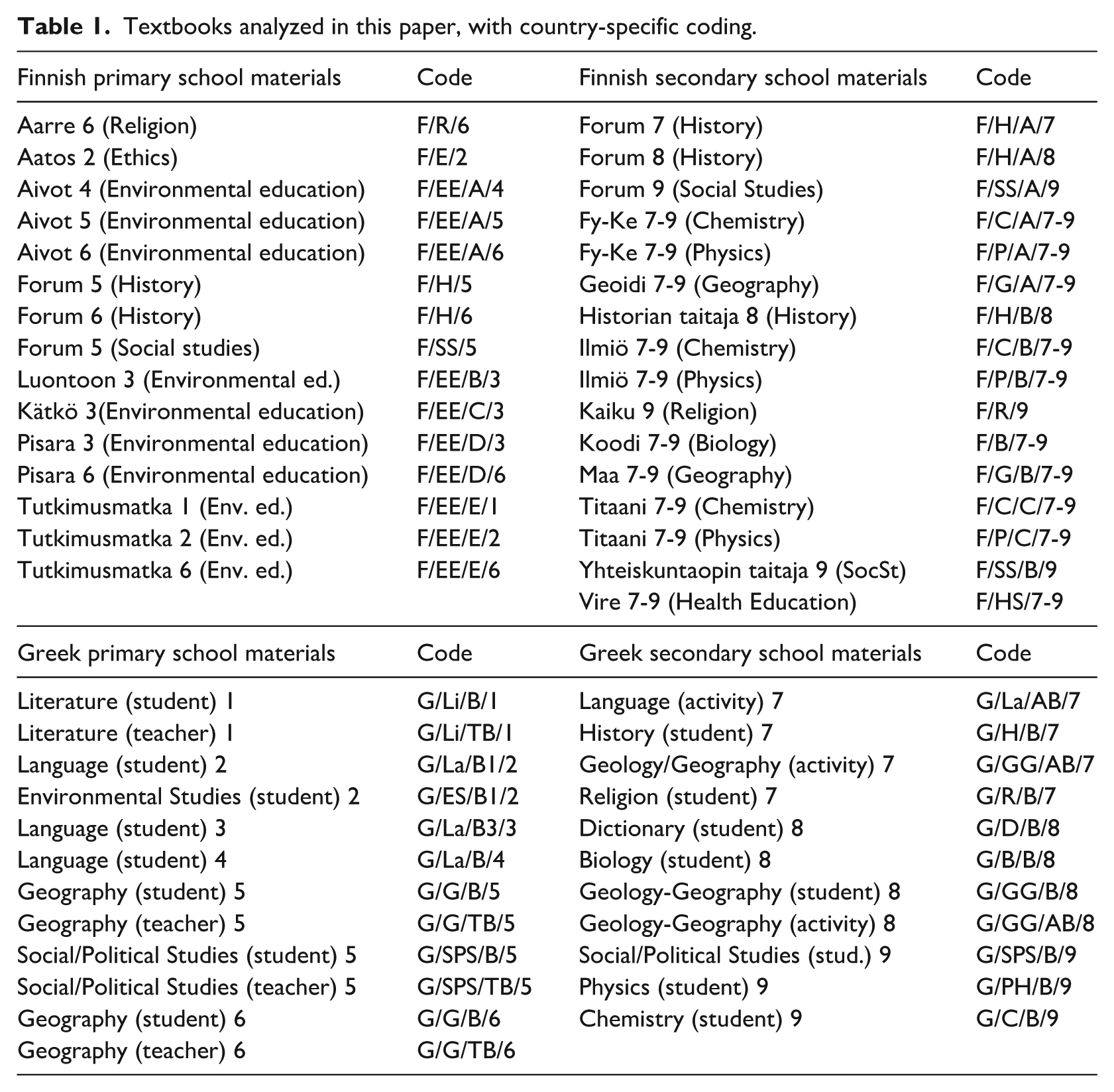
Table 1 lists the textbooks analyzed in this paper with country-specific coding (Finnish textbooks from different publishers named), including only those where climate mobility was explicitly or implicitly addressed. While the analysis focuses on CC-induced (im)mobilities, we also covered as separate topics “mobility, migration and refugees,” and “climate change and environmental concerns,” as the nexus was marginally present. Curricula are referred to with full titles. The dataset was created during the spring of 2023. In both countries, the curricula are openly available. For the teaching and learning materials, in Finland the publishers gave us access to them and in Greece all materials are openly accessible.
Textbooks analyzed in this paper, with country-specific coding.
The decolonizing planetary citizenship framework forms our analytical starting point. We carefully reviewed all selected materials, looking for entries that either offer pedagogical opportunities for engaging with this approach or contradict it. The focus was primarily on content related to climate mobility and, secondarily, on different forms of human mobility and climate change in connection with other environmental concerns. After a thorough analysis, we narrowed down the most obvious examples of both perspectives. In practical terms, the critical documentary analysis was carried out separately yet in dialogue by two researchers familiar with the national curricula and school practices (Finland Sulonen, Greece Bami). The first author (Kallio) is responsible for the analytical framework and the final analysis.
Due to the richness of the dataset and the different ways education is organized in the two countries, we present the analysis in country-specific sections, raising comparative elements primarily in the Greek analysis and in the concluding discussion. While combining the sections would allow for a more in-depth comparative analysis, doing so risks overlooking the nuances of the national programs, which we consider highly relevant to the practical development of CCE in both countries.
Climate mobility in Finnish basic education
Finnish school curriculum
The Finnish general Curriculum Criteria repeatedly refers to sustainable development while CC is mentioned only four times. Sustainable development is an ambiguous concept, and little guidance is given to schools on how to interpret it. Sustainability principles—including ethical thinking, cultural awareness, and the understanding of human rights—ought to be present in the school’s culture and practices, but the content remains so diverse that almost anything can be made to fit in, if properly framed. This leaves the teaching of CC mainly to the discretion of the teacher whose work can be guided by municipal and school-specific interpretations of the curriculum, and stresses the role of teaching and learning materials.
In the primary school, Environmental Education (EE) Curriculum introduces the themes of “responsibility toward the environment” and “understanding and mitigating the effects of CC.” Individual choice is emphasized throughout, accompanied by encouragement for “change through action.” Similarly, the Religion Curriculum mentions “valuing life” and “caring for the nature” in terms of personal choice. The Secondary School Curriculum introduces deeper reflection on environmental agency, hinting toward da Silva’s coresponsibility in planetary citizenship yet without a decolonizing perspective: Concrete actions and collaborative projects for the environment and for other people broaden the scope of responsibility. Students are guided to understand the importance of their choices and actions for themselves, their local community, society and nature. Together, they reflect on the links between the past, present and future, and on different scenarios for the future.
The Secondary School Biology and Geography Curricula focus on relationships with nature. They encourage students to conserve it, as part of personal sustainable lifestyles connected with global responsibility and in relation to the built environment. Regional identity and human rights are mentioned as themes, the latter of which can also be found in Religion and Health Studies Curricula.
Migration is addressed in the Finnish Curricula rather generally, without direct references to refugees or migrants. While they highlight many broad themes under which migration would fit well, teachers are left empty-handed about how to approach the topic. The word migrant is mentioned most often in the context of “Finnish as a second language,” with reference to students with migration background. This is telling about the place of international migration in the Finnish basic education system.
Finnish primary school
During the first 2 years CC is not discussed in Finnish school materials. The first grade EE makes general references to environmental agency: “Sometimes we buy stuff we don’t necessarily need. Natural resources will not last forever. We only have one earth, let’s take care of it! [. . .] You can help the earth to feel better. You can act so that in the future everyone has a world where it is good to live.” (F/EE/E/2). The second grade EE addresses the question of water, in several countries other than Finland: “Two thirds of the world’s population suffer from a lack of water [. . .] In some countries there are not even water wells, let alone water treatment plants. These countries also lack hygienic toilets.” (F/EE/E/2) In these entries, environmental concerns are placed elsewhere, in time and/or space, thus distancing CC from the students’ own lives.
Migration, also, is missing as a theme during the first 2 years, with one exception: Ethics. It is a subject attended by a notable minority of students as those belonging to a religious community take Religion instead. The third grade Ethics chapter on multiculturalism introduces five stories, asking whether the child in the story is “a refugee” or “a migrant” – concurrently explaining these terms – for example: “Amel is eight years old and was born in Iraq. As civil war broke out in her home country the family came to Finland.” (F/E/2). In the second grade, the teacher’s supplementary materials recommend Sanna Pelliccioni’s book “Onni-boy makes a new friend.” It is about the friendship between two boys one of whom is Iranian. Without a common language, they are at first puzzled by the different customs of their homes, but soon discover similarities between their families and each other. These rare examples of empathic pedagogy including potential for decolonizing education, as in Zembylas (2018), lie in stark contrast with how migration and migrants are generally addressed.
In materials for all students, migrants are first introduced in the third grade EE: “Migrants are people who have moved from their country of origin to another country” (F/EE/D/3) Internal migration, which makes up the majority of climate mobility, is excluded. Here we also have the first mention of environmentally induced forced mobility in the context of drought, referring to mobilities more broadly: “In areas with little rainfall, lakes and rivers dry and people have to leave their homes because of the drought.” (F/EE/D/3) Similarly, in the fourth grade, extreme weather events caused by CC are taken up, including that some people are forced to leave their homes. Continuing the future-oriented threat approach, one of the materials states: “In the future, for example storms, floods, and heat waves will become more common [. . .] many areas will become uninhabitable due to droughts and melting glaciers [. . .] sea levels will rise and cause coastal areas to sink” (F/EE/A/4).
The same book addresses environmental refugees in the European context: “Europe also accepts refugees from areas where living has become too dangerous due to drought or war. In recent years, refugees have been so many that some European countries are limiting the number of comers.” (F/EE/A/4). This notion is, first, misleading: neither the EU nor European states welcome refugees due to environmental reasons, in alignment with international agreements. Secondly, the proposal can be seen as politically informed: while war and drought are paralleled as equally important causes of asylum migration, the number of refugees is seen as a problem for European countries, not an issue of humanitarian responsibility, which aligns with current EU policies (Häkli et al., 2024). Education on the “ever-present” climate coloniality between the Global South and North, as portrayed by Sultana (2022), is nonexistent.
The fifth grade History approaches migration in the form of prehistoric mobility, including human-induced erosion of land, hunting species to extinction, and the over-exploitation of natural resources. It is highlighted that, even in ancient times, people’s own actions have forced them to move as they have exhausted the resources. This critical understanding is not, however, brought to inform the present society where the coloniality of nature continues (De la Hoz et al., 2024), and neither is it connected with the history of CC. Instead, the books emphasize the long-term effects of the prehistoric human activities to local nature: “The environmental damage of ancient times is still visible today everywhere in the vegetation of the Mediterranean.” (F/H/5).
EE for the fifth grade identifies the nexus between migration and CC: “There will be fewer areas suitable for human habitation, and people will have to move to more compact areas. This will lead to increase in the number of climate refugees.” (F/EE/A/5). Climate refugees are not discussed in the context of states or the EU, as in the previous case, which gives the text a bit of a different tone. Refugeeness is rather presented as a vulnerable social position—or political subjectivity (Kallio et al., 2019)—stemming from forced mobility (that does not necessarily lead to migration), and not as a status provided by a state or other authority. This connotation comes closer to how climate refugees are discussed in humanitarian scholarly and policy debates, as displaced persons (e.g. Atapattu, 2020; Hatano, 2021; Apap, 2019/2021).
In the sixth grade, CC and migration are included in EE, Religion and History. EE addresses forced mobility as one of the wide-ranging impacts, again futuristically: “CC is going to cause the most changes in people’s lives in the future. It will affect housing, food production, energy production, industry and migration.” (F/EE/D/6). The continuous temporal distancing implicitly implies that we should worry about CC only when it directly impacts on our society, instead of acknowledging the erosion of basic infrastructures in various parts of the world that has taken place for decades. This is another example of the “banal colonialism,” as discussed by Carlsson (2020) in the Swedish context, embedded in Finnish CCE.
A sixth grade Religion book explains some consequences of CC: “There are so many people (in our planet) that we are threatening to use up resources and destroy animal habitats [. . .] CC is melting glaciers and making many areas too dry for growing food.” (F/R/6). Although the section ends by stating that as individuals, “people need to change their lifestyles to stop CC,” the mention of a large population at the beginning constructs an image that human population growth is a main cause of CC, while it is Western capitalist society that has created a culture in which animal habitats are destroyed and resources overexploited for the benefit of colonial powers (Sultana, 2022; Zembylas, 2024).
In EE, the students learn at sixth grade about the situation of Pacific Islanders: “CC causes rising of the sea level, due to which several low-lying Pacific islands will sink underneath. If it continues at the same rate, for example thousands of Tuvalu’s inhabitants will become climate refugees.” (F/EE/A/6) While surely a good-intentioned aim to identify Tuvaluans as climate refugees, the portrayal lies in striking contrast with Pacific Islanders’ conception of their situation and how they wish to be identified and supported as victims of CC impacts. Farbotko’s (2022) research stresses that they refuse the subject position of refugee and, instead, seek recognition of their long history of moving between places, including their related knowledge and competent agency. Rather than asking international support for getting asylum, Pacific Islanders request that their multi-sited living is made possible in the increasingly challenging circumstances (also Boas et al., 2024). Through the idea of coloniality of knowledge, the misrepresentation in the textbook can be seen as proof of the “orientalizing” Western/Northern gaze (Baldwin, 2012). It defines the world through what da Silva (2011) calls “global ethos,” from which planetary citizenship education ought to move toward a universal ethos based on “macroethics of coresponsibility”—or “unlearning emotional imperialism” as Zembylas (2024) suggests (also Trott et al., 2023).
Finnish secondary school
In the secondary school, the most content that links CC with forced migration is in Geography that, as a subject, is connected to Biology in the Finnish school. Alongside wars and religious persecution, the books cite various CC related causes of migration, such as desertification, depletion of drinking water and food, rising sea levels, desertification, and reduced monsoon rains leading to food shortages. All books for grades 7–9 introduce refugees and/or migration, but with notable variation. One presents migration as general mobility: “Population growth also occurs when more people move into an area than move out. The movement of people from one area to another is called migration.” (F/G/A/7-9) Another material emphasizes that those forced to migrate for climate reasons are not considered refugees: “Extreme weather events will become more frequent due to climate change. [. . .] The poorest countries will be most affected. People fleeing environmental problems in their home areas are not officially refugees.” (F/G/B/7-9) Depending on which book is chosen, a rather different emphasis is suggested to the educational praxis—the latter obviously offering much better tools for decolonizing education.
From a critical perspective, some similarities with primary school materials exist, such as future-orientation and de-contextualization. A seventh grade Geography book states: “CC is going to cause the most changes in people’s lives in the future. It will affect housing, food production, energy production, industry and migration.” Climate mobility is here suggested to concern abstractly “people” in the “future.” Another book reveals the ignorance toward Pacific Islander’s local knowledge (cf. Boas et al., 2024): In the Pacific Islands some communities have been forced to move inland and some of the residents have moved to Australia. As the sea levels continue to rise, the lowest-lying islands will become completely uninhabitable. These displaced people are called climate refugees. CC and its impacts are driving people away from their original habitats. (F/G/A/7-9)
Baldwin (2012, drawing on Said, 1979: 207) describes this as “orientalization” of climate mobility: “They were seen through, analysed not as citizens, or even people, but as problems to be solved or confined or – as the colonial powers openly coveted their territory – taken over.” Another example from the same book series blames the sea, storms, and boats for the deaths of migrants, rather than people or states: A large number of people every year seek to migrate across the Mediterranean from Asia and Africa to Europe. Unfortunately, however, many people’s lives end in the Mediterranean when their small, fully loaded boats cannot cope with the rough seas and capsize in storms. (F/G/A/7-9)
New materialist and posthumanist approaches, advocated by Verlie (2020) among others, offer support for such a reading where CC is understood as intra-action of human and non-human agency, including distributed responsibility. As Häkli (2018: 172, emphasis in original) notes, herein lies the risk of diluting human responsibility: “when posited as an ontological condition, the distributedness of agency and responsibility pertain to all phenomena, irrespectively of what their status is when evaluated in moral terms.” We therefore consider such grievances “sham-empathic” with an alienating effect: “the sham-empathizer runs away with the feelings of another and leaves the other alone” (Smaling, 2007: 321, also Kallio et al., 2025c).
A related interesting detail can be found in Physics, through a link to an article on the possible future of climate migration regarding plants and animals: “Animal and plant species could end up as climate refugees.” (F/P/B/7-9) This playing with the idea of asylum migration resonates with the posthumanist tradition where non-human species are brought in parallel with humans, the perspective that Honnacker (2020) calls “holistic ecocentrism.” While an understandable desire to challenge the anthropocentric worldview, we identify here a risk of placing refugees into a “less-than-human” subject position (Philo, 2017). The question of who is entitled to international protection as a refugee is a question of recognizing equal human dignity (on dignity, see Kallio et al., 2025c), which should not be confused with what da Silva (2011) calls planetary macro-ethics where citizenship is not solely anthropocentric, and the humankind ceases to be seen as the center and only measure of everything (cf. Kallio et al., 2025b).
Other perspectives to the nexus between CC and mobilities are offered in Health Studies and Social Studies for ninth graders. They again address climate/environmental refugees in a manner that equates forced CC-induced migration and asylum migration: “With CC, suitable places to live are becoming scarce. Climate refugees are a new phenomenon: people are forced to leave their homes and countries as the conditions become too difficult for living.” (F/HS/7-9) Yet in the Social Science material the future scenario regarding the whole planet can be read as a progressive stance, proposing—in a planetary spirit of coresponsibility—that such refugees ought to be acknowledged “including in Europe:” CC is the most serious global environmental threat. Average global temperatures are rising, causing melting glaciers, hurricanes and floods. Some drought-stricken areas, for example in Africa, could become completely uninhabitable, and low-lying island nations could be permanently submerged. [. . .] However, the effects will be felt everywhere, including in Europe, as CC drives millions of environmental refugees. (F/SS/A/9)
The same book explains various methods that countries use to fight CC, such as the Paris Agreement with agreed emission limits. This can be identified as exploration of the “political tendency” (Håkansson et al., 2018), acknowledging at least partially the bias between so-called Global South and North. The same is recognized in the ninth grade Religion (F/R/9), where the inadequacy of current agreements is underscored, however not in connection with people’s well-being. The dominating nature-culture divide is re-established by formulating CC as a question of “nature ethics,” similarly to other Religion books in our data set—in a study subject that mostly considers the life of humans. This resonates with the above-discussed posthumanist approaches that we find problematic. Another Social Science book addresses political issues and controversies related to climate mobility quite exceptionally in the Finnish school, allowing for decolonizing planetary citizenship education: As a prosperous country, Finland has a duty to help. On the other hand, there are those who believe that the funds should be directed first and foremost to the Finns themselves. It is not just about money, but also about religion and culture. Some Finns think that new customs, languages and cultures enrich Finnish culture. Others think that multiculturalism is a threat to Finnishness. (F/SS/B/9)
Biology, for grades from 7 to 9, discusses the adverse effects of CC on ecosystems and organisms. Human activities are explicitly identified as the cause of this damage and the subsequent biodiversity loss, however without a distinction between different people and places: “Even the Earth’s climate is changing due to human emissions of greenhouse gases.” (F/B/7-9). This generalization of “the human” is one way to hide from the view the colonial power relations embedded in CC, now and in the past, and their inherent “racial logic” (Sultana, 2022). In contrast, in eighth grade History, the origins and aggravation of CC are linked to industrialization, for the first time in the Finnish school. At this point, the students are at 14–15. This passing notion offers teachers an opportunity for decolonizing CCE including the theme of mobility and the coresponsibility perspective, even if these are not explicitly mentioned: Recent global warming has shown that industrialization has also had far-reaching environmental impacts. The ever-increasing volume of goods produced, and the transport and energy consumption per capita are eating up natural resources and producing emissions that are accelerating the greenhouse effect. (F/H/A/8)
The eighth grade History books deal with forced migration of today as part of general internationalization and with reference to poverty and conflicts, without connection to CC but including an empathic approach that merits attention: “A Palestinian refugee says: When I had to leave my village as a refugee, I didn’t have a piece of bread. [. . .] We left everything in the village: money, grain, animals. Everything. We fled with very few clothes, wearing only our shirts.” (F/H/A/8). Another example is an image with a caption: “Riot police and refugees at the Greek–Turkish border, in 2016. Refugees protest against EU plans to return asylum seekers back to Turkey. What might the people in the picture be thinking?” (F/H/B/8) These two examples offer different empathic learning opportunities. While Palestinians are portrayed as victims without a named persecutor, with little agency, the latter makes visible the state/EU violence against refugees as well as their responses. These timely cases – that could easily be linked with climate mobility – offer another rare opportunity in the Finnish materials to consider migration from critical pedagogical perspectives.
Finally, we want to mention that Chemistry and Physics highlight the significance of natural sciences in the mitigation of CC yet acknowledging that technological solutions are not enough: political decision-making, a change in attitudes, and mundane activities are also needed. Similarly, Health Studies (F/HS/7-9) and Religion (F/R/9) for ninth graders stress the obligation of states and policymakers instead of solely relying on individuals. But in all cases, this encouragement to climate citizenship says little about where such activities should take place and by whom—for example, should Finnish people and the state mitigate CC to prevent climate mobility in other places, in the name of Western/Northern responsibility? Without such contextualization, the message remains vague.
Climate mobility in Greek basic education
Greek curricula
In the Greek school, the General Curriculum presents CC as a highly important theme: A systemic view of reality will help students to understand the natural environment as a supersystem composed of many subsystems with (self)regulating mechanisms set in motion by the occurrence of imbalances [. . . including] the looming CC caused by anthropogenic interventions [. . . this] will increase environmental awareness and sharpen their ability to understand the consequences of human activities on our planet.
While seemingly powerful, this approach is only detailed in Environmental Education, an optional course that many schools do not include in their study programs (see Malandrakis, 2018). 5 Thus, CCE does not have a central place in the Greek school.
Environmental Education runs over all grades and is dedicated to raise the students’ awareness about environmental protection, ecosystems, and CC and its relation to human activities including to “record the human interventions that cause CC [and] the consequences due to CC.” Following a general overview of sustainable development and the related need for international cooperation, the Curriculum introduces CC and its multiple causes and consequences as a key theme, including a mention of climate refugees. Yet it does not discuss climate migration to a further extent than this emerging “type of refugee:” In the long term, CC will endanger millions of people living in coastal areas and cause water and food shortages in many parts of the world and serious consequences for the global economy, agriculture and health. Today, a new type of refugee is being observed, the CC refugees.
Migration, instead, is covered in many detailed Curricula. 6 History Curriculum underlines it as a timeless, continuous phenomenon, binding the history of the humankind and societies to population movements from ancient times till now, at all grades. For example, in the primary school, the Dorian movements are introduced at the fourth grade, with a suggestion to “discuss the causes and consequences of colonization and make connections with current movements, migrations of peoples.” In the sixth grade, the Greco-Turkish war (1919–1922) and the refugee issue Greece faced after the massive populations exchange (1923) is mentioned. 7 While these offer a rich entry to different forms of migration, connection to environmental effects is missing.
The Secondary School Curriculum of New Greek Literature offers general guidelines for teaching migration, including forced mobilities, with an empathic tone and including decolonizing potential (cf. Kallio et al., 2025a): “To develop a positive perception and attitude towards the modern multicultural and multi-ethnic society. To raise awareness of the issue of immigration and to develop a positive attitude towards the Other, the refugee, the immigrant.” These are accompanied by practical suggestions for “indicative activities,” including “discussion on the contribution of refugees to the development of the economy and culture of their host countries” and “cultivating the consciousness that we live in a radically pluralistic world and the effort to understand ourselves through acquaintance and constant comparison with other systems of values, customs, attitudes.” The Ancient Greek Language and Literature Curriculum adds to this by exploring Aristophanes “Birds” under the topic of “voluntary and involuntary migration: a chronic tendency of people to leave their place, when social conditions force it.” Thus, the Greek school acknowledges forced mobilities as an integral part of society, which is in stark contrast to the Finnish school.
Greek primary school
CC and its relation to human activities appears mostly in Literature and Language (grades 1, 2, 3, 4) and Geography (grades 5, 6), while EE and Social and Political Studies include some related content. In Literature, the theme of climate mobility is implicitly present from the first grade, through Ivan’s story: Ivan and his family leave their place and all their belongings, along with their cat Eftychu, due to the disaster caused by an avalanche. It’s Christmas Eve. In the camp of the new country they moved to, everything is snowy and decorated. (G/Li/B/1) The related teacher’s book offers an evocative pedagogical instruction: Intersectional topic with environmental education (social life, environment): The text provides the opportunity to develop a discussion about the immigration flow to our country, the problems and concerns of immigrants, etc. The students are asked to express themselves, if they were in Ivan’s position, what would concern them and how they would feel. Through the text they find that regardless of national identities there are cultural issues common to all people, such as the coming of the new year and what it entails. (G/Li/TB/1)
The instruction carries two messages: First, the notion “immigration flow” adopts the idea about migrants as a problematic mass entering our territory (cf. Häkli et al., 2024; Stoffelen, 2022). Yet the second message, clearly emphasized in the task, stresses common humanity that makes migrants’ problems and concerns understandable. The students are encouraged to empathize with Ivan, which we consider a fruitful starting point for approaching the contextual meanings of climate mobility, in line with Zembylas (2018, 2024) decolonizing pedagogies of unlearning (also Kallio et al., 2025a). This encouragement is similar to the Finnish primary school Ethics materials and differs from the secondary school proposals regarding “climate/environmental refugees.”
In the second grade environmentally induced migration appears as two children discuss desertification and consider leaving to an imaginary country: “In my country, the land dries up, the grass does not grow, and the animals are thirsty. I’m going to find Hocharupa.” (G/La/B1/2). In the third grade, internal displacement due to natural disasters is mentioned but not further discussed. A girl from Sri Lanka says, ’Our house was destroyed by a tidal wave, after the big earthquake. We lost our everything. We have found shelter in a temple.’ (G/La/B3/3). These narrative approaches, nearly completely missing in the Finnish materials, form the best example of empathic climate mobility education in the whole dataset. While they do not explicitly address coresponsibility in the globalized world, or coloniality, the narratives are inviting for such approaches.
The first extensive reference to CC including anthropogenic causes is made in the fifth grade Geography Teacher’s Book, when the students are at 11–12. It discusses ecological disasters that may produce “ecological refugees” as people’s living environments, including agricultural, become destroyed. The term is in quotation marks which underlines it as an expression, not a status. The teacher is advised to utilize the concepts of “interdependence” and “system” in teaching: “An example of the destruction of the water ecosystem is the basin of the Aral Sea, one of the greatest environmental tragedies of our planet [. . .] that created 28,000 “ecological refugees”” (G/G/TB/5). The same example is used in the seventh grade Geology-Geography book (see next section).
The book also takes up migration movements between Greece and other countries, mainly from a demographic perspective and regarding national citizens. In contrast, when discussing the large ports of Greece, it talks about “entry into our country of people who create social problems (drug trafficking, human smuggling, illegal trade, etc.).” Here, “regular” and “irregular” mobilities are clearly distinguished in a normative sense, which resonates with “human classification” in EU’s migration policy (Häkli et al., 2024). This approach that challenges the principle of coresponsibility contrasts with how labor migration is discussed in the second grade Environmental Studies (vocational subject), in the form of a personal narrative: Maria lives in Thessaloniki. She was born there. Her parents come from Kavala. They came to Thessaloniki because they found work there. Her classmate, Claudian, lives in the apartment next door. He has come with his family from Albania. (G/ES/B1/2)
Here, labor mobility from one city or country to another is framed as business as usual, without mentioning their selective regulation in the EU and Greece. Climate migrants would often like to move like this, but they can only do so if coming from a country favored by the European states.
In fifth grade Geography, reference to ecological refugees appear again, yet this time as a fact not a question, similarly to the Finnish materials that talk about climate refugees in a threatening future. While this is a way to introduce the idea to the children progressively, it can mislead them to think that such refugees are acknowledged of as part of global humanitarian responsibility. Hence, much is left to the teacher’s discretion: In areas of low latitudes, the mortality of the inhabitants will increase due to the large spread of infectious diseases [. . .] The shortages of food and drinking water, as well as the dangerous way of living due to drought, storms and floods will cause movements of population groups. Ecological refugees will be introduced, which are very likely to bring about rearrangements in the global social balance. (G/G/TB/5)
In the fifth grade Social and Political Studies, the idea of “global citizen” is introduced, with responsibility for social and environmental issues in their country but also around the world, following the climate justice approach (Trott et al., 2023). The book gives an example of chocolate consumption in the West and how this affects the lives of people in countries where cocoa is produced (forest destruction, pesticides, child labor). This notion is rather particular as it detaches the citizen from the nation-state—in line with da Silva’s (2011) and Dobson’s (2004) citizenship conceptions—in state-based education that usually sets out to socialize the students into the territorially defined national society. Moreover, students are encouraged to take civic responsibility for CC, individually and collectively. This is characteristic to Greek textbooks; they emphasize collective action and the systemic approach, unlike the Finnish materials where individual agency and responsibility are central.
Greek secondary school
In the seventh grade, migration and CC are taken up in many books, however rarely in connection with each other. Religion includes a call for empathy for “modern refugees,” through a representation of Jesus as an immigrant in Egypt and a related message of the Greek Orthodox church about CC. This interesting way to consider the connection between forced mobilities and CC remains a passing mention. The Language book takes a more straightforward approach, through a news-excerpt entitled “The climate is changing” from the Eco-magazine. Even if not directly mentioned, mobilities are implied, in different parts of the world. This offers opportunities to discuss climate mobility as a globally shared challenge: This summer, belied its name. Widespread devastation from unprecedented flooding in Prague, Dresden, central-eastern Europe. Dozens dead and billions of euros in damage. The death toll has reached one thousand in East Asia, while ten million people in China are threatened by floods. Water is already covering part of the North Pole, in place of the permafrost. At the same time, drought is drying up vast swathes of Africa. [. . .] The vast majority of scientists believe that our “bad weather” is largely due to the greenhouse effect, the rise in the average temperature of the Earth, mainly as a result of carbon dioxide emissions. Entire books are not enough to contain the warnings of organizations and scientists. But it all boils down to “No more!”. It’s as simple as that. And yet so difficult. Difficult because it requires breaking with big interests. Interests that have imposed their policies. (G/La/AB/7)
In seventh grade Geology-Geography book, the drying up of the Aral Sea, beginning from the 1960s, is used as an alarming prediction about the consequences of CC in Greece. It quotes the mayor of Muinac: The weather has changed. It goes from bad to worse, the climate has changed, the summers have become hotter and the winters colder. People are sick and constantly feel the salt on their lips and eyes. The revelation of the bottom also has global implications. Forty-three million tons of salt, once locked in lake water, are gradually blown up into the Arctic Ocean each year, accelerating (slightly) the melting of Arctic ice. When strong winds blow, the salt that rises from the surface is capable of clogging car carburetors, while the high rates of esophageal cancer and high child mortality in the area are attributed to the same cause. (G/GG/AB/7).
That the impacts of CC to civilizations are taken up through such a critical and concerned approach builds a ground for exploring climate mobility from a planetary perspective, especially if combined with the narrative approach used in primary school Literature and Language (see also connection to the fifth grade Geography Teacher’s Book). This opens a “political tendency” (Håkansson et al., 2018) approach much better than the threatening tone used in the eighth grade Geology-Geography, which is the only book for all students including direct references to climate migration. There, consideration of future opportunities for people and places negatively impacted by CC are missing (cf. Boas et al., 2024): The World Health Organization (WHO) estimates that by 2030 these extreme events (which many attribute to human activities and especially to the worsening of the greenhouse effect) will be responsible for approximately 300 000 deaths each year. In addition, the sea level rise will wipe out many coastal plains, deprive people of arable land and therefore create millions of ecological migrants. Extreme weather events will become much more frequent and intense in the future, with dramatic effects on people’s lives. (G/GG/B/8)
In the ninth grade, many references to migration and CC exist, yet the two issues are not connected (e.g. Physics, Chemistry, Religion, Social and Political Studies). The most interesting is the Social and Political Studies approach to empathizing with migrants through different dimensions (migration as life change factor; migration and social inequality; poverty as migration cause; migration, discrimination and social rights; UN bodies and NGOs supporting refugees). Rarely in the Greek school, this calls the students to react with their emotions (cf. Zembylas, 2024). Consider the following task as an example of empathic relations-building which could easily be linked with climate mobility: I walk in the city and the others say disparagingly: ‘The Pakistani.’ I’ve heard it so many times. . .” Put yourself in the shoes of an immigrant, a disabled person, an unemployed woman. List correspondingly the possible problems they face. Link them to their respective rights that are being violated. (G/SPS/B/9).
In contrast, the eighth grade Dictionary presents problematic references. The entry “migration” includes the following examples: “The illegal immigrants requested political asylum in our country.” and “The Coast Guard vessel spotted the ship with the illegal immigrants.” (G/D/B/8). These references to illegal immigrants undermine a rights-based understanding and reproduce nationalistic anti-migration ideologies, revealing how “the racial logic of climate tragedies and cumulative impacts are ever-present” in the school (Sultana, 2022: 4). As a country and as part of the EU, Greece is bound by humanitarian policies and treaties underlining that no person is “illegal.” People arriving without personal documents at the borders of the EU are migrants or asylum seekers, whose cases should be processed following the policy outlined in the New Pact on Migration and Asylum (Häkli et al., 2024). The Dictionary entry can hence be read as an alarming example of what Baldwin (2012) calls “new racisms.”
Discussion and conclusions
This article provides an analysis of climate mobility education in Finland and Greece, including comparative elements. The results show that the topic is poorly covered in basic education in both countries, and a social scientific approach is minimal. These findings resonate with those from other countries (e.g. Bonilla and Quesada, 2024; Gugssa et al., 2021; Perrin, 2023). Our analysis is framed by a decolonizing planetary citizenship approach (Kallio et al., 2025a; Kallio et al., 2025b). It revealed that neither country strongly recognizes climate mobility through a decolonizing lens. As a result, most dimensions of climate coloniality are absent (Baldwin, 2012; De la Hoz et al., 2024; Sultana, 2022; Zembylas, 2018). Similarly, the idea of coresponsibility—according to which countries in the Global North should play a leading role in fighting CC (da Silva, 2011)—is barely included, indicating that planetary citizenship is neither adequately supported nor encouraged.
In Finland, when CC is discussed in a societal sense, it is mostly addressed as a future phenomenon and a set of problems occurring elsewhere. Its colonial-industrial history and presence are overlooked, as is the interconnectedness of people and places across borders. The generalization of “the human” hides from the view the colonial power relations embedded in CC, now and in the past, and their inherent “racial logic” (Sultana, 2022). Some of the materials even encourage the development of “sham-empathic” relationships with distant others and non-human nature, which is particularly harmful from a decolonizing perspective (cf. Smaling, 2007: 321, also Kallio et al., 2025c). Together, these factors efficiently obscure the need to teach “planetary macro-ethics” (da Silva, 2011). The few times that the history of societies and CC are paralleled, or the current situation is approached from the perspective of the Finnish people’s responsibility for the past and the present, only highlights the blindness to climate colonialities. In general, materials portray Finland as a benevolent bystander, a state and a nation that can offer to help “others” with their challenges—including climate mobility—if “we” choose to do so.
In Greece, the vocational environmental education course adopts a planetary perspective, transcending the territorially divided reality of nation-states. This educational program has the potential to deconstruct “othering” and colonial hierarchies in relation to climate mobility. The problem is that all of this content is included in an optional course; otherwise, little material exists for CCE (cf. Malandrakis, 2018). Migration is a major theme in many subjects from the early years of primary school. Connecting this rich exploration of mobilities with the EE course content would build a solid foundation for decolonizing planetary citizenship education on climate mobility if made available to all students.
The most significant comparative finding regards migration. In Greece, various types of mobility are discussed throughout the educational journey and in different subjects. In Finland, migration is not even mentioned in the primary school curriculum, and is only a minor topic in the secondary school: migrants are usually portrayed as a mass of people who need our help, resonating the spirit of the EU’s current migration policy (Häkli et al., 2024) – or as migrant students in the classroom. This is alarming. How can the students understand the plurality of climate mobility if migration overall is overlooked? The Greek approach has its problems, too. Migration is mostly discussed as a “Greek experience”. The imaginary of a homogeneous nation dominates the national identity, producing “othering” and hierarchies, and even racist attitudes.
That translocal and transnational mobilities, including some environmental links, are more prevalent in Greece than in Finland can be partly explained by the countries’ histories and current situations. Greece has a long history of migration in various forms, including internal and external climate mobility due to hazards. In contrast, Finland has a relatively small migrant population, and any kind of climate mobility is experienced only indirectly. In the globalized world, however, climate mobility is something that both countries are thoroughly intertwined with, and they are not beyond coresponsibility.
Another difference between the countries concerns citizenship. In the Finnish materials—that address CC more than the Greek framework—mitigation and adaptation measures are often mentioned, and responsibility for them is demanded, primarily from individuals but also from states and other collective actors. In the Greek school, collective responses and a systemic approach predominate, in the limited amount of material that discusses environmental issues. However, these references are all rather abstract; who should do what and where is mostly left open. This does not offer fruitful grounds for developing planetary citizenship.
One of our key findings concerns human responsibility and the inalienable human dignity. Some materials present ideas familiar from posthumanist and new materialist research that challenge the anthropocentric worldview by treating humans and non-humans as equals (e.g. Verlie, 2020). In an extreme case, natural and material elements are blamed for human misfortune, even death. While drawing attention to the harm that human-induced CC is causing to natural environments and other species is understandable, we consider playing with these ideas risky because distributed responsibility leads to the dilution of human responsibility (Boysen, 2018; Häkli, 2018; Philo, 2017, also Kallio et al., 2025b).
Based on the analysis, we argue that relational connections between places and people should be strengthened throughout school education to help students understand that climate-induced mobility is not their problem someplace else or our problem in the future, but a shared problem here-and-now. We join Zembylas (2024) call for radical unlearning as part of decolonizing education (also Kallio et al., 2025a). In both Finland and Greece, decolonizing CCE would improve people’s understanding of CC as a translocal and transnational phenomenon with a colonial-industrial history. Furthermore, we propose a similar development at the EU level, assuming that the situation in other European countries is not that different, thought this requires further comparative research.
Our study lays the groundwork for a cross-disciplinary, EU-wide assessment of CCE. In the current situation, where states and people all over Europe are confronted with the direct and indirect impacts of CC, we consider this a highly relevant further inquiry. How will future generations be educated to understand, not only the natural scientific processes and effects of CC, but also its societal impacts? As Reid (2019: 768) aptly notes, CCE encompasses more than just climate education; it involves a societal understanding of the origins, drivers, and dynamics of CC. These “political dimensions” (Håkansson et al., 2018) must be inherently included in the curricula and teaching and learning materials, to strengthen the nexus between climate education, citizenship education (Abs, 2021) and global education (Franch, 2020).
Footnotes
Acknowledgements
We wish to thank the whole HUMANE-CLIMATE research team and the SPARG community for supporting our work. We thank Kirsten Sivesind for the highquality peer review process that respects different traditions of research, as well as the three anonymous reviewers whose comments helped us to finalize the manuscript.
Author contributions
The lead author is responsible for the conception and design of the article including the analytical framework, and for the drafting of the paper. The gathering of the data corpus, and the analysis and interpretation of the data, was done in three parts: Nefeli Bami is responsible for the Greek school data corpus, including the interpretation of the data and its preliminary analysis. Maria Sulonen is responsible for the Finnish school data corpus, including the interpretation of the data and its preliminary analysis. Kallio is responsible for the final analysis, including the comparative elements and the theoretical interpretation. All authors took partin the revision process. They meet the criteria for authorship as per the ICMJE guidelines.
Declaration of conflicting interests
The authors declared no potential conflicts of interest with respect to the research, authorship, and/or publication of this article.
Funding
The authors disclosed receipt of the following financial support for the research, authorship, and/or publication of this article: This research was funded by the Research Council of Finland (grant 347374).
