




Abstract
The year 2020 will be remembered as the time when the COVID-19 pandemic swept the world. Almost overnight, all educational activities pivoted to online platforms and teaching and learning was navigated in uncharted terrains. In mathematics education, concerns about sustaining online teaching and learning of mathematics have generated efforts in using digital technologies. In this paper, we use the lens of complexity theory and in particular the constructs of agents, interaction, dispersed control, and emergence to describe top-down and bottom-up mechanisms for change within the sudden shift to emergency remote teaching and learning. The authors’ collaborative work was carried out through online meetings discussing observations on and insights about their experience as mathematics teacher educators during the COVID-19 pandemic and traction data in three locally available online platforms. The main findings indicate two government-led, top-down initiatives, and three community-led bottom-up initiatives. The results suggest that mathematics teachers, mathematics teacher educators, and mathematics teacher consultants served as actors within the larger system. We discuss the possibilities and constraints of mathematics education in a time of crisis through the lens of complexity theory and offer trajectories for further research.
Keywords
Introduction
The year 2020 presented humanity with myriad disruptive challenges (Daniel, 2020) that necessitated the implementation of widespread emergency remote learning (Lindblad et al., 2021). In an attempt to contain and curb the spread of COVID-19, many governments around the world issued immediate lockdowns, often involving a complete shutdown of schools. This sudden shift caught education systems throughout the world underprepared for the challenges and projected changes associated with instruction at a time of crisis (Atweh et al., 2023; Hannon and Temperley, 2022). One perspective of crisis-related change brings up the notions of accountability and responsibility. Focusing on this perspective, Milner et al. (2021) coined the term hybrid accountability, and identified policy inertia in governance and reform in comparison to grassroots changes spearheaded by local actors. Our paper delineates crisis-related processes in one specific context through the lens of complexity theory to shed more light on mechanism of response and change. Complexity theory lends itself to speaking about such dynamics as Mason (2008) notes, “One of the most important insights of complexity theory is this notion of emergence which implies that, given a sufficient degree of complexity in a particular environment, new (and to some extent unexpected) properties and behaviours emerge in that environment” (p. 37). These new behaviors emerge in and through interaction between local actors, who “are not inert and independent but fluid and co-specifying” (Davis and Sumara, 2005: 311). Against this backdrop, studying specific, geographically bound environments contributes to shifting “from a concern with decontextualized and universalized essence to contextualized and contingent complex wholes” (Mason, 2008: 39–40). An environment-specific approach to change has been identified as the catalyst for reform emanating from space- and local-specific ecological systems (Milner et al., 2021).
Awareness of the significance of spatially and temporally bounded conditions has also been recognized in the field of mathematics education. For example, Chan et al. (2021) assert that a “mathematics educator in a time of big or small crisis would face local, immediate challenges” (p. 5, our emphases). Such challenges are observed by mathematics educators when they “see students, teachers, families, and politicians focused on the compelling, immediate, local needs” (Chan et al., 2021: 6).
In this paper, we contribute to the literature by focusing on one locality showcasing its context-specific, contingent complex whole. This paper adds to research that was conducted in other localities such as Denmark, Italy, and England (Milner et al., 2021), Greece (Lavidas et al., 2022), and East Europe and specifically Romania, Hungary, Bulgaria, and the Republic of Moldova (Mitescu-Manea et al., 2021).
From the perspective of the local approach to understanding change and reforms, we bring forth the context of Israel as the place-specific context; and mathematics education as the subject-specific discipline. Before we turn to providing more details about the context of Israel, we discuss the literature in mathematics education during a time of crisis and provide a succinct discussion of the theoretical framework of complexity theory.
Mathematics education during a time of crisis
Studies in mathematics education during and after COVID-19 examined challenges in transitioning to online teaching from the perspective of students (Thurm et al., 2023) in Belgium, Germany, and Netherlands; the use of technologies during a time of crisis (Villa-Ochoa et al., 2023); preservice teachers’ lesson plans in Medellin, Colombia (Villarreal et al., 2023); and mathematics teacher educators’ insights on the ethical constructs of responsiveness and responsibility (Atweh et al., 2023) in four countries at the Association of Southeast Asian Nations. These studies used theories such as human-media interaction (Villa-Ochoa et al., 2023); grounded theory (Atweh et al., 2023); and activity theory (Vale and Graven, 2023). Questions still remain, however, as to a theory that explains contextualized processes in geographically bounded locations where local actors initiate top-down and bottom-up change. Our paper contributes to the research literature in mathematics education during crises in at least two ways. It delineates processes that took place in an additional country thus expanding the landscape on the map. It also uses the theoretical framework of complexity theory thus adding a new lens for examining such processes.
The Covid-19 lockdowns forced teachers and students to become netizens—overnight—having to quickly learn how to navigate teaching and learning through digital tools (Klemer et al., 2023). Within mathematics education, this shift renders qualitative differences between online and emergency remote teaching and learning (ERTL). Unlike the former, the latter is characterized by a significantly steep learning curve of techno-pedagogical tools for teaching mathematics. ERTL epitomizes a shift that is heavily dependent on three emergent and immediate aspects in the ERTL of mathematics education: (1) Mathematics content—how teachers organize themselves around a sudden shift that necessitates teaching the curriculum remotely; (2) Math-specific techno-pedagogical skills—the difference in techno-pedagogical skill sets that both teachers and students need to master; (3) Math-specific student engagement—the need to reimagine and reframe student engagement in ERTL. While each deserves a discerned attention in research, practice, and scholarship, we are cognizant of the interrelated and inter-animated nature of the three.
The need to treat ERTL differently from online learning is alluded to by Lavidas et al. (2022) who explored mathematics teachers’ challenges during Covid-19. They identify different types of barriers such as (i) inadequate conditions for teaching caused by lack of appropriate equipment and problems with internet connections; (ii) absence of appropriate training as teachers and students were unfamiliar with needed pedagogical materials; and (iii) difficulties in implementing communication processes. That the transition to ERTL is associated with unique needs is also alluded to in the work of Wahyuningsih et al. (2021) who surface the use of online project-based learning by integrating virtual mind maps media, audio-visual media, and virtual posters. In ongoing discussions and conversations, we met regularly over a year to discuss the nature of the transition to remote teaching and learning during the pandemic. Our purpose was to better understand processes and become cognizant of ways in which emerging needs were addressed. We used the lens of complexity theory to which we turn next to make sense of the processes we observed.
Theoretical framework: Complexity theory and the critical role of actors within
Gilpin and Murphy (2010) examine crises through the lens of complex systems theory. They demonstrate how individual actors act collectively as agents and generate unpredictable societal patterns. These actors operate within their local milieu to generate context-specific adaptations. Actors are integral to complexity theory. For the purpose of this paper, we build on Morrison’s (2002) definition of complexity theory, who sees it as “a theory of survival, evolution, development and adaptation” (Morrison, 2002: 6) and as a theory where learning from one’s environment is “vital for survival” (Morrison, 2002: 117). This is where we see the connection between complexity theory and crisis.
Complexity theory was imported into the field of education to explain change and reform (see Chen, 2023; Mason 2008; Plessis, 2021). The reason we believe complexity theory is a helpful theoretical framework for our work is that it provides us with “the right vocabulary to precisely describe what we’re studying. . .that not only captures the conceptual building blocks of self-organization and emergence but can also describe how these come to encompass what we call functionality, purpose, or meaning” (Mitchell, 2009: 301, italics in original).
The following bold-faced constructs describe complex systems as a collection of specific properties, which include the clustering of large numbers of individual, self-organizing actors such as molecules, neurons, institutions, humans, or any other type of agentive entities. Indeed, Mason (2008) recognizes that educational systems are complex by default as these systems are comprised, inter alia, of numerous agencies and structures that include teachers, students, parents, and other stakeholders such as “the state and its education departments, economic structures and business organisations” (Mason, 2008: 44). Another property is interaction between responsive, co-constitutive, and co-evolving actors that initiate change in themselves and in the system’s architecture. When actors interact, they do so because they share a common goal, space, and challenges (Wenger, 1998) and sometimes communicate remotely through social networks (Segal and Biton, 2024). Complex systems also include dispersed and decentralized control, which is associated with enhanced neighbor interactions (Axelrod and Cohen, 2000; Mason, 2008) that typifies systems where actors are free to interact and work together with limited intervention from a body that prescribes actions and consequences. Another property is emergence, which makes visible new, and to some extent unexpected, ways of being and doing within an environment that carries “a sufficient degree of complexity” (Mason, 2008: 37). Emergence, thus, contributes to the system’s unpredictability (Turner and Baker, 2019). We use these four key tenets in making sense of our observations.
Space-specific context—Israel
Understanding complexity theory as a theory of survival, evolution, development, and adaptation (Morrison, 2002), as well as a way to shift from decontextualized and universalized perspectives to contextualized and contingent complex wholes (Mason, 2008), we focus our attention on the context of Israel, which has a population of approximately 9.3 million people, of whom 860,000 are elementary school students and about 611,000 are in middle and secondary school (Central Bureau of Statistics, 2022; Ministry of Education Israel, 2022). The Israel Ministry of Education has two main sectors: Hebrew and Arabic.
Like in many other countries and districts around the world, the education system in Israel is centralized. The Israel Ministry of Education (MoE) governs budgets, management, curricula, and policies. Israel’s population comprises 79% Jews, and 21% Arabs (Central Bureau of Statistics, 2022). The total number of schools in the Hebrew Education sector and the Arabic Education sector is about 3300 and 780, respectively (Central Bureau of Statistics, 2021a, 2021b). In each sector, there are two inspectors for school mathematics. One is responsible for Grades K–6; the other is responsible for Grades 7–12. Each mathematics inspector has a team of teaching consultants who provide support and guidance in pedagogical and content matters to practicing teachers (Perl et al., 2018).
Israel is no stranger to emergency school closure. Due to frequent security alerts caused by tensions between Israel and some of its neighboring countries, the Israel Ministry of Education (MoE, 2014) has been preparing for emergency online teaching since 2011. In addition to the National Computing Program, Israel set up the Education Ordinance 8 (Israel Ministry of Education, 2014)—an emergency learning program aimed at maintaining continuity of learning during State emergencies where access to schools becomes unsafe.
This study adds to the growing literature on the changes in mathematics education during crises in the following three ways: (1) we identify challenges and context-specific changes that emerged organically during the COVID-19 pandemic; (2) we use the lens of complexity theory to explain the mechanism of these changes; and (3) we identify top-down and bottom-up changes that were spearheaded by local actors.
Methodology
This paper is the result of ongoing conversations and discussions we conducted for observations on and insights about responses to emergency remote teaching and learning (ERTL) of mathematics. We are a group of researchers of interorganizational alliances engaged in collaborative research (Mulvihill and Swaminathan, 2022: 11), which promotes the idea of, among others, intraprofessional work (Mulvihill and Swaminathan, 2022: 2) as a means to gaining insights through “the process of deliberation together” (Mulvihill and Swaminathan, 2022: 23). Data were collected from personal experience working with in-service teachers, and conversations with colleagues in the Ministry of Education. To make sense of these observations, we build on Trouche et al. (2012), who offer the top-down/bottom-up framework to address the following research questions.
Research questions
Following the onset of the school closure,
What were the challenges of mathematics teachers as they were implementing ERTL?
What state-wide (top-down) efforts were made in Israel to support ERTL?
What grassroots (bottom-up) initiatives were made in Israel to support ERTL?
Data collection
Four data collection procedures were carried out: conversations with colleagues, the authors’ personal experience teaching during the COVID-19 pandemic, and website usage data:
The second author met with a group of three colleagues who operated as mathematics education leaders. There were two 60-minute conversations with each of the education leaders. The meetings took place on Zoom and were recorded and transcribed. The three colleagues were (i) A district mathematics teacher consultant from the Ministry of Education; (ii) A national mathematics teacher consultant from the Ministry of Education; and (iii) The head of mathematics instruction in one national school network. All three have been working with mathematics instructors in schools across Israel and played a key role in guidance and counseling to teachers through the sudden shift to ERTL. In their work, they promote the objectives of the Ministry of Education and large-scale mathematical national projects. They are an essential, connecting link between school mathematics teachers and policy makers in the Ministry of Education.
Ongoing conversations with 18 in-service mathematics teachers during the ERTL: The second author met with the teachers once a week between March and October 2020, as part of their graduate studies in a course on integrating technology in teaching mathematics. They shared their difficulties and needs, as well as their challenges with ERTL. Students comprised Arab and Jewish teachers of mathematics who taught online in grade levels ranging Grade 1–Grade 6. Thirteen meetings were recorded and transcribed. In addition, at the end of the course, the teachers submitted personal reflections on the challenges they experienced teaching mathematics during ERTL.
Website usage data: As accessibility to content knowledge online became a necessity, we used traction data of online mathematical content in nationally available online platforms that include online educational libraries operated by the Center for Educational Technology (CET) and two YouTube channels run by CET and LNET. We accessed Google Analytics, YouTube Analytics, research and development projects, and CET usage data between March 15th 2020 and March 21st 2021.
Research meeting notes: We worked on an interactive Google Docx file where meeting notes were collaboratively recorded to surface the research processes, data analysis, and insights from the collected data. This ongoing interactive work followed the research team meetings that took place every 3 weeks over a year.
Data analysis
Our analytical approach employed key constructs from complexity theory as a central theoretical lens to examine responses during crisis events. Agency, conceptualized as the capacity of actors (human and non-human) to make choices and enact changes within complex adaptive systems, emerged as a crucial construct for understanding how educational stakeholders navigated constraints and created innovative solutions during remote emergency teaching and learning (ERTL).
The data analysis followed a systematic process of interpretive coding and triangulation. Initially, we conducted open coding of the conversations, website usage data, and research meeting notes to identify emergent patterns. Through iterative analytical cycles, we refined these codes using complexity theory constructs, specifically focusing on self-organizing agents and their adaptive behaviors. This theoretical framing allowed us to distinguish between different levels of agency manifested in ERTL initiatives.
Our triangulation process involved two complementary approaches to enhance validity and reliability (Mathison, 1988). We employed methodological triangulation by comparing findings across multiple data sources (conversations with mathematics consultants and in-service teachers, website usage data, and research meeting notes). We implemented investigator triangulation by comparing interpretations and resolving discrepancies through consensus.
This triangulation process enabled us to develop a robust understanding of how agency operated within complex educational systems during crisis, revealing the dynamic interplay between top-down and bottom-up initiatives. The concept of agency proved essential in answering our research questions by illuminating how self-organizing actors mobilized resources, created new operational structures, and transformed educational practices in response to ERTL.
Specifically, we discussed the mathematics teachers’ challenges and difficulties regarding ERTL, the ways they tried to cope with these difficulties, and the top-down and bottom-up efforts that were made in Israel to address teachers’ and students’ needs during the ERTL. In each ERTL-related response, we examined who is/are the self-organizing agents human or non-human who led the initiatives; the parameters of interaction between responsive, co-constitutive, and co-evolving agents that initiated change in themselves and in the system’s architecture; dispersed and decentralized control, which is associated with enhanced and extended neighbor interactions with no specific controlling entity who dictates what needs to happen, when, and how; and emergence, which took shape when the interactions between agents led to new patterns, new properties, and new phenomena contributing to the system’s unpredictability.
Findings
In the following sections we present the findings and the supporting data. Within the context of ERTL in mathematics education, we observed five levels of agency: the MoE; the mathematics teachers and mathematics teacher consultants; research and development projects; non-governmental organizations (NGOs); and local communities of practice. The construct of agency cuts across the research questions as we detail below.
Regarding the first research question, we identified the following challenges mathematics teachers coped with while implementing ERTL:
The need for techno-pedagogical knowledge suitable for remote teaching management and communicating with students, such as Zoom and Google Meet. The mathematics education leaders talked about the difficulty of the teachers to teach without a blackboard, and to make efficient and effective use of a digital blackboard. The in-service teachers also talked about the difficulty of monitoring students’ learning and assessment processes during the ERTL. There was a growing realization that teachers needed tools that would help them to not only communicate with their students but also organize distance teaching and learning.
The absence of technological tools such as computers, tablets, and other devices that allow access to ERTL: The digital divide has prevented many school students from lower socioeconomic (SES) status from accessing ERTL. This aligns with the increasing poverty rate among working families in Israel, which is much higher than the OECD (2020) average. This situation did not allow for continuity in learning or continuous participation in the Zoom sessions, which, we observe, has led to the creation of educational gaps between students across Israel potentially leading to detrimental effects on learning.
The need for online teaching and learning resources for ERTL: This is manifested mainly among the middle school and high school teachers. The lack of appropriate online materials for a visual and dynamic presentation of mathematical concepts or for implementing inquiry tasks was another layer in the mathematics teachers’ challenges. We observed teachers needed technological environments and applications that would allow them to present and demonstrate mathematical concepts.
Regarding the second research question state-wide (top-down) efforts made in Israel to redress the need for ERTL, we recognize that the concept of agents includes not only the state, the teachers, and their students but also inanimate objects such as digital devices, infrastructure, and Internet connectivity such as the Israel National Broadcasting System. It is the interanimated relationship between animate and inanimate actants that directs, limits, and enables change. We identified two types of agents that operated within top-down mechanisms. These included government-mandated initiatives and projects intended to provide teachers and students with techno-pedagogical tools and know-how to redress needs related to ERTL. These took the form of establishing an educational National Broadcasting System and reconfiguring communities of practice.
In the bottom-up initiatives, we observed two types of bottom-up agentive initiatives: online communities of practice for professional development, and within and across school mentorship networks.
Top-down efforts
Educational National Broadcasting System
As soon as a decision for school shutdown was made, the Israel Ministry of Education, an institutional agent, set up the educational National Broadcasting System. The broadcasting system comprised 24 studios that provided a scheduled program of both live and recorded lessons organized by age group and school subject. The MoE selected teachers who recorded mathematics lessons in Hebrew and Arabic, which were broadcast daily on designated TV channels and Internet sites.
Two organizations were contracted to spearhead the operation of the National Broadcasting System as both had extensive experience with teaching mathematics using online platforms. The Center for Educational Technology (CET) coordinated live lessons for Grades 1–6, and LNET Learning Technologies (LNET) focused on Kindergarten and Grades 7–12. CET and LNET converted office spaces into studios. The teachers who were selected to record the lessons were provided condensed courses on diction and camera readiness. These teachers also received ongoing support in preparing lesson plans suitable for broadcasting on television.
On the first day of broadcasting on March 15, 2020, more than 290K unique users viewed the dedicated YouTube channels, and more than 36K users subscribed to the channel—25K in Hebrew and 11K in Arabic. By March 20, 2021, there were close to 63K subscribed users and over two million views! In parallel, CET dropped the paywalls for their online libraries as well as educational resources. These resources include non-fiction and academic titles, as well as textbooks, digital simulations, online courses, and recorded lessons. The usage of these resources grew from an average of 300K daily users (before the pandemic) to over 1.5M users on the first day of school closure.
Reconfiguring communities of practice
The second level of initiatives taken up by local agents blossomed among teachers of mathematics and their MoE mathematics teacher consultants. It was apparent early on that lessons given on remote teaching and learning platforms could not be a carbon copy of lessons in brick-and-mortar classrooms. The transition to remote teaching necessitated attention to and development of techno-pedagogical approaches and strategies conducive to learning in an ERTL environment.
These top-down initiatives took place in the form of ongoing Zoom sessions, focusing on demonstrations of best techno-pedagogical practices in ERTL as well as providing technical advice. Mathematics teachers pooled digital teaching/learning materials and visual manipulatives on designated websites and collaborative Google Drive files, organized according to grade levels.
Non-profit organizations’ initiatives
In non-profit organizations’ initiatives, we observed temporal, spatial, and spectral dynamics as we elaborate on next. Temporal dynamics reference our observations that discourse in and about mathematics was no longer bound by a specific time scheduled for a predetermined time slot. Open access to lessons in mathematics launched by non-profit organizations made it possible for users to attain content anywhere, anytime as soon as this content was made available. Users could watch and listen to the lessons at their own time allowing them to play, replay, and pace their learning of the mathematical content whenever and wherever they accessed these lessons. Spatial dynamics refer to noticing that these top-down initiatives invited mathematical discourse beyond the boundaries of a class to include family units. For example, The Centre for Educational Technology (CET)—a non-profit organization—has spearheaded the creation of a new spot on a national television morning show, in which the host would present a mathematical problem relating to the COVID-19 pandemic, such as the shortage of toilet paper rolls or the measuring of physical distancing. Viewers were reminded that each problem could be solved in more than one way and might involve extraneous data. Every day, thousands of students submitted their solutions online. Students were encouraged to consult their family members, and the family who answered correctly in the shortest time won a gift voucher. That was a time when everything was shut down and whole families were restricted to their homes. Working on mathematical problems that could bring family members together to think, unpack, and attend to issues could potentially ameliorate the shattering experience of isolation imposed by COVID-19.
With regard to the spectral dynamics, top-down initiatives also widened the spectrum of participants in mathematical discourse. An additional initiative launched by CET was catered for higher grades. The purpose of this initiative was two-pronged. The first was to increase the potential of student-centered teaching of mathematics at a time of crisis. The second was to better prepare students for their secondary school graduation exams. These were provided by inviting highly reputable mathematics teacher educators and the alumni of an elite IDF intelligence unit to develop relevant learning materials suitable for remote learning of selected topics. This wide spectrum of local agents introduced digital resources to promote mathematical discourse. Mathematics teachers were on the lookout for digitized material that they could use without much adaptation. Several projects of research and development (R&D), which involve experimental implementation of approaches to school mathematics and are directed by teams of mathematicians and mathematics educators, made content freely available to all. One such project is the Mathematics News Snapshots (see MNS: https://mns.org.il) R&D initiative (Movshovitz-Hadar, 2008), which is aimed at providing high school students with a glimpse into the dynamic nature of the development of contemporary mathematics, its ubiquitous presence in human lives, as well as the wide scope of current problems that mathematicians attempt to solve.
To close the gap between school curricula and contemporary mathematics, the MNS project provides a set of PowerPoint presentations as a source for Grade 10–12 mathematics teachers to interweave in their teaching. Each Mathematics News Snapshot focuses on one mathematical idea. Prior to the COVID-19 pandemic, the MNS project policy was to offer News Snapshots only to teachers who participated in their professional development program, in order to ascertain a more structured support for teachers (see Movshovitz-Hadar, 2018). However, as soon as the education system switched to ERTL, and uncertainty was abounding, teachers expressed a desire to offer extracurricular content in their lessons. An executive decision was made to make the MNS available and openly accessible to all. Teachers and students were welcomed to roam it freely and run a flipped-classroom style of teaching and learning. We now turn to the grassroots (bottom-up) initiatives.
Bottom-up initiatives
Online communities of practice in social media
Social media can serve as spaces for professional development (Bissessar, 2014; Biton and Segal, 2021; Rensfeldt et al., 2018; Segal and Biton, 2024). We observed the phenomenon of cross-pollination among members of online communities in social media. For example, a Facebook group for pre-and in-service mathematics teachers that was set up in October 2016 by two elementary mathematics teachers, provided a space for teachers to share ideas about mathematical content, techno-pedagogical approaches, and student engagement. The group has grown in size and now counts 6500 members. This is notable given that there are only about 9000 in-service and 3000 pre-service mathematics teachers across Israel (Shriki and Movshovitz-Hadar, 2011). Looking into the discourse in this Facebook group, we examined the nature of discussions held in the group during three different time frames: September 1st, 2019–February 29, 2020 (pre-COVID-19); March 13th to May 2nd, 2020 (COVID-19 school closure); and May 3rd to the 31st, 2020 (the gradual return to school). We examined the content and traction in the Facebook group and looked into the nature of mathematics-related interactions during the pandemic.
Prior to the school closure and the transition to ERTL, about 250 members, mostly elementary school teachers, were regularly active. Posts dealt with learning materials, requests for help regarding pedagogical approaches, and information about websites relevant to teaching curricular content.
In January 2020, prior to the school closure, the traction comprised an average of five posts a day, each with about seven replies. However, as the school closure was announced, traction increased to an average of about 20 posts daily, each with dozens of responses. Posts focused on requests for ideas for techno-pedagogical aspects of ERTL, as well as requests for concrete and applicable activities in, information about, and reviews of the use of technological environments for the teaching of mathematics. To respond to these requests, three WhatsApp groups were launched by mathematics teachers from all over the country (in addition to the Facebook group). One WhatsApp group for primary mathematics teachers now includes about 230 teachers; a second group for middle school teachers, includes about 300 teachers; and a third group for high school mathematics teachers, includes about 500 teachers. Each of the group members shared materials that they had designed or come across, uploaded presentations and instructional YouTube videos that they produced, and provided explanations on how to produce instructional videos. In addition, members shared links to apps that were found to be useful such as GeoGebra and Desmos. Moreover, multi-participant and multi-directional, didactic and conceptual discussions in mathematics and the pedagogy of mathematics took place among the teachers often regardless of the grade level they teach.
In the third time period, when the gradual return to school was announced, the nature of interaction in the posts evolved again. For example, the return to school necessitated the assignment of primary upper-grade teachers to teach mathematics in the lower grades. That was the case only in elementary schools where classes were split into two to minimize the risk of contracting COVID-19. Upper elementary school teachers who were suddenly required to teach mathematics in Grades 1–3 asked for support, mentorship, and guidance. Daily inquiries included requests for didactic and content assistance for planning lessons on specific mathematics topics. Each request was followed by hundreds of responses in the form of mathematics content, pictures of hand-written explanations and examples, references to online materials, and even invitations for further one-on-one consultation. The following example represents many similar instances in the data that illustrate this. A teacher in the WhatsApp group of primary mathematics teachers asked for ideas for remotely teaching the topic of spatial objects. She immediately received a variety of suggestions about inquiry tasks in dynamic applications. Such interactions showcase the four tenets we identified. Initiatives such as the WhatsApp groups set up by the mathematics teachers within a dispersed and decentralized control context allowed for interaction that generated the emergence of pedagogies and teaching strategies thus expanding the repertoire of inquiry tasks and representations of spatial objects.
The lockdown created a sense of solidarity, a common goal, and shared vision and the Facebook and WhatsApp groups have evolved into a space for a significant process of professional development.
Within- and across-school mentorship networks
Teachers with expertise in integrating technology, have become mentors for their colleagues in their schools and in geographically neighboring schools. Teachers in schools turned to these expert teachers to receive assistance, and the principals also encouraged these mentorship networks with the aim of improving teaching and learning processes. These mathematics expert teachers helped their colleagues to become familiar with relevant technological environments for communicating and teaching mathematics, which enabled a dynamic representation of mathematical concepts and objects within the distance teaching framework.
These expert teachers also purchased, out of pocket, digital tools to make ERTL more efficient. For example, they helped teachers to overcome challenges in presenting mathematical formulas, expressions, and equations in free writing in the absence of the familiar blackboard from the classroom environment. They quickly identified several types of graphic boards and electronic pens that connect easily to the computer. The use of such technologies allowed teachers to have their writing on horizontal surfaces reflected on both their and the students’ screens. Teachers became cognizant of the need to enhance their techno-pedagogical knowledge. Drawing on Koehler and Mishra (2009), we define techno-pedagogical mathematics teacher knowledge as an “understanding of how teaching and learning can change when particular technologies are used in particular ways” (p. 65). The expert teachers shared their knowledge of particular technologies used in particular ways with their colleagues, and by that encouraged them to purchase innovative technological tools that helped them in teaching mathematics remotely. These expert teachers served as local agents of change for the teachers.
Discussion
In this paper we share observations on and insights about processes of change in mathematics education during ERTL through the lens of complexity theory. More specifically, we use the four constructs of agency, interaction, dispersed and decentralized control, and emergence. We began by presenting research literature on challenges related to ERTL in mathematics. Our paper contributes to the literature by suggesting the use of complexity theory to understand processes of change. We were guided by three research questions: (1) What were the challenges of mathematics teachers as they were implementing ERTL? (2) What state-wide (top-down) efforts were made in Israel to support ERTL? and (3) What grassroots (bottom-up) initiatives were made in Israel to support ERTL?
To answer these questions, we used the theoretical framework of complexity theory as it allowed us, among other things, to surface the critical role of interaction between various agents within bottom-up processes of decentralized control in the emergence of new phenomena.
With regard to the first research question about the challenges the teachers experienced, the shift to ERTL forced teachers, students, and parents to go through a steep learning curve to effectively use synchronous and asynchronous modes of interaction. In this transition, there were challenges and goals to address. Many mathematics teachers aimed at finding efficient and effective ways to teach through an essentially unfamiliar digital environment. This involved getting used—overnight—to communicating with each other through a microphone, a screen, and a camera while trying to engage students in doing mathematics in a meaningful way. The lack techno-pedagogical know-how was identified across geographical boundaries and school contexts. This is corroborated by Klemer et al. (2023) who conducted their study in Israel during the COVID-19 pandemic and surfaced the barriers regarding the use of digital technology during the transition to ERTL. Similarly, Lindblad et al. (2021) and Milner et al. (2021) describe how ERTL generated significant challenges to teachers who had to not only take responsibility for remote teaching but also provide answers to students with special needs.
In addition to reconfiguring how to teach subject-specific content, teachers had to devise new strategies to enhance, support, and sustain student engagement. While work on how best to sustain student engagement has been a fertile field of research, such work in the context of ERTL is much needed. Using the lens of complexity theory, we suggest, devising new such strategies in a time of crisis can be surfaced and made visible.
Collectively, the Israel education system that comprises the MoE, local organizations and R&Ds, teachers, and mathematics teacher educators pulled up their sleeves to quickly look for ways to address the teachers’ challenges. Teachers had to adopt and adapt practices to teach remotely. As time passed, a clear phenomenon emerged. More and more teachers collaborated online and shared practices they developed. Such practices emerged in and through the top-down and bottom-up processes, social network groups, and mentorship networks thus epitomizing the four complexity theory tenets of agents, interaction, dispersed and decentralized control, and emergence. This, in turn, seemed to generate increased teachers’ public-professional accountability (Milner et al., 2021) as well as a sense of belonging to the mathematics education professional virtual community of practice that has a mutual engagement; a joint enterprise, and a shared repertoire (Shriki and Movshovitz-Hadar, 2011; Wenger, 1998).
As for the students, even though we did not explore the impact of the pandemic on learning within and between different socio-economic groups, we note that some adequate conditions for learning pertain to the accessibility to—and availability of—uninterrupted and reliable Internet connectivity, personal computers, and quiet spaces for learning for each family member. This has been identified in the literature as the digital divide and as a manifestation of inequities in education systems (Korovkin et al., 2023; Mitescu-Manea et al., 2021). The experience with ERTL has crystallized the need for creating adequate conditions for equal access to learning that is no longer restricted to location-specific available resources.
The necessity to shift formal schooling in general and mathematics education in particular from brick-and-mortar spaces to virtual platforms behooves us to rethink how to make possible what’s necessary in reshuffling priorities in making learning equitable, and reconfiguring or revamping available technologies, pedagogies, and curricular expectations. Table 1 structures the top-down and bottom-up initiatives using the tenets from complexity theory.
Complexity constructs and change in mathematics education during ERTL.
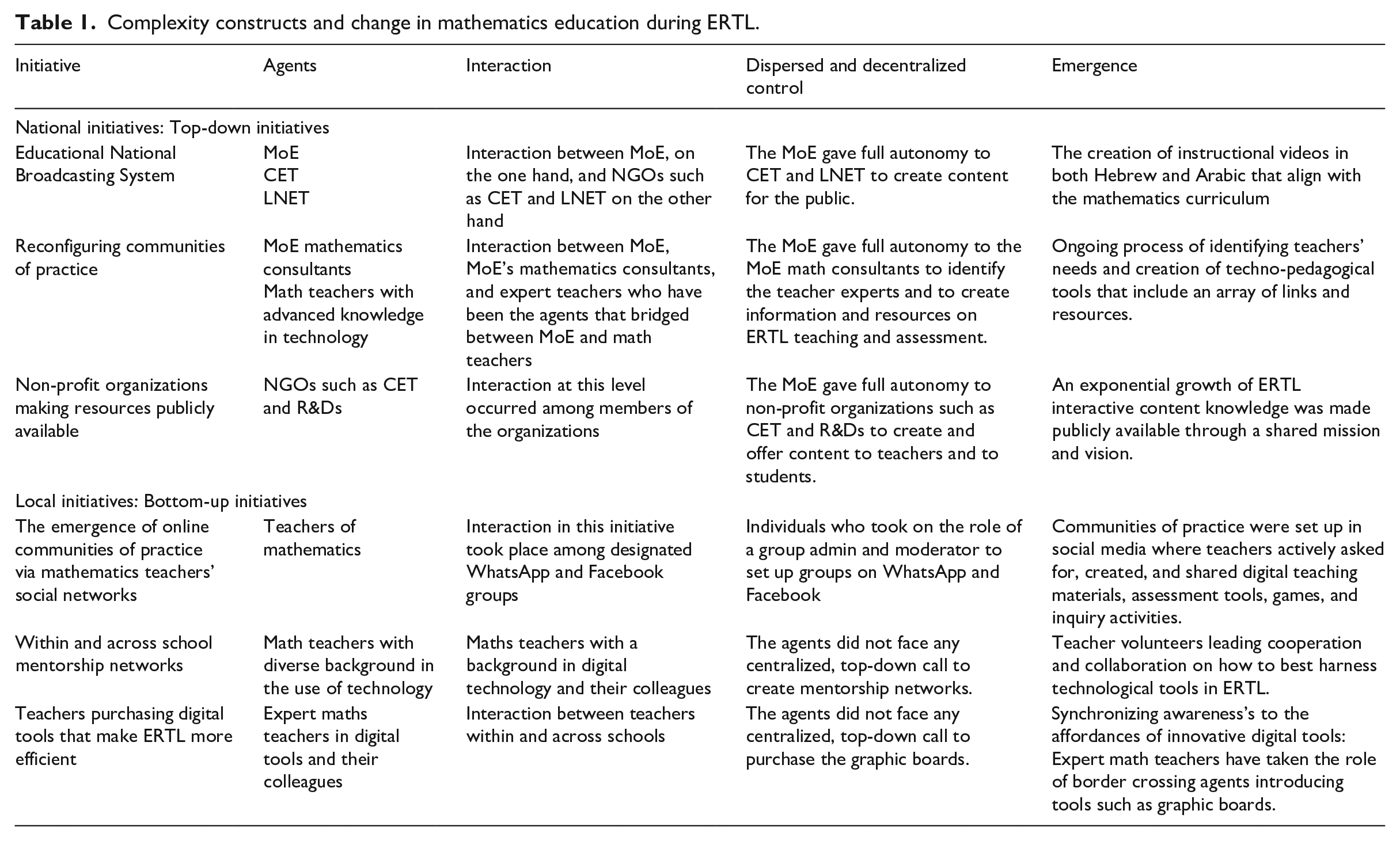
The results of the current study identified teachers, mathematics teacher educators, and mathematics teacher consultants as agents of change within the system. These change agents played crucial roles in setting up mechanisms of coping with emerging challenges and improving capacity in adapting to changing environments. As shown in Vale and Graven (2023), teachers used online platforms such as WhatsApp, YouTube, and Zoom. The use of online platforms speaks to the potential of and benefits in teaching mathematics through the flipped classroom approach, which was used by the Mathematics News Snapshots (Movshovitz-Hadar, 2008) and discussed in Cevikbas and Kaiser (2023), who point to the promise flipped classrooms carry for “both during and after the COVID-19 pandemic and during potential future crisis events” (p. 187).
It is through interaction of agents who work in proximity, share a mission, operate within a system, and experience bottom-up decentralized control that makes it possible for actors to function as change agents and collaborate on new forms of teaching and learning of mathematics. These manifest what Davis and Sumara (2005) dub “nested layers of individual action and collective movement” (p. 311) as individuals engaged in action on a shared mission of developing materials for ERTL in mathematics. We suggest that the interanimation between these nested layers of individual action and collective movement make it possible to understand that it is not the centralized direction that furnishes the system with a deep level of coherence, but the cooperation and collaboration among a localized system’s constituent agents, a notion that is substantiated in Axelrod and Cohen (2000) and Mason (2008).
These processes corroborate Wei et al.’s (2009) and Tucker’s (2019) conclusion as they convincingly argue that rather than setting up top-down sessions provided by external experts in technology, change in practice may benefit from and be supported and sustained throughout the school year by providing the necessary conditions for the emergence of professional learning communities.
The innovation of the current study is reflected in the implementation of complexity theory as a theoretical framework to analyze and present the challenges of mathematics teachers during the ERTL. Using complexity theory as a framework to understand change in education emphasizes the role of agents as key components within complex systems. These agents, as Chen (2023) notes, play a crucial role in shaping educational processes and outcomes. Our work is corroborated by Chen’s (2023) observation that “agents are characterized by having clear goals, autonomy in decision-making, and the capacity to adapt to changing environments” (Chen, 2023).
We hope that this paper offers not only a theoretical blueprint based on complexity theory but also insights on how local agents engage in bottom-up nested layers of individual action and collective movement to echo Davis and Sumara (2005). Even though, more than a decade ago, Hiebert (2013) has eloquently and convincingly suggested that “[t]eaching is the single common pathway along which improvements reach students” (p. 45), we believe teachers remain indispensable in working on change. As articulated by Villarreal et al. (2023), mathematics teachers used technologies to communicate, access information, and support each other both academically and emotionally during the lockdown. To answer the question: “Will we ever teach mathematics again in the way we used to before the pandemic?” that Engelbrecht, Borba, and Kaiser (2023) ask, we think the answer is “No!” Looking forward, we believe there is a need to explore the very mechanisms of change in mathematics education. We offer to consider the lens of complexity-related constructs such as agents, interaction, dispersed and decentralized control, and emergence as these may provide additional insights on processes of change.
This study adds to the increasing literature on the lasting impacts of COVID-19 on mathematics education in the following four ways: (1) we use the framework of complexity theory to capture the non-linear, interdependent nature of system components that characterize change processes; (2) we offer a top-down and a bottom up structure of initiatives to identify emergent patterns that resist prediction through reductionist methods; (3) we observe how the initiatives have broadened the temporal, spatial, and spectral dynamics of teaching and learning mathematics; and (4) we offer a helpful cluster of components that provide a broader landscape of simultaneously operating processes. More research that uses the lens of complexity theory to explain processes of change can provide empirical evidence to further develop this stance.
Limitations of this study
The present study is based on the authors’ observations on and insights about the experience of ERTL. The agency that surfaced in our study, the interactions we observed, and the nature of the dispersed and decentralized control we identified are limited to a specific location. From this, it is likely that the point of view about the challenges of mathematics teachers during ERTL, and the national and local efforts to deal with challenges, present only a few pieces in a complex, dynamic puzzle of the context of mathematics education during ERTL in Israel.
Future directions
Retrospectively, as the effects of the COVID crisis are gradually receding, several questions come to mind that merit further discussion from both the theoretical and practical aspects. These include system-wide and spontaneous initiatives that take form in different localities and that hold value to the post-COVID mathematics education community. To prepare for an event that may enforce school closures in the future, the following questions remain open: How can newly emerged processes be scaled up to improve the quality of mathematics education for all? Which initiatives and responses can and should be further developed and supported? How can some of these initiatives be scalable and sustainable to make lasting changes in pre-service and in-service mathematics teacher education programs? How might top-down and bottom-up initiatives in techno-pedagogical approaches afford opportunities for improving mathematics education? Which of the new techno-pedagogical approaches do mathematics teachers take with them as they go back to in-person teaching? Change is very much a situational, co-constructed, cultural event. Change is where agents, systems, interaction, and emergence operate and develop. COVID-19 is very likely to leave its mark on mathematics education. How complexity theory can be harnessed to maximize the lessons learned offers a useful way to better understand how and why change happens.
Footnotes
Declaration of conflicting interests
The author(s) declared no potential conflicts of interest with respect to the research, authorship, and/or publication of this article.
Funding
The author(s) disclosed receipt of the following financial support for the research, authorship, and/or publication of this article: The author(s) received no financial support for the research, and authorship. The first author is grateful to Brock University for partial financial support for the publication of this article. The authors are graeful to Israel MALMAD for their support in publishing this article.
