




Abstract
The study explores the social belonging of first-generation students in a large university in Austria after the pandemic. While social belonging is a complex notion and nebulous to define, this study applies n enhanced concept of student engagement, which views student engagement as active involvement and social belonging on behalf of a student, and as integration and social support measures on behalf of the university. A strong sense of social belonging is on the one hand fundamental to becoming a student and the likelihood to graduate, however, the institution must also provide social support and academic integration on the other hand. This study explores the social belonging of seven first-generation students in Austrian higher education applying a qualitative approach using narrative interviews. The findings illustrate that first-generation students navigate higher education under significant economic constraints and experience intermittent access to social support measures. They hold strong feelings of social belonging with friends outside the university and do not make new friends at university easily. The study shows that first-generation-students depend on financial and social support by their families more than others and that negative sentiments during studying block their active involvement in class, and thus their sense of belonging.
Keywords
Introduction
Student diversity is meanwhile viewed as central to the capacity of higher education institutions (HEI) to manage post-pandemic teaching, learning, and campus life. This includes increasing the rates at which diverse student groups access and participate in higher education, improving the conditions in which they do so, and providing equal opportunities for learning, participation and social (upward) mobility. Depending on the country, institution and respective tuition fees, higher education can, however, be an expensive endeavour, especially for students who do not have the required economic capital (Bathmaker et al., 2013). First-generation students – as a particular group within the diverse student body – face specific challenges in higher education (Spiegler and Bednarek, 2013), especially after having had to overcome the COVID-19 pandemic and its consequences. The current cohort of students were forced to move from an analogue campus to online spaces, without personal interaction with peers or faculty. Participating in virtual classes provided few opportunities for interaction outside these structured sessions (Resch et al., 2022). This significantly reduced the relevance of the campus as a shared space of learning and social belonging. COVID-19 left students with limited forms of communication about academic content, reduced relationships (Guessoum et al., 2020), and feelings of disengagement: ‘Students (. . .) are predicted to suffer – if not already – from the potential effects of pedagogical dislocation and becoming disengaged from their studies and learning communities’ (Watermeyer et al., 2020: 17).
In Austria, where the higher education system is rooted in a strong tradition of face-to-face teaching, it is clear that the situation faced during the COVID-19 pandemic has had an even greater impact on first-generation students entering tertiary education. First-generation students hold strong meritocratic beliefs when entering university, sharing the notion that anyone can succeed regardless of their social class or background. They do, however, also have to invest more work into adjusting to their new environment, since the higher education sector is geared towards elite or higher middle-class culture, norms, and values, which makes it more difficult to develop a corresponding sense of belonging (Veldman et al., 2023). Ultimately, social class shapes who will experience an immediate form of social attachment to an institution and who will have to work on developing that feeling.
Social class is undoubtedly a significant element of student diversity and has in previous research been defined or measured based upon the financial realities of parents of first-generation students, that is, those whose parents do not themselves have an academic background (Ardoin, 2018). Definitions used by first-generation students identifying themselves as such are equally as important as supposedly objective measures like lower level parental education or lower status occupations.
As yet, research about the social belonging of first-generation students in the European higher education context remains limited, and while related studies do exist from the United States (i.e., Stephens et al., 2012; Veldman et al., 2023), they are not really comparable due to the differences in the higher education context. In contrast to other higher education systems around the globe, the majority of campuses in the United States require students to live nearby or in shared dormitories on campus and pay (comparably) high tuition fees. In most European countries, university students live in their hometowns, either with their families or in shared apartments with their peers, and commute to campus every day. As a consequence, there might be different expectations about how attached a student might become to his or her university. Belonging is a complex notion and unfortunately vague and nebulous to define. It is a basic human need (Maslow, 1943; Yildirim et al., 2021), an emotional attachment (Yuval-Davis, 2006), connectedness with peers (Jindal-Snape and Rienties, 2016) and a form of student engagement.
This is the starting point of the study at hand: Based on Wolf-Wendel et al.’s (2009) idea of student engagement, this study has four conceptual dimensions: (a) involvement and (b) social belonging as dimensions of the student and (c) integration and (d) social support as dimensions of the institution. Involvement is the amount of time and effort students put into their studies and other activities that lead to the experiences and outcomes that constitute student success. Social belonging is defined as relations with peer students and faculty (Nunn, 2021). Integration is how HEI allocate their human and material resources and organize learning opportunities and services to encourage students to participate in and benefit from activities (Wolf-Wendel et al., 2009: 412–413). Finally, social support is defined as the functional content of social relationships such as the perceived or actual support (Wilcox et al., 2005).
To help us to better understand the connectedness of social belonging and studying at university, the current study explores the social belonging of first-generation students at the largest university in Austria as one dimension of student engagement. After presenting our conceptual framework in more detail and mapping the state of research regarding the social belonging of first-generation students in higher education, this article presents empirical findings based on a qualitative approach using narrative interviews (Rosenthal, 2015) with seven female first-generation students in Austria in 2022. The study concludes with a critical reflection of social belonging in European higher education in a post-pandemic society and its practical implications for faculty and diversity management.
Conceptual framework and state-of-research
Wolf-Wendel et al. (2009) link student engagement to involvement and integration. They argue that student engagement has two facets, reflecting the extent to which the student engages and the efforts made by the HEI to engage them. The overarching concept of student engagement represents these two key dimensions. It can, therefore, be summarized as the interplay of active (classroom) behaviour on behalf of the first-generation student and academic and social integration on behalf of the HEI (Tight, 2020). Disengagement in contrast to engagement is viewed as a state of low activation of students in general (Balwant, 2018).
The conceptual framework of the study is, therefore, based on Wolf-Wendel et al.’s (2009) idea of engagement enhanced with two further dimensions: (a) involvement and (b) social belonging as dimensions of the student and (c) integration and (d) social support as dimensions of the institution (Table 1). All dimensions are framed in the context of student diversity – in particular by first-generation students and their experiences of student engagement.
Conceptual framework.
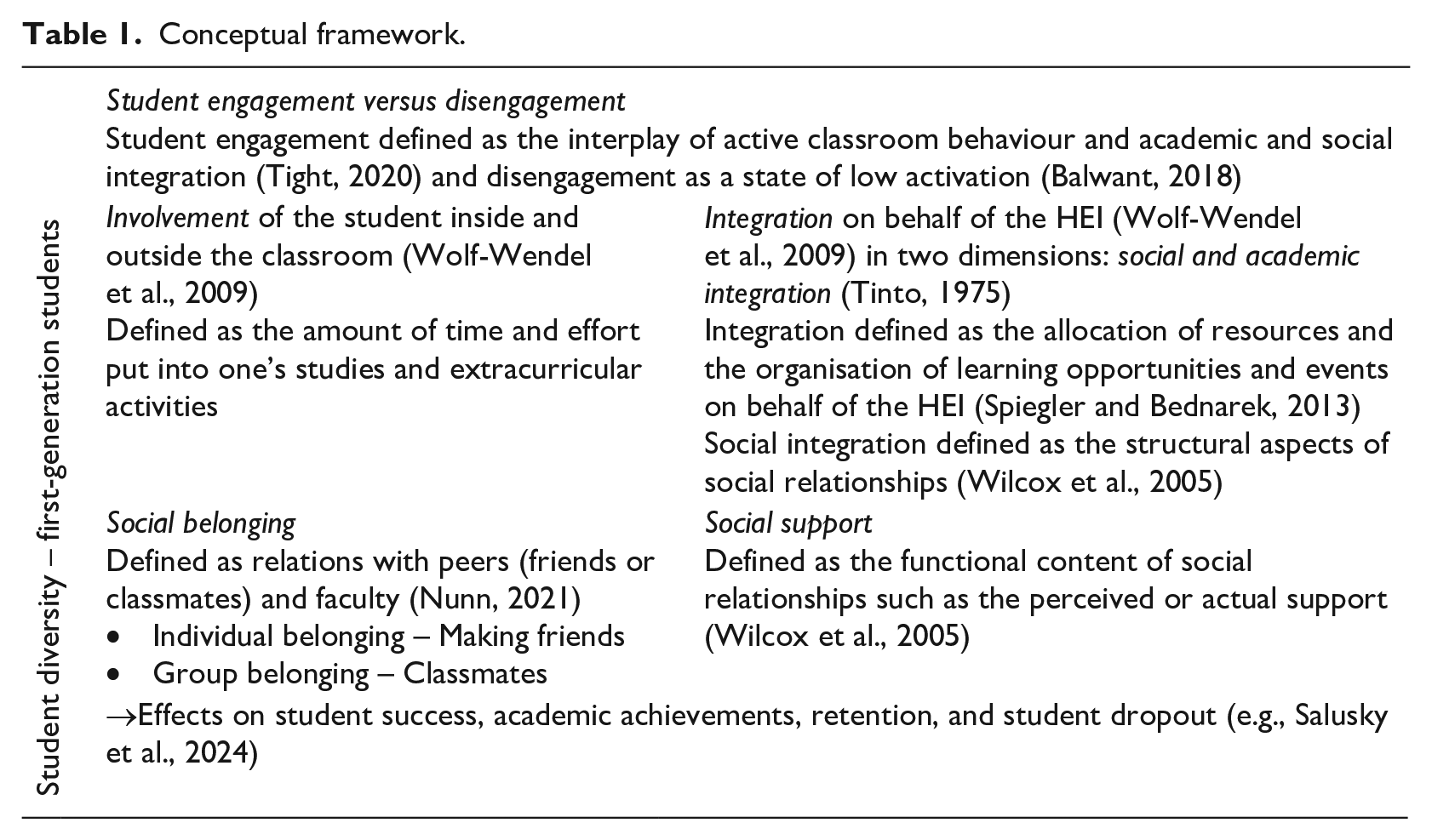
Social belonging – the main focus of this study – is defined as relations with peers (friends or classmates) and faculty (Nunn, 2021). Developing a sense of social belonging and maintaining social networks on campus are fundamental elements of becoming a student and belonging to a university (Nunn, 2021). It has even been suggested that a sense of belonging is one of our most fundamental needs. In his hierarchy of needs, Maslow (1943) places love and a sense of belonging on level three after physiological (food, water, shelter) and safety and security (health, employment, family) needs. In education, a sense of social belonging is one of the main drivers for retention and is therefore closely linked to academic success (Salusky et al., 2024). Learning processes are not merely academic in nature, they are also social (Coleman, 2013). A sense of belonging and trust in higher education is the basis for academic learning and involves the developing and maintaining of relations with peers and faculty as part of university life – both inside and outside the classroom (Resch and Amorim, 2021; Souza et al., 2017). A lack of belonging is connected to the risk of leaving university without graduating (Azmitia et al., 2018). However, multiple factors create tension and challenges for first-generation students, when it comes to developing this sense of social belonging: they are more likely to have greater financial obligations (Salusky et al., 2024), they are more likely to commute to university (rather than live on campus), and they are more likely to have to work and study in parallel (Unger et al., 2020). They can also be subject to increased experiences of othering as minority students on campus, reducing their likelihood of feeling like equals (Nunn, 2021). Belonging to a specific social class is demonstrated differently, i.e. in terms of language, speech, interests, status symbols, or clothing. In Austria, language is a particular dimension of social class, as the official language German has many dialects, which are affiliated with geographic origin within the country, social origin and social class.
The transition to university is also considered to be easier for those students whose new identity as a student is more consistent with their previous identities (Veldman et al., 2023). Transitioning to university will always remain a highly complex process, especially for first-generation students, who are not familiar with the university context (Lessky et al., 2021). Students negotiate between their former life with their family, in their hometown and their friends and their new life ahead of them at university. This process of ‘“finding their place” may create tensions which have to be resolved. Making and maintaining social support with peers and (to a lesser extent) staff is central to this process’ (Wilcox et al., 2005: 712). A lck of social support in these transitions can decrease first-generation students’ social belonging to their university and, ultimately, their own academic success.
Social belonging means belonging to a social group, such as a circle of friends, peer students, or a student association on campus, in which members of the group make students feel welcome (Nunn, 2021). Social belonging comprises the existence and quality of friendships with peer students – either within the first-generation students’ groups (bonding) or with continuing generation students outside the immediate peer group (bridging). López et al. (2023) report lower levels of student engagement in class for first-generation students, thus further reducing their sense of social belonging. However, belonging is not a static concept, it evolves over time. The level of social belonging experienced by first-generation students is usually lower than for other student groups. Their need to belong is likewise met to lower degrees than for other student groups, although their social belonging does improve over time (Nunn, 2021). The reasons for the low degrees of social belonging are manifold and include, for example, working and studying in parallel, which reduces the time spent on campus, the amount of time available for extracurricular activities on campus or engagement in student organizations (Spiegler and Bednarek, 2013), and the lower priority given to leisure time. Athletic events, social activities, or extracurricular clubs are often organized at times when first-generation students have other obligations (i.e., caring for family members, working, or commuting) and are thus unable to participate (Salusky et al., 2024; Spiegler and Bednarek, 2013). Majority students tend to automatically identify with the campus-community and find it easy to feel part of the academic world, while for first-generation students creating a sense of belonging is hard work (Nunn, 2021).
In addition, the conception of social belonging may include participation in student organizations, volunteer activities, sports teams, clubs or religious groups, where first-generation students come into contact with their peer students and strengthen friendships through shared experiences and interests. It is known that students experience a higher sense of belonging through extracurricular activities (Silver, 2020). However, first-generation students often find it harder to put this into practice as they lack the time for additional activities on campus. Living together in shared dormitories is an additional common feature of social belonging. However, this is not common practice in Europe, where students usually live off campus, and first-generation students are generally less likely to live in student residences (Spiegler and Bednarek, 2013).
Nunn (2021) notes that first-generation students rarely experience an immediate sense of social belonging, especially in public universities, where the number of enrolled students is large, communities are hard to oversee, and campuses are widespread. This goes hand in hand with an analysis of the literature in this field by Spiegler and Bednarek (2013), who report that the structural dimension is undervalued in research with first-generation students, a fact that makes the exploration of the other conceptual dimensions besides the size of the university – integration and social support on behalf of the HEIs – even more relevant. More specifically, they conclude that depicting the issues faced by first-generation students as individual rather than structural poses a problem to the research field. HEI have historically perpetuated class-based inequalities (Crew, 2024). HEIs and their specific services significantly influence a student’s social life. This influence may manifest in spatial arrangement of teaching facilities, the availability of social support programmes, student associations, departmental events, thus in the end leading to or fostering a departmental or cohort identity. It is, as a consequence, not the students’ sole mission and responsibility to develop a sense of social belonging, but also an act of exchange between the university and the student to mutually develop this sense of belonging. This idea is portrayed in the dimension of integration by Wolf-Wendel et al. (2009) on the basis of Tinto (1975): students’ social and academic integration. Integration is defined as the allocation of resources and the organisation of learning opportunities and events on behalf of the HEI (Spiegler and Bednarek, 2013). Tinto’s theory of student integration (Tinto, 1975, 1987) has dominated the discourse on academic success in higher education for many decades (Johnson et al., 2014). His theory of integration offers a substantive explanation for student departure from undergraduate institutions which encompasses an academic (academic integration) as well as a social (social integration) component. Following Tinto’s (1987) argumentation, lack of social integration will lead to lower commitment towards study activities. Furthermore, students who are socially integrated are more likely to complete their studies and graduate. So, social integration can be viewed as the structural aspects of social relationships (Wilcox et al., 2005).
Empirical study
Study setting and rationale
Differences in economic capital can create barriers for social relationships and division among first-generation and other students. First-generation students have lower social belonging scores than other student groups. Living off campus has the strongest negative effect on their social belonging, and they show the lowest degrees of involvement in campus events (Spiegler and Bednarek, 2013). First-generation students have also been particularly affected by financial loss during the COVID-19 period (Rodríguez-Planas, 2022), thus making social class and economic capital even more relevant criteria for analysing social belonging at university. Given that intentions to drop out of higher education have increased significantly in this group, this financial loss has also impacted their academic success (Koopmann et al., 2024).
Upward mobility through (higher) education in Austria remains low compared to other European countries. The main reason for this is the early selection process at the age of ten, when pupils in the Austrian school system are separated into academic (Allgemeinbildende Höhere Schule) or other secondary (Mittelschule) school tracks, thus laying the grounds for social and educational inequalities at an early (st)age (Lessky et al., 2021). Accordingly, educational upward mobility into higher education is a far less common experience for first-generation students (Spiegler, 2018).
Various higher education research studies with first-generation students have focused on their transition processes into higher education. We have taken a different approach and chosen to explore how they experience their time at university and, more specifically, their social belonging with their friends and classmates. Accordingly, our study delivers a first-hand perspective on students’ experiences of social belonging while studying.
Methodology and data collection
The study site was a large, urban university in Austria, in which approximately 90,000 students enrol each year. For the purposes of this study, two specific departments were chosen as research sites on the basis of the fact that firs-generation students are more likely to take up less prestigious subjects (Spiegler, 2018): the Faculty of Educational Science and the Centre for Teacher Education, which together encompass around 11,000 students. The study sought to augment existing knowledge on first-generation student experiences by asking the following research questions:
(a) How do first-generation students make sense of their social belonging at university?
(b) How does social class impact their experiences of belonging?
To analyse the experiences of first-generation students, we opted for a qualitative approach that links theory-building and empirical research and provides in-depth insights into student perspectives on the research topic. More specifically, narrative interviews following Rosenthal and Loch (2002) and Rosenthal (2015) were conducted. Interviews were minimally structured to allow a free flow of the participant’s associations. We used a short narrative focusing not on their whole educational career, but on their university experience only. However, almost all study participants compared their university experience to their school experience. We applied an explorative approach to the interviews to build rapport and encourage honesty (Gall et al.,2003). The narrative interview proceeded by asking one very general and open question (Jovchelovitch and Bauer, 2000) in the beginning: ‘Please tell me about your entry into higher education with reference to your specific working class background. How did you experience your start at university and your academic studies?’ The introductory question included possible areas to focus on, that is, selection of study programme, entry into higher education, family support, experience of becoming a student and academic experience to include in their narratives. Prompts and follow-up questions probed for specific examples and expansion on key aspects of social belonging. For example: ‘You told me about . . . could you please tell me more about . . .’. However, in most cases, narrations were not interrupted.
The interviews lasted on average 41 minutes, were audio recorded, and were subsequently transcribed by the second author of this study (in German). While all of the first-generation students who participated in the study were native speakers of German, some of them did speak in their local dialects. All interviews were transcribed verbatim, meaning that the use of local dialects was retained in the transcripts. For any publications in English, these utterances in German dialect are lost, as they are not translatable, but instead represent the respective participant’s working class background. Data collection concluded when data saturation was achieved (Sandelowski, 2008).
Participants
Purposeful sampling was used to recruit seven first-generation students to participate in the study in the summer term of 2022. The inclusion criteria were ‘identifying as a first-generation student’ and ‘being enrolled in either a Bachelor or Master programme at the university in the aforementioned departments, i.e. the Faculty of Educational Science or the Centre for Teacher Education’.
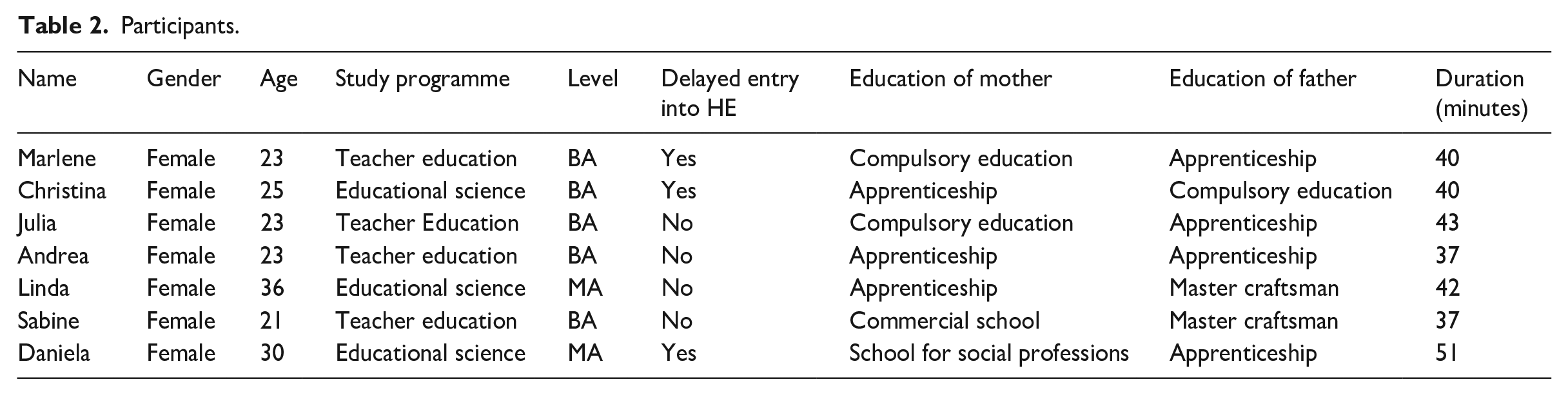
Table 2 summarizes the characteristics of the study participants. All of the participants were female, which corresponds to the chosen study programmes, which are both female-dominated fields. Those participants who were enrolled in a Bachelor programme were younger (21–25 years of age) than their counterparts in Master programmes (30–36 years of age). Parental education was non-academic in all cases, while half of the parents had completed an apprenticeship (7 out of 14), two had a master craftsman diploma, two had attended vocational high schools (for social and commercial professions), and three had only completed compulsory education (the lowest possible educational background in Austria). Three of the study participants reported a delayed entry into higher education, having started and dropped out of one or two programmes at the same or other higher education institutions prior to enrolling in their current programme. All study participants received some form of financial aid during studying. Three participants have older siblings, who study as well. Three participants have single mothers.
Participants.
Data analysis
Two independent researchers reviewed each transcript, and start codes were generated from each review. It was surprising that the data involved various accounts of barriers to social belonging and involvement although the narrative interviewing did not focus on barriers and no problem-centred approach was applied. The start codes involved the following: feelings of insecurity and alienation, financial support, overburdening, and social belonging. Once all of the start codes had been generated, they were grouped into categories and, ultimately, into three final themes: financial and social support, coping with negative sentiments (including the start codes insecurity, alienation, and overburdening), and social belonging to friends and classmates.
As Scharp and Thomas (2019) argue, critical social science scholars should assess their own positions in the research field and how these contribute to their interpretations of their participants’ lived experiences: The research team consisted of one former first-generation student and one former continuing generation student. In contrast to what we expected from the literature review, some themes were not identified in the data: academic support by educators and getting involved on campus in extra-curricular activities, which could have been relevant themes for social belonging.
Findings
Students depend on financial and social support
All first-generation students received some form of financial aid when attending university and all students described scarcity in regard to their financial capital. Linda describes a well-functioning scholarship system for her Bachelor’s, but scarcity for her Master’s degree, leading to the necessity of asking her parents for help. Daniela speaks about the financially limited scholarships she received, and her mother, who could not pitch in, just as in Julia’s and Marlene’s case, and Sabine reports living from her scarce savings. The findings in this theme show that students from single mothers (Daniela, Julia, Marlene) seem to experience more financial hardship than others.
Linda, as the oldest participant in the study, talks most openly about her need for financial support. She differentiates between her Bachelor’s and Master’s degrees, stating that during her Bachelor’s she was eligible for financial aid (‘Selbsterhalterstipendium’, app. 900 Euros per month), after having worked fulltime for 7 years before enrolling in university. Looking back at her Bachelor’ studies, she is content with her financial situation: ‘I did not lack anything’. She makes a relevant connection between social support and financial support by reflecting that a friend volunteered for the local student union and was thus well informed about student support needs. This friend told her about the financial aid system and as a consequence she applied and received the money. This exemplifies first-generation students’ need for informational capital, which she accessed through her friend. In her Master’s, Linda was not financially supported anymore and needed help from her parents. She states that she felt supported by her parents, but felt pressured however to repay her parents as soon as possible: ‘Financially, it was a little difficult at times, but I have to say when I ran short I asked my parents and they were willing to help, but I wanted to pay them back as soon as possible, when the sensitive phase was over’.
Daniela is the second student in the study, who was enrolled in a Master’s degree programme. In the beginning of her becoming a student, she was unsure what to study, and changed her field of study three times, from business law to law to educational science. Between these transitions, she reported having standby times, in which she was required to work. Equivalently, she had to work and study in parallel to be able to complete her final degree. She does not differ between her Bachelor’s and Master’s degree, but rather describes her financial situation as ‘being dependent all the time’. She refers to her family background, having a single mother with a low income, who works in a social profession, from whom she is not able to borrow money. ‘I was dependent on this scholarship and (…) it was ridiculous anyway, I think, I received 50 Euros per month and family allowance [Familienbeihilfe, app. 200 Euros per month]. I mean I think in total I stepped out with 300 Euros a month and had to work ten hours a week along the way in order to make ends meet somehow’.
Julia’s and Marlene’s parents were not able to support them financially either. Marlene asked her mother to transfer her family allowance [Familienbeihilfe, app. 200 Euros per month] to her account, but she needed it herself. ‘I never received pocket money or something like that. During my studies, they always told me to look for a job, so that I could afford what I wanted to afford. I asked if I could have my alimony, that was not possible. She didn’t want that and I received my family allowance pretty late as well because my mother needed it (…) she went into personal insolvency two years ago’. Julia repeats this experience by reporting that her mother was not able to give her money on a regular basis.
Sabine describes being in an extraordinary situation due to the post-covid experience. As during the pandemic she did not fully use her reserves, she now has extra money. ‘I actually get through quite nicely due to COVID-19. Everybody gave me some extra money for my highschool degree and for the final trip after graduating, which I didn’t use. These are my savings and I still have them’. However, her savings are limited.
Negative sentiments block involvement
Most first-generation students in the study reported negative feelings in the beginning of their careers as university students. They justified their sentiments with accounts of high academic demands, a high academic language level and high levels of closure at university blocking their involvement and creating feelings of distance, insecurity, overload or alienation.
Christina and Daniela felt lost and alone in the beginning of their studies. They did not know anyone in their degree programmes. Linda feels alienated in class when comparing herself to other peer students. She reports feeling nervous and insecure and remembers having no understanding of what being a university students means, and nervously arriving at the crowded main lecture hall with thousands of other students. Daniela shares parts of these sentiments, when she describes being overwhelmed by the high level of academic contents: ‘Making comparisons. What does X think about Kant? I didn’t even understand what Kant was saying. How should I understand, what someone else was saying about Kant?’ This exemplifies that her social background made her feel insecure and blocked her active involvement in the debates on Kant. Linda justifies her low degree of active involvement in class in similar ways. She tries describing herself as an academic self and compares her time at university with school: ‘At school there were only a few presentations or situations, in which I was supposed to speak in front of many. That is why that was horrible for me, I mean cold sweat and reddening, to present at uni, where I raised my own standards because I knew, ok I am here at university (…) what a mega-fear of presentations. And discussion rounds were so intimidating I honestly have to say’. The student states that active involvement in debates and discussion rounds is intimidating and, hence, Linda prefers to listen only. She goes on further, stating that academic language made her afraid at first. Andrea, Sabine and Linda underline this by saying that academic language posed a barrier to their active involvement and feeling of belonging to university, while Andrea and Sabine speak the most obvious dialects in the interviews. Sabine represses her dialect so that others cannot draw conclusions from her language to her working class background. Linda states that she finally managed to cope with this kind of formal language at the very end of her Bachelor’s degree. She reports having to use a dictionary oftentimes to understand academic language and being disappointed that ‘studying is much more work and less joy than I expected’.
Social belonging to friends and classmates is low
Common elements among those students who talked about their friendships in the course of their academic experience were that their strong ties were outside the university (i.e., with friends from school, their hometown or elsewhere), and their weak ties were within the university (if they had established any friendships at all during their time at university).
Both Marlene and Julia clearly state that they have not made friends with anyone at university, neither in class nor on campus. Julia explains that her friends originate from school and that she does not spend time on campus, and, hence, does not meet anyone: ‘I don’t really have a lot of uni friends, but I do have a lot [of friends] from before at school, but not really uni friends. I don’t get to know anybody. I go there [to class] and then I leave again immediately after’. Marlene’s narrative shows that she attends classes but does not spend time on campus. Her social belonging to the university is therefore low. In contrast to Julia, who does not want to spend time on campus (‘I don’t feel that I urgently need social contacts at university’), Marlene wistfully explains that she would have liked to have done so. She puts her lack of friendships on campus down to the COVID-19 situation and the lack of opportunities to meet on campus:‘I didn’t have time through COVID or, well, I couldn’t really meet with anyone. I did get to know some people, but I guess it was stupid because of COVID when you couldn’t really connect’.
Marlene goes on to add that she only has a few friends in any case: ‘I actually only have two real friends, and they are currently both catching up on their high school diploma’. In Marlene’s account of her friendships, she chooses to refer to their adjacent identities since, like her, both have chosen delayed entry into higher education. Julia also mentions having a close friend who is currently catching up on her high school diploma. In both cases, their close friends are peers who share the same identity (bridging capital ‘It seems to me that I got on much better with those who also have a working class background or are the first in their family to go to university. We share the same or similar experiences and were better able to share them with each other’). Andrea and Christina both speak about being friends with other first-generation students rather than students from academic families. They justify this with a stronger feeling of social belonging within their own group, being on the same wavelength, and having the same information deficits (and need to compensate for them) as other first-generation students. Christina states: ‘I was lucky that my circle of friends included people who were already older, who had started studying two years before me, and were also on the teacher education course […]. The whole story with the curriculum and those issues, I wouldn’t even have known that there is a curriculum and that you simply have to work through it’. She further explains that she had known nothing about the structures of the study programme, enrolment, and course registration, or about how to apply for financial aid, and was fortunate to have been able to share these deficits with other first-generation students. Andrea repeats this sentiment: Andrea clearly makes the connection between friendships and informational support in this statement and recognises this information flow as a great advantage of friendships within the first-generation student group.
Julia and Linda, in contrast, both speak of problems and changes in their circles of friends during their time at university. Julia has difficulties in connecting with peer students as she feels that they have different priorities to her. She explains that going to clubs and doing other leisure activities, which regularly involve spending money, is not feasible for her. She therefore chooses not to spend time with students who do and justifies this with three arguments: (1) those students are not ‘serious’ students as their leisure time is more important to them than their studies, (2) they are more immature than her since they receive money from their parents and therefore only learn to be independent late(r) in life and (3) they have other interests than her. Julia seems to be describing two groups of students, those who are like her and those who are not. She actively states that she would not seek friends on campus. Linda describes a breach in her circle of friends: those with traditional responsibilities in her home town and those studying in a large city. Linda had moved from a rural area to the capital city to go to university.
Generally speaking, the students found it difficult to establish and maintain friendships at the university. While first-generation students do seem to succeed in building friendships with like-minded peers with corresponding identities who provide support and reassurance on campus (bonding capital), they find it more difficult to do so with students with different identities (bridging capital). The first-generation students who participated in the study do not connect to others easily and therefore prefer to maintain friendships from outside the university.
Students hardly talked about relevant experiences of social belonging in class. One explanation for this is the COVID-19 period of online learning, but also university structures, which seem to stimulate more loose contacts in class.
Christina is one of the first-generation students with a delayed entry into university. First, she attended a University of Applied Sciences and explains that she experienced positive social belonging there. Study programmes there are arranged in classes of app. 30 students, which work through the whole study programme together in cohorts. In contrast, classes at university are one-time experiences and thus, in the end, create social distance. The following quote illustrates her comparative experience in two university structures: ‘There [at the University of Applied Sciences] you are together in every course. At uni you attend one course with that person and another course with another person and lecturers don’t really know you. At the University of Applied Sciences lecturers are closer to their students, they even remember their names or for example know that your work and study in parallel. It’s a bit more like family’. ‘It’s a bit better now because I know some people and then you know that the others are fighting the same battles as you are. That’s comforting that I am not the only one who is at my wits’ end’. She notices that studying in a fixed cohort feels like ‘family’, a group who regularly meets and shares courses and contents, while at the university students rarely meet for more than one semester, depending on the size of the study programme and the number of students enrolled. Sabine experiences similar distance in classes due to the pandemic. She describes the situation in post-pandemic classes like this.
Daniela is the only first-generation students who experienced a stronger sense of social belonging through participating in study groups. According to Daniela, her study groups ‘saved her’ by discussing difficult texts and academic contents over a longer period of time. While at first, she does not seem to remember different study groups, but only one in the STEOP phase (introduction and orientation phase), she then remembers attending a second study group in the course of her studies. She explains that the first study group was diverse in terms of student backgrounds. She refers to other peers with a working class background, but also migrant students and students who worked and studied in parallel. In her second study group, later during her academic experience, she contrarily reports being the only first-generation student: ‘All others were bourgeois. One – I recently found out – even completed her PhD in education science’.
Discussion
To obtain a better understanding of the social belonging of first-generation students in Austrian higher education, their experiences of barriers to attending university in post-pandemic times cannot be omitted. Here, the three main results of the study will be discussed in the context of previous research: (1) First-generation-students depend on financial and social support more than others. (2) Negative sentiments block their active involvement in HE. (3) First-generation students hold stronger feelings of belonging with friends outside the university and do not make new friends at university easily.
First, students depend on financial support and the connected social support by their families in order to overcome financial barriers and hardships. The findings of the study show that the three students, who described their parental support as particularly high (Andrea, Linda, Sabine), experienced their time at university as less burdensome than others. In contrast, Daniela, Julia and Marlene from single mother homes seem to experience more financial hardship than students with two parents. These students navigate higher education under significant economic constraints and often experience limited or intermittent access to student peer networks. Other studies in this field support this finding: families were identified as active participants in investing emotionally, financially and practically in assisting students to realizing their studies (Guzmán-Valenzuela et al., 2022). It seems like the specific social support first-generation students require is multidimensional and contains elements of financial, informational, and emotional support. Putnam (2000) argues that the total of social capital (in the United States) has been declining as less people become involved in bridging activities. Following his argument, we conclude that the post-pandemic university has lower social capital potential than before the pandemic as many students have considerably reduced their time on campus. Low levels of bonding and bridging capital produce lower solidarity among students, although minority students require social support networks more than in non-pandemic times. This has important implications for research and diversity management practice. López et al. (2023) suggest minimizing the distance from home to campus for as many students as possible to foster a sense of social belonging and an uptake of activities on campus. However, this is an economic matter, especially for first-generation students with a range of financial obligations.
Accessing peer networks not only fulfils the purpose of developing a sense of belonging, it also assists first-generation students in obtaining valuable study-related information, i.e. on study logistics, course registration, or curricula, that might not be accessible via official communication channels (Lessky et al., 2021). The interface between social support through peer networks and study-related information (informational capital) is a significant intersection of student engagement. Through peer networks, students become familiar with the unwritten rules of the institution.
Second, negative sentiments block students’ active involvement in higher education. Students reported being confronted with a high level of academic language or hiding their dialects for others not to detect their origins in rural Austria. Austria has distinct dialects of German, which clearly disclose the geographic origin of a person based on their language and which are affiliated with social origin and social class. Working-class students experience a gap between their use of dialect at home and the use of high standard German at university. Crew (2024) argues that it is necessary to move away from linguistic homogeneity, assimilatory beliefs, and a deficit perspective towards minority students and view dialects as a form of linguistic capital – the ability to communicate in different language styles. This aspect of our findings show how linguistic inequality is still (re)produced in neoliberal higher education.
Third, first-generation students hold stronger feelings of belonging with friends outside the university or those with similar identities. This finding might of course also apply to other groups of students in the post-pandemic university and might not be specific to this group. The study shows that first-generation students who maintain friendships at university do not necessarily meet these friends in class. Many of them take classes on campus or virtually and leave immediately afterwards. A strong sense of belonging, thus, cannot be developed (Nunn, 2021). This might also explain why none of the participants gave an account of getting involved (with student associations or clubs) on campus. While Wilcox et al.’s (2005) study found out that students’ development of friendships began to replace their reliance for support on family and friends at home, this argument is not supported with the accounts of the students in the present study. Students report a lack of new friendships and relying on old ones even in their new lives at the university. The participants in this study reported stable social capital outside the university as they maintained close friendships to peers from school or their home towns, most of whom were also non-traditional students with a delayed entry into higher education. Given their needs, within-group relationships seem to have the most value for these first-generation students, who report gaining relevant informational capital from this immediate peer group. According to the literature, a lack of social integration at university will ultimately lead to a lower likelihood to complete one’s studies and graduate (Tinto, 1987). In three of seven cases, first-generation students terminated one or more degree programmes prior to finding their current programme (Marlene, Daniela, Christina). Each transition period posed a risk to their likelihood to graduate, a financial burden, and a loss in social belonging. However, students with stable networks to friends and family outside the university may manage these transitions well although their social belonging to a specific higher education institution may decrease.
The study has important implications for faculty and higher education diversity management departments. Social class undoubtedly remains a significant element of student diversity in higher education. Universities should develop interventions that assist first-generation students in accessing the informational capital they need, that is, a combination of social and cultural capital (Lessky et al., 2021). In addition, universities are commonly communities with high degrees of closure (Crew, 2024). If universities seek to increase their social capital potential in the post-pandemic future, they will need to shift from expecting students to be campus-ready and instead become student-ready themselves (Grabsch et al., 2024). Institutional efforts will have to range from presenting student-friendly information about financial aid to academic support systems through advising, job opportunities, and special interest groups (Martin and Ardoin, 2021). Educators could offer opportunities for extra-curricular engagement in order to impede the further decline of social belonging among students. Familiarizing highschool students from working class families as early as possible with universities may also be a relevant outreach activity for diversity management departments, which removes later barriers (school-university partnerships, Resch et al., 2024). Their numerous struggles they overcome also make them excellent candidates for mentoring (Crew, 2024). Since the first-generation students in the study reported that they were not able to spend much time on campus, universities could establish virtual or hybrid activities that first-generation students who commute to campus could attend at different times, thus creating equal participation. If this does not happen, social class risks becoming merely an organizational category and not an imperative for diversity management. These (and other) measures show the potential for universities across Europe to improve their social justice agendas for diverse students to ensure equal participation for all in post-pandemic times.
While we believe this study to be sound, we do also acknowledge its limitations. We deliberately chose a small sample size of seven female students from two departments at an Austrian university, which limits the generalizability of the findings. Our findings are not intended to generalize the situation on the research site’s campus to other universities. In addition, the interviews purposefully avoided focusing on students’ academic trajectories. Without comparing the experiences of these seven first-generation students to those of students from other social backgrounds, it cannot conclusively attribute this experience solely to first-generation status. Other categories of students (such as those from families with degrees in different fields or middle-class students living far from universities) might similarly experience these challenges. Ideally, other studies in this field could implement a mixed methods approach to further explore the social identities of first-generation students and generate suitable responses to the barriers of social belonging. It is also unclear how social belonging for first-generation students evolves over time as this was not a longitudinal study. Researchers in other studies found that the interviewees communicated more openly in a second round of interviews. Also, we are critical about the choice of the interview form, as narratives do produce long stories without guarantee that research questions are answered, especially if stories are not concise. However, the theme of social belonging did emerge in the data and as a consequence, we believe the narrative approach added validity to the findings. However, in-depth interviews, semi-structured interviews or focussed interviews might have led to more in-depth results of the theme of social belonging. Applying a qualitative approach to gain direct insights into the perceptions and experiences of first-generation students provided valuable food for thought for faculty and diversity management. The study gave first-generation students a voice through the empirical data.
To conclude, equal opportunities for all students to participate in higher education regardless of their background are fundamental principles of higher education policymaking, although they might not always be put into practice (Bastedo and Gumport, 2003). Nonetheless, a recent systematic review found that only a few studies address the socio-economic status or social class of students as a dimension of diversity in higher education, unlike other diversity dimensions such as gender or ethnicity, which are considered far more frequently (Resch, 2023). Thus, first-generation students remain an underrepresented group – in research, policy, and practice.
Footnotes
Declaration of conflicting interests
The author(s) declared no potential conflicts of interest with respect to the research, authorship, and/or publication of this article.
Funding
The author(s) received no financial support for the research, authorship, and/or publication of this article.
