




Abstract
This paper reports on a survey and follow-up focus groups with students attending a highly academically selective and socially ‘elite’ university in England. Informed by Bourdieu’s theory of class-based capitals, the research explores three distinctive dimensions of (non)belonging at university among our study participants relating to levels of (1) economic capital evident in feeling financially able to participate in the extracurricular aspects of university life, (2) cultural capital evident in feelings of ‘fitting-in’ with the dominant habitus of students attending the university and (3) social capital evident in feelings of inclusion in social activities and friendship groups. The students in our sample from disadvantaged backgrounds scored significantly lower on all three elements of belonging compared to their more advantaged counterparts, particularly in relation to economic capital. Excerpts from the open questions in our survey and subsequent focus groups illustrate the interrelated nature of the barriers to economic, cultural and social belonging faced by students from disadvantaged backgrounds. Echoing previous studies of other national contexts, our findings point to the need for highly selective universities to do more to facilitate belonging for less advantaged students, not least by tackling financial hardship and promoting a more inclusive socio-cultural climate.
Introduction
Highly selective UK universities have traditionally been the preserve of students from the most advantaged social backgrounds (Boliver, 2015a; Harrison, 2017). Since the introduction of ambitious new widening access targets for England’s most academically selective universities (Office for Students (OfS), 2018), however, the proportions of students entering these institutions from neighbourhoods with higher education participation rates in the top as compared to the bottom quintile nationally has declined steadily from a ratio of 7.4-to-1 in 2018 to 5.6-to-1 in 2022 (Boliver and Jones, 2023). 1 While highly academically selective universities have become more socioeconomically diverse than previously, it remains the case that these institutions continue to be dominated both numerically and socio-culturally by students from socioeconomically advantaged backgrounds. Unsurprisingly, students from socioeconomically disadvantaged backgrounds often harbour a sense of non-belonging at these institutions (Addison and Stephens Griffin, 2022) which has been found to be a contributing factor in lower levels of course completion and achievement at degree level (Ostrove and Long, 2007; Pedler et al., 2022; Phillips et al., 2020).
Bourdieu’s (1986) theory of class-based capitals provides an invaluable conceptual framework for understanding the nature of socio-economic group differences in sense of belonging in higher education, and for identifying the changes needed to promote belonging at university for all students. In the first half of this paper, we elucidate Bourdieu’s distinction between economic, cultural and social capital and use this conceptual framework to map out the existing empirical evidence on less advantaged students’ experiences of (non)belonging at university.
Building on insights from the existing empirical literature, and drawing on the capitals framework developed by Bourdieu, in the second half of the paper we report on a new study which combines social survey and focus group methods to explore socioeconomic group differences in sense of belonging among students attending Durham University, a highly academically and socially selective university in the North East of England. Our analysis of the survey data collected as part of this study illustrates the value of the capitals framework, revealing three interrelated but distinctive components of students’ sense of (non)belonging at this institution. Specifically, we find that students from less advantaged backgrounds report lower levels of belonging in comparison with their more advantaged peers in relation to measures of (1) economic capital, that is, their financial ability to participate in the extracurricular aspects of university life, (2) cultural capital, that is, feeling as though they ‘fit-in’ with the dominant habitus of students at the institution, and (3) social capital, that is, feeling included in social activities and friendship groups. Selected excerpts from the qualitative data gathered from students from less advantaged backgrounds show in more detail some of the ways in which economic, cultural and social capital inequalities work individually and in interaction to diminish these students’ sense of belonging at the university. We conclude the paper by showing how Bourdieu’s capitals framework can be used not only to understand but also to develop strategies to address disparities in sense of belonging at university.
Literature review
Numerous social scientific studies have documented empirically that less advantaged students are less likely than their advantaged peers to feel that they belong in higher education, especially at the most academically selective institutions. These studies often focus on one particular dimension of comparative disadvantage, such as coming from a working-class rather than middle- or upper-class background (Loveday, 2015; Reay, 2017); being in the first generation of family members to go to university as opposed to having one or more graduate parents (Henderson et al., 2020); or residing in a lower income household (Harrison et al., 2018). Although social class, parental education, household income and other indicators of relative socioeconomic advantage and disadvantage are not entirely synonymous with one another, membership in these categories overlaps substantially (Adamecz-Völgyi et al., 2020). Moreover, the socioeconomically disadvantaged members of these categories bear a striking resemblance to one another with respect to their experiences of (non)belonging in higher education. These commonalities make Bourdieu’s concept of capitals a useful tool for understanding the roots of (non)belonging in higher education across all of these facets of socioeconomic disadvantage.
In his theoretical analysis of the nature of class-based inequalities in contemporary societies, Bourdieu employs the concept of ‘capital’, defined as accumulated labor (in its materialized form or its “incorporated,” embodied form) which, when appropriated on a private, that is, exclusive, basis by agents, or groups of agents, enables them to appropriate social energy in the form of reified or living labor’ (1986: 15). Bourdieu recognised the fundamental importance of economic capital – that is, resources that are ‘immediately and directly convertible into money and may be institutionalized in the form of property rights’ (1986: 16) – but argued for a broadening out the concept of ‘capital’ to recognise the ways in class inequalities also manifest in cultural and social forms.
Accordingly, Bourdieu coined the term ‘cultural capital’ to refer to the way in which members of the advantaged class profit from their ease with and mastery of valued cultural forms. For Bourdieu, cultural capital is principally ‘embodied. . .in the form of long-lasting dispositions of the mind and body’ (1986: 17) which constitute a ‘habitus’ or way of being associated with membership of the dominant class, as well as being imbued in objects regarded as esteemed ‘cultural goods’ and institutionalised in the form of educational credentials. Bourdieu also coined the term ‘social capital’ to capture ‘the aggregate of the actual or potential resources which are linked to possession of a durable network of more or less institutionalized relationships of mutual acquaintance and recognition’ (1986: 21). These ‘social connections’ provide members of the advantaged class with access to ‘material profits, such as all the types of services accruing from useful relationships, and symbolic profits, such as those derived from association with a rare, prestigious group’ (1986: 22).
Importantly, for Bourdieu, both cultural and social capital represent ‘disguised forms of economic capital’ which, although ‘never entirely reducible to that definition, produce their most specific effects only to the extent that they conceal (not least from their possessors) the fact that economic capital is at their root’ (Bourdieu, 1986: 24). In the case of cultural capital in its embodied form, Bourdieu notes that ‘the link between economic and cultural capital is established through the mediation of the time needed for acquisition [with] differences in the cultural capital possessed by the family imply[ing] differences first in the age at which the work of transmission and accumulation begins. . .and then in the capacity, thus defined, to satisfy the specifically cultural demands of a prolonged process of acquisition’ (1986: 19). Because the cultivation of cultural capital occurs via a long process of socialisation, initially within the family and later also at school, it tends to go ‘unrecognized as capital and [mis]recognized as legitimate competence’ (1986: 18; Warikoo and Fuhr, 2014). Similarly, investment in valuable social capital connections ‘presupposes an unceasing effort of sociability, a continuous series of exchanges in which recognition is endlessly affirmed and reaffirmed. This work. . .implies expenditure of time and energy and so, directly or indirectly, of economic capital’ (1986: 22–23). As Bourdieu notes, these social connections are ones that ‘have been established and maintained for a long time, as if for their own sake’, which ‘has the effect of transfiguring the purely monetary import of the exchange’; in other words, ‘the time lag is one of the factors of the transmutation of a pure and simple debt into that recognition of nonspecific indebtedness which is called gratitude’ (1986: 24–25).
For Bourdieu, these various ‘kinds of capitals, like the aces in a game of cards, are powers which define the chances of profit in a given field’ or social space (Bourdieu, 1985: 196). That is to say, those in possession of higher volumes of the forms of capitals favoured in a given domain of social life occupy more powerful positions relative to others and are better placed to thrive in that field. Bourdieu’s (1996) own analysis of the French higher education field of the 1960s and 1970s highlighted the role played by the prestigious grandes écoles in the intergenerational reproduction of elites via the continued transmission and consecration of cultural and social capital.
The extant literature indicates that economic capital inequalities result in very different experiences of higher education for less advantaged students with impacts on sense of belonging. Less advantaged students are typically reliant on government-backed student loans to cover their living expenses while at university and less able to call on their parents to help supplement their income (Sutton Trust, 2023). As a result, socioeconomically disadvantaged students may lack the financial resources needed to live in increasingly expensive rented student accommodation provided by the university or private sector (HEPI, 2023) and so are more likely to continue to live at home (Donnelly and Gamsu, 2018) with consequences for their ability to engage in the extracurricular and social aspects of university life (Holdsworth, 2006). Even where living in student accommodation is a financially viable option, socioeconomically disadvantaged students often report being unable to afford to engage in extracurricular activities requiring expenditure on membership fees or equipment, such as university societies and sports teams, and in prestigious social events such as formal dinners and formal balls which require expenditure on costly tickets and clothing (Hindle et al., 2021). Even on a day-to-day basis, clothing is an area in which socioeconomic discrepancies may be most marked, with socioeconomically disadvantaged students conscious of their limited financial ability to dress as their more affluent peers do in expensive clothing brands (Mountford, 2017). The limited economic capital possessed by socioeconomically disadvantaged students also means they are more likely to struggle to purchase necessary academic equipment such as their own laptop and other hidden course costs such as academic field trips (Mates et al., 2022). Moreover, these students are much more likely to be engaged in paid work for reasons of financial need (Holden, 2022), placing additional constraints on the time available to study impacting on degree performance (Callender, 2008), and constraints on the time available to engage in extracurricular activities or simply spend time socialising with their student peers (Lee et al., 2024). All of the above constitute barriers to full participation in university life rooted in economic capital inequalities, often leading to feelings of isolation and nonbelonging. Such economic barriers to belonging have been observed in other national contexts, including Austria (Resch and Bleicher, 2025); however, they are perhaps particularly pronounced in the UK context where, unlike other European nations, the costs of participating in higher education have been shifted entirely onto students cast as a private consumers (Boliver and Promenzio, 2025).
The existing literature also documents the myriad ways in which less advantaged students feel that they do not fit in culturally at university. This is not surprising given that, as Bourdieu and Passeron (1977) notes , educational institutions including universities reflect, legitimise and reproduce the dominant culture of socioeconomic elites. While more advantaged students find university spaces familiar due to their cultural similarity with home and school, less advantaged students are less familiar and less at ease with the middle- and upper-class cultural forms and practices that dominate the university. These include the grand architecture of university buildings (Ball et al., 2002); the rituals and etiquette pertaining to academic and social events such as matriculation ceremonies, formal dinners and black-tie balls (McDonald, 2024); the highly competitive and elitist ethos that pervades the most selective institutions (Reay, 2017); and styles of speaking and writing deemed appropriate in an academic context (Abrahams and Ingram, 2013). Consequently, less advantaged students frequently report feeling less confident than their more privileged peers when it comes to participating in both the academic and social life of the university (Addison and Mountford, 2015; Maclean, 2022). The literature documents that less advantaged students are not only unfamiliar with dominant cultural forms, but also routinely face having their own cultural styles ‘misrecognised’ as inferior by more privileged students (Loveday, 2015). In its more overt forms, this includes being openly mocked for speaking with a regional accent, a different vocabulary or “non-standard” syntax (Loveday, 2016; White, 2020). These findings for the UK chime with evidence from other countries of the ‘habitus conflict’ experienced by first generation scholars (Nairz-Wirth et al., 2017) who are unfamiliar with the ‘taken-for-granted languages, routines and social rituals through which university life is organized’ (Romito, 2025). Several studies have in fact found that first generation scholars frequently resort to ‘social background concealment’ in order to fit in (Veldman et al., 2023).
The literature further documents the nonbelonging that flows from less advantaged students’ comparative lack of social capital. Less advantaged students often have few family or community members to whom they can turn for advice and guidance about how to navigate the academic requirements and social mores of university life (Addison and Stephens Griffin, 2022). Moreover, less advantaged students face a range of barriers to cultivating the social connections with other students that are critical to developing a sense of belonging at university (Meehan and Howells, 2019), not least due to their more limited economic capital which restricts opportunities to engage in the social and extracurricular aspects of university life (Resch and Bleicher, 2025). This is especially problematic since the formation of new friendships with student peers could provide an alternative source of ‘informational capital’ about how to succeed academically at university in the absence of such sources of information within the family and community of origin (Lessky et al., 2021). Less advantaged students often feel excluded from friendship groups that appear to have been formed even before students arrive at university. As one interviewee in a study of first generation students in Italy observed: ‘you see these little groups that seems like they know each other before, from school maybe’ (Romito, 2025). In the UK context, this exclusion from already-formed friendship networks is exacerbated by the tendency for highly selective universities to be dominated by students from affluent families who previously attended fee-paying private secondary schools (HESA, 2024). Private schools in the UK function as a tool of elite socialisation and reproduction (Sutton Trust, 2019), providing not only a schooling experience that cultivates a deep familiarity with the dominant culture (Stenhouse and Ingram, 2024), but also an enduring social network on which to draw at university and beyond (Stevens et al., 2008). As such, previously privately educated students typically arrive at selective UK universities already knowing many other privately students and symbolically recognise even those they have not previously met as being part of their social network (Bathmaker, 2021). Private schooling in the UK therefore serves to provide social capital connections which, as Bourdieu notes, are ‘socially instituted and guaranteed by the application of a common name (the name of a family, a class, or a tribe or of a school, a party, etc.) and by a whole set of instituting acts designed simultaneously to form and inform those who undergo them’ (Bourdieu, 1986: 21, emphasis added). Having attended a private secondary school represents a ‘consecration’ which promotes mutual recognition of fellow privately educated students as ‘worthy of being known’ (Bourdieu, 1986: 22–23). By the same token, it ‘reaffirms the limits of the group’ (Bourdieu, 1986: 22–23) such that state school educated students are likely to be implicitly or explicitly excluded from the relatively socially closed networks established by privately educated students at the outset of university life.
Methodology
Building on these insights from the existing literature and drawing on Bourdieu’s capitals framework, we conducted a quantitative and qualitative survey and follow-up focus groups with students attending Durham University, a highly selective university in the North East of England, to explore socioeconomic group differences in sense of belonging at university. Durham University operates a ‘distinctive college system’ which provides students with accommodation, pastoral support and a range of social activities and prides itself on its ‘wider student experience programme including drama, music, sport, volunteering’ (Durham University, 2024). The university ranked 78 globally (QS World University Rankings, 2024), 8 out of 130 universities nationally (Complete University Guide, 2024), and is a member of the prestigious Russell Group of research-intensive universities which markets itself as representing the ‘Jewels in the Crown’ of the UK university sector (Boliver, 2015b). Conversely, Durham University is rated lowest in the UK for social inclusion (Patel, 2023), with less than two-thirds of its undergraduate students drawn from non-selective state schools and less than a quarter being in the first generation of family members to go to university in contrast to figures of 91% and 43% respectively for the UK university sector as a whole (HESA, 2024).
The survey was conducted online during summer 2022 and was followed by a series of focus groups with specific demographic sub-groups. The purpose of the study was to quantitatively measure and qualitatively understand students’ sense of belonging at the university, with a particular focus on the nature and magnitude of any differences in sense of belonging between socioeconomically advantaged and disadvantaged students. The survey was sent via email to all students attending the university, regardless of level or year of study, degree programme, funding type and full time or part time student status. The survey yielded a total of 2052 responses, equating to approx. 9.5% of the student population. For the purposes of this paper, we focus on the survey data for the sub-set of respondents who are UK domiciled ‘home’ students (N = 1252). Participation in the survey was entirely voluntary and so survey respondents are not a random sample of the target population. Students from less advantaged backgrounds are somewhat over-represented among survey respondents: for example, while 62% for all UK domiciled students enrolled at the University had attended a state school, this was the case for 72% of UK domiciled respondents to the survey.
The survey data collected was principally quantitative, involving the use of Likert scales to measure students’ degree of (non)belonging on a battery of measures which we describe in the next section. To gain a deeper understanding of how students experienced (non)belonging, we also collected qualitative data via the survey and follow-up focus groups. Survey participants were invited to share their experiences via free-text responses to two open questions which asked them to ‘recall a particular incident that made you feel included at Durham University or increased your sense of belonging’ and to ‘recall a particular incident that made you feel excluded at Durham University or decreased your sense of belonging’. Around two-fifths of survey participants provided responses to one or both questions (N = 810). Survey participants were also given the option to participate in follow up focus groups. 580 respondents gave their contact details and a total of 27 students were selected to participate in 7 online focus groups, with each group comprising students with particular demographic characteristics. Thematic analysis was performed on the free-text survey responses and focus group transcripts using a mixture of deductive and inductive coding.
The study was funded by a Durham University Equality, Diversity and Inclusion (EDI) Sub-Fund grant. Ethical approval was secured via the university’s Anthropology Department Ethics Committee. The application included a Data Management Plan and datasets are stored securely and in a way that maximises opportunities for secondary analysis by researchers based at the university. All participants and Durham University colleges were anonymised. All peer researchers were given training on safeguarding prior to conducting focus groups.
Measuring socioeconomic advantage and disadvantage
Our survey data includes a range of self-reported student demographic characteristics, including five indicators of socioeconomic dis/advantage: (1) from a working-class versus a middle/upper-class background; (2) attended a non-selective state school rather than a selective state school or private fee-paying school; (3) in the first generation of family members to go to university versus has graduate parents; (4) whether or not in receipt of means-tested financial aid from the university; and (5) whether or not engaged in paid work during term-time due to financial necessity. Because these five indicators are not statistically independent of one another, we experimented with latent class analysis to see if it was possible to reduce the five indicators down to a single categorical measure of socioeconomic dis/advantage. Fit statistics for a sequence of latent class models, shown in Table 1, indicate that these five indicators could indeed by reduced down to a single variable, comprising two distinctive and meaningful categories and a third residual category which as we demonstrate below simple captures a small proportion of cases with much missing data.
Fit statistics for latent class models.
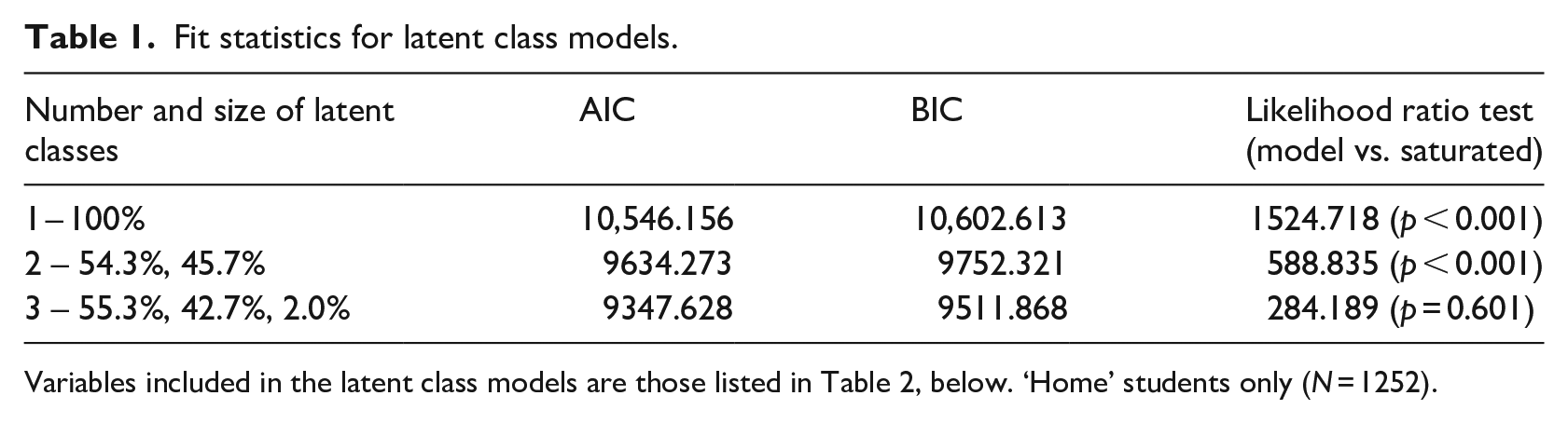
Variables included in the latent class models are those listed in Table 2, below. ‘Home’ students only (N = 1252).
As Table 2 shows, the first and largest latent class, accounting for 55.3% of all ‘home’ students, captures the more socioeconomically advantaged respondents to our survey: this group of students disproportionately self-identify as middle/upper-class (94.7%), had attended private fee-paying (41.8%) and to a lesser extent academically selective state schools (17.3%), are not first-generation university-goers (84.8%), are not in receipt of financial aid from the university (86.5%) and are not engaged in paid work during term-time for financial necessity (74.3%). The second latent class, accounting for 42.7%, captures socioeconomically disadvantaged students: these respondents overwhelmingly self-identify as working-class (93.0%), attended non-selective state schools (87.4%) and are first-generation university students (67.9%); and comparatively large proportions are in receipt of financial aid from the university (52.0%) and/or work during term-time for financial necessity (37.0%). The third latent class (2.0%) captures those for whom there is much missing data on the five indicators of socioeconomic dis/advantage used to construct the latent classes, and so we include these cases but don’t report on them in the analysis that follows.
Distribution of latent class analysis input variables within each latent class.
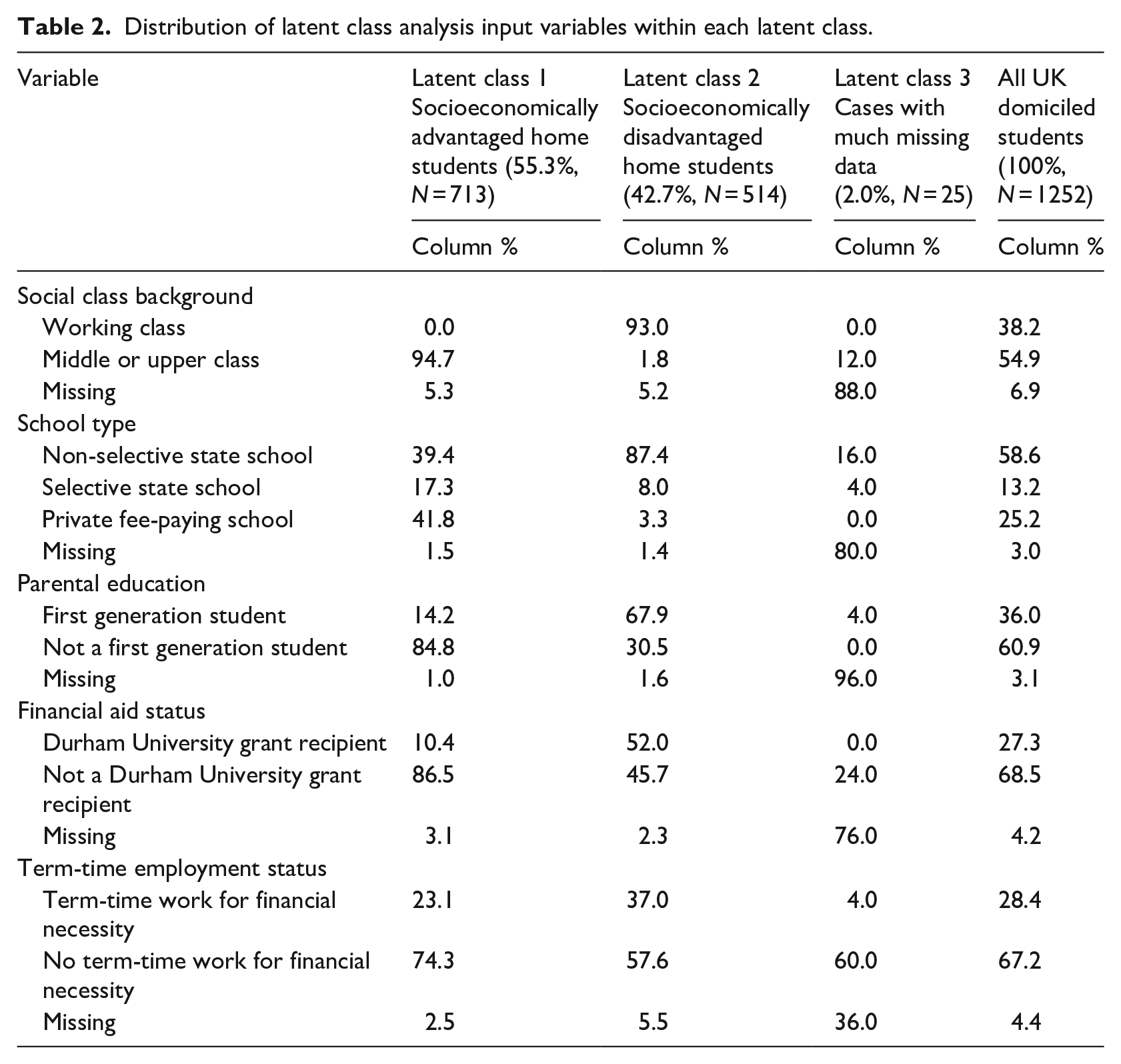
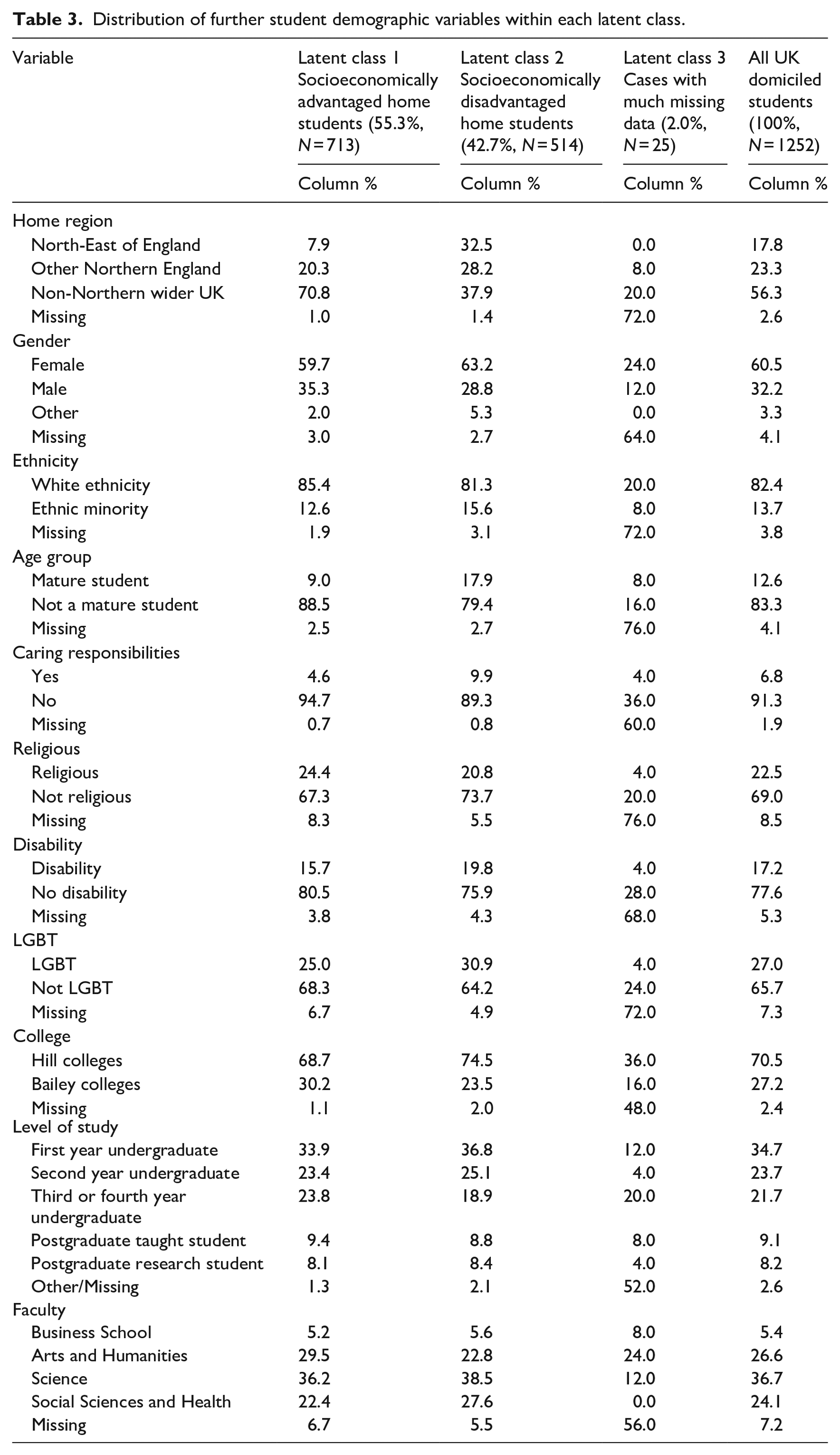
Table 3 reports the distribution of several additional student demographic characteristics within each latent class and, in the final column, for the analytical sample overall. As can be seen, socioeconomically advantaged ‘home’ students are also substantially more likely than their disadvantaged peers to be from places outside of the North and especially the North East of England. Those in the socioeconomically advantaged latent class are also slightly more likely than their socioeconomically disadvantaged peers to be male (35.3% vs 28.8%), white (85.4% vs 81.3%), not a mature student (88.5% vs 79.4%), without caring responsibilities (94.7% vs 89.3%), religious (24.4% vs 20.8%), without a disability (80.5% vs 75.9%), not LGBT (68.3% vs 64.2%), and a member of one of the traditionally more socially elite Bailey colleges (30.2% vs 23.5%). The distribution of more and less advantaged ‘home’ students by year and faculty of study, in contrast, is broadly similar.
Distribution of further student demographic variables within each latent class.
Measuring belonging at university
We invited our survey participants to respond to a number of attitudinal survey items designed by the research team to capture various facets of students’ sense of belonging at university. These survey items were designed with Bourdieu’s three forms of capital, seeking to elicit from respondents to what extent they felt able to afford the economic cost of participating in the extracurricular aspects of university life, accepted by others in terms of their cultural attributes, and included in friendship networks and social activities. These attitudinal survey questions were framed in the form of statements to which survey participants were invited to respond using a five point Likert scale ranging from 1 = Strongly Disagree through to 5 = Strongly Agree, with statements that were phrased negatively (e.g. ‘I often feel lonely at university’) subsequently reverse coded for analysis purposes.
Using exploratory principal components analysis, we identified 17 attitudinal survey items that could be reduced down to three distinctive components of belonging, capturing the economic, cultural and social aspects of belonging respectively. Table 4 reports model fit statistics for our preferred principal components analysis which, following the convention of selecting the model with an eigenvalue greater than 1.0, identifies three principal components accounting for 58.4% of the variance across 17 survey items.
Principal components analysis model fit statistics.
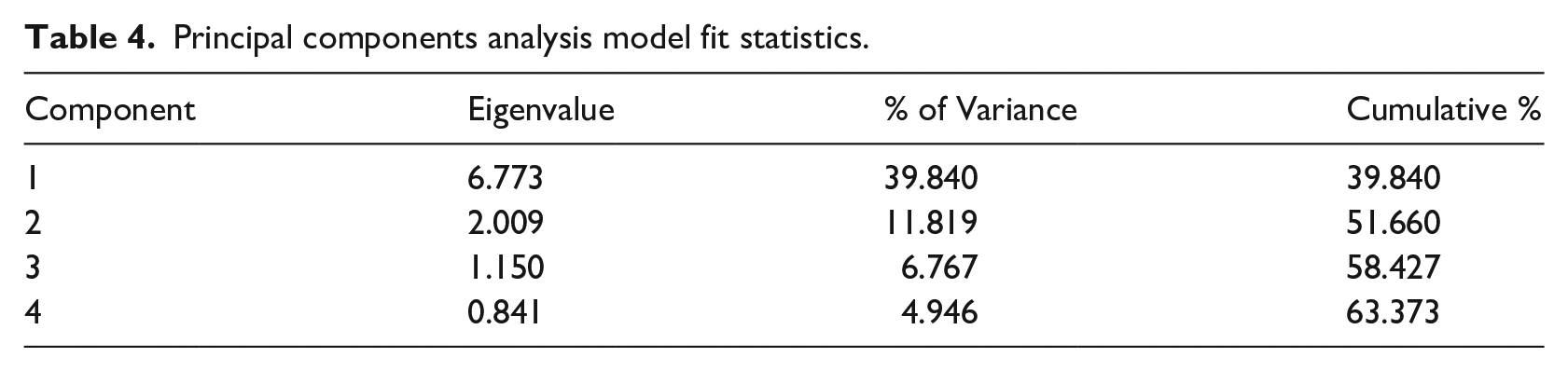
Table 5 reports the extent to which each of the 17 items included in our final exploratory principal components analysis model load onto each of the three principal components. All 17 items load positively onto the first and largest component, with items 1–11 displaying particularly high positive loading values on component one, coupled with neutral or negative values on components 2 and 3. We interpret the first component to be capturing belonging at university in relation to social inclusion in a manner akin to Bourdieu’s concept of social capital. That is to say, items 1–11 capture the degree to which students feel that the university is a place in which there are others with whom they can connect socially (e.g. ‘8. My college is a great place to make friends’) and who involve them in friendship groups and social activities (e.g. ‘11. My fellow students include me in activities I’m interested in’).
Principal components analysis: item loadings.
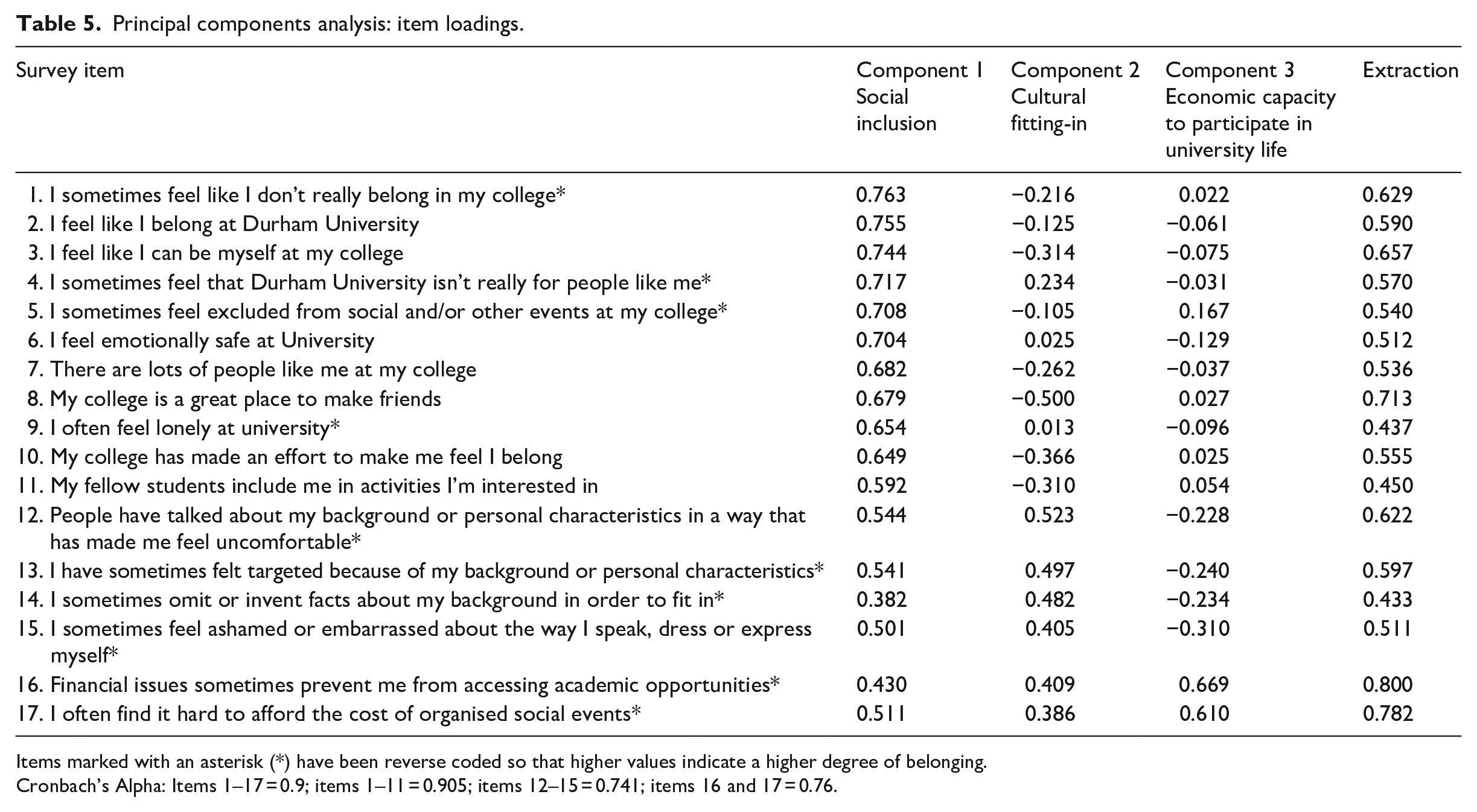
Items marked with an asterisk (*) have been reverse coded so that higher values indicate a higher degree of belonging.
Cronbach’s Alpha: Items 1–17 = 0.9; items 1–11 = 0.905; items 12–15 = 0.741; items 16 and 17 = 0.76.
Items 12–15 display strong positive loading values on the second component, coupled with negative loading values on component three. As such, we interpret the second component to be capturing belonging at university in the sense of cultural ‘fitting-in’ or, in Bourdieusian terms, the possession of embodied cultural capital or a habitus that matches that of the dominant culture at the university. For instance, item 15 picks up on the extent to which respondents ‘. . .sometimes feel ashamed or embarrassed about the way I speak, dress or express myself’ at university.
Items 16 and 17 are unique in their strong positive loading onto the third component. As such, we interpret the third component as capturing a further distinctive facet of belonging relating to the economic capacity of students to engage with the wider university experience. Item 17, for example, states ‘I often find it hard to afford the cost of organised social events’, which reflects Bourdieu’s account of how economic capital inequalities shape and constrain opportunities.
Cronbach’s Alpha tests indicate a high degree of internal consistency among all 17 indicators (α = 0.9) and among those that load particularly strongly onto components one (items 1–11 α = 0.905), two (items 12–15 α = 0.741) and three (items 16 and 17 α = 0.76). In order to retain the original Likert scale values in our subsequent analysis, we use the arithmetic mean of survey participants’ responses to each set of items to create three measures of belonging relating to Bourdieu’s three forms of capital.
Findings
We analyse our quantitative survey data using bivariate and multivariate linear regression models to explore whether students from the socioeconomically advantaged and socioeconomically disadvantaged groups (our latent classes one and two) differ significantly from one another with respect to each of three distinctive aspects of belonging identified by our principal components analysis presented above. These analyses were conducted in Stata, using the margins command to calculate predicted values in relation to each of our three aspects of belonging. Our findings are presented in graphical form, below, and highlight the extent to which mean belonging scores for socioeconomically advantaged and socioeconomically disadvantaged students differ from one another before and after controlling statistically for a range of other student characteristics. As with the original Likert scale, values of 3 indicate a neutral response, while values smaller than and larger than 3 indicate low and high levels of belonging respectively. We present first our findings for economic capital (principal component 3) because, as will be seen, it is in relation to the economic barriers to belonging that our socioeconomically advantaged and disadvantaged respondents differ most dramatically. We also discuss economic capital and belonging first because, as will also become apparent, economic inequality plays a significant role in shaping respondents experiences of (non)belonging in cultural (principal component two) and social (principal component one) terms.
Alongside our discussion of our statistical findings in relation to the economic, cultural and social capital aspects of (non)belonging, we present excerpts from the responses of less advantaged students to the open-ended questions in our survey and their contributions to follow-up focus group discussions. These excerpts shed light on the various ways in which feelings of economic, cultural and social (non)belonging manifested in students’ everyday experiences of university life, and how, as theorised by Bourdieu, economic capital inequalities were often at the root of students’ accounts of cultural and social non-belonging.
Economic capital and (non)belonging
As Figure 1 shows, socioeconomically disadvantaged students scored substantially lower than their more advantaged peers on the principal component relating to economic capacity to participate fully in university life. In the bivariate analysis, the average score for socioeconomically disadvantaged students on this metric was 2.4 compared to 3.4 for socioeconomically advantaged students; that is, on the negative and positive sides of neutral, respectively. These scores are virtually unaltered (2.4 vs 3.3) by the inclusion of controls for other demographic characteristics. Economic belonging scores were also lower in the multivariate as well as bivariate analyses for female and other gender identity (2.9 and 2.6) students relative to males (3.1), for students with a disability versus those without (2.8 vs 3.0), and for those who reported being LGBT versus those who did not (2.8 vs 3.0).
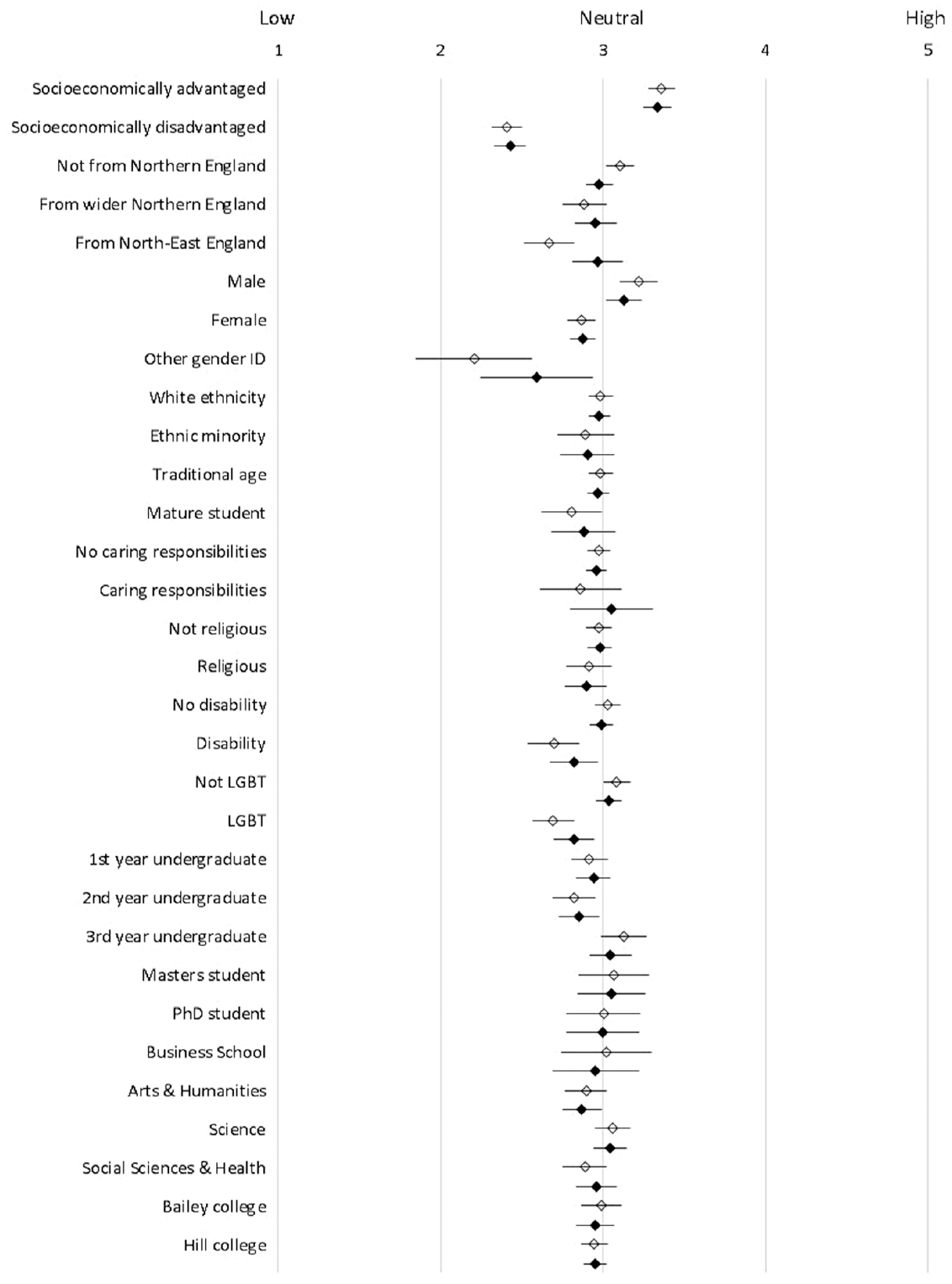
Bivariate and multivariate analysis of students’ sense of economic capacity to participate in university life, Note: Data points represent differences in mean values before (◇) and after (◆) controlling for all other variables shown; whiskers show 95% confidence intervals. Values smaller (larger) than 3 indicate a lower (higher) than neutral level of belonging. Home students only (N = 1252). Model fit statistics (r-squared) are 0.158 and 0.207 for the bivariate and multivariate model respectively.
In the qualitative data we collected, students related the various ways in which their comparative lack of economic capital limited their scope to participate in the social and extracurricular aspects of university life: There’s definitely issues of, like, how expensive it is to, like, fully participate in like University life here.
For those who opted to live in student accommodation provided by the university, the ‘extortionate’ cost of doing so was keenly felt by disadvantaged students. Unsurprisingly therefore, for some less advantaged students, the high cost of student accommodation made a residential university experience unaffordable. Living at home while studying, however, prevented them from engaging in student life on a full-time basis and created social distance between them and other students: The reason for me now doing distance learning is that I don’t have enough funding to live in Durham. So that kind of comes in with the price of things, not necessarily the price of things at the university, but just the fact that the income is not there in order to even live at the university, in the town of the university, let alone, let alone to, kind of, attend, you know, formals and all of that kind of thing.
Indeed, those who could not live in university accommodation for reasons of cost found it difficult to attend social events after hours: Because I don’t live in Durham, so I can’t go to the evening events in societies, it’s not really convenient for me to go all the way through to Durham, you know, an hour on the bus.
Lacking economic capital within the family, socioeconomically disadvantaged students often needed to work alongside their studies to help support themselves financially at university. This not only limited their opportunities to socialise with other students, thus reducing their scope for accumulating social capital, but also marked them out as culturally ‘other’ to their more privileged peers: I got to uni and nobody else in my flat apart from one girl had ever had a part time job. They were shocked by the idea that you’d work before you came to uni or that you’d save up money yourself or that, you know, you’d work alongside your degree [. . .] I felt excluded there because it almost felt a bit shameful.
Many disadvantaged students found the hidden costs of university life, such as the price of membership of their college’s Junior Common Room, which provides access to social events, prohibitively expensive: I did not have £140 to spare to join the JCR [Junior Common Room], therefore I’ve not been included in many things. It’s a shame, I enjoy getting involved and taking on responsibility, but I don’t have those opportunities as I couldn’t fork out £140 for a membership. There are a couple of us in our year, I think it was about £140 [for membership of the Junior Common Room] for undergrad, for [College], and we actually chose not to pay it, but the treatment we got for having not paid it, we were absolutely hounded. We were told no, you won’t be able to access any events. And you were almost, like, guilted into feeling like you should hand over £140.
Similarly, many disadvantaged students reported having to forego opportunities to engage in extracurricular activities such as sports clubs and student societies – a key avenue for making friends at university – due to the cost of membership: I’d have love to have done college sport. But then again, it just became, ‘oh, pay your subs, pay subs’ or whatever and you just think, ‘oh for goodness sake, I just wanna go and hit the tennis ball, kick the football.’ But I can’t and I can’t make those friends - there’s gonna be some additional costs, but it doesn’t need to be everything behind a paywall. I remember in freshers week seeing that the Durham University Union Society cost £45 to join [. . .] almost a week’s groceries! [. . .] I was shocked by that and didn’t join.
Formal social events such as formal dinners and black-tie balls were also often out of the price range of disadvantaged students: The cost of one ball was something like £85 or something. And I think it’s kind of dependent on almost what you’re used to, what you sort of grew up with, like I could never [. . .] particularly my friends struggle to actually justify that for one, like evening. Like, you know, for us that was maybe two weeks or two, three weekly shops.
The centrality of expensive social events to university life was such that many disadvantaged students remarked: ‘When I couldn’t afford to go to formals, I felt excluded. I couldn’t even be a part of the college’.
Cultural capital and (non)belonging
As shown in Figure 2, students from socioeconomically disadvantaged backgrounds reported lower feelings of cultural belonging than their advantaged peers, both before (2.9 vs 3.4) and after (3.0 vs 3.4) controlling for other demographic factors. Cultural belonging scores were also lower in the multivariate as well as bivariate analyses for females and those who reported their gender as other (3.1 and 3.0) relative to males (3.4), for students with a disability versus those without (2.8 vs 3.3), for those who reported being LGBT versus those who did not (3.0 vs 3.3), and for those in the Arts & Humanities faculty relative to the Business School (3.1 vs 3.4).
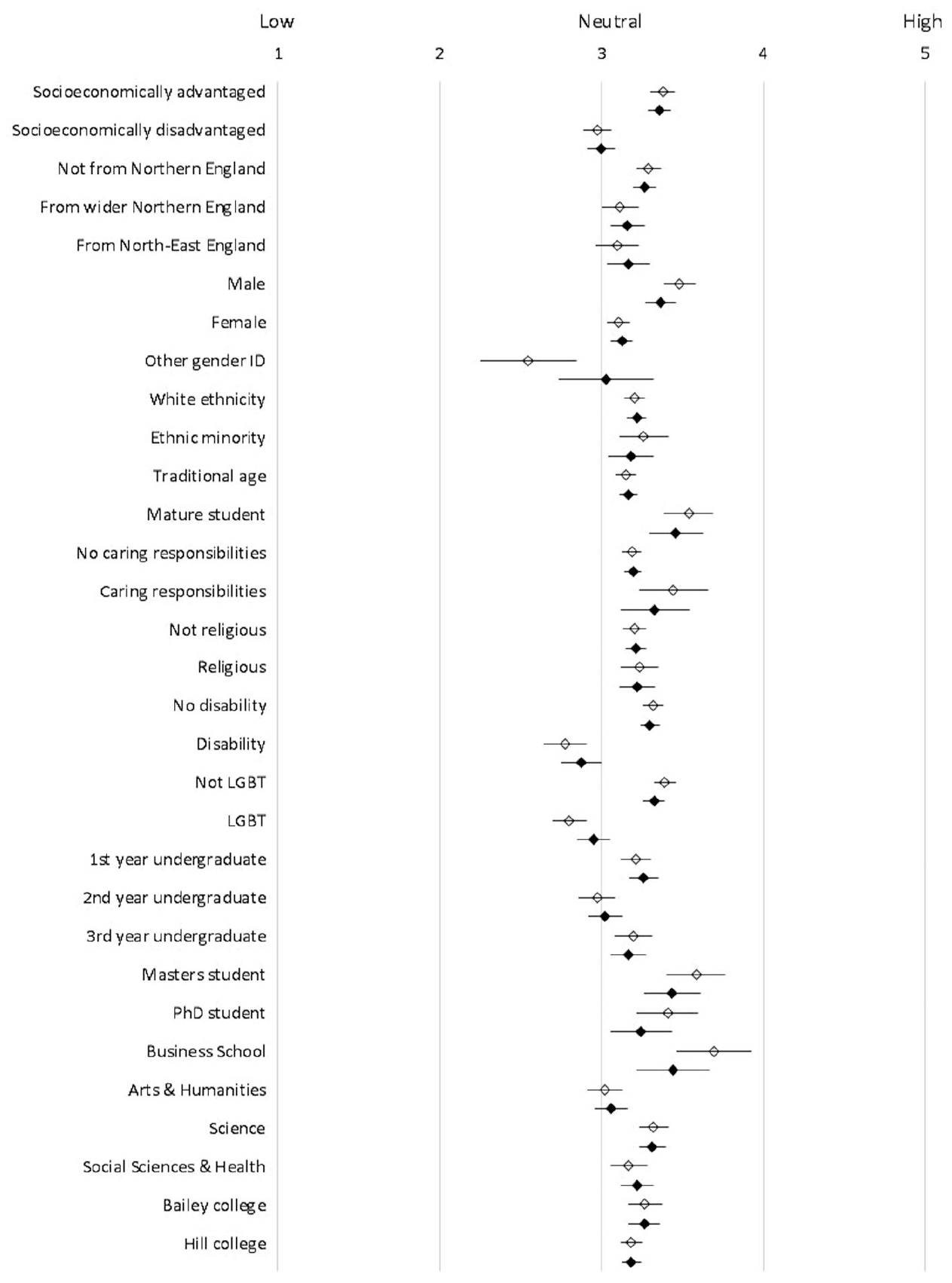
Bivariate and multivariate analysis of students’ sense of cultural belonging. Note: Data points represent differences in mean values before (◇) and after (◆) controlling for all other variables; whiskers show 95% confidence intervals. Values smaller (larger) than 3 indicate a lower (higher) than neutral level of belonging. Home students only (N = 1252). Model fit statistics (r-squared) are 0.041 and 0.208 for the bivariate and multivariate model respectively.
The qualitative data revealed that formal dinners and black-tie balls were not only prohibitively expensive for many, but also culturally alienating. In these formal social settings, socioeconomically disadvantaged students were keen aware of feeling like a ‘fish out of water’ (Bourdieu and Wacquant, 1992) in the social world of the university: As a working class student, I don’t go to any college formals or balls, it’s sort of half because I can’t afford it and half because I just feel really sort of alienated by it. I did the compulsory one on fresher’s week and nothing since then because I just felt so out of place.
Indeed, many less advantaged students spoke not only about the culturally alien nature of formal dining, but also about feeling culturally othered in these settings due to belittling remarks made by more privileged students about their out-of-place habitus: Someone had said something like: ‘Oh well, you’re Northern, and so, like, you’re stupid. You won’t know what bread plate’s yours’. My first, and only, formal dinner I was sat opposite a young man who went on to detail how he had never spoken to a ‘commoner’, couldn’t understand my Northern accent, and thought it was bizarre that me and others had to rely on Student Finance to afford University.
Some also relayed experiences of being belittled by advantaged students regarding the clothes they wore for formal events: [I have] been told I look bad because of my suit for the formal, when I can’t afford a new one. I wore the same dress twice to different balls because it was quite expensive, and I didn’t want to wear it just once. However, somebody made a rude comment which put me off attending these kinds of events.
This cultural othering of less advantaged students was especially common for those with a regional accent. Although the university is located in the North of England, it is dominated numerically and culturally by advantaged students from the South of England, such that many less advantaged students who spoke with a Northern accent reported feeling ‘treated like an outcast in my own region’. Disadvantaged students from the local area were acutely aware that the only others with accents like theirs were staff employed by the university in low status service roles: I went and sat down at the formal, and everyone had accents very different to mine, so I felt I couldn’t talk, so I didn’t for quite a while. [. . .] I heard that the waiting staff sounded like me, so I was very tempted to abandon my meal. I had a class where I was told that my accent was the same as the people who served their food. It was laughed and joked about that I was from the local area.
This linguistic aspect of less advantaged students’ habitus was frequently coded by more privileged peers as inferior embodied cultural capital worthy of ridicule: The first words spoken to me by my neighbour in College were to make fun of my accent. My Northern accent [is] ridiculed repeatedly. At first I could take it as a joke then it quickly became annoying and embarrassing People would constantly make fun of my accent and tell me to ‘speak properly’ and would make me feel stupid because of where I come from, [. . .] like I wasn’t really a person anymore
Frequently, this ridicule took the form of overt expressions of class prejudice by more advantaged students: I am from [nearby city]; my entire family have mining heritage. [. . . Durham University] is full of students making fun of Durham locals calling them stupid and dirty for this profession. [I have been] told countless times by a flatmate that I seem the ’most chavy’ and continuously refers to northerners as degenerates. It’s just like this idea that northern people are somehow inferior. And I think the accent is one of the massive things that’s like identifiable to pick up on. But I’ve had so many things [said to me] about the way I dress and everything.
Having a northern regional accent was often associated by more advantaged students as indicating a lack of intelligence: [I was] called uneducated because of my accent. You are perceived because you are northern, because you have an accent, you know, you’re of less intelligence and have less standing. And it kind of rubs off on you.
Expressions of class prejudice by more privileged students in relation to accent occurred in classroom settings as well as social spaces, affecting less advantaged students’ academic self-conception and participation in classroom discussions: During my first seminar, students repeatedly asked me to say phrases that they believed to be used often in the North East. It made me feel like a circus monkey and since then I decided not to speak during seminars. I have a Northern accent and one time in my lab I pronounced a word and overheard a group of posh people mocking the way I said it. They weren’t people I knew or considered friends and so it was definitely a joke at my expense and not a joke including me. I felt quite upset about it. There have been experiences where I have been mocked for having a North-East accent. Someone started sniggering when I made a comment in a tutorial. Other people have assumed that I am poor because I am from the North-East. Generally, people have just assumed that I am not as good as them, academically.
Most incidences of feeling humiliated by comments on accent and other aspects of habitus such as dress were enacted by advantaged students, but some came from the academics teaching students: Teachers have laughed at the way I speak when I’ve spoken up in class as I don’t always sound very smart Senior university staff asking why I have attended a guest speaker lecture, and if I’m sure I’m in the right place. Based on the way I dress and my thick Northern accent.
More often, academic staff were criticised for not challenging (and therefore implicitly condoning) other students’ behaviour and remarks: In lectures during first year, a few private educated people made classist insults about the working class. Nobody challenged this, even the lecturer.
Social capital and (non)belonging
Figure 3 compares students from different socioeconomic and other demographic groups with respect to their mean responses to the survey items relating to social inclusion, both before and after controlling for all other independent variables. As Figure 3 shows, the socioeconomically disadvantaged students in our sample report significantly lower average levels of feeling included socially relative to their advantaged counterparts, in both the bivariate analysis (2.9 vs 3.4) and after controlling for other demographic characteristics (2.9 vs 3.3). Social inclusion scores are also significantly lower in the multivariate as well as bivariate analysis for those who come from the North East region of England relative to those from elsewhere in the UK (2.9 vs 3.2), those with a disability versus those without (2.9 vs 3.2), and those who reported being LGBT versus those who did not (3.0 vs 3.2).
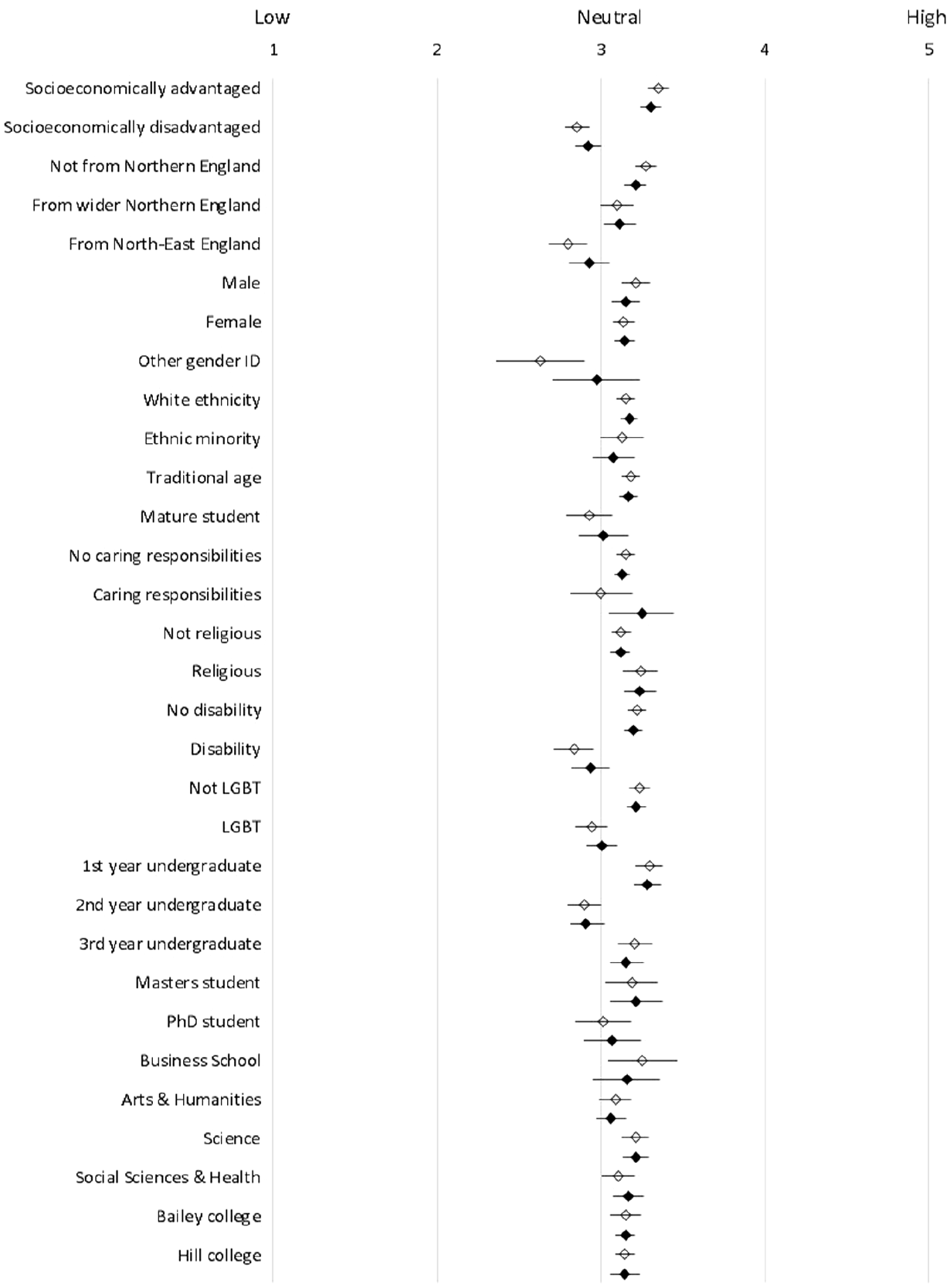
Bivariate and multivariate analysis of students’ sense of social inclusion. Note: Data points represent differences in mean values before (◇) and after (◆) controlling for all other variables shown; whiskers show 95% confidence intervals. Values smaller (larger) than 3 indicate a lower (higher) than neutral level of belonging. Home students only (N = 1252). Model fit statistics (r-squared) are 0.076 and 0.167 for the bivariate and multivariate model respectively.
Having attended a private fee-paying school served as a major source of social capital, demarcating those who were or were not considered ‘worthy of being known’ (Bourdieu, 1986: 23). Indeed, many socioeconomically disadvantaged study participants reported encountering exclusionary social networks formed on the basis of type of school attended soon after initial enrolment at the university: Freshers week was the worst. Everyone I met [. . .] would first of all ask me what school I went to and/or what my parents do. I’d tell them and they’d proceed to tell me about their boarding/private school and their rich parents with big jobs and I just couldn’t relate. First three weeks of university, [I was] being asked constantly what school I went to. At first, I didn’t understand why they would care or think they would know my school. Then I later realised it was actually about what private school they went to.
Many disadvantaged students reported quickly becoming aware of their status as the odd-one-out for not attended a private school: “First moving in to realise I was one of the only state students at my college and only one of my whole block I was the only member if my first year flat not southern, didn’t go to private school and hadn’t been rejected from Oxbridge. I was consistently belittled for my background. Once at a flat party everyone was discussing things they’d got up to at school and, at some point, I realised I was the only one there (of maybe 9 or 10) who didn’t go to a fee-paying school.
Disadvantaged students were frequently felt mocked by advantaged students for not having attended a private school as well as for the way they spoke: I got made fun of for going to a state school and had people make a comment on my ‘working class’ accent. The first words spoken to me by my neighbour in college were to make fun of my accent. Another neighbour immediately stopped speaking to me on finding out I didn’t go to a private sixth form.
In many cases, disadvantaged students reported being ostracised by groups of advantaged students who ‘all know each other and have these private school connections’. For example, students reported: A girl making a new group chat for our friends but removing state schoolers, including me. Being blanked by people I met in freshers who went to private school, areas of the college bar being taken over by private schoolers and if I try to go there they all look at me with disdain.
The overriding impression for many was that ‘People who know each other from big boarding schools from the South have formed a big exclusive group that is intimidating and unwelcoming. They make me feel judged and make me think there’s something wrong with me’.
Discussion and conclusion
The quantitative and qualitative findings presented in this paper highlight significant differences between advantaged and disadvantaged students with respect to sense of belonging at university. Analysis of the survey data revealed that disadvantaged students’ sense of belonging is substantially lower than that of their more advantaged peers in three key respects which map closely onto Bourdieu’s (1986) conceptual distinction between economic, cultural and social forms of capital. These disparities were particularly large in relation to economic capital barriers to belonging, which our qualitative data revealed affected the capacity of many disadvantaged students to afford to rent student accommodation, to travel into the university from home to attend social events in the evening, and to be a full-time student without also engaging in paid work. Moreover, disadvantaged students frequently felt excluded from extracurricular activities due to the prohibitively high costs of memberships of junior common rooms, sports teams, student societies and formal dinners and balls. The centrality of these activities to the student experience meant that a lack of economic capital severely impeded disadvantaged students’ sense of inclusion and belonging at the university.
In relation to cultural capital, disadvantaged students reported that the extracurricular aspects of university life were not only prohibitively expensive, but also culturally alienating. Disadvantaged students, especially those who spoke in Northern accents, reported feeling like a ‘fish out of water’ (Bourdieu and Wacquant, 1992) in a social field where few others – besides those in catering and other working-class service roles – spoke like them. This was exacerbated by the ways in which advantaged students frequently remarked on their accents, ways of dressing and other features of their habitus, casting them as not only out-of-place but also explicitly inferior. Such class prejudices were expressed not only in social spaces, but also in classroom contexts, making disadvantaged students feel reluctant to speak in seminar discussions for fear of ridicule.
Disadvantaged students also reported being implicitly excluded or overtly ostracised from social networks due to lacking the previously acquired social capital that having attended a private school conferred on their more advantaged peers. Private schooling provided advantaged students with ‘a durable network of more or less institutionalized relationships of mutual acquaintance and recognition’ (Bourdieu, 1986: 21); that is to say, a ready-made network of friends including those already known prior to starting university and those instantly ‘recognised’ as peers during the first few weeks at university. Disadvantaged students not only lacked the prior social capital needed to be distinguish them as ‘worthy of being known’ but were also explicitly excluded from membership in friendship groups by virtue of having been state-school educated and thus being outside ‘the limits of the group’ (Bourdieu, 1986: 22–23). Lacking the social capital of a private education prior to attending university made accruing social capital at university much more difficult for disadvantaged students.
Our findings demonstrate the value of Bourdieu’s distinction between economic, cultural and social capital for teasing out the different facets of (non)belonging. Our findings also illustrate, as Bourdieu observed, that the cultural and social components of (non)belonging ultimately have ‘economic capital. . .at their root’ (Bourdieu, 1986: 24). For example, disadvantaged students’ feelings of not ‘fitting in’ culturally at the university was exacerbated by the prohibitively high economic cost of extracurricular activities and, in the case of formal occasions, of dressing the part. Moreover, disadvantaged students’ exclusion from social networks was largely rooted in economic capital inequalities, particularly the economic means to purchase private schooling prior to going to university.
Bourdieu’s capitals framework is of evident value when it comes to explaining the sources and manifestations of (non)belonging at university. Equally, the capitals framework provides insights into the kinds of initiatives needed to bring about positive change. Given the salience of economic capital inequalities and its status as the root of social and cultural capital inequalities, universities have a clear role to play, first and foremost, in dismantling the economic barriers to belonging faced by less advantaged students. Some obvious strategies include providing lower-income students with more generous, non-repayable bursaries, and subsiding the cost of the various extra-curricular and social activities acknowledged by universities themselves to be key to full inclusion in university life.
While it is important that universities recognise and redress the fact that less advantaged students are relatively poor in terms of economic capital, it is equally important that universities play a role in tackling the misrecognition of less advantaged students as culturally impoverished and socially ‘[un]worthy of being known’ (Bourdieu, 1986: 23). Regarding cultural difference, universities must actively challenge the assumption that middle and upper-class ways of speaking and being are intrinsically superior, tackle expressions of class prejudice by more advantaged backgrounds, and promote positive engagement of all students with a wider range of cultural forms and practices. Regarding social connections, there is also a role for universities to play in discouraging the formation of socially elite cliques and encouraging diverse friendship groups among students.
Although these disparities between students with respect to economic, cultural and social capital are the result of wider structural inequalities, universities not only could but also should play a role in ameliorating these disparities with a view to closing the belonging gap between their more and less advantaged students. Indeed, as one of our focus group participants astutely observed: I don’t think Durham University is a place for working class people . . . Is it fair to encourage working class people to go to an environment that is so hurtful to them? . . . Is it that working class people shouldn’t go to Durham? Or is it the environment needs to change?
Footnotes
Declaration of conflicting interests
The author(s) declared no potential conflicts of interest with respect to the research, authorship, and/or publication of this article.
Funding
The author(s) disclosed receipt of the following financial support for the research, authorship, and/or publication of this article: The author(s) received funding for this study from the Durham University Equality, Diversity and Inclusion (EDI) Sub-Fund.
