




Abstract
Edu-business is changing understandings, aims, content and methods of education on both a European and global scale. This is also the case in Finland, where various private educational enterprises are gaining a stronger role in defining what education is and should be. In this article, informed by our previous conceptual work related to changes in education governance and marketisation and privatisation of education, we are analysing interviews of edu-preneurs as powerful new actors in education. We ask what kind of storytelling is involved when edu-preneurs in Finland describe their services and products, and how they make sense of their industry, their work and themselves as edu-preneurs and how affective dimensions are involved.
Introduction
Education, and what is understood as education, is in a constant flux. One of the strongest drivers both globally and locally in these changes relates to economically driven imperatives alongside growing marketisation of education and especially private businesses participating in education, or edu-business (Ball and Youdell, 2009; Hogan and Thompson, 2021). The changes edu-business is driving for can be witnessed not only in educational practices, but also in changing policy and governance frameworks (Ideland et al., 2021). The influence of these transformations in Europe is apparent in the ways education markets project hopes and dreams for education (Serder, 2024), how education businesses are constantly strengthening their influence through vigorous networking and events (Candido et al., 2024; Player-Coro et al., 2018), and how privately owned digital tools have become an essential part of educational spaces due to the Covid-19 pandemic (Cone et al., 2021).
In Finland, the marketisation of education and edu-business has been studied, for example, from the perspective of the construction of educational ecosystems (Seppänen et al., 2020), early childhood education and care (Pesonen and Valkonen, 2023; Pihlaja and Laiho, 2021), education export (Candido et al., 2024), cooperation and networks between the state and the private sector (Lempinen and Seppänen, 2021), as part of affective and cognitive capitalism (Brunila and Hannukainen, 2017; Brunila and Valero, 2018; Nehring and Brunila, 2023; Valero, Jorgensen and Brunila, 2018), private tutoring (Kosunen et al., 2022), as well as an alliance with psychologisation and therapisation of education (Brunila, 2014; Ecclestone and Brunila, 2015). However, the private sector and edu-preneurs as creators of new demands, producers and determinants of the contents, products, services, solutions, objectives and means of education, has received less attention in the research literature. Also, the highly affective nature of edu-business and promises related to it has been left untouched.
Finland is no exception in this phenomenon. Private companies have entered education and the phenomenon of the ‘edu-business’ and its actors has grown extensively while market and business logics and practices have been incorporated into education. Edu-business in Finland is a fast-growing group of private companies offering plethora of services and education for-profit. Edu-business involves applying business principles and practices, such as marketing, financial management, and efficiency metrics, to the field of education. Edu-business in Finland takes multiple forms, including for-profit schools, online education platforms, educational consulting firms, and educational technology companies. The goal of edu-business is to increase revenue and profits while providing educational services by edu-preneurs.
In this article, we are taking a special focus to the ways in which edu-preneurs, the entrepreneurs running and leading edu-business in Finland, are conceptualising education and the role of edu-business in education from a broader point of view. We use the term edu-preneur, rather than entrepreneur, to draw attention to the tension which emerges when drawing together education as a public good with the profit-making aims of entrepreneurship. This study is a part of the on-going research project “Interrupting Future Trajectories of Precision Education Governance (FuturEd) led by Kristiina Brunila. In the project we have studied future trajectories of education and economically driven education governance both globally and nationally by exploring for example marketisation of education from early childhood education to comprehensive schools, youth transitions, higher education, and education export (e.g., Brunila and Nehring, 2023; Mertanen, Vainio and Brunila 2023). Informed by our previous theoretical work and research results, we now focus on edu-preneurs and their views on education to better understand affective dimensions related to edu-business as part of the changing education governance enhancing marketisation.
In this study, we analyse 15 interviews with edu-preneurs to probe the affective dimensions they associate with work and the broader educational landscape. We employ storytelling as our method of analysis driven by an interest in deciphering the dynamics of power within the edu-business sector and its influence on edu-preneurs. As Jørgensen (2022) eloquently posits, storytelling is a potent medium that enables individuals to reflexively construct narratives about themselves, situated within the intricacies of power relations. This method obtains a unique quality to put a sequence of events into a story. By scrutinising their perspectives and conceptions of edu-business through the lens of storytelling, we construct a nuanced portrayal of how edu-preneurs interpret and navigate their industry, their professional roles, and themselves as edu-preneurs. We contend that the storytelling of edu-preneurs not only crafts promises surrounding edu-business and education but also reveals that the affective dimensions within the storytelling are intricately interwoven with and responsive to the ongoing transformations in economically driven education governance. This research seeks to understand how edu-preneurs position themselves, how they are shaping and redefining the essence and objectives of education, and how they align their business endeavours with the public education system.
Marketisation in and of education in Finland
Finland is a Nordic welfare state with a nationally regulated educational system. Thus, Finnish education has been considered a public good emphasising equal access, autonomy of teachers and fairness and equality in educational cultures and practices. However, over the past thirty years the Finnish state has undergone a welfare state retrenchment and has gradually shifted towards a neoliberal competition state. Accordingly, previous research has shown how marketisation has gained a stronger foothold in both the delivery and practices of education by introducing various neoliberal practises to public education (e.g., Kantola and Kananen, 2013; Brunila and Ylöstalo, 2020). This can be connected to the ways in which Finland as a nation-state has strengthened both its economic and political ties with international and global organisations, such as the EU and the OECD (e.g. Mertanen and Brunila, 2022).
In the past three decades, modes of education governance and attendant flows of ideas at the international and national level in Finland have become multi-directional and contentious, in the context of globalisation, economically driven imperatives, and shifts from knowledge-driven to data-driven future oriented policies and science. Changing governance has called into question the future role of the nation state regarding the principles of choice and competition, securing economic growth and this has created new demands in relation to the production of knowledge, individually oriented behaviour management and human capital. The shift from government to governance, emphasising the role of networks and interaction between the multiple public and private sectors are some of the changes the welfare state is undergoing.
One of the most concrete examples of Finland’s strengthening economic and political ties, as previously mentioned, is the impact of the EU membership on the nation. Following the steep recession in the 1990s and the subsequent EU membership in 1994, there has been an increased involvement of marketisation and the private sector in shaping education. Concurrently, public debates, research, and policy papers have increasingly characterised education with a sense of disorientation regarding its aims, content, methods, and values. Another tangible example of the Finnish education system’s connection and interplay with global organisations is the significant influence of the PISA studies on setting goals for the Finnish education system. Particularly, the declining results in the most recent PISA results have garnered significant attention, including a general sense of an educational deterioration in Finland. This perceived weakening has compelled educators to 'open up' to society, which in Finland has involved inviting new stakeholder networks and agendas, supported by national governing bodies such as the National Board of Education. However, a persistent and strong faith in public education remains in the wider public perception of education. This leaves the recognition of the agendas and consequences of marketisation, including those of edu-business, largely unexamined.
Over the past three decades, the marketisation of education in Finland has intensified from at least three directions: (i) from within the education system itself, as a form of quasi-market, (ii) externally, through private and commercial entities, and (iii) through a shift in the aims, content, and methods of education towards the development of human capital and competitiveness. In the context of broader global trends, Finland has mirrored the approach where education is increasingly viewed as a tool to secure international competitive relation to more global developments. Finland has followed the trend where education is seen to secure international competitiveness and foster an entrepreneurial ethos among teachers, administration, and students (e.g., Mononen Batista-Costa and Brunila, 2016; Suoranta et al., 2022). While the development in Finland differs from the more laissez-faire education markets in the UK and the United States (Ball, 2007; de St Croix et al., 2019), the Finnish education system is currently in a phase where private companies are exerting more influence than ever before.
Through edu-preneurs and edu-business, the rationale of creating quality through competition and freedom of choice in the markets has become more prevalent in the Finnish education system. This market-based approach to arranging education, which aligns with the neoliberal disregard for the concept of ‘the social’, is gradually altering the role of education. Once seen primarily as a public service fostering equal and democratic participation, it is now increasingly focused on ‘quality control’, ‘best practices’, ‘outcome evaluation’ and ‘learning results’ similar to trends observed globally (Ball and Junemann, 2012; Ball and Youdell, 2009). The underlying logic for education driven by edu-preneurs and edu-business is based on a model where efficiency and quality are measured and evaluated through the inputs and outputs of education (see also Knox et al., 2020; Suoranta et al., 2022). The allure of global comparisons in educational ‘outcomes’ lies in the promise of creating transferable ‘best practices’ that are purported to be effective irrespective of the societal context (e.g., Auld and Morris, 2019; Candido et al., 2020).
Affective subjectivation and changing education governance
In this article, our focus is on the affective dimensions of edu-business as part of the changing education governance enhancing marketisation. We interpret ‘affect’ as a socially constructed phenomenon, manifesting as intensities within the affective-discursive arrangements of education governance highlighting economically driven personalised and optimised education. We elaborate on how storytelling by edu-preneurs constitutes these affective-discursive arrangements, forming patterns of thoughts, words, and activities that shape and produce realities, subjectivities, relationships, and behaviours. Discourse, in this context, is the mechanism that determines what can be expressed and enacted. Following the insights of Wetherell (2013), we acknowledge that discourse and its production are intimately linked with affect in our everyday experiences.
We propose that examining affective dimensions offers a valuable lens for understanding how the emerging private edu-business sector is integrating education with business logics, competences, and skills, as well as with affective dimensions. This includes analysing the interplay between positive and negative affects associated with various aspects of edu-business. We contend that affect plays a pivotal role in shaping practices and modes of subjectivation. ‘Affective subjectivation’ refers to the processes whereby edu-preneurs are inclined to turn themselves into subjects within the edu-business context. This concept illuminates how edu-preneurs are inclined to conform to specific behaviours in highly economised environments, influenced not only by economic factors but also their emotions, thoughts, and ways of knowing. Edu-preneurs work to produce their own relevance to education, manifesting attachments to particular education narratives, actors and structures. Affective subjectivation thus extends beyond merely shaping physical and emotional states; it also encompasses influencing how individuals think, feel, and acquire knowledge and develop attachments within the edu-business framework (see further Berlant, 2011; Brunila and Valero, 2018; Valero et al., 2018).
In this article, our focus is particularly on the affective dimensions of edu-business reflected in the interviews of edu-preneurs. These dimensions are key to understand both the marketisation and privatisation of education. Our research has previously demonstrated how marketisation is an integral component of changing education governance, aiming for increasingly individual-centred and personalised interventions geared towards labour market readiness, employability, and self-responsibility. Changing education governance emphasising marketisation and privatisation, in fact, reveals a growing tension and complexity between viewing education as structured institutions of socialisation, and perceiving it as an arena rife with diverse agendas, interests, and ideologies. This complexity is further heightened by the transnational nature of governance and emerging partnerships between state policy actors and for-profit industries, which have expanded and multiplied the channels of influence.
Data and analysis
Over the past 2 years, we have carefully mapped edu-business companies and networks operating in Finland and more globally. Our previous results suggest that education is gradually moving away from national and public sector hands to complex networks built on various agendas and interests such as commercialism, while children and young people have been subject to different data collection (Brunila et al., 2020; Mertanen et al., 2023; Mertanen and Brunila, 2023). In this article, we chose to use the data Brunila had conducted by doing interviews with edu-preneurs because they wanted to obtain a more insider-perspective of edu-business. In the data, edu-preneurs in Finland come from various backgrounds, many of them are former teachers and school principals with a background in schooling and education. Furthermore, they have backgrounds for example in engineering, software development and consultancy. Interviewing this varied group provided a fruitful opportunity to gain in-depth understanding about the ways in which the edu-preneurs themselves position themselves, how they are building and reconfiguring what education is and should be, and how they are relating their business to the public education system.
The interviews were conducted by Brunila from 2021 to 2022 using Teams, due to the restrictions imposed by the Covid-19 pandemic. All the edu-preneurs who received an invitation responded affirmatively. The invitation outlined that interviews would focus on their work as edu-preneurs, their perspectives on the current state of education in Finland, and their views on potential future changes in education landscape. Brunila sought to understand how they discussed their work and envisioned the future of education, including what it might look like, who the main actors would be, what the primary aims and methods of education might entail, and the role of edu-business in these future developments. Each interview was scheduled for an hour, but they often extended this timeframe, as the edu-preneurs were keen to elaborate more than initially anticipated. Digitalisation was a topic of interest during the interviews, particularly as many edu-preneurs were offering digital solutions, products and services for schools and teachers. Based on the online-discussions, Brunila observed that the edu-preneurs were generally charismatic, lively, outspoken, and cheerful, with a confident manner in expressing their views.
Altogether, the dataset comprises interviews with 15 edu-preneurs. In addition to these, Brunila conducted interviews with professionals and advocates working in various organisations and foundations that support edu-business and facilitate networking among business. However, these additional interviews were excluded from the current dataset. For this article, 10 interviews with edu-preneurs were selected for further analysis.
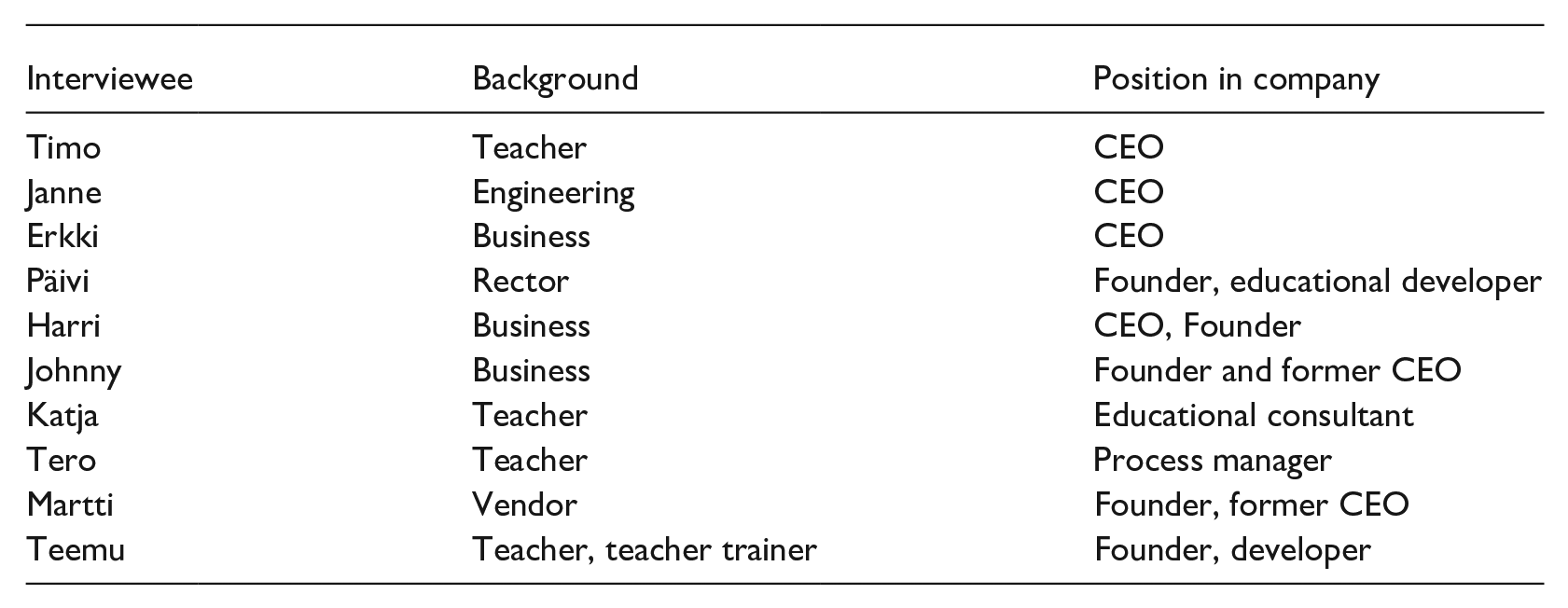
In this article, we employ storytelling as our approach. Storytelling enables us to reconfigure our thoughts and emotions, as well as express our identities, as noted by Arendt (1998). Utilising this approach, we interpreted the interviews with edu-preneurs as stories within the history of a specific period. Accordingly, this paper explores the nature of storytelling used by edu-preneurs in Finland who provide educational services and products, focusing on how they make sense of their industry, their work, and their identities as edu-preneurs. Additionally, we investigated how their storytelling constructs perceptions and ideas about edu-business and the role of affective dimensions in this process.
We analysed the transcribed interviews, focusing particularly on instances where edu-preneurs described their current state, the presence and future of education, and their personal aspirations for educational systems. During our collective analysis, we identified recurring themes of school failure, business as a rescuer and problem-solver, and a drive to transform education for a brighter future. According to our findings, these themes collectively formed a comprehensive storyline of the edu-preneurs, their work, and their roles. Concurrently, our analysis deepened our interest in exploring how affective dimensions were intertwined with storytelling.
Our joint analysis also highlighted the impact of affects on everyone involved in these encounters, including researchers. When we experience strong emotions towards others, such as being upset or moved, we might project these feelings onto them, transforming our personal reactions into characterisations of the other person. For instance, our feeling of ‘you upset or worry me’ could evolve into ‘you are upsetting and worrying’. These affective responses often create borders between us and others (Ahmed, 2000). Additionally, we recognised the importance of understanding how our own attachments and commitments, for example to public education within the Nordic welfare state, influence our perspectives. Similarly, we noted how edu-preneurs have developed their attachments and commitments to education, albeit in a privatised context, within the framework of a Nordic welfare state.
Generally, the affective-discursive storytelling by edu-preneurs portrayed edu-business in a positive, convincing, and cheerful light, emphasising it as a legitimate, creative, joyful, powerful, and helpful service. The aspects of business logics and profit-making were mostly absent in the storytelling except for a few marks suggesting that edu-business is not necessarily a path to great wealth. Through the storytelling, edu-preneurs fashioned themselves as embodying the affective labour intrinsic to edu-business. We interpreted this as a both as a cognitive and non-cognitive power dynamic within the process of evolving in economically driven political rationality. This dynamic is characterised as tempting and seductive, shaping one’s actions, knowledge, and feelings in a certain way, while concurrently reducing the human condition to human capital (see also Toiviainen and Brunila, 2021). This led us to the initial conclusion that affect plays a crucial role in the practices of edu-business, as well as in the patterns of affective subjectivation.
There are also possible so-called dark sides of storytelling as Jørgensen and Valero (2023) have demonstrated. When education becomes a site for edu-business and business logics, education is tactically linked to strategising and profit making. The ‘public appearance’ produced in storytelling could be understood as a vehicle to show the ‘value’ and legitimacy of the ‘educational’ product and service, with monetary exchange as the first aim, and educational aims as a conduit through which the monetary exchange is made. In edu-business, this exchange either happens from the public purse to private coffers, or it is financed by private interests setting the agenda for public institutions. The dark sides in this article can be understood as a form of strategic storytelling by undermining public education, schools, and teachers and in narrowing the possibilities for schools to serve as a common space among people with purposes other than accumulating value, for promoting edu-business for a better future and for presenting oneself and the business successfully. In other words, with the idea of dark sides we were able to show how storytelling becomes storyselling (see also Jørgensen and Valero, 2023).
In the following, we analyse our data in interlinked acts forming a shared storyline. In our analysis, each act presents a turn, tension, or a conflict in the strategic storytelling, with a specific position given to the edu-preneurs and edu-business.
Strategic storytelling from failure to a hopeful and bright future
The strategic storytelling of the edu-preneurs started with the failure of education system (Act 1), continued with an intervention by the edu-business with greater success (Act 2), and finally ended with a better and bright future provided by edu-business (Act 3).
Act 1
Act 1 started with the edu-preneurs’ notions about the current state of the public education system in Finland.
Schools are not able to close the gap of differences. Not everyone says this aloud. And this type of very narrow thinking that begins already early in schools narrows everyone’s thinking from the perspective of know-how. So, we must ask whether people are really equipped to manage in the evermore diverse working life. (Erkki)
In the interviews, edu-preneurs often described themselves as observing schools and education systems from a distance, positioning themselves as outsiders. By adopting this stance as ‘outsiders’, they primarily viewed the school and education system from afar. These observations, often informed by their prior experiences as former ‘insiders’ such as teachers, allowed edu-preneurs to adopt a position akin to that of an ‘objective’ observer. This perspective purportedly granted them a broader view of education, one less entangled in the daily operations and functions of schooling and teaching.
As observers with a vested interest, they were able to focus on ‘core’ issues in the education system. At the same time, this ‘objective’ view tapped into wider international discourses used, for example by the EU and OECD, in framing education as in crisis (e.g., Mertanen and Brunila, 2022; Robertson, 2022). Their harmonisation with these officially supported narratives produced a ‘common-sense,’ or truth about inherent contemporary challenges in education, which the edu-preneurs then described as an uncomfortable and unspoken reality in Finland. In this turn, they legitimised the international ‘education crisis’ discourse, while using it to disrupt the narrative of Finnish educational excellence. Throughout the storytelling, we noticed these types of turns, mobilising congruities and incongruities in a range of discursive-affective production to weave a story that cohered through the edu-preneurs’ own work to rescue education into a bright, uncomplicated future.
In Act 1, the public education system was predominantly portrayed as problematic and, most significantly, as a failure in a way or another. Generally, public education was deemed quite old-fashioned, slow, insufficient, and out of touch with the real world. The dark sides of the storytelling were evident in the extracts above where edu-business was depicted as the rescuer of a failing public education system and ineffective teachers. The term ‘failing’ was used to describe both the public educations system and the teaching profession as slow, outdated, narrowly focused, and lacking in innovation, particularly with respect to workplace relevance. Consequently, the public system and teaching profession were seen as deficient in the creativity needed to adapt to changing societal and work environments. Moreover, teachers were perceived as unable to provide engaging and enjoyable educational experiences.
Nowadays it is just impossible or very difficult at least to offer interesting and fulfilling enough classes as a teacher, so that children would pay attention. Teachers’ knowledge and creativity are inevitably lagging behind. (Katja)
The affective attachments discernible from this storytelling predominantly related to negative emotions associated with public education and schooling, such as boredom, frustration, judgement, dissatisfaction, and even shame. During the interviews, it was not evident how these critical perspectives on public education were substantiated, despite many of the edu-preneurs having backgrounds in public schooling. This storytelling aligned with a familiar ‘common sense’ portrayal of an educational decline.
The origins of these well-rehearsed discourses, which problematise education, are diverse. They may stem from a critical sociological perspective that has been prevalent since at least the 1960s, or from research highlighting inequalities in education, which contradicts the often-portrayed image of Finnish education as equitable and fair (Brunila and Edström, 2013; Saarinen et al., 2021). Notably, during the interviews, edu-preneurs did not provide deeper insights into the sources informing their viewpoints. This epistemic ambiguity, arising from the unclear foundations of their negative views, created an opportunity for a strategic common-sense to take shape. This ambiguity allowed edu-preneurs to position themselves as significant contributors in the field of education. This epistemic gateway for edu-business has also been underscored by various intergovernmental organisations, including the OECD (see Kallo, 2021)
Generally, during the interviews, the edu-preneurs spoke with little hesitation, conveying a strong sense of certainty about their views. Notably, the only instances of hesitation occurred when Brunila inquired about the research and knowledge underpinning their work, business, services, and products. This question evidently was not favoured, as evidenced by the hesitancy and lack of clarity in their responses. None of the interviewees could provide specific examples of research that informed their work. Additionally, they did not appear to be actively seeking research-based knowledge.
Act 2
Act 2 begins with a call to action, where edu-preneurs take the initiative in addressing and solving problems identified in Act 1. Their solutions include innovating new tools, services, practices, ideas, and products to assist schools and teachers. For instance, edu-preneurs demonstrated readiness to engage actively, metaphorically getting their ‘hands dirty’ in supporting teachers who are exhausted and overworked, introducing them to new ways of thinking and relating to the world.
We are here to help teachers of course; we provide them what they need and don’t have. We already do a lot of collaboration with teachers; they test our products and learn while they test them. (Timo) We can help teachers to transform, to become more entrepreneurial, to help to catch up what is going on in a society. (Martti)
The storytelling depicted edu-business as a heroic figure, emerging as a rescuer and supporter of the faltering educational system, schools, and teachers. Edu-business was portrayed as aiding and fostering a transformation towards entrepreneurialism. Viewing edu-business as a form of schooling and education involved considering its ability to align with the right people and methods. Consequently, we interpreted the notions of edu-business as embodying social and moral distinctions, based on perceptions of who and what is deemed worthy and competent to provide education and schooling ‘in the right way’. Interestingly, teachers were seen as crucial agents, both as part of the root cause of the problem and as key to the necessary changes. The affective attachments we identified in the storytelling were predominantly positive, characterised by affects such as compassion, curiosity, determination, and enthusiasm.
Companies are starting to see themselves as places to learn. And the role that teachers have had, that will surely face big changes. . .in other words, inside four walls there is a teacher teaching their own substance, but instead they should head towards workplaces and be more like coaches/facilitators and create new kinds of relations as teachers, there will be enormous changes like these. (Erkki)
In this phase, the edu-preneurs shifted focus from the public education system and its stakeholders, whom they had associated with negative emotions in the first act, to the second act. Here, they emphasised the supportive and networked interactions facilitated by edu-preneurs as a source of relief for teachers. This transition can be linked to a broader shift from government to governance, suggesting that it is no longer solely the systemic organisation that benefits students, but rather the collective effort of autonomous, networked individuals who can bring about joy and happiness (e.g. Rose, 1999). Narratively, this represents a pivotal plot twist, where teachers undergo a transformation in perspective and identity. This change validates and unleashes their true potential as agents of change in education and as a positive force in their students’ lives. This role is crucial for the narrative, providing coherence and fulfilling the portrayal of the education system within the storytelling.
Act 3
In Act 3, the edu-preneurs neared the completion of their envisioned work. They had diligently performed their important duty, taking responsibility and overcoming challenges in their quest to build a superior education system. As they approached the end of their journey, they began to see signs of hope and validation, suggesting that their efforts would indeed lead to educational success, superior quality, and best practices. The education system was on the brink of transforming from merely good to excellent. Despite this progress, concerns lingered about potential resistance to this brighter and improved future, prompting the edu-preneurs to remain vigilant in safeguarding the advancements they had championed.
Finland is probably producing a good average. However, new winds would be needed (in education), opening, business is the future. (Timo) This networking, it is a future trend, and our school system is still a closed system, its own world. . .the organisers of schools and higher education, they should not be disconnected from the trends of this world. (Johnny)
In Act 3, storytelling reached its climax, envisioning a hopeful and bright future shaped by new trends, winds of change, and even some challenges brought forth by the emergence of edu-business. When edu-business was presumed to be inherently beneficial, it was consequently perceived as a marker of excellence. The affective attachments we discerned in the storytelling were overwhelmingly positive, encompassing affects of ambition, anticipation, omnipotence, condescension, and certainty. These affects were tied to the anticipated ascendancy of private initiatives and the perceived decline of public efforts, facilitated by networking, ‘opening’, education to broader society, recognising global trends, bridging the public sector with the wider world, and increasing competition in the future.
The call for ‘opening’ education emerged as a particularly intriguing point in our discussions. Naturally, the antithesis of ‘open’ is ‘concealed’. The advocacy for opening up public schooling and education suggested that these systems were perceived as closed entities, akin to containers or sealed spaces, necessitating a metaphorical ‘cracking open’. Research literature on cognitive capitalism and education in Finland has previously noted that for more extensive marketisation to occur, there’s a greater need for education to open up to society. This opening allows new networks, interests, and agendas to enter and influence the educational landscape (see e.g., Brunila et al., 2015).
We could still develop our educational system that it would be the best system. But if our educational system does not go along these changes, then someone else will take care of education. There will be private companies and their services already available. (Harri). Teachers will already be an old-fashioned profession in the future, routine and perhaps a bit boring, artificial intelligence will inevitably replace teachers at some point. (Janne)
For us, the conclusions drawn from this portion of the findings were not particularly surprising. To legitimate their industry, services, and products, the storytelling strategically needed to undermine public education and identify its weaknesses. According to this narrative, education couldn’t be ‘rescued’ from within. Instead, it was implied that working for the betterment of education and schools would be more effectively achieved from an external standpoint – specifically, from within the edu-business sector.
The logic of storyselling in this context centred on the premise of ‘what I can do for you in the future.’ Here, selling was not just about exchanging products or services; it was about creating loyal customers and establishing a sustained, networked flow of capital transfer from the consumer to the edu-business. In this scenario, public education itself is cast as a consumer. The goal was to secure the edu-preneurs’ own financial future by selling a compelling vision of the future of education, a future into which they are intricately woven.
It should also be noted that anticipated future imperatives have become key in planning and governing global educational policy (Brunila and Nehring, 2023; Mertanen et al., 2022). Not surprisingly, edu-preneurs seemed well-versed in these future forecasts, particularly those put forth by intergovernmental organisations, such as the crisis discourse in education. They skilfully integrated these projected paths into their own visions, blending hope and despair, optimism and pessimism, to advance their agendas. Starting with a critique of the current state of education, they expressed a belief in the potential for transformative improvement. In the storytelling, these future anticipations were often used to justify an enhanced role for edu-business in shaping and delivering future education. Pinning hopes on a brighter future entailed envisioning all the positive changes that could come from edu-preneurs’ promises of a better and improved education.
Reflecting the affective encounters with the edu-preneurs
We delved deeper into analysing the storytelling of affective encounters with edu-preneurs, aiming to gain a more profound understanding of how they perceived themselves as edu-preneurs, what aspects of their work in edu-business captivated and energised them, and to what they were committed. Of course, the edu-preneurs were not immune to prevailing norms and complexities of power relations. Through storytelling, we gained insights into how edu-preneurs became active participants in shaping their identities. In the realm of edu-business and in terms of affective subjectivation (as discussed in Valero et al., 2018), the process of ‘becoming’ could be seen as both conditioned by and dependent on the prevailing norms. At the same time, it involved navigating a personal path that resonated with their sense of purpose. Our comprehensive analysis of the data led us to recognise the importance of understanding the modes of affective subjectivation that define both edu-business and edu-preneurs themselves.
Firstly, the predominant storytelling among the edu-preneurs revealed a consistent ambivalence between the public and private sector. This wasn’t entirely surprising, given that in Finland, education is traditionally viewed as a public good. Nevertheless, there was a discernible sense of frustration regarding their relationship with public education. This sentiment could partly stem from the current landscape, where edu-business and edu-preneurs are somewhat challenged in establishing direct access to schools and teachers with their industry.
If we would assume that public sector is responsible for education and educating employers, well that will change for sure, those roles will change. University pedagogists could also go to private companies to do projects. (Erkki) If anyone in the future wants to pay for it (education), then what is the problem with that? I don’t understand this. (Katja) I mean, there is still place for public education and teachers, because this is Finland and equal access to education is important. (Katja) If our education system is not able to adjust to these new needs and reach them, then private actors come, and international actors come, and they take care of it. (Martti)
In Act 1, our interpretation of the affective attachments conveyed in the storytelling identified a notable ambivalence. The prominent affects associated with the current state of Finnish public education - confusion, uncertainty, frustrations, and fear of missing out - were intertwined with affects of pride and an almost nostalgic affection for an ideally functioning public education. This ambivalence, as we understood it, arose from a conflict where the role of public education was being questioned, with market forces seen as an inevitable influence. Simultaneously, there was a desire to preserve the most positive and effective elements of the public education system.
I must say I was a bit bored when working as a teacher, the same things happening repeatedly. I decided to quit, and I am glad I did. Now my days are all different, and I am my own boss, I can basically do what I want. (Teemu) I decided to quit my job because of the bureaucracy. Then I just moved to work in a private company. And I’m happy I did. (Päivi)
In Act 2, edu-preneurs shared more personal perspectives about their experiences working in the field, often drawing on their background as former teachers or students. These reflections highlighted a sense of urgency in addressing the problems identified in the Act 1. This phase featured what we have termed a ‘breakout’ from the public to the private sector, marked by a clear conflict and contrast between the two sectors (as also noted by Ideland et al., 2023). Echoing Ideland and Seder’s findings in their study of Swedish edu-preneurs, this breakout was not just a career shift, but also spatial – moving from one job environment to another. Affective dimensions played a significant role as well. The affective attachments we discerned from the storytelling revealed negative ones such as boredom and repetition associated with the public sector. In contrast, positive affects such as independence, freedom, inspiration, pride, and dynamicity were associated with the private sector.
We interpreted the affective attachments that edu-preneurs associated with their work in edu-business as primarily centred on their individual selves. Self-satisfaction, the promotion of their own work, and the promise of ease not just for themselves but also for potential consumers were central to their affective subjectivation. We observed that the edu-preneurs seemed eager to distance themselves from the complex and ambivalent frustrations they experienced as teachers. They perceived the education system as stifling individualism, creativity, and freedom. This sentiment may be linked to broader criticism regarding school structures, the social valuation of teaching, and the mounting pressures on teachers due to the scaling back of the welfare state, a process to which their edu-business are inadvertently contributing.
And those big visions, they are so inspiring. There are many examples, when you see that global vision, the need that turns on the flame in you, and hey, I have a solution to this! (Päivi) It is just simply more fun to work in a company. More freedom. (Janne) I can be proud of what I do. (Katja) The way things work is great, I am on the move all the time, we’re not just talking, we are doing things. (Erkki)
Finally, the tensions evident in the first two Acts found partial solution in Act 3, where a brighter, more joyful, and exciting future for education seemed imminent. In this phase, the edu-preneurs realised their vision for the previously failing public education system. They appeared to embody this ‘future’ affective attachment, successfully imparting it to the broader education system, which they were increasingly becoming an integral part of. In the realm of edu-business, there’s an emphasis on thriving through strategic planning and profit-making, coupled with a desire to be perceived in a particular manner. Essentially, the ethos of edu-business becomes ingrained in the identities of the edu-preneurs. The transition from public to private sectors enabled them to emerge as more independent, innovative, and proud figures, capable of contributing meaningfully and powerfully to education, while experiencing a sense of joy and pride in their work.
The prevalent positive affects such as joy, enthusiasm, and optimism in our analysis could be interpreted as imperatives to embody positivity and happiness. This positivity and happiness are part of the process of affective subjectivation, where edu-preneurs engage in the project of self-improvement. This is because business logic in this context involves not only selling the business but also selling the person and personality. Ascribing value to positivity and happiness elevates certain modes of being, doing, and types of personhoods over others. In the economically driven ethos, individuals who are happy and positive are often seen as optimistic and, consequently, more likely to be successful, including economically. They are perceived as capable of overcoming challenges with appropriate solutions and development strategies. Consequently, positivity, happiness, and privilege form a potent economic dynamic. Drawing inspiration from Sara Ahmed’s work, we might say that positivity appears to be a marker of privilege. As Ahmed (2010) suggests, happiness gets you more in the bank; happiness depends on other forms of capital as well as acquiring or accumulating capital for the individual subject.
In the world of enhancing positivity and happiness, negative and unhappy subjects tend to be considered alienating from the world because they are not striving and making a constant effort to accomplish and achieve something. This is also where we came to think of schooling and how it disciplines students, teachers, and principals into certain kinds of subjectivities. This experience of school as a disciplinary regime can be extremely alienating and oppressive, as Foucault (1995) compares the school as a disciplinary institution with the prison. However, edu-business can only be loosely considered an institution, and as such surveillance and disciplinary structures are less regularly produced in edu-businesses than in schools. To some extent, this lack of institutional discipline might have been felt by the edu-preneurs as experiences of freedom and agency.
In addition, edu-preneurs can hold privilege within their businesses and operate in a space of gratification. They exercise power in satisfying their own educational vision through the market. Michel Foucault connects this privilege to individualisation, and such individual privilege is felt by the edu-preneurs as a kind of breakout or freedom. This may be because edu-businesses work more like what Foucault describes as feudal regimes, rather than disciplinary regimes like schools (Foucault, 1995). The edu-preneur works to exercise increasing sovereignty and privilege in education through their edu-business, in a process of ascending individualisation of the self, wherein the edu-preneur produces education as governable, governed in part by the edu-preneur. The type of storytelling that derives from feudal regimes follows the arc of the noble epic hero. Storyselling the hero arc requires the edu-preneur to discipline themselves in the constant public production of a joyous, accomplished, epic self through affective labour.
Storyselling also serves as a narrative structure through which edu-preneurs affirm their affective attachment to schools as a place of optimism for a bright future. In producing this hopeful narrative, they remain emotionally close to education - something they find meaningful, personally and socially - while affirming their own potential to lay legitimate claim to action within this space, weaving and knotting the tensions needed to refashion education according to logics of edu-business, with their own work sold as instrumental in fashioning the future. This affective attachment to a hopeful education future may explain in part the edu-preneurs willingness to participate in the interviews; it gave them an opportunity to express their attachments not only in narrative form, but also relationally through interaction with the First Author Kristiina Brunila, a well-known figure in educational research in Finland.
We posit that the concept of affect is instrumental in unravelling the complex, affective-discursive power dynamics inherent in the rationality of edu-business. In our analysis, we drew upon the prior work of Valero et al. (2018) on affective subjectivation to elucidate the processes through which edu-preneurs become inclined to turn themselves into subjects within the context of edu-business and industry. Affective subjectivation can be viewed as the outcome of a particular governing style that fabricates subjectivities inclined to operate productively in increasingly economised and marketised environments. This connection highlights a confluence of private and public interests, agendas, and initiatives, all interwoven with affective encounters in the field.
Understanding storytelling as appearance (Arendt, 1998) embroiled us to ask how edu-preneurs’ subjectivities and subjectivation were told or even sold while “lived, felt and practiced” (see also Ahmed, 2000: 15). Here we came across storytelling as storyselling, by the need to invest in the self while selling one’s appearance in a certain way to be confirmed as people who have agency in the world. Through this process one opens the self for consumption and customers and stakeholders. There are probably no other individuals than entrepreneurs who rely so much on making their stories seen and heard before an audience (see also Jørgensen and Valero, 2023). Through storyselling, edu-preneurs tend to improve their image by maximising positive affects.
Affects, embodying both cognitive and non- cognitive dimensions of power in the process of identity formation within economically driven rationality, emerge as quite captivating. They influence edu-preneurs to act, think, and feel in specific ways, often translating the human condition to human capital. The storytelling around the breakout agent, envisioned as a rescuer, hero, supporter, and bearer of a hopeful future, centrers on a dichotomy. It contrasts the perceived outdated, slow, dull, and uncreative nature of the public sector with the exciting, fast-paced, innovative, creative, fun, and joyful private sector. This contrast was highlighted in the interviews as a primary motivation for working in the private sector (as also discussed by Ideland and Serder, 2023).
The storytelling positioned those who had previously worked in the public sector breaking away from it because of too much burden, responsibility, accountability, control, and slowness. On the other hand, there was a lot of joy, energy, charisma, confidence, and inspiration when edu-preneurs discussed their work in edu-business. Accordingly, the storytelling was mostly a highly individualised and privileged talk related to personalised achievements and to positive affects attached to edu-business. While affects were at the core of the desire to work towards the good we kept wondering during the analysis whether there was a denial of certain affects as a form of boundary maintenance work. Then again, what could edu-preneurs be doing otherwise? What stories and futures would they weave themselves into – or what structures and mechanisms (aside from edu-business) could give space for this frenetic creative energy these people have to expend profit-making from education?
Conclusion
Affects have emerged as a pivotal element in education governance, arguably because they represent one of the last untapped resources for enhancing productivity and efficiency. By incorporating affective dimensions into our analysis, we contend that economic imperatives not only operate but also govern how edu-preneurs – as embodiment of economic imperatives – perceive and value themselves, education, and their business. Affects carry distinct cultural and economic values. Positive affects such as joy, creativity, and excitement are closely associated with edu-business and edu-preneurs often reflecting a face of privilege. If certain ways of being and doing promote positivity, then advocating for positivity essentially means endorsing those specific ways of being and doing. Consequently, the connection between positive edu-preneurs and positive worlds they envision and create becomes a powerful one.
The influence and promise of edu-preneurs on perceptions of education operates by leveraging Finland’s reputation as a model country in education, while simultaneously undermining the existing educational system to legitimate their industry, services, and products. Despite some criticisms, edu-business has been redefined as a marketable, useful, and significant industry that contributes to the economy. In our analysis, we found that edu-business is replete with promises of betterment and improvement, often discussed in terms of providing support, rescue, opportunities, freedom, joy, fun and creativity. These promises align well with the objectives of economically driven education governance, which envisions a positive future and improvement through a focus on individualised and personalised learning. This approach incorporates psychological, emotional, and affective dimensions, and its economically driven rationality promotes individual agency. This is in stark contrast to the perceived slow, burdened, lacking, lagging behind, and inefficient public sector education.
Changing education governance operates effectively by focusing on certain aspects that have been seemingly overlooked or neglected in economically driven education governance, specifically the psychological, emotional, and affective aspects of life. It is in this gap that edu-business and edu-preneurs have found their niche, aiming to address this deficiency. Understanding the affective dimensions of edu-preneurs is particularly relevant in the context of education governance. Employing the conceptual lens of affect helps highlight how significant structural changes in education are intertwined with deep transformations in the aims, agendas, and methods of education.
According to our results, edu-business as a form of economically driven education governance provides an opportunity to transform economically non-productive or sometimes hard-to-reach affects into economically productive ones. This we think might be important results for the understanding of why edu-business seems so promising and seductive and why it is growing so rapidly both globally and nationally. Edu-business provides a way for meeting the demands of the highly individualised and self-disciplinary neoliberal rationality. For the edu-preneurs, it is a highly personalised possibility as an affective form of subjectivation. Through edu-business as more widely education governance, political, structural, and societal issues turn into individual and affective issues and encounters. Further understanding of affective capitalism and subjectivation as well as education governance could perhaps help to understand why the edu-business seems such a seductive and alluring form of work and a form of industry.
Footnotes
Declaration of conflicting interests
The author(s) declared no potential conflicts of interest with respect to the research, authorship, and/or publication of this article.
Funding
The author(s) received no financial support for the research, authorship, and/or publication of this article.
