




Abstract
In this article, we contribute to the research on the process of privatisation of Finnish early childhood education (ECE), describe how the privatisation has proceeded within the legal framework and how profit making has become possible in ECE. Furthermore, we analyse how local key policy actors justify the privatisation of ECE and what the problems represented to be in local privatisation policy are. The data for the first part of this research were chosen from critical legislative changes concerning private daycare/ECE from a period 1973 to 2018. The second part of our research data consists of in-depth interviews with two leading managers in ECE administration and two politicians in one Finnish municipality. The findings reveal that privatisation has become part of Finnish ECE through tacit and invisible steps, both in legislation and in municipal services illustrating hidden privatisation. At the national level, the process towards private ECE has been a part of social and health care reforms without a deep analysis of daycare/ECE and the needs of this service. At the local level, the privatisation of ECE was seen as an attempt to address economic problems as well as challenges in the balance between the supply of and the demand for ECE services.
Introduction
In common with other Nordic countries, early childhood education (ECE) 1 in Finland have mainly been understood as a public, universal welfare service ensuring equal access for all children regardless of their parents’ socio-economic status, ethnic background, or geographical location (Karila, 2012; Lloyd and Penn, 2014). Finland is internationally known as a ‘latecomer’ in the league of countries favouring market-friendly provision of education. On the other hand, neoliberal policy principles, such as choice in a public-school market, have already been adopted in Finnish basic education (Dovemark et al., 2018).
However, ECE services are globally and increasingly understood as a business providing private commodities within a competitive market and trading these commodities to ‘consumer’ parents (see e.g. Gupta, 2018; Kambutu et al., 2020; Mahon et al., 2012; Perez and Cannella, 2011). This new understanding about ECE services is part of the neoliberal belief in market rationality (Rizvi and Lingrad, 2010), which has made ECE services subject ‘to the logic of commodification, calculation and contract’ (Dahlberg and Moss, 2005: p. 29).
Historically, private providers have long existed in the Finnish ECE system; they are a part of the ECE tradition and also a part of how kindergartens were initially established at the end of the 19th century. These private providers were run by a range of non-profit associations and other actors (associations, churches, private persons and so forth.), and their number has been small (Kinos and Alila, 2014). In Finland today, municipalities are responsible for providing ECE services in which every child has legal entitlement to ECE placement. Municipalities have autonomy in the provision of services and the forms of that provision (Law 540, 2018). Currently, ECE is offered by a mix of public and fast-growing private sector actors (Karila et al., 2017).
A great deal of research focussing on neoliberalism and privatisation in relation to ECE has been conducted. Research has directed to the impacts of privatisation on quality, availability, consumer choice and equality of ECE (e.g. Akgunduz and Plantenga, 2014; Kambutu et al., 2020; Plantenga, 2012; Van der Werf et al., 2021) as well as ECE policy and policy discourses behind privatisation (e.g. Gupta, 2018; Mahon et al., 2012). Comparative research has focussed on the differences in ECE quality between private and public providers and how private markets are regulated, funded and organised in the different national ECE policy contexts (e.g. Bachman et al., 2020; Lloyd and Penn, 2014; Penn 2014; White and Friendly, 2012). Even though there is research on the process of privatisation in ECE (e.g. Arrabal and Zhang 2016; Dýrfjöd and Magnúsdottir, 2016; Haug, 2014) it is not yet understood in a nuanced way. Furthermore, research on privatisation in the Finnish context is still relatively meagre (see, however, Ruutiainen et al., 2020, 2021).
In this article, we are interested in the process towards privatisation of Finnish ECE at the policy level, expressed within a legal framework. Furthermore, we focus on the local policy level – on views of the key actors of ECE in one case municipality through analysing the problem representations in privatising ECE (Bacchi 2009). In Finland, municipalities are responsible for providing ECE services to their inhabitants, and local authorities ensure the quality of both the public and private ECE services (Law 540, 2018). Thus, local governance has become increasingly important when examining the changes in ECE (also see Karila, 2012: p. 591).
To contextualise our analysis, we begin by clarifying our theoretical and methodological approaches and give an overview of the current Finnish ECE system. After presenting the empirical data and results, we conclude by discussing our findings.
The policy and processes of private ECE
In this article, we are widening discourses around the private sector on a for-profit basis in ECE. Similar to the work by Ozga (2000), we approach policy as discourse. Policy is constructed and presented discursively in texts, speeches and other public forms. ECE policy offers an imagined future state of affairs, and the policy can be considered as the answer to some problems. Policy can also be expressed in silence: what is left unproblematic in problem representation (Bacchi, 2009; Rizvi and Lingrad, 2010).
Ball and Youdell (2007) define two key types of privatisations in the public sector: endogenous (internal) privatisation and exogenous (external) privatisation to describe the appearance of neoliberalism in education. In this article, we are interested in exogenous privatisation, which means that public services are opened to the private sector on a for-profit basis. Endogenous privatisation refers to the application of ‘new public management’ (NPM) principles to make public educational institutions more business-like, emphasising, for instance, effectivity and accountability. As Ball and Yodell (2007, p. 13) state ‘These forms of privatisation are not mutually-exclusive and are often inter-related, indeed, exogenous privatisation is often made possible by prior endogenous forms’. Central in both forms of privatisation is the increase in market logic – the idea of rational customers choosing from different service providers – and competition. The neoliberal discourse of freedom of choice has been commonly used when arguing for policies that support private ECE providers (Haug, 2014; Lundahl et al., 2013; Ruutiainen et al., 2020).
Even when privatisation involves the direct use of private companies to deliver education services, this is often not publicly well known or understood, which Ball and Youdell (2007, 8–9) call hidden privatisation. The market is considered to be an efficient managerial tool to meet the changing needs of parents in dynamic environments. Moreover, behind the market-friendly provision of services is the belief that markets offer more choices, are more efficient and reduce expenses (Gallagher, 2017: p. 707; Lloyd and Penn, 2014). Furthermore, state funding in the form of vouchers, private care allowances or other types of subsidies have been available to for-profit providers to generate consumer choice in the market (Gallagher, 2017).
A vast literature exists on privatisation, however, research on the process of privatisation continues to lag. Arrabal and Zhang (2016) examined the endogenous and exogenous dynamics of privatisation in and for in Spanish ECE. They argue that one of the exogenous mechanisms of privatisation is ‘the so-called “indirect management” system’. The state established direct public funding to increase ECE services and also ‘sells at auction’ public funding to private providers to get ECE services. This is called a mixed model of ECEC provision (Arrabal and Zhang 2016: p. 124).
About the Nordic context Mahon and colleagues (2012, p. 427; see also Lundahl et al., 2018) summarise, ‘Nordic countries have edged toward a neoliberal free choice model’ in a system where a subsidised and regulated private sector (for-profit or non-profit) coexists with the public sector. In Sweden, private providers were freely permitted to set up of private preschools with the law change in 1993, but the preschool classes remained publicly funded. Private preschools (private companies, organisations, groups of staff, etc.) are allowed to make a profit, and since 2009, a voucher system has been in operation (Alexiadou et al., 2022; Jönsson et al., 2012). Haug (2014) analysed how the public-private partnership has developed in Norwegian ECE during the last four decades. Norway has a mixed ECE model: private providers run over 50% of Norwegian kindergartens, mostly not for profit. Acceptance of public-private partnership was a basic idea and assumption which was formally determined in the first ECE Act from 1975. Legislation also merged two different forms of ECE provision bringing two traditions of care and education into one institution. The municipalities were responsible for financing, developing and controlling these services, but in close partnership with private interests and ownership. In Norway, the private sector has answered the need for more ECE places. In 2008, the question of profit for private owners became an acute problem. The owners argued for profit making and it was permitted from 2012, with tightened regulations.
Ruutiainen and colleagues (2020) drew on interviews with local Finnish decision-makers and they analysed how the interviewees perceived the growth of private ECE provision and public subsidies for the private sector. They showed that decision-makers rationalise privatising ECE in a contradictory and inconsistent way. Researchers identified three frames within which public subsidies for private ECE and ECE privatisation are rationalised: the pragmatic frame, the government frame and the choice frame. The pragmatic frame highlights that private provision is a cost-efficient way to produce services. In the government frame, the public–private relationship is addressed in two ways. On the one hand, private. ECE is positioned as part of the public sector and on the other hand it is seen as a complementary role and a separate sector. The key notion of the choice frame is that private ECE, when it is a part of the public system affords all families more opportunities to choose their children’s ECE. Overall market logic has a strong role in the local actors’ views, but they still relate ECE services to universalism and highlight the public control over ECE provision.
Dýrfjörð and Magnúsdóttir (2016) overviewed how the neoliberal ideas have reshaped ECE system in Iceland. It has moved since 1985 from being a financially homogenous system in terms of provision and funding towards a market-driven system with the help of internal and external privatisation. External privatisation has been manifested with the growth of private providers since 2000. The most radical change was the Education Act of 2008, which among other changes encouraged the establishment of privately run preschools with a ‘money goes with child’ approach. The law for Directorate of Education in 2015 also opened up privatisation in consultancy, curriculum materials and evaluation tools.
Ruutiainen and colleagues (2020) argue that the private ECE provision in Finland has increased mainly because of public funding to the private sector. It is one central factor in the privatisation of ECE, but in this article, we take legislation that frames ECE as a starting point, to increase understanding about the process of privatisation. The changes over time in legislation in policy analysis are important because ‘the meanings are bound to historical conditions’ (Michalowski, 1993; in Bacchi, 2000: p. 47) and for instance public financial support is legitimated in legislation. Our aim is to find ‘different layers’ emerging with time and to recognise important changes towards privatisation, which form a chain of consequences, as Foucault (2005) indicated. As Bacchi (2009) notes, most government policies do not declare that there is a problem when legislative changes are made, but the nature of the policy implies that something needs to be changed. We also approached local politicians and officials in the interviews as vital actors in the municipal policy process (Ball, 2012) and in the formulation of ECE policy.
Context for this study: Finnish ECE
The Day Care Act enacted in 1973 ended a diverse and fractured system of children care in Finland (Law 36, 1973). Paananen (2017) has synthesised the policy and governance history of Finnish ECE into the main phases. Before the Day Care Act (36/1973), ECE was local social care. The next two phases focused on construction of ECE (1974–1978) and developing the content of ECE (1980–1989). During these phases, the ECE was nationally governed and a part of construction of the Finnish welfare state. From 1991 to 1996, pre-primary education was in focus and during 1999–2006 broad guidelines for ECE were given. In 2013, the policy area of ECE moved from the domain of social services to the sphere of education reflecting the rationale of educational continuity and cohesion. Beginning in the 1990s, ECE governance is characterised by information and programme governance. Throughout the 1990s the Finnish education system also more generally shifted from a centralised to heavily decentralised (Paananen 2017, 53–56; Kinos and Alila, 2014).
As we get closer to current Finnish ECE, there have been many essential changes in the last two decades. One crucial reform was the change in the administrative sector. The 2003 Social Welfare Act (Law 155, 2003) allowed municipalities to choose their administrative sector in ECE. This opportunity launched a process whereby most of the municipalities transferred daycare (as ECE was called at that time) from the social sector to the education sector (Harju et al., 2007). The National Development Program for Basic Services for the years 2010–2013 states that ‘the process to clarify and solve the position of ECE in Finnish administration should continue’ (Ministry of Finance, 2009, 50). This process ended as mentioned above when ECE was transferred from the Ministry of Social Affairs and Health to the Ministry of Education and Culture (Minedu) in 2013.
In Finland, the central administration of ECE has a three-tiered structure (Law 540, 2018). Minedu is the highest authority and responsible for the overall planning, guidance and monitoring of ECE as well as for preparing educational legislation. The Finnish National Agency for Education (EDUFI) works under Minedu as a national expert office. EDUFI guides and develops ECE and is responsible for the National Core Curriculum for Early Childhood Education and Care, among others. The first ECE curriculum as a norm was implemented in 2017 (Finnish National Agency for Education, 2016). Regional State Administrative Agencies (AVIs) deal with the regional tasks of Minedu in the field of ECE.
Currently, Finnish families have several publicly supported childcare options: the child can attend municipal or private ECE or the child can be cared for at home. With a child under 3 years of age, families are eligible for a homecare allowance from Kela, which is an independent social security institution with its own administration and finances supervised by the Finnish Parliament. This enables families to take care of their children by themselves or use other informal care options. Furthermore, families can be provided with a private daycare allowance by Kela, and they can avail themselves of ECE services from the market. The prerequisites for receiving the private ECE allowance are that the child is under school age and not enrolled in municipal daycare (public daycare). The other way of subsidising private services is through service vouchers given by municipalities. The voucher’s value is determined by the age of the child, the period of care and the income of the family; its value can differ depending on the municipality. The client fees are dictated on the basis of the size and income of the family and the number of hours that a child participates in ECE (Ministry of Education and Culture, 2021; Ministry of Education and Culture, 2014: p. 34).
Many of the municipalities support the market mechanism for public funding in the form of vouchers or allowances. The number of vouchers has increased since 2009 (Law 569, 2009); in 2011, only 11 out of 300 municipalities used vouchers in ECE, whereas in 2018, every third municipality used vouchers (Association of Finnish Local and Regional Authorities, 2015; Lahtinen and Selkee, 2016; Lahtinen and Svartsjö, 2018).
Even though the share of private ECE varies considerably in Finnish municipalities 2 , statistics shows that the private sector is growing fast. In a survey (n = 217) conducted in 2015, a third of municipalities had no private ECE, a third had under 10% and a third had over 10% (Riitakorpi et al., 2017). In 2017, 6.3% of all children received a private care allowance for ECE, and 9.5% received a voucher. The homecare allowance for children under 3 years was given to 44% of all the children of that age (THL, 2018). The number of private units has doubled since 2008, as then there were 566 units (THL, 2010), and in 2018, there were 1051 units (Regional State Administrative Agencies, 2018).
Methods
Research questions
Our research questions in this article are the following: How does the privatisation proceed within the legal framework and how profit making has become possible in ECE? Furthermore, we examine: How do local key policy actors justify the privatisation of ECE and what they left unproblematic in the privatisation of ECE?
Our research on privatisation is clearly twofold. The first part of our research sheds light on the historical legislative changes through which Finnish ECE has opened the way to the private sector on a for-profit basis. In the second part of our research, we go to the local level and are inspired by Carol Bacchi’s (2009) policy analysis: ‘what’s the problem represented to be’ (the WPR). Bacchi stresses a metaphorical constitution (problematisation) of policy problems. Problems can be used to entitle policy goals and acts; we are governed through problematisation.
Research material, case municipality, and analysis
The material for the first study question (data 1) about the legal framework and the privatisation of ECE was chosen from the daycare/ECE legislative timelines that deal with critical changes concerning private daycare/ECE (1973, 1982, 1994 and 2018).
These timelines were deduced from legislation by reading carefully the daycare/ECE legislation and searching for structural changes in it. The main source in the analysis is the Daycare Act/Early Childhood Education Act, but we will add essential changes from other legislation that has had an important influence on daycare/ECE and also three government proposals and one memo of the Ministry of Social and Health Care concerning these changes. The first important time period is 1973 when the original Daycare Act came into force. The second important time period is the beginning of the 1980s when a reform reshaped and integrated national planning and financing in social and health care services. The third important timeline is at the beginning of the 1990s, when the roles of municipalities and the state were again reshaped together with the changes in the Daycare Act, which resulted in a skeleton law with reduced norms. The fourth period begins when the entirely new Act for Early Childhood Education (Law 540, 2018) came into effect on 1 September 2018.
The analysis of the legislation was done by systematic qualitative content analysis that had the features of document analysis by examining the changes that are linked to privatisation. The documents in our study are ‘social facts’ and they present the ‘social reality’ of the time (see Atkinson and Coffey, 2004, 58; Coffey, 2014, 67). Documents are produced, shared and used in socially organised ways; however, they are not transparent representations of decision-making processes (Atkinson and Coffey, 2004, 58), and the implementation of what is written in these documents has affected the lives of children, families and ECE employees in Finland. Our analytic procedure entailed selecting, making sense of the data and then synthesising the data contained in our material. In the first round, it was important to read the legislation systematically and in a chronological order from 1973 to 2018 because the Daycare Act was changed 33 times from 1973 to 2012 (Alila, 2013). The idea was to search for the changes in the legislation promoting exogenous privatisation.
The second part of our research consisted of four in-depth interviews (data 2) conducted in August 2018 in an urban big Finnish municipality. The participants held key positions either as a leading manager (M1 and M2) in ECE administration or as a leading politician (P1 and P2). Finnish local management is characterised by division into political and professional management. Both politicians were chairs of an education committee set by the municipal council. The committee is responsible for ECE services. Both managers had a professional background in ECE and extensive experience (20–30 years) in the field. The politicians came from both the right and left wings of the Finnish party system. In addition, the politicians were also experienced, even though they varied in age. Selection of the interviewees was based on their high institutional position; in other words, they are people with power (Walford, 2012). The participants have an influence on the local ECE policy and its implementation. Interviewing powerful actors underpins methodological challenges: among others, the interviewees’ institutional positions can lead to self-censorship and defensiveness; moreover, their positions set special demands for ensuring anonymity (Walford, 2012). We did not identify problems in the interaction or the dominance of the interviewees.
As we have shown, Finnish municipalities have the right to govern ECE and also decide who can provide these services and to what extent (Law 540, 2018). Thus, local governance illustrates changes in Finnish ECE, even though our research focuses only on one case municipality and thus has limitations in describing all the variations in Finnish ECE privatisation. However, our research provides an informative case because in 2010, politicians reached a political agreement about aiming to share private and public ECE provision in a 30:70 ratio. Such agreements were also made in many other Finnish municipalities. In 2018, over 40% of daycare centres were private and over 30% of the children in ECE were in private care in our case municipality. The objective, 30%, was achieved rapidly. Our findings might be specific to one municipality, but the intensification of privatisation is a general trend taking place in many other municipalities. Hence, we believe that our findings have a wide resonance for the privatisation of Finnish ECE.
The new legislation and the fast-increasing proportion of the private ECE sector in the case municipality outlined the interview themes, which were the following: (1) the policy of the studied municipality regarding the privatisation of ECE, (2) the governance and regulation of private ECE providers and (3) the benefits and challenges of privatising ECE from the viewpoints of administration and governance, children and families, as well as ECE staff. Both authors took part in the interviews.
The tape-recorded interviews were transcribed by a research assistant. When analysing interviews, we applied Bacchi’s ideas (the WPR) about policy analysis, but we did not use them in a strict sense. At the beginning of the analysis, the interview material was read through carefully. In the next reading cycles, we organised the material into thematic categories – the national policy of ECE, costs, markets, the regulation of private providers, customers and quality – to condense the material. In the analysis of in-depth interviews, we utilised some elements (questions) from the WPR method. In the next phase of analysis, attention was focused on the following questions (see Bacchi, 2009) 3 : what is the policy problem presented in ECE for which privatisation is the answer, what assumptions underpin the problem framing and what are the issues that are not problematised (silences)?
Results
Legal framework: The changes that give more space for privatisation
Through the Daycare Act (Law 36, 1973), several childcare arrangements were made uniform, and daycare became an important part of social services in Finland. One reason for a new Daycare Act was that the society needed women in labour market (Kinos and Alila 2014, 11), which in turn increased the need for daycare. Kinos and Alila (2014, 9) described the period from 1970 to 1993 as ‘a state-led welfare services building period’. At that time, daycare was an independent area of social services in national planning, and the state´s financial aid was targeted directly at daycare in municipalities. Local councils in social care accepted the municipal plans, and the National Board of Social Services (NBSS) confirmed them and also drew up a national 5-year plan. The NBSS supervised and controlled daycare in its own provincial area. The daycare expanded by 42 580 children in municipal daycare in 1973 to over 100 000 children in 1980 (Sosiaali-ja terveydenhuollon taskutiedote 2000).
To obtain permission to act as a private provider, the daycare centre had to be accepted by the State Provincial Office (Law 36, 1973, 27§). When a private daycare centre was part of the municipal plan, it could receive state aid to cover 30% of its operating costs (Law 36, 1973, 17§). The client fees were ordered to be the same in both the municipal and private sectors (Law 36, 1973, 23§) that characterised the equal treatment of clients. In the 1970s, the daycare centre could not be maintained for profit. This clause was explicit in legislation (Law 36, 1973, 23§).
In 1981, the government reformed national social and health care planning and state aid mainly to standardise and simplify the planning structures that were different in the health and social sectors; the aim was also to improve services and reduce administration costs (HE 101/1981). This reform came into effect in 1984, and it considerably changed the system of government subsidies: daycare no longer received ‘earmarked’ subsidies. Moreover, daycare was no longer an independent area of planning at the national and municipal levels. It became a part of planning in social and health care services nationwide, but still at the municipal level; the social care council was responsible for organising, guiding and controlling daycare in its own area (Law 677, 1982). In that decade, daycare was a growing area of social care. In 1985 there were 170 000 children (about 50% of all children under school age) in municipal daycare even though there was still lack of daycare placements in many municipalities (Lasten päivähoito, 2009).
In the Daycare Act, the section concerning the prohibition on profit-seeking disappeared along with the social and health care reforms (Law 677, 1982). In this new Act on Social and Health Care Planning and Government Aid (677, 1982, 3§), there was a new section stating that the municipality could organise the services by itself or acquire the services from the state, another municipality or a private provider. Child group norms were as strict as they were in the 1970s, and the client fees had to be the same in both the private and municipal sectors (Law 710, 1982, 43§). Furthermore, with new aims in legislation, the quality demands for daycare were increased (Law 36, 1973, amendment in 2a§ 304/1983).
The 1982 frame law of daycare dealing with financing and planning social and health services (Law 677, 1982) was updated again in 1992 (Law 733, 1992) at the same time as the economic recession reared its head in Finland. The law focused on the financing structure, and it widened the freedom of the municipalities in organising social welfare and health care (HE 216/1991). More power was given to municipalities to create a service system that not only provided services to all those in need but also ensured that the services were economical and efficient. Municipalities were given greater freedom to act, to simplify administrative operations (HE 216/1991). It became possible for municipalities to make payment commitments or acquire services through other agreements (Law 365, 1995).
In the 1990s, the strict norms limiting the number of children in a group were removed, and the new staff-to-child ratio system came out in 1992 (Decree 239/1973, with Amendments 806/1992). This change made group norms loose and the number of children increased in a group (Pihlaja and Junttila, 2001). The idea was meant to make the most of daycare resources and prevent the underutilisation of daycare placements (Memo of the Ministry of Social and Health Care, 1992). After this, the municipalities started to follow the utilisation rate of daycare placements intensively. These managing practices – ‘governing by numbers’ – represent the ideas of NPM (see Rizvi and Lindgard, 2010).
In the legislation, there was no mention of for-profit or non-profit operations in daycare services; thus, the ‘silent’ permission to make profit since 1982 was still valid. In 1997, the private daycare allowances were implemented (Law 1128, 1996). It enabled parents to choose a private provider and increased the proportion of private ECE.
Still, at the beginning of the 1990s, the legislation mentioned that the fees from families must be the same in both the private and public sectors (Law 734, 1992). Paragraphs about fees in daycare were added to the Act on Client Charges in Healthcare and Social Services (Law 1134, 1996). This norm guided both private and public actors in daycare; it ensured that families could only be charged a maximum 11-months fee per 1 year, and that these fees should remain the same for both the public and private sectors (Law 1134, 1996, 7a§).
In 2003, more changes were made in social and health service legislation, and along with these changes, the service voucher was launched. This also paved the way to the use of vouchers in daycare (Law 733, 1992, Amendment 1309/2003, 12§). Vouchers became more important with the new Act on Social and Healthcare Service Vouchers (Law 569, 2009). The aim of the new law (569, 2009) was to widen the choices of clients, improve access to services and promote cooperation between municipalities and private providers. At this time, the client fees for private and municipal sectors were still the same. In 2016, the Act on Client Fees in Early Childhood Education and Care (Law 1503, 2016) was implemented; it prescribed the maximum fees for ECE, but this concerned only municipal ECE, not the private sector.
Summary of the key changes in legislation: private daycare/ECE
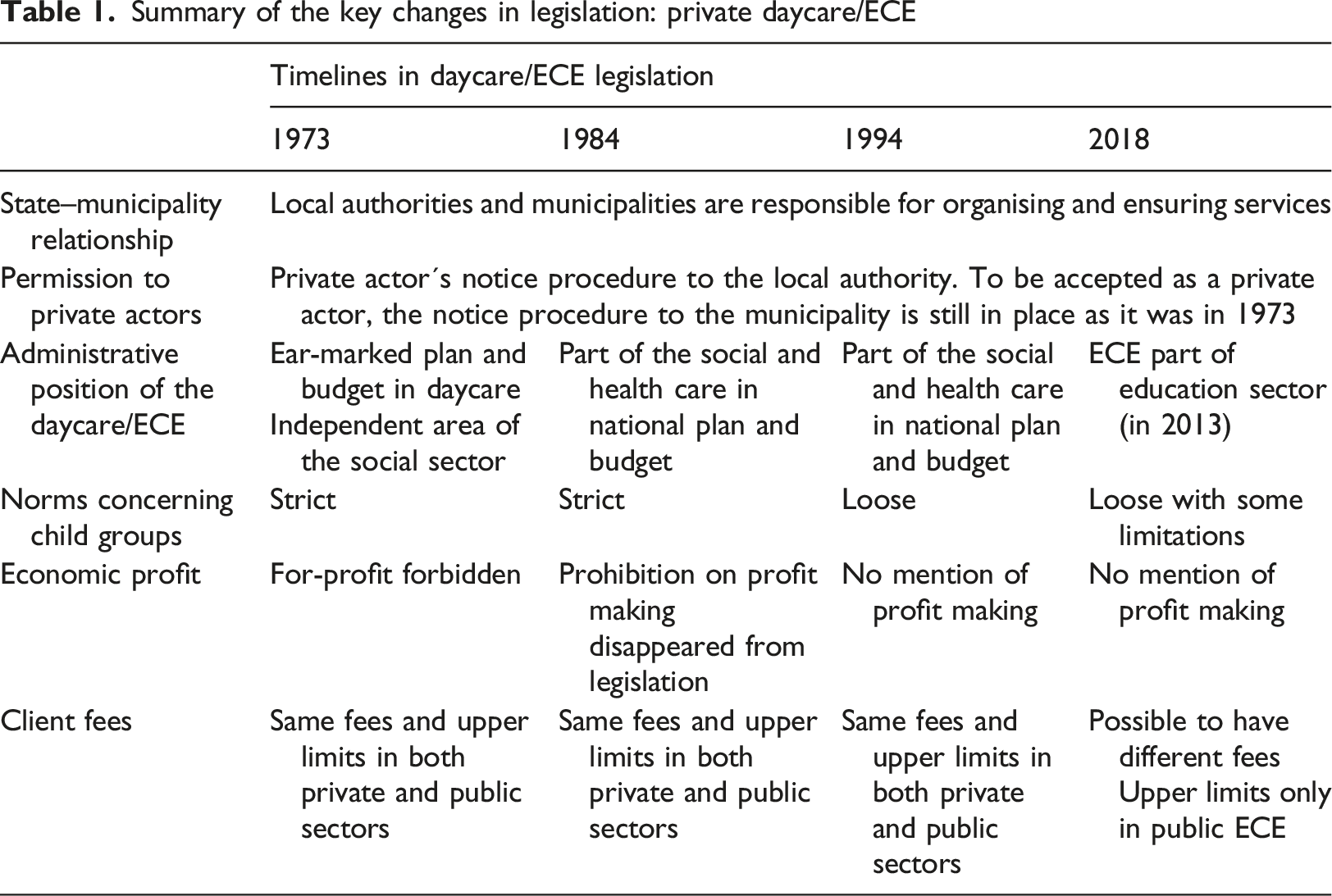
One unchanged element in legislation with respect to the privatisation of ECE from 1973 to 2018 has been the responsibility of municipalities to organise and ensure daycare/ECE and its quality. Another unchanged element is how private kindergartens can start their operations. To be accepted as a private actor, the notice procedure to the municipality is still in place as it was in 1973. This means that the provider should report to the municipality to establish a daycare centre. Furthermore, the AVIs (earlier the State Provincial Office, SPO) still play a role in this process; they are responsible for registering private units and inspecting them in case of problems (Table 1).
The process towards privatisation since 1973 includes several dates and changes in legislation. To sum up the critical elements in those changes, the first and a very important one is when the prohibition to make a profit disappeared from the legislation in 1982 along with the social and health care reforms. The whole public economy played an important role in the social and health care reforms. These reforms were ‘favourable to economical organisation’ and by these, it was ‘possible to achieve savings’ (HE 101, 1981) reflecting the neoliberal austerity discourse, which underpins the idea that public expenditure cuts are central. In the 1990s, legislative changes around Finnish daycare still emphasised economic savings, deregulation and internal market approaches (see also Dýrfjörð and Magnúsdóttir, 2016). Another critical element in legislative changes was the launching of a service voucher. In the name of freedom of choice, service vouchers were an essential factor in the creation and development of markets in social and health care services.
National changes in legislation, with new positive attitudes about private services, are linked to transnational ideologies. According to Paananen (2017), the transnational trend has also stressed accountability and performativity in Finnish ECE. These trends, together with freedom of choice, increasing effectiveness and the creation of flexible and diverse services, were within the framework of the legislation (HE 20/2009 vp). How was this possible in the Finnish ECE when even in basic education, profit-seeking is not allowed? The changes in daycare legislation concerning privatisation were mainly focused on social and health care and when daycare was part of the social and health care, its privatisation was not questioned until now it can be problematised as a part of the education sector.
Local representations of privatisation
Next, we consider the local policy level, the municipality. The responsibility and governance of private daycare/ECE have been and still are in the hands of local authorities. With a new law (540, 2018), concerning ‘Early childhood education and care provided by a private service provider’ gave private providers regulations. Moreover, new quality demands for ECE emerge from the law (540, 2018) and the recent curriculum for ECE (Finnish National Agency for Education, 2016).
The concepts – economy and choice – constructed from interviews reflect the problems that attracted the privatisation of ECE and the assumptions underpinning privatisation, as well as the unproblematic questions (silences).
Economy – The controversial costs of ECE services
The economic justification of ECE privatisation was very clear among our interviewees. As one manager (M1) indicated, savings was the main premise of the political agreement between the share of private and public ECE (30:70) in the municipality: ‘municipal production requires investments, and municipalities are economically tight’. As it is, cost efficiency is said to be the most important reason for increasing the number of private ECE services in Finnish municipalities. In a 2015 survey, nearly half of the municipalities believed that supporting private ECE services would be cheaper than using the services arranged by the municipality (Riitakorpi et al., 2017).
One assumption behind privatisation was that the municipality can save costs and avoid economic risks (see also Ruutiainen et al., 2020: pp. 37–38), as one politician (P1) argued: So, it is a win-win situation [that the municipality also has private ECE providers]. We do not need to establish all those daycare centres. We would have had no opportunities to produce daycare services as quickly as they have been needed during the last few years… If we do not need the private services, we just won’t give service vouchers, and then it will be the problem of private providers that they must shut down the daycare centres.
The politician above approaches the issue from the perspective of economic discourse and does not consider the situation from the perspective of the families and children. When private daycare centres are forced to shut down, the children enter to the municipal ECE. The lack of continuity and changing staff around the child can be a threat to the quality of ECE.
Although some of our interviewees strongly assumed that markets reduce expenses (see Gallagher, 2017; Lloyd and Penn, 2014), some of them also admitted that the comparison of costs is not simple. Many factors affect the costs of ECE, and policymakers do not necessarily pay attention to them when making comparisons between the costs of the public and private services. For instance, children with special needs and children with a need for ECE with extended hours are usually in municipal ECE and demand more resources. There are also other differences in the costs of municipal and private ECE, for instance, expenses of staff and facilities, as one manager (M1) pondered:
It is obvious if one thinks about which costs are the expenses of ECE consist of; they consist of staff expenses and rent. The private providers have shown how they can get house properties at a reasonable price ... Our municipal ECE has these pressures like other big organisations have, our rent costs are surely bigger, and then when the expenses are saved from the cost of staff, they [private providers] can certainly have only one kindergarten teacher per group.
Although the manager in her above comment approaches staff expenses from an economic perspective, she also highlights in the interview the importance of qualified staff as ensure for the quality of ECE.
The interviewees also elaborated on the recent municipal debate about the costs, and which is cheaper: private or municipal. The debate originated from a report comparing ECE costs in several municipalities. The private ECE appeared cheaper, but it clearly emerged from the report that the figures were not comparable. Some of our interviewees found that even so, some politicians in the municipal sector made use of this and wanted to increase the ‘cheaper’ private ECE.
Our interviewees did not ponder the administrative work done by the municipality for private providers. For instance, the municipality is obliged to inspect the private daycare centre before opening it, and the municipality must manage the service guidance of ECE according to the new legislation. Therefore, the costs involved in guiding private providers are allocated at the municipal level.
The interviewees also considered client fees related to the economic situation of families. Municipalities can set limits for client fees in the private sector, but our municipality has not done so. The following quote from one manger expresses the idea that markets level out the differences in fees:
M2: No, they [limits of the client fees] have not been set; the others find that it is in a sense restricting entrepreneurship. We do not set maximum prices either for food markets. Competition is desired to bring down the prices.
One politician (P1) considered that the limits for client fees would have been a bright idea in terms of equality. However, she found that it is right to charge higher fees for families who want English language immersion in ECE. She did not see any problem with that. The politician identified economically different starting points between families, but did not ponder that they may produce inequality between children. Learning the language generates additional cultural capital for some children but not for all.
In summary, privatisation is seen as an answer for the tightening economy of the municipality. The assumption underpinning this was that the private service production is cheaper even if our interviewees admitted that the cost comparison was challenging and unclear (see Bacchi, 2009: pp. 4–5). Furthermore, the faith in the market mechanism was used to justify privatisation.
Choice – Complementary but selectively private ECE
Freedom of choice was another important justification for private ECE (see also Lundahl et al., 2013; Ruutiainen et al., 2020: pp. 40–41). As one manager (M2) stated: ‘because nowadays, young families more and more want to have options and they want customers to be listened to’. Besides highlighting the freedom of choice for families, our interviewees found that private providers can organise more services in a flexible manner, for example, when there is a need for more placements in ECE. Private daycare centres complement the municipality’s own ECE network, which makes it easier to carry out the neighbourhood service principle for families. Thus, privatisation is the answer for problems in the balance between the supply and the demand for ECE services, and for problems in restricted options (see Bacchi, 2009: pp. 2–3).
The politicians considered that the private sector is perhaps more innovative than the municipal daycare in developing the institutional culture of ECE (e.g. different emphasis, age grouping and staff tasks), whereas the other manager (M1) emphasised that the municipal sector also provides specialised activities, the municipal daycare centres are not used to marketing themselves in the same way as the private actors.
All the interviewees found choice to be a positive matter, and they considered it to be important. They assumed that markets offer more choices to families and thus make service production efficient (see Gallagher, 2017; Lloyd and Penn, 2014). According to Myers and Jordan (2006), the choices families make are affected by the prevailing system to which parents adapt. However, the interviewees also admitted that the choice might, in fact, be a quasi-choice; there was a risk to equality because not all families can choose in the same way when the municipality restricts and regulates the choices. Thus, it is a question about equality as an equal opportunity to choose (see Paananen et al., 2019: p. 58).
The complementary role of private ECE also has selective elements. One manager (M1) worried about the division of the families according to their economic status: I find that polarisation has taken place here [the case municipality], I cannot say, we have not followed, we do not have time to follow, whether there are differences in families’ incomes regarding private and public ECE. But we know that a large part of immigrant children attend municipal ECE, and children with special needs and children in scheduled daycare almost all attend municipal ECE.
The situation in the case municipality is much the same as elsewhere in Finland: most of the children who need special support are in public ECE (see Pihlaja and Neitola, 2017; Riitakorpi et al., 2017: pp. 41–42).
Highlighting choice – in the legislation and in the interviews – underpins the idea that families can choose, can master the access process, use the available information and utilise their social relations to make the best decisions. Therefore, families are forced to the markets, to choose an ECE provider, public or private. However, such an idea of parents as informed ‘customers’ is problematic (e.g. Gallagher, 2017; Plantenga, 2012), as it can be a threat to the social equity highlighted by the Nordic welfare model. This question was unproblematised in our interviews, even though one manager (M1) considered the division of the children between private and municipal sectors according to their background and family income as a possible problem.
Discussion
In this article, we have asked how the privatisation has proceeded within the legal framework and how profit making has become possible. Furthermore, we have studied how the local key actors justify the privatisation of ECE by analysing what are the problems represented to be calling privatisation and the underpinning assumptions. Our last research question was as follows: What key actors left unproblematic in problem representation.
Our twofold research approach (legislation and the views of the local key policy actors) widens understanding about the process of privatisation of ECE. Economy and freedom of choice were critical ideas behind the legislative changes to privatisation. The same elements – the represented problems that calling the privatisation of ECE – emerged from the interviews. Especially our interview analysis brings out those silences, unproblematic questions in problem representation of the private provision of ECE.
Privatisation has become part of Finnish ECE through tacit and invisible steps, both in legislation and also in municipal services illustrating hidden privatisation (see Ball and Youdell, 2007). Historically, the important factor in the process of exogenous privatisation in Finnish ECE is that daycare (as it was called in the 1980s and 1990s) was a part of the social sector when the prohibition to make a profit disappeared in 1982 from the legislation along with the social and health care reforms. Legislative changes have been made without a deep analysis of daycare and the needs of this service. We could say that the removal of the prohibition clause in 1982 was a case of ‘throwing the baby out with the bath water’. Would the same process have been possible if ‘the historical conditions’, have been different, for instance being a part of the education sector? Finnish basic education has been and still is mostly a public, universal system, prohibited from making a profit.
The other reform that has had an impact on privatisation and increased the proportion of private services is the service voucher legislation again as part of the social and health care reforms. What is also interesting here is that with public funding, the State is taking a stand on the need to support private companies, and, at the same time, it is supporting international corporate business, the interest of which is making a profit for its shareholders (see Gallagher, 2017).
On the local policy level, the privatisation of ECE was an attempt to address some problems presented by our case municipality’s key actors. Two central problems were the costs and economic risks. According to our interviewees, privatisation can reduce the costs of ECE at the municipal level (see also Gallagher, 2017; Ruutiainen et al., 2020), such as investment costs, as well as minimise risks, for instance, when new facilities are needed for services. Then again, when we consider the risks, we should bear in mind that the municipality is always responsible for ensuring the quality of ECE and for organising ECE placement for children. Thus, the municipality always takes a risk when giving permission to provide ECE, in case of possible business failures in the private sector.
Aside from the economic justification of privatisation, all the interviewees highlighted the freedom to choose – both central ideas of neoliberalism (see e.g. Gallagher, 2017; Haug, 2014; Lundahl et al., 2013). Private actors along with municipal ECE complement public services and offer more options to families. Furthermore, our interviewees saw the balance between the supply and the demand for ECE services as a problem caused by the rapid changes in the demographics of the municipality.
The personal assumptions (see Bacchi, 2009) differed between our key actors, and there was no consensus on what is really behind privatisation. The implementation of ECE in the case municipality has multiple logics and understanding with different assumptions among people who are making decisions with ‘varying facts’.
The unproblematic question in the interviews was equality – the core value in Finnish society. However, research has shown that a policy shift towards privatisation has also compromised equality: private ECE providers may promote educational injustice against low-income families and children (e.g. Kambutu et al., 2020; Perez and Cannella, 2011). Our interviewees did not consider what privatisation means for equality among families even though it became clear that private companies are choosing their clients and are thus excluding some children. When equality was considered, it was approached as an option by building on the freedom of choice discourse. Ruutiainen and colleagues (2020, p. 43) presume that traditional idea of equality in ECE which highlight families’ universal right to public ECE may be shifting towards families’ equal opportunity to choose the ECE provider and place. In Varjo and Kalalahti´s (2018) study, Finnish local education authorities highlighted the fact that in basic education, school choice must be governed by public authorities because, otherwise, social and residential segregation may be promoted.
The unproblematic issue when discussing privatisation was the child too. The child-centred humanity discourse (UN, 1989), which challenges the human capital aspects in ECE and tries to ensure a good childhood, did not emerge in any way in our research material. The new goals of ECE in legislation (540/2018) and the Core Curriculum of ECE require child-centred elements and quality demands concerning the care and education of children. However, the key person and the key elements in ECE were hidden in the discussion. This finding reflects the rationales of Finnish ECE policies, which have had a traditional heavy focus on labour market needs (see e.g. Paananen et al., 2019). Adamson and Brennan (2014) used examples from Australia and England and wrote that private investment facilitated by market mechanisms is at risk of overshadowing the deeper goals of the social investment agenda that call for policies that boost human capital.
The Finnish case of the process of exogenous privatisation in ECE indicates hidden privatisation (Ball and Yodell 2007) which has taken place during the long period in the shadow of other welfare state’s service sectors. Ideas of neoliberalism, accountability and flexible services, were similar within legislation as well as in the discourses of our local actors. What is more, those underpinning assumptions of privatisation at local discourse were various (see also Ruutanen et al., 2020). This might lead to ‘fragmentation, goal-ambiguity and contradictions’ (Vermeulen et al., 2016: p. 5) in local ECE policy. Furthermore, the silences of ECE policy were equality, quality and child itself. These are themes which should be brought out in a political discussion about privatisation and future research.
The disadvantages of private ECE in Finland became widely publicised in 2019. In the programme of Sanna Marin’s government (2019), it was stated that the opportunity to extend the restriction of profit seeking to ECE legislation, as in basic education, will be investigated. The report is currently being prepared by Minedu officials. The future will show how the aim of making a profit, an aim that is new in the Finnish ECE context, will meet the new quality demands of ECE. If the child-centred discourse as well as quality and equality discourses are overshadowed by economic ones, the Finnish ECE and ECE more widely in the global context will face great challenges in the future.
Footnotes
Acknowledgements
We would like to thank Kirsi Alila, Counsellor of Education at the MInistry of Education and Culture, for her valuable comments on this article.
Declaration of conflicting interests
The author(s) declared no potential conflicts of interest with respect to the research, authorship, and/or publication of this article.
Funding
The author(s) received no financial support for the research, authorship, and/or publication of this article.
Notes
Author biographies
PhD (Education), Adjunct Professor (Docent) Anne Laiho is a Senior Lecturer in the Department of Education/Centre for Research on Lifelong Learning and Education (CELE) at the University of Turku, Finland. Her main research interests include higher education, education policy, gender and education as well as education of health care professionals. Her current research interests include research project Changing University Institution and Equalities in Academic Work ( ), privatisation of early childhood education and male gender in teacher education. Laiho lectures among others in the Sociology of Education. Along with research and teaching she supervises doctoral and master thesis.
PhD, special teacher Päivi Pihlaja is an Adjunct Professor (Docent). She has been working as a university research fellow and senior lecturer in special education subject at the University of Turku, Finland. Currently she is a Senior Lecturer at the University of Helsinki, Finland in early education subject. Her research interests are related both to early childhood education and special education. She has been a leader to projects examining, for example, inclusive education and co-teaching or social-emotional difficulties in early education and in basic education. Her long-term research work in a longitudinal study EduSteps is part of a large multidisciplinary study at the University of Turku (see Kasvatus, koulutus ja oppiminen https://sites.utu.fi/hyvan-kasvun-avaimet/tutkimusteemat/). Currently she is leading Toddlerstudy () that examines social-emotional competence and difficulties in early education. Along with teaching and research, she has supervised doctoral students.