




Abstract
For several decades, there has been a global trend of the devolution of autonomy to local leadership levels. The topic has consequently gained attention in educational research, showing the complexity and multi-layered nature of the phenomenon. Nevertheless, empirical research has focused largely on individual leadership or institutional school autonomy, overlooking school leader unions’ collective autonomy at the intersection between leadership levels and as a link between policy and practice. This paper aims to explore the communication and formation of collective autonomy through school leader unions in their mediating role between policy and practice, under shifting national policy contexts with increased global policy influence. Attention is drawn to union magazines and how they have depicted the issue over time, analysing texts on assessment from nearly 300 issues through a two-fold conceptualisation of collective autonomy as the capacity to influence policy and control individual professionalism. The results highlight the possibility of unions functioning as mediators between policy and practice, national and local, when collective autonomy is not too restricted. The study calls for further empirical research on collective autonomy, paying attention to the intricate relationship between policy, collectivism and individual leadership practice.
Introduction
For quite some time, autonomy has been a ‘hot topic’ in educational policy and practice, partly due to global policy influence from international organisations such as the Organisation for Economic Co-operation and Development (OECD) (Verger et al., 2019). Since the 1990s, devolution of responsibility and decision-making to local levels, followed by increased accountability, has accelerated in educational governance in many parts of the world, challenging previous roles of the policy actors (cf. Helgøy et al., 2007; Keddie and Holloway, 2020; Mentini and Levatino, 2024). Autonomy is also an important component of professionalism, be it individual or general professionalism, that comes into play in situations such as day-to-day decision-making, in negotiating workplace matters or in influencing national educational policy (Day, 2020; Frostenson, 2015; Wallander and Molander, 2014). As such, distribution of autonomy is fundamentally a matter of decision-making power and influence and a phenomenon of importance to many different levels and actors in education, including collective agents such as labour unions (Cribb and Gewirtz, 2007).
Previous research indicates that unions’ collective autonomy through influence on national policy processes have decreased in several European countries since the turn of the century (e.g. Helgøy and Homme, 2007; Mentini and Levatino, 2024). However, most of the attention in research has been given to teacher unions and teachers’ collective autonomy, and there is a need for empirical investigation of school leaders’ collective autonomy, as it appears through school leader unions. Through their unions, school leaders collectively engage in discussions and decisions concerning the profession, uniquely placed in the nexus between policy and practice, with the possibility to influence both (Helgøy and Homme, 2007; Mausethagen and Mølstad, 2015; Prøitz et al., 2023).
In the running to improve educational quality, national governing bodies and international organisations alike have developed many different instruments for external assessment, such as school inspections and the Programme for International Student Assessment (PISA) (Grek, 2009; Grek et al., 2013). However, in decentralised governance systems, the issue of accountability implies inherent tensions, as external assessment and quality control might constrain or affect leaders’ autonomy (Eacott, 2015). In this regard, assessment serves as an interesting case for studying collective autonomy. The Nordic context is an important example, given the tradition of decentralised governance and assessment policy reforms that have taken place in the past decades (Prøitz and Aasen, 2017). A special focus in this article is drawn to Sweden and Norway, as Norwegian governance is characterised by decentralisation and low-stakes accountability, while Swedish governance is increasingly characterised by recentralisation, marketisation and strong politicisation, thereby representing important context variations for comparison (Prøitz and Nordin, 2020; Wermke and Prøitz, 2022). The following research questions direct the analysis: How was collective autonomy communicated and formed through school leader union magazines in Sweden and Norway between 2006 and 2021? How does this reflect unions’ roles in the interplay between policy and practice?
Following this introduction, school leader unions and the policy contexts in Sweden and Norway are presented, including a brief outline of the countries connections to the EU and OECD. An outline of collective leadership autonomy in the literature and as a conceptual lens in this study then precedes data materials and research methods, before closing off with presenting and discussing the results.
Context of the study
School leader unions in Sweden and Norway
Sweden and Norway stand out as relevant examples to expand the current body of research, as unions in the Scandinavian countries traditionally have a strong position as actors in the tripartite collaboration between the state, employers and employees, and they are seen as important voices in policymaking often invited to the table when policy is discussed (Hvid et al., 2018; Sorensen et al., 2021). Unions have also played an important role in building social democracy and Nordic welfare societies in Sweden and Norway, and in negotiating working conditions for teachers and school leaders (Gunnulfsen and Skedsmo, 2023; Prøitz and Aasen, 2017). Research on teacher unions in both countries, however, shows that Swedish unions have experienced a comparative loss of impact on policy, indicating important context diversity that is also relevant for school leader unions (Helgøy and Homme, 2007; Wermke and Prøitz, 2022).
The Swedish Association of School Principals and Directors of Education was established in 1966, with the Norwegian Association of School Leaders following in 1977. While at the time of this study, there were trade unions in both countries organising both teachers and school leaders, these two were the only unions exclusively organising leaders, representing leaders working in schools and local education administrations. The term school leader is consequently used in this text as an overarching term that includes principals and other leaders working in schools, as well as in local education administrations. In 2022, the Swedish union had approximately 5400 working members, 1 while the Norwegian union had approximately 4040 members. 2 Both unions highlight their aim to function as drivers in developing high professionality and the importance of leadership for educational development. Through their role in national policymaking and as the largest unions for school leaders, these unions are important agents for school leaders’ collective interests in both countries.
2006–2021: A reform-intensive period
Sweden and Norway share a similar ideational foundation in what is often referred to as the Nordic model of education (Blossing et al., 2014), but differences in educational governance have developed through extensive policy changes and reforms over the past 30 years (Prøitz and Nordin, 2020; Rönnberg, 2014; Stenersen and Prøitz, 2022). The Swedish school system is now characterised by a multiplicity and fragmentation not found to the same extent in Norway, where less competition and output governance constitutes a more ‘low-stakes professional context’ (Wermke and Prøitz, 2022: 224). The timelines drawn up in Figures 1 and 2, while not extensive, show a selection of policy documents and events central to issues of decentralisation/recentralisation of responsibility, accountability and assessment from 2006 to 2021.
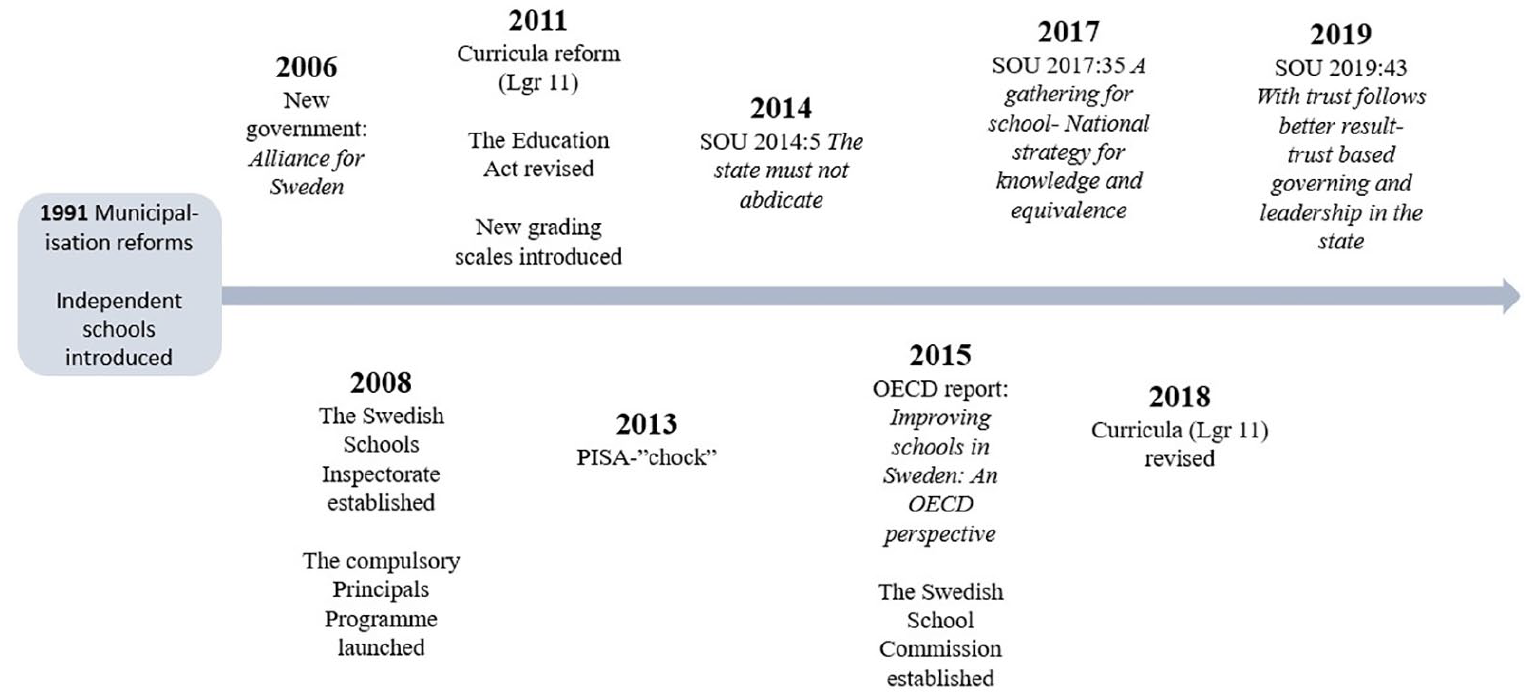
Sweden 2006–2021: A reform-intensive period with increased centralisation.
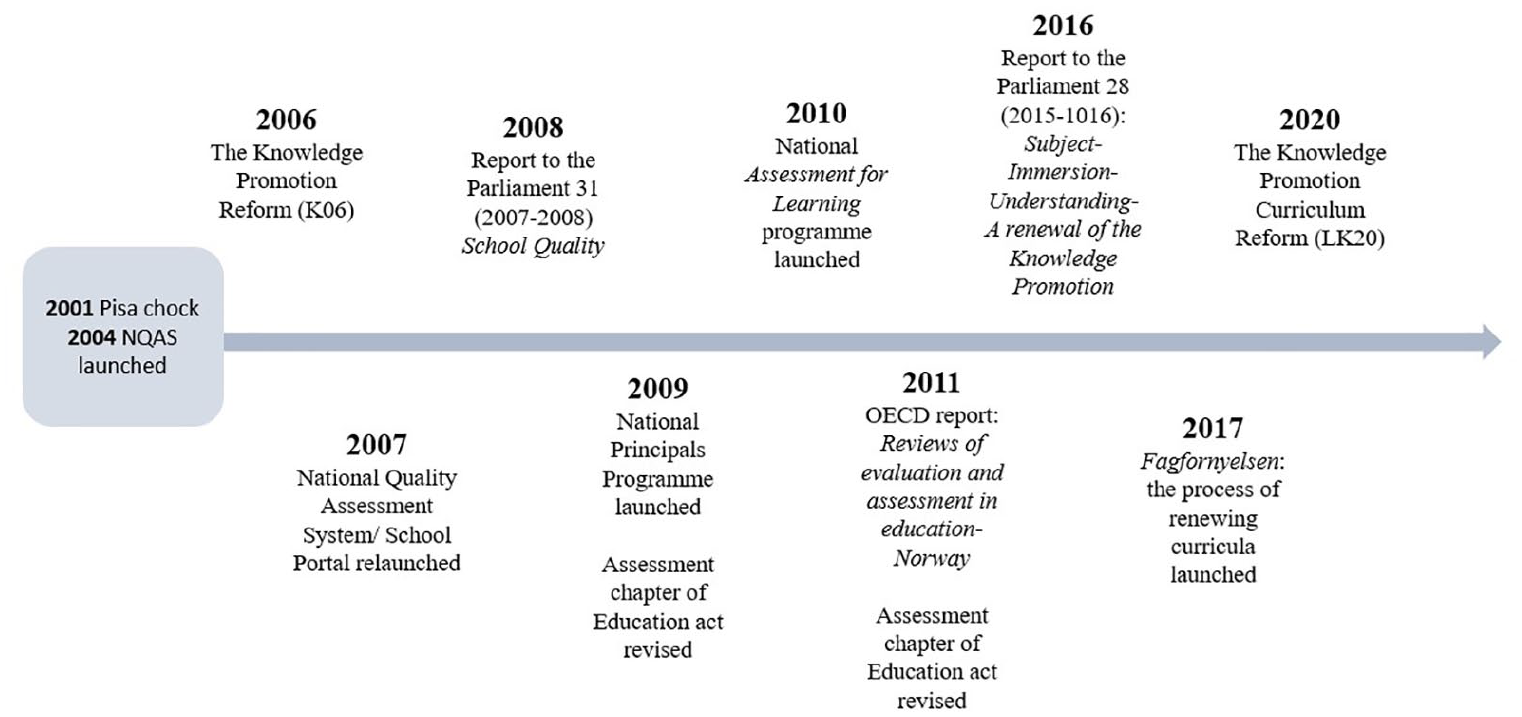
Norway 2006–2021: A reform-intensive period sustaining decentralisation.
During the past two decades, transnational actors like the OECD have played important roles in defining school quality in Sweden and Norway, as in many other countries worldwide (Grek, 2024; Kauko et al., 2018; Verger et al., 2019). While the countries differ in that Sweden is a member of EU and subject to EU’s legal and policy influence, and Norway is not, results from PISA for example, have sparked public debates about educational quality in both countries (Smeds-Nylund et al., 2023). Norway experienced a PISA shock in 2001 (Figure 2), which pushed a political consensus towards increased accountability and the establishment of national quality assurance systems (Møller and Skedsmo, 2013). Decreasing PISA results in Sweden around 10 years later (Figure 1) similarly triggered political action with the commissioning of the OECD (2015) report Improving schools in Sweden: An OECD perspective and establishment of the Swedish Schools Commission.
Sweden (Figure 1) has moved further towards a marketisation of schools than Norway, opening up for a system of independent school providers from the 1990s, creating pressure on public schools and challenging the state’s role as provider of comprehensive education (Nordholm et al., 2022b; Normand, 2018; Wermke and Salokangas, 2021). Quality assessment, results and school rankings have gained a more predominant role in information about school performance, and new ways of assessing quality of educational outcome were introduced for the state to keep a sense of control and ensure equality in education with devolution of autonomy (Christensen et al., 2021; Hudson, 2007). Despite decentralisation reforms, Sweden has, in the past 15 years or so, seen a push towards recentralisation of educational governance, and the state is now more present at the municipal level, marked particularly by the establishment of the Swedish Schools Inspectorate, expansion of the Swedish National Agency for Education, external improvement projects and the introduction of quality dialogues (Ärlestig and Leo, 2023) (Figure 1). Control from the central municipal level has also increased significantly over the past decade (Nordholm et al., 2022a, 2022b). The relationship between the state and local levels in governing Swedish education has been extensively debated. Decentralisation reforms were criticised for not realising the intended increase in school leader autonomy as superintendents took on the previous role of the state, and that the relationship between school leaders and local politics was unclear and lacked trust (SOU 2014: 5). Trust-based governance was further discussed in 2019, highlighting the importance of trust for ‘more freedom of action and greater motivation’ (SOU 2019:45: 22), however, the situation can still be described as ‘cross-pressure’ as tensions still exist (Ärlestig and Leo, 2023: 79). In 2008, the voluntary National School Leadership Training programme was made mandatory, with the National Agency for Education in charge of goals, guidelines, admissions and distribution of resources to universities running the programme (Norberg, 2019). Arguments have been made that the reforms of the 1990s fuelled a professionalisation process for school leaders in Sweden (Jarl et al., 2012), a process in which training programmes play an important part.
In 2006, the launch of the Knowledge Promotion Reform (K06) in Norway changed educational governance from input to outcome orientation through a new competence-based curriculum (Figure 2), and decision making was pushed to the local levels, increasing the emphasis on local leaders’ accountability through responsibility for results (Møller and Skedsmo, 2013; Prøitz and Aasen, 2017). In the wake of the reform, a relaunch of the National Quality Assessment System and a report about school quality (St.meld. nr. 31 (2007–2008)) contributed to lifting forth a focus on systematic quality assessment and performance in schools and municipalities. The change towards more output control, however, was installed within a system with a long-standing tradition of local municipal autonomy where municipalities are free to decide how to integrate and use results in local systems and governance, and Norway is still characterised by ‘soft’ accountability (Gunnulfsen and Skedsmo, 2023; Prøitz et al., 2022). This leaves room for significant local differences in policies related to learning outcomes, rendering education largely a ‘municipal affair’ (Nordholm et al., 2022a) (Figure 2). Nevertheless, arguments have been made that school autonomy in Norway might be narrowed by municipal autonomy if the latter holds schools accountable through performance results (Camphuijsen et al., 2021).
Norway had no national training programme for school leaders until 2009 (Gunnulfsen and Skedsmo, 2023). The 2008 report recommended the programme, arguing that a systematic national approach to the competence required of school leaders was needed to enhance school quality (St.meld. nr. 31 (2007–2008)). However, the programme was not made mandatory as it was in Sweden, and while the Norwegian Directorate for Education and Training is responsible for admission, funding and framework, the universities running the programmes are given a large amount of leeway to decide content and goals, resulting in programmes with different profiles and knowledge foundations (Møller, 2016). As in Sweden, professionalisation of school leaders has accelerated in Norway during the past 30 years detaching them more from teachers (Smeds-Nylund et al., 2023), and recognised in policy as a profession of their own since 2007 (Valle and Lillejord, 2023).
Collective leadership autonomy
According to the literature, a multidimensional understanding of autonomy in education is widespread (Ågren et al., 2023; Dieudé and Prøitz, 2022; Salokangas et al., 2020; Wermke et al., 2022). Cribb and Gewirtz (2007) identify three dimensions of autonomy and control related to various agents and different domains of their work, categorising agents along a three-tiered division as individual, collective or institutional. Collective agents are defined as teams working either within schools or politically through, for instance, trade union work or national policy lobbying. Frostenson (2015) similarly describe autonomy according to three levels where general professional autonomy imply influence on general organisation or control principles of schools. School leaders’ impact on learning outcomes and the important role they play in school improvement and educational quality is well established by now (Darling-Hammond et al., 2009; Leithwood et al., 2020; Ugarte et al., 2022). The crossfire of conflicting demands impacting school leaders when increased local autonomy is followed by stronger accountability and external assessment can, however, result in creative exercise of leadership autonomy (Gobby et al., 2018).
While much research focuses on school leaders’ individual autonomy (McKay, 2018; Merkle, 2022; Niesche et al., 2023; Nordholm et al., 2022a), research on school autonomy highlights stakeholders’ concerns with countering the individualism of managerial autonomy with the more democratically oriented professional and collective autonomy (Gobby et al., 2022). Collective decision making and control of practice is also used to support individual leadership autonomy through the use of bridging strategies (Kim and Weiner, 2022), while policy trends of partnerships and collaboration can potentially challenge both leadership and school autonomy (Lumby, 2009). In the Nordic countries, collegial professional autonomy between school leaders and teachers have seemingly weakened, with the collective autonomy of school leaders pointed out as an area for potential development, as ‘stronger leadership means strengthened forces for principals to implement educational policy and reforms’ (Smeds-Nylund et al., 2023: 109). Collective leadership autonomy is an important aspect of the formation of school leadership as a profession, however, the relationship between individual and collective when collective autonomy is perceived as threatened or restricted, for example, through external assessment and control, is complex (Cheng et al., 2016; Eacott, 2015; Kachanoff et al., 2022).
School leaders’ individual sense of autonomy may vary depending on the context and situation (Ågren et al., 2023; Salokangas and Wermke, 2020). While individual autonomy plays an important part in everyday policy enactment (Ball et al., 2012), increased individual autonomy is also associated with the risk of failure, for instance, through external assessment and control (Wermke and Salokangas, 2021). Through identifying, communicating and influencing important policy decisions, collective autonomy can help individual leaders navigate the policy landscape and reduce risk through the collective force of the profession, facilitating decisions based on shared professional knowledge (Hermansen, 2017). Collective autonomy is also connected to the wellbeing of members who tie their identity to the group, and when a groups’ collective autonomy is perceived as restricted through external quality assessment, it impacts members personally. Perceptions of collective autonomy restrictions might consequently lead to collective actions to restore the group’s autonomy (Kachanoff et al., 2022). In this sense, various forms of assessment as governance affect collective autonomy and actions through attempts to maintain or restore autonomy. To elucidate school leaders’ collective autonomy in a union setting, this study turns to conceptualisations of teachers’ collective autonomy carried out in a similar context.
In describing what they define as ‘new professionalism’ in schools, Helgøy and Homme (2007) point out that a move towards increased individual accountability with the decentralisation of governance has led to a new form of collectivism where the main motive is to secure the individual’s interests through collective actions. This represents a change from the ‘old professionalism’ where the profession as a collective group is held responsible and accountable. Against this backdrop, they define collective autonomy as the collective’s influence on and supplying conditions for national educational policy making (Helgøy and Homme, 2007), identifying autonomy as a phenomenon that plays out externally between the group and the policy makers (Figure 3).
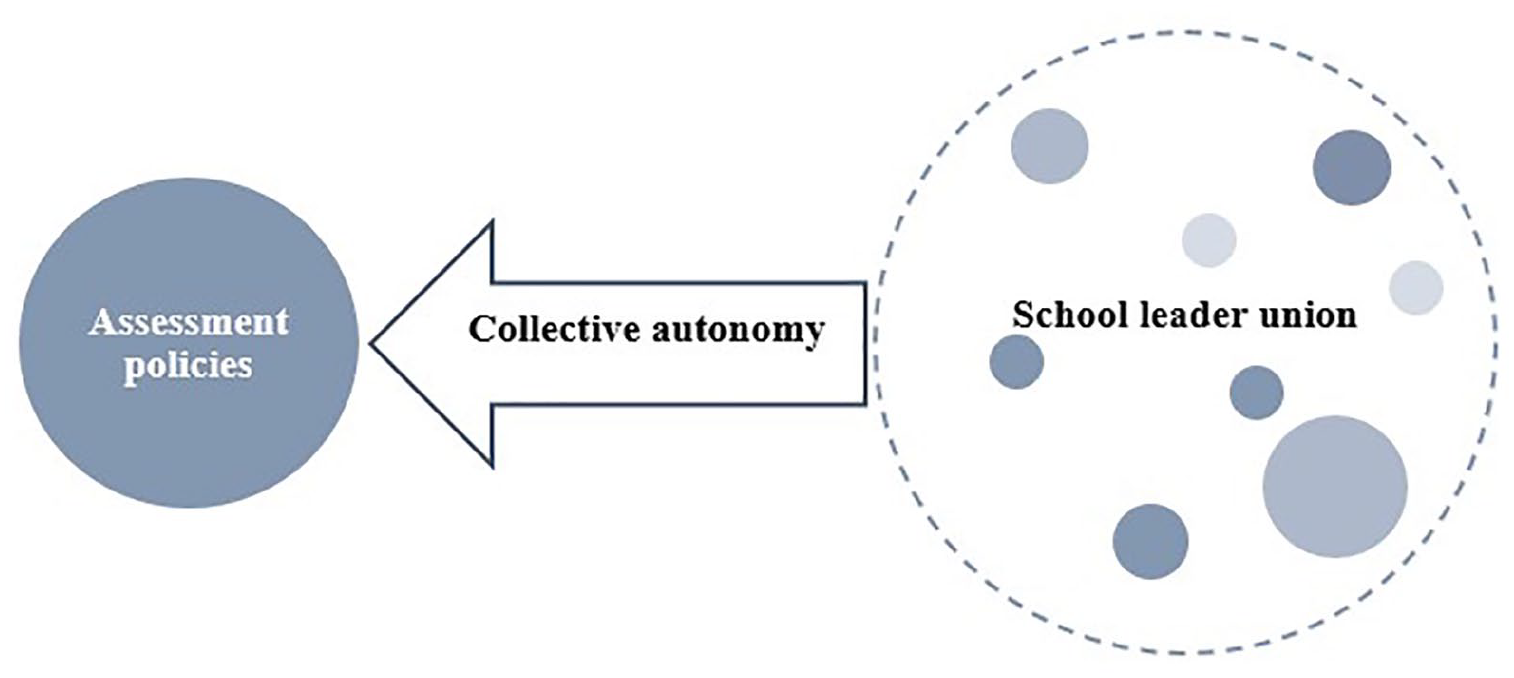
External collective autonomy as a policy influence.
Mausethagen and Mølstad (2015), on the other hand, describe collective autonomy as an organisation or a union’s control over the individuals’ work and professionalism, identifying collective autonomy as a phenomenon that plays out internally between the group and its individual members (Figure 4).
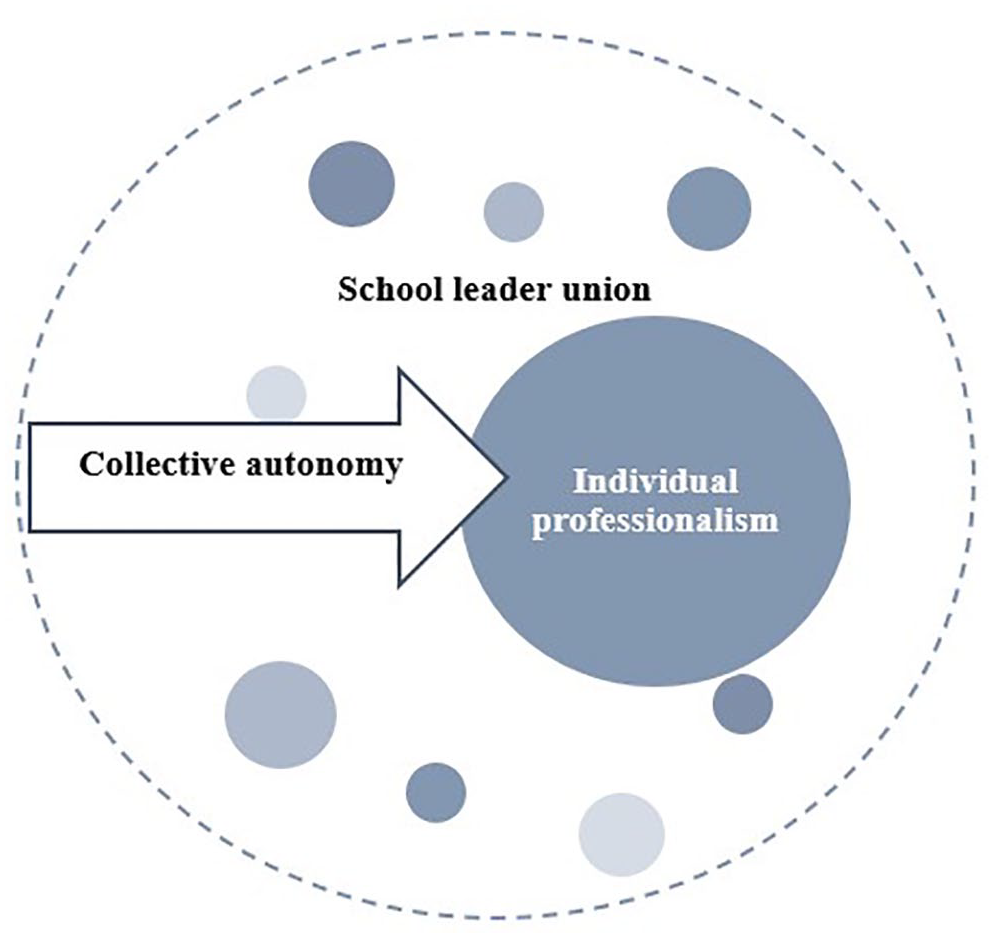
Internal collective autonomy as controlling individual professionalism.
Their point of view seems to resemble Freeman and Sturdy’s (2014) description of the formation of knowledge communities. According to Freeman and Sturdy (2014: 14), knowledge that has some form of ‘reliability, regularity and constancy’ depends on a collective of knowers to monitor, regulate and discipline individual knowledge. In this sense, knowledge communities serve as channels through which individual knowledge is enacted. With this as a reference, this article understands the formation and maintenance of unions as knowledge communities as an essential element of collective autonomy, as described by Mausethagen and Mølstad (2015) inherently connected to individual enactment of knowledge and autonomy. This two-fold understanding of external and internal collective autonomy serves as a conceptual lens for the analysis and discussion of the findings of this study.
Materials and methods
Data material
Skolelederen and Skolledaren are professional magazines for members of the Norwegian Association of School Leaders and the Swedish Association of School Principals and Directors of Education. They were chosen as data material because they represent important sources for broadening our understanding of collective autonomy in unions and as a distinctive textual genre that provides valuable historical insight (Bowen, 2009). Thus far, these magazines have been underexplored as source material in educational policy research. They provide valuable insight into the unions’ involvement, understanding and dissemination of their roles in policymaking, but also as knowledge-inscribed artefacts contributing to shaping collective knowledge and autonomy (Freeman and Sturdy, 2014). The study draws on a total of 298 issues, 152 Norwegian and 146 Swedish, covering the period from 2006 to 2021 (see Supplemental Appendix for a complete list). As previously noted, this was a reform-intensive period in both countries, with several changes and policy events placing school leaders’ work under pressure (Figures 1 and 2). At the time of analysis, all the Norwegian magazines were accessible online as PDF files, while the Swedish magazines from 2014 onwards were similarly accessible online. The Swedish magazines from 2006 to 2013 were made available for the author to read and scan at the unions’ archives in Stockholm. Both magazines have had stable leadership, with two editors each during the 16 years analysed. The independent editors are themselves authors of some texts, while other texts are written by the union leaders, representatives or members, researchers or experts on employment law. The content is diverse, spanning articles and interviews with school leaders and politicians, reports from conferences, presentations of new research, book reviews and question columns about legal issues.
Analytical approach
Designed as a comparative study anchored in qualitative content analysis (Hsieh and Shannon, 2005; Phillips and Schweisfurth, 2014; White and Marsh, 2006), the analysis consisted of two phases. The first was an initial reading and coding to identify relevant texts and obtain an overview of the material. Second was a further selection, re-coding and in-depth analysis of the texts. Figure 5 outlines the two analytical phases.
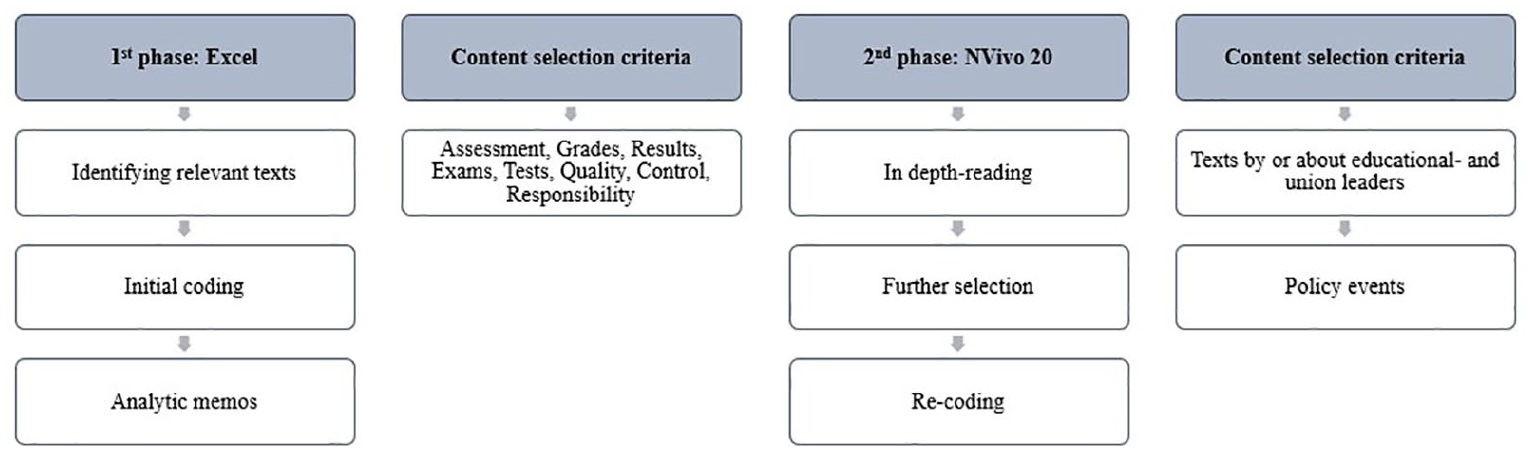
A two-phase analysis.
In the first phase, all magazines were examined to identify texts on assessment with a broad understanding of the concept, including both pedagogical practices and governance through external evaluation (Ydesen et al., 2023). The following categories were included in the first phase: assessment, grades, results, exams, tests, quality, control and responsibility. Throughout this phase, an Excel spreadsheet was used to record the number of relevant texts in each issue of the magazines, the titles of the texts, page numbers and brief notes on the content of the selected texts. Colour codes were then applied to the content notes to obtain an overview of the patterns of content. Throughout the initial reading process, analytic memos were written, recording reflections, impressions and interpretations and historical and contextual events, leaving an audit trail of the first phase of the analytical process behind (Birks et al., 2008).
Following the initial analytical phase, the extracted texts were read in depth and recoded using NVivo 20. To ensure focus on the discussions, arguments and attitudes of the unions and their members as units of analysis, and to make the number of extracted texts manageable for in depth qualitative analysis, a further selection was applied excluding texts written by the editors, researchers or other experts. This final selection resulted in a total of 262 texts from Swedish magazines and 225 texts from Norwegian magazines. Within the extracted texts, references to assessment policy events were also coded to identify which policy issues were foregrounded as part of the process of forming knowledge communities. The union magazines are understood as artefacts inscribed with knowledge that play an important part in the formation of the unions as communities of knowledge through selecting, disseminating and interpreting policy (Freeman and Sturdy, 2014). Through these discursive processes, certain topics and problems are foregrounded, while at the same time leaving others out and reducing the scope of the unions’ areas of knowledge and interest (Saarinen, 2005). Frictions might also rise to the surface within these discussions, revealing opposing or competing views on policies that might impact collective autonomy (Saarinen, 2008). In this sense, texts on policy in union magazines represent a site where external collective autonomy is communicated and internal collective autonomy is formed, making them particularly relevant to this study. By looking for patterns guided by the research questions, the collected extracts were analysed and discussed through the lens of a dual understanding of collective autonomy, as outlined in the previous chapter, aiming to create a composite understanding of the phenomenon. The approach can be described as abductive, alternating between and reinterpreting both theory and empirical material (Alvesson and Sköldberg, 2018).
This study is part of an international research project with researchers from both Sweden and Norway and a reference group consisting of both union- and school leaders. To ensure rigour and minimise linguistic misunderstandings and cultural bias, drafts of the paper have been read, commented on and discussed by project members and reference group members several times from the first coding and throughout the analytical process. The paper has additionally been presented and discussed at several international conferences such as the NERA 2022 and CIES 2023. A limitation to the study is that the material analysed only to some extent provide evidence of actual influence on policy or individual members’ professionalism. A triangulation of other materials and methods such as policy documents and interviews could contribute to more fully understand these processes. A strength of the study, however, is the richness and stability of the material allowing for conceptual depth through tracing the phenomenon over time and in triangulation with the policy contexts situating the findings (Tracy, 2010; White and Marsh, 2006).
Results
In the following, the results from the analysis are presented through an overview of the most dominant assessment policy events communicated through magazines, based on the analysis of assessment topics discussed by union leaders and members. Discussions of policy events are used as examples of discursive processes contributing to forming collective autonomy, aiming to understand how collective autonomy is communicated and formed through the unions’ roles in the interplay between policy and practice (Helgøy and Homme, 2007; Mausethagen and Mølstad, 2015; Saarinen, 2008). The overviews listed below (Table 1) show policy events appearing in eight or more magazines, as they form the clearest clusters of events. All appeared in texts in which union leaders or members discussed one or several aspects of assessment in a broad understanding (Ydesen et al., 2023).
An overview of policy events found in Swedish and Norwegian magazines.
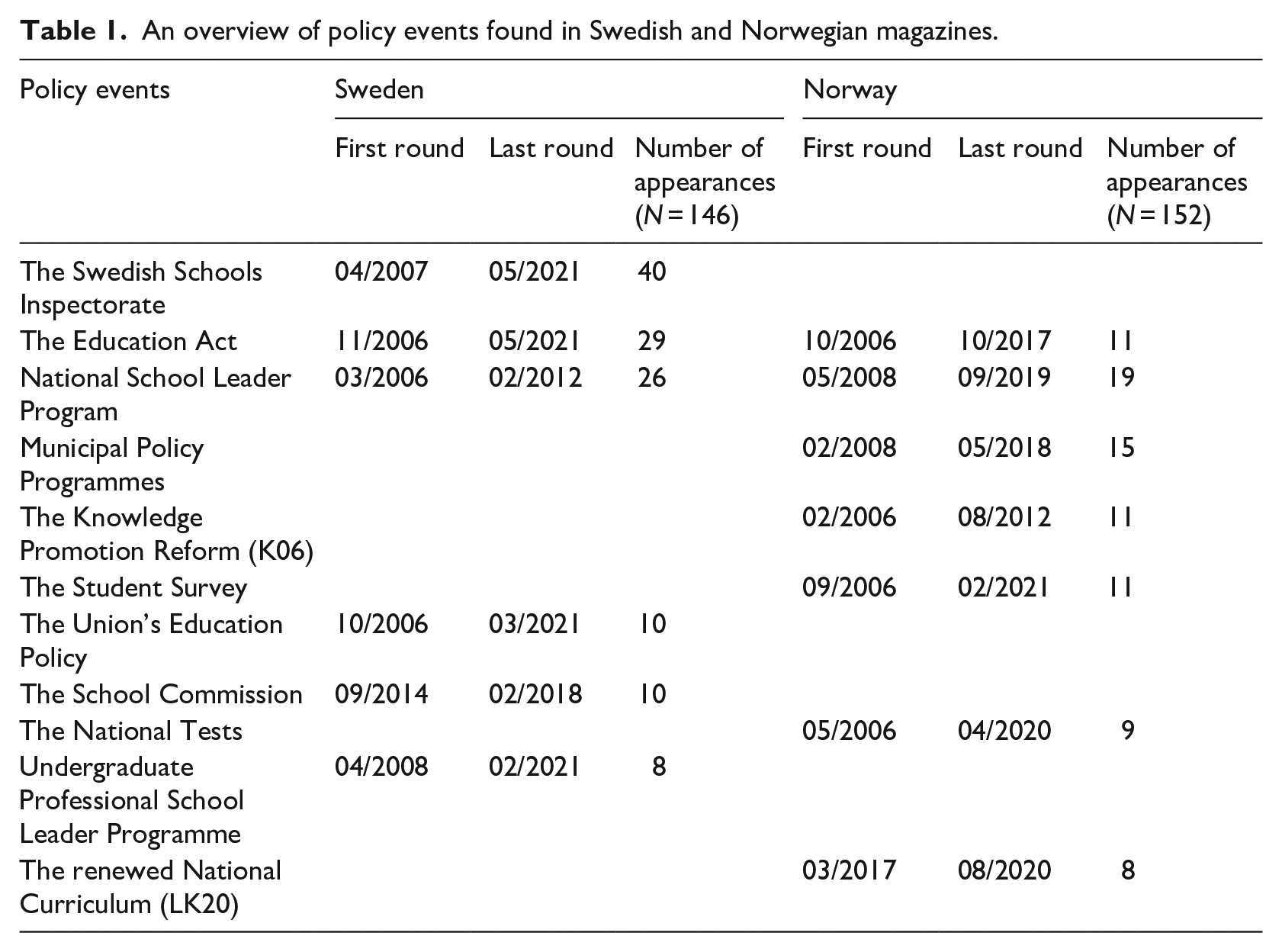
Despite a fairly equal number of magazines, there were fewer appearances of policy events in the Norwegian texts (N = 84) than in the Swedish (N = 123), communicating lower assessment policy engagement in the Norwegian context. The analysis shows that three policy events were foregrounded in the Swedish magazines, communicating higher policy engagement in these areas, while policy events in the Norwegian magazines are more evenly distributed.
Engaging with policies
External inspections in Sweden
At the top of the list, we find the Swedish Schools Inspectorate, established as a national, state-run agency in 2008, whose task is to audit and examine educational quality and follow up on schools’ and municipalities’ results and goal achievement. From the outset, the Swedish union was critical to the establishment of the inspectorate, arguing that inspection, evaluation and support for quality development are so closely connected that it would be unwise to separate the responsibility for these areas into different state authorities. As the inspectorate started releasing critical reports, discussions in the magazines criticised the inspectorate for focusing too much on the control of law enforcement and too little on the support of quality development. It was also argued that ‘the state must take a larger responsibility to facilitate and support development, for example, around the systematic quality work’ (Union leader, Skolledaren 8/2012).
3
The controlling function of the inspectorate was communicated as contrasting to pedagogical leadership, but arguments were also being made that critical reports should be used to ‘strengthen school leaders’ demand for more time for pedagogical leadership’ (School leader, Skolledaren 3/2011) and increase support for administrative tasks. According to the texts, the conflicts reached a peak in 2014, as the publication of PISA results at the end of 2013 called out a crisis in the Swedish education system, followed by the commissioned OECD report in 2015. However, the inspectorate’s role and focus were debated until the end of the period analysed, criticising the unilateral focus on faults, errors and documentation rather than on quality development and achievements: I was hopeful when one should start doing quality audits. [. . .] Finally, I thought the quality development in Swedish schools would speed up. Judge for my surprise—and disappointment—when, from the top of the school’s inspection pyramid, [there] was sent out a questionnaire, which mostly was about documentation. (School leader, Skolledaren 5/2021)
Legislation
Second, the Education Act was referred to in the Swedish magazines, partly as it states the compulsory demands for school leaders’ education, but mostly because it defines school leaders’ responsibility related to results and quality assessment: ‘The new Education Act strengthens the principal’s responsibility for meeting the school’s goals, and a change in working conditions is necessary’ (Union leader, Skolledaren 4/2010). When the revised Education Act entered into force in 2011, the union leader pointed out that leadership had become more complicated, with more focus on external assessment and control, as ‘the principals’ responsibility for documentation and administration in the schools increase in scope and leave less time for pedagogical leadership’ (Union leader, Skolledaren 9/2011). Similar to the discussions regarding the inspectorate, external assessment was presented as contradicting pedagogical leadership, focusing on how documentation related to assessment ‘stole’ time away from their pedagogical work and thus portraying pedagogical leadership, as the core of internal leadership professionalism, as threatened by externally imposed assessment policies. The Education Act was also discussed in the Norwegian magazines, for example, when the union leader in 2017 called for simpler, less detailed legislation, stating that ‘the school is often perceived as thoroughly regulated with laws and regulations that can take anyone’s breath away’ (Union leader, Skolelederen 08/2017). Questions on the requirements for school leaders’ formal competence were also raised. However, where discussions of the Education Act in the Swedish magazines centred on school leaders’ responsibility related to results and external quality assessment, the issue of responsibility was not found in the Norwegian texts discussing the Education Act.
School leader programmes
The most discussed assessment policy event in the Norwegian magazines is also found among the top three in the Swedish magazines, namely, national education for school leaders. Signals from the preparations for the report on school quality (St.meld. nr. 31 (2007–2008), 2008) indicated that a recommendation for a national training programme for school leaders was on its way in Norway, resulting in the establishment of the programme Rektorskolen in 2009. The National School Leader Training Programme in Sweden was made compulsory in 2007, and the union was clearly in support of this, arguing that it would contribute to increase school quality and results while also raise the status of school leaders: ‘It is therefore very positive that we now have a proposition for a new state-run principal education [. . .]. We are particularly pleased that our old concern has been heard—the principal education shall be obligatory’ (Union leader, Skolledaren 3/2006). Unlike in Sweden, however, the training programme in Norway was not made compulsory, an issue not problematised in any way in the Norwegian context. The programme was discussed regularly up until 2012 in the Swedish magazines, and the discussion concerning school leader education for quality was continued by a push for an undergraduate professional school leader programme from 2008 onward: ‘A professional programme for school leaders enables a strengthened leadership that has opportunities to create conditions both for increased quality in teaching and to make the school a dynamic and even more attractive workplace’ (Union leader, Skolledaren 4/2018). The Norwegian union was similarly highly supportive of the establishment of a national school leader programme: Finally, the message we have been waiting for came: ‘The Principal School’ becomes reality! [ . . . ] The way I have interpreted signals from our members, this will be perceived as a very good start and a good help to develop into a skilled principal. (Union leader, Skolelederen 6/2008)
Their support remained consistent until 2019, but some dissatisfaction with the lack of political investment in school leadership was also found within these texts. Arguing that ‘good leadership is decisive for quality development’ (Union leader, Skolelederen 10/2014), the union leader pointed out that allocating money for the programme in the national budget was not enough to lift leadership. The union also offered its own leadership training courses ‘as a supplement to the national leadership programmes’ (Union leader, Skolelederen 7/2016) aiming to fill the gaps between theory and practice. In 2017, however, the union clearly communicated its capacity to influence policy related to the content of the programme: We probably cannot boast that we set the political agenda, but we have certainly hit the ground running on many of our core issues [. . .] That fact that we are given the credit for the principals’ programme now being expanded with modules that offer skills development adapted to the various needs of the leaders is also inspiring. (Union leader, Skolelederen 10/2017)
In 2019–2020, the union was consulted when the programme in Norway was renewed, giving the union ‘the possibility to say something about what we mean are important elements seen from our perspective’ (Union leader, Skolelederen 9/2019).
Norwegian municipal policy, curriculum reform and the Student Survey
A noteworthy difference between the two union magazines is that municipal policy programmes were highly emphasised in the texts related to assessment in the Norwegian magazines, reflecting the union’s positive stance towards local policy and decision making: ‘[The union] believes that local solutions and good leadership in each municipality/at each school gives better results than central detailed regulations give’ (Union leader, Skolelederen 5/2006). The local policies discussed were mostly related to quality assessment and quality development; some focused on specific subjects or skills and some on more overarching themes across the schools’ activities and results. The distribution of responsibility for results was also discussed, showing signs of school leaders trying to find their way, as both local schools and administration levels were given more responsibility with the Knowledge Promotion reform (K06): [. . .] responsibility for the poor results should be shared by more. Comprehensive school reforms, changed governance structure and an extensive degree of decentralised responsibility and tasks to schools without sufficient resources following, [. . .] are just some conditions that will not contribute to better schools and increase learning outcomes for students just like that. (Union leader, Skolelederen 10/2007)
Discussions regarding K06 further emphasised the large responsibility placed on local leaders for the successful implementation of the reform. The union displayed some concerns, asking ‘whether the leaders have been given the necessary competence, resources and other framework conditions to master this formidable task for which such great hopes are attached’ (Union leader, Skolelederen 6/2006). Hesitation towards the reform was also shared by school leaders, who pointed out that interpretation and refinement of the curricula into local contexts took too much time, suggesting that ‘more detailed curricula from central authorities can free up planning time at the individual school’ (School leader, Skolelederen 4/2008). They also shared their concern with the result focus in the new reform and the National Quality Assurance System, stating that it might come at the expense of social learning and lifting forth the task imposed on schools through the Education Act to educate ‘independent, thinking individuals who function well in the community’ (School leaders, Skolelederen 8/2012).
The Student Survey was referred to in 11 issues of the Norwegian magazines, also related to discussions of quality assessment and quality development, and analysing the results from these surveys seems to play an important part in Norwegian school leaders’ quality assessment work. The survey gives Norwegian pupils a voice in quality assessment not found through the Swedish magazines and is not criticised or commented upon as an element of the quality assessment system in the texts but appears to be an integrated part of leaders’ work.
Union policy, The Swedish School Commission and support from the OECD
The analysis also found discussions about the Swedish union’s own educational policy programme, launched in 2007. Despite being an apolitical organisation, the launch of the programme indicates a clearer stance towards policy issues: It is not the union’s task to take sharp political standpoints. However, it is clear that we shall be able to take stands when it comes to questions affecting our precondition to carry out the task and when it comes to the principals’ work environment and salary. (Union leader, Skolledaren 5-6/2007)
Furthermore, discussions of the Swedish School Commission were identified. The commission was ordered by the government in 2015 to submit proposals aiming to improve results, quality and equality in Swedish schools. The commission was appointed on advice from the OECD, following the release of the OECD report Improving Schools in Sweden: An OECD Perspective (OECD, 2015), similarly commissioned by the Swedish Government. Through their seat in the commission, the union particularly fronted three issues. First, the superintendent’s role should be described in the Education Act. Second, the need for a professional school leader education separate from teacher education. And third, a need to investigate upper secondary school’s financing, dimensioning and locations, claiming that ‘the state must take a significantly greater responsibility here and the situation is urgent’ (Union leader, Skolledaren, 4/2017). The union found support in the OECD report regarding pedagogical leadership, development and the complexity of the governance system, and the union leader leaned on the report to support the union’s views on policy, highlighting that the seat in the commission would be a good place to influence future policies: The Swedish School Leader Union has a good chance to influence the school of the future from a clear school leader perspective, with our representation in the School Commission. [ . . . ] As I see it, there is an agreement between the conclusions and recommendations left by the OECD and the politics the Swedish School Leader Union runs. [ . . . ] The most important question, in my opinion, is how we shall ensure an equal school for all our children and young. (Union leader, Skolledaren 5/2015)
In this regard, it could be argued that the Swedish union used the OECD to promote or legitimise their own policies and thus to communicate high external autonomy.
External assessment through national tests in Norway
The National Tests were similarly discussed in relation to results and quality assessment, but unlike the Pupil Surveys, there were concerns raised with regard to how results from the National Tests were used, displaying a strong resistance towards the national tests being used for school rankings, which can be understood as a risk threatening school leaders as a group. While the union initially showed its support for an increased result focus in Norwegian education, pointing out that a focus on results traditionally has not characterised Norwegian schools, resistance towards rankings and competition was found to be stable throughout the period analysed. In response to the 2011 OECD report (Nusche et al., 2011) about the national quality assessment system, school leaders stood firmly in communicating their stance against results and measures being used for ranking, strongly resisting the political tendency towards increased competition: ‘The way I see it, the quality of an assessment system does not increase proportionally with the number of measurements’ (School leader, Skolelederen 02/2012). Unlike the Swedish union, this somewhat critical stance towards the OECD report, signals a union that do not need to lean on external forces to influence national assessment policies, communicating strong external autonomy. Resistance towards rankings was further discussed in 2020, where different understandings of the intention of national tests between school and municipal levels were highlighted: There seem to be big differences between schools and between school owners [municipalities] in their understanding of the intention of national tests. In my opinion, the tests should be used as support for local development; therefore, I am critical of the tests being used to rank schools and municipalities. (Union leader, Skolelederen 3/2020)
To sum up, the analysis revealed several differences between the discussions in the two magazines. While both unions communicated resistance against external quality assessment, through school inspections in Sweden and the use of results from national tests for rankings and competition in Norway, results from the national tests were not problematised in the same way in Sweden. Whereas the Swedish texts focused on the downsides of school leaders’ increased legal responsibility for results, such as less time for pedagogical leadership, the Norwegian texts only problematised responsibility to some extent, pointing particularly to the division of responsibility between schools and school owners. The Swedish union also turned to the OECD for external legitimacy to a larger extent than the Norwegian union. While both unions communicated support for national leadership programmes for educational quality in general, the Norwegian union also focused internally on the specific competence school leaders need. The compulsory dimension from the Swedish context was absent in the Norwegian context, which, on the other hand, to a larger extent expressed the capacity to influence the content of the programme. Where discussions in the Swedish magazines clearly foregrounded three topics, discussions in the Norwegian magazines were more evenly distributed and had fewer appearances, indicating lower policy engagement and less foregrounding of external collective autonomy.
Discussion and concluding remarks
The aim of this study was to explore the communication and formation of collective autonomy through school leader unions in their mediating role between policy and practice under shifting national policy contexts with increased global policy influence. With the policy events discussed most frequently in texts on assessment in each union’s magazine as a starting point, the following discussion uses the conceptual lens of collective autonomy as two-dimensional, comprised of external interaction with policies and internal control of professionalism (Helgøy and Homme, 2007; Mausethagen and Mølstad, 2015).
Collective autonomy restriction: External assessment
The inspections and audits of the Swedish Schools Inspectorate represent external assessments intended to increase quality (Camphuijsen et al., 2021; Mufic, 2022); as Eacott (2015) has pointed out, assessment of externally defined quality markers might contribute to decreased leadership autonomy. In the Swedish union magazines, the inspections and reports by the state-run inspectorate were portrayed as restricting the autonomy of school leaders as a collective by narrowing the scope for quality development and pedagogical leadership through strict control of results and law enforcement. The attention given to the inspectorate in the texts indicates collective action to restore collective autonomy (Kachanoff et al., 2022) in a policy landscape where the union’s possibility to influence and supply conditions for policymaking seems challenged (Helgøy and Homme, 2007). Paradoxically, the union’s response to this autonomy restriction imposed by a state-run agency was a call for the state to take more responsibility for other areas of school leaders’ work, such as internal quality development (Mausethagen and Mølstad, 2015). The discussions also showed how different values and understandings of quality collide, as illustrated by the union contradicting external assessment and pedagogical leadership, possibly due to the elusive yet normative concept of quality, as described by both Mufic (2022) and Eacott (2015). Thus, the continuous collective action towards reducing the risk of individual blaming and shaming associated with inspections and rankings by the union can also be understood as an attempt to gain defining power over what constitutes quality in education, consequently strengthening internal collective autonomy through controlling the epistemic standpoint of the profession (Freeman and Sturdy, 2014; Hermansen, 2017; Mausethagen and Mølstad, 2015).
While both PISA and the national tests have a similar potential to restrict autonomy through external quality assessment, and both countries have experienced ‘PISA-chocks’, neither of the unions foregrounds discussions for or against participation in PISA. The analysis shows little or no signs that these tests were portrayed as threatening collective autonomy in either country. Rather, the analysis from Norway reveals support for the use of national tests for quality enhancement in line with national policies, as also pointed out by Camphuijsen (2021). This might reflect the professionalisation of school leaders separating them from teachers in both countries (Jarl et al., 2012; Valle and Lillejord, 2023), given that PISA and national tests control teachers’ work more directly than leaders’ work, thereby impacting leaders to a lesser extent (Kachanoff et al., 2022). The Norwegian union did, however, oppose political attempts towards rankings and competition, which can be interpreted as shielding individual members through limiting external control, and in turn securing stronger internal collective autonomy. As opposed to the Swedish union’s struggles with inspection policies, the Norwegian union communicates strong external collective autonomy in the face of national policies that enable it to project and focus forward rather than try to reverse past policy decisions. However, concerns raised with regard to municipal use of results from the tests towards the end of the period reflect a fragile relationship between local municipal autonomy and collective leadership autonomy not prevalent in the Swedish context of recentralisation. While local differences in how results are used can be explained by the decentralisation of local municipal autonomy in the Norwegian context (Prøitz et al., 2022), and the union explicitly supports local solutions rather than detailed central regulations, protecting individual members from the potential risk of ranking and competition and thereby maintaining and securing collective autonomy seems to take precedence over local municipal autonomy. As the union also has members from local education authorities, this stance has the potential to destabilise internal collective autonomy (Mausethagen and Mølstad, 2015).
Professional control: School leader programmes
The analysis revealed that both unions discussed national school leader education as an important move towards quality enhancement in schools, explicitly supporting the establishment of these programmes. Unlike the external assessments, the analysis of this policy event shows no explicit indication of collective autonomy restrictions in either country. The topic indicates that the formation of internal collective autonomy through a shared education is a way of not only controlling individual professionalism but also strengthening external autonomy through the collective’s power to define quality (Helgøy and Homme, 2007; Mausethagen and Mølstad, 2015; Saarinen, 2005). There are some interesting differences between the two countries, however. Most notably, the school leader programme was made compulsory in Sweden but not in Norway. As the National Agency of Education is responsible for content, admission and resources for the programme in Sweden (Norberg, 2019), the state in reality has a very tight grip on the formation of individual school leader professionalism, creating an important frame for internal collective autonomy (Mausethagen and Mølstad, 2015). The texts do, however, indicate that the Swedish union’s support for a mandatory national school leader education, despite strong central governance, might also be motivated by raising the status of the profession. Higher status through formal qualification can be used as an argument towards higher salaries and improved working conditions for school leaders, which, in turn, can signal strong external autonomy to union members (Helgøy and Homme, 2007). As the school leader programme in Norway was not made compulsory, there seems to be more leeway for the union to influence individual professionalism through supplementing leadership training courses, as well as influencing the national course content through dialogue with the universities providing the programmes. In this sense, the state holds a softer grip and creates a more flexible frame for internal collective autonomy in Norway which, as the analysis clearly showed, is used to communicate strong external autonomy through policy capacity (Helgøy and Homme, 2007).
As exemplified through the most prevalent assessment policy events, collective autonomy in the Swedish union paradoxically seems to be formed partly through stories of the controlling state as an external threat, where the union engages in collective action to protect the individual and restore the group’s autonomy (Kachanoff et al., 2022), and partly through collective action to make the state take on more responsibility in several domains, impacting both external and internal control. Where the OECD is portrayed as an ally, it can be argued that they, at least to some extent, contribute to strengthen the narrative of a strong collective, which is also paradoxical given the impact OECD policies have had on devolution of autonomy accompanied by accountability through external assessment (Verger et al., 2019). In the Norwegian magazines, the focus on national policy as an external threat is not as prevalent, and the union consequently rely less on external forces like the OECD to form collective autonomy. Collective autonomy formation seems to happen through the communication of strong external autonomy, particularly through influencing policy directed at formations of knowledge communities (Freeman and Sturdy, 2014). On the other hand, handling differences in local municipal policy seems more of a puzzle, with its potential to disrupt collective autonomy from within by pitting the autonomy of one membership group against another.
School leader unions’ role in the interplay between policy and practice
Being the only unions in their respective countries that solely represent leaders gives the Swedish and Norwegian unions a unique position as mouthpieces for issues concerning leadership in education. The analysis in this paper has shown that the unions’ role in the interplay between policy and practice is complex, constantly balancing between internal and external forms of collective autonomy and control. This extends the work of Helgøy and Homme (2007) and Mausethagen and Mølstad (2015) towards a more dynamic understanding of collective autonomy. On the one hand, the unions function as guardians of their members’ individual interests through policy influence by being reactive to past decisions or proactive towards decisions in the future. The leaders’ day-to-day work experience and welfare is central, particularly related to the division of responsibility and control, and the unions have a responsibility to communicate this to decision makers. In this regard, the singular members’ experiences of collective and individual autonomy are entangled, echoing the work of Cribb and Gewirtz (2007) and Kachanoff et al. (2022). On the other hand, the unions function as creators and developers of school leaders’ professional knowledge, values and attitudes towards quality in education. However, the unions are not the only actors in the running to define school leaders’ professional development, with the state setting the stage for professional programmes in both countries. However, while the motive and end goal might vary between the different actors, the gain for the unions nevertheless seems to be stronger internal collective autonomy, which in turn can make them better equipped to influence policy and strengthen external autonomy through a self-reinforcing spiral.
Governance through increased local autonomy has taken slightly different paths in the two countries. In Norway, social and human dimensions have been emphasised, while managerialism, marketisation and the recentralisation of quality assessment through inspections characterise the Swedish context (Normand, 2018). These differences also become evident through and influence the unions’ roles in the interplay between policy and practice. The Norwegian union resembles a mediator or translator, linking national policy, local policy and local practice, allowing for a broad perspective on education including both societal and individual dimensions through a collective solid enough to criticise international policy influence from e.g. the OECD. Nevertheless, the analysis also reveals that local politics and administrations increasingly make use of their own autonomy, raising the question of the distribution of autonomy and control within the local levels of municipalities and schools. Adaptations to marketisation in Sweden seemingly lead to more tension and a larger degree of state control of collective autonomy, with the union taking on the role of advocate by foregrounding questions concerning mechanisms of control and fighting to uphold the individual autonomy of its members (Saarinen, 2005; Wermke and Prøitz, 2022).
By analysing texts on assessment in school leader union magazines, this article contributes towards a dynamic understanding of collective autonomy. Findings resonate with previous research elucidating the complexity and multidimensional character of autonomy (Cribb and Gewirtz, 2007; Frostenson, 2015; Wermke et al., 2024), and the results also show the entanglements of collective, individual and local/municipal autonomy, indicating that different actors striving for controlling quality affect the scope of collective autonomy. School leader unions have the possibility of functioning as mediators in the nexus between policy and practice, given that collective autonomy is not perceived as too restricted, however, more attention needs to be paid to how unions’ communication of policy capacity impact their collective autonomy and capacity for action or pro-action. While some indications are given here, further attention should also be given to the role international organisations such as the OECD play in the formation of collective autonomy in union settings, particularly bearing in mind the OECD’s policy push for devolution of autonomy with accountability (Verger et al., 2019). The findings also imply the need to consider different dimensions and levels of autonomy when developing policy, supporting the findings of Kim and Weiner (2022). More research is needed, however, to fully understand the mechanisms at play in creating and upholding collective autonomy and the consequences that restricted or extended collective autonomy might have on quality in education in different political contexts.
Supplemental Material
sj-docx-1-eer-10.1177_14749041241277921 – Supplemental material for Collective autonomy through school leader unions (2006–2021): Comparative case study from Sweden and Norway
Supplemental material, sj-docx-1-eer-10.1177_14749041241277921 for Collective autonomy through school leader unions (2006–2021): Comparative case study from Sweden and Norway by Rikke A Sundberg in European Educational Research Journal
Footnotes
Acknowledgements
The author would like to thank Skolelederforbundet and Sveriges Skolledare for their help with retrieving data material and information, and Professor Christian Ydesen, colleagues in the CLASS Project and the research group SEPP (Studies in Policy and Practice) for helpful comments on drafts of this article.
Declaration of conflicting interests
The author declared no potential conflicts of interest with respect to the research, authorship, and/or publication of this article.
Funding
The author disclosed receipt of the following financial support for the research, authorship, and/or publication of this article: This work is part of CLASS (Comparisons of Leadership Autonomy in School districts and Schools), funded by the Research Council of Norway [grant number 315147].

Supplemental material
Supplemental material for this article is available online.
Notes
Author biography
References
Supplementary Material
Please find the following supplemental material available below.
For Open Access articles published under a Creative Commons License, all supplemental material carries the same license as the article it is associated with.
For non-Open Access articles published, all supplemental material carries a non-exclusive license, and permission requests for re-use of supplemental material or any part of supplemental material shall be sent directly to the copyright owner as specified in the copyright notice associated with the article.
