




Abstract
Management tools do more than manage and organise – they classify and contribute to the construction of education-as-concept. This article shows how tendering-based procurement, used by Swedish municipalities to outsource adult education to non-public providers, works to commensurate ‘education’ into measurable tender evaluation criteria. Drawing on the sociology of conventions approach and 47 procurement examples, I show that tendering evaluation criteria define what constitutes ‘desirable’ education through various degrees of commensuration. Further, I show how mechanisms intended to evaluate and compare bids also construct the value of education different – for example, promoting cost-efficiency as valuable; constructing education as an on-demand service; or by assuming a supply-and-demand approach and viewing value as fluid. Based on the exemplified commensurations and valuations, I discuss the consequences of education privatization via tendering-based procurement. Since competition is inherently built into the tool, it becomes valuable. Further, procurement recasts education stakeholders into market roles and reshapes their relationships. In short, the article underscores the importance of understanding how education privatization is organized and what role management tools play in shaping education, calling for critical education research to delve into their dynamics and impact.
Keywords
Education privatisation and marketization is an established subject in critical education research, where the effects of market competition, rankings and accountability through assessment are well discussed (Ball and Youdell, 2009; Connell, 2013; Košmerl and Mikulec, 2021; Williamson, 2021). Research on marketization mechanisms such as competition and students’ free choice concludes that these incentivise grade inflation (Vlachos, 2019) and intensify teachers’ work (Fitzgerald et al., 2019), affecting public and privately run schools alike (Lundahl et al., 2013). Students become consumers (Symonds, 2021; Tomlinson, 2017), teachers become entrepreneurial salespeople (Gupta, 2021) and principals become public relations managers rather than leaders of educational institutions (Bjursell, 2016). Arguably, this endangers democracy and exacerbate inequalities (Alexiadou et al., 2016; Verger et al., 2016), while disproportionately affecting already disadvantaged groups (Blackmore, 2022; Offutt-Chaney, 2022). Lately, critical research has focused on how policy travels (Ball, 2016; Mikulec and Krašovec, 2016; Offutt-Chaney, 2022) and on the elites who construct and implement these policies (Aydarova, 2022; Milana and Rasmussen, 2018; Savage et al., 2021), highlighting their role in reshaping education.
Less attention is paid, however, to how privatisation is organised and to the management tools used in this. The mode of privatisation and the tools used to manage it deserve attention, as they determine the effects of privatisation (Verger et al., 2020) – for example, by shaping the role and value of the education they organise (Holmqvist, 2022a). One such tool is tendering-based procurement – a closed auction process through which public institutions commission services and products. It is used in areas such as construction, public transport, and rubbish disposal, as well as welfare services such as health and elderly care. In education, procurement is mainly used to outsource auxiliary services such as technical support, cleaning, or food services (Burch, 2009; Williamson, 2021). In Sweden, however, tendering-based procurement is also used to outsource the provision of education itself in the case of municipal adult education (MAE) (Holmqvist et al., 2021). Swedish MAE seems to be unique in this (Holmqvist, 2022a). Remarkably, no research to date has focused on the particularities of this management tool in relation to education, despite it being an ‘outlier’ example of educational marketization. Exploring its effects on education and contrasting it with the much more common mode of privatisation through students’ free choice would therefore be valuable in understanding the role of management tools and organisational models in the privatisation of public education.
This article aims to explore how the choice of procurement as tool used to organise the outsourcing of education affects the value(s) of education. For this purpose, I draw on the empirical example of Swedish MAE, where local authorities use tendering-based procurement to organise and outsource the provision of this public education. The article opens with an explanation of the theoretical approach, followed by a description of the empirical context, the tendering-based procurement process, and the data used in the study. The article’s main section presents the findings focusing on commensuration – that is, how education is made tractable through the use of this management tool – and valuation – that is, how the value of education becomes constructed. This is followed by a concluding discussion on the finding’s implications and the article’s contribution to research on the privatisation and marketization of education and the role of management tools in shaping value(s).
Management tools from a sociology of conventions perspective
Taking a sociology of conventions approach (Chiapello and Gilbert, 2019), I view management tools as form investments which, through their configuration, can (re)shape our understanding of the phenomenon that they manage. They do this work by ordering and classifying things and people according to various conventions, and by attributing value. Such valuations draw on conventions of worth – that is, on collective constructions of qualities based on certain moral principles (Diaz-Bone, 2018: 147). Conventions of worth create a common language of concepts that allows actors to coordinate and collaborate without having to resource to violence (Boltanski and Thévenot, 1999, 2006). In short, management tools meant to organise education do much more than management work. They also distribute advantage and create hierarchies based on what classifications and underlying values they construct (Chiapello and Gilbert, 2019: 120). Far from being deterministic, however, what functions a tool ends up having in a situation depends both on its configuration (macro-level), and how it is used (micro-level). When governing bodies, such as the Swedish government and the European Union prescribe the use of public procurement, this tool ‘exists independent of its uses and the context in which it [will be] applied’ (Chiapello and Gilbert, 2019: 236). Nevertheless, procurement constitutes a framework designed to regulate public-private partnerships in terms of how providers are chosen and contracted. Regulation is thus a built-in feature of the tool. At the same time, procurement must fit various needs across a broad range of sectors and contexts. Organising public transport, construction, health care services and education all have their challenges and prerequisites. This means that features forged on a macro level and embedded in the tool-as-framework become translated and inscribed on a micro level as procurement is used in specific situations and contexts.
Management tools have many functions, both intended and implicit (Chiapello and Gilbert, 2019: 204). For example, an excel file used in procurement might be intended to calculate the total points that a tender will score, and rank all tenders. But it can also have further, less obvious or intended functions, such as imposing truths about what features constitute ‘desirable education’. Thus, studying the implicit functions of management tools is essential to understanding how these tools shape the entities they aim to manage (Chiapello and Gilbert, 2019: 130). For this article, I focus on two such functions – commensuration and valuation. By ordering and defining entities, commensuration lets us ‘organise, edit, and simplify ideas and information’ (Espeland and Sauder, 2016: 37) and thus comprises an important feature in decision-making and performance evaluation (Chiapello and Gilbert, 2019: 126). According to the seminal work of Espeland and Stevens (1998), commensuration allows us to compare things that are not a-like, by invoking a common metric such as price or usefulness. However, ‘one of the things that happens [when] functionally non-equivalent systems are made equivalent, [is that] all traces of former non-equivalence are obliterated’ (Hacking, 1999: 77). In other words, as we commensurate one thing with another, we produce new entities by recognising certain aspects and neglecting others (Chiapello and Gilbert, 2019: 126). Turning to procurement, this means that buyers such as public institutions must commensurate what they wish to procure into parameters that can be measured through a common metric and determine the parameters’ value in relation to each other. Valuation – the practice of ascribing worth or value to persons and things – is another inherent feature of management tools. For commensuration, valuation constitutes ‘the underlying principle of sorting’ (Lamont, 2012: 208). Value, thus, ‘is not intrinsic to the object but produced in the relationship between the object and the person who considers it valuable, and results from practical valuation activities’ (Chiapello, 2015: 16). In short, what constitutes ‘good’ education depends on which conventions of worth are invoked (cf Boltanski and Thévenot, 2006).
League tables, for instance, reconcile ‘good education’ with learning output expressed through exam scores or grades and are thus based on the convention that productivity and performance are valuable. Advertising education based on alumni’ employment rates, on the other hand, is an expression of a market convention that values the customers’ return on investment. Affirmative action in course admissions draws on a civic convention where equal opportunity and collective interest are valued. Quality is therefore not a built-in, constitutive feature of services such as education. Rather, quality is constructed within a situational context (Diaz-Bone, 2018: 181). A case study of two Swedish municipalities’ use of procurement in organising MAE (Holmqvist et al., 2021) shows that this management tool is used to promote different values. One municipality was shown to lean heavily on and value competition for its assumed positive effects on education quality. A second municipality, on the other hand, worked to eliminate competition between schools, to impose civic responsibility on companies, and to increase equal opportunities for students. This shows that procuring institutions draw on particular conventions of worth both when they choose to use this tool to outsource education, and as they implement it to compare and rank incoming tenders.
What values procurements invoke and how are questions that merit attention, as the parameters set up to assess and compare tenders also construct what counts as valuable – as quality – in education. Other single case studies of MAE organisation (Beach and Carlson, 2004; Wärvik, 2013) suggest that the competition associated with the procurement process affects how providers organise and run schools and, by extension, how education becomes envisioned and enacted. Before moving on to discussing how and why this happens, however, it is relevant to say a few things about the empirical context.
The case of Swedish MAE procurement
MAE is part of the Swedish public education system. Aimed at adults, it includes elementary and upper secondary level education, as well as Swedish language courses for migrants. Though MAE is mandated nationally, its organisation and provision are the responsibility of the 290 municipalities, who may choose to run courses themselves, outsource to other municipalities, or commission courses from non-public providers such as for-profit companies and non-profit organisations. On a national level, half of all MAE students today are enrolled in courses run by non-public providers, 1 making this a heavily privatised public education system. The predominant tool used to outsource MAE to non-public providers is tendering-based procurement. However, trends vary across the country. Generally, smaller, and rural municipalities are moving away from outsourcing by running more courses themselves, while metropolitan municipalities continue to contract non-public providers (Muhrman and Andersson, 2022).
Structured by national and trans-national regulations, the procurement process itself can broadly be summarised in a few steps. First, the commissioning institution must define what it is looking for and draw up a contract notice. Such a document specifies the public needs, the minimum criteria for acceptable service and the conditions for how bids will be evaluated – based on offered price; on certain quality criteria; or a mix thereof. Next, providers are invited to submit tenders. These bids, made by for-profit companies or non-profit organisations, describe what services these can provide, at what price, and under what conditions. As a third step, the public institution processes tenders. Bids that do not meet the minimum criteria are disqualified and the remaining tenders are evaluated and ranked according to the criteria specified in the contract notice. The procurement process then concludes by announcing the winner(s) and allowing an opportunity for other providers to appeal the decision. Though there are no published data on this, public officials consulted in this research project say that appeals are common and a constant concern for those who construct contract notices and evaluate tenders, as appeals prolong the procurement process and risk delaying the start of education provision. If no appeals are made, however, the process can move to the establishment of a public-private partnership through contract. Such partnerships commonly span a period of three to five years, after which a new procurement cycle can be initiated.
The data set used in this study consists of contract notices from forty-seven tendering-based procurements of MAE run between 2015 and 2019, representing ninety-four municipalities of various sizes and geographical settings. 2 Nine contract notices were issued jointly by multiple municipalities and 38 were issued by individual municipalities. Issuing joint contract notices is not uncommon, especially when municipalities already collaborate on other issues or services. It provides a means for municipalities to conserve resources, as all procurement administration only has to be handled by one municipality. This can be particularly important for small municipalities, or municipalities operating on a tight budget.
As I present examples from the data, I have chosen to denote these as ‘case 1, case 2’, and so on rather than disclose the exact source of each example. Instead, I have provided a list of the ninety-four municipalities included in the study. I chose to anonymise examples because I did not want the findings presented in this article to be misinterpreted as characteristic representations of a particular municipality’s praxis. The short nature of courses, fluctuating student volumes, and characteristics of outsourcing in MAE mean that the landscape of organisation and management is constantly changing. Procurement cycles generally span 3–5 years and buyers formulate their own terms and conditions for each cycle, which means that a set-up found in a case example at one point, might not still be in place in the municipality a few years later. The results discussed below should therefore be read as a snapshot of procurement as a well-established organisation practice rather than as a representation of long-term patterns or general procedures.
For the analysis, I have looked at (1) what tender evaluation criteria are stipulated in the contract notices, (2) how these criteria are measured and (3) how they are weighted. As my data set consists of original documents not created for research purposes (Merriam and Tisdell, 2015: 183), this posed certain challenges. Contract notices differed in structure (some described the evaluation process in clearly marked sections, while others distributed them throughout various parts of the documents), in length (from a few pages to almost a hundred, and from one document to an entire folder) and in format (including word documents, excel files, PDFs, photocopies and in one case physical copies). To manage this disparity, I have worked both with the documents directly, and synthesised the relevant information in a table. Working with the original documents has helped me get a sense of each data unit in its context, while the compiled table allowed me to consider the cases in relation to each other and made it easier to get an overview. Of course, there is always a trade-off, when balancing volume and detail in qualitative research. My focus here is on exploring one specific part of the procurement process – how municipalities aim to evaluate and weigh tenders by formulating tender ranking criteria and measurements. The findings are presented below.
Making education tractable
Public organisations commissioning education must find ways to gauge the relevancy of a providers’ offer and to compare and choose between potentially vastly different offers, before the service exists and can be delivered. For these reasons, municipalities must construct tender ranking criteria, and define how these should be measured or evaluated. By constructing such criteria and their evaluators, municipalities construct definitions of ‘good’ or ‘desirable’ education. This makes education tractable and commensurate to measurable, defined features. The analysed data set includes examples of various degrees of commensuration, as education is more, or less defined, boiled down and made measurable.
From lowest-price auctions to audition-like evaluations
In 18 of the 47 cases analysed in this study, tenders are evaluated and ranked based solely on price. This means that the tender with the lowest price offer that also meets the minimum qualification criteria stipulated by the municipality wins the contract. Constructing competition in this way, through price bidding alone, constructs desirable education as commensurate with efficient resource management. The company that can run education as stipulated and for as little cost as possible is rewarded by winning the contract. This is the most intense commensuration exemplified in the data since price as the sole evaluation metric condenses everything that education is into a question of cost-efficiency.
Other examples of easy-to-measure metrics used by the commissioning institutions included in the data set are: measuring the number of additional courses a provider will offer; the percentage of certified teachers employed; the number of guaranteed hours of on-site teaching and tutoring offered to students; the geographical proximity of provider’s facilities to the municipality’s urban hub measured in kilometres; the promise to provide technical support, equipment and training for students and municipal staff, phrased as a yes/no question; and the ability to start as soon as possible after contract establishment, reported by filling out the date when the provider can begin to run courses. Though cases vary in what they measure, price is the only metric used by itself to determine the outcome of tenders and thus the desirability of a providers’ offer. The other exemplified metrics are stipulated as part of lists of multiple evaluation criteria. Referencing quantities – volume, density, distance, percentages – as evaluation metrics give an impression of neutrality. Since numbers are abstract, we tend to perceive them as ‘reproducible and transparent’ (Espeland and Sauder, 2016: 37) and as factual (Mau, 2020). Nevertheless, these criteria are simplifications that do not capture the entirety of that which they describe. While teacher density can be measured, there is no straightforward way to equate the metric with learning outcomes, educational equality or any other aspect that could constitute desirable or ‘good’ education. The appearance of simplicity masks the relationship between what is measured and what counts. Trust in numbers also obfuscates institutions’ responsibility and their spokespersons’ agency.
In contrast to such confined, easy-to-measure criteria, the data set also includes examples akin to auditions, where the commissioning institutions avoid deconstructing the concept of education into separate, explicit features. To illustrate this, the following example from a contract notice gives a more general, non-specific description of how tenders are to be evaluated.
Attach an action plan to your tender. Overall assessment, where we will consider aspects such as your business idea, student discretion, inner organisation and operations, teacher qualifications and expertise, teaching methods and educational approach, digital learning platform, access to adequate equipment, adherence to national syllabi, readiness to work with rolling admissions, organisation of administrative services towards the buyer, school location and facilities, and your approach to special needs assistance. (Case 41, my emphasis)
Tendering providers are here asked to submit an ‘action plan’ that showcases the providers’ character or brand. How the fit or quality of a tender is to be judged is however not defined here. Where other examples pose separate, defined questions and give technical instruction – for example, on word or page limits – Case 41 avoids all such quantifications. What the procuring municipality has named an ‘action plan’ is not specified and there are no technical instructions, such as a maximum number of words or pages. Further, the municipality states that it will perform a general assessment of the action plan, where it will consider certain aspects – from digital learning platform to adherence to national policy, organisational flexibility, teaching staff and facilities. The wording indicates that these are not fixed criteria for evaluation, but rather some of the things that will potentially be considered in the overall assessment. Other comparable cases in the data set ask for similar presentations – some written, others oral – and, in one case, ask for contact information for previous contractors describing that the evaluation will be based on interviews with such references.
Treating evaluations as auditions stands in stark contrast to auctions. In auditions, evaluators hold power (Nylander, 2014). Attributing discretionary power over evaluations to human actors rather than to numbers makes the evaluation seem more subjective, as value is not clearly defined. Education is here not submitted to the same type of commensuration, as in through the easy-to-measure metrics exemplified above.
Interestingly, there were no examples among the 47 analysed cases where tenders were ranked based on audition-like evaluations alone. The cases that construct audition-like evaluations combine these with other, measurable criteria such as price bids, frequent course enrolment, offers of additional courses, geographical proximity or the number of guaranteed teaching hours per week. This constructs some aspects of desirable education as measurable and others as incommensurable (Espeland and Stevens, 1998).
Checklists
Most contract notices in the data set stipulate between three and seven criteria on which the evaluation and ranking of tenders are based, mixing both easy-to-measure metrics and parameters that are more open to interpretation. Case 8 presents one such example, as it lists the following five evaluation criteria.
offered price in relation to lowest price offer received
online learning platform with a focus on how user friendly it is for students and whether it is possible to compile and export student result reports
teachers focusing on percentage of employed teachers who are certified and whether teachers accompany students throughout a course (from beginning to end)
course offer in addition to the mandatory courses stipulated in the procurement
how customer service, administration and quality reporting towards the municipalities is organised
Here, commissioners have formulated five evaluation criteria to rank incoming tenders. This ‘checklist’ tells providers what to focus on to stay competitive: price, online learning platform, teacher certification, course offer and customer service towards the municipalities. Further, the contract notice details what parameters will be used to evaluate each criterion. The ‘quality’ of the online learning platform, for example, is evaluated based on how user friendly it is for students and if it allows the public institutions to follow the outcome of education by monitoring student results. ‘User-friendly’ and ‘output overview’ are two specific interpretations of quality that construct MAE students as users and output, rather than learners. Teachers are specifically addressed as one of the five criteria for tender evaluation and ranking. However, teaching quality is constructed as commensurate to certification rates – that is, the percentage of teaching staff with a teaching licence – and teacher continuity – that is, a promise that teachers will not be switched out throughout a course.
When evaluation is based on contained, clearly defined, measurable criteria this can give the impression that the concept under scrutiny – education quality – has been fully captured. At its worst, this can lead to absurd situations where ‘tiny statistically meaningless differences’ or parameters that are easy to measure can become reified, while true variation or incommensurable core aspects are ignored (Espeland and Sauder, 2016: 99).
Some contract notices ask for tenderers to submit long-form essays, which are then evaluated based on a few, clearly defined criteria.
Answers should be in the form of an essay, no longer than 10 pages. Essays will be judged in regards to the quality of (1) orientation activities for new students and how well students’ needs, background, prior knowledge and qualifications are taken into account; (2) realisation of education in terms of well-thought-through activities, good structure, and sound educational ethos/core pedagogical concept; (3) quality evaluation and follow-up of student progress and results; and (4) the school leader’s organisational work and education leadership, including taking part in day-to-day operations and dealing with the four fictional students’ situations. (Case 19, my emphasis)
Here, tenderers are asked to describe how they would respond to four fictional student profiles. Providers are asked to submit one coherent answer in the form of an essay, which will be judged based on four distinct criteria – student reception, clarity of pedagogical approach, quality assurance practices, and school leadership – each scored separately. Such descriptions invite full presentations but are nevertheless commensurations.
The predefined grading principles must be translated into a common metric, so they can be compiled, making tenders comparable. Thus, all parameters – be they helping students reach their personal learning goals, access to laptops, quality evaluation procedures, or anything else – are translated into numbers – points or economic value.
The need to work out the value of disparate parameters in relation to each other is inherent in tendering-based procurement. How and how much education is dissected and boiled down varies between cases, as procurement allows for a broad variety and degrees of commensuration. In part, this is because of the framework's allowance. Much, however, is connected to the question of value(s).
Constructing the value of education
The evaluation criteria listed in procurement contract notices attribute and distribute value by constructing the aspects of education included in the evaluation as valuable. Consequently, this renders everything that is not articulated and measured invisible or worthless. Further, how the chosen aspects are evaluated – how they are measured and by whom, how they are weighted in relation to each other – invokes a variety of conventions of worth (Boltanski and Thévenot, 1999, 2006). Thus, a criterion can be valued for multiple reasons and in diverse ways. Figure 1 illustrates this point by showing how ‘course offer’ – one of the most common evaluation criteria in the analysed data – is evaluated in two case examples.
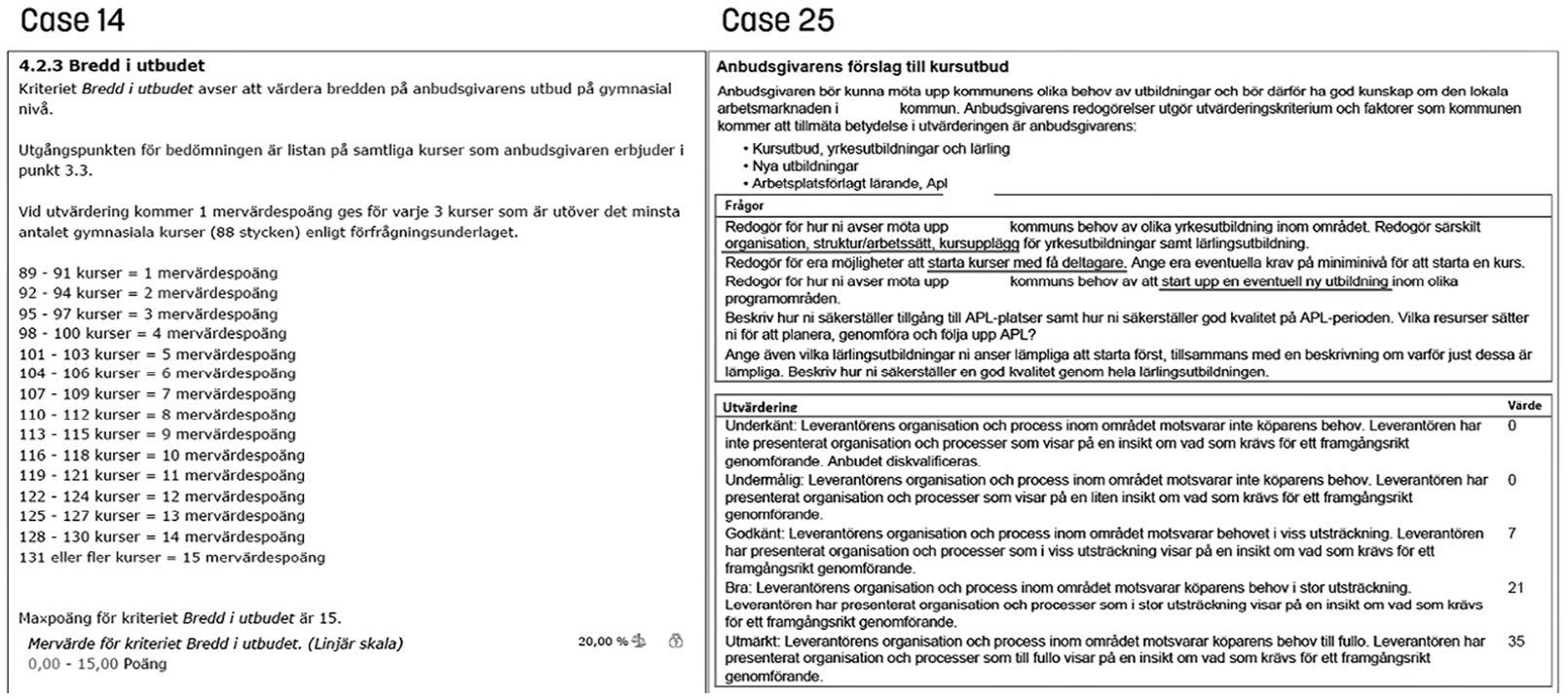
Excerpts from two contract notices, showing how the evaluation criteria ‘course offer’ is presented and communicated to tendering providers. Case 14 asks how many additional courses the tendering provider will offer. The evaluation section shows a list of numerical values, with every 2 additional courses awarding one added-value point. Case 25 asks for a written explanation of what the tendering provider will offer. The municipality will evaluate the tender based on course offer, new programs and workplace-based learning opportunities for VET courses. Then, the contract notice lists questions that providers can use as guidelines when writing up their answers. The last ‘box’ in this section shows the available added-value points – a tender may receive 0, 7, 21 or 35 points, depending on how well the described service provision meets the buyers’ needs and the providers’ level of insight into what is required for successful operations in the areas.
Case 14 asks providers to submit a list of all courses they offer. The list is then evaluated based on the number of courses offered that surpass the 88 courses included in the standard commission (the first three additional courses offered are worth one point, the next three are worth two points etc.). This constructs quality as a question of volume – a large course offer is valued and rewarded. Case 25 asks providers to describe how they organise courses and ensure quality during workplace-based learning, and to explain if they can start new courses during the contract period. The contract notice then states that answers are assessed based on how well the provider’s organisation and procedures match the buyer’s needs. This constructs the desirable provider as one that takes responsibility for students’ learning both in school and while training at a workplace, and that is flexible in what education it offers. This comparison illustrates how commensurations intended to facilitate tender ranking also construct the value-frame of education. Despite both examples focusing on ‘course offer’ as evaluation criteria, quality is constructed based on different conceptualisations and valuations of education.
Education as a question of cost-efficiency
Most analysed contract notices outline between three and seven ranking criteria. However, these are not valued equally in the assessment. A frequent practice is to calculate the Economically Most Advantageous Tender (EMAT
3
) value, by subtracting the fictional price deduction achieved by a tender from their offered price, that is Offered price – fictional price deduction = EMAT value
The fictional price deduction comprises all evaluation criteria other than offered price. Put simply, the EMAT value – the lower the better – represents a cost-benefit ratio, or the worth of a service or product, from the perspective of the buyer. In the case of MAE procurement, this means that municipalities are inviting offers from providers with various specialisations. A rural municipality, for example, might be ready to pay a higher price if the outsourced education is run locally and could then offer a fictional price deduction based on geographical proximity. This means that a provider who can deliver cheap education can be outcompeted by a provider with a higher price tag that has other desirable qualities. Thus, the EMAT-formula merges all features of education into one unit (fictional price deduction) and simultaneously equates these features with economic value. Using the EMAT-formula means that anything and everything becomes comparable via the metric of cost. The education on offer has not only been reduced to a few defined features, translated into financial worth; it is also inserted into a mathematical formula. Thus, the formula appears to make the decision, based on hard facts (numbers).
In short, the mathematisation of invoking the EMAT formula gives the impression that complex phenomena such as ‘good education’ can be fit into a neat little box. Of course, as ample research on other types of privatisations in education has shown, such an approach – through the translation of anything and everything into economic terms – changes how we view education and what its purpose or outcome should be. Instead of valuing learning, for example, we measure output expressed in grades or level of employment after graduation; the percentage of certified teaching staff; frequency of quality monitoring inspections; or even the level of customer support service. Capturing something as complex as education in just a few, concrete characteristics and translating these into cost-benefit ratios is no easy task.
Further, this ‘building of a calculative space’ (Normand and Derouet, 2016: 3) not only reifies numbers but also incentivises reverse engineering (Espeland, 2016) where affected actors look to play the system by developing strategies to improve their numbers (cf Verger et al., 2016). This in turn prompts public institutions to become weary of exploitation and pre-empt it by formulating criteria that counter the feared behaviour perpetuating a spiral of reactionary behaviours. Some analysed cases, for example, reward tenders that promise or can prove that teachers follow students through an entire course. This evaluation criterion aims to discourage providers from treating courses as factory lines where workers (teachers) operate specialised stations (lecturing, exam design and supervision, grading, student contact etc.).
Education as an on-demand service
The challenge of quantifying incommensurable things does more than incentivise tendering providers to play the system. It also encourages actors in charge of formulating such criteria to measure the easily quantifiable, rather than what might actually be important (Biesta, 2010). Figure 3 provides an example of this.
Here, there is a clear construction of value as ‘more is better’. More customer support, more supported languages, more courses offered, more opportunities for students to take part in training or laboratory sessions – are all rewarded with substantial fictional price deductions. This constructs the value of education as a question of accessibility and availability. The learner is constructed as self-directed and autonomous – as a ‘modern’ citizen, who is busy with other commitments such as family, or employment, and who consequently needs access to an education offer that is easy to reach and understand, with technical support available at all hours.
The value of education as fluid
The neoliberal imagination exemplified in Figure 2 can be compared to the one emerging from the example presented below in Figure 3. In contrast to the previous example, this case does not focus on the student’s agency and broad access. Instead, it constructs desirable education as a matter of high-quality teaching staff and competitive pricing.
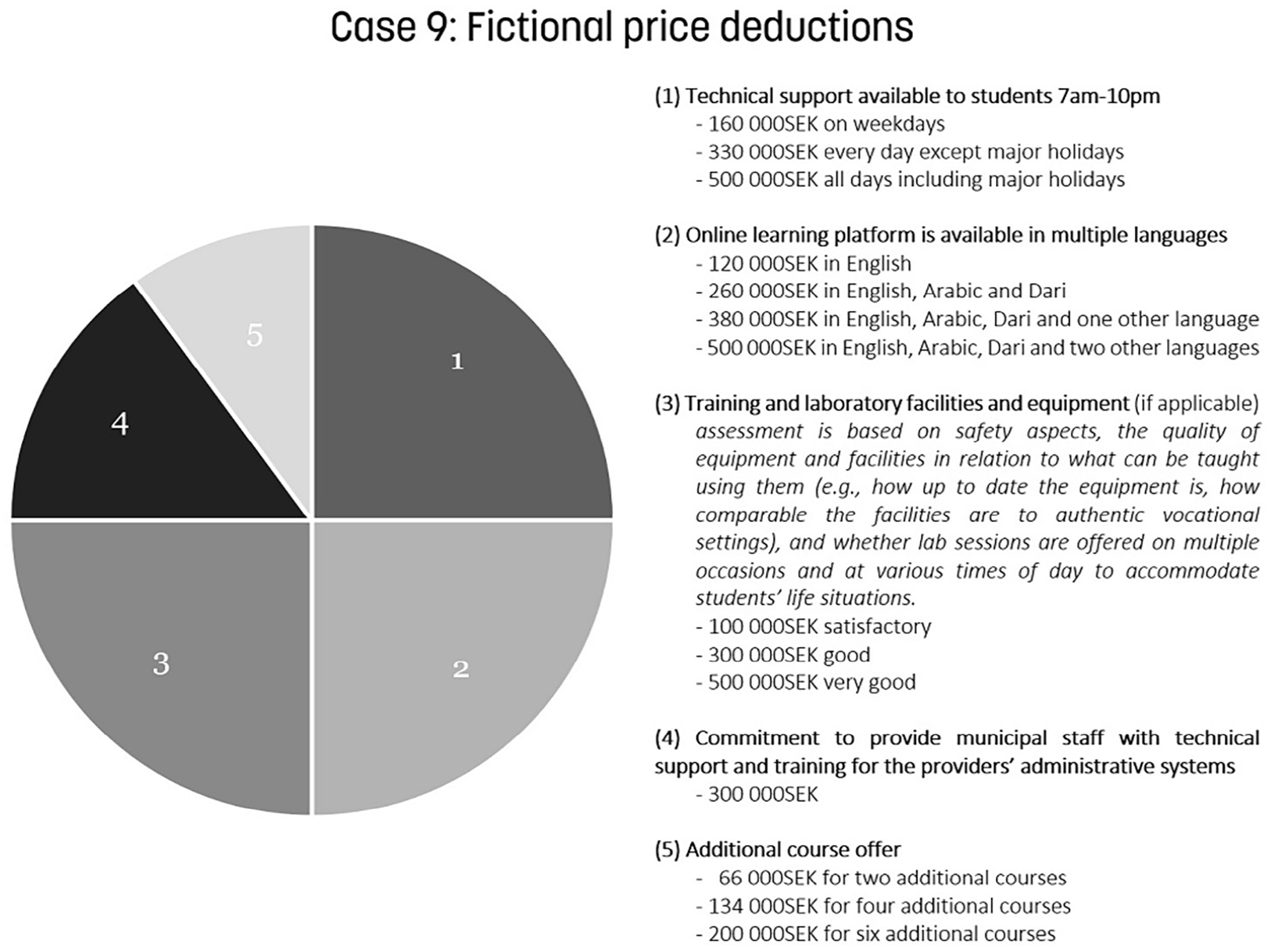
The evaluation criteria in Case 9 and the proportions of fictional price reductions available.
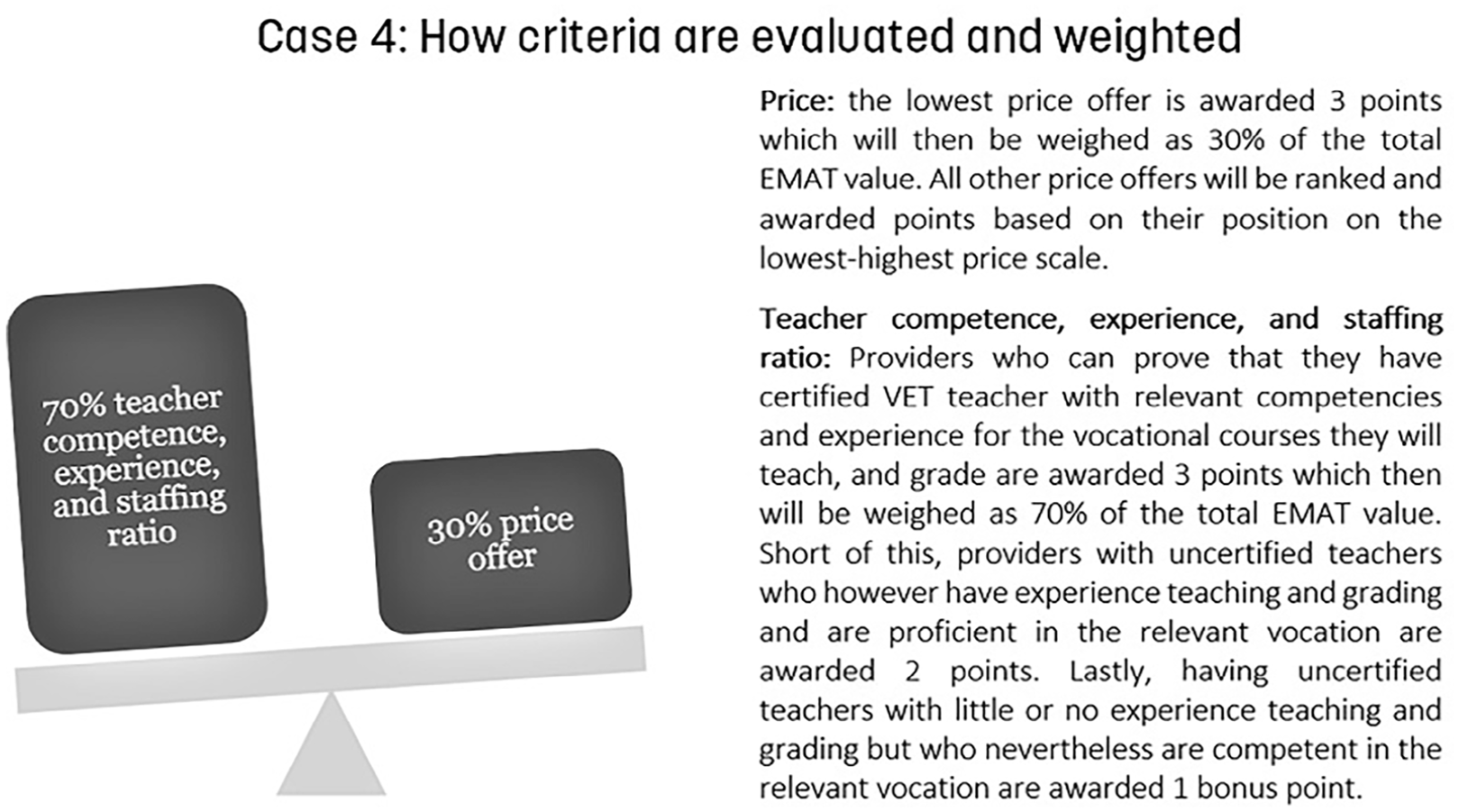
The evaluation criteria description and value distribution in one procurement.
Only two criteria are considered when ranking tenders – offered price and teaching staff. Here, relations between factors emerge as central. First, the relationship of worth between the two ranking criteria – teaching staff and price offer – is made explicit. Teaching staff are more than twice as valuable as cost-efficiency expressed through price. Second, there is also a hierarchical relationship within the various ‘qualities’ formulated for teaching staff. Teaching certifications are ranked higher than teaching experience, which in turn is deemed more valuable than familiarity with the subject areas to be taught. This hierarchical relationship between certification, teaching experience and subject familiarity is of course a construction and communicates that formalised knowledge trumps tacit knowledge, which in turn outweighs niche expertise. Thus, different conventions of worth are brought together and their value is constructed as a hierarchical relationship (Chiapello, 2015: 16).
Further, a providers’ price offer in this case is not taken at face value but weighed against all other submitted price offers – it is ranked based on competitiveness, invoking the market logic of supply-and-demand. If we compare this formulation of price as criteria to that presented in the EMAT formula, the two invoke different conventions of worth. The EMAT formula constructs price as primarily a question of efficient resource management thus, where price represents an ideal of maintaining production while keeping costs down. The case example presented in Figure 3 however invokes price in relation to what the competition can offer. A tender’s position in relation to other tenders – first, second, third and so on – is valued, rather than the monetary difference between price offers.
This creates an entirely different market than the one established by the 18 price-based auctions that I discussed at the beginning of this article’s finding section. Price-based auctions incentivise providers to do ‘anything’ to lower costs. The market constructed in case 4 (Figure 3) on the other hand encourages providers to focus on their teaching staff, rendering issues of education and learning more central/readily at hand in the contracting process. This raises some critical issues, to which we turn next.
How auctions shape the value of education: The implications of education privatisation through tendering-based procurement
First, focusing on the context of Swedish MAE, the choice of procurement as tool used to organise the outsourcing of education means that learners, teachers and education providers become affected by choices made at the organisational meso-level (Holmqvist, 2022a). This article has further illustrated how procurement as management tool requires public institutions to formulate evaluation and ranking criteria laden with worth before public-private partnerships can be established. However, this diffusion of values is undetermined because the tool does not dictate the evaluation logic. Some municipalities have constructed contract notices that value the student as a self-determining individual, and their freedom to choose when and how to take part in education. Others want certified expert staff who work closely with students through generous scheduling of tutoring. Others still focus on mitigating societal inequality by incentivising the creation of equal opportunity and assistance for students in need. In short, local enactments will differ in what is valued or focused on and why. Of course, valuations constructed in the procurement process do not directly govern the enactment of education. Adult education learners have their motives and agency (cf Assarsson and Sipos-Zackrisson, 2005; Lynch, 2008), as do educators who resist and critique the consequences of procurement on education (Holmqvist, 2022b).
Nevertheless, organisation through procurement and the provided education are not de-coupled processes. Dissemination of values is an inherent function of management tools (Chiapello and Gilbert, 2019: 123). Education practices in all locations are altered by the focus on what tender ranking criteria a municipality constructs when they make use of procurement to privatise public education. In this, what evaluation criteria are formulated and how they are evaluated in the tender ranking process, becomes critical for how education is conceptualized and treated by providers. From the perspective of a provider, allocating resources to securing facilities in attractive geographical locations to gain an advantage in the tendering process means that there are less resources left to employ teachers or secure study assistance for students. Measuring the percentage of certified teachers among employed staff can also have unintended consequences such as providers cutting down on other expenses such as auxiliary staff or facilities. How well providers read and respond to the public institution’s desires determines who ends up on top. The need to answer to the buyer’s wishes becomes imperative in an education system organised through tendering-based procurement – the difference between being the last one in or the first one out is crucial in this all-or-nothing market. No contract means that the provider cannot run any courses – a cut-off effect that is not present in all types of education markets (e.g., the student’s free choice market). This market feature incentivises providers to take the ranking criteria set up in the contract notice seriously, follow the descriptions formulated by procurers, and adapt to the underlying value conventions shifting their focus and resources to match the valuations formulated in the procurement.
Second, on a macro-level, tendering-based procurement inherently constructs competition as valuable and recasts education actors into market roles. Education organisers such as municipalities become costumers, schools become providers and sellers of education, teachers and learners become commodities in the production cycle. Interestingly, in examining the contract notices, the market convention of valuing competition seems to be restricted to the provider market and not the student market. Almost all contract notices stipulate that the procurement will result in the contracting of one provider (or one provider per course area). In the few cases where municipalities are looking to contract more than one provider for outsourced MAE, students will be enrolled with providers based on tender rankings. This means that students are not free to choose between providers and there is no incentive for providers to compete for students once contracts are signed. The market is thus constituted by providers competing to meet municipalities' needs as buyers, not students. This is a clear example of how procurement as a management tool has other effects on education than, for example, privatisation through free choice.
Relationships between stakeholders are constructed differently by these markets. Where other privatisation mechanisms such as free choice position students as costumers (Symonds, 2021; Tomlinson, 2017) and teachers as salespersons (Gupta, 2021), procurement erases both teachers and students as actors, casting them instead as commodities to be managed and traded. Teachers working in MAE experience intensification of work and loss of professional autonomy (Holmqvist, 2022b; Wärvik, 2013), just as in other education systems characterised by competition and devolution (Fitzgerald et al., 2019). In contrast to systems where teachers are expected to perform to maintain their livelihood, MAE teachers do not have any control over their job security. Since trans-national and national policy require public institutions to treat all tendering providers equally and fairly, established providers have no advantage over newcomers in the next procurement cycle. Thus, teachers working in MAE are essentially contracted on a project basis. Teachers can be offered to move from one company to the next, so a change in provider does not have to mean unemployment. However, insecurity is always present, e.g., as employment becomes renegotiated every few years. Similarly, students have no say in how their access to education is organised, as this is up to each municipality to decide. Some municipalities have chosen to create choice for students, reinstating them as customers parallel to the buying municipality, while others enrol students based on providers’ results in the tender ranking process or construct other, local, solutions (Holmqvist et al., 2021). Constructing students as commodities is of course not unique to MAE (cf Köpsén, 2022), or privatisation organisation through procurement. It is an inherent feature of all systems featuring competition (Fourcade and Healy, 2007). Further, privatisation of public education, in general, tends to recast public actors in the role of contractor rather than provider of public education (Ball and Youdell, 2009).
Conclusion
How education privatisation is organised and through which management tools must be taken seriously. Here, I have shown how the use of procurement exacerbates the marketization of public education through valuation and commensuration. League tables, for instance, meant to measure quality and help applicants make informed decisions, construct schools’ value as relational where one is always better or worse than others. Thus, ranking becomes the focus of education providers’ daily operations (Espeland and Sauder, 2016). Free student choice makes truth of the student’s responsibility and power, where the individual learner is constructed as best positioned to know what they want and need (Symonds, 2021). Organising education through vouchers encourages selective student admissions (Verger et al., 2016) and incentivises the establishment of schools in geographical areas with more affluent demographics (Robertson, 2015). In short, such tools shape both conditions for and outcomes of education, as well as the behaviour and demeanour of the actors involved (cf Alderton and Pratt, 2022; Gorur and Dey, 2021).
This article has demonstrated how tendering-based procurement as one such tool comes with certain inescapable mechanisms. Competition and education commensuration into quantifiable, economic metrics come with the package, regardless of what choices are made in a particular enactment of procurement, as is the distribution of market roles between those involved. At the same time, actors – for example, policymakers, politicians, and education providers – inscribe the tool with a range of valuations. Whether value is constructed purposefully or unwittingly depends on the agency and power of the actors involved, as well as the nature of the management tool. Scrutinising the role and interactions of actors, however, lies outside the scope of this article.
Here, I have drawn on the sociology of conventions approach to show how a tool used to privatise and organise education also (re)defines the education it manages by promoting certain features and values over others, and how it (re)distributes advantage and roles among the actors involved. Consequently, the article serves as a call for critical research not to shy away from seemingly dry, legislative aspects of privatisation, but to add a critical analysis of education management tools and the markets they crate to the governing technologies, techniques, and discourses already under scrutiny.
Footnotes
Declaration of conflicting interests
The author declared no potential conflicts of interest with respect to the research, authorship, and/or publication of this article.
Funding
The author received no financial support for the research, authorship, and/or publication of this article.
