




Abstract
When comparing lifelong learning systems in Europe, Swedish vocational education has been characterised as a statist, school-based ideal type, with strong emphasis on egalitarianism and social citizenship. However, the popularisation and expansion of higher vocational education (HVE), a post-secondary training form that has a mandate to train people to meet local labour market needs, complicates these composite descriptions. Building on conventions theory and pragmatic sociology, our analysis probes the plural worlds of HVE participation, beyond simplistic understandings of human capital accumulation or universalistic welfare. Drawing on interviews with participants and archival material, we analyse forms of justifications evoked by those engaged in this transforming skilling regime. Our analysis reveals that participants do not enrol merely for getting work or getting ahead. Rather, participation is described as a response to constraints, a means to challenge difficult circumstances encountered in the labour market, or related to contingencies. Taken together, HVE emerges as a flexible mode of governing vocational knowledge to match local labour market needs, with rivalling conventions of worth. We discuss the increasing significance of projection and anticipation for individuals and organisations involved in skilling regimes, and propose a prospective convention that underscores expectancy and promise.
Keywords
Introduction
At a 2021 press conference to launch a governmental commission on the future of Swedish higher vocational education 1 (HVE), the then-Minister of Education remarked, ‘The criticism I get about HVE when I go out and meet people is that, in principle, there should be more of it — that is the only criticism I have heard’ (Regeringskansliet, 2021). As noted by the minister in this same event, the expanding segment of HVE has been popular; the worth of this educational form is not contested, rather it appears to be widely endorsed as an efficient and flexible tool to meet local labour market needs. Three decades have passed since the early experimentation phase of Swedish HVE in the 1990s and the segment has developed to become relatively established in the wider landscape of Swedish post-secondary education and training. Over the period 2018–2021, governmental authorities granted 31,300–39,800 new training places to HVE training providers annually, which makes it comparable in size to study places in the vocational programmes of the Swedish upper-secondary school system (Myndigheten för yrkeshögskola, 2022). The institutionalisation and popularisation of HVE warrants further empirical analysis, particularly on the principal forms of justifications behind its expansion.
As a publicly-funded post-secondary educational form, Swedish HVE has a mandate to train people for work and, especially, to match them to changing local labour market needs. A mandate like this has required the involvement of a broad assemblage of actors: from training providers, employers, municipalities, participants and the state. For long, Sweden has been classified as possessing a form of ‘statist’ vocational educational and training (VET) system (Busemeyer, 2014; Busemeyer and Trampusch, 2011). In comparison with other countries, the VET system in Sweden has been found to be primarily based on school-based education, rather than within a work-based learning environment such as the corporatist tradition of apprenticeships (Dobbins and Busemeyer, 2015; Virolainen and Persson Thunqvist, 2017). When comparing lifelong learning systems across Europe, Swedish VET has been heralded as part of a ‘universal regime’, with a strong emphasis on solidarity, egalitarianism and social citizenship (Esping-Andersen, 1990; Verdier, 2013, 2018).
While the expansion and provision of HVE is still predominantly funded by the state, the segment consists of programmes that are highly flexible and collectively-coordinated in order for training delivery to function well. With the rapid expansion of HVE, questions arise about Swedish VET as a comprehensive, universalist and statist ideal-type. Verdier (2018) notes that Sweden is undergoing a process of hybridisation in which the universal orientation gradually makes way for a more active involvement of organised market forces. Furthermore, based on earlier research with population-level register data of all training participants and their trajectories into HVE, it has been shown that alongside the system’s rapid expansion, more participants of varied backgrounds are enrolling in this training form (Ye et al., 2022). The process of increased diversity in the enrolment structure, which includes rising average age and a higher number of participants from middle income quintiles, point in the direction of a pluralistic mode of participation.
In this article, we examine the transformations of conventions of skilling within Swedish HVE and when actors on the ground devote themselves to its educational offerings. Our aims in this paper are two-fold: first, we trace the temporality and mutability of skills regime typologies, with the use of archival data, earlier research and Swedish HVE policy. Secondly, through interview data, we analyse what justifications participants evoke for embarking on HVE, taking into consideration the worth and worthiness they assign to learning and work. We accomplish this through joining others who build on pragmatic sociology and conventions theory to analyse vocational education and training systems as a coordination problem with rivalling conventions of worth (Leemann and Imdorf, 2015; Zehnder and Gonon, 2017).
Research approach: Pragmatic sociology and conventions theory
Since we are primarily concerned with examining how actors recognise, negotiate and justify uncertainty and differing orders of worth, our analyses are guided theoretically by perspectives from conventions theory (Boltanski and Thévenot, 1999, 2000, 2006). This theoretical approach builds on a multitude of different research traditions and focuses on actors’ pragmatic capacities for coordination, evaluation, justification and critique (Knoll, 2013: 40). Saar and Ure (2013) propose that in order to challenge prevalent assumptions that there is one, singular economic trajectory linking market economies and lifelong learning systems, multiple regimes are needed for appreciating the intricacy of real-world action and coordination. The challenge of reconciling opposing forces – for example, demands of a skilled workforce for meeting the needs of the labour market versus the centrality of adult education for fostering democratic citizens – is a longstanding theme in the literature on adult education; providers, participants and programme planners are often wedged between different definitions of the common good (Evans et al., 2016).
Central to the sociology of conventions is a pragmatist foundation that compels researchers to suspend scholastic judgement and acknowledge that people possess their own critical capacities, especially in uncertain or morally-complex situations, to construct justifications for their actions. These justifications can, in return, be seen to rest on more generalisable axiomatic principals of worth, which then needs to be recognised by others, in order for their sayings and doings to come across as both reasonable and worthwhile. Hence, for an argument or course of action to be conceived as legitimate, fair and just, they need to be based on an established normative framework or value repertoire, what is sometimes referred to as ‘orders of worth’ (Boltanski, 2012; Boltanski and Thévenot, 1999, 2006).
In the orders of worth framework, several common cultural established repertories of valuation have been identified (Boltanski and Chiapello, 2018; Boltanski and Thévenot, 2006), where justifications follow the guiding principles of, for instance, inspiration, fame, the domestic, the civic, the market, the industrial or the project order. Each convention is composed of its own set of evaluation criteria, information format or interpersonal relation, and actors ‘are used to these quality conventions as part of their mainly implicit knowledge about their culture’ (Diaz-Bone and de Larquier, 2022: 12). Actors question, criticise and switch between conventional forms of equivalence, especially in situations where coordination is problematic or difficult to achieve (Boltanski and Thévenot, 2000; Diaz-Bone and de Larquier, 2022). This approach, which takes seriously the constraints in situations, positions and chances that limit possibilities for coordinating action, is a framework that was largely developed as a reaction to the dispositional tenets of French sociology during the 1970s–1980s (Boltanski, 2011).
Pragmatic sociology and conventions theory have proved generative in educational research, for example, in constructing ideal-types of lifelong learning systems based on cross-country comparisons (Verdier, 2013, 2018), or examining benchmarking techniques deployed by transnational organisations like the European Union (Bruno, 2008). The framework has been used to analyse an array of localised problems such as justifications and valuations of Swedish art education (Fürst and Nylander, 2023), the free-rider problem in cooperative VET in training networks (Leemann and Imdorf, 2015), critiques formulated by adult educators (Holmqvist, 2022), how aspirants encounter ‘reality tests’ in education-to-work transitions (Ye, 2020), as well as the development of Swiss VET and the compromises of civic, industry and market conventions (Zehnder and Gonon, 2017). Imdorf and Leemann (2023) have also recently synthesised the state-of-the-art in research on education and conventions. In sum, earlier research from this theoretical movement has been particularly fruitful for enriching our understandings of how adult learners orientate and coordinate actions, especially in situations where different worlds of worth collide.
Accordingly, we are provided a useful theoretical toolbox to broaden understandings of Swedish lifelong learning as inherently egalitarian/universalistic as well as the narrow conceptualisation of ‘interests’ as oriented only towards individual action or human capital advancements. In this article, we draw on archival data, earlier research and policy documents for describing the context of HVE’s transformation, while our empirical case builds primarily on interview data with participants of HVE. The analysis of the interviews is focused on the justifications they enact, in particular, how they formulate legitimate arguments for partaking in HVE (the situation of analysis), as well as how they reconcile the justifications offered to them by the organisations they are part of.
Transformations in skilling regimes
Over the last few decades, concerted attempts from policymakers have been targeted at post-secondary national VET systems and other educational forms that promote lifelong learning. These reforms have been set against the backdrop of heightened political pressures to increase the efficacy of public investments in higher education and to cope with the uncertainties of matching supply and demand in rapidly-changing labour markets (Brown et al., 2020). While processes of convergence can be identified through a narrow human capital rationale, comparative research on national lifelong learning systems also provide valuable insights into how these educational arrangements tend to differ considerably between countries. Distinct regimes of ‘valuation’ have been attributed to different lifelong learning systems, based on broader historical developments and the evolution of state policies, labour market relations and policy instrumentation.
Rubenson and Desjardins (2009), for instance, earlier showed that Swedish adult education is characterised by high participation and wide access and that the emergence of different welfare state regimes has shaped the organisation of its educational sector. Similarly, Salais (2004) classified Scandinavian countries in the well-being world, in contrast to the market (Anglo-Saxon) and status (Continental) worlds. In these traditional ideal-typical characterisations, coordination of Swedish VET and adult education can be argued to rest on a strong civic convention, in which communitarian and collective ideals from civil society are deemed pivotal (Boltanski and Thévenot, 2006).
Even if Scandinavian countries share certain similarities, there are also distinguishing features as to how these educational systems have been organised. The comparison typically made in VET research is between Sweden and Denmark, two ‘archetypical’ welfare states often described as experiencing extended periods of social democratic regimes and reforms, but that differ when it comes to the institutional set up of their skills formation systems (Dobbins and Busemeyer, 2015). While Sweden has been typified as possessing a VET system that is ‘school-based’, Denmark has been classified as a country where employers’ involvement and apprenticeships are used to a greater extent. These analyses also maintain that the skill formation regimes of both countries have remained relatively stable since the 1980s (Dobbins and Busemeyer, 2015).
However, given the transformations that have taken place in the sector of VET and lifelong learning systems over the last few decades, there is reason to revisit these propositions. Verdier (2013, 2018), who has contributed to a comparative understanding of ‘lifelong learning regimes’, has emphasised the increased complexity of comparing national systems due to the interlinkages of this segment to the educational system as a whole, as well as with other parts of society and the economy. Moreover, Verdier (2018: 478) argued that analyses of ‘national systems of education and lifelong learning in terms of regimes confirm that the typologies shaped by clusters lead to an overestimation of the social homogeneity of national systems’; examining how these systems evolve demonstrate ‘a growing complexity of their societal configurations, even if not of equal magnitude’.
Since the turn of the century, public policies in the realm of Swedish education have combined traditional features of active labour market policy and social welfarism with a greater involvement of market forces. Examples of this hybridisation range from the marketisation of the compulsory schooling system (Lundahl, 2016; Sandgren, 2022), public procurement and tendering of municipal adult education (Holmqvist, 2022) to higher education institutions increasingly being mobilised for competence development and lifelong learning (Nylander and Fejes, 2021; SOU, 2019: 6). Of particular importance is a political reform in 2011 targeting the upper secondary school system (Gy 11), which increased the differentiation between academic and vocational tracks, diminished the chances for vocational students to enrol in the university and gradually led to a steady decline in the number of students applying and embarking on a vocationally-oriented trajectories (Panican and Paul, 2019).
Similarly, Olofsson and Thunqvist (2018) mapped out the three phases of the historical evolution of initial VET in Sweden, showing how the system has moved from being ‘homogenous’ to being more differentiated; reflecting the political movement and trend towards bridging the gap between education and work through a stronger working-life orientation in VET policy. While some features of universality remain – for example, strong public investments in adult and continuing education – over the past decade, there has been a weakening of the universal orientation of the Swedish educational system due to the onset of ‘rules belonging to the organised market regime’ (Verdier, 2018: 472).
The changing conventions of organising Swedish HVE
In the aftermath of a long series of educational reforms from social democratic governments in the mid- to second-half of the 20th century, the educational system in Sweden gradually became more universal (Ball and Larsson, 1989). However, the steady massification of post-secondary education from the 1970s and onwards was soon followed by reforms that were more vocationally-oriented, adjusted to market demands and competition in the international realm (Börjesson and Dalberg, 2021). By the 1990s, Sweden experienced a period of financial volatility, inflation, economic recession and changed its framework for fiscal and monetary policies. With a more cautious attitude towards public spending and inflation, unemployment stabilised at high levels, the economy went through a process of deindustrialisation and educational policies that could meet changing skills demands became a strong focus. 2 Following these structural transformations, one of many supply-side oriented reforms was to experiment with short-cycle, higher vocational education and training.
The current system of HVE has been designed to provide decentralised, flexible education through municipalities, private training providers, regional institutions or higher educational institutions. Established formally in 2009, the HVE system was launched to train adults to acquire the ‘right competence at the right time’, and programmes are often adjusted to local labour markets needs and demands (Köpsén and Muhrman, 2020; Ye, 2020). With its formalisation, education and training at the post-secondary level in Sweden is now less ‘hidden’ and there has been substantial strengthening of its institutional and funding base (OECD, 2014; Prop 2015/16: 198).
As described by then-General Director of the Swedish Agency for HVE (Persson, 2018: 55), the main actors in this educational segment are employers, training providers, participants and the governmental agency. In this system, employers and corporations seem to play a key role as they are involved in identifying and defining ‘a need for competence in the labour market’ and also form a majority of each programme’s management board (Persson, 2018). Köpsén (2022) has argued that Swedish HVE policy has construed learners as commodities in an industrial-like process of employability, as it caters strongly to the skill demands of the labour market and employers wield most influence over the curricula.
Before the agency funds a training provider for launching a programme, decisions on the curriculum or defining eligibility requirements are made by these providers. The national agency, however, ultimately decides and evaluates which, among a multitude of proposals crafted by training providers, should be granted state funding for training places. This is an assessment that is based on various dimensions such as a proven local labour market need, previous track-record of the provider, quality in grant application and the proposed management board. Obtaining approval to run the programme and receiving public funding for delivery is typically limited to a 2-year time frame, although reforms have been put in place to extend the educational provision over longer periods (Ds 2015: 41). Swedish HVE can thus be viewed as coordinated through a networked, project-oriented assemblage of various actors, in relation to provision and participation (Boltanski and Chiapello, 2018).
The number of participants enrolling in HVE in Sweden has been steadily increasing (Ye et al., 2022). In 1998, the number of study weeks offered by providers amounted to 5691, whereas by 2021 the agency had granted providers 33,945 weeks of training in total – an expansion of five times. Through the rapid growth of HVE, we also see a drastic shift in what kind of providers are responsible for offering these training places. As shown in Figure 1, in HVE’s initial, experimental phase in 1998, publicly-owned organisations such as regions, municipalities, universities made up 67% of training providers, while privately-owned organisations constituted only 21% in 1998. By 2021, the share flipped, with privately-owned organisations making up 62% of the providers, and publicly-owned entities amounting to only 28%.
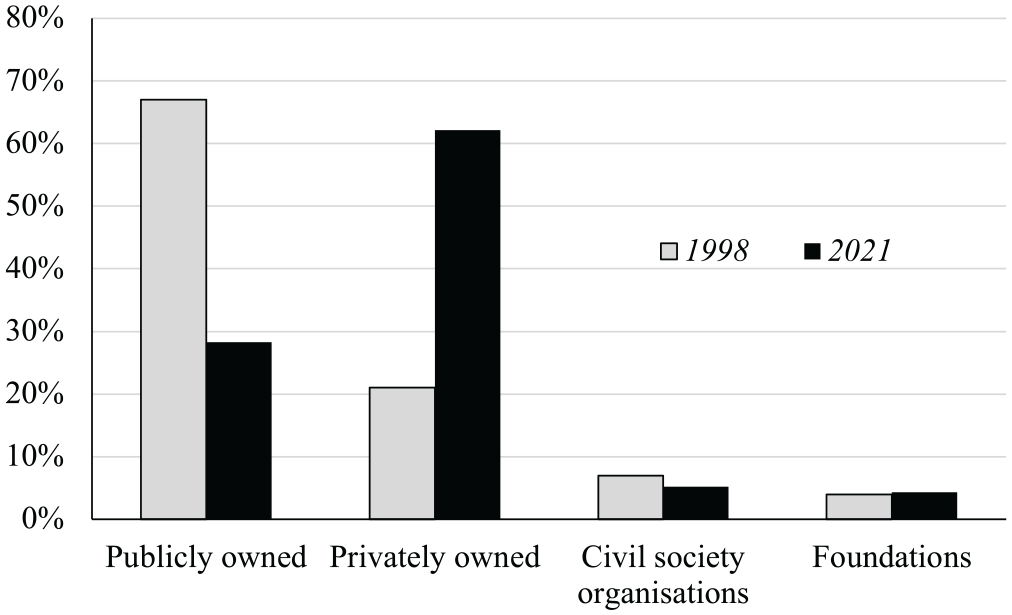
Comparison of type of training providers in Swedish HVE, by proportion, 1998 and 2021.
HVE has thus been able to build on the infrastructure of an existing system of ‘lifelong learning’ that predates its establishment, and which has made continuing education a key feature of the Swedish welfare model (Rubenson, 1994). In Figure 2, we sketch out the conventions from which the value of higher vocational / adult education draws legitimacy, and the transformations that have taken place over time. As illustrated in Figure 2, the traditional elements of Swedish adult VET and HVE, such as the civic and industrial conventions, are still integral elements of the system, but are in the process of being re-formulated in light of current state priorities.
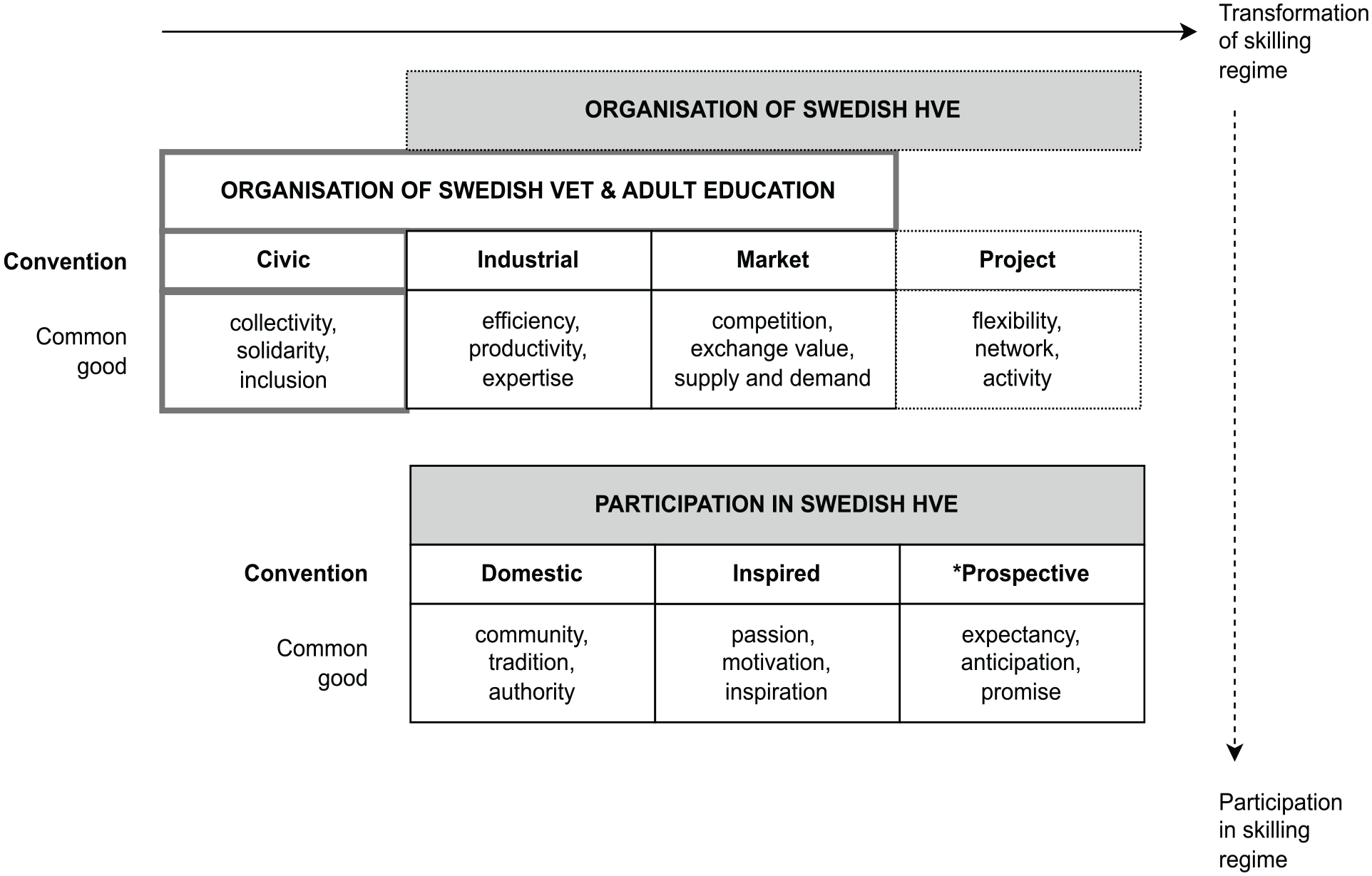
Transformation and conventions of HVE.
Currently, the organisation of HVE can be said to draw primarily from what Boltanski and Chiapello (2018) characterise as a project convention: operating on short-term management, driven by external stakeholders and consultancies, with the aim of matching participants’ skills to employers’ demands. It combines some traditional features of Swedish welfarism – active labour market policy, tuition-free adult education, generous study loans and financial support – with the market convention that emphasises competition and private provision, while maintaining some degree of state control. Furthermore, as our analysis of interview data with HVE participants will show, participation in this training form also rest on the domestic, inspired and prospective conventions, and the outcomes of HVE are very much based on the pragmatic compromises reached between these different value regimes.
Methodological considerations: Analysing justifications of participation
With some exceptions (see e.g. Ye, 2020, 2021), qualitative research on participants’ experiences with Swedish HVE are few and far between. Although academic research on HVE are beginning to surface, it has primarily been explored through administrative statistics on participants’ labour market outcomes (Eliasson and Stenberg, 2021), the backgrounds of incoming participants (Ye et al., 2022), as well as the gender differences in participation pertaining to training sectors (Chudnovskaya et al., 2023). With earlier quantitative research showing a trend towards increased diversity in recruitment, there is a clear motivation for exploring the participation of HVE qualitatively. Drawing on interviews with participants allows us to tap into the plurality of justifications inherent in participants’ meaning-making processes for embarking on HVE. Interviews allow us to learn about ‘the arc of someone’s life’ and could help identify the ‘pivotal social forces’ that alter their life trajectories (Lareau, 2021: 90). Without growing participation, the HVE segment would not be able to expand in accordance with current policy priorities.
Our project commenced right as the COVID-19 pandemic unravelled in 2020. After careful processes of gaining access, we obtained permission to conduct the interview study at four distinct HVE training providers. This selection of providers was done purposefully, and the programmes were sampled in a way to capture diversity in training profiles. Different types of providers were included – publicly-owned training campuses, folk high schools and private training companies – and the specific vocational programmes we zoomed in on had different profiles in terms of participation rates by gender, as well as labour market outcomes of earlier cohorts. While mostly located along the south and centre of Sweden, we also sampled for different localities with regards to population density.
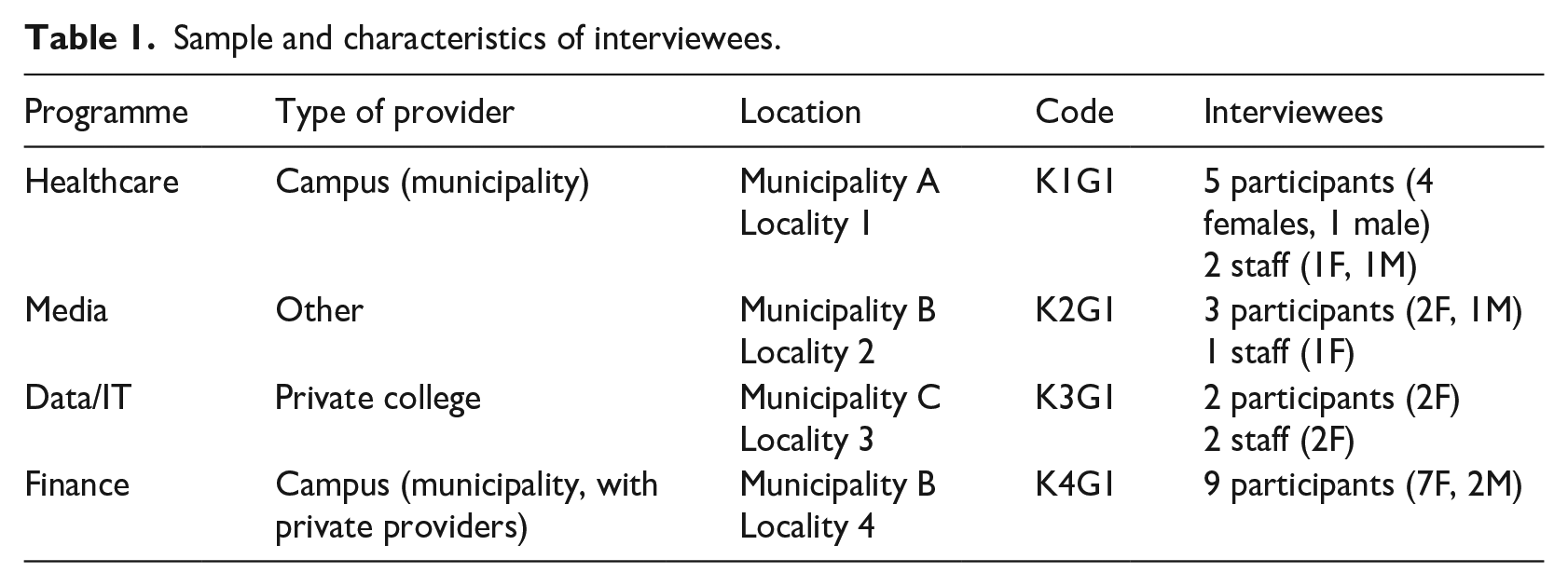
The interviews with participants and training providers were conducted over the years 2020–2022, with the majority of the interviews conducted virtually due to the pandemic. In this paper we analyse 24 transcribed interviews (see Table 1 for sample). The average length of each interview was an hour. For one of the training sites, it was possible to visit the campus during a period of the pandemic when infection rates were low and the campus was open. We attended a virtual campus event to get a sense of the development of the campus work through presentations by employers and programme coordinators, and also attended other HVE-related events during the data collection period. Although this sample is not representative of the HVE population, the different means of data collection allowed us to reach participants from different backgrounds and to gain an in-depth understanding of experiences of HVE. Our interview protocol included questions about participants’ present (what they were doing in training), past (what they were doing before, how they got to the point of applying for a training programme) and future (how they envisaged their working life after training).
Sample and characteristics of interviewees.
The analytical strategy of the interview data followed this process. First, we familiarised ourselves with the interviews by writing a memo for every participant, summarising their trajectory, narratives and experiences. Next, adopting an iterative coding tactic, we inductively generated initial codes emerging from the data that would allow us to focus on the justifications enacted by the actors. We then grouped the codes into larger themes and then related them to the orders of worth framework as a heuristic, while also building on the framework. The analytical strategy could thus be most closely related to abductive analysis and reasoning, a productive pragmatic approach that calls for movement between data to theorising, and which also demands for the researcher to be open to discovery and surprises (Swedberg, 2014; Timmermans and Tavory, 2022). All the interviews were conducted in Swedish, so the presented quotes in the text were translated by the authors at the point of presentation.
The study was limited by several challenges, first of which was the pandemic’s impact on programmes and participants that clearly affected the number of people whom we could reach during our data collection phase. There was also a bias in our sample from a gender perspective, with a majority of interviewees identifying as female. However, this could also be due to the fact that two of the programmes we sampled had more female than male participants. Nevertheless, this bias is reflected upon when we analyse our findings. The nature of HVE programmes being short-term also meant frequent change in coordinators and programme managers. Due to the ease of identification as these programmes are rather unique, we remove identifying characteristics in the presentation of findings (e.g. name of training programme, location of programme). Finally, it is important to note that since the data collection overlapped with the pandemic period, the participants’ experience was, to a large extent, a pandemic experience. This context is reflected in their responses and general outlook, which is underscored with uncertainties related to future expectations.
Participants responding to an expanding and transforming skilling regime
In this section, we analyse how participants account for their participation in HVE through value frameworks underlying their justifications for skilling. Analysing the interview data, we identified three types of justifications participants enacted for enrolling in HVE: their participation was described as being shaped by their situations of constraints, as a means to challenge current circumstances, or as a result of contingencies. Each of these justifications are related to dominant value regimes linked to the orders of worth framework. However, participants also shift between and question these orders of worth depending on their situations. Moreover, their actions are also derived from what we conceive of as an emerging prospective convention.
Constraints
Across the interviews and training sectors, participants shared how they were constrained both in geographical sense, as well as in terms of social distance and proximity. For example, these justifications ranged from describing how they do not feel like university is an option for them, they are not willing, or are not able to move in order to study, them having small children, and needing to be close to home.
The biggest challenge is to study with one kid who is three and one who is six. (. . .) HVE was still something that I felt that, yes, I can take that. I’m not going to spend five years at university, but this still makes sense. (Healthcare_K1G1_102)
The extract above is from an interview with a woman in her late 30s, enrolled in a Healthcare programme. She lives in the same locality where she was born and at one point in the interview, commented: ‘I will die here, that I can say’. Having always worked in healthcare in an assistant nurse role, she applied to this particular programme 5 years ago and did not get in. She then applied again and attained a spot in strong competition with others and reasoned that she could not turn down the offer. After working many years caring for people, she described a longing to have another function within the healthcare system that was oriented towards administration. In the interview, she explains her reasons for participation as one that was due to a combination of multiple factors that previously constrained her actions, such as not being able to move away from home to go to university.
Another training participant who had a similar reason for participation revealed: ‘I had no such desire to move from the area, so to speak, to study something. But it was that if I’m going to study something, then it has to be here’ (Healthcare_K1G1_104). Through emphasising the importance of proximity, to study where they live, it becomes clear that if there is no training provision in the geographical vicinity of their home, there is low possibility that these participants would have enrolled in HVE.
There were also other types of constraints, beyond issues of geographical proximity to education and training. Other interviewees were, for example, highly-skilled migrants, and had not been able to have their previous qualifications from another country recognised and validated. In a programme on Finance, one of the participants who moved to Sweden for family reasons and who had higher education credentials and a career in her home country described her struggles of getting into the Swedish labour market.
I haven’t got a job with my bachelor’s degree; I have a bachelor’s degree from (home country). It has been a year that I have been looking for a job and I thought that it is better to have something – so this was the closest that was available (. . .) As a new arrival, that is the problem, getting the link to working life because, it is the way it is. . . (. . .) It is clear that a bachelor’s degree from (home country) may not be so comparable, even if you have validated and all that. But it is what it is. (Finance_K4G1_101)
This extract above highlights how the participant has been compelled to accept the constraints that she faces in the Swedish labour market, as she repeats: it is what it is. The challenges of labour market ‘integration’ and the ‘under-employment’ of highly-skilled migrants in Sweden is part of a larger phenomenon, which have been receiving greater research attention after the turn of the century. The participants with migrant backgrounds we interviewed often voiced compromises between their sense of self, derived from formal qualifications and professional experiences elsewhere, and the situated struggles they face in having their competences and worth recognised in the Swedish labour market. These experiences concur with earlier research that have been illustrating how the recognition of prior learning in Sweden generates ambiguity and clashes in organisational logics, leading often to migrants facing great difficulty in obtaining work that is comparable and appropriate to their actual educational qualifications and prior professional experiences (Diedrich and Omanović, 2023; Riemsdijk and Axelsson, 2021; Risberg and Romani, 2022).
In our analysis, we are offered further insights into how justifications of participating in HVE, due to constraints, appear to rely on striking a balance between the domestic convention as well as labour market integration. The ‘authority’ inherent in current practices of recognition of prior learning generates a tension between logics and expectations, as it requires a reliance on policy tools and qualifications for channelling people into the ‘right’ educational and occupational tracks.
Challenging current circumstances
Participants also justified reasons for enrolling as a means for them to challenge current circumstances by searching for something they can be passionate about. Examples include them describing how they possess a desire to exit ‘toxic work environments’, or soul-killing (själsdödande) jobs, their wish to work regular hours; or their need to be able to thrive and be satisfied (trivas) in their work lives. These justifications rest on an inspired worth, and in this pursuit, participants show that they are opting out, or challenging, industrial and domestic logics. For example, in one of the interviews, a participant shared how despite the fact that she will obtain a lower salary, she found value in changing occupations and pursuing another pathway, which was a motif we found in other interviews as well: Shift work, no thanks! I would like to work during the day. It was also a big reason why I started studying and, actually, started thinking about doing something else, that I don’t want to work shifts anymore (. . .) So then I think it’s worth changing jobs, and actually doing something fun, even if the salary. . .well, it is much, much worse than the one I have today. Because money is not everything! I am trying to tell myself that, all the time. (Healthcare_ K1G1_101)
In another interview with a participant in a Data/IT training programme, she describes herself as being ‘non-traditional’ as she was a trainee at 50 years, and was changing careers from interior design to becoming a user-experience designer. She shares that she had always worked a lot and now she wanted to cut back for personal reasons and not ‘work the hell out of herself’ at the next stage of her life. Another participant in a finance programme described a similar desire to leave her job in cleaning. When she saw advertising about this particular programme, she thought it would be a good time to switch careers as she no longer wanted to clean people’s homes, especially during the pandemic.
I worked in cleaning and felt that the body probably won’t last forever because I’m not 25 anymore
4
. . . so I thought no. But now I take the opportunity to do something fun. And then I saw this ad (for the programme) and then it was a perfect fit when the pandemic hit — being at people’s houses and cleaning isn’t great fun when there’s a pandemic. So, it fit in very well with the time in my life. (Finance _K4G1_102)
The findings here corroborate results from a survey published recently by Statistics Sweden (2023) that found that approximately half of graduates reported their main reason for choosing higher vocational education was to change occupations. The next motivation was to improve their opportunities in the labour market. Our interview findings enable us to get behind these aggregate findings, to developing a deeper understanding for these motivations. More importantly, these extracts presented above were predominantly from the female participants interviewed. Arguably, the ‘force of circumstance’ (De Beauvoir, 1965) may be agentic for individuals, if they are presented with opportunities and openings to break away from existing challenging conditions.
An important aspect of these justifications observed here is what participants are opting out from, and what they are attempting to challenge or alter. In some ways, one could see this as a challenge against the industrial or domestic logic, a pursuit of an alternative worth. As pointed out by Leemann (2018: 864), when individuals experience major crises or problems in coordinating action, they ‘can denounce a prevailing convention by invoking another convention’, demanding for conditions that ‘enable an alternative regime of engagement’. Likewise, Sendroiu (2023) propose that juggling multiple justificatory frames can be generative, particularly in times of crises.
Contingencies
However, as the participants were not entirely sure what their future outcomes would be, they often acknowledged that they acted on chance, serendipity or calculated risk-taking for achieving progress. A third justification identified in our empirical material had to do with contingencies. For example, decisions to participate could be motivated by job opportunities opening up close to where they live: a projected or forecasted ‘vacancy chain’. Among our interviewees, several testified to how they were initially on a reserve list, experienced a period of waiting, but then eventually secured a training place which compelled them to ‘seize’ the opportunity. Take for example this interviewee’s quote: I came in as ‘a reserve’. It was the pandemic that made me enrol, because (training provider) had the opportunity to open a second group. . . I am very sure of what I would have done (if I did not get in). I would still be living at home. I had not felt so good, but I would have tried to study more. Like doing courses at study associations or Kurs.se and all that (. . .) Thanks to the pandemic I entered HVE. Then I got an apartment and moved once and for all. It has been a positive ‘snowball effect’ for me. So, I have something to do these days. (Data/IT_K3G1_102)
This interviewee traces her process of getting into HVE as setting in motion a positive ‘snowball effect’ for her trajectory, yet also signalling concern of what the alternative would have been like if she did not obtain a training place. For the healthcare programme, a majority of respondents repeated the same statistic they were told: more than 600 applied, only less than 40 got spots. The emphasis of selectivity and them ‘getting in’ highlights the degree of contingency for those who get to enrol. Participating in a new training programme is significant, especially if this requires one changing occupational course, or returning to ‘school’ after a long period of being in the world of work. The sense of being recognised and validated, as well as the narrative of finally being chosen, were persuasive in facilitating an aspirant’s decision to embark on a change in their life-course.
There were also other kinds of uncertainties that added to the unpredictability of training outcomes. In the extract below, a participant describes how there is risk to training in programmes that are launched based on the changing currents of labour market needs, especially if the demand-side is already met when one graduates. However, she shares how she felt lucky that through this training, she was able to get her foot into the labour market: You never know what will happen in the future. . . I mean, when you search for an education that they have a great labour market need for in a municipality, and then when you are almost done with that education, the demand can no longer be there. . . But I can say that I have been lucky now that I got a job. I hope I can continue to work there. (Finance _K4G1_113)
Some participants attempted to manage this ambiguity of whether or not they would land a job in their own hands. One participant shared how he did his own labour market analysis to evaluate the potentiality of obtaining a job after training: . . . I did a little analysis to see – now with petrol prices and things like that in this world – what possible jobs are there in my immediate environment that I can imagine myself working with. And then this is an option. And I believe that the chances of getting a job are very high in my local area, and after the training (. . .) Here in the (locality) where I live, there are a lot of self-employed people, and a self-employed person needs help with paperwork. (Tax) declaration and the like. (Finance_K4G1_122)
This quote above highlights how important the spectrum of available opportunities weigh on participants’ decisions to participate, but also reinforces the need to examine how participants act to mitigate contingencies and ‘chance’ in their trajectories and justifications (Ye and Nylander, 2021). Unlike other adult educational forms in Sweden where the purpose and target audience have been contested, the mandate for Swedish HVE has been explicit from a policy standpoint – it is an educational form that trains people for work.
However, the pertinent themes derived from our analysis demonstrate that for the participants, it is not just about getting work or getting ahead. The justifications offered complicate reasons for participation. Acting on constraints and acting on contingency could be viewed as being on polar ends of an action spectrum. Nevertheless, these justifications wed by showing that HVE ‘works’ if there is coordination between the various stakeholders; there is a local labour market need identified and there are suitable actions and justifications on the part of training providers and participants.
Prospective worth in higher vocational education and training
One of the main repercussions of changing varieties of capitalism throughout the last half-century has been the transformation of companies and public policies from bureaucratic forms that are standardised, modularised and industrial, to organisational forms that are flexible and network-based (Boltanski and Chiapello, 2018). Lifelong learning and higher VET can be seen as key components in the contemporary ‘spirit of capitalism’. That the Swedish state has vested interests in maintaining tuition-free possibilities for adults to reskill and upskill harkens back to advancements of social policies in the post-WWII era when comprehensive schooling was championed (Ball and Larsson, 1989; Dobbins and Busemeyer, 2015). However, these institutional resources are not inherently oriented towards a certain set of values. Rather they are in a constant state of negotiation in order to maintain public legitimacy.
Connecting to previous research on various lifelong learning regimes, our paper cautions researchers against merely classifying Sweden as an ideal-typical welfare regime based on civic and universalistic principles of defining ‘the common good’ (Salais, 2004; Verdier, 2018). Furthermore, based on conventions of skilling manifested by the institutionalisation of HVE and its modus operandi, comparative VET research should not assume that Sweden makes up a traditional ‘statist’ school-based VET-system (Busemeyer and Trampusch, 2011; Dobbins and Busemeyer, 2015). While a statist skill formation system was prevalent in Sweden during 1960s and 1970s when the established model of industrial relations was disintegrating and a vision of a comprehensive schooling system was being rolled out (Karlsson et al., 2018), the establishment and expansion of HVE is part of a bigger transformation of the lifelong learning system in Sweden, one in which learning within the workplace is increasingly emphasised and facilitated. Private enterprises also operate a larger proportion of public welfare services, while being funded by state and municipal taxation.
The case of Swedish HVE allows us to look more closely at what we believe to be a more general trend in the organisation and justification of skilling regimes in the 21st century. As we have seen, the embeddedness of HVE in publicly-governed educational organisations has gradually given way to a system where the state outsources educational provision to private corporations, enterprises and for-profit organisations. However, the state still maintains discretionary power over key aspects, such as funding arrangements. In contrast to the marketisation taking place in compulsory schooling, upper secondary and municipal adult education (Holmqvist, 2022; Lundahl, 2016), the governmental agency has retained a centralised role in evaluating rivalling proposals of HVE provision based on local labour market forecasts. As such we encounter a state-financed system that propels ‘human capital investment’ based on a flexible educational policy tool, whereby the training offered is meant to take a deferential role in relation to local labour market demands.
In Figure 2 presented earlier, we provided a typology adapted from the orders of worth framework originally proposed by Boltanski and Thévenot (2006). As we have shown through the visualisation, the organisation and coordination of HVE is based on certain collective conventions such as the project, the industry and the market. However, the practical mode of coordination also relies on active decisions of adult individuals to participate and to invest time and effort in up- and re-skilling. Participants respond to the popularisation and expansion of HVE in their own ways, by mobilising conventions that are distinct in pursuing a common good.
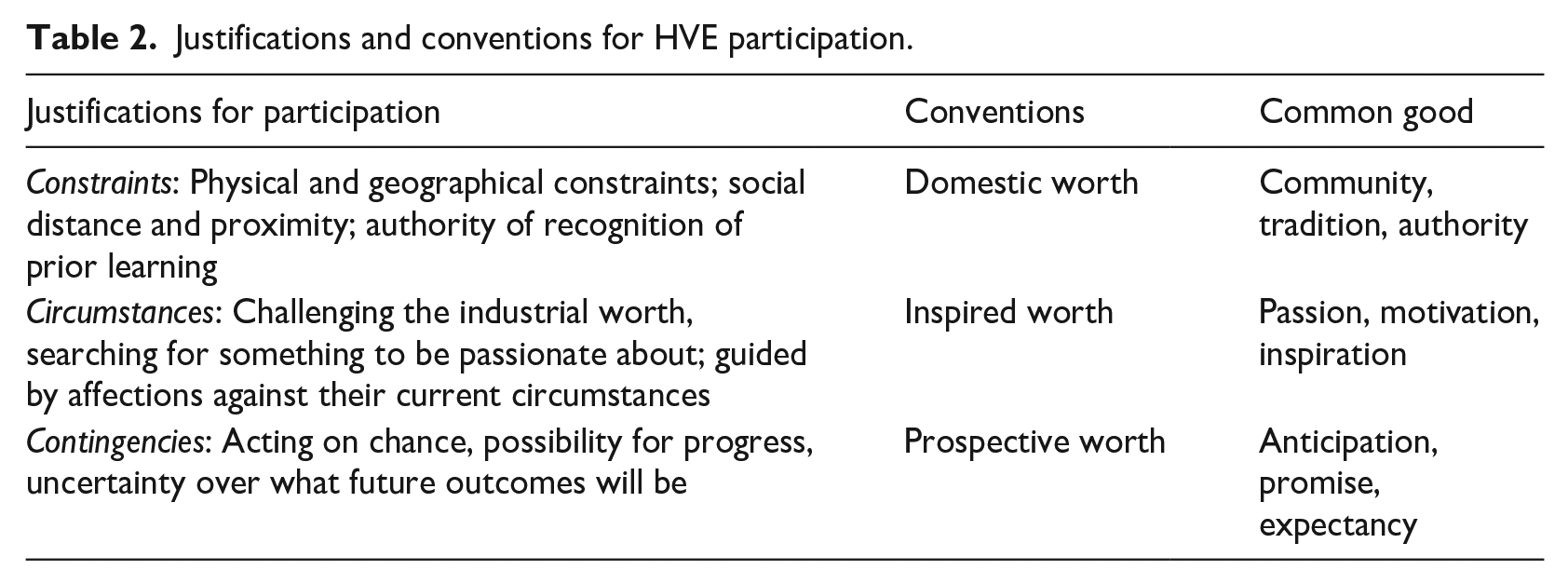
Table 2 summarises our interview findings and show how the various justifications for participation relate to conventions from the orders of worth framework. Synthesising the empirical threads presented above, we consider higher vocational education to be a mode of governing vocational knowledge that is deemed useful to its participants if it can strike a balance in relation to the domestic sphere and be a source of inspiration. The analysis also shines a torch on the inadequacies of existing labour market and educational infrastructures, in so far as participants seek out adult educational options based on them being in situations of constraint or fatigue. In efforts to break out of difficult situations, participants turn to reasoning around contingent events, the seizing of unexpected opportunities, or their efforts for making the best of their challenging circumstances.
Justifications and conventions for HVE participation.
Furthermore, considering the heightened significance of anticipation for individuals and organisations in relation to skilling assurances, we identify a convention that emphasises promise and anticipation that is based on a prospective worth. The prospective worth is aligned with earlier research on future-oriented actions that have endeavoured to move beyond the structure versus agency binary (Beckert, 2016; Mische, 2009; van Lente and Rip, 1998). Like van Lente and Rip (1998: 203–204) have argued in the context of technological developments, ‘prospective stories’ should be viewed as key occurrences of social life. Prospection is a collectively-coordinated form of engagement in which common actors act on the risks and chances they face in the labour market. What comes to the fore are the pragmatic capacities of actors who are constantly tested (Boltanski and Thévenot, 1999, 2000, 2006). As skilling and skill needs are forecasted and altered based on prognoses of local and national labour market needs, participants demonstrate continuous adaptation and coordination through the establishment of prospective worth.
It is important to clarify that the prospective worth that people draw from is not the same as an individual’s capacity to aspire (Appadurai, 2004), nor can it be reduced to ‘the choice of the necessary’ among individuals, based on their habitus or disposition being transformative or reproductive (Bourdieu, 1977). In a situation of uncertainty such as participating in an expanding HVE segment with uncertain local labour market outcomes, our analysis reveals how the significance of industrial and civic conventions are downplayed in the decision-making processes of these participants. Deriving worth from inspiration, or forging new compromises within the domestic sphere through embarking on training for a new vocation, HVE is providing educational offers considered viable. The participants encompass plural interests given the constraints, circumstances and contingencies they face, grounding these negotiations around their actions and decisions on risks, promise and anticipation.
Concluding remarks
In this paper, we traced the transformation of Swedish skilling regimes, focusing specifically on the introduction and expansion of a new form of higher vocational education in the landscape of educational offerings. We then narrowed in on how participants in this segment have responded to its expansion and have voiced justifications for embarking in such upskilling and reskilling programmes. By learning how participants move between different justifications, this study reveals the importance of practical judgements and pragmatic capacities in the coordination of participation. While the governing mandate has clearly re-oriented HVE in a direction that is based on short-term project-based training, and employers collaborating in this arena have to offer resources through training places to participants, the state is still ultimately involved in the financing of this educational segment. Through funding these programmes, they direct participants to industries and sectors that have projected shortages in terms of future labour market needs.
It is possible to identify that some key features commonly associated with the Nordic model of universalistic welfare have remained vital for the contemporary organisation of HVE. These include active labour market policies to match labour supply and demand, generous study loans for embarking on skilling programmes, and ambitions to reach ‘full employment’. Nevertheless, the governance of vocational educational pathways is in line with Verdier’s (2018) analysis of a hybrid system, with increasing leeway for market forces and social differentiation. Our analysis also emphasises the future turn and the weight of the prospective convention in enabling our understandings around the transformation of skilling regimes.
In conclusion, we argue that the introduction of HVE tests the limits of the statist, school-based VET ideal-type Sweden has been placed in historically. In terms of its primary logics of governance and organisation, the transformation that accompanies the expansion of HVE is very much aligned with new modes of organising education, whereby networks of stakeholders are involved, flexibility and project-based coordination are emphasised. It sparks a shift in the public perception of the common good in the governing principles of Swedish VET, from the civic convention (collectivity, participation, inclusion) to the project convention (flexibility, employability, network and activity). Rather than a statist skilling regime guided merely by industrial or civic coordination principles, collective bargaining processes and compromises between efficiency and egalitarianism, the HVE system builds on a strong direct involvement of employers, external stakeholders and the engagement of participants. Accordingly, this raises questions about the temporality and mutability of skills regime typologies, and how hybridisation and transformation should inform our understandings of the governance of vocational knowledge.
More importantly, we emphasise that the increasing hybridity between different skilling regimes should be specified by taking into consideration the worth and worthiness assigned to learning and work by common actors. Participants do respond to expanding availabilities for vocational training in later stages of their life-course with justifications that rest upon other rivalling conventions. This ongoing transformation in conventions of skilling generates critical tensions and compromises between conflicting orders of worth, an area of research that we believe deserves continued scholarly attention.
Footnotes
Acknowledgements
Special thanks to Christian Imdorf for organising and chairing two meetings in 2022 at the Nordic Sociological Association conference session on Conventions and Education, and ‘Sociology/Economy of Conventions: An Interdisciplinary Conference for Methods and Theory Development (with special focus on Education)’ at Leibniz University, Hannover, where we received useful comments on earlier drafts of this paper. We are also grateful to those who engaged with and offered comments at the Vocational Education Seminar Series at Linköping University and the SCORE conference ‘Organising the World 2.0’, at Stockholm University, in 2022.
Declaration of conflicting interests
The author(s) declared no potential conflicts of interest with respect to the research, authorship, and/or publication of this article.
Funding
The author(s) disclosed receipt of the following financial support for the research, authorship, and/or publication of this article: We gratefully acknowledge project funding from the Swedish Research Council (VR-2019-04146).
