




Abstract
This paper analyses the provision of education in Argentina in systemic terms. Using the concept of quasi-monopoly and the notions of exit, voice and loyalty, we study the logic of organization and distribution of students within the educational system. We support the idea that the provision of private and public education makes a coherent whole, where the State plays an active role. We then evaluate the implications of this configuration on the Argentine system in terms of: (a) freedom of choice; (b) productive efficiency; (c) equity; and (d) social cohesion following Levin’s framework. We describe how the Argentine quasi-State monopoly system works as an important device of scarcity administration, increasing socio-economic segregation through its tendency to push the middle and upper-middle classes into private schooling while granting public schooling for the lowest income sectors. Finally, this article lays the foundation for the use of the quasi-State monopoly notion for the study of other educational systems.
Introduction: privatisation of education in Argentina
During the post-Second World War period (1950–1960), the Argentine education system showed a clear picture of an unchallenged State monopoly over the educational system (Morduchowicz, 2001).The State had complete control over the financing, administrative and pedagogical or educational fields. State financial aid provided to private schools was kept to a minimum and private schools were granted very limited leeway regarding decision- making. The end of the1950s depicts schooling rates above the regional average (James, 1987; SITEAL, 2006) in a scenario where private schooling did not exceed 10% of the total enrolment (Morduchowicz, 2001; Walford, 2013). Throughout the 1960s, a series of new regulations would change the state of affairs as regards private schools. As a result, private schools were granted more pedagogical autonomy, the State regulatory burden was lessened, and the State financial aid increased (Petrucci, 2005). At the same time, this decade also saw the beginning of a steady process of growth – both absolute and relative – in private schools enrolment, even when the education arena has overall been resistant to pro-market discourses (Beech and Berrenechea, 2011). Half a century later, private schools (from kindergarten to tertiary level) account for 29.1% of the total enrollment for 2014 (DiNIECE, 2015) (see Figure 1).
Evolution of the private enrolment: compulsory education, 1895–2014.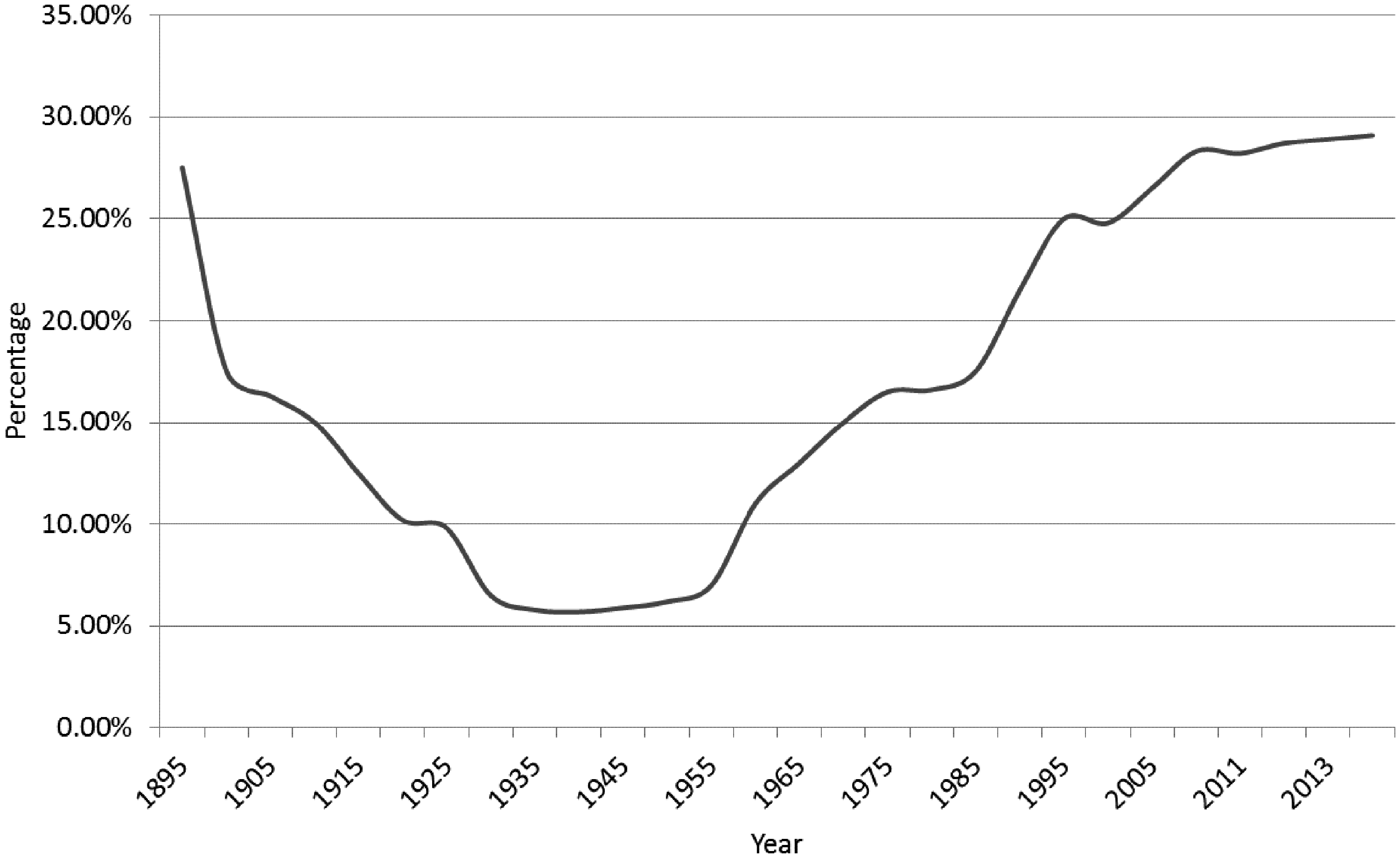
The concept of quasi-monopoly (inspired by a classic work of D'Aspremont and Gabszewicz (1985)) has been used in some studies to analyse the emergence of the private sector as an alternative to the traditional free State-run education system (Narodowski, 2008, 2011; Narodowski and Moschetti, 2015a). For the case of Argentina, this new private sector played a role in absorbing a growing demand that the traditional public sector could no longer satisfy, be this due to financial constraints of the State, or due to the rigid pedagogical offer of public schools as compared to the wider pedagogical offer of private schools (Llach, 2006). The interplay between the new private sector and the traditional State monopoly sector shapes a quasi-monopoly (D'Aspremont and Gabszewicz, 1985) that reflects a complex and dynamic balance between both sectors rather than the logic of confrontation or competition.
Contrary to the traditional public sector that has kept its centralized bureaucratic features, the new private sector was granted a growing autonomy that allowed for school-based management practices as regards teacher hiring, curriculum and pedagogical orientation definition, school day and year calendar organization, among others (Narodowski and Andrada, 2000). Besides, findings from in-depth qualitative studies suggest that the private sector attracts greater social recognition (Gamallo, 2011; Krüger, 2012; Tiramonti, 2009; Veleda, 2005) while the public sector's reputation has been seriously affected by teacher strikes, violence, unsafety and a consequent ‘second best’ perception (Gertel, Cámara, Decándido and Gigena, 2013; Narodowski, Moschetti and Alegre, 2016; Scialabba, 2006). Unfortunately, there are no standardized evaluation systems of educational quality that would at least shed some light beyond mere ‘perception’ of quality. The National Assessment Operation (ONE) is held every three years and its results do not admit year-to-year comparison. Besides, results are not usually available until two years after the evaluation and the National Education Law does not allow data dissemination.
In the international academic literature, the case of Chile has been thoroughly studied to understand the impact of a quasi-market education system in the process of socio-economic segregation (Carnoy, 1998; Hsieh and Urquiola, 2006; Narodowski and Nores, 2002; Rambla, Valiente and Frías, 2011; Torche, 2005). The academic literature that has studied school segregation in Latin America has focused particularly on the analysis of Chile. The Chilean large-scale and longstanding voucher system and its quasi-market governance structure have been an important source for understanding the logic of school segregation and providing evidence for similar market-oriented systems such as England and Wales, New Zealand or Sweden. Nevertheless, the education governance structure of the Argentine educational system also seems to produce school socio-economic segregation on a similar scale than in Chile (Narodowski and Nores, 2002) though it is, as we shall see, of a different nature than that in quasi-market systems.
The aim of this work is to analyze the current logic of organization of the Argentine education system in view of the recent growth of the private sector, and to focus on its interplay with the traditional public sector and the resulting socio-economic segregation. The road map of the article is as follows: first, we describe how the private school sector operates and portray its growth over the last decades. Then, we present statistical evidence showing increasing socio-economic segregation arising from Argentina’s particular education governance structure. Section four analyses the quasi-State monopoly of education as a pro-segregation device, and evaluates the implications of this configuration on the Argentine educational system in terms of: (a) freedom of choice; (b) productive efficiency; (c) equity; and (d) social cohesion, following Levin’s (2002) framework. Finally, we draw some conclusions exploring the relationship between the quasi-monopolistic structure of the Argentine education system and the increase in socio-economic segregation in schools.
School choice without vouchers in Argentina
In Argentina there are no demand-side subsidies, voucher programs, free school choice programs or charter schools (Morduchowicz, 2001; Narodowski, 2008; Narodowski and Moschetti, 2015a). However, as from the 1960s, some social sectors began to make use of their socio-economic and cultural capacity to pay for their own education outside the scope of the traditional public monopoly, thus shaping a new diversified pedagogical field, an ‘exit sector’, client-oriented, and partly financed by the State. 1 As such, it has been the private sector that has mostly offered religious education in Catholic, Protestant, Jewish and Muslim schools, but also the country's immigration history is reflected in the private sector: there are French, Italian, Galician, English, Welsh, Armenian, Scottish, Turkish, Japanese schools, among many others. Secular or experimental schools such as Waldorf, Piagetian orientation or art education also widen the offer.
Private schools are usually run by NGOs, civil society organizations or sole proprietors, and fall into two categories: for-profit and non-profit (Moschetti, 2015; Morduchowicz, 2001; Narodowski and Andrada, 2001; Newland, 1995; Perazza, 2011). Unlike other countries, in Argentina there are no public-private partnerships undertakings in education, at least not in their usual form (Broadbent and Laughlin, 2003; Reeves, 2003; Verger, 2012). Nonetheless, most private schools benefit from supply-side State subsidies that aim to finance (totally or partially) the salaries of those teachers who teach subjects included in the official national curriculum.
The origin of this subsidy mechanism can be traced back to 1947 (Law 13.047), during the first presidency of Juan D. Perón. It had a double purpose: to ensure school provision in areas where there were no public schools, and to supply financial aid to private schools, mostly Cathoilc at the time, serving low-income households that had to face the new minimum teacher wage regulations. Law 13.047 can be considered a turning point in the history of the Argentine education system since it marked the beginning of the systematization of a policy that later underwent greater definition regarding the proportion of the subsidies allocated to schools (Decree No. 15 of 1964 and Decree No. 2.542 of 1991, among others). This proportion currently ranges between 40% and 80% of teacher salaries for private schools that charge fees, and 100% in the case of schools that do not charge additional fees (Mezzadra and Rivas, 2010). While current legislation specifies certain criteria to define the allocation and amount of subsidies (socio-economic status of the population served, proximity and availability of similar State supply), these criteria are not exhaustive, and the decision rests, as pointed out in some studies, on the discretionary judgment of enforcement authorities (Mezzadra and Rivas, 2010; Morduchowicz, 2001).
Argentina is a federal country and each province administrates and finances its own education system. In every province, private education enrolment has grown over the last decades and legislation on State expenditure on private education has made little difference. Sixty-five percent of private educational institutions in Argentina are subsidized by the State to some degree. In the province of Buenos Aires, which represents 45% of the school population, the figure rises to 73% (Mezzadra and Rivas, 2010; Rivas, 2010). The study of Mezzadra and Rivas (2010) shows that for the province of Buenos Aires there is some progressivity between expenditure and the income level of the population served. However, there are also significant inconsistencies: ‘17% of the schools in the poorest tercile receive less than 50% of State subsidy. In turn, 16% of schools in the highest tercile receive more than 75% of State support’ (Mezzadra and Rivas, 2010: 58).
Within this context of ‘school choice without vouchers’ (Narodowski, 2002) or without demand-side subsidies, different studies show that the lowest income sectors tend to stay in public schools but the middle or upper-middle classes ‘exit’ to the private sector (López, 2002; Scialabba, 2006; Veleda, 2005; Narodowski, 2008).
State subsidies to the private sector have a low relative impact regarding each province’s total expenditure on education (Morduchowicz and de Mello, 2003).This means that these subsidies are cost-efficient inasmuch as the Argentine Constitution guarantees free education for all. A counterfactual scenario of free education for all in public schools would certainly result in a financial challenge, given the prevailing constraints and fiscal crisis of the last half century (Chudnovsky and López, 2007).
The process of reconfiguration of the Argentine educational system that took place during the second half of the twentieth century can be thought of as a solution to two specific problems: firstly, the financial constraints to fulfill the promise of providing free and high quality education for all (Allen and Weaver, 1979; Isuani, 2010; O’Connor, 1973); and secondly, a changing context where State legitimacy problems become more challenging.
To sum up, we note that the Argentine educational system has grown quantitatively in all levels, and has overcome financial constraints by having the middle classes and upper-middle classes make no use of public schools and exit to private education. This segregating effect is not an anomaly but inherent to the quasi-State monopoly governance structure.
Socio-economic segregation in the Argentine education system
Research on school segregation within the Argentine education system began in the mid-1980s. The classical works of Braslavsky (1985) and Braslavsky and Filmus (1987), in line with the tradition initiated by Bourdieu and Passeron (1964), reported the existence of differentiated circuits of schooling according to the households' socio-economic level. Later research on school segregation in Argentina appears to account for two complementary phenomena. First, choice of a private school seems to be associated with the income level of families. For instance, in a study on private education and socioeconomic segregation, Narodowski and Nores (2000) show some evidence with regard to the negative association between households' purchasing power and enrolment in public schools. While the lowest income sectors tend to stay in the public schools, the middle and upper-middle classes tend to exit to the private sector. Likewise, Gasparini, Jaume, Serio and Vázquez (2011) conclude that the probability of going to a public school declines as household per capita income increases. Figure 2 shows that between the first and tenth income decile there is a gap of 60 percentage points in the probability of enrolling in a public school in primary and secondary levels.
Public school enrolment conditional probability analysis in Argentina 2003 vs. Argentina 2009.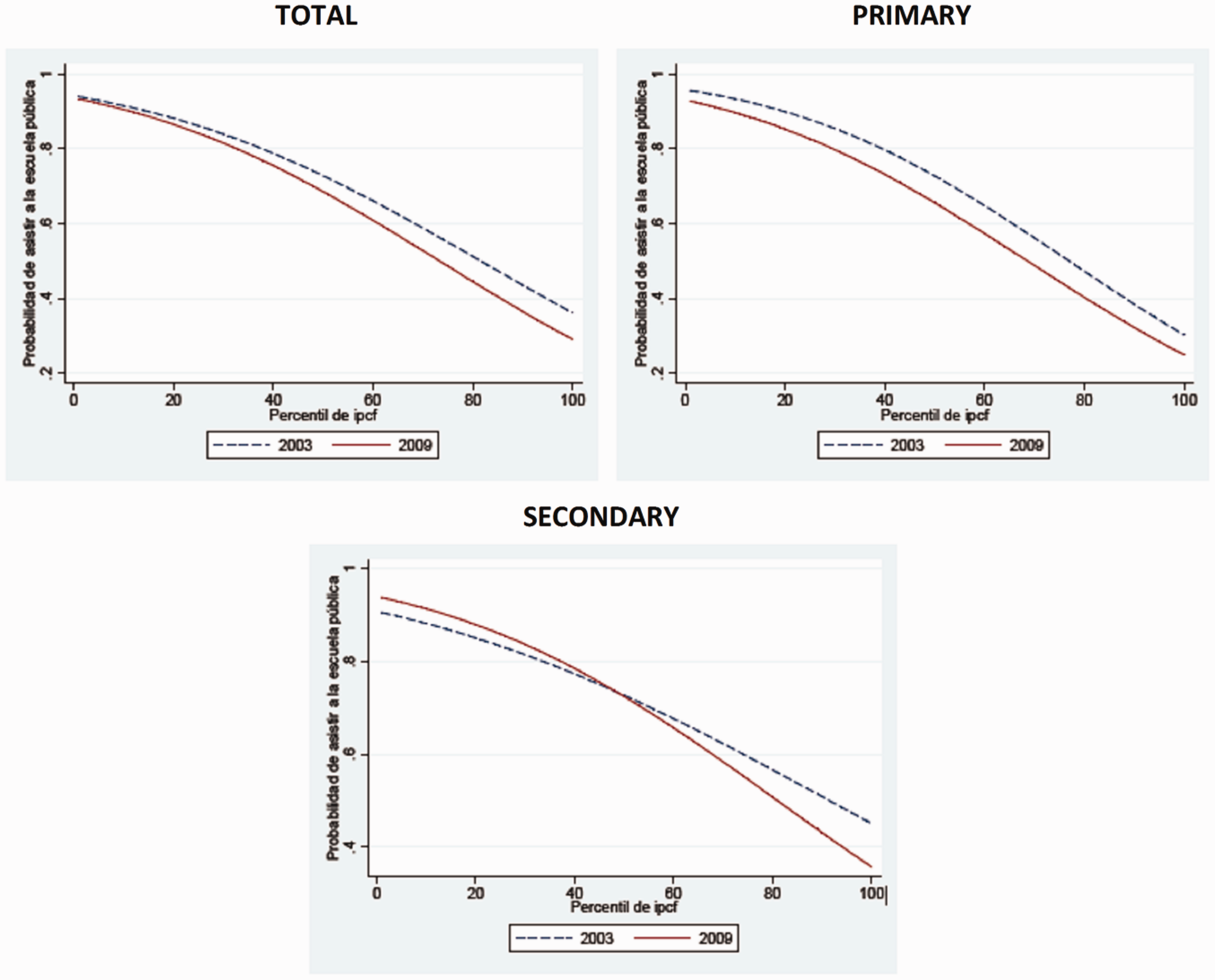
This evidence is consistent with a recent study for the City of Buenos Aires (Narodowski, González, Gottau and Moschetti, 2014) that explored the relationship between school choice and neighborhood patterns. Even though the city shows an overall high percentage of students enrolled in private schools – reaching 47,9% for primary school in 2012 –, low-SES neighborhoods contribute much less to the private sector when compared to middle or high-SES contexts. Moreover, different studies prove that only a small number of families with exit capacity stay ‘loyal’ to the public sector (Scialabba, 2006). In fact, only a few public schools can withstand an analysis in terms of loyalty, more specifically those with a long tradition and high reputation which have been ‘colonized’ by the middle and upper-middle classes (Gottau and Narodowski, 2014).
In theory, the extra cost of private schooling should act as a disincentive for the exit option given that there is no tax exemption for not using public schools. Even when for the case of some subsidized schools fees are relatively low, free private schools are virtually non-existent. In line with Hirschman (1978), the voice option can prove costly in terms of time, resources and effort, and as such, the exit option may, in fact, prevail over the voice option. As Di John points out, an effective use of the voice mechanism ‘requires collective action, which is subject to the well-known difficulties of organization, representation and free-riding’ (2007:309). Unsurprisingly, neither the middle classes nor the lower-income sectors resort to the voice mechanism. The first ones seem to find it much easier to pay for private subsidized schooling, the latter ones usually lack the economic, cultural and social resources to effectively do so, and even then, the voice mechanism seems incompatible with the bureaucratic structure of the traditional State monopoly (Andrada, 2003, 2007).
The second phenomenon seems to be that of self-segregation. Some studies have shown that the middle and upper-classes develop strategies of social closure, thus self-isolating in schools where the tuition is an insurmountable barrier to most impoverished sectors. Veleda (2005) relates educational segregation and socio-urban segregation, and evidences the growing formation of segregated territorial markets where social differences become wider, especially in urban areas. Other studies use the concept of ‘fragmentation’ (Ziegler, 2007; Tiramonti, 2009) to portray an extreme process of segmentation where the social ties that link the different sectors within the educational system no longer exist. Using Bourdieu s concept of distinction these studies complement previous research showing how the formation of the private sector is also the result of the middle classes unwillingness to share educational settings 'contaminated' by the poor (Veleda, 2005).
On balance, the education system of Argentina depicts a vast majority of public schools increasingly populated by low-income sectors, and an exit private sector only for those who can afford it. This supports the hypothesis of a quasi-State monopoly with segregating side-effects inherent to its own logic and organizational dynamics.
Quasi-State monopoly of education as a pro-segregation device
The configuration of an education system under a quasi-State monopoly model tends to raise concerns regarding the prevailing quality standards of each subsector. The answer to these concerns is usually resolved by highlighting the advantage of private education over public, in terms of quality standards. However, for the case of Argentina, a rigorous assessment of this sort seems to be quite difficult due to the lack of systematic evaluation mechanisms. Even in Latin American countries which have an institutionalized system of quality evaluation, such as Chile, research shows a virtual parity between private and public schools. Some studies even tend to show some marginal advantage for the latter as regards effectiveness in student learning achievement (Bellei, 2007; Somers et al., 2004). Similar results were obtained by other studies which delved into this question on the basis of the information provided by Programme for International Student Assessment evaluations: higher achievement in private schools is mainly due to their enrolment selectivity practices and the families’ socio-economic background (Dronkers and Avram, 2009; Dronkers and Robert, 2008; Ferrera et al., 2011; Martínez and Ferrá, 2007).
Regardless of the lack of data as to the results of standardized evaluations, for the case of Argentina there is evidence that most social sectors perceive private schools as ‘better quality’ when compared to an allegedly ‘degraded' State supply (Gómez Schettini, 2007; Scialabba, 2006; Tiramonti, 2009). These perceptions play a fundamental role in fostering the exit process of the middle classes and upper-middle classes described above.
So, considering that education systems are set to achieve wider reaching objectives than those evidenced by standardized evaluations, it is particularly interesting to analyze the implications of a quasi-State monopoly configuration on the Argentine education system within the framework proposed by Levin (2002): (a) freedom of choice, (b) productive efficiency, (c) equity, (d) social cohesion.
According to Levin, ‘freedom of choice’ refers to the right of families to choose schools for their children within the existing educational alternatives so as to match their ‘values, educational philosophies, religious teachings, and political outlooks’ (Levin, 2002: 162). In order to fulfill this criterion, and given the widely diverse parental preferences, an education system should offer an equally diverse supply structure. In this sense, freedom of choice becomes restricted by uniform supply structures or by limited enrolment mechanisms.
Levin describes ‘productive efficiency’ as ‘the maximization of educational results for any given resource constraint’ (Levin, 2002: 162). The freedom of choice and productive efficiency criteria are usually emphasized by voucher advocates since they are both key elements of market-driven solutions.
The ‘equity’ and ‘social cohesion’ criteria somehow determine a trade-off in relation to the previous two. According to Levin, equity stands for ‘fairness in access to educational opportunities, resources, and outcomes by gender, social class, race, language origins, and geographical location of students’ (Levin, 2002: 163). In turn, social cohesion implies the existence of an educational offer uniform enough so as to provide students a common experience in the exercise of the values of a given society.
In the context of the Argentine quasi-State monopoly, the freedom of choice criterion only applies to those families that have the necessary cultural and economic resources to exit the traditional State sector and pay the resulting expenses inherent to the private provision. The Argentine case is quite particular since the State widely provides supply-side funding which reduces tuition fees in private schools. This makes the exit alternative more accessible, at least financially, for middle or low-middle income families (Narodowski and Moschetti, 2015b). However, for the lowest income sectors this possibility is almost denied. The reason for this is that even when they could actually freely choose a school in the public sector (zoning regulations are hardly enforced in practice), families would have to face other expenses, especially transportation.
A quasi-State monopoly certainly offers greater school choice opportunities than a traditional State monopoly. However, the possibility to choose (even if aided by supply-side subsidies) is directly conditioned by the purchasing power and the income level of the demand, as we saw above. There seems to be a direct correlation between socioeconomic segregation and diversity in school provision to afford greater parental choice in that it leads to processes of educational self-segregation (Ziegler, 2007).
Productive efficiency might be considered the most relevant element of the Argentine quasi-State monopoly. The growing demand for education and the financial constraints associated to the granting of full coverage in this scenario imply a real challenge for educational administrations at the provincial level (provinces are the main responsible agents in education according to the current legislation). In this sense, the quasi-State monopoly structure enables the maximization of per-student funding transferred to the traditional public sector while the exit to the private sector is propelled by minimum State funding (Narodowski and Moschetti, 2015b; Moschetti, 2013). This cost-efficient funding mechanism, inherent to the functioning of the Argentine education system, allows sustaining high educational coverage rates in spite of the chronic fiscal crisis. Middle and high-income sectors' private spending on education makes it possible for the State's financial flow to be allocated almost exclusively to the schooling of low-income students.
Under the logic of a quasi-State monopoly, the action of the State is re-defined forming an array of complex State governmentality (Martínez Boom and Narodowski, 2016) which ensures the quantitative growth of the education system not only through the growth of the public sector but also through the growth of the private sector. This provision structure appears to ensure greater and better coverage than a State monopoly and act as a bailout in the sense that, if it were not for the private sector, the State would not be able to provide education for all (Narodowski, 2008; Narodowski and Moschetti, 2015b). In this vein, Vázquez (2015) shows that in the case of the Autonomous City of Buenos Aires, the middle-classes' expenditure on education enables the State expenditure on education to be destined almost exclusively the most vulnerable sectors.
This combination of partial school choice and productive efficiency as applied in Argentina seems to have costs in terms of segregation since the schooled population is divided by virtue of its ability to pay for education. In this scenario, the evidence offered explains the deep equity problems in Argentina. The widespread negative perception of the public school as a trigger of incremental exit processes (Narodowski, Moschetti and Alegre, 2016; Narodowski and Moschetti, 2015b; Scialabba, 2006), together with the economic and cultural resources as a sine qua non condition to effectively realise the exit to private schools, have determined the configuration of a highly segregated system.
Finally, in the field of social cohesion, the Argentine education system presents for some authors signs of ‘fragmentation’ (Kessler, 2002; Tiramonti, 2009). The burden of strong regulations on the traditional State sector (Morduchowicz, 2001; Narodowski, 1999; Narodowski and Andrada, 2000) creates a wide distance from the reality experienced by the private sector, which is only obliged to comply with a vaguely defined curriculum. It is precisely one of the distinctive characteristics of the private sector to hold a heterogeneous pedagogical offer when compared to the homogeneity of the State sector. Gertel, Cámara, Decándido and Gigena (2013) have shown the importance of the extra-curricular activities carried out in private schools to the detriment of public schools. Private schools (even those subsidized by the State) are also allowed to freely hire and fire teachers in the labor market while State-run schools are subject to rigid bureaucratic regulations regarding teacher recruitment, preventing them from choosing their own staff (Narodowski, Vinacur and Alegre, 2014). Undeniably, this raises serious consequences in terms of equity given the evident distortion in the distribution of educational goods in a quasi-State monopoly.
Conclusion
The quasi-State monopoly seems to serve a bailout function for the traditional state monopoly that can no longer deliver for the educational needs of a growing population. What was intended to be a uniform educational offer during the first half of the twentieth century has opened up to a much more complex architecture that continues to guarantee schooling for all, but with segregation consequences.
The provision, administration and financing once overtly under State control have been redefined in terms of the quasi-State monopoly logic in which the State still keeps the control of the system as a whole, only that in a different manner and according to its current possibilities. Within this logic of education provision, no competition is evidenced sensu stricto – as it may in fact appear on the Chilean educational provision model. There is no trade-off between the growth of private and public education to the detriment of the latter. The growth of private education in Argentina is explained by the logic of the growth of the education system as a whole. In other words, it is argued that it is not possible to understand the logic of the privatization process of education if this growth is not related to the future of public education and the demand for education. However, under such a scheme, very little or even no desegregation seems plausible.
This articulated balance between public and private education inherent to the notion of quasi-monopoly may provide a structural explanation to understand the functioning of other education systems. It would be necessary then to analyze the cases of other Latin American education systems, such as Brazil or Uruguay, which have shown a significant growth of private education enrolment in recent years without the existence of an explicitly quasi-market model (Dos Reis Silva et al., 2011; Ministerio de Educación y Cultura, 2012).
In the light of the evidence presented, it is thus clear that the quasi-monopolistic balance between public and private education allows for a growth in education coverage by fostering private enrolment through supply-side State funding, thus making it possible for the lowest income sectors to find a place in public schools. Counterfactually, it would be of great interest to analyze how much the State’s financial effort would have to increase if all the families claimed for their place in public schools, as guaranteed by the Argentine law. The result of this study would show the degree of efficiency of the quasi-State monopoly.
The concept of quasi-State monopoly seems to work for the case of Argentina, in terms of its explanatory power regarding the quantitative growth of the Argentine educational system, the growth of private education and the social composition of the public school. The challenge remaining ahead is to confront it with other education systems (initially, with other Latin American countries with similar education policy) so as to continue to evidence its achievements and difficulties.
Footnotes
Declaration of conflicting interests
The author(s) declared no potential conflicts of interest with respect to the research, authorship, and/or publication of this article.
Funding
The author(s) received no financial support for the research, authorship, and/or publication of this article.