




Abstract
In the knowledge society, conceptions about the value of DE have been challenged by transformations in its characteristics and finalities fostered by global drivers of change, including widening the purposes of higher education. This study explores the perceived value of DE in social and health sciences within the intersection of the purposes of higher education in the European knowledge society. Data were collected using 25 focus groups with members of scientific and monitoring commissions, supervisors, PhD candidates and holders from one Portuguese university's doctoral programmes in social and health sciences. The study identified three dimensions of the value of DE: personal, academic and career agency and development; knowledge and knowledge outputs and outcomes; and socioeconomic impact. These multiple dimensions of value coexist and interact in ways that may reinforce or hinder each other. Our findings reflect an ecological university constantly re-organising in the context of the knowledge society. The study stresses the need to strive for a better balance between the ecosystems involved in DE to foster its potential contribution to understanding and (re)creating a knowledge society that effectively strives for the betterment of the world.
Introduction
Within the frame of the European knowledge society, doctoral education (DE) has been defined as a context of interaction between education, research and innovation (EUA-CDE, 2018). In this context, DE has been described as a process with multiple purposes and outcomes for PhD candidates but also for the scientific field, organisations and society (Anderson and Gold, 2019; Boud et al., 2021; Loxley and Kearns, 2018).
However, despite the wide recognition of the multidimensional value of DE (comprising different elements and views), there are some significant controversies, for instance, related to the pertinence of increasing the number of PhD holders under the current labour market conditions (Santos et al., 2016), the subjugation of the purposes of DE to business interests (Frick et al., 2017), or the excessive focus on publishing (Tijdink et al., 2016).
Furthermore, global drivers of change have been contributing to the transformation of the characteristics of DE and challenging its purposes (Andres et al., 2015). Within a context of expansion and diversification of the higher education sector (e.g., the creation of polytechnic institutes and growth of the private sector) (Cerdeira et al., 2019), DE has been undergoing a process of massification and democratisation of access. There is a significant increase in the number of PhD candidates and holders and the entry of DE by non-traditional PhD candidates, such as professionals working outside academia or first-generation higher education students (Offerman, 2011). Additionally, the labour market of PhD holders has expanded and diversified (Andres et al., 2015). DE has been challenged by transformations in higher education, such as changes in the relationship between the state and higher education institutions (HEI), consisting in a weakening of state control over higher education in favour of greater market control (Zgaga, 2009), the implementation of the Bologna Process (Andres et al., 2015), dynamics of academic research (e.g., increased multidisciplinarity, international competition), the need to meet funding criteria while preserving academic freedom and research integrity (van den Akker et al., 2017) or the emergence of open science (Hasgall et al., 2019).
Knowledge societies may be defined as post-industrial societies in which different forms of knowledge (e.g., scientific, cultural) are the significant sources of productivity and, therefore, the basis for economic and social development (Hornidge, 2011). According to United Nations Educational, Scientific and Cultural Organization (UNESCO, 2005: 27), ‘knowledge societies are about capabilities to identify, produce, process, transform, disseminate and use information to build and apply knowledge for human development. They require an empowering social vision that encompasses plurality, inclusion, solidarity and participation’.
In the European knowledge society, HEIs have been called upon to assume a wide range of purposes: ‘preparing students for life as active citizens in a democratic society; preparing students for their future careers and enabling their personal development; creating and maintaining a broad, advanced knowledge base; and stimulating research and innovation’ (EHEA, 2007: 1–2).
Nevertheless, the role of higher education in knowledge society has been threatened by increased marketisation, precariousness and performativity (Deem, 2020), which may be defined as a subordination of the efforts, values, purposes and self-understanding to measures and comparisons of output, resulting in an overvaluation of productivity to the detriment of experience (Ball, 2012). According to Magalhães (2018), within the context of the European knowledge society, there has been a reconfiguration of the links between the fundamental purposes of higher education, represented by the three vertices of the knowledge triangle – education, research and innovation. Under this reconfiguration, the innovation discourse has become hegemonic (Magalhães, 2018), leading to a monocultural and mono-epistemological academic context focused on productivity and applicability to satisfy the market needs (Magalhães and Veiga, 2022). This performative context requires academics to be accountable and more focused on reporting what they do than doing it (Ball, 2012). It may have negative consequences on the mental health of PhD candidates and their dedication to the co-creation of knowledge, which, although less accountable, may contribute to the betterment of society (Deem, 2020).
Barnett (2000, 2018) also criticised HEIs as excessively focused on economic interests (entrepreneurial), arguing in favour of ecological universities, which assume an anthropocosmic endeavour of engaging in the promotion of the wellbeing of several ecosystems or ecological zones (knowledge, learning, culture, natural environment, social institutions, human subjectivity and economy) with different and often incompatible rhythms, agendas, frameworks and epistemologies. In this supercomplex context, legitimate knowledge was transformed into multiple knowledges from multiple knowledge creators and gatekeepers and serving multiple knowledge beneficiaries and interests. However, instead of undermining its value, this context challenges the university to explore possibilities to realise its potential to critically create knowledge about the world and contribute to the well-being of the present and future world.
The multiple purposes of DE
The doctoral journey may be envisioned as a transformative learning process with the PhD candidates at its centre (Stevens-Long et al., 2011; Yazdani and Shokooh, 2018). PhD holders have been described in quite diverse ways: as independent scholars and stewards of the discipline (Yazdani and Shokooh, 2018), as knowledge workers equipped with reflection, interdisciplinary knowledge, research and transferable skills (Hancock and Walsh, 2016), or as flexible and forward-thinking consumers, organisers, analysts and creators of understandable and actionable knowledge (Patterson et al., 2020).
Bryan and Guccione (2018) identified four domains of doctoral value for PhD holders: career, skills, social and personal value. The career value includes the improvement of professional practice (e.g., evidence-based practice) (Alves et al., 2021; Bryan and Guccione, 2018, Stevens-Long et al., 2011; Wisker et al., 2019), access to academic careers and activities (e.g., participation in research projects) (Alves et al., 2021; Boud et al., 2021) or career progression in academia or other contexts (Anderson and Gold, 2019; Bryan and Guccione, 2018; Loxley and Kearns, 2018). The skills value includes the development of technical skills (e.g., laboratory techniques) and more abstract and transferable cognitive skills, which can be helpful in multiple contexts and activities (e.g., critical thinking) (Bryan and Guccione, 2018; Durette et al., 2016). The social value of DE may include the development of social bonds and networks or increased status, professional recognition and credibility (Bryan and Guccione, 2018; Loxley and Kearns, 2018; Wisker et al., 2019). The personal value may be related to the development of dispositions such as rigour, creativity, tolerance (Stevens-Long et al., 2011), self-confidence and self-esteem (Wisker et al., 2019), resilience, a sense of pride and achievement (Bryan and Guccione, 2018) or identity changes (Bryan and Guccione, 2018; Colbeck, 2008; Lopes and Menezes, 2018; Stevens-Long et al., 2011).
Other conceptions of value also consider the contributions of DE to the advancement of science and society. According to Loxley and Kearns (2018), DE encompasses knowledge generation and instrumental value, which is related to applying the knowledge and competencies developed throughout DE to engender change. Similarly, Anderson and Gold (2019) concluded that DE contributes to advancing and disseminating knowledge and creating new tools, frameworks, models, practices and policies with potential organisational and societal impact.
At the organisational level, DE may generate valuable outputs and outcomes for HEIs, namely qualified human resources (Kyvik and Olsen, 2012) or enhanced attractiveness and competitiveness (Kehm, 2006). It can also promote a research culture outside academia (Alves et al., 2021), the creation/implementation of new practices/processes/products (Alves et al., 2021; Anderson and Gold, 2019; Santos and Patrício, 2020), economic benefits (Boud et al., 2021) or increased organisational prestige and credibility (Alves et al., 2021; CFE Research et al., 2014). Furthermore, DE may strengthen networks between higher education and other sectors through collaborative projects (CFE Research et al., 2014). On a broader level, the societal impact may encompass overcoming inequalities, fostering social justice (Boud et al., 2021), improving the population’s quality of life or striving for a better world (Stubb et al., 2014).
Despite identifying a wide range of purposes of DE, conceptions about its value are not uncontroversial. For instance, there is a concern that the professional impact of DE might be more critical for research-related professions (Kyvik and Olsen, 2012). Some authors also criticise the shift of DE from education, learning and pedagogy to professional training, shaped by the interests and needs of the industrial sector, which may jeopardise the freedom, critical awareness and creativity of academic research (Frick et al., 2017) and its socioeconomic impact (Kemp et al., 2012). Additionally, even if many authors emphasise the value of knowledge dissemination outputs, such as theses, papers and conferences (Jowsey et al., 2020; Sharmini et al., 2015; Wilkins et al., 2021), the pressure to publish, particularly in high-ranked, English-language journals, has led some authors to consider this as being done at the cost of quality or societal impact (Tijdink et al., 2016), consuming time in a lengthy process that can have demotivating consequences (Wilkins et al., 2021).
The current study
The aim of the study was to explore the perceived value of DE in social (SoSc) and health sciences (HeSc) within the intersection of the fundamental purposes of higher education in the European knowledge society, including the plural perspectives of diverse actors in one of the largest and most prestigious Portuguese universities. The study intended to answer the following questions: How do different actors (faculty members of scientific and monitoring committees 1 (SMC), supervisors, PhD holders and PhD candidates) conceptualise the value of DE in SoSc and HeSc? What is the role of DE in the prosecution of the purposes of higher education in the European knowledge society?
In this study, value will be defined as the outcomes and positive impacts of doctoral education.
The scientific areas were defined according to the Revised field of science and technology (FOS) classification (DSTI/EAS/STP/NESTI, 2006).
The context of the study
In recent decades, the Portuguese higher education system experienced significant growth (Cerdeira et al., 2019) and internationalisation (DGEEC, 2021), propelled by the democratic revolution of 1974 and boosted by the adoption of the Bologna Declaration in 1999 (Cerdeira et al., 2019). The number of new PhDs increased from 8.5 per 100 thousand inhabitants in 2004 to 20.4 in 2019 (FFMS, 2021), particularly in the areas of HeSc and SoSc and Humanities (Lopes and Menezes, 2018). The number of PhD scholarships awarded by the Fundação para a Ciência e a Tecnologia (FCT), which is the primary funding agency for PhD scholarships in the country, increased from nearly 850 per year in the decade 1994–2003 to 2030 in 2007; however, following the economic crisis of 2008, the number of scholarships decreased to as low as 685 in 2013 (OECD, 2019), increasing to 1451 in 2022 (FCT, 2023).
Aligned with the principles of the Bologna Process, DE in Portugal is mostly formally structured in doctoral programmes, which must be accredited by the A3ES Quality Assurance Agency (OECD, 2019), although some PhDs may not have a teaching component. Unlike other countries, there is no formal distinction between different models of doctoral degrees (so in this study, the term PhD was adopted to designate the doctoral degrees); however, university-industry networks have been encouraged through the funding of doctoral programmes and scholarships (Cardoso et al., 2019), and many PhD candidates hold non-academic full-time employment during their doctoral studies, bearing the expenses (e.g., tuition fees) associated with PhD attendance (Alves et al., 2021).
Despite its supporting role in the country’s development post-financial crisis (Santos et al., 2016), DE still faces fundamental challenges; this has inevitably led to discussion, both in the public and academic spheres, on the significance and meaning of DE. For instance, a report from OECD (2019) points to poor structuring (e.g., a defined cohort of PhD candidates; integration in doctoral schools), focus on developing the competencies required by employers, and a weak strategic prioritisation of the public investment in PhD training. It has also been claimed that, in the academic sector, career opportunities are insufficient and precarious (Carvalho et al., 2022; OECD, 2019), and there is a limited absorptive capacity of PhD holders in the wider economy (OECD, 2019). Although the information on this subject is scarce and might be outdated, some studies point to remaining negative perceptions about the value of PhD holders outside the walls of academia (Alves et al., 2021; Barroca et al., 2015). Furthermore, the persistence of the brain drain has been depriving the country of benefiting from the skills acquired by PhD holders and their potential impact on the country’s development (OECD, 2019).
Methodology
To understand the inter-subjective representations reflecting perceptions of different social groups (Acocella, 2012), data were collected using focus groups (FG). FGs were carried out online, using the Zoom platform, due to restrictions to in-person meetings, caused by the COVID-19 pandemic.
Twenty-five FGs were implemented between June 2020 and January 2021: 7 with SMC; 6 with supervisors; 6 with PhD holders and 6 with PhD candidates. The separation of the participants according to their academic profiles took into consideration hierarchical relationships, which could hinder participants’ willingness, confidence or comfort to interact and express their viewpoints (Onwuegbuzie et al., 2009). When participants had multiple roles (e.g., SMC who are also supervisors), they were instructed to answer the questions by referring to their assigned profile.
FGs took between 80 and 129 minutes (Mean = 95’), included from three to six participants and were guided by one moderator. Considering that the participants had specialised knowledge and experience regarding the topics discussed and also to promote more in-depth discussions (Onwuegbuzie et al., 2009), our goal was to include between four and six participants in each FG; however, due to absences, five FGs had only three participants, requiring particular attention from the moderator to create an informal atmosphere and foster participation and interaction among the participants; despite this, the dynamic of these FC appeared to have evolved successfully.
The FGs addressed perceptions about what a PhD is, a narrative of some relevant experiences lived by the participants within DE, the expected or desired outputs, outcomes and impact of DE and the factors and processes that may foster or hinder their achievement. FGs with PhD holders and PhD candidates also addressed motivations to undertake a PhD. The guiding questions (supplemental material) followed the model from Krueger (1997). The moderator assumed a semi-directive posture: introduced guiding questions and presented stimulus material; facilitated the discussion; encouraged all members to participate; stimulated the deepening of some ideas brought up by the participants (Acocella, 2012); and summarised the main conclusions for member checking (Braun and Clarke, 2006).
The selection of participants considered their academic and professional experience (e.g., experience as SMC, PhD holders and PhD candidates with diverse professional profiles), integrating participants from both scientific areas and different faculties and PhD programmes (PhD degrees); the availability of e-mail contacts. Potential participants were identified via the search tools of the university’s websites or using the snowball sampling method. Further information about their academic and professional profile and contacts was obtained online (e.g., LinkedIn, CienciaVitae, scientific papers). Participants were invited and informed about the objectives and methodology of the study via e-mail, assigned to the focus groups through an online calendar and gave their informed consent. Anonymity, confidentiality and data security were managed and controlled.
The study included 105 participants, 63 from HeSc and 42 from SoSc, from 23 PhD programmes in HeSc and 11 in SoSc. The difference in the number of participants from each scientific area was related to the lower number of PhD programmes in SoSc at the university. Table 1 describes the characteristics of the participants.
Characteristics of the participants.
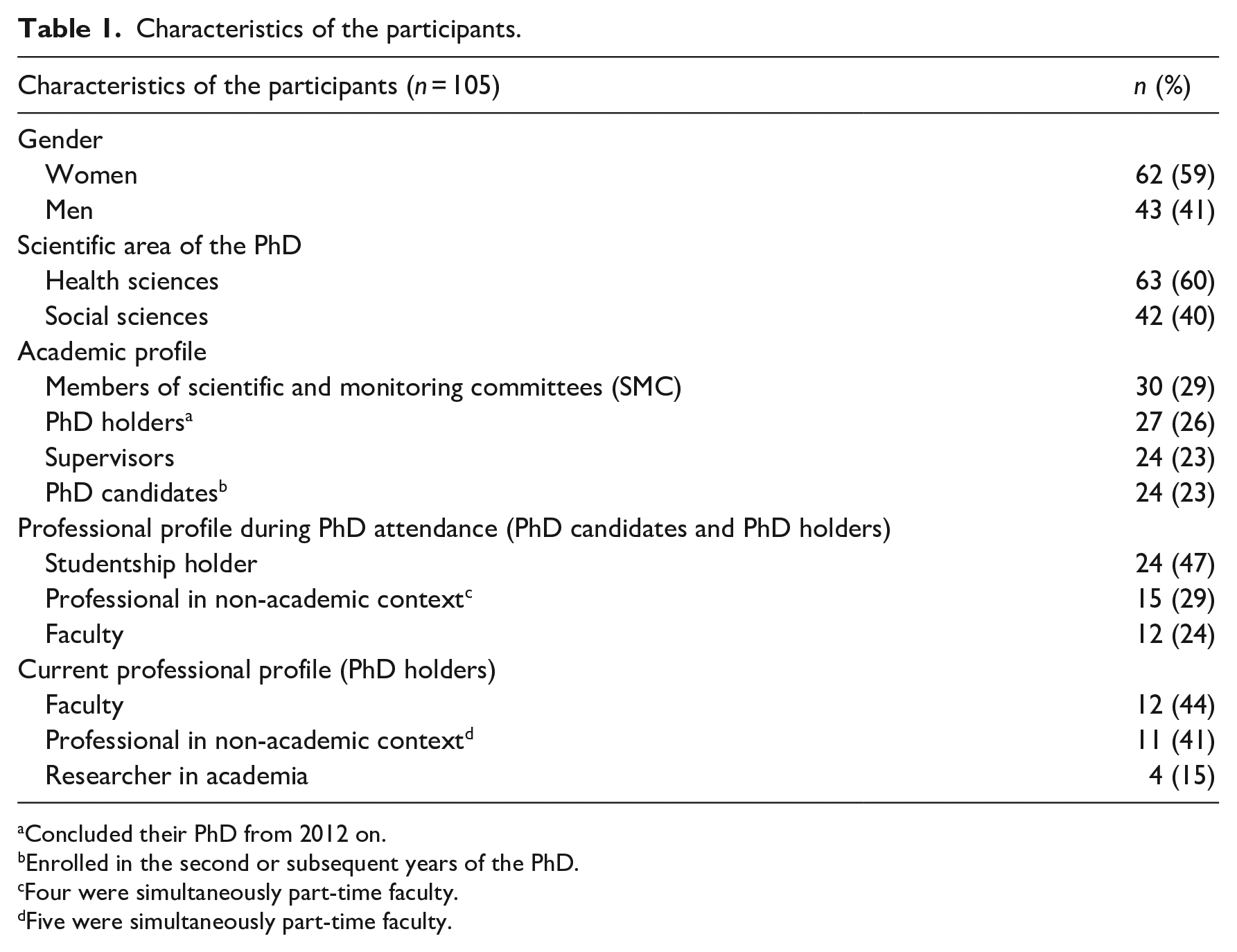
Concluded their PhD from 2012 on.
Enrolled in the second or subsequent years of the PhD.
Four were simultaneously part-time faculty.
Five were simultaneously part-time faculty.
FGs were transcribed verbatim, and the transcripts were sent to participants for validation. Four participants suggested changes to the transcript. Data were analysed using constructivist, inductive and deductive thematic analysis to describe the results but also to identify the underlying concepts and ideas (Braun and Clarke, 2006). Firstly, the transcripts were carefully read, and data were coded with the support of the NVivo12 software. Then, researchers reviewed the coded data to find areas of similarity and organise codes into emergent themes and sub-themes. Afterwards, (sub)themes were discussed and cross-checked by the research team. For a better understanding of the level of consensus/dissent, thematic analysis was complemented with the number and/or proportion of: participants (total and per scientific area and academic profile) who mentioned each theme, subtheme or code; FGs in which each theme, subtheme or code was mentioned; participants within each FG who mentioned each theme, subtheme or code (Onwuegbuzie et al., 2009).
The project followed the ethical guidelines of the Portuguese Society of Educational Sciences (SPCE, 2014) and was approved by the Ethics Committee of the Faculty of Psychology and Education Sciences of the University of Porto.
Findings
Participants identified three dimensions of value of DE (Figure 1): personal, academic and career agency and development (comprising the PhD degree, knowledge and competencies, personal growth and PhD holders’ identity, career development and agency, positive emotions and personal relationships); knowledge and knowledge outputs and outcomes (comprising theoretical/methodological, applied or applicable knowledge and knowledge outputs and outcomes, including outputs that promote knowledge dissemination); and socioeconomic impact, resulting from knowledge and knowledge outputs and outcomes and the actions of PhD holders enabled by their increased agency and development.
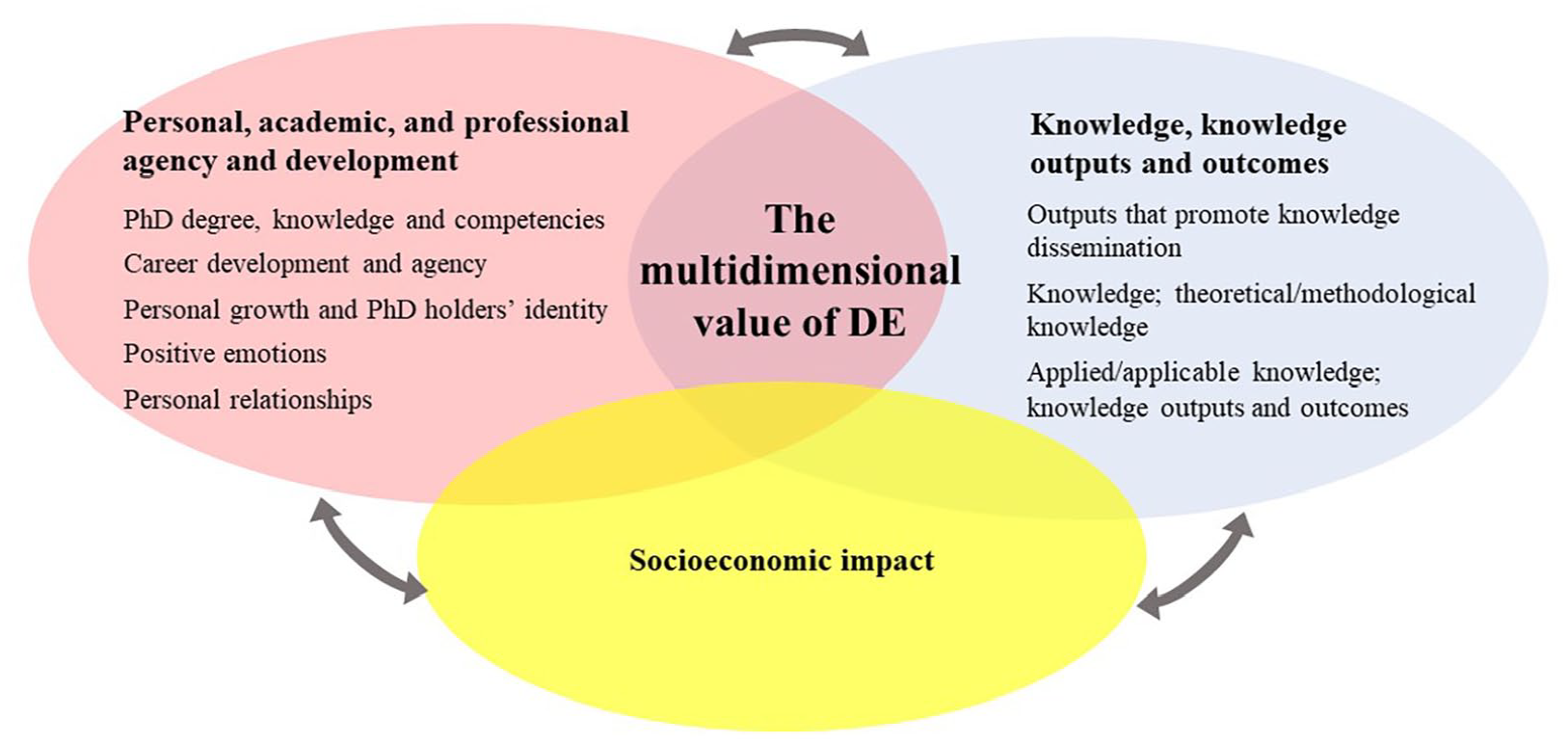
The multidimensional value of doctoral education.
Table 2 shows the number and proportion of participants who mentioned each dimension and subdimension of value.
Proportion of participants who mentioned each dimension and subdimension of value.
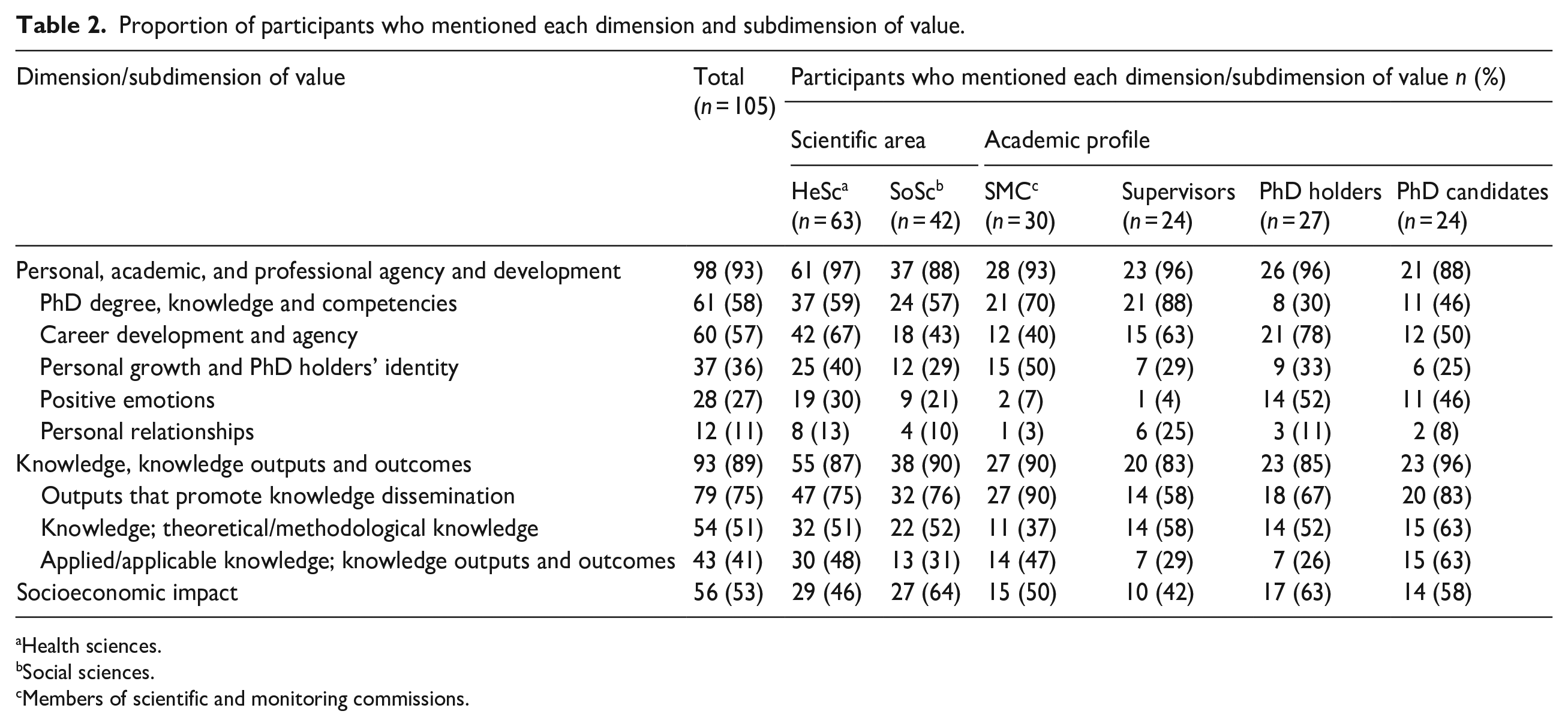
Health sciences.
Social sciences.
Members of scientific and monitoring commissions.
Personal, academic and career agency and development
Ninety-eight participants (93%) mentioned the value of personal, academic and career agency and development. The theme was mentioned in all FGs (n = 25, in 24 by at least half of the participants). This was the dimension of value mentioned by a higher proportion of participants in total and by a higher proportion of participants from HeSc, SMC, supervisors and PhD holders and the second most mentioned by PhD candidates.
Emphasising that a PhD is an academic degree, most participants (58%) stressed the relevance of completion and receiving qualification (described as a researcher’s driving licence and a certificate of proficiency/competence) and/or the value of knowledge acquisition and competence development (e.g., scientific writing, autonomy, critical thinking). However, there were some tensions around the type of competencies and knowledge that should be developed/acquired (e.g., cultural knowledge vs technical competencies). This subdimension was mentioned in 23 FGs, and in 17 was mentioned by at least half of the participants.
More than a third of participants stressed that DE might/should enhance personal growth and the construction of PhD holder’s identity. This subdimension was mentioned in 17 FGs (in 7 by at least half of the participants). Personal growth was described as a different posture, or way of being and interacting with others, a diverse and often more critical perspective, the widening of horizons or increased maturity, self-knowledge or self-confidence and a sense of responsibility, caution and agency in research, academic or professional practice. The PhD holder identity was described as a sense of belonging to the PhD holders’ social group/elite and the academic community and changes in self-concept (they come to see themselves as having a certain level of knowledge, competencies and personal growth perceived as distinctive characteristics of PhD holders).
Most participants emphasised the value of DE as professional agency and development, described as career access or development, internationalisation, increased salary and stability, increased likelihood of participating in research and academic activities (e.g., lecture classes, or belonging to academic examining committees), improved performance (e.g., evidence-based practice, rigour, or theoretical update), increased professional status, recognition or voice, motivation for research and lifelong learning and development of professional networks and partnerships. This subdimension was mentioned in 22 FGs (in 16 by at least half of the participants). Nevertheless, while one-third of the participants highlighted this kind of professional impact on careers in academia, only a few highlighted the contributions of DE to career development in non-academic contexts, which may be related to participants’ professional experience (most worked in academia). Furthermore, nearly a third of participants (29%) expressed concerns regarding weaknesses of the labour market (scarcity of opportunities to access and succeed in challenging careers, deterioration of working conditions in higher education and poor understanding and receptiveness to the added value of PhD holders and scientific knowledge outside higher education) which may jeopardise career agency and development and exacerbate competitiveness, performativity and specifically the overemphasis on accountable outputs. A few participants highlighted that these difficulties may be more severe for PhD holders without previous professional experience outside higher education and/or with graduation degrees in SoSc.
Some participants highlighted the value of positive emotions (e.g., relief, nostalgia, joy, satisfaction or personal fulfilment) triggered by PhD completion, success (e.g., acceptance of a paper), the pleasure of doing research or peer recognition. This subdimension was mentioned in 15 FGs (in 5 by at least half of the participants). However, it was acknowledged that PhD candidates may experience intense positive and negative emotions in different situations. Most participants (61%) mentioned negative emotions (e.g. loneliness, sadness, suffering, exhaustion, despair, discouragement, frustration and insecurity) or mental health problems (e. g. anxiety or depression). These emotions were triggered by work overload, lack of autonomy, time management difficulties, work-life imbalance, underachievement, solitary work, uncertainties regarding the PhD work, and career prospects, or the pressure to publish, however, they were not considered a subdimension of value because they were not described as a positive outcome, but mostly as negative psychological processes, experienced throughout the PhD, which may undermine, but also sometimes stimulate the value of DE as a positive emotional experience (e.g. despair prompts relief) and the achievement of other (sub)dimensions of value (e.g. exhaustion may hinder degree completion; frustration may lead to the improvement of a paper).
A few participants noticed that DE may also enhance personal relationships with supervisors, colleagues, and/or research participants, contribute to learning and career development of supervisors (e.g. through paper co-authorships) and examiners, and/or enhance supervisors’ positive emotions towards the success of their supervisees, or negative emotions towards their difficulties, underachievement or withdrawal.
Considering differences between scientific areas, this dimension of value was mentioned by a higher proportion of participants from HeSc than participants from SoSc. The main differences regarded the sub-dimension of career development and agency and may reflect labour market differences. Indeed, more than 30% of participants from SoSc expressed concerns about the weaknesses of the labour market while less than 25% from HeSc mentioned it. Interestingly, the subdimensions of personal growth and PhD holders’ identity and positive emotions were also mentioned by a higher proportion of participants from HeSc than SoSc, however, the emotional rollercoaster seems to be more intense in the area of HeSc, considering that 65% of participants from this area (and 55% from SoSc) also mentioned concerns about negative emotions and mental health.
SMC and supervisors were more focused on the subdimension of PhD degree, knowledge and competencies. However, when compared with the other academic profiles, SMC were also the ones that focused more on personal growth. Most supervisors also mentioned career development and agency. That subdimension was the one which was mentioned by a higher percentage of PhD candidates and PhD holders. This may reflect concerns about struggles that they are currently facing or expect to face to achieve their career prospects, which seem to be noticed by their supervisors. Nearly half of the PhD candidates also focused on PhD degree, knowledge and competencies, and both PhD holders and PhD candidates focused on the positive emotions that they experience throughout the PhD. Supervisors were the ones who focused more on personal relationships, expressing satisfaction regarding lasting friendships with their supervisees.
Interestingly, although the differences between academic profiles were more related to the level of focus than to the content, SMC seemed to approach the processes and outcomes of DE in a more general way, assuming the responsibility of representing an institution, but also reflecting a wider experience in multiple roles (e.g., PhD candidates, supervisors, directors). PhD candidates seemed to rely more on their individual and not so extensive experience in the academic context. Supervisors and PhD holders seemed to assume an intermediate position. Although supervisors also expressed their role as representatives of an institution, this role seemed to be frequently intertwined with their role as those who monitor and provide support to PhD candidates.
The following quotes illustrate the interactions around the value of DE as personal, academic, and professional agency and development: FG14 (PhD holders): P58 (HeSc): (. . .) It was a huge challenge, but at a certain point I start to realise that it makes sense (. . .) So, in the middle of all the anguish, by the end, when we got the good news that it was ending, or that it had already ended [laughter], then I knew, then it felt good, but there were moments of great anguish, and great difficulty, and above all, of feeling that I was not in control of my life, and that was very difficult for me. (. . .) P55 (SoSc): (. . .) I found myself feeling more insecure, less confident, with more . . . saying things with more caution (. . .) when a person does a PhD it seems that he has more responsibility, so it’s all heavy. We are always being scrutinized, and we know more, which is curious. And . . . it was from the point of view of identity, I think there was this change, which I think is responsibility, maybe maturity (. . .). (. . .) P57 (HeSc): (. . .) Grabbing one project after another was something that I thought would continue ad eternum until I really had a different solution. And. . ., and at the end, a few months ago, I had the opportunity to . . ., to be able to teach at a university (. . .). It seems like a more stable situation (. . .). (. . .) P56 (HeSc): (. . .) I actually had an experience contrary to that of P57, which was, because I have a PhD I lost my position, in quotes, as a teacher [in a polytechnic institute], (. . .) they cannot hire PhD holders because they have no money, they cannot make contracts, and so I lost my position (. . .). FG 13 (supervisors) P52 (HeSc): Well, I think that evolution is, for me, the main measure of the quality of a PhD thesis. When a student starts at a relatively minimum level and manages over time to develop the competencies which are translated into autonomy, into the ability to propose work and interpret work (. . .). P53 (HeSc): (. . .) He is able to pursue, develop his research line, apply for a project and be funded as a principal investigator (. . .). He completed that milestone, and that milestone is the first step of his career, basically, I understand that the doctorate is the first step of the career, isn’t it? (. . .) P54 (SoSc): (. . .) Firstly, success, for me, is him finishing, or her finishing the PhD, but then (. . .) a PhD enables the person to be, in fact, an autonomous researcher, to contribute to that area, (. . .) and to be outstanding, to be invited, for example, to conferences, to lectures. (. . .)
Knowledge and knowledge outputs and outcomes
Ninety-three (89%) participants mentioned the value of knowledge and knowledge outputs and outcomes. It was mentioned in all FGs (n = 25, and in 24 by at least half of the participants). This was the dimensions of value which was mentioned by a higher proportion of PhD candidates and participants from SoSc and the second most mentioned by participants from HeSc and the other academic profiles. Considering differences between groups, it was mentioned by a similar proportion of participants from SoSc and HeSc, revealing a consensus between areas regarding the role of DE in knowledge creation, however, this dimension was mentioned by a higher proportion of PhD candidates and SMC than PhD holders and supervisors.
Participants highlighted different types of knowledge and knowledge outputs and outcomes: theoretical/methodological knowledge (e.g. theoretical advances; critical analysis or approaches; new research questions or research lines; methodological innovations such as a scale validation; or negative results, when research work fails to generate original/expected conclusions); applied/applicable knowledge; knowledge outputs and outcomes such as solutions for problems, intervention projects, innovative in healthcare practices; patents; marketable products; and outputs that promote knowledge dissemination (e.g. papers; conferences; thesis; books; news on social media, or exhibitions and presentations in non-academic contexts).
Regarding the outputs that promote knowledge dissemination, four important contributions were identified: scientific advancement (e.g. enhancement of discussion, critique, refutation and further research); career development of PhD candidates and supervisors (publications are a criterion of recognition, recruitment and assessment); socioeconomic impact (through the enhancement of scientific literacy or the application of knowledge); and as an objective and accurate assessment and completion criteria which boosts the progress and quality of the research work, and fosters the development of core competencies for researchers. Outputs and outcomes may be direct and short-term (e.g. when the PhD aims to develop a product), or indirect and medium or long-term (e.g., when the knowledge that was created enables the further development of a product).
Although it was acknowledged that different types of knowledge and knowledge outputs and outcomes were valuable, some tensions emerged around the relative value of theoretical/methodological versus applied/applicable knowledge and around the value of knowledge itself versus accountable knowledge outputs and outcomes (e.g., papers; marketable products).
Knowledge outputs that promote knowledge dissemination was mentioned in 24 FGs and the subdimension mentioned by a higher proportion of participants from all the groups and scientific areas. Despite criticising the excessive focus on this sub-dimension of value, almost all participants recognise the need to publish as inevitable. Theoretical/methodological knowledge was also mentioned in 22 FGs and by more than half of the participants from HeSc, SoSc, supervisors and PhD candidates. Applied/applicable knowledge was mentioned in 21 FGs, but it was mentioned by a higher proportion of participants from HeSc, PhD candidates and SMC than participants from SoSc, supervisors and PhD holders. These findings may reflect not only disciplinary differences (e.g., certain HeSc sub-areas such as Pharmaceutical Sciences seem to have more networks with industry) but also a greater compliance of PhD candidates and SMC respectively with the completion requirements and the requirements for the funding and assessment of PhD programmes and research, which are based on knowledge outputs.
The following quotes illustrate interactions around the value of DE as knowledge and knowledge outputs and outcomes: FG 24, PhD candidates: P98 (SoSc): (. . .) The world needs practical, feasible things, tangible. Therefore, for me, a doctoral thesis (. . .) has to add value, and it has to be applied, the knowledge has to be applied, it has to be ‘transversalized’ there has to be translation of knowledge, it has to be useful (. . .). (. . .) P99 (SoSc): (. . .) The idea of usefulness sometimes means that work with very interesting contributions, but contributions whose applicability is not very direct, are considered unimportant. (. . .) They are useful in the sense that they allow us to think about a set of issues, and I think that we, as a society, still need to think about those issues, even if their applicability then requires other paths to get there. P98 (SoSc): P99, sorry, but I think when we talk about applicability, it’s not just about the practical. Anything that adds knowledge . . . FG 1 (SMC): P1 (HeSc): (. . .) What they [PhD candidates from a specific PhD programme] want is to solve their problem, they don't care much about writing articles (. . .). For these professions, for certain PhDs the article can be a means to, but it is not the main goal (. . .). P3 (HeSc): (. . .) All the PhDs that I have ever supervised, and that I hope to continue to supervise, aimed at solving very concrete, practical problems. (. . .). Well, doing this implies knowing what science is and how it is done (. . .) I think we all agree on that, the goal of a PhD is to produce science. (. . .) If it is to produce science, I would also like to remind you that the format per excellence of science dissemination is still the scientific article (. . .) Then, we cannot say ‘no, you don’t have to publish anything, getting a PhD has nothing to do with publishing’. Oh . . . oh . . . oh yes it does! (. . .) One thing is to say that scientific articles obviously have limitations in terms of what they want to say and their content and how they represent the PhD, another thing is to say that they don’t have to publish (. . .).
Socioeconomic impact
Most participants (53%) highlighted the value of DE as a driver of socioeconomic impact, resulting directly from research and research outputs and outcomes developed throughout the PhD, or from further actions of PhD holders. Some mentioned specifically the organisational impact of DE in academia. Through socioeconomic impact, DE may reward society for its investment in research and education. This dimension of value was mentioned in 24 FGs, (in 15 by at least half of the participants).
Participants specified some examples of the socioeconomic impact of DE, such as the creation of a better society, economic impact or the improvement of scientific literacy, health and well-being of the population. They also specified examples of the organisational impact of DE on academia, such as the economic impact of tuition fees, human resources training, research stimulus, the establishment of networks and partnerships, or publications and its impact on the attractiveness, assessment and fundraising of PhD programmes, HEIs and research centres. Nevertheless, some participants criticised the overvaluation of this dimension of value or stressed that even scientifically relevant research work might not have a direct socioeconomic impact, or the socioeconomic impact may be hindered by external constraints (e.g., organisational resistance to change).
Socioeconomic impact was mentioned by a higher proportion of participants from SoSc, PhD holders and PhD candidates, than participants from HeSc, SMC and supervisors. Furthermore, while the organisational impact on academia was mentioned by a higher proportion of supervisors (38%) and SMC (19%) than PhD holders and PhD candidates (less than 10%), the broader socioeconomic impact was mentioned by less than 20% of the supervisors and more than 45% of the participants with other academic profiles. This may reflect a deeper awareness of these different profiles about the impact of research on the contexts where they work (academia/other professional contexts).
The following quotes illustrate interactions around the value of DE as a driver of socioeconomic impact: FG16 (PhD holders): P65 (SoSc): (. . .) For me, it is very important that what is researched has social relevance (. . .). P68 (HeSc). (. . .) It is hard for me to see a lot of research work whose social relevance is very minimal, and therefore does not contribute to society. I don't really understand the purpose (. . .) What I understand is that health institutions also need to undergo an organisational transition so that they learn to incorporate all these results from doctoral studies (. . .). FG 12 (supervisors): P49 (HeSc): What matters to us, supervisors, is a PhD with publications, period. Publication gives us money to sustain the research group. (. . .) The PhD student is worth money for the research group, is worth assessment.
Interactions between dimensions and subdimensions of value
In 24 FGs participants mentioned the three dimensions of value, and in one FG, participants mentioned two dimensions. A few participants (8%) mentioned only one dimension, while most mentioned two (49%) or three (43%) dimensions, evidencing that the dimensions of value may coexist and interact in ways that may reinforce each other (e.g., the acquisition of knowledge and competences may enhance knowledge creation whose application may have a socioeconomic impact). However, nearly half of the participants (49%) noted that interactions might also be harmful when the overemphasis on one (sub)dimension may hinder the emphasis and/or achievement of other(s). These concerns were mentioned in 22 FGs and in 13 by at least half of the participants. However, they were mentioned by a higher proportion of participants from SoSc (62%), PhD candidates (75%) and SMC (60%), than participants from HeSc (40%), PhD holders (41%) and supervisors (17%).
Most of the negative interactions described by participants concerned the overemphasis of accountable outputs and outcomes (e.g., technical and observable skills, marketable products, scientific publications and journal rankings, or economic impact) resulting in a constraint of academic freedom and a devaluation or underachievement of less accountable outputs and outcomes: downsize of the quality of the journal (ranking position), paper or the intrinsic quality of research to match assessment criteria based on the number of publications; devaluation of the learning process, ethical issues and social impact; decrease of the engagement on reflexiveness, critical and comprehensive thinking, personal growth, knowledge acquisition and cultural development; avoidance of scientifically relevant research topics without direct or immediate applicability or economic impact; avoidance of risk-taking to prevent negative results, which tend to be less publishable in high-ranked journals; devaluation of not indexed or low-ranked mother-tongue journals; constraint of the sovereignty and relevance of the examiners by the fact that the largest portion of paper-based thesis has already been peer reviewed before the defence.
It was also argued that performativity and accountability (often exacerbated by the competitiveness resulting from a lack of opportunities to access and succeed in challenging careers, by the political agenda of the knowledge society, or the need to correspond to assessment and funding criteria) caused tensions regarding the concept of value by fostering a constant struggle to find the balance between a high level of quality, whose definition is subjective (e.g., intrinsic quality of research), and a certain quantity of outputs and outcomes (e.g., number of articles or journal ranking). Available resources constantly constrained this quantity/quality struggle (e.g., funding for research-related expenses) and time (e.g., time to complete the degree, time to dedicate to the PhD).
Eight participants (from all scientific areas and academic profiles) stressed the need for a strategic vision. These participants highlighted that the value of DE could differ according to the characteristics, needs and expectations of PhD candidates, the PhD programme and the research context, considering important to define the value of DE for each case and identify and implement individual and collective strategies for value achievement, based on scientific evidence about the processes and outcomes of DE.
The following quotes illustrate interactions around the interactions between (sub)dimensions of value: FG 6 (SMC): P23 (SoSc): (. . .) All this pressure for relevance, to ask the student: ‘Hey, and you? What is the knowledge you are going to produce useful for?’ Isn’t it? This ‘what’, this question posed at the outset, in fact, has an impact on the process, on the training process, and moreover, constraints the process (. . .). (. . .) P25 (HeSc): (. . .) Whoever does not comply with the parameters of this process may be doing an exceptional and very good quality work, but as it is not measurable from the economic and numbers point of view, we are not working well (. . .). (. . .) P22 (SoSc): (. . .) What the academic institution nowadays promotes in young academics who are doing their PhD (. . .) is not to be autonomous, is to be conformists, is to do what the . . ., the . . ., the editorial statutes of the journals with the highest scientific impact suggest or condition (. . .). Therefore, there is here a censorship that the . . ., the university nowadays makes the doctoral students internalise to become successful academics (. . .).
Discussion and conclusions
This study explored the perceived value of DE in SoSc and HeSc in the intersection of the multiple purposes of higher education in the European knowledge society. Unlike other studies, which only considered the voices of a single (e.g. PhD candidates, or PhD holders, or supervisors) (Bryan and Guccione, 2018; Loxley and Kearns, 2018; Stubb et al., 2014; Wisker et al., 2019), or two actors (e.g. academics and doctoral alumni) (Boud et al., 2021), this study triangulates voices of multiple actors involved in the PhD process presenting a mutually constructed insight into the still controversial role of DE in the context of a southern European knowledge society which, similarly to other countries (Andres et al., 2015) has been under a process of transformation, democratisation and reconceptualisation of DE (Santos et al., 2016).
The study identified three main dimensions of value of DE: personal, academic and career agency and development; knowledge and knowledge outputs and outcomes; and socioeconomic impact. These multiple dimensions of value coexist and interact in ways that may reinforce or hinder the achievement of each other.
These multiple dimensions of value reflect the hybrid and distinctive nature of DE (simultaneously an academic degree and research work) and the fragmented identity of PhD candidates, who may develop and experience multiple academic identities (e.g. researcher, teacher, engaged public scholar) (Colbeck, 2008; Lopes and Menezes, 2018) This characteristic stresses the pertinence of a reprofessionalisation of PhD candidates’ academic work through the creation of synergic connections between their multiple academic identities (Colbeck, 2008). Furthermore, it complexifies the processes of academic management which have to consider not only pedagogical but also human resources management concerns, adjusted to the needs specificities of (junior) scholars (Gaisch et al., 2020).
Furthermore, this multidimensionality appears to configurate the contributions of DE to the multiple purposes of Higher Education (EHEA, 2007) which in turn seem to reflect the intersection of the four interacting and juxtaposed archetypal models, inspired by founding narratives of higher education described by Zgaga (2009): the knowledge model, inspired by the Humboldtian narrative, emphasises the autonomy of HEIs and academics and their role in the creation of advanced knowledge and innovation; the professional model, inspired by the Napoleonic narrative, emphasises the role HEIs play in the development of skills required by the labour market, and the opening to new segments of the public; the personality model, inspired by the Newmanian narrative, emphasises the role of HEIs in personal development and the cultivation of the intellect; and the transversal Deweyan model, inspired by the narrative of John Dewey, stresses the role of higher education in promoting citizenship and civic participation (Zgaga, 2009). The emphasis on the value of personal, academic and career agency and development seems to reflect both the personality and the professional models (Zgaga, 2009), focusing on the role of DE as an academic degree which contributes to the Higher Education purpose of enabling students’ personal development and preparing them for their careers (EHEA, 2007). The emphasis on the value of knowledge and knowledge outputs and outcomes seems to reflect the knowledge model (Zgaga, 2009), focusing on the role of DE as research work which contributes to the Higher Education purpose of creating and sustaining an advanced knowledge base capable of stimulating research and innovation (EHEA, 2007). The emphasis on the value of socioeconomic impact seems to reflect the Deweyan model (Zgaga, 2009), focusing on the role of DE as a public service which contributes to the development of society, not only through its research outcomes but also through the preparation of PhD candidates to play active roles as citizens in democratic societies (EHEA, 2007).
The findings from this study also displayed some challenges which bound and complexify the concept of value of DE and threaten its achievement: negative emotions and mental health problems triggered by difficulties during the PhD process; weaknesses of the labour market which threaten the achievement of career agency and development and lack of strategic vision which hinders the achievement of the full potential of each PhD candidate or PhD project. Furthermore, this study also displayed tensions regarding the relative relevance of different (sub)dimensions of value, different types of knowledge and different knowledge outputs and outcomes, exposing a critical view on the overemphasis of accountable outputs and outcomes, which threatens the achievement of other relevant but less accountable ones. These tensions revealed a constant struggle to find and include in the definition of value of DE a balance between quantity and quality (constrained by available time and resources), which is also a struggle between the (needed) accountability and performativity, versus the (needed and desired) academic freedom, personal fulfilment or society uptake.
Findings from this study point to the need to assure some processes to achieve different kinds of value, for instance, career guidance, services to support communication and engagement with society, the training of supervisors to embrace the current challenges of DE, funding criteria, or partnerships with non-academic institutions. These findings also suggest a need to clarify and revisit the concepts of value of different actors, which underlie institutional and individual, practical and political decisions regarding DE (e.g., the definition of access, assessment and completion criteria; the choice of research topics or optional curricular units), which are often solutions of compromise between the possible and the desired and should be knowledge-based, strategic and reflexive. It also raises some questions for future work regarding the organisational impact of DE in academic and non-academic contexts, the outcomes for supervisors and examiners, the differences between scientific areas and actors, the relation between different dimensions of value or issues related to the effect of democratisation on the concept of value of DE. Furthermore, after a pandemic in which many universities have concentrated their research efforts on addressing society’s most pressing needs (Bachmann and Frutos-Bencze, 2022), it seems essential to explore how COVID-19 may have changed the perceived impact or potential impact of DE on society.
Participants from both scientific areas and academic profiles mentioned all the dimensions and subdimensions of value and all the threats and challenges to the concept and achievement of value. However, even if the study was more focused on the co-construction of the concept of value of DE through the voices of different actors than in a comparison between them, it was possible to find some differences regarding the concerns and focus of different groups on different (sub)dimensions of value. The similarities may be related to the dual role (and multiple identities) of some of the participants but may also reflect that as early-stage researchers, PhD candidates and PhD holders share (or shared) the same academic context and culture as SMC and supervisors engaging on the shared struggles and dilemmas. This characteristic distinguishes PhD candidates from undergraduates and master’s students, highlighting the relevance of research focused on DE. On the contrary, the differences may reflect different disciplinary and institutional research cultures, different research topics and methodology or external factors such as labour market demands. Other differences seem related to different tasks, duties and challenges inherent to the roles and identities of participants with different academic profiles. These differences highlight the relevance of including different actors’ voices to fully understand the multidimensionality of the value of DE.
Some limitations may be pointed out to this study: the study did not include other actors whose visions could be relevant (e.g. employers); the number of participants from SoSc and HeSc was not balanced; findings from FGs, mainly quantitative must be interpreted with caution, considering that the interventions of participants may be influenced by the interactions between participants and with the moderator (Acocella, 2012); although the findings from this study may be relevant for other contexts, findings from qualitative studies are context-sensitive and not meant to be generalised (Murgado-Armenteros et al., 2012); the small number of participants in some FGs may have harmed interactions between participants (Onwuegbuzie et al., 2009); the online format made it impossible to control each participant’s setting (Murgado-Armenteros et al., 2012).
The challenges and tensions identified by this study could corroborate a vision of DE in crisis: unable to fulfil either the professional expectations of PhD candidates or the needs of a more diversified labour market (Carvalho et al., 2022; OECD, 2019; Suomi et al., 2020); drifting away from its primordial role of developing a culturally distinct group of citizens; or ceasing to assert itself as the prime driving force of personal, scientific, cultural and social development under the pressure of a society driven by economic interests (Frick et al., 2017; Magalhães and Veiga, 2022). However, it is possible to conclude that it reflects an ecological university, constantly striving to re-organise in the knowledge society (Barnett, 2018). At the level of educational policies, it also stresses the need to strive for a better balance between the different ecosystems involved in DE, preventing the multidimensional value of the DE from being undermined by an overly performative context.
According to Barnett (2018), the ecological university embraces the utopic but feasible challenge of navigating super complexity (which characterises knowledge societies), constrained by features of different ecosystems, but still able not only to explain or criticize but also to constructively, creatively and critically imagining and living out the multiple possibilities to contribute to the wellbeing and advancement of each of the ecosystems and the whole world. Keeping this in mind, it is possible to consider that the findings of this study underline that the value of the DE is inexorably bounded to its paramount role in the utopian but feasible task of contributing to the development of knowledge (in its various forms) and of knowledge creators who can understand and (re)create a knowledge society that, as envisioned by the UNESCO (2005) effectively strives for the betterment of the world.
Supplemental Material
sj-docx-1-eer-10.1177_14749041231206197 – Supplemental material for The value of doctoral education in the intersection of the multiple purposes of higher education
Supplemental material, sj-docx-1-eer-10.1177_14749041231206197 for The value of doctoral education in the intersection of the multiple purposes of higher education by Patrícia Alves, Amélia Lopes, Ricardo Cruz-Correia and Isabel Menezes in European Educational Research Journal
Footnotes
Author contributions
All authors contributed to the study conception and design and material preparation. Data collection was performed by Patrícia Alves. Data analysis was performed by all the authors. The first draft of the manuscript was written by Patrícia Alves and all authors commented on previous versions of the manuscript. All authors read and approved the final manuscript.
Declaration of conflicting interests
The author(s) declared no potential conflicts of interest with respect to the research, authorship, and/or publication of this article.
Funding
The author(s) disclosed receipt of the following financial support for the research, authorship, and/or publication of this article: This work was funded by the European Union, through the European Social Fund, and by national funds, through the Portuguese Foundation for Science and Technology, IP (FCT), under the doctoral research grant no. SFRH/BD/145719/2019. It was also supported by the FCT under the multi-year funding awarded to CIIE [grants no. UIDB/00167/2020; and UIDP/00167/2020].
Compliance with ethical standards
The project followed the ethical guidelines of the Portuguese Society of Educational Sciences (SPCE, 2014). All participants were informed about the study aims, assured anonymity and confidentiality, and informed of their right to withdraw their consent at any point. The participants were asked for permission to be recorded and quoted in forthcoming publications. All identifying information (e.g. employer) has been removed from participants’ cited responses.

Supplemental material
Supplemental material for this article is available online.
Notes
Author biographies
References
Supplementary Material
Please find the following supplemental material available below.
For Open Access articles published under a Creative Commons License, all supplemental material carries the same license as the article it is associated with.
For non-Open Access articles published, all supplemental material carries a non-exclusive license, and permission requests for re-use of supplemental material or any part of supplemental material shall be sent directly to the copyright owner as specified in the copyright notice associated with the article.
