




Abstract
The academic career stories and trajectories of PhD holders have been widely studied in the context of economic austerity and an oversupply of doctors. However, few studies have investigated career building among ex-academics and how a doctoral degree and university work might affect their career possibilities outside academia. This paper explores the trajectories of ex-academics: PhDs with university work experience who have left academia to pursue non-academic careers. Based on 40 qualitative interviews with ex-academics, their employers and senior university leaders, the study employs a narrative approach to construct five career stories: the Theoretical Endangered Nerd, the Practical Geek, the Chic Hybrid, the Pristine Novice and the Odd Elite. This varied picture of career sensemaking provides new insights into career building among ex-academics.
Introduction
Throughout Europe and globally, higher education is being transformed at many levels. More than a decade ago, the Salzburg Principles of 2005 (European University Association (EUA), 2010) formed part of the Bologna Process, which aimed to develop doctoral (PhD) education to meet the rapidly changing needs of knowledge-based economies and societies (Kivisto et al., 2017). In Finland, the government has increasingly pressured academia to engage in knowledge transfers with the public, private and third sectors (Ministry of Education and Culture (MoEC), 2016; Nikunen, 2012; Stenvall and Laitinen, 2015), and the mobility of PhD holders across labour market sectoral borders is a key aim of a recent policy initiative proposing a four-stage career model. To facilitate such mobility, the initiative sought to introduce more indicators for assessing researchers’ performance across sectoral borders, to utilise Academy of Finland funding instruments and to harmonise researchers’ job descriptions in different sectors (Ministry of Education, 2008). However, the new career model has not yet achieved its goal (Välimaa et al., 2016). Additionally, new public management has introduced market-driven trends and values to Finnish higher education (e.g. Hoffman et al., 2011; Kallio et al., 2015), further contributing to the fragmentation of academic career paths (e.g. Dany et al., 2011; Musselin, 2010; Robson and Wihlborg, 2019; Ylijoki and Ursin, 2013).
Since 1994, when Finnish doctoral training was reformed to align with international practice, the number of PhDs has increased, resulting in a growing number of junior academics competing for jobs at universities and in other sectors (Kivisto et al., 2017; Vipunen Education Statistics, 2018; Ylijoki and Henriksson, 2017). This has led to an oversupply of PhDs for available academic positions. At the same time, external grants and state funding for universities are diminishing (Holopainen, 2017; Organisation for Economic Co-operation and Development (OECD), 2017; Sainio, 2010; see also Roumbanis, 2018). In 2015, Finland had the highest number of unemployed PhDs among OECD countries (OECD, 2017).
As elsewhere, doctoral training in Finland has traditionally prepared students primarily for basic research (OECD, 2015) and academic positions in universities and research centres, rather than for careers in other sectors (Niemi et al., 2011). Finnish industry has tended to employ fewer PhDs than industry in some other countries, possibly because Finnish PhDs are not taught the applied research skills that society increasingly demands (Halse and Mowbray, 2011; Neumann and Tan, 2011; OECD, 2015, 2017).
Following implementation of the Salzburg Principles, the European guidelines known as the Salzburg Recommendations (EUA, 2010) emphasised the need to support PhD candidates’ professional development in terms of transferable skills and the promotion of general public awareness of these skills (Telling and Serapioni, 2019). Awareness is a critical issue in Finland, as PhDs’ skills remain an unknown quantity outside the academic sector, and academics are commonly labelled ‘ivory towerish’ (Lam, 2010: 320; see also Fritsch and Krabel, 2012). It has also been suggested that building networks and mobility across different national and international sectors can bridge the ‘communication gap with potential employers and recruiters’ (EUA, 2010: 4). While studies exploring PhDs’ core competencies have identified a range of transferable skills that can be of use in global employment markets (Durette et al., 2016), they also acknowledge that even PhDs themselves are not always aware of all they can offer beyond academia.
Among academics who have exited academia (henceforth, ex-academics) to build careers in other sectors, some have subsequently returned to academic positions (see e.g. Aarrevaara and Pekkola, 2010; Barcan, 2018; Hancock, 2018; Kehm and Teichler, 2013; Locke and Bennion, 2010; Teichler and Höhle, 2013). However, thus far, there is little understanding of ex-academics’ experiences and career trajectories or of how doctoral degrees and university work experience (Aarnikouvu et al., 2019; Helin et al., 2019; Pekkola, 2014) might affect career prospects beyond academia.
The present study explores collective group (Hunter, 2010: 49) career stories of Finnish PhDs who have exited academia, drawing on earlier research on ‘junior academic career stories’ in Finnish universities (Ylijoki and Henriksson, 2017; see also Hancock, 2018). However, unlike many previous studies, this research aims to gain a retrospective view of how contextual factors in early academic career development relate to subsequent employment beyond academia. In particular, we focus on how PhDs with university work experience are understood in terms of career transfer and career building outside academia.
The rationale for this study is threefold. First, as previous studies have tended to focus on academics working in universities, little is known about the experiences of ex-academics who transfer to other sectors. Second, this study contributes to the current discussion in academia and Finnish society concerning ex-academics’ employability and knowledge transfer beyond academia. Third, the study provides a new narrative perspective that triangulates the sensemaking of ex-academics, their employers and university leaders in relation to what it means to be an ex-academic and to build a meaningful career outside academia.
The paper is organised as follows. The next section introduces the narrative approach employed in the research. The subsequent section describes the research data and method of analysis. This is followed by accounts of the five ex-academic stories extracted from the developed narratives. The final section presents a discussion, implications and conclusions.
A narrative approach
This study explores experiences and perceptions of ex-academics’ career building. Focusing on the transition from academia to other sectors, the study employs a ‘narrative approach’ (Ylijoki and Henriksson, 2017: 1294) to examine how individuals make sense of events in their own and others’ lives and social surroundings (Miller and Glassner, 1997; Richardson, 1990). As the narrative approach has been widely used in a variety of disciplines, including education, psychology, history and management (Connelly and Clandinin, 1990; James, 2017; Polkinghorne, 1995), the term narrative has been defined in numerous and sometimes contradictory ways. For example, Labov (1972: 359) defined narrative as ‘one method of recapitulating past experience by matching a verbal sequence of clauses to the sequence of events which (it is inferred) actually occurred’. Ricoeur (1984: 52) stressed the chronological nature of narrative, noting that it captures ‘the temporal character of the human experience’. The present study draws on Connelly and Clandinin’s (1990: 2) view of narrative as ‘the study of the ways humans experience the world’ and Holley and Colyar’s (2009: 681) account of narrative as ‘the result of sequence and action . . . the telling (or retelling) of a story in a specific time sequence’.
Polkinghorne (1995) distinguished between two types of narrative inquiry: analysis of narratives (using stories as data) and narrative analysis (using storytelling to analyse data and present findings). It could, however, be argued that these overlap (Holley and Colyar, 2009; see also James, 2017: 3104). For example, Craig (2012: 91) described narrative inquiry as both ‘a method of investigation and a mode of representation’, and, according to James (2017: 3113), narrative inquiry is rarely an ‘off-the-shelf model’. In other words, the narrative approach chosen for any particular research should be appropriate to the studied context and can be regarded as fluid and organic. For this reason, any narrative inquiry should be seen as a unique process that other researchers can use as a guideline or for inspiration, but ‘not as a blueprint to be replicated exactly’ (James, 2017: 3113). In the present study, both the analysis of narratives and narrative analysis methods of inquiry are applied as appropriate to the context and the data.
As employed here, the narrative approach involves configuring and reconstructing data into comprehensible wholes as stories that sustain the rich nuances and meanings of human activities. This facilitates an exploration of ex-academics’ career transitions and changes within a wider career narrative linked to their social and cultural contexts, including relationship dynamics within group narratives (Hunter, 2010). Understanding these career transitions and changes integrates the organisational and individual aspects of each story. Since the interpretation of past and present is necessarily retrospective, the stories are not equally available to everyone, as life and work situations differ (Connelly and Clandinin, 1990; Ylijoki and Henriksson, 2017). Although formed by individuals, the narratives also draw on shared sociocultural meanings. Building on this perspective, the stories in this study are ‘group narratives’ (Hunter, 2010: 6), constructed from collective stories situated in time and place (Bosanquet et al., 2017; Miller and Glassner, 1997).
This study is influenced by the works of Hunter (2010), James (2017) and Ylijoki and Henriksson (2017), as well as that of Cohen and Mallon (2001), all of which explore how stories establish sequences and chronicles of events, along with corresponding ambiguities and inconsistencies. In career transitions, retrospective sensemaking of ‘improvised work experiences that rise prospectively in fragments and fall retrospectively into pattern – a mixture of continuity and discontinuity’ (Weick, 1995: 40) facilitates a deeper understanding of career change. Articulating aspects of social surroundings that are seen to constrain or enable career decisions can shed light on how individuals relate to the wider social world.
Clearly, then, PhDs’ transition from university work to other sectors cannot be properly explained without understanding the context of Finnish academic culture (Niemi et al., 2011; Ylijoki and Henriksson, 2017; see also Degn, 2015). This is the point of departure for the present study. Finnish academic culture currently faces institutional pressure to prepare PhD students for more than basic research (OECD, 2015) and academic careers in universities and research centres. Today’s PhDs are expected to be empowered to pursue career transitions across sectoral boundaries. These pressures suggest new ways of making sense of PhDs’ career building. In their recent study, Ylijoki and Henriksson (2017) examined these new sensemaking approaches by describing five ‘junior academic career stories’ compiled from the experiences of 12 junior academics who were building careers inside universities. As described below, the present study instead explores the collective group career stories of Finnish ex-academics: that is, individuals who have left academia and pursued careers elsewhere.
Data and analysis
This study draws on qualitative empirical data gathered between May and November 2017, as part of a larger research project. The data were collected in 40 interviews involving three groups: ex-academics (group EXA; N = 18), human resource managers and representatives of the ex-academics’ current and previous employers (group EMP; N = 8) and university senior leaders and board members (group UNI; N = 14). Information about the participants’ genders, work organisations and backgrounds is summarised in Table 1.
Interview participants.
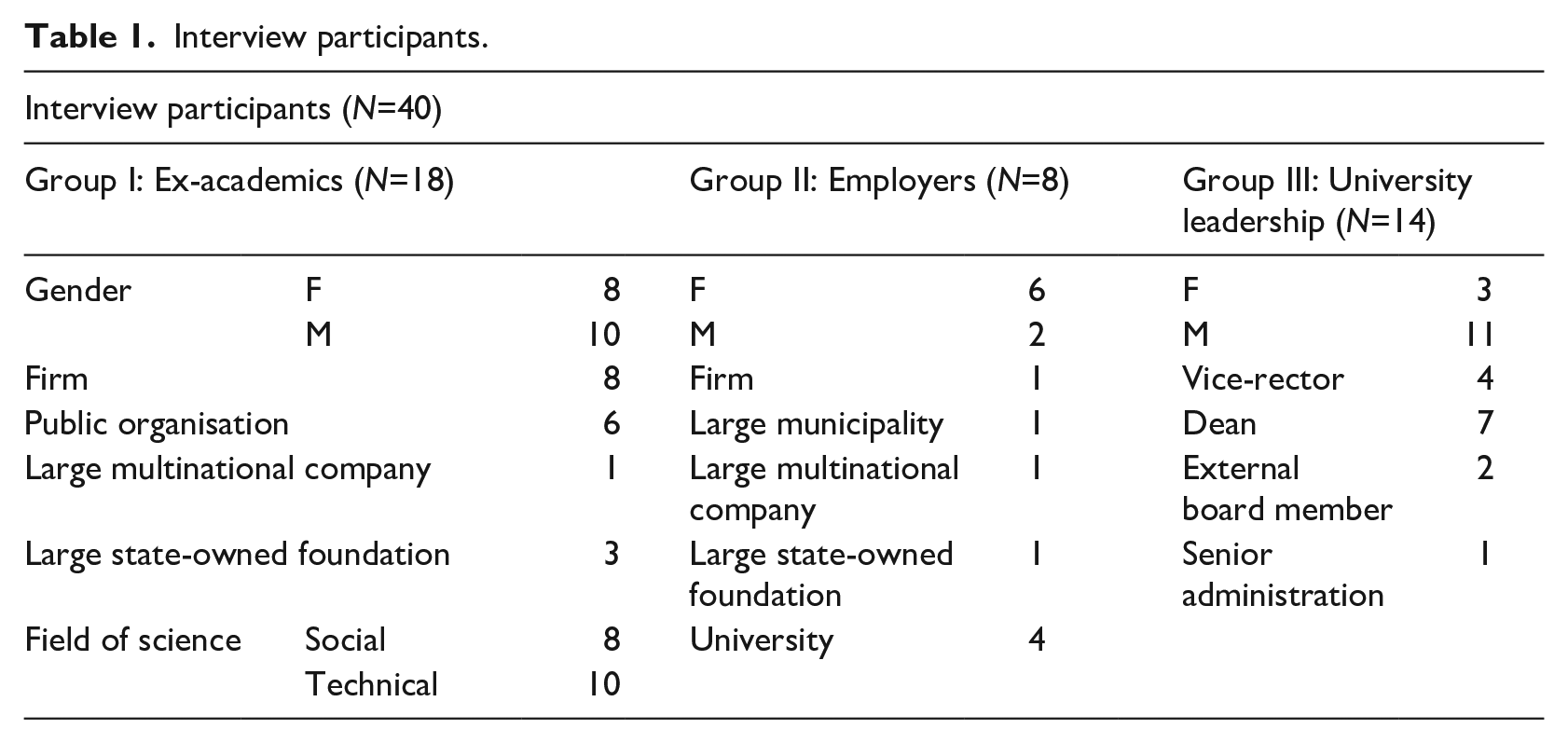
Informants were recruited by selective and snowball sampling (Bernard, 2000). In practice, this involved contacting technical and social sciences professors from different universities to ask whether they could identify potential informants meeting the following three conditions: (a) work experience in a Finnish university; (b) a PhD in either social (soft) or technical (hard) sciences (for present purposes, ‘social sciences’ included business sciences); and (c) at least one year of work experience in some other sector after exiting academia. During the subsequent interviews with the ex-academics identified by the professors, the interviewees were themselves asked to identify other potential informants (snowball method).
In selecting informants for the second and third groups, the homepages of Finnish universities and public and private organisations played a key role. Where possible, informants in the second group were selected from the organisations for which the ex-academics currently or previously worked. For the third group, hard and soft sciences were equally represented among the selected upper management and board members from different universities. As several informants in the third group had previously worked outside academia after completing their PhD, they had some direct experience of being ex-academics.
Interviews lasted between 45 and 80 minutes and were audio-recorded. Informants in all three groups were asked to describe their professional backgrounds and careers. They were also asked about the reasoning and rationale of PhDs exiting academia and their thoughts on ex-academics’ career transitions and career building outside academia. To ensure anonymity, informants are identified in the results section by assigned codes (e.g. ex-academic #13: (EXA-13); employer #8: (EMP-8); university #10: (UNI-10)).
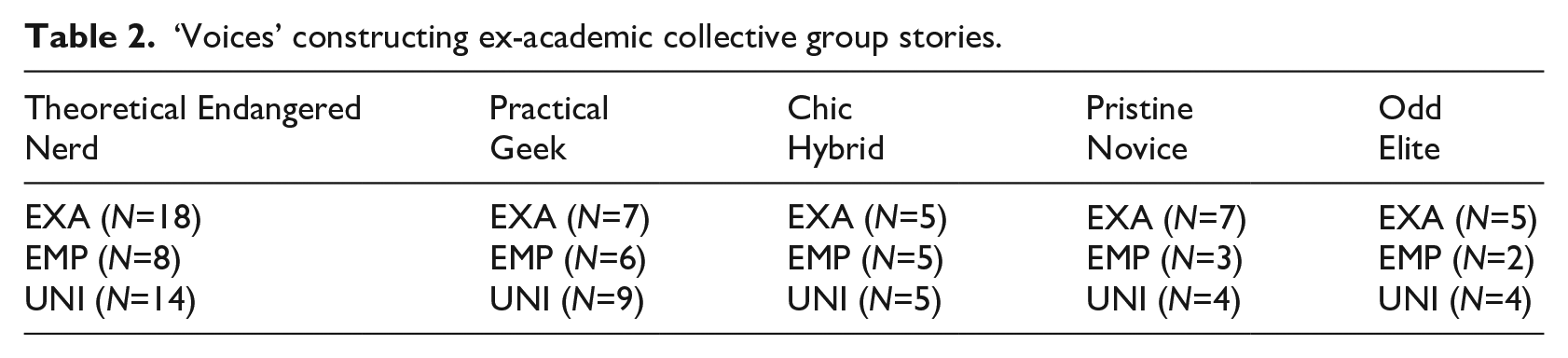
As previously mentioned, the present study was influenced by the works of Hunter (2010), James (2017), Ylijoki and Henriksson (2017) and Cohen and Mallon (2001). In addition, as in Bosanquet et al. (2017: 893), the narratives reported here are ‘collective or composite’: that is, they are constructed from the multiple interview responses (‘voices’) of the three groups (Tables 2 and 4), rather than from the experiences of a single group or individual. These collective group narratives utilise empirical quotations from thematically structured themes (Silverman, 2011) detected during the analysis. These data are multi-layered and represent the career-building experiences of ex-academics with university work experience in Finnish universities at a moment in time. One of the complexities of this approach is the emergence of multiple subjectivities in the text (Connelly and Clandinin, 1990); we believe this use of multiple first-person accounts highlights the diverse identities and experiences of the ex-academics involved in the sensemaking of the three participant groups.
‘Voices’ constructing ex-academic collective group stories.
Following transcription of the recorded interviews, all transcripts were read multiple times to gain a general understanding of the data. In the next stage of the empirical analysis, the ex-academics’ (group 1) responses to professional background and career questions were scrutinised. These responses were in narrative form and were used as narrative data (Polkinghorne, 1995). The 18 narratives were read multiple times to identify emergent themes in how the ex-academics talked about their professional backgrounds and careers. The narratives were then content-analysed to search for similarities and differences in how the stories were told and to identify any critical incidents or other matters that may have affected career building from the informants’ own points of view. In short, detected themes were coded and assigned to categories (Silverman, 2011). These inductively generated categories were organised along six dimensions: (a) university work contracts; (b) universities as institutions/university work/PhD degrees; (c) practices: activities complementing PhD studies; (d) orientation: risk-taking/security-seeking; (e) focus: single/interdisciplinary; and (f) pressures/constraints. Next, each narrative was analysed in terms of these six dimensions to develop a plot and central chronology of past, present and future (Connelly and Clandinin, 1990: 9). This scheme was used to construct new narratives and to group similar narratives, yielding three collective group narrative stories labelled (a) theoretical; (b) practical; and (c) hybrid.
As this stage examined only part of the empirical data, the next stage analysed all participants’ responses to the question concerning the reasoning and rationales behind PhDs exiting academia and their thoughts on ex-academics’ career transition and career building outside academia. Beyond discussing their own rationales, the ex-academics (group EXA) also described and evaluated how and why others might have exited academia. The remaining informants (groups EMP and UNI) also discussed different types of ex-academics and their rationales for exiting academia. At this stage, it was anticipated that the rest of the data would fit the three stories identified previously.
All the data, including the rest of the unanalysed data, were re-read multiple times to gain an in-depth understanding of the content and emergent themes. Unlike the narratives of the 18 ex-academics previously analysed, the narratives resulting from this stage did not address questions about reasonings and rationales or career transition and career building outside academia. Instead, the emergent themes were coded and grouped into categories before being constructed as narratives – in other words, narrative analysis (Polkinghorne, 1995) was used as the first step in facilitating the six-dimensional analysis.
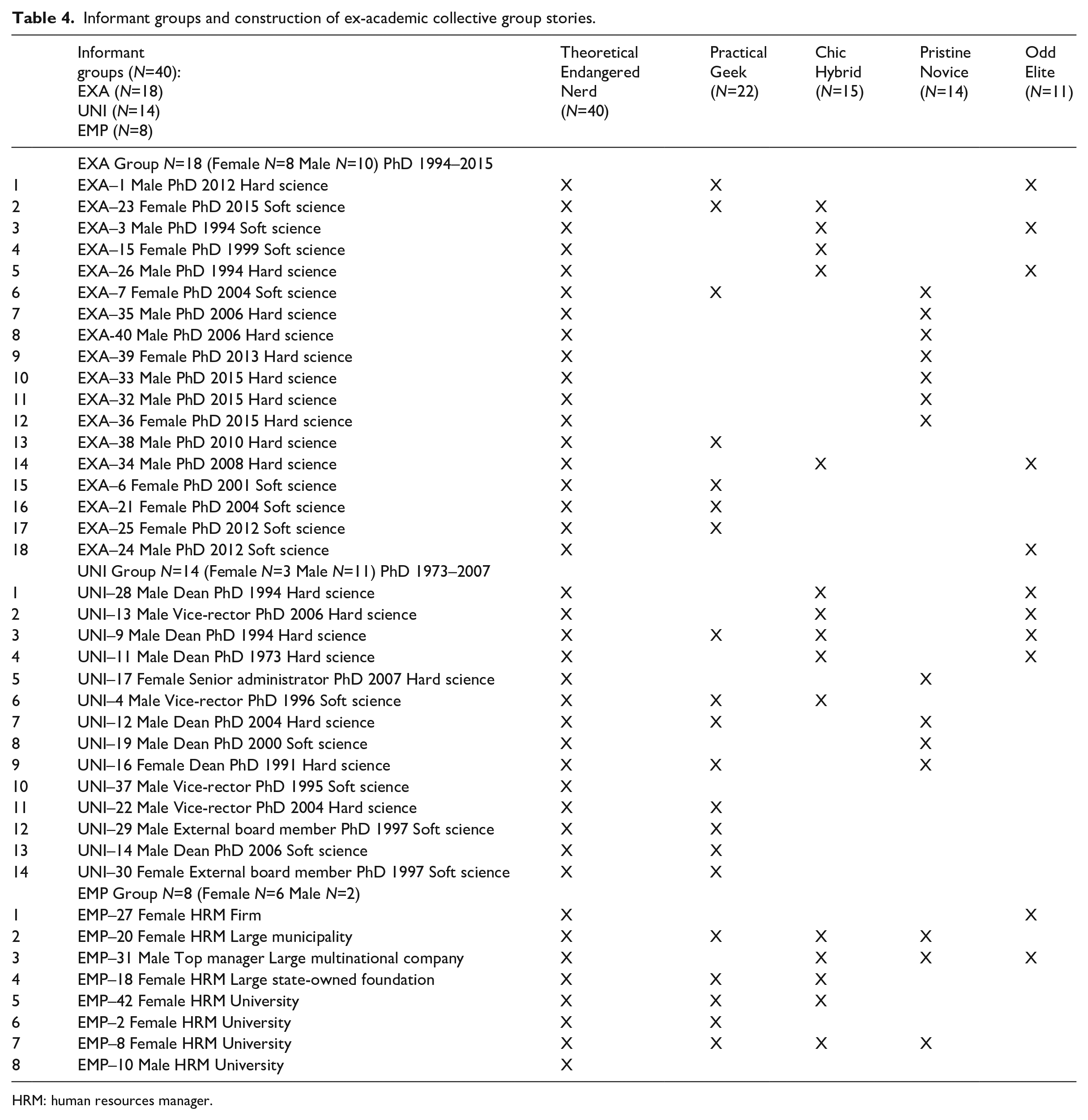
This analysis yielded 84 new narratives beyond the previously identified 18 ex-academic narratives. As many informants discussed more than one ex-academic story, the process yielded 102 narratives in total (see Table 4). Each of the 84 narratives was subjected to a six-dimensional analysis, as well as a simultaneous effort to piece together new narratives and group similar ones to ensure a comprehensive grasp of the stories and the multiple ways in which ex-academics’ careers evolve (see also Ylijoki and Henriksson, 2017).
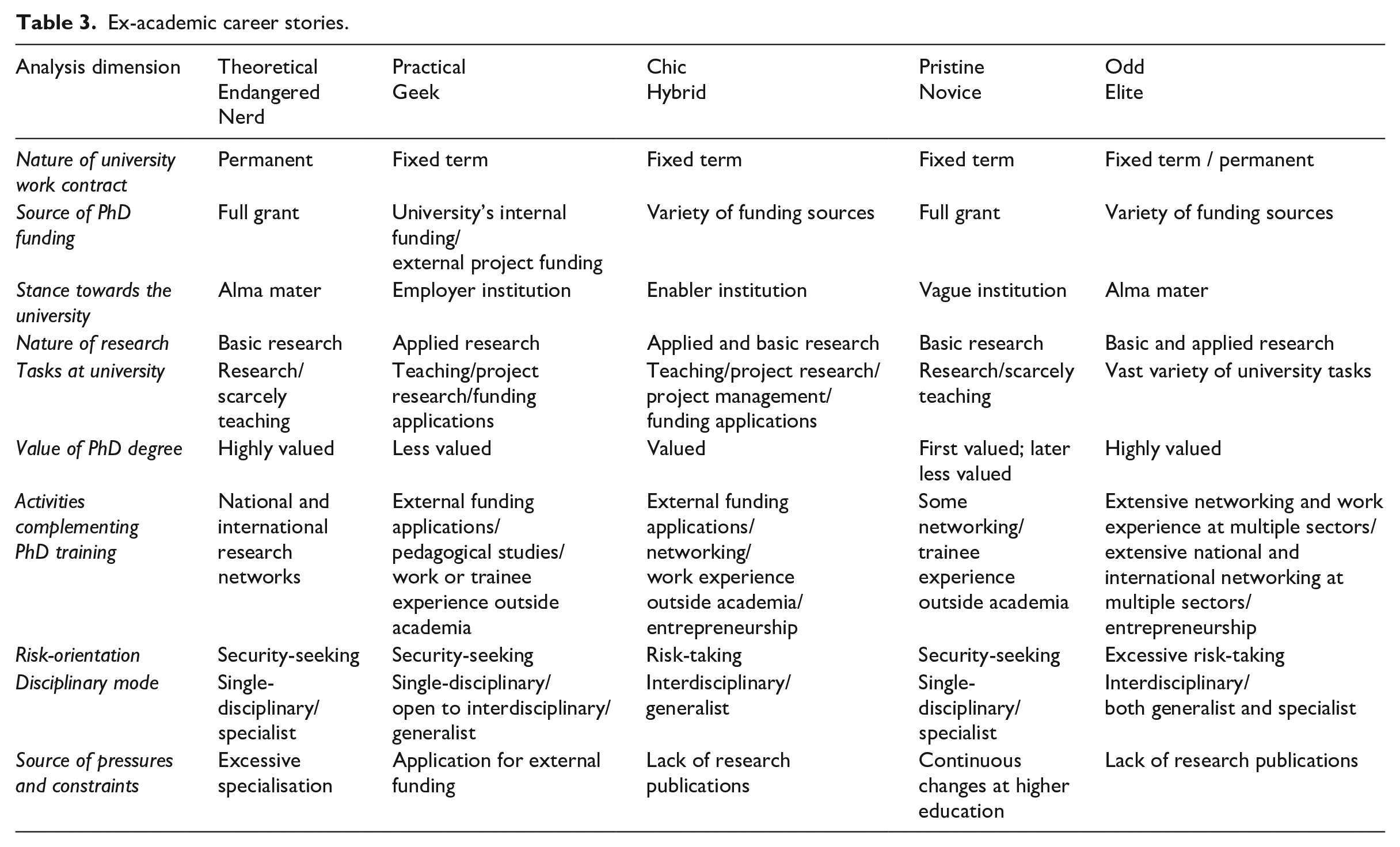
While some of the new narratives fit the three types identified previously (theoretical, practical and hybrid), analysis of the remaining data generated five new typologies encompassing the three original types (see Table 3): (a) Theoretical Endangered Nerd; (b) Practical Geek; (c) Chic Hybrid; (d) Pristine Novice; and (e) Odd Elite. The titles of the five stories have been adapted from the empirical data analysis and drawn from how the informants used different semantic typologies to talk about ex-academics. These characterisations reflect the informants’ frequent use of humour and caricature, which tend to vary across cultures and nationalities. For example, the Finnish informants used expressions like ‘theoretical nerd with a feather pen in his/her hand’ (EMP-2) and ‘tinfoil hat type’ (EXA-38). The title Theoretical Endangered Nerd reflects the atmosphere identified in the empirical data concerning the political attitude towards academics in Finland (see also Sintonen, 2015) and challenges ex-academics face pursuing employment outside academia due to being considered too theoretical and unable to engage in practical work. The historical stereotype of academics might be endangered if academics become mainstream, as academics may leave traditional basic research and theory-building behind to gain employment outside academia. The Practical Geeks typology reflects the empirical data showing that academics are seen as ‘nerds’ outside academia, despite having practical skills for work life (see also Suomi et al., 2019). Chic Hybrids have a mixture of practical and agile work life skills, but are also competent in academic research. Therefore, according to the empirical data, they have a favourable identity (see also Zinn, 2019) in terms of employability outside academia. The title Pristine Novice reflects junior academics’ orientation toward academic work prior to becoming full-fledged ‘theoretical nerds’ and building careers outside academia (see also Ylijoki and Henriksson, 2017). Finally, the title Odd Elites refers to ex-academics who cross boundaries within and outside academia and attain both practical and theoretical skills, which are seen as favourable by employers (see also Aarnikoivu et al., 2019). Each story encompasses both hard and soft scientists and draws on multiple interviews from all three participant groups (see Tables 2, 3 and 4).
Ex-academic career stories.
Informant groups and construction of ex-academic collective group stories.
HRM: human resources manager.
Capturing culturally distinctive and coherent ways of making sense of ex-academics’ career experiences in Finland, the career stories were constructed from multiple perspectives in collective group vein (Tables 2 and 4). They triangulate the reflections of ex-academics, university leaders and HR professionals.
The six dimensions of analysis
As discussed above, the iterative empirical data analysis identified six dimensions: (a) university work contracts; (b) universities as institutions/university work/PhD degrees; (c) practices: activities complementing PhD studies; (d) orientation: risk-taking/security-seeking; (e) focus: single/interdisciplinary; and (f) pressures/constraints. Although inductively detected, these were later abductively analysed, as earlier career studies have used other combinations of similar dimensions (e.g. Aarnikoivu et al., 2019; Durette et al., 2016; Ylijoki and Henriksson, 2017). It was also important to further clarify how the dimensions contribute to the narratives’ plots and the key time-based structure of past, present and future (Connelly and Clandinin, 1990: 9) in generating the five comprehensive group stories. The informants discussed their professional backgrounds, as these were a focal point of the interviews; however, they rarely mentioned family–work balance or the roles of age and gender issues in the context of ex-academic career building.
In relation to the first dimension (university work contracts), there are three categories of academic faculty and work in Finnish universities (Ylijoki and Henriksson, 2017). While universities’ internal funding pays for permanent faculty in (a) administration and (b) research and teaching (see also Kivisto at al., 2017), external funding pays for (c) fixed short- and long-term contracts. Finnish academic careers, especially in the early ‘post-doc’ phase, are characterised by short-term employment contracts and relatively low levels of inter-institutional mobility (Aarnikoivu et al., 2019).
Approximately 70% of teaching and research staff hold fixed-term positions (commonly ranging from six months to two years). In Finland, unlike in many other countries (see e.g. Harvey et al., 2017), these are an essential component of ‘regular’ full-time academic staff (see e.g. Sivistystyönantajat, 2017). This de facto division of the academic workforce into permanent, budget-funded faculty and fixed-term, externally funded researchers is based on academic tradition, prior legislation and budgetary practices (Kohtamäki, 2013; Pekkola, 2014). However, neither current legislation nor official statistical data recognise this division.
At Finnish universities, PhD candidates are typically employed for a fixed term and fund their studies in four main ways. The first group is supported by universities’ internal funding explicitly earmarked for PhD studies, and their key obligation is to complete their PhD studies with little or no teaching work. The second group comprises university teachers on fixed-term contracts, again supported by internal funding; their job description involves relatively little research work. The third group work on fixed-term contracts using research and development project funding from national research councils, the EU or other funding bodies. These funding instruments often prioritise either basic research or applied research (OECD, 2015) and development with partner organisations. Finally, a fourth group of PhD candidates take part-time or full-time jobs outside academia while completing their PhD studies (see also Aarnikoivu et al., 2019; Ylijoki and Henriksson, 2017).
The second dimension (universities as institutions) echoes Yljoki and Henriksson’s (2017) finding that the nature of university work and PhD degrees contributes to the decision to stay in or exit academia. Regarding the third dimension (practices and activities during PhD degrees), Durette et al.’s (2016) recent work on the core competences of PhDs concluded that work experience can impact one’s ability to build networks. The fourth dimension (risk-taking orientation) relates to the role of resilience in the face of uncertainty in career building (Giddens, 1991, 2000; Nicholson et al., 2005; Nir and Zilberstein-Levy, 2006; Zinn, 2019). The fifth dimension (single or interdisciplinary orientation) also influences one’s basic approach to career building outside academia (Aarnikoivu et al., 2019; Roumbanis, 2018). Finally, each story reveals how the sixth dimension (pressures and constraints) shapes ex-academics’ careers (see also Gieryn, 1983; Lam, 2010).
Together, the five stories shed light on the cultural stances of ex-academics, employers/recruiters and senior university leaders in making sense of ex-academics’ career building. As discussed in the next section, the results reveal extremes and even contradictions in the interviewees’ understandings. Building on Ylijoki and Henriksson’s (2017: 1297) model, each of the five career stories begins with an empirical quote ‘to illuminate and provide a nuanced depiction of the characteristics of a given story’, along with ‘apposite phrases from the data’, with longer quotes identified by group affiliation (e.g. EXA-1, EMP-1, UNI-1).
Ex-academics: Five collective group stories
The Theoretical Endangered Nerd
‘The stereotype is still alive . . . the researcher is alone in the booth and conducts the work alone . . . we need to come out of the silos’ (EXA-23).
The Theoretical Endangered Nerd sees the university as the home of academia and the point of origin of basic research. In this, they echo Merton (1957): ‘What is the purpose of university’s existence? Is it to produce researchers for university? Or assure skilled labour with . . . theoretical knowledge for societies’ needs?’ (EMP-27). These PhDs focus on basic research and are guided by their supervising professors toward permanent academic positions, which are funded by full grants.
Theoretical Endangered Nerds assign high value to the PhD degree, and their core aim is to succeed in an academic career. They take admission into the ‘ivory towerish’ research culture for granted: ‘[T]ypically, the PhD students work alone on their research’ (UNI-28). Similarly: ‘. . . it [research work] doesn’t necessarily include any social interaction, the PhD studies, and neither typically [does] the research work in itself. [It is] mostly sitting quietly by the computer or notebook in the booth’ (EXA-35). In fact, Theoretical Endangered Nerds seem to adopt the ‘ivory tower’ culture of their alma maters early in their careers, during their bachelor’s and master’s studies.
However, the data revealed changes in this ‘ivory tower’ working culture. As one informant reflected, ‘The time of the lonely heroic researcher is gone’ (EXA-25). Though most still conduct their research individually rather than in teams, socialisation is beginning to break this trend (Lam, 2010). Further, Theoretical Endangered Nerds face increasing pressures that conflict with the ‘ivory tower’ culture; as one informant noted, ‘[in] modern times, most successful researchers are involved in international research, and they have . . . a tolerance for networking’ (UNI-9). Theoretical Endangered Nerds see the university as a castle within which the most valuable research work is accomplished, and they believe that research work must be protected from extensive teaching responsibilities and the need to apply for research funding. However, changes in Finnish universities’ state funding programmes have destabilised this protected scheme.
Theoretical Endangered Nerds tend to specialise in one scientific discipline and avoid risk-taking other than in relation to new research breakthroughs. They do not aim for interdisciplinarity because it is considered too risky and potentially harmful to deep specialisation: ‘In my situation especially . . . I have been working on basic research . . . that is useless for practical work’ (EXA-36). Theoretical Endangered Nerds encounter constraints when their specialisation or theoretical orientation fails to meet the demands of academia or external sectors: ‘Some of our managers say that it is useless to recruit PhDs; I am the only exception . . . because I also understand something about [interdisciplinary] practice’ (EXA-21). Similarly, one informant (EXA-6) shared that ‘many people find ex-academics too theoretical’. With respect to practical applicability, ‘. . . it depends what you have done at the university. If you have mainly worked alone with research, it is a rather big difference to work with clients and be dependent on them’ (EMP-42). Moreover, EMP-20 noted that ‘[i]t is up to the person how well they develop from lonely research work to social team work and collaboration with clients’.
However, specialisation is sometimes considered advantageous in sectors other than academia: ‘For specialised knowledge-intensive tasks at least, it [specialisation] is seen as a positive and not too theoretical’ (UNI-30). Theoretical Endangered Nerds do not commonly transfer to jobs outside academia and have little work experience beyond the university. Therefore, those employed outside academia are mostly headhunted. As one of the interviewed employers explained, they pursue PhDs because ‘we are a fact-based organisation and we want information, deeper knowledge and analysis’ (EMP-27). However, Theoretical Endangered Nerds are generally interested in returning to academia rather than building careers elsewhere. Because this group’s work experience and networks relate mainly to national and international academia and international research outcomes, they do not necessarily align with the ‘political pressures [for] effectiveness and concrete practical benefits for society’ (UNI-9) raised by policy makers and contemporary society.
In summary, the collective group narrative of the Theoretical Endangered Nerd is reconstructed from 40 informant narratives, as presented in Table 4. This story describes a specialised academic researcher with a deep and narrow focus on basic research (OECD, 2015), often with no interest in practical applications. The story emphasises the core historical values that inform the role and purpose of academic knowledge in society, even as the academics remain in the ivory tower. The PhD degree and the university as an institution are highly valued, and the Theoretical Endangered Nerd aspires to permanent university faculty status. The empirical data confirm that this applies to both ‘soft’ and ‘hard’ sciences.
One interesting additional finding was that all the informants discussed the Endangered Theoretical Nerd story. In terms of employability, the value of the Theoretical Endangered Nerd in other sectors was not clear-cut, and the empirical data suggest that these PhDs face the greatest challenges in that regard. However, there was also some evidence that the Theoretical Endangered Nerd adds value to organisations, especially in highly specialised industries. These ex-academics tend to remain in research-oriented roles within their own disciplines and in the same sectors they first enter after leaving academia. However, when an opportunity arises, the Theoretical Endangered Nerd’s goal is to return to an academic career.
The Practical Geek
‘. . . some of our PhDs tend to be involved in more practically oriented work . . . and applied research that has a more immediate effect on surrounding society, and that is okay’ (UNI-19).
While completing PhD studies, Practical Geeks have fixed-term contracts with their universities that entail both teaching (supported by the university’s internal funding) and research and development projects (supported by external funding instruments/sources). As one participant noted: In a way, it is all about applying continuously for research funding. You need to succeed every six months or so, depending on the length of funding, whereas you only need to succeed once when applying for a job elsewhere, and then you can concentrate on the actual work. (EXA-1)
This story also includes an appreciation and willingness to teach: ‘I liked teaching, and I had nice experiences, but teaching is not really valued at the university’ (EXA-38).
The Practical Geeks’ views on universities as institutions reflected the unpredictability of academic careers with short-term work contracts and ongoing funding applications. The Practical Geek’s relationship with the university as an institution is distant and instrumental, such that the university is viewed as a financial enabler of a PhD degree, rather than as a career-building aid: ‘Then, we received the . . . funding . . . That is when I decided to take up [my] PhD’ (EXA-23). One ex-academic (EXA-6) described university work as follows: ‘It is so detached from the reality . . . I got a dream job here . . . as a knowledge worker . . . It kind of integrates the worlds of research and decision-making’. Practical Geeks do not assign high value to PhD degrees; for them, completing a PhD is a matter of convenience, rather than a goal: ‘I never really had any burning inner desire for a PhD degree . . . The circumstances just enabled . . . to take up the PhD work’ (EXA-1). Moreover, ‘when they [PhDs] are too long in university work, it gets harder to find [a] job outside academia, and, simultaneously, the universities’ current financial resources do not allow more recruitment’ (EMP-31).
In this story, the activities associated with PhD studies are closely related to the funding instrument. Interviewed PhDs who worked as teachers engaged in fewer networking activities outside of their students. Such Practical Geeks might take up pedagogical studies (‘I completed the pedagogical studies’ (EXA-25)), which are complementary to PhD studies. By contrast, those involved in more research and development-oriented work had more networking opportunities: ‘We did quite a lot of investigation-type applied research . . . I only had a few teaching responsibilities’ (EXA-21). Such work is commonly linked to externally funded research and development projects that focus more on applied research (OECD, 2015) and partner organisations. As one respondent noted, ‘What you do at the university affects . . . projects you implement . . . and you gain knowledge that enables you to exit’ (EXA-38). Typically, such development work resembles working cultures beyond academia: ‘They develop a resilience to competitive working culture and continuous performance measurement’ (EMP-2). Hence, it is sometimes contradicting for PhDs to learn to work outside academia because it is the law of market and business that rules everything. There is hardly time for long and deep analysis; instead, you need to proceed fast to a final product and deal with a client. This differs from classic academic work. (EMP-18)
The Practical Geek’s orientation is more security-seeking than risk-taking: ‘If someone had offered a slightly longer work contract . . . I might have considered staying [at the university]’ (EXA-38). As another ex-academic who related to this story explained, ‘I longed for more continuity at the university’ (EXA-1). The drive for security is also linked to the short-term nature of fixed work contracts and the risks to contract continuity. Similarly, ‘working outside academia might be tempting in terms of security [for] the future, since there are more secured permanent work places available than in universities’ (UNI-4).
The Practical Geek story often includes work or trainee experience outside academia prior to or during PhD studies. In addition, while Practical Geeks often remain within a single discipline, they may be interested in adding interdisciplinary knowledge to their repertoire. While completing their PhD degrees and working at their universities, the informants who related to this story sometimes realised that their future career was in another sector: ‘I left after my PhD defence because, during the PhD work, I realised that the research work is not my career. Then I exited’ (EXA-7).
In this story, the constraints centre on the continuous stress of applying for external funding to secure fixed-term work contracts. This application process is time-consuming and hinders actual research work: ‘When I have the funding and work contract, I can get on with research and publishing . . . I also have to manage projects successfully – otherwise, I will not be granted the next funding’ (EXA-23). However, learning to work under pressure to ensure continuous funding is also important work experience: ‘It seems that they do well in very demanding tasks and are not too theoretical’ (UNI-30). The need to apply for external funding, therefore, has pros and cons for Practical Geeks: ‘It seems that they have learned to develop, present and defend their ideas . . . which is helpful in complex work environments’ (EMP-10). In addition, ‘they have somewhat learned to cope with [a] competitive work environment and [the] uncertainty of the future. It helps to adapt to work life outside academia’ (EMP-2).
At the heart of the Practical Geek story is a desire for practical results in work and career, rather than a concern with theoretical matters: ‘I am goal-driven . . . I do not need a half year to decide what kind of perspective to take. That is the problem with many ex-academics’ (EXA-21). The Practical Geek values practicality: ‘[P]ractical development work has been of more interest to me’ (EXA-25). In addition, ‘collaboration projects with firms enhance PhDs’ practical work life skills. We have seen it a lot’ (UNI-16).
Practical Geeks see careers outside academia as easier and less stressful than an academic route. They find jobs outside academia through their networks or open competition. As one reflected, ‘I went to a firm which I kind of knew. I applied for the open position’ (EXA-1). According to one employer, ‘it is up to the individual [to determine] how they can utilise their knowhow’ (EMP-20). Furthermore, ‘We have witnessed how practically oriented PhDs are employed outside academia’ (UNI-22).
In summary, the collective group narrative of the Practical Geek story is reconstructed from 22 informant narratives, as presented in Table 4. This story reveals how ex-academics’ career building begins during their doctoral degree studies and academic work. Practical Geeks have an instrumental view of the PhD degree and the university as an institution, and they are found mostly among externally funded project researchers, including those who teach. Some have also worked outside academia before or during their academic career and PhD studies.
Possible contradictions in this story relate to how members of this group come to PhD studies, which are less likely to be a planned objective than a matter of circumstance (either to secure future work contracts or because they succeed in attracting the types of external funding that facilitate the pursuit of a PhD). Practical Geeks are generalists and avoid taking risks. Their research is not their core interest area unless it is also practically oriented. Further, Practical Geeks are found in both ‘soft’ and ‘hard’ sciences, and the empirical data suggest that a majority are female. Typically, Practical Geeks remain in their own discipline and keep up to date with knowledge in their field. When changing jobs, they usually stay in similar occupational fields, often within the same sector.
The Chic Hybrid
‘When you transfer from university to other sectors and across sectors many times, you learn to understand different sectors, and if you stay within the university or a single sector, you will develop an incorrect understanding of those sectors’ (EXA-26).
Chic Hybrids see universities as enablers of both basic research and the practical application of research to other sectors of society. Their PhD degrees are completed during fixed-term work contracts as teachers, researchers or project managers at their universities, funded by various sources. Viewing continuous external funding applications as valuable work experiences rather than burdens, Chic Hybrids value their PhD degrees as enablers of interesting work opportunities across different sectors: ‘But I did not think an academic career or a permanent work contract was something that I aimed for . . . With a PhD degree, I would gain more knowhow to work in other sectors’ (EXA-34). This perspective was not shared by all: ‘I am somewhat sceptical of how much university work itself enhances possibilities to adapt to other sectors outside academia. Even I have experienced it positively myself’ (UNI-28). However, ‘[t]here are PhDs who have learned to brand and market their knowhow and skill outside academia’ (EMP-18).
This story emphasises interdisciplinary research teamwork and the flow of new knowledge across disciplines: ‘Utilizing the knowledge in your own work, you can develop yourself and the issues’ (EXA-15). According to employers, ‘they [PhDs] can evaluate wholes and base their judgements on knowledge, and that is how we achieve genuine development’ (EMP-8). Most of the informants who related to this story agreed that, ‘in every respect, researchers should be encouraged to [engage in] more interaction with other disciplines’ (EXA-23).
Chic Hybrids may have multiple academic degrees from different disciplines; however, although they are more generalist than specialist, they have a demonstrable capability to specialise in compelling research work: ‘There are situations where the employers have less educational background than the PhD applying for the job, and I have heard many times how this might have hindered the requirements outside academia’ (UNI-13). Hence, ‘it is up to the employers how they detect the work life skills and competences while recruiting PhDs’ (UNI-9).
Importantly, this story encompasses both younger and more senior ex-academics. Furthermore, Chic Hybrids have often worked in other sectors before entering academia: ‘Within industry . . . as a consultant, . . . engineering work . . . Then, I went back to university’ (EXA-23). Risk-taking is common in this group, whose members are attracted to the idea of leaving a permanent work position to try something new: ‘I started to think differently [about] why I should have permanent work, and then I just left the permanent teaching position’ (EXA-34). Transferring from a university to another organisation in the public, private or third sector – and, in some cases, self-employment – is central to this story: ‘The desire for new experiences and learning . . . takes PhDs to crossing boundaries and working outside academia’ (UNI-11). In addition, ‘I have realised that PhDs who leave academia have [an] urge for [a] faster work rhythm and to try new work paths’ (EMP-42).
Networking across sectors and at the (mostly) national level is typical of Chic Hybrids. They may also have international networks (mostly for research purposes) and are often connected to their work outside academia. Many informants who related to this story described being headhunted while working at a university: ‘I was already being asked a year ago to come here to work’ (EXA-3). Employers explained that Chic Hybrids tend to avoid institutionalisation in their careers and look for new working opportunities: ‘[They don’t like] being stuck in the same role . . . There are more opportunities to find new experiences’ (EMP-31). Chic Hybrids are often headhunted across sectors, and they do well in open recruitment competitions outside academia: ‘Competition for financial funding and all other [funding] is very tough . . . I have realised that the PhDs who come here to work are extremely capable: They cope excellently’ (EMP-20). In addition, one informant remarked that ‘PhDs who have university work experience learn resilience to uncertainty and how to work under pressure, [and they have a] problem-solving attitude’ (UNI-4).
When applying for academic positions, Chic Hybrids face constraints related to their lack of research publications. Some overcome this constraint by writing and publishing articles while simultaneously building careers outside academia.
In summary, the collective group narrative of the Chic Hybrid story is reconstructed from 15 informant narratives, as presented in Table 4. This story includes both specialists and generalists, although the latter are more common. Like Practical Geeks, Chic Hybrids have work experience in other sectors before entering academia. Further, this story includes representatives of both ‘soft’ and ‘hard’ sciences. Networking and a multi- or interdisciplinary focus are at the heart of the Chic Hybrid story, and risk-taking is a driving force for new learning endeavours. Transferring across different sectors is commonplace, and an entrepreneurial attitude (Lam, 2012) with an urge to innovate often sparks an inner drive for continuous change. Chic Hybrids perform well in open recruitment and frequently attract headhunters. Typically, Chic Hybrids do not aim to return to an academic career, as they have already ‘seen it’, but they maintain loose networks with academia. Since some also persevere with (applied) research and publishing, universities commonly invite them as visiting lecturers. Among the informants, there were more male ex-academics relaying this story than female ex-academics (see Table 4).
The Pristine Novice
‘I really did not see any future for myself at the university anymore even though I had dreamed about [an] academic career’ (EXA-39).
Pristine Novices are typically junior PhDs or are close to finalising their doctoral studies. Unlike Practical Geeks and Chic Hybrids, they continue directly to doctoral studies after completing their master’s degrees. Pristine Novices have some (or even extensive) university work experience on externally funded research projects after completing their PhDs. In contrast to Practical Geeks, Pristine Novices collect university work experience that primarily involves basic research, with little or no teaching. They are often recruited to academia while finalising their master’s degrees by professors leading research projects: ‘We have these young researchers who might have [a] prestigious future in academia’ (EMP-8).
Unlike the Practical Geek and Chic Hybrid stories, the Pristine Novice story typically involves less pressure to apply for external funding, as Pristine Novices commonly have fixed-term work contracts based on research project funding for the duration of their PhDs. Further, Pristine Novices are likely to have had internships or work experience outside academia, usually in related fields: ‘You need to look actively for connections and participate in events’ (EXA-32). In addition, ‘We have very good contacts and networks with firms, and they are keen to collaborate with our researchers’ (EMP-8). Pristine Novices may also gain minor international academic work experience while working on their PhDs, and they are likely to be more committed to their research teams and their leading professors than to their universities. Pristine Novices assign high value and importance to their PhD degrees, but eventually come to see their perceived value of such degrees as inflated.
Like Endangered Theoretical Nerds and Practical Geeks, Pristine Novices are not risk-takers: ‘We should be able to keep the researchers and be able to offer better work contracts instead of the current short-term fixed contracts, which are often stressful for employees’ (UNI-19). Constraints arise, for example, when Pristine Novices’ original research teams come to an end or their leading professors move to new positions or other universities, breaking the secured continuum. In these circumstances, Pristine Novices are less willing to stay at the university and risk seeking new funding, a new research team or a new leading professor to secure their academic careers: It is well known in academia that, even when you apply and do all the work for research funding, it will not be guaranteed that you also will gain value from it in the end due to fixed term work contracts. Instead, someone else might receive a work contract based on that particular funding. (UNI-16)
For these reasons, Pristine Novices begin to look for security elsewhere: ‘Then, I realised that I cannot achieve very good outcomes alone. I need a research team, and I kind of begin from zero again . . . An academic career was not very appealing at that point’ (EXA-35). It is at this point that Pristine Novices begin to perceive their PhD degrees as less important.
Somewhat like Endangered Theoretical Nerds, Pristine Novices tend to specialise in one scientific discipline and are not interested in adding new interdisciplinary knowledge or experience to their repertoire. Interestingly, however, despite having relatively extensive university work experience, Pristine Novices have not yet been extensively exposed to the classic ‘ivory tower’ academic culture. In contrast to Practical Geeks, they are more involved in basic research and have demonstrable capabilities and promising academic outcomes: ‘We are competing with firms and other organisations of our best researchers. They receive job offers from around the world, even while completing their PhD studies’ (UNI-19). Ongoing changes in higher education mean that Pristine Novices are often victims of unpredicted situations and loss of their academic ‘nests’. After such incidents, they no longer aspire exclusively to in-depth basic research work and begin to take an interest in applied research with practical outcomes and customer-facing solutions: ‘I started to think that I wanted to gain experience in the business sector . . . something that has real outcomes and solves real problems’ (EXA-40). According to one informant, ‘they might have some adjustment problems at first in finding their role outside academia, but after a while, they will do well’ (UNI-12). Another noted, ‘PhDs and we at university need to learn to communicate PhDs’ knowhow outside academia’ (UNI-17).
Pristine Novices are attractive to recruiters outside academia and are often recruited quickly, even while still finalising their PhD degrees: ‘At the recruitment fair, I met one old friend who works here, and they invited me. I decided to leave, even though the PhD was not finalised’ (EXA-33). As one ex-academic said, ‘I was offered a job at [x] because I had been a trainee there during my studies’ (EXA-7). Employers appreciate ex-academics’ traineeships and work experience in other sectors: ‘Theory, as such, is important, but one also needs experience of how to apply it in practice’ (EMP-20). Pristine Novices are also recruited through their networks outside academia: ‘I had already been with this firm for a few years as a part-timer’ (EXA-35). An employer discussing PhD networking and recruitment made a related point: ‘Our HRM [human resources manager] and me, we often visit universit[ies] . . . where we want to recruit . . . to network with faculty members and PhD students and to offer them internships and employment’ (EMP-31).
In summary, the collective group narrative story of the Pristine Novice is reconstructed from 14 informant narratives, as presented in Table 4. This story closely resembles that of the Endangered Theoretical Nerd in terms of the view of university as the home of research and education, with the explicit difference that Pristine Novices’ secured academic career relationship is shattered by change. Following the critical disappointment of losing the professor and research team who originally recruited them, Pristine Novices move swiftly to rework their original plans for academic careers into ex-academic careers. In other words, Pristine Novices are victims of circumstances that ultimately loosen their academic ‘family’ ties. At first, having been recruited by a university with a fully funded fixed-term contract to complete their PhDs over several years, they are able to concentrate exclusively on research (unlike the Practical Geeks and Chic Hybrids). Pristine Novices’ initial aim is an academic career, and they exhibit the required research orientation and results. However, although their PhD degree is an important part of their education, they later assign little value to it. Unforeseen changes and their own risk avoidance orientation shifts their thinking, and they begin to doubt the possibility of building an academic career. In turn, their external networks and work experience lead to work opportunities in other sectors, and they are likely to be headhunted or successful in open recruitment competitions. They are not risk-takers and are more often specialists than generalists, and they commonly build their ex-academic careers with the same employers they join after exiting their university careers. Finally, this story applies to both ‘hard’ and ‘soft’ sciences and was relayed equally often by female and male ex-academics (see Table 4).
The Odd Elite
. . . so people still choose an either–or career at a university or in other sectors, public or private, and then they return to the university at some point. Instead, you should be continuously jumping across sectors . . . to renew your thinking and to experience other worlds. (EXA-24)
The Odd Elite sees the university as the home of all good and valuable knowledge and societal development. They appreciate basic research and do not question the core values of higher education or the role of the university as the highest educator: ‘I value what I have learned there and the networks [I developed]. I try to stay in touch with them’ (EXA-24). While completing their PhD degree, some Odd Elites work on fixed-term contracts in different university roles or as entrepreneurs. In some cases, they have a permanent work contract at the university.
In this story, the key point is not the funding mechanism for PhD studies or one’s work status at the university, but the strong ongoing drive to learn new things and push one’s comfort zone. For example, according to one interviewee, ‘[a]fter I completed the PhD degree, I moved to the industry sector . . . took up MBA studies . . . After nine years in the industry sector, I returned to university’ (UNI-13). As another noted, ‘I am a person who wants to learn new [things], and it has been extremely inspiring’ (UNI-28). As another informant described: My interest in research and completing PhD studies arose when I met people at university who had a similar interest in different phenomena. I knew that universities can rarely offer long-term work contracts, but that did not matter . . . I just have this endless belief in myself and survival . . . Actually, I still keep close contact with my academic ex-colleagues and sometimes give lectures at classes. (EXA-34)
As these interview quotes show, Odd Elites assign high value to their PhD degree, particularly in instrumental terms, as it allows them to experience multiple sectors and new endeavours.
Odd Elites take risk-taking to an extreme level: ‘It is scary, of course . . . I resigned from a permanent professorship . . . jumped into business, of which I had no previous knowledge. I knew that I had to learn new [things]. Very fascinating’ (UNI-28). In many cases, Odd Elites seek out inter- and multidisciplinary endeavours, both academically and across sectors. While they may remain within their original academic discipline, they also cross disciplinary boundaries and hold multiple academic degrees: ‘I completed my sixth academic degree . . . and founded a firm . . . took up a senior leadership position in the public sector’ (EXA-24). In many cases, ‘if you continuously work with innovations which were appealing for firms also on the international level while completing a PhD and during university work, it has resulted in very competent careers for PhDs’ (EXA-1). Odd Elites are both specialists and generalists, balancing and reconciling the two extremes. They have a strong networking orientation, and their networks extend nationally and internationally across multiple sectors.
Odd Elites succeed both inside and outside academia, again nationally and internationally: ‘I have been around the world a lot in industry, mostly in leadership positions . . . and have lived abroad for long periods’ (UNI-11). As one interviewee related: Look, at this stage of my career, I have experienced everything in and outside academia – at least I thought so, until when I was head hunted to this [organisation]. I instantly agreed to leave my job at university and try out something new again. (EXA-3)
Employers who related to this story stressed Odd Elites’ ongoing experimental orientation: ‘Those who prefer to stay in their bubble or their comfort zone – although it may seem nasty to say it – if you recruit such people, you will quickly run into problems’ (EMP-27).
Unless they have published academic research on an ongoing basis, Odd Elites face constraints when they consider a return to their academic careers: ‘Ten years in the industry sector . . . you will not publish many journal articles. So, it is challenging to reintegrate to the university’ (UNI-13). Odd Elites are interested in research and, unlike Chic Hybrids, are slightly more oriented toward basic than applied research. At the same time, they exhibit a strong willingness to collaborate with other sectors and to provide research-based knowledge for practical use: ‘A lot of people – in other universities, too – feel strongly that [basic and applied] research work is meaningful. That is why I came here’ (UNI-11). The rich work experience they gain across multiple sectors (even globally) is appreciated by universities recruiting for senior leadership positions and professors of practice. While the Odd Elite story typically involves headhunting (‘I have experienced myself and seen this happen: how the best PhDs are handpicked by the headhunters’ (EXA-26)), these individuals also succeed in open recruitment competitions and aspire to eventually return to academic careers. In this way, their story differs from those of the Chic Hybrid, the Practical Geek and the Pristine Novice, but is similar to that of the Endangered Theoretical Nerd, although any return to an academic career is less goal-oriented: ‘They come to work with us, but then some return to university’ (EMP-31).
In summary, the collective group narrative of the Odd Elites is reconstructed from 11 informant narratives, as presented in Table 4. This story reflects a risk-taking orientation and an ongoing determination to stay outside one’s comfort zone to complement the PhD degree and university work. Risk-taking is more evident in this than any other of the stories. Typically, the Odd Elite’s story involves multiple transfers across sectors, both nationally and internationally, and vast and heterogeneous networks. Simultaneously, Odd Elites remain in relatively close contact with their alma mater or with the university sector in general, again both nationally and globally. Despite the challenge posed by their lack of published research, they have an inner urge to return to an academic career. Like the other stories, that of the Odd Elite covers both ‘hard’ and ‘soft’ sciences; however, unlike the others, it was relayed only by male ex-academics (and one female employer; see Table 4).
Discussion
The peculiarities of academic career stories of ex-academics
As few studies to date have focused explicitly on career building among doctoral degree holders with university work experience who have exited academia and transferred to other sectors in Finland (Aarnikoivu et al., 2019; Helin et al., 2019; Pekkola, 2014), this study draws on existing research on the academic careers of PhDs working in universities (Billot, 2010; Durette et al., 2016; Hancock, 2018; Lam, 2010; Ylijoki and Henriksson, 2017). Although some similarities were observed between these two groups, there were more differences. This makes sense, in light of the differences in research settings between academic career building and ex-academics’ career building outside academia.
The career stories of both junior academics (Ylijoki and Henriksson, 2017; see also Barcan, 2018; Roumbanis, 2018) and ex-academics have their origins in the story of the ‘Theoretical Endangered Nerd’ (see also Lam, 2010). Interestingly, the similarities between academic and ex-academic career stories often produced differing career outcomes (see also Roumbanis, 2018). For example, Ylijoki and Henriksson’s (2017: 1297–1298) story of the ‘Novice of the Academic Elite’ shares some similarities with the stories of the Theoretical Endangered Nerd and the ‘Pristine Novice’. Similarly, their stories of the ‘Victim of the Teaching Trap’ (2017: 1298–1300) and the ‘Academic Worker’ (2017: 1300–1301) share some commonalities with the ‘Practical Geek’ story, while the ‘Research Group Member’ and ‘Academic Freelancer’ (2017: 1301–1304) stories share similarities with that of the ‘Chic Hybrid’. These overlaps relate to the culture of university work: that is, to the different kinds of work contracts that allocate academic workers to different categories within Finnish universities (Ylijoki and Henriksson, 2017: see also Kogan et al., 1994).
Regardless of the similarities of the career stories of academics and the differences between the career story-types of ex-academics, there are some dimensions that are visible watersheds in all career stories. These dimensions are grouped in the following vein: risk-taking orientation, attitude toward the vocation (stance towards the university, value of PhD degree, disciplinary mode and nature of research), gender, environmental contingencies (the nature of the university work contract, tasks at the university and source of PhD funding) and stances toward them (see also Table 3).
The first watershed is that the risk-taking orientation seemed to be the critical aspect articulating the social surroundings that constrained or enabled career decisions. In turn, these shed light on how the stories relate to the wider social world. The individual and institutional relationships, complexities, dynamics and contradictions of risk-taking have been studied extensively in the social sciences (Giddens, 2000; Nir and Zilberstein-Levy, 2006); however, in terms of ex-academics, there remains a need for greater understanding of the role of risk-taking in career development across sectors and outside academia. Nicholson et al. (2005) found that risk-takers come in three non-exclusive types: stimulation seekers, goal achievers and risk adapters. In addition, Zinn (2019) systematised the existing body of qualitative research on individuals’ risk-taking and distinguished a variety of motives, levels of control and reflexivity surrounding risk-taking. Furthermore, the risk-taking orientation is a learning process connected to surrounding social norms. A risk-taking orientation is not static and may evolve and vary in response to contexts or changed life situations. Hence, reduced risk-taking may be linked to negative events or increased responsibility for others (e.g. family, caring for children or the elderly), and some events may even increase dangerous risk-taking (e.g. high-risk leisure sports, criminal activity).
The stories of the Theoretical Endangered Nerd and the Practical Geek represent the extremes of the ex-academic career-building continuum. Both are low risk-takers and risk adapters. Both work at opposite poles of the university’s pillar activities: basic research (the Theoretical Endangered Nerd) and teaching (the Practical Geek; see also Heijstra et al., 2017; Ylijoki and Henriksson, 2017). According to Nir and Zilberstein-Levy (2006), pre-tenure academics are reluctant risk-takers and are typically unwilling to take on academic engagements (e.g. longitudinal studies, non-mainstream research openings, teaching and applying for funding) that do not provide quick results that add to their academic achievements. In contrast, when they have more secured work contracts (i.e. tenure-track positions or permanent work contracts), they are more open to risk-taking (see also Nicholas et al., 2005). This resonates with the story of the Theoretical Endangered Nerd. By contrast, Practical Geeks are not risk-takers and prefer to move outside academia after experiencing unsecured academic positions (see also Heijstra et al., 2017), though they are forced to take risks while still in their academic careers, due to their vulnerable positions (e.g. short fixed-term contracts, funding application rallies and teaching loads) and loss avoidance (Nicholas et al., 2005; Nir and Zilberstein-Levy, 2006; Zinn, 2019).
While resembling the Chic Hybrid, the Odd Elite takes these similarities (e.g. risk-taking) to a more extreme level. These academic career builders view risk-taking as ‘a means to an end’ and ‘an end itself’ (Zinn, 2019: 3), actively seeking continuous stimulation and successfully managing risk to achieve full control over their career development. In addition, in this story, a positive identity is dependent on risk-taking (Nicholas et al., 2005), the addition of a multidisciplinary orientation to research and the integration of national and international networks and ex-academic work experiences. Odd Elites’ drive for social and international mobility is also rooted in an interest in managerial achievements, which often promote financial success (Berglas, 1986; Ghosh, 2013; Stuart-Kotze and Roskin, 1983). As described in the introduction, the Bologna Process within European academia has enhanced internationalisation and mobility (Robson and Wihlborg, 2019), and Odd Elites and Chic Hybrids answer this call by striving for mobility, networking and internationalisation.
While the Pristine Novice story may seem akin to the pre-Theoretical Endangered Nerd story, these individuals’ progress to the ‘ivory tower’ may be derailed by unforeseen incidents, such as the exit of leading professors or the fragmentation of their research group. In this regard, Pristine Novices seem victims of the university’s career-building culture, as no one in academia is looking after their best interests (see also Heijstra et al., 2017; Ylijoki and Henriksson, 2017). Further, their low risk-taking orientation may trigger an interest in careers outside the university, thereby distancing them from the university sphere. Compared to the Theoretical Endangered Nerd, who engages in risk-taking to pursue an academic career and invests holistically in academia based on a Humboldtian hegemony (Välimaa, 2012), Pristine Novices are unwilling to take similar risks because their commitment to an academic career is more socially driven and because they do not feel indebted to academia, which has taken away from them (i.e. in terms of leaving them alone in a vulnerable situation marked by job insecurity) as much as it has given. To regain control, and in response to vulnerability and job insecurity, they risk their futures as academic elites to build careers in other sectors (Heijstra et al., 2017; Zenn, 2019).
The second watershed of careers is the attitude towards the vocation. The Theoretical Endangered Nerd story highlights the leading mission of a university: that is, education led by ‘pure’ knowledge gleaned from basic research discoveries. This story is rooted in Humboldtian ideas (Välimaa, 2012) of academic freedom and contradicts market-driven objectives and applied research (Suomi et al., 2019). Furthermore, it illustrates professional, institutional dedication and a commitment to academia and an academic career, similar to the French Catholic church bishopric’s early oblates. The bishopric’s Episcopal corpus was grouped into the early oblates and later ordinates/inheritors (Dianteill, 2004). The oblates were typically holistically dedicated to the institution and its religious traditions and were willing to sacrifice all their ‘worldly’ desires and possessions to the church, which they saw as having already given them everything. By contrast, the later ordinate, ‘aristocratic’ inheritor was motivated to commit to the church due to heritage.
There is an inherent risk in holistically investing all career capital in a single disciplinary and academic career, as in the oblate group; however, there is a significant difference in that the commitment between the church and the bishops is mutual, whereas academia might not make any permanent commitment to pursue the best interests of the Theoretical Endangered Nerd (see also Zinn, 2019). The attitude toward the vocation in the other four stories is less holistic; it is more of ‘a means to an end’ than an ‘end itself’.
The third watershed of the career stories is gender (even though the informants did not actively discuss this point, it seems it has career implications). The observed absence of females in the Odd Elites story, and their prevalence among Practical Geeks, can be understood in terms of earlier research on issues of gender equity in academia, which shows that female PhD students undermine their own capabilities and experience lower levels of satisfaction than males (Mantai, 2018). Helin et al. (2019) noted that women are more likely than men to dislike competitive settings, such as competition for senior positions (Bosquet et al., 2018; De Paola et al., 2017).
Finland is a low power distance country with a feminine society (Hofstede, 2001, 2019). Its education policy is characterised by an emphasis on equal opportunity in access to education and academic careers (Helin et al., 2019). In addition, the National Institute for Health and Welfare (2018) has identified Finland as a pioneer in gender equality. However, gender disparities in Finnish academia remain an issue (Academy of Finland, 2018; Helin et al., 2019; Lätti, 2017; Rolin and Vainio, 2011). The Odd Elites story slightly resonates with the inheritors, rather than oblates (Dianteill, 2004), echoing Helin et al.’s (2019) findings that the professoriate in Finland tend to be selected based on parental background and gender.
The final watershed relevant for career stories is that of attitude towards environmental contingencies and stance toward uncertainty. The findings of this study indicate that fixed-term university work contracts and the continuous pressure to apply for external funding lead Practical Geeks, Chic Hybrids and Pristine Novices to career-building schemes and possibilities that differ fundamentally from those of the Theoretical Endangered Nerd. While Practical Geeks struggle to juggle their PhD, university work and applications for external funding, Chic Hybrids thrive on all the action (see also Hancock, 2018; Roumbanis, 2018). In both stories, however, fixed-term work contracts and external funding schemes complement PhD studies, enhancing adaptation to the working cultures of other sectors (see also Gieryn, 1983; Lam, 2010; Ylijoki and Henriksson, 2017).
Pristine Novices face fewer pressures than Practical Geeks and Chic Hybrids to apply for external funding during their PhD studies. With little teaching work, they can focus on research, usually supported by full grants and externally funded, long-term fixed-work contracts, allowing them to build external networks (see also Heijstra et al., 2017). Odd Elites differ from the others because their university work contracts seem not to affect their relationships with universities as institutions or their attitudes toward an academic career, and they thrive on continuous change and uncertainty. In contrast, the Theoretical Endangered Nerds, who are not willing to risk their academic careers, work mostly on long, fixed-term contracts or secure permanent contracts, thus have less incentive to cross boundaries into other sectors, although some Theoretical Nerds work as ex-academics in other sectors, typically after being headhunted.
The study’s findings also highlight ex-academics’ boundary-crossing efforts, suggesting that their transfer to other sectors from academia is somewhat easier than the reverse. This finding aligns with earlier research (Fritsch and Krabel, 2012; Lam, 2010; Ylijoki and Henriksson, 2017). However, the Odd Elite and the Theoretical Endangered Nerd stories illustrate possible pathways back to academia.
Conclusions
This study has advanced our understanding of the roles of risk-taking, change and the factors related to ex-academics’ career-building efforts. In addition, it proposes that ex-academics’ risk-taking orientations depend on the larger social context, as well as on individuals’ own risk-taking orientations in career building. Furthermore, the study highlights that the evolution of ex-academics’ career building depends not only on individual risk orientation, but also on other factors affecting their career stories: attitude toward the vocation, gender, environmental contingencies and an attitude toward uncertainty. However, risk-taking may respond to these by enhancing positive identity and self-esteem, resulting in a feeling of being in control of one’s own career development. This feeling may become a ‘self-fulfilling prophesy’.
Based on the findings of this study, it can be argued that elements of university work generally characterised as hindrances to academic career building (Lam, 2010; Roumbanis, 2018; Ylijoki and Henriksson, 2017) – teaching, applied research and short-term work contracts requiring continuous applications for external funding – can also enhance and complement ex-academics’ career development. University work can either support or hinder employability elsewhere, and Finnish universities have begun to look at new ways of enhancing PhDs’ mobility and employability outside academia, including mentoring programmes and career counselling (see also MoEC, 2016 ; Nuutinen et al., 2018), to promote knowledge transfer across societal sectors (although the impact of such efforts is not yet known). Career building is not an entirely individual matter or a straightforward choice, but rather involves institutional, organisational, social and personal constraints. For this reason, not all career stories are available to all ex-academics (see also Ylijoki and Henriksson, 2017).
This study offers novel insights into how the career-building activities of PhDs beyond academia are understood by other ex-academics and employers, recruiters and university leaders. In so doing, it provides valuable information for PhDs and PhD students, higher education leaders and developers and employers in both academia and industry. The five stories indicate that an interest in societal issues and commercial challenges enhances the knowledge-based economy by bridging basic and applied research (although this is less often true of Theoretical Endangered Nerds). While both basic and applied research knowledge undoubtedly contribute to prosperity (Hampden-Turner and Trompenaars, 2015; Lam, 2010), it is important to acknowledge that the Theoretical Endangered Nerd story is rooted in the historical academic tradition and answers the current global academic call for excellence, ranking and high-level performance (see also Ylijoki and Henriksson, 2017). Without Theoretical Endangered Nerds and the longstanding academic values they represent, there might be no new stories to tell, as both ex-academics’ and academics’ career stories are ultimately rooted in this classic academic culture.
The empirical data reported here do not explore unsuccessful ex-academics’ stories – that is, PhDs with university work experience who are unemployed – and this gap in our existing knowledge invites further research. Nevertheless, this study contributes new insight to the knowledge on ex-academics’ successful employment and career development outside academia, as illustrated by the five collective group stories. Specifically, the findings show how and what kinds of decisions ex-academics make and how they manage risk-taking during the different stages of their PhD studies, including periods as junior researchers and academic employees. Although the findings are specific to Finland, they may resonate in other national contexts, and the exploration of these issues in different cultural settings beyond Europe represents another interesting avenue for future research.
Footnotes
Acknowledgements
The authors wish to thank the ‘Exiting academics in networked knowledge-societies’ research project and Academy of Finland for funding this study.
Declaration of conflicting interests
The author(s) declared no potential conflicts of interest with respect to the research, authorship, and/or publication of this article.
Funding
The author(s) received no financial support for the research, authorship, and/or publication of this article.
