




Abstract
For German higher education, the introduction of a two-cycle study structure resulted in a new transition stage after the completion of the bachelor’s degree. In contrast to some other countries, this structural change was stretched over a relatively long period. At the same time, the number of students enrolled in higher education has increased substantially. Existing empirical evidence indicates that starting a master’s degree programme is socially selective – in favour of students with tertiary qualified parents. Against this backdrop, we analyse how the level of social inequality at the new transition from the bachelor’s to the master’s level has developed over the course of the past two decades. Drawing on data from large-scale DZHW graduate surveys (graduate cohorts from the years 2005, 2009, 2013, 2017), we are able to replicate previous findings showing considerable social inequality at the transition to the master’s level. However, this inequality could not be detected for the 2005 graduate cohort, the ‘early adopters’. It seems that after an initial period of turmoil and uncertainty in the early stages of the implementation process, established patterns of inequality had re-emerged by the 2009 graduate cohort. We discuss the implications of our results for further research and policy-making.
Keywords
Introduction
In the late 1990s, the Bologna Process was initiated in Europe with the overall goal of creating what is referred to as the European Higher Education Area. A range of reforms were introduced to foster student mobility, employability and comparability of qualifications by ‘harmonising’ (Sorbonne Declaration, 1998) the structure of higher education (Bologna Declaration, 1999). However, this harmonisation process had different implications for the various participating countries – depending on the structure of the tertiary system before the Bologna Process (Kroher et al., 2021; Witte, 2006).
In terms of student population, Germany was the largest participating country to implement fundamental changes to the structure of higher education from a single-cycle to a two-cycle system (Kroher et al., 2021: 27; Neugebauer et al., 2016: 51). Therefore, it is not surprising that introducing a consecutive degree structure was a controversial topic at the national level (Liebeskind, 2019: 603; Münch, 2010; Schick, 2004). Many critical voices interpreted the orientation towards the Anglo-Saxon system as a departure from traditional ideals to education in Germany and feared a lowering of standards in higher education. Adopting the two-cycle system resulted in a shorter path to attaining a first (bachelor’s) degree. Compared to the approximately 5 years required to complete a degree with the previous single-cycle structure, duration was shortened to only 3 years. At the same time, the reforms introduced a new transition within higher education, from the bachelor’s to the master’s level. This additional transition has also raised much debate among educational researchers in recent years, not least due to the already selective nature of access to higher education in Germany prior to the Bologna Process (e.g. Reimer and Pollak, 2010; Schindler, 2014). Empirical research has convincingly shown that transitions in educational systems reinforce social inequalities, given that students from privileged social backgrounds tend to choose more prestigious educational pathways at higher rates than their less privileged peers (Jackson, 2013).
While the so-called ‘social dimension’ was emphasised relatively late within the Bologna Process (Bergen Communique, 2005), empirical evidence from Germany indicates that students from disadvantaged social backgrounds are less likely to continue with a master’s degree after completion of a bachelor’s degree compared to students from advantaged social backgrounds (e.g. Lörz et al., 2015). However, the majority of empirical studies have only examined inequalities at the formerly unknown transition from bachelor’s to master’s degree at a single point in history. There is a lack of monitoring longterm developments of social inequality at the transition to master degree programmes for the whole implementation process. In contrast to smaller and more centrally governed countries, the implementation of the two-cycle degree structure stretched over a period of almost two decades in Germany (Kroher et al., 2021; also see Figure 2). Moreover, it occurred at the same time as a significant increase in the number of students enrolled in German higher education (Statistisches Bundesamt (Destatis), 2020). Thus, it is particularly relevant to consider any changes over time when examining the consequences of this structural change for patterns of social inequality. In the following, we argue that the gradual establishment of the bachelor’s degree as qualifying for entry to the labour market coupled with the ongoing expansion of higher education is likely to have led to increasing inequality at the (new) transition to the master’s level.
Based on this argument, the aim of our paper is to provide the first systematic empirical analysis of social selectivity at the new transition point from the bachelor’s to the master’s level over time. Drawing on data from four large-scale DZHW 1 graduate surveys – including graduate cohorts from the years 2005, 2009, 2013 and 2017 − we analyse whether levels of social inequality at this transition point have changed. Comparing these graduate cohorts allows us to monitor developments across the entire implementation period of the Bologna Process in Germany.
Higher education in Germany
Rapid expansion within education as a global trend is especially pronounced within higher education (Altbach et al., 2010; OECD, 2020: 41). Official statistics show that a record 2.9 million students were enrolled at German higher education institutions in 2018/2019 (Autorengruppe Bildungsberichterstattung, 2020: 178). As can be seen in Figure 1, the relative proportion of students from an entire birth cohort that enrolled in some form of higher education in the course of the past two decades increased from 28.9% in the year 2000 to 50.2% in 2018.
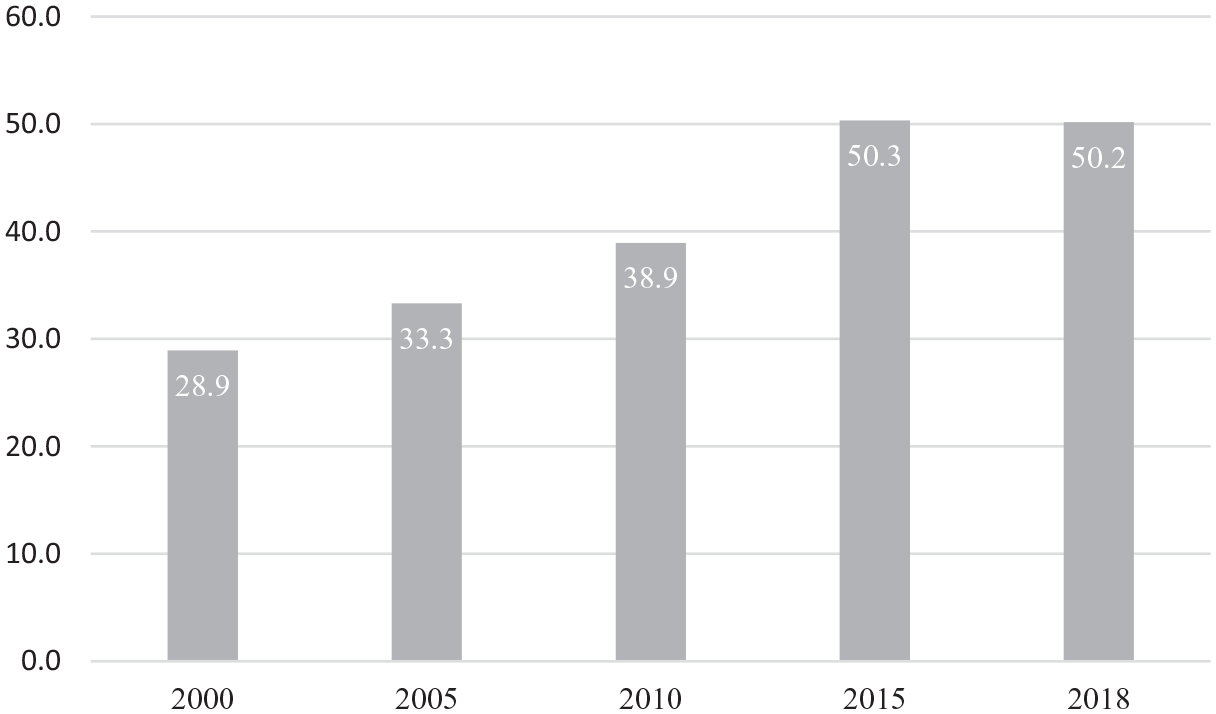
Proportion of beginning higher education students in each year as proportion of whole birth cohort in Germany 2000–2018.
However, in an international comparative perspective these enrolment rates are not particularly high, which can be linked to Germany’s stratified educational system (Allmendinger, 1989). Students are sorted into either the traditional academic track for upper secondary education (‘Gymnasium’) or non-academic tracks (‘Realschule’ or ‘Hauptschule’) as early as age of 10 or 11 (see Figure A1 in the Supplemental Appendix). This early sorting is already highly dependent on students’ social background (Neugebauer et al., 2013), with direct access to higher education requiring attendance of the ‘Gymnasium’ track, which provides a general entrance certificate. By contrast, students attending non-academic tracks often enter vocational training within Germany’s strong vocational system (Powell et al., 2012). However, the pathways leading to eligibility for entry to higher education have become more diverse in recent years: alternative educational or occupational certificates can provide access to specific subjects at the tertiary level (Wolter, 2012). Overall, transition rates to higher education from academic upper secondary education have been consistently high (70%−80%), but depend on parental social background – even if controlled for prior academic achievement (Autorengruppe Bildungsberichterstattung, 2020: 184–186; Neugebauer et al., 2013).
Further, Germany has long been classified as a binary higher education system (Shavit and Arum, 2007; Teichler, 2009). Besides the distinction between research-oriented universities and practice-oriented universities of applied sciences (formerly called ‘Fachhochschulen’), the tertiary system is not especially stratified in terms of institutional resources and prestige, and relies almost entirely on public funding (Mayer et al., 2007). As can be seen in Figure 2, traditional single-cycle degrees were phased out very slowly, with bachelor’s (and later master’s) degrees only becoming the dominant qualifications relatively recently, both at the traditional research-based universities and at the practice-based universities of applied sciences (Autorengruppe Bildungsberichterstattung, 2020: 198). Nevertheless, an accelerated shift occurred in the winter term 2008/2009 driven by national policy regulations requiring the abolishment of most single-cycle degrees (Hochschulrektorenkonferenz, 2008). This trend is very similar for number of graduates (see Figure 2) and number of enrolments (see Figure A2 in the Supplemental Appendix), eventhough the available records for absolute enrolment numbers are shorter.
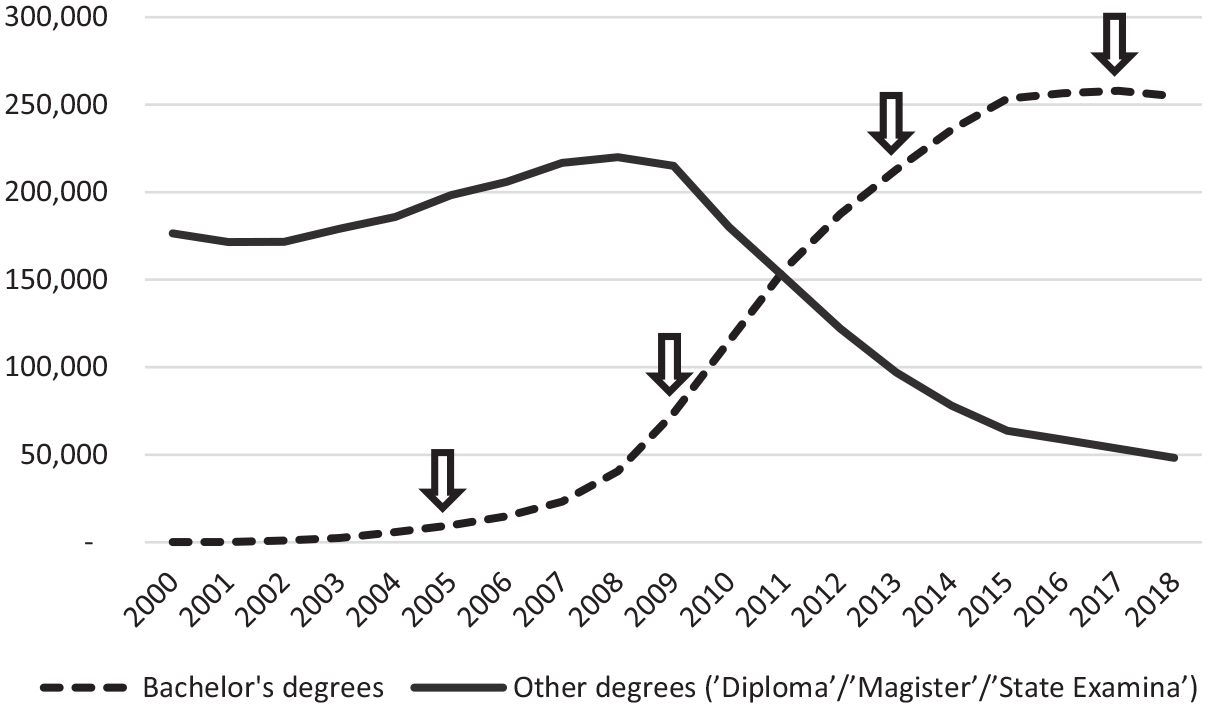
Development of first awarded degrees in German higher education from 2000 to 2018* (in absolute numbers of higher education graduates).
Theoretical considerations
Inclusion and diversion hypothesis
A common argument associated with the expansion of higher education is that it has often led to greater institutional differentiation, for example, the establishment of alternative higher education institutions in addition to traditional university programmes (Shavit and Arum, 2007; Teichler, 2008). Reflecting on the role of community colleges in the United States, Brint and Karabel (1989) introduced the potential ‘inclusion and diversion’ function of new higher education institutions. On the one hand, new higher education institutions can have an inclusive function, attracting students from less privileged social backgrounds who previously did not enter higher education at all. On the other hand, these new types of institution can also divert the same strata from entering other types of institution or other forms of higher education with higher prestige (Shavit and Arum, 2007).
Accordingly, it can be argued that the introduction of bachelor’s degree programmes in Germany could lead to more inclusion of groups that previously did not enter higher education. This might be due to the short duration of the degree, potentially offering a shorter path to the labour market. At the same time, however, this additional transition point into master’s programmes might divert students from less privileged social backgrounds away from long-cycle tertiary degrees (see Neugebauer et al., 2016: 52).
Explaining unequal transition patterns
In order to explain why students with different social backgrounds differ in terms of the choice to enrol in a bachelor’s programme and subsequently in a master’s programme, we draw on sociological rational choice models (Boudon, 1974; Breen and Goldthorpe, 1997). These models assume that students from privileged social backgrounds more often choose prestigious educational tracks given that they generally have better grades or test scores at previous levels of schooling (‘primary effects’). Even accounting for these performance differences between social groups, however, there are systematic differences in students’ enrolment decisions dependent on social background (‘secondary effects’). These secondary effects as differences in socially selective decision-making are driven by differential evaluation of (i) costs and (ii) benefits, as well as of their (iii) prospects for successfully completing an advanced degree (Breen and Goldthorpe, 1997; Erikson and Jonsson, 1996).
Based on this core assumption in rational choice models (Stocké, 2019), one might expect systematic differences in students’ decisions depending on social background. Regarding the decision to enrol in a master’s programme, the assumption is that the costs of choosing to defer labour market entry in pursuit of an advanced degree will be more of a hindrance for less privileged students given that their families have fewer economic resources. Differential evaluation of the benefits of various qualifications according to parental background is often tied to the concept of relative risk aversion (Breen and Goldthorpe, 1997). 2 In general, this means trying to avoid an intergenerational loss of status. For children from privileged backgrounds, the highest tertiary degree – in this case, the master’s degree – is necessary to secure a job at least at the same level as their parents. By contrast, working-class students will most likely already surpass their parents’ occupational standing by completing a bachelor’s degree and finding a job matching their qualifications. Following this logic, students from more privileged social backgrounds have more to lose by not choosing a master’s degree than their less privileged peers, who are expected to be more risk averse. Additionally, the evaluation of one’s chances of successfully completing a master’s programme might also differ by social background – this factor, however, may be less relevant at this already advanced educational level (for first, but contradictory evidence Bergann et al., 2019). Students who have completed a bachelor’s degree, irrespective of social strata, are certainly confident that they can also succeed at the next level due to their familiarity with the requirements of higher education. Nevertheless, potential social background differences in grade point averages at the bachelor’s level could be a relevant factor that restricts access to a master’s degree given that many master’s programmes restrict admission through a ‘numerus clausus’.
Explaining unequal transition patterns over time
In order to explain any change over time, we first refer to the fact that the implementation of the consecutive degree structure stretched over a relatively long period (see Figure 2). This implies that there was no established labour market for graduates with a bachelor’s degree in the initial phase of the Bologna Process – compared to graduates with traditional single-cycle degrees (‘Diploma’, ‘Magister’ or ‘State Examina’) or vocational training certificates (Neugebauer and Weiss, 2018). Therefore, we assume that, for the first cohorts graduating with a bachelor’s degree, the prospects of immediate labour market entry must have been perceived as quite risky. As more study programmes adopted the consecutive degree structure, the bachelor became more established and employers started offering more entry-level positions that these bachelors could apply for (Minks and Briedis, 2005). For the 2013 graduate cohort, for example, 65% of all bachelor’s graduates from one of the universities of applied sciences and 25% of all university bachelor’s graduates entered the labour market immediately within 1.5 year after graduation (Fabian et al., 2016: 26, see Figure A1 in the Supplemental Appendix).
With an increasing number of bachelor’s graduates, we assume that the perception of risk associated with entering the labour market with a bachelor’s degree will have decreased. While this development likely led to a general trend towards more students leaving higher education with a bachelor’s degree, it may be more pronounced among students with no tertiary qualified parents (‘non-academic backgrounds’): Once direct labour market entry is perceived as a sufficiently secure option, theory predicts more incentives for choosing this option rather than enrolling in a master’s programme. Meanwhile, students with more privileged backgrounds should be less affected by these changes given that, in most cases, a master’s degree is needed to guarantee an occupational position at a similar level to their parents (Breen and Goldthorpe, 1997).
Second, we refer to the considerable expansion of higher education (see Figure 1). In the case of Germany, a number of previous studies have examined how educational inequalities changed during the expansion of higher education prior to the Bologna Process. Interestingly, these studies found that while inequalities at the transition from primary to secondary education decreased over time (Klein et al., 2010), the opposite applied to the transition from upper secondary to higher education (Lörz and Schindler, 2009; Mayer et al., 2007). This overall trend of increasing inequality at the transition to tertiary education might be explained by greater performance differentials between students with different social backgrounds and/or increasing heterogeneity in terms of educational motivations and career plans (Schindler and Lörz, 2012). Similarly, we expect the composition of the population of bachelor’s degree students to be more heterogeneous than at the master’s level with respect to academic ability as well as other characteristics such as students’ motivation. Given that higher education expansion has led to a larger population of, possibly, less academically inclined students from less privileged social backgrounds enrolling in bachelor’s programmes, this increasing diversity might lead to increased inequalities at the transition to a master’s degree.
To sum up, we have presented two trends within German higher education, the first concerning growing opportunities for labour market entry with a bachelor’s degree and the second an increasingly heterogeneous student population. Together, these trends lead us to predict increasing inequality at the transition to the master’s level over the implementation period for the new two-cycle study structure in Germany. While our descriptive research design does not allow us to reach clear empirically based conclusions regarding the respective impact of these two parallel trends, at least, they provide the context for the discussion of previous as well as our own findings below.
Previous research
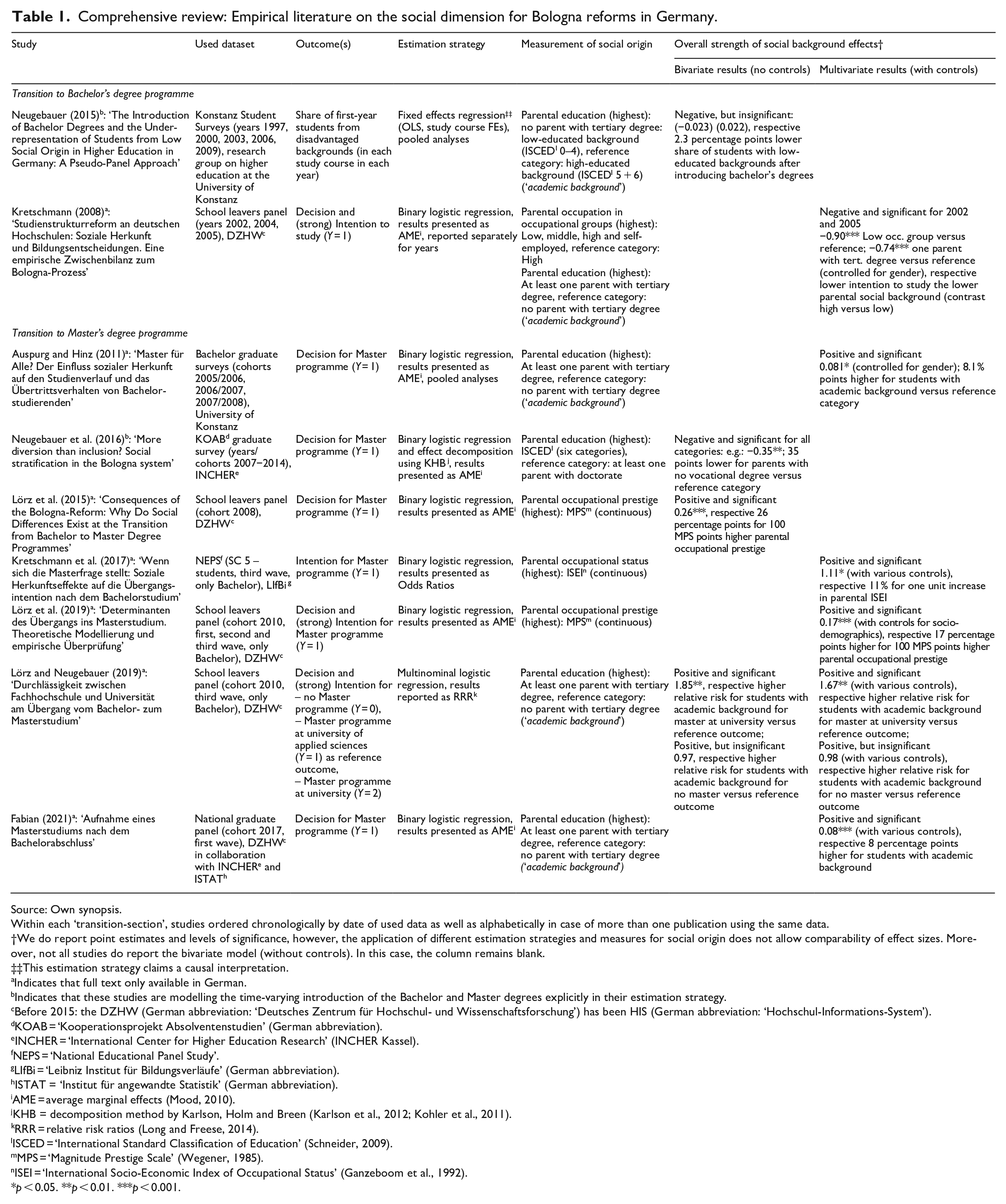
The nature of the German education system (see Section 2) results in considerable inequality of educational opportunity, which is known as ‘Bildungstrichter’ (Kracke et al., 2018). Numerous previous studies for Germany have demonstrated that there was already considerable social inequality in access to higher education prior to the Bologna Process (Becker and Hecken, 2009; Maaz, 2006; Mayer et al., 2007; Reimer and Pollak, 2010; Schindler, 2014). However, the restructuring of higher education has provided a good opportunity to evaluate the consequences of the Bologna reforms for these well-known patterns of social inequality. Table 1 presents existing empirical studies for Germany related to the ‘social dimension’ of Bologna reforms that we were able to identify using manual search methods. By applying advanced technical search methods, contributions in non-listed journals, edited volumes and working papers might have been missed (e.g. Lörz et al., 2019). However, we are confident that this comprehensive review will cover all relevant empirical work for the German context. Studies are ordered chronologically according to the time of data collection in order to map the findings according to the progress of the Bologna implementation process. For all studies, we report the data that is used, the central dependent variable, the analytical strategy, as well as how social origin is measured (see Table 1). In the last column, we state the most relevant coefficient estimate(s) for the social background measure, respectively. Because the studies use different operationalisations for social background, it is difficult to compare the strength of potential social background effects across studies (Thaning and Hällsten, 2020).
Comprehensive review: Empirical literature on the social dimension for Bologna reforms in Germany.
Source: Own synopsis.
Within each ‘transition-section’, studies ordered chronologically by date of used data as well as alphabetically in case of more than one publication using the same data.
We do report point estimates and levels of significance, however, the application of different estimation strategies and measures for social origin does not allow comparability of effect sizes. Moreover, not all studies do report the bivariate model (without controls). In this case, the column remains blank.
This estimation strategy claims a causal interpretation.
Indicates that full text only available in German.
Indicates that these studies are modelling the time-varying introduction of the Bachelor and Master degrees explicitly in their estimation strategy.
Before 2015: the DZHW (German abbreviation: ‘Deutsches Zentrum für Hochschul- und Wissenschaftsforschung’) has been HIS (German abbreviation: ‘Hochschul-Informations-System’).
KOAB = ‘Kooperationsprojekt Absolventenstudien’ (German abbreviation).
INCHER = ‘International Center for Higher Education Research’ (INCHER Kassel).
NEPS = ‘National Educational Panel Study’.
LIfBi = ‘Leibniz Institut für Bildungsverläufe’ (German abbreviation).
ISTAT = ‘Institut für angewandte Statistik’ (German abbreviation).
AME = average marginal effects (Mood, 2010).
KHB = decomposition method by Karlson, Holm and Breen (Karlson et al., 2012; Kohler et al., 2011).
RRR = relative risk ratios (Long and Freese, 2014).
ISCED = ‘International Standard Classification of Education’ (Schneider, 2009).
MPS = ‘Magnitude Prestige Scale’ (Wegener, 1985).
ISEI = ‘International Socio-Economic Index of Occupational Status’ (Ganzeboom et al., 1992).
p < 0.05. **p < 0.01. ***p < 0.001.
First of all, with respect to enrolment rates, there is no significant increase for the majority of study programmes (Horstschräer and Sprietsma, 2015). Furthermore, with respect to social disparities, the main finding of a study using a pseudo-panel approach is that the introduction of the bachelor’s degree did not significantly increase, but rather decrease, enrolment of under-represented groups (Neugebauer, 2015): The share of students with low-educated backgrounds is 2.3 percentage points lower after introducing shorter Bachelor degrees. In line, intentions to study are lower for those whose parents have no tertiary degree compared to their peers with tertiary qualified parents (Kretschmann, 2008). However, these results are significant for all categories of social background.
Given the gradual implementation of the consecutive degree structure, it took some time before a substantial number of bachelor’s graduates faced the decision to continue with a master’s programme or enter the labour market (see Figure 2). One of the first studies to examine this decision, by Auspurg and Hinz (2011), showed that the overall (direct) transition rates to master’s programmes are quite high and are affected by the educational level of students’ parents: The direct transition rate to master’s programmes was about 9 percentage points higher for students having at least one parent with a higher education qualification compared to those whose parents do not have any higher education qualification. While these results are based solely on graduate data for the University of Konstanz (about 700 graduates), Neugebauer et al. (2016) additionally confirmed that social background effects on the transition from a bachelor’s to a master’s degree are comparable in size to those at the transition into higher education using nation-wide data. A similar study by Lörz et al. (2015) replicated these findings using representative panel data for the 2008 cohort of German upper secondary school leavers. This study used parental occupational prestige, a continuous measure, as a measure for students’ social background rather than parental education. The main results show a quite strong positive association between students’ social background and the decision to continue with a master’s degree: The direct transition rate into master’s degree programmes increases by 26 percentage points with each 100 point increase in parental occupational prestige based on the Magnitude Prestige Scale (Wegener, 1985).
While these three studies all analysed students’ final decisions, Kretschmann et al. (2017) have confirmed these social disparities in the transition to the master’s level using data measuring students’ intentions of enrolling in a master’s programme. They also employed parental occupational status as a continuous measure of social origin, but in a different way. Taking performance differences into account, the odds for intending to continue studying in a masters’ degree programme increase by 11% for a unit increase in parental ISEI. Based on data of the German National Educational Panel Study (NEPS), their analyses highlighted the relevance of the type of higher education institution for the intention to continue with a master’s programme. This and similar findings motivated Roloff (2019) to investigate the role of self-selection into universities or universities of applied sciences by using propensity score matching. His analyses showed that about half of the differing transition rates at different types of higher education institutions reflects differences in student demographics between universities and universities of applied sciences. However, the remaining half seemed to be a substantial independent effect of the type of higher education institution attended. Therefore, Lörz and Neugebauer (2019) further investigated the question of mobility between universities and universities of applied sciences. Mobility patterns were mostly directed in one direction: from universities of applied sciences to universities. The decision to switch to a university master’s programme was mainly driven by parental educational background, but also by the grades attained at the bachelor’s level. Besides individual characteristics, however, contextual factors such as the availability of master’s programmes also make a difference.
Therefore, Lörz et al. (2019) provided an exhaustive empirical test of the individual and contextual determinants of the transition to master’s level. Interestingly, all ascribed characteristics gender, social origin and migration background as well as age significantly affected the transition to the master’s level (net of each other), but also students’ prior achievement, prior educational pathways and cost-benefit calculations. Overall, the underlying decision-making process seems to be complex and conditional on prior educational pathways which is in line with the findings from Neugebauer et al. (2016) and Kretschmann et al. (2017). Finally, the most recent study by Fabian (2021) confirmed these social disparities at the transition from the bachelor’s to the master’s level: Though the direct transition rate to master’s programmes is not reported, graduates having at least one parent with a higher education qualification compared to those whose parents do not have any higher education qualification have an 8 percentage points higher enrolment rate into master’s programmes (controlled for gender, migration background and vocational training certificates).
Taken together, all reviewed studies documented unequal transition rates from bachelor’s to master’s programmes according to students’ social origin. These findings seem to be robust across different data sources, as well as different operationalisations of social background (see Table 1, last column).
However, almost all of the reported empirical studies examined the new transition to the master’s level at a single point in time exclusively. Due to different estimation strategies and different operationalisations of social background, the overall strength of background effects is difficult to compare between the empirical studies. Furthermore, not all studies report ‘pure’ transition rates (bivariate models). Moreover, studies differ in terms of the number and nature of independent variables used to explain social origin gaps in the transition to master’s programmes. Summing up, these studies do not address the question of whether the level of inequality in transition rates among students with different social backgrounds changed during the gradual implementation process and the parallel ongoing expansion of higher education in Germany. The only exception is the study by Neugebauer et al. (2016) pooling data for multiple graduate cohorts 2007–2014 and running pseudo-panel fixed-effects regressions to compare the propensity of under-represented social groups to choose master’s programmes before and after the Bologna Process. However, this study did not explore whether the level of social background effects changed across the entire implementation period. Therefore, we will address this question in our analyses below, going beyond previous empirical research on the German case by analysing data covering this (more) extended period of time. With respect to policy evaluation, we investigate potential long-term consequences of fundamental institutional changes.
Data
We use large-scale graduate survey data provided by the Research Data Centre for Higher Education and Science Studies (fdz.DZHW). 3 These graduate surveys have a long tradition in Germany: Since 1989, a representative sample of higher education graduates is drawn every fourth year and (since 1997) interviewed up to three times with the aim of monitoring the transition from higher education to the labour market and graduates’ later professional career (Jungbauer-Gans, 2018). For the purpose of our paper, these graduate panels are suitable when analysing socially differentiated transition patterns in the German context. They enable us to describe patterns of enrolment into master’s degree programmes based on actual behaviour (instead of students’ intentions, see Table 1). However, even if graduates from one cohort by definition share the same year of graduation, the decision for master’s degree programmes was made at different time points depending on individual courses of study.
We use the first panel wave of the four graduate cohorts from the years 2005 4 , 2009 5 , 2013 6 and 2017 7 . This range allows us to cover the whole implementation period of the Bologna Process in Germany, as well as the so-called ‘new millennium higher education expansion’ (see Figure 1). Even though the graduate cohort from the year 2001 is closest to the second millennium, we do not consider these data. By definition of the target population, almost all graduates exclusively attained one of the ‘traditional’ one-cycle higher education certificates. Finally, our choice of data is in line with previous research: Three of the studies cited in the above literature review also analyse data from graduate surveys (see Table 1; Auspurg and Hinz, 2011; Fabian, 2021; Neugebauer et al., 2016), but in contrast to our contribution only draw on single graduation years or cohorts (except Neugebauer et al., 2016).
For all cohorts, higher education graduates were surveyed about 1–1.5 year after graduation: whether graduating with either a bachelor’s, master’s or one of the ‘traditional’ one-cycle degrees in Germany. Paper-pencil or online questionnaires were sent out by higher education institutions based on a two-step, disproportional stratified, random sample for Germany (for details in 2005 see Baillet et al., 2021; in 2009 see Baillet et al., 2017; in 2013 see Hoffstätter et al., 2021; in 2017 see Fabian et al., 2021). However, there are slight differences between the cohorts. For the 2005 graduation cohort, bachelor’s graduates were oversampled compared to those completing traditional degree programmes (see Baillet et al., 2021) in order to achieve sufficient sample sizes. Due to differences in the early adoption of a two-cycle degree structure, certain subjects such as economics are therefore over-represented, while others such as teacher education are under-represented. For our core analyses, we do not apply any weighing procedures. Since we control for a variety of determinants such as subject and type of institution in our multivariate models, we account for the relevant weighting variables. Therefore, we do not expect bias regarding the correlation between social background and the transition to master’s degree programmes – our relation of interest. However, the descriptive distributions should be interpreted cautiously with respect to drawing conclusions on the entire graduate population.
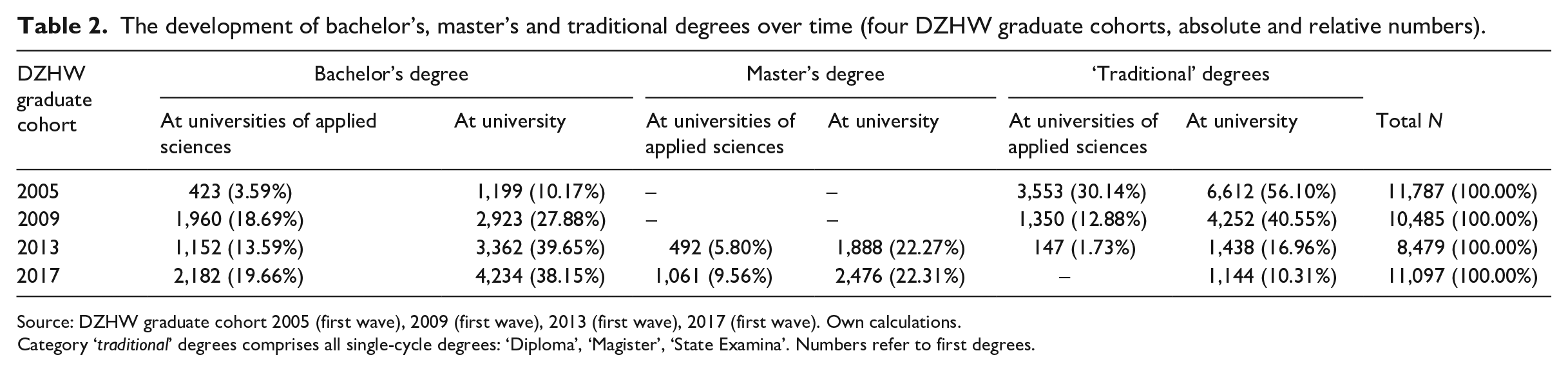
As can be seen in Table 2, bachelor’s graduates were in the minority in the 2005 graduate cohort, both at universities and universities of applied sciences, but as expected made up the majority of graduates in the most recent 2017 graduate cohort. This general trend in our survey data is in line with data reported in official statistics (see Figure 2). The data also illustrate that universities of applied sciences have been quicker to adapt the two-cycle structure and phase out the traditional single-cycle degrees (‘Diploma’, ‘Magister’ or ‘State Examina’) (Autorengruppe Bildungsberichterstattung, 2020: 198). Interestingly, single-cycle degrees at universities show a strong persistence with more than 10% among all certificates in the 2017 graduate cohort (see Table 2). Among these are mainly ‘State Examina’, especially in teacher education (Blömeke, 2019).
The development of bachelor’s, master’s and traditional degrees over time (four DZHW graduate cohorts, absolute and relative numbers).
Source: DZHW graduate cohort 2005 (first wave), 2009 (first wave), 2013 (first wave), 2017 (first wave). Own calculations.
Category ‘traditional’ degrees comprises all single-cycle degrees: ‘Diploma’, ‘Magister’, ‘State Examina’. Numbers refer to first degrees.
For our analyses, we restrict the sample to graduates in the two-cycle system: those respondents who either attained (a) a bachelor’s degree and stated enrolment into master’s degree programmes at the time of the interview or (b) a master’s degree for which a completed bachelor’s degree was required. We include graduates from universities of applied sciences as well as from universities and end up with 22,480 respondents in total. Of these, about one-fifth (23.27%) attained a bachelor’s degree only and four-fifth (76.73%) either attained a master’s degree or is currently enrolled in a master’s degree programme, respectively.
Our main dependent variable, our outcome of interest, indicates whether bachelor’s graduates have pursued or finished a master’s degree programme (Y = 1) or directly entered the labour market or choose any other vocational training alternatives (Y = 0). Thus, we analyse actual behaviour of graduates in our sample. It might be possible that those graduates who report plans to continue their studies at the master’s level will enrol into master degree programmes after they have been interviewed.
Our central independent variable for indicating social background is parental level of education. Referring to the widely used concept of ‘academic background’ in the literature (see Table 1), we use a binary indicator, grouping students who have two parents with a tertiary degree in one group and all others in a reference group. 8 This operationalisation has the advantage that we can identify a group of clearly advantaged students and compare them to the remaining student population. Nevertheless, we test whether our results are robust across alternative operationalisations of parental background in our multivariate analyses.
The data contains rich information on individual student characteristics and prior educational pathways. For socio-demographic characteristics, we use gender, citizenship (operationalised whether graduates were born in Germany) and age. For describing enrolment into bachelor’s degree programmes, we use the type of higher education entrance qualification as a dummy variable for regular (‘Gymnasium’ track) versus restricted, prior academic performance at ‘Gymnasium’ (reversed and standardised by federal states) and an indicator for completed vocational training prior to enrolment. For describing characteristics of bachelor studies, we use a dummy variable indicating whether the bachelor was completed at a university or a university of applied sciences. Furthermore, we grouped information on field of study into five fields and included grade point average at the bachelor’s level (reversed and standardised by field of study). Further, we created a dummy variable indicating whether students were in any way employed during bachelor studies.
We applied multiple imputation to estimate missing values appropriately (Van Buuren et al., 2006; White et al., 2011). Here we follow the approach of ‘fully conditional specification’, thus each variable described above is specified with an own regression model. For imputation, we use all variables that are included in our subsequent analyses. We report the average coefficients and standard errors based on 50 multiple imputed datasets. As suggested in the literature, we do not use imputed values for our dependent variable in our multivariate analyses (von Hippel, 2007). 9
Analytical strategy
Though our outcome of interest is a binary indicator, we estimate linear probability models (LPMs, Long and Freese 2014; Mood, 2010; Wooldridge, 2010). Compared to logistic or other nonlinear models, they have the advantage that coefficient estimates can be interpreted intuitively as per cent change: the per cent change in the probability that bachelor graduates will have enrolled in a master’s degree programme for each unit increase in the independent variable(s). In the applied statistical literature, LPM has been increasingly considered a viable alternative to logistic or probit regression (Breen et al., 2018; Mood, 2010). 10 To account for heteroscedastic error terms due to the multilevel structure of our data, cluster-robust standard errors on the level of higher education institutions are calculated.
Our modelling is based on three steps. As we are interested in the social gradient for the transition to master’s degree programmes, as a first step, we calculate the bivariate association between parental level of education and enrolment into master’s degree programmes for each cohort (Model 1). This bivariate baseline model shows whether, in which direction and how strong the decision to continue higher education at the master’s level depends on social backgrounds across the entire implementation period.
This ‘pure’ relationship, however, might be a result of (self-)selection into different educational contexts prior to the master’s level (Roloff, 2019) as well as changing student composition due to higher education expansion. Therefore, we include further socio-demographic information as well as information on prior educational pathways gradually as a second step. More precisely, we introduce gender, age and citizenship as well as the type of higher education entrance qualification (regular vs restricted), prior academic performance (at ‘Gymnasium’ or equivalence) and an indicator for completed vocational training prior to enrolment in Model 2. Following this stepwise approach, we finally include information related to the completed bachelor’s degree in Model 3. Thus, we further control for field of study (grouped into five fields), type of higher education institution (university vs university of applied sciences), grade point average and student employment at the bachelor’s level.
Including these variables in two steps in our models has two reasons. First, previous studies have shown that all these factors influence the choice of a master’s degree programme, following the importance of prior educational pathways (see Table 1). Thus, controlling for such detailed individual characteristics allows us, at least to some extent, to account for possible changes in the composition of the population of bachelor’s graduates over time. The reported coefficient estimates for bachelor’s graduates’ social background in Model 3 are thus adjusted for increasing heterogeneity in terms of performance or other observed characteristics of bachelor’s graduates. Second, all the factors not only influence the decision to study at a master’s level, but are also correlated with social background, as it were.
We acknowledge, that Model 3 in particular might suffer from ‘overcontrol bias’ (Elwert and Winship, 2014; Grätz, 2022). We condition on whether the bachelor’s degree was obtained at a university or university of applied sciences. Though this factor indeed drives the association between social origin and enrolment into master’s degree programmes substantially, about half of the effect is independent of the type of higher education institution attended (Roloff, 2019). Therefore, we argue that it is most informative to present and contrast a model without (Model 2) and a model with characteristics of prior bachelor’s studies (Model 3).
Up to this point, we have looked at the graduate cohorts individually. In a third step, we therefore test whether there has been significant change over time by pooling data from these four graduate cohorts in one dataset and interacting our indicator variable for social background with dummy variables for the respective cohort. This allows a formally test of whether the social gradient for the transition to master’s degree programmes has changed over time (Chow, 1960) independent of differences in the samples size for each cohort (see Table 2). We run these analyses for the bivariate model (Model 1) as well as for the full multivariate model (Model 3).
Results
Table 3 reports descriptive statistics for the dependent and independent variables across the four graduate cohorts, for each cohort separated according to bachelor’s level (‘no master’) and master’s level (‘master’). Overall, the proportion of bachelor’s graduates transitioning to the master’s level remains high across graduate cohorts (72.14% for the 2005 cohort compared to 78.91% for the 2017 cohort). Even with this stable trend, the population of bachelor’s graduates has grown over time (also see Figure 2 and Table 2). Other than this and fewer female graduates in the 2017 cohort, only few systematic changes are observed across the four graduate cohorts. Even in light of the considerable expansion of higher education (see Figure 1), the composition of the population of bachelor’s and master’s graduates does not seem to have changed in fundamental ways during this period. This refers both to the composition by ascribed characteristics and by performance.
Descriptive statistics (four graduate cohorts, means, N).
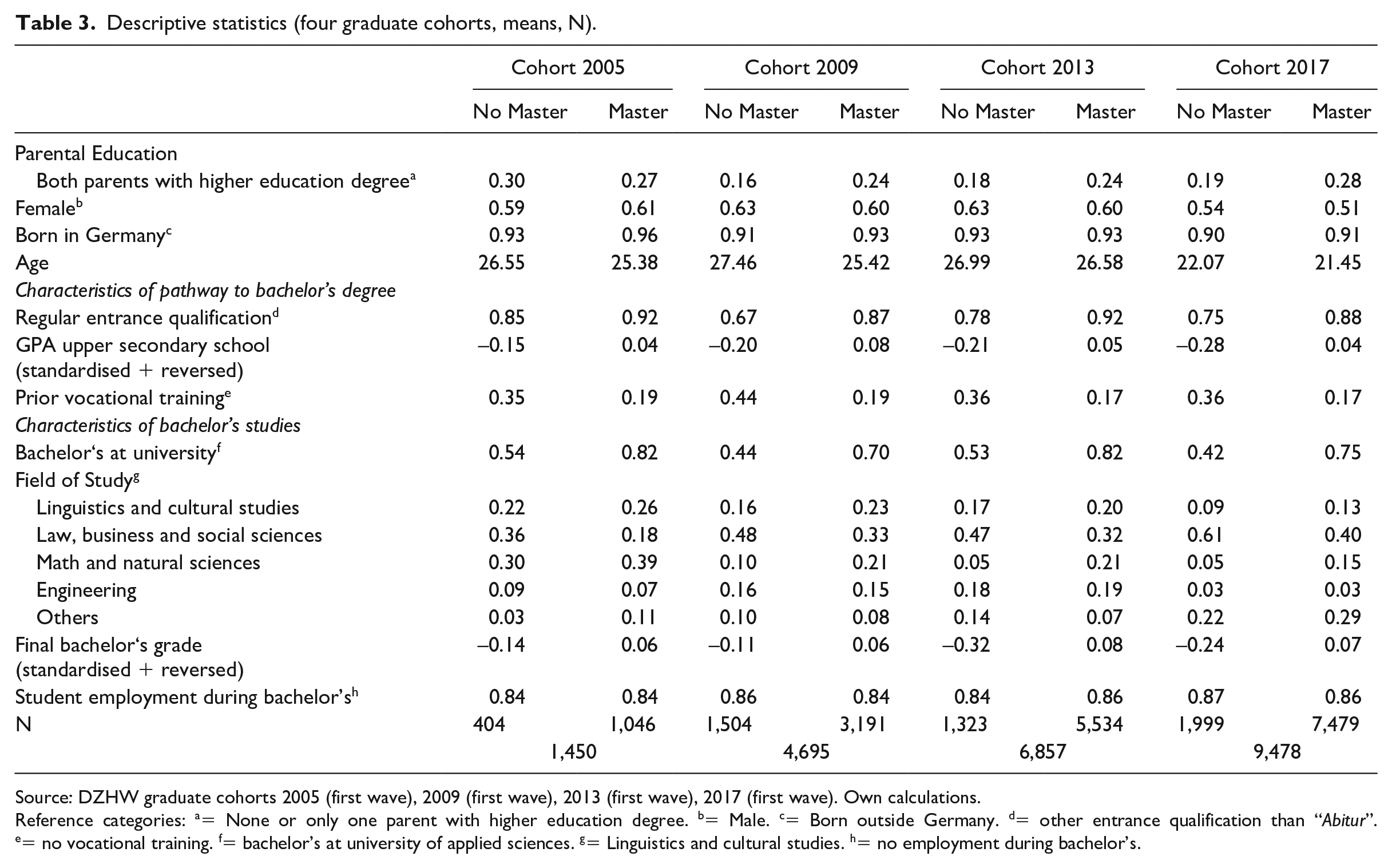
Source: DZHW graduate cohorts 2005 (first wave), 2009 (first wave), 2013 (first wave), 2017 (first wave). Own calculations.
Reference categories: a= None or only one parent with higher education degree. b= Male. c= Born outside Germany. d= other entrance qualification than “Abitur”. e= no vocational training. f= bachelor’s at university of applied sciences. g= Linguistics and cultural studies. h= no employment during bachelor’s.
Unequal transition patterns
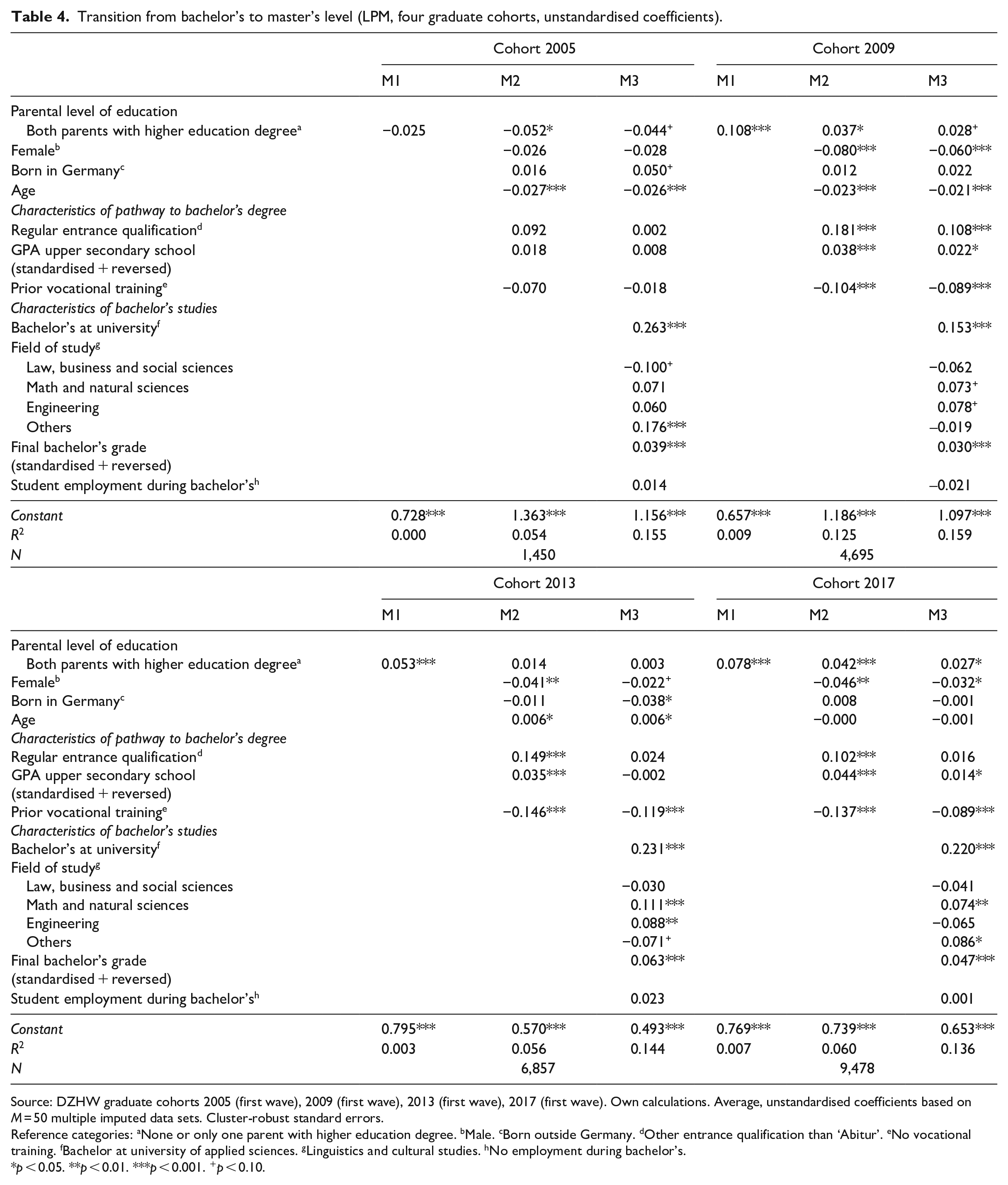
In the following, Table 4 displays the results of LPMs for the transition to the master’s level across the four graduate cohorts. We start by comparing coefficient estimates for parental education in the unadjusted bivariate models (Model 1, first row). For the 2005 graduate cohort, there is only a negligible difference between graduates whose parents have qualifications from higher education and their peers: 2.5 percentage points less, which does not reach statistical significance. However, for the 2009 and subsequent graduate cohorts, graduates with higher levels of parental education were significantly (at least p < 0.01) more likely to enrol in a master’s degree programme (10.8 percentage points for 2009 graduate cohort, 5.3 percentage points for 2013 graduate cohort and 7.8 percentage points for 2017 graduate cohort). In contrast to the 2005 graduate cohort, all significant differences are now positive. These associations are in line with our theoretical assumptions above: the ‘new’ transition is accompanied by social disparities in favour of advantaged groups. However, these bivariate models do not indicate a (strong) uniform trend towards increasing inequality across graduate cohorts; the gap in favour of students with higher levels of parental education fluctuates between approx. 5–11 percentage points. Compared to previous studies, this range of the social gradient over the 2009–2017 graduate cohorts seems to be rather at the lower end (see Table 1, penultimate column in Table 1). Due to different operationalisations of social background and missing information, such an evaluation is challenging.
Transition from bachelor’s to master’s level (LPM, four graduate cohorts, unstandardised coefficients).
Source: DZHW graduate cohorts 2005 (first wave), 2009 (first wave), 2013 (first wave), 2017 (first wave). Own calculations. Average, unstandardised coefficients based on M = 50 multiple imputed data sets. Cluster-robust standard errors.
Reference categories: a= None or only one parent with higher education degree.
Male.
Born outside Germany.
Other entrance qualification than ‘Abitur’.
No vocational training.
Bachelor at university of applied sciences.
Linguistics and cultural studies.
No employment during bachelor’s.
p < 0.05. **p < 0.01. ***p < 0.001. +p < 0.10.
We now turn to the results from Model 2, which allow us to examine whether the inequality patterns found in the bivariate baseline models remain once we control for other socio-demographic characteristics and characteristics of the pathways into bachelor’s degree programmes. While we focus our interpretation on the indicator for parental education, we also highlight some noteworthy patterns for the control variables across the four graduate cohorts.
Starting with results for the 2005 graduate cohort, we see that the coefficient estimate for parental education increases to 5.2 percentage points and even reaches statistical significance (p < 0.05) in Model 2. This indicates that graduates without two parents with a tertiary degree were actually more likely (by about 5 percentage points) to enrol in a master’s degree programme – all else being equal. This finding is especially interesting, because it contradicts theoretical predictions (see chapter 3). Examining the indicators for enrolment into higher education in the 2005 graduate cohort, it is noteworthy that the typical predictors for entry to a bachelor’s programme – type of entrance qualification, final grade from upper secondary school and having a vocational qualification – do influence the transition to the master’s level in the expected way; but all remain insignificant (all with p > 0.10).
As already indicated in Model 1, a different picture emerges for the subsequent graduate cohorts. For the 2009 graduate cohort, the coefficient estimate for parental education is reduced to 3.7 percentage points in the second model, but remains positive and statistically significant (p < 0.05). With the exception of country of birth, all other variables that provide information about socio-demographic background and pathways to a bachelor’s degree affect master’s degree enrolment significantly (p < 0.001) in the expected way.
For the 2013 graduate cohort, the coefficient estimate for parental level of education is considerably reduced by 3.9 percentage points to 1.4 percentage points in Model 2 (compared to Model 1), and becomes insignificant when accounting for socio-demografic characteristics and pathways to bachelor degree programmes. For the most recent 2017 cohort, the differential between the two parental education groups is only reduced to 4.2 percentage points in Model 2 and remains statistically significant (p < 0.001).
We now turn to the results from Model 3, which allow us to examine whether the inequality patterns found in Model 2 change once we control for characteristics of bachelor’s studies. Starting with the results for the 2005 graduate cohort, we observe a reduction in the size of the coefficient for parents’ level of education (4.4 percentage points at p < 0.10). Having attended a university during bachelor’s studies as well as final grade at bachelor’ s level significantly affect enrolment into master’s degree programmes (p < 0.001). In the 2009 graduate cohort, the coefficient for parent’s level of education is further reduced: from 3.7 percentage points (at p < 0.05) in Model 2 to 2.8 percentage points (at p < 0.10) in Model 3. The social gradient in both 2005 and 2009 graduate cohorts is rather small and only significant at a 10 percent level of significance, however, the coefficients point into the opposite direction. For the 2013 and 2017 graduate cohort, the social gradient is reduced once accounting for characteristics of the bachelor’s study. However, the coefficient only remains significant for 2017graduate cohort (p < 0.05).
Regardless of the particular cohort, the relevance of having studied at a university versus a university of applied sciences is remarkable (see Table 4, Model 3): the size ranges from 15.3 percentage points for the 2009 graduate cohort to 26.3 percentage points for the 2005 graduate cohort. As expected, performance during the bachelor’s degree is an important predictor for enrolment into master’s degree programmes (p < 0.001). However, the pattern for different field of studies is quite mixed.
To sum up, our results suggest that, at least for the three most recent graduate cohorts, there is inequality in the transition to the master’s level that is comparable to the level of inequality at the transition from upper secondary to higher education (see Neugebauer et al., 2016: 58). For these cohorts, results largely mirror findings from previous German studies (see Table 1): students/graduates from more privileged backgrounds are more likely to enrol in a master’s degree programme. While this finding is in line with our theoretical expectations (see chapter 3), there is no indication of a clear trend towards increasing inequality across cohorts. The 2005 graduate cohort is particularly interesting, because the social gradient is unexpectedly reversed. Based on our findings we therefore conclude that, after a period of turmoil and uncertainty when first implementing a two-cycle study structure driven by the Bologna Process, a stable pattern of inequality has emerged for the 2009 and subsequent cohorts.
Unequal transition patterns over time
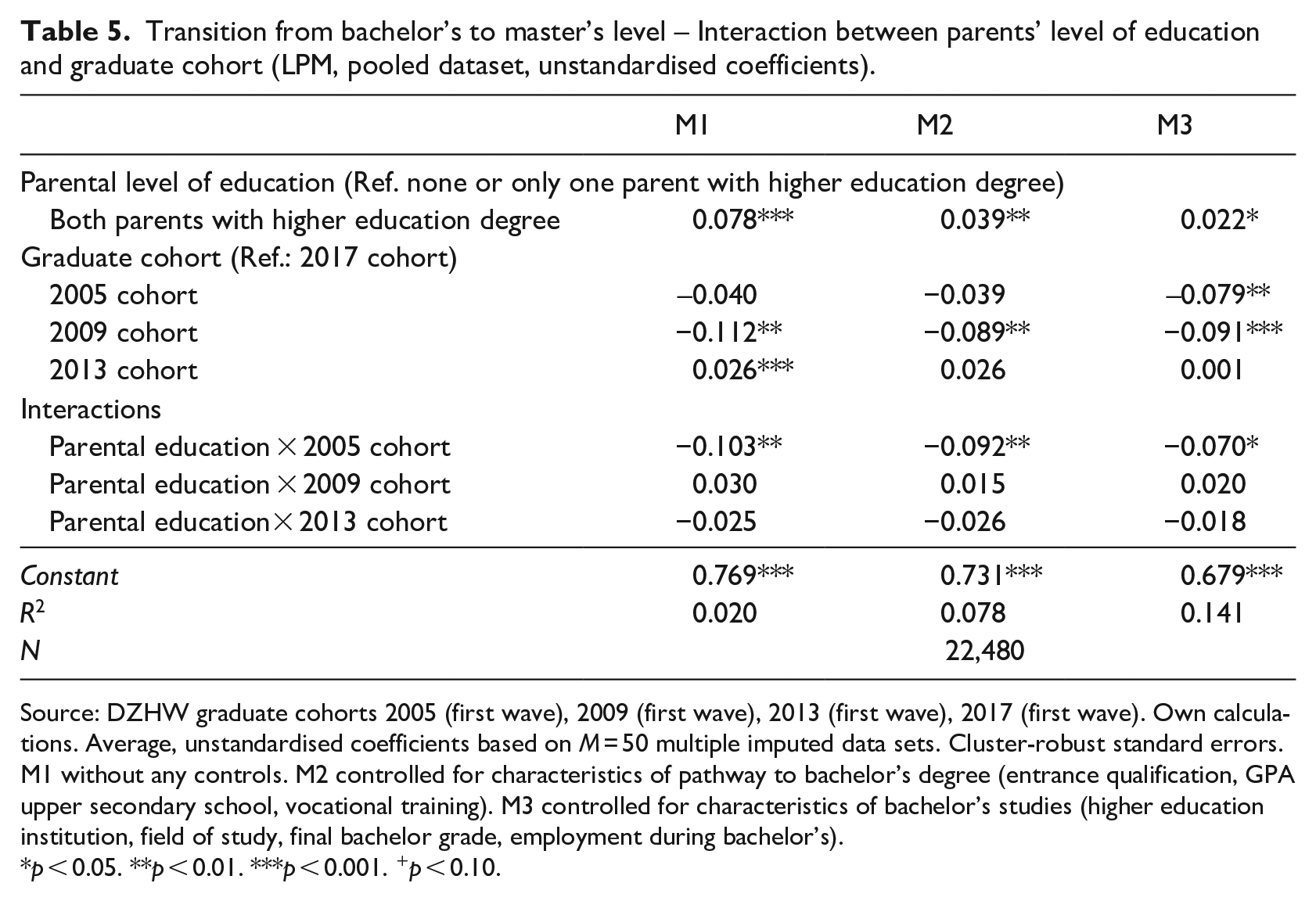
As a final step, we use the pooled dataset to interact the indicator variable for parental education with the respective cohort dummy to formally test whether the level of inequality at the transition from bachelor’s to master’s level is indeed not increasing over time. Table 5 shows the coefficients for parental education, cohort and the interaction between parental education and cohort for our three model specifications. The respective interaction effects indicate whether the coefficients for parental education differ significantly from the estimates for the 2017 graduate cohort: A negative coefficient estimate indicates that the level of inequality was lower for the respective cohort (2005, 2009 and 2013) relative to 2017 and vice versa for a positive coefficient estimate. The only significant interaction coefficient is for 2005 graduate cohort (at least p < 0.05). This indicates that the level of inequality was higher for the 2017 graduates compared to the 2005 – irrespective of model specification. Overall, these results confirm the picture of nonlinear change. Following the initial introduction of a two-cycle structure, a relatively stable level of inequality seems to have emerged at the transition to the master’s level – but no clear trend towards increasing inequality can be detected.
Transition from bachelor’s to master’s level – Interaction between parents’ level of education and graduate cohort (LPM, pooled dataset, unstandardised coefficients).
Source: DZHW graduate cohorts 2005 (first wave), 2009 (first wave), 2013 (first wave), 2017 (first wave). Own calculations. Average, unstandardised coefficients based on M = 50 multiple imputed data sets. Cluster-robust standard errors.
M1 without any controls. M2 controlled for characteristics of pathway to bachelor’s degree (entrance qualification, GPA upper secondary school, vocational training). M3 controlled for characteristics of bachelor’s studies (higher education institution, field of study, final bachelor grade, employment during bachelor’s).
p < 0.05. **p < 0.01. ***p < 0.001. +p < 0.10.
Sensitivity checks
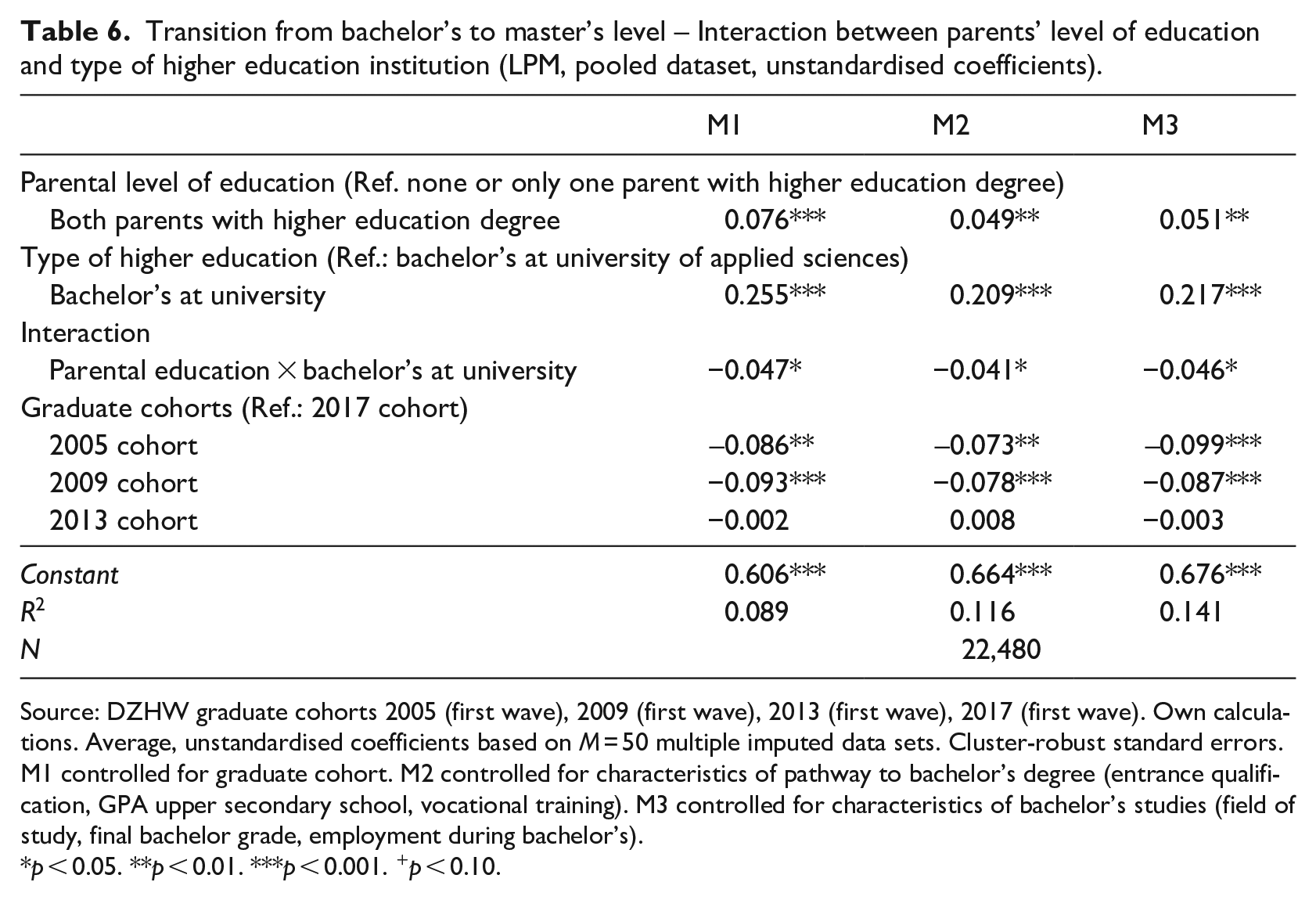
Given that students completing their bachelor’s degree at university have a much higher propensity to enrol at the master’s level (see Table 4, Model 3), we explore whether the pattern of inequality according to parental background differs across the two types of higher education institution. Results reveal that the coefficient estimate for having attended university is between 4.7 and 4.1 percentage points lower (depending on model specification) for graduates who have two parents with a tertiary degree (see Table 6). Alternatively, the negative impact of having attended a university of applied sciences on transitions to the master’s level is less pronounced for those graduates whose parents have an academic background compared to those with non-academic parents (at p < 0.05). These findings demonstrate how the ‘new’ and ‘old’ forms of institutional differentiation in German higher education – degree levels and type of higher education, respectively – conjointly produce complex patterns of social inequality in German higher education.
Transition from bachelor’s to master’s level – Interaction between parents’ level of education and type of higher education institution (LPM, pooled dataset, unstandardised coefficients).
Source: DZHW graduate cohorts 2005 (first wave), 2009 (first wave), 2013 (first wave), 2017 (first wave). Own calculations. Average, unstandardised coefficients based on M = 50 multiple imputed data sets. Cluster-robust standard errors.
M1 controlled for graduate cohort. M2 controlled for characteristics of pathway to bachelor’s degree (entrance qualification, GPA upper secondary school, vocational training). M3 controlled for characteristics of bachelor’s studies (field of study, final bachelor grade, employment during bachelor’s).
p < 0.05. **p < 0.01. ***p < 0.001. +p < 0.10.
Finally, the estimated level of inequality might be sensitive to the type of operationalisation used to indicate parental background (Beller, 2009; Korupp et al., 2002; Thaning and Hällsten, 2020; see Table 1). We replicate results from Models 1 (see Figure A3 in the Supplemental Appendix) and 3 (see Figure 3) for all cohorts (see Table 4) with three alternative definitions for parental education. Coefficient estimates are plotted in Figure 3: The first bar represents our ‘reference operationalisation’ of both parents with tertiary qualification; the second bar, our first alternative definition, is a dummy variable indicating whether at least one parent has a tertiary degree. This measure is quite common in the literature (see Table 1). The two remaining bars show whether the student’s father or mother, respectively, holds a tertiary degree. With this, we provide evidence not yet available for the established concept of ‘academic background’.
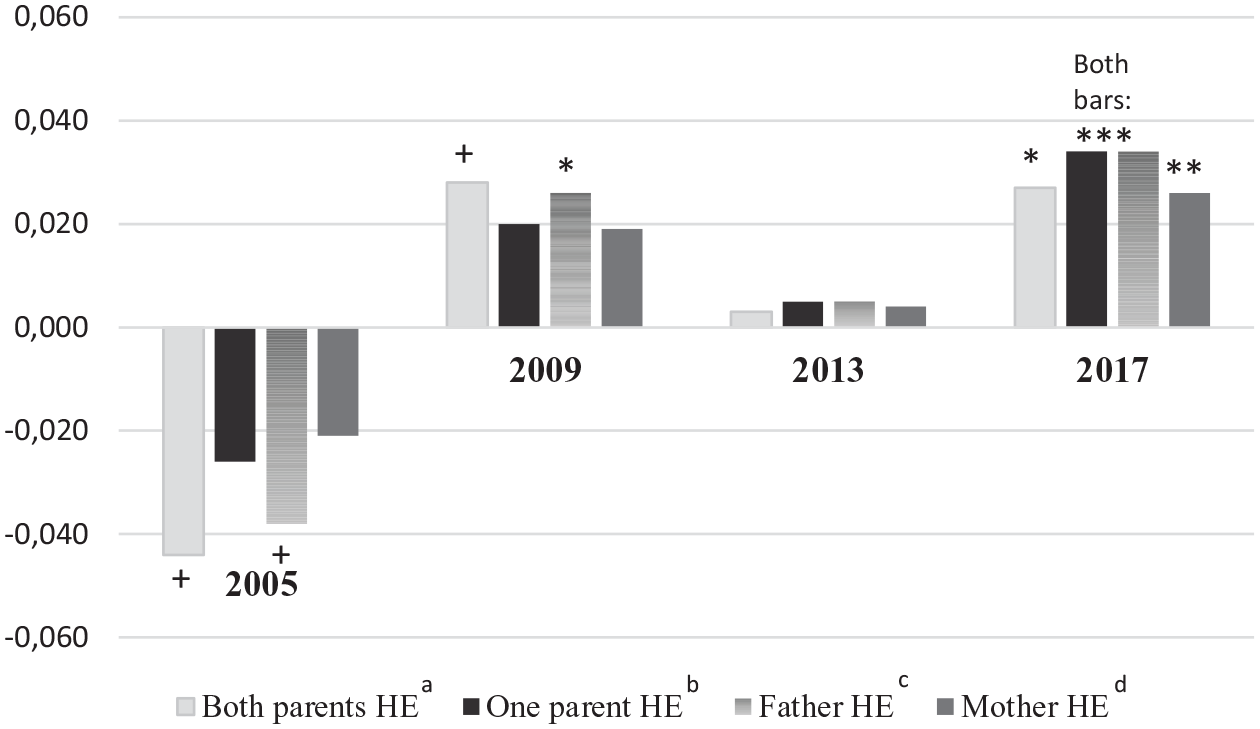
Regression coefficients (LPM) for different operationalisations of parents’ level of education (based on Model 3, Table 4).
Irrespective of the concrete operationalisation, enrolment into master’s degree programmes significantly depends on parental education (at least at p < 0.05) - except for the 2005 graduate cohort (see Figure A3 in the Supplemental Appendix). Accounting for characteristics of pathways into bachelor’s degree programmes as well as bachelor studies substantially reduces this raw gap of social background - again, 2005 graduate cohort is the exception. However, the size of the coefficient estimates differs to some degree between the different operationalisations, which might contribute to heterogeneous results in the previous literature (see Table 1). Nevertheless, our results replicate the pattern of findings reported in Table 4 and the available studies for Germany (see Table 1). 11
Summary and discussion
More than 20 years have passed since the Bologna Process was initiated with the goal of creating a unified European Higher Education Area (Bologna Declaration, 1999; Sorbonne Declaration, 1998). Among other goals, structural convergence with respect to degrees was placed on the political agenda. For Germany in particular, realising this goal resulted in fundamental restructuring from single-cycle to two-cycle degrees – but this process stretched over an extended period of time. This paper contributes to the existing body of empirical literature by explicitly taking the gradual introduction of bachelor’s and master’s degrees into account. Drawing on data from four recent graduate surveys (2005, 2009, 2013, 2017) spanning across the past two decades, we are generally able to replicate previous findings showing social inequality at the transition from the bachelor’s to the master’s level.
However, these well-known patterns are not stable over time. Inequalities in transition rates to the master’s level were apparent for the 2009 and later cohorts. For the 2005 graduate cohort, however, bachelor graduates from less privileged backgrounds enrolled in a master’s programme at a rate significantly exceeding their more privileged peers (p < .0.10, see Figure 3). These students, ‘the early adopters’, chose a bachelor’s degree at a point when these ‘Anglo-American’ degrees were still a novelty in the German higher education system, as well as the German labour market. It seems that after an initial period of turmoil and uncertainty in the early stages of the implementation process, established patterns of inequality had re-emerged by the 2009 graduate cohort.
As an aside, our empirical analysis provides another interesting finding. The new degree structure has revealed an interesting interaction between type of higher education and students’ social backgrounds. While bachelor’s graduates from a university of applied sciences enrol in a master’s programme at a considerably lower rate than those from a university, this pattern is less pronounced for students whose parents have a tertiary degree. This indicates possible heterogeneous treatment effects for attending one or the other type of higher education institution in Germany (Brand and Thomas, 2013).
With respect to the ‘social dimension’ of the Bologna Process, both the reviewed and our own empirical evidence indicates that the political goal of promoting the participation of under-represented groups in higher education, especially at the master’s level, has not been met in Germany. Revisiting the ‘inclusion and diversion’ hypothesis, the new degree structure does not seem to have led to more inclusion of under-represented groups in German higher education – but it has, at least to some extent, diverted students from less privileged social backgrounds from pursuing a master’s degree programme.
While our findings are consistent with earlier empirical studies, some caveats with respect to our methodological design should be mentioned. First, as we have repeatedly pointed out in our argumentation, the introduction and generalisation of a two-cycle degree structure occurred at a time of rapid educational expansion (see Figure 1). Our empirical strategy cannot fully disentangle the extent to which the observed changes are a result of the new degree structure or the expansion of higher education. The two processes are interrelated; even accounting for a relatively rich set of control variables does not solve this issue. Second, our analysis has a descriptive character and thus outlines inequality patterns over time. Meanwhile, studies that use a design better suited to identifying a causal effect of the Bologna Process for social inequality (e.g. Neugebauer et al., 2016) typically distinguish between ‘before’ and ‘after’ Bologna and therefore do not account for important changes during the implementation process. Third, as we only draw on first-wave data for each cohort, we do not know whether bachelor’s graduates successfully completed the master’s degree programme they started.
Even though more than 20 years of Bologna reforms in Europe were the reason for some recent publications and reviews (Broucker et al., 2019; Dienel, 2019; Kroher et al., 2021; Vögtle, 2019), there is still a lack of knowledge regarding the ‘social dimension’ of the Bologna Process. While our results highlighted how the reforms created a new transition and hence new inequalities in German higher education, there is still need for a coherent definition of ‘disadvantaged groups’ when monitoring the Bologna Process (Vögtle, 2019: 3). Most scientific studies related to the ‘social dimension’, including our own, have focussed on the level of education (‘academic background’) or occupational status of parents (see Table 1). However, other dimensions, such as students’ ethnicity or migration background, should be examined in more detail in future work (for an exception, see Jungbauer-Gans and Lang, 2019). And finally, a more comprehensive evaluation of implementing a two-cycle degree structure for the development of social inequality needs to study labour market success of those who leave higher education with a bachelor’s versus a master’s degree (Lörz and Leuze, 2019; Neugebauer and Weiss, 2018).
Supplemental Material
sj-docx-1-eer-10.1177_14749041221101293 – Supplemental material for Stability or change? Social inequality at the transition from bachelor’s to master’s degree programmes in Germany. Empirical evidence from four graduate cohorts
Supplemental material, sj-docx-1-eer-10.1177_14749041221101293 for Stability or change? Social inequality at the transition from bachelor’s to master’s degree programmes in Germany. Empirical evidence from four graduate cohorts by David Reimer and Ulrike Schwabe in European Educational Research Journal
Supplemental Material
sj-docx-2-eer-10.1177_14749041221101293 – Supplemental material for Stability or change? Social inequality at the transition from bachelor’s to master’s degree programmes in Germany. Empirical evidence from four graduate cohorts
Supplemental material, sj-docx-2-eer-10.1177_14749041221101293 for Stability or change? Social inequality at the transition from bachelor’s to master’s degree programmes in Germany. Empirical evidence from four graduate cohorts by David Reimer and Ulrike Schwabe in European Educational Research Journal
Supplemental Material
sj-docx-3-eer-10.1177_14749041221101293 – Supplemental material for Stability or change? Social inequality at the transition from bachelor’s to master’s degree programmes in Germany. Empirical evidence from four graduate cohorts
Supplemental material, sj-docx-3-eer-10.1177_14749041221101293 for Stability or change? Social inequality at the transition from bachelor’s to master’s degree programmes in Germany. Empirical evidence from four graduate cohorts by David Reimer and Ulrike Schwabe in European Educational Research Journal
Footnotes
Acknowledgements
We thank two anonymous reviewers as well as Thorsten Euler, Simon Rolls, Jens-Peter Thomsen and Lars Ulriksen for their valuable comments on earlier versions of the manuscript. We would also like to thank Gregor Fabian and Anne Weber for their support with data access. Mike Mielcarski provided valuable help as student research assistant.
Declaration of conflicting interests
The author(s) declared no potential conflicts of interest with respect to the research, authorship and/or publication of this article.
Funding
The author(s) disclosed receipt of the following financial support for the research, authorship and/or publication of this article: This work was partially supported by the Independent Research Fund Denmark under Grant DFF − 7013-00104.

Supplemental material
Supplemental material for this article is available online.
Notes
Author biographies
References
Supplementary Material
Please find the following supplemental material available below.
For Open Access articles published under a Creative Commons License, all supplemental material carries the same license as the article it is associated with.
For non-Open Access articles published, all supplemental material carries a non-exclusive license, and permission requests for re-use of supplemental material or any part of supplemental material shall be sent directly to the copyright owner as specified in the copyright notice associated with the article.
