




Abstract
This article examines the fit (or lack thereof) between the competencies needed by the sport industry and the proficiency of sport management students. The authors apply importance–performance analysis as a strategic management tool to analyze the results of two competence-oriented datasets in a German context. They find that students’ self-identified proficiency is lower than the importance attributed to proficiency by industry experts. The authors critically discuss the absence of differences between the perceived performance of Bachelor’s and Master’s degree students and provide strategic recommendations for sport management higher education. The article highlights the development and communication of generic competencies as a unique selling proposition and reflect on the need to improve subject-specific competencies to further professionalize the field of sport management. Based on these results, a critical reflection of curriculum design in sport management higher education is needed.
The global trends of commercialization, digitalization and mediatization have contributed to the rapid growth of the global sport industry (Mathner and Martin, 2012). The direct effects of the sport industry contributed 2.98% (nearly €300 billion) of the overall gross value added of the economy in the European Union (SportsEconAustria, 2012). To respond to emerging opportunities, this industry requires a highly qualified and flexible workforce possessing a diverse set of competencies (Fahrner and Schüttoff, 2019).
The growing professionalization, along with a higher demand for graduates in the field, has resulted in the proliferation of academic sport management programs (Costa, 2005; Kaiser and Beech, 2012; Shilbury et al., 2017). However, sport management is a young discipline that is attempting to ground its social legitimacy in academia and the professional world. To date, it has failed to distinguish itself clearly from other professions (Dowling, 2018).
With the Bologna Process in the 1990s and the transition to Bachelor’s and Master’s degrees, the institutional environment in Europe around vocational/technical and higher education has given competence-based education much attention (European Commission, 2008, 2015). Following Rychen and Salganik (2001: 43), competencies enable individuals “to successfully meet complex demands in a particular context through the mobilization of psychosocial prerequisites (including cognitive and noncognitive aspects)”. Here, competencies are more than skills: they are skills, attitudes and knowledge. Chyung et al. (2006: 308) explain, “it is not only about what one knows and can do but also whether one is able to accomplish a task and produce an outcome that is valued by both oneself and the organization”. Indeed, competence-based education targets the development of competencies relevant to the field of study to raise the employability of graduates.
Although Europe is unified by its structural reform of higher education (e.g., Bachelor’s and Master’s degrees, the European Credit Transfer and Accumulation System 1 ), no guidelines for competence-driven curricula exist. Here, sport management higher education (SMHE) lacks a distinct competence framework: there is a gap in knowledge about which competencies are needed by the sport industry and how to develop these (Baker et al., 2017; De Schepper and Sotiriadou, 2017; Jiang and Alexakis, 2017; Mathner and Martin, 2012; Raven, 2018). Baker et al. (2017) state that the competence gap is a multifaceted concept and includes both over-education and under-education. We follow the call for more studies to investigate graduate and undergraduate sport management programs (Dowling, 2018) and the need for a constant evaluation of the competencies required in the sports industry (DeLuca and Braunstein-Minkove, 2016; Ko et al., 2011). The purpose of this study is to identify the competencies that are important in the sport industry, to examine the proficiency of sport management students in those competencies, and to analyze the extent to which sport management students meet industry needs. Based on this analysis, we present workable recommendations and courses of action for curriculum design and development in SMHE.
The study contributes to a more sophisticated understanding of sport management. It differs from previous research on competencies in sport management in three ways. First, we compare the perspectives of sport industry representatives with students in their final year. With this approach, we draw conclusions directly concerning the further development of SMHE. Second, previous studies on competencies in the sport management context have lacked a validated instrument; we have adopted and validated a questionnaire from the Erasmus+ project “New Age of Sport Management Education in Europe” to examine the relevant competencies for sport managers (Wohlfart and Adam, 2019; Wohlfart et al., 2020). Third, we apply an adapted importance–performance analysis (IPA), as introduced by Wohlfart and Hovemann (2019), and offer a sustainable and functional strategic management tool for higher education.
Literature review
Various systematic reviews internationally have examined which competencies should be emphasized in specific study programs based on the notion of preparing students for the requirements of the labor market(s) (business: Jackson, 2010; engineering: Passow and Passow, 2017; information systems: Figl, 2010) as well as in higher education more generally (Abelha et al., 2020; Caballero and Walker, 2010; Calonge and Shah, 2016; Chan et al., 2017; Osmani et al., 2019). The results across these reviews highlight the significance of students’ need to develop generic competencies next to relevant subject-specific competencies—and the responsibility of higher education institutions (HEIs) in supporting students in this process.
The literature on the competencies needed in the sport industry is characterized by a specialist–generalist divide. Although some authors have argued that the industry requires different competencies for different settings (Barcelona and Ross, 2004; Fahrner and Schüttoff, 2019), others have argued that graduates need to possess a wide range of generic competencies to be successful in many types of settings (Jamieson, 1987, Wohlfart and Adam, 2019). Several studies have identified the need for a specific approach for the sport management industry (DeSensi et al., 1990; Emery et al., 2012; Kaiser and Beech, 2012). The results unanimously conclude that sport managers are essentially communication managers (Packheiser and Hovemann, 2013; Petersen and Pierce, 2009). There has been skepticism about the relevance of a specific sport management education (as opposed to generic management education) in academia and industry (Zhang, 2015).
Sport management lacks a definition of what the profession entails (Dowling, 2018). Because of this deficiency no prerequisite qualifications exist, resulting in competition between SMHE and other vocational training (Kaiser and Schütte, 2012). Experience in the specific sector, an affinity for sports, and passion and endurance are common job requirements (Packheiser and Hovemann, 2013; Wohlfart and Adam, 2019). With increasing professionalization, future sport managers need to possess a blend of generic management competencies and those competencies that are specific to the sport industry (Jiang and Alexakis, 2017; Mathner and Martin, 2012).
Because of the heterogeneity of the sport industry (e.g., communication, tourism, health, fitness, commercial goods), the necessary competencies of sport managers are complex, and empirical results from examining these competencies are based on individual graduate studies rather than objective industry requirements. Exceptions include the studies by Emery et al. (2012) and Packheiser and Hovemann (2013), which analyze the requirements stated in job advertisements for sport managers in Australia and Germany, respectively. Additionally, several transnational research endeavors have focused on the employability of sport graduates and the sport management labor market, offering new pathways for further research (Baker et al., 2017; Wohlfart and Adam, 2019).
Despite various research endeavors, however, we still lack a clear understanding of the current needs of the sport industry for sport managers, leading us to our first research question:
RQ1: Which competencies are needed in the sport industry?
The continuous increase in SMHE programs (Costa, 2005; Kaiser and Beech, 2012; Shilbury et al., 2017) has been accompanied by growing interest in the academic community and examination of these programs and their students and graduates. We refer to the systematic review of 98 studies conducted by Miragaia and Soares (2017) for research in SMHE published between 1982 and 2014; the review demonstrates the dominance of North American and Anglo-Saxon influence in SMHE research. The authors conclude that there is a need to contextualize curricula and redefine objectives and learning outcomes to comply with the requirements of contemporary society.
Eagleman and McNary (2010) examine the status of undergraduate sport management curricula in the USA using a content analysis methodology, finding large differences between programs based in different schools and differences between public and private universities. In analyzing the curricula of SMHE programs in Germany, Dunkel et al. (2018) highlight the lack of focus on subject-specific competencies, as well as an explicit distinction between Bachelor’s and Master’s degrees. Like Eagleman and McNary (2010), the authors project a lack of systematic curriculum design for SMHE in Germany.
Students begin studying sport management because of a strong passion for or interest in sports (e.g., USA: Barnhill et al., 2018; Mathner and Martin, 2012; Schwab et al., 2013; Australia: Sibson, 2011), yet they have little sense of what to expect after graduation and trust that the institution will prepare them. A study by DeLuca and Braunstein-Minkove (2016) examines the preparedness of students from one US university for their first industry encounter (i.e., the for-credit internship). The authors criticize the lack of career goal orientation of undergraduate students and exposure to industry professionals. The integration of experiential learning practices (e.g., internships) into most sport management programs enables students to experience the “real world” outside academia.
Nevertheless, research on the competence development of sport management students is scarce. SMHE needs to critically examine the competence development of future sport managers based on important competencies, leading to our second research question:
RQ2: How proficient are students in competencies important for the sport industry?
Studies have shown a “skills gap” between the competencies required by industry and the competencies developed by HEIs (Moore and Morton, 2015; Osmani et al., 2019) as well as differences in how graduates tend to overstate their own abilities (Hack-Polay, 2020). Correspondingly, several studies have outlined and discussed the “disconnect” (DeLuca and Braunstein-Minkove, 2016; De Schepper and Sotiriadou, 2017) or “gap” (Barnes, 2014; Emery et al., 2012; Ko et al., 2011; Mathner and Martin, 2012) between the competencies employers require and those developed in SMHE. Barnes (2014) discusses background information related to the transition of graduates when entering the job market based on the presumption that it is the role of SMHE to “prepare students for career entry and transition into productive roles within their new jobs upon graduation” (p. 27). Mathner and Martin (2012), meanwhile, compare the perceptions of sport management graduates and undergraduates in the USA with the perceptions of sport management practitioners, finding significant differences between the two groups (e.g., practitioners attaching significantly more importance than students to working with people). In the European context, Baker et al. (2017) also report significant differences in the perception of competencies between sport graduates and employers, identifying possible improvements for sports graduate employability programs.
Although previous studies have highlighted the gap between the competencies employers require and competencies developed in SMHE, there has been no systematic approach to examine the match between employers’ needs and students’ perceived performance, leading us to our third research question:
RQ3: To what extent does the performance of students match the needs of the sport industry?
To further develop and professionalize SMHE, we introduce IPA as our conceptual framework to analyze the extent to which the performance of students in a variety of relevant competencies matches the needs of the sport industry in a systematic way.
Conceptual framework
IPA was originally developed by Martilla and James (1977) for marketing research. It applies a two-dimensional grid that allocates specific attributes into one of four quadrants based on their importance and performance. Hence, an IPA can identify the gap between the two examined dimensions (importance and performance). The four quadrants offer a systematic overview of the relevant characteristics for academics and practitioners (Figure 1).
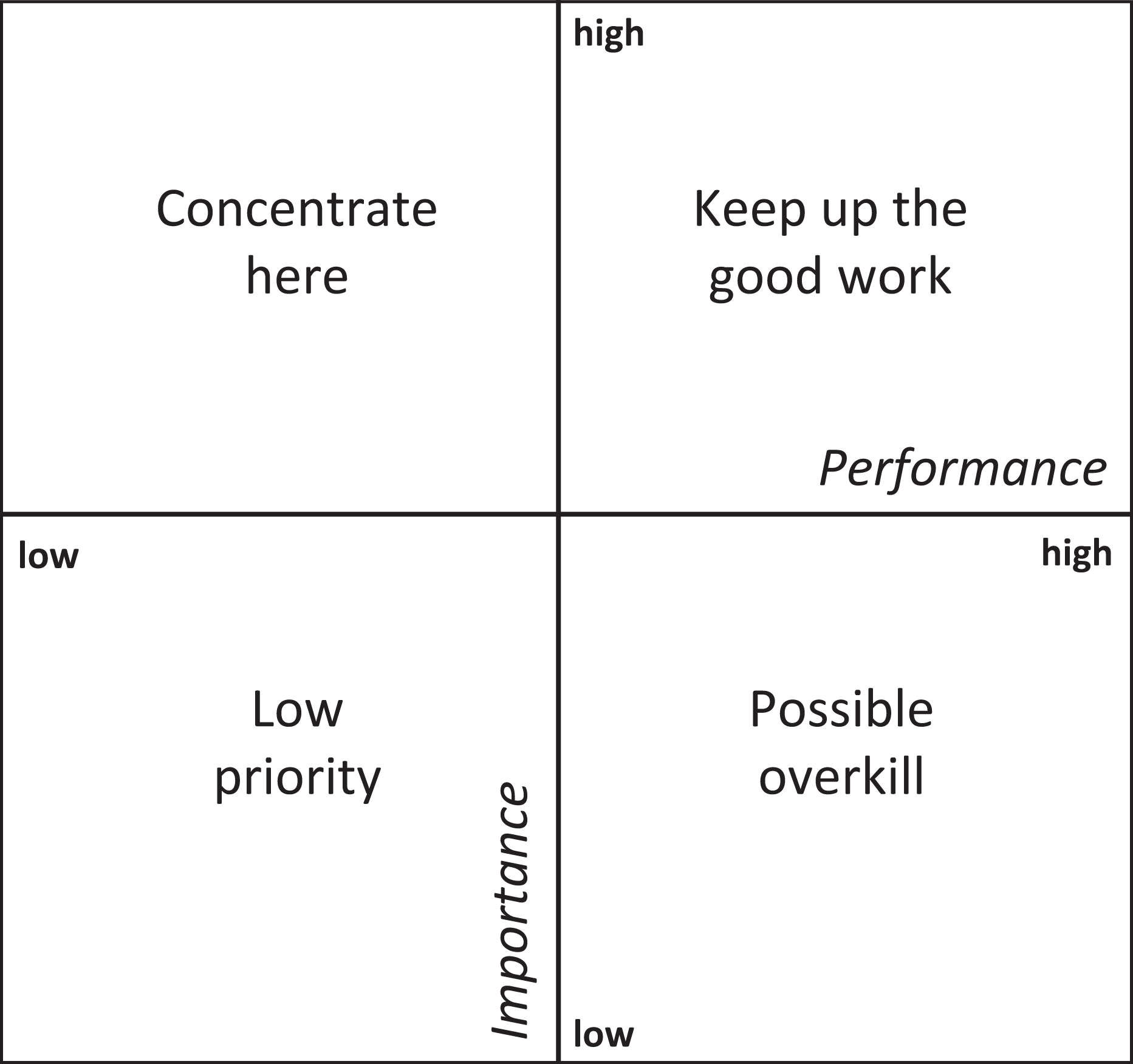
Original importance–performance grid. Source: After Martilla and James (1977).
In general, IPA follows the trend of a consumer-driven market, deriving management strategies by assessing the importance and performance of one sample group (e.g., consumers). Previous studies in higher education have applied IPA to focus on quality management and single stakeholder (student) satisfaction (Alberty and Mihalik, 1989; Lakkoju, 2016; McLeay et al., 2017; O’Neill and Palmer, 2004; Pike, 2005).
Wohlfart and Hovemann (2019) show how IPA can be used to solve the dilemma of systematically measuring competencies in industry and higher education; they modify the IPA for higher education by introducing a second stakeholder group into the conceptual framework. Previous studies regarding higher education have focused on the quality of a study program solely from a student perspective (Mai, 2005; McLeay et al., 2017). Though student satisfaction is an important factor in assessing programs in higher education, other measures of internal quality should be considered. The adapted IPA enables consideration of multiple stakeholders in the formulation of strategic management decisions for HEIs to respond to their consumers’ needs, these being competency-oriented qualifications based on industry requirements. The authors argue that, although industry experts and students could, respectively, be able to foresee trends and developments in their field and/or rate their performance in these areas, the gap between the two stakeholder groups remains ambiguous (Wohlfart and Hovemann, 2019).
The current study applies an extended application of IPA in accordance with Wohlfart and Hovemann (2019), including the perspective of both stakeholder groups (industry experts and students). Applying IPA enables us to systematically and critically analyze the match between employers’ needs and students’ perceived performance, and so to respond to our research questions. In this way, we intend to begin to bridge the gap between SMHE and the sport industry.
Method and sample
To answer the research questions, we followed a three-step approach, examining (1) the importance of competencies according to sport industry experts; (2) the proficiency of sport management students in those competencies; and (3) the similarities and discrepancies between the two. In operationalizing the two sample groups, we focused on the German context. In Germany, the sport industry contributed 2.5% of the gross value added of the economy in 2015 and employed 1.2 million people (Bundesministeriums für Wirtschaft und Energie [Federal Ministry for Economic Affairs and Energy], 2018). Analogously, there has been a continuous increase in the number of HEIs in Germany offering academic sport management courses since the inauguration of the first sport management course in 1981. In 2019, there were some 48 sport management programs at 31 HEIs, 15 of which were for Master’s degrees (Wohlfart et al., 2020).
The first two steps of the analysis required separate questionnaires and data collection. Both sample groups received web-based questionnaires with closed and open-ended questions. The focus was on the competencies relevant to sport management occupations. The third step combined the datasets to draw comparisons between the two samples.
Instrument
We adopted a competence questionnaire used in the Erasmus+ project “New Age of Sport Management Education in Europe” (NASME). The original questionnaire was developed by an international team of researchers from nine European countries based on professional experience and the research literature. It contains 72 items representing relevant skills and requirements (Wohlfart and Adam, 2019). The respondents included sport industry experts with leading management positions (n = 544). They were asked to rate both the importance of the skills and requirements for future sport managers and their individual proficiency in these 72 items on a five-point scale. Item-proofing steps (Cronbach’s alpha, correlations) were employed for both item sets (importance and proficiency), resulting in the elimination of 13 items.
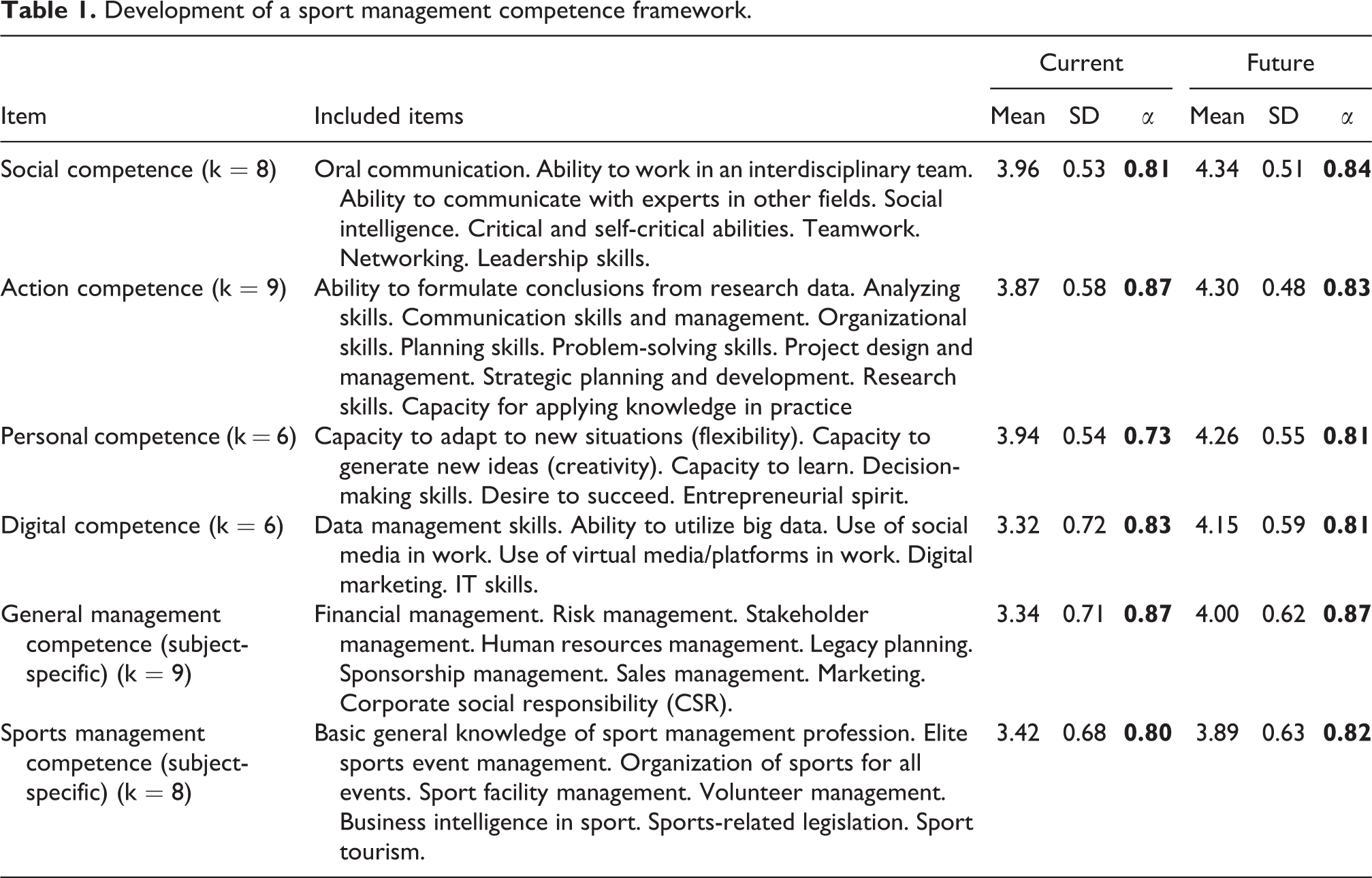
Based on our understanding of competencies as a combination of skills, attitudes and knowledge, we defined a competence framework for sport managers. We developed our framework based on education policy guidelines—in particular, the Kultusministerkonferenz 2 (KMK), which specifies differing levels in competence-based education for Bachelor’s, Master’s, and doctoral degrees. The policy paper includes four competence areas: social competence, action competence, personal competence and subject competence (KMK, 2017). Additionally, subject competence is separated into sport management competence and general management competence. Finally, a cluster for digital (technical) competence is included. Several items (k = 13) did not fit the competence framework and were excluded; this resulted in six competence blocks with 46 items: social competence (k = 8), action competence (k = 9), personal competence (k = 6), digital competence (k = 6), general management competence (k = 9), and sport management subject competence (k = 8). Table 1 offers an overview of the included items, along with the mean, variance and reliability (α) measures for the six computed blocks.
Development of a sport management competence framework.
Sample 1: Sport industry experts
The first sample was acquired through the NASME project. Experts from the field of sport management in Germany were recruited in advance through purposeful sampling via e-mail or telephone (n = 103). They were asked to evaluate the importance of future competencies in the field of sport management (first research question) on a scale from 1 to 5 (1 = not at all important, 5 = very important). We had a satisfactory response rate (54.4%), with 54 experts answering the survey.
The respondents (19% female, 81% male), with a median age of 30–44 years (min. 20–24; max. 60–64), all lived in Germany. They were top-tier managers, directors, general secretaries, professors and other highly qualified individuals from sport federations and associations (37%), professional sport clubs (22%), private organizations (17%), public institutions (13%) and nonprofit sport clubs and associations (11%). Some 85% of the respondents held a Bachelor’s degree or higher (47% sport management, 18% sport sciences).
Sample 2: Sport management students
With a second questionnaire, we enquired into the same competencies from the perspective of students in their final year (second research question). The sampling frame included all 48 sport management programs in Germany (Wohlfart et al., 2020). Based on the curriculum analysis of Dunkel et al. (2018), one program was included. The chosen program is based at a university with a strong tradition in sport sciences, one of the first to introduce a specific sport management degree. It was selected because (a) it offers both Bachelor’s and Master’s degrees in sport management, (b) it emphasizes both the teaching and research of sport management, and (c) it has strong industry relations at both regional and national levels.
The BSc and MSc degrees in sport management are offered in the German language over a course of six and four semesters, respectively (180 and 120 ECTS). Both programs include an even share of economics, sport sciences and sport management modules, as well as a compulsory internship. The assessment methods include written exams, project reports, oral presentations and theses.
The sample consisted of 124 students who had finished at least 85% of their study program. The questionnaire was distributed in June 2018 and 2019. The students were asked to evaluate their level of competence on a scale from 1 to 5 (1 = very weak, 5 = very strong). Additionally, we asked about career aspirations and socio-demographics. We received 103 responses (83%), but after filtering these based on completeness and comprehensibility, our sample consisted of 83 students (34% female, 66% male; 59% Bachelor’s, 41% Master’s). The final response rate of 67% is satisfactory, with the sample being representative concerning both gender and degree.
The students were 25 years old on average (SD = 2.48; median = 24). They showed strong tendencies to want to work in professional sport clubs (55%) or private-sector organizations (54%). 3 Relatively few (< 15%) were considering work in a public institution (e.g., municipality, university, ministry, etc.), while a quarter envisaged working as entrepreneurs. Concerning the functional areas aspired to, the students were mainly interested in project management (26%), event management (15%) and marketing management (14%).
Results
The aim was to elicit the competencies needed in the sport industry, examine the proficiency of sport management students in these competencies, and analyze to what extent sport management students was meeting industry needs. As described above, we collected and analyzed data from 54 sport industry experts and 83 sport management students.
Importance ratings of competencies by industry experts
Sport industry experts have high expectations of sport managers. Across all 46 items, the average importance rating was 4.1 (SD = 0.78). 4 Social competence was considered the most important (M = 4.4, SD = 0.46), followed closely by action competence (M = 4.3, SD = 0.42) and personal competence (M = 4.3, SD = 0.46). We interpret the low variance between 0.18 and 0.22 for these three competence blocks to be a sign of homogeneity across the sample group. As explained in the methods section, subject-specific competencies were examined with respect to sport management (M = 3.6, SD = 0.49), general management (M = 3.9, SD = 0.51), and digital competencies (M = 4.0, SD = 0.56).
We found deviations within the three competence blocks concerning items in the context of marketing management (digital marketing, marketing, sponsorship management, use of virtual media/platforms in work and use of social media in work). These five items had very high importance and strong inter-item correlations. We excluded these from the original competence blocks and tested them as an individual block, which we labeled “marketing management competence” (α = 0.84). The new results highlight the importance of marketing management competence next to the non-subject-specific competence blocks. Figure 2 offers an overview of the importance of competencies needed by sport managers in our sample.
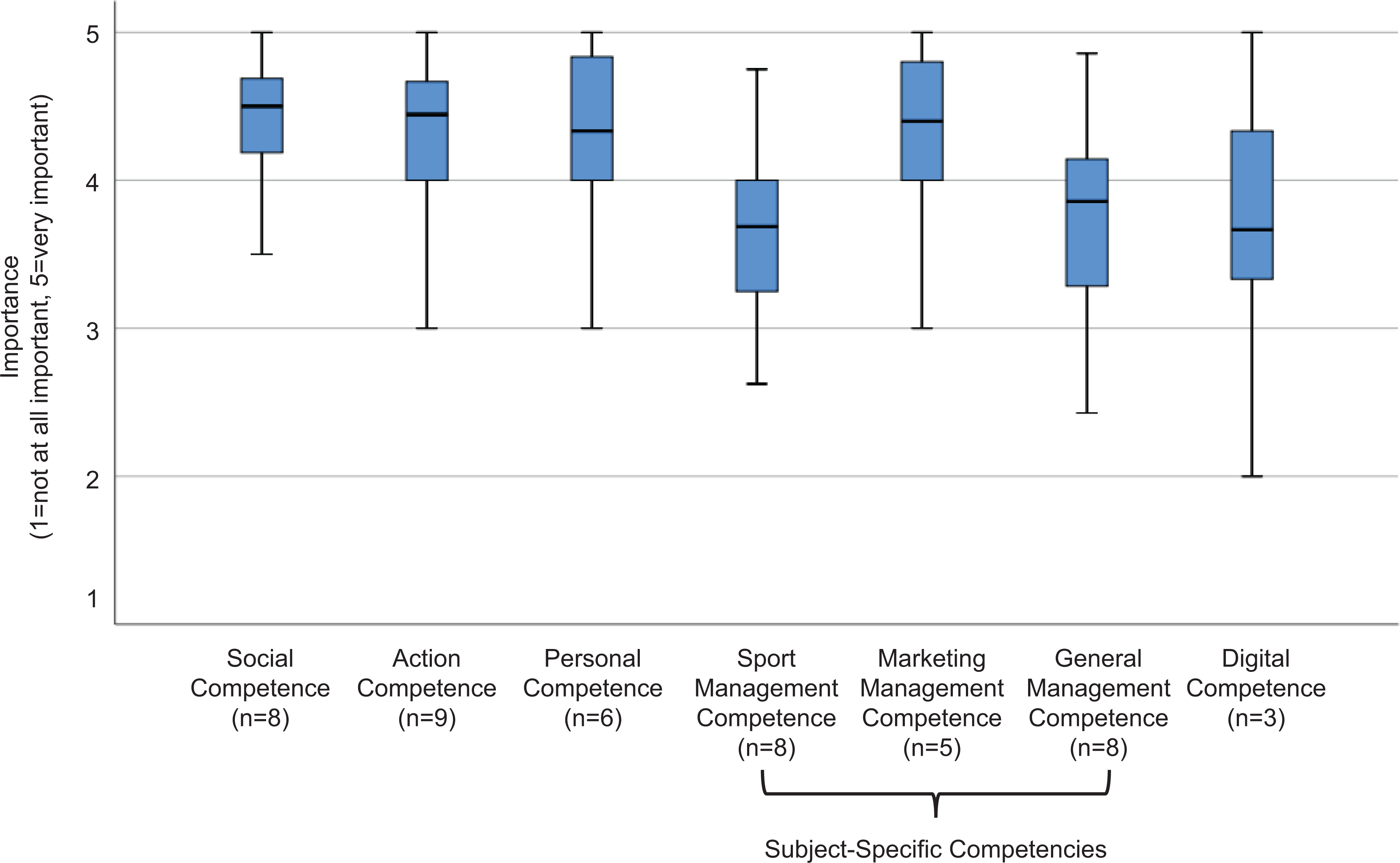
Importance ratings of sport management competencies according to sport industry experts (n = 54).
Because it is very likely that the importance placed on competencies depends on the context of experts, we explored the data based on employer groups 5 using a multivariate analysis of variance (MANOVA). The Shapiro–Wilk test was conducted to test the normal distribution across the competence blocks as dependent variables (α = 0.05). 6 Correlations between the dependent variables were low (r < 0.70), indicating that multicollinearity was not a confounding factor. Homogeneity of variances was asserted using Levene’s test, which showed that equal variances could not be assumed for all dependent variables (p < 0.05 for digital competence). The assumption of equality of covariance matrices was confirmed with Box’s text being p > 0.1. The MANOVA showed significant differences between the dependent variables based on the current employer of the respondents for Hotelling’s trace (T = 1.396, F(28, 134) = 1.67, p = 0.03) and Roy’s largest root (ϕmax = 1.030, F(7, 38) = 5.59, p < 0.01), as well as significant tests of between-subjects effects for personal competence (p = 0.03), social competence (p = 0.04), and marketing management competence (p = 0.04). Because of the small sample size and varying group sizes, we cannot make statements about pair-wise differences. 7
To answer our first research question, all competencies were considered very important across all sectors and organizational types. Social and personal competencies and action competencies such as analyzing skills (M = 4.2, SD = 0.73), planning skills (M = 4.4, SD = 0.67), and problem-solving skills (M = 4.5, SD = 0.58) were given high importance. Concerning subject-specific competencies, our experts felt that marketing management competence was the most important competence block (M = 4.3, SD = 0.60).
Performance ratings of competencies by students
The student sample evaluated its performance at 3.2 (SD = 1.1) 8 on average across all 46 items, with the best performance in social competence (M = 3.7, SD = 0.56), followed closely by action competence (M = 3.6, SD = 0.52) and personal competence (M = 3.5, SD = 0.70). Proficiency in subject-specific competence blocks averaged at 2.8 (SD between 0.67 and 0.80). The results again implied a rigorous analysis of marketing management items, leading to the recalculation of the competence blocks accordingly (α = 0.72). Figure 3 offers an overview of the performance results based on the student sample.
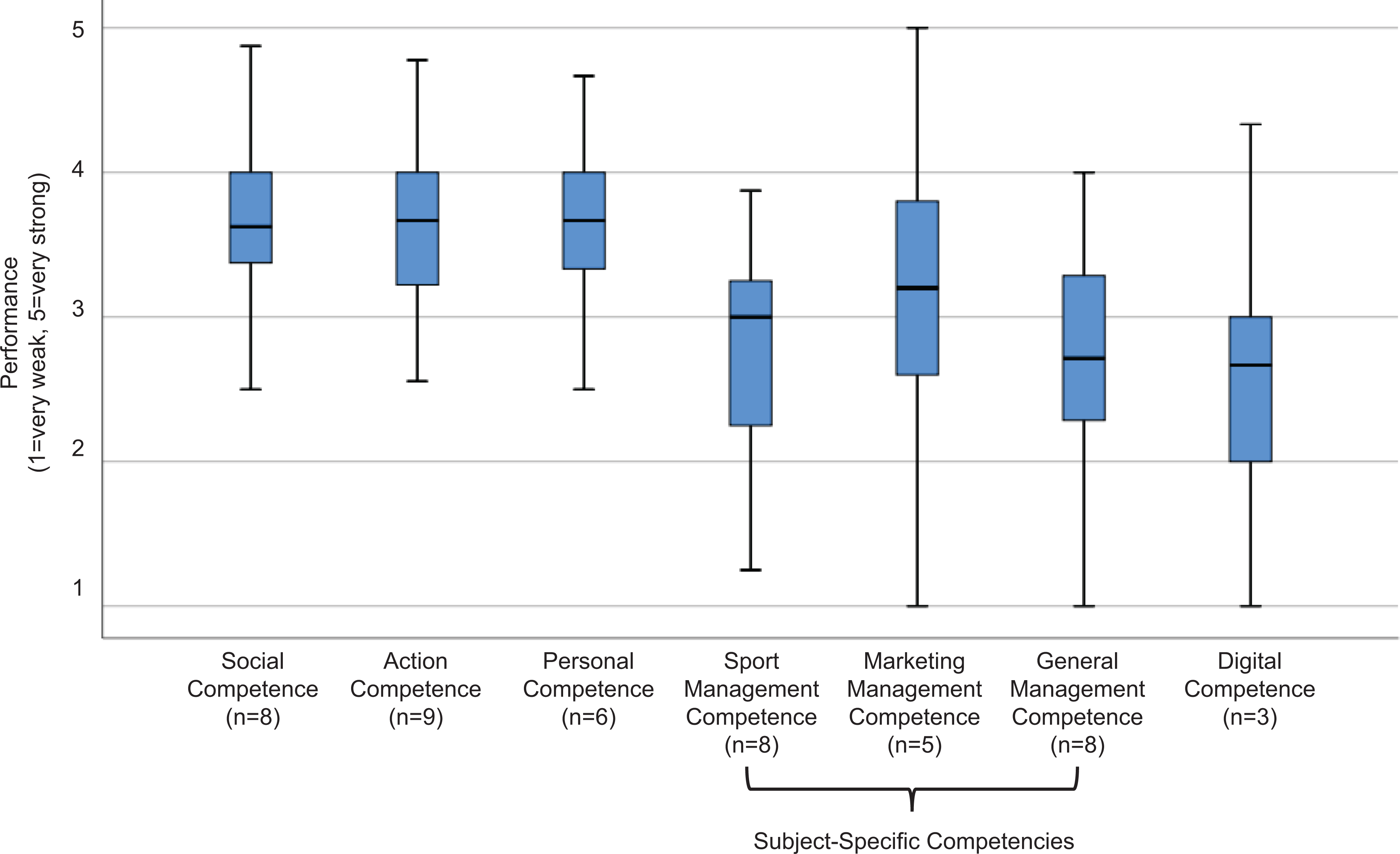
Sport management students’ self-perceived performance ratings of their sport management competencies (n = 83).
Answering our second research question, the perception of performance was average across most competencies, favoring generic competencies over subject-specific competencies. Following the assumption that Master’s degree students perform stronger than Bachelor’s degree students, we compared the two subsamples. There were no significant differences for six of the seven competence blocks. The self-perceived performance of action competence presented a slightly higher average for the Master’s degree students (M = 3.8, SD = 0.44) than for the Bachelor’s degree students (M = 3.5, SD = 0.56); t(82) = −2.064, p = 0.042. No significant differences were found based on gender.
Concerning generic competencies, the students rated their performance in teamwork (M = 4.4, SD = 0.69) as their strongest competence, followed by the desire to succeed (M = 4.2, SD = 0.90) and organizational skills (M = 4.1, SD = 0.80). The strongest subject-specific competencies were knowledge of the sport management profession (M = 3.5, SD = 0.94), marketing (M = 3.5, SD = 0.93), and sponsorship management (M = 3.2, SD = 1.07), the last two being part of the new marketing management competence block.
IPA of competencies for sport managers
To answer the third research question, we compared the results of the two questionnaires. The data were pooled into one large database and examined. Table 2 shows the results concerning required competencies for sport managers based on their importance according to sport industry experts and performance according to sport management students, respectively.
Importance and performance of competencies for sport managers according to sport industry experts (n = 54) and sport management students (n = 83).
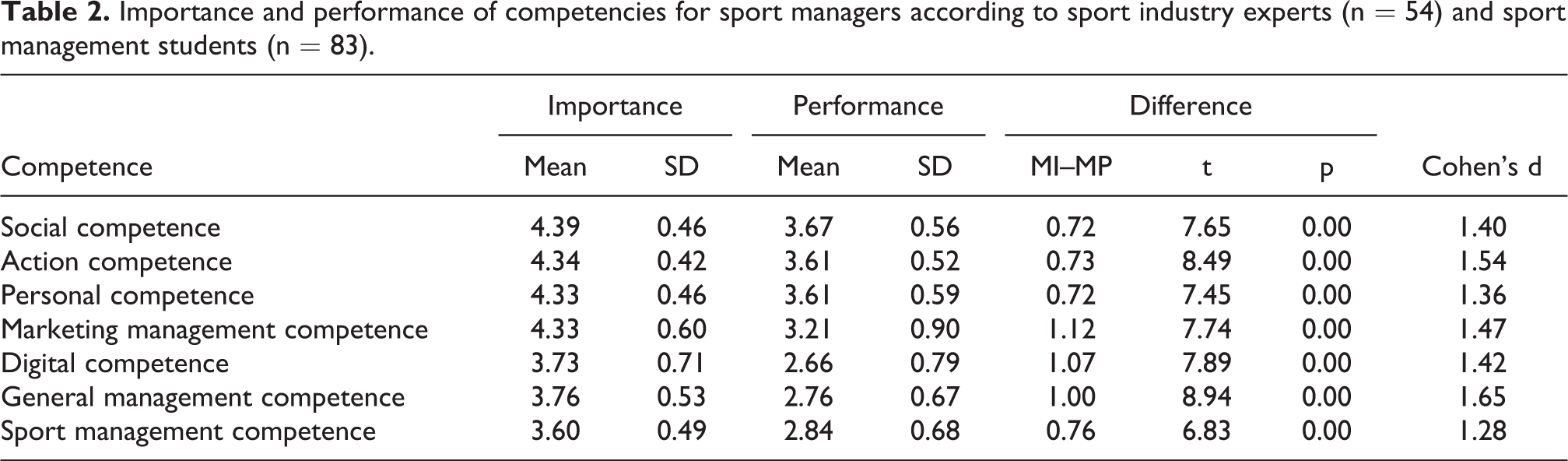
The competence blocks all presented significant differences between the mean importance and mean performance values with a very large effect (Cohen, 1988). The ranking of the competencies was the same save for subject-specific sport management competence, which the students indicated outperformed digital competence. In contrast, the industry representatives indicated that the latter was slightly more important.
We applied an IPA as a strategic management tool by allocating the values of self-explicated importance of competencies on the Y-axis and the respective values of student performance on the X-axis (Figure 4). Previous studies have generally placed the cross-point of these two dimensions either in the center of the scale used (Go and Zhang, 1997) or in the center of the data (Ford et al., 1999). We followed more recent applications of IPA, which recommend a data-centered approach in which the respective mean values are used as the cross-point in the matrix (Bacon, 2003; Wohlfart and Hovemann, 2019). The cross-point of our matrix is drawn at the coordinates of the mean values of importance (4.1) and performance (3.2), respectively. Because of the large discrepancy between these two mean values, caution should be taken when interpreting the matrix because all items were perceived as being important (min. 3.76). 9 High importance values across examined competencies have also been found in other studies (Jiang and Alexakis, 2017; Ko et al., 2011).
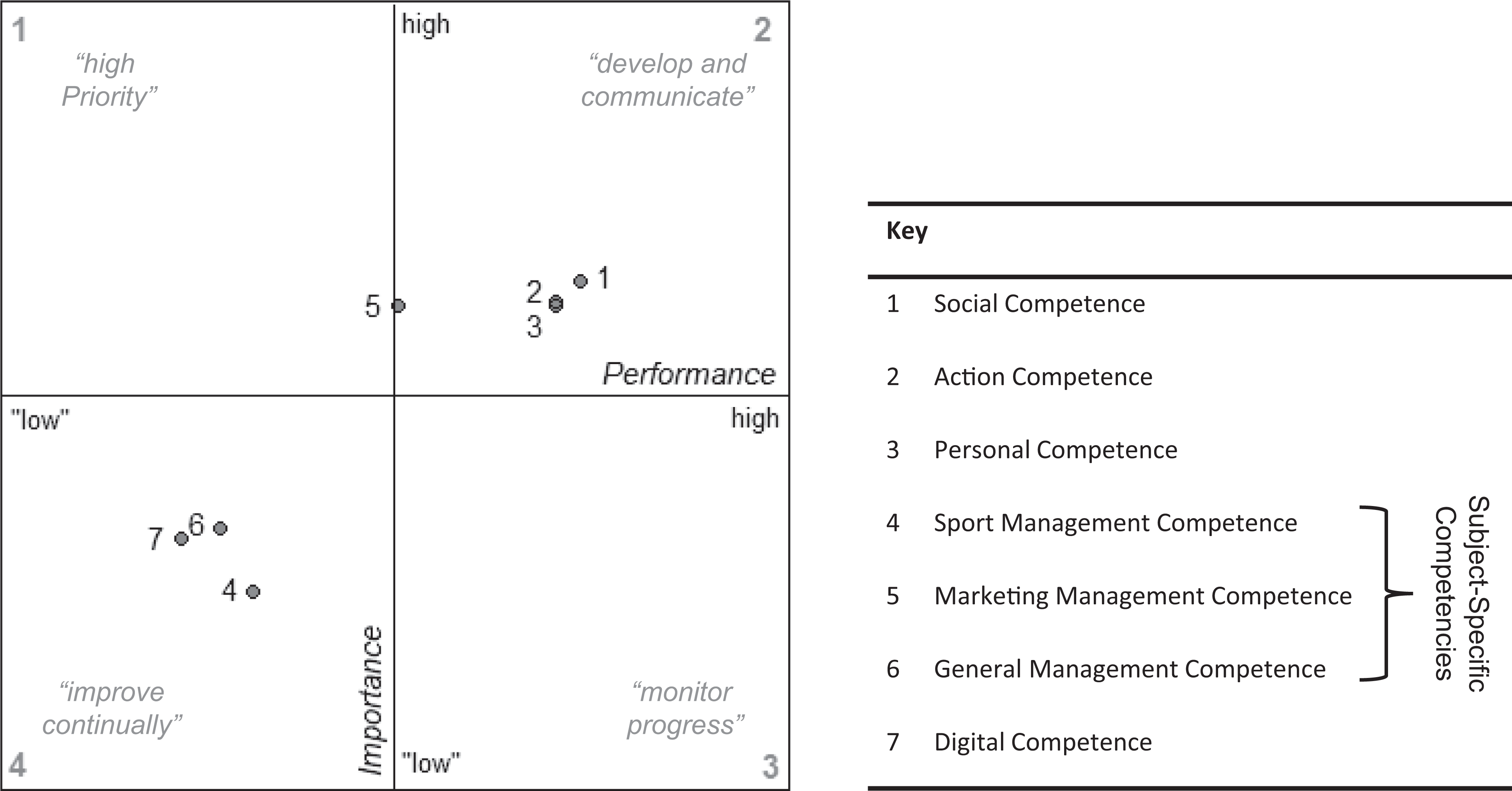
Importance–performance analysis of sport management competencies.
Competencies that were important for future sport managers but that the student sample did not perceive themselves as being able to perform well are located in the first quadrant (“high priority”). In the second quadrant (“develop and communicate”), competencies were identified that were important for future sport managers in which the student sample perceived themselves as performing well. The third quadrant (“monitor progress”) shows competencies that were seen as less important for the future but in which current performance was high. The fourth quadrant (“improve continually”) shows those competencies for which both importance and performance ratings were lower than the respective mean values (Wohlfart and Hovemann, 2019). We found competencies in quadrants 2 (social, personal, action, marketing management) and 4 (digital, general management, sport management) that hold managerial implications for SMHE.
Discussion and implications
In applying the IPA, the current study provides a foundation for examining competence-based education as a vital field in bridging the gap between industry and academia. Overall, the results yielded three major themes: competencies to be further developed and communicated, competencies to be improved and the need for an adequate curriculum design to (better) differentiate between Bachelor’s and Master’s degrees.
Develop and communicate unique selling proposition of SMHE
Students who study sport management follow their passion when selecting their degree (Barnhill et al., 2018). Sport, meanwhile, has proven to support the development of generic competencies (Chalfin et al., 2015). In further refining these competencies throughout their studies, SMHE supplies well-prepared graduates for an industry in which generic competencies are in high demand. According to our results, SMHE should further develop and communicate this unique selling proposition to (potential) students and the sport industry.
The transformation of various items into the new subject-specific competence block “marketing management” seems plausible in light of previous studies concerning the expectations of the sport industry, which require sport managers to be communication managers first and foremost (Packheiser and Hovemann, 2013; Petersen and Pierce, 2009). Wohlfart and Adam (2019) recommend developing digital competencies by integrating or strengthening subject-specific courses concerning (applied) digital marketing and social media management while implementing or expanding the use of virtual media platforms in learning activities. Our results highlight the importance of marketing management competence from an employer’s perspective and concede a relatively high performance among students (see Figure 3).
In the student sample, 14% reported an interest in working in marketing management. The curriculum of this specific sport management program offers two marketing modules (15 ECTS) in the Bachelor’s degree, explaining the high performance ratings compared with other subject-specific competence blocks. Thus, there is a reinforcement of the need for a deeper discussion of marketing management topics in a Master’s program to justify the prolonged study time and satisfy industry needs (KMK, 2017).
Continually improve subject-specific competencies
The IPA indicates a need to refine the development of subject-specific competence. It is striking that sport management competence is considered the least important from the perspective of sport industry representatives. How is this possible? If not taught in SMHE, how can this competence be developed?
HEIs are responsible for preparing students for the labor market (KMK, 2020). Dowling (2018: 6) discusses the importance of establishing a “systematic body of knowledge” in sport management and the vital role that universities play. As Wohlfart et al. (2020) point out, the geographical, cultural, political and intellectual contexts affect sport management scholarship. It is recommended that sport management programs in Germany and the EHEA reach an agreement on the core components of content in SMHE at both Bachelor’s and Master’s levels, similar to the common professional components as laid down by the Commission on Sport Management Accreditation (COSMA) in the USA. An agreement at the national level seems both promising and realistic and could be discussed in annual academic conferences. Based on the data, the importance of marketing management competence is emphasized. Additionally, to improve subject-specific competencies, it is recommended that input on current issues in sport management and general management content should be included in SMHE (COSMA, 2016; Raven, 2018). With subject-specific input, SMHE can demonstrate its unique contribution to the industry as opposed to generic management education (Zhang, 2015).
On the other hand, HEIs should educate future professionals as change agents (Dowling, 2018; Frisby, 2005). Next to the positive aspects of sport, SMHE should engage with the troubled aspects (corruption, doping, discrimination, etc.) and sensitize its students toward them (Hums, 2010; Thibault, 2009). If successful, this would strengthen the external professional authority of the field and acknowledge the vital role that SMHE plays.
Our results also highlight the need for generic competencies. These should be developed in tandem with subject-specific competencies. This recommendation is in line with ongoing processes in the shift from teaching to learning in higher education (Hsu and Malkin, 2011) and SMHE (Lumpkin and Achen, 2015). This should be made tangible by including generic competencies as learning outcomes in module manuals. Bachelor’s and Master’s degrees should differentiate (a) the type of (generic) competence to be developed and (b) the level of competence to be developed in the courses. As generic competencies are also highly relevant outside the sport industry (Jackson, 2010), their development would offer graduates an additional competitive advantage in the labor market.
Next to subject-specific competencies, the results indicate that digital competence falls within this strategic quadrant. Although future sport managers will not be responsible for developing and programming digital tools, they need to understand and work with these tools in the future (Pate and Bosley, 2020). External shocks, such as the COVID-19 pandemic, shows that the importance of digital competence for future managers in any discipline is increasing tremendously. We believe this to be both a great challenge for HEIs in general, including SMHE, and, simultaneously, a great opportunity for both academia and industry. Communication in seminars using online/video platforms or the creation of podcasts or videos in groups as part of a module can be used.
Strengthening Bachelor’ s and Master’ s degree profiles
The absence of significant differences between the perceived performance of Bachelor’s and Master’s degree students needs to be critically analyzed. The Bachelor’s degree was developed to be an independent professional degree (European Commission, 2019). The consecutive sport management Master’s degree was developed to enable graduates to take on leading positions in the sport business (i.e., manager, team leader, etc.). Therefore, the two programs should have different goals concerning the employability of graduates and should develop different generic and subject-specific competencies. According to educational policy goals, a Master’s degree program must develop higher levels of competence across all competence blocks compared with its Bachelor’s degree counterpart (European Commission, 2008, 2019; KMK, 2017).
The results contradict the expectation of Master’s degree students outperforming Bachelor’s degree students across all competencies. For SMHE in Germany, Dunkel et al. (2018) criticize the lack of differentiation concerning subject-specific competencies. Our study reinforces this finding, extending it to include a lack of differentiation among generic competencies. Based on our results, student investment in a sport management Master’s degree is not justified.
It is strongly recommended that SMHE strengthens the individual profiles of sport management degrees. One step toward this could be with the design and implementation of a competence-based curriculum: learning outcomes of Master’s degree modules must have higher standards concerning both generic and subject-specific competence development. Although Bachelor’s degrees are recommended to introduce the topic, Master’s programs should build on that introduction and further develop competence levels (e.g., “Introduction to Marketing” in the Bachelor’s degree and “Strategic/International Sport Marketing” in the Master’s degree).
Limitations and future research
The primary limitation of the current study is the small and convenient sampling of industry experts and students in Germany. Because the first sample group was acquired through a European research project, we can substantiate the results of the sport industry to be homogeneous with the situation in the other investigated countries (Wohlfart and Adam, 2019). For the student sample, the results may have been different if the examination had been carried out in a broader context. However, we assert the relevance of this case because of its representativeness of sport management education in Germany. We encourage other institutions in Germany and globally to follow our systematic approach with IPA and examine the performance of their students compared with industry demands.
Furthermore, the study focuses on two key stakeholders: employers and (prospective) employees. However, there are other stakeholders, such as higher education administrators, curriculum developers and faculty. Future (quantitative and qualitative) studies could involve these stakeholders to identify the opportunities and barriers of a competence-based curriculum. These studies could result in the development of concrete action plans and a mutual understanding of core competencies in SMHE.
Additionally, we want to reflect on the use of IPA in deriving strategic implications for higher education. Bacon (2003) discusses the validity of different approaches of the quadrant analysis, advising caution in applying it; the results depend on decisions made by the researcher(s) and should be critically reflected on according to the context. We do not claim statistical validity of the results but highlight the practical strength of this tool in deriving implications for higher education in light of industry and policy demands.
Another limitation relates to the questionnaire and its underlying competence areas. In 2020, the time of writing, no competence framework for sport managers exists because of the quasi-professional nature of sport management (Dowling, 2018). We need to move forward and find a common understanding of which competencies are relevant for sport managers and then develop these in SMHE. The aggregated competence blocks used here offer a broad overview of important competence areas. Future studies need to examine the items that define these in the context of sport management. Building on the presented competence framework, a qualitative investigation into the various competence areas seems promising in moving forward toward further professionalization. We want to encourage further examination of why certain competencies are important for sport managers.
Looking ahead, there is a need for a deeper investigation of differences between Bachelor’s and Master’s degrees in higher education. Do the graduates of these two programs truly not perform differently? Or are Master’s degree graduates better judges of their performance? Maybe the reference bias in the respective peer groups leads to a misrepresentation of performance values. Longitudinal studies of competence development throughout both study programs could enable a critical discussion.
Conclusion
The current study examined the importance of competencies in the sport industry and compared the results with the performance of prospective employees from a sport management department in Germany. Generic competencies are of the strongest importance according to the industry representatives. Sports management competence, meanwhile, is the “least important”. We argue that, because of the societal responsibility of HEIs, a unilateral focus on generic competencies cannot be supported. Rather, these competencies should be developed in tandem with the potential (critical) core components of SMHE. Various recommendations for application in curriculum design have been offered.
The students indicated that they performed most strongly in generic and marketing management competencies. Surprisingly, we find no significant difference in the performance levels between Bachelor’s and Master’s degree students. Consequently, we highlight the need for improvement in curriculum design based on standardized frameworks.
There is a mismatch between the importance attributed to certain competencies by sport industry representatives and students’ perception of their performance with respect to these competencies. This is not surprising, because the student sample consists of young professionals about to enter the industry. Concerning the fit between performance and importance, at first glance the sample seems to be well prepared for the labor market. Accordingly, the requirements formulated by the Bologna Declaration for fostering employability seem to be met. IPA, as a strategic management tool, derives implications for higher education by depicting the importance of future competencies against the respective performance ratings of students. Based on the results, we recommend the development of modules that foster generic competencies. Furthermore, the results indicate “lower” importance and performance for subject-specific competencies in general management and sport management, resulting in a need for continual improvement in these areas. Further research in this area is required to strengthen the external professional authority of the field and recognize the vital role SMHE plays in this development.
The gap between SMHE and the sport industry may persist. Influenced by trends such as commercialization, internationalization, digitalization and sustainability, SMHE needs to re-evaluate its curricula on a regular basis to remain relevant and legitimate. With the current study, we have started to build a bridge between higher education and the industry. We hope that further studies will seize the opportunity to build on this beginning.
Footnotes
Declaration of conflicting interests
The author(s) declared no potential conflicts of interest with respect to the research, authorship, and/or publication of this article.
Funding
The author(s) disclosed receipt of the following financial support for the research, authorship, and/or publication of this article: This work was supported by the Erasmus+ Program “New Age of Sport Management Education in Europe” of the European Union (2017-1-DK01-KA203-034270).
