




Abstract
In this article, we address the questions: How is the purpose of higher education constructed within policy texts from the European Higher Education Area (EHEA), England and Sweden? How does this position students in making the transition from Bachelor to Masters? We do this through analysis of two recent policy documents from each of the EHEA, England and Sweden, identifying key discourses including the meanings, oppositions, contradictions and logics that structure the texts. We look at what aspects of ‘global policyspeak’ are common across them, what are their particularities and how these are shaped by distinct histories. We argue that all the texts represent neoliberal policies in sharing an economic rationale for higher education and in individualising the benefits of university education. Students are, in their transition from Bachelor to Masters, expected to maximise their employability and their ability to contribute to the national and global knowledge economy. However, there are also differences between the policy documents, tensions within them and alternative discourses, such as a focus on dialogue and academic freedom that challenge the reduction of higher education to the economic.
Introduction
In this paper, we analyse policy documents as a way of understanding Bachelor-to-Masters transitions. This supplements the focus on student actions, motivations and experiences in much research on transitions and offers a broader context for the empirical data presented in the other papers in this special issue. We explore the positions that policy texts make available to transitioning students (Davies and Harré, 1990), thus decentring identity and its associations to an inner stable essence. We argue that in order to understand transitions we need to identify the positions available to higher education students – as prospective workers, as apprentice academics, as experiencing a rite of passage into (middle-class) adulthood, as realising their potential, as furthering their country’s economic competitiveness, as supporting human progress and so on. We look at two documents from two countries within the European Higher Education Area (EHEA), England and Sweden, to examine how ‘global policyspeak’ (Ball, 2008: 1) and discourses travel across national settings.
We are active in debates about the direction of higher education and our critical perspective is shaped by an opposition to how universities have become ‘part of the EU’s “knowledge industry” . . . obliged to produce knowledge which is being, in an unprecedented manner, both marketized and bureaucratized’ (Moutsios, 2013: 37). However, while this shapes the questions we ask, our work is not normative but seeks to understand how this marketisation manifests and operates. We ask the following questions of our six policy texts: How is the purpose of higher education constructed? How does this position students in making the transition from Bachelor to Masters?
We start with the purpose of higher education because in order for students to choose to transition (or not) to MA study, they must narrate that choice and give it meaning.
We examine variations in how Bologna is conceived and implemented in different political contexts. We selected policy texts from the EHEA, England and Sweden as these offer three distinctive perspectives albeit, as we show, within a common overarching economic agenda. The EHEA crosses 48 countries with governments ranging from the anti-austerity left to the nationalist right. It launched in 2010 as a process of creating a shared framework for higher education on the grounds of supporting staff and student mobility, and increasing accessibility and competitiveness. England, since 2010, has been led by right-wing governments and even before that, the postwar welfare state has been eroded since the late 1970s. Sweden has also moved right but has a stronger social democratic tradition than England (Östberg, 2019). Both countries are members of the EHEA and have experienced dramatic rises in the proportion of young people progressing to HE and increasingly stratified university systems that shape postgraduate study choices (Brooks, 2006; Hallonsten and Holmberg, 2013). In England, there have been no structural changes to the HE system in order to align with Bologna and following a 2016 referendum, the UK left the European Union but remains part of the EHEA.
As elaborated in the introduction to this special issue, England has maintained a 1 year Masters programme against the three-cycle structure advocated by Bologna (Education and Skills Committee, 2007) so that it takes just 4 years to gain a Bachelor’s and a Masters. In contrast to many European countries, the UK system has always had a break between these two cycles with an undergraduate degree alone giving access to most of the graduate labour market. Recent higher rates of progression into postgraduate programmes are partly a response to increasing graduate unemployment particularly post-2008 (Brooks and Everett, 2008). In contrast, in Sweden, the Bologna process led to substantive changes in university education (Ministry of Education, Research and Culture, 2005). The degree structure was aligned with Bologna, with the introduction of a 2-year Masters degree and modified undergraduate qualifications and universities were required to specify objectives for all their constituent modules. New widening participation measures were introduced, with government instructions on how to implement these and agencies directed to evaluate the work of Higher Education Institutions (HEIs). In addition to these contrasts, we live and work in Sweden and England. Thus, as researchers, we can draw on our understanding of these national contexts in the data analysis while using the contrasts between them to make the familiar strange.
The Bologna process ‘has added a European dimension to the previous nationally oriented policies aiming at improving efficiency and quality of higher education as part of the international economic competition’ (Kogan et al., 2006: 5). To make sense of the economic agenda that shapes the policies, our analysis draws on theorisations of neoliberalism starting from Lawson’s (2018: 92, original emphasis) definition ‘of the political project of neoliberalism as the continual expansion of markets and market-derived forms of measurement and evaluation into all areas of social life’. This is particularly useful for looking at higher education because of the definition’s focus on ‘the prioritisation of economic freedom over political freedom’. However, Lawson and other writers on higher education (e.g. Olssen and Peters, 2005) emphasise the variety of forms that neoliberalism takes and the different rates and manners in which it has been applied. Our aim is to attend to such differences in forms, rates and manners in a way that can support the work of developing counterdiscourses.
Methodology
We know that higher education is increasingly becoming marketised but we know little about the nuances in the diverse ways that neoliberalism positions education and students. Thus we have chosen a theoretical sample of countries and texts that can allow us to explore a range of ways that neoliberalisms are enacted in European HE policy. Initially we wanted to get a broader picture of the Bologna reforms and the values advocated through them. For that purpose, we analysed two Bologna implementation reports from 2012 and 2018 (European Commission, 2012; European Commission, 2018). The 2018 report is the successor of the 2012 report and the 2015 Yerevan Communiqué and report. These reports deliver ‘clear messages on the challenges ahead’, drawing ‘on authoritative qualitative and quantitative information from each country’ giving a ‘clear, comparative view of how higher education reforms and modernisation have been addressed at national level’ (European Commission, 2012: 3). These contain a strong neoliberal voice that differs from those in Sweden and England. As a result, we decided to use them not just as background but as a point of comparison. While not strictly comparable to national policy documents, they are the most detailed texts (200–300 pages long) relating to HE in the EHEA and show the discourses in operation. We also considered analysing the EHEA Communiques. We found those documents, like the implementation reports, to have a neoliberal technocratic voice but, unlike the reports, to be too short (at 4–5 pages long) to allow us to develop an analysis of the associated policy discourses.
In order to select documents from two nations England and Sweden, we agreed on three principles: (1) relevance to understanding HE policy and student choices during Bologna implementation, (2) influence within their policy regimes and (3) contribution to the variations in perspectives on education in the different national contexts.
In England, we selected the two most recent white papers on higher education: Higher education: Students at the Heart of the System (Department for Business, Innovation and Skills, 2011) and Success as a Knowledge Economy: Teaching Excellence, Social Mobility and Student Choice (Department for Business, Innovation and Skills, 2016). In white papers, a Government sets out proposals for future legislation. They are written by civil servants, the permanent employees who do the work of government regardless of who is elected, under the close direction of ministers. Control of HE is devolved to national legislatures in Northern Ireland, Scotland and Wales, so these white papers only apply to England. Through them we can see the rightward shift in education policy. The first was published by a coalition led by the right-wing Conservative Party with the centre-right Liberal Democrats and the second by a majority Conservative government. They are the only two major government texts relating to universities published since 2010. They also encapsulate the consumer-oriented approach to governance that has structured HE in England since the 1980s, where marketisation is now more firmly established than in any other EHEA country (Brooks, 2019).
To select Swedish documents, we searched the government database (Government Offices of Sweden, n.d.) reviewing the ‘legal documents’ that are produced at different stages of legislative processes and are assigned an important role in decision making (Fejes, 2008). Applying a search string ‘universities and research’ yielded documents on various topics on university education and research. Yet, none of the documents published since 2010 focussed on student transitions or choices. Many looked at strategic development of HE or changes in HE. We listed 29 documents that seemed relevant and found those most pertinent using our selection criteria. There were two reports from 2018 on HEI in Sweden in relation to other countries, titled Internationalisation of Swedish Higher Education - A Strategic Agenda (En strategisk agenda för internationalisering (Delbetänkande om ökad internationalisering 2018a: 3, from January 2018)) and Increasing the Attractiveness of Sweden as a Knowledge Nation (Ökad attraktionskraft för kunskapsnationen Sverige (Delbetänkande om ökad attraktionskraft 2018b, from October 2018)). These documents are the result of a government inquiry established in March 2017 with the goal of proposing strategies to internationalise Swedish HEIs. They are summarised in a shorter English report, Internationalisation of Swedish Higher Education Institutions (Summary of the Inquiry on increased internationalisation of higher education institutions 2018c), that we selected for analysis. In addition, we selected a 2019 report on university governance and resource allocation titled A long-term, coordinated and dialogue-based governance of the university 1 (En långsiktig, samordnad och dialogbaserad styrning av högskolan (Översyn av universitetens och högskolornas styrning och resurstilldelning 2019)). The inquiry was conducted in collaboration with different actors from universities, student unions and industry in Sweden. Both documents come from a time when Sweden has been governed by the Social Democratic Party, together with the Green Party. Yet, in the past years, centre-right alliances have gained influence in Swedish politics.
We use discourse analysis to explore how the purposes of higher education are presented and argued for in policy documents, in the context of Bologna, as well as the positions available for students transitioning from BAs to MAs. Discourse analysis allows us to depict and discuss meanings that are being taken for granted as goods, problematising things described with adjectives such as ‘effective’, ‘accountable’ and ‘quality’. The starting point is ‘that you have to suspend your belief in the innocence of words and the transparency of language as a window on an objectively graspable reality’ (MacLure, 2003: 12, original emphasis). Meanings, ideas and arguments in policies exist through discourses or fictions functioning in truth (Walkerdine, 1990) – collections of meanings that bring objects into being, determining ‘what can be said about something as well as who can say it, and even what can be thought or imagined’ (Mendick, 2006: 17).
To operationalise this, we adapted the following questions that MacLure uses to open up research texts.
• How are knowledge claims established and defended?
• What are the problems, what needs to be solved, what is important, how do the texts persuade?
• Where does this text get its authority?
• What kinds of oppositions structure the arguments and the moral framework of this text? How might these oppositions be broken down?
• How are subjects drawn in this text? Who gets agency? (How are students, academics constructed, are they given agency, are they in control, what versions of students are constructed and which ones are missing?)
• Whose ‘voices’ are privileged in this text? Who is silenced? (Whose interests are represented?)
• What are the questions that this text cannot pose to itself?
• Where are the gaps, silences and inconsistencies in this text?
• What might be so taken for granted in this text that it is almost impossible to ‘see’ it? (A trick question, of course, but no less important because of that.)
(Adapted from MacLure, 2003: 82)
The analysis was done iteratively. We started by analysing the two Bologna implementation reports separately and discussed the use of these questions as the basis for interrogating the texts and the insights we gained from them. The questions provided us with a way into and an orientation towards the policy texts, as we read and discussed them, rather than a series of questions to be answered one by one. Having consolidated our way of approaching the data analysis, we applied the questions to the Swedish and English policies. Several times during the analysis of the Swedish and English policies, we met to discuss our results, contrasting how the purpose of higher education and student transitions are constructed in the European, English and Swedish documents. In doing so, we drew on our experiences of neoliberalism and on pertinent research, especially Davies (2014).
To test emerging themes and confirm the identified focuses within the policies, we identified keywords through which meanings around students and student transitions were created. During the whole process, we jointly collected keywords that stood out to us as relevant and compared how and how often these appear across the six documents, using this to support or counter our developing arguments. Keywords that we collected were: autonomy, autonomous; choice/s; collaboration/s, collaborate, collaborative/ly; community/ies; competition/s, competitive; economy, economic/s; employment, employability; in/equality; excellent/excellence; invest-ed/ing/ment; market-s/place; measure/s/d/ing; monitoring, monitor, monitored; potential/potentiality; social mobility; sustainability/sustainable; transition; widening participation.
The purposes of higher education
In this section, we identify the explicit and implicit purposes ascribed to HE within the policy texts. We start with the 2012 and 2018 Bologna implementation reports in which the primary goal of global economic competitiveness is in tension with the ideal of a collaborative European project. We then explore the English white papers in which non-economic purposes of education are acknowledged only to be dismissed while competition is foregrounded. Finally, we analyse the Swedish documents, one of which includes a discourse of knowledge for its own sake as a way of securing Sweden’s competitiveness. We do this because it is through discourses about HE’s broader ideas and goals (what we call ‘the purposes of HE’) that student transitions are rendered – more or less – intelligible.
Bologna reports: Technocratic competition
The 2012 report asks ‘Why is this agenda so important?’ The reply starts, ‘Europe needs more graduates. Future jobs are going to require people with more and better skills, and . . . we wish to be competitive on the global stage . . . in a global knowledge economy . . . Our citizens need to be able to develop their potential if our countries are to fulfil theirs’. The rationale for education is constructed here through a combination of a skills market, global competition and national and individual potential. The term knowledge economy has reconfigured education ‘as a massively undervalued form of knowledge capital that will determine the future of work, the organization of knowledge institutions and the shape of society in the years to come’ (Olssen and Peters, 2005: 331). The discourse of a global knowledge economy thus directs higher education to economic goals. Indeed this is the archetypal neoliberal position in which developing individual and national potential are aligned, with more and better education as the route to both (Archer et al., 2010). It is unthinkable that Europe could need fewer graduates or future jobs require fewer skills. Bologna is “vital for economic regeneration and sustainability of the wider continent of Europe (European Commission, 2012: 3). This phrase is haunted by its others: a degenerate (or at least un-regenerated) and unsustainable Europe. Thus, Europe’s Economic competitiveness is positioned as the solution to broader problems including sustainability.
The stated rationale for Bologna shifts between 2012 and 2018. The 2018 report opens with a broader focus making no mention of economic competitiveness. The ‘technical goals of the Bologna Process – converging degree structures, shared standards for quality assurance and common recognition practice’ (p. 3) are constructed as means for developing understanding, trust and collaboration across the EHEA, implicitly building a common European project. However, looking at the document as a whole, the economy dominates with the main goal of HE constructed as supplying workers for the labour market despite its initial broader focus. For example, the report audits the ‘qualification mismatch’, tying HE to the economy through the assumption that a graduate’s skills and level of education should match their labour market position. The report also notes that ‘using labour market forecasting, involving employers, providing incentives to include work placements . . ., improving career guidance services . . . were still not applied everywhere’ in the EHEA (p. 230). This is ‘a recommendation . . . phrased grammatically as a description’ as it conveys a moral imperative that such things should be applied everywhere, something that Lemke (1990) identifies as typical of technocratic texts. Technocracy is an ideology that prioritises leadership by ‘experts’ over democratically-elected leaders (Lockhart, 2015). It presents ‘evidence’ as if it were neutral rather than contested. Here, as with the 2012 statement beginning ‘Europe needs more graduates’, ‘no argument is made concerning the value of the outcome nor any as to value-choices regarding means. The argument is only that the covertly recommended means [labour market forecasting etc] are necessary to the unargued ends [a competitive European knowledge economy]’ (Lemke, 1990).
Bologna’s economic agenda and the accompanying monitoring and control colonise HE with its models of good practice rendering HEIs subservient to its project and setting up mechanisms to equalise conditions across them. This is visible in the maps charting progress on Bologna. Maps of the EHEA are shaded to indicate how far different measures are enshrined in policy and practice in its different countries and highlighting which are and which are not in line. The 2012 report uses 103 such figures, rising to 192 in 2018, evidence of a growing focus on measurement and inter-country comparison as essential tools to attain ‘quality’. The term ‘Monitor/ing’ occurs 55 times in 2012 but 200 times in 2018. The 2018 report even maps which countries are ‘Monitoring whether ECTS credit allocation is regularly monitored’ (p. 60, emphasis added). The reports also include scorecards: maps giving countries a ‘score’ based on how many measures they have implemented, visualised via traffic-light colours, from green to amber to red, to show which countries are falling behind in implementing Bologna.
Bologna generates ‘a quantitative, utilitarian audit of nations. Whether nations are actually in direct economic competition with each other is not confirmed, but benchmarking uses the power of comparison to identify priorities for action and communicate their urgency’ (Davies, 2014: 128). The marketisation of governance has intensified since Bologna, alongside a shift from governance via national legislation to transnational structures that govern through incitement rather than compulsion. Fitting with the technocratic language discussed above, the reports’ charts convey an aura of neutrality, of government by an expertise that is beyond ideology. Universities must follow regulations by national agencies and governments, something that closes down opportunities for differences. Bologna introduces specifications of HE across nations, which erode ‘traditional conceptions of professional autonomy over work in relation to teaching and research. Neoliberalism systematically deconstructs the space in terms of which professional autonomy is exercised’ (Olssen and Peters, 2005: 325).
England policies: Market competition
The England white papers share an economic agenda with the Bologna reports but see this as being realised through making the purpose of HE responding to the needs of its ‘consumers’: students. As its name suggests, 2011’s Students at the Heart of the System has as its: ‘overall goal . . . a sector that is freed to respond in new ways to the needs of students’ (p. 3). 2016’s Success as a Knowledge Economy states: ‘Graduates are central to our prosperity and success as a knowledge economy, and higher education is a key export sector’ (p. 8). Like the Bologna reports, this constructs HE in a global marketplace in which nations compete for students but unlike those reports, it explicitly positions graduates at the centre of this. Competition is also more central. Certainly, the Bologna reports’ tables and maps create national anxiety and feelings of inter-country competition. Rather than aiming ‘to achieve a form of peaceful consensus, via the provision of an agreed-upon principle of equivalence’, they ‘nurture existential anxieties on the part of leaders, which might drive a greater concern and enthusiasm for competitiveness’ (Davies, 2014: 141). However, there are few direct references to competition in the Bologna reports with the word and its derivatives occurring just five times in 2012 and once in 2018. The much shorter England white papers use these terms 21 and 69 times respectively. As this indicates, they are more openly ideological documents that advocate for a marketised HE sector.
The 2011 white paper champions ‘a more market-based approach’ (p. 73). In contrast to the Bologna reports, it sees competition, not monitoring as what will improve universities. For example, it advocates ‘a more diverse, dynamic and responsive higher education sector where funding follows the student and the forces of competition replace the burdens of bureaucracy in driving up the quality of the academic experience’ (p. 24). Competition is constructed as powerful and as opposed to bureaucratic audit which weighs down universities. Similarly this document talks about using information to ‘stimulate competition’ (p. 34) and how, for student choice to operate, all providers ‘must be able to compete on a level playing field’ (p. 47). However, it also draws on technocratic discourses to justify its proposals ‘on the grounds that it is what expert analysis of the facts demands that we do’ rather than in relation to competing values or interests (Lemke, 1990). For example, the plan to increase tuition fees from about £3000 to £9000 that generated large protests in November 2010 (Smoke, 2020) is constructed as the only fair response to post-2008 debt levels: We inherited an enormous deficit which required difficult decisions. . . . We could have reduced student numbers or investment per student or introduced a less progressive graduate repayment mechanism. But these would all have been unfair to students, higher education institutions and the country. (p. 5)
Such justifications that present ‘the positivist and technocratic ideal, of purely “objective” socio- economic public discourse’ (Davies, 2014: 20) have disappeared by 2016. They are replaced by a more-strident commitment to marketisation, reflecting the shift from a centre-right coalition to a right-wing government. The 2016 white paper is entirely oriented to competition, with ‘Creating a Competitive Market’ as the first of its three chapters. Within its logic, if the government creates an appropriately-regulated marketplace, the ‘invisible hand’ will do the rest: ‘Competition between providers in any market incentivises them to raise their game, offering consumers a greater choice of more innovative and better quality products and services at lower cost. Higher education is no exception’ (p. 8). With the deepening commitment to marketisation, there is a narrowing of the purposes of (higher) education. In 2011, the focus was on the exchange value of degrees, or their value as a commodity within the labour market, and the economic purposes of universities. But alongside this, the white paper acknowledged other motivations for university study and its use-value in satisfying a broader range of human needs (Marx, 2011). For example: ‘Students may study a subject because they love it regardless of what it means for their earnings. But one of the purposes of higher education is to prepare students for a rewarding career’ (p. 78). Although other motivations are dismissed as less important, this differs from the 2016 white paper that only includes market-driven reasons for pursuing HE.
The way that monitoring features in the England documents reinforces this exclusive orientation to the market. Its role is to supply the information necessary to resource a free market. The 2011 white paper talks about a ‘new, fit-for-purpose regulatory framework’ which can ‘protect students and taxpayers’ without creating ‘a bureaucratic burden that stifles innovation’ (p. 66). This trend continues in the 2016 white paper which sets out plans to update the ‘regulatory architecture’ on the grounds that this ‘was designed in the early 1990s for an era of limited university competition, student number controls and majority public grant funding that has now passed’ (p. 62). This change is presented as something natural and inevitable neither ideological nor intentional: the era has simply ‘passed’. The Office for Students will be ‘a market regulator clearly focused on the student interest’ (p. 63) but this reduces the student interest in their education to that of a consumer which, as we explore later, narrowly frames their post-BA transitions.
Sweden policies: Collaborative competition
The two Swedish documents on internationalisation (2018) and governance (2019) both view Sweden as a leading knowledge nation and assign to HE the purpose of maintaining and improving that position. Thus HE is a ‘tool for developing the most advanced “knowledge society” in the world’ (Kogan et al., 2006: 5). Competition is constructed as the key driver of quality in both documents. However, the 2019 text also offers critiques of the role of competition in HE governance and acknowledges tensions between the associated monitoring and control and the autonomous and collaborative environments that can generate original knowledge.
In the 2018 document, the importance of quality is argued based on marketisation and nation-building interests. Broader goals such as sustainability are included but these are subsumed to Sweden’s economic interests and to not falling behind in global competitiveness at all levels: ‘Countries, regions, municipalities and higher education institutions all compete to attract knowledge, competences, and investment, in order to improve their position and stimulate their economic development’ (p. 3). HEIs are seen as ‘key factors’ to succeed in this competition that is becoming ‘fiercer’ today (p. 16). They should therefore strengthen their attractiveness as partners domestically and internationally in order to attract students and staff who can maintain high-level education and research, as well as to supply highly-quality staff and ideas to Sweden’s knowledge-based society and economy. There is a sense of urgency constructed, arguing that Sweden is ‘lagging behind’ despite ‘significant efforts to attract competences and investments’ (p. 3). In contrast, Sweden is also presented as a strong competitor that needs to defend its position as a knowledge nation albeit one that is not visible enough; monitoring and marketing are advocated to increase the country’s visibility. A competitiveness rhetoric establishes an ‘optimal sense of anxiety’ among political leaders, suitable not only for reaching economic goals but to ensure that this global competition becomes ‘a fateful issue for their people and territory’ (Davies, 2014: 138). This short account shows that the 2018 text shares many features with the Bologna Implementation Reports. However, the 2019 document on governance marks key departures from this economically-reductive vision of competing nations and institutions. We thus explore it in more detail.
The 2019 document argues that HE should be organised around quality ideals and norms that are formed in an international context but it also emphasises that universities should have academic freedom and independence in how they implement broader HE agendas. HEIs should have responsibility for developing quality assessment and other norms through collegial processes. Quality is seen to be achieved, among other ways, through diversity within HE. In contrast to the homogenisation of Bologna, HEIs are encouraged to establish different profiles. Although England shares a focus on diversity, it is as a necessary prerequisite for a competitive HE marketplace. The Swedish rationale, in this document from 2019, includes both collaboration and competition. Competition, while seen as crucial to achieving quality, is also rendered problematic as it encourages homogenisation rather than diversity. For example, research or teaching may focus on content that is popular or likely to get financial support over areas with less immediate economic potential. Tensions between competition as a ‘natural and important aspect of the academy’ and the risks of competition are acknowledged (p. 134). Cooperation and division of work are described as alternatives.
The 2019 document presents ideas on how universities can contribute to societal development, based on academic independence, with less control and monitoring. Independent research is seen as the ‘core task’ of universities as ‘it is not possible to know which knowledge or competence will be of value in the future’ (p. 105). The future must be understood as uncertain which requires us to question established ideas and values. The document both emphasises HEIs’ ‘unique’ ability to develop education in a way that affects and renews the future labour market and argues that the purposes of HE are broader than satisfying labour market needs, and include strengthening individuals’ development, democratic participation, societal engagement and critical thinking. This reverses the relationship between the economy and education assumed in the EU and English texts. It is the only one of our six policy documents that positions HEIs’ ability to develop original knowledge through research as central to universities’ role in contributing to a sustainable future. Such views of HEIs could imply that students and educators can engage with learning, knowledge and uncertainty in more open and less constrained ways, as is called for in recent education literature (Amsler and Facer, 2017; Holfelder, 2019).
However, the document also acknowledges tensions between this broader purpose of universities and their role in providing the labour market with competent employees. It concludes that HEIs are difficult to govern and argues that governance should not be micromanaged (detaljstyrad).
The changes and expectations of the outside world are constantly in tension with the unpredictability of research, the collegial responsibility and long-term planning of education and research projects. This needs to be asserted at the same time as HEIs should have expectations and pre-conditions to adapt to and change in response to the rapid changes in the outside world and new requirements (p. 119)
Looking across the six documents, we find an overriding focus on the role of higher education as a driver for the economy and of the need for competition and regulation to enable this. However, this obscures differences in whether the purpose of HE is to respond to or drive economic growth, whether competition functions to offer consumer choice or to create a force for change and dealing with uncertainty, and whether autonomy, collaboration and heterogeneity have a place in contemporary universities. In this section, we have discussed student positions only as they are implied through discourses on the purpose of HE and HEIs. In the following section we present what these policy documents say explicitly about students and student transitions from Bachelor to Masters.
Student positions and transitions
The six documents all position students as key HE stakeholders, however with a varying degree of agency. They share a concern with employability which is about improving an individual’s position in the labour market by giving them a competitive advantage rather than about changing the economic opportunities available. Below, we look at how this plays out in each set of texts alongside how they construct differences between students and their transitions from undergraduate to postgraduate study. As with the purposes of HE, the Swedish 2019 document distances itself from principles that we identify as central to the other texts and argues that employment data, while important, ‘should not be linked to automatic steering e.g. through the resource allocation system; the rapidly changing nature of the labour market is an important reason to avoid such backward-looking steering’ (p. 34).
Bologna reports: Students as raw materials
Within the Bologna implementation reports, students are positioned in different ways, as HE’s embodied raw materials and outputs, as stakeholders to be involved in quality assurance, as a collective that should reflect the diversity of the wider population, as mobile actors transferring credits transparently and equitably across the EHEA, and as critical to furthering European cooperation and economic growth. Students are positioned as resources to solve the economic crisis by becoming more employable. Despite 20 references to the economic crisis in the 2012 report, there is just one fleeting mention of a need to intervene in the labour market. Instead, unemployment is overwhelmingly seen as soluble through individual employability, which governments and institutions can and must deliver by being responsive to employers. In 2018, as in 2012, the problem of structural unemployment arising from an economic crisis is to be solved by governments and HEIs giving individuals a competitive advantage in the labour market. Quality is achieved through common structures across Europe and effective learning activities. The 2012 report informs us that this is ‘what our young people demand, this is what our economies require and this is what our societies need’ (p. 3). This constructs young people, in extraordinary alignment, demanding what economies require.
Throughout most of the Bologna reports, students are homogenised. When they speak at all - as when they ‘demand’ understanding, trust and collaboration – they do so with one voice. The exceptions are chapters and subsections on ‘the social dimension’ where the student body is divided by ‘socio-economic status, gender, disability, ethnicity, etc’. and the focus is on monitoring under-represented groups and taking measures to reduce the barriers they face. The 2012 report includes a chapter on lifelong learning that also highlights differences, stating that HEIs should support ‘flexible learning paths, including part-time studies, as well as work-based routes’. In the 2018 report, lifelong learning appears in different parts of the document. It is dealt with and monitored in the same technocratic ways as other aspects of education. The document tells us that 35 out of 39 countries have or are in the process of developing qualifications frameworks for lifelong learning and relates this to the EU’s overarching frameworks. These coordination efforts ‘ultimately should benefit learners in navigating their education path across levels and sectors of education in Europe’ (p. 120). Lifelong learning is produced as a matter of defined learning outcomes and standards, leaving limited possibilities to account for differences between learners and countries.
Student homogeneity allows for mobility and internationalisation, which are central to Bologna. They are discussed in terms of broader goals such as enhancing mutual understanding and narrowly-economic goals such as fostering employability. However, whatever the goal, students are rendered as goods being transferred in production. For example, the 2018 report includes a new measure, identifying ‘net importing countries’ that receive more ‘mobile students’ than they send, and ‘net exporting countries’ that send more mobile students than they receive. The target of 20% who have by 2030 spent a study period abroad is far from realisation, but measures are reported to show how increased mobility can become a reality, for example, through financial incentives or mobility requirements within students’ programmes. There is an obvious difference between student demand for mobility and the value ascribed to mobility in the policy documents that is neither made explicit nor explained.
Student transitions are shaped by the HE structures as they have been developed in the Bologna reforms. Bologna requires a qualifications framework through which students can progress from one cycle to the next as the economy requires without ‘major transitional problems’ (European Commission, 2012: 36). Despite the lifelong learning chapter in the 2012 report, people who, often due to their educational or social background, enter university later in life are called ‘delayed transition students’. This term ignores their broader experience, conceptualising them as making the same transition as their (undelayed) classmates. The focus is on minimising any consequent disruption rather than on embracing their difference. Again students are analogous to raw materials in a regulated production process, in which ‘delay’ and ‘qualification mismatch’ are to be avoided. The terms ‘production efficiency’ and ‘product quality’ imagine the educational process as one of producing graduates (Kogan et al., 2006: 5). Within these regularised transitions, students poised between Bachelor and Masters ‘should have a choice between pursuing their studies and starting out in employment’ (p. 99). The 2018 report is uncertain when discussing the proportion of students who progress from first cycle (Bachelor) to second cycle (Masters). This transition point embodies tensions between the neoliberal focus on more education and individual choice and the Bologna requirement for three distinct cycles of HE necessitating a change in many countries to introduce a separate Bachelor degree with ‘labour market recognition’. Education is a phase in which students become competitive in terms of credits earned and work and cultural experiences collected (including via mobility), which aims at more secure, lucrative and satisfying employment futures.
England policies: Students as consumers
Both England white papers centre students. The first rhetorically puts them ‘at the heart of the system’ and states that tuition fee rises ‘put more power into the hands of students’ by making them the direct purchasers of their education (p. 15). The second white paper names the market regulator ‘the Office for Students’: ‘For the first time, competition, choice and the student interest will be at the regulator’s heart’ (p. 19, our emphasis). Students are neither stakeholders nor products but consumers within a marketplace. As with other aspects of marketisation, this shift to students as consumers begins in 2011’s white paper and is consolidated in 2016. In 2011, the existing watchdog the Higher Education Funding Council for England (HEFCE) was given ‘a new role as consumer champion for students and promoter of a competitive system’ (p. 6). The white paper also suggests that the consumer magazine Which? (more usually used to compare cars or computers) provide ‘information for prospective students and their parents’ (p. 30) about different courses to aid them in their consumer choice. Which? features again in 2016 alongside talk of ‘consumer confidence’ (p. 25) and ‘compliance with consumer law’ (p. 52, 67, 84). This positioning of students as consumers is noted in other research on HE in England: ‘marketisation has promoted the institution of a variable fees regime which reconstructs students as “customers” and “consumers”’ (Bradley et al., 2013: 9).
One of the 2016 white paper’s main proposals is to replace HEFCE with a new Office for Students, an independent ‘consumer focused market regulator’ (p. 17) showing the strong orientation to HE students as consumers in a market. However, it is 2011’s policy changes that are more fundamental to repositioning students as consumers as they move responsibility for undergraduate funding from government to individual students by cutting the central government grant and tripling tuition fees: HE becomes positioned as a private not a public good. As discussed above, there is more acknowledgement of the wider goals of HE in the 2011 than 2016 white paper. By 2016, economic goals and motivations have moved from one among many to the only viable concern. Overwhelmingly, this reduces the purpose of HE to improving individuals’ employability: ‘the idea that excellent teaching occurs in a vacuum, independent of its impact on students’ future life chances, is not one we can or should accept’ (p. 43) and ‘for most students, the most important outcome of higher education is finding employment’ (p. 78).
Unsurprisingly differences between students are largely discussed in terms of employability with social mobility, or the possibility of increasing one’s socioeconomic status, a prominent goal of both white papers. The government’s role, here and in relation to HE, is to intervene only as far as is necessary to create a ‘level playing field’ between competing actors within a marketplace that, as above, is the guarantor of quality. However, markets require consumers: rational economic actors who shop around, quitting bad courses and institutions and using all the information available to make their choices, not students with emotional or practical attachments to family, friends, homes and places nor ones whose concerns about accumulating debt shape their decisions. Students’ expressed needs for debt-free HE are ignored as their ‘needs’ are co-opted to rationalise marketisation. The government’s role is no longer to ensure students complete their courses as a competitive market requires some to fail. Thus, ‘market exit’, a term used to describe the closure of courses and HEIs leaving thousands of students stranded, is now ‘a crucial part of a healthy, competitive and well-functioning market’ (p. 38). In 2011, the government committed to providing a mix of grants, scholarships, flexible routes into and through undergraduate degrees and advice and support to make HE more accessible to people from disadvantaged backgrounds. This creates tensions. In 2011 the government introduced means-tested grants to cover living costs and national scholarships to cover fees. In 2016, grants were replaced by loans and scholarships were devolved to individual institutions as a way of distinguishing themselves in the HE marketplace. The white paper ignores the unequal impact of these changes on students from different socioeconomic backgrounds and how the costs of Masters courses are restricting the transitions of heavily-indebted students (Wakeling et al., 2017).
The massification of HE has seen a rise from 5% of the population attending university in 1960 to nearly 50% now. The resulting credential inflation finds people progressing to Masters as a means of securing distinction as more people compete for graduate employment (Brooks and Everett, 2008). The increases in tuition fees to cover the cost of undergraduate degrees and the subsequent mirroring of this in Masters fees reinforces the positioning of education as a private investment. In this context, the choice of whether or not to pursue a Masters degree in England is akin to the decision to purchase any other goods or services. The (student) consumer is constructed as weighing costs against benefits, considering the impact on their employability and potential earnings. These policy texts make structural inequalities invisible. Students who are discouraged by the debt incurred can only be viewed as individual consumers personally responsible for any failure to ensure their employability through postgraduate study. Such students are disproportionately working class (Byford, 2015).
Sweden policies: Students as attractive stakeholders
In the Swedish documents, as in the Bologna reports, students are key stakeholders. As in the Bologna reports, students are seen as a resource for the economy and a way to increase the quality of higher education, something that is stated more explicitly in the 2018 document. This document argues that internationalisation is central to attracting foreign investment in research and innovation and that mobile, high-quality students are key factors to ensure Sweden’s competitiveness. High-quality incoming students contribute to the skills supply in Sweden, while high-quality outgoing students provide links to Sweden. Students are described as ‘increasingly mobile’ resources, along with money, knowledge, people, values and ideas that provide new opportunities for international cooperation (p. 10). The 2018 document argues that the demand for higher education is increasing ‘dramatically’, and that nations and HEI are increasingly competing for resources and skills. Again, the rhetoric establishes a level of anxiety – that Sweden could lose the battle for students and other resources – that drives the neoliberalisation of education. Attracting high-quality students is also linked to increased quality, which, however, the 2019 document reflects on critically. The 2018 document is about ‘attracting’ students, which assigns students a customer role (without explicitly mentioning it). The 2019 document picks up this role explicitly and rejects it, arguing that students should not only be seen as ‘customers that have the right to demand a high-quality and useful education, but as partners in the development of HEI and makers of themselves as creative and critical-thinking individuals in work life and society’ (p. 104).
The 2018 document considers students as either a homogenous group of high-quality or highly-qualified students or as a group of foreign or even ‘third-country students’. However, even when discussing third-country students, the focus mostly lies on how to attract high-quality students, through migration laws or scholarships, to ensure Sweden’s competitiveness within the knowledge economy. The 2019 document discusses university structures that can support diverse students, such as ‘life-long learning courses’ that are ‘flexible for the student’ (p. 34). It finds that such courses are ‘less economically viable for the HEI’ and proposes a funding model that is less dependent on student numbers (p. 34). While lifelong learning does not appear in the 2018 document, it appears 61 times in the 2019 document, at one point in direct connection with the goal to ‘support equal opportunities and broader recruitment’ (p. 42). This document also includes a chapter on equal opportunities that discusses gender issues in Swedish society at large and particularly within academia, suggesting strategies to put ‘men and women in the same power position to develop society and their own lives’ (p. 305). The document argues that diversity, both for people and HEIs, is ‘important to satisfy today’s and tomorrow’s need for knowledge and competence’ (p. 123). Hence, seeing students as a diverse group and working for equal opportunities is embedded in a logic of ensuring Sweden’s competitiveness in the global knowledge economy.
The Bachelor-Masters transition is not only a decision point for students, but a point in time where students can be attracted to Swedish HEIs. According to the 2018 document, HEIs should take responsibility for increasing Sweden’s competitiveness by making foreign students’ decisions to study in Sweden easy and attractive. Besides advocating for more suitable migration laws and scholarships, the process of coming to Sweden should be ‘effective’ (p. 32), HEIs should collaborate with employers to create ‘possibilities to become established in the local labour market’, which is identified as another ‘key factor for many students when choosing a study destination’ (p. 31). Foreign students’ transitions to Swedish HEIs are viewed as having a clear benefit for Sweden that should be maximised. Likewise, students transitioning to a study programme outside Sweden are seen to strengthen Sweden’s competitiveness as they maintain links with Sweden. As with the Bologna reports, students in general are seen as a homogenous group that contribute to the knowledge economy, including through their mobility.
The 2019 document, to a much larger extent, argues for diversity and cooperation instead of competition and homogeneity. For example, it proposes ‘that funding becomes less dependent on the number of students and their credits’ (p. 34), to support less popular courses, and advocates ‘steering should be more tailored towards different HEIs’ profiles in order to leverage the diversity of the Swedish higher education landscape and promote cooperation where HEIs can use each other’s strengths for joint development of high quality research and education’ (p. 31).
Summary and conclusions
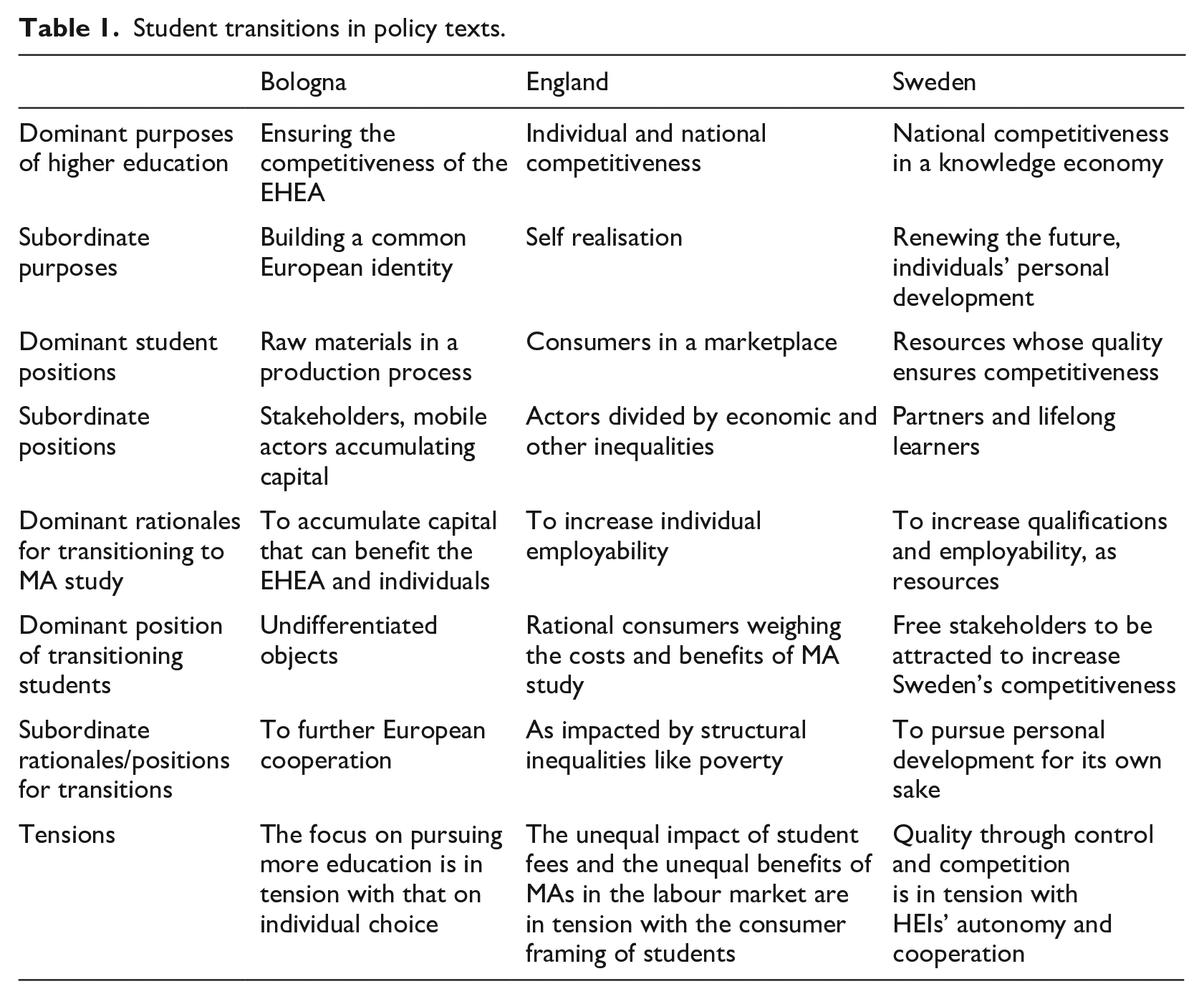
Across the policy texts, economic competitiveness is the overriding theme in the construction of the purpose of HE and employability is primary when it comes to goals for student development. This individualistic focus on employability defines students’ transitions from undergraduate to postgraduate degrees. Attracting quality students and generating quality postgraduates are central, with university education positioned as a production process in which transitions are a matter of rational economic choice in a competitive marketplace. Table 1 below summarises the ways these feature across the three sets of policy texts and shows how our understanding of transitioning students is enhanced by looking at them in the context of a broader framework of the rationales for universities.
Student transitions in policy texts.
Our research supports other studies that evidence how socio-political contexts impact the implementation of European processes (Brooks, 2019). It also shows the growing dominance of neoliberalism, ‘the disenchantment of politics by economics’ (Davies, 2014: xiv), in which students can be viewed as raw materials in a production process or consumers in a market, not citizens nor human beings. Of course, HEIs have some choice in how they enact these macro-level policies and students vary in the extent to which they take up, negotiate and resist policy discourses (Brooks, 2018; Jayadeva et al., 2020). We do not naively think that policies determine identities. However, ‘because policy documents are typically written by those occupying powerful positions in society, the language they use and the constructions they advance are likely to become part of entrenched, dominant discourses’ (Brooks, 2019: 16). We end by asking what these policies mean for students and academics.
As we have shown, despite local differences and histories, HE is overwhelmingly constructed on economic grounds around competition. Even the Swedish document that presents concerns is a reaction to this established ‘commonsense’. The identification of the global system as a knowledge economy positions HE as central to national economic competitiveness. Students are positioned within this as both products and consumers. In their transition from Bachelor to Masters, they are expected to maximise their employability, and their ability to contribute to the national and global economy. Such marketisation, while enacted under a rhetoric of freedom ‘does not diminish the state’s power but diffuses it – changing the nature of that power to harness the potential of society’s more hidden, diffuse, and entrenched power relationships’, eliminating ‘all possibilities of alternative ways of living’ and creating ‘an enclosure of thought’ (Lawson, 2018: 131).
However, there are also differences between the documents, with more social democratic, technocratic or marketised forms, suggesting it is better to talk about neoliberalisms than neoliberalism. For example, the Bologna implementation reports talk about the need to create a common European identity and project via mobility which is in tension and needs balancing with national competitiveness and identity. This common identity, as Fejes (2008) argues, creates inclusion, but also exclusion and otherness which are not acknowledged by policy documents Yet, the recent Swedish document argues that competition can be problematic because it fosters homogeneity rather than diversity. Such homogeneity is achieved through regulatory mechanisms and diversity is thus eradicated. Student transitions are a matter of economic calculation within a set of predefined values. There is also a tension implicit in mentions of the economic crisis in the England and EHEA documents as they advocate for employability and individual social mobility as a way of addressing structural inequalities.
Even if the transition from Bachelor to Masters represents a decision point, it is part of a larger education system that habituates students to ‘corrosive passivity’ (Bonnett, 2013: 195). University education serves the purpose of state-building and nationalist projects, universities are governed on the basis of quantified and categorised descriptions of the present, which pervert universities’ potential to safeguard the future (Facer, 2018). Universities are being undermined epistemologically and socially, as they have ‘been incorporated into the state and into the global cognitive economy’ (Barnett, 2018). Students are regulated to behave as appropriate consumers to become high-quality products and goods that institutions and employers choose and compete for in order to maintain their competitiveness.
An alternative vision for the purpose of higher education is for it to become an experimental and political space in which fundamentally different, sustainable, societies can be imagined (Holfelder, 2019; Osberg, 2010). For this to happen, HE needs to be freed from neoliberal market agendas (Amsler and Facer, 2017). Fisher (2009: 80) evocatively labelled the sense that there is no alternative as ‘capitalist realism’. Capitalism realism’s ‘oppressive pervasiveness’ is such ‘that even glimmers of alternative political and economic possibilities can have a disproportionately great effect. The tiniest event can tear a hole in the grey curtain of reaction which has marked the horizons of possibility under capitalist realism. From a situation in which nothing can happen, suddenly anything is possible again’.
Footnotes
Declaration of conflicting interests
The author(s) declared no potential conflicts of interest with respect to the research, authorship, and/or publication of this article.
Funding
The author(s) disclosed receipt of the following financial support for the research, authorship, and/or publication of this article: This work was partially supported by the Independent Research Fund Denmark under Grant DFF − 7013-00104.
Notes
Author biographies
Heather Mendick works in London as an independent research consultant, focusing on education and social justice. Heather’s publications include the book Masculinities in Mathematics, and the co-authored books Urban Youth and Schooling and Celebrity, Aspiration and Contemporary Youth Education and Inequality in an Era of Austerity. She tweets from  .
.
Anne-Kathrin Peters is an Associate Professor at KTH in Sweden, working with education and sustainability, focusing on social justice. She is especially interested in the role of education and research for change. Most of her work has been on norms, values, and identities in computing education. She tweets from .